
Nano Letters
DOI: 10.1021/nl503179j
Author(s): Abraham Vázquez-Guardado, Alireza Safaei, Sushrut Modak, Daniel Franklin, and Debashis Chanda
The interactions between plasmonic and photonic modes of a cavity-coupled plasmonic crystal are studied in diffraction and diffractionless regimes, which lead us to the understanding of coherent interactions between electron plasma, higher order cavity, and diffraction modes. The strong interaction …
[Phys. Rev. Lett. 113, 263902] Published Mon Dec 29, 2014
Author(s): Hamidreza Ramezani, Hao-Kun Li, Yuan Wang, and Xiang Zhang
We propose a class of spectral singularities emerging from the coincidence of two independent singularities with highly directional responses. These spectral singularities result from resonance trapping induced by the interplay between parity-time symmetry and Fano resonances. At these singularities…
[Phys. Rev. Lett. 113, 263905] Published Tue Dec 30, 2014
Author(s): Jason A. Newman and Kevin J. Webb
Coherent imaging and communication through or within heavily scattering random media has been considered impossible due to the randomization of the information contained in the scattered electromagnetic field. We report a remarkable result based on speckle correlations over incident field position t…
[Phys. Rev. Lett. 113, 263903] Published Tue Dec 30, 2014

Author(s): Lachlan J. Rogers, Kay D. Jahnke, Mathias H. Metsch, Alp Sipahigil, Jan M. Binder, Tokuyuki Teraji, Hitoshi Sumiya, Junichi Isoya, Mikhail D. Lukin, Philip Hemmer, and Fedor Jelezko

 The spin on a silicon defect in diamond can be prepared in a coherent quantum state, a promising sign that it could encode information in a quantum internet.
[Phys. Rev. Lett. 113, 263602] Published Mon Dec 22, 2014
Author(s): Benjamin Pingault, Jonas N. Becker, Carsten H. H. Schulte, Carsten Arend, Christian Hepp, Tillmann Godde, Alexander I. Tartakovskii, Matthew Markham, Christoph Becher, and Mete Atatüre
The spin on a silicon defect in diamond can be prepared in a coherent quantum state, a promising sign that it could encode information in a quantum internet.
[Phys. Rev. Lett. 113, 263601] Published Mon Dec 22, 2014
Article
Various vertical surface emitting, terahertz quantum-cascade lasers have been proposed recently but these suffer from power cancellations in the far-field and limited extraction efficiencies. Here, Vitiello et al. circumvent these issues using two-dimensional photonic quasi-crystalline resonators.
Nature Communications doi: 10.1038/ncomms6884
Authors: Miriam Serena Vitiello, Michele Nobile, Alberto Ronzani, Alessandro Tredicucci, Fabrizio Castellano, Valerio Talora, Lianhe Li, Edmund H. Linfield, A. Giles Davies
We theoretically demonstrate that increase of absorption with constant gain in laser systems can lead to onset of laser generation. This counter-intuitive absorption induced lasing (AIL) is explained by emergence of additional lasing modes created by an introduction of an absorbing medium with narrow linewidth. We show that this effect is universal and can be encountered in simple Fabry-Perot-like systems and doped spherical dielectric nanoresonators. The predicted behavior is robust against frequency detuning between the gain and absorbing medium.
Author(s): Alexandre Laurain, Maik Scheller, and Pavel Polynkin
A scheme using two pump wavelengths in the infrared and ultraviolet produces more efficient laserlike emission in air, which could benefit remote sensing applications.
[Phys. Rev. Lett. 113, 253901] Published Wed Dec 17, 2014
A little while ago, Nikon released a new line of CMOS cameras, based on the sensors used in their digital cameras. I hadn’t looked closely at them until now, and it turns out they are quite impressive. There is both a color version (the DS-Ri2) and a monochrome version (the DS-Qi2). Both are based on a 16 megapixel sensor with 7.3 μm pixels. The DS-Qi2 sports a 77% peak QE and 2.2 electrons of read noise. The only apparent drawback to them is the relatively low speed of 6 fps at full frame. For many applications, though, that won’t be a problem and I’m eager to get my hands on one to give it a try.
One interesting thing is that the sensor is very large (36mm x 24 mm). It’s so large that the camera comes with an F-mount, and in fact, the sensor is larger than the field number of the microscope. I suspect if you used it with a 1x coupler that you would see noticeable vignetting. Nikon mentioned that they have 2.5x couplers for these lenses, and I think something like that is the way to go. If you used a 2x coupler, you would be very close to Nyquist sampling for a 10x / 0.45 NA objective and could bin 2×2 for imaging with a 100x / 1.4 NA objective.
All in all, it looks pretty exciting, and it’s nice to see another option for cameras out there.
Plasmonics aims to interface photonics and electronics. Finding optical, near-field analogues of much used electro-technical components is crucial to the success of such a platform. Here we present the plasmonic analogue of a non-reciprocal antenna. For non-reciprocality in a plasmonic context, the optical excitation and emission resonances of the antenna need to be an orthogonal set. We show that nonlinear excitation of metal nanoantennas creates a sufficient shift between excitation and emission wavelengths that they can be interpreted as decoupled, allowing for independent tuning of excitation and emission properties along different spatial dimensions. This leads, for given excitation wavelength and polarization, to independent optimization of emission intensity, frequency spectrum, polarization and angular spectrum. Non-reciprocal optical antennas of both gold and aluminum are characterized and shown to be useful as e.g. nonlinear signal transducers or nanoscale sources of widely tunable light.

Author(s): K. G. Makris, L. Ge, and H. E. Türeci
For wave propagation in a lossy optical medium, the total optical power is commonly expected to decay with propagation distance. Using methods of non-normal operator theory, researchers challenge this notion and show that overall lossy optical materials with a small amount of distributed gain can amplify certain input signals by orders of magnitude.

[Phys. Rev. X 4, 041044] Published Mon Dec 15, 2014


We present an approach for the description of fluorescence from optically active material embedded in layered periodic structures. Based on an exact electromagnetic Green's tensor analysis, we determine the radiative properties of emitters such as the local photonic density of states, Lamb shifts, line widths etc. for a finite or infinite sequence of thin alternating plasmonic and dielectric layers. In the effective medium limit, these systems may exhibit hyperbolic dispersion relations so that the large wave-vector characteristics of all constituents and processes become relevant. These include the finite thickness of the layers, the nonlocal properties of the constituent metals, and local-field corrections associated with an emitter's dielectric environment. In particular, we show that the corresponding effects are non-additive and lead to considerable modifications of an emitter's luminescence properties.
A new study indicates that lots of bits of old studies turn up, verbatim, in lots of newer scientific studies. The new study (which I have not checked to see whether it contains uncredited copied text) is:
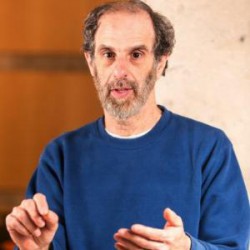
“Patterns of text reuse in a scientific corpus,” Daniel T. Citron and Paul Ginsparg [pictured here], Proceedings of the National Academy of Sciences, epub December 8, 2014. The authors at Cornell University, report:
“We consider the incidence of text ‘reuse’ by researchers via a systematic pairwise comparison of the text content of all articles deposited to arXiv.org from 1991 to 2012. We measure the global frequencies of three classes of text reuse and measure how chronic text reuse is distributed among authors in the dataset. We infer a baseline for accepted practice, perhaps surprisingly permissive compared with other societal contexts, and a clearly delineated set of aberrant authors. We find a negative correlation between the amount of reused text in an article and its influence, as measured by subsequent citations.”
Co-author Ginsparg is the creator of arXiv.
John Bohannon gives further details and comment, in Science magazine.
(Thanks to investigator Scott Langill for bringing this to our attention.)
Riccardo SapienzaI should use this excuse...
Richard Feynman told stories that got people thinking. This passage from a talk Feynman gave at a meeting of the National Science Teachers Association in 1966 in New York City, was later printed — as part of a transcript of the entire talk — in The Physics Teacher, vol. 7, issue 6, 1969, pp. 313-320.
The next day, Monday, we were playing in the fields and this boy said to me, “See that bird standing on the stump there? What’s the name of it?”
I said, “I haven’t got the slightest idea.”
He said, “It’s a brown-throated thrush. Your father doesn’t teach you much about science.”
I smiled to myself, because my father had already taught me that [the name] doesn’t tell me anything about the bird. He taught me “See that bird? It’s a brown-throated thrush, but in Germany it’s called a halsenflugel, and in Chinese they call it a chung ling and even if you know all those names for it, you still know nothing about the bird–you only know something about people; what they call that bird. Now that thrush sings, and teaches its young to fly, and flies so many miles away during the summer across the country, and nobody knows how it finds its way,” and so forth. There is a difference between the name of the thing and what goes on.
The result of this is that I cannot remember anybody’s name, and when people discuss physics with me they often are exasperated when they say “the Fitz-Cronin effect,” and I ask “What is the effect?” and I can’t remember the name.
I would like to say a word or two — may I interrupt my little tale — about words and definitions, because it is necessary to learn the words.
It is not science. That doesn’t mean, just because it is not science, that we don’t have to teach the words. We are not talking about what to teach; we are talking about what science is. It is not science to know how to change Centigrade to Fahrenheit. It’s necessary, but it is not exactly science. In the same sense, if you were discussing what art is, you wouldn’t say art is the knowledge of the fact that a 3-B pencil is softer than a 2-H pencil. It’s a distinct difference. That doesn’t mean an art teacher shouldn’t teach that, or that an artist gets along very well if he doesn’t know that. (Actually, you can find out in a minute by trying it; but that’s a scientific way that art teachers may not think of explaining.) …
An array of nanometer-sized aluminum pyramids acts as a directional antenna for light, and the direction depends on wavelength.
Assess the real cost of research assessment
Nature 516, 7530 (2014). http://www.nature.com/doifinder/10.1038/516145a
Author: Peter M. Atkinson
The Research Excellence Framework keeps UK science sharp, but the process is overly burdensome for institutions, says Peter M. Atkinson.
Optical microscopy is one of the oldest scientific instruments that is still used in forefront research. Ernst Abbe's nineteenth century formulation of the resolution limit in microscopy let generations of scientists believe that optical studies of individual molecules and resolving sub-wavelength structures were not feasible. The Nobel Prize in 2014 for super-resolution fluorescence microscopy marks a clear recognition that the old beliefs have to be revisited. In this article, we present a critical overview of various recent developments in optical microscopy. In addition to the popular super-resolution fluorescence methods, we discuss the prospects of various other techniques and imaging contrasts and consider some of the fundamental and practical challenges that lie ahead.

A laser-driven particle accelerator, delivering a beam of electrons with a record-breaking energy of 4.2 giga-electron-volts, could lead to compact x-ray lasers or high-energy colliders.
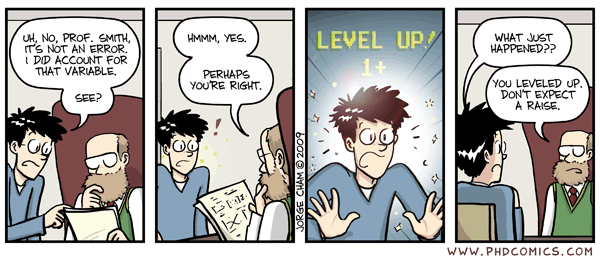
| Piled Higher & Deeper by Jorge Cham |
www.phdcomics.com
|
|
 |
||
|
title:
"Level Up." - originally published
12/8/2014
For the latest news in PHD Comics, CLICK HERE! |
||
We report on experiments with deformed polymer microlasers that have a low refractive index and exhibit unidirectional light emission. We demonstrate that the highly directional emission is due to transport of light rays along the unstable manifold of the chaotic saddle in phase space. Experiments, ray-tracing simulations, and mode calculations show very good agreement.
Physics: Quantum computer quest
Nature 516, 7529 (2014). http://www.nature.com/doifinder/10.1038/516024a
Author: Elizabeth Gibney
After a 30-year struggle to harness quantum weirdness for computing, physicists finally have their goal in reach.
Single-shot compressed ultrafast photography at one hundred billion frames per second
Nature 516, 7529 (2014). doi:10.1038/nature14005
Authors: Liang Gao, Jinyang Liang, Chiye Li & Lihong V. Wang
The capture of transient scenes at high imaging speed has been long sought by photographers, with early examples being the well known recording in 1878 of a horse in motion and the 1887 photograph of a supersonic bullet. However, not until the late twentieth century were breakthroughs achieved in demonstrating ultrahigh-speed imaging (more than 105 frames per second). In particular, the introduction of electronic imaging sensors based on the charge-coupled device (CCD) or complementary metal–oxide–semiconductor (CMOS) technology revolutionized high-speed photography, enabling acquisition rates of up to 107 frames per second. Despite these sensors’ widespread impact, further increasing frame rates using CCD or CMOS technology is fundamentally limited by their on-chip storage and electronic readout speed. Here we demonstrate a two-dimensional dynamic imaging technique, compressed ultrafast photography (CUP), which can capture non-repetitive time-evolving events at up to 1011 frames per second. Compared with existing ultrafast imaging techniques, CUP has the prominent advantage of measuring an x–y–t (x, y, spatial coordinates; t, time) scene with a single camera snapshot, thereby allowing observation of transient events with temporal resolution as tens of picoseconds. Furthermore, akin to traditional photography, CUP is receive-only, and so does not need the specialized active illumination required by other single-shot ultrafast imagers. As a result, CUP can image a variety of luminescent—such as fluorescent or bioluminescent—objects. Using CUP, we visualize four fundamental physical phenomena with single laser shots only: laser pulse reflection and refraction, photon racing in two media, and faster-than-light propagation of non-information (that is, motion that appears faster than the speed of light but cannot convey information). Given CUP’s capability, we expect it to find widespread applications in both fundamental and applied sciences, including biomedical research.