Author(s): Frans Pretorius
The gravitational-wave signal observed by the LIGO detectors shows no deviation from what general relativity predicts.
[Physics 9, 52] Published Tue May 31, 2016
Author(s): Frans Pretorius
The gravitational-wave signal observed by the LIGO detectors shows no deviation from what general relativity predicts.
[Physics 9, 52] Published Tue May 31, 2016
Review
Recent work has shown that quantum mechanical effects in plasmonic nanogap structures become important as the gap distances approach the subnanometre length-scale. Here, the authors review the major findings which challenge the classical picture of these structures and discuss future directions for the field.
Nature Communications doi: 10.1038/ncomms11495
Authors: Wenqi Zhu, Ruben Esteban, Andrei G. Borisov, Jeremy J. Baumberg, Peter Nordlander, Henri J. Lezec, Javier Aizpurua, Kenneth B. Crozier


Author(s): Lutz Langguth, Romain Fleury, Andrea Alù, and A. Femius Koenderink
A reflective surface can distort the acoustics of a sounded gong, an effect that might be used to demonstrate cavity quantum electrodynamics in the classroom.

[Phys. Rev. Lett. 116, 224301] Published Thu Jun 02, 2016

Nature Photonics 10, 361 (2016). doi:10.1038/nphoton.2016.97
Authors: Tianyu Liu & Yat Li
The sustainability of many existing desalination technologies is questionable. Plasmon-mediated solar desalination has now been demonstrated for the first time, using an aluminium structure that absorbs photons spanning the 200 nm to 2,500 nm wavelength range, and is both cheap and 'clean'.
Riccardo Sapienzanow the next step is to have 10^6 ions...
Author(s): Stephen Begley, Markus Vogt, Gurpreet Kaur Gulati, Hiroki Takahashi, and Matthias Keller
Five trapped ions have been coupled to a high finesse optical cavity in a fully deterministic way.

[Phys. Rev. Lett. 116, 223001] Published Tue May 31, 2016
Author(s): Robert Keil, Charles Poli, Matthias Heinrich, Jake Arkinstall, Gregor Weihs, Henning Schomerus, and Alexander Szameit
We present a method of locally inverting the sign of the coupling term in tight-binding systems, by means of inserting a judiciously designed ancillary site and eigenmode matching of the resulting vertex triplet. Our technique can be universally applied to all lattice configurations, as long as the …
[Phys. Rev. Lett. 116, 213901] Published Fri May 27, 2016
Author(s): Matthieu Davy, Julien de Rosny, and Philippe Besnier
The cross-correlation of a diffuse wave field converges toward the difference between the anticausal and causal Green’s functions between two points. This property has paved the way to passive imaging using ambient noise sources. In this Letter, we investigate Green’s function retrieval in electroma…
[Phys. Rev. Lett. 116, 213902] Published Fri May 27, 2016
Author(s): Cristian Della Giovampaola and Nader Engheta
Some of the plasmonic phenomena can be imitated by exploiting the structural dispersion of parallel-plate waveguides filled with positive dielectrics. This synthetic platform, as a test bed for exploring plasmonic features, is more suitable for longer-wavelength regimes and may exhibit lower loss, since positive dielectric materials are utilized.

[Phys. Rev. B 93, 195152] Published Tue May 24, 2016
Author(s): I. S. Burmistrov, I. V. Gornyi, and A. D. Mirlin
Disordered superconductors show remarkable physics governed by the interplay of superconductivity and Anderson localization. The competition between these phenomena leads to a quantum phase transition: the superconductor-insulator transition (SIT). In this paper, the authors develop a theory of local density of states (LDOS) – including its average and mesoscopic fluctuations – as measured in tunneling experiments near the SIT. They use the nonlinear sigma-model renormalization-group framework (“fermionic approach”) and treat systems with short-range and Coulomb interactions on equal footing. The average LDOS obtained shows a pronounced depletion around the Fermi energy, both in the metallic phase (i.e., above the superconducting critical temperature) and in the insulating phase near the SIT. The LDOS fluctuations are found to be particularly strong for the case of short-range interactions. The findings compare well with experimental observations of depletion of LDOS and of its large point-to-point fluctuations in the metallic and insulating phases near the SIT in TiN, InO, and NbN films. The observed effects are thus intrinsic properties of a macroscopically homogeneous system and do not require any additional assumptions, such as granularity.

[Phys. Rev. B 93, 205432] Published Fri May 20, 2016
The magneto-optical activity, namely the polarization conversion capabilities of high-index, non-absorbing, core-shell dielectric nanospheres is theoretically analyzed. We show that, in analogy with their plasmonic counterparts, the polarization conversion in resonant dielectric particles is linked to the amount of electromagnetic field probing the magneto-optical material in the system. However, in strong contrast with plasmon nanoparticles, due to the peculiar distribution of the internal fields in resonant dielectric spheres, the magneto-optical response is fully governed by the magnetic (dipolar and quadrupolar) resonances with little effect of the electric ones.
Author(s): Satoshi Sunada, Susumu Shinohara, Takehiro Fukushima, and Takahisa Harayama
Single wavelength spectra are demonstrated for 2D micro-cavity lasers with fully chaotic cavities.

[Phys. Rev. Lett. 116, 203903] Published Fri May 20, 2016
The de Broglie relation is revisited in connection with an ab initio relativistic description of particles and waves, which is the same treatment that historically led to this famous relation. In the same context of the Minkowski four-vector formalism, we also discuss the phase and the group velocity of a matter wave, explicitly showing that both transform as ordinary velocities under a Lorentz transformation. We show that such a transformation rule is a necessary condition for the covariance of the de Broglie relation, and stress the pedagogical value of the Einstein-Minkowski-Lorentz relativistic context in the presentation of the de Broglie relation.
The pressure to publish pushes down quality
Nature 533, 7602 (2016). http://www.nature.com/doifinder/10.1038/533147a
Author: Daniel Sarewitz
Scientists must publish less, says Daniel Sarewitz, or good research will be swamped by the ever-increasing volume of poor work.
Row over proposed Italian biomedical centre intensifies
Nature 533, 7602 (2016). http://www.nature.com/doifinder/10.1038/533158a
Author: Alison Abbott
Document submitted to the Italian Senate criticizes institute that will oversee a €1.5-billion project.
Celestial mechanics: Fresh solutions to the four-body problem
Nature 533, 7602 (2016). doi:10.1038/nature17896
Authors: Douglas P. Hamilton
Describing the motion of three or more bodies under the influence of gravity is one of the toughest problems in astronomy. The report of solutions to a large subclass of the four-body problem is truly remarkable.
Author(s): L. A. Cobus, S. E. Skipetrov, A. Aubry, B. A. van Tiggelen, A. Derode, and J. H. Page
We use dynamic coherent backscattering to study one of the Anderson mobility gaps in the vibrational spectrum of strongly disordered three-dimensional mesoglasses. Comparison of experimental results with the self-consistent theory of localization allows us to estimate the localization (correlation) …
[Phys. Rev. Lett. 116, 193901] Published Fri May 13, 2016
Strong interaction between light and a single quantum emitter is essential to a great number of applications, including single photon sources. Microcavities and plasmonic antennas have been used frequently to enhance these interactions through the Purcell effect. Both can provide large emission enhancements: the cavity typically through long photon lifetimes (high $Q$), and the antenna mostly through strong field enhancement (low mode volume $V$). In this work, we demonstrate that a hybrid system, which combines a cavity and a dipolar antenna, can achieve stronger emission enhancements than the cavity or antenna alone. We show that such systems can be used as a versatile platform to tune the bandwidth of enhancement to any desired value, while simultaneously boosting emission enhancement. Our fully consistent analytical model allows to identify the underlying mechanisms of boosted emission enhancement in hybrid systems, which include radiation damping and constructive interference between multiple-scattering paths. Additionally, we find excellent agreement between strongly boosted enhancement spectra from our analytical model and from finite-element simulations on a realistic cavity-antenna system. Finally, we demonstrate that hybrid systems can simultaneously boost emission enhancement and maintain a near-unity outcoupling efficiency into a single cavity decay channel, such as a waveguide.

Substituting noble metals for high-index dielectrics has recently been proposed as an alternative strategy in nanophotonics to design broadband optical resonators and circumvent the ohmic losses of plasmonic materials. In this report, we demonstrate that subwavelength silicon nanoantennas can manipulate the photon emission dynamics of fluorescent molecules. In practice, it is showed that dielectric nanoantennas can both increase and decrease the local density of optical states (LDOS) at room temperature, a process that is inaccessible with noble metals at the nanoscale. Using scanning probe microscopy, we analyze quantitatively, in three dimensions, the near-field interaction between a 100 nm fluorescent nanosphere and silicon nanoantennas with diameters ranging between 170 nm and 250 nm. Associated to numerical simulations, these measurements indicate increased or decreased total spontaneous decay rates by up to 15 % and a gain in the collection efficiency of emitted photons by up to 85 %. Our study demonstrates the potential of silicon-based nanoantennas for the low-loss manipulation of solid-state emitters at the nanoscale and at room temperature.
Author(s): Paraj Titum, Erez Berg, Mark S. Rudner, Gil Refael, and Netanel H. Lindner
Researchers discover a unique topological phase present in a periodically driven, two-dimensional system: All of its bulk Floquet states are localized by disorder while its edges support propagating chiral modes.

[Phys. Rev. X 6, 021013] Published Fri May 06, 2016
A material with fractal geometry can focus microwaves onto a spot 15 times smaller than their wavelength.
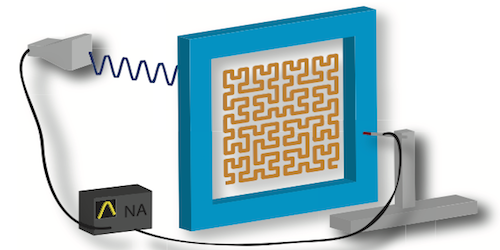
[Physics] Published Thu May 05, 2016
Machine-learning-assisted materials discovery using failed experiments
Nature 533, 7601 (2016). doi:10.1038/nature17439
Authors: Paul Raccuglia, Katherine C. Elbert, Philip D. F. Adler, Casey Falk, Malia B. Wenny, Aurelio Mollo, Matthias Zeller, Sorelle A. Friedler, Joshua Schrier & Alexander J. Norquist
Inorganic–organic hybrid materials such as organically templated metal oxides, metal–organic frameworks (MOFs) and organohalide perovskites have been studied for decades, and hydrothermal and (non-aqueous) solvothermal syntheses have produced thousands of new materials that collectively contain nearly all the metals in the periodic table. Nevertheless, the formation of these compounds is not fully understood, and development of new compounds relies primarily on exploratory syntheses. Simulation- and data-driven approaches (promoted by efforts such as the Materials Genome Initiative) provide an alternative to experimental trial-and-error. Three major strategies are: simulation-based predictions of physical properties (for example, charge mobility, photovoltaic properties, gas adsorption capacity or lithium-ion intercalation) to identify promising target candidates for synthetic efforts; determination of the structure–property relationship from large bodies of experimental data, enabled by integration with high-throughput synthesis and measurement tools; and clustering on the basis of similar crystallographic structure (for example, zeolite structure classification or gas adsorption properties). Here we demonstrate an alternative approach that uses machine-learning algorithms trained on reaction data to predict reaction outcomes for the crystallization of templated vanadium selenites. We used information on ‘dark’ reactions—failed or unsuccessful hydrothermal syntheses—collected from archived laboratory notebooks from our laboratory, and added physicochemical property descriptions to the raw notebook information using cheminformatics techniques. We used the resulting data to train a machine-learning model to predict reaction success. When carrying out hydrothermal synthesis experiments using previously untested, commercially available organic building blocks, our machine-learning model outperformed traditional human strategies, and successfully predicted conditions for new organically templated inorganic product formation with a success rate of 89 per cent. Inverting the machine-learning model reveals new hypotheses regarding the conditions for successful product formation.