Shared posts

08 Sep 14:09

Photon Molecules in Atomic Gases Trapped Near Photonic Crystal Waveguides

by James S. Douglas, Tommaso Caneva, and Darrick E. Chang

Author(s): James S. Douglas, Tommaso Caneva, and Darrick E. Chang

Pulses of light are made up of quantum particles called photons. A novel way of making individual photons interact could pave the way toward generating photonic “molecules” and even more complex states of light.


[Phys. Rev. X 6, 031017] Published Thu Aug 04, 2016

19 Aug 10:44

All-Dielectric Colored Metasurfaces with Silicon Mie Resonators

by Julien Proust, Frédéric Bedu, Bruno Gallas, Igor Ozerov and Nicolas Bonod

TOC Graphic

ACS Nano
DOI: 10.1021/acsnano.6b03207
17 Aug 19:16

Tunability of the dielectric function of heavily doped germanium thin films for mid-infrared plasmonics

by Jacopo Frigerio, Andrea Ballabio, Giovanni Isella, Emilie Sakat, Giovanni Pellegrini, Paolo Biagioni, Monica Bollani, Enrico Napolitani, Costanza Manganelli, Michele Virgilio, Alexander Grupp, Marco P. Fischer, Daniele Brida, Kevin Gallacher, Douglas J. Paul, Leonetta Baldassarre, Paolo Calvani, Valeria Giliberti, Alessandro Nucara, and Michele Ortolani

Author(s): Jacopo Frigerio, Andrea Ballabio, Giovanni Isella, Emilie Sakat, Giovanni Pellegrini, Paolo Biagioni, Monica Bollani, Enrico Napolitani, Costanza Manganelli, Michele Virgilio, Alexander Grupp, Marco P. Fischer, Daniele Brida, Kevin Gallacher, Douglas J. Paul, Leonetta Baldassarre, Paolo Calvani, Valeria Giliberti, Alessandro Nucara, and Michele Ortolani

Mid-infrared plasmonics has the potential to revolutionize molecular sensing technology, if integrated into optoelectronic chips. Recently,several groups working on plasmonics have substituted metals with heavily doped semiconductors for the sake of integration, also opening up the possibility of tuning the device response via the doping level. In this work, the authors analyze the relevant case of heavily doped Ge films by combining transport measurements with infrared spectroscopy. They demonstrate a broad tunability of the screened plasma frequency up to the mid-infrared range. The main loss channels are identified through comparison of the experimental scattering rates with quantum calculations and pump-probe measurements. Heavily doped Ge is highlighted as a viable route for the integration of mid-infrared plasmonics into silicon optoelectronic platforms.


[Phys. Rev. B 94, 085202] Published Mon Aug 15, 2016

16 Aug 21:02

demoing the Photometrics Prime 95B back-thinned CMOS

by sam

(See my second post on this camera here.)

Photometrics has released the Prime 95B, the first scientific CMOS camera with a back-thinned sensor. This means that the sensor is significantly more sensitive than the front-illuminated versions of other CMOS scientific cameras. So the Prime 95B has a 95% quantum efficiency, whereas other scientific CMOS cameras have 60-70% QE; the newest version of competing CMOS cameras tout 80%+ QE. Back-thinning really helped CCD technology (EMCCDs are back-thinned, for example), but back-thinning CMOS sensors has been more challenging, for some technical reasons that I don’t know.

I demoed the Prime 95B when it was in the Nikon Imaging Center (Kurt wrote up details here). The CMOS camera was installed on a spinning disk confocal along with a 1024×1024 pixel EMCCD. The Prime 95B has 11 um pixels, slightly smaller than the 13 um of the EMCCD’s pixels; this results in a higher spatial sampling rate and thus lower sensitivity for the CMOS, because the photons are spread across more pixels. This can be simply corrected by using a different lens, but we didn’t do that here. So it provided an unlevel playing field, favoring the EMCCD.

emccd vs prime bead

Despite that, the Prime 95B matched or outperformed the EMCCD in all the tests we did. The above image compares the EMCCD (left) with the Prime 95B (right) imaging a 100 nm Tetraspeck bead. Below, I compare them imaging a fixed test sample at very low light levels.

emccd prime

The comparisons I made were mainly qualitative. By eye, I was not able to find conditions were the EMCCD outperformed the Prime 95B. That’s saying a lot, especially because the Prime 95B costs approximately half as much! For single-molecule imaging, the EMCCD might still be the king (see Kurt’s curve), but I didn’t have time to perform those detailed or quantitative tests. But for all other imaging and spinning disk confocal, I’d rather have the Prime 95B. No more deciding the optimal EM gain settings and the large dynamic range of the CMOS make it a real winner!

15 Aug 12:35

Engineering the Light-Transport Mean Free Path in Silica Photonic Glasses

by Espinha, Andre; Ibisate, Marta; Blanco, Alvaro; et al.
Title: Engineering the Light-Transport Mean Free Path in Silica Photonic Glasses
Author(s): Espinha, Andre; Ibisate, Marta; Blanco, Alvaro; et al.
Source: PARTICLE & PARTICLE SYSTEMS CHARACTERIZATION, 33 (7): 352-357 JUL 2016
Document Type: Article
11 Aug 19:53

Detailed Observation of Multiphoton Emission Enhancement from a Single Colloidal Quantum Dot Using a Silver-Coated AFM Tip

by Hiroki Takata, Hiroyuki Naiki, Li Wang, Hideki Fujiwara, Keiji Sasaki, Naoto Tamai and Sadahiro Masuo

TOC Graphic

Nano Letters
DOI: 10.1021/acs.nanolett.6b02479
03 Aug 20:30

IBM creates world’s first artificial phase-change neurons

by Sebastian Anthony

(credit: IBM)

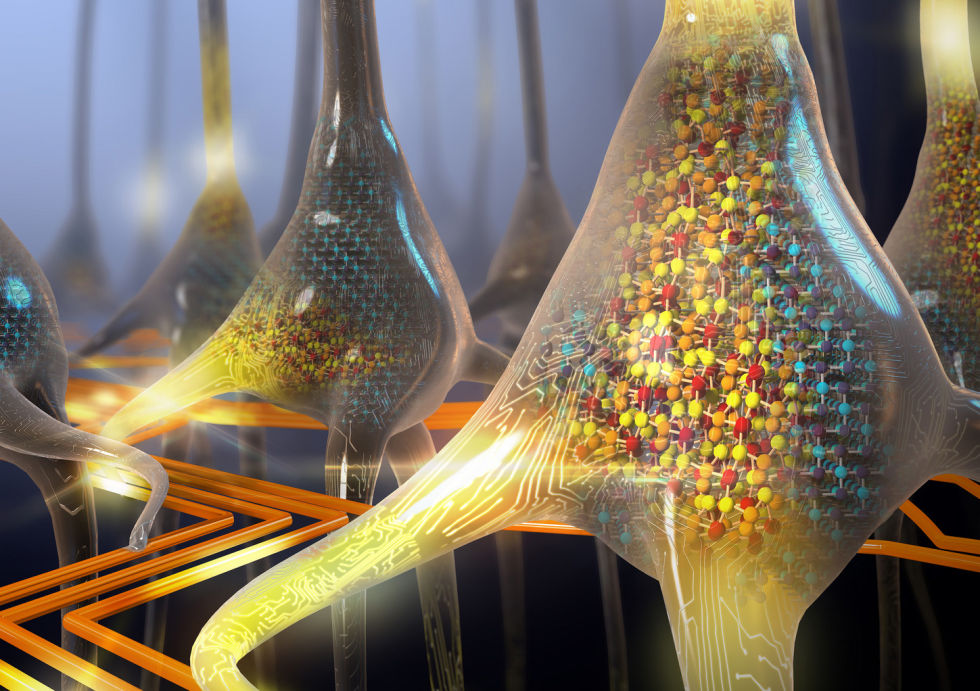
IBM Research in Zurich has created the world's first artificial nanoscale stochastic phase-change neurons. IBM has already created a population of 500 of these artificial neurons and used them to process a signal in a brain-like (neuromorphic) way.

This breakthrough is particularly notable because the phase-change neurons are fashioned out of well-understood materials that can scale down to a few nanometres, and because they are capable of firing at high speed but with low energy requirements. They are also stochastic—i.e. they always produce slightly different, random results, like biological neurons—which is very important as well.

Enough fluff—let's talk about how these phase-change neurons are actually constructed. At this point, it might help if you look at the first diagram in the gallery.

Read 11 remaining paragraphs | Comments

03 Aug 20:30

The future of science arXiving

by Iulia Georgescu

Nature Physics 12, 722 (2016). doi:10.1038/nphys3849

Author: Iulia Georgescu

Paul Ginsparg shares his thoughts about the future of the preprint server he created 25 years ago.

01 Aug 22:16

Lorentz Nonreciprocal Model for Hybrid Magnetoplasmonics

by Dominik Floess, Thomas Weiss, Sergei Tikhodeev, and Harald Giessen

Author(s): Dominik Floess, Thomas Weiss, Sergei Tikhodeev, and Harald Giessen

Using localized surface plasmons, the magneto-optical response of dielectric thin films can be resonantly amplified and spectrally tailored. While the experimental realization and numerical simulation of such systems received considerable attention, so far, there is no analytical theoretical descrip…


[Phys. Rev. Lett. 117, 063901] Published Mon Aug 01, 2016

30 Jul 09:33

Hot Electron Generation and Cathodoluminescence Nanoscopy of Chiral Split Ring Resonators

by Yurui Fang, Ruggero Verre, Lei Shao, Peter Nordlander and Mikael Käll

TOC Graphic

Nano Letters
DOI: 10.1021/acs.nanolett.6b02154
30 Jul 09:31

Objects of Maximum Electromagnetic Chirality

by Ivan Fernandez-Corbaton, Martin Fruhnert, and Carsten Rockstuhl

Author(s): Ivan Fernandez-Corbaton, Martin Fruhnert, and Carsten Rockstuhl

A chiral object cannot be superimposed onto its mirror image—a geometric definition of chirality. A new theoretical study introduces a definition of electromagnetic chirality.


[Phys. Rev. X 6, 031013] Published Thu Jul 28, 2016

27 Jul 08:41

Spatiotemporal Control of Light Transmission through a Multimode Fiber with Strong Mode Coupling

by Wen Xiong, Philipp Ambichl, Yaron Bromberg, Brandon Redding, Stefan Rotter, and Hui Cao

Author(s): Wen Xiong, Philipp Ambichl, Yaron Bromberg, Brandon Redding, Stefan Rotter, and Hui Cao

We experimentally generate and characterize eigenstates of the Wigner-Smith time-delay matrix, called principal modes, in a multimode fiber with strong mode coupling. The unique spectral and temporal properties of principal modes enable global control of temporal dynamics of optical pulses transmitt…


[Phys. Rev. Lett. 117, 053901] Published Mon Jul 25, 2016

26 Jul 22:19

The Interplay of Symmetry and Scattering Phase in Second Harmonic Generation from Gold Nanoantennas

by Sylvain D. Gennaro, Mohsen Rahmani, Vincenzo Giannini, Heykel Aouani, Themistoklis P. H. Sidiropoulos, Miguel Navarro-Cía, Stefan A. Maier and Rupert F. Oulton

TOC Graphic

Nano Letters
DOI: 10.1021/acs.nanolett.6b02485
26 Jul 09:52

Super-resolution spectroscopic microscopy via photon localization

by Biqin Dong

Article

Photon localization microscopy uses stochastic emission events from fluorescent molecules to enable super-resolution imaging, but spectroscopic information is lost. Here, the authors improve the spatial resolution of this technique with a method that also detects each blink’s fluorescence spectrum.

Nature Communications doi: 10.1038/ncomms12290

Authors: Biqin Dong, Luay Almassalha, Ben E. Urban, The-Quyen Nguyen, Satya Khuon, Teng-Leong Chew, Vadim Backman, Cheng Sun, Hao F. Zhang

25 Jul 11:24

“Why does popcorn jump when it bursts?”

by Marc Abrahams

Emmanuel Virot explains, carefully, why he believes popcorn bursts when it jumps:

Details, in writing, burst from the pages of the study “​Popcorn: critical temperature, jump and sound,”  by E. Virot and A. Ponomarenko, published in the Journal of the Royal Society Interface [12, 20141247 (2015)]. Virot  contemplates popcorn at the Hydrodynamics Laboratory at École Polytechnique.

The study begins with the sentence: “Popcorn is the funniest corn to cook, because it jumps and makes a ‘pop’ sound in our pans. “

23 Jul 13:57

95% QE SCMOS vs. EMCCD

by Austin

In 2011, I reviewed the Andor Neo, one of the first scmos cameras commercially available. I ended my report with this statement,

“…there is much life left in the good old frame transfer sensor…until someone cooks up a back thinned scmos…”

Recently, back thinned scmos camera have come to market, and Kurt Thorne at the UCSF NIC has an excellent report on Photometrics’ new Prime 95B camera. While there may be specific areas of research that can benefit from a BT EMCCD, it looks like the days of EMCCD are at an end for most of us. I guess the question now is, what comes next?

-Austin


The post 95% QE SCMOS vs. EMCCD appeared first on Austins Imaging Blog.

22 Jul 20:26

Extinction and Scattering Properties of High-Order Surface Plasmon Modes in Silver Nanoparticles Probed by Combined Spatially Resolved Electron Energy Loss Spectroscopy and Cathodoluminescence

by Naohiko Kawasaki, Sophie Meuret, Raphaël Weil, Hugo Lourenço-Martins, Odile Stéphan and Mathieu Kociak

TOC Graphic

ACS Photonics
DOI: 10.1021/acsphotonics.6b00257
22 Jul 20:25

All-Dielectric Silicon Nanogap Antennas To Enhance the Fluorescence of Single Molecules

by Raju Regmi, Johann Berthelot, Pamina M. Winkler, Mathieu Mivelle, Julien Proust, Frédéric Bedu, Igor Ozerov, Thomas Begou, Julien Lumeau, Hervé Rigneault, María F. García-Parajó, Sébastien Bidault, Jérôme Wenger and Nicolas Bonod

TOC Graphic

Nano Letters
DOI: 10.1021/acs.nanolett.6b02076
22 Jul 20:25

Super-Resolution Imaging of a Dielectric Microsphere Is Governed by the Waist of Its Photonic Nanojet

by Hui Yang, Raphaël Trouillon, Gergely Huszka and Martin A. M. Gijs

TOC Graphic

Nano Letters
DOI: 10.1021/acs.nanolett.6b01255
22 Jul 20:24

Spectrally resolved white light interferometry to measure material dispersion over a wide spectral band in a single acquisition

by Yago Arosa
Yago Arosa, Elena López Lago, Luis Miguel Varela, Raúl de la Fuente
In this paper we apply spectrally resolved white light interferometry to measure refractive and group index over a wide spectral band from 400 to 1000 nm. The output of a Michelson interferometer is spectrally decomposed by a homemade prism spectrometer with a high resolution camera. The group ... [Opt. Express 24, 17303-17312 (2016)]
21 Jul 22:00

The bicycle problem that nearly broke mathematics

by Brendan Borrell

The bicycle problem that nearly broke mathematics

Nature 535, 7612 (2016). http://www.nature.com/doifinder/10.1038/535338a

Author: Brendan Borrell

Jim Papadopoulos has spent a lifetime pondering the maths of bikes in motion. Now his work has found fresh momentum.

21 Jul 22:00

Scientific literature: Information overload

by Esther Landhuis

Scientific literature: Information overload

Nature 535, 7612 (2016). doi:10.1038/nj7612-457a

Author: Esther Landhuis

How to manage the research-paper deluge? Blogs, colleagues and social media can all help.

21 Jul 21:58

Multiscale metallic metamaterials

by Xiaoyu Zheng

Nature Materials. doi:10.1038/nmat4694

Authors: Xiaoyu Zheng, William Smith, Julie Jackson, Bryan Moran, Huachen Cui, Da Chen, Jianchao Ye, Nicholas Fang, Nicholas Rodriguez, Todd Weisgraber & Christopher M. Spadaccini

21 Jul 21:58

Selective Plasmonic Enhancement of Electric- and Magnetic-Dipole Radiations of Er Ions

by Bongseok Choi, Masanobu Iwanaga, Yoshimasa Sugimoto, Kazuaki Sakoda and Hideki T. Miyazaki

TOC Graphic

Nano Letters
DOI: 10.1021/acs.nanolett.6b02200
21 Jul 12:50

Testing the Prime95B – a back-illuminated sCMOS camera with 95% QE

by admin

A few weeks ago I mentioned that Photometrics had released a new camera, the Prime95B, featuring a back-illuminated sCMOS sensor with 95% peak QE. I got a chance to play with it last week, and I’m pleased to say that it performs as well as you would expect. We compared it to an iXon 888 EMCCD mounted on our CSU-W1 spinning disk confocal. We had purchased this EMCCD for imaging those samples that were too dim to get good images with the Zyla 4.2 sCMOS camera we also have mounted on the confocal. (You can see a sketch of how everything is configured in this previous post). For testing the Prime95B, we replaced the Zyla 4.2 with the Prime95B, allowing us to directly compare the Prime95B and the iXon 888.

Before I get to the data, however, what performance do we expect? To get a sense of what to expect I wrote a Matlab script that calculates the theoretical performance for a number of different cameras, using their quantum efficiency, read noise, and excess noise factor (for EMCCDs). You can get the script here.   You can read more about how to calculate the signal-to-nosie ratio for a camera in this Hamamatsu white paper. Here, I’m ignoring the different pixel sizes of the various cameras by assuming that they all receive the same photon flux per pixel, as if the magnification had been adjusted to produce the same effective pixel size at the sample.

Theoretical performance of different cameras.

Theoretical performance of different cameras. Ideal is a theoretical ideal camera with QE=1 and no read noise. EMCCD assumes a high EM gain, ~200x; 82% QE sCMOS is a Flash4.0v2 or Zyla 4.2 Plus; 72% QE sCMOS is a Flash 4.0 or Zyla 4.2; ICX285 is a Coolsnap HQ2 or similar interline CCD camera.

As can be seen here, the Prime95B is expected to outperform all other cameras at high light levels. In particular, it even should outperform an EMCCD camera for light levels greater than about 2 photons/pixel. This calculation does not take into account fixed pattern noise or dark current. Fixed pattern noise is not so easy to quantify, but my sense is that it is a significant contributor to the noise of some sCMOS cameras. Finally, it’s interesting to see how much better all of these cameras are than the ICX285 cameras, which were state of the art only a few years ago.

Now on to the data. We ran a number of tests on different samples, comparing the Prime 95B to the iXon 888 EMCCD. In all cases, we saw what you would expect from the graph above – it’s very difficult to find a regime where the EMCCD outperforms the Prime95B. Here are some example images from a test slide with our laser launch at 0.1% power and a 50 msec exposure time. For comparison, the white level was chosen to saturate the top 0.01% of pixels in each channel and the black level was set to the mode of the background peak. All the images below are scaled like this.

EMCCD at 0.1% laser power; click to see full size image.

EMCCD at 0.1% laser power; click to see full size image. Download the 16-bit tiff here.

Prime95B

Prime95B at 0.1% laser power; click to see full size image. Download the 16-bit tiff here.

I think the Prime95B image looks better than the EMCCD, but this is a pretty bright image, even with our laser power at 0.1%. To further reduce the sample brightness, I inserted an OD1 filter in the filter turret, so that it attenuated both excitation and emission light, resulting in a 100x attenuation of the signal. This let us reduce the signal to where we were unable to see an image on the EMCCD camera.In the next set of measurements, we also adjusted the exposure times to compensate for the different pixel sizes of the two cameras. The iXon 888 EMCCD has 13 µm pixels; the Prime 95B has 11 µm pixels. The different in area is (13/11)2 = 1.4, so we used a 1.4x longer exposure time for the Prime95B to collect the same number of photons per pixel on each camera.

EMCCD, attenuated signal, 50 ms exposure

EMCCD, attenuated signal, 50 ms exposure. Download the 16-bit tiff here.

Prime95B_70ms

Prime95B, attenuated signal, 70 ms exposure (= 50 ms * 1.4). Download the 16-bit tiff here.

Finally, we did one additional test. The 13 µm pixel size of the EMCCD is not quite Nyquist sampling with the 100x/1.4 lens we used to acquire these images, so we used a 2x magnifier to reduce the effective pixel size to 6.5 µm and then increased the exposure time on the EMCCD so that the photon flux per pixel was equivalent between the EMCCD and the Prime95B. This is probably the most favorable test case for the EMCCD.

EMCCD, 2x magnification, 143 ms exposure time. Click here to download the 16-bit tiff.

EMCCD, attenutated signal, 2x magnification, 143 ms exposure time. Download the 16-bit tiff here.

Prime 95B, 50 ms exposure. Click here to download the 16-bit tiff.

Prime 95B, attenuated signal, 50 ms exposure. Download the 16-bit tiff here.

Here it’s harder to decide which image is better; I would say they’re about equivalent. This was essentially what we found for all our testing, which included real experimental samples in addition to these test slides. The only times we could see the EMCCD outperform the Prime95B was when the image was barely detectable. This is consistent with the theoretical graph shown above, where the crossover between the EMCCD and Prime95B occurs at at SNR just greater than 1.

If you’d like to see more data from our demo, email me. I have a number of other demo images I can send you.

I’m very impressed with this camera. We did not see significant fixed pattern noise, and although the tests presented here are not quantitative, they are consistent with the theoretical expectations that this camera should outperform existing cameras for most signal levels. The improvement in camera performance over the last decade is quite striking, and there is not much more improvement that one can hope for. Manufacturers can continue to beat down the read noise, and perhaps increase QE by a percent or two, but that’s about it. The one thing I would like to see would be a version of this camera with more, smaller pixels for Nyquist sampling on low magnification objectives, and the ability to capture their full space-bandwidth product.

In conclusion, if you’re looking for a high performance camera, the Prime95B is definitely worth checking out. It lives up to the hype!

18 Jul 21:23

All-Dielectric Silicon Nanogap Antennas To Enhance the Fluorescence of Single Molecules

by Raju Regmi, Johann Berthelot, Pamina M. Winkler, Mathieu Mivelle, Julien Proust, Frédéric Bedu, Igor Ozerov, Thomas Begou, Julien Lumeau, Hervé Rigneault, María F. García-Parajó, Sébastien Bidault, Jérôme Wenger and Nicolas Bonod

TOC Graphic

Nano Letters
DOI: 10.1021/acs.nanolett.6b02076
14 Jul 15:08

Hot-Electron Dynamics and Thermalization in Small Metallic Nanoparticles

by J. R. M. Saavedra, Ana Asenjo-Garcia and F. Javier García de Abajo

TOC Graphic

ACS Photonics
DOI: 10.1021/acsphotonics.6b00217
14 Jul 15:07

Towards strong light-matter coupling at the single-resonator level with sub-wavelength mid-infrared nano-antennas

by M. Malerba, T. Ongarello, B. Paulillo, J.-M. Manceau, G. Beaudoin, I. Sagnes, F. De Angelis and R. Colombelli

We report a crucial step towards single-object cavity electrodynamics in the mid-infrared spectral range using resonators that borrow functionalities from antennas. Room-temperature strong light-matter coupling is demonstrated in the mid-infrared between an intersubband transition and an extremely reduced number of sub-wavelength resonators. By exploiting 3D plasmonic nano-antennas featuring an out-of-plane geometry, we observed strong light-matter coupling in a very low number of resonators: only 16, more than 100 times better than what reported to date in this spectral range. The modal volume addressed by each nano-antenna is sub-wavelength-sized and it encompasses only ≈4400 electrons.

13 Jul 09:51

Suppression of scattering for small dielectric particles: an anapole mode and invisibility. (arXiv:1607.02838v1 [physics.optics])

by Boris Luk`yanchuk, Ramon Paniagua-Dominguez, Arseniy I. Kuznetsov, Andrey E. Miroshnichenko, Yuri S. Kivshar

We reveal that an isotropic homogeneous subwavelength particle with a high refractive index can produce ultra-weak total scattering due to vanishing contribution of the electric dipole moment. This effect can be explained with the help of the Fano resonance and scattering efficiency associated with the excitation of an anapole mode. The latter is a nonradiative mode emerging from destructive interference of electric and toroidal dipole moments, and it can be employed for a design of highly transparent optical materials.

12 Jul 20:38

Transformation Optics: A Time- and Frequency-Domain Analysis of Electron-Energy Loss Spectroscopy

by Matthias Kraft, Yu Luo and J. B. Pendry

TOC Graphic

Nano Letters
DOI: 10.1021/acs.nanolett.6b02100