Shared posts

15 Mar 22:57

Optical physics: Supercavity lasing

by Mikhail Rybin

Optical physics: Supercavity lasing

Nature 541, 7636 (2017). doi:10.1038/541164a

Authors: Mikhail Rybin & Yuri Kivshar

Light in a laser is confined in the form of standing waves. By engineering such waves, scientists have designed an optical system that enhances this confinement, producing a compact laser that emits a high-quality beam. See Letter p.196

14 Feb 20:50

In-Plane Plasmonic Antenna Arrays with Surface Nanogaps for Giant Fluorescence Enhancement

by Valentin Flauraud, Raju Regmi, Pamina M. Winkler, Duncan T. L. Alexander, Hervé Rigneault, Niek F. van Hulst, María F. García-Parajo, Jérôme Wenger and Jürgen Brugger

TOC Graphic

Nano Letters
DOI: 10.1021/acs.nanolett.6b04978
13 Feb 22:01

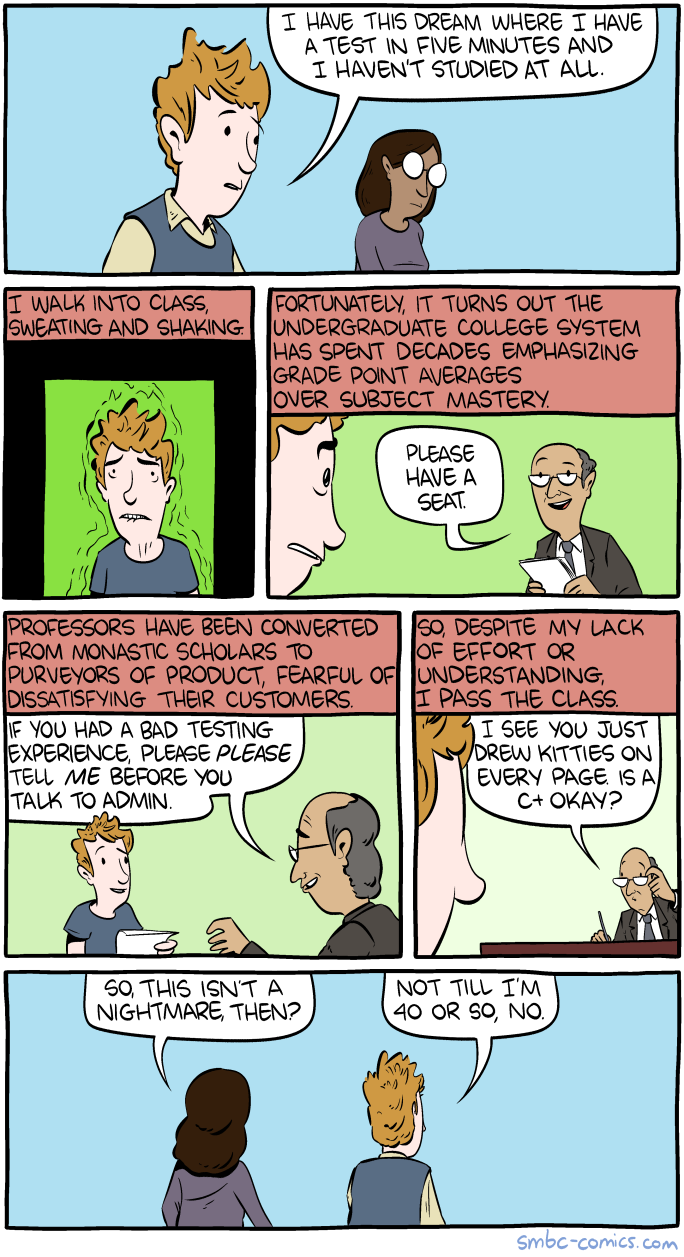
Saturday Morning Breakfast Cereal - Finals Nightmare

by tech@thehiveworks.com


Click here to go see the bonus panel!

Hovertext:
I really can't tell if this one will get hatemail or lovemail.

New comic!
Today's News:

The time draws nigh! All proposals for BAHFest East must be in by Wednesday!


NOW THEN, here's the keynote lecture from BAHFest Sydney 2016, by none other than Dr. Karl:


10 Feb 09:14

Efficient fiber-coupled single-photon source based on quantum dots in a photonic-crystal waveguide

by Raphaël S. Daveau
Raphaël S. Daveau, Krishna C. Balram, Tommaso Pregnolato, Jin Liu, Eun H. Lee, Jin D. Song, Varun Verma, Richard Mirin, Sae Woo Nam, Leonardo Midolo, Søren Stobbe, Kartik Srinivasan, Peter Lodahl
Many photonic quantum information processing applications would benefit from a high brightness, fiber-coupled source of triggered single photons. Here, we present a fiber-coupled photonic-crystal waveguide (PCWG) single-photon source relying on evanescent coupling of the light field from a tapered ... [Optica 4, 178-184 (2017)]
10 Feb 09:12

Chirped guided-mode resonance biosensor

by Graham J. Triggs
Graham J. Triggs, Yue Wang, Christopher P. Reardon, Matthias Fischer, Gareth J. O. Evans, Thomas F. Krauss
Advanced biomedical diagnostic technologies fulfill an important role in improving health and well-being in society. A large number of excellent technologies have already been introduced and have given rise to the “lab-on-a-chip” paradigm. Most of these technologies, however, require ... [Optica 4, 229-234 (2017)]
10 Feb 09:09

[Report] Scalable-manufactured randomized glass-polymer hybrid metamaterial for daytime radiative cooling

by Yao Zhai
10 Feb 09:01

Switching of Photonic Crystal Lasers by Graphene

by Min-Soo Hwang, Ha-Reem Kim, Kyoung-Ho Kim, Kwang-Yong Jeong, Jin-Sung Park, Jae-Hyuck Choi, Ju-Hyung Kang, Jung Min Lee, Won Il Park, Jung-Hwan Song, Min-Kyo Seo and Hong-Gyu Park

TOC Graphic

Nano Letters
DOI: 10.1021/acs.nanolett.6b05207
08 Feb 10:34

Near-perfect broadband absorption from hyperbolic metamaterial nanoparticles [Engineering]

by Conor T. Riley, Joseph S. T. Smalley, Jeffrey R. J. Brodie, Yeshaiahu Fainman, Donald J. Sirbuly, Zhaowei Liu
Broadband absorbers are essential components of many light detection, energy harvesting, and camouflage schemes. Current designs are either bulky or use planar films that cause problems in cracking and delamination during flexing or heating. In addition, transferring planar materials to flexible, thin, or low-cost substrates poses a significant challenge. On...
07 Feb 21:25

La cottura della pasta

by Dario Bressanini

Parlare di cottura della pasta in Italia è più pericoloso che parlare male della mamma o della sorella. Molti sono i riti irrinunciabili, le convinzioni adamantine, gli imperativi più o meno assoluti, i “non si fa” definitivi e le scomuniche velocissime. Consapevole di camminare sui gusci d’uova, mi metto lo scolapasta (!) in testa per ripararmi da eventuali flame e andiamo a incominciare.

Il processo con cui il cibo è più comunemente preparato per la tavola -la bollitura- è così familiare a chiunque, e i suoi effetti così uniformi, e apparentemente così semplici, che pochi, io credo, si sono presi la briga di indagare come o in che modo questi effetti vengono prodotti”.

pasta-food-oil-63244

Così scriveva nel 1799 Benjamin Thompson, più conosciuto come Conte Rumford –uno dei fondatori della termodinamica– in un saggio in cui analizzava scientificamente i processi di cottura, stupendosi di come fossero così poco compresi, anche e soprattutto dai cuochi, che li avevano sotto gli occhi tutti i giorni. Ancora oggi un atto così semplice e quasi quotidiano come far bollire l’acqua per la pasta è spesso fonte di molte discussioni. Quanta acqua usare? Si deve usare o meno il coperchio? Quando si deve aggiungere il sale? Una volta gettata la pasta si può abbassare il fuoco? Questa volta ci concentriamo sulla temperatura dell’acqua.

Acqua a bollore o no?

Molte persone pensano che l’ebollizione dell’acqua sia una condizione assolutamente necessaria per poter cuocere la pasta, ma già Thompson intuì che questo non è vero. La cottura del cibo infatti dipende solo dalla temperatura raggiunta, e non dal fatto che l’acqua stia bollendo o meno. La temperatura di ebollizione dell’acqua dipende dalla pressione atmosferica e questa diminuisce con l’altitudine. Degli spaghetti immersi in acqua a bollore a Sestriere, a circa 2000 metri di altitudine, cuociono a circa 93 °C, rispetto ai 100 °C che si raggiungono a livello del mare. Ciò significa che si possono usare quelle temperature anche ad altitudini più basse, senza però far bollire l’acqua. Perché, scrive Thompson

tutto il combustibile che viene utilizzato nel farla bollire vigorosamente è sprecato, senza aggiungere un singolo grado al calore dell’acqua, né velocizzare o accorciare il processo della cottura di un solo secondo. Poiché è dal calore, dalla sua intensità e della sua durata che il cibo viene cotto, e non dall’ebollizione dell’acqua che non ha alcun ruolo in quell’operazione.”.

Thompson non parlava di pasta ma di carne e verdure ma il principio è del tutto generale: ciò che conta è la temperatura raggiunta e non il fatto che l’acqua stia bollendo.

fusillicotturaLa cottura della pasta è governata principalmente da tre fattori: la velocità di penetrazione dell’acqua all’interno dell’impasto, la gelatinizzazione dell’amido e la denaturazione e conseguente coagulazione del glutine. Tutti questi fenomeni dipendono dalla temperatura.

L’acqua penetra nella pasta anche a basse temperature, persino in acqua fredda, ma più la temperatura aumenta e più velocemente entra nell’impasto. La gelatinizzazione dell’amido è quel fenomeno in cui i granuli di amido assorbono acqua e formano un gel. L’amido di frumento gelatinizza tra i 60 °C e i 70 °C. Il glutine denatura e coagula tra i 70 °C e gli 80 °C. Notate che sono tutte temperature molto al di sotto delle temperature di ebollizione comuni nelle nostre cucine. Questo significa che è possibile cuocere la pasta anche tenendo l’acqua a 80 °C, mettendoci solo un pochino di più perché l’acqua idrata l’impasto un po’ più lentamente.

Ogni tanto qualche cuoco riscopre questo fatto e ripropone una sua versione di quello che Thompson già nel ‘700 aveva descritto, dando delle regole su quando spegnere il fuoco dopo aver gettato la pasta. Non si tratta però di un nuovo metodo di cottura della pasta, e non merita un nome specifico perché, lo ribadisco, ciò che conta è solo la temperatura raggiunta e non se l’acqua stia bollendo o meno.

L'esperimento

Se non ci credete fate questo esperimento: mettete due litri d’acqua in una pentola. Portatela all'ebollizione col coperchio (risparmierete sui tempi e sul gas). Una volta all'ebollizione aggiungete il sale e un etto di pasta corta. Mescolate una ventina di secondi per evitare che la pasta si attacchi, spegnete il gas, coprite e preparate il vostro sugo preferito. Le mie penne dopo 12 minuti, uno in più dell’indicazione della confezione, erano pronte, con l’acqua ancora a 86 °C, al di sopra della temperatura di gelatinizzazione dell’amido e di coagulazione delle proteine. Pronto il sugo, ho scolato, condito e mangiato con gusto. L’acqua di cottura forse (forse, dovrei fare un confronto diretto) era un poco più limpida del solito, segno che potrebbe (potrebbe) essere fuoriuscito meno amido, ma in ogni caso niente di rilevante dal punto di vista nutrizionale.

cotturapasta1

Ma perché fermarsi qui? È possibile buttare la pasta anche prima che l’acqua arrivi all'ebollizione: ho provato a buttare pasta e sale dopo 8 minuti, con l’acqua a 80 °C. Ho poi continuato a scaldare, col coperchio, sino all'ebollizione per poi spegnere il gas. Sette minuti dopo la pasta era pronta. Trovate la combinazione di tempi e temperature che meglio si adatta alla vostra pasta per non avere il maccherone stracotto fuori e crudo dentro. Vi può sembrare inutile, ma pensate a quanta energia viene sprecata ogni giorno per far bollire acqua che poi verrà gettata nel lavandino. Gas e soldi letteralmente buttati. Nel mio primo esperimento ho impiegato 11 minuti per portare l’acqua all'ebollizione, e ne avrei impiegati altri 11 per la cottura. Lo so che siete diffidenti ma se non vi fidate potete sempre iniziare a spegnere il fuoco qualche minuto prima di togliere la pasta. Risparmierete comunque.

Dato che vi sarete già scandalizzati troppo, della cottura della pasta al microonde vi parlo una prossima volta ;)

Alla prossima

Dario Bressanini

P.S. se volete potete trovarmi anche sul mio canale YouTube e sulla mia pagina Facebook

Letture consigliate

Sicignano, A., Di Monaco, R., Masi, P., & Cavella, S. (2015). From raw material to dish: pasta quality step by step. Journal of the Science of Food and Agriculture, 95(13), 2579-2587.

03 Feb 08:26

All-dielectric nanophotonics: the quest for better materials and fabrication techniques. (arXiv:1702.00677v1 [physics.optics])

by Denis G. Baranov, Dmitry A. Zuev, Sergey I. Lepeshov, Oleg V. Kotov, Alexander E. Krasnok, Andrey B. Evlyukhin, Boris N. Chichkov

All-dielectric nanophotonics is an exciting and rapidly developing area of nanooptics which utilizes the resonant behavior of high-index low-loss dielectric nanoparticles for enhancing light-matter interaction on the nanoscale. When experimental implementation of a specific all-dielectric nanostructure is an issue, two crucial factors have to be in focus: the choice of a high-index material and a fabrication method. The degree to which various effects can be enhanced relies on the dielectric response of the chosen material as well as the fabrication accuracy. Here, we make an overview of available high-index materials and existing fabrication techniques for the realization of all-dielectric nanostructures. We compare performance of the chosen materials in the visible and IR spectral ranges in terms of scattering efficiencies and Q-factors. Various fabrication methods of all-dielectric nanostructures are further discussed, and their advantages and disadvantages are highlighted. We also present an outlook for the search of better materials with higher refractive indices and novel fabrication methods enabling low-cost manufacturing of optically resonant high-index nanoparticles. We hope that our results will be valuable for researches across the whole field of nanophotonics and particularly for the design of all-dielectric nanostructures.

31 Jan 16:40

Random Matrix Theory Approach to Chaotic Coherent Perfect Absorbers

by Huanan Li, Suwun Suwunnarat, Ragnar Fleischmann, Holger Schanz, and Tsampikos Kottos

Author(s): Huanan Li, Suwun Suwunnarat, Ragnar Fleischmann, Holger Schanz, and Tsampikos Kottos

We employ random matrix theory in order to investigate coherent perfect absorption (CPA) in lossy systems with complex internal dynamics. The loss strength γCPA and energy ECPA, for which a CPA occurs, are expressed in terms of the eigenmodes of the isolated cavity—thus carrying over the information...


[Phys. Rev. Lett. 118, 044101] Published Thu Jan 26, 2017

31 Jan 16:27

Complementary Speckle Patterns: Deterministic Interchange of Intrinsic Vortices and Maxima through Scattering Media

by Jérôme Gateau, Hervé Rigneault, and Marc Guillon

Author(s): Jérôme Gateau, Hervé Rigneault, and Marc Guillon

Intensity maxima and zeros of speckle patterns obtained behind a diffuser are experimentally interchanged by applying a spiral phase delay of charge ±1 to the impinging coherent beam. This transform arises from the expectation that tightly focused beams, which have a planar wave front around the foc...


[Phys. Rev. Lett. 118, 043903] Published Fri Jan 27, 2017

30 Jan 15:33

Focusing light through frosted glass leads to new 3D display technology

by Chris Lee

Enlarge / We're not at the hand-held hologram projector state yet, but we're getting there.

Sometimes it amazes me how fast physics goes from fundamental ideas to producing a new toy. The latest example comes from a bunch of experiments and theory on how opaque materials affect light passing through them, a topic that we have covered extensively in the past. The work had the catnip qualities of being cute and simple and exploring some pretty fundamental physics ideas.

The idea behind the research was simple. Scattering materials, like white paint or sugar cubes, turn light into a chaotic jumble. But if we could control how they scatter light, we could turn them into useful things like focusing devices. I know the researchers who pioneered this idea, and they were all rather conservative about possible applications. And that was appropriate; the ideas that they had—medical imaging, high-resolution imaging, and security applications—have all (with the exception of security) proved to be possible but really difficult.

So I was a bit surprised to see the ideas applied to holographic displays. I have to admit, I never even thought of it, but once you see the idea it is like being slapped silly by Captain Obvious.

Read 18 remaining paragraphs | Comments

26 Jan 06:34

Ultrasensitive Label-Free Nanosensing and High-Speed Tracking of Single Proteins

by Matz Liebel, James T. Hugall and Niek F. van Hulst

TOC Graphic

Nano Letters
DOI: 10.1021/acs.nanolett.6b05040
26 Jan 06:32

Bridging the Gap between Dielectric Nanophotonics and the Visible Regime with Effectively Lossless Gallium Phosphide Antennas

by Javier Cambiasso, Gustavo Grinblat, Yi Li, Aliaksandra Rakovich, Emiliano Cortés and Stefan A. Maier

TOC Graphic

Nano Letters
DOI: 10.1021/acs.nanolett.6b05026
25 Jan 16:55

Polarized Nonlinear Nanoscopy of Metal Nanostructures

by Naveen Kumar Balla, Carolina Rendón-Barraza, Luong Mai Hoang, Pawel Karpinski, Esteban Bermúdez-Ureña and Sophie Brasselet

TOC Graphic

ACS Photonics
DOI: 10.1021/acsphotonics.6b00635
24 Jan 19:36

A single molecule as a high-fidelity photon gun for producing intensity-squeezed light

by Xiao-Liu Chu

Nature Photonics 11, 58 (2017). doi:10.1038/nphoton.2016.236

Authors: Xiao-Liu Chu, Stephan Götzinger & Vahid Sandoghdar

A two-level atom cannot emit more than one photon at a time. As early as the 1980s, this quantum feature was identified as a gateway to ‘single-photon sources’, where a regular excitation sequence would create a stream of light particles with photon number fluctuations below the shot noise. Such an intensity-squeezed beam of light would be desirable for a range of applications, such as quantum imaging, sensing, enhanced precision measurements and information processing. However, experimental realizations of these sources have been hindered by large losses caused by low photon-collection efficiencies and photophysical shortcomings. By using a planar metallodielectric antenna applied to an organic molecule, we demonstrate the most regular stream of single photons reported to date. The measured intensity fluctuations were limited by our detection efficiency and amounted to 2.2 dB squeezing.

24 Jan 19:36

Optical microscopy aims deep

by Sylvain Gigan

Nature Photonics 11, 14 (2017). doi:10.1038/nphoton.2016.257

Author: Sylvain Gigan

A new set of imaging techniques that take advantage of scattered light may soon lead to key advances in biomedical optics, providing access to depths well beyond what is currently possible with ballistic light.

24 Jan 10:05

Dynamics of non-Markovian open quantum systems

by Inés de Vega and Daniel Alonso

Author(s): Inés de Vega and Daniel Alonso

This review gives a summary of the many techniques that are used in the analysis of open quantum systems. Emphasis is on those cases where it is unsuitable to use a memoryless or Markovian point of view, generally because there is no large separation of time scales between system and environment dynamics. The approaches reviewed include master equations, Heisenberg equations of motion, chain mapping representations, and various stochastic methods such as path integral Monte Carlo and stochastic equations. Guidance is given on how to evaluate the suitability of each of these methods for application in different physical problems.


[Rev. Mod. Phys. 89, 015001] Published Fri Jan 20, 2017

19 Jan 15:26

Spectrally and Spatially Resolved Smith-Purcell Radiation in Plasmonic Crystals with Short-Range Disorder

by I. Kaminer, S. E. Kooi, R. Shiloh, B. Zhen, Y. Shen, J. J. López, R. Remez, S. A. Skirlo, Y. Yang, J. D. Joannopoulos, A. Arie, and M. Soljačić

Author(s): I. Kaminer, S. E. Kooi, R. Shiloh, B. Zhen, Y. Shen, J. J. López, R. Remez, S. A. Skirlo, Y. Yang, J. D. Joannopoulos, A. Arie, and M. Soljačić

An experimental setup based on a modified scanning electron microscope is used to explore fundamental aspects of the coupling of free electrons to plasmonic crystals and localized plasmonic resonances.


[Phys. Rev. X 7, 011003] Published Tue Jan 17, 2017

16 Jan 16:35

Collective motion: Disorder in the wild

by C. J. Olson Reichhardt

Nature Physics 13, 10 (2017). doi:10.1038/nphys3929

Authors: C. J. Olson Reichhardt & C. Reichhardt

Simple models have given us surprising insight into how animals flock, but most assume they do so through a homogeneous landscape. Colloidal experiments now suggest that a little disorder can have unexpected — and spectacular — effects.

14 Jan 21:51

Channeling of Branched Flow in Weakly Scattering Anisotropic Media

by Henri Degueldre, Jakob J. Metzger, Erik Schultheis, and Ragnar Fleischmann

Author(s): Henri Degueldre, Jakob J. Metzger, Erik Schultheis, and Ragnar Fleischmann

A theoretical analysis of wave propagation through anisotropic media shows unexpected collective effects occur.


[Phys. Rev. Lett. 118, 024301] Published Mon Jan 09, 2017

14 Jan 21:51

Second-Harmonic Scattering from Metallic Nanoparticles in a Random Medium

by Naima Khebbache, Anthony Maurice, Smail Djabi, Isabelle Russier-Antoine, Christian Jonin, Sergey E. Skipetrov and Pierre-François Brevet

TOC Graphic

ACS Photonics
DOI: 10.1021/acsphotonics.6b00520
09 Jan 21:27

Plasmonic Waveguide-Integrated Nanowire Laser

by Esteban Bermúdez-Ureña, Gozde Tutuncuoglu, Javier Cuerda, Cameron L. C. Smith, Jorge Bravo-Abad, Sergey I. Bozhevolnyi, Anna Fontcuberta i Morral, Francisco J. García-Vidal and Romain Quidant

TOC Graphic

Nano Letters
DOI: 10.1021/acs.nanolett.6b03879
07 Jan 22:09

Experimental realization of an absolute single-photon source based on a single nitrogen vacancy center in a nanodiamond

by Beatrice Rodiek
Beatrice Rodiek, Marco Lopez, Helmuth Hofer, Geiland Porrovecchio, Marek Smid, Xiao-Liu Chu, Stephan Gotzinger, Vahid Sandoghdar, Sarah Lindner, Christoph Becher, Stefan Kuck
We report on the experimental realization of an absolute single-photon source based on a single nitrogen vacancy (NV) center in a nanodiamond at room temperature and on the calculation of its absolute spectral photon flux from experimental data. The single-photon source was calibrated with respect ... [Optica 4, 71-76 (2017)]
04 Jan 10:36

Fluorescence lifetime and quantum yield

by admin

Two months ago I saw a tweet noting the linear relationship between quantum yield and fluorescence lifetime in fluorescent proteins. I hadn’t seen this before, so I wanted to see if it held on a wider range of fluorescent proteins, so I added the ability to plot lifetimes on my fluorescent protein visualization and added lifetimes for all the proteins I could find (37 in total).

Quantum yield vs. fluorescent lifetime (ns) for 37 fluorescent proteins, colored by emission wavelength and brightness. Click for full size image.

As you can see, the correlation is pretty good, although there is clearly some curvature to the plot, fitting a straight line gives lifetime = 3.67 * QY + 0.85 with an R2 of 0.789. This suggests that short lifetimes are mainly caused by non-radiative de-excitation of the fluorophore, the long fluorescence lifetimes and high quantum yields both result from little coupling into other de-excitation modes and are governed mainly by the intrinisic radiative lifetime of the protein. This further suggests that the radiative lifetime of all fluorescent proteins is around 3 – 5 ns.  What sets this? Interestingly, Alexa dyes show a similar relationship of QY and lifetime, with maximum lifetimes around 4 ns.

Any comments by someone who knows more than I do would be most welcome.

01 Jan 23:22

Tapered Glass-Fiber Microspike: High-Q Flexural Wave Resonator and Optically Driven Knudsen Pump

by Riccardo Pennetta, Shangran Xie, and Philip St.J. Russell

Author(s): Riccardo Pennetta, Shangran Xie, and Philip St.J. Russell

Appropriately designed optomechanical devices are ideal for making ultra-sensitive measurements. Here we report a fused-silica microspike that supports a flexural resonance with a quality factor greater than 100 000 at room temperature in vacuum. Fashioned by tapering single-mode fiber (SMF), it is …


[Phys. Rev. Lett. 117, 273901] Published Thu Dec 29, 2016

01 Jan 23:21

Weaving Knotted Vector Fields with Tunable Helicity

by Hridesh Kedia, David Foster, Mark R. Dennis, and William T. M. Irvine

Author(s): Hridesh Kedia, David Foster, Mark R. Dennis, and William T. M. Irvine

A prediction of divergence-free knotted vector fields from complex scalar fields has consequences for studies of magnetic fields in complex patterns.


[Phys. Rev. Lett. 117, 274501] Published Thu Dec 29, 2016

01 Jan 23:20

Enhancement and Inhibition of Spontaneous Photon Emission by Resonant Silicon Nanoantennas

by Dorian Bouchet, Mathieu Mivelle, Julien Proust, Bruno Gallas, Igor Ozerov, Maria F. Garcia-Parajo, Angelo Gulinatti, Ivan Rech, Yannick De Wilde, Nicolas Bonod, Valentina Krachmalnicoff, and Sébastien Bidault

Author(s): Dorian Bouchet, Mathieu Mivelle, Julien Proust, Bruno Gallas, Igor Ozerov, Maria F. Garcia-Parajo, Angelo Gulinatti, Ivan Rech, Yannick De Wilde, Nicolas Bonod, Valentina Krachmalnicoff, and Sébastien Bidault

Substituting noble metals for high-index dielectrics has recently been proposed as an alternative strategy in nanophotonics, to design broadband optical resonators and circumvent the ohmic losses of plasmonic materials. On the other hand, the authors show that subwavelength silicon nanoantennas can either enhance or inhibit spontaneous emission from fluorescent molecules, a process that is inaccessible with noble metals at the nanoscale. This study highlights the potential of dielectric resonators for low-loss near-field manipulation of solid-state emitters, at room temperature.


[Phys. Rev. Applied 6, 064016] Published Wed Dec 28, 2016

29 Dec 11:12

Resonant Wood's anomaly diffraction condition in dielectric and plasmonic grating structures. (arXiv:1612.08674v1 [physics.optics])

by Mikhail M. Voronov

The general features of the light scattering resulting in the so-called resonant Wood's anomalies in the reflection and transmission spectra are described using the effective parameters of a quasi-guided mode. The expression determining the spectral angular dependence of Wood's anomaly in the case of plasmonic grating structures is given and compared to the analogous expression for dielectric grating structures. Comparison of the resonant Wood's anomalies (RWA) with the surface plasmon-polariton resonances (SPPRs) is discussed as well.