×You need to sign in to continue.

Shared posts

08 Sep 21:10

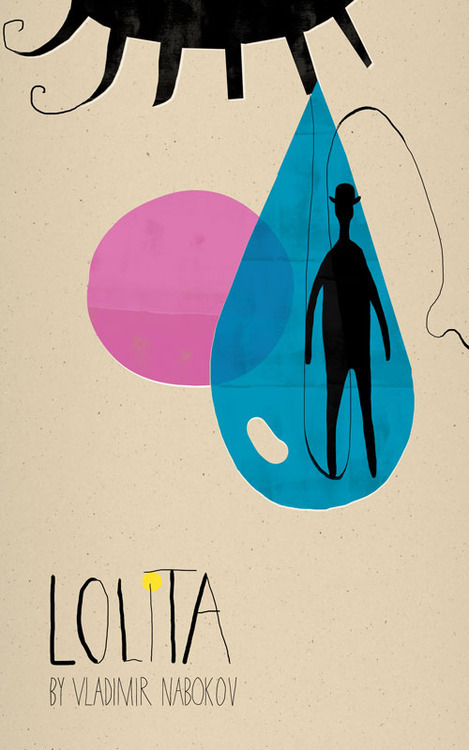
the “lolita” covers

gowns:

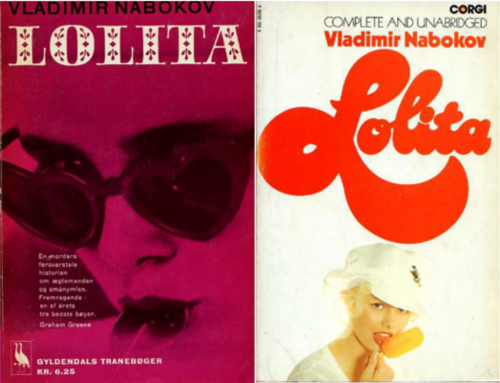
here’s a question: if vladimir nabokov’s “lolita” is truly the psychological portrait of a messed up dude and not the girl – let alone a sexualized little girl, as all of the sexualization happens inside humbert humbert’s head – then why do all the covers focus on a girl, and usually a sexy aspect of a girl, usually quite young, and none of them feature a portrait of humbert humbert?

image

here are nabokov’s original instructions for the book cover:

I want pure colors, melting clouds, accurately drawn details, a sunburst above a receding road with the light reflected in furrows and ruts, after rain. And no girls. … Who would be capable of creating a romantic, delicately drawn, non-Freudian and non-juvenile, picture for LOLITA (a dissolving remoteness, a soft American landscape, a nostalgic highway—that sort of thing)? There is one subject which I am emphatically opposed to: any kind of representation of a little girl.

and yet, the representations of the sexy little girl abound.

i became driven by curiousity. why did this happen? why is this happening?

i am not alone – there’s a book about this, with several essays and artists’ conceptions about the politics and problems of representation surrounding the covers of “lolita.” this new yorker article gives a summary of the book and its ideas, and interviews one of the editors:

Many of the covers guilty of misrepresenting Lolita as a teen seductress feature images from Hollywood movie adaptations of the book— Kubrick’s 1962 version, starring Sue Lyon, and Adrian Lyne’s 1997 one. Are those films primarily to blame for the sexualization of Lolita?

As is argued in several of the book’s essays, the promotional image of Sue Lyon in the heart-shaped sunglasses, taken by photographer Bert Stern, is easily the most significant culprit in this regard, much more so than the Kubrick film itself (significantly, neither the sunglasses nor the lollipop ever appears in the film), or the later film by Adrian Lyne. Once this image became associated with “Lolita”—and it’s important to remember that, in the film, Lolita is sixteen years old, not twelve—it really didn’t matter that it was a terribly inaccurate portrait. It became the image of Lolita, and it was ubiquitous. There are other factors that have contributed to the incorrect reading, from the book’s initial publication in Olympia Press’s Traveller’s Series (essentially, a collection of dirty books), to Kubrick’s startlingly unfaithful adaptation. At the heart of all of this seems to be the desire to make the sexual aspect of the novel more palatable.

here’s a couple of kubrick inspired covers:

image

which very well could have, after tremendous sales, have influenced the following covers:

image

…straying so far from the intention of nabokov that the phenomenon begins to look more like the symptom of something larger, something sicker.

after a lot of researching covers, it was here, in this sampling of concept covers for the book about the lolita covers, that i found an image that best represents the story to me:

image

[art by linn olofsdotter – and again, this is not an official cover]

but why aren’t all the covers like that? even the ones published by “legitimate” publishing companies, with full academic credentials, with no intended connection to the film; surely they must have read nabokov’s instructions for the cover. and yet, look at the top row of lolita covers: all legitimate publishing companies, not prone to smut. and yet.

image

my conclusion is that the lolita complex existed before “lolita” (and of course it did) – a patriarchal society is essentially operating with the same delusions of humbert humbert. nabokov did not produce the sexy girl covers of lolita, and kubrick had only the smallest hand in it. it was what people desired, requested and bought. the image of the sexy girl sells; intrigues; gets the hands on the books.

as elizabeth janeway said in her review in the new york review of books: “Humbert is every man who is driven by desire, wanting his Lolita so badly that it never occurs to him to consider her as a human being, or as anything but a dream-figment made flesh.”

isn’t that our media as a whole? our culture as a whole?

the whole lot of them/us – seeing the world through humbert-tinted glasses, seeing all others as Other and Object, as solipsistic dream-reality. as i scroll through the “lolita” covers i wonder: where’s the humanity in our humanity?

pretty interesting read here

06 Sep 16:29

startrekships: airyairyquitecontrary: blue-author: unstoppably...


startrekships:

airyairyquitecontrary:

blue-author:

unstoppablyplushjuggernaut:

KIRK THIS WHY YOU GOTTA FILL OUT THE LOG

I’ve heard the theory that Kirk’s logs just get circulated round headquarters for lulz before being dumped in the circular file as obvious fabrications by someone bored with a frontier posting.

“Hey, have you seen this one? He says he fought Apollo.”

“What, the old earth probe?”

“Try the old earth GOD!”

“Hilarious! Classic Kirk! That’s better than the time when he was transported to an evil dimenison.”

The reason why in The Naked Now it was Riker who remembered that the previous polywater infection had happened is that he’s the sort of person who would read The Hilarious Adventures of Captain Kirk for fun.

I especially like this idea because of the implication that all the other captains in Starfleet are reporting perfectly ordinary experiences like visiting a space station, dropping off supplies at a colony, bit of a stand-off with some Klingons in disputed space but got out of it unscathed - and then there’s Kirk all, “sorry guys we’ve been off course this week because my first officer seriously needed to get laid (LIKE YOU HAVE NO IDEA MY NECK STILL HURTS)” and “let me tell you about the Chicago Gangster planet” and “WHIPPED AND THROWN IN JAIL BY SPACE NAZIS.”

I actually really like the above explanation

I thought this was already canon

05 Sep 14:50

spaceauddity: fifth-dimensional: feferipixies: stygende: nordegrafs: kawaiipyro: i think...

spaceauddity:

fifth-dimensional:

feferipixies:

stygende:

nordegrafs:

kawaiipyro:

i think anyone who’s every used the internet has seen this picture at least once

 #should have done the blonde anime girl in the red plaid

you mean

yes that one exactly

wake me up inside

That first image is an edit of HUGZzz by Irene Strychalski. She’s improved tremendously in the past nine years, and you can see her current work on her tumblr, reniedraws! She has done backgrounds for Archer and Unsupervised, backgrounds and character designs for Chozen, and pencils and inks for issue #1 of Deadpool Family. She’s currently making a webcomic called Shaman Child. Here’s some of her current art:

[girl with scarf] [deadpool] [wedding commission] [hair and water]

As for the anime girl in the plaid skirt, I braved the hellscape that is early ‘00s anime websites, exploring endless gif-covered Gaia pages and vampire-filled roleplay forums, traveling across seas of unsourced DeviantArt edits and low-res hentai, to discover that she is an original character by Hiro Suzuhira. She has done work for Shuffle!, Ef: A Tale of Melodies, Akikan!, Phantom Breaker, and We Without Wings, among many others, and she is also a prolific freelance illustrator. Here are some examples of her art:

[chronicle cover] [misa] [soul eater] [higurashi] [phantom breaker] [leo]

tumblr VH1 presents “Where are they now? Early 2000′s internet artists”

04 Sep 07:06

‘Purity culture’ isn’t just a sex thing. It’s a do-nothing thing.

by Fred Clark

A great deal of great stuff is being written about white evangelical “purity culture” and the perverse, pervasive and pernicious effects it has on Christian ideas about sex, gender, “modesty,” marriage, etc.

This obsession with “purity” isn’t just a sex thing. That’s where it finds its main expression these days, but purity culture is a fountain flowing deep and wide. It influences how white evangelicals view everything — themselves, God, “the world,” all of it.

A verse from the epistle of James provides an almost-perfect distillation of this view. James 1:27 says:

Religion that God our Father accepts as pure and faultless is this: … to keep oneself from being polluted by the world.

That’s the idea in a nutshell. This is how their religion is defined — the thing to which they are converted and the sum total of their understanding of discipleship. It’s all about being “pure and faultless” and doing everything possible to avoid pollution or contamination or “defilement” from the entire world. That’s what religion is.

And that’s also, according to this purity ideology, what “the world” is — a great big ball of pollution, a cosmos of disease, defilement and contamination.

What then, is a good Christian to do in such a world? As little as possible. Faith is a blank page that must be kept blank. It is a spotless, pure and undefiled white sheet that must be hidden away from anything and everything that might stain its pure whiteness.

At the moment of salvation, Jesus’ blood washes us white as snow. It’s all downhill from there. (Or, as Steve Taylor put it, “They all start dying from the day they’re born again.”) Purity ideology means that no Christian will ever again be quite as pure and righteous and clean as they are at that moment of conversion. Given that ideology, any talk of “sanctification” or discipleship rings hollow. Those things are a trap — a temptation to start defiling that blank page by writing on it.*

This is something Peter Leithart circles around, but can’t quite pin down, in his First Things post on “Why Evangelical Films Fail“:

Evangelicalism is also a conversionist faith. The key crisis of life is the moment of commitment to Christ. In Woodlawn, most of the characters convert early in the film, necessarily so because the story is about the effect of the revival on race relations. But that means that the line of character development is flat. The really crucial character development has taken place in the moment of conversion. …

Theologically speaking, character development is “sanctification.” A conversionist form of Christianity places less emphasis on sanctification than on conversion and justification. In films, that translates into drastic oversimplification of human psychology. For Evangelicals, there are only two sets of motivations, as there are two kinds of people: Saved and unsaved.

This precludes the possibility of storytelling. Stories require characters to choose and change and grow. Purity ideology warns against any of that. You started out spotless — any change from there will mean “being polluted by the world.” The story cannot go anywhere.

This also precludes the possibility of living a story. Or of living. Period.

Keep yourself from being polluted by the world.

Keep yourself from being polluted by the world.

And I know from personal experience, and then from my years of youth ministry, and from the email in my inbox, that this story-stopping, life-throttling ideology is a source of enormous anxiety for many white evangelicals. They believe. They want their faith to define them and to be the Most Important Thing in their lives. But they aren’t allowed to do anything about that, or with that. They’re warned that doing anything would be dangerous. Doing anything is to be avoided.

The alternative — doing nothing, on principle — is frustrating and meaningless. The few bits of permissible world-avoiding busywork are no help. “Evangelism” is encouraged, but only the forms of no-contact, boy-in-a-bubble evangelism that just alienate the “unsaved” that such approaches treat as aliens. Those kinds of evangelism thus wind up heightening the sense of meaninglessness and frustration.

And then there’s Bible-reading — the daily devotions or “quiet time” one is mandated to feel guilty about not doing. But reading the Bible through the lens of purity ideology — through a lens that filters out anything that seems to suggest actually doing something in and with “the world” — winds up just as frustrating. Read that way, the Bible is dull and confusing. (Thus prompting the double-whammy of feeling guilty about finding it dull and confusing.) Ditto for the other big permissible/mandated activities of prayer and worship.

Go ahead and try to write a story in which the only activities characters engage in are: 1) Bible-reading and prayer; 2) evangelism; and 3) Not Having Sex. Those characters will never choose, grow or develop. When the story arrives, they’ll be unable to get on board, and thus it will have to go on without them.

And just as it is impossible to write a story with characters as flat and stunted as that, so too it is impossible to live a life keeping one’s own character as flat and stunted as that. The stasis of the perpetually pure, white, blank page is impossible. You’ll still change, but you won’t grow. You’ll ossify — shrinking and getting harder, but more brittle.

So what’s the alternative?

Let’s go back to that verse from James, which I described as only an almost perfect distillation of purity ideology, because there’s actually a bit there where I put that ellipsis. And when you include that bit, it utterly ruins the whole attempt to interpret this verse as an endorsement of white evangelical purity ideology.

What James actually says is this:

Religion that God our Father accepts as pure and faultless is this: to look after orphans and widows in their distress and to keep oneself from being polluted by the world.

That “look after orphans and widows in their distress” bit gets mentally erased because it can’t be made to fit with what white evangelicals are seeking to confirm for themselves with this verse. Messing about with orphans and widows — who are, by definition, unmarried women, and thus, by definition, dangerous — is imprudent for those whose priority is trying to remain pure and faultless and to avoid becoming polluted. Poor people are notoriously dirty and unruly. That can rub off, you know. Messing about with anyone is, well, messy.

So, since this orphans and widows bit can’t be made to fit in with what they imagine the rest of the verse is saying, it fades into invisibility. That doesn’t only leave the remainder of James’ statement incomplete, it mutates the meaning of the rest of the verse.

“Look after orphans and widows in their distress and keep yourself from being polluted by the world,” James says. That’s how you keep yourself from being polluted by the world — by looking after the powerless, the disenfranchised, the poor, the outcast. And this is what “being polluted by the world” means: It means joining in the world-system’s neglect of people like them. It means participating in and supporting their neglect and oppression.

For James here, “the world” doesn’t refer to infidels or to “secular” culture or to everyone who isn’t a pure and undefiled member of our exclusively pure and true sect. Here, as in much of the New Testament,** “the world” means something more like “The Powers That Be.”

That is “the world” that James was talking about. And that is “the world” that James’ brother was talking about when he told his disciples, “If you belonged to the world, it would love you as its own. As it is, you do not belong to the world, but I have chosen you out of the world. That is why the world hates you.”

To understand that, translate “the world” as TPTB, or, if you like, as “The Empire,” or even “Wall Street”:

If The Powers That Be hate you, keep in mind that they hated me first. If you belonged to The Powers That Be, they would love you as their own. As it is, you do not belong to The Powers That Be, but I have chosen you out of their clutches. That is why The Powers That Be hate you.

It’s still possible to do that while maintaining something like white evangelical purity ideology. You can interpret “keep yourself from being polluted by the world” as “keep yourself from being polluted by The Powers That Be,” and still come away thinking that your whole job is to avoid, escape and safeguard the unblemished purity you were granted at the moment of conversion. You can thus retain the same egocentric elevation of your personal purity as your sole concern.

But that, again, requires you to change the meaning of what James said by mentally erasing the essential bit of that verse — the bit about orphans and widows and those in distress. That, again, is the key to what James is saying. It’s not about you. It’s about them. Put your self-centered concern for personal purity above your regard for them and you have, by definition, become polluted by The Powers That Be.

- – - – - – - – - – - -

* The spark for this little journey through the psychology of white evangelical purity ideology was David Badash’s recent post discussing the lawless Kentucky clerk insisting on a religious exemption from doing her job, “Kim Davis Has Been a Practicing Christian for Only Four Years.”

Badash there makes the mistake of thinking of evangelical Christianity as a practice, a craft, a journey of discipleship. It’s not that. It’s the opposite of that. Thanks to purity ideology, white evangelical Christianity gives us only one thing to do: Get saved. After that, it’s just a matter of retaining as much of the initial purity that establishes until, eventually, you die and/or get Raptured.

If Kim Davis got saved only four years ago, that means she probably has more of her initial purity still intact than some lifelong Christian who got saved 40 years ago.

** Context matters, of course, and context is the best way to make sense of what purity ideology can’t understand as an apparent contradiction in what the Bible has to say about “the world.” Sometimes the Bible speaks of “the world” as this thing that hates and defiles us, this thing we’ve been called out of and away from. But other times it speaks of “the world” as this thing that God loves, and that God commands us to love and sends us into in order to share, and express, and embody that love.

So use the brain God gave you and read that phrase — “the world” — in context. When the world is discussed as an evil, powerful system of injustice, then treat that phrase as “The Powers That Be.” When the world is, instead, a reference to just, you know, the whole planet and such, then read it that way. It would be illiterate nonsense to read John 3:16 as meaning, “For God so loved The Powers That Be,” just as it would be illiterate nonsense to read James 1:27 as saying, “keep oneself from being polluted by the entire planet.”

03 Sep 19:00

Become a ruthless, noble lady in this 'Renaissance revenge simulator'

by Leigh Alexander
g3y3KX

Your wealthy father and brother have been killed by distasteful schemers, and now you're to be married off to one of them. Can you plan your brutal revenge without arousing suspicion—while acting like a perfect courtly lady?

Masques and Murder, by James Patton, is part interactive fiction, part statistical role-playing game. You manage the life of the orphaned Justitia, a young woman at court who must prepare for masquerades and music concerts while secretly nursing your fury and winning over your distasteful suitors so they'll be easy to kill.

It's a real delightful concept: There are all sorts of "princess maker"-style simulations about raising a character, often a girl, to grace and success by prizing certain skills over others; the wonderful Long Live the Queen turns this formula on its head, forcing you to keep one step ahead of a courtly world that wants to kill you.

But in this game, the statistics that are used to make a "lady"—your knowledge of verse, theology, music and dance—actually lull your evil suitors into vulnerability to the more lethal trades you study. During the tutorial, the three distasteful nobles are introduced to you after the fashion of a visual novel, a fun subversion of the "which bachelor do you choose to pursue" trope.

uUlEwx

The goal is to manage your statistics such that you can quietly kill off all three evil men and avenge your family. The Renaissance setting, full of classical music and maudlin paintings of skulls and roses—all the art the game samples is genuine period pieces&mdashis a wonderful tonal backdrop for feeling like a creature of grace with steel and fire underneath.

You can play Masques and Murder for free, but the developer suggests a $5 donation if you enjoy the game.

01 Sep 17:55

The uncanny sex fiends of Christianity Today (No. 2)

by Fred Clark

Here’s another turn of the screwed-up from my favorite source of sex stories, the Christianity Today newsfeed: “Ligonier Suspends R. C. Sproul Jr. over Ashley Madison Visit.” The subhed tells us: “Reformed leader admits accessing adultery website ‘in a moment of weakness, pain, and from an unhealthy curiosity.’”

So this is another scandalous story of yet another conservative white Christian revealed by the Ashley Madison hack to have been an adulterous liar cheating on his spouse, right?

Actually, no. Not at all. This is the story of a guy who once visited an adult website in 2014. He’s not married. He used to be, but, as CT’s report mentions, parenthetically, “(His wife died of cancer in 2011).” As though there were anything parenthetical about that fact.

There’s no scandal here. The man isn’t an apostate or a heretic, a betrayer, a deceiver or a sinner. He got lonely. Treating this like a scandal is just cruel and wrong.

And just because the guy himself is making this grounds for public confession, elaborate contrition and self-flagellation doesn’t mean we have to join in, taking turns with the whip.

In a blog post this morning, Sproul Jr. said he accessed the site “in a moment of weakness, pain, and from an unhealthy curiosity. … My goal was not to gather research for critical commentary, but to fan the flames of my imagination.

“First, I felt the grace of fear. Second, I felt the grace of shame. I was there long enough to leave an old email address. And within minutes I left, never to return,” he wrote. “I did not sign up for their service or interact with any clients. I have always remained faithful to my wife even after her passing.”
Jeebus.

PulpYDBTake a moment for gratitude here. This could’ve been you — raised and groomed for leadership in an ultra-Calvinist sect that conceives of God’s grace as something that reveals itself to us primarily through fear and shame. Imagine what it would mean to have been indoctrinated (literally) to believe that grief and loneliness aren’t natural, human emotions, but sinful flaws through which Satan works to tempt us. (To fully appreciate that, understand that you would have been taught your whole life that those adjectives — “natural” and “human” — refer to something dirty, wicked and depraved. Thus, Calvinism.)

Granted, it might’ve been better if the guy had instead checked out, say, eHarmony, where a kindly old evangelical therapist could have introduced him to someone who shared more of his general outlook on life. (Although, alas, eHarmony notoriously refuses to deny Arminians from access to its services.) Or he could’ve tried “Collide” — that new “Tinder for Christians” app that still strikes me as a parody that accidentally took on a life of its own. Or just like, you know, any of the normal dating sites that normal people use.

And I’ll also grant that it may have been less the “grace” of a guilty conscience and more the recognition that the site was a money-siphoning scam that kept Sproul from actually signing up. Or maybe he just realized that a site catering to cheaters and swingers and sugar-daddies wasn’t quite what he was looking for.

Whatever. The bottom line, again, is that this poor man’s wife died of cancer four years ago. If “grace” is to mean anything real — anything other than a doublespeak euphemism for heavy burdens hard to bear — then we should cut him some slack and extend him some grace to be lonely and grieving, even if that sometimes leads him to seek some fleeting spark of connection or intimacy in sub-optimal ways.

“With the revelation of the hack has come the revelation of my sin. I recently informed the board of Ligonier Ministries, which has handled the matter internally, having suspended me until July 1, 2016,” he wrote. “I also informed my presbytery which is also handling the matter internally. And now the world is informed. My sin, sadly, has impacted those who are innocent — my colleagues, friends, and family. I have and will continue to seek their forgiveness. I covet your prayers.”

I can’t speak for Sproul’s colleagues, friends or family, or for his presbytery, but it seems to me that they should be seeking his forgiveness more than the other way around. His “sin” has not had any more impact on them than his grief and loneliness apparently did. Which is to say that his supposed sin hasn’t affected them at all.

Yet that doesn’t seem to be stopping them from requiring his public confession, display of contrition, and punishment. Maybe if he re-enacts Cersei’s walk of shame they might deign to re-accept him, but even then it seems as though he’ll forever be tainted, in their eyes, by the shameful sins of grief and loneliness.

On the other hand, a yearlong hiatus from Ligonier Ministries might do this guy some good. Stepping away from having to promote and defend its toxic theology might even help to restore his soul.

29 Aug 21:33

sarcastic-clapping: tracomalfoy: shiromouse: i saw a post that was like ‘tumblr has become such...

sarcastic-clapping:

tracomalfoy:

shiromouse:

i saw a post that was like ‘tumblr has become such a garbage site’ and I don’t think they were around for the bird in the chocolate fountain gif that set off a website-wide war sometime around 2012

I need

sarcastic-clapping

to elaborate on this bc nobody does it quite like they do.

i can’t believe i’ve been on this blue hellscape for so long that im called upon as a scholar of ancient tumblr memes but yet……here we are……

[cracks knuckle] so the chocolate bird meme.

the chocolate bird meme actually started in 2011, technically. a gif of a cockatoo in a chocolate foundation began circulating…

image

 ….and for some reason struck people as “relatable content.” i remember seeing it as early as april 2011. that post ended up getting hundreds of thousands of notes (which was a HUGE deal at the time since the site’s user base was much smaller. think the equivalent of getting like 1.5 million notes now.) 

then, shockingly, someone decided to write an essay about why the gif wasn’t funny at all, but rather problematic and abusive. i believe this was written in december 2011/january 2012.  

image

what this person and a shit ton of others DIDN’T know (because no one fucking googles anything) is that it was a CGI bird. the entire scene was fake. it was from fucking JACK AND JILL, aka the movie widely regarded as the WORST ADAM SANDLER MOVIE OF ALL TIME–let me say that again bc it’s saying a lot: the worst ADAM SANDLER movie OF ALL TIME. 

by janurary/february 2012, the gif had started a site-wide debate about whether or not it was a depiction of animal abuse. people were literally unfollowing other people based on whether they supported/condemned the gif. no matter what opinion you voiced, you were pretty much guaranteed to get flack or anon hate, tbh.

one person defending the gif replied to the OP of the post that condemned it, and the OP’s response is what really launched The Meme.

image

the OP’s reply, beginning with “listen here cum-slut….” became a copy pasta. at first, people would just paste the entire unedited rant into any situation where injury or insult was perceived. then people started adding it as a caption to unrelated or tangentially related posts (anything to do with birds or people eating chocolate were frequent targets)

the one i remember the most vividly was the version that someone attached to a gif of augustus gloop in the chocolate river from the 2005 charlie and the cholate factory where any mention of birds was replaced with “fat kid” (2011/2012 tumblr was v problematic and The Discourse had not yet taken root) 

image

eventually the entire rant just got shortened to “listen here cum-slut” because the meme was so pervasive that pretty much everyone who had a tumblr at the time had memorized the rest of the post or some variant of it. just quoting the opening line implied the rest of the copy pasta (very similar to “what the fuck did you just fucking say about me you little bitch?”)

so that’s how a cgi gif of a bird in a chocolate fountain caused a website-wide war. the lesson here is that tumblr has and always will be a garbage site. started at the bottom and yeah no we’re still at the bottom nothing has changed get used 2 it kids. or leave and save yourselves. it’s obviously 2 late 4 me

28 Aug 18:35

Indianapolis launches literacy-promoting "Big Free Libraries"

by Cory Doctorow
Zephyr Dear

WHY IS IT FUCKING CHARTREUSE


Chris writes, "Indianapolis has just launched a great new series of art installations intended to promote both art and literacy."

"The Public Collection will act as a sort of artistic big version of the "Little Free Libraries" that have been popping up lately -- offering hundreds of books to the general public, including homeless and hospital patients, absolutely free."

The grand opening ceremony was held at the site of yet another art installation, called “Monument”—a huge assembly of bright green Greek-style columns with their own rotating bookshelves built in, and a Mark Twain quote overhead. There were a series of speakers, including the project’s coordinators, architects, and even Mayor Ballard. They explained that the project had been inspired by a similar project in New York (it’s not clear whether this was another art installation, or just all the Little Free Libraries going around), and they wanted to demonstrate that art was for everyone while at the same time doing something about the imbalance in terms of the availability of books to the community.

The Public Collection: Indianapolis’s own ‘Big Free Libraries’ [Chris Meadows/Teleread]

26 Aug 01:52

"According to the researchers, some students are creating at least two accounts in a MOOC — one or..."

“According to the researchers, some students are creating at least two accounts in a MOOC — one or more with which to purposely fail assignments in order to discover the correct answers, which they use to ace the assignments in their primary account.”

-

This Is How Students Cheat in MOOCs – The Ticker - Blogs - The Chronicle of Higher Education (via infoneer-pulse)

Hahaha well played you little shits

23 Aug 00:25

malakhgabriel: awgusteen: Ok so I have to talk about how...


malakhgabriel:

awgusteen:

Ok so I have to talk about how excited I am about this book. It’s an upcoming children’s novel called George, written by genderqueer author Alex Gino. It’s about a little trans girl who wants the world to see her for who she is.

I’ve poked around the author’s website and was really pleased by what I found and this looks like it could be a terrific read.
You can pre order it at alexgino.com (which I am about to do right now) but if you can’t afford an expensive hardback bother your rich friends to get a copy or something idk in any case this looks exciting and I want people to know about it

Also ask your local public library to order a copy!

22 Aug 17:01

Unpopular opinion

thepeoplesfriend:

As a society we’re way too hung up on endings as the be all end all part of a story, and this elevation of endings promotes some pretty awful writing because a bunch of poorly written stories get a pass if they have a twist ending

Connected to this is the replacement of like, critical analysis of texts (what the story is about, what your reading of the story is)with logistical analyses (literally what happened in the story). This is why twist endings disarm so much criticism because the critic can then be accused of not understanding the logistical aspects of the story, which are seen as required before one can analyze the themes of the text. It also leads to “plotholes” criticism (a criticism of the logistics of a story) replacing political criticism

so like, formalist obsession with a close reading of the whole text where the ending is given critical importance to the theme, but taken to nonsense extremes basically? I can see that

also reminds me of Eliezer Yudkowsky whining about people criticizing Harry Potter and the Methods of Rationality before it was done–in a world increasingly characterized by serial works the “ending” might be a way of dodging criticism/responsibility until people are fully invested?

20 Aug 18:56

Have You Played… Toonstruck

by John Walker

Have You Played? is an endless stream of game recommendations. One a day, every day of the year, perhaps for all time.

As recently decreed by the Unquestionable Authorities as better than Monkey Island 2, it seems that just about everyone should be playing the marvellous Toonstruck [GOG]. But are they? Have you? Played it?

… [visit site to read more]

20 Aug 17:47

BREAKING: Nuclear Stuff Really Complicated

by Josh Marshall

This is, quite honestly, a big deal. The opponents of the Iran nuclear deal are doing fairly well in the media-pundit-sphere. But they've had an extremely difficult time making substantive arguments against the deal because according to almost all technical experts it is about as tight and comprehensive and total a surveillance regime as we've ever seen. Ever. Iran will not have a nuclear weapon under any circumstances for 10 to 20 years. Unless they choose to cheat. And if they do, the U.S. and the international community will almost certainly catch them and catch them before they're able to weaponize. But here's the problem — that's only the opinion of people who actually know what they're talking about.

Read More →
20 Aug 17:21

Eat invasive species and enjoy guilt-free meat

by Cory Doctorow


For some values of guilt-free, anyway: I ate practically nothing but lionfish when we went diving in the Caribbean, and every delicious forkful helped save the reef from a destructive, invasive species.

So dine on California wild boar ("dark and lean, packing a more intense flavor than cured ham"); New York dogfish ("a bit like scallops but less chewy"); Tambaqui Fish Ribs ("resemble baby-back ribs but are more tender"); Atlantic red snapper and Puerto Rican iguana kebabs. They're the species it's OK to wish extinction upon (at least in specific regions).

You’ve heard of the locavore, but what about the invasivore? Whether it’s lionfish, which are ruining reefs in Mexico, or wild boar, tearing up California valleys, invasive species are the latest offering on menus around the world. After being accidentally introduced to local habitats, where most of them don’t have natural predators, these organisms multiply—often at a rapid pace—causing environmental stress, infrastructure harm, and even health problems. Pioneering chefs are taking sustainability one step further by working with foragers, fishermen, and hunters as a form of edible conservation. “I was looking to utilize ingredients that may not be mainstream,” says Taylor Naples of Craft New York. “Then I realized these items had great flavor.” Here’s a global guide to some of the animals, fish, and plants you might order next.

The Delicious, Invasive Species You'll Be Eating Next [Maridel Reyes/Businessweek]

(Image: Red lionfish, Paula Whitfield/NOAA, public domain)

20 Aug 14:22

The drone warfare game where you spy on players with your smartphone

by Laura Hudson
IMG_3703-v01-16x9

"Bycatch" is a term used by fishermen to describe the extraneous marine life that unintentionally gets caught in their nets. It's also the name of a card game that deals with a very different sort of collateral damage: the civilians killed by drone strikes.

Created by Subalekha Udayasankar and the studio Hubbub, Bycatch is described as a game about "flawed surveillance, impossible decisions, and the people caught in between." Three to five players are given a series of cards, which represent either citizens of their own nation, or intelligence about "suspects" who, presumably, they need to kill. The goal is to shelter your own citizens from the drone strikes of your opponents, while finding—and eliminating—subjects in other nation.

In order to determine where to strike, you surveil your opponents' cards by poking a smartphone in front of their hands and taking a single picture of their cards. Of course, that doesn't mean they have to make it easy; they can literally keep their cards close to their chest to obscure your view, although they have to leave at least a small gap for your phone to poke through.

cards

Much like drone surveillance, this leaves you with imperfect data—if it's badly angled or out of focus, you're out of luck—but you have to decide whether to launch a strike anyway. If you're playing to win, you probably will. Although you lose ten points for each killing civilian you kill, you gain 100 points for every suspect you take out. This creates a significant incentive to strike early and often, even if your intelligence is bad or even non-existent.

Just so long as you don't mind having all those bodies on your conscience, of course. Perhaps the most striking thing about the game is how the system it creates makes the random killing of innocents seem first necessary and then almost easy—and then, perhaps, makes you uneasy with how effortless it has become.

Bycatch is available for purchase for €12 (a little over $13).

20 Aug 05:02

Like I’m sitting here with the lights on and everything, fully modern home, and this fucking raccoon...

Like I’m sitting here with the lights on and everything, fully modern home, and this fucking raccoon just waltzes in like he owns the fucking place. Walks down the hallway, to my room, and just sorta hangs around gnawing on shit till I notice him and shoo him away.

Between this, the rat, the mice, and the centipedes, I’m actually interacting with more wildlife in Toronto than I did in the fucking suburbs of Pennsylvania.

It’s just a matter of time at this rate before I run into one of the coyote wolves that apparently prowl the city parks after dark

19 Aug 13:40

I mean I just finally watched Only Lovers Left Alive with hexmeridian yesterday and you know what it...

I mean I just finally watched Only Lovers Left Alive with hexmeridian yesterday and you know what it had? A queer character that was decently developed (albeit in the super super subtle way that literally everything in that film is developed) and treated respectfully.

You know what it also had?

VAMPIRES IT HAD FUCKING VAMPIRES.

Basically I’m extra angry about About Ray because for a few hours they tricked me into giving a shit about a film in a genre that I otherwise have absolutely no interest in (i.e. films where there are no vampires or dragons or people shooting lasers from their dicks or whatever). They tricked me into thinking that maybe I should care because maybe it’d be good and important enough for me to overlook my natural suspicions about films that don’t include some fantasy element i.e. some element to make it worth my damn time.

But nope, all smoke and mirrors and hollywood bullshit.

Setting aside for the moment the reactionary character of much of speculative fiction, I think this is representative of a wider failure of imagination. Oscar bait has no vision, it’s locked in some realist novel mode that’s about a century out of date. So, too, is liberal politics utterly without vision. For both, though, queers are supposed to turn up anyway because what we’re given is better than nothing, ostensibly. To embrace the imaginative faculty and create a truly utopian vision is utterly beyond mainstream cinema and mainstream politics, so we’re just going to get the same tepid shit offered to us again and again, with the expectation that we will keep showing up.

Fuck you, where’s my dragon?

19 Aug 00:24

The (real) hard problem of AI

by Cory Doctorow

It's not making software that can solve our problems: it's figuring out how to pose those problems so that the software doesn't bite us in the ass.

Stuart Russell (Peter Norvig's co-author on the authoritative Artificial Intelligence: A Modern Approach) lectures on the real significance of modern AI research and its potential and pitfalls.

Russell's point boils down to this: when (or if) we figure out how to get AI to solve the difficult problems we have, the problem of expressing that problem in terms that will not get the AI to go astray is very, very hard. It's the "sorcerer's apprentice" problem -- the reason that the third genie wish is always, "Please undo the first two wishes."

Not least because AI systems are often designed to decompose hard problems into simpler sub-problems and to solve those -- so if you tell HAL9000 to keep the mission going, it might decide to create and solve a sub-problem of keeping itself running at all costs so that it can fulfill its larger mission.

Russell's problem is really not an AI problem at all -- it's just a special case of the problem of regulation altogether. If you tell company managers that they have a duty to use their investors' money wisely, how do you stop them from interpreting that as "Pollute to the point where your estimated savings from not treating your waste are just ahead of the penalties you'll pay for destroying the health of everyone in breathing range of the factory?"

This is the subject of Tim Harford's important book Adapt, which talks about the problem of constructing bank rules that encourage banks to behave responsibly, instead of just recklessly enough to make as much money as possible without being shut down as a criminal enterprise:

It was over a year after Lehman Brothers collapsed before a British court started to hear testimony from Lehman's clients, the financial regulator and PwC about what might be the correct way to treat a particular multi-billion dollar pool of money that Lehman held on behalf of clients. Who should get paid, how much and when? As PwC's lawyer explained to the court, there were no fewer than four schools of thought as to the correct legal approach. The court case took weeks. Another series of court rulings governed whether Tony Lomas was able to execute a plan to speed up the bankruptcy process by dividing Lehman creditors into three broad classes and treating them accordingly, rather than as individuals. The courts refused.

It slowly emerged that the bank had systematically hidden the extent of its financial distress using a legal accounting trick called Repo 105, which made both Lehman's tower of debt and its pile of risky assets look smaller and thus safer than they really were. Whether Repo 105 was legitimate in this context is the subject of legal action: in December 2010, New York State prosecutors sued Lehman's auditors, Ernst & Young, accusing them of helping Lehman in a "massive accounting fraud". But if that case remains unproven, it is quite possible that Lehman's financial indicators were technically accurate despite being highly misleading, like the indicator light at Three Mile Island which showed only that the valve had been told to close, and not that it actually had.

(Thanks, Seb!)

18 Aug 17:02

Why it’s nice to compete against a large, profitable company

by Jason

cartoon7196A big, profitable company seems like the hardest thing for a small company to compete against. They have everything: money, brand, momentum, existing customers, press, product teams, distribution channels, expertise, market insight, analysts, sales offices, product features, and, by definition, a working business model.

All a little startup has is a decent idea and extremely greasy elbows.

But David has a clear path to slaying Goliath. The insight is: The profitable revenue stream is a prison. It’s the Achilles heel that allows the little guy to win.

A company with a large, profitable, growing revenue stream betrays facts useful to a startup: There’s a huge market to be had (else it wouldn’t be large and growing). This market is willing to pay far more than cost for this product (else profits wouldn’t be generated). This abundance will last for a while (large, profitable businesses typically die a slow, sagging death rather than disappearing in a flash).

This means the market is ripe for an Innovator’s Dilemma-style disruption. A startup with new cost structures, new technology, and new ideas can compete with a good-enough product at 1/2, 1/4, or possibly even 1/10th the price, and start cleaning up.

But wait! The big profitable company can just lower prices, thereby removing the main competitive advantage from the upstart, right? Wrong. The big profitable revenue stream is the goose that’s laying the golden eggs. The goal of a large company is to protect the profit stream at all costs, even if that means giving up on innovation. The current valuation of the company is based on continued growth in revenue and earnings, not erosion due to ankle-biters. Watch how fast your stock plummets when Wall Street thinks your future earnings are in jeopardy.

Don’t forget: Small changes in top-line revenue create massive changes in profitability. A business with a 20% profit margin is very healthy. If you lower top-line prices by 20%, your costs don’t magically decrease 20%, so now your profits are 0%. So if a startup cuts prices by 50% or 80%, the big company cannot chase. In fact, even reducing top-line by a measly 10% still cuts profits in half — a penalty too massive to endure, for an effect (slightly lower prices) which won’t materially change the price conversation in the market.

cartoon2015

Therefore, a large company typically asks: “If we can’t help but lose the low end of the market, how could we charge even more on the top end, to make up for that lost business?” Will that strategy work? It might! Either way, the new startup can grab 1/2 of that big company’s low-end market share, and still be really profitable because it’s working with new ideas, new tech, new business models, and so on.

But wait! Perhaps the big company will sacrifice earnings for growth? Not anymore. That’s a young company’s game. In the big-boy and big-girl world of real, at-scale companies, valuation is about total future earnings. Growth is important only because it leads to more earnings, not because it’s “growth for growth’s sake.” That’s the argument a young company uses, when the primary goal is to become dominant in a market before someone else does, setting up decades of future profitability.

A final word of caution. All this applies only if you’re attacking the product line that generates the massive profits. If you’re attacking a loss-leader, the situation is reversed.

Big, profitable companies often have other lines of business which are not profitable, sometimes extremely so. The profitable business unit funds the others. For example, Google’s profitable search business funds GMail. Amazon’s retail business funded AWS, and now that AWS is closing in on $10B in annualized revenue with 20% profit margins, it’s funding other projects as we speak.

Attacking a profitable business on its loss-leaders is a terrible strategy, because it can use all its powers against you, plus orders of magnitude more dollars, and not care about a direct business model to support those decisions. That is a scary competitor — lots of resources and nothing to lose!

For example, Microsoft decided to make Internet Explorer a loss-leader against Netscape, and destroyed that company. Of course that was after Netscape was a huge, going concern, so that wasn’t a strategic error on Netscape’s part, but rather a clear demonstration of the power of a profitable company who doesn’t care about making money in a certain market. On the flip side, Google built a $1b business apps market that competes against Microsoft, because in this case “Office” is the profitable line of business that Microsoft can’t impinge.

So, competing against a large, profitable, growing business might be the smartest thing you can do! Just make sure you’re hitting them where they’re fat, not where they’re able to beat you at your own game.


17 Aug 22:24

Is there a good, inexpensive (not even free, just affordable) way a non-academic can access scholarly articles? I'm never going to cite an article in anything and I'm not affiliated with a university, I just enjoy reading & checking primary sources.

That’s such a good question!! Oh my goodness!

The short answer is yes, definitely! I’m going to tell you The Big Dirty Secret at the end of this post. But first you have to read how to do it properly, okay?

If you’re browsing, and you don’t know exactly what article you want, probably the best place for you to start is Google Scholar. Type the research topic (I used a clear, modular search string - “socioeconomic status and pet ownership”) into the search bars and see what comes up.

image

See how some of them offer PDFs/HTML on the right there? They are open-access, or the authors have uploaded PDFs to researchgate, or something. At any rate, you can get that material. Click on that, and you’ve got the article.

What about the ones that don’t have that option? Well, you can still click on the link. It’ll take you to the Abstract, and ask you to pay $30 or whatever to read the rest. But pro tip: the Abstract will probably have enough information for a light research skim, and could be good enough for you. (Also try copy-pasting the whole title of the article, and normal-Googling it. Sometimes authors have uploaded the full text somewhere random, like on their personal websites.) 

What if you ONLY want to look at articles you can have RIGHT NOW? My go-to recommendation for you is PubMedCentral. It’s a full-text archive of curated open-source biological/medical research articles, and officially a Good Place To Start. Everything you find on PMC, you can have for free. Even though it’s broadly biology/medical, you can find over 400 articles on the topic of “ethnicity and dog ownership” :

image

Look at that! All of those are free, and you can have them. 

But what if you already know exactly what article you want, and a mean ol’ paywall has gotten in your way? Like, everyone is talking about that cool new article in Nature, and you want to read it too, but you’re not at a university and you don’t wanna pay. How can a non-academic get their little paws on all of that sweet research locked away in the ivory tower?

Well, you can download the Open Access Button to your browser, and then when you hit a paywall, you can press it, and it will try to get the article for you by politely and legally sneaking behind the paywall. If it can’t, it can email the author on your behalf and ask for a copy. You can also do this by mining the author email from the Author Information sections of the paper.

But…

here is the big one.

hopefully the long post has scared everybody off.

BECAUSE THIS IS A BIG FUCK-OFF SECRET .

COVER YOUR EARS, CHILDREN.

If you’re absolutely leg-crossingly hopping-up-and-down desperate for a specific article that is maddeningly out of your reach… and you have an academic interest…

*swigs from flask and stares off into distance*

let me tell you about Sci-Hub.

If you were to be the sort of person who clicks on links, you could click on that link, which would take you to a strange-looking, Russian website with a search bar. Don’t worry if you don’t read Russian - we know what you do with search bars, don’t we? 

If you were the sort of person who WANTED to do that sort of thing, you could put the name of the article in there, and it would just nip behind the paywall and get it for you. Unlike the OA Button, which is polite and friendly and helpful and asks first, Sci-Hub uses hacked proxies to steal papers, and that’s very rude. Elsevier is losing its shit trying to kill it.

Using it is stealing, and I cannot condone that sort of behavior in my followers.

It was built by Alexandra Elbakyan, a female scientist from Kazakhstan, who is quite an interesting lady.

But I didn’t tell you any of this.

17 Aug 19:03

story time: sex ed in the U.S.

bakethatlinguist:

frank-myhero-iero:

gavelenvy:

I don’t have a belly button - it was surgically removed in the process of treating Crohn’s disease that progressed to life-threatening peritonitis about four years ago.

This isn’t a story about a belly button, or about intestines or any lack thereof. This is about the United States.

As part of a ‘getting to know you’ exercise a few weeks ago, a group of people and I were playing ‘two truths and a lie.’ For my turn, my lie was ‘I used to live in Canada.’ I was called on immediately after the game was over for confirmation that my statement ‘I don’t have a belly button’ was true.

I complied immediately, revealing a set of long purple scars that stretch across my abdomen - one of which crosses through the midline, no belly button in sight.

I gave a condensed version of the story and the general consensus was ‘bro, sick.’ Except for one guy, who looked utterly horrified.

“Wait,” he said slowly, something clearly dawning on him, “how are you going to have kids?”

This threw me for a second, but I’m used to being asked that question - my abdomen is full of scar tissue, I’m missing some key organs, the medicine I’m taking to stay in remission is a known abortifacient and I may well not be able to have children. I’ve discussed it before, but generally not with strangers.

“Uh,” I replied. “Well, that’s a complicated question. There are a lot of factors and I don’t really know.”

“No, no,” he insisted. “You don’t have a belly button.”

“What?”

“Isn’t that how the baby… you know, eats?”

“I’m sorry?”

“So like, the baby couldn’t get food. Because there’s nowhere for the umbilical cord to connect.”

“Wait,” I said, deeply confused. “Like, how was I born? This is recent, I was born with a belly button. I lost it like fourteen years after being born, there wasn’t a conflict.”

“No, I get that, but if you had a baby, there would be nowhere for the umbilical cord to connect and it wouldn’t get food. You don’t have a belly button so there’s nowhere to connect.”

I paused for a second, the realization dawning on me that this guy had a winning combination of no boundaries and literally no idea how pregnancy worked.

“Dude,” another guy cut in, “that’s not how it works.”

“That’s how babies get belly buttons, man,” the first guy insisted.

“The umbilical cord is a source of nutrients, yeah, but they’re stored in the placenta,” I offered. “That’s a totally different organ.”

“Then why do the mom and the baby both have belly buttons?”

The second guy was getting kind of upset, but I was totally beyond that - this guy had graduated high school and was heading off to college to study political science and didn’t have a clue where babies come from. It was actually comical.

I decided to interrupt and change the subject before anything got heated.

“What do you want to do after college?” I asked the first guy.

“Oh, I don’t know. I guess I just want to be a politician - like, public policy, that sort of thing. Run for office, you know.”

And then the entire exchange made sense.

holy shit esther.

For fucks sake!

17 Aug 19:01

annleckie: fozmeadows: annleckie: blinkiechan AWESOME It...


annleckie:

fozmeadows:

annleckie:

blinkiechan AWESOME

It literally took me until last month to realise that, when spoken out loud, Anaander Mianaai sounds like Aanaander Me-An’-I. 

I swear to you that was an accident.

You say that now, but maybe the other Ann Leckie did it on purpose.

17 Aug 18:58

nikki-tung: sirkowski: Satan is cast of out the hill of Heaven...


nikki-tung:

sirkowski:

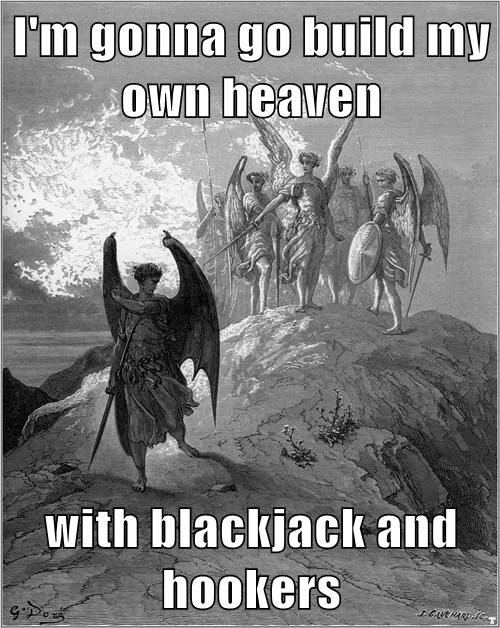
Satan is cast of out the hill of Heaven and cast in Hell’s canyons - by Gustave Doré

I laughed, I’m going to Hell.

16 Aug 20:54

buzzfeed: There’s a Chrome extension that replaces...


buzzfeed:

There’s a Chrome extension that replaces “Millennials” with “Snake People” and it’s pretty great. [x]

also relevant

15 Aug 19:46

Life update

Zephyr Dear

yay im helpin

so over the past couple weeks I’ve been coming to terms with the fact that there’s a really high likelihood that I’m autistic

the realization has basically simultaneously been hugely relieving and mildly world-shattering for me but it honestly explains so many aspects of myself that I never fully understood or has caused stress in my life

it helped me understand my interests, my cognition and speech problems, my relationship with gender, previous melt/shutdowns, and habits. all of what I thought were disparate events or symptoms in my life suddenly have begun clicking into place which is cathartic and emotionally exhausting at the same time

it’s also made me realize I still have a lot of icky ableist notions swimming around in my head cuz I keep feeling retroactive shame and embarrassment for expressing myself in ways that would be considered weird because I didn’t know that I was “broken”

it’s such a nasty word and it has so many icky icky connotations but it’s the word that’s been echoing through me since my realization and I’ve started questioning my perceptions and second-guessing every relationship and social interaction I’ve ever made

I kinda fell off the face of the earth for a little while and stopped talking to everyone even my family and they think I’m ignoring them but really I just don’t know how to talk to them about it

but I’m coming back into functioning society slowly. A and T have been good support, mostly helping me not be such a slump and remember how to talk to people (also shoutout to J for being a trans/autistic sounding board while I get my thoughts out of shambles). Y'all know who you are

so if you haven’t heard from me lately that’s why I guess

in other news I might get a septum piercing today cuz they’re really cheap at high class in se pdx and I’m feeling impulsive

15 Aug 16:55

clatterbane: madeofpatterns: withasmoothroundstone: gaycommunion: I think part of what bugs me...

clatterbane:

madeofpatterns:

withasmoothroundstone:

gaycommunion:

I think part of what bugs me re: the Stonewall rhetoric is that it’s answering erasure with more erasure and this weird neohomophobia that tons of “queer” tumblr bloggers seem to possess.

To remove the trans folk and POC from the events of Stonewall is racist and transphobic. There’s no other way to discuss that, but there’s literally people on here who claim that Stonewall “had nothing to do with gay men”. There’s people suggesting that the raid of a gay bar, whose main visitors were gay men, that was extremely popular due to allowing gay men to dance with each other, and the resulting police brutality it had that included gay men,…. had nothing to do with gay men? …what?

The idea that cis gay men had nothing to do with Stonewall, especially the first night, is just historically inaccurate, especially when we have names from the 13 arrested for assaulting officers and rioting that include gay men. Even Sylvia Rivera has gone on record to state that the amount of GNC-folk and street queens present the first night wasn’t as many as people believe because the Stonewall was a bar mainly for gay men and many street queens or lesbians had to know someone to be able to get in, with the amount of street queens allowed usually capped per night.

You should be mad at the white-washing and cis-washing and be angry and boycott the movie, but the dangerous reactionary discourse to literally rewrite history and suggest cis gay men weren’t at all present, when they were realistically the largest group represented by the very nature of a bar for gay men being raided, does nothing to advance or progress anything.

There’s also a thing that happens around things like this, where there’s a denial of the strong ties that have always existed between the trans and gay communities.  In particular, there have always been trans men who found a home in the lesbian community and trans women who found a home in the gay community, and there always will be.  This does not mean (as some people oversimplify it to) that trans men are just “really extreme butches” or that trans women are just “gay male drag queens” (although there are some trans men who live as lesbians, butch or otherwise, and trans women who live as drag queens).  It does not mean that trans women who are lesbians don’t belong in the lesbian community or that trans men who are gay don’t belong in the gay male community.  It just means that until very very recent history there was not such a strong division between gender and sexuality for some people, and there have always been trans people who have found a home in the gay and lesbian communities because of the way those communities dealt with gender.  And there probably always will be.  

It’s just become very risky to talk about this openly among people who will take it in every possible wrong way that there is to take it.  But the fact is that there has always been a very close tie between some trans people and the gay and lesbian communities (especially before the whole idea of being trans existed as a separate thing, because that’s when these communities evolved), and there’s nothing inherently wrong with that as long as people don’t misinterpret it as meaning all kinds of things it doesn’t actually mean.

Also, it’s telling to me that these ties between being trans and being gay exist in many different cultures, not just the white Western lesbian and gay communities.  I’ve seen many examples of cultures where there are identities that are not possible to classify as specifically either gay or trans by Western standards but that include elements of both – which is also how things were in large parts of the Western gay and lesbian communities until it became considered wrong to conflate gender and sexuality.  But there are serious reasons that gender and sexuality do get mixed like that, all the time, in lots of cultures around the world.  They don’t always get mixed in the exact same ways, but they do get mixed, and that’s because there’s connections there that go deeper than ideology.

And if anyone takes any of what I said in a transphobic or homophobic or trans-exclusionary way, you’re completely missing my point, because that’s not what I mean, I guarantee it.  And I know this may seem like a tangent from what I’m replying to, but it does fit in with it – it’s the reason there were both trans and gay people at Stonewall, and the reason that not everyone can agree on which people to identify as trans vs. gay, and the reason that there were undoubtedly people who would refuse classification as just one or the other by modern standards.  (And boy do I see a lot of people using highly modern classification on people who were from a time when these modern classifications didn’t exist in the same form they are now.)

Partly because being gay is, in itself, seen in large parts of society as failing at gender and not really fully being a man/woman. Regardless of overall gender presentation.

Like, the word for homosexuality used to be “sexual invert”. 

I see this also in how people want to claim Pauli Murray as either a lesbian or as trans or as queer and… maybe today she’d identify as one of those things. Or some of those things. But at the time she didn’t. And there’s something… anachronistic about insisting on interpreting her that way. And it’s not really knowable *which* of those things she’d see herself as, if any.

She is an elder of a previous generation who we need to respect. And part of that respect is… listening to how *she* saw herself. And why.

I was actually thinking along similar lines earlier today, starting into an autobiography from Jayne County who was also there. (Which I got curious about, after another recent discussion of a related topic.)

Not even to page 50 yet, but here’s a pretty relevant quote:

There were certain divisions in the gay world even then, but we didn’t have the words for them. Everyone was just gay as far as we were concerned; that was the word we used. I remember reading Christine Jorgensen’s book, and she said she wasn’t gay, she was this thing called a transsexual. But Diamond Lil would say, ‘Oh, she’s too much, she’s gay, Miss Thing!’ It didn’t matter whether you were a very straight gay man, or a screaming street queen, or a full-time drag queen, or a transsexual who wanted to have a sex change: you were gay. We considered ourselves to be the ‘flaming’ side of gay life. That was another expression we’d picked up from Diamond Lil. Whenever there was a documentary on TV or an article in the papers about homosexuals, they’d always have their eyes blacked out and they’d be sitting in the dark mumbling their confessions, and we’d get really annoyed. I complained to Diamond Lil about one of these programmes, about how depressing it was, and she said, ‘Yarr, darling, they should show ze flaaaaaaming side! La girls! La queens!’ That’s what we were: flaming creatures, just like the title of the Jack Smith film.

Christine Jorgensen actually came to Atlanta to do her one-woman show, so I was aware of the idea of transsexualism from quite early, but I didn’t know where I stood in relation to that. I was relating very much to this blanket idea of ‘gayness’, and my transsexual realisation didn’t come till a lot later. In the 60s, people weren’t making divisions as much as we do now; we didn’t talk about gay, lesbian, transsexual, bisexual, transvestite or anything it was all just one big grab-bag of being different. Sometimes I think we’d all be a lot better off without all that classification and arguing about terms, although I recognise that it’s a very basic human need to be able to say ‘I am THIS.’ But now that people know so much more about sexual minorities, it seems harder. I know people have to learn about other people’s lives in order to become more tolerant, but sometimes that makes bigotry worse. The more straight people know about us, the more they have to hate…

I ended up spending most of the Summer of Love in the Stonewall. I never did make it to San Francisco. The Stonewall Inn was full of drag queens, hippy queens with long hair down to their shoulders, butch lesbians in men’s shirts, a few straight people. All types. It was just a little room with a bar on the right and a brick wall at the back, with a jukebox playing everything from the Supremes’ ‘I’m Livin’ in Shame’ to the Doors’ ‘Hello I Love You’, and everyone danced the boogaloo and the shingaling, which were the big dances that year. I was there every night…

That was published in 1995, coincidentally just a few years after I started getting involved some with LGBTQ* communities. The common terminology and ways of looking at things were kind of different even 20 years ago, and the language in the quote reflects that.

(For one thing, there were a decent number of people still identifying as transsexual. She no longer IDs that way either, and has commented on having bern just as glad to ditch it because it sounded so medicalized. BTW, the first context I saw “trans*” used in, was explicitly meant to include people who ID'ed as transgender and transsexual. I don’t use it anymore, as much as the common rationale has changed there.)

But, I think it’s important to keep in mind that the ways people within our communities understand and look at things has changed a hell of a lot since the late ‘60s. And, from everything I have seen, the Stonewall (among other places) was open to just about everyone who wanted to go there. It attracted a pretty wide variety of people.

From other context, I think the “straight people” reference there was meant in a late ‘60s sense too, the same as “very straight gay man” earlier. Basically meaning people who wouldn’t stand out that much as compared to the ones seen as queens and/or hippie types then, rather than the way it’s currently used. But, yeah, just “plain” cis gay men and lesbians by current standards went there too.

That definitely shouldn’t get presented as the only group of people there, or the ones who primarily got fed up enough to start chucking bricks around and setting fires. Much less in such a whitewashed way. It’s dishonest, disgusting, and erases at least half the people who took part in the riots. Just adding that explicitly, because it is important.

13 Aug 03:27

kidbuudha: knowledgeequalsblackpower: knowledgeequalsblackpower:...


kidbuudha:

knowledgeequalsblackpower:

knowledgeequalsblackpower:

I’ve seen people mention cultural appropriation and about how this is all about what sells$$$. But what I think is missing from the conversation is the history of Compton.

During the Great Migration, hundreds of thousands Black people migrated out of the South into the cities of the North and West in hopes of WWI & WWII jobs and to get away from crazy white people in the South. They were sad to find out that America was racist from sea to shining sea and there was just as much discrimination in their new homes as there had been in the South. In L.A., Blacks (as well as Asians, Mexicans and Native Americans) faced harassment and couldn’t go or move into certain neighborhoods/areas. One of the areas they couldn’t move into was Compton.

Back then, Compton was a suburb of L.A. and it was the white “suburban American dream”. It was completely white. However, as Black citizens and lawyers (particularly Thurgood Marshall) beat formalized racism in the courts (i.e. Shelly v Kraemer and Brown v Board of Education), new Black migrants set there sights on Compton. 

  • In 1955, Blacks made up 17% of Compton’s citizenry
  • In 1960, Blacks made up 40% of Compton’s citizenry

However, that didn’t mean it was integrated. Informal policies upheld by the majority White population (realtors, businesses, school officials, politicians, everyday citizens, etc.) maintained segregation. One of these informal policies was violence. Black people were harassed and abused by the LAPD and white gangs like the ”Spook Hunters“. There was literally two Comptons… one Black, one white.

People like to romanticize the Civil Rights Movement, but they forget there were a lot of scary race riots across the U.S. in the 60s as well. The government decided to enact programs to fix income inequality. White people got angry and the racial tension that was is always there began to bubble to the surface. There was lots of violence. One of the most violent riots was Watts Riots.

Watts Riots (August 11-15, 1965)
The backdrop: Race relations were strained all over in the 1960s, and Los Angeles was no exception. Growing tension between blacks and whites and between police and civilians added fuel to the fire.
The final straw: A white California Highway Patrol officer pulled over and arrested a black man for driving drunk, but the growing crowd of witnesses soon turned antagonistic. The mob grew angry, and when the CHP officer wound up arresting the man’s brother (also in the car) and mother, full-flegded riots broke out in the Watts section of town. Fires, violence, and looting were rampant for days, and the riots would be the biggest in L.A. history until those in 1992. The National Guard eventually came in to help. At the end of the spree, 34 people were dead, more than 2,000 injured, and almost 4,000 arrested.

Rather than doing the right thing and ridding the city of its racism, white Compton residents decided to just abandon the city. This phenomenon is called “white flight”.

image

The development of the freeway system made it easy for whites to travel farther away to the suburbs, further instigating segregation. Blacks soon overcrowded the South Central area of Los Angeles, eventually boxed into an area confined within the largely uncrossable borders of the 110 and 10 freeways and Pico Boulevard.

As America’s economy shifted from a manufacturing base to the service sector in the 1970s, many jobs left Compton. This is really when Compton enters into a decline.

By the 1970s, the area’s density and shortage of manufacturing jobs increased crime and branded the black communities - even including more affluent and middle-class nearby neighborhoods like Baldwin Hills - as one large, notoriously violent enclave.

By the 1990s, the mere mention of the name Compton had become so toxic that the nearby southern California suburbs had the city of 100,000 erased from their maps. Its schools were crumbling. Drugs were rampant, and street-gang tensions had escalated into what historian Josh Sides describes as “a brutal guerilla war.” The city became the U.S. murder capital, per capita, surpassing Washington with one homicide for every 1,000 residents—and the details were numbing. In 1989, a 2-year-old was gunned down in a drive-by as he wandered his front yard; a 16-year-old was shot with a semiautomatic weapon as he rode his bike. 

And this is the climate under which Niggaz Wit Attitude emerged. Their violent, aggressive storytelling reflected and brought attention to the deterioration of Compton. NWA spoke out against the notorious L.A. Police Department. They went multi-platinum and ushered in a new form of music, gangsta rap. All this was in spite of the fact that radio wouldn’t play their music and MTV wouldn’t play their videos. The FBI even sent them a letter trying to censor them (apparently they didn’t like “Fuck tha Police”). It was the emergence of NWA that crystallized “the image of Compton as a defiantly violent ghetto,” an image the city is decades later still trying to change.

Two decades later, Compton has a new lease on life. The community is still poor, and unemployment is more than twice the national average. But the number of homicides is at a 25-year low, slashed in half from 2005. There are fewer gunshots and more places for kids to go after school. Alongside the liquor stores and check-cashing stands are signs of middle-class aspiration: a T.G.I. Fridays, an outbreak of Starbucks and a natural-food store. Along the way, blacks became a minority in Compton, which is 60 percent Latino today.

And they just got a fierce new mayor. But the point is, people still live in Compton and thus their lives are impacted by all the history of their environment. The LAPD is still corrupt and racist. Regardless of whether or not Forever 21 has truly pulled the shirts, you can easily find these same shirts on etsy or on other places online. But, why would you want to wear that? Compton exists. If you’re not from there then???? It’s just very tacky. 

(via The Compton Clash, ForensicColleges.net "10 Worst Riots in America”, PBSKCETNewsweek

Reblogging since the “Straight Outta Compton” film is coming out soon and we will be marking 50 years since the Watts Riots on August 11th. 

^^^

12 Aug 17:33

Interactive movies make their glorious return

by Leigh Alexander

It was the 90s. Games had their big chance. Personal computers had surged into homes and schools, promising education and entertainment innovations at our fingertips. Iridescent, futuristic CD-ROMs were suddenly everywhere: You could have an entire color encyclopedia on a single disk. You could get hundreds, no, thousands of free America Online minutes on a CD. And you could have a serious, adult computer game with real-world actors and blood and sex and all kinds of grown-up stuff—even if it took 5 discs.

When the Sierra On-Line horror adventure Phantasmagoria (7 discs!) made it into my family home, I had just gotten my first period. On the sight of the package—abstract curtain-wings embracing a beheaded woman—I knew things were about to change. Although I had enjoyed the adventure tales of King Graham and his family in Sierra’s previous King’s Quest game, this, I felt sure, was a game for grown-ups. My best friend and I huddled around it after school, delighted to view such illicit and terrifying material.

It had lots of things we hadn’t seen before up to that point. A chilling lullaby lures you to a rocking chair that moves on its own! Every chapter, the fortune-telling mannequin gets a little bit scarier! It has truly gruesome death scenes, a part where you have to hide in a coffin from your possessed husband, and even a rape scene—to my mind at the time, just more squicky adult stuff to alternately giggle and thrill at.

Phantasmagoria, like many contemporary titles, just seemed to be fundamentally more "mature" at the time thanks to its real-world actors and full-motion video. Replaying those games today, though, you see an ill-fated detour of game history for what it is: an idealistic millstone.

The things that are creepy to me about Phantasmagoria today have to do with its dissonance: The blurry wisp of a video actress hangs numbly greenscreened against gooey computer-generated objects, occasionally repeating idle movements as she waits for your command. You repeat the same letterbox film of her leaving one room, entering the next, every time you want to navigate the house.

You make the actress march around all the screens, tediously, for something that has changed. There is an unsolicited thirty-second video of her looking around, petting the bed curiously. You click on a faucet or a mirror: Usually nothing happens, except you get to watch her use it, self-consciously and dutifully. Later you research the actors and actresses of the FMV game age and find that with the exception of some notable celebrity cameos (recall John Hurt as a comedically-unscrupulous, fourth wall-breaking psychiatrist in the clunkily psychosexual Tender Loving Care), a good many of the performers’ backgrounds are in softcore.

It’s a problem that the video game industry has had for some time: the conflation of "realism" with maturity. The more plausible your graphics are, the more dignified your stupid ghost slime murder boobs story will be. Much as it is today, many of these plays for "realism"—especially the hunger for a legitimacy that might come with expensive Hollywood actors—actually makes worse games out of unsustainable development budgets. There’s a reason that "FMV games" never 'stuck'.

But lots of fans remain profoundly fond of that era, the way we love our teenage selves for trying so damn hard, fumbling for our way. The combination of naivety and ambition, of "adult" aims with clumsy adventure-game interfaces, or the video avatar pulling, say, a fireplace poker out of the thin air behind them when the player clicks the "inventory". Games are a medium young enough that some of today’s fans were around to see the first ones made. We all love our cult stuff, our cheesecake.

And while the use of video might be only dubiously compatible with what we understand to be conventional game designs, there’s nothing inherently frictive or inaccessible about video itself. Recent mystery release Her Story relies on video recordings of an actress partially as a "retro" tactic; the whole game has a pleasantly-textured ‘90s throwback feel. But it’s also about searching a database and reviewing police interviews, and watching videos is the most natural, accessible mechanic to offer a player.

Quirk, nostalgia and ease of use are three decent reasons not to shut the door on the possibilities for video in games, particularly when it comes to the mystery genre, to which video is especially well-suited—it not only conjures the creepy voyeurism of late-night crime television, but the game can use realistic human behavior and movement as a mechanic, engaging the player to read body and facial language to look for suspects’ lying behavior (an entire tech company was sprouted to create the same effect for Rockstar’s dubiously-received L.A. Noire).

I tell an absolute truth: Lately, a video murder mystery served up the best time I’ve had of any computer game recently. Some friends and I spent a weekend at a country house recently, and next to an actual fireplace, we decided for some reason to try Contradiction: Spot the Liar, a video murder mystery we expected to be terrible and hilarious and the perfect thing for us all to shout at while we became persistently less sober on our holiday.

It was all of these things. And it was also particularly impressive because it managed to marry all the things we loved about old FMV adventures—goofy character performances, the beloved awkwardness of some of the conventions—with actual mechanical innovation.

The central convention of Contradiction: Spot the Liar is that to solve the mystery—a student has died under mysterious circumstances in a small town—you must catch the characters you interview in contradictions with themselves. That’s all. While random events may occur that give you further inventory items or information, you mostly unveil the story by interviewing people; the things they tell you become statements you can call them on later, and you’re listening for the times they say two things that cannot both be true.

Someone could be overtly lying to you, but unless they have contradicted themselves, you can’t advance the story. As such there is the repetition people tend to dislike about adventure games—visiting and revisiting areas carefully when you get stuck, looking for what you missed—but there’s none of the infamous pixel-hunting, screen-searching, or combining objects in absurd and frustrating ways. And the constraint can actually be delightful, inspiring creative play—when you can’t call out a liar, you look for other ways to call out the untruth by talking to someone else. It has the expected slow and frustrating bits, but it also has a "cheats" system (we’ve never had to use it) and a "current tip" (we use it liberally).

It’s streamlined and good for groups, especially for parties where people don’t normally play video games. It serves up cheesecake from the moment its gilded logo first comes shimmering onto the screen (is that the Contra font?). You play a hero detective, Jenks—actually, we’re not sure if he’s really a detective. He wears a broad-brimmed hat and shiny shoes with curly toes, and he often phones up a nebulous "chief", but he never shows anyone a badge, and in the brief exposition all we’re told about him is that for some reason he has "until first thing tomorrow morning" to solve the week-old crime.

The actor is wildly expressive and wonderfully anti-charismatic. It’s as if the game knows that any leading man would gain an inherent absurdity, being directed by the player to plod around knocking on doors and windows multiple times per hour, presenting dozens of objects and facts to tolerant strangers. Therefore why not eschew the chiseled detective in favor of casting an incredibly absurd person; his performance is inescapably glib, funny and gleeful—"what would you say… if I showed you this," he will deadpan sincerely, brandishing a flyer or a packet of herbs or, no word of a lie, a set of devil horns, with admirable flourish.

All the other actors carry their weight admirably: They are just ridiculous enough, just suspicious enough, giving facial performances that are alternately vaunted and sincere, believable but also easy to laugh about. Contradiction is just perfect at what it wants to be: A retro tribute with some modern conveniences, all the best and weirdest parts of an ambitious bygone age with none of the impracticalities.

When you become an adult, you learn that "maturity" has little to do with realism, or blood, or salaciousness, or grit. It can mean populism and playfulness; graduating from being kids hushed guiltily around the Night Trap "bathroom scene" to being a party of adults flocked in earnest good humor around an utterly unpretentious "video murder mystery". Try this game, drink a bunch of wine and laugh together about old times. That’s one of the things playing games is really great for.

11 Aug 04:49

i think most of my regrets are losing friendships or relationships (not romantic ones, not that type...

i think most of my regrets are losing friendships or relationships (not romantic ones, not that type of regret) and so a lot of me performing myself is performing myself as “someone worth knowing still” or like always sweeping out stuff so the Other can come back (it’s not coming back)

i remember when i was a kid i was told that greek hospitality was about not ever knowing if a god was visiting you. and i tend to want to never give up on people or strike them from my life in some impulse like that – couldn’t any eyes be grey, in the right light?

i have a running list of friends or acquaintances i think “i would welcome them back, but they are never coming back”. at least nowadays i also have a list that i don’t keep of people i did cut off, without any regret

every person, i do think, can show you a different part of yourself

and so in this weird way i tend to think, anyone i lose, there i am lost, forever

The Return of the Other is also some kind of return of the self, so i take rejection to mean, “you don’t offer them a self they want to know of themselves” and it is sad to be giftless

when i feel i am that, i try to think about being a creature without human language. connected instead beyond a distance of silence to a different hospitality and strangeness

10 Aug 18:56

Rolling Stones' stage hands can't get no remuneration

by Jason Weisberger

rollingstones-650x380

Seems the Stones bounced 100 paychecks to the stage hands who worked their Buffalo, N.Y. show.

Rigging the Ralph for the Rolling Stones was a 'satisfying' second job for Justin Booth. He worked long hours surrounding last month's show. "We set up the day before and took down after the show," Booth said. But Booth was far from satisfied when he checked his bank account, after depositing his check. The check had bounced. "When I called the bank, they said it was debited from my account because it was non-sufficient funds from the people that issued the check," Booth said.