Shared posts

19 Oct 04:56

A single game as a lifelong hobby

by Daniel Cook

Do you finish one game and then move onto the next? This is the dominant pattern of play for gamers. What happens when players stop consuming and starts investing in a single evergreen computer game for years on end?

Players of traditional games specialize

Across the 5500+ year history of gaming and sports, players typically focus on a single game and turn it into their predominant hobby. A chess player may dabble in other games, but chess is their touchstone. They join chess clubs, they play with fellow chess fans and they spend 90% of their gaming time playing chess. Overall, players specialize.

Such players do play other games, but to a far lesser degree.

There are also communities that embrace the identity of being good at multiple games or sports. These are a minority.

And some are inclined to claim all hobbyists are 'athletes' or 'players' and thus unified in some common tribe. Such verbal gymnastics rarely provide much insight into a dedicated hobbyist's specific passions or the nature of their community.

Specializing in a hobby occurs for many reasons. Traditional sports or games often have the following attributes:
  • Evergreen activities: You don't beat them. You stop when you get bored. Usually they consist of nested loops that operate on time scales of up to a generation. Consider the nesting of Match : Event : Season : Career : Training the next generation.
  • High mastery ceiling: Most are nearly impossible to master completely. You can always get a little better. You can always get better at Go, Soccer or Poker.
  • Strong communities: There exist strong social groups of like-minded players that have their own group norms, hierarchies and support structures. To be a dedicated basketball player is to be part of an extensive basketball playing network.
  • Life long identities: Someone who excels in the game starts to identify as a member of that group. The game becomes source of purpose bigger than themselves. They can look back on their life and say "There were some ups and downs, but I'm secure in my accomplishments as a player of game X"
  • Grass roots or service-based business models: Any cultural structure can be fruitfully analyzed by understanding the flow of money. Many traditional games have extremely low barriers to entry. It costs little to access the initial equipment. Often items like decks of cards or chessboards are either communally owned or purchased by a family and one set of equipment serves multiple participants.

    At higher levels of play, cash flows into the ecosystem through purchases of more advanced or higher status equipment or various service, membership or event fees. In all cases, the businesses involved have strong financial and culture incentives to get you playing and keep you playing.

Players of digital games consume

The hobby of computer or console gaming follows a different usage pattern; gamers play a wide variety of games. NPD claims core gamers buy an average of 5.4 games in a 3-month period. In a recent discussion of Steam purchases on Kotaku, commentators chimed in that they had purchased 100 to 800 games. These are played for a period of time and then set aside so that a new game might get some play.

These players specialize far less. They may prefer a genre of games such as RPGs or shooters, but they'll still consume many games within that genre.

Why the difference in playing patterns? Commercial digital games have some distinct attributes that encourage serial play instead of evergreen play. Not all digital games fit this mold, but the trends are worth noting.
  • Complete-able games: Most computer and console games can be completed in 5 to 40 hours. It is rare that you find digital games that retain users longer than 6 months. Actual playtime is shorter than the official length since most players do not complete their games and even fewer play through a title more than once. Compare this to the generational nested loops of traditional evergreen games.
  • Narrative and Puzzle-focused gameplay: The majority of the gameplay is focused on high burnout single use puzzles or evocative narrative stimuli. Designers spend their budget handcrafting specific scenarios for maximum emotional impact the first time through.
  • Low mastery ceilings: Since the design goal is to move players through the content of a game as smoothly as possible, the game mechanics are generally balanced towards the average skills of first time players. It is rare and surprising when a single player narrative computer game offers examples of masterful play. All this leads to early burnout where players rapidly become 'bored' and put the title aside.
  • Weak player identities: It is difficult for a player to establish their identity around their excellence in any one game. To be a good Braid player just isn't that special. Lots of other people have walked the same path; there is little player creativity and outside the occasional Let's Play video, few people care.
  • Content-focused business model: Digital games businesses have a strong financial incentive to get you to pay upfront and then move onto their next title. Games are treated as a content or boxed product business. An optimal strategy is to put high quality boxes on shelf (either physical or virtual) and get people to buy as many boxes as possible. Since exciting content remains a large cost center, there is ever increasing pressure to make games flashier and more marketable on the front-end and shorter on the back-end.
Shortness of play is perhaps the key reason why players end up consuming multiple games. With gamers spending 16-18 hours a week gaming, it doesn't take long to burn through a single title. When a single game fails to entirely fill a person's leisure time, players buy additional games. Only a set of multiple consumable titles provides enough engagement for someone to make a full-fledged hobby out of content-based games.

This fits the general profile of a media hobbyist. As we shifted from evergreen hobbies to digital retail-focused games, we trained users to behave in a fashion similar to that of a reader who reads many books or a movie goer who watches many movies.

A media culture

To be a 'Gamer' is to buy into numerous requirements that only exist to enable the creation of easily consumable media products.
  • Reviewers exist to help players select their next media purchase
  • Critics exist to demonstrate how media conveys a message to society. They are trained (if they are trained) in other media-centric fields such as movies or literature. There is little systemic thinking since media is first and foremost not a functional system but an evocative stimuli.
  • The form of popular games is determined by whether or not it fits in a media box. Form is the standardized structure of a piece of media. The 2-hour narrative movie is a form of video. The 300 page novel is a form of writing. So too is the 14-hour adventure game or the level-based narrative FPS.
  • Stores and storefronts exist to sell the hobbyist a steady trickle of new media. Since media creation is expensive and the share of a player's time is small for any single piece of media, aggregators of content are typically 3rd parties that don't produce all the media themselves.
  • Communities are built around mass media that act as a shared experience for large populations of consumers. Big brands like Mario, Mass Effect or Final Fantasy form cultural anchors much like Star Trek or Star Wars. Comparisons, reminiscences and fan fantasies about future sequels or expansions are common.

Digital evergreen hobbies

Into this media-centric ecosystem we've seen the reemergence of major games that hew more closely to the traditional games of old. MMOs like World of Warcraft or MOBAs like League of Legends are services. A digital game like Minecraft ties into numerous communities and is often played for years. Some like Halo or Call of Duty cleverly camouflage themselves as traditional consumable boxed products all while deriving long term engagement and retention from their extensive multiplayer services. These games share many of the attributes of older hobbies:
  1. They attempt to be evergreen.
  2. They have high mastery ceilings and robust communities.
  3. Many, especially eSports, replicate the nested yearly loops of a traditional sport.
Each of these games is a hobby onto itself. People predominantly play a single game for years. In one poll of 5400 WoW players, 49% claimed to never actively play another MMO.

The rise of services

This shift to services is accelerating, driven by business factors and steady player acceptance. Developers are slowly coming around to the realization that an evergreen service yields more money, greater stability and a more engaged player base. Experiments of the past few years with social, mobile and Steam games suggest that microtransactions will likely become a majority of the gaming market. They already represent 70% of mobile revenue and continue to grow rapidly on other platforms.

This new revenue stream places new constraints on game designs.  Types of laboriously handcrafted content that was once feasible when your game was played 10 hours is no longer profitable if revenue trickles in over hundreds or thousands of hours of play.  Deep mechanics once again matter.  Communities you want to spend time in become a competitive advantage.

There are indeed manipulative companies scamming settlers in this newish frontier. Don't act so surprised. This is the case for any frontier and this is not the first time games have attracted disreputable developers.  Look beyond the flashy, inevitable crooks, just as you looked beyond the licensed games, the porn games and the gambling games that infest your typical game markets.  Look at the big picture and observe where the new opportunities for greatness blossom.

No, they won't cross over

These new evergreen players become hobbyists, but not media-centric gamers. This is most evident in the audiences that play 'casual' social and mobile titles. Many of these players never bought into the current gamer culture. It is common to see someone deep into Candy Crush and when you ask them if they are a gamer, they will deny it. They do not 'game', they never have 'gamed'. They don't share a common heritage of Mario, Zelda, COD, Halo or any of the mass media touchstones that unite current gamers. What they have is a wonderful hobby that in their mind has nothing to do with existing computer games.

There exists a fantasy that somehow new players will get hooked on one game and then transfer over to consuming other games. Since this assumes a play pattern of high volume serial consumption, I doubt that this will occur. Great evergreen games leave little room in a hobbyist's schedule for grand feasts of consumable content. You don't finish a great hobby and then look for your next dalliance. You keep playing the game for years or even generations.

 The perfect service-based game is one worthy of your entire lifetime of leisure.

If this seems an exaggeration and current titles feel unworthy of this high bar, wait a while. Developers are very talented. And the financial incentives to build the perfect service-based game are strong.

Not one gaming hobby but many

So where does that leave our understanding of 'gaming?'
  • Some people avidly knit in their leisure hours.
  • Others play a creative game like Farmville, Dwarf Fortress, Minecraft or the Sims.
  • Others participate in a social online game like World of Warcraft, Eve or Facebook.
  • And then there is a small but active community of proudly old-school Gamers that like consuming puzzles and story media.
What we currently think of as 'gaming' becomes just another hobby amidst a vast jungle of digitally augmented hobbies.

There are those who might see this as a threat, but that is mere fear talking. Existing hobbies tend to last for at least a generation. Those who've tied their identity to consuming media-style games as their hobby will stop participating in the hobby when they die. I expect to see 80-year olds still buying adventure games because that is what they were raised on and that is what they love. Niche producers can make good money serving these avid fans.  The rise of new hobbies thus do not invalidate a current hobby.  In fact, you'll have media-centric games for at least the rest of your life.

 Though each hobby likely will need to compete for new members.

Impact on the cultural ecosystem

With this shift comes change. The following may challenge your existing expectations.
  • Specialized interests, not shared experiences: The drop rates on defense potions matters little to your typical gamer. Yet it is of earth shattering importance to the community of Realm of the Mad God players, impacting hundreds of hours of their life. At a certain level of mastery, the language used to describe in-game concepts becomes indecipherable to casual audiences. This inhibits communication with external groups, but facilitates bonding within the group.
  • Deep systemic analysis, not broad media criticism and reviews. Hobbies are predominantly comprised of human systems and communities, not texts to analyze or boxes to sell. Political, anthropological or economic forms of discourse are more appropriate yet there are few game critics trained in these fields. Successful commentators are typically past players with a master-level understanding of the hobby. They are rarely dilettantes flitting from media event to media event.
  • Unique cultures, not mass cultures: A hobby can develop a set of inward facing social norms. This can be a negative if extreme viewpoints are allowed to fester. It can also be a huge positive and promote inclusivity, equality and long term positive relationships. Each hobby is a cultural petri dish that need not adopt dominant tropes or values.
  • Participation, not marketing campaigns: New players of a hobby hear about it from a friend or stumble upon a free trial. They participate first and see if they enjoy the lifestyle that the hobby promotes. Big bang media events can flood the early stages of the acquisition funnel, but they do not directly result in revenue or a sustainable community. 
One aspect that surprises me the most is the stealthiness of inwardly sufficient hobbies. A smoothly running process is barely newsworthy for those unfamliar with the hobby. Over 5 million people partake in Geocaching, one of the greatest modern games ever invented.  Yet other than the occasional human interest story, it rarely breaks into the public consciousness. What would a media-focused rag say?  "People are having healthy fun...still.  Just like they were last year." That's not news. There is no new box to hype or content to whinge about.  There's no advertising to sell. So silence is the default until you look inside the vibrant magic circle. Geocachers return the favor by labeling outsiders Muggles.

Let a thousand flowers blossom

The concept of one true gamer community will be less feasible as evergreen hobbies grow in popularity. Instead, we have a crazy mixing bowl of diverse, separate, long-term communities. Few will share the same values or goals. Few players will consider themselves having anything in common with players of a different game.

Social organizations such as PAX will still promote common ground, much like the Olympics promotes common ground between athletes. But day-to-day cross-pollination will be rare.

I personally value a wild explosion of diversity. We need less mass culture and more emphasis on vibrant, generative communities instead of passive industrialized consumption.

The existing society of players may be tempted to deal with those not like themselves negatively through shaming ("I can't believe you play Farmville, stupid person!") Here's how we might instead react positively.
  • Freedom of Play: Like freedom of religion, any player has a right to devote their life to any game even if it isn't something enjoyed by another player.
  • Mutual respect: Any player deserves your respect for their hobby even if you do not personally understand it. Avoid stereotypes and engage with the person.
  • Willingness to explain: Any insider should be willing to explain to an outsider how their hobby works. Proselytize by inviting them to play with you. An open-minded outsider should be willing to listen.
The fact that individual hobbies exist is not new. The shift comes from realizing that individual digital hobbies will soon to be the default play pattern. Adapt accordingly.

take care,
Danc.

References and Additional Links

Note: Gamers often wonder why Farm Equipment simulators sell.  Judged as mass media, they are horrible.  Judged however as an independent hobby, they have many of the attributes of an engaging lifelong interest.  If you laugh at them, it is because you are outside their tribe and ignorant. 
09 Oct 23:50

Your app makes me fat

by Kathy Sierra
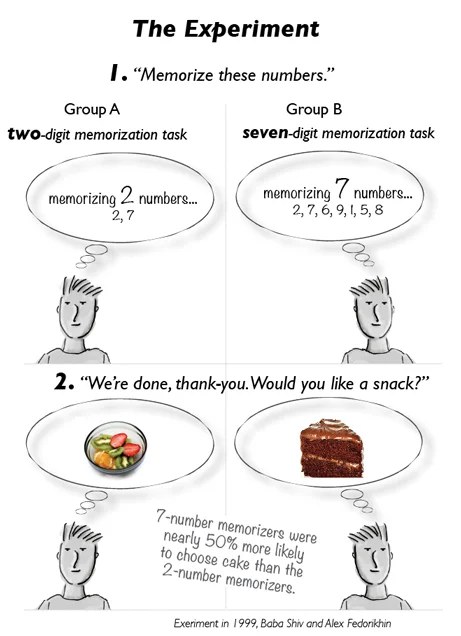
FixedMemorization.jpg

In 1999, Professor Baba Shiv (currently at Stanford) and his co-author Alex Fedorikhin did a simple experiment on 165 grad students.They asked half to memorize a seven-digit number and the other half to memorize a two-digit number. After completing the memorization task, participants were told the experiment was over, and then offered a snack choice of either chocolate cake or a fruit bowl.

The participants who memorized the seven-digit number were nearly 50% more likely than the other group to choose cake over fruit.

Researchers were astonished by a pile of experiments that led to one bizarre conclusion: 

Willpower and cognitive processing draw from the same pool of resources.

Spend hours at work on a tricky design problem? You’re more likely to stop at Burger King on the drive home. Hold back from saying what you really think during one of those long-ass, painful meetings? You’ll struggle with the code you write later that day.

Since both willpower/self-control and cognitive tasks drain the same tank, deplete it over here, pay the price over there. One pool.  One pool of scarce, precious, easily-depleted resources. If you spend the day exercising self-control (angry customers, clueless co-workers), by the time you get home your cog resource tank is flashing E. 

The tank is empty.

And even if you loved solving tough puzzles at work, the drain on your self-control still happens. One pool. Whether the drain was from something you love or hate doesn’t matter.

Cognitive resource tank don’t care.

You snap at the kids or dog over the tiniest thing.

Or the dog snaps at you

DogExperimentWebVersion.jpg

An experiment asked one group of dogs to sit, just sit, nothing else, for a few minutes before being released to play with their favorite treat “puzzle” toy (the ones where the dog has to work at getting the treats out of it). The other group of dogs were allowed to just hang out in their crates before getting the treat puzzle.

You know where this goes: the dogs that had to sit — exercising self-control — gave up on the puzzle much earlier than the dogs that were just hanging out in their crate.The dogs that were NOT burning cognitive resources being obedient had more determination and mental/emotional energy for solving the puzzle. Think about that next time you ask Sparky to be patient. His cognitive resources are easily-depleted too.

Now think about what we're doing to our users.

If your UX asks the user to make choices, for example, even if those choices are both clear and useful, the act of deciding is a cognitive drain. And not just while they're deciding... even after we choose, an unconscious cognitive background thread is slowly consuming/leaking resources, "Was that the right choice?" 

If your app is confusing and your tech support / FAQ isn't helpful, you’re drawing down my scarce, precious, cognitive resources. If your app behaves counter-intuitively – even just once – I'll leak cog resources every time I use it, forever, wondering, "wait, did that do what I expected?". Or let's say your app is super easy to use, but designed and tuned for persuasive brain hacks ("nudges", gamification, behavioral tricks, etc.) to keep me "engaged" for your benefit, not mine (lookin' at you, Zynga)... you've still drained my cognitive resources.

And when I back away from the screen and walk to the kitchen...

Your app makes me fat.

If our work drains a user’s cognitive resources, what does he lose? What else could he have done with those scarce, precious, easily-depleted resources? Maybe he’s trying to stick with that diet. Or practice guitar. Or play with his kids.

That one new feature you added? That sparkly, Techcrunchable, awesome feature? What did it cost your user? If the result of your work consumes someone’s cognitive resources, they can’t use those resources for other things that truly, deeply matter. This is NOT about consuming their time and attention while they're using your app. This is about draining their ability for logical thinking, problem-solving, and willpower after the clicking/swiping/gesturing is done. 

Of course it's not implicitly bad if our work burns a user's cog resources.Your app might be the one place your user wants to spend those resources. But knowing that interacting with our product comes at a precious cost, maybe we’ll make different choices. 

Maybe we’ll think more about what our users really care about. Maybe we’ll ask ourselves at each design meeting, “is this a Fruit-choosing feature or a Cake-choosing feature?” and we’ll try to limit Cake-choosing features—the ones that really drain them — to that which supports the thing they're using our app for in the first place.

(Yes, cognitive resources can be partly replenished throughout the day by getting glucose to the brain, but be careful with that. A high-protein snack combined with small infrequent sips on a sports drink can help, a lot.)

But even if we can justify consuming our user's cognitive resources while they're using our product, what about our marketing? Can we honestly believe that our "content marketing" is a good use of their resources? "Yes, because it adds value." we tell ourselves. But what does that even mean? Can we honestly say that "engaging with our brand" is a healthy, ethical use of their scarce, precious, limited cognitive resources? "Yes, because our content is useful."

And that's all awesome and fabulous and social and 3.0ish except for one, small, inconvenient fact: zero sum. What you consume here, you take from there. Not just their attention, not just their time, but their ability to be the person they are when they are at their best. When they have ample cognitive resources. When they can think, solve-problems, and exercise self-control. When they can create, make connections, and stay focused. 

Is that "content" worth it?  Maybe. But instead of "Is this useful?" perhaps we should raise the bar and ask "Will they use it?" (and so, yeah, I'm more than a little self-conscious about typing that as I consume your cognitive resources. But I didn't start Serious Pony to save your cognitive resources; I want to help save the cognitive resources of your users).

I'm not against "content marketing". On the contrary, it's nearly the only form of cog-resource-draining marketing that can be "worth it". It's the one form of marketing that can help people become better at something they care about. It's one form of marketing with the potential to deliver the user-learning so few companies care about. Content marketing can (and should) be "the missing manual." It can (and should be) the inspiration for our users to learn, get better (at the thing they care about), and connect with other users

But if it's "content" designed solely to suck people in ("7 ways to be OMG awesome!!")  for the chance to "convert", we're hurting people. If we're pumping out "content" because frequency, we're hurting people. I'm hurting some of you now. That's on me. It's why I try to use graphics to make the key point, so you don't have to read the post (also because I'm really rambly-aroundy, I know, workin' on it.)

My father died unexpectedly last week, and as happens when one close to us dies, I had the "on their deathbed, nobody thinks..." moment. Over the past 20 years of my work, I've created interactive marketing games, gamified sites (before it was called that), and dozens of other projects carefully, artfully, scientifically designed to slurp (gulp) cognitive resources for... very little that was "worth it".  Did people willingly choose to engage with them? Of course. And by "of course" I mean, not really, no. Not according to psychology, neuroscience, and behavioral economics research of the past 50 years. They were nudged/seduced/tricked. And I was pretty good at it. I am so very, very sorry.

My goal for Serious Pony is to help all of us take better care of our users. Not just while they are interacting with our app, site, product, but after. Not just because they are our users, but because they are people

Because on their deathbed, our users won't be thinking,"If only I'd spent more time engaging with brands."

Help them conserve and manage their scarce, precious, easily-depleted cognitive resources for what really matters. To them. And don't forget to take care of your own. Think of the kids. Think of Sparky.

(That's actually my Icelandic sheepdog Boi) 

(That's actually my Icelandic sheepdog Boi) 

--This post began as a small essay I wrote for the lovely group at Uncommon

(And you really do want to meet the horses at our Icelandic horse farm.) 

(Update: fixed the memorization graphic -- thought bubble didn't match the text)

Comments now closed. 


29 Jul 02:32

July 27, 2013


Whee!
27 Jul 18:41

'So much darkness, so much desperation': Talking with the directors of 'Detropia'

by Dylan Matthews

Heidi Ewing and Rachel Grady are the directors of " Detropia ," a documentary released last year about the city of Detroit and what decades of industrial decline and population flight have done to it. It's on Netflix; I highly recommend it. It is their fourth documentary feature; they also contributed a segment to the "Freakonomics" documentary. Their second feature, "Jesus Camp," was nominated for an Academy Award for Best Documentary Feature in 2006. We spoke on the phone Friday morning; a lightly edited transcript follows.

Dylan Matthews: Thanks for taking the time, I really appreciate it.

Heidi Ewing: Thanks for having us. It's one of those films that I guess the time is still ripe for, especially right now.

Rachel Grady: We saw it coming, unfortunately.

Heidi Ewing: It was one of those things where people didn't want to hear the message of the film, necessarily.

Rachel Grady: Because it's bad news. People hate bad news.

Heidi Ewing: We were trying to do as positive a spin on it as possible, and we wanted it to be people who could leave but have chosen to stay, and there's so much darkness, so much desperation, that it was really hard to come up with the story that we did, where there's hope. There's always hope.

Dylan Matthews: One of the really powerful scenes in the movie is set at a town hall meeting, where Mayor David Bing is trying to sell the public on a plan to move folks toward the city center. What's happened with that initiative since you wrapped filming?

Rachel Grady: It was met with a really bad reaction. These are the citizens that have decided to stay. They're the ones, in general, that have put in all the hard work of keeping the city floating, so I think it's really devastating to them that they're the ones that have to move, after all their dedication to the city.

The other thing is that it's happening anyway, because services are shutting down very quickly in terms of safety — ambulances, police officers — and in terms of quality of life, like garbage pickup, or whether or not someone fixes the big hole in the road, in front of house, or if the city is mowing the large field across the street.

Heidi Ewing: They've cut services, already, to those areas. On paper it is a very smart idea to bring everybody into a few neighborhoods, because it is impossible to pay for services and manage such a vast tract of land.

When you look at Cleveland and Pittsburgh, and why they've done better than Detroit, besides diversifying their industries, the reason is that those are manageable spaces, especially a place like Pittsburgh. Detroit has this added issue of the industrialized wasteland. The sheer space makes it unmanageable.

One of the urban planners you see talking to the mayor in one scene is a really smart guy, and I turn on the radio the other day and there he was, being interviewed by "All Things Considered." The attempt to make it official, to get people to move, is going to come alive again. There's no financial incentive to get anybody to move, so they're trying to make it voluntary. I think if there was a financial incentive, many would leave, but that's a fantasy.

Dylan Matthews: The movie showcases one young artist couple that moved in precisely because the city's gotten so cheap — they got a very swank loft apartment for $25,000. And they aren't alone. What are they getting out of being there?

Heidi Ewing: They got a Whole Foods out of it, for one thing.

It is happening. It's all true. There are young people moving in, and you can get a luxurious pad for cheap. Most of the newcomers, they're not going to feel the bankruptcy, because they already live in the area that the city is focusing on developing and is policing, where [Detroit businessman] Dan Gilbert is buying up skyscrapers.

I don't think that couple will actually feel the bankruptcy, but the vast majority of the residents will. About 50,000 won't and they're all living within 20 blocks of that Whole Foods. People will continue to move in. They're not afraid of municipal bonds — they don't know what that means.

Rachel Grady: That's a very interesting question. I want to see what happens to those people when they have to have kids

Heidi Ewing: There are no schools for their kids. They'll have to leave.

Rachel Grady: A lot of things have to come together for there to be a functioning city. The schools are a big part of it, and the schools are some of the worst in the entire country. We'll see if they get scared off eventually.

Heidi Ewing: It's an interesting question, and it's just so interesting that if it weren't for the lack of jobs for young people, it wouldn't have happened.

Detroit is benefiting from this recession in that people who would have never moved to Detroit in another economy — they'd be in Chicago, New York — are moving there. Detroit offers this urban excitement, they can live for cheap, there's this little micro-economy with restaurants and shops for people with some means, so it's actually a boon for Detroit in a weird way. That is the reason that those people continue to come. It's all part and parcel of this non-recovering economy we're all living in.

Dylan Matthews: Detroit's collapse has happened despite the auto industry getting bailed out and U.S. automakers making a big comeback in recent years. What explains that decoupling?

Heidi Ewing: The metonym for the auto industry has always been Detroit — "Detroit's bouncing back today" and so on. They should stop doing that, because the fate of Detroit and the fate of the auto industry diverged long ago. The fact that Chrysler and GM are bouncing back does not affect the local economy, and I think people still don't quite get that.

Rachel Grady: Even the people who live there believe that. They're kind of living in the past, in terms of there reality of the situation. This has been going on for decades. It takes a while for people to embrace what's happening. There's so much nostalgia about Detroit by Detroiters.

Heidi Ewing: It's the most nostalgic place in America, for sure. There are still people who will tell their kids and grandkids about the good old days, and the kids get confused and think they lived through that.

You sit down with Mr. Stevens at the Raven Lounge [Stevens is a major character in the movie - Dylan] and they're hanging out in their awesome suits and talking about the good old days in the plant and making a middle-class lifestyle. It's inspirational what happened to Detroit and you're kind of in it, and it's an epic spot.

I was born in 1971, I lived eight miles outside the city, and I never saw the good old days. I remember Japan ravaging all my dad's competitors, and his business barely surviving. But we're all hankering for a time none of us lived through.

Dylan Matthews: The city's seen a really striking demographic shift in recent decades, going from being 84 percent white in 1950 to 83 percent black in 2010, and had a lot of tension around that, the 1967 riots being the most notable example. How has that history, especially the riots, shaped things today?

Rachel Grady: I think that it was devastating to the city. A lot of people pegged the riots at the end of the 60s to the big corner that the city turned in terms of viability and quality of life, etc.

The vast majority of white citizens totally abandoned Detroit and never went back. This actually played out in a lot of cities in America. There was white flight everywhere. It's just like everything else with Detroit — it's not even that it's extremely original, it's just the scope is bigger. The scope is to devastating levels.

Do other cities have infrastructure problems and white flight? Yes. Did their economies collapse because manufacturing disappeared? Yes. None of it is 100 percent unique, it's just that it happened at such a devastating level.

Heidi Ewing: There are also built-in racial divisions, with the highways and byways. It's a car-centric place, so you can divide black and white neighborhoods in a much more efficient way, so that it's very hard to get from one place to the next. And you're stuck with that.

That's another way that the races were divided in a very efficient way. It's not just emotional and psychological. In Detroit, that separation was strategic.

Rachel Grady: Another irony is that a lot of Detroiters don't have cars.

Heidi Ewing: The percentage is crazy high.

Rachel Grady: And the bus system — they're losing bus lines. In the movie, you see the woman pleading not to take her transportation away. Without the bus, you can't even go to your minimum-wage job. Every which way you turn, it's hard to live there, unless you have means.

Heidi Ewing: And even a very basic level of means.

Rachel Grady: Take a place like the Bronx, which has some persistent poverty issues even though the rest of New York City doesn't. They have public transportation. D.C. has this problem, east of the Anacostia, where it's hard to get into the city.

Heidi Ewing: It's always about will. Could a huge amount of investment come into Detroit and everyone get $5,000 to move? Are we going to bail out American cities? You can't liquidate a city and hire a new CEO, so is the government going to get into the business of federally bailing out cities?

The foundations are there for years — Ford, Knight, it is a hit list of foundations that are working in Brightmoor and trying to bring people into the city, so in a way it's become an NGO hotspot. It's going to take very radical measures to fix Detroit, and I haven't seen anything drastic and radical happen in this country in a long time. It's hard to see how this turns around. I really hope we're surprised.

Dylan Matthews: How insulated have the suburbs been from all of this?

Heidi Ewing: There's definitely been an uptick in crime in the suburbs in recent years. It's always going to permeate the suburbs, but it's pretty insulated, to be honest. Basically just a few of the bordering towns, like Southfield and Dearborn, and even maybe Ferndale — the closest suburbs to the city.

I think that their demographics have changed a great deal. Anyone who could leave has left. If you work for suppliers, like my father was, or as an engineer or lawyer, auto is still present there. A lot of houses went up for sale after the federal bankruptcy, but in terms of suburbs being affected by the goings-on in Detroit, not really.

Dylan Matthews: You joked that you can't hire a new CEO for a city, but Rick Snyder is sure trying with the city manager. What's been the reaction to that move?

Heidi Ewing: You've got the expected reaction, which is that the white Republican governor is trying to take this city over. It's no coincidence that Kevyn Orr is a black man, and that was a very smart decision.

The city is so weary that it wasn't a shock, and I think a lot of people are like, "Maybe this will fix it, since it hasn't been working the way things have been working." It's not an overwhelming, "We're mad, we're upset, he should leave." I would not characterize the majority as having that reaction.

If you live in Detroit, you're not shocked it went bankrupt. Only people outside are surprised. That would be my takeaway. I don't know, Rachel, if you think that's

Rachel Grady: I think that it's kind of like what Heidi was saying in terms of "Will we end up with a federal bailout or not?" An emergency manager was put in by the state, who could override the city government, and he lost. So a federal bailout, that's totally looking to be the future. But if people do lose their pensions

Heidi Ewing: it's going to be a s--show. I don't think people saw that coming. I do not believe that Detroiters or anybody saw this coming.

Rachel Grady: A lot of places have that on the table. A lot of civil servants across the country are going to watch what happens there. As Tommy Stevens said, it's coming to you. That's the last line of the movie. Talk about the nail in the coffin of the American dream. That's really pulling the rug out from people.

Heidi Ewing: Think about it. You're risking your life as a policeman, knowing you're going to get a pension when you're done, and they deny you that — it's unthinkable.

Rachel Grady: For me, it's the beginning of a much bigger domino effect. I don't know how it can't spread to everyone in this country.

Heidi Ewing: How many cities would be psyched to say, "We don't have to honor that? See ya."

Rachel Grady: It's either going to play out as a cautionary tale or a blueprint.

Heidi Ewing: I believe this is dramatic. This is big. Whatever goes down here does matter. There have been a lot of news cycles about Detroit. "It's coming back. It's dead. It's alive." It's so crazy. One Super Bowl ad and everyone says Detroit's coming back.

It literally happened. We were making the film and showing it at festivals, and everyone would be like, "This is so negative, I thought it's coming back."

Rachel Grady: People who've never been to Detroit say it's pretty negative.

Heidi Ewing: Eminem says it's back!

Rachel Grady: We're not trying to be negative nellies.

Heidi Ewing: We were very careful in what we allowed on the screen, to make sure we aren't ghetto-gazing or being exploitative, so we've seen these crazy cycles. This is a big deal, though. It is unprecedented. The last big bankruptcy, Birmingham, there's 600,000 residents, but it was $3 billion. This is $20 billion. The scale is different.

Rachel Grady: The other bankruptcies, almost all of them are tied to one big, public work that failed. Jefferson County was about a sewer system that didn't happen, went over cost. This is pensions that are draining the city. A huge part of it is the pensions.

Heidi Ewing: It's down to the bone, so then the pensions do come into play. We'll see. I don't know. It's a big question mark what happens next.

Rachel Grady: Not to be trite, but you never know. This is America. Americans are amazing, they really are.

Heidi Ewing: Tree farm! Lumber yard! Wind factory! Maybe some crazy s-- will go down in the Northeast and it'll make so much more sense to build in Detroit. I don't know. Unlikely.

Rachel Grady: We're rooting hard for the city.

Heidi Ewing: We're going to keep tabs on everything that's going on there.

Rachel Grady: And our advice is that everyone should.

Heidi Ewing: This cycle will move on. It's going to be exiled to, like, page A21.

Dylan Matthews: One outside-the-box proposal I've heard is to create a special type of visa for people on the condition that they move to Detroit. How much would that do, do you think?

Heidi Ewing: This is Bloomberg's brilliant idea. He said that on "Meet the Press." He was like, if I could wave a magic wand, I'd say that any immigrant can come to the U.S. — as long as they move to Detroit. It's a crazy idea, but it's kind of a good one.

Rachel Grady: It's a lot of things at the same time.

Heidi Ewing: I think it's a great idea, not going to lie. Immigrants have made this country great. That worked before. Let's do that.

Rachel Grady: The part of the city that hasn't taken as big a hit is the area where all the Mexicans live, and they're still a tight community. They can buy products from Latin America, there's a sense of a buzz. Not to over-exaggerate, though. People keep talking about Mexicantown, it was more like a Mexican-a-few-blocks.

Heidi Ewing: It does have restaurants. It is the most healthy place in Detroit, other than Midtown, and it was built by immigrants. Of course, if we can even pass an immigration bill is one question. But why not?


27 Jul 01:48

You Think “Weiner” Is Bad? Ctd

by Andrew Sullivan

integrityincongress

A reader can top Harry Baals:

I know this is juvenile, but I can’t help it.  Here in New Hampshire, Dick Swett was a congressman for a few terms in the early 1990s. His campaign posters never failed to elicit a smile. Best of all, he was subjected to the Daily Show treatment when he stood up and asked President Obama a question at a town hall in Nashua in 2010.

Another:

I used to be a political consultant, and in the office we would keep track of great political “Dick” names. In the early 1990s, the president of the Cook County Board (the county that contains Chicago) was Dick Phelan. The last name was pronounced exactly the way it would to have your doctor write you an ED prescription.

Another:

When I did political fundraising in Michigan there was a big time lobbyist named Dick Weiner. Yes, just like Anthony.  That was a difficult call to make without laughing!

Another:

I was doing some personal research on Blower Bentleys yesterday and came across this video on the 1937 Grand Prix circuit:

I’m turning 52 tomorrow, maybe I’ll finally grow up.

Another:

I’ve always found the most unfortunate politician’s name to be Dick Mountjoy, a politician in the California State Assembly and Senate.  It didn’t help that I first encountered him while on a middle-school field trip to Sacramento.  I’d say his name was tailor-made for an adolescent’s sense of humor, but I can’t honestly say that I find his name any less hilarious now 15+ years on.

Another shifts genders:

Your reader who served with SFC Boner reminded me of a sailor off the USS Blue Ridge I met several times while I was deployed to Japan: a woman named Seaman Boob.

Imagine hearing that name get passed over the 1MC several times a day. Getting promoted didn’t help her much either; I believe she was an an interior communications electrician, so she became IC3 Boob, then IC2 Boob, and if she stayed in long enough, IC1 Boob …

Another:

Clearly the American military enjoys a significant advantage in terms of amusing names: the relative ethic diversity and the omnipresence of the nametape on the uniform make it impossible to ignore.  In my brief military career alone, I’ve had the pleasure of meeting Sergeant First Class Crazybear, Sergeant Sargent, and Major Horney.

Nothing, however, will outstrip a fond memory at the end of a deployment to Iraq at Ali Al Salem Airbase, Kuwait.  I was redeploying separately from my unit, and there were about 50 random sleep-deprived souls scattered about the waiting area, ready to head back home. In such situations, a relatively senior individual is designated to ride herd on the other passengers and ensure everyone is present through the time-tested Army roll call.  We all stood in yet another formation as a major read our names off in a loud, commanding voice:

“Garrity!”

“Here!”

“Gilchrist!”

“Here!”

The major paused.  A note of uncertainty crept into his voice.

“Glass … coke?”

And from the back, loud and triumphant:

“It’s pronounced Glasscock, sir!”

Another looks to the sports world:

Allow me to introduce you to Dick Pole, former Major League Baseball player and coach. And here are a few more from baseball, including Rusty Kuntz.

Another:

Let us not forget Randy Bush, who played outfield for the Twins in the 1980s.

Another:

This person isn’t a public official or a news reporter, but I still think the classic funny name of all time is a retired ob-gyn in Virginia named Harry Beaver.  Yes, he goes by Harry, not Harold.

And another:

Whenever I hear about people with funny/unfortunate names, I always think back to one of my college professors at UC Santa Cruz. Harry Beevers was one of the preeminent plant biologists of the 20th century. He was instrumental in discovering the glyoxylate cycle and the glyoxysome in plant cells. He was from the Northeast of England and spoke with a pronounced Durham / Geordie accent. He was a little intimidating in his classroom lectures but brilliant.

Another might just be pulling our leg:

In Junior High School (Greenfield Jr High, in El Cajon, CA) close to 30 years ago, my gym coaches were Harold Balls and John Hiscock. No joke. Of course the common refrain (amongst both students and staff) was, ” Where’s Hiscock and Balls?”, followed by much snickering.

I heard that after I left, Hiscock retired and was replaced by a coach named Longerbone. The whole thing was so preposterous that a local radio station once called the school on air to confirm that this wasn’t some kind of joke.

Another:

When I was in college I worked at a call center doing tech support for AT&T Wireless. One time I fielded a call from someone named Harry Johnson. My supervisor heard me laughing (while my microphone was muted, of course) and wandered over to check it out. When he saw the name Harry Johnson on my computer screen he started laughing too. Then, in one of the coolest but least responsible things a boss has ever done, he told the rest of our 15-person team to put their customers on hold and check out my screen.

One more:

My first GYN was named Dr. Stiff. Nice man, went to our church, had a good (and I should add, properly scientific) talk – along with his female partner in his practice – with all us high school girls about the sorts of things you need to see a GYN about, and made us feel very comfortable, and then I started going to him. I say this because I would not have chosen a GYN named Dr. Stiff out of the phone book – which might have been why he was trying to drum up business at church!

More readers are snickering over at our Facebook page. Update from a reader:

Now that you’ve expanded the review into the sport world, you have to acknowledge the legendary NASCAR racer, who died earlier this year: Dick Trickle. I once asked someone who worked in the sport, why he didn’t go by Richard or Rick? He said that Trickle started racing in Wisconsin on dirt tracks, where one of the other competitors was Richard Head, who did not go by Richard. I assume Trickle figured, by comparison …

And then there was the former head football coach at Glassboro State College in New Jersey in the ’80s: Richard Wackar. He did not go by Richard.

I assume you now realize this thread may never end?

Subscribers need to get their $2/month‘s worth.


26 Jul 23:53

INTP Confession #289

I always contradict myself. After saying something I realise I didn`t mean it. Then I think I should have thought about it a bit longer, but that wouldn`t have been any better in the end. I constantly develop new truths and as soon as I speak them out my opinion changes. So I contradict myself on and on inside my head, it can be exhausting. I try not to think about things so deeply all the time, obviously it`s no use…

26 Jul 19:01

Bryan Fischer is very brave when confronting imaginary monsters

by Fred Clark

Like many small children, when I was a little kid I was worried that there might be … something in my bedroom closet — something that lurked there, hidden, waiting until after dark to creep out and do me harm.

My dad was pretty terrific about that. I don’t remember many things from when I was that young, but I remember when he came in with a flashlight and we searched all through the closet to see that nothing was there.

And all the while he was telling me about when he was a little kid and he was worried that there was a monster in the crawlspace under their house until his dad took him under there with a flashlight. So I wound up not scared of either the imaginary monster in the closet or of the fear that I was weird for being afraid of the imaginary monster in the closet.

That’s what being a good dad looks like.

Religious right spokesman Bryan Fischer offers an alternative response to childhood fears:

Click here to view the embedded video.

“I would ask them if they’d experienced any demonic presences in their room,” Fischer says. And then, when the children respond to this encouragement by saying yes, yes they have “experienced demonic presences in their room,” Fischer touts this as evidence of his finely honed spiritual discernment.

“Once we dealt with the demonic spirits, and took authority over them,” Fischer says, “then that problem was resolved and it went away.”

That’s just terrible parenting. It reminds me of this bit of advice from Mister Rogers:

Some families give their children a spray bottles with water as “monster spray,” or put a sign on the door “No monsters allowed.”  That may seem to work in the short term because children are so trusting of us adults and so willing to believe the fantasy — but what it could say to them is that their parents, too, think that monsters are real, and that the monsters might actually be there.  In the long term, we want them to know that monsters aren’t real and they really are not there.

That describes exactly what Fischer is doing with/to these children. He’s giving them imaginary “monster spray” that doesn’t really do anything except confirm in their minds that “monsters are real, and that the monsters might actually be there.”

Fischer doesn’t mind that he’s teaching children that monsters are real because he believes that monsters are real himself. Gay monsters. Feminist monsters. Baby-killing monsters. Muslim, atheist and liberal monsters.

And also actual monster monsters. Like from scary movies. Exactly like from scary movies because that is where Fischer’s ideas about such monsters comes from, even though he’s convinced himself that he got his ideas about them from the Bible.

Witchfinder General Bryan Fischer really believes in the witches he is hunting:

There are covens. These are clusters of witches that meet. They’ll start meeting at midnight, they’ll break up a 2:00, 3:00 in the morning, and they will send demonic spirits out on assignments against their chosen targets. One night, 2:00 in the morning, I’m awakened by something grabbing my ankle. … Something grabbed my ankle and was trying to pull me out of the bed.

Fortunately, Fischer says, he knew the counter-spell. He said “Jesus” and “it went away.”

This calls to mind something else Fred Rogers said about the fears of small children:

Fears might also grow out of children’s struggles with their own angry feelings at their parents for making rules and setting limits, paying more attention to a new baby than to them, or for not giving them something they really want. Children can be afraid of getting too angry at their parents because they wonder if maybe their anger could result in losing their parent’s love, and that would be devastating. They sometimes project those angry feelings onto some outside thing — a dog, a tiger, a vacuum cleaner or a toilet drain — and then they fear that the very angry thing may just destroy them.

I think what Mister Rogers says there explains a great deal about Bryan Fischer and his followers.

But on the other hand, it’s possible I’m getting things backwards. It may be that Bryan Fischer isn’t frightening small children by helping to convince them that monsters are real. It may be that the child in his story was frightening Bryan Fischer by helping to convince him of that.

“What brought me into the conversation,” with the children he talks about, Fischer says, is that these kids “were very disobedient, very rebellious to their parents.”

Consider for a moment the kind of church and the kind of family in which it makes sense to the parents to invite someone like Bryan Fischer into their home to speak to their children about proper discipline. The threshold for what such parents regard as “very disobedient, very rebellious” is probably not very high.

So these kids are in trouble with mom and dad — big trouble, so big that their parents have called in the Witchfinder General to talk to them. But with his very first question, he provides them with an escape hatch: “I would ask them if they’d experienced any demonic presences in their room.” There’s no need to take the blame themselves — Fischer is practically pleading with them to pull a Flip Wilson and say the devil made them do it.

So they tell Fischer what he wants to hear:

These demonic presences would tell them, “Look, if you don’t disobey your parents, I’m gonna hurt them. If you don’t disobey your parents, I’m gonna kill them.” And so the girl was frightened then, out of her love for her parents, wanted to protect them, frightened into disobeying them.

And he swallowed it. No getting grounded or spanked or forced to copy pages out of 2 Chronicles longhand or whatever else passes for punishment in such households. All the kid has to do is nod earnestly as Fischer prays for her, then he goes off to tell their parents that the kid was just acting out of love for them because they’d been threatened by the scary monster under her bed.

If that’s what happened here, then I’m impressed with this kid. And I hope that is what happened, because the other possibility is too depressing to contemplate.

Either way, though, thanks to Bryan Fischer’s hard work it’s 10-to-1 odds that this kid will be an atheist by age 19.

26 Jul 18:56

July 25, 2013


Pow!
26 Jul 18:52

It’s our biggest “stress test” video yet....


It’s our biggest “stress test” video yet. Enjoy!

26 Jul 18:51

littlerobinbird: not mine but… HAHHAHAHAHHA TOTES FROTHIN BRO...


littlerobinbird:

not mine but…

HAHHAHAHAHHA TOTES FROTHIN BRO LMAO

i wish math was taught like this

26 Jul 18:09

Juror Says Zimmerman "Got Away with Murder"

by Paul Constant

Good Morning America just posted this:

The only minority on the all-female jury that voted to acquit George Zimmerman said today that Zimmerman "got away with murder" for killing Trayvon Martin and feels she owes an apology Martin's parents.

"You can't put the man in jail even though in our hearts we felt he was guilty," said the woman who was identified only as Juror B29 during the trial. "But we had to grab our hearts and put it aside and look at the evidence."

ABC News will be milking this interview for the next 24 hours, so prepare for another Zimmerman-related media onslaught. The juror apparently also says Zimmerman "can't get away from God." That's certainly comforting.

[ Subscribe to the comments on this story ]

26 Jul 06:33

margotdarling: dorothy-snarker: How Orange Is the New Black is...


margotdarling:

dorothy-snarker:

How Orange Is the New Black is Doing Women of Color Right. 

"The key is that these women are the heroes (and villains) of their own stories. They are not just amusing anecdotes meant to add color to the main character’s life. We know this because most of the time Piper isn’t even aware of their histories – how they got there, what’s happening now. Their backstories are just theirs and ours to know and understand. So these women have their own agency, their own agendas, their own struggles, their own triumphs, their own failures. This matters."

READ THE FULL POST HERE

i watched this show all in one sitting, seriously, if you have netflix GO WATCH IT

26 Jul 06:32

INTP Confession #287

I always fall in love with Fs.

What I like people who have the F preference for I think…are like…actual human things, conversations, for lack of a better term instead of “discussions.” Sometimes I get sick of discussions, which can be entirely to myself and the internet and I want a conversation every once in awhile and once Fs figure that out and don’t try to be like me (or alternatively get frustrated and just leave) they mostly just listen to me and nod or laugh while I spew all of my intellectual crap like a compulsion and I like that. I think that’s why I love Fs…human things.

26 Jul 00:32

Undeniable Sabotage

by Brian Beutler

In my experience, Obamacare opponents are equally adamant about two things: that the law should and will fail; and that nobody should ever say anything mean about them.

They bristle visibly when you note -- as Norm Ornstein just did -- that the implementation hurdles they've erected amount to "sabotage."

If Obamacare were workable, they say, it would be impossible to undermine: The exchanges wouldn't be vulnerable to the exigencies of state politics, the expansion measures wouldn't have been vulnerable to a Supreme Court ruling that set back its coverage goals, it wouldn't require bureaucratic confirmations or additional implementation funding -- and Republicans aren't obligated to help Democrats overcome any of these challenges.

Semantics I guess. If you're competing for a promotion with someone in your office who can't complete her TPS report unless you submit your Initech Quality Assurance data, and you just don't do it, I'd say you're sabotaging her. But that's me.

Anyhow, I think we've reached the point at which even passive saboteurs have to either admit their allies have gone too far, or drop the Eddie Haskell routine and cop to their mischief.

"With the Obama administration poised for a huge public education campaign on healthcare reform, Republicans and their allies are mobilizing a counter-offensive including town hall meetings, protests and media promotions to dissuade uninsured Americans from obtaining health coverage," Reuters reports. "'We're trying to make it socially acceptable to skip the exchange,' said Dean Clancy, vice president for public policy at FreedomWorks, which boasts 6 million supporters."

Emphasis mine. It's bad enough to just not care all that much if the U.S. has a large uninsured population. But if there's an excuse for encouraging people who have the means to remain uninsured, I can't fathom it.

It almost goes without saying that this effort is being undertaken to keep younger, healthier people out of the exchanges, and send the individual insurance market into an adverse-selection "death spiral." That would ruin the system for people who want the help Obamacare offers them. And so the campaign effectively amounts to asking people to continue putting their well-being and livelihoods at risk for the good of the cause of keeping health care for sick people unaffordable.

Who takes pride in this?


22 Jul 16:58

Legally binding "buzz-off" letters for debt collectors

by Cory Doctorow

The Consumer Finance Protection Bureau has released a set of templates for letters to send to harassing debt collectors. These letters contain the binding language required by fair debt collection laws and should cause debt collectors to back off. What's more, they remind debt collectors of the penalties for ignoring such a letter and let them know that you know your rights and are willing to enforce them against the hounds.

New ways to combat harmful debt collection practices (via Consumerist)

(Image: Chopping off my little finger, a Creative Commons Attribution (2.0) image from nihonbunka's photostream)


22 Jul 16:57

Did you know the federal government thinks doctors can work 50-hour days?

by Sarah Kliff

Most Wonkblog readers, I would imagine, have a sense that our health care system doesn't work quite perfectly. One major source of that dysfunction is a secretive committee that sets prices for a $2.7 trillion industry. Meet the American Medical Association's Relative Value Update Committee.

The inner workings of the Relative Value Update Committee are becoming a little less secretive. Peter Whoriskey and Dan Keating wrote a fantastic piece over the weekend that that revealed how off-base the RUC's value estimations are, following on excellent work earlier this month from Washington Monthly's Haley Sweetland Edwards. Taken together, the two are one of the clearest windows we have into the bizarre world of medical prices. Here are six of the details that jumped out at me in reading the two pieces:

1. Thirty-one people meet in private, once every three years, to determine the entire country's health care prices. The Relative Value Update Committee (the RUC, pronounced "ruck" by health wonks) has members that represent various medical specialties. In 2013, they gathered at a hotel in Chicago, and went about their business of setting price data for one of the country's largest economic sectors.

"The purpose of each of these triannual RUC meetings is always the same: it's the committee members' job to decide what Medicare should pay them and their colleagues for the medical procedures they perform," Edwards writes. "How much should radiologists get for administering an MRI? How much should cardiologists be paid for inserting a heart stent?"

2. The American Medical Association spends $7 million developing these prices. Medicare has a half-dozen, part-time workers to review the data. The RUC does not have the final say in medical prices; once they have determined the relative value of procedures, the MRIs and heart stents and hundreds of other things, Medicare reviews their findings. But they don't have much manpower in this area. "The government has about six to eight people reviewing the estimates provided by the AMA, government officials said, but none of them do it full time," Whoriskey and Keating write.

This helps explain a data point from Edwards' piece: In the past 22 years of turning prices over to Medicare, the agency "has accepted about 90 percent of the RUC's recommended values—essentially transferring the committee's decisions directly into law."

3. If the RUC's estimates were right, some doctors would literally work more than 24 hours each day. One way the RUC figures out how much doctors should earn is by estimating how long it takes to do a particular procedure, like the average time of a colonoscopy. Those estimates, Whoriskey and Keating's analysis suggests, are inflated. If those numbers are right, 78 doctors in Florida must work more than 24 hours a day to perform all the medical procedures they bill. One especially impressive doctor finds time for 50 hours worth of procedures in a given day. You can see that here, in this interactive graphic:

4. Medical productively and technology keep increasing. But, for some reason, so do health care prices. The RUC has been seven times as likely to raise estimates of work values rather than lower them, according to Whoriskey and Keating's analysis. "Between 2003 and 2013," they write, "AMA and Medicare have increased the work values for 68 percent of the 5,700 codes analyzed by The Post, while decreasing them for only 10 percent.

"While advances in technology and skill should have reduced the amount of work required, the average work value for a code rose 7 percent over that decade, largely because officials raised the value of doctors' visits. The rise came in addition to allowances for inflation and other economic factors."

5. The economists who created the RUC now think the RUC works horribly. William Hsiao, a Harvard economist, makes an appearance in both pieces as one of the godfathers of the RUC system. The idea, when it started back in the late 1980s, was to create a "rational" system for setting Medicare prices, which had begun to grow wildly. I'll let Edwards take over here:

The plan went downhill almost immediately. In order for the system to work in practice, new services and procedures had to be added and old ones updated every year. Certain procedures, like in the cataract surgery example, that were initially very difficult and time-consuming to perform had become steadily more routine and quicker to do, while other procedures had gotten more complex and required more skill to perform. Those RVUs needed to be adjusted accordingly. The question soon became: Who should be responsible for updating the RVUs for all those thousands and thousands of procedures?

The Bush administration, skittish of anything resembling government price setting, rejected the idea of establishing an independent council of advisers within the government. Instead, in 1991, they gave the task to the most powerful interest group in the industry, the AMA (which had, of course, graciously offered its services). "And that was the point where I knew the system had been co-opted," Hsiao told me. "It had become a political process, not a scientific process. And if you don't think it's political, you only have to look at the motivation of why AMA wants this job."

While advances in technology and skill should have reduced the amount of work required, the average work value for a code rose 7 percent over that decade, largely because officials raised the value of doctors' visits. The rise came in addition to allowances for inflation and other economic factors.

6. Doctors tell the RUC how valuable their work is. In a way, it makes sense to ask doctors how much work it takes to practice medicine; they probably have the best first-hand knowledge of what happens when they perform a heart surgery or a colonoscopy. But surveying doctors on how difficult their work is to set medical prices creates every incentive for doctors to overestimate their value.

"These specialist societies get their data from surveys of their own membership—a group of people who stand to gain directly and materially from making a procedure seem as difficult, time-consuming, and stressful as possible," Edwards writes.

Barbara Levy, who heads the RUC, defended the committee's work on this front. From Whoriskey and Keating: "Sometimes the doctors within a specialty will overestimate the value of their work, Levy said. When that happens, the committee has increasingly decided to significantly lower their estimates of the work involved. 'Suppose I am a cardiologist, and I think I am the most important thing on Earth,' Levy said. The RUC, she said, may have to say, 'We know you're really important but' you've overestimated the work involved on the survey."


21 Jul 18:06

Microsoft call center worker fired for hanging up on a neo-nazi

by Mark Frauenfelder

Julian says: "We all have to deal with call centers and they are alas today's dark Satanic mills. A place where you can get low pay, high stress and no recognition. A friend of mine was recently canned at one (a contractor for Microsoft), for hanging up on someone with a pro Nazi nym.

Around 6:15 PM PST on July 17th of this year, I got a call from Dave. Dave had some kind of an accounts issue, which we don’t normally touch. I told him I could transfer him to the Live department and they could take a look at the issue for him. Up to this point Dave seemed perfectly nice. He didn’t even give me shit about being named April and having a male-sounding voice. Then I asked him his gamertag.

“I’ll spell it out for you,” says Dave. “It’s H-E-E-B, and then it’s all together, no spaces, H-U-N-T-E-R, and then an S-S. So it should be HeebHunterSS with no spaces.”

Hanging up on a Nazi


21 Jul 18:03

Peak Scalia

by Josh Marshall

With his own claims to originalism fading fast, Scalia suggests liberal judicial activism, practiced by some of colleagues on the Court, is part of what brought about the Holocaust in Nazi Germany. The speech was an address to the Utah State Bar Association.

From the Aspen Times ...

Scalia opened his talk with a reference to the Holocaust, which happened to occur in a society that was, at the time, "the most advanced country in the world." One of the many mistakes that Germany made in the 1930s was that judges began to interpret the law in ways that reflected "the spirit of the age." When judges accept this sort of moral authority, as Scalia claims they're doing now in the U.S., they get themselves and society into trouble.

So far I have not seen any other press accounts of this speech, let alone a transcript. If you see more can you send me an email at our main email address at the upper right?


21 Jul 17:14

Interview with Austin Grossman

by Cory Doctorow
Rick sez, "Austin Grossman goes recursive to talk about writing about writing video games during the Golden Age of the Rise of the Video Game in his novel You. From the challenges of writing much of the book in the second person to the challenges of writing about one medium in another. Video games, prose and technology in the economic crucible of the late 1990's." (MP3)


21 Jul 05:28

The Indivisible Mind

by Andrew Sullivan

dish_brainnebula

Richard Brody praises Thomas Nagel’s new book, Mind and Cosmos, for the value it places on human achievement:

Nagel’s thesis has … radical consequences for philosophy itself. His argument implies that consciousness—indeed, mental life, whether conscious or not—is not atomic but holistic: there is no such thing as a piece or an atom of experience, but, rather, a mind at a given moment is flooded with an incalculable number of perceptions, memories, ideas, judgments, and desires. Even enumerating them in the plural is a little silly, because it implies the ability to isolate them as singular events or things. Therefore, philosophy, in order to account for mental life, will need to turn aside from isolated experiments in logic and argumentation in favor of rough-edged, life-sized chunks—historical events and figures, works of art, artists themselves, cities, countries, languages, human dramas of all sorts, lived or imagined.

Which is to say that, though Nagel doesn’t write about art in “Mind and Cosmos,” the book’s widest implications involve art and how it helps us to understand the world. If Nagel is right, art itself would no longer be merely the scientist’s leisure-time fulfillment but would be (I think, correctly) recognized as a primary mode of coming to grips with the mental and moral essence of the universe. It would be a key source of the very definition of life. Aesthetics will be propelled to the forefront of philosophy as a crucial part of metaphysical biology, and so, the writing and practice of philosophy will come to look more like texts by Nietzsche, with their own built-in aesthetic and subjective components and emphases on historical and practical events. The very beauty of Nagel’s theory—its power to inspire imagination—counts in its favor.

Previous Dish on Nagel’s book here, here, and here.

(Photo by Flickr user ezhikoff)


20 Jul 17:11

bfleuter: I am just in a fanart sorta mood! This one is for...


bfleuter:

I am just in a fanart sorta mood!

This one is for Nimona by Ginger Haze, which is an excellent webcomic about supervillains in a pseudo medieval setting.

aw dang THIS IS RAD

20 Jul 17:10

Teaching OOP programmers how to write side-effect free code

thisotplife:

image

lollllll

20 Jul 17:09

Shock & Awe and the Great Disconnect

So….this is interesting (and a bit perplexing).

I became close friends with a coworker some time ago and when I met her I could immediately tell she was kinky. I just knew, there was something about her and I knew.

We became close enough that somehow the topic of kink came up and my suspicions that she was kinky were confirmed (and I officially labeled myself as ‘the kink whisperer’).

She started to tell me about her kinks and confide in me gradually, telling me I was the first person outside of her partner that she could talk to. I kept pretty tight-lipped about my own kinks, only sharing the absolute minimum, constantly fighting the urge to want to share these things with *someone* in person, and feeling I could scare her off or regret it down the line.

I wanted to send her my blog, but I was afraid, so I told myself I’d just own up to it if she ever accidentally found it. Fine.

But then I told her about my trip one day and she immediately guessed I was going to go and have ‘kinky European sex’ (I was so glad this part of the exchange occurred via text message because there was no way I could have had a logical explanation as to why my cheeks were so red). I can’t outright lie to people I care about in most circumstances, so I tried to just divert attention from the situation without actually giving any sort of yes/no, which clearly says enough.

She clearly knew, I couldn’t bring myself to lie to her about it.

Tonight was the first time I saw her since returning, I was wearing a skirt and noticed her looking at the bruise on my thigh and felt myself shift to cover it.

We caught up and she asked about my trip and took the chance to tease me by throwing in something about me having sex, and because it’s me I just blushed and laughed and became quiet and awkward with a knowing smirk on my face.

I couldn’t just let the comment go, so we finally addressed it, and I didn’t really admit it…but pretty much did.

"How did you know?! What was the one reason that you apparently knew?!" I questioned, laughing and blushing defensively.

"You were visiting a couple. People don’t do that unless they’re going to have sex."

"….I could have not, though…." was my ‘reply.’

She said when she told her husband I was staying with a couple his immediate response was “she’s going to have a lot of sex” (cue my immediate blushing) and she just went “yep.” Hmph.

Eventually I was curious, from the way she phrased her question, and I asked if she was inferring I had sex with both of them or just one of them or what. I was curious.

"You apparently know me so well, you tell me!" I teased.

She didn’t give me a definitive guess, but I answered when she asked.

And then I was feeling brave and pointed out the cane mark on my thigh (the one I posted a picture of).

"You think I don’t know what a cane mark looks like?"

Oh. Well that’s settled then.

She said she noticed but wasn’t going to say anything. I said I was glad I could actually show someone and actually talk about what it is.

I felt like my bruise was a badge when I looked at it after leaving and getting into the car. Someone actually knew what my mark stood for (maybe other people knew, too, but none I’ve been made aware of) and it made me feel transparent in a way that made me feel really proud.

I guess…I’m not entirely sure what the purpose of this post is. Part of me really wants to share this blog with her so we can feel closer in that way, part of me really isn’t so sure (and not in any way because of her, but in general).

I think I wrote this post hoping maybe she’d find it, secretly/not-so-secretly, but now I’ve remembered my blog has been flagged as adult so that’s pretty unlikely.

Maybe I just want someone to tell me what to do, and if it’s worth the risk.

The only person who has ever seen this blog that I know in person was my ex, Robert….but I’ve changed a *lot* since then…and have made some pretty out-there discoveries in the two years since my relationship with him (and his relationship with this blog) ended. I don’t believe he still checks up on this blog like he used to after our relationship ended, but I can’t say either way for sure.

I just….

It’s really scary to think of someone seeing such a personal, raw part of me. This blog really has come such an incredibly long way and I can’t even begin to acknowledge all of the good that has come from it. Exposing this part of myself still seems terrifying.

I think this really all goes hand-in-hand with the fact that people knew about my trip this time, and I still had to be really careful about what I said. I couldn’t share any of the details about things that went on, it’s made me feel really disconnected from the people I care about.

It’s just really difficult feeling the need to deny someone a part of yourself when you want nothing more than full acceptance because you’re afraid someone could reject you, or not understand, or see you in a different light.

And I guess that’s really more of a human issue instead of a very deep, personal one….but it is still a struggle.

Hmm. I don’t know, tumblr, I guess you just don’t realize how important you are to me. And how vital my relationships with the people I’ve met through this blf are to me, because this *is* my scene. My introduction to kink. My community.

Without you all I have nothing.

I already know you accept the most challenging parts of me, but I worry about everyone else.

20 Jul 16:57

writeswrongs: tony-starked: rabbleprochoice: gynocraticgrrl: ...


writeswrongs:

tony-starked:

rabbleprochoice:

gynocraticgrrl:

Tough Guise: Violence, Media & The Crisis in Masculinity

with Ed. M, Ph.D Jackson Katz

Same for mass shootings which are almost entirely done by white males.

If it was done by, literally, ANYONE ELSE of any other race or gender, I can’t even IMAGINE the shit that would be said by people.

I read somewhere, someone had this theory that the reason shootings are mainly committed by white males is because when women or poc feel alienated, depressed, etc, we are trained to keep it to ourselves, whereas white men are raised with a sense of entitlement that allows them to make their own problems everyone’s problem.

I wonder if it is true for shooting or for road rage or both or neither.

the bolded!

20 Jul 16:54

Cheap, easy, no-mess cold-brew coffee

by Cory Doctorow


I've just finished teaching week four of the amazing Clarion Science Fiction Writers' Workshop at UC San Diego; in addition to spending a week working closely with some very talented writers, I came up with a new and cheap way to make astounding cold-brew coffee.

I bought a $10 "nut-milk" bag and a plastic pitcher. Every night before bed, I ground up about 15 Aeropress scoops' (570 ml) worth of espresso roast coffee -- the $20 Krups grinder is fine for this, though I wouldn't use it with an actual espresso machine -- leaving the beans coarse. I filled the bag with the grind, put it in the bottom of the empty pitcher like a huge tea-bag, and topped up the pitcher with tap water (distilled water would have been better -- fewer dissolved solids means that it'll absorb more of the coffee solids, but that's not a huge difference). I wedged the top of the bag between the lid and the pitcher and stuck it in the fridge overnight.

In the morning, I took the bag out of the pitcher and gave it a good squeeze to get the liquor out of the mush inside. Add water to the pitcher to fill to the brim and voila, amazing cold-brew. You can dilute it 1:1 or even further.

Cleanup was easy: invert the bag over a trashcan or garbage disposal, rinse off the bag, and you're ready to go.

This produced very, very good coffee concentrate, with only a little grit settled into the bottom 3mm of the pitcher (easy to avoid). It may just be the cheapest and easiest cold-brewing method I've yet tried.

See also: HOWTO attain radical hotel-room coffee independence


19 Jul 17:08

The Best Defense Is A Good Economy

by Andrew Sullivan

Drezner has a long article (pdf) on the diminishing returns from defense spending. It concludes:

The lesson from this analysis for U.S. grand strategy is that an overreliance on military preponderance is badly misguided. Again, it is not that military power is useless; it is that the law of diminishing marginal returns has kicked in. The United States would profit more from investing in nonmilitary power resources than in military assets. An excessive reliance on military might, to the exclusion of other dimensions of power, will yield negative returns. Without a revived economy and the associated global recognition of a renaissance in American economic power, the United States runs the risk of strategic insolvency. The United States needs to focus primarily on policies that will rejuvenate economic growth, accelerate job creation, and promote greater innovation and productivity. If the U.S. economy is perceived to be rebounding, then the biggest economic beneªts that have been hypothesized to flow from military predominance will be preserved. Furthermore, over the long run, economic growth is the strongest driver for growth in defense spending. Short-term cuts can lead to long-term growth in defense spending. As policymakers weigh the choice between maintaining a large military and taking steps toward economic revival, the results in this article point strongly toward deeper cuts in defense expenditures.

Steinglass adds:

[T]here was a time when states needed huge armies because they were interested in conquering each other to get bigger, suck in more tax revenue, and justify their rulers’ thirst for glory. Then after that there was a time when states represented rival ideologies that fought each other to justify the belief systems that held them in power with their own populations. Then the Berlin Wall fell, and now that’s over too. I just don’t see the rationale for preserving a military that can defeat any other militaries anywhere in the world twice at the same time in an age when states are no longer seeking to conquer other states for fun and profit, as they were during the struggle of liberal democracies against totalitarianism. The vague strategic rationales that float underneath our defence budgets don’t describe a vision of the world that makes any sense to me.

Me neither, which finally dawned on me after the debacles of Iraq and Afghanistan. This issue is generational as well. Those born after the Cold War ended cannot understand why this vast continent, defended by two vast oceans, with woeful infrastructure and massive debt, should still be playing the global hegemon game. The Founders would be appalled. But the logic of this is so powerful that even 9/11 cannot refute it. In retrospect, au contraire. Our reaction proved its expiration date had long passed.

That’s why I can live with the sequester. It may be the only way to bypass the McCainiacs and military-industrial-complex and actually slash defense.


18 Jul 15:36

code has no metaphor in it and it is the thing it acts on too there is something very beautiful...

code has no metaphor in it

and it is the thing it acts on too

there is something very beautiful about that, and rather theological

like Karl Marx says, “The philosophers have only interpreted the world, in various ways: the point, however, is to change it."

functional languages especially are scoured of most volume and rendered rather cryptic, though if you know what you are looking at you understand how efficiently expressive it is and even if you don’t, simply run it and then you see an entire world open up in front of you

for instance, here is conway’s game of life (the entire thing) in a line of APL

life←{↑1 ⍵∨.∧3 4=+/,¯1 0 1∘.⊖¯1 0 1∘.⌽⊂⍵}

18 Jul 15:26

Twilight: Chastity Culture

by Ana Mardoll
[Content Note: Purity Culture]

Twilight Summary: In Chapter 14, Edward and Bella spend the night together.

Twilight, Chapter 14: Mind Over Matter

Today we're going to dip our toes into some abstinence porn (which is 8 parts longing to 13 parts Not Doing It) to go with last time's creepy over-protectiveness by fathers of their daughter's sacred hymens. And if all goes well a side conversation about pacing in relationships (particularly ones where neither has been in a relationship before).

When we last left Twilight, in a post that seems like a lifetime ago, Bella had rushed through dinner and dishes while Charlie stared suspiciously at her and wondered why she was in such a hurry to leave his presence despite the fact that it's been well-established that Bella doesn't enjoy hanging out with people in general or her father in specific (minus a few ball games she sits through with him without the text bothering to inform us if she enjoys the game or the time spent together, as I recall).

   I worked to make my tread sound slow and tired as I walked up the stairs to my room. I shut the door loud enough for him to hear, and then sprinted on my tiptoes to the window. I threw it open and leaned out into the night. My eyes scanned the darkness, the impenetrable shadows of the trees.
   “Edward?” I whispered, feeling completely idiotic.
   The quiet, laughing response came from behind me. “Yes?” [...]
   “Oh!” I breathed, sinking unsteadily to the floor.   “I’m sorry.” He pressed his lips together, trying to hide his amusement.
   “Just give me a minute to restart my heart.”
   He sat up slowly, so as not to startle me again. Then he leaned forward and reached out with his long arms to pick me up, gripping the tops of my arms like I was a toddler. He sat me on the bed beside him.
   “Why don’t you sit with me,” he suggested, putting a cold hand on mine. “How’s the heart?”
   “You tell me — I’m sure you hear it better than I do.”

I've said before that I both like and dislike Chapter 14 in part because it feels realistic to me. And now I want to explain why that is.

Chapter 14 feels realistic to me partly because it's so rushed in terms of the evolution of Bella and Edward's relationship. I've been a teenager in purity culture and abstinence culture and while I wouldn't for a moment think my experiences are typical of every teenager living in that environment, it wouldn't surprise me if S. Meyer and I share a lot of similar experiences. Certainly I see a lot of the teenager-I-was in Bella at times.

This day started out with Bella and Edward still on unsure footing with each other. She knew what he was, but hadn't viewed physical evidence of it; he knew that she intellectually understood his nature, but he wasn't yet reassured that she wouldn't run when it became clear just how alien he is. Now she's seen him in his most vulnerable moment -- the sparkling that he has to hide from every other human -- and she's accepted and loved him for it. They've declared their love for each other, with Bella even stating that she'd rather die than be apart from him. Now they're going to spend the night together because she can't bear to be separated for even a moment, and he reveals that he's felt the same way about her for so long that he's been literally breaking into her bedroom at night.

Absolutely none of this is, as a general rule, healthy. But it is something that I understand.

I want to be clear here: I am not advocating a one-size-fits all approach to relationships. There are some people who know within minutes of meeting that they are meant to be together for life, and they then set about making that work. There are other people who can be together for decades and still not be certain that they want to be together forever. There are all kinds of healthy relationships in between. And "destined forever" relationships can legitimately happen even at young ages, with romantically inexperienced people. I am not disputing that. People are unique and their relationships are not my business. I am not on-board with "minimum engagement lengths" or "minimum sexual partners" or similar universal fiats used to shame people (most frequently women) for supposedly not being relationship-savvy enough. None of that here.

But I also recognize that I, personally, was a young person who thought I was "destined forever" with lots of people I barely knew, and the reason I thought that was because I was romantically inexperienced in a culture that pretty much required me to be and stay romantically inexperienced. So the going from Crush to Love to Together Forever to Never Apart For Even A Moment stages of longing in a relationship in a single week, or even a single day, is something I'm very familiar with.

And one of the reasons why I really strongly dislike abstinence literature -- or, let's be more specific, chastity literature, because Edward and Bella aren't just abstinent with each other, they're also Explicitly Virgins, which is thematically different from a romance novel about sexually-experienced people needing/desiring to be abstinent for some reason -- is that I have long held the strong and abiding belief that if I'd just felt comfortable fucking some of my True Love Forevers in my late teens / early twenties, then my relationships would have been infinitely more healthy and would have probably ended a lot sooner once I was able to work out the difference between Love and Lust. That I was not given the tools to do so safely and without self-shaming is something that I blame, and blame with no small residual anger, on my childhood culture.

So. Now we have Edward and Bella longing for each other longer than the day is long on the bright side of the moon. And a very strong question in my mind is how much of this longing is based on actual True Love Forever and how much of it is based on the fact that they're both very new to this whole relationship thing and, to a certain extent, each has found for the first time someone who Understands and Accepts them. Those are very important and fundamental things in a healthy relationship, but it's also easy when you're young and in a culture that discourages personal-or-vicarious experience with relationships to think that NO ONE ELSE will ever Understand or Accept you in the way that this person does right now.

To a certain extent, I wonder if Bella gets this on some level. A lot of ink will be spilled later over how much she doesn't want to marry Edward despite wanting to be with him forever as a vampire. To a certain extent, this seems like a strange distinction to draw in the sand, but in addition to (1) injecting some form of drama (will she!? won't she!?) along with (2) underscoring how much Edward rilly-rilly wants to be with her forever and isn't just in this for the blood-snack as well as (3) getting the wedding porn into the novel without it being all Bella's idea since Good Girls Don't Want, I think there's also (4) some suggestion that Bella has issues with marriage precisely because Renee and Charlie's marriage ended with so much hurt feelings on both sides.

Yet what is interesting about this is that Bella would take to heart the object lesson that marriages (especially rushed teen marriages) can end, sometimes badly, without recognizing that relationships (especially rushed teen relationships) can end, sometimes badly. For all that she rushes Edward -- spend the night! have sex! get married! have sex! be vampirized! have sex! -- forward, propelled by her own fear of mortality and becoming older than he, it doesn't apparently occur to her that their relationship is eerily paralleling the relationship of her parents: teen marriage, teen pregnancy, ... and then what? Some of you have predicted that Bella and Renesmee might well leave Edward a few years after Breaking Dawn, and it's certainly possible.

To a certain extent, I think it's a powerful thing that Twilight shows Bella in a proactive, sex-positive light because I do think it is important for teenage girls to be told that wanting sex does not make them bad people. But when Bella's sex-positivity is (from a literary perspective) nothing more than a way to inject desire without actual sex occurring, I don't think that there's a net gain over purity culture. Even I, growing up in a profoundly oppressive culture, was taught that women were supposed to want sex -- we were just supposed to want sex with our husbands. Female sexual desire wasn't demonized in my childhood purity culture just as long as it served patriarchal interests.

I see that token nod to "acceptable" female desire in Twilight: Bella desires Edward, but not in ways which subvert his power, nor in ways which damage her "purity". Every page where Bella and Edward don't fuck is a page that is conveying to the reader that it's alright to want sex, but it's still not right to have it. Even Edward ties premarital sex to the salvation of Bella's soul, despite the fact that he's a murderer several times over and he believes she will probably become one as well (at least a few times! while she's learning!) after becoming a vampire.

Which creates the strong impression that despite her acceptable female desire, premarital sex is still quite possibly the worst thing Bella could do to damn her soul. This is a highly problematic message to send to teenagers already struggling with Purity Culture messages, and I think the positive message of female desire in Twilight is outweighed by the over-arching requirement of chastity from its characters.

18 Jul 15:24

College-Educated Americans Less Engaged in Jobs

College-Educated Americans Less Engaged in Jobs:

Yeah. Best decision I ever made was switching into programming, where I actually felt challenged and valued. (And I didn’t even go to school for it.)

17 Jul 21:02

INTP Confession #276

Some have been wondering if being an INTP equals to having a handicap or that we act like we have a handicap just because our type is INTP. Well, I’m happy as one. I’m not social and I like being alone most of the time, but I’m not afraid of people or socializing with them or having to run errands in public, it’s just not my cup of tea. I don’t mind close, romantic relationships (one at a time, though), but I’ve accepted that I might never end up in one again. The thought really doesn’t bother me in general. I don’t hate people. I do think mankind as a collective whole has screwed up a little, but it’s nothing that couldn’t be fixed eventually, one way or another. I do think some people are plain stupid, and maybe it is elitistic and inconsiderate of me, but can you really deny it after reading the news, for example? Maybe I do seem a little odd and reclusive and a bit eccentric at times with certain matters to other people, but they’re free to think as they wish. I consider myself to be a balanced enough individual that I can say I would fit in the masses, and that I DO fit in the masses. Sometimes I do think the world has gone a little too crazy and people have created too complex systems for themselves to be trapped in, but overall I think life is quite fascinating. And overall I have no troubles with it, although I do have a few quite pressing issues.

In short, I am quite happy to be an INTP, observing this crazy world of ours, but I don’t let the world or my type cripple me.