Fragment of a General Theory of Value

Today is the fourth _why day. So I thought I’d say a few words about his final gift to the rest of us, CLOSURE.
First, a few words about the words I’m about to write. Software developers (though you don’t have to be one to read this) love meta, so surely you’ll indulge me for these next few paragraphs. Don’t worry, it’s only a little bit of meta-data.
And if you don’t understand some of my language, things like “Open GL” and “fighting NULL” and so on, you can skip it and be fine I think. - _why, CLOSURE
Nowadays people are actually somewhat jaded by the term “postmodern”. Well, perhaps jaded is an understatement. Nauseated might be more like it. - Larry Wall, “Perl, the first post-modern programming language”
I define postmodern as incredulity toward meta-narratives, - Lyotard, “The Postmodern Condition: a report on knowledge”
_why’s work has always taken on a strong element of the postmodern, and CLOSURE is no different. So in order to really get CLOSURE, you need to get a little postmodern. So let’s breifly examine this statement by Lyotard.
A ‘narrative’, to Lyotard, is a story that organizes tribal knowledge, the structure of our life and society. Therefore, a meta-narrative is a narrative about a narrative. As an example, let’s say you want to make sense of programming languages. A meta-narrative about programming languages would be that in the beginning, we started off with assembly language. Then we moved forward to structured programming, with Pascal and C and such. Next came object oriented languages, which is where we’re mostly at today. We’re starting to finally lean functional.
Now, this narrative works. It’s not wrong. But it also isn’t really true, either. After all, Lisp existed waaaay before the contemporary moment, yet it’s often functional. Actually, presenting Lisp as functional is in of itself not exactly true. So this meta-narrative, while it helps us understand a bit about programming languages and their history, also has a bunch of lies. It’s not black and white, it’s quite gray.
“Well, it doesn’t matter – no one’s going to listen to either of us. I can say whatever I want at this point. You can tell the truth and no one would care.
"That’s amazing.”
“I’m going to change my story weekly – the more confusion the better. The Jonathan story is locked.”
_why, CLOSURE, HELLOYES (p56)
So what I’m saying is this: I’m about to present you with a meta-narrative about CLOSURE. So be skeptical of me! What I’m about to tell you is a lie, I swear. Don’t take what’s about to come as the final word, some sort of actual truth. It’s just my own little anti-memory that I’d like to share with you.
CLOSURE is a few different things. 90% of what you need to know is located in DISCLAIMER, which is page 13 of CLOSURE. In it, _why mentions a few things:
#4 is a big deal. No more waiting for _why to come back. That’s it. No more questions, no more wondering, no more guesses. This is all we have.
For me, #3 was the most important. It brought me to tears, to be honest. That’s what I personally really needed to hear. It’s very strange to take up the work of someone you’ve never met, and make their life’s work your own. I spent quite a bit of time really wondering if keeping some of his stuff alive was the correct thing to do, and so this was a big relief. It was all gravy after that. #2 is related, it’s all public domain. That’s good to know.
#1 is interesting. It could just be flavor, but I think it’s something more than that. One of the major themes of CLOSURE is identity, and _why / Jonathan ’s struggles with it. On page 19:
Now, could you please tell me the point of this ridiculous anonymity exercise, hmm?
As it turns out, oddly enough, your real self is just an unknown programmer from Utah. The myth is that easily dispelled. Why not making something of your real self? (Of course I know why and can tell you: Because your fear of the world has clouded your ability to do things to improve your situation. You are stuck there in Draper, Utah, until you can cut through the paranoia!)
Please, Mr. Gillette, come on in. The water’s fine. ;)
Emery Pestus, CLOSURE
While many hold _why as some kind of superhero, it’s really important to remember that he’s human. We, the Ruby community, placed an indescribable amount of pressure on a human being to play a character for us, without consideration for his feelings. Think about this for a moment: could Jonathan ever write Ruby code? As Jonathan? What if it had unit tests? If it was just some old, normal, boring gem that added a little feature to Rails?
Could we let him just be him? I’m not sure. I’m not sure he could let him just be him, either.
Once, I met someone for dinner in Chicago. This was the first time we’d met, and so we were asking each other a lot of questions. One of my answers yielded an interesting response: “Oh, you’re like actually for-real. All that twitter stuff isn’t an act. That’s really you.”
Impermanence is possibly the biggest question raised in CLOSURE.
kafka would be a lot harder to get into if the trial only ran on a power pc. - one of _why’s last tweets
This tweet was really confusing, until CLOSURE. _why reveals that one of his biggest problems is what we call ‘bitrot’: you can’t just write a program, it must be updated. I have one of the first C programs I ever wrote, from when I was 12, and it wouldn’t compile on a modern system, due to a ‘clear screen’ function I wrote that interacted with the hardware that I owned at the time. I don’t have any of the GW-BASIC programs that I wrote as a child, because there was no way to transfer the source off of the computer: I didn’t have a disk drive, they were too expensive.
And so it is with Kafka. Right before he died, Kafka asked his friend Max Brod to burn everything he ever wrote. Brod published it instead. _why brings up that if The Trial was written for the PowerPC, he wouldn’t have needed Brod to burn it: it would have just naturally gone away.
Our industry is constantly changing, and that’s great. But we have no institutional memory. We keep making the same mistakes, over and over again. _why talks about fighting NULL, and how that was his biggest struggle as a programmer. The guy who invented null pointers, Tony Hoare, calls it “my billion dollar mistake”. Yet Go has null pointers.
It’s really easy to burn out. I won’t lie, when _why deleted himself, I thought it was a terribly silly idea. But the more stuff I do, the bigger my projects and responsibilities get, and the more of a public person I am, the more it sounds appealing.
When I had a shitty band in high school, I wrote a dumb song after a girl dumped me called “The Only Constant is Change.” I thought it was clever at the time.
Speaking of the industry, and burnout, that’s the last part of CLOSURE, and the hardest. The entire end of the book is about it, and it’s a very obvious, very ridiculous allegory.
There is a cult of Steve Jobs, and they speak incorrect French. They obsess over these flutes, and the flutes can make more flutes, and when one of them gets old and dies, they forget him immediately. When a new person is born, they start worshipping him, and induct him into the cult as quickly as possible, by clothing him in blue jeans and a black turtleneck. The cult members never eat any food.
The cult is programmers, the flutes are programming. It all falls out of that. Songs on the flute always start with C#, which I found amusing.
It occured to me that they could use the flutes to describe a whole landscape, to transfer a map from one man’s mind to another.
- _why, CLOSURE, page 84: SPAWN
There’s also a really fantastic comparison between Steve Jobs and Bill Gates, as well as an angel investor who wants to invest in _why: I highly recommend that part.
For instance, many people struggle with acceptance, feeling like they aren’t accepted by other people. But what I deal with is primarily hatred of entrepreneurs. But it’s something that I’m always working on and I’ve gotten much better.
I’ve come to realize that I’m starting to become a grumpy old man. These damn kids never learn from their elders, we solved all the world’s problems back in the 60s and 70s, and they don’t know anything. I wish we had a better way to transfer institutional knowledge and stop repeating ourselves.
There is so much more that’s enjoyable in CLOSURE. Please check out the full thing, even if you don’t get all of it. For example, the part on Neil Gaiman is amazing.
I hope these jumping off points helps you in your journey. Let’s all have some fun with programming, okay?

I confess. I did it. I was in college, and I took money for doing journalism: A little freelance gig there, a paid summer internship there. And then I went back to writing for my college newspaper like it never happened. Good thing the National Collegiate Journalism Association never caught wind of it, or I surely would have lost my eligibility to continue on competing as a student-journalist, and the college paper could have faced big-time sanctions.
Of course, there is no NCJA, and if there were it wouldn't care whether reporters for college papers took money for doing what they were trained to do. It is not, in other words, at all like the NCAA, the body that oversees college sports with an iron fist and the sensibility of an unusually constipated accountant.
Which brings us to the case of Jonathan Benjamin. He is a University of Richmond student with an entrepreneurial streak. He launched a clothing line, called Official Visit, that he hoped would become the next Under Armour or Nike. He marketed his clothing line using Facebook and Twitter, as one does in the modern age, and, quite reasonably posted photographs of himself wearing the clothes.
And it was enough to potentially cost him his eligibility to play college basketball. As Patrick Hruby reported at Sports on Earth, Benjamin had run afoul of an NCAA rule that student athletes can start a business, so long as the "student-athlete's name, photograph, appearance or athletics reputation are not used to promote the business."
It's just the latest in a series of stories, with varying degrees of absurdity, of how the body that oversees college athletics metes out its bizarre version of justice. Just this week, the NCAA backtracked after first ruling that a Marine veteran could not play football for Middle Tennessee State University because he had played in loosely organized games on-base while in the military. And the NCAA is investigating whether star Texas A&M quarterback Johnny Manziel sold his own autograph, which if proven would count as a grave offense.
This all has its roots in the central fraud that is big-time college sports. Universities function as the nation's true minor league sports franchises, driving billions in revenue in the process, mainly from football and mens' basketball. The players, er, student athletes, are not only unpaid by their universities; the NCAA rules actively prevent them from earning money in any way from the thing that they spend most of their waking hours doing. They will not be allowed on the field or court if they so much as they take $20 in exchange for signing an autograph for a fan.
Because there are vast revenues to be won for fielding a top-tier team in one of the televised sports, universities will spend untold millions to try to improve. But because their star performers are student athletes who they are not allowed to pay, that competition occurs not by bidding up salaries but in other ways. By spending big to get the best coach (hence Alabama coach Nick Saban's $5.3 million annual pay package); investing in the best facilities; and developing a reputation as a place that prepares its athletes well to make a go at the NFL or NBA after a few good years at the college level.
The result: Some kid who grew up poor in Tuscaloosa puts his health on the line by playing left tackle for the University of Alabama and isn't allowed to take a dime for it, working under a coach gets paid hedge fund money.
Defenders of the current system would argue that amateurism is the essence of college sports, what makes the NCAA men's basketball tournament or a great football rivalry game so exciting. That makes no sense to me; the precise pay arrangements of the people on the field don't really matter if you're the one in the stands watching what you hope will be an entertaining game.
A better argument can be made that the system is one of elaborate cross-subsidies, in which big-time college sports support more truly amateur pursuits that in turn enrich college life. Having a wildly profitable football program is, for the University of Texas, a way of funding a less high-profile tennis or swimming or track team, and ultimately the educational mission of the institution. Perhaps if there were bidding wars among universities for top high school recruits in football and basketball, that would eat up the profits that now subsidize lower profile athletics, and universities would be worse for it.
But here's how the rules for college athletics could be changed to make more sense, and offer more basic fairness to the athletes involved, while preserving their role as a prestige sports as a revenue driver for universities.
Keep their unpaid status. But eliminate restrictions on other ways they can earn income. An endorsement deal with a local car dealer? Mazel tov. Getting paid for autographs? Why not? It could even enliven some currently low-profile college sports if, for example, budding professional tennis players found it useful to enroll in a university and compete at that level while tuning up for Wimbledon.
Years ago, the Olympics realized that requiring competitors to be "ameteur" created all kinds of problems. First, it meant that some of the world's top athletes were not allowed to play, making the competition less compelling; do you remember any Olympic basketball games from before 1992, when NBA players were finally allowed to participate?
And second, it meant that there was all kinds of difficult rule enforcement around who counted as an amateur and who didn't; a nation could employ an athlete as a "soldier" when their real job was to train for the Olympics, but one shoe endorsement deal was enough to end an Olympic career.
The Olympics eventually realized that in the interest of quality competition and basic sanity, they needed to relax on the whole principle of amateurism. It's time for college sports to do the same.

    
|

|
|
This is a jar full of major characters
Actually it is a jar full of chocolate covered raisins on top of a dirty TV tray. But pretend the raisins are interesting and well rounded fictional characters with significant roles in their stories.
We’re sharing these raisins at a party for Western Storytelling, so we get out two bowls.
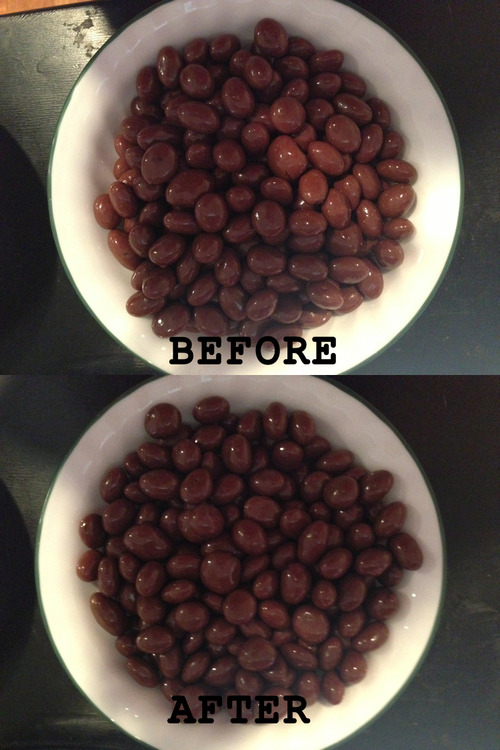
Then we start filling the bowls. And at first we only fill the one on the left.
This doesn’t last forever though. Eventually we do start putting raisins in the bowl on the right. But for every raisin we put in the bowl on the right, we just keep adding to the bowl on the left.
And the thing about these bowls is, they don’t ever reset. We don’t get to empty them and start over. While we might lose some raisins to lost records or the stories becoming unpopular, but we never get to just restart. So even when we start putting raisins in the bowl on the right, we’re still way behind from the bowl on the left.
And time goes on and the bowl on the left gets raisins much faster than the bowl on the right.
Until these are the bowls.
Now you get to move and distribute more raisins. You can add raisins or take away raisins entirely, or you can move them from one bowl to the other.
This is the bowl on the left. I might have changed the number of raisins from one picture to the next. Can you tell me, did I add or remove raisins? How many? Did I leave the number the same?
You can’t tell for certain, can you? Adding or removing a raisin over here doesn’t seem to make much of a change to this bowl.
This is the bowl on the right. I might have changed the number of raisins from one picture to the next. Can you tell me, did I add or remove raisins? How many? Did I leave the number the same?
When there are so few raisins to start, any change made is really easy to spot, and makes a really significant difference.
This is why it is bad, even despicable, to take a character who was originally a character of color and make them white. But why it can be positive to take a character who was originally white and make them a character of color.
The white characters bowl is already so full that any change in number is almost meaningless (and is bound to be undone in mere minutes anyway, with the amount of new story creation going on), while the characters of color bowl changes hugely with each addition or subtraction, and any subtraction is a major loss.
This is also something to take in consideration when creating new characters. When you create a white character you have already, by the context of the larger culture, created a character with at least one feature that is not going to make a difference to the narratives at large. But every time you create a new character of color, you are changing something in our world.
I mean, imagine your party guests arrive
Oh my god they are adorable!
And they see their bowls
But before you hand them out you look right into the little black girls’s eyes and take two of her seven raisins and put them in the little white girl’s bowl.
I think she’d be totally justified in crying or leaving and yelling at you. Because how could you do that to a little girl? You were already giving the white girl so much more, and her so little, why would you do that? How could you justify yourself?
But on the other hand if you took two raisins from the white girl’s bowl and moved them over to the black girl’s bowl and the white girl looked at her bowl still full to the brim and decided your moving those raisins was unfair and she stomped and cried and yelled, well then she is a spoiled and entitled brat.
And if you are adding new raisins, it seems more important to add them to the bowl on the right. I mean, even if we added the both bowls at the same speed from now on (and we don’t) it would still take a long time before the numbers got big enough to make the difference we’ve already established insignificant.
And that’s the difference between whitewashing POC characters and making previously white characters POC. And that’s why every time a character’s race is ambiguous and we make them white, we’ve lost an opportunity.
*goes off to eat her chocolate covered raisins, which are no longer metaphors just snacks*
This metaphor is the bestest
Kagan was speaking at a public event in conversation with historian and librarian Ted Widmer of Providence's Brown University.
"The justices are not necessarily the most technologically sophisticated people," AP quotes her as saying. Their young clerks use email, but "The court hasn't really 'gotten to' email."
At 53, she is the youngest and most recently appointed to the court.
Members of the court "write memos printed out on paper that looks like it came from the 19th century," and those memos are walked around the building by a "chambers aide."
Read the full article: Kagan: Court hasn't really 'gotten to' email.
|
|
Carrie Arnold explores research pointing to increasing evidence “that psychiatric woes can be solved by targeting the digestive system”:
For decades, researchers have known of the connection between the brain and the gut. Anxiety often causes nausea and diarrhea, and depression can change appetite. The connection may have been established, but scientists thought communication was one way: it traveled from the brain to the gut, and not the other way around.
But now, a new understanding of the trillions of microbes living in our guts reveals that this communication process is more like a multi-lane superhighway than a one-way street. By showing that changing bacteria in the gut can change behavior, this new research might one day transform the way we understand — and treat — a variety of mental health disorders.
So far it looks like tweaking bacteria would carry the most mental benefits while a patient is still young.

yes I know you started in the mailroom when you were sixteen what you are not grasping here is that today you need three years experience and two references to even be considered for an unpaid internship in that mailroom
Or they hire you in the mailroom for $9 an hour, but if you really put in the effort and impress the right people and always go the extra mile and become outstanding at your job… within two or three years you might move up to working in the mailroom for $9.50 an hour.

Congratulations, 50 states: You might be getting a new sibling! The new hotness is North Colorado, a potential state that conservative activists in Unitary Colorado have started agitating for. "The activists started pushing after this year's legislative session, when Democrats who control the Colorado legislature passed new laws regulating firearms and oil exploration," The Washington Post's Reid Wilson reported Monday. "The new measures, conservatives believe, are the latest steps taken by an overbearing legislature that's Denver-centric, to the exclusion of the state's rural areas."
I'm of two minds on this. On the one hand, splitting up big states until we have 545 states with Wyoming-sized populations — so the Senate is finally geographically representative, large states aren't underrepresented in the Electoral College, House districts no longer vary widely in population size, and residents of currently-large states have state governments where their voices matter more — would be great. But what you really want to do is maintain the 50 number and just rearrange the borders so all the states are equal in population. Urban planner/artist Neil Freeman drew a great map of what that would look like:

"States could be redistricted after each census -- just like House seats are distributed now," Freeman writes. He's probably, joking but this Adirondack native thinks there are much worse ideas.

|
|





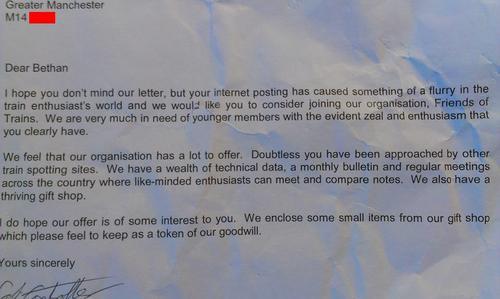
a friend came round to help me revise and forgot to log out of her facebook on my laptop so I’ve spent the last 20 minutes devoting her facebook to trains.
I’ve also got the middle name “ILikeTrains” pending and have joined 50 “I love trains” groups.
UPDATE:
TODAY BETH RECEIVED THIS LETTER FROM A TRAINSPOTTING ORGANISATION. THIS IS THE MOST SUCCESSFUL THING I’VE DONE IN MY ENTIRE LIFE.

If someone is keeping a Big List Of Inevitable Things somewhere, they can cross out ‘modders remaking Morrowind in the Skyrim engine’. For it is no longer inevitable, but is in fact, er, evitable? No, that’s not right. Though I guess you could avoid it, but that would make the modders of Skywind very sad indeed, because all their hard work in rebuilding Morrowind is worth looking at. Even if you just coo over the videos below, because cooing over the scenery is pretty much all that’s possible right now.
(more…)

Vlambeer is making yet another videogame like it’s their job or something. They have probably lost their minds, but we may as well reap the rewards. Originally a quick and dirty Mojam prototype dystopia-’em-up, Wasteland Kings is now evolving into a full-on action-roguelike (or “roguelike-like,” as designer JW Nijman describes it) with heaps of characters, procedurally generated locations, and of course, guns. In practice, that means you run from area to area, dodging and blasting circles around enemies in a desperate bid for survival. All the while, you mutate new, largely randomized powers and pick up better, stranger weapons. Sounds a bit like fellow action-roguelike The Binding of Isaac, doesn’t it? And while the inspiration is certainly there, Nijman insists that Wasteland Kings is millions of cracking, sun-parched miles away from a carbon copy.

|
|
I noted over the weekend that Mingo County, West Virginia probably takes the crown for having the most corrupt and crazy ass judiciary and law enforcement in the country. But now comes TPM Reader SD who says, those guys have nothing on us here in St. Clair County, Illinois. And looking at the links he sent, he may be right.
It all started back in March when St. Clair County Circuit Court Judges Joe Christ and Michael Cook headed off for a weekend at the hunting lodge. You might think this was a Scalia-Kagan odd-judicial-bedfellows shootin' kind of thing. But not exactly. Because Judge Christ, 49, died at the lodge of a cocaine overdose.
Christ had only been on the bench for about a week at the time of his death. Prior to that he'd been a longtime county prosecutor. Where'd he get the coke? Well, he bought it from St. Clair County Probation Officer James K. Fogarty, 46, who was charged with drug possession, drug dealing to judges and unlawful possession of a firearm.
So what was County Judge Michael Cook, 43, to make of all this narcotics selling and using under his own nose? Well, it turns out Cook, who presides over the county drug court, is a heroin addict, though he also did a lot of coke with Fogarty and Christ.
He was later arrested on May 22nd on heroin and weapons possession charges at the home of his heroin dealer Sean McGilvery, 34. When he was arraigned the next morning Cook was still wearing the cut-offs and "Bad is my middle name" t-shirt he'd been wearing at the time of his arrest. Cook later went to rehab and just a couple weeks ago he agreed to the suspension of his law license, which seems reasonable.
McGilvery (who seems not to work in law enforcement) meanwhile is accused of conspiring with Deborah Perkins, 65, and Douglas Oliver to purchase large quantities of heroin in the Chicago area to deal at the street level in East St. Louis.
In light of these developments, County Attorney Brendan Kelly has recommended to the County Board that a "strong and broad drug testing" system be put in place at the county courthouse.
Now, after educating myself about the situation in St. Clair County (which includes East St. Louis, which has had a bad reputation for basically forever), I'm inclined to agree with SD who says his county gives Mingo County a run for its money, though Mingo has been building its reputation for corruption and crazy-ass antics for decades.
But I want to open this up. Is your county in the running? As we've done with mayors, we want to find the true leader in county government corruption. Is it Mingo? Is it St. Clair? Or is it your county? Send us your story and give it your best shot.

|
|
Maine Gov. Paul LePage is one of the coarsest bits of flotsam washed ashore in the 2010 Tea Party wave election. He's often found comparing IRS agents to Gestapo and jokes about sodomy as punishment. But this is something even for him. According to the Portland Press Herald, at a fundraiser last week, the Gov. told Republican supporters that President Obama "hates white people."
It was a private event. And there appears to be no recording. But two Republican lawmakers, who asked that their names be withheld for fear of political retribution, confirmed LePage's comment when asked directly. Others who spoke on the record said they had no memory of him saying, were distracted or simply refused to comment.
Two Republican lawmakers confirmed the comment when asked directly by a Press Herald reporter, but asked that their names be withheld for fear of political retribution. Each said LePage talked about how Obama could have been the best president ever if he highlighted his biracial heritage. But, LePage said, the president hasn't done that because he hates white people."Yeah, he said it," said one lawmaker. "It was one little thing from a speech, but I think most people there thought it was totally inappropriate."
...
One of the lawmakers who confirmed the comments said he supports the governor's policies but is tired of being asked to defend controversial statements.

|
|

Glenn Greenwald, left, with David Miranda, who was held for nine hours at Heathrow under schedule 7 of Britain's terror laws. Photograph: Ricardo Moraes/Reuters
The mood toughened just over a month ago, when I received a phone call from the centre of government telling me: "You've had your fun. Now we want the stuff back." There followed further meetings with shadowy Whitehall figures. The demand was the same: hand the Snowden material back or destroy it. I explained that we could not research and report on this subject if we complied with this request. The man from Whitehall looked mystified. "You've had your debate. There's no need to write any more."During one of these meetings I asked directly whether the government would move to close down the Guardian's reporting through a legal route – by going to court to force the surrender of the material on which we were working. The official confirmed that, in the absence of handover or destruction, this was indeed the government's intention. Prior restraint, near impossible in the US, was now explicitly and imminently on the table in the UK. But my experience over WikiLeaks – the thumb drive and the first amendment – had already prepared me for this moment. I explained to the man from Whitehall about the nature of international collaborations and the way in which, these days, media organisations could take advantage of the most permissive legal environments. Bluntly, we did not have to do our reporting from London. Already most of the NSA stories were being reported and edited out of New York. And had it occurred to him that Greenwald lived in Brazil?
The man was unmoved. And so one of the more bizarre moments in the Guardian's long history occurred – with two GCHQ security experts overseeing the destruction of hard drives in the Guardian's basement just to make sure there was nothing in the mangled bits of metal which could possibly be of any interest to passing Chinese agents. "We can call off the black helicopters," joked one as we swept up the remains of a MacBook Pro.
Read: "David Miranda, schedule 7 and the danger that all reporters now face."
Related reading at Freedom of the Press Foundation: "Investigating Acts of Journalism Under 'Terrorism' Laws Is A Hallmark of Authoritarian Regimes."
|
|
Commissioner Dan Saltzman has put his name on what actually appears to be a $2 million plan to help address homelessness—more than the $1.7 million figure he gave on KGW this weekend—with half of that requested money going to programs meant to help homeless women in particular.
Saltzman's office this afternoon sent the Mercury a copy of the outline he mentioned sending to Mayor Charlie Hales last week. The memo (pdf) was sent August 15, the day after Hales and his team finally invited Saltzman's chief of staff, Brendan Finn, Portland Housing Bureau experts, and former Housing Commissioner Nick Fish to one of Hales' long-planned informational sessions on homelessness.
(Fish, the day before that meeting, first went public on Blogtown with a passionate denunciation of the mayor's handling of homelessness and how little he and others had been consulted.)
The full plan submitted by Saltzman builds off the kernel of an idea he and Hales had been working out before all the political outcry grew too loud to ignore. It includes $300,000 in immediate unspent money for things like increased shelter space for homeless women, and that piece could go before council by September 18. But the rest of the memo was clearly influenced by the discussion in Hales' office last Wednesday.
Advocates and officials at the meeting pushed for more than just shelter relief—and Saltzman and Hales appeared to be listening. (I posted a lengthy examination of Saltzman's evolution on this issue Sunday morning.) He's also asking commissioners to vote, when the city's budget is revised this fall, for $1.7 million more in resources. Some $700,000 would go toward expanding his programs for homeless women. The rest, $1 million, would be spent on helping get kids off the streets and also go toward work with people of color.
The model for that million bucks is a similar one-time effort brokered in 2010 by Fish and former Mayor Sam Adams. As I reported back then, Adams found the money and Fish worked to convene business interests and providers in something of a détente after what were still fresh wounds from the 2009 sit-lie fight.
Those wounds have reopened, to a degree, in recent weeks. Saltzman's office hasn't answered yet where Saltzman might find the money for his plan.
Update 7:50 PM: Israel Bayer, executive director of Street Roots and one of the advocates who attended last Wednesday's meeting, sent me a statement tonight. It reiterates his hope that Multnomah County might match the city's investment. He also seems to be casting the political backlash over Hales' heavy steps toward enforcement as a blessing in disguise.
"We're hoping the county will consider matching the funds to target hard-to-reach youth on the streets and to support more mental health outreach workers in the community.
City Hall and Multnomah County have a real opportunity to turn this into a real opportunity for people experiencing homelessness and mental health in our community. It's a win-win for people on the streets, government, law enforcement, and a concerned business community.
Street Roots believes we can get there..."
Hit the jump for some specifics:
The Options for Homeless Women program will:
Open existing shelter bottlenecks. Currently the two City-funded women’s shelters have 130 & 190 person wait lists. We will expand existing shelter capacity by working with existing providers to shorten shelter stays and to free up existing beds.
Divert more women from shelter. Tools such as additional rent assistance, street outreach, and housing advocacy and placement services, will help move women from shelter into housing or retain their current housing.
The Options for Homeless Women program will serve women in families, couples, youth and individuals.
Requests for Additional One-Time Funds through the Fall BuMP: These investments would boost service providers’ ability to use proven homelessness prevention methods citywide.
Additional $700K for Options for Homeless Women: I would like to expand the program by $700k this fiscal year to reach an additional 250 women. This program can be easily expanded on a quick time frame to reach more homeless women, families, and couples.$1M for Options for Priority Vulnerable Populations identified through A Home for Everyone: A $1 million infusion into the service continuum allows us to use the same intervention and prevention tools for priority populations identified in the community plan to end homelessness, including: unaccompanied youth, communities of color, and adults with disabilities.
This type of investment would utilize a similar approach as the $1 million special appropriation during FY 2010-11. The funding had an immediate and significant impact on reducing homelessness in the Central City. 311 households were moved from the streets into homes, and of those, 73% were still in housing a year later. The primary methods involved leveraging existing street outreach with rent assistance funds, as well as job and housing placement support services for youth
I referred yesterday to the weird little story of Onan in the book of Genesis.
It’s a weird story for a host of reasons, including that it’s a screaming anachronism for those who attempt a “literal” reading of the Pentateuch based on the non-literal, extra-textual presumption that the book of Genesis was written by Moses as dictated by God.
Here, in its entirety, is the story of Onan, from Genesis 38:
But Er, Judah’s firstborn, was wicked in the sight of the Lord, and the Lord put him to death.
Then Judah said to Onan, “Go in to your brother’s wife and perform the duty of a brother-in-law to her; raise up offspring for your brother.” But since Onan knew that the offspring would not be his, he spilled his semen on the ground whenever he went in to his brother’s wife, so that he would not give offspring to his brother.
What he did was displeasing in the sight of the Lord, and he put him to death also.
That’s quite a bit of smiting for such a brief, four-verse story. Poor Er’s wickedness was so great that he was put to death by a lethal miracle. That’s an extreme punishment, so be sure to learn the lesson of Judah’s firstborn and don’t … er … don’t do whatever it was that Er did. (At least the guy’s name lives on, and to this day we all say it whenever we want to abort a thought just as God cut short the life of poor Er.)

This is what Onanism looks like. God is displeased.
Judah points out to Er’s brother, Onan, that it is now his duty as a brother-in-law to impregnate his dead brother’s widow. Onan takes this as license to have sex with his late brother’s wife, but he always pulls out so that he won’t have to worry about having a new son/nephew and another mouth to feed. That wasn’t the deal with “the duty of a brother-in-law” so Onan is put to death as well.
Alas, Onan’s name has also lived on in a flagrant misreading of this story. “Onanism” became something of a euphemism for masturbation, and this text has been, for centuries, cited as forbidding masturbation. Onan’s name has been invoked in warning juvenile boys not to behave like juvenile boys. If they spilled their seed like Onan did, they were warned, they might go ow-ow-out like a blister in the sun.
That use of the story abuses the text worse than any juvenile boy has ever abused himself. Onan wasn’t masturbating — he was having sex with his sister-in-law. The story cannot be twisted into teaching that masturbation puts one in danger of being put to death by divine intervention. (Apart from contradicting the text, the idea that anyone who masturbates might be struck dead by God is obviously wrong anyway — disproved by the continuing existence of the human race.)
It’s equally mendacious to abuse this story by trying to force it to say something else it refuses to say: that sex must always be for the purpose of procreation. That’s not what the text says. That’s not something the story itself will allow you to say this story “teaches.” The story absolutely does not say that sex must always be for the purpose of procreation. The story says, rather, that sex with your dead brother’s childless widow must always be for the purpose of procreation.
And to understand what that’s all about in this story, we have to discuss the howling anachronism here.
The “duty of a brother-in-law” here refers to the practice of yibbum. This practice is outlined in Deuteronomy 25:
When brothers reside together, and one of them dies and has no son, the wife of the deceased shall not be married outside the family to a stranger. Her husband’s brother shall go in to her, taking her in marriage, and performing the duty of a husband’s brother to her, and the firstborn whom she bears shall succeed to the name of the deceased brother, so that his name may not be blotted out of Israel.
In our story, in other words, Judah instructs his son Onan to do what the law commands — the law as given by Moses centuries after Judah is dead and buried. Er, oops.
Onan’s duty was to continue his dead brother’s line by providing a child for his sister-in-law. That child would be regarded as his brother’s heir, keeping his brother’s share of the land in his brother’s name. That child would also be immensely important for the wellbeing of Onan’s sister-in-law. As a childless widow, she would be utterly dependent in that ancient economy, whereas a second wife with a firstborn son has hope for an economic future.
That’s the whole point of this duty. It’s the one reason that Onan was required to marry his sister-in-law. If she and Er had had children, then the law would have forbidden Onan to marry her (see Leviticus 18:6-16 and Leviticus 20:21 — which also warns that anyone who marries their late brother’s non-childless widow will be unable to have children with her).
This form of marriage, in other words, was part of the safety net for childless widows in this ancient economy. Onan’s sin was not “spilling his seed,” or having sex for reasons other than procreation. Onan’s sin was his exploitation of the helpless and his failure to fulfill his responsibility in the safety net for childless widows.
That passage in Deuteronomy 25 outlining the “duty of a brother-in-law” also lays out the oddly baroque punishment for any brother-in-law who refused this duty:
If the man has no desire to marry his brother’s widow, then his brother’s widow shall go up to the elders at the gate and say, “My husband’s brother refuses to perpetuate his brother’s name in Israel; he will not perform the duty of a husband’s brother to me.”
Then the elders of his town shall summon him and speak to him. If he persists, saying, “I have no desire to marry her,” then his brother’s wife shall go up to him in the presence of the elders, pull his sandal off his foot, spit in his face, and declare, “This is what is done to the man who does not build up his brother’s house.”
Throughout Israel his family shall be known as “the house of him whose sandal was pulled off.”
As unpleasant as that punishment sounds, what with all that face-spitting and sandal-pulling and name-changing, it’s still a much lighter sentence than what Onan was given — being “put to death” by the very hand of God.
Onan was dealt a more severe sentence because he was guilty of a more severe crime. Him Whose Sandal Was Pulled Off was guilty of neglecting his duty to provide for a childless widow. Onan was trying to weasel out of that duty while at the same time exploiting the very woman he was duty-bound to help. HWSWPO failed to play his role in the safety net for childless widows. Onan was attacking the very existence of that safety net.
This is an ancient story. The past is a foreign country, and the farther back we go into the past the more foreign it seems. It can be almost impossible to decipher such an ancient alien world, let alone to derive moral lessons from it that are applicable to our lives in the very different world we live in today.
Yet I still think we can learn something from the weird little story of Onan in the book of Genesis. Neglecting our duty to provide a safety net for those who need it is shameful behavior — a lasting shame so severe it forever alters our very name and how we are perceived throughout the community. But it’s even worse to attack the very idea of such duty while simultaneously exploiting those we are duty-bound to protect.
I think we are on solid biblical footing, in other words, to say that the current effort among House Republicans to gut SNAP is an example of the sin of Onanism. The anti-welfare rhetoric and ideology of the tea party — with its denunciations of “takers” and “moochers,” and the rallying cry of its founding in rejection of mortgage assistance for soon-to-be-homeless families — is a virulent, vicious strain of Onanism,
And this weird little story in Genesis suggests that God takes that sin very seriously indeed.

Hey, here's a movie that sounds like it'll be worth seeing! Wong Kar-wai's The Grandmaster! Being released here in the States by The Weinstein Co.! Wait.
Though the new film has played in China, abroad and in festivals, the version being released in the United States is a shorter cut. The American edit, with his approval, adds explanatory titles, character names and some different footage and hews to a more linear chronology. The highlights remain, like an almost phantasmagorical fight that takes place inches away from a roaring train in winter. (Via.)
Huh. Weird. Oh well. Hey, here's another movie that sounds like it'll be worth seeing! Bong Joon-ho's Snowpiercer! Being released here in the states by the Weinstein Co.! Oh. What the—
With the film's strong reception in Korea, importing it as-is would seem like a no-brainer. But as rumors would have it, the film is facing a Harvey Weinstein-shaped roadblock. Last week, Australia's Inside Film reported that Weinstein, whose company has distribution rights in the U.S. and elsewhere, wants to chop 20 minutes off of the 126 minute film. (Considering a number of this summer's blockbusters ran around two and a half hours, 126 minutes doesn't seem very long to us.) Inside Film sourced British film festival programmer Tony Rayns, who said the cuts would make the film a more traditional action movie that would appeal to the "presumed level of American mid-west hicks." (Via.)
Man... well, okay. Moving on, here's something else you might be interested in! Michel Gondry's Mood Indigo, which will be... oh, goddammit. Thirty-six minutes shorter?
After debuting in late April in Gondry’s native France, Mood Indigo went on to open the Karlovy Vary Film Festival on June 28, where reviews were encouraging if not universally glowing (at the very least, the movie promises to exist more firmly within the tradition of Gondry’s active formal imagination than his recent The We and the I). However, Vendetta Films, a New Zealand-based distributor, has now announced that, “only a new version of Mood Indigo will be screened and released…in all territories outside of France.” (Via.)
If only there were some sort of... network... of... interconnected computers... that one could somehow use to, I don't know... "download" the original cuts of films? The versions that haven't been dumbed down for us? If only.
Until that glorious day, I leave you with some quotes from Wong Kar-wai and Grandmaster stars Tony Leung and Zhang Ziyi.
"The U.S. version is more straightforward and linear," Mr. Wong explains. "The Chinese audience is more interested in experiencing the history. In the U.S., it's more about the story."
"I think it's wise for him to do a version for Americans," says Tony Leung, who plays the lead role of Ip Man, the real-life Chinese martial arts grandmaster of the early 20th century who famously was Bruce Lee's childhood instructor. "It's much easier for them to follow."
"In my opinion, I like the American one," says Zhang Ziyi, who in her role as the headstrong Gong Er is Ip Man's (fictitious) romantic interest and fighting rival. "It's clearer. Easier for foreigners." (Via.)

Comparison photo… Left: Pre-T Right: 7 months on T… I don’t see much of a difference but maybe I’m wrong
i see a difference
although you are ridiculously good looking in both so maybe that is your point of confusion

Readers know I have been grappling for a while with the vexing question of the balance between the surveillance state and the threat of Jihadist terrorism. When the NSA leaks burst onto the scene, I was skeptical of many of the large claims made by civil libertarians and queasily sympathetic to a program that relied on meta-data alone, as long as it was transparent, had Congressional buy-in, did not accidentally expose innocent civilians to grotesque privacy loss, and was watched by a strong FISA court.
Since then, I’ve watched the debate closely and almost all the checks I supported have been proven illusory. The spying is vastly more extensive than anyone fully comprehended before; the FISA court has been revealed as toothless and crippled; and many civilians have had their privacy accidentally violated over 3000 times. The president, in defending the indefensible, has damaged himself and his core reputation for honesty and candor. These cumulative revelations have exposed this program as, at a minimum, dangerous to core liberties and vulnerable to rank abuse. I’ve found myself moving further and further to Glenn’s position.
What has kept me from embracing it entirely has been the absence of any real proof than any deliberate abuse has taken place and arguments that it has helped prevent terror attacks. This may be too forgiving a standard. If a system is ripe for abuse, history tells us the only question is not if such abuse will occur, but when. So it is a strange and awful irony that the Coalition government in Britain has today clinched the case for Glenn.
A disclosure upfront: I have met David Miranda as part of a my friendship with Glenn Greenwald. The thought of his being detained by the British police for nine hours because his partner embarrassed the American government really sickens me at a gut level. I immediately think of my husband, Aaron, being detained in connection to work I have done – something that would horrify and frighten me. We should, of course, feel this empathy with people we have never known – but the realization is all the more gob-smacking when it comes so close to home. So of course my instinct is to see this exactly as Glenn has today.
But put that instinct aside for a moment. David was detained under an anti-terrorism law:
Section 7 of the British Terrorism Act allows the authorities to detain someone for up to nine hours for questioning and to conduct a search of personal items, often without a lawyer, to determine possible ties to terrorism. More than 97 percent of people stopped under the provision are questioned for under an hour, according to the British government.
David was detained for nine hours – the maximum time under the law, to the minute. He therefore falls into the 3 percent of interviewees particularly, one assumes, likely to be linked to terrorist organizations. My obvious question is: what could possibly lead the British security services to suspect David of such ties to terror groups?
I have seen nothing anywhere that could even connect his spouse to such nefarious contacts. Unless Glenn is some kind of super-al-Qaeda mole, he has none to my knowledge and to suspect him of any is so close to unreasonable it qualifies as absurd. The idea that David may fomenting terrorism is even more ludicrous.
And yet they held him for three hours before informing his spouse and another six hours thereafter. I can see no reason for those extra six hours (or for that matter the entire nine hours) than brute psychological intimidation of the press, by attacking their families.
More to the point, although David was released, his entire digital library was confiscated – including his laptop and phone. So any journalist passing through London’s Heathrow has now been warned: do not take any documents with you. Britain is now a police state when it comes to journalists, just like Russia is.
In this respect, I can say this to David Cameron. Thank you for clearing the air on these matters of surveillance. You have now demonstrated beyond any reasonable doubt that these anti-terror provisions are capable of rank abuse. Unless some other facts emerge, there is really no difference in kind between you and Vladimir Putin. You have used police powers granted for anti-terrorism and deployed them to target and intimidate journalists deemed enemies of the state.
You have proven that these laws can be hideously abused. Which means they must be repealed. You have broken the trust that enables any such legislation to survive in a democracy. By so doing, you have attacked British democracy itself. What on earth do you have to say for yourself? And were you, in any way, encouraged by the US administration to do such a thing?
(Photo: Dan Kitwood/Getty.)





I was gonna make Emmy draw this but she said no so I drew it myself.
I’ve never drawn a comic before!
NEIL I’M SO PROUD OF YOU. I will say no from now on forever

A system designed at Georgia Institute of Technology enables people with high-level spinal cord injuries to operate a computer and electrically powered wheelchair by moving their tongues. The Tongue Drive, as the system is called, now in prototype, allows a user to wear a dental retainer completely inside the mouth embedded with sensors to control the system (pictured above). The sensors track the location of a tiny magnet attached to the user’s tongue.

I just finished Gone Home which is a game that came out yesterday and that you can buy on Steam right now for less than $20 and that is worth every penny. It’s been getting rave reviews everywhere but I recommend you don’t read them. I recommend you set aside two hours and play this game instead.
Here’s the premise, briefly: it’s the 90s. You arrive home from a trip to Europe to find your house empty. There’s a note on the door and there’s some messages on the answering machine. What happens next - what you find out about what happened - is up to you. And remarkably, there’s no fighting. You don’t have to kill anyone.
I’ve complained to friends before that people of my age - gamers - have grown up in a time that allows us to be insanely, ridiculously spoiled. Games went from Pac-Man to Super Mario Brothers to Doom in under thirteen years. Thirteen years! And this pace has continued. I’ve grown up expecting that a great game is not only clever and fun and ingenious - a tall enough order as it is - but also that it shows me something with the medium that has never been done before. A great game, for me, has to innovate and expand the actual medium of video games itself. And incredibly, for decades, those expectations have been met.
Look at the reviews of the greatest games, and you’ll see those reviews mentioning something that game did that nobody else before then ever thought to do. That’s insane! That is actually insane. There’s no other medium like this. Nobody hands you a novel and says “You’ve got to read this, the author does something with the words on page 352 that simply wasn’t possible twenty years ago.” But in games, this is routine. We’ve come to expect it.
I’ve been worried that this time of ceaseless innovation is coming to an end: after all, the gigantic leap between Pitfall and Super Mario Brothers 3 (only six years separate those two games! Imagine the amazing shows we’d be seeing if playwriting advanced this quickly!) was made possible by computers developing as quickly as they did. Computers are still advancing, obviously, but game development has been trending towards the more complicated, the more expensive, the riskier to produce. When you’ve got a lot of money on the line, it pays to play it safe. And I’d think, hey Ryan, perhaps these thirty or so years of explosive creative development are coming to an end. Perhaps it is, in fact, actually really unfair to expect every great game to alter the medium of gaming itself. Perhaps, Ryan, a great game can simply be clever and fun and engaging without necessarily needing to show you something you’ve never seen done before.
Perhaps it’s time you lower your expectations.
Gone Home shows me those fears were wrong. There are still new things being invented, and there’s still new ways to play games that we’re just discovering now.
Gone Home: check it out.

In contrast, Amy's response to the dilemma conveys a very different impression, an image of development stunted by a failure of logic, an inability to think for herself. Asked if Heinz should steal the drug, she replies in a way that seems evasive and unsure:
Well, I don't think so. I think there might be other ways besides stealing it, like if he could borrow the money or make a loan or something, but he really shouldn't steal the drug -- but his wife shouldn't die either.
Asked why he should not steal the drug, she considers neither property nor law but rather the effect that theft could have on the relationship between Heinz and his wife:
If he stole the drug, he might save his wife then, but if he did, he might have to go to jail, and then his wife might get sicker again, and he couldn't get more of the drug, and it might not be good. So, they should really just talk it out and find some other way to make the money.
Seeing in the dilemma not a math problem with humans but a narrative of relationships that extends over time, Amy envisions the wife's continuing need for her husband and the husband's continuing concern for his wife and seeks to respond to the druggist's need in a way that would sustain rather than sever connection. Just as she ties the wife's survival to the preservation of relationships, so she considers the value of the wife's life in a context of relationships, saying that it would be wrong to let her die because, "if she died, it hurts a lot of people and it hurts her." Since Amy's moral judgment is grounded in the belief that, "if somebody has something that would keep somebody alive, then it's not right not to give it to them," she considers the problem in the dilemma to arise not from the druggist's assertion of rights but from his failure of response.
As the interviewer proceeds with the series of questions that follow from Kohlberg's construction of the dilemma, Amy's answers remain essentially unchanged, the various probes serving neither to elucidate nor to modify her initial response. [...] Failing to see the dilemma as a self-contained problem in moral logic, she does not discern the internal structure of its resolution; as she constructs the problem differently herself, Kohlberg's conception completely evades her. Instead, seeing a world comprised of relationships rather than of people standing alone, a world that coheres through human connection rather than through systems of rules, she finds the puzzle in the dilemma to lie in the failure of the druggist to respond to the wife.
[...] Just as Jake is confident the judge would agree that stealing is the right thing for Heinz to do, so Amy is confident that, "if Heinz and the druggest had talked it out long enough, they could reach something besides stealing." As he considers the law to "have mistakes," so she sees this drama as a mistake, believing that "the world should just share things more and then people wouldn't have to steal." Both children thus recognize the need for agreement but see it as mediated in different ways — he impersonally through systems of logic and law, she personally through communication in relationship. Just as he relies on the conventions of logic to deduce the solution to this dilemma, assuming these conventions to be shared, so she relies on a process of communication, assuming connection and believing that her voice will be heard.
[...] Although the frustration of the interviewer with Amy is apparent in the repetition of questions and its ultimate circularity, the problem of interpretation is focused by the assessment of her response. When considered in the light of Kohlberg's definition of the stages and sequence of moral development, her moral judgments appear to be a full stage lower in maturity than those of the boy. Scored as a mixture of stages two and three, her responses seem to reveal a feeling of powerlessness in the world, an inability to think systematically about the concepts of morality or law, a reluctance to challenge authority or to examine the logic of received moral truths, a failure even to conceive of acting directly to save a life or to consider that such action, if taken, could possibly have an effect.
[...] But the different logic of Amy's response calls attention to the interpretation of the interview itself. Conceived as an interrogation, it appears instead as a dialogue, which takes on moral dimensions of its own, pertaining to the interviewer's uses of power and to the manifestations of respect. With the shift in the conception of the interview, it immediately becomes clear that the interviewer's problem in understanding Amy's response stems from the fact that Amy is answering a different question from the one the interviewer thought had been posed. Amy is considering not
whether Heinz should act in this situation ("should Heinz steal the drug?") but rather how Heinz should act in response to his awareness of his wife's need ("Should Heinz steal the drug?"). The interviewer takes the mode of action for granted, presuming it to be a matter of fact; Amy assumes the necessity for action and considers what form it should take. In the interviewer's failure to imagine a response not dreamt of in Kohlberg's moral philosophy lies the failure to hear Amy's question and to see the logic in her response, to discern that what appears, from one perspective, to be an evasion of the dilemma signifies in other terms a recognition of the problem and a search for a more adequate solution.
Thus in Heinz's dilemma these two children see two very different moral problems — Jake a conflict between life and property that can be resolved by logical deduction, Amy a fracture of human relationship that must be mended with its own thread.
Script doctor Damon Lindelof talks to Vulture about the challenges of blockbuster screenwriting:
“Once you spend more than $100 million on a movie, you have to save the world,” explains Lindelof. “And when you start there, and basically say, I have to construct a MacGuffin based on if they shut off this, or they close this portal, or they deactivate this bomb, or they come up with this cure, it will save the world—you are very limited in terms of how you execute that. And in many ways, you can become a slave to it and, again, I make no excuses, I’m just saying you kind of have to start there. In the old days, it was just as satisfying that all Superman has to do was basically save Lois from this earthquake in California. The stakes in that movie are that the San Andreas Fault line opens up and half of California is going to fall in the ocean. That felt big enough, but there is a sense of bigger, better, faster, seen it before, done that.”
“It sounds sort of hacky and defensive to say, [but it’s] almost inescapable,” he continues. “It’s almost impossible to, for example, not have a final set piece where the fate of the free world is at stake. You basically work your way backward and say, ‘Well, the Avengers aren’t going to save Guam, they’ve got to save the world.’ Did Star Trek Into Darkness need to have a gigantic starship crashing into San Francisco? I’ll never know. But it sure felt like it did.”