
Shared posts
19 Oct 04:51
New project: automating fandom
by Darius Kazemi
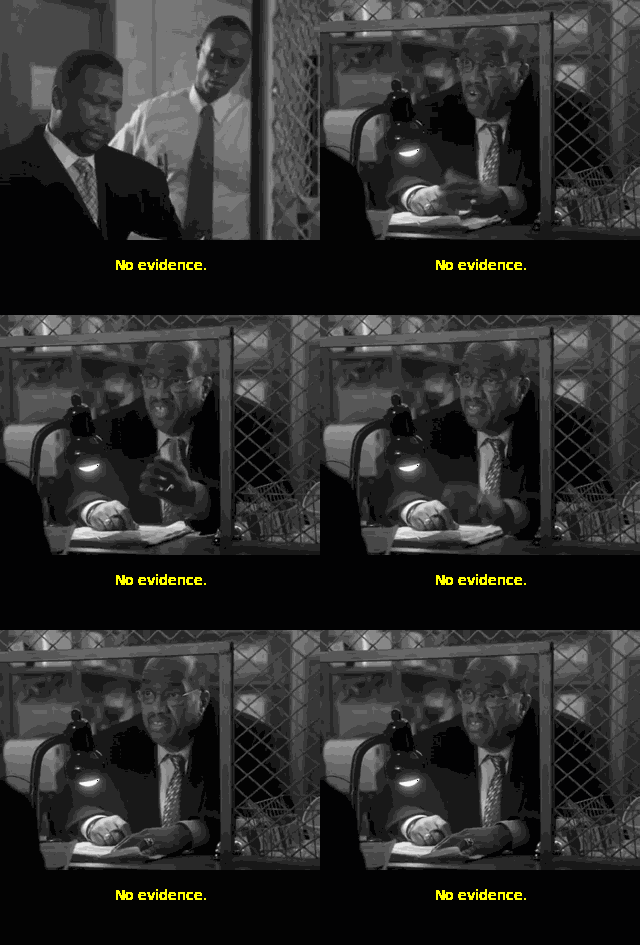
I just posted up a new project: it’s a bot that makes animated GIFs from TV shows and posts them to tumblr. The way it works is pretty simple: I have a video of The Wire and its corresponding subtitle file, which provides dialogue with timestamps. The bot finds some dialogue at random, looks up the timestamps, clips the video, gifs it, and uploads to tumblr.
You can see the tumblr here: http://wirescenes.tumblr.com/
14 Aug 18:39


thegirlwithchocolateshoes: Coloring coloring books into a whole...
Coloring coloring books into a whole new level.
Art on the right by: http://loish.deviantart.com/
Coloring book pages belong to Disney.
14 Aug 18:38


The Boy Who Cried: The Wolf Among Us
by Jim Rossignol
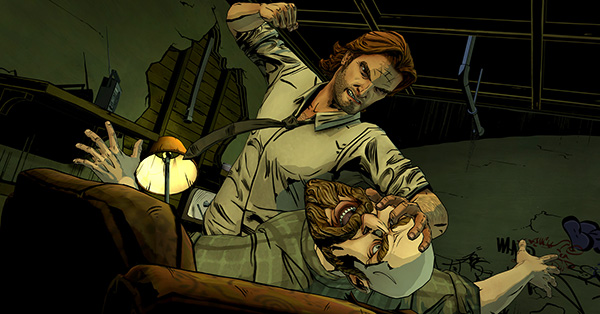
Telltale seem to have a bit of a swagger about them now. The Walking Dead was pretty good, and they know it. They’re taking that swagger over to The Wolf Among Us, which has a confident new trailer, below. In case you missed the excitement, it’s a new episode series based on the Fables comic book series – with you playing as Bigby Wolf – and it’s coming up towards the end of this year. Perhaps not my sort of thing – I never did truly respect a point and clicker – but I do like a man with sideburns.
(more…)
14 Aug 18:38
Daily Dialogue — August 14, 2013
by Scott
When the restaurant is empty Linguini and Colette bring Remy to meet Ego.
Remy: At first, Ego thinks it’s a joke. But as Linguini explains, Ego’s smile disappears. He doesn’t react beyond asking the occasional question. And when the story’s done, Ego stands, thanks us for the meal, and leaves, without another word. The following day, his review appears:
Anton Ego: In many ways, the work of a critic is easy. We risk very little, yet enjoy a position over those who offer up their work and their selves to our judgment. We thrive on negative criticism, which is fun to write and to read. But the bitter truth we critics must face, is that in the grand scheme of things, the average piece of junk is probably more meaningful than our criticism designating it so. But there are times when a critic truly risks something, and that is in the discovery and defense of the new. The world is often unkind to new talent, new creations. The new needs friends. Last night, I experienced something new: an extraordinary meal from a singularly unexpected source. To say that both the meal and its maker have challenged my preconceptions about fine cooking is a gross understatement. They have rocked me to my core. In the past, I have made no secret of my disdain for Chef Gusteau’s famous motto, “Anyone can cook.” But I realize, only now do I truly understand what he meant. Not everyone can become a great artist; but a great artist can come from anywhere. It is difficult to imagine more humble origins than those of the genius now cooking at Gusteau’s, who is, in this critic’s opinion, nothing less than the finest chef in France. I will be returning to Gusteau’s soon, hungry for more.
– Ratatouille (2007), screenplay by Brad Bird, story by Jan Pinkava & Jim Capobianco & Brad Bird, additional story material by Emily Cook & Kathy Greenberg & Bob Peterson
The Daily Dialogue theme for the week is Pixar moments suggested by Mark Walker. Today’s suggestion by Daniel Cossu.
Trivia: Part of the story was initially supposed to take place in the catacombs below Paris. This idea was dropped when Brad Bird took over the project from Jan Pinkava. Only short sections taking place in the sewers remain from the original project.
Dialogue On Dialogue: “A great artist can come from anywhere.” That probably speaks to anyone who visits this blog. But also in a broader sense, it is about how each of us has the potential to do great things.
14 Aug 18:25


Wireless baby monitor hacked, baby insulted
by Rob Beschizza
Zephyr DearI found a horror-movie scene...
A mystery man patched into a camera-equipped wireless baby monitor, watching and yelling abuse at a child--and its parents, when they came to see what was going on. ABC's Alana Abramson reports from the intersection of ill will and appallingly insecure technology.
The incident occurred on Aug. 10 as Marc Gilbert was doing the dishes after his birthday dinner and he heard strange noises coming from his daughter Allyson’s room while she was sleeping, Gilbert said. “Right away I knew something was wrong,” he told ABC News. As he and his wife got closer to the room, they heard the voice calling his daughter an “effing moron,” and telling her,”‘wake up you little slut.” The hacker then began shouting expletives at her parents and calling Gilbert a stupid moron and his wife a b****
Calling it "hacking," however, may be more storytelling than science. These gadgets--often very inexpensive--are so insecure that simply driving around with a receiver will let you peek into others' baby bedrooms.
    
|
13 Aug 19:34

Icarus Proudbottom Teaches Typing Is Incredible
by Nathan Grayson

“When we’re done with you, your fingers will be like gods.”
That is just one of roughly a trillion gems from Icarus Proudbottom Teaches Typing, which doesn’t really teach typing so much as it uses the act of inputting words into a computer as a loose framework magnificently bizarre insanity. You might remember Icarus Proudbottom and his best spirit owl pal from John’s favorite game of all time (it’s about poo), but this one unfurls a yarn of a rather different nature (it’s not about poo). Sometimes there is typing. Other times? RPG stat sheets, virtual pet minigames, loving odes to the tilde key, copious profanity, and a sinister end-of-game plot twist. Icarus Proudbottom Teaches Typing probably won’t teach you to type, but it might help you learn to love again.
13 Aug 19:24
Narnia: Love the Sinner, Period
by Ana Mardoll
[Content Note: Colonialism, Slavery, Violence]
[NB: The title of this post is a reference to the platitude "love the sinner, hate the sin" which is almost universally used as a rhetorical cudgel to harm innocent people who are guilty only of a failure to conform to various social standards, while excusing the hateful person from the responsibility of their harmful actions. This title is not meant to suggest that real acts of harm, such as those perpetuated by Caspian and Edmund, should be summarily excused.]
 Narnia Recap: In which Eustace is turned back into a boy.
Voyage of the Dawn Treader, Chapter 7: How The Adventure Ended
Alright! After however many solid weeks of fobbing ya'll off with tiny posts because I've been burning the candle all fifteen ends, today we are going to start going through the unnecessarily long and violent process of Eustace's conversion. And remember! The best thing about metaphors is that you can write any old crap on the page and someone will work out a profound meaning for you to have meant all along because people are awesome pattern-spotters, even when the patterns weren't, strictly speaking, put there on purpose. (Which is a long and delightful way of saying that there are going to be Disagreements about how to interpret this. Tally-ho.)
About six days after they had landed on Dragon Island, Edmund happened to wake up very early one morning.
WHUT. *sputters* They were considering leaving Eustace after five days of him being a dragon?! (Since the first day was taken up with him being lost.) And much of those five days had to have been devoted to fixing the mast and fixing the storm-battered ship and turning the dragon-slain sheep into dried-or-smoked-or-sausaged-or-salted-or-whatever haunches of meat to hang in the ship for stores, surely. So they were considering leaving him behind even while they were using him for work all this time.
That's it. I'm tempted to just quit now. Everyone on this damn ship (minus Eustace and maybe Reepicheep) is evil and deserves nothing more than the bitterest of contempt. I have lost any vestige of pity for them and clearly this whole thing is a metaphorical voyage of the damned. The only way this can be redeemed is if moonlight breaks through and shows they're all corrupted skeletons and then Jack Sparrow swoops down and slaughters them all before announcing that he will never, ever make another movie again.
As he woke he thought he heard something moving, so he raised himself on one elbow and looked about him: and presently he thought he saw a dark figure moving on the seaward side of the wood. The idea that at once occurred to his mind was, “Are we so sure there are no natives on this island after all?” ... Edmund made sure that his sword was in its place and then rose to investigate.
He came down softly to the edge of the wood and the dark figure was still there. He saw now that it was too small for Caspian and too big for Lucy. It did not run away. Edmund drew his sword and was about to challenge the stranger when the stranger said in a low voice, “Is that you, Edmund?”
.............................. I don't even know how to start with this. I don't even know if I want to start with this. I feel bile in my throat, is how awful this passage is.
So, just to recap. Caspian et. al. visited an island that had been wracked by the evils of slavery. A significant portion of the populace had been reduced to second-class citizens with no rights over their land or their bodies or even a right to life. Because Slavery Is Wrong, Caspian set all the slaves free and made sure slavery would never happen ever again by, basically, saying so with his Mighty King Words. (Except of course for the slaves who had already been bought and shuffled off to other countries.)
Caspian et. al. then sailed directly from the Island of Freed Slaves to a new island where their modus operandi from Day 1 (and we're now on Day 6) has been to claim ownership over everything they see. Because Caspian et. al. owns the land, rather than any hypothetical native people who might be using the island. And he owns the land by virtue of being the first white person to see the land; he's done nothing whatsoever to "improve" or build upon the land (which would be a bullshit reason anyway, but one with which Lewis would have been familiar), and in fact they've actually made the island worse, what with all the tree-ripping-up and sheep-killing.
And Caspian doesn't even have the whole possibly-fake ancestral claim thing that he supposedly had with the last group of islands. He's got no right to be there except by virtue of the fact that an entirely different land of people decided to make him king. Or, in other words, he has got absolutely no right to be there. He's trespassing while insisting that his white kingly lineage means he owns whatever he wants and plus he's got the swords to enforce it.
But land-theft wasn't quite enough for our heroes, and thus Edmund has now drawn his sword in order to "challenge" a person who has apparently only been observing them quietly, assuming that he even knew Caspian et. al. were on the beach at all and didn't just stumble onto them out of coincidence and then decide to leave them alone like you do. And Edmund is challenging the stranger with his sword drawn because the native people of the island most definitely do not own their bodies or a right to life. If Edmund doesn't like what he hears, then he has every right to chop the native person to bits because failure to satisfactorily answer a privileged white man carries an automatic death sentence.
STELLAR.
Oh, and also? This native person that Edmund is considering murdering is pretty probably a child considering how small the form is. She/He is definitely smaller than Edmund and is only just taller than little Lucy. In fact, she/he is shaped remarkably like an especially small and weak 11-year-old boy! Which makes it even more awesome that Edmund is drawing his sword on him/her with every intention to kill if Edmund (THE JUST) decides that the situation calls for it, because what? You were thinking that being called King Edmund The Just in Narnia didn't mean that you consider yourself judge-jury-and-executioner when faced with a quiet person minding his/her own business on his/her own land? Or you were maybe thinking that a boy who was once nearly murdered under a flimsy legal justification wouldn't use his own flimsy legal justifications to murder smaller boys given the chance? You're so weird!
But the important thing here is that this hypothetical-native-person-who-is-actually-Eustace isn't a slave! Because Slavery Is Wrong and that is why the ship's oars aren't one of those slave galley things that Lewis has heard so much about. Slaves and natives may not own their land, their bodies, or their lives, but at least the natives don't have to row a boat and they should be thankful for that. And this is why I say that this book is a long love-letter to colonialism regardless of whatever Lewis might or might not have written against the concept in some other book. Because holy fuck.
“Yes. Who are you?” said he.
“Don’t you know me?” said the other. “It’s me—Eustace.”
“By jove,” said Edmund, “so it is. My dear chap—”
“Hush,” said Eustace and lurched as if he were going to fall.
“Hello!” said Edmund, steadying him. “What’s up? Are you ill?”
Eustace was silent for so long that Edmund thought he was fainting; but at last he said, “It’s been ghastly. You don’t know … but it’s all right now. Could we go and talk somewhere? I don’t want to meet the others just yet.”
And, okay. I get that Lewis was pulling shit willy-nilly from the Bible and didn't feel the need to make things fit here in this context because pulling from other sources means you don't actually have to do work on your own. And that's how we get this painfully awkward scene where Edmund doesn't recognize the form or face or voice of the cousin he was living with over the summer while sharing a room together, and then living with on a crowded little boat where they shared sleeping quarters with Caspian, and who has been a dragon for approximately five days which is probably not enough time to forget what someone looks or sounds like.
Instead, I suspect this is supposed to be a reference to people not recognizing Christ after his resurrection, which was not the same thing because (a) being dead is not the same thing as being a dragon for a couple of days in a country where peoples' physical forms change on a dime, and (b) Christ was theoretically supposed to look changed by his experience, whereas I sort of doubt that Eustace is supposed to look radically different here (unless we really have gone whole-hog with the notion that being redeemed and good makes you prettier and less deformed in which case that's a big barrel of NO.), and (c) at least some of those folks who didn't recognize Christ didn't strictly speaking know him before he appeared to them post-resurrection, which is a touch different from not recognizing the guy you've been sharing a room with for months.
Also note the continued penchant for pain: Apparently Aslan wasn't willing or able to come up with aconversion experience transmogrification that doesn't hurt like hell.
“Yes, rather, anywhere you like,” said Edmund. “We can go and sit on the rocks over there. I say, I am glad to see you—er—looking yourself again. You must have had a pretty beastly time.”
Nit-noid: Speaking of Edmund not being influenced in any sense by his experiences in Lions, Witches, and Wardrobes: Aslan's Day Off, I would think that of all the members of Caspian's crew, he would be the one least willing to go off alone to converse with people who seem innocent and trustworthy yet have clearly been magicked in some way and may not be all that they appear to be. But whatever, it's not like mistakes like that aren't fatal in Narnia. (Oh wait.)
“I won’t tell you how I became a—a dragon till I can tell the others and get it all over,” said Eustace. “By the way, I didn’t even know it was a dragon till I heard you all using the word when I turned up here the other morning. I want to tell you how I stopped being one.”
“Fire ahead,” said Edmund.
“Well, last night I was more miserable than ever. And that beastly arm-ring was hurting like anything—”
“Is that all right now?”
Eustace laughed—a different laugh from any Edmund had heard him give before—and slipped the bracelet easily off his arm. “There it is,” he said, “and anyone who likes can have it as far as I’m concerned. Well, as I say, I was lying awake and wondering what on earth would become of me. And then—but, mind you, it may have been all a dream. I don’t know.”
“Go on,” said Edmund, with considerable patience.
... yeah. I don't know what to do with this. Eustace has never laughed a laugh of pure pleasure or unsullied irony before, just as he has never before liked someone or been liked by anyone. And Edmund is demonstrating "considerable patience" for listening to Eustace feel his way through his tale after having lost his voice for five days; suffered through a series of harrowing, confusing, and traumatizing events; and now experienced a horrifically painful magical cure that he can barely explain, has difficulty remembering, and has no reference with which to describe. Oh, and also, he's never told a story before and doesn't know how because he's read all the wrong books, etc.
Meanwhile Edmund has been using Eustace as a hot-water bottle, plotting to leave him behind (possibly even to leave him behind without warning, since they didn't bother including Eustace in the planning councils), and stalking about on the beach with a sword looking to threaten and/or murder young native children. But Edmund, JUST TO BE REALLY CLEAR HERE, is the patient one. And now I am going to quote Fred Clark on a passage from Left Behind because it makes me happy to take my mind off the fractal terrible that is Lewis' writing of this passage:
Ah. Wasn't that refreshing? It was for me.
I mention the above for a couple* of reasons.
One, this whole conceit that Edmund is super-fucking-patient doesn't work. It cannot. The whole premise of this book is that the narrator interviewed one or more people (only Lucy is listed as a direct source, iirc) in order to write down the events that happened. If this "considerable patience" is just an interpretation of the narrator's, then the narrator is therefore inserting his own editorial ideas about this passage, in which case we now have a deeply biased narrative rather than a factual account, which should now be treated with very deep suspicion.
An unreliable narrator undermines the entire conceit of the book, which is supposedly to help others learn to recognize Aslan in their own world. (Seriously, that's the moral at the end of the story.) If we can't rely on the accuracy of the narrative (and clearly we cannot, but I would argue that Lewis probably didn't intend us to come to that conclusion), then we cannot recognize Aslan in our world, as anything the narrator writes about Aslan is now deeply suspect. The words on the page stop being a historical and/or journalistic account and become deeply biased propaganda; so deeply biased, in fact, that the narrator couldn't resist putting in his totally irrelevant opinion about whether Eustace is getting to the point fast enough. If he is willing to alter or embellish or invent minor details to satisfy his petty grudges, then the entire account is now untrustworthy in the exteme.
The alternative to the narrator placing this in is that Edmund or Eustace told him to use this framing; that Edmund or Eustace informed the narrator that Edmund was being "considerably patient" and the narrator duly wrote it down. Possibly Edmund was the one who remembered it this way, since presumably Eustace would have reason to not remember that piddling little detail among all the de-dragon-ing. But that just brings me back to the Fred Clark quote above, in that people don't work that way.
If the takeaway from this encounter, the thing that Edmund remembered years later, was not the glory of the miracle or the pain of his cousin's conversion, but rather that Edmund was hella-patient because Eustace was taking his fucking-sweet-time spitting the story out, then it is patently false that Edmund was being patient because clearly this bothered him enough to stick with him. It may be possible to be considerably patient and aware of it in the moment, but to cling to that detail as a very important detail to be crowed about to a narrator years after the fact? That stretches my credulity. At that point, it's a false patience, one that is only being indulged in because one feels one must or because one wants to feel like the "better person". This is a "patience" that is practiced entirely for self-gratification. And that isn't patience, nor does it look the same to the person having it bestowed on them.
It's possible -- possible -- that the framing is supposed to be Eustace hating himself after the fact. It's possible that all the hatred the narrator heaps on Eustace throughout the book is supposed to be self-hatred (both in the Doylist sense which has been proposed where Lewis supposedly sees Eustace as the character most like himself and in the Watsonian sense wherein Eustace is standing over the narrator's shoulder saying "no, really, I was a TERRIBLE person, make that more clear right here.").
But if we accept that framing, then we accept that a healed person -- a person whose flaws and wounds were literally healed by an all-powerful god -- can and does and should carry around a constant and unrelenting self-loathing for who they were prior to their conversion. That such a thing is healthy and desirable (since, you will note, this is a morality tale for Instruction to Children) even to the extreme absurdist point of Eustace demanding that it be made manifestly clear that his cousin was "considerably patient" for listening to him tell about a miracle when clearly there were more interesting things on the beach than Eustace and his Aslan-story. Like rocks, surely. Or some seaweed.
I've done a lot of things in my life that I regret, for various reasons. But I decided a long time ago that, given the chance to do everything all over again and correct things, I wouldn't. Not because I'm proud of who I was, but because I have decided to love, really love, who I am now. And I recognize that as I am the sum of my actions and experiences, I am who I love today because I was once very different from who I am now. Those actions and experiences which are bittersweet to me in retrospect (or in some cases, just flat-out bitter) are not things I can really hate, because to hate me then conflicts with my decision to love myself now.
Eustace doesn't love himself now, not if he's the source of all the visceral hatred in the text, the demand that Eustace be needled at every turn, even after his conversion, because FUCK YOU EUSTACE WE'RE BEING PATIENT JUST TO HEAR YOU OUT etc. I believe that self-love is incompatible with that level of self-hatred. I believe that a more healthy outlook would be for Eustace to recognize that, okay, maybe he was an asshole as a kid. Sure. But if he hadn't been an asshole, he wouldn't have had this experience. He wouldn't have turned into a dragon and been able to help his friends and family in a way he never believed imaginable. He wouldn't have seen Aslan in all his glorious beauty and wouldn't have been personally saved and healed by his physical touch. (An experience that Peter and Lucy and Susan never got, and even Edmund was only saved from a distance.) All the "bad" things in Eustace's life and personality led inexorably to the "good" things which he (supposedly) comes to treasure as a Friend of Narnia.
If Eustace still hates himself, even after all this, then something has gone tragically wrong and this book is even more saddening to me than before. But if the source of the hatred is from Edmund, or the Narrator, or from the author himself, then I have only searing anger. Because even after all his suffering, and after his full conversion to the church of Aslan, Eustace is still being singled out as awful, ugly, terrible, horrible, a blight whose words are so useless that it takes not attention or kindness or politeness or interest but rather considerable patience for someone to want to listen to him for even a moment, even after six days of total silence.
There's ugliness there, but the cause doesn't lie with Eustace.
* The second reason, which I ran out of steam and didn't get to, is that Eustace is telling a story that is not only amazing and magical (as opposed to, you know, slides from his recent vacation or something), but also a story that is a rare and valuable example of Aslan's movement in this world. Aslan is supposed to be The Most Important Thing to Edmund and Lucy; their whole lives supposedly revolve around him (and are supposed to revolve around him, which is why Susan is damnable) and even the sound of his name is like the taste of dark chocolate combined with a self-epiphany wrapped in complete religious ecstasy.
The notion that Edmund is being "considerably patient" here is entirely wrong because, given this framing, he should be savoring every word. He is the first person to hear the story of how Aslan saved Eustace; the only appropriate response to that is to be quivering with anticipation, waiting on the edge of his seat, and hanging on ever syllable falling from Eustace's mouth. If Edmund really believes that Aslan is real and amazing and wonderful and an ineffable mystery to be studied and understood and unwrapped, he should be taking fucking notes. He's not "considerably patient" to be listening to Eustace feel his way through his narrative; if anything, he should be motivated entirely by religiously-pure-but-nevertheless-genuine self-interest. Hearing about Aslan is the second best thing that can ever, ever happen to Edmund, with the first best thing being seeing Aslan himself.
I'm not just making this up from whole cloth: gathering together to tell and re-tell the exact same stories about Aslan every time is what the grown-up Friends of Narnia** do. It's what Susan doesn't do, and why she is left out of paradise, possibly for forever. Having this described as "considerable patience" for Edmund to hear the tale that, for the sake of his very soul, he will choose to hear repeated hundreds if not thousands of times in the future makes no sense. It'd be like saying that I'm patient for eating the foods that please me and keep me alive, or that I'm patient for having the sex that I enjoy. That's not patience.
Amusingly, I will note that if Edmund is finding it annoying listening to Eustace's conversion experience when he'd rather be talking about his own, that phenomena maps nicely over into my own experiences with Wednesday night testimonials, when we all secretly wanted everyone else to shut up about their stupid conversion experience so that we could stand up and tell our conversion experience which was obviously way better than everyone else's. But while that might make Edmund human, it also doesn't make him "considerably patient" because that's basically the opposite of patience: it's impatience trying to pretend it's something its not.
Which brings me back to Fred Clark: Edmund logically cannot be described as patient here, and if he thinks he's being patient, then it shows on his face and in his body language, in which case he's also being a jerk.
** I originally accidentally typed this out "Friends of Aslan". I then changed it for the sake of accuracy, and yet it somehow seemed more accurate before I made the correction.


[NB: The title of this post is a reference to the platitude "love the sinner, hate the sin" which is almost universally used as a rhetorical cudgel to harm innocent people who are guilty only of a failure to conform to various social standards, while excusing the hateful person from the responsibility of their harmful actions. This title is not meant to suggest that real acts of harm, such as those perpetuated by Caspian and Edmund, should be summarily excused.]
Narnia Recap: In which Eustace is turned back into a boy. Voyage of the Dawn Treader, Chapter 7: How The Adventure Ended
Alright! After however many solid weeks of fobbing ya'll off with tiny posts because I've been burning the candle all fifteen ends, today we are going to start going through the unnecessarily long and violent process of Eustace's conversion. And remember! The best thing about metaphors is that you can write any old crap on the page and someone will work out a profound meaning for you to have meant all along because people are awesome pattern-spotters, even when the patterns weren't, strictly speaking, put there on purpose. (Which is a long and delightful way of saying that there are going to be Disagreements about how to interpret this. Tally-ho.)
About six days after they had landed on Dragon Island, Edmund happened to wake up very early one morning.
WHUT. *sputters* They were considering leaving Eustace after five days of him being a dragon?! (Since the first day was taken up with him being lost.) And much of those five days had to have been devoted to fixing the mast and fixing the storm-battered ship and turning the dragon-slain sheep into dried-or-smoked-or-sausaged-or-salted-or-whatever haunches of meat to hang in the ship for stores, surely. So they were considering leaving him behind even while they were using him for work all this time.
That's it. I'm tempted to just quit now. Everyone on this damn ship (minus Eustace and maybe Reepicheep) is evil and deserves nothing more than the bitterest of contempt. I have lost any vestige of pity for them and clearly this whole thing is a metaphorical voyage of the damned. The only way this can be redeemed is if moonlight breaks through and shows they're all corrupted skeletons and then Jack Sparrow swoops down and slaughters them all before announcing that he will never, ever make another movie again.
As he woke he thought he heard something moving, so he raised himself on one elbow and looked about him: and presently he thought he saw a dark figure moving on the seaward side of the wood. The idea that at once occurred to his mind was, “Are we so sure there are no natives on this island after all?” ... Edmund made sure that his sword was in its place and then rose to investigate.
He came down softly to the edge of the wood and the dark figure was still there. He saw now that it was too small for Caspian and too big for Lucy. It did not run away. Edmund drew his sword and was about to challenge the stranger when the stranger said in a low voice, “Is that you, Edmund?”
.............................. I don't even know how to start with this. I don't even know if I want to start with this. I feel bile in my throat, is how awful this passage is.
So, just to recap. Caspian et. al. visited an island that had been wracked by the evils of slavery. A significant portion of the populace had been reduced to second-class citizens with no rights over their land or their bodies or even a right to life. Because Slavery Is Wrong, Caspian set all the slaves free and made sure slavery would never happen ever again by, basically, saying so with his Mighty King Words. (Except of course for the slaves who had already been bought and shuffled off to other countries.)
Caspian et. al. then sailed directly from the Island of Freed Slaves to a new island where their modus operandi from Day 1 (and we're now on Day 6) has been to claim ownership over everything they see. Because Caspian et. al. owns the land, rather than any hypothetical native people who might be using the island. And he owns the land by virtue of being the first white person to see the land; he's done nothing whatsoever to "improve" or build upon the land (which would be a bullshit reason anyway, but one with which Lewis would have been familiar), and in fact they've actually made the island worse, what with all the tree-ripping-up and sheep-killing.
And Caspian doesn't even have the whole possibly-fake ancestral claim thing that he supposedly had with the last group of islands. He's got no right to be there except by virtue of the fact that an entirely different land of people decided to make him king. Or, in other words, he has got absolutely no right to be there. He's trespassing while insisting that his white kingly lineage means he owns whatever he wants and plus he's got the swords to enforce it.
But land-theft wasn't quite enough for our heroes, and thus Edmund has now drawn his sword in order to "challenge" a person who has apparently only been observing them quietly, assuming that he even knew Caspian et. al. were on the beach at all and didn't just stumble onto them out of coincidence and then decide to leave them alone like you do. And Edmund is challenging the stranger with his sword drawn because the native people of the island most definitely do not own their bodies or a right to life. If Edmund doesn't like what he hears, then he has every right to chop the native person to bits because failure to satisfactorily answer a privileged white man carries an automatic death sentence.
STELLAR.
Oh, and also? This native person that Edmund is considering murdering is pretty probably a child considering how small the form is. She/He is definitely smaller than Edmund and is only just taller than little Lucy. In fact, she/he is shaped remarkably like an especially small and weak 11-year-old boy! Which makes it even more awesome that Edmund is drawing his sword on him/her with every intention to kill if Edmund (THE JUST) decides that the situation calls for it, because what? You were thinking that being called King Edmund The Just in Narnia didn't mean that you consider yourself judge-jury-and-executioner when faced with a quiet person minding his/her own business on his/her own land? Or you were maybe thinking that a boy who was once nearly murdered under a flimsy legal justification wouldn't use his own flimsy legal justifications to murder smaller boys given the chance? You're so weird!
But the important thing here is that this hypothetical-native-person-who-is-actually-Eustace isn't a slave! Because Slavery Is Wrong and that is why the ship's oars aren't one of those slave galley things that Lewis has heard so much about. Slaves and natives may not own their land, their bodies, or their lives, but at least the natives don't have to row a boat and they should be thankful for that. And this is why I say that this book is a long love-letter to colonialism regardless of whatever Lewis might or might not have written against the concept in some other book. Because holy fuck.
“Yes. Who are you?” said he.
“Don’t you know me?” said the other. “It’s me—Eustace.”
“By jove,” said Edmund, “so it is. My dear chap—”
“Hush,” said Eustace and lurched as if he were going to fall.
“Hello!” said Edmund, steadying him. “What’s up? Are you ill?”
Eustace was silent for so long that Edmund thought he was fainting; but at last he said, “It’s been ghastly. You don’t know … but it’s all right now. Could we go and talk somewhere? I don’t want to meet the others just yet.”
And, okay. I get that Lewis was pulling shit willy-nilly from the Bible and didn't feel the need to make things fit here in this context because pulling from other sources means you don't actually have to do work on your own. And that's how we get this painfully awkward scene where Edmund doesn't recognize the form or face or voice of the cousin he was living with over the summer while sharing a room together, and then living with on a crowded little boat where they shared sleeping quarters with Caspian, and who has been a dragon for approximately five days which is probably not enough time to forget what someone looks or sounds like.
Instead, I suspect this is supposed to be a reference to people not recognizing Christ after his resurrection, which was not the same thing because (a) being dead is not the same thing as being a dragon for a couple of days in a country where peoples' physical forms change on a dime, and (b) Christ was theoretically supposed to look changed by his experience, whereas I sort of doubt that Eustace is supposed to look radically different here (unless we really have gone whole-hog with the notion that being redeemed and good makes you prettier and less deformed in which case that's a big barrel of NO.), and (c) at least some of those folks who didn't recognize Christ didn't strictly speaking know him before he appeared to them post-resurrection, which is a touch different from not recognizing the guy you've been sharing a room with for months.
Also note the continued penchant for pain: Apparently Aslan wasn't willing or able to come up with a
“Yes, rather, anywhere you like,” said Edmund. “We can go and sit on the rocks over there. I say, I am glad to see you—er—looking yourself again. You must have had a pretty beastly time.”
Nit-noid: Speaking of Edmund not being influenced in any sense by his experiences in Lions, Witches, and Wardrobes: Aslan's Day Off, I would think that of all the members of Caspian's crew, he would be the one least willing to go off alone to converse with people who seem innocent and trustworthy yet have clearly been magicked in some way and may not be all that they appear to be. But whatever, it's not like mistakes like that aren't fatal in Narnia. (Oh wait.)
“I won’t tell you how I became a—a dragon till I can tell the others and get it all over,” said Eustace. “By the way, I didn’t even know it was a dragon till I heard you all using the word when I turned up here the other morning. I want to tell you how I stopped being one.”
“Fire ahead,” said Edmund.
“Well, last night I was more miserable than ever. And that beastly arm-ring was hurting like anything—”
“Is that all right now?”
Eustace laughed—a different laugh from any Edmund had heard him give before—and slipped the bracelet easily off his arm. “There it is,” he said, “and anyone who likes can have it as far as I’m concerned. Well, as I say, I was lying awake and wondering what on earth would become of me. And then—but, mind you, it may have been all a dream. I don’t know.”
“Go on,” said Edmund, with considerable patience.
... yeah. I don't know what to do with this. Eustace has never laughed a laugh of pure pleasure or unsullied irony before, just as he has never before liked someone or been liked by anyone. And Edmund is demonstrating "considerable patience" for listening to Eustace feel his way through his tale after having lost his voice for five days; suffered through a series of harrowing, confusing, and traumatizing events; and now experienced a horrifically painful magical cure that he can barely explain, has difficulty remembering, and has no reference with which to describe. Oh, and also, he's never told a story before and doesn't know how because he's read all the wrong books, etc.
Meanwhile Edmund has been using Eustace as a hot-water bottle, plotting to leave him behind (possibly even to leave him behind without warning, since they didn't bother including Eustace in the planning councils), and stalking about on the beach with a sword looking to threaten and/or murder young native children. But Edmund, JUST TO BE REALLY CLEAR HERE, is the patient one. And now I am going to quote Fred Clark on a passage from Left Behind because it makes me happy to take my mind off the fractal terrible that is Lewis' writing of this passage:
Don't count on it, Buck thought. But he said, "I'm listening."
Throughout this conversation, Buck seems to think it's safe, or possible, to indulge in such thoughts as long as he doesn't explicitly state them out loud. The problem is that we humans don't work that way. If we say, "I'm listening," while intently thinking, "Don't count on it," that thought will be expressed and conveyed just as clearly as the contradictory words. And I think Buck realizes this. Here with Nicolae as with Verna earlier, he follows a juvenile impulse to make faces and roll his eyes behind the teacher's back until he gets caught doing so, at which point he'll say, "What? All I said was 'I'm listening.'" I'm not sure what he thinks he gains from this, or why Jenkins thinks it makes Buck seem smarter, cooler or more admirable.
Imagine that you were in Buck's situation here. Imagine that you were part of a secretive underground resistance network struggling to thwart the schemes of a diabolical cabal led by an evil mastermind.
I would think that part of your agenda would be to learn as much as you could about that cabal and its nefarious plans. It would be immensely helpful if somehow you could manage to plant a bug in the cabal's inner sanctum, a tap on their phones or a secret backdoor access into their computer network. ... That's what you would do, anyway, if you were part of such a resistance group. Because you are not a sophomoric, dimwitted, incurious moron.
... Buck and Rayford come across in these chapters as the most inept and unimaginative spies in the history of espionage. This scene between Nicolae and Buck will continue for several more pages. The Antichrist desperately tries to persuade Buck to take notes on his evil schemes while Buck stubbornly — and rudely — refuses. Worst. Spy. Ever.
Ah. Wasn't that refreshing? It was for me.
I mention the above for a couple* of reasons.
One, this whole conceit that Edmund is super-fucking-patient doesn't work. It cannot. The whole premise of this book is that the narrator interviewed one or more people (only Lucy is listed as a direct source, iirc) in order to write down the events that happened. If this "considerable patience" is just an interpretation of the narrator's, then the narrator is therefore inserting his own editorial ideas about this passage, in which case we now have a deeply biased narrative rather than a factual account, which should now be treated with very deep suspicion.
An unreliable narrator undermines the entire conceit of the book, which is supposedly to help others learn to recognize Aslan in their own world. (Seriously, that's the moral at the end of the story.) If we can't rely on the accuracy of the narrative (and clearly we cannot, but I would argue that Lewis probably didn't intend us to come to that conclusion), then we cannot recognize Aslan in our world, as anything the narrator writes about Aslan is now deeply suspect. The words on the page stop being a historical and/or journalistic account and become deeply biased propaganda; so deeply biased, in fact, that the narrator couldn't resist putting in his totally irrelevant opinion about whether Eustace is getting to the point fast enough. If he is willing to alter or embellish or invent minor details to satisfy his petty grudges, then the entire account is now untrustworthy in the exteme.
The alternative to the narrator placing this in is that Edmund or Eustace told him to use this framing; that Edmund or Eustace informed the narrator that Edmund was being "considerably patient" and the narrator duly wrote it down. Possibly Edmund was the one who remembered it this way, since presumably Eustace would have reason to not remember that piddling little detail among all the de-dragon-ing. But that just brings me back to the Fred Clark quote above, in that people don't work that way.
If the takeaway from this encounter, the thing that Edmund remembered years later, was not the glory of the miracle or the pain of his cousin's conversion, but rather that Edmund was hella-patient because Eustace was taking his fucking-sweet-time spitting the story out, then it is patently false that Edmund was being patient because clearly this bothered him enough to stick with him. It may be possible to be considerably patient and aware of it in the moment, but to cling to that detail as a very important detail to be crowed about to a narrator years after the fact? That stretches my credulity. At that point, it's a false patience, one that is only being indulged in because one feels one must or because one wants to feel like the "better person". This is a "patience" that is practiced entirely for self-gratification. And that isn't patience, nor does it look the same to the person having it bestowed on them.
It's possible -- possible -- that the framing is supposed to be Eustace hating himself after the fact. It's possible that all the hatred the narrator heaps on Eustace throughout the book is supposed to be self-hatred (both in the Doylist sense which has been proposed where Lewis supposedly sees Eustace as the character most like himself and in the Watsonian sense wherein Eustace is standing over the narrator's shoulder saying "no, really, I was a TERRIBLE person, make that more clear right here.").
But if we accept that framing, then we accept that a healed person -- a person whose flaws and wounds were literally healed by an all-powerful god -- can and does and should carry around a constant and unrelenting self-loathing for who they were prior to their conversion. That such a thing is healthy and desirable (since, you will note, this is a morality tale for Instruction to Children) even to the extreme absurdist point of Eustace demanding that it be made manifestly clear that his cousin was "considerably patient" for listening to him tell about a miracle when clearly there were more interesting things on the beach than Eustace and his Aslan-story. Like rocks, surely. Or some seaweed.
I've done a lot of things in my life that I regret, for various reasons. But I decided a long time ago that, given the chance to do everything all over again and correct things, I wouldn't. Not because I'm proud of who I was, but because I have decided to love, really love, who I am now. And I recognize that as I am the sum of my actions and experiences, I am who I love today because I was once very different from who I am now. Those actions and experiences which are bittersweet to me in retrospect (or in some cases, just flat-out bitter) are not things I can really hate, because to hate me then conflicts with my decision to love myself now.
Eustace doesn't love himself now, not if he's the source of all the visceral hatred in the text, the demand that Eustace be needled at every turn, even after his conversion, because FUCK YOU EUSTACE WE'RE BEING PATIENT JUST TO HEAR YOU OUT etc. I believe that self-love is incompatible with that level of self-hatred. I believe that a more healthy outlook would be for Eustace to recognize that, okay, maybe he was an asshole as a kid. Sure. But if he hadn't been an asshole, he wouldn't have had this experience. He wouldn't have turned into a dragon and been able to help his friends and family in a way he never believed imaginable. He wouldn't have seen Aslan in all his glorious beauty and wouldn't have been personally saved and healed by his physical touch. (An experience that Peter and Lucy and Susan never got, and even Edmund was only saved from a distance.) All the "bad" things in Eustace's life and personality led inexorably to the "good" things which he (supposedly) comes to treasure as a Friend of Narnia.
If Eustace still hates himself, even after all this, then something has gone tragically wrong and this book is even more saddening to me than before. But if the source of the hatred is from Edmund, or the Narrator, or from the author himself, then I have only searing anger. Because even after all his suffering, and after his full conversion to the church of Aslan, Eustace is still being singled out as awful, ugly, terrible, horrible, a blight whose words are so useless that it takes not attention or kindness or politeness or interest but rather considerable patience for someone to want to listen to him for even a moment, even after six days of total silence.
There's ugliness there, but the cause doesn't lie with Eustace.
* The second reason, which I ran out of steam and didn't get to, is that Eustace is telling a story that is not only amazing and magical (as opposed to, you know, slides from his recent vacation or something), but also a story that is a rare and valuable example of Aslan's movement in this world. Aslan is supposed to be The Most Important Thing to Edmund and Lucy; their whole lives supposedly revolve around him (and are supposed to revolve around him, which is why Susan is damnable) and even the sound of his name is like the taste of dark chocolate combined with a self-epiphany wrapped in complete religious ecstasy.
The notion that Edmund is being "considerably patient" here is entirely wrong because, given this framing, he should be savoring every word. He is the first person to hear the story of how Aslan saved Eustace; the only appropriate response to that is to be quivering with anticipation, waiting on the edge of his seat, and hanging on ever syllable falling from Eustace's mouth. If Edmund really believes that Aslan is real and amazing and wonderful and an ineffable mystery to be studied and understood and unwrapped, he should be taking fucking notes. He's not "considerably patient" to be listening to Eustace feel his way through his narrative; if anything, he should be motivated entirely by religiously-pure-but-nevertheless-genuine self-interest. Hearing about Aslan is the second best thing that can ever, ever happen to Edmund, with the first best thing being seeing Aslan himself.
I'm not just making this up from whole cloth: gathering together to tell and re-tell the exact same stories about Aslan every time is what the grown-up Friends of Narnia** do. It's what Susan doesn't do, and why she is left out of paradise, possibly for forever. Having this described as "considerable patience" for Edmund to hear the tale that, for the sake of his very soul, he will choose to hear repeated hundreds if not thousands of times in the future makes no sense. It'd be like saying that I'm patient for eating the foods that please me and keep me alive, or that I'm patient for having the sex that I enjoy. That's not patience.
Amusingly, I will note that if Edmund is finding it annoying listening to Eustace's conversion experience when he'd rather be talking about his own, that phenomena maps nicely over into my own experiences with Wednesday night testimonials, when we all secretly wanted everyone else to shut up about their stupid conversion experience so that we could stand up and tell our conversion experience which was obviously way better than everyone else's. But while that might make Edmund human, it also doesn't make him "considerably patient" because that's basically the opposite of patience: it's impatience trying to pretend it's something its not.
Which brings me back to Fred Clark: Edmund logically cannot be described as patient here, and if he thinks he's being patient, then it shows on his face and in his body language, in which case he's also being a jerk.
** I originally accidentally typed this out "Friends of Aslan". I then changed it for the sake of accuracy, and yet it somehow seemed more accurate before I made the correction.
13 Aug 19:04
How to: Turn a fish vegetarian
by Maggie Koerth-Baker
Researchers have figured out a way to feed meat-eating fish on an all-vegetarian diet — essentially, they've made the fish-food version of Tofurky. Why? Turns out, commercial fish farms catch lots and lots of small, wild fish every year, in order to feed the bigger fish that they raise and sell. This new feed (based on plant proteins) could save both money and wild ocean fisheries, leaving the small fish to grow and multiply. 


|
|
13 Aug 12:06
‘Night Vale’ needs to sound more like Art Bell
by Fred Clark
So I finally got around to checking out the “Welcome to Night Vale” podcast:
Welcome to Night Vale is a twice-monthly podcast in the style of community updates for the small desert town of Night Vale, featuring local weather, news, announcements from the Sheriff’s Secret Police, mysterious lights in the night sky, dark hooded figures with unknowable powers, and cultural events.
Turn on your radio and hide.
I read the transcripts from the first two episodes at this Tumblr fan site and I was won over by the delicious, delirious storytelling. Here’s the very first bit:
Hello listeners. To start things off I’ve been asked to read this brief notice: the city council announces the opening of a new dog park at the corner of Earl and Summerset near the Ralph’s. They would like to remind everyone that dogs are not allowed in the dog park. People are not allowed in the dog park. It is possible you will see hooded figures in the dog park. Do not approach them. Do not approach the dog park. The fence is electrified and highly dangerous. Try not to look at the dog park, and especially do not look for any period of time at the hooded figures. …
That got me hooked. Writers Joseph Fink and Jeffrey Cranor have painted a surreal universe with aptly chosen odd-ball details, suggestive hints, gonzo riffs and deadpan understatement. It’s creepy and funny and quotable and very well done overall.
So then I listened to the podcast.
 Ugh. No. This is not at all what I had been reading. The conceit of the show is that you’re listening to a community radio station serving the isolated and very strange desert town of Night Vale. Read transcripts of the show and that is exactly the voice you will encounter. It’s the idiosyncratic voice of a strangely serene, reassuringly incurious and matter-of-fact community radio host. But the podcast itself does not allow you to encounter that voice.
You won’t hear that voice in the podcast. What you’ll hear, instead, is a book on tape, read by the narrator of a book on tape using his very best books-on-tape narrator’s voice. That’s not the voice of a community radio host. It’s the voice of someone who has apparently never heard a community radio host. This voice has nothing to do with the premise of the show.
Reading transcripts of the show, I heard the voice of this small-town radio host and it drew me into the story. Listening to books-on-tape-narrator guy reading those same words took away that voice and pushed me out of the story.
The storytelling of Night Vale is really good, but the form needs to complement the content. It should be a radio play, not a book on tape. And it should be a radio play that sounds like a radio broadcast. Somebody like Roy Blount Jr. or Tom Bodett should be reading this stuff. Maybe Tim Russell. Heck, Glenn Beck would be pretty good. Or Don Imus. Joe Frank probably sounds too much like Joe Frank, but George Noory or Art Bell would be terrific. Maybe all they really need is someone who can do a good Jean Shepherd imitation.
But not books-on-tape-narrator guy.
It’s still quite fun, and I still recommend it, even despite BOTNG. But I don’t think I’ll be listening to more episodes of the podcast. I’ll keep reading the transcripts, though, and I’m really looking forward to the inevitable book. On paper, not audio.

12 Aug 17:28


No Messiah for You!
by Josh Marshall
Tennessee judge rules parents can't name child 'Messiah'. "The word Messiah is a title and it's a title that has only been earned by one person and that one person is Jesus Christ," ruled Child Support Magistrate Lu Ann Ballew.
|
|
12 Aug 17:25
What makes GMO plants scary?
by Maggie Koerth-Baker
Golden Rice is a strain of rice genetically engineered to produce extra beta-carotene, part of a humanitarian effort to get more Vitamin A into the diets of people who subsist primarily on rice. The genes that produce the beta-carotene come from corn and a soil bacterium. On the legal end, the rice was developed using free technology licenses that allow the International Rice Research Institute to hand the rice out for free to subsistence farmers, and allow those farmers to save seeds and replant in subsequent years. Last week, anti-GMO activists destroyed a test plot of Golden Rice in the Philippines. 


|
|
11 Aug 13:18


Head of DC Comics: "We don't publish comics for kids. We publish comics for 45-year-olds"
by Rob Beschizza
This remarkable quote is reported by Paul Pope, describing how a pitch of his was rebuffed by an un-named executive.
Asked by Yang if he had tried to do an all-ages book with a franchise character, Pope said he did test the waters, only to be knocked back. "Batman did pretty well, so I sat down with the head of DC Comics. I really wanted to do 'Kamandi [The Last Boy on Earth]', this Jack Kirby character. I had this great pitch… and he said 'You think this is gonna be for kids? Stop, stop. We don't publish comics for kids. We publish comics for 45-year olds. If you want to do comics for kids, you can do 'Scooby-Doo.' And I thought, 'I guess we just broke up.'"
|
|
11 Aug 04:23


Lavabit founder has stopped using email: "If you knew what I know, you might not use it either"
by Cory Doctorow
 Earlier this week, Xeni reported on the shutdown of Lavabit, the email provider used by NSA whistleblower Edward Snowden. Ladar Levison, Lavabit's founder, has given an interview to Forbes about his reasoning for the shutdown, which comes -- apparently -- as a result of a secret NSA search-warrant complete with a gag order.
After discussing the general absurdity and creepiness of not being allowed to freely criticize the government for the order they brought to his company, he concludes by saying that he's stopped using email altogether, and "If you knew what I know about email, you might not use it either."
“This is about protecting all of our users, not just one in particular. It’s not my place to decide whether an investigation is just, but the government has the legal authority to force you to do things you’re uncomfortable with,” said Levison in a phone call on Friday. “The fact that I can’t talk about this is as big a problem as what they asked me to do.”
Levison’s lawyer, Jesse Binnall, who is based in Northern Virginia — the court district where Levison needed representation — added that it’s “ridiculous” that Levison has to so carefully parse what he says about the government inquiry. “In America, we’re not supposed to have to worry about watching our words like this when we’re talking to the press,” Binnall said.
Lavabit's Ladar Levison: 'If You Knew What I Know About Email, You Might Not Use It' [Kashmir Hill/Forbes] 
|
|
10 Aug 16:39


theroself: kyrianne: owl-and-dove: neeble: impossiblecosmonau...
Well… fuck.
oh shit son
Can we get a sequel where Penny is a higher up villain and he meets her again and it’s a giant bag of angst and plot twists???
AS IF THIS HADN’T MESSED ME UP ENOUGH

10 Aug 16:21

malkatz: kristalclearly: xoxolovemomma: themunchkym: deathleh...
someone on facebook posted this intending it to be negative but instead it’s INCREDIBLE. go girl scouts
I WOULD LIKE TO EAT MORE OF THESE COOKIES PLEASE AND THANK
It’s so funny that this is supposed to be negative criticism.
*spends entire income on thin mints
true story: people were enraged that a young transgirl was accepted into the girl scouts. they released a statement saying they will accept girls of any gender, shape or size.
10 Aug 00:09


lawofgar: ryannorth: So far I have been gifted with TWO...
Zephyr DearThat show was bizarrely magical. And also, so impossibly dorky. How did it happen???
So far I have been gifted with TWO amazing TNG reaction gifs while talking with @johnmartz and life has never been sweeter
Let me be honest, before tumblr I never thought about the possibility of amassing Riker gifs.
My dream is to have gifs of the entire NCC-1701-D bridge crew, each smiling at me and/or giving me a thumbs up. I find it hard to believe that, with those gifs, anything bad could ever happen to me again.
Roslyn Cook, Rachel Helps likes this
09 Aug 18:02


A High-Speed Bus System
by Andrew Sullivan
Yglesias thinks it’s doable:
Buses often fall down on the job—not because they’re buses, but because they’re slow. Buses are slow in part because city leaders don’t want to slight anyone and thus end up having them stop far too frequently, leaving almost everyone worse off. Buses also tend to feature an inefficient boarding process. Having each customer pay one at a time while boarding, rather than using a proof-of-payment where you pay in advance and then just step onto the bus, slows things down. That can generate a downward spiral of service quality where slow speeds lead to low ridership, low ridership leads to low revenue levels, and low revenue leads to service that’s infrequent as well as slow. Closing the loop, a slow and infrequent bus will be patronized almost exclusively by the poor, which leads to the route’s political marginalization.
Worst of all, even though a bus is a much more efficient use of crowded space than a private car, it ends up stuck in the same traffic jam as everyone else.
09 Aug 17:17


The Latest In Hamburger Technology, Ctd
by Andrew Sullivan
Zephyr DearThe difference really seems to be that you can call it meat - it falls in the meat category.
For reals though, try a delicious soy burger?
Daniel Engber thinks that lab-grown meat is nonsensical. He notes that the world’s first test-tube burger began “yellow-white, so [creator Mark Post] colored it with beet juice, caramel and saffron”:
[L]aboratory meat only seems “real”—it only matches up with the taste you know and love—when mixed with additives to improve its color, flavor, and mouthfeel. But if that’s true, then what’s the point? Does a base of cultured cow cells really get us any closer to a perfect substitute for flesh than soy or wheat or mushroom? Last year, Slate’s Farhad Manjoo raved about the latest veggie form of “chicken,” a product made from extruded soy paste that, in the words of its founder, gets “the proteins to align in a way that makes them almost indistinguishable from animal proteins.” Sounds like dopey marketing to me, but Farhad swears Beyond Meat is “90 to 95 percent as realistic as chicken.”
The whole idea, of course, is that lab-made meat can do much better because it’s made from bovine stem cells: Instead of 95-percent authenticity, it will get to 99 percent or even higher. But there’s little reason to be hopeful. It’s true that scientists can make synthetic versions of natural products—much of the vanilla flavor in our food supply, for example, comes not from the vanilla orchid but a process of industrial fermentation. (Either way, the ingredient tastes pretty much the same.) Meat is a far more complicated substance, though—a mix of muscle, fat, tendons, ligaments, and blood—and one that doesn’t lend itself to “nature-identical” formulations. (The life history of an animal also affects its taste, and makes it harder to recreate that taste by hand.)
06 Aug 22:14


Lab meat "delicious", "weird"
by Rob Beschizza

A delicious lab-burger, comprising meat grown in a test tube rather than hacked from the corpse of a once-living creature, was eaten for the first time today at a news conference in London. Genetic material was taken from a cow and "turned into strips of muscle" that were then combined into a patty, reports the BBC.
Upon tasting the burger, Austrian food researcher Ms Ruetzler said: "I was expecting the texture to be more soft... there is quite some intense taste; it's close to meat, but it's not that juicy. The consistency is perfect, but I miss salt and pepper."
She added: "This is meat to me. It's not falling apart."
Mmmmmm! PETA pledged $1m to anyone who managed to get edible lab meat to consumers by 2012; the team missed that deadline, but found mystery support in the form of Google founder Sergey Brin.
|
|
06 Aug 20:43
I just figured out why I get patted down every time I fly! I just learned that that the TSA’s...
I just figured out why I get patted down every time I fly!
I just learned that that the TSA’s automated-badstuff-detector software has to be set for “male” or “female” manually by the person operating a body scanner machine. And if you set it for “male,” and the person in question has breasts, they will show up as two suspicious areas on the chest. I think there are about a million times more people who are trans*, or have gynecomastia, or are androgynous/masculine-looking cis women, than have ever blown up an airplane with a tit-bomb… but, you know, national security.
This explains why almost every time I’ve gone through a body scanner, I’ve not only gotten pulled aside for a pat-down, I’ve gotten pulled aside specifically for a pat-down of my chest by a male TSA officer.
Ah well. Beats going through the airport in a pink dress yelling “I HAVE WHAT YOU WOULD CONSIDER LADY PARTS,” or whatever it would take.
Doesn’t beat, you know, getting rid of an utterly non-evidence-based security system that assumes anyone who doesn’t resemble a cast member of Leave It To Beaver is made of bombs.
06 Aug 20:39
themajesticmountainscold: maxolines: sassy-spoon: nerdbird: Google is definitely a woman, it...
Google is definitely a woman, it starts suggesting things before you can even finish your sentence.
That must mean Bing is a man, tries to convince people it’s superior and does a horrible job with pleasing its user.
sassy-spoon lives up to its url

05 Aug 18:58


Colors or numbers?
by Seth Godin
As soon as we measure something, we seek to improve the numbers.
Which is a worthwhile endeavor, if better numbers are the point of the exercise.
The other path is to focus on colors, not numbers. Instead of measuring, for example, how many people click on a link, we can measure how something you wrote or created delighted or challenged people... You can see the changes in emotion, or dignity improved or light shed.
The questions we ask change the thing we make. Organizations that do nothing but measure the numbers rarely create breakthroughs. Merely better numbers.
05 Aug 18:56
laughcentre: a drinking game: go to the beginning of your facebook timeline and take a shot every...
a drinking game:
go to the beginning of your facebook timeline and take a shot every time you cringe
05 Aug 18:51
On Writing
by Scott
Zephyr Dear/purr
 “I don’t think that writers or painters or filmmakers function because they have something they particularly want to say. They have something that they feel. And they like the art form: they like words, or the smell of paint, or celluloid and photographic images and working with actors. I don’t think that any genuine artist has ever been oriented by some didactic point of view, even if he thought he was.”
– Stanley Kubrick (via FilmmakerIQ)
05 Aug 05:12
it embarrasses me how insecure i am now about my big tummy it bothers me much more than my actual...
Zephyr Dear:(
it embarrasses me how insecure i am now about my big tummy
it bothers me much more than my actual tummy
otoh
i spent most of this weekend asleep or eating which was great
i worked out briefly but i think i ate too little and was dizzy
i havent painted in awhile now in part because i think to myself
well what am i going to do with all these paintings i have no where to put them
and nobody cares
05 Aug 01:53
You Made Sue Storm Cry
Once upon a time, Stan Lee, a rabid misogynist, invented the Fantastic Four. I’m gonna be honest, the writing was pretty shitty, but the premise was awesome - a team full of superheroes with different powers and opinions about superheroism. A variety of relationships - siblings, friends, lovers. A pretty damn good rogues’ gallery and some decent adventures.
Overall, the team was pretty good, and defeated a ton of baddies in their early issues. Except for Sue Storm. Sue was undeniably the weakest link of the team. She spent her time crying, saying her powers were useless, and getting kidnapped by villain after villain.
This is not an exaggeration in any way.
Stan Lee wouldn’t give her any chance to shine. He kept writing her as an insecure, self-hating, ineffectual crybaby, and wouldn’t let her take credit for even her few victories. He couldn’t even think of any good uses for invisibility, for crying out loud.
Pictured: Sue not even getting any credit for beating up Doctor Doom.
She was a really lousy superhero, and a drag to read about. She didn’t get any good lines or get to do anything cool. So naturally, fans hated her guts. And they wrote in and told Stan Lee so.
What did he do in response?
Did he decide to take Sue off the team and stick to writing male characters because he couldn’t write women who weren’t offensive stereotypes? Nope.
Did he decide to put some effort into writing Sue as something besides an offensive stereotype? Hahaha no.
He did this:
That’s right, a fourth-wall-breaking mailbag issue where the readers learned that their mean, mean letters made Sue Storm cry, and they should just learn to appreciate her the way
Stan Lee’s sockpuppetsthe rest of her team does!So, why exactly should we continue to read the adventures of Sue Sadsack Storm?
You wanna see women kicking ass? Go watch women wrestling! Superhero comics aren’t about that sort of shit! I hope you picked up this action-packed superhero comic for something besides people doing cool shit with their superpowers, because Sue won’t be doing any of that! The guys will, though.
Why is she even on the team if she’s not going to participate at all?
That’s right. We should read the adventures of Sue Storm because even though she doesn’t get to do any of the adventuring, her teammates value their relationships with her and she totally adds a lot to the team offscreen!
And also this one time she got to go invisible and toggle a switch in the middle of an exciting action sequence!
This reminds me of the arguments I’ve seen that fans just have to try harder to appreciate female characters as much as they appreciate male characters. It’s bullshit. Sue Storm was a shitty, shitty character throughout Stan Lee’s run. Because he wrote her that way. He gave her all of those character traits, he put her in situations where her powers were useless, he gave her that dialogue, he made her lose fights, he kept her from any chance of heroism and being an enjoyable character fans could identify with.
The writer was the one who needed to change. Not the fandom.
The writing was sexist. It was bullshit to create an unlikeable character and then blame fans for not liking her. We’re not obliged to happily accept any slop thrown our way, even if female characters are rare.
I really do like subsequent incarnations of Sue, but it really, really depends on the writer, and how much they’re willing to develop her character, give her good lines, and let her shine.
Sue Storm isn’t inherently a bad character. She isn’t inherently an interesting character either. It all depends on how she’s written. Characters aren’t real people. They aren’t naturally who they are. They are written deliberately. That writing can be critiqued. And making your characters cry into their mail is just cheap emotional manipulation to avoid engaging actual critiques.
I bolded part of this for emphasis. This isn’t specifically about Sue Storm but an example of what Summer’s been saying about how people treat characters like they’re real people in order to dismiss criticism of how they’re written/portrayed and put the blame on the reader for not trying hard enough to like them.
Also, I’m amused that Stan Lee’s response wasn’t even to really address his critics as much as be like “you’re being MEAN to her, don’t you feel bad now?” And look the character I’m writing is crying! And the characters I’m writing like her! It’s almost like this weird fictional peer pressure thing. -_o Plus, I’m not even sure how that’s an argument. All the villagers in Beauty and the Beast liked Gaston. Did we have to like him too? And he’s not even supposed to be a hero we’re supposed to associate with and enjoy reading about.
His “behind every great man is a great woman” argument is hilarious too. Not just because that argument is often used to dismiss arguments about lack of representation of women in the workplace or in power (“oh but my wife, she’s the REAL boss of the house!”) but also, they’re not real, so Sue isn’t actually doing anything for them behind the scenes. Nor is Stan Lee interested in writing the amazingly useful things she apparently is doing for them, he’s just using it as a handwave and attempting to put the onus on the readers for his own writing limitations and sexism.
(It’s also not a particularly great response to make her helpless in the comic that’s about how she’s not useless and helpless. She’s just crying and saying she should quit and it’s the guys making the arguments to defend her.)


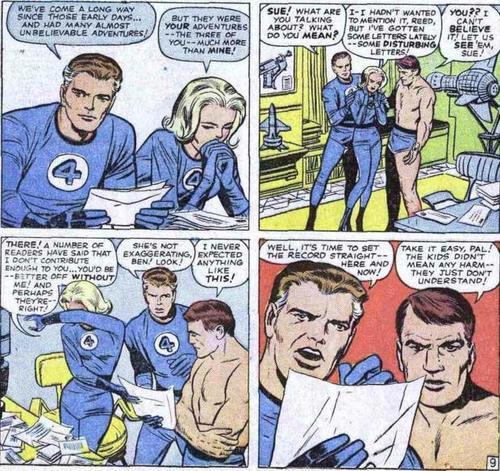


This example may seem antiquated, but we still see this exact same argument brought up today when people are critical of how a female character is written. It’s also a good example why the “separate but equal” excuse for weak female characters is still comically lame.
"Feminine" attributes and "masculine" attributes are mostly arbitrarily assigned by whatever culture they’re in, and are a poor means of constructing believable, compelling characters of any gender.
Rodanof42 likes this
04 Aug 21:40


The Minds Of Monks
by Andrew Sullivan
Christof Koch describes a classic 2008 study that investigated the brains of Buddhist monks:
The cognitive scientists fitted skullcaps with 128 electroencephalographic (EEG) electrodes to the heads of eight long-term Buddhist practitioners and 10 student volunteers. The former were asked to attain a state of “unconditional loving-kindness and compassion” (a form of meditation that does not focus on a single object and is sometimes referred to as “pure compassion”), whereas the volunteers thought about somebody he or she deeply cared about and then tried to generalize these feelings to all sentient beings.
The onset of meditation in the monks coincided with an increase in high-frequency EEG electrical activity in the so-called gamma band (spanning 25 to 42 oscillations a second), which was synchronized across the frontal and parietal cortices. Such activity is thought to be the hallmark of highly active and spatially dispersed groups of neurons, typically associated with focusing attention. Indeed, gamma activity in these monks is the largest seen in nonpathological conditions and 30 times greater than in the novices. The more years the monks had been practicing meditation, the stronger the (normalized) power in the gamma band.
More important, even when the monks were not meditating, but simply quietly resting, their baseline brain activity was distinct from that of the students. That is, these techniques, practiced by Buddhists for millennia to quiet, focus and expand the mind—the interior aspect of the brain—had changed the brain that is the exterior aspect of the mind. And the more training they had, the bigger the effect.
03 Aug 18:04
digivolvin: in general when i think of straight people i kind of think of the anchovies from...
in general when i think of straight people i kind of think of the anchovies from spongebob
