Shared posts

07 Jan 00:44

Barbarism, again: on efficiency

by philphord
trudeau pirouette

Pierre Trudeau executing a little pirouette behind the Queen’s back.

So if I have this beef with capitalism, you might ask, what kind of world do I want to live in? What system would I advocate? Now, I could dream up any number of systems that would work out great in my mind and rather less so in the real world (always assuming that the real world would care what I might have to say about it), but always what I end imagining is something like what we have, only a lot more inefficient. Something like Canada in the Trudeau years.

We are used to thinking of efficiency as a virtue and the lack of it as a very terrible thing indeed, but I would like you to imagine that, in the realm of art and human life, “efficiency” is just another word for “no options.”

“Efficiency” is always efficiency of something, whether it is the efficiency of an engine or of an economic system. In an engine, it is the ability to run as long as possible on the least amount of fuel, or (put more abstractly) to direct the greatest possible share of its energetic output into the work it is intended to do. Come to think of it, the latter definition also serves to describe what we mean by an efficient economy. But in a machine or any other item of utility we seldom have much doubt as to what it is intended to do — what it is for. Now, I could take a power drill and use it as a paperweight, or a wedding dress as a dog sling, but in each case you would assume that I was making some kind of point, and that the object in question had become in some way symbolic. If you stay within the frame of reference determined by utility (“what is it for, and how might it best fulfill that function?”), this kind of symbolic repurposing is merely silly. But if you move to a wider frame of reference, it can become a great many more things. Once you’re making dog slings out of wedding dresses, you’re well on the way to art.

Art is a realm of things liberated from the single dimension of utility. In this way, art is the faithful mirror of human beings. For human beings are plural creatures, prone to indecision, inconsistency, capricious needs, and here-today-gone-tomorrow moods. In the postmodern academy, it’s not cool to make universalizing statements about “human nature,” but the hell with it: I’ll go out on a limb here and say that human beings are inherently and universally not assimilable to any one frame of reference. It is the most fundamental of all human behaviors to act in a way that defies reasonable prescriptions. Paul Theroux once wrote that the one human universal is the hatred of rowing into a headwind. But even this sensible thought cannot be true, because it is easy to imagine that some distant tribe in the Outer Antipodes has convinced itself that the gods smile upon headwinds and that it is lucky to paddle into them. Anything that a rational perspective would condemn as inefficient is, within a broader perspective, capable of generating meaning. And for human beings, meaning is the name of the game.

One possible definition of the life worth living is a life that seeks always to keep open the greatest number of options — options for meaning, options for experience, options for self-understanding and self-definition. This, to me, is what practice is after.* This, to me, is what it is to be human. Anything that stands in the way of that process is (let’s all say it together now) barbarism. Insofar as the ideal of efficiency takes part in denying the full range of possible human meanings, it takes part in barbarism.

It makes sense to ask an employee to behave more efficiently at work, because in the context of a job, a human being has a fairly simple and unitary purpose. If your job is to fix air conditioners and you’re spending 80% of your time watching porn, your boss might rightly object. Within the context of this job, a human being has only one function, and you’d be hard-pressed to argue that watching porn has anything to do with it. But what if our air-conditioner repair person wasn’t watching porn at work, but drawing alternative comix? Or surreptitiously pulling out a flute at odd moments? The likely response would be “do that on your own time.” That is, on the time your productive role in consumer society permits you, which is to say the dregs of time, at the bleary beginning or exhausted end of the day. For the rest of your time, you have one role and that is to fix some goddamned air conditioners. Efficiency, here, is the measure of how completely you have restricted yourself to this one option.  

But human beings aren’t simply reducible to their jobs, and insofar as they are, they are necessarily damaged, amputated, partial entities. And one of the great deformations of the neoliberal regime is how we do in fact reduce human beings to their function as producers and consumers — inflow and outflow of measurable quanta, namely $$$. Value for money, money for value. In the version of America in which we now live, it seems widely assumed that what we want from a person is pretty much the same thing we would want from a lawnmower. If you believe, as market fundamentalists do, that there is a reciprocal relationship between the economy as a whole and individual consumers, that efficiency in the one entails efficiency in the other, and that the greatest happiness for the greatest number of people is becomes possible only when such efficiencies are maximized — then every human activity that does not obviously contribute to such efficiencies is a mistake. Sleep itself becomes a “standing affront to capitalism.” Think of all those hours you’re just lying there, having stupid pointless unproductive dreams, when you could be on the internet, clicking on links and fulfilling your rightful role in consumer capitalism: a pair of disembodied eyeballs, tracked and quantified as they move through the electronic midway, contributing their tiny quantum of economic value to the system.

It is unsurprising that those who above all prize what Rebecca Solnit calls “the four horsemen of my apocalypse”  – Efficiency, Convenience, Profitability, and Security – which is to say, those who have completely adapted themselves to the regime of consumer capitalism —  don’t really understand what art is for. Art belongs to the same domain as sleep or love or spirituality or even basic human decency, none of which ever quite snaps to the grid. Their domain is what lies outside the single dimension of quantifiable function. This is the domain of the inefficient.

The typical response of the quantifiers — and here I am speaking not only of our corporate overlords but the neopositivist philosophy that blesses and dignifies their endeavors — is to deny that anything that lies outside their systems of measure has any value or meaning. (Need I point out that this, too, is barbarism?) It reminds me of a bit of doggerel my Dad used to recite about Benjamin Jowett, a noted translator of Plato and eminence of Oxford’s Balliol College:

My name is Benjamin Jowett
I’m the master of Balliol College
Whatever is knowledge, I know it
And what I don’t know isn’t knowledge.


Logical positivists always said that any language that failed to convey empirically-grounded propositional meanings (like, say, poetry) was “nonsense” about which philosophy (and ideally everyone else) should remain silent. The dead-eyed apparatchiks of the No Child Left Behind gulag insist that “creativity” (you know, classes in art and music and such) isn’t their concern, since you can’t test it. An unintentionally funny example of how neopositivists seem incapable of understanding anything that isn’t put in quantified and standardized terms: when an entertainingly ornery philosophy blog called Fuck Theory called out Stephen Pinker’s execrable “Science is Not Your Enemy” piece that appeared (where else?) in The New Republic, one of Pinker’s dim-bulb supporters wrote in to defend him, writing that ”Pinker…is a profoundly intelligent man.  He would do extremely well on objective tests verbal aptitude and reading comprehension.” This in response to philosophical and historical arguments. But then again, neopositivists generally wish that philosophy and history would just go away, because these disciplines mess up their tidy systems. History and philosophy, too, are inefficient. And silencing their impudent questions is pretty much the agenda of Pinker’s piece and the whole “mamas, don’t let your babies grow up to be liberal arts majors” thing we’ve seen play out in the media throughout the past year.

The less fanatical among the educrats might try to ease the harsh edges of their ideology with some render-unto-Caesar jive (“I don’t say that art classes aren’t valuable in their own way, I’m just saying that our priorities must remain focused on STEM**), but they are really just being inefficient, and the more hardcore among them know it. Neopositivism is a jealous god and will suffer no other gods before it. Pluralism is for the weak. The whole point of an imperial monism like neopositivism is to have ONE way to reduce the whole messy, prolix, contradictory human experience to something cleaner, more rational, more . . . efficient. Pinker’s solution to the old “two cultures” conundrum is typical: you get one culture out of two cultures when one of them (guess which) is assimilated to the other. It reminds me of the would-be Indiana senator Richard Mourdock’s idea of bipartisanship: “bipartisanship ought to consist of Democrats coming to the Republican point of view.” 

One more time, with feeling: this is barbarism. Say it loud and there’s music playing. Say it soft and it’s almost like praying.

*A lot more needs to be said about this. For one thing, serious practice always involves a very great limitation of means — if piano is your practice, you will pursue it to the exclusion of a great many other things. And yet the severe forms of self-limitation encountered in practice are in fact ways of maximalizing a different set of options — the options of meaning and the self. But what I mean by that is complicated, and this topic will have to wait for another day.

**Edu-speak for science, technology, engineering, and math.


01 Jan 06:47

Best Pope Francis Story Yet

by Josh Marshall

This is a great story to end the year on. Ken Langone, billionaire founder of Home Depot (nice place, I've shopped there), says Pope Francis is bumming out the tycoon class by giving all the love to the poors. (I mean, Langone doesn't seem to be a big Matthew 19:21 kinda guy, does he?) And if it keeps up, they may cut off their contributions for things like restoring St. Patrick's Cathedral.

This reminded me of when Jesus said, "It is easier for a rich man to go through the eye of a needle than for a Pope to understand complex financial instruments or the challenges faced by those who labor with them."

To ring in the New Year, what's your Matthew 19:24 riff to honor Ken Langone?

31 Dec 20:10

How to paint realistic creature fur

by Mark Frauenfelder

Artist Nate Hallinan has a good tutorial on painting creature fur in Photoshop.


31 Dec 20:05

Narnia: Intent is Magic

by Ana Mardoll
[Narnia Content Note: Genocide, Religious Abuse, Chivalry, Racism, Slavery]
Content Note: Misogyny, Rape Culture]

Narnia Recap: In which Lucy goes into the Magician's tower to read a spell.

Voyage of the Dawn Treader, Chapter 10: The Magician's Book

There's a lot of reasons why I prefer to deconstruct books in the order of publishing date as opposed to canonical order. My biggest reason is ultimately a personal one: it's more intuitive for me to navigate the words on the page as they appeared in (semi-) real-time, as opposed to how they were arranged later, with all the benefits and drawbacks of hindsight. Others, I know, approach literature in different (and equally valid) ways.

I mention this, however, because today's passage is an illustration of how words-on-the-page are often approached differently depending on what we've read before. If we were working through the books in canon-order, we would have already done The Horse and His Boy, given that it is set within the Golden Age of the Pevensies and therefore straddles the time gap between The Lion, The Witch, and the Wardrobe and Prince Caspian. (Indeed, technically speaking, THaHB occurs within a single chapter of LWW.)

And if we had already read THaHB, it would be firmly fixed in our minds that Queen Lucy the Valiant is not only a lovely vibrant young woman who has had every prince in the Narnia 'verse bucking for her merry hand in marriage (citation: LWW), but who is also a passionate warrior-queen who loves the thrill of battle for its own sake and is as brave as any man et cetera, et cetera. We might therefore be a touch confused at child!Lucy here who is frightened of her own shadow. 

I struggle somewhat with how to express my sense of contradiction here, because I do not want to come off as saying that it's wrong to be afraid (it's not) or unnatural for a little girl in this situation to be afraid (it's not) or like Lucy is a bad person to be afraid (she's not). It is okay to be afraid. It's also totally okay, from a Watsonian perspective (by which I mean if Lucy were a real live person) for Lucy to be afraid in this instance: there's obviously a qualitative difference between being an adult archer in a huge battle with comrades beside you versus being a child in a solitary situation facing an invisible magician. Those things are not the same thing.

But from a Doylist perspective (that is to say, seeing the text through the eyes of an author), I feel like it's appropriate to ask why Queen Lucy the Valiant is so fearful in this chapter when, a couple of books from now, she'll be jostling for the joy of battle with more than a little fervor. The simplest answer is (as always) that Lewis forgot, or that he didn't care about consistency. Or we can fall back on the fact that the Pevensie children seem to have curiously faulty memories about their time in Narnia. (Though this, as usual, undermines the Problem of Susan--she can't be sinful for thinking their childhood memories nothing more than make-believe if her memories really are fuzzier than a kitten wrapped in a skein of yarn and napping on an alpaca throw-blanket.)

Yet I believe the answer is that characterization, for Lewis, was intentionally kept fluid in order to fit the moral he was trying to convey in any situation. (And I believe, without belaboring the point, that we've seen this shifting characterization several times already in this book with regards to Edmund and Eustace.) In THaHB, Lucy will appear in contrast to Susan; Susan, who is weak and womanly and fearful, will stay home from the literal war being fought over her, while Lucy will be brave and courageous and will risk her body (in a way that Susan will not risk hers) to save her country. Good Lucy, Bad Susan--and in a moral message that clearly links bravery with goodness.

Here however, Lewis wants to use Lucy to send a moral lesson to the girl readers about their sinful girly vanity, so that means that Lucy must be the bad girl in the room. This means that Lucy has to be stripped of her bravery (since bravery is a measure of goodness) and additionally that Lucy has to be given the sin of vanity where she has never before shown any sign of being vain. (And this is especially frustrating because if Lewis wanted to showcase a lack of bravery and a surfeit of vanity, Caspian or Eustace would surely have been better characters for this sequence. But instead we get Lucy, because Lewis seemed to have a serious bug up his butt about female vanity, if the "lipsticks and nylons" didn't already make that plain.)

But a major problem that I want to address is that when characterization is kept fluid in order to serve morality, you end up with the problem that morality is inextricably linked to personality rather than to actions. Instead of having good people wrestle with the morality of their actions, we end up with morality lessons around people whose personalities are good or bad as the situation demands. Good People people do good things simply because they are Good People, and Bad People do bad things because they are Bad People, and the difference is not one of actions--for, as we've already seen, our protagonists do bad actions all the time without the narrative noticing or caring--but rather one of intentions, and of who is wearing the Bad Person hat for any given day and chapter.

Let's dive in before I talk your ears off. 

   When Lucy woke up next morning it was like waking up on the day of an examination or a day when you are going to the dentist. It was a lovely morning with bees buzzing in and out of her open window and the lawn outside looking very like somewhere in England. She got up and dressed and tried to talk and eat ordinarily at breakfast. Then, after being instructed by the Chief Voice about what she was to do upstairs, she bid goodbye to the others, said nothing, walked to the bottom of the stairs, and began going up them without once looking back.

If it was at any point explained why Lucy has to go upstairs alone, I missed it. I could maybe understand it if this were supposed to be a stealth mission, but that idea is entirely undermined by the fact that the Dufflepuds gave them a ginormous feast and had them stay the night rather than sending Lucy upstairs right away after the capture. I'm guessing that this is supposed to just be one of those self-evident things, because magic or because adventure or because whatever. I also note that there is no mention of Lucy being armed, which again contradicts everything we know of her to this point.

So we're sending a little girl all alone and unarmed upstairs to confront an evil wizard, and Reepicheep feels like this isn't going to affect her honor, and we all know (as Lewis surely must have) that when the word "honor" is applied in the chivalric sense to a woman, 9 times out of 10 the speaker means sexual purity. I don't really know what to say about this, except that I'm thunderstruck by Lewis' continual invisibling of the concerns of women in his stories. He's like Caspian living it up with his new friends while Lucy is being chained up by pirates, blissfully ignoring anything that would ruffle his privileged happy feels.

Then there's a lot of stuff about the whole place being very scary except Not Really because later, when everything is all said and done, the house will seem very warm and homey and cheery. So there's a strong undercurrent of a theme that the place is scary only because Lucy herself is scared, and not because the place or the situation are legitimately frightening things.

   It was quite light, that was one good thing. [...] “The last doorway on the left,” she said to herself. It did seem a bit hard that it should be the last. To reach it she would have to walk past room after room. And in any room there might be the magician—asleep, or awake, or invisible, or even dead. But it wouldn’t do to think about that. She set out on her journey. The carpet was so thick that her feet made no noise.

Lucy the valiant warrior queen, who has been in many a battle and slain many an enemy and healed (and surely also failed to heal) many a fallen comrade on the bloody field of combat, is afraid of dead bodies. And, as previously noted in the last chapter, insects and maybe also frogs and other jumpy things. OK. 

   “There’s nothing whatever to be afraid of yet,” Lucy told herself. And certainly it was a quiet, sunlit passage; perhaps a bit too quiet. It would have been nicer if there had not been strange signs painted in scarlet on the doors—twisty, complicated things which obviously had a meaning and it mightn’t be a very nice meaning either. It would have been nicer still if there weren’t those masks hanging on the wall. Not that they were exactly ugly—or not so very ugly—but the empty eye-holes did look queer, and if you let yourself you would soon start imagining that the masks were doing things as soon as your back was turned to them.

And also unknown and maybe magical signs on the wall (despite not being frightened by the strange wall-symbols in the caves under the Stone Table in Prince Caspian) and also masks with empty eye holes. Sure.

   After about the sixth door she got her first real fright. For one second she felt almost certain that a wicked little bearded face had popped out of the wall and made a grimace at her. She forced herself to stop and look at it. And it was not a face at all. It was a little mirror just the size and shape of her own face, with hair on the top of it and a beard hanging down from it, so that when you looked in the mirror your own face fitted into the hair and beard and it looked as if they belonged to you. “I just caught my own reflection with the tail of my eye as I went past,” said Lucy to herself. “That was all it was. It’s quite harmless.” But she didn’t like the look of her own face with that hair and beard, and went on. (I don’t know what the Bearded Glass was for because I am not a magician.)

And also novelty mirrors. Lucy the valiant queen of valiantness is afraid of insects and frogs and dead bodies and door-symbols and masks and novelty mirrors. And while Lewis might not know what the Bearded Glass was for, I can venture to guess that it was for showing how frightened Lucy is, because it wasn't enough for Lucy to be unsettled or disconcerted, she has to be frightened and a-frighted and frighty-fright-fright-boo for the reader to really appreciate just how scared Lucy is: she's literally scared by her own reflection.

   Before she reached the last door on the left, Lucy was beginning to wonder whether the corridor had grown longer since she began her journey and whether this was part of the magic of the house. But she got to it at last. And the door was open. [...] For the Book, the Magic Book, was lying on a reading-desk in the very middle of the room. She saw she would have to read it standing (and anyway there were no chairs) and also that she would have to stand with her back to the door while she read it. So at once she turned to shut the door.
   It wouldn’t shut.
   Some people may disagree with Lucy about this, but I think she was quite right. She said she wouldn’t have minded if she could have shut the door, but that it was unpleasant to have to stand in a place like that with an open doorway right behind your back. I should have felt just the same. But there was nothing else to be done.


You know? No. NO. All this faux pat-the-little-girl-on-the-head, no-really-this-is-very-scary, you-poor-little-dear fake sympathy can go stuff itself. The door won't close, and the book won't move, and the reading desk won't rotate, etc. etc. because the author says so and railroading is the only way Lewis The Dungeon Master likes to play so strap in and get ready for a bumpy ride NO. 

Queen Lucy the Valiant does not accept this. Queen Lucy the Valiant breaks the window panes, or the dishes she brought up with her for this very purpose, and scatters the broken glass and ceramic shards across the threshold to warn her if any invisible magicians try to sneak into the room. Queen Lucy the Valiant stacks books up at the doorway so that no one can enter without knocking them over and giving her warning. Queen Lucy the Valiant sets the door on fire as a warning to the other doors to listen to her over the author. Queen Lucy the Valiant does anything other than meekly submit to the situation crafted by the author (and/or by the evil wizard) to put her at the most disadvantage.

   One thing that worried her a good deal was the size of the Book. The Chief Voice had not been able to give her any idea whereabouts in the Book the spell for making things visible came. He even seemed rather surprised at her asking. He expected her to begin at the beginning and go on till she came to it; obviously he had never thought that there was any other way of finding a place in a book. “But it might take me days and weeks!” said Lucy, looking at the huge volume, “and I feel already as if I’d been in this place for hours.”


So, too, can all this Have I Mentioned Lately That The Dufflepuds Are Stupid go stuff itself. Considering that the Dufflepuds are slaves and probably don't own any books of their own and come to think on it it's a miracle they aren't all illiterate, then no it's not surprising that the Chief doesn't know about tables of content and bookmarks and whatnot. And given that the magician's book is a traditional grimoire, with hand-written pages and no tables of content and no bookmarks and (very probably) designed to allow the pages to be moved around, the Chief just so happens to be right that the only way to find the spell is to start at the beginning and step through. Not that he gets any credit for that.

I want to save the actual vanity spell for next time, because I think it deserves its own post, but I want to touch on one more piece of characterization here.

As Lewis does with all his characters who he dislikes (or who are intended to be disliked for the duration of a scene like this one), Lucy has descended into Stupidly Silly. I've already talked at length about how the Talking Animals and the Dufflepuds are stupidly silly, and we've discussed how this is a technique to Other the character and distance the reader from sympathy with hir. Now we get to see this applied to Lucy.

Lucy has spent the better part of this morning being so frightened that she has literally been terrified by her own reflection. She's practically shaking with fear in this (Not Really) ominous house, and she's thoroughly anxious to finish her job and get out as quickly as she can. She has every reason to believe that the magician in the house is hostile and might try to harm or retaliate against her; once she makes the Dufflepuds visible (which will release her obligation to them and hopefully cause them to free her and the others) she needs to hoof it back to the Dawn Treader before the evil magician can hurt her.

(All of this is supposing that Queen Lucy the Valiant doesn't intend to fight the magician and free the Dufflepuds, but that has been the understanding left to us by the dialogue and narrative--Lucy appears to intend to do only for the Dufflepuds what they have asked and no more, and then to flee the island.)

So of course, while she's in a huge rush and no small terror at being discovered and attacked, she's going to leaf as slowly as possible through this book:

   It was written, not printed; written in a clear, even hand, with thick downstrokes and thin upstrokes, very large, easier than print, and so beautiful that Lucy stared at it for a whole minute and forgot about reading it. The paper was crisp and smooth and a nice smell came from it; and in the margins, and round the big colored capital letters at the beginning of each spell, there were pictures.   There was no title page or title; the spells began straight away, and at first there was nothing very important in them. They were cures for warts (by washing your hands in moonlight in a silver basin) and toothache and cramp, and a spell for taking a swarm of bees. The picture of the man with toothache was so lifelike that it would have set your own teeth aching if you looked at it too long, and the golden bees which were dotted all round the fourth spell looked for a moment as if they were really flying.
   Lucy could hardly tear herself away from that first page, but when she turned over, the next was just as interesting. “But I must get on,” she told herself. And on she went for about thirty pages which, if she could have remembered them, would have taught her how to find buried treasure, how to remember things forgotten, how to forget things you wanted to forget, how to tell whether anyone was speaking the truth, how to call up (or prevent) wind, fog, snow, sleet or rain, how to produce enchanted sleeps and how to give a man an ass’s head (as they did to poor Bottom). And the longer she read the more wonderful and more real the pictures became.

There are really only two ways that I can see to make sense of this.

One way is that Lucy is ensorcelled. (And it is, I think, a reflection on Lewis' writing that we have to reach for this option so very often. "The characters are acting wildly out of character! Are they ensorcelled? Maybe? WHO KNOWS.") This is definitely how the movies of this scene play it; that Lucy is dawdling over the magic book because her attention is magically arrested. But, as with every other ensorcelled scene, this explanation vastly reduces the impact of the moral lesson, since Lucy is no longer fully in control of her actions. The sin of vanity, or temptation of vanity, can't really be a sin or a temptation if the person has limited control over her actions. As a moral lesson, it doesn't work.

The second option--which leaves Lucy's culpability intact but not her character--is that she's suddenly become very stupid. She's fearful, yes, but not so fearful that she acts sensibly. She's like the Dufflepuds who fear the magician but not enough to not bad-mouth him loud enough for him to hear them. She's like the Animals who fear the Telmarines but not enough to form a capable fighting force, and who instead have to wait around a few hundred years until a sensible human shows up to overrule their silly impulses.

As a tool in the moralist's arsenal, making the sinner Stupidly Silly might seem like an unproductive move. After all, wouldn't Lucy be a better object lesson if she were willfully vain instead of silly-ly vain? But in actuality, the Othering provided by the sillyfication is necessary in order for Lewis' message to go down without the reader questioning it. If Lucy were behaving shrewdly and rationally, the reader might wonder if her vanity is also shrewd and rational. (Spoiler: It is.)

In order for Lewis to be sure that the reader (who is also expected to be a child and less likely to argue with the author) accepts that Lucy's actions are wrong, he needs to also be clear that the source of her actions are wrong. If Lucy's reasoning is silly, flawed, faulty, and stupid, then it therefore follows that the actions resulting from her reasoning are wrong without need for further examination.

Everything that follows in Narnia flows from this poisoning of the well: If a character--whether it be Talking Animals or Dufflepuds or Lucy or Calormen--is silly and wrong-headed, then hir actions are wrong. If a character is right-headed, then hir actions are right. Eustace was right to attack the sea serpent with a sword, not because it was the right action, but because it stemmed from the right attitude. Lucy will be wrong to try to cast the beauty spell not because it is a wrong action (we will not be allowed to examine the rightness or wrongness of the action) but because she is, right now, in the wrong frame of mind. Caspian and Cornelius were right to drug their guards in order to escape because they had the right attitude, but another character (to be discussed later) will be wrong for doing the exact same action, merely because she is deemed by the author to be uppity.

Intent in Narnia doesn't just excuse actions, it actually colors them entirely, with no thought allowed otherwise for whether the action itself was right or wrong.
31 Dec 19:57

Wonkblog: Robert Rubin’s graph(s) of the year

by Wonkborg

Time has its "Person of the Year." Amazon has its books of the year. Pretty Much Amazing has its mixtapes of the year. Buzzfeed has its insane-stories-from-Florida of the year. And Wonkblog, of course, has its graphs of the year. For 2013, we asked some of the year's most interesting, important and influential thinkers to name their favorite graph of the year — and why they chose it. Here are Robert Rubin's.

The first, which is a chart, not a graph, in my view, is deeply troubling with respect to the future of our society and the future of our democracy. How can any society or any government succeed when most of its institutions are held in such low regard by its citizens?

The Hamilton Project graph makes the point that a surprising portion of those in poverty or in the lower middle class, have had at least some post-high school education.

- Robert Rubin was Secretary of the Treasury under Bill Clinton and is currently co-chairman of the Council on Foreign Relations.

See all the graphs of 2013 here, including entries from Bill Gates, Jonathan Franzen, Patty Murray, Tyler Cowen, Bill McKibben, Emily Oster, Ta-Nehisi Coates, Brian Greene, Chuck Schumer, Chris Hayes, and Ron Wyden.


31 Dec 19:28

Journalism’s Surrender

by Andrew Sullivan

Not sure what to think of this sponsored section on #SouthSudan in the Dec. 30 issue of @TIME. pic.twitter.com/yfj8BYVl68

— clairelambrecht (@clairelambrecht) December 28, 2013

I should end the year on an upbeat note, shouldn’t I? But Time Inc. ruined it. The surrender of journalism to advertizing and public relations – not alliance with, but surrender to – was the biggest media story of 2013 that the media almost didn’t cover at all. But it’s right there in black and white, if buried on the slowest news day of the year:

Time Inc. will abandon the traditional separation between its newsroom and business sides, a move that has caused angst among its journalists. Now, the newsroom staffs at Time Inc.’s magazines will report to the business executives. Such a structure, once verboten at journalistic institutions, is seen as necessary to create revenue opportunities and stem the tide of declining subscription and advertising sales.

Now remember this is not some desperate trade magazine; this is Time Fucking Inc. Journalists at Time will report directly to those on the business side (or is that now an anachronism?) seeking advertizing revenues and sponsored content contracts. That’s what the editors now are. And listen to the howls of outrage swirling around every other journalistic institution, read the columns decrying the end of independent journalism, witness the mass exits of outraged editors, observe the talking heads fulminate and readers rebel!

Actually, there was one resignation, and it was a deeply honorable one:

Among those who expressed concern was Martha Nelson, the recently departed editor in chief. Before Mr. Ripp came aboard and brought on Mr. Pearlstine, the magazines’ editors all reported to Ms. Nelson, who was seen as a staunch defender of newsroom autonomy. Late last summer, Mr. Ripp invited Ms. Nelson to Nantucket to discuss his plans, according to several current and former Time Inc. executives. Troubled by the idea of reporting to the business side, she resigned.  “When Joe suggested a new structure that required editors to report to the business heads, I wasn’t comfortable being part of it,” Ms. Nelson said. “You can’t take apart what you have promoted and built.”

This is the way the press ends. Not with a bang but a “revenue opportunity.”

31 Dec 19:25

Screenwriting 101: Elgin James

by Scott

“That’s such a thing where people just sell themselves short anyway and be like ‘What is my shortcut?’ As opposed to trying to tell something interesting and figuring out who you are through writing – and that’s really what it is – we have all this horrible or beautiful wreckage inside of us and then you try to just get it out somehow. That’s the beautiful thing about words. Even when you read a book, or in a screenplay, when someone puts together these words that you’re familiar with, but puts them together in a certain way… it’s like ‘I feel that way all the time and I could never figure out how to articulate that’… that’s just like magic. But then other people are like, ‘Oh, I want to be in the movie business and what do I have to do? I have this great idea about boy meets girl… and what are these other films like? How can I do that? Let me buy ‘Save The Cat’. What’s the gist? What can I just get through? How can I just break it down?’ I feel as an artist, you’re just selling yourself short.”


– Elgin James (GITS Interview, September 3, 2012)

31 Dec 15:13

Fake Feels and Free Passes

by Jamie Madigan

The Capilano suspension bridge in Vancouver, British Columbia is kind of a big deal in certain psychology circles, and I think it can illustrate why people have ignored the flaws in games like The Last of Us and The Walking Dead during the last few Game of the Year debates. The bridge, which is only a few feet wide, soars among the treetops of the surrounding Capilano Park, and these are TALL trees. If you were to glance over the side of the bridge as you crept along, you’d see a stomach flipping drop of about 230 feet to a river that’s only deep enough to make you wet in addition to very dead if you were to fall. On top of all that, the bridge sways and creaks alarmingly with every little breeze and footstep. Crossing it is so unnerving that many people who try experience increased heart rate, sweaty palms, and short breaths.

In other words, they get scared.

The Capilano suspension bridge. FEAR!

The Capilano suspension bridge. FEAR!

So imagine that you’re crossing that bridge. Good, now, to make the scene a little more interesting, imagine that there’s a woman standing at the middle of the bridge. Even better, she smiles at you as you approach. (Also, if need be, imagine that you’re a hetero dude.)

Researchers Art Aron and Donald Dutton set up an experiment along these lines at this very bridge back in 1974.1 The woman, who was working for the researchers, asked male bridge crossers to complete a short survey that involved telling a story in response to an ambiguous picture. After completing the task, the woman gave the men a phone number, telling them that should they have any questions they should totally call her. The researchers then repeated the scenario miles away with the same woman, but on a stout, low to the ground, and thoroughly unintimidating bridge.

Half the men who got the number of the girl on the scary bridge tried to call her up. Only about 12 percent of the ones on the blase bridge in the control group made use of those same digits. Also, remember those stories the subjects were asked to make up about the ambiguous picture? Those who did so while swaying slightly back and forth over the Capilano River were much more likely to come up with narratives involving sex. 2

The suspension bridge story is my favorite illustration of how misattributions of emotional arousal can trip us up. And despite the “boy meets bridge meets girl” nature of the tale, I don’t mean “arousal” in just the sexual sense. Psychologists use that term to describe anyone experiencing any number of intense emotions and the accompanying physiological responses. In the case of the bridge crossers, fear was presumably in play, yet the subjects got it confused with some variation of sexual or romantic arousal. Later, Aaron and Dutton did another study where they paired a male subject with a female confederate, scared the bajeezus out of him by making him think that he might receive painful electric shocks, then asked him how cute he thought the girl was. Those who were nervous about the impending shocks tended to rate her closer to the “smokin’ hot” end of the scale.

Why? Because the fast moving parts of our brains are marvelously adept at drawing the shortest line possible from cause to effect. My heart is racing and my skin is flushed. This woman is talking to me. She must be cute! This won’t happen if she’s clearly hideous or covered in spiders, but it may be enough of a nudge otherwise. Especially if the relatively slow moving, rational part of your brain that usually stops and says “No, dumbass, it’s probably the scary bridge” is preoccupied or tired. In that case, then we’re much more likely to automatically misattribute our arousal to whatever explanation is the most salient and requires the least mental effort.

I think this explains why certain games get overrated.

Or at least certain aspects of games. Take the first season of The Walking Dead for example. That game did a great job of making you care about its characters, and every chapter featured predicaments and decisions that really got people worked up. Anxiety, fear, regret, and melancholy were frequent visitors during my time with that game. And the game did a fantastic job of strategically spacing emotional story beats right before and after action and exploration sequences. As a result, I’d often be emotionally aroused while searching through cupboards or fumbling through QTE sequences. And like those bridge crossers meeting the woman at the most nerve-wracking point of their trek, I was predisposed to attribute my intense emotions to “having fun navigating dialog trees” or “Looking through every drawer in this dilapidated kitchen.” Even though those sequences sometimes sucked.

twd

You may wonder what kind of idiot can’t parse the sources of this arousal and separate them. But you’d be surprised. Physiological and psychological states of arousal can persist for several minutes during which you think you’ve calmed down, and misattribution of arousal can still happen. For example, in one study 3 researchers had subjects run on a treadmill. Then, after they stopped and felt they had calmed back down to normal, the experimenter showed them a clip from an erotic film.4 Even though the subjects felt that their pulse and general agitation had returned to normal, there was still enough undetected residual arousal to make them report being more hot and bothered by the film relative to a control group.

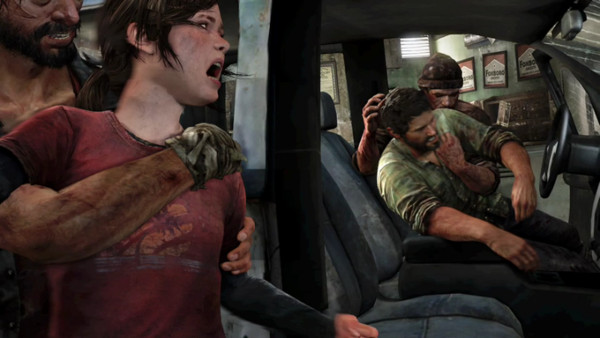
The same thing may be happening to inflate your appreciation of a boring game sequence that follows from an intense, arousing one –even if you think you’ve calmed down and gotten over it. Or the inverse may happen in either The Walking Dead or The Last of Us: you may misconstrue the emotional high from an intense action sequence as feelings of parental affection for Clementine or Ellie, respectively.

JOEL! The stealth mechanics in this game are not as robust as you think. JOEL!

" JOEL! The stealth mechanics in this game are not as robust as you think. JOEL! "

This isn’t to say that playing a game to experience emotional reactions to it isn’t a valid reason to love a game or give it a coveted spot on a “best of” list. In fact, The Last of Us is one of my very favorite games from 2013 pretty much only for its emotional resonance. My point is that you should take a step back and be honest about it. You’re not gripping your controller and staring at the screen in slack-jawed amazement because the combat system is so great –or the animation or the voice acting or the script, or whatever other easy explanation is in front of your lazy brain. When you’re feeling strong emotions your mind looks for an explanation, but the quickest one to present itself and the easiest one to accept isn’t always the correct one.

That said, here’s the real lesson you should take from all this: the next time you get to choose where to go on a date, take him or her on a roller coaster. It’ll make you seem way hotter.

Follow me on Twitter, Facebook, or RSS.

31 Dec 06:29

Architecture in Portland: Best and Worst Developments of 2013

by Jeff Jahn
art_house_sm.jpg
Art House's gleaming metal and glass on the North Park Blocks (all photos Jeff Jahn)

There has been a subtle but important shift in Portland's architecture scene this year that hearkens to a shift in Portland's overall seriousness. I call it the year the faux brick died. To these eyes faux brick was the "humble brag" of Portland's design lexicon... simultaneously disingenuous and passive aggressive because metal and wood were too lux or direct. I'm glad that architecture in Portland is moving beyond trying to make new 10-12 story metal frame buildings look like brick. Nobody is going to do a 12 story wood clad building either.

Still, three of the most interesting projects; Kengo Kuma's Japanese Garden (check out our interview), PNCA's Cloepfil designed 511 building and the new Willamette transit bridge (which we should name after Mark Rothko because he grew up on its west banks, while experiencing all racism Jewish immigrants endured) wont be completed for some time so we have a lot to look forward to in years to come... especially if the Portland Art Museum can solidify key elements for their next expansion ideas.


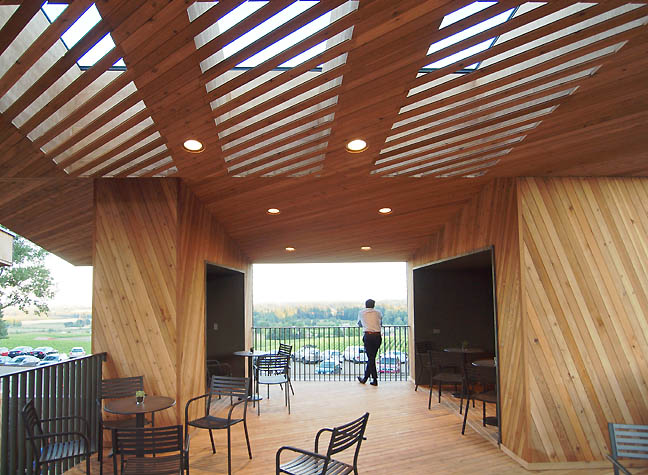
SB_Lookout_sb.jpg
Terrace area of the Sokol Blosser's new Tasting Room facilities designed by Allied Works

The clear winner of 2013 was Sokol Blosser's new tasting room by Brad Cloepfil and his team at Allied Works. Start to finish this project is probably one of the best things from Brad since his W+K headquarters and the opening party was the shindig of the year (I generally hate parties and would rather geek out on space, ideas or objects but that is exactly what most of the attendees wanted to talk about ...so it was great). Overall, Sokol Blosser set such a high bar in 2013 that 2014 will have difficulty matching the excellence. The fact that it is wine country throws down a gauntlet for the rest of the wineries and the city of Portland itself.


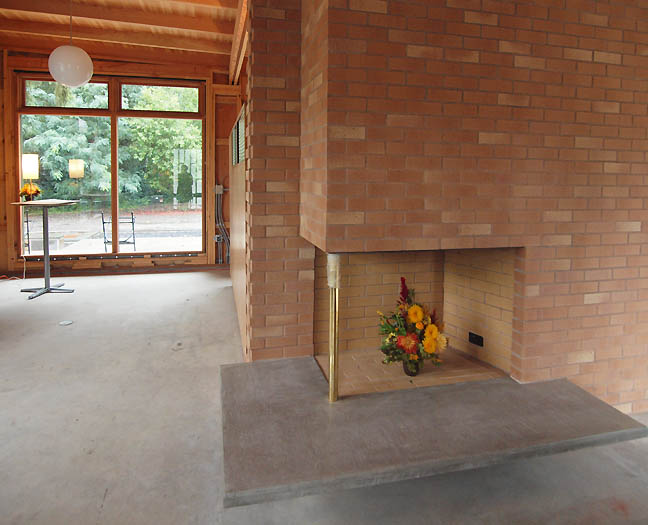
Belluschi_Pav_1_sm.jpg
Marylhurst University's Belluschi Pavillion restoration project

The single worst architectural snafu was an odd deviation of proportions in Marylhurst Univerity's Belluschi Pavillion project. By altering the fireplace ledge design to be much wider (you can see the original here) this otherwise very worthy project is getting off on a correctable wrong foot. The too shiny brass bar simply looks tacky, but it is the far more cantilevered ledge which corrupts Belluschi's design language (proportions matter here and its worth fighting any code disputes). This is an important preservation project and they have admirably kept in the kitchen area period. Overall, this doesn't need to be a museum to modernist design (with all original furniture etc.) but the hearth is the heart of this building. We often say this is NW style architecture but it is really just another iteration of Prairie Style Architecture ala Frank Lloyd Wright (Belluschi sought Wright's input on the Portland Art Museum), where the hearth is crucial. Since the restoration is not complete there is still time to correct this.


Union_Way1_sm.jpg
Union Way

Perhaps the most exciting retail project in Portland for 2013 was Union Way, which cut a high end shopping alleyway between the Ace Hotel and Powell's books. The architects at Lever, whose Principal, Thomas Robinson has a previous history with Herzog & de Meuron and Allied Works would be my pick for firm most poised for superstar status to rival his former gigs. What I love about this is the way the wood an light present themselves in such an simple unpretentious ways while oozing that "natural wood = lux" aesthetic that has become all the rage for the past half decade. Thankfully they chose to avoid using overly knotty wood or anything resembling logs. In fact the subtle knots seem more prominent high above head height, which transitions to the darker old growth beams from the original structure. So instead of the somewhat tired log cabin thing, this feels like a slick northern European ski chalet situation. Rarely does a hallway become the main design element in any project, but here it is... retail that actually pays attention to the site and seeks to amplify it.


arthouse_lobby1_sm.jpg
Art House lobby


Another Lever designed project, Art House (developed by the Powell family for PNCA) wins points for not using wood or brick for cladding. Instead, the faceted metal opens a lot of interesting hallways that terminal in large windows that look out upon the canopy of the North Park Blocks. The comparative lack of brick seems honest compared to all of the odd 10+ story faux brick "humble braggers" that have defined most residential projects in the Pearl.It might not be the best building in the Pearl but from the outside it is both the boldest and most nuanced... perhaps paving the way for a whole new class of buildings in the Pearl District.


emery1_sm.jpg
The Emery

The Emery (by ZGF) wins my vote for the best new residential building Portland for 2013... and it needs to be since it is in the south waterfront area which remains an island within Portland's urban fabric. With curves and facets making every unit unique this place is right out of Denmark. By addressing the Ross Island Bridge it also has a better texture than the grey south waterfront spires to the south, which feel very generic by comparison. Overall, the varigation of floor plans and materials makes this the best high density residential project in Portland for 2013. One has to go back many years to Randy Rapaport's projects to find anything superior and those were much more deluxe pre-crash projects.

Next up, Portland's art scene 2013 in review
31 Dec 06:16

Nailing the neoliberal end-game

by Cory Doctorow
"The possibility of success is used to call the majority of people failures." -Molly Crabapple, Filthy Lucre


31 Dec 06:12

Morality is subjective. Prove otherwise.

I don’t actually have to.

Even if morality is constructed, it’s constructed by people; of which I am one. I am capable of constructing a morality based around empathy, liberation and justice and to try to put those ideals into practice. As are those who share those values. I don’t need to appeal to any higher source of values to legitimize that for me.

Meanwhile, if you’d like to avoid taking responsibility for your effect on the world by having tired, boring, philosophical debates while people are dying: that’s certainly an option. But please don’t appeal to morality when people treat you like the detached, pretentious, asshole you are.

30 Dec 23:06

Wonkblog: Peter Thiel’s Graph of the Year

by Wonkborg

Time has its "Person of the Year." Amazon has its books of the year. Pretty Much Amazing has its mixtapes of the year. Buzzfeed has its insane-stories-from-Florida of the year. And Wonkblog, of course, has its graphs of the year. For 2013, we asked some of the year's most interesting, important and influential thinkers to name their favorite graph of the year — and why they chose it. Here's Peter Thiel's.

Knowledge may be priceless, but a higher education is clearly not. University administrators keep hiking tuition, the wages of graduates keep falling, and a whole generation of Americans is struggling under the crushing burden of debt as they postpone their dreams for a tomorrow that may never come.

Peter Thiel co-founded PayPal and is now a venture capitalist with Mithril and Founders Fund. He also grants fellowships to young people who undertake projects in lieu of going to college.

See all the graphs of 2013 here, including entries from Bill Gates, Jonathan Franzen, Patty Murray, Tyler Cowen, Bill McKibben, Emily Oster, Ta-Nehisi Coates, Brian Greene, Chuck Schumer, Chris Hayes, Jason Furman, and Ron Wyden.


30 Dec 20:57

Scenes from the Class War (12.30)

by Fred Clark

Click here to view the embedded video.

“Nationwide, 12 million people make use of payday loans each year, turning to them for a desperate short-term cash infusion, and on average they spend $520 in interest to borrow $375, according to a report from The Pew Charitable Trusts.”

“Instead of helping homeowners as promised under agreements with the U.S. Treasury Department, Bank of America stalled them with repeated requests for paperwork and incorrect income calculations, according to nine former Urban Lending employees.”

“Forced arbitration clauses give corporate wrongdoers immunity from justice if they sell a shoddy product, commit fraud, violate consumer protection laws, or fail to do what they promised.”

“Millions of mobile phones, laptops, tablets, toys, digital cameras and other electronic devices bought this Christmas are destined to create a flood of dangerous ‘e-waste’ that is being dumped illegally in developing countries, the UN has warned.”

“Wage theft steals more money than all store robberies and bank heists combined.”

“An identity theft service that sold Social Security and drivers license numbers — as well as bank account and credit card data on millions of Americans – purchased much of its data from Experian, one of the three major credit bureaus.”

Experian is not a company from which you can opt out.”

“A bad credit rating is far more often the result of unexpected personal crisis or economic downturn than a reflection of someone’s abilities.”

“Two-thirds of Americans over age 65 rely on Social Security for over half their income, and for over a third of all seniors, those checks make up more than 90 percent of their income.”

Income inequality breeds retirement inequality.”

Social Security is a system that pays for itself. If we did absolutely nothing to Social Security, we would make payments for more than 20 years exactly at this level. And then they would drop by roughly by about 25 percent and pay forever into the future.”

“I think it’s cool that China successfully landed a spacecraft on the moon today, but it makes me feel sad because we can’t even fix our own bridges.”

“By ‘infrastructure’ here I mean something more than the term usually implies: All the things that a First World country is expected to have: Not only roads, bridges, communication systems, cheap-and-efficient transportation systems, but also clean water, safe food, schools which provide the citizens of the country with the needed skills and knowledge, basic safety nets which protect them against major illness, the pains of old age and utter poverty.”

“A plan to put shelters in schools after seven children died in 2013 from a series of devastating tornadoes has been scrapped because Republican leaders are pushing for corporate tax cuts instead.”

“Hundreds of executives have used the same strategy, and Richard Covey, the attorney who pioneered the technique, said it has cost the federal government about one third of all estate and gift taxes collected since 2000.”

“It takes a remarkable degree of self-absorption and sense of self-entitlement to be healthy, young(ish) and affluent — and yet consider oneself a ‘loser.’”

“The Koch brothers have a combined net worth of $72 billion. Each of those billions is a thousand millions. So every million these guys spend is like a guy with $72,000 spending a single buck.”

“By saving those jobs and preserving the future of the American auto industry, it estimates that the bailout boosted personal income by over $284 billion from 2009 to 2010.”

30 Dec 20:25

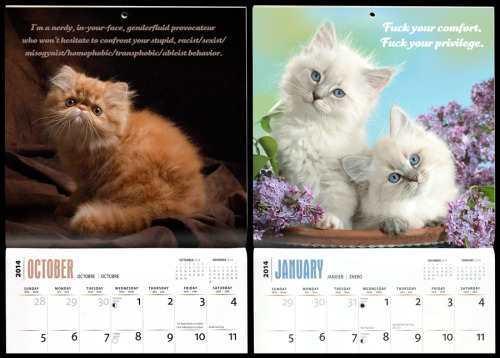
Social Justice Kittens 2014 Calendar (sample pages)


Social Justice Kittens 2014 Calendar (sample pages)

30 Dec 19:50

Awakened In 2013: first, we imagined what the new wall-merging mechanic might look like in an older,

by Patricia Hernandez
Zephyr Dear

jvkdlsa;fjdklsjfdaslgdsa

Awakened In 2013: first, we imagined what the new wall-merging mechanic might look like in an older, classic Zelda game. Today, we're going to imagine what a 2013 remake of Link's Awakening might look like—here's a rendition by artist Jonatan Iversen-Ejve. (Via Tiny Cartridge)

Read more...


30 Dec 06:11

→ The Products Apple Doesn’t Have Time to Improve

Collin Donnell:

The dearth of good Safari extensions compared to what Chrome has is a good example of Apple’s tendency to get something going, get kind of sidetracked and then not give it the attention it needs to succeed.

My main concern for Apple’s future is the growing list of such products, especially the increasing number of major Mac applications.

iWork for Mac is a worst-case example. Its series of substantial updates every 12–18 months completely stopped in 2009, and the 2013 rewrites don’t feel like nearly 4 years of work — they feel a lot more like a rushed 12-month effort in response to marketing threats against the iPad’s suitability for office “work”, prioritizing Apple’s marketing needs at significant expense to iWork customers’ needs.

The iLife apps feel abandoned, too: iPhoto, iMovie, and Garage Band haven’t seen meaningful Mac updates in 3 years. iLife effort has clearly shifted to their iOS versions instead, and while iMovie and Garage Band are impressive on iOS, iPhoto hardly seems worth the effort and the opportunity cost to its Mac version — and I bet iPhoto is the most used and most important iLife app by far.1

The pro apps are sputtering along — Final Cut Pro X was a disaster that’s slowly being resolved, Logic Pro X is OK (but still unreasonably buggy), and Aperture is continuing its tradition of always feeling abandoned (and slow, and buggy).

While most of the press demands new hardware categories, I’d be perfectly happy if Apple never made a TV or a watch or a unicorn, and instead devoted the next five years to polishing the software and services for their existing product lines.


  1. Furthermore, most tasks served by the iLife and iWork apps really are better on Macs. Rather than show off the power of iOS devices, they often frustrate users by slamming hard into the limitations of iOS’ document-silo model, multitasking, and inter-app communication. 

∞ Permalink

30 Dec 03:21

“Marry ‘Em When They’re Fifteen”

by Andrew Sullivan

In which the right to free speech for Phil Robertson continuesMoney quote:

Look, you wait ‘til they get to be twenty years-old and the only picking that’s going to take place is your pocket. You got to marry these girls when they’re about fifteen or sixteen and they’ll pick your ducks.

And it appears he practiced what he now preaches. Also: could Sarah Palin please tell me what “picking your ducks” means? Her role model didn’t explain. Update from a reader:

I grew up in the rural north, not Louisiana, but here’s my take. A woman who will pick your ducks means just that; she will pluck the ducks you’ve shot. I did a fair amount of duck hunting with my dad. Plucking the ducks is a messy, smelly job involving boiling water and melted paraffin. My mother wouldn’t do it. I didn’t know any wives/mothers who would. My mother’s attitude was, “You shot ‘em, you clean ‘em”. Only a woman wholly subservient to her husband would clean his ducks without complaint, the kind you could keep barefoot and pregnant in the kitchen.

When we would travel to Manitoba to some remote hunting camp, there was usually a native woman, dirt poor and uneducated, who for a few bucks would clean ducks for any hunter who didn’t want to do it himself. That’s the only kind of woman I know you’d clean your ducks for you – and even her you’d have to pay.

30 Dec 00:59

hemera4: Thranduil’s face appreciation


hemera4:

Thranduil’s face appreciation

30 Dec 00:59

i have a special method to make shopping fun


i have a special method to make shopping fun

29 Dec 22:12

For a gender-confused Anon who left me a lovely message - and...


For a gender-confused Anon who left me a lovely message - and anyone else having issues with sexuality or gender identity who maybe wishes there was some kind of Sorting Hat that would help you figure it out. You don’t have to choose! Probably the hardest thing you’ll ever have to do is make peace with not knowing. You might decide differently every single day. Just try to be true to whatever version of yourself you wake up as each morning. It’s really all you can do. 

Looking good, everyone. 

29 Dec 20:44

Wonkblog: Paul Farmer’s Graph of the Year: Rwanda’s plummeting child mortality rate

by wonkblog

Time has its "Person of the Year." Amazon has its books of the year. Pretty Much Amazing has its mixtapes of the year. Buzzfeed has its insane-stories-from-Florida of the year. And Wonkblog, of course, has its graphs of the year. For 2013, we asked some of the year's most interesting, important and influential thinkers to name their favorite graph of the year — and why they chose it. Here's medical anthropologist Paul Farmer's.

2014 will mark the 20th year since the 1994 genocide in Rwanda. Over the past decade, the Rwandan health sector has linked an equity plan with a robust delivery system to achieve some of the steepest declines in premature mortality ever documented anywhere. The country’s child mortality rate—once the world’s highest—has fallen at a pace of 11.1% per year, and is now in line with the global average. There is much to celebrate, but perhaps even more to learn.

Dr. Paul Farmer is Kolokotrones University Professor at Harvard University, an infectious disease physician with the Brigham and Women’s Hospital, and co-founder of Partners In Health, which works in Rwanda and nine other countries.

See all the graphs of 2013 here, including entries from Jonathan Franzen, Bill McKibben, Emily Oster, and Ta-Nehisi Coates.


29 Dec 20:41

Resident Evil Fanbase Also Old, Decaying, Capcom Tells Investors

by Owen Good
Zephyr Dear

The part at the end tho, where it's all "this is what they're saying to their investors, which may be more forthright." Because they've got no incentive to mislead *investors*...

Resident Evil Fanbase Also Old, Decaying, Capcom Tells Investors

Resident Evil is old enough to vote as of March. (That means its 18 years old). Its fanbase also has aged commensurately, Capcom said in a recent investor guide. This is not really a good thing, the company delicately points out.

Read more...


29 Dec 19:54

‘A Christmas Present or Two or Ten’

by John Gruber

Fascinating bit from the Conan O’Brien show. Makes me wonder just how prevalent these canned segments are.

29 Dec 19:47

Rust is surprisingly expressive

Do you remember the first time you saw Rails' ActiveSupport library? I do: it totally blew my mind. The only dynamic language I had used up to that point was Perl, and it had a similarly mind-blowing effect on my young self. I thought that dynamic typing was mostly a requirement towards making this kind of expressiveness possible, but it turns out Rust can be just as expressive, while retaining type safety and static dispatch.

There was a time in the early days of Rails when its evangelists would show off snippets of what it let you do. These were often ActiveSupport extensions to the core language itself. It’d go something like this:

Hey, have you tried Rails? Check this out:

irb(main):002:0> Time.now - 2.days
=> 2009-12-26 09:57:02 -0800
irb(main):003:0> 2.days.ago
=> 2009-12-26 09:57:04 -0800

Did I just blow your mind???

At the time, I enthusiastically replied “Yes, yes you did!” and immediately typed rails new foo. And all was well and good in the world.

Fast forward a few years. I now know that static typing is not equivalent to public static void main(String [] args) {. I’ve seen the Hindley-Milner light. Yet, for all practical purposes, I’ve still been hacking in Ruby for these past few years. For the most part, I’d found the complaints about dynamic typing from the static typing camp to be very FUD-y. I very rarely get TypeErrors in my Ruby code. Refactoring generally isn’t very difficult.

But slowly, this has started to change. I think that it’s that I tend to do more infrastructure and plumbing work now. I’ve run into more and more situations where types would be helpful, or picking the mutable state path has caused headaches.

Then, I wake up to an IM from Yehuda:

bro, did you see my tweets?

Basically, this:

➜  active_support git:(master) cat main.rs
extern mod active_support;
use active_support::Period;
use active_support::Time;

fn main() {
  let time = Time::now();
  println!("{:?}", time);
  println!("{:?}", 2.days().from_now());
  println!("{:?}", 2.weeks().from_now());
  println!("{:?}", 2.months().from_now());
  println!("{:?}", 2.years().from_now());
}
➜  active_support git:(master) ./main 
active_support::time::Time{date: active_support::date::Date{year: 2013, month: 12u, day: 28u}, hours: 0u, minutes: 59u, seconds: 6u, nanos: 242647081u}
active_support::time::Time{date: active_support::date::Date{year: 2013, month: 12u, day: 30u}, hours: 0u, minutes: 59u, seconds: 6u, nanos: 243287552u}
active_support::time::Time{date: active_support::date::Date{year: 2014, month: 1u, day: 11u}, hours: 0u, minutes: 59u, seconds: 6u, nanos: 243347757u}
active_support::time::Time{date: active_support::date::Date{year: 2013, month: 2u, day: 28u}, hours: 0u, minutes: 59u, seconds: 6u, nanos: 243388962u}
active_support::time::Time{date: active_support::date::Date{year: 2015, month: 12u, day: 28u}, hours: 0u, minutes: 59u, seconds: 6u, nanos: 243427393u}

Whaaaat? Yup. To compare side-by-side:

# Ruby
2.days.from_now
// Rust
2.days().from_now()

Awesome. Please note that in the Rust, this is fully type-checked, safe, and statically dispatched. No slow reflection techniques used here!

Now, I should say that I almost never use 2.days, but the point is that it’s a benchmark of expressiveness: if you can write it, you can do all sorts of other flexible things. Thinking back to my ‘libraries vs. application code’ confusion over types, I’m reminded by something Gary Bernhardt once said about Ruby vs. Python. I’m paraphrasing, but as I remember it:

Python is a beautiful, clean language. But the same restrictions that make it nice and clean mean that it’s hard to write beautiful, clean libraries. Ruby, on the other hand, is a complicated, ugly language. But that complexity allows you to write really clean, nice, easy-to-use libraries. The end result is that I prefer Python the language, but I find myself preferring programming with Ruby.

I’m starting to wonder if maybe I feel the same way about static vs. dynamic typing: I like the simplicity and the speed of programming in a dynamic language, but maybe, given the right static language, I’ll end up preferring to program in $LANGUAGE better.

And that language might just be Rust.


You can check out Yehuda’s rust-activesupport on GitHub, if you’d like to see how this is accomplished. He’s also told me that he will write a post explaining its implementation in technical detail, I’ll link to it here when he’s written it.

29 Dec 19:44

Spooks and American Exceptionalism

by Cory Doctorow
Ex-CIA agent Philip Giraldi takes a stab at explaining how his fellow retired spooks -- Democrat and Republican -- can be so comfortable with a president who has given himself the power to order assassinations and a regime where the constitution has been effectively suspended. It's all down to American Exceptionalism: "It's OK when we do it, because we're the good guys."


29 Dec 19:44

Wonkblog: Sen. Ron Wyden’s Graph of the Year

by Wonkborg

Time has its "Person of the Year." Amazon has its books of the year. Pretty Much Amazing has its mixtapes of the year. Buzzfeed has its insane-stories-from-Florida of the year. And Wonkblog, of course, has its graphs of the year. For 2013, we asked some of the year's most interesting, important and influential thinkers to name their favorite graph of the year — and why they chose it. Here's Sen. Ron Wyden's.


Massive new supplies of affordable natural gas have paid big dividends for the U.S. economy and manufacturers. But benefits to consumers have been a lot slower coming. One reason for that is ratepayers are usually on the hook to pay for the new pipelines and infrastructure that’s needed to bring this gas to homes. I’m working on ensuring that there are strong incentives to prevent utilities from overcharging consumers and to make sure customers are fully repaid when rates are raised unjustly.

- Ron Wyden is a Democratic senator from Oregon, and chairman of the Senate Energy Committee.

See all the graphs of 2013 here, including entries from Jonathan Franzen, Bill McKibben, Emily Oster, and Ta-Nehisi Coates.


29 Dec 03:16

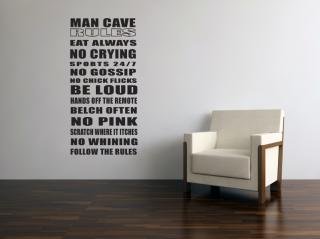
Man Cave Rules: A wall decal

by drew


man-cave-rules

I think the idea of a “man cave” is cringeworthy, and this $39 wall decal with “Man Cave Rules” explains why. It’s not a masculine room if it has a word decal on the wall and you can pick from 29 colors, including “Mustard”, “Key Lime”, “Blue Grey” and “Antique Violet.”

Yeah, bro, this antique violet lettering is a true display of my celebration of masculinity. Want a beer? Here you go– whoa, whoa! No, bro! Don’t throw that cap into the trash! Put it in my satin flower basket! WAIT NO I MEAN MY MAN RECYCLING BIN. NO LAUGHING BRO IT MATCHES MY WHITE SATIN CHAIR COVER. I MEAN MY MAN-BUTT HOLDER. I MEAN SPORTS. BEER ME.

28 Dec 19:54

The 20 Best Movies Disappearing From Netflix on New Year's Day

by Brian Barrett on Gizmodo, shared by Mike Fahey to Kotaku

The 20 Best Movies Disappearing From Netflix on New Year's Day

When the clock strikes its last midnight in 2013—or somewhere around there, anyway—dozens of movies will disappear from Netflix streaming. Fortunately, you've still got some time to churn through the ones you'll miss the most. Here's a list of the very best of the movies that'll be gone in 2014.

Read more...


28 Dec 19:50

Face Of The Day

by Andrew Sullivan

alessia-toscana-1024x1024

A project to ponder in the wake of Christmas:

Shot over a period of 18 months, Italian photographer Gabriele Galimberti’s project Toy Stories compiles photos of children from around the world with their prized possessions—their toys. Galimberti explores the universality of being a kid amidst the diversity of the countless corners of the world, saying, “at their age, they are pretty all much the same; they just want to play.”

But it’s how they play that seemed to differ from country to country. Galimberti found that children in richer countries were more possessive with their toys and that it took time before they allowed him to play with them (which is what he would do pre-shoot before arranging the toys), whereas in poorer countries he found it much easier to quickly interact, even if there were just two or three toys between them.

Toy Stories will be published by Abrams Books on March 24. Explore more of Galimberti’s work here.

28 Dec 19:49

How can Rails react to the rise of the JavaScript applications?

by Andrzej Krzywda
The rise of JavaScript applications is tremendous. Every week new JS frameworks appear. Every website UI is now JS-heavy.

How can Rails react to it?

Do we need to worry about our jobs?

History

Let's go back to the history for a while.

Rails was created as a light-weight, but well-structured alternative to create dynamic, db-backed, html websites.

I still own the main Rails book, that was published in 2005: Agile Web Development with Rails. I just checked, there was 558 pages of good content. Only 16 pages were about The Web, V2.0 (this part was written by Thomas Fuchs, not by the main authors - DHH and Dave Thomas). Back then, Rails supported JS via the prototype library. There was no mention about RJS, yet.

Late 2006, I bought another book - Ajax on Rails. I have it in front of me right now. This time, RJS was important already, as they wrote: "Ruby-generated JavaScript (RJS) is the capstone of Ajax in Rails". Before the concept was introduced in the book, all the server did was returning HTML snippets (data) and the JS libraries inserted it into appropriate places. No such thing as view model, data-binding, etc, yet.


Where are we now?

Rails does a really good job of handling the backend part. It's secure, based on conventions, all apps are similar, everybody knows how to work with it.

Look at the frontend part of many Rails apps, though - you don't see the conventions, you don't see the same structure everywhere.

There's this pro-Rails argument, that it's better for a startup to do Rails, because many Rails devs will know what is going on if the project is done the-Rails-way - so, it's easier to scale the team. It's no longer true, though. Yes, the backend part is usually familiar, but the JavaScripts? They're completely different in every Rails app. Often, they're like 50% of the codebase.

Some developers just hack together some jQuery plugins and call it a day.

Some developers go with DHH suggestions and use RJS (UPDATE: or clean JS returned from the server) (to be honest I have never seen this approach in a Rails app, but I'm sure someone followed DHH here).

The new trend is to use JS frameworks, like Ember.js or Angular.js, which are opinionated and feel more aligned to the philosophy of Rails (conventions, magic, implicit features).

Other developers (me included) want to control the JavaScript app and don't use any framework, relying on self-imposed architectures like http://hexagonaljs.com/.

How can Rails react?

There are some possible ways of reacting. I'm trying to be neutral here, although obviously I have an opinion on that.

1. We can leave it as it is, with [R]JS being recommended by the leader

From my observations, the [R]JS recommendation gets ignored mostly. To be fair, none of the leaders is actively discouraging anyone to use some proper JS frameworks. It's just not the main focus.

This leaves the community disconnected from the leader (which may not be a bad thing). I've met many people who are worried for the future of Rails. They're not sure if Rails is a good technology to invest their time. For such people it may mean that in the longer run, they'll prefer to focus their education on the JS part more than on the Rails. We already see the increasing number of jobs ads requiring Angular or Ember.

This way, we'll see the trend started with rails-api growing in popularity.

2. Rails can adopt/recommend one of the JS frameworks.

It can be Angular or Ember. The first one has a huge growing trend recently. Ember is led by well-respected people from the Rails community (Yehuda). It's smaller overall but quite popular in the Rails world already.

We've seen a similar situation in the history of Rails, when Yehuda created Merb and then made it to Rails (oversimplifying a bit). Can the same happen with Ember? It's very likely.

What about Angular which is becoming the default JS framework? Can Rails recommend it? There's nothing in Rails that makes it hard to develop with Angular. But Angular is not the default choice, yet. DHH made some bold moves in the past, like making CoffeeScript on by default (thank you!). Can the same happen to Angular?

3. Rails will encourage JS frameworks but stays JS-framework-agnostic.

This is more or less what is happening already in the community. People use Rails together with many of the existing JS frameworks, with success.

4. All of the above

We can see DHH keep recommending [R]JS. The Rails core will make Ember the default choice, but easy to disable it. The community will keep using Rails together with everything.

The future

What is going to happen? I honestly don't know. Rails is doing fine-enough. It doesn't need to react in any way. We need to remember that it's not only about purely rational, technological choice. Rails was always famous for its marketing. We can see some unexpected moves, like coming up with its own JS framework.

What would I prefer?

Personally, the current situation is fine for me. I ignore the [R]JS way of creating the Rails apps. I'm allowed to create the JavaScript apps the way I want. Rails is good for API. I'm fine with any choice.

However, as I said, it's not only about rational choices, it's about the emotions. Do we want it or not, the Rails community is huge nowadays with new people coming every day.

If my main goal was to keep Rails hot for the new people, then I'd suggest choosing Angular as the framework that is on by default in Rails. That would bring a lot of love to the community. Angular is loved they way Rails used to be loved.  I personally don't really like the Angular way, but this choice will be good/easy for the new people for whom it's better to follow choices made by others.

In the meantime, other backend communities keep improving. Did you see PHP and Symphony2? It's a framework which is architecturally ahead of Rails (a topic for another blog post, probably). Did you notice how popular Scala is becoming?

Should we care about the future of Rails? Is it more pragmatic to be backend-independent and start learning more about other backend choices? Should we go the microservices way and have the app implemented in several backend technologies at the same time?

Many questions, lots of guessing :)

If you liked this blog post, you will enjoy following me on Twitter.

UPDATE: I changed RJS to [R]JS in some places. It's not really RJS that is recommended by DHH, but SJR - Server JavaScript Responses - see http://37signals.com/svn/posts/3697-server-generated-javascript-responses