


If It Fits, I Sits [via]
Previously: Cats Stuck in ThingsTHE MERCAT
Fucking cats dude.
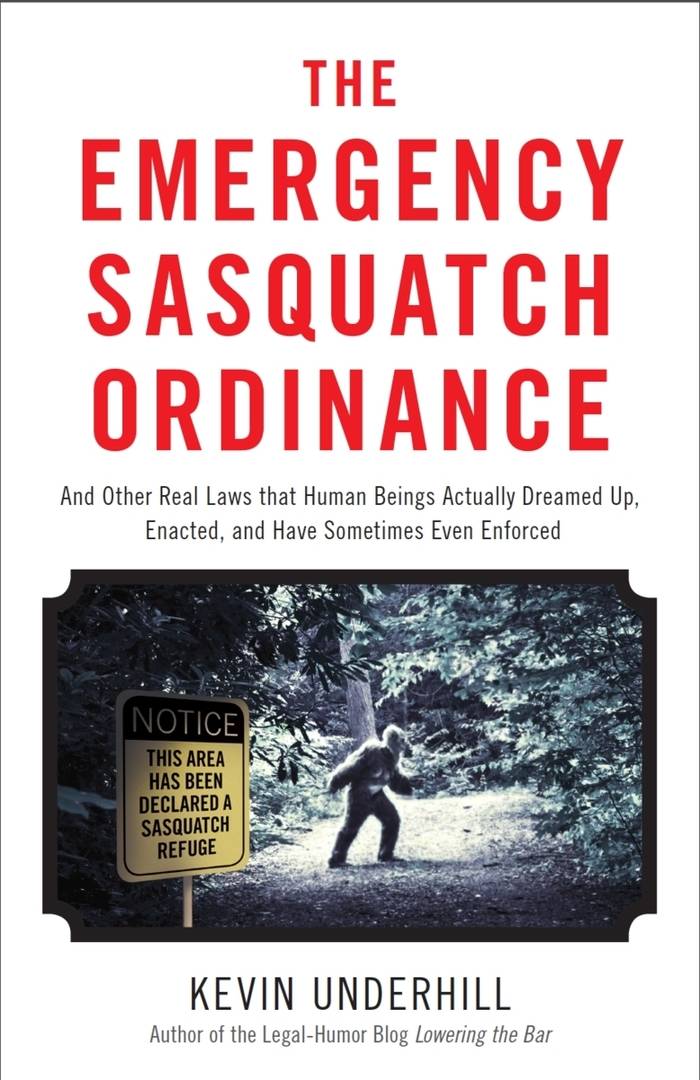
Kevin Underhill, the very funny lawyer behind Lowering the Bar, a very funny law-blog, has published a book of weird laws through the ages, called The Emergency Sasquatch Ordinance and Other Real Laws That Human Beings Have Actually Dreamed Up, Enacted, and Sometimes Even Enforced. It's a genuinely funny and extremely weird tour through the world's dumbest rules, starting with the Babylonians (who had a trial-by-ordeal through which you could prove you weren't guilty by jumping into the river and not drowning) up through the Hittites (who had a whole set of rules about whether it was OK to steal your neighbor's door); the ancient Greeks and Romans (who were allowed to go into their friends' houses to search for their stolen property, provided they did so in nothing but a loincloth, to ensure they didn't plant any goods while searching) and modern times, including the notorious "Pi=3.2" state law.
Humanity's inventiveness in making dumb rules is really boundless. Underhill's snarky commentary brings to life such rules as:
* Ala. § 34-6-7, which forbids secret passages leading from billiard rooms
* Ark. HR Con Res 1016, which sets out the official possessive form of Arkansas (it's "Arkansas's")
* Ga. Code Ann § 43-43A-I, which establishes that a pay toilet is not a coin-operated amusement
* Or. HR Con Res 12, which sets out Oregon's official state microbe (brewer's yeast!)
* Tex. penal code § 43.23(g) which exempts Texas lawmakers from the state's five-device-limit on sex-toys
* Australia's Goods and Services Tax Act § 165-55, which gives tax commissioners the power to "treat a particular event that actually happened as not having happened;" and "Treat a particular event that did not actually happen as having happened" (and a lot more contrafactual goodness)
* Lei No 3.770 of Mato Grosso do Sul, Brazil, which requires cellular phone companies to extend a 50% discount on airtime to stutterers
* German Civil Code §§960-61, 962, 963 and 964, which set out the rules requiring beekeepers to chase after their errant swarms, rules for adjudicating the mingling of swarms chased by more than one beekeeper; and rules for removing your swarming bees from other beekeepers' hives
I laughed a lot reading The Emergency Sasquatch Ordinance and I'm considering laminating my copy for long life by the toilet, as it is some of the best short-form humorous reading I've yet encountered.
    
|

Current Dark Science page at 25% zoom, perhaps better explaining why it takes me flippin’ forever to draw these.
this is, I think, a multi-faceted answer, so I’ll attempt to answer it in facets. I’m also putting it under a cut, because long.
1. Yes, definitely! I’d love to see more male characters that fall shamelessly outside what superhero comics consider “manly,” which is generally speaking an absurd parody of masculinity tropes.
2. I don’t actually think it’s an issue of not having a weak side. Superman is the poster child for invulnerable superheroes, and has fallen out of favor according to some because he’s “too powerful” and therefore boring, while Peter Parker as Spider-Man is probably THE most popular Marvel superhero and is getting his fifth movie, and is shown to be well below the pinnacle of manliness - he’s a skinny nerd who gets bullied when not in costume.
3. So I’d say it’s not so much that male heroes are shown as being 100% strong all the time, as it is that CERTAIN KINDS of weakness is unpopular. It’s okay to show Peter Parker being bullied because the way the fantasy around him works, he secretly shows them up when he operates as the enormously strong and capable Spider-Man. Despite being driven by buckets of emotional pain, Bruce Wayne still vents his feelings by hitting things instead of by talking it out.
4. One could question if this is a shortcoming of the superhero genre. The traits of weakness/vulnerability/fear is a tricky one when speaking of a superpowered protagonist. In other genres, it’s not that uncommon to have male protagonists who are fearful/weak/incompetent for much of the story - it’s a staple of the Hero’s Journey, in fact. Superheroes, however, are by their very nature, power fantasies. The less popular ones tend to be ones who just aren’t powerful enough, or that people don’t want to relate to.
5. I would posit that what I’d really like to see portrayed more in male heroes, strange as it may seem, is powerlessness - and the hero’s ability to come to terms with it. This doesn’t mean they can’t still be power fantasies! I will point to my personal favorite Marvel movie, Thor, where Thor starts out the movie an unlikeable blustering mess of masculinity tropes, and through losing his powers - and becoming OKAY WITH LOSING HIS POWERS - really grows and becomes a worthy hero. Thor is torn down and rises out of the destruction of his old, needlessly violent self who hurt his friends and family with his actions, and emerged as a genuinely good person. Thor is not the most popular movie among all the Marvel movies, however, and it has been criticized by some comics fans as being “boring” - however, Thor the character remains a fan favorite.
6. I can point, however, at Hawkeye in his most recent iteration, in Matt Fraction’s Hawkeye title - an EXTREMELY vulnerable character who, frankly, tends to fail more often than not. The title has been enormously popular, although granted, perhaps moreso outside of the “traditional” comics crowd. Hawkeye the character tends to be belittled by fans for “not having real powers,” missing the point that his lack of powers are actually potentially an extremely interesting character angle, and Fraction’s Hawkeye uses it.
7. And since I can’t possibly spend this whole long post just talking about male heroes alone, obviously I’d like to see the same thing from female heroes - having them struggle with fear, weakness, and vulnerability - while still operating within the superhero genre as power fantasies (and of course, also in more diverse supporting or villainous roles where they don’t have to be power fantasies). They’re just coming at it from the other side, from traditionally being the ones who either aren’t powered or get easily vanquished or depowered or killed (fridged).

Matt Ford considers the relationship between city planning and social unrest:
In many ways, France pioneered the conscious use of urban design for political purposes. Paris in the early 19th century was essentially a medieval city, suffocating from overcrowding and poor infrastructure. Baron Haussmann’s urban renovations under Napoleon III in the 1850s and 1860s gave the City of Light a modern sewage system, beautiful suburban parks, and a network of train stations. He also took the opportunity to demolish unruly lower-class neighborhoods, banish their impoverished inhabitants to suburbs, and replace their cramped, narrow alleys with spacious, grand boulevards. In the event of an uprising, like those that took place in 1789, 1830, and 1848, French authorities hoped the wider streets would be both harder for revolutionary Parisians to barricade and easier for columns of French soldiers to march through to suppress revolts.
Similar calculations are still made today.
In 2005, Burma’s ruling junta moved the government from Yangon, a sprawling metropolis of 5 million people, to the new inland capital at Naypyidaw for security reasons. Isolated from other population centers, Naypyidaw is populated mostly by government functionaries and military officials who spend as little time as possible in the eerily desolate city. Burmese officials claim almost a million people live there, although the true population is likely far, far lower than that. When the Saffron Revolution erupted two years later, in 2007, the large-scale protests that rocked other Burmese cities never took hold in Naypyidaw, and the country’s military rulers remained in power after a brief but brutal crackdown.
Even if the city’s population had been large enough for demonstrations, where would they have taken place? Broad boulevards demarcate the specially designated neighborhoods where officials live, with no public square or central space for residents, unruly or otherwise, to congregate. A moat even surrounds the presidential palace. One journalist described the city as “dictatorship by cartography.”
Update from a reader:
Just a quick note from a working cartographer: this is dictatorship by geography, not cartography. While there are many instances of maps as tools for propaganda (Monmonier and de Blij is a good start for this), and as much as someone like me would be flattered by that type of power, dictatorship by cartography is a highly inaccurate turn of phrase.
(Photo: Aerial view of the purposefully-built capital city of Naypyidaw, Myanmar on May 23, 2008. By Stan Honda/AFP/Getty Images)

According to the GOP's new tax plan, it's OK to raise taxes on the rich so long as they live in blue states.
Here’s the thing the tribal gatekeepers of white evangelicalism don’t know: The world on the other side of their fence is vast and free and beautiful.

Banishment is a hard trial to endure. To be condemned and rejected by one’s own family is not a pleasant thing. You resist it, you fight against it, pleading to make some bargain that would allow you to stay.
But in the end, you are cast out — forced outside, friendless and alone, into the outer darkness where there is wailing and gnashing of …
Wait. Hold on a minute. It’s not really dark here in the outer darkness. It’s actually kind of sunny and warm. And that’s not wailing and gnashing you hear, but laughter and singing — good singing (the music really is a lot better out here). And you’re not alone. There are people everywhere, friendly people — way more friendly people out here than there were in there.
It takes your eyes a moment to adjust to sunlight — it’s so much brighter than the dim candles the gatekeepers had allowed back inside. But then you look around and realize you’ve found a new home — a place where you can breathe. A place where you can see without worrying that you’ll see the wrong things or hear the wrong things or think the wrong things. It’s liberating. It’s Jubilee — a new creation. Old things are passed away; behold, all things are become new.
You see some familiar faces out here, others who had been expelled from the tribe long ago. Back inside, you’d been told they were dead, yet here they are, very much alive. There’s Brian McLaren — still writing books and reaching more people than ever. There’s Rob “Farewell” Bell, teaching more people about the Bible than he ever could have under the watchful eye of the ever-suspicious gatekeepers.
You hear a buzzing sound behind you, a faint droning that carries that familiar note of faux lamentation you recognize from years of such gatekeeper sermons …
Why has this happened? Is it a fluke, an anomaly that the three leading voices for a new evangelicalism have all, to one degree or another, left the church’s teachings and worship?
Is this a morality tale about celebrity’s corrosive power? Well, yes, but I think it’s something much deeper …
Have mercy, you think. They’re still at it! Back inside the tribal compound, the gatekeepers are still insisting they’re in charge.
Joanne Chesimard, Black Liberation Army Fugitive In Cuba, Added To FBI’s Most Wanted Terrorists List
1. please notice how this opening paragraph doesn’t even refer to ms. assata shakur as a person—she’s a “fugitive member of a black militant group”
2. notice how they call her by “joanne chesimard” and NOT her REAL name, “assata shakur.”
3. notice how *flaunting her freedom” is positioned as the crime—a liberation centered black woman is “flaunting” her freedom.
4. notice how not one single place in this article does it mention anything at ALL about cointelpro or that white people who made up the weather underground are all free even tho they actually committed terrorists acts that more legally fit the term (ie. bombing buildings with the assumed effect of “terrorizing” people into revolution or complacency)—it makes not a single solitary attempt to contextualize what was going on the 70s or even what the black liberation army was.
oh, but it DOES says she ran to cuba to “espouse her anti-US views”…
(via iinventedeverything)
sister shakur got them SALTY! Not only did she get out of the torture and the kangaroo court they had her in, she’s still easy, breezy, and beautiful in Cuba? SALTY. Cos was this 40 years ago? and they’re double the reward to $2mil? SALTY!
Stay Free, Sister Shakur.
(via crispycheezefriez)
“horrific crime”?? excuse me while i laugh until i’m out of breath. wow. talk about white supremacist law systems. innocent black boys and girls are gunned down every day by cops in this nation. the jails are stuffed, and many of the black and brown people in our prisons are only there because of a racist cop or racist judge in the first place. that’s all hunky dory. you can have a black kid in cuffs who “shoots himself in the head” while in a cop car and nobody blinks. you can have black men shot to death the night before their wedding, because of trigger happy cops with terror in their hearts. business as usual. cops can fire 40 bullets into a black man for pulling his wallet out, and they are forgiven. a cop can shoot a cuffed black man in the back while sitting astride him and dare to defend his actions.
but let one black woman (possibly) kill a cop (and given how everyone from the president down to the FBI and street cops were murdering Black Panthers just for, well, being Black Panthers, i say she could have taken down 10 more just to begin to approach Fair) and 40 years later, she is still wanted by law, called a terrorist, and has a 2 million dollar bounty on her head! Assata refers to herself as a “20th century escaped slave,” and it’s easy to see why. the racist cops could kill 100 black men and women (and they will by christmas, probably, if it takes them that long), but they cannot rest because they got tagged by one.
that, my friends, is an inferiority complex writ large.
(via nezua)

I drew a 7 page story for Adventure Time #25 written by Ryan North! Ryan wrote a beautiful story that made tears come from my eyes.
;_; I like stories about best buds.
The book is now in stores and features rad art by rad artists, see a preview here.
the spooky skeletons were within us… all along
The tribal gatekeepers of white evangelicalism are exhausting. If there were any plausible way to argue that they were acting in good faith rather than just smarmily pursuing raw power, then perhaps they’d be worthy of more than snark. But pretending they’re behaving in good faith just requires that we ignore far too much that is far too evident.
Still, kudos to Tony Jones for patiently trying to address the purported substance of the gatekeepers’ perpetual complaint. In “Can You Be Pro-Gay and Stay Evangelical? Yes … and No” Tony looks at the way that word “evangelical” is used both as a descriptive label for a particular strain of Protestant Christianity and also as a tribal boundary in the power games of tribal warlords who want to silence all dissent by delegitimizing anyone who might question their authority. It’s a helpful, if depressingly familiar, overview of this perennial problem.

Danielle Suarez is an agent with the U.S. Border Patrol. Women are not allowed to help patrol the borders of the evangelical tribe. The agents in charge of that — the tribal gatekeepers — are all white men.
Tony’s post focuses on what I hesitate to call the most recent assertion of tribal authority by the gatekeepers — it’s a very recent story, but it’s two days old at this point, so folks like Al Mohler and Russell Moore may have already moved on to slap down some other uppity Christians who have dared to question their tribal authority on some other topic. But anyway, Tony writes about the gatekeepers’ response to a Daily Beast piece posted Sunday regarding the anti-gay legislation being considered in Arizona, Kansas and other states. The piece, “Conservative Christians Selectively Apply Biblical Teachings in the Same-Sex Marriage Debate,” is by Jonathan Merrit and Kirsten Powers.
If “evangelical” is to have any meaning or use as a descriptive term for a particular kind of Protestantism, then Merritt and Powers would clearly, obviously and easily fit that term. They are born-again American Christians whose faith is characterized by all the attributes that scholars of religion describe as evangelical. They’re not Catholic and they’re not mainline Protestant. They’re evangelicals.
Ah, but there in the Daily Beast, they have dared to say things that the gatekeepers have decreed it is forbidden for evangelicals to say. What if someone listens to them? The gatekeepers must keep that from happening, and so they rush to de-legitimize Merritt and Powers, to anathematize them, decreeing that they are outsiders, not part of the tribe, no one that good, loyal members of the tribe should ever listen to. The gatekeepers’ response is thus swift and definitive: Merritt and Powers are not evangelicals, they say, not Real, True Christians.
Here’s where Tony’s post is helpful:
Merritt and Powers are true blue evangelicals.
But we’d be naive not to acknowledge that there’s another working definition of evangelicalism at play. That’s a cultural definition, and it swirls less around theology and more around brands: Christianity Today, James Dobson, contemporary Christian music, Christian colleges, and Republican politics. Jim Wallis can jump up and down all day, screaming, “I’m an evangelical!,” and Russell Moore and Al Mohler will calmly say, “No you’re not.” Or, they might quote Jerry Falwell, who once told Jim that he was “as much an evangelical as an oak tree.”
The example of Jim Wallis is particularly useful. The gatekeepers may hate him, but despite decades of trying, they’ve never been able to expel him from the tribe. That’s because Jim has scrupulously followed the letter of the law and never strayed from the essential core of the tribal “definition” of a Real, True evangelical.
He’s a white Protestant who thinks abortion should be illegal.
And no matter how much it rankles the tribal gatekeepers that Wallis is still somehow permitted to claim the word, that means they cannot expel him from the tribe. That is the trinity — the tribal trilateral that trumps the Bebbington quadrilateral and every other attempt to define “evangelical” as a theological or ecclesial category. White. Protestant. Anti-abortion.
Tribal gatekeepers, of course, maintain a very long, ever-evolving list of other official, proper “stances” that Real, True evangelicals must affirm on a multitude of subjects. Even the slightest deviation from the official stance is severely discouraged on all of those topics, but I don’t think any of them is mandatory in quite the same way that being anti-abortion is. One can believe in evolution and an ancient universe while remaining a member in good standing of the evangelical tribe. One can dance and drink beer and remain within the tribe. One can perhaps even be (somewhat) “pro-gay” and be permitted to remain within the bounds of the tribe — although that would probably require that one also be particularly vehement in demanding the criminalization of abortion.
As a tribal signifier, abortion is distinct in two ways. First, as we just discussed, it’s an immediate, irrevocable deal-breaker in a way that nothing else is. And, second, unlike all those other tribal signifiers, it stands by itself rather than acting as a vicarious symbol expressing a particular view of the Bible. White evangelical opposition to abortion is an odd accident of history — a partisan political variable adopted about 35 years ago that did not serve as a stand-in for a particular white American hermeneutic.
That’s what all those other tribal signifiers, past and present, tend to be — short-hand substitutes for the clobber-text hermeneutic of white American Christianity. Whether it’s the currently ascendent tribal marker of being anti-gay, or if it’s the tribal marker of young-Earth creationism, or if it’s the rapidly fading tribal marker of teetotalism, all of those things weren’t so much about the things themselves, but were, rather, ways of shouting, “But what about the Bible?” They were ways of demonstrating one’s allegiance to what tribal gatekeepers called “the authority of the scriptures.”
Which is to say, the authority of the scriptures as interpreted by the tribal gatekeepers. Which is to say, ultimately, the authority of the tribal gatekeepers themselves. Because this idea of “the authority of the scriptures” isn’t really about whether or not the Bible itself is actually anti-alcohol or anti-science or anti-gay. Ultimately it’s about who is allowed to say what it is that the Bible says. It’s about who is allowed to speak and to act as though they are the voice of God.
The “evangelical left” described by David Swartz and others was permitted to remain evangelical because, despite its focus on poverty and war, it tended to preserve the clobber-text hermeneutic of white evangelicalism. Folks like Jim Wallis and Ron Sider and their contemporary, neo-monastic heirs make their fellow evangelicals nervous by applying that same hermeneutic to biblical texts on wealth and poverty and violence. And they make the tribal gatekeepers particularly nervous by appealing to the authority of the scriptures in a way that undermines the authority of those gatekeepers. But they remain loyal to that hermeneutic, and thus cannot be easily expelled from the tribe.
And in any case, they’re all still white, Protestant and anti-abortion, and that’s the bottom line.
Zephyr DearI really have no clear idea of what any of those guys were like, as people, and every now and then it startles me.
Stanton Peele blames the Temperance movement for expurgating our Founding Fathers’ prolific drinking habits from American history:
It is impossible for Americans to accept the extent to which the Colonial period—including our most sacred political events—was suffused with alcohol. Protestant churches had wine with communion, the standard beverage at meals was beer or cider, and alcohol was served even at political gatherings. Alcohol was consumed at meetings of the Virginian and other state legislatures and, most of all, at the Constitutional Convention.
Indeed, we still have available the list of beverages served at a 1787 farewell party in Philadelphia for George Washington just days before the framers signed off on the Constitution. According to the bill preserved from the evening, the 55 attendees drank 54 bottles of Madeira, 60 bottles of claret, eight of whiskey, 22 of porter, eight of hard cider, 12 of beer, and seven bowls of alcoholic punch.
That’s more than two bottles of fruit of the vine, plus a number of shots and a lot of punch and beer, for every delegate. That seems humanly impossible to modern Americans. But, you see, across the country during the Colonial era, the average American consumed many times as much beverage alcohol as contemporary Americans do. Getting drunk—but not losing control—was simply socially accepted.


Today’s guest post is from Kay.
I’m a young woman and a devoted Christian. I have been faithfully married to the same man for over six years. We have a child. We are very much in love.
So imagine my shock when I discovered, last Sunday, that I’m in the throes of adultery.
Like many pastors around the country, my pastor chose the month of February to preach a sermon series on marriage. It started out really well. The first message was on the roles outlined by Ephesians 5—usually a sticky topic, but one he handled brilliantly. The second sermon was flat-out gold, describing the different kinds of communication in marriage. I went home ready to put the principles I learned into practice.
Then came “Affair-Proofing Your Marriage.”
My pastor began by reading a definition of adultery:
“Adultery defined…is taking the most sacred expressions of intimacy in marriage and giving them to someone other than your spouse.”
Now, let me be clear, this is not a Webster’s definition. Nearly all dictionaries, ancient and modern, define adultery as “voluntary sexual intercourse between a married person and a person who is not his or her spouse.” I suppose if we consider sex to be the most sacred expression of intimacy in marriage, then the first definition makes sense. But then he continued:
“You can have an affair without having sex. You can have an affair on an emotional level. Affairs happen in our feelings and thoughts long before they become physical.”
He then went on to describe how one can know whether they are engaged in an emotional affair:
I was able to check three of the four boxes. Why? Because I’m currently seeing a therapist.
I am a victim of childhood sex abuse. I was molested by my father at a young age. I thought I had prayed through the worst of it, but something occurred recently to reopen my wounds. A few months ago, my ability to continue coping with the pain failed and I very nearly experienced a full mental breakdown. I entered therapy on the verge of suicide. Through the tender care of my therapist (and the support of my husband and friends), I’m gradually recovering my life. But at a price.
See, I’m experiencing a phenomenon in therapy common to most victims of childhood abuse, called ‘Erotic Transference.’ It basically refers to an attraction—often romantic or sexual—that develops towards one’s therapist. Many times, these feelings are unwelcome, painful and humiliating, and are completely unrelated to the therapist’s age, physical attractiveness, or even gender. The feelings often have little to do with what’s happening in the present; instead, they are indicative of unmet needs in the past. The best way of dealing with the transference is, of course, to talk it out in therapy and use the feelings as a way to connect to and resolve past issues.
Yet, according to my pastor’s sermon, by having these feelings, I’m being disloyal to my spouse. Aside from God, my spouse should be the only one hearing my deepest thoughts and meeting my emotional needs. The way I should be dealing with these feelings is to a) confess the feelings to my husband, b) cut off all contact with my therapist, and c) maybe find a new therapist.
The problem is, finding a new therapist won’t solve the problem of my ‘emotional adultery,’ even if the therapist were female. Such is the nature of therapy and the nature of my wound. The transference will just come up again. And again. Until it is fully dealt with. So if I follow my pastor’s teaching to its logical conclusion, I shouldn’t go to therapy at all. And I most certainly shouldn’t discuss these feelings with my therapist, even if it can aid in my healing. That’s, supposedly, wildly inappropriate.
According to my church, only two people are approved for meeting my emotional needs: God and my spouse. Whatever one can’t meet, the other will. Funny how not a single scripture was quoted to back this up.
The problem with doctrine like this is that it allows no room for genuinely hurting people to get help. I had walked into service that morning finally at peace after wrestling all week with emotions of terrifying intensity, only to be made to feel ashamed of it all. I could just imagine how many other people might have been sitting there that morning, in the same situation, listening to those words and making a decision that might negatively impact their health and vitality for years to come. I know the Bible calls us to high standards of love and holiness in marriage. I’ll be the first to defend that. But this is the danger when the Evangelical Church decides to redefine words for its own benefit.
Pastors: Stop. Think. There is a wasteland of hurting hearts all around you, and real consequences to what you choose to teach.


Junot Díaz, speaking at Yale (via malinche)
Those final four sentences are something else.
(via genericlatino)
You cannot be transformed when you are afraid.
You cannot be transformed when you are afraid.
(via delilahsdawson)
My Congo African Grey picks up stuff REALLY fast. Sometimes he’ll piece together stuff that’s hilarious.
Yesterday I was sitting next to him reading, and he was preening quietly so I told him he was being really good — giving them attention when they’re not screaming gives them the option of not screaming when they want attention, so I try to do this a lot.
His response? He said in a friendly tone, “You’re a really good Nattie. Haha. I love you, bitch.” My husband and I use obscenities as casual endearments.
Then sometimes he’ll throw stuff together in Engrish-y ways that almost make sense. The other day we were moving, so I put Bongo (the African Grey) and our cockatiel in their travel cages so I could take their huge cages apart to stick in the truck. Bongo didn’t like this, so he decided to lift up his water bowl, which lifts the food cup door, and throw it on the floor. Shocked, I said, “You douche!” Bongo yeowled, this hilarious gibberishy cat-like sound. My husband came in and asked what happened, and Bongo said, “Yes, that became water now.” I want to put that on a shirt with like, a picture of an anthropocentrized flower or something.
Other times he’ll say stuff that makes sense, logically and grammatically, that he’s put together on his own, but it’s just funny. The other day we were sitting in silence for a while, when Bongo suddenly let out this long sigh and said, “Well, I guess I *am* Bongo,” not in a revelatory tone, but in the same grudging way someone takes responsibility, like when someone says, “I guess I *am* the adult here.” I blinked at him and said, “Alright. How does that make you feel?” and he just gave a weary “hm” and started preening, like there was nothing to be done for it so we may as well move on with life.
On a less philosophical note, a few weeks ago we put the birds to bed, which basically means just putting them in their cages and covering them. Most nights, Bongo does not want to go to bed, but that night he REALLY didn’t want to. He tried to scramble back out of the cage but wasn’t fast enough. He then clung to the side as my husband wrapped the blanket around, and, adopting my husband’s raging-at-Mortal-Kombat voice, yelled, “Nooooooooooooooooo!” We cracked up because we couldn’t help it, which he did not seem to appreciate. He fell silent once the blanket was in place. Then we flicked the light switch off, and Bongo said simply, “Fuck.”
Bongo is awesome. Parrots are awesome. When we lived in Texas, there was a breeder who said that her breeding parrots would speak some human to their chicks, like “good girl” and “here’s some nummies” when feeding them. Bongo uses both when he talks to our cockatiel, which is positively creepy since they hate each other; he’ll climb on Precious’s cage to harass him, and say, “Come here Precious” and snicker, and when Precious starts squawking in outrage, he says, “Calm down, Precious,” or (more rudely) “Shut up, Precious.” What’s especially amusing about this is we practically never said those things to Precious because Precious didn’t scream as much as Bongo used to; we’d say “calm down, Bongo” instead, but he says Precious. He also tries to blame his own screaming on Precious if I’m out of the room: he will scream a lot, and if I eventually say anything back telling him to knock it off, he says “shut up Precious.” And then screams again. (He doesn’t scream much anymore after I started being more alert to enforcing and ignoring certain things.) Precious also does this horrible, scratchy barking sound in imitation of an alarm clock we had when he was a baby, and Bongo will start whistling La Cucaracha whenever Precious starts in on this because Precious LOVES La Cucaracha and will instantly start singing instead.
It is always interesting to me to see different ways Bongo figures out how to use sounds to change stuff around him. One of my favorite things he likes to do is sit on the back of my wooden office chair, and he will start banging his beak rhythmically on it, which is a normal bird thing, especially with male birds (Precious does it too). But if I start making percussive beat boxing noises, he will keep banging his beak AND make a clicking sound AND put his wings up and dance a bit. The rhythm is shaky but it’s super cute. If he wants to get my attention, he knows I will do that with him for a while. He also likes to sing, “Boooooongo, Booooongo biiiiird,” in it sometimes, just whatever notes he feels like.
But what’s been REALLY great, is Bongo’s about to turn six, so for the last year or so he’s been transitioning to adulthood more fully. He seems to have gotten much smarter — like, quicker to understand things — and mellowed out over this time. The other week I was sick and lying in bed, really tired, but Bongo was freaking out wanting to see me so my husband brought him in the bedroom and left him on the chair I mentioned earlier. Bongo started gibbering and laughing and talking to me a bunch, which cheered me up, and I didn’t want him to feel ignored so I kept up for twenty minutes or so. Finally, though, I was just too tired, but Bongo kept talking. I tried to think of a way to explain, not really knowing if anything would work, but not wanting to upset him. When we put the birds to bed at night, we say, “It’s bedtime!” so that seemed like an option. Then he knows that “mommy” is me, plus he had started using it as an adjective — he started saying “want mommy kiss” a year ago.
So I try, “It’s mommy bedtime.” To my surprise, he stops talking abruptly, then says, “Okay.” And he stayed completely silent while I took a nap. When I woke up, he said in a bright British accent, “Hullo!”
Birds are the best.
”nattie (via weeaboo-chan)
I saw an article about parrot intelligence where some jackass was going on in the comments about how birds don’t understand the human words they use and their mimicry isn’t any more impressive than those cats that sound like they’re saying “no”, we just get fooled into believing they’re intelligent because they figure out how we react to these sounds and how to use them to get what they want and it’s like dude I’m sorry but are you aware of what “language” is?
(via coelasquid)
hey treesofarden
(via gguillotte)
This made me lol so hard


I had a couple of requests for Valentine themed art in my ask box, so here’s some Mitzi and Zib from way back when (late, of course, because that’s how Tracy do).
This is pretty amazing. Fox is resurrecting the crudest and most discredited defenses of slavery and the Confederacy, arguing that slavery was on the way out and that the South was willing to let it go. It was just Lincoln who decided to launch a murderous and costly war for no reason. John Stewart takes it from there.
I'm getting pretty sick of being nagged to install your damn apps.
XKCD helpfully translates:
Yeah, there are smart app banners, which are marginally less annoying, but it's amazing how quickly we went from "Cool! Phone apps that finally don't suck!" to this sad, eye rolling, oh-great-of-course-you-have-an-app-too state of affairs.
"Would you like to install our free app?!?" is the new "It looks like you're writing a letter!"
— Jeff Atwood (@codinghorror) January 9, 2013
Four years, give or take a few months, if you were counting. So what happened?
Your platform now has a million apps? Amazing! Wonderful! What they don't tell you is that 99% of them are awful junk that nobody would ever want.
Let's start with the basics. How do you know which apps you need? How do you get them installed? How do you keep them updated? How many apps can you reasonably keep track of on a phone? On a tablet? Just the home screen? A few screens? A dozen screens? When you have millions of apps out there, this rapidly becomes less of a "slap a few icons on the page" problem and more of a search problem like the greater web. My son's iPad has more than 10 pages of apps now, we don't even bother with the pretense of scrolling through pages of icons, we just go straight to search every time.
The more apps out there, the more the app stores are clogged with mediocre junk, the more the overall noise level keeps going up, which leads directly to this profligate nagging. Companies keep asking how can we get people to find and install our amazing app instead of the one question they really should have asked.
Why the hell are we building an app in the first place?
I want to know who exactly is going to all the trouble of installing the McDonalds app on their device instead of simply visiting the McDonalds website in the browser as needed. What problem does that app solve for french fry enthusiasts that it needs to be permanently installed on your device? Why are they giving away free Big Macs just to get people to install this thing?
It was so much easier when iOS was totally dominant and the iPhone was the only player. Before the iPad and tablets. Before Android got decent in 4.0 and Google standardized the Play store. Now there are, at minimum, four radically different mobile platforms that every serious app player has to support:
(For extra credit: how many of these are actually "mobile"?)
Unless you're careful to build equivalent apps in all those places, it's like having multiple parallel Internets. "No, sorry, it's not available on that Internet, only the iOS phone Internet." Or even worse, only on the United States iOS phone Internet.
If you're feeling generous, we should technically include Windows 8 and Windows Phone in here too. All with different screen dimensions, development stacks, UI guidelines, and usage patterns. Oh and by the way, that's assuming no other players emerge as serious contenders in the computing device market. Ever.
At the point where you find yourself praying for a duopoly as one of the better possible outcomes, that's … not a good sign.
Buying an app is the modern Support Your Favorite Small Software Vendor Day. I was always fine with dropping ten or twenty bucks on software I loved. I'm a software engineer by profession; apps are cheaper so I can buy even more of them.
Have you ever noticed that the people complaining about apps that cost $3.99 are the same people dropping five bucks on a cup of fancy coffee without batting an eyelash? Me too, and I'm with the coffee people. $3.99 for your app? Outraaageous!
Now, contrast this with your app, Mr. Developer. I don’t know you from Adam. You’re pitching digital Instant Refresher Juice 1.0 to me in the form of a new app. The return I’m going to get is questionable at best. I already have 30 apps on my phone, some of them very good. Do I need another one? I don’t use the 30 I have. The experience I’m going to get from adding one more app is not trustable. I’m assured of nothing. Last week I bought an app for 99 cents and it was terrible. I used it once, for 15 seconds. I could be shoving $1 straight down the toilet again for all I know. Your app, good sir, is a total gamble. Sure, it’s only a $1 gamble… but it’s a gamble and that fact matters more than any price you might place on it.
For some reason I don't completely understand, mobile app review systems are frequently of questionable value, so all you really have to go on are the screenshots and a bit of text provided by the developer.
Imagine you bought your coffee, only to open the lid and find it was only half full, or that it wasn't coffee at all but lemonade. If only 1 in 5 cups of coffee you bought actually contained coffee, a $3.99 price for that coffee starts to seem unreasonably high. When you buy an app, you don't really know what you're going to get.
Turns out, the precious resource here isn't the money after all. It's your time. In a world of millions of apps, free is the correct and only price for most apps except those rare few of extreme, easily demonstrable value – probably from well known brands of websites you already use daily. So hey, everything is free! Awesome! Right? Well…
I know, I know, I'm sick of this trite phrase too. But if the market is emphatically proving that free is the only sustainable model for apps, then this is the new reality we have to acknowledge.
Nothing terrifies me more than an app with no moral conscience in the desperate pursuit of revenue that has full access to everything on my phone: contacts, address book, pictures, email, auth tokens, you name it. I'm not excited by the prospect of installing an app on my phone these days. It's more like a vague sense of impending dread, with my finger shakily hovering over the uninstall button the whole time. All I can think is what shitty thing is this "free" app going to do to me so they can satisfy their investors?
For the sake of argument, let's say the app is free, and the developers are ethical, so you trust that they won't do anything sketchy with the personal information on your device to make ends meet. Great! But they still have to make a living, don't they? Which means doing anything useful in the app requires buying three "optional" add-ons that cost $2.99 each. Or there are special fees for performing certain actions. Isn't this stuff you would want to know before installing the app? You betcha. Maybe the app is properly tagged as "offering in-app purchases" but the entire burden of discovering exactly what "in-app purchases" means, and how much the app will ultimately cost you, is placed completely on your shoulders. You, the poor, bedraggled user.
Have you ever tried actually using the Amazon app on iOS, Android, and Windows? iOS does the best, mostly because it's been an app platform for longer than the others, but even there, the Amazon app is a frustrating morass of missing and incomplete functions from the website. Sure, maybe you don't need the full breadth of Amazon functions on your phone, though that's debatable on a tablet. But natural web conveniences like opening links in new tabs, sharing links, the back button, searching within the page, and zooming in and out are available inconsistently, if at all.
The minute you begin switching between platforms – say you use an iOS tablet and an Android phone and a Windows 8 touch laptop, like I do – you'll find there are massive differences between the Amazon apps (and the eBay apps, and the Netflix apps, and the..) on these different platforms. At some point, you just get fed up with all the inconsistencies and oddities and quirks and say to hell with these apps, can I please just use the website instead?
Now, if your website is an awful calcified throwback to 2003, like eBay, then the mobile apps can be a valuable opportunity to reinvent your user interface without alienating all your existing users. If there's one thing I love about tablet and phone design it's that their small screens and touch interfaces force people to think simpler. This is a good thing. But if you don't eventually take those improvements home to the mothership, you're creating two totally different and incompatible UIs for doing the same things.
It seems like a fool's errand to dump millions of dollars of development time into these radically different, siloed app platforms when Amazon could have spent it improving their website and making that experience scale a bit better to every device out there.
But that's not an option, because apparently the web is dead, and mobile apps are the future. I'm doing my best to resist a sudden uncontrollable urge to use my Ledge Finder app to find the nearest ledge to jump from right now.
The tablet and phone app ecosystem is slowly, painstakingly reinventing everything I hated about the computer software industry before the web blew it all up. Even fans are concerned:
I’m waiting for something that will unify the world of apps and make manually going to an App Store to find a new app as weird as typing in a URL to find a new website. My bet is that this won’t be Facebook. Instead, I would not bet against some young upstart, perhaps one inspired upon reading about a $19 billion deal, to go heads-down and come up with something crazy.
I'll have more to say about this soon, but I expect there to be an explosion of new computing devices all over the world in the next few decades, not a contraction. Sometimes the craziest solution is the one that's been right there in front of you the whole time.
| [advertisement] Hiring developers? Post your open positions with Stack Overflow Careers and reach over 20MM awesome devs already on Stack Overflow. Create your satisfaction-guaranteed job listing today! |
 Narnia Recap: The ship travels to the island where dreams come true.
  |
| @ mainlandmart.com |
 A page from a GCHQ top secret document prepared by its secretive JTRIG unit
 One of the many pressing stories that remains to be told from the Snowden archive is how western intelligence agencies are attempting to manipulate and control online discourse with extreme tactics of deception and reputation-destruction. It’s time to tell a chunk of that story, complete with the relevant documents.
Over the last several weeks, I worked with NBC News to publish a series of articles about “dirty trick” tactics used by GCHQ’s previously secret unit, JTRIG (Joint Threat Research Intelligence Group). These were based on four classified GCHQ documents presented to the NSA and the other three partners in the English-speaking “Five Eyes” alliance. Today, we at the Intercept are publishing another new JTRIG document, in full, entitled “The Art of Deception: Training for Online Covert Operations.”
By publishing these stories one by one, our NBC reporting highlighted some of the key, discrete revelations: the monitoring of YouTube and Blogger, the targeting of Anonymous with the very same DDoS attacks they accuse “hacktivists” of using, the use of “honey traps” (luring people into compromising situations using sex) and destructive viruses. But, here, I want to focus and elaborate on the overarching point revealed by all of these documents: namely, that these agencies are attempting to control, infiltrate, manipulate, and warp online discourse, and in doing so, are compromising the integrity of the internet itself.
Among the core self-identified purposes of JTRIG are two tactics: (1) to inject all sorts of false material onto the internet in order to destroy the reputation of its targets; and (2) to use social sciences and other techniques to manipulate online discourse and activism to generate outcomes it considers desirable. To see how extremist these programs are, just consider the tactics they boast of using to achieve those ends: “false flag operations” (posting material to the internet and falsely attributing it to someone else), fake victim blog posts (pretending to be a victim of the individual whose reputation they want to destroy), and posting “negative information” on various forums. Here is one illustrative list of tactics from the latest GCHQ document we’re publishing today:

Other tactics aimed at individuals are listed here, under the revealing title “discredit a target”:

Then there are the tactics used to destroy companies the agency targets:

GCHQ describes the purpose of JTRIG in starkly clear terms: “using online techniques to make something happen in the real or cyber world,” including “information ops (influence or disruption).”

Critically, the “targets” for this deceit and reputation-destruction extend far beyond the customary roster of normal spycraft: hostile nations and their leaders, military agencies, and intelligence services. In fact, the discussion of many of these techniques occurs in the context of using them in lieu of “traditional law enforcement” against people suspected (but not charged or convicted) of ordinary crimes or, more broadly still, “hacktivism”, meaning those who use online protest activity for political ends.
The title page of one of these documents reflects the agency’s own awareness that it is “pushing the boundaries” by using “cyber offensive” techniques against people who have nothing to do with terrorism or national security threats, and indeed, centrally involves law enforcement agents who investigate ordinary crimes:

No matter your views on Anonymous, “hacktivists” or garden-variety criminals, it is not difficult to see how dangerous it is to have secret government agencies being able to target any individuals they want – who have never been charged with, let alone convicted of, any crimes – with these sorts of online, deception-based tactics of reputation destruction and disruption. There is a strong argument to make, as Jay Leiderman demonstrated in the Guardian in the context of the Paypal 14 hacktivist persecution, that the “denial of service” tactics used by hacktivists result in (at most) trivial damage (far less than the cyber-warfare tactics favored by the US and UK) and are far more akin to the type of political protest protected by the First Amendment.
The broader point is that, far beyond hacktivists, these surveillance agencies have vested themselves with the power to deliberately ruin people’s reputations and disrupt their online political activity even though they’ve been charged with no crimes, and even though their actions have no conceivable connection to terrorism or even national security threats. As Anonymous expert Gabriella Coleman of McGill University told me, “targeting Anonymous and hacktivists amounts to targeting citizens for expressing their political beliefs, resulting in the stifling of legitimate dissent.” Pointing to this study she published, Professor Coleman vehemently contested the assertion that “there is anything terrorist/violent in their actions.”
Government plans to monitor and influence internet communications, and covertly infiltrate online communities in order to sow dissension and disseminate false information, have long been the source of speculation. Harvard Law Professor Cass Sunstein, a close Obama adviser and the White House’s former head of the Office of Information and Regulatory Affairs, wrote a controversial paper in 2008 proposing that the US government employ teams of covert agents and pseudo-”independent” advocates to “cognitively infiltrate” online groups and websites, as well as other activist groups.
Sunstein also proposed sending covert agents into “chat rooms, online social networks, or even real-space groups” which spread what he views as false and damaging “conspiracy theories” about the government. Ironically, the very same Sunstein was recently named by Obama to serve as a member of the NSA review panel created by the White House, one that – while disputing key NSA claims – proceeded to propose many cosmetic reforms to the agency’s powers (most of which were ignored by the President who appointed them).
But these GCHQ documents are the first to prove that a major western government is using some of the most controversial techniques to disseminate deception online and harm the reputations of targets. Under the tactics they use, the state is deliberately spreading lies on the internet about whichever individuals it targets, including the use of what GCHQ itself calls “false flag operations” and emails to people’s families and friends. Who would possibly trust a government to exercise these powers at all, let alone do so in secret, with virtually no oversight, and outside of any cognizable legal framework?
Then there is the use of psychology and other social sciences to not only understand, but shape and control, how online activism and discourse unfolds. Today’s newly published document touts the work of GCHQ’s “Human Science Operations Cell,” devoted to “online human intelligence” and “strategic influence and disruption”:


Under the title “Online Covert Action”, the document details a variety of means to engage in “influence and info ops” as well as “disruption and computer net attack,” while dissecting how human beings can be manipulated using “leaders,” “trust,” “obedience” and “compliance”:


The documents lay out theories of how humans interact with one another, particularly online, and then attempt to identify ways to influence the outcomes – or “game” it:


We submitted numerous questions to GCHQ, including: (1) Does GCHQ in fact engage in “false flag operations” where material is posted to the Internet and falsely attributed to someone else?; (2) Does GCHQ engage in efforts to influence or manipulate political discourse online?; and (3) Does GCHQ’s mandate include targeting common criminals (such as boiler room operators), or only foreign threats?
As usual, they ignored those questions and opted instead to send their vague and nonresponsive boilerplate: “It is a longstanding policy that we do not comment on intelligence matters. Furthermore, all of GCHQ’s work is carried out in accordance with a strict legal and policy framework which ensures that our activities are authorised, necessary and proportionate, and that there is rigorous oversight, including from the Secretary of State, the Interception and Intelligence Services Commissioners and the Parliamentary Intelligence and Security Committee. All our operational processes rigorously support this position.”
These agencies’ refusal to “comment on intelligence matters” – meaning: talk at all about anything and everything they do – is precisely why whistleblowing is so urgent, the journalism that supports it so clearly in the public interest, and the increasingly unhinged attacks by these agencies so easy to understand. Claims that government agencies are infiltrating online communities and engaging in “false flag operations” to discredit targets are often dismissed as conspiracy theories, but these documents leave no doubt they are doing precisely that.
Whatever else is true, no government should be able to engage in these tactics: what justification is there for having government agencies target people – who have been charged with no crime – for reputation-destruction, infiltrate online political communities, and develop techniques for manipulating online discourse? But to allow those actions with no public knowledge or accountability is particularly unjustifiable.
Documents referenced in this article:
The post How Covert Agents Infiltrate the Internet to Manipulate, Deceive, and Destroy Reputations appeared first on The Intercept.
Zephyr DearGosh it's almost like two sides can be in conflict.. and neither one is a hero!
Moynihan considers the odd politics of Western progressives who support Venezuela’s “Bolivarian revolution”:
A pro-Chavez academic writing in The Nation argued that the massive street demonstrations across the country “have far more to do with returning economic and political elites to power than with their downfall.” The Guardian headlined a news story: “Venezuela’s hardliner reappears as Nicolas Maduro expels US officials.” That hardliner wasn’t Maduro, whose government is arresting regime opponents and strangling the free press, but Leopoldo Lopez, the opposition leader currently languishing in jail. Flip over to the Guardian’s editorial for the bizarre excoriation of President Obama for his supposed “support for regime change in Venezuela.”
It’s a thought experiment I often present to the Western Chavista, one that usually ends up demonstrating that sympathizers of the regime, both in this country and in Europe, have something of a colonialist attitude towards Venezuela. Because one wonders the reaction of these faux progressives if Prime Minister David Cameron, President Barack Obama, Chancellor Angela Merkel–pick your the imperialist lackey!–arrested an opposition leader who had organized peaceful street protests? Or if the CIA shut off the internet in politically restive cities like Berkeley and Brooklyn; blocked Twitter traffic it found politically suspect; and took over PBS, forcing it to broadcast only pro-administration agitprop, never allowing the opposition party to traduce the government across public airwaves?
Update from a reader:
I think you should ask yourself a very basic question: do you really think that every regime that you don’t like is necessarily illegitimate?
Has it crossed your mind that there are countries with populations that support leaders who don’t cater to American interests, or have the same values as your bourgie free-market readership? Do you think it’s a coincidence that you see as inherently undemocratic any country that does not act in a way that you approve of? This is what democracy actually is: people deciding to do things that you don’t like. If your support for elections is only as strong as their capacity to deliver results that you like, then you have no actual commitment to democracy at all.
During the Iranian protests, the Dish was draped with green ribbons for months, and yet there was barely any notice of why the current regime survives: because it is in fact very popular with a significant majority of Iran’s citizens. It’s just not popular with the English-speaking, Westernized Iranians who write blogs and are on Twitter. I don’t like that regime anymore than you do, but I don’t pretend that my disapproval amounts to proof positive that the regime is illegitimate or not supported by a majority of its people.
I think you and the whole crew over there should ask yourself whether the events of the last ten years suggest you should adjust your understanding of how the world works, or what progress means. Because from the Iraqi civil war to the election of Hamas to, yes, the repeated re-election of the Chavez government, what the world has shown is that it will pursue its own interests against the narrow paternalism of Western progressives. You’ve got to decide if you actually support real, messy, ugly democracy, or if you support the rosy lies of the Bush-era embrace of “democracy.”

 Nerdcore rapper Dan Bull earns a good living from his Youtube videos, but he is constantly being dragged away from the studio to fight fraudulent copyright claims from major labels, who are able to censor his work with impunity. The video for his 2010 song I'm Not Pissed has been removed ten times by automated, fraudulent claims from the likes of BMG Rights Management and PRS, who face no consequences for lying about their involvement with his work.
In a new song called Fuck Content ID, Bull slams Google's automated Content ID takedown system, documenting his woes at the hands of Big Content, and with Google, who collaborate in a system of copyfraud that neither one seems to care about.
For his 2010 [NSFW] song “I’m not pissed”, he reveals a screen-grab showing 18 separate claims that have been made against it. While some of them were released after being disputed, two of them, BMG Rights Management and PRS, rejected the dispute and stand by their initial claim.
“It is up to me to prove myself innocent by asking eighteen different publishing companies through an automated system to revoke the automated claims. Each publisher has a month to reply, with no obligation to even do so. If even one of the eighteen publishers says ‘nope’ then it’s back to square one,” Bull explains.
“Any financial loss or restrictions on my channel are entirely on me, and will not be compensated for once the claim is lifted. This has been going on since last year with no end in sight,” he adds.
Why YouTube’s Automated Copyright Takedown System Hurts Artists [Ben Jones/Torrentfreak] 
|
|
The Tea Party primary challenger in the Kansas Senate race, a radiologist, posted on Facebook x-rays of what were apparently his own deceased patients (in other cases he appears to have obtained them through his hospital privileges), mocking and making light of the wounds that ended their lives. Beyond the sociopathy that gets you to do something like that, I have to imagine HIPAA (which sometimes complicates even rather trivial communication by medical professionals) makes this a big big no-no.
"In an imperative language, you have no guarantee that a simple function that should just crunch some numbers won’t burn down your house, kidnap your dog and scratch your car with a potato while crunching those numbers."

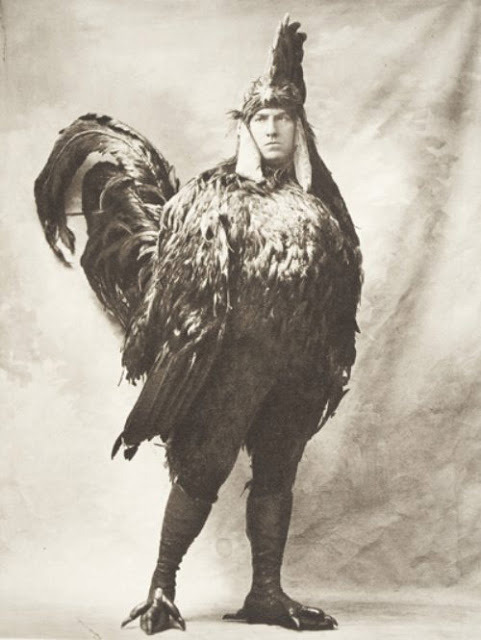








The weirdest vintage Halloween costumes
They just straddle the line between silly and horrifying
cool as hell
the bottom one reminds me of maus
Amazon is well on its way to monopolizing book distribution. Its strategy is like Walmart’s.
First you gain an initial advantage through economies of scale and introducing new efficiencies. So far, so good. That is how free enterprise is supposed to operate.
Then you leverage your initial advantage in the marketplace to squeeze suppliers and lower your costs. This enables you to keep prices low so as to knock out small competitors and keep new competitors from emerging.
Meanwhile you treat your rank-and-file employees like dirt.
