Shared posts

04 Jul 22:13

Cookie Shapes

by vihart

A new video, about an afternoon taking a break from math to bake with friends. No math allowed! Right?

Gonna talk about the process of creating this video, but first, the people.

Gwen Fisher is a mathematical artist whose work I’ve known for many years. Every time it’s something new: a new technique for creating woven beadwork (along with a math paper that generalizes the technique), or new fractal beadwork (along with a theory of what path the thread needs to take), and years ago when I posted about some beadwork hyperbolic planes I made, Gwen was the first to send me an email saying she’d tried my instructions, and then followed up with some new hyperbolic variations of her own that were well beyond anything I had the skill to create. After that, we finally ran into each other at one conference, and then another conference, and then I found out I’d just moved 10 minutes from her house, and the rest is history!

When Gwen introduced me to her sister Ruth I was surprised to find I was already a fan of her work as well: she was the Ruth in Sweets by Ruth! I like my coffee to taste like coffee and my chocolate to taste like chocolate, the perfect combo of which I’d found in Ruth’s brownies at Red Rock Coffee (please don’t stalk me), so I thought it a fairly strange coincidence. When we pitched the idea of making mathematical gingerbread shapes to her, she knew exactly what we needed: a sturdy dough that wouldn’t change shape too much while baking, while still being delicious, and would we like it to come in a number of bright happy colors that would suit themselves to being filmed? Yes, yes we would! And besides all those perks, switching from the gingerbread idea to shortbread allowed the most amazing edible pun.

I can’t remember when I first met Andrea Hawksley. She’s another person where I came into contact with her or her work many years ago, and have done so again repeatedly until it reached a tipping point. It could have been 6 years ago at MIT in the context of mathematical origami or computational geometry, or maybe it was at one of her mathematical dance workshops, or when I read one of her papers. I knew we were destined to be friends a couple years ago at a recreational math conference when I saw her casually and informally leading a group of people in cutting slits in extra conference flyers and slotting them together with icosahedral symmetry. That’s when I found out I’d moved not far from her as well!

I make mathematical art for a living, but I also like to do it for fun, and in the past couple years I’ve met up with Gwen, Andrea, and sometimes others, to have fun figuring out new technique for creating new math art, or see a visiting colleague’s latest work, or, in this case, to try out some mathematical baking. Except I had a new camera to try out, so I finally broke the casual just-for-funness by filming for a video.

That was over a month ago, and I’ve been working on this video since! Well, along with other things. But this video presented a lot of new challenges for me.

First, I usually start with a complete concept for a video, spend weeks on the script, then film and edit to that script. Many vloggers are extremely good at filming hours of footage of unpredictable things as they happen, then remembering and pulling out good moments to turn into a coherent story, perhaps framed and pulled together by footage of themselves talking face-on to a camera.

Sorting through hours of footage and pulling out anything resembling a story is not a skill I have developed, and if making this video taught me nothing else it is greater respect for those who do so on a weekly basis. I pulled out the best footage and sound clips I’d managed to get (working with a new camera, some stuff came out horribly), re-arranged events to follow more of an arc from less-mathy to more-mathy, and ended up with an edit that had no story and would only really be fun to watch for people who recognize an aperiodic tiling or truncated icosahedron when they see one. So I did what I do best: I created a story and wrote a script.

This is a trick taken from vloggers. Narrate about your day, cutting in actual footage of it. But I don’t “vlog,” my story was invented, and I wasn’t especially interested in following the standard format of talking to a camera. Could I do the frame story in my second-person notebook style? The notebook makes things personal, hands-on, as if you could be drawing this stuff yourself. It’s badly-drawn visual representations of things, not the things themselves, letting your imagination do the work. Would it make any sense to try to integrate that with real footage of real things?

Doing it in standard vlog style, except replacing talking-head with notebook, turned out much too jarring. I needed something more natural, something that helps your brain make the connections between what’s going on in notebook world and real world. Thus, I decided to try out real footage overlaid and framed by notebook-happenings. Then, there’s notebook footage, real footage, vocal narration, and real dialogue, and if I wanted to sometimes do fake narration over real footage, I had to make it super clear what was narration and what was real time, clear yet not jarring. For this reason, whenever there’s a switch from narration to real-world sound, there’s usually a cut from notebook to footage, or from footage to notebook. Sometimes real footage is paired with narration, so when switching back to the actual sound I can cut to footage-in-notebook view, which gives your brain all the cues it needs to make the transition seem right. Then, real-life and notebook-land is brought even closer together by sometimes popping up a quick notebook person to say something that’s clearly being said by a real person in the real footage, and it happens so quick that you don’t have time to worry whether it’s a transition to a different thing before you know it’s not.

All this was done carefully and consciously, so you can imagine why it took me a month!

Then, there’s the sound itself. I’d been worried about how the narration and natural sounds would work together, but as soon as I tried layering some stuff I realized I’d had a stroke of luck: my new camera records sound in 5.1, which turned out to be perfect, because it makes it really clear what is narration (mono, artificial) and what is from the footage (all around, like in real life). I knew I could take advantage of this, layering real noises on top of narration without the listener having any trouble keeping track of which is which. Still, the initial introduction of real-sound after narration was a bit jarring, and so I introduced the real noises by purposely mingling them with the narration, fake narration-me yelling about the broken color symmetry along with real-me, which connected the two sound stories right at the beginning and makes all the natural sound make sense and feel connected later.

Maybe you can see why one of my pet peeves is when people say I am naturally great at video editing and have some genius talent, which is both untrue and denies the hard work I put in. The truth is that I spend a lot of time identifying problems (lack of story, inaccessible to non-mathy people), studying what other people have done to fix them (frame story, narrating over footage), trying those things out and identifying problems with that (frame story is in wrong style, now add in rough transitions, things are worse than before), then trying out fixes for that (connect frame story to real footage by every means I can think of: overlay video, overlay sound, switch so quickly you don’t even notice), see what works, iterate. Even after years of doing this for a living, sometimes it still takes me a month to figure out a new problem.

Hopefully what you notice in the end is not the editing at all but the actual things we were making and the awesomeness of the people with whom I had the pleasure of making edible mathematical art. A lot of the frame story is made up (we went in with the full intention of making mathematical cookies, but that’s not a story, and is hard to sympathize with if you’re “not a math person”). The ending, however, is mostly true: after hours of patience, Walter took his chance to gobble up some of our best work.

15 Mar 17:42

National Weather Service forecast: You are basically screwed

by Maggie Koerth-Baker

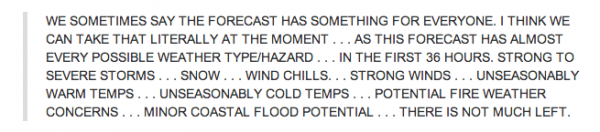
This was included as part of the official forecast last night for the Baltimore, Maryland/Washington DC area. Hope you all are surviving the apocalypse. (via Wired)


15 Mar 17:39

It's tough being a cop

by Rob Beschizza
The life of a police officer is medically and pscyhologically ruinous, writes Erika Hayasaki: "Brian had been a healthy and fit ex-airborne infantry soldier when he began his policing career. But he eventually developed hypertension, anxiety, peripheral neuropathy, hearing loss, arthritis, and post-traumatic stress disorder." [Atlantic]


15 Mar 17:38

Peak Facebook

by Cory Doctorow


Jeswin proposes that Facebook has failed, explaining that the more you use Facebook, the worse it gets. He describes a login screen with 30 stories on it, four of which are interesting, and blames Facebook for encouraging its users -- especially commercial users -- to share in ways that make the experience worse for everyone.

I don't have a Facebook account and tend not to pay much attention to stories about the service, but I was struck by this: "their product looks like one of those spam filled mailboxes from the nineties." One of the claims for walled gardens is that they're able to use a combination of data-mining and the ability to kick out bad actors to make your inbox spam-free. I've always felt that this was wildly oversold: the hardest-to-deal-with "spam" in my inbox is stuff from people I know, or who know me, and who want attention from me for something that is worthy but that I lack time for (if I pay attention to their stuff, I'll have to neglect something else I've already committed to). Facebook makes it easier for more people to do this, which always sounded like a recipe for disaster to me. Likewise the ability to exclude bad actors: once you get to Facebook's size, you can't police spammers and crazies in realtime -- they pop up faster than you can get rid of them. Every walled garden I ever used, all the way back to Compuserve, had problems with bad actors who'd fill up your screen with commercial pitches, hatemail, and other undesirable junk.

I was also struck by Jeswin's contention that Facebook gets worse the more you use it. That was certainly my experience in the brief time I was on Facebook; as I wrote in How Your Creepy Ex-Co-Workers Will Kill Facebook, the more people there are on a social network, the more people there will be inside your social graph that you don't want there, but can't exclude for social reasons. This essay's been reprinted a lot, so I'm guessing it struck a chord for many people.

For me, the problem with Facebook is that it doesn't exist to enhance your social experience -- rather, it's there to monetize it, and if the best way to get rich from your social relationships is to distort them so that they become dysfunctional and a source of pain and anxiety, that's exactly what they're going to do. They want an experience that keeps you disclosing your personal information and keeps you visiting and clicking -- not one that makes you happy. If the optimal way to get your attention is to make you miserable (and let's face it, Someone is wrong on the Internet is a powerful motivating force!), that's just what they'll do.

Facebook gets worse the more you use it

As you use Facebook more, you start accumulating friends. You become part of groups. You end up telling Facebook more about what you like and your preferences. But according to their design, every connection or ‘like’ is also a chance for somebody’s updates to get into the list of stories shown to you.

After a period of active use, you have way too many friends, groups and pages that can get stories into your feed.

Loudmouths now have gigantic megaphones

Since everybody is on Facebook, one can expect that it will in some way mirror the behavior of society in general. In the real world however, people’s opinions only have a limited reach.

Facebook is godsent (sic) for people who love to talk, but have nothing to say. Here is a network that doesn’t care about originality or the quality of content. In the time it takes to create something original, they could share dozens of things.

The Facebook experiment has failed. Let’s go back. [Jeswin/Medium]

(via O'Reilly Radar)

(Image: Facebook Developer Garage, Kris Krug, CC-BY-SA)


15 Mar 17:18

INTP Confession #701

A letter to my closest friend:

I don’t really care if you want to think everything is beautiful and poetic and romantic, or that you have some higher purpose, or anything else like that. That’s your way of coping. That’s okay.

Stop trying to force me to be like you, though.

This has become exhausting. My life has no meaning, and I’m perfectly content with that. Happy, actually. Why is this so hard for you to understand?

13 Mar 04:07

transetheralscritta: Sony President. Shots fired. hahaha omg


transetheralscritta:

Sony President.

Shots fired.

hahaha omg

13 Mar 04:04

INTP Confession #690

I talk to people who are not there. I hear this is normal for an INTP. But, it’s VERY abnormal for other people. It’s just, I will imagine a person I would love to have a conversation with and I just do. Not on purpose ether, my mind just veers off. Actually, I’d say when I’m talking to other people it’s almost always unconscious, which is cool because I can kind of psycho analyze the the conversation after I am brought back to reality. When I have conversations withmyself myself, I’m usually trying to figure something out and I will debate myself a bit. I always end up winning in the end. lol It’s because of my high intuition, I’m able to learn things by questioning myself and then answering myself. This seems to be absurd to most people. I get the most weirded out looks if I just hint at the idea conversing with myself. I don’t think I’m insane. I suppose, if I was grew up more social.. if I was more social in general. Maybe I wouldn’t converse with myself.(so much) Social with people who actually understand me, anyway. I always seem to screw up my relationships though.

10 Mar 04:07

Take What Is Given, a CatFoxWolf comic by Quidditas. Download a...


Take What Is Given, a CatFoxWolf comic by Quidditas.

Download a free pdf of this comic here.

10 Mar 03:57

Bad Machinery for March 8th 2014

comic
10 Mar 03:51

depressioncomix: depression comix #150View Post Before it gets...


depressioncomix:

depression comix #150

View Post

Before it gets too negative around here, let’s see some hope!

10 Mar 03:49

Friends: An Annotated Index of Ross Geller (101-106)

by Ana Mardoll
[Content Note: Misogyny, Patriarchal Relationships, Disability]

Let me tell you a story.

When I was younger, my parents were dedicated fans of the Friends sitcom. I watched it with them, never missing an episode, and I generally liked everyone on the show (flaws and all) with the glaring exception of Ross. I hated Ross with the fire of a thousand suns, and my folks were largely baffled at how harsh and unforgiving I was. (The term "feminist" was invoked at me, and not in a positive manner. But I'm glad the label stuck!) But I didn't care because c'mon Ross Geller is clearly the worst.

Anyway. I grew up and I mostly forgot about Friends until my surgery last year when I found that the episodes work really well for keeping me out of a depression head-space when I'm confined to bed. I started watching the show again and realized that I owed it to my younger self to write a post for her about Why I Dislike Ross Geller. Given that I was about a decade or two away from actually being timely and topical, I was pretty darn shocked at how many people popped in to validate my Ross hatred. Then about a year after that, Melissa found my post and we cross-posted it here because as it turns out, we are Ross-Hating Besties. Which is obviously the best kind of besties!

We now text each other about Ross and how he is THE WORST several times a week (which always makes me dissolve into a fit of giggles), because Liss has been catching the reruns and I've been in and out of bed with back pain and head-cold-allergy-fun. It is our fervent desire to meet up one of these days, plop down on the nearest couch, and watch all the Friends together while heckling Ross and throwing popcorn at the screen.

In the meantime, I am writing an annotated index of Ross Geller's failings, organized by DVD disc since my mom gave me her complete set to hang on to for her (and which is definitely Very Serious Feminist Commentary, lolololol!) and I am dedicating the work to Liss, my bestie who loves to hate Ross with me. ❤


An Annotated Index of Ross Geller: Disc 1

Episode 101: The Pilot

Synopsis: This opening episode establishes the Friends and sets up Rachel and Ross as an overarching romantic arc. Ross has been left by his wife (who has discovered she is a lesbian), and Rachel has left her fiance at the wedding altar. There are long lingering shots of the two alone in their respective spaces (Ross in his new apartment; Rachel in Monica's apartment) wondering what to do now and what life will hold for them. Ross also establishes that he has always had a crush on Rachel, and Rachel acknowledges her awareness of his high school crush and gives him permission to ask her out sometime--Ross does not immediately pursue the relationship, however.

Analysis: This episode sets the tone for how Ross will interact with Rachel. He is initially cheered to see her when she enters the coffee shop for the first time, but despite his obvious interest in pursuing a relationship with her, he doesn't want to give up his angst over the loss of another woman (in this case his wife Carol) and his concerns about his own future--this foreshadows Ross' tendency to treat his relationship with Rachel like a game where his goal is to min/max his internalized concept of "success", rather than focusing on his and Rachel's shared happiness.

Another tone set in this episode is Ross' tendency to belittle Rachel and treat her like she is foolish; he interrupts her phone conversation with her father to mock her "What if I don't wanna be a shoe?" metaphor about her existential crisis. Considering that she has been deeply sheltered all her life, and her father is bringing a tremendous amount of pressure on her to marry Barry (including arguing that it shouldn't matter if she doesn't love him), this is a really asshole move on Ross' part; he is undermining her confidence in her ability to explain and convey her feelings both to herself and others.

The final tone set in this episode and continued forward is Ross' unwillingness to openly and honestly pursue a relationship with Rachel. He frames his confession of feelings in the past tense ("back in high school, I had a, um, major crush on you.") so that he can safely disavow them if Rachel reacts badly; when she acknowledges his crush and gives him encouragement to move forward, he frames his asking her out as a future hypothetical ("do you think it would be okay if I asked you out? Sometime? Maybe?") rather than a direct offer and additionally layers his request with a self-pitying aside that calls attention to his "vulnerability" ("try not to let my intense vulnerability become any kind of a factor here").

All of this is calculated to make it very difficult for Rachel to say No: he's not asking her out, he's asking if he can ask her out at some unspecified future date, and he's drawing awareness to how painful it would be if she didn't let him have this 'little' request. Ross will then choose not to follow up on this "permission" to ask Rachel out for the same reason that he dances so vigorously around the request here: he is afraid of giving her room to issue an unequivocal No, which would mean he would have to stop asking. Instead, he hopes to maneuver her into a relationship with him without her conscious awareness of it ("is it a date if she doesn’t know we’re going on a date?"--Episode 105); if she doesn't know she's being pushed into a relationship with him, she can't say no.

--

Episode 102: The One With The Sonogram At The End

Synopsis: Ross' ex-wife tells him that she's pregnant and tells him that he can decide his level of involvement in the child's life.

Analysis: Ross is characteristically rude to his ex-wife Carol and her girlfriend Susan, and strongly underplays the involvement that Susan will have in the child's life, saying that he doesn't "remember [Susan] making any sperm". Of course this ignores that (canonically) Ross will see the child on the occasional nights and weekends, whereas Susan will be a live-in provider and daily fixture in the child's life. It's difficult for me to unwrap how much of Ross' hostility is over his pain from the divorce (which was preceded by marital infidelity), his misogyny, and his homophobia, so I'm inclined to give him a little slack in this episode since there will be plenty of times to criticize him later.
 
What is less cool is for him to continue to act out his discomfort with the situation by determinedly touching everything in the office (as a museum employee, he should know better), and his decision not to meaningfully defend his sister during a long dinner in which both her parents emotionally abuse her. The only time Ross speaks up in Monica's defense over the course of the evening is to mildly ask "Cows, Dad?" when their father compares Monica to a cow in contrast to "people like Ross who need to shoot for the stars". It is telling that in an episode which is supposed to be about Ross' conflicted feelings at becoming a father, he doesn't feel the need to defend his sister from their own abusive father, nor does he consider that level of abuse something he doesn't want to model on his own child.

--


Episode 103: The One With The Thumb

Synopsis: Ross has only a minor role in this episode which mostly centers around Monica's boyfriend Alan (who the Friends like more than she does), Phoebe's concern at being gifted large sums of money which she doesn't feel comfortable with, and Chandler's struggle with smoking.

Analysis: It is noteworthy that the writers decided that Ross' "failing" would be precise speaking ("And Ross, with his over-pronouncing every single word?") as opposed to his rudeness to the other Friends (including correcting their speaking and mocking them for being less educated than he) and his passive-aggressive centering of himself. It is also noteworthy that while all the Friends like Alan and encourage Monica to remain with him, Ross is her brother and might (but doesn't) choose to understand the pressure this request is placing on his sister. Ross has also very recently been hurt in a relationship and might (but doesn't) choose to understand that how a couple seems to their friends is not indicative of the healthiness of their relationship together.

--

Episode 104: The One With George Stephanopoulos

Synopsis: Chandler and Joey try to take Ross to a hockey game on the anniversary of his first sexual encounter with Carol; Rachel, Phoebe, and Monica have a sleepover and realize that George Stephanopoulus is in the apartment across the street.

Analysis: This episode is a difficult one, because it is revealed near the end that part of Ross' obsession with this day is that his first night with Carol wasn't just his first night with Carol, but was also his first night with a woman, period. Okay, I am okay with that being an important anniversary for someone. BUT. Throughout this episode, Ross continually treats Carol like a sexual fantasy instead of as a real person, and continues to dole out incredibly intimate details about their sex life to the Friends.

There's absolutely no sense that Ross has Carol's consent to tell all these details, and it's deeply discomforting to hear him talk about that night as though her feelings about it, and her feelings about it being shared, are meaningless and presumed non-existent. He's utterly dehumanized her into a sexual script he wants to share with the others. It's also made deeply clear that he was sharing at least some of this with others while he was still married to Carol; Monica notes the date as meaningful to him, and Ross implies that he told her soon after it happened.

As a final note, when the "mean" E.R. nurse is hit in the face with the hockey puck, Ross yuks "...Now that was fun."

--

Episode 105: The One With the East German Laundry Detergent

Synopsis: In this episode, Rachel does her laundry and Ross accompanies her to the laundromat.

Analysis: This is the first Ross-and-Rachel episode since the pilot, and it continues the worrying Nice Guy trends we saw there. Ross opens by asking Rachel what she is doing for the night--an obvious attempt to build up to a date request without leaving himself open for a No--and when she reveals that she already has plans (laundry), Ross asserts that he had already made the exact same plan to be in the exact same place ("Oh, you uh, you wanna hear a freaky coincidence? Guess who's doing laundry there too?"). When Rachel points out that this doesn't make sense ("Don't you have a laundry room in your building?"), Ross makes up a flimsy excuse about rats on the spot.

This is standard and problematic dishonesty from Ross. He refuses to be upfront about his desire to be with/around Rachel, and he does so because he doesn't want to leave her an opening to say No and shut him down. This is harmful passive-aggressive Nice Guy behavior and means that if Rachel weren't comfortable with Ross' attention, she would have few options for asking him to stop--if she asked him not to do laundry at her laundromat that night, he would accuse her of overreaction and of "imagining" things.

Even if Rachel does want to pursue a relationship with Ross, this passive-aggressive approach still harms her because it makes it difficult for her to openly state her feelings when Ross is treating all questions of romance between them as laughable and ridiculous in order to shield himself from harm. At best, he's building an emotional barrier between them in order to protect himself; at worst, he's engaging in boundary-transgressing behavior that employs the same tools found in a stalker's arsenal. None of this is healthy or fair to Rachel.

Chandler--who is established as being very bad with relationships--throws fuel on the fire by insisting that the outing is a date even "if she doesn't know" it's a date because it's Saturday night (i.e., date night), and he urges Ross not to bring his dirty underwear or 'feminine' detergent to the laundromat. His bad advice, however, doesn't absolve Ross from taking it. (And this will be a common deflection tactic by the writers; it's not Ross' fault if Chandler or Joey egged him on!) 

At the laundromat, Rachel has an open and business-like attitude towards learning this new thing, but Ross is determined to keep things awkward by extravagantly flinching and turning away at the sight of Rachel's underwear when she asks whether white panties go in with whites or with delicates. (As a side-note, from someone who doesn't sort laundry because who needs extra work amiright, it's not super great to see Ross lecture Rachel on separation to begin with.)

Then we have another foreshadowing moment with Rachel and Ross when she confesses that the laundry is important to her because "I feel that if I can do this, you know, if I can actually do my own laundry, there isn't anything I can't do." The problem here is that Ross just automatically agrees with Rachel (in a jokey, intimacy-deflecting way by showing a moment of vulnerability over Carol and then immediately shutting down the story with a joke), presumably because he thinks that constant agreement will help to get her into a relationship with him, and then when something goes wrong with the laundry, he tries to lie to her about the existence of the problem in an impossible attempt to avoid hurting her.

Ross doesn't believe Rachel can make it on her own; he frequently mocks her to that effect and will say as much later in the series when she becomes pregnant. And it's because of that attitude that he presumably can't see that agreement is not what she needs here; she needs to hear someone tell her that she can make it on her own regardless of magic milestones (like laundry), that he believes in her, and that life is about learning, not about innate ability. A Rachel who can magically do laundry perfectly the first time isn't a Rachel who has demonstrated survival skills; a Rachel who can endure defeat, learn from it, and get back up from it, is

Ross should know that; he's old enough and been through a bad enough breakup and put together IKEA furniture badly enough to know that these "on your own" milestones aren't the important thing--continuing to muddle through them and not give up is what's really important. He could give Rachel the pep talk she needs now, but instead he trying to sing a song ("Uh-oh, uh-oh, the laundry's done. It's, uh, it's a song. The laundry song that we sing.") in a doomed-to-fail attempt to distract her from the fact that all her laundry is now pink. And he does that not because he cares about her feelings--in which case he would realize she's about to be hurt and attempt to diffuse the blow rather than pretend it will never come--but because he thinks constant agreement and cheerfulness is the best way into her arms. None of that feels compatible with respect or genuine love.

--

Episode 106: The One With The Butt

Synopsis: Chandler goes out with a woman but dumps her when he realizes he can't deal with a poly relationship; Joey gets a part as body double for Al Pacino in a nude shower scene.

Analysis: This is another episode that isn't heavy with Ross details, but it's worth noting his attempts to cheer Chandler when Chandler is sad at having broken up with Aurora. Ross tells him: "Look at it this way: you dumped her. Right? I mean, this woman was unbelievably sexy, and beautiful, intelligent, unattainable... Tell me why you did this again?" We see that the most important things here that Ross values are winning (that Chandler was the dumper, not the dumpee) and how "attainable" the woman is.

It is noteworthy that Ross doesn't try to cheer Chandler up by referencing being happier in the long-run or being incompatible with Aurora (even though Ross should understand incompatible needs in a relationship, what with having an ex-wife who is a lesbian). Instead, he builds up Aurora not based on who she is or how well she fits Chandler as a partner, but rather as a function of her looks, her intellectual status, and her overall desirability according to mainstream social values. Later we will see that Ross uses these same metrics to evaluate Rachel and his other romantic partners.  

Also noteworthy here is that Ross initially defends Chandler's decision to date Aurora and his reasoning that "I get all the good stuff: all the fun, all the talking, all the sex; and none of the responsibility. I mean, this is every guy's fantasy!" When Phoebe asks "Ross, is this your fantasy?" and Monica asks "So you guys don't mind going out with someone else who's going out with someone else?", Ross admits that Chandler's situation is his fantasy ("...Yeah, yeah, it is.") and argues that monogamy is "a tricky concept" and starts to haul out evo-psych apparently against it. (I presume he was going to argue that men are driven to procreate with as many woman as possible, blah blah evo-psych cis-sexism assholery fart.)

This is an, ahem, interesting position for Ross to take, given that he will spend most of the series furiously jealous of his ex-wife's girlfriend Susan and of any man whom he believes has a romantic interest in Rachel.
10 Mar 03:18

Pope Francis says maybe to civil unions

by Fred Clark

From a legal point of view, “civil unions” just don’t cut it.

To see why, just consider why the idea of civil unions as a separate-but-equal marriage-like thing for same-sex couples seems initially appealing for some folks. Anyone who views civil unions favorably arrives at that point because they’ve recognized that there’s an injustice — an inequality under the law — that needs to be corrected. They’ve recognized that it’s fundamentally unfair for opposite-sex couples to have access to more than a thousand legal benefits that come with getting married while same-sex couples are barred from access to such benefits.

That’s wrong, and those who advocate for civil unions see that it’s wrong.

So far so good. Recognizing an injustice and wanting to correct it is a Good Thing. But proponents of civil unions balk at the obvious next step. If you’re upset by inequality, the simplest solution is to establish equality. Civil unions are an attempt to get that result without quite actually doing that. They are an attempt to allow same-sex couples access to all the legal benefits of marriage except that of being legally married — an attempt to grant legal equality while still denying social equality.

And like all separate-but-equal schemes, that can’t work. All such schemes rely on mechanisms to enforce and perpetuate separateness, and all such mechanisms deny the possibility of real equality.

That’s why civil unions, here in the U.S., can’t be squared with the Constitution and its guarantees of equal protection under the law. As Supreme Court Justice Ruth Bader Ginsburg said, the Constitution doesn’t allow us to grant one set of citizens marriage while offering others only “skim-milk marriage.”

For all of that, though, this is still a big deal: “Pope Francis: Church could support civil unions.”

Pope Francis reaffirmed the Catholic Church’s opposition to gay marriage on Wednesday, but suggested in a newspaper interview that it could support some types of civil unions.

The Pope reiterated the church’s longstanding teaching that “marriage is between a man and a woman.” However, he said, “We have to look at different cases and evaluate them in their variety.”

States, for instance, justify civil unions as a way to provide economic security to cohabitating couples, the Pope said in a wide-ranging interview published Wednesday in Corriere della Seraan Italian daily. State-sanctioned unions are thus driven by the need to ensure rights like access to health care, Francis added.

A number of Catholic bishops have supported civil unions for same-sex couples, including Pope Francis when he was Archbishop of Buenos Aires in 2010, according to reports in National Catholic Reporter and The New York Times.

But Wednesday’s comments are “the first time a Pope has indicated even tentative acceptance of civil unions,” according to Catholic News Service.

Roman Catholic thinking on the relationship between church and state is … complicated. John Courtney Murray is still dead and in many ways it seems his ideas about how the Catholic church should behave in pluralistic societies under secular government were buried with him. But Murray’s theology suggests that Francis’ “tentative acceptance of civil unions” is a positive step for the church.

In the eyes of the Roman Catholic Church, this couple is in a civil union. Bruce and Patty have been legally married for more than 22 years, but because Mr. Springsteen’s previous marriage ended in divorce, the church refuses to recognize his second marriage. Yet it still allows that second marriage as a legal right. (Getty Images photo by Jon Raedle.)

Again, civil unions just don’t cut it legally. Separate-but-equal cannot be squared with the legal system of any country whose constitution guarantees equal protection under the law. So it would be inadequate and wrong — both unjust and illogical — for the pope and his church to advocate civil unions as a legal reality in America or in any other country. Marriage equality — the full and equal legal recognition of same-sex marriage — is the only just aim, and the church should never stand opposed to justice.

But for the church itself, and for how it regards legally married same-sex couples, I think the framework of civil unions can be helpful.

This is, after all, how the church already regards most legally recognized marriages — including most “traditional” legal marriages between opposite-sex couples.

My marriage, for example, is really only a “civil union” in the eyes of the Roman Catholic Church. My wife was previously married in the Catholic church. That marriage ended in divorce (just as my previous marriage did — although the Catholic church doesn’t care about that one so much because my first wife was Protestant). But the Roman Catholic Church does not recognize divorce. In its eyes, my wife’s first marriage wasn’t just a legal covenant, but a “sacramental, indissoluble union … established by God” and “it is impossible for any human power to break the God-made bond, or sacramental covenant, between husband and wife. ”

And thus, since the Catholic church can never recognize that divorce, it also does not recognize my wife’s current marriage — to me — as legitimate or real.

But note the important thing here: Despite this firm commitment to its doctrine of marriage, the Roman Catholic Church is not attempting to bar Catholics from access to legal divorce. It is not lobbying to make it illegal under secular law for anyone to obtain a civil divorce. Nor is it attempting to prevent divorced people from access to legal, civil remarriage. Divorce and remarriage are, in the eyes of the Catholic church, sins. But the church acknowledges that they are also a legal right that it would be unjust and immoral (i.e., sinful) to deny others.

There’s no reason — no Catholic reason — that Pope Francis and his church could not take the same approach to same-sex marriage.

A further point on this: Official Catholic doctrine says that my marriage is actually the sin of adultery. My wife, the church says, is thus an adulteress living in sin, and must therefore be denied the sacraments. That’s not merely false and unjust, it’s rude — which is why I think it was utterly appropriate for the ‘vixen to respond with a hearty “Same to you, buddy”* and never look back.

Yet for all this sacrament-denying, soul-damning-for-eternity condemnation, the Catholic church is also able, however grudgingly, to admit that my marriage is a Good Thing. Without compromising its condemnation of our shameful wickedness and adultery, the church also acknowledges that, granted that regrettable context, it’s nice to see a couple of wicked adulterers settling down together and getting along so well. There’s a sense in which the church is even able, somewhat haltingly, to be happy for us. It’s able on some level to recognize that there are a lot of wicked adulterers and other “intrinsically disordered” people in this world and that, all else being equal, if some of those adulterers or intrinsically disordered people find love and make lifelong commitments to one another then, well, that’s something that deserves to be celebrated.

There’s a sense, in other words, in which the Catholic church regards my marriage as no different from any other marriage that occurs outside that church. A couple of lifelong atheists are legally wedded by a justice of the peace in a courthouse? That is, in the eyes of the church, not the same as a sacramental, indissoluble union established by God and overseen by a priest. It’s not what the Catholic church thinks of as a marriage, merely a “civil union.” But it’s still nice, isn’t it? It’s good for them and good for the whole community. Sure, yes, they’re hell-bound sinners, but we can still honor the commitment they’ve made to one another and smile as we wish them a happy anniversary every year.

There’s no reason the Catholic church cannot take that exact same position toward legal marriage equality for same-sex couples.

That is, in fact, the most just course of action for this pope and this church. That is what the Roman Catholic Church ought to do if it is to be faithful to its own teaching. It needs to get out of the way of legal equality and abandon all opposition to the full legal recognition of secular same-sex marriage just exactly as it has done with the full legal recognition of secular opposite-sex divorce and remarriage.

I think it should also reconsider and reform its teaching on the ecclesiastical and sacramental validity of same-sex marriages and opposite-sex remarriages, but that’s a separate matter. That step would involve a change in Catholic theology, and Catholic theology is their business. It’s their prerogative to work out their business on their own. If they want to continue denying the sacraments to Catholics who are divorced and remarried or to Catholics in same-sex marriages, that’s a mistake and an injustice (a harmful, hurtful sin) that the Catholic church is free to continue. Within their own church, they have every right to keep being utterly and perversely and cruelly wrong in that way.

But the Catholic church’s legal opposition to legal marriage equality is not occurring within their own church. This is an injustice the church is committing outside of its own jurisdiction. That’s wrong. And it’s wrong according to Catholic principles and Catholic teaching.

There’s no good Catholic reason for them to be fighting against the secular, legal right of same-sex couples to get married. That is a mistake and a sin and an error and an injustice that Francis and his church have no business continuing.

They need to, in a word, repent.

- – - – - – - – - – - -

* Not her actual words, but this is a family friendly blog.

09 Mar 19:40

The NSA Has An Advice Columnist. Seriously.

by Peter Maass
askzelda5-1

What if the National Security Agency had its own advice columnist? What would the eavesdroppers ask about?

You don’t need to guess. An NSA official, writing under the pen name “Zelda,” has actually served at the agency as a Dear Abby for spies. Her “Ask Zelda!” columns, distributed on the agency’s intranet and accessible only to those with the proper security clearance, are among the documents leaked by NSA whistleblower Edward Snowden. The columns are often amusing – topics include co-workers falling asleep on the job, sodas being stolen from shared fridges, supervisors not responding to emails, and office-mates who smell bad. But one of the most intriguing involves a letter from an NSA staffer who complains that his (or her) boss is spying on employees.

In the letter, which Zelda published in a column on September 9, 2011, the employee calls himself “Silenced in SID” – referring to the Signals Intelligence Directorate, the heart of the NSA’s surveillance operations. Zelda’s column, headlined “Watching Every Word in Snitch City,” offers an ironic insight into a spy agency where the spies apparently resent being spied upon.

“Dear Zelda,” the letter of complaint begins:

Here’s the scenario: when the boss sees co-workers having a quiet conversation, he wants to know what is being said (it’s mostly work related). He has his designated “snitches” and expects them to keep him apprised of all the office gossip – even calling them at home and expecting a run-down! This puts the “designees” in a really awkward position; plus, we’re all afraid any offhand comment or anything said in confidence might be either repeated or misrepresented.

Needless to say, this creates a certain amount of tension between team members who normally would get along well, and adds stress in an already stressful atmosphere. There is also an unspoken belief that he will move people to different desks to break up what he perceives as people becoming too “chummy.” (It’s been done under the guise of “creating teams.”)

Surveillance tends to sow suspicion and unease among the people who are being surveilled. Is anyone listening? Who might be the spy among us? What trouble might I get into with the things I say? These questions can eat away at the core of human relations – trust. And this is true even at the agency that is conducting the surveillance.

The letter continues:

We used to be able to joke around a little or talk about our favorite “Idol” contestant to break the tension, but now we’re getting more and more skittish about even the most mundane general conversations (“Did you have a good weekend?”). This was once a very open, cooperative group who worked well together. Now we’re more suspicious of each other and teamwork is becoming harder. Do you think this was the goal?

Silenced in SID

Zelda is shocked.

Dear Silenced,

Wow, that takes “intelligence collection” in a whole new – and inappropriate – direction. …. We work in an Agency of secrets, but this kind of secrecy begets more secrecy and it becomes a downward spiral that destroys teamwork. What if you put an end to all the secrecy by bringing it out in the open?

Her column reads like an unintended allegory – or a cleverly masked one. The NSA’s own advice columnist explores the ways in which pervasive surveillance can erode freedom of expression and social cohesion by making it difficult for people to have faith in the privacy of their communications.

Zelda continues:

You and your co-workers could ask [the supervisor] for a team meeting and lay out the issue as you see it: “We feel like you don’t trust us and we aren’t comfortable making small talk anymore for fear of having our desks moved if we’re seen as being too chummy.” (Leave out the part about the snitches.) Tell him how this is hampering collaboration and affecting the work, ask him if he has a problem with the team’s behavior, and see what he says. …. Stick to the facts and how you feel, rather than making it about him (“We’re uncomfortable” vs “You’re spying on us.”).

There is no indication that Zelda is trying to make a larger point, but some of what she goes on to propose would be useful for ordinary citizens outside the agency who worry about government and corporate surveillance.

If you are bothered by snitches in your office, whether of the unwilling or voluntary variety, the best solution is to keep your behavior above reproach. Be a good performer, watch what you say and do, lock your screen when you step away from your workstation, and keep fodder for wagging tongues (your Viagra stash, photos of your wild-and-crazy girls’ weekend in Atlantic City) at home or out of sight. If you are put in the “unwilling snitch” position, I would advise telling your boss that you’re not comfortable with the role and to please not ask that of you.

Who is Zelda? And who is “Silenced in SID”? The document provides no information about the identity of the letter’s author; he or she could be almost anybody at the agency. In a previous column, Zelda explains that Ask Zelda! was initially intended as a forum for supervisors in the Signals Intelligence Directorate, but that non-supervisory workers began submitting questions, too.

A bit more is known about Zelda. Her introductory column, in 2010, identifies her as serving for approximately 20 years as “a first-line and mid-level Agency supervisor.” At the time her column began, she was also an adjunct faculty member of the agency’s National Cryptologic School. Her column was part of a regular NSA bulletin called “SIDtoday” that is distributed on the agency’s classified NSAnet. According to traffic statistics, in fact, Ask Zelda! quickly proved to be among the bulletin’s most popular features.

“We usually end the calendar year by providing a suspenseful countdown of the top dozen most widely read SIDtoday articles of the year,” noted a SIDtoday bulletin on December 27, 2011, “but this time around it is not really a nail-biter, because Zelda articles occupied all of the top five slots!” Her most popular article that year, about swearing at the NSA, received 19,446 hits.

“Since SIDtoday is like an online newspaper, we decided to follow the tradition of newspaper write-in advice columnists (such as Dear Abby and Miss Manners) and give me a nom de plume,” Zelda writes in advance of the first anniversary of her column. “I like it because using a pen name creates a persona who’s more memorable and accessible than ‘Ask Mary Smith, Chief of S456.’ Plus it creates a certain mystique about Zelda… she’s bigger than life. It also prevents me from getting inundated with hate mail and requests for advice outside of the column.”

Zelda can be a church lady. Her first column addressed employee attire in summer months, and she was not pleased. “Somehow, shorts and flip-flops don’t exactly convey the image of a fierce SIGINT warrior,” she writes. “Not only is beach attire unprofessional in the workplace, but in certain cases it can be downright distracting to co-workers (if you get my drift).” She recommends that offenders, who might be just out of college and not know any better, should be told to dress “in a professional manner” even when it feels like a swamp outside. This column received 9,186 hits by the end of 2010 – placing it number four on the list of most-read SIDtoday articles for the year.

But on privacy, Zelda is surprisingly liberal, given that the agency where she works spies on vast numbers of private phone calls, emails, texts, chats, status updates, webcams and address books. In a column titled, “Guilty Until Proven Innocent?”, Zelda responds to an NSA worker who goes by the pen name “Innocent Bystander” and who explains that a colleague has filed an anonymous complaint about their bosses, calling them “abysmal” and “idiotic.” Unfortunately, everyone believes that Innocent Bystander has written the complaint, and as a result, “The chill I’m feeling is pretty severe!” Anonymous complaints should be discouraged, Innocent Bystander says, so that innocent parties do not come under suspicion.

“You make a good case against anonymous mailbags,” Zelda replies, “but a lot of people won’t give feedback at all if they know it will be attributed to them. I believe scathing comments such as your co-worker’s are the exception and not the rule.”

Her response to “Silenced in SID” does not acknowledge the irony – or hypocrisy – of an employee at a spy agency complaining about being spied on. But Zelda directly addresses the long-lasting effects of inappropriate surveillance. “Trust is hard to rebuild once it has been broken,” she observes. “Your work center may take time to heal after this deplorable practice is discontinued.”

Documents referenced in this article:

The post The NSA Has An Advice Columnist. Seriously. appeared first on The Intercept.

09 Mar 00:07

ittybittymanatee: elliotexplicit: Deleted scene from the...


ittybittymanatee:

elliotexplicit:

Deleted scene from the critically acclaimed film, Gravity.

oh my god, you tried

07 Mar 05:05

Netflix disables Chrome's developer console

by Cory Doctorow

When you watch Netflix videos in the Chrome browser, the service disables Chrome's developer console, a debugging and programming tool that gives you transparency and control over what your browser is doing. The Hacker News thread explains that this is sometimes done in order to stop an attack called "Self-XSS" that primarily arises on social media sites, where it can cause a browser to leak nominally private information to third parties. But in this case, the "Self-XSS" attack Netflix is worried about is very different: they want to prevent browser owners from consciously choosing to run scripts in the Netflix window that subvert Netflix's restrictions on video.

This is the natural outflow of the pretense that "streaming" exists as a thing that is distinct from "downloading" -- the idea that you can send a stream of bytes to someone else's computer without the computer being able to store those bytes. "Streaming" is at the heart of "rental" business models like Netflix's, and there's nothing wrong with the idea of rental per se. But the only way to attain "rental" with computers is to design computers so that their owners can't give them orders that the landlords disagree with. You have to change the computer and its software so that you can't see what it's doing and can't change what it's doing.

Your browser is a portal to your whole social life, your financial life and your work life, entrusted with the most potentially compromising secrets of your life. Anything that allows third parties to make it harder for you to figure out what the browser is doing, or to prevent it from doing something you don't want, should be a non-starter. As soon as a powerful entity like Netflix comes to depend on -- and insist on -- computers that owners can't control, that company is doing something wrong. Not because rentals are bad, but because taking away owner control from computers is bad.

This is why it's such a big deal that Netflix has convinced Microsoft, Apple, and Google to build user-controlling technology into their browsers, and why it's such a big deal that Microsoft, Apple, and Google have convinced the W3C to standardize this for all devices with HTML5 interfaces. Any time we allow the discussion to be sidetracked into "How can Netflix maximize its revenue by enforcing rental terms?" we're missing the real point, which is, "How can people be sure that their browsers aren't betraying them?"

Netflix disables use of the Chrome developer console (pastebin.com)


05 Mar 21:49

The Acid Test For Francis, Ctd

by Andrew Sullivan

And he fails:

Speaking about the horrific abuse of children by priests, Francis said “the cases of abuse are terrible because they leave very deep wounds”.  Benedict XVI “was very courageous and opened a road, and the Church has done a lot on this route, perhaps more than all others”, he stated. He noted that the statistics reveal the tremendous violence against children, but also that the vast majority of abuse takes place in the milieu of the family and those close to them.  The Church is the only public institution to have moved “with transparency and responsibility”, he said; no one else has done as much as it, “but the Church is the only one to be attacked”.

This is more of the institutional defensiveness that has proven so devastating to the church’s moral authority and a bad omen for more thoroughgoing accountability and reform. Here’s hoping that he will leave this attitude behind and lead further down the road of “transparency and responsibility” he believes Benedict opened.

Previous Dish on the subject here.

05 Mar 07:01

molly-ren: snazzapplesweet: weh This is my ideal cuddle...


molly-ren:

snazzapplesweet:

weh

This is my ideal cuddle scenario. Just keep doing what you were doing and let me ground myself in your lap.

05 Mar 06:53

"When companies offer bad jobs, they can find themselves in a vicious downward cycle. Take..."

“When companies offer bad jobs, they can find themselves in a vicious downward cycle. Take supermarkets, for example. That’s an industry full of bad jobs—low pay, unpredictable hours, and work that is not meaningful. But it’s also a very complex working environment. In a typical supermarket, employees manage thousands of products, serve more than 2,000 customers a day, and carry out hundreds of sales promotions a week. When you operate such a complex environment with employees who are unmotivated, poorly trained, or overworked because the store is understaffed, the result is operational problems. Products are misplaced or mispriced. Promotions are advertised but not carried out. Employees can’t answer customers’ questions—they may not know or have time. Those problems reduce sales and profits, so sales decline, so labor budgets shrink, so companies invest even less in their people. That’s the vicious cycle. Companies can still make money operating in this cycle, but they are leaving a lot on the table. Customers come as long as there are good deals, but they have no loyalty.”

- Zeynep Ton
05 Mar 06:48

Your Ancestors, Your Fate

Your Ancestors, Your Fate:

When you look across centuries, and at social status broadly measured — not just income and wealth, but also occupation, education and longevity — social mobility is much slower than many of us believe, or want to believe. This is true in Sweden, a social welfare state; England, where industrial capitalism was born; the United States, one of the most heterogeneous societies in history; and India, a fairly new democracy hobbled by the legacy of caste. Capitalism has not led to pervasive, rapid mobility. Nor have democratization, mass public education, the decline of nepotism, redistributive taxation, the emancipation of women, or even, as in China, socialist revolution.

To a striking extent, your overall life chances can be predicted not just from your parents’ status but also from your great-great-great-grandparents’. The recent study suggests that 10 percent of variation in income can be predicted based on your parents’ earnings. In contrast, my colleagues and I estimate that 50 to 60 percent of variation in overall status is determined by your lineage. The fortunes of high-status families inexorably fall, and those of low-status families rise, toward the average — what social scientists call “regression to the mean” — but the process can take 10 to 15 generations (300 to 450 years), much longer than most social scientists have estimated in the past.

We came to these conclusions after examining reams of data on surnames, a surprisingly strong indicator of social status, in eight countries — Chile, China, England, India, Japan, South Korea, Sweden and the United States — going back centuries. Across all of them, rare or distinctive surnames associated with elite families many generations ago are still disproportionately represented among today’s elites.

05 Mar 00:32

fuckyeahvintageillustration: 'Paysages et coins de rues /...


fuckyeahvintageillustration:

'Paysages et coins de rues / Landscapes and Street Corners' by Jean Richepin; illustrated in colour by Auguste Lepère and with an introduction by Georges Vicaire. Published 1900 by Librairie de la collection des Dix, Paris.

See the complete book here.

love the color palette 

04 Mar 22:40

Hewitt Award Nominee

by Andrew Sullivan

A reader in North Carolina flags a disturbing fundraising letter:

IMG_1209_2Not much shocks me anymore. I know how the right feels about Obama. They’ve made that clear. So when I received an envelope from my congressman, I almost trashed it like I do all the others. Still, since “no less than Western civilization” was apparently hanging in the balance, I thought I should read it. It’s mostly a fundraising screed filled with the usual apocalyptic Tea Party claptrap. Then, I got to this part of the letter [embedded below]:

You see, I am already on the front lines, taking seriously my oath of office: to defend the U.S. Constitution — and you and your fellow Americans — against all enemies, foreign and domestic. And for that I am being attacked from all sides, including from my fellow Republicans. My friend, make no mistake, Barack Obama is Enemy Number One!

enemy-#1

As you can read from the envelope, this is a letter from Congressman Robert Pittenger, Chairman of the Congressional Taskforce on Terrorism & Unconventional Warfare. So, if the chairman of this taskforce has found, no doubt after much hard work and research, that our president is the number one enemy of our country (apparently outranking al Qaeda), then isn’t this breaking news? What does he propose should be done to Enemy Number One? (The letter goes on to discuss Obama’s “Islamo-Communist upbringing,” really just icing the cake.)

I don’t know that I’ve ever read one of these political fundraising letters from a member of Congress of either party that declared the President of the United States to be “Enemy Number One.” I suppose some things still shock me after all.

Dish award glossary here.

04 Mar 22:32

THE HUMANS DO IT ALL THE TIME, IT MEANS YOU’RE A GOOD BOY


THE HUMANS DO IT ALL THE TIME, IT MEANS YOU’RE A GOOD BOY

04 Mar 20:34

nevver: Number of new planets graph An exciting year if you...


nevver:

Number of new planets graph

An exciting year if you are planning a vacation outside of our solar system.

04 Mar 20:04

appendixjournal: Carl Sagan’s childhood drawings about space...


appendixjournal:

Carl Sagan’s childhood drawings about space are just as endearing and idealistic as you’d imagine.

04 Mar 20:00

Good Lord is This Guy Stupid

by Josh Marshall
Zephyr Dear

TPM's commentary has been getting more abrasive lately, it seems like..

04 Mar 04:50

What if the question wasn't "Who sneaks SNACKS into a sex dungeon" but "Who SNEAKS snacks into a sex dungeon" or "Who sneaks snacks INTO a sex dungeon"?

…these are excellent points.

04 Mar 04:45

These have been floating around the internet for years - but I...


These have been floating around the internet for years - but I just came across them.  You can see more of these drawings (there are dozens), and the students written impressions of scientists, over at the FermiLab Education Office's website.

04 Mar 04:44

"I need white people to stop pretending consent was possible during slavery. Stop lying to..."

I need white people to stop pretending consent was possible during slavery.

Stop lying to yourselves that those black cousins are the result of illicit love affairs & grasp that slaves could not say no.

When consent is not an option, when you’re only seen as 3/5ths of a human being & you have no legal standing? You can’t say yes.

I need white America to sit down for a sec. Look into the faces of black Americans with the same last names & figure it the fuck out.

Our ancestors were raped by your ancestors. Regularly. Some of the kids were treated kindly. Most were not. They were sold.

White mistresses punished the slaves for “tempting” master & congratulated themselves on that bloody work. Read the narratives.

Not the cleaned up ones either. Read Incidents in The Life of A Slave Girl & understand that Mammy was a victim, not the one who loved you.

She couldn’t care for her kids, couldn’t choose her husband or their father most of the time. She was a slave.

Millions of people died on the Middle Passage. Millions more died here at the hands of your ancestors. Own that.

Now you want to sing Kumbaya & keep oppressing our communities & erasing our contributions. Spare me the tired bullshit.

Male slaves fared no better. There’s a long history of them being raped, tortured & killed too. That was slavery. Stop romanticizing it.

Our children were fed to alligators as bait (feel free to look that up) died of starvation or exposure & that was slavery too. Yep, we were livestock & you use sickly livestock as bait.

Stop watching Gone With The Wind & fantasizing about beautiful plantations if you can’t accept what happened on those plantations.

House slaves had it better in the sense of access to food & possibly better treatment, but they were still slaves.

14 year old slave girls weren’t falling in love with the men who could beat them & everyone they loved to death.

Read the tales of enslaved women who killed their children to spare them. Read about people beaten to death as an example.

Sally Hemings could have left Jefferson in Paris. Of course her entire family was still in his power. And his “love”? Didn’t free her. Ever.

Go look at the pictures of former slaves backs. Whipped until they bled & left to scar so they were maimed for life & couldn’t run.

Also before you talk about the cleaned up narratives, remember that the people relating their stories knew lynching was always possible.

Records of slavery were deliberately destroyed so that former owners wouldn’t have to pay anyone.

That “peculiar institution” was generations of blood, pain, & terror. That’s what built America. Never forget that.

Now stop talking about anyone’s white ancestors like they deserve the fucking credit for the success of people descended from slaves.

American slavery began in 1619. June 19, 1865 was the last official day of slavery. Do the math on how long it takes to heal that wound.

After slavery was officially over? Black codes & Jim Crow laws followed. America’s history of oppression is longer than that of freedom.

Also before any d*mb motherfuckers land in my mentions. I have a degree in history. I will read you to filth & bury you in sources.

Trust & believe there is no country here for people who want to romanticize a system that is still grinding away at my community.

All this fluffy fucking talk about American history to coddle white kids feelings & engender patriotism? You won’t get it here.

My ancestors built this country, I served this country & I will tell the damned truth about this country. Don’t like it? Fuck you.

Now let me get in my feelings about slavery before Africans were brought here. Because we weren’t the first people enslaved.

We were deliberately sought out for our skill sets & resistance to disease. Know why we were resistant? We’d had contact for years.

All of that “My ancestors never owned slaves so it has nothing to do with me?” Go look at those NDN ancestors again. See how many were free.

While you’re in there checking that out? Look up those old country ancestors & see how many benefited from slavery indirectly.

Also while we’re talking about NDN relatives? Yo, learn a name besides Cherokee. Better yet, learn about the genocidal tactics they faced.

Look up immigrant groups becoming white in America. Find out who had to bleed so they could gain access to white privilege.

Let’s really talk about the Red Summer of 1919 & how it wasn’t an unusual occurrence. Tulsa, Rosewood? They were just famous.

Let’s talk about welfare & who could access it. Hell let’s talk about who is collecting more of it right now.

Let’s talk about the primary beneficiaries of affirmative action (spoiler! White women!) & what it means to attack black people instead.

Shit, let’s get into the Great Depression & the Great Recession & who is hurting the most financially through both.

Let’s talk about conditions on reservations, in the inner city, & the violence faced by POC who try to leave those areas.

Hell, let’s talk about why we don’t see shows that reflect the American population set in the past, present, or future.

Go read Columbus’ diaries & see what “civilization” really meant to the people he encountered.

For that matter go read up on King Leopold & the Congo. I’ll wait while you cry.

That’s the thing about whiteness as a social construct in America. It’s not about white people, it’s about white power over others.

When we’re talking about white privilege? We’re talking about what it takes to shape this society based on oppression.

America is a young country with a lot of power because of genocide, slavery, & continuing oppression. Individuals build institutions.

All of these conversations aren’t about bringing out white guilt, they’re about ending this institution developed over the generations.

Also let’s be clear that America is sick with this ish across the political spectrum. It may manifest differently but it exists everywhere.

Before I go, let me also suggest that people who are curious about anything I tweeted about take a tour through Google with terms.

It’s not that I won’t answer questions, but there are books out there that I think everyone should read on slavery, whiteness, & America.


- Karnythia,  laying it down with righteousness on Juneteenth — the truth about slavery and its lingering effects on America.  (via skyliting)

I don’t want to see tl;dr no you ALL need to fucking read this. (via thisisnotblackhistorymonth)
03 Mar 23:05

"Some readers may find it surprising to learn that a woman shortage blighted the ancient world, with..."

“Some readers may find it surprising to learn that a woman shortage blighted the ancient world, with about 130-140 men for every 100 women. This is so because many female infants were left to die of exposure and because of the mortal risks associated with pregnancy and childbirth. Yet both Christians and their critics observed a marked overrepresentation of women in the early churches, a fact the critics used to their advantage: “What respectable group caters to women?” Why, one wonders, did so many women find the churches appealing if women’s contributions were not valued? The answer is, simply, that the early churches did value women’s contributions. Not only did women show their strength in numbers, they did so in leadership positions as well.”

- The Power and Presence of Women In The Earliest Churches
03 Mar 22:10

ē The Cost of Bitcoin

by Ben Thompson

Putting aside the particulars of Bitcoin, the potential it represents is absolutely a very big deal.

As I’ve written multiple times on stratechery, the defining characteristic of anything digital is its zero marginal cost. Take apps for example:

What makes the software market so fascinating from an economic perspective is that the marginal cost of software is $0. After all, software is simply bits on a drive, replicated at the blink of an eye. Again, it doesn’t matter how much effort was needed to create said software; that’s a sunk cost. All that matters is how much it costs to make one more copy – $0.

The implication for apps is clear: any undifferentiated software product, such as your garden variety app, will inevitably be free. This is why the market for paid apps has largely evaporated. Over time substitutes have entered the market at ever lower prices, ultimately landing at their marginal cost of production – $0.

The same story applies for music, movies, content, etc., and this has fundamentally changed what it means to do business on the Internet. It’s why, for example, WhatsApp was so valuable to Facebook: attention is the true finite resource, and how it’s commanded is, in some ways, besides the point.

Bitcoin and the breakthrough it represents, broadly speaking, changes all that. For the first time something can be both digital and unique, without any real world representation. The particulars of Bitcoin and its hotly-debated value as a currency I think cloud this fact for many observers; the breakthrough I’m talking about in fact has nothing to do with currency, and could in theory be applied to all kinds of objects that can’t be duplicated, from stock certificates to property deeds to wills and more.

What makes Bitcoin so clever is how it assumes self-interest and uses incentives. To put it in the simplest possible terms, instead of a paid broker for transactions, tens of thousands of distributed computers working independently do the verification, at no cost to those involved in the transaction. Their reward is the possibility of more Bitcoin – the verification process is also the mining process. Most people are focused on the “mining” part of the process, but it’s the verification aspect that is profound.

Unfortunately, it’s not clear you can really divorce this verification process from the speculation involved with mining; it’s the speculation that incentivizes the verification. In other words, while the process behind Bitcoin enables unique digital goods beyond currency, the incentives only really work if said digital good has stored monetary value. Absent those incentives those doing the verification would need to earn some sort of commission, and then we’re right back where we started.1

Still though, currency is something – surely no-fee transfers is worth celebrating! And, as someone who regularly deals with wire transfers, I’m sympathetic to this point. Still, even if zero-fee transfers became seamless, Bitcoin as presently architected would be anything but free, and every one of us would have to pay the price.

The problem is the externalities of verification/mining. From the Wikipedia article on externalities:

In economics, an externality is the cost or benefit that affects a party who did not choose to incur that cost or benefit.

For example, manufacturing activities that cause air pollution impose health and clean-up costs on the whole society, whereas the neighbors of an individual who chooses to fire-proof his home may benefit from a reduced risk of a fire spreading to their own houses. If external costs exist, such as pollution, the producer may choose to produce more of the product than would be produced if the producer were required to pay all associated environmental costs. If there are external benefits, such as in public safety, less of the good may be produced than would be the case if the producer were to receive payment for the external benefits to others. For the purpose of these statements, overall cost and benefit to society is defined as the sum of the imputed monetary value of benefits and costs to all parties involved. Thus, it is said that, for goods with externalities, unregulated market prices do not reflect the full social costs or benefit of the transaction.

Recall the magic that makes Bitcoin profound: scores of independent computers all over the world running at full speed in the hope of capturing new Bitcoin, and in the process verifying transactions for free. Those computers need power, and that power needs to be generated. True, whoever owns the servers is paying a huge electricity bill, but (in most areas of the world) that electricity bill does not include the societal cost of pollution generated by electricity production.2

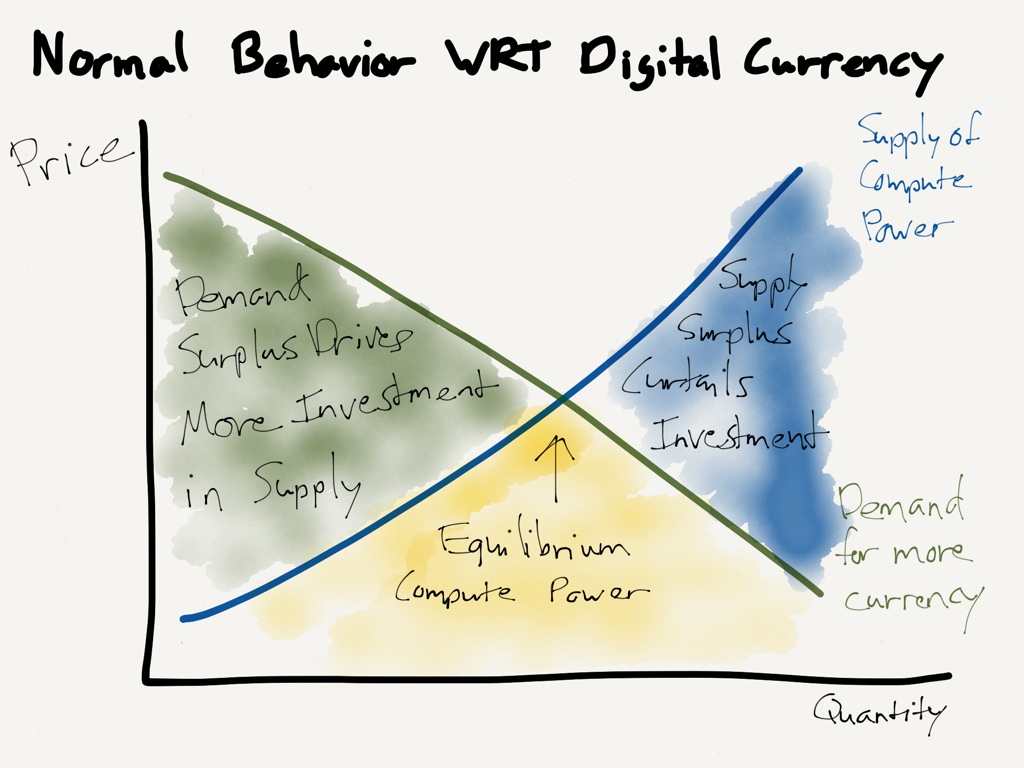
Moreover, the design of Bitcoin guarantees that electrical consumption increases dramatically indefinitely. Normally, you would expect the supply of computing power for a digital currency to initially increase, thus increasing the supply of said digital currency, which then lowers the price, ultimately reducing demand:

Under normal conditions, as the supply of computing power increases, the amount of a digital currency would increase as well. This lowers the price, eventually reducing demand.

Under normal conditions, as the supply of computing power increases, the amount of a digital currency would increase as well. This lowers the price, eventually reducing demand.

That’s not the case with Bitcoin though. Anticipating the amount of power that would be thrown at mining Bitcoin, Satoshi Nakamoto built in a simple escalator that ensured new Bitcoin would be released about every 10 minutes no matter the amount of power being applied to mining/verification. This has effectively locked Bitcoin miners into a zero sum contest wherein greater and greater computing power serves only to steal opportunity from fellow miners; there is no corresponding increase in Bitcoin to be had.

Bitcoin is designed to be released on a regular schedule, no matter how much computing power is applied to it. This means supply will never catch up to demand, resulting in ever higher prices paid for with more computing power, i.e. more electricity.

Bitcoin is designed to be released on a regular schedule, no matter how much computing power is applied to it. This means supply will never catch up to demand, resulting in ever higher prices paid for with more computing power, i.e. more electricity.

The only possible increase is in computing power, which ultimately means Bitcoin effectively uses electricity as a release valve for inflation, compounding the externalities that accompany power production.

For what it’s worth, the structure of Bitcoin dictates that the price continue to rise, presuming it remains a viable currency. That price, though, is not free, and no one asked me if I were willing to pay.

  1. In fact, Bitcoin, which has a cap on the total amount of Bitcoin that will ever exist, is ultimately headed this way
  2. For the record, I am a major proponent of carbon taxes as both a means of reducing pollution as well as spurring innovation

The post The Cost of Bitcoin appeared first on stratēchery by Ben Thompson.