Shared posts

19 Jun 16:54

Competition Time!

by Charlie Stross

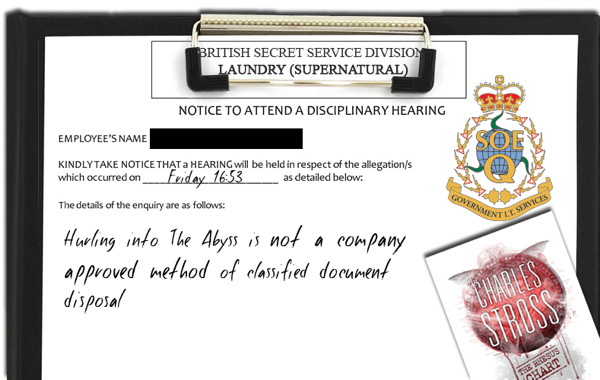
As we're two weeks out from publication of "The Rhesus Chart", we in Human Resources at SOE (Q Division) thought it would be amusing to run a competition for the worst, most embarrassing, disciplinary hearing we in the Laundry have ever had the misfortune to be involved in.

Post your worst workplace disciplinary problems in the comments below. (Please remember to check that your name appears correctly on your comment. Due to a bug in the way the blog handles logins with Google OpenID, some names are mangled: if this happens to you, add another comment identifying yourself.)

Five lucky winners will receive signed first-edition hardcovers of "The Rhesus Chart"; five runners-up will receive "Magic Circle of Safety" public awareness mugs, and/or a surprise visit from the Black Assizes.

Entries will be judged by me (Charlie Stross) on July 7th, and announced in a separate blog post. (Many thanks to co-sponsors Orbit Books for ideas, support, and the clipboard above.) I'll arbitrarily pick the cleverest reasons, or just the ones that make me laugh the loudest and the longest. Here are some brief examples to get you started (extra points for florid and unforgettable details):

* Employee called in three OCCULUS teams to bring down the Bird-God of Balsagoð, which turned out to be a pigeon.

* Failed to attend mandatory diversity awareness training due to being trapped in another dimension.

* Made inappropriate sashimi-themed jokes when attending reception for treaty negotiation delegation from BLUE HADES.

* Emailed selfie of own genitalia to another employee, resulting in PTSD and nightmares about ovipositors and traumatic insemination.


18 Jun 23:25

Facebook Slingshot

by John Gruber

Ellis Hamburger, writing for The Verge:

At first, Facebook’s new ephemeral messaging app, Slingshot, feels like yet another Snapchat clone. The free app, available now for iPhone and Android, lets you take a quick photo or video, mark it up with some colorful drawings, caption it with big white text, and then fire it off to a bunch of friends. But then you receive your first message, and you realize this is something completely different.

In Snapchat or any other messaging app, you can view a message as soon as you receive it. But in Slingshot, you can’t view an incoming “shot” until you send a shot back to the sender. “It’s not just about telling your story, it’s about asking others for their story,” says Slingshot designer Joey Flynn. In other words, Slingshot makes you trade a photo of what you’re doing before you can “unlock” the picture of whatever your friend is up to. Huh?

If they give you phones in hell, this is the sort of app that’s on them.

18 Jun 23:24

Supernatural: Thoughts

Spoiler warning: All The Spoilers for Supernatural. All of them. 

Exposing yourself to certain fandoms on tumblr is like signing up for a bout with Stockholm syndrome: sooner or later, you’re going to drink the Kool-Aid. And by “drink the Kool-Aid”, I mean “become obsessed with Supernatural“, which – surprise!* –  is exactly what happened to me. I mean, I knew all about the sexism, the queerbaiting, the manpain; about the woeful representation of POC. I vowed, on the public internets, that I would never watch it – and in a universe without tumblr, I may well have done just that. But slowly, steadily, like dripping water eroding stone, the steady flow of GIFs, photosets and soulful meta wore down my resistance. Surely, I told myself, I ought to at least watch the pilot, just so I can say that I gave it a fair shot. So I did – and I wasn’t impressed. I even livetweeted my endeavour, complete with scathing criticism. The portrayal of women was so ludicrous, and Dean Winchester so obnoxious, that I didn’t make it much more than halfway through the first episode before giving up, and for a while, that was that: I’d tried Supernatural, I hadn’t liked it, end of story.

But.

Despite myself, I found that I wanted to know what happened next. Enough of my friends whose taste in shows I either shared or respected had been surprised by my reaction – had vouched for the worthiness of at least the first five seasons, despite the acknowledged problematic elements – that I started to waver. Had I been judging too harshly? My curiosity was piqued, but in the end, what tipped the balance wasn’t the recommendations of friends or the writings of strangers: it was this speech by Misha Collins – which, yes, I encountered via tumblr – in which he calls out the show’s writers for their needless use of sexist language and misogynistic tropes. Just the fact that one of the main actors was willing to both acknowledge the problem and speak about it went a long way towards reassuring me that Collins, at least, was someone whose work I wanted to support. So I made my decision: I’d give Supernaturalanother try, endeavouring to make it to at least Season 4, when Castiel – played by Collins – finally makes an appearance.

This decision was roughly equivalent to taking a second hit of heroin because the first one hasn’t kicked in yet.

As promised, Supernatural has a lot of problems – and I mean, a lot. (As, indeed, does heroin.) There’s scarcely a male character on the show whose defining emotional arc doesn’t hinge on his having lost his mother, wife/girlfriend and/or children, and scarcely a female character with an emotional connection to Sam or Dean Winchester who hasn’t been fridged in order to give them more angst (though in fairness, the male death toll is similarly high). Overwhelmingly, the POC characters are either exoticised, stereotyped and/or played as villains, while the queerbaiting is made all the more frustrating by the overall lack of actual queer characters. The sexist language, too, is omnipresent: if you made a drinking game of it, and took a shot whenever someone says bitch, whore, or explicitly codes weakness as female (“no chick flick moments”) and strength as male (“sack up!”), you would end up drunk after any given episode. Throughout nine seasons, but especially in the first three, almost every female character either falls squarely into one of four categories – Victim (dead or damselled), Virgin (pure and protectable), Vixen (sexy and strong) or Virago (angry and strong) – or straddles their intersections with all the subtlety of a brick to the face. Supernatural is, quite categorically, a show about straight white manpain as facilitated by dead ladies and magic – and if that were all it was, I’d never have made it through two full seasons, let alone nine.

However.

It is also a show with a sprawling, complex mythology that nonetheless manages to stay coherent and engaging as it develops. Like The X Files, it has a deft touch with humour, poking fun at its own meta and idiosyncrasies at least as often as it takes itself seriously. It strikes a solid balance between stand-alone episodes and extended arcs, and the characters – well, that’s where things get interesting. Because for all that the Winchesters are frequently situated as being traditionally masculine, even hypermasculine heroes, this isn’t their be-all, end-all.

In fact, there’s an argument to be made that Dean – whose love of classic rock, classic cars, weapons, whiskey and women makes him about as stereotypically masculine as it’s possible to be – is also an active subversion of the very masculinity he ostensibly personifies. Sometimes, this comes across as being an unintentional – but still canonical – consequence of queerbaiting: that is, of the show’s habit of putting (presumably) straight characters in homoerotic situations, or strongly implying a homoerotic subtext, without ever crossing the line into overt displays of queerness. But this practice, while deeply frustrating, also feels like a very real reflection of, and reaction to, the show’s conflicting fanbases, and to the sheer impossibility of pleasing them both – namely, of the schism between (predominantly) male viewers who tune in for the adventures of Fiercely Hetereosexual Warrior Dean Winchester, the epitome of maleness in a show that is very definitely All About Dudes, and (predominantly) female viewers who tune in for Tortured Bisexual Dean Winchester, a good man who is eighteen kinds of broken and quite clearly in love with an angel. (Or his brother. Or both. Whatever.) Uncharitably, the queerbaiting is a way of firmly committing to the former fanbase while giving the latter just enough hope to keep them invested. More charitably, it’s a way of trying to please both groups equally without doing anything that either camp could construe as unforgivable. Most likely, it’s a combination of both, which, when combined with the conservative homophobia of network executives, tends to err on the side of default straightness. Whatever the answer, Dean Winchester remains a complex enough character to defy easy categorisation – and intentionally or not, even without the problem of queerbaiting, his version of masculinity as portrayed on the show is worth interrogating; as, indeed, is Sam’s.

Right from the outset, the Winchester brothers are set up as being, if not total opposites, then temperamentally opposed. The first time I tried to watch the pilot, Dean came across as brash, obnoxious and full of himself, while Sam, whose initial distance from hunting provides the audience with an introduction to the concept, feels more sympathetic: a nice, normal guy being dragged into danger and tragedy by an uncaring sibling. But as the season – as the show – progresses, it soon becomes clear that things aren’t what they seem. Dean’s arrogance is, very explicitly, a coping mechanism, and even in Season 1, we can see the cracks. Sam, by contrast, is highly – and successfully – compartmentalised, able to set aside his past and live normally in ways that Dean just can’t. Nowhere is this more apparent than in the comparison of Dean’s attempt to live a normal life at the end of Season 5 and Sam’s attempt to do likewise at the end of Season 7. When Dean leaves, Sam is imprisoned in hell, having first extracted a promise that Dean won’t try to rescue him. Dean accedes, and goes to live with Lisa, his ex-girlfriend, and her young son, Ben – his reward for having stopped the apocalypse. But Dean, by his own admission, is a mess: he is tormented by Sam’s loss, suffering from recurrent nightmares and flashbacks as well as survivor’s guilt. When the hunting world impinges on his new life, his relationship with Lisa irreparably breaks down as he begins to exhibit the classic symptoms of PTSD: hyper-vigilance, obsessive behaviour, aggression as a fear response, and a compulsive need to control both his environment and the actions of his loved ones. Sam, however, suffers from no such baggage, despite the fact that he doesn’t know if Dean is alive or dead. He makes a new life for himself with ease, and while he does talk to his new partner, Amelia, about having “lost” his brother, it’s clear he isn’t psychologically damaged in the way that Dean is.

In fact, the only time we really see Sam undergo this level of distress in response to trauma – nightmares, impulsive behaviour, rage – in a context that isn’t directly related to his burgeoning demon powers is very early in Season 1, immediately following Jessica’s death. Which begs the question: is Sam compartmentalised because it’s an inherent part of his personality, or is it something he’s learned – a coping mechanism, the same as Dean’s bravado? I’d contend it’s a combination of nature and practise. From what we learn of Sam’s childhood in various flashback episodes, it’s clear he’s always harboured a burning desire to be normal, but it’s equally clear that the same is true of Dean, too. Both brothers have suffered from their upbringing, but whereas Sam is clearly capable of cutting himself off from his family (running away as a teenager, going to college, moving in with Amelia), Dean can never manage it. Which is, quite arguably, the consequence of his being the older brother: Dean’s entire life has revolved around protecting Sam and obeying his father, whereas Sam, who lacked those responsibilities, has a better baseline for normalcy – or at least, for self-definition in the absence of family and hunting – and therefore a better starting position from which to try and establish himself as a separate person. The Winchesters rely on each other, but while Sam depends on Dean as a person, Dean depends on Sam for his purpose, too.

Superficially, Sam is presented as being sensitive and emotional – and therefore the more stereotypically feminine of the two – while Dean is typed as tough and strong: a heroic masculine archetype. But in terms of their actual psyches, the opposite is true: Sam is compartmentalised, resilient and capable, while Dean is a wreck. Throughout the show, both brothers are repeatedly told by a slew of older men – hunters, angels and demons alike – to “stop whining” and “sack up” whenever they dwell on their problems. Any failure to do so, whether perceived or actual, is invariably criticised as being feminine, or derided by comparison to feminine behaviours. Yet at the same time, Dean’s issues are real enough that the same people telling him to “be a man” are also, at various points, genuinely worried by his refusal to seek help or tell them what’s wrong. The contradiction is not only striking, but deeply representative of the toxic burden of enforced, stereotypical masculinity. On the rare occasions when Dean does try and talk about his feelings, he is invariably mocked as weak, whiny and effeminate; but when, having absorbed these lessons, he tries to cope through drinking, self-destructive behaviour and suicidal thoughts, he is criticised – often angrily – for being an idiot. Sam likewise receives the same treatment, but to very different effect. Unlike Dean, who can’t separate himself from his work, Sam’s stress response is to leave whatever situation is upsetting him and calm down elsewhere – a much healthier approach, though one that also earns him rebuke. Time and again, when Sam gets angry, feels betrayed or is otherwise shown to be under pressure, he leaves, turning his back on his (undeniably damaged) family and ignoring other responsibilities in favour of self-care. That he is often cast as selfish, untrustworthy, traitorous and insensitive for doing this – presumably on the basis that Real Men don’t run from their problems or let their friends down, ever, no matter the personal cost – is part and parcel of the same toxic logic that romanticises male self-sacrifice and silence.

For all that Supernatural can and does act as a paean to the virtues of traditional masculinity – brotherhood, battle, stoicism, strength – whether intentionally or not, it just as frequently demonstrates why this mindset is  brutally flawed, with the worst psychological consequences of investing in its mythos – repression, loneliness, self-hatred, addiction, suicidal ideation, insecurity, worthlessness – personified by Dean Winchester. Unlike countless action movie heroes who drink their whiskey, kill the bad guys and stride manfully into the sunset without ever flinching, Dean drinks excessively to the point of attracting comment, has nightmares about his actions, and has to be rescued from danger at least as often as he does the rescuing, because half the time, his “act first, think later” policy is a self-destructive impulse rather than an actual plan. Almost, you could define the split in the Supernatural fandom as being between those who think Dean Winchester is someone to be idolised for his masculinity, and those who see him as needing help. And even now, I still can’t tell if Dean’s relationship with traditional masculinity is deliberately portrayed as compounding his traumas to the point of causing new ones, or if its implications have been hidden from the writers by cognitive dissonance and/or social conditioning. Given the number of creative voices involved, I suspect it’s both, depending on the episode – but either way, it makes for some interesting analysis.

As a duo, what makes Sam and Dean so compelling is the extent to which their personalities, strengths and weaknesses differ, not just from each other, but from first appearances. Particularly in the early seasons, much is made of Sam’s ability to successfully comfort the many grieving strangers they encounter, whereas Dean is always blunt, less adept – and less willing – to tailor his approach to the person, a contrast we’re initially inclined to see as proof of Sam’s sensitivity and Dean’s rudeness. And certainly, Sam is a caring person. But as the show progresses, his interactions become less a function of compassion and more the consequence of his being a better liar than Dean, with fewer compunctions about emotionally manipulating strangers to get the information he needs. When it comes to informational lies – credit card scams, adopting fake IDs – Sam tends to be uneasy with the deception in ways that Dean isn’t; but while Dean is happy pretending to be someone else, he doesn’t fake his emotional reactions. Broadly speaking, Dean is a situational liar and emotionally honest, while Sam is an emotional liar and situationally honest – the exact opposite of how they present.

When it comes to their relationships with women, however, another curious comparison presents itself. Without wanting to overanalyze the handful of sex scenes sprinkled throughout the show, it’s notable that Dean’s encounters, in contrast to his aggressively masculine persona, tend to be romantic, even gentle, with Dean himself often shown to be the more passive partner, while Sam is assertive and dominant to the point of being rough (asmore than one person has noticed). Dean has slept with angels; Sam lies down with demons. And for most of the show, that’s not just a metaphor: the big reveal of Season 5 – that Sam is meant to be Lucifer’s vessel, while Dean is earmarked for Michael – is arguably foreshadowed by their earlier romantic pairings with Ruby and Anna, respectively. But as of the most recent season, their predestined dichotomy is turned on its head: Season 9 starts with Sam being possessed by an angel, and ends with Dean turning into a demon, a deliberate subversion that shows how far Sam has come, and how far Dean has fallen. The Winchesters have been to Heaven, Hell and Purgatory, but despite the implied promise of the lyrics to Carry On Wayward Son, they’re yet to find any peace.

What really gets me about Dean Winchester, though, is his status as the most broken of Broken Birds I’ve ever encountered – and in a show where so much else about the gender roles is regressive, it’s striking that the most ostensibly masculine character is one who’s best defined by a trope that’s overwhelmingly female-dominated. In this sense, Dean actually makes for a good case study about our perceptions of gender in stories; specifically, our tendency to hold female characters to higher standards than men, not only in terms of their actions and personalities, but in how we judge whether they’re three-dimensional or poorly-drawn tropes, and our corresponding tendency to assume male competence as a default. Right from the outset, and despite being situated as the more experienced hunter, Dean is – not ineffectual by any stretch of the imagination, but prone to the kind of error which, were he a woman, would likely be counted as signs of inherent weakness.

In the first four episodes of Season 1, for instance, Dean continuously fails to establish his fake identities with any degree of success: twice, he gets in trouble with officials who call his bluff, and twice his incompetence leads to civilians detecting the lie. In 1.1 (Pilot) and 1.4 (Phantom Traveller), it’s Sam, not Dean, who kills the Big Bad, and while he saves the child in 1.3 (Dead in the Water), the offending ghost is dispelled, not through his actions, but the self-sacrifice of another character. The only monster Dean kills is the titular villain of 1.2 (Wendigo), and in 1.4, he’s actively disarmed by his fear of flying. All of which is paired with a high degree of sentimentality: in both 1.2 and 1.3, Dean is visibly flustered by a simple kiss on the cheek, while his strongest emotional connection consists of his bonding with a child over their mutual loss of a parent. Under identical conditions, a female character would, I suspect, have to work much harder to be seen as competent: her failed bluffs would be seen as failures of intelligence compounded by a poor kill rate, while her visible terror would see her pegged as overly emotional. Which is what happens, when successive generations of terrible female characterisation condition viewers to infer the presence of gendered stereotyping on the basis of normal behavioural cues: there’s such a backlog of bullshit to work through re the portrayal of women on screen, it can be hard to step back and judge new characters on their individual merits. But because Dean Winchester is not just male, but overtly masculine, wrapped in a leather jacket and driving a Chevy Impala, we trust that he knows what he’s doing, even when we’d be well within our grounds to think the opposite.

I have more to say, but I’ll save it for another post, as this one is already considerably longer than planned. Apparently I have Feelings about Supernatural that demand expression, and that, right there, is a sentence I never, ever thought I’d be writing. TUMBLR, WHAT HAVE YOU DONE TO ME?

Feel These Things

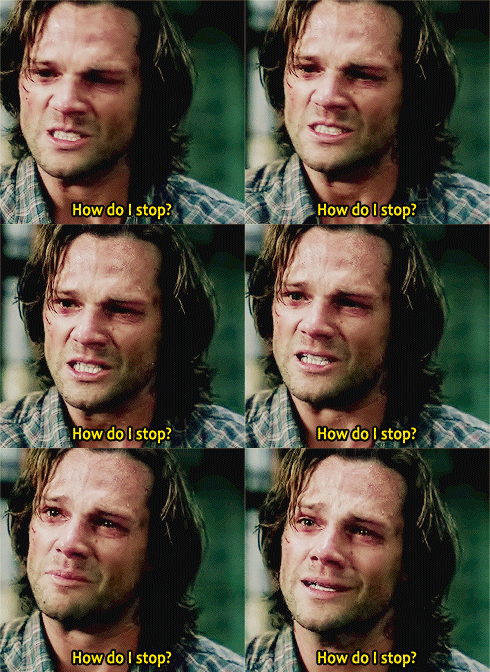
Sam Winchester - How Do I Stop

Dean Winchester - I Wish I Couldn't Feel A Damn Thing


*Or not, for anyone who’s been following my tumblr/Twitter presence for the past few weeks.
18 Jun 21:17

For God so loved the world

by Fred Clark

Darrell Dow shares this image from an ad for A Beka Books, the homeschooling publisher of Pensacola Christian College:

I had to re-read that several times before it finally sunk in that they were saying “standing between the world and your child” was supposed to be a good thing.

The sad thing is that sentence is utterly true for A Beka Books’ target audience: “You’re the only thing standing between the world and your child.”

The sick thing is that the next sentence doesn’t say, “So get the heck out of their way.”

Keep in mind that A Beka Books fancies itself an educational publisher. This slogan perfectly captures the stunted notion of “education” they have in mind. The whole world is right outside your door, a glorious universe of possibilities, wonders, joys, truth and dazzling beauty. We’ll help you make sure your kid never sees any of it.

Remember, too, that this is coming from Christians of the sort who loudly proclaim their devotion to the Great Commission: “Go ye into all the world, and preach the gospel to every creature.” Whatever the second part of that means, it’s surely impossible to do if you refuse to do the first part — if you think of the world as something to be kept apart with barricades and barbed wire.

And remember, too, that these are Christ-ians, people who purportedly worship the word become flesh, the incarnate God who taught us that “God so loved the world” — God loved the κόσμον, the cosmos, the whole kit and caboodle of the universe.

I’ve said this before, but white fundamentalists remind me of the Krikkiters from Douglas Adams’ Hitchhiker’s Guide. In Adams’ story, the planet Krikkit was enveloped in a dust cloud that kept them from seeing the rest of the universe. But finally, one day, they developed the technology to launch a rocket up into space, finally seeing beyond the cloud that shrouded their planet:

They flew out of the cloud.

They saw the staggering jewels of the night in their infinite dust and their minds sang with fear.

For a while they flew on, motionless against the starry sweep of the Galaxy, itself motionless against the infinite sweep of the Universe. And then they turned round.

“It’ll have to go.”

Ultimately, of course, none of these homeschooling parents will be able to keep back the world any more than they’re able to keep the sun from rising. You can homeschool your kids, allowing them to read nothing but A Beka Books, and then send them off to Pensacola Christian’s hermetically sealed campus to complete their education, but eventually they’ll find their way around all the obstacles you’ve placed between them and the big wide world.

“You’re the only thing standing between your child and the world.”

The world. “That’s here. …”

That’s home. That’s us. On it everyone you love, everyone you know, everyone you ever heard of, every human being who ever was, lived out their lives. The aggregate of our joy and suffering, thousands of confident religions, ideologies, and economic doctrines, every hunter and forager, every hero and coward, every creator and destroyer of civilization, every king and peasant, every young couple in love, every mother and father, hopeful child, inventor and explorer, every teacher of morals, every corrupt politician, every “superstar,” every “supreme leader,” every saint and sinner in the history of our species lived there – on a mote of dust suspended in a sunbeam.

You’re standing between your child and the world. For God’s sake, get out of their way.

18 Jun 05:22

untranslatablephrase: Dull Tool, Fiona AppleYou forgot the...


untranslatablephrase:

Dull Tool, Fiona Apple

You forgot the difference between equanimity and passivity
is so on point that it’s literally started to turn up in my dreams, so.

18 Jun 04:13

NSA Turned Germany Into Its Largest Listening Post in Europe

by The Intercept
Der Spiegel cover.

The National Security Agency has turned Germany into its most important base of operations in Europe, according to a story published by Der Spiegel this week.

The German magazine reports that documents provided by NSA whistleblower Edward Snowden “paint a picture of an all-powerful American intelligence agency that has developed an increasingly intimate relationship with Germany over the past 13 years while massively expanding its presence.” The magazine adds, “No other country in Europe plays host to a secret NSA surveillance architecture like the one in Germany…In 2007, the NSA claimed to have at least a dozen active collection sites in Germany.”

The story reveals that the NSA’s key facilities in Germany include Building 4009 at the “Storage Station” on Ludwig Wolker Street in Wiesbaden, which is in the southwest of the country. Officially known as the European Technical Center, the facility is the NSA’s “primary communications hub” in Europe, intercepting huge amounts of data and forwarding it to “NSAers, warfighters and foreign partners in Europe, Africa and the Middle East,” according to the documents.

Spiegel also reports that an even larger NSA facility is under construction three miles away, in the Clay Kaserne, which is a U.S. military complex. Called the Consolidated Intelligence Center, the facility will cost $124 million once it is completed, and will house data-monitoring specialists from the Storage Station.

The agency’s operations in Germany came under intense scrutiny earlier this year when Spiegel revealed that the NSA had eavesdropped on Chancellor Angela Merkel’s cellphone calls. In its latest issue, the magazine reports on a legal controversy over the NSA’s still-close relationship with its German partner, the Bundesnachrichtendienst (BND). The Snowden documents show that “the exchange of data, spying tools and know-how is much more intense than previously thought,” according to Spiegel—and this raises the question of whether the BND is violating constitutional protections on privacy for Germans abroad and foreigners in Germany.

The scope of the NSA’s activities in Germany is considerable. Another key NSA facility, Spiegel reports, is the “Dagger Complex” in Griesheim, a town about 25 miles from Wiesbaden. It is “the NSA’s most important listening station in Europe,” with around 240 intelligence analysts working there in 2011. The facility’s official name is the European Center for Cryptology. “NSA staff in Griesheim use the most modern equipment available for the analysis of the data streams, using programs like XKeyscore, which allows for the deep penetration of Internet traffic,” according to Spiegel.

The story also delves into the growth of facilities that house the NSA’s Special Collection Service, which is a joint operation with the CIA to collect targeted communications. There are more than 80 SCS stations around the world, and the Snowden documents indicate two sites are located in Germany—in the U.S. consulate in Frankfurt, and the U.S. embassy in Berlin, which is where the SCS is believed to have recorded Chancellor Merkel’s phone calls.

The post NSA Turned Germany Into Its Largest Listening Post in Europe appeared first on The Intercept.

18 Jun 04:12

Three Regimes of Desire


Three Regimes of Desire

18 Jun 00:43

Quote For The Day

by Andrew Sullivan

“I feel comfortable with [Hillary Clinton] on foreign policy. If she pursues a policy which we think she will pursue, it’s something that might have been called neocon, but clearly her supporters are not going to call it that; they are going to call it something else,” – Robert Kagan, unrepentant architect of the catastrophe in Iraq, and unreconstructed neocon, on the potential to revive neoconservative global aggression under president Hillary Clinton.

17 Jun 23:42

Our Little Lie Detectors

by Andrew Sullivan

Ryan Jacobs reviews research that suggests kids know how to spot a liar:

Studies have already shown that kids work as incredibly precise detectors of straight-up lies. Outside the realm of bold-faced falsehoods, though, children perform quite brilliantly, too. Subtler and more elegant deceit—the kind where the truth is told but other important elements are shaded or concealed—doesn’t go unnoticed by six-year-olds either, according to a new study published in Cognition. Unbeknownst to their teachers and parents, young kids are apparently equipped with the perceptive powers of seasoned Cold War spies. The new paper suggests that they don’t appreciate when they’re being misled with lies of omission and even adjust their behavior based on a previous record of deceit.

Eliana Dockterman explains how the experiments worked:

Researchers at MIT studied how 42 six and seven-year-olds evaluated information. … [T]he children were separated into two groups: one group got a toy that had four buttons, each of which performed a different function—lights, a windup mechanism, etc.; the other group got a toy that looked the same but only had one button, which activated the windup mechanism.

After the two groups of children had played with their respective toys, the researchers put on a show: a teacher puppet taught a student puppet how to use the toy, but only showed the student puppet the windup function. For the kids playing with the one-button toy, this was all the information; but for the kids playing with the four-button toy, the teacher puppet had left out crucial information. The researchers then asked all the children to rate the teacher puppet in terms of how helpful it was on a scale from 1 to 20. The kids with the multi-functional toy noticed that the puppet hadn’t told them the whole story and gave it a lower score than the children with the single-function toys did.

17 Jun 21:30

Where We've Arrived At

by Josh Marshall

This is Ted Cruz's top speech writer and communications advisor. Because one unarmed man can break out of or take over a US Navy warship, no problem ...

We're likely keeping Benghazi terrorist on a ship instead of GTMO, a secure facility that's made for this http://t.co/WRzD2CaXYR

— Amanda Carpenter (@amandacarpenter) June 17, 2014

17 Jun 19:22

Privacy is Dead

by Ben Thompson

According to a new study, customers are very concerned about their privacy. From the New York Times write-up:

People around the world are thrilled by the ease and convenience of their smartphones and Internet services, but they aren’t willing to trade their privacy to get more of it.

That is the top-line finding of a new study of 15,000 consumers in 15 countries. The privacy paradox was surfaced most directly in one question: Would you be willing to trade some privacy for greater convenience and ease? Worldwide, 51 percent replied no, and 27 percent said yes. (The remainder had no opinion or didn’t know.) There were country-by-country differences, but there was a consistency to the results, especially in the developed nations…

When asked to name the leading threats to online privacy in the future, 51 percent of the global panel of consumers picked “businesses using, trading or selling my personal data for financial gain without my knowledge or benefit”…The survey seems to present a grim outlook for data-driven online businesses and marketers.

Coincidentally, on the same day it was revealed that Facebook will use your web browsing history for ad targeting. From Ad Age:

Through its ubiquitous “like” buttons on publisher sites across the web, Facebook has long been able to watch the web surfing behavior of its 1.28 billion monthly users. Soon it will begin to use that information for ad targeting on Facebook…

Facebook is using the passive data — where users go on their PCs and phones — to make its own ads smarter. Advertisers who want to reach Facebook users who are interested in camping, for example, will be able to reach that audience with greater accuracy. “There’s just a more robust set of information that informs that you’re interested in camping,” Mr. Boland said.

So is Facebook doomed? Hardly. The truth is few consumers would be willing to pay the price for true privacy. To understand that price, it is necessary to understand why privacy is dead.

Advertising is Lucrative, and Free Is Often Imperative

The first reason that many sites rely on advertising is that it is simply much more lucrative than charging on a per-user basis. Consider this site: the week I write this, Booking.com is sponsoring Stratechery for $500. If there is a sponsorship every week, that means ~$2,250 in monthly income. I also write the Daily Update for Stratechery members; membership costs $10/month, which means one month of sponsorship has the same income potential as 225 members.

To be clear, while I’m very grateful for my sponsors, I greatly enjoy writing the Daily Update and strongly believe in the member-supported model and am determined to make it work. But it shouldn’t be any surprise that for most sites, the advertisement versus member-support decision isn’t really a decision at all: advertising wins.

There are other services that can’t even realistically choose between advertising and member-supported. Facebook is a great example: the utility of Facebook is directly correlated with how many people you know who are also using Facebook, and the only way to maximize that number is to make the service free, supported by advertising. Google is in a similar boat: the efficacy of search is in many ways tied to how many people are using search. Queries and clicks are the raw grist for Google improving its algorithm, and the more the better, which means making queries free.

Targeting Information is the New Scarcity

The explosion of ad-supported content and ads on the Internet have created a glut of inventory; all things being equal, one piece of inventory is worth the same as another, which is to say worth $0. It’s pricing 101: if supply outstrips demand, the price drops; the flipside of infinite inventory is a price of $0.

When it comes to the price sites or apps can charge for ads, though, the key phrase is “all things being equal.” Some sites, like the New York Times, can charge more based on the the perceived quality of their audience and the prestigiousness of the New York Times brand; others, like Yahoo, can offer wide reach with one ad-buy (although this is worth increasingly less because programmatic buying offers the same scale benefits across a wide array of sites and apps).

The greatest amount of pricing power, though, is commanded by sites that target ads to specific groups. This is why Facebook is such a powerful player in online advertising, and why Google has spent so much time on the Google+ identity system (the social network aspect was only ever frosting on the cake). This means that any site that monetizes through advertising is heavily incentivized to know as much about their customers as possible, and to devise ways to leverage that knowledge into higher rates.1

Many Ad-Supported Apps and Sites Have Significant Consumer Benefit

I just noted that Facebook and Google, in order to function, must be free (and thus ad-supported) in order to offer meaningful social networking and better search, respectively. The biggest beneficiaries, though, are the people who actually use Facebook and Google. Facebook doesn’t seem to get much respect in tech circles, but the truth is it has had and continues to have a more meaningful impact on normal consumers lives than any of the various companies and products that actually get tech people excited. As for Google, I’ve used the product countless times just to write this article; it’s exceedingly difficult to imagine how any of us could function without it.

A whole host of other sites don’t have to be free, but as I noted above the economics lead them to the ad model; ultimately, though, consumers benefit by having access to an astonishing amount of information without paying anything. It’s fine to argue that content in particular should depend on subscribers, but no one person can subscribe to everything.

No Room for Privacy

The net result is an iron circle in which advertisers pay free apps and sites, who in turn provide significant benefit to consumers, who in exchange surrender targeting info about their demographics and preferences:

photo (4)

You cannot take away any one of these components without taking away all of them. Unless we as a society are willing to give up all of the benefits provided by search, social networks, and the free dissemination of information, then we will give up our privacy.

Towards Responsibility

The first step towards dealing with this new reality responsibly is coming to grips with the circle I just illustrated: demanding that all users have zero data collected about them necessarily means choking off much of the consumer benefit provided by the Internet. Those who truly wish to opt-out can opt-out of Facebook, Google, etc. (any objections that this would be unpleasant actually makes my point).

Secondly, there needs to be an industry standard for anonymizing and aggregating data. All of the relevant players claim they do this sort of anonymization and aggregation, but the effectiveness of their methods are a black box. It should be impossible to tie any of this lucrative information to an individual, and in return, apps and sites that ensure this is the case should receive some sort of imprimatur attesting to their responsibility.

Finally, there should be significant resources spent establishing this imprimatur as something worth “paying” for when it comes to consumer attention. Sites and apps should be rewarded for treating information responsibly, with meaningful fines if violations are found.

The devil is certainly in the details of this sort of verification system, but the danger of not working through these issues now are more government impositions along the lines of the recent “Right to be forgotten” decision handed down in the European Union. While that decision is not directly applicable to the issue of collecting and selling user data, it ought to serve as evidence that governments will effect change with the blunt instruments of regulation and judicial decree if we as an industry decline to wield our own scalpels.


A postscript: from what I’ve heard Apple is going to be making a significant marketing push around privacy; the rhetoric at WWDC certainly suggested this was the case. While this is primarily a strategy credit (i.e. the opposite of a strategy tax), it will be interesting to see just how much of an impact it makes on consumers.

  1. To be clear, I don’t collect any user information and don’t share any membership information – and never will. My only selling point to sponsors is the obvious sophistication of a Stratechery reader :)

The post Privacy is Dead appeared first on stratechery by Ben Thompson.

17 Jun 19:18

wongtonz: Aaron Diaz ( creator of Dresden Codak and my...


wongtonz:

Aaron Diaz ( creator of Dresden Codak and my favourite LoZ au ) says things. 

17 Jun 17:01

This is not good news. This is not salvation.

by Fred Clark

Thomas Kidd’s short post today on African American poet Phillis Wheatley gave me pause when it came to his discussion of George Whitefield — the great evangelist of the Great Awakening whose death was the subject of Wheatley’s first popular poem.

I didn’t realize that Whitefield was a slave-owner — an untroubled, unrepentant, complacent slave-owner.

But he was actually worse than that.

Growing up in the white evangelical subculture, I knew a bit about Whitefield. We studied the Great Awakening in history classes at my evangelical Christian school, and every such lesson included descriptions of Whitefield’s spectacular gifts as a preacher, the huge crowds his outdoor sermons drew, and the revival that followed in his wake.

Nearly everything I encountered about Whitefield was along the lines of this brief hagiography from a few years ago in Christian History magazine. That article mentions that Whitefield first came to the colonies as a missionary to Georgia. And it recalls the famous orphanage he founded in Georgia — without mentioning that this orphanage was also a plantation built upon stolen labor and stolen lives.

Here is all that history has to say about Whitefield and slavery and Georgia:

Whitefield also made the slave community a part of his revivals, though he was far from an abolitionist. Nonetheless, he increasingly sought out audiences of slaves and wrote on their behalf. The response was so great that some historians date it as the genesis of African-American Christianity.

Everywhere Whitefield preached, he collected support for an orphanage he had founded in Georgia during his brief stay there in 1738, though the orphanage left him deep in debt for most of his life.

But its’ far, far worse than that.

When Whitefield first founded his orphanage in 1738, slavery was illegal in the colony of Georgia. The evangelist was certain, however, that “hot countries cannot be cultivated without negroes,” and that legal slavery would be the key to making his endeavors there profitable. So George Whitfield — who was, as Christian History said, “probably the most famous religious figure of the 18th century” — began lobbying the crown and the trustees of the colony to make slavery legal there.

Whitefield’s efforts were essential to that cause. Without his hard work, slavery might never have become legal in Georgia.

Let that sink in. Ponder that — the immensity of it, the consequences of it, the incalculable toll and immeasurable injustice of it.

And then ask yourself whether it is possible that such a grievous evil could be so inextricably woven in with the revivalism of the Great Awakening without in any way influencing the form, shape, and substance of that revival and the kind of Christianity it planted here in American soil.

Ah, but Whitefield was simply a “man of his time.” Hogwash. John Woolman was also a man of Whitefield’s time.

But my point here is not to pass judgment on George Whitefield. My point here is to learn from corrosive rot that infected the gospel according to George Whitefield so that we can learn to guard ourselves against the same lethally evil disease — to identify, root out, and cauterize every instance of its lingering presence in our faith, theology, culture and law.

Here are the symptoms. This is deadly. This is what death looks like, from Whitefield’s correspondence — a letter he wrote on March 22, 1751:

As for the lawfulness of keeping slaves, I have no doubt, since I hear of some that were bought with Abraham’s money, and some that were born in his house.—And I cannot help thinking, that some of those servants mentioned by the Apostles in their epistles, were or had been slaves. It is plain, that the Gibeonites were doomed to perpetual slavery, and though liberty is a sweet thing to such as are born free, yet to those who never knew the sweets of it, slavery perhaps may not be so irksome. However this be, it is plain to a demonstration, that hot countries cannot be cultivated without negroes. What a flourishing country might Georgia have been, had the use of them been permitted years ago? How many white people have been destroyed for want of them, and how many thousands of pounds spent to no purpose at all? Had Mr Henry been in America, I believe he would have seen the lawfulness and necessity of having negroes there. And though it is true, that they are brought in a wrong way from their own country, and it is a trade not to be approved of, yet as it will be carried on whether we will or not; I should think myself highly favoured if I could purchase a good number of them, in order to make their lives comfortable, and lay a foundation for breeding up their posterity in the nurture and admonition of the Lord. You know, dear Sir, that I had no hand in bringing them into Georgia; though my judgement was for it, and so much money was yearly spent to no purpose, and I was strongly importuned thereto, yet I would not have a negro upon my plantation, till the use of them was publicly allowed in the colony. Now this is done, dear Sir, let us reason no more about it, but diligently improve the present opportunity for their instruction. The trustees favour it, and we may never have a like prospect. It rejoiced my soul, to hear that one of my poor negroes in Carolina was made a brother in Christ. How know we but we may have many such instances in Georgia ere it be long?

This is not good news. This is not salvation. This cannot be reconciled with the gospel.

The man who wrote those words was surely, at some fundamental, essential level, wrong about the meaning of the good news and of salvation.

And yet today, in 2014, the white evangelical understanding of good news and salvation is still shaped and bounded by the model and teachings of the man who wrote that passage above.

That’s a problem.

That’s a huge problem.


16 Jun 22:40

Job interviews reward narcissists

by Cory Doctorow

Self-presentation style in job interviews: the role of personality and culture, a UBC study presented in the Journal of Applied Social Psychology found that job interviews were optimized for self-aggrandizing narcissists, while people from cultures that value modesty and self-effacement fared poorly (it probably helps that everyone conducting a job interview had to pass a job interview to get that job, making them more likely to have confidence in the process). (via Reddit)

16 Jun 20:00

America Is Armed To The Teeth

by Andrew Sullivan

gun_ownership_map

Zack Beauchamp maps American exceptionalism when it comes to gun ownership:

Here’s a map of firearm ownership around the world, using 2012 data compiled by The Guardian. The United States has nearly twice as many guns per 100 people as the next closest, Yemen — 88.8 guns per 100 as opposed to 54.8 in Yemen. … How does this relate to homicide rates? Not simply. For instance, the United States has over 12 times as many guns per person as Honduras, but the 2012 US gun homicide rate per 100,000 people (2.97) is 1/22 of Honduras’ (68.43). That’s because, while guns make murder easier, wealthy industrialized countries generally have significantly lower rates of violent crime than comparatively impoverished ones. But when you compare the United States to nations like Britain and Japan, it becomes clear that firearm ownership contributes to America’s murder problem. The American homicide rate is about 20 times the average among Organization for Economic Cooperation and Development countries (excluding Mexico).

Also, although mass shootings are getting more media coverage, they actually aren’t on the rise:

12-massshootingsnew.w1120.h1472It’s clear that there is no major upward trend. And slicing the data differently doesn’t make a difference — [James Alan Fox, a criminologist at Northeastern University] said that since homicides are on the downswing in general, the overall shape of the graph wouldn’t change much if you changed the definition of a mass shooting to, say, three victims or more. There isn’t even any upswing in the number of school shooting victims, at least based on the Department of Education’s own official statistics (PDF).

Why, then, is there such a powerful feeling that things are getting worse? Media coverage plays a big role. It’s almost hard to believe today, but there was a time in the not too distant past when people in New York might not even hear about a school shooting that happened across the country.

Drum puts Fox’s statistics in context:

Since 1993, the rate of violent crime in America has plummeted by half. That’s the background to measure this against. In general, America has become a much safer, much less lethal place, and yet mass shootings have remained steady. Compared to the background rate of violent crime, mass shootings have doubled. Why?

And here’s an equally interesting question: between 1976 and 1993, violent crime increased by a significant amount, but mass shootings remained steady. Again, why? Raw numbers are a starting point, but they don’t tell the whole story

16 Jun 19:39

The Self-Pity Paradox

by Ben Orlin
Zephyr Dear

NVC provides an elegant exit strategy from this and other common conversational paradoxen.

In the self-pity paradox, a distressed person interprets any attempts to reassure them as further evidence of the very thing that’s distressing them. For example…

Red Queen: No one ever believes me!

Alice: Well, I do.

Red Queen: There you go again! I say that no one believes me, and scarcely a moment passes before you’re disbelieving me again.

Alice: I’m not! I said that I do believe you.

Red Queen: Precisely! If you believed me, then you’d have agreed that no one believes me.

Alice: But if I believe you, how could I agree that no one does?

Red Queen: Wretched girl. You have no idea what it’s like to be Queen. Everyone contradicts me – and you worst of all!

Alice: I do not!

Red Queen: You’re doing it again! I assert that everyone contradicts me, and you assert otherwise – contradicting me yet again!

Alice: Fine, then. You’re right. No one believes you, and everyone contradicts you.

Red Queen: I knew that already, stupid girl. I’m the one who just told you so.


16 Jun 19:27

Excerpts From David Brat

by Elizabeth Stoker

What buzz, huh? The Catholicsphere is especially interested in this hardline Calvinist who attends Mass. I’m writing a profile on him at the moment, but until that pops up I thought I’d share with you beautiful people some snippets of his theology taken from his essay “God and Advanced Mammon — Can Theological Types Handle Usury and Capitalism?”

First of all, if you’re saying to yourself, ‘Holy smokes, that’s a lot of signalling in one title, he should really make sure to define is terms’ then a) you are right and b) you will be disappointed.

The definition of usury has varied and changed drastically over time and across regions. An entire essay could be spent on these distinctions, and many of these distinctions are covered by other authors in this issue of Interpretation. Even in the biblical texts, crucial distinctions are made between those in the fold (brothers and sisters) and outsiders. In addition, usury can be simply charging interest, or it can be charging too high an interest, or it can be even broader in scope. I do not think these are the distinctions that ultimately matter at present.

The distinctions always matter, Dave! Now tell us about Calvinism.

Capitalism is the major organizing force in modern life, whether we like it or not. It is here to stay. If the sociologists ever grasp this basic fact, their enterprise will be much more fruitful. We set alarm clocks to follow the schedule of the market. Children leave their families to follow the job market. We often weigh our social worth by looking to market wages, salaries, and consumption patterns. We spend much more time on market activity than God activity. Thus, Calvinism.

I clearly missed something; Calvinism doesn’t quite seem like a Q.E.D. point there. Quickly, caricature theological critiques of usury!

Usury is bad. Usury is morally bad. Usury is the charging of interest payments for simply borrowing money. Usury is frowned upon in the Bible. Liberation theology might be required here. Usury is specifically forbidden in many biblical texts. Our modern culture of capitalism exploits the poor by conventions such as usury. Many grow rich by usury. The poor are hurt by usury. Therefore, usury is bad. We should get rid of usury. (Who is this we?)

I don’t know, Dave, but ‘we’ includes Pope Francis and Saint Augustine for sure. Silly billies, right? Anyway, Dave, why can government be totally amoral?

Where are the obvious category errors above? The most obvious is the assumption that because we are Christians, the society’s use of usury stands judged under Christian values. Curiously, the church is currently loathe to judge anyone for anything. Sin is not in vogue. But when it comes to capitalism, judgment is at hand…There is obviously a tremendous gulf between biblical statements made to faith communities and their direct application to secular law today. Seminaries go out of their way to show the complexities of exegesis, but when it comes to hot-button issues such as usury, rationality often flies out the window. Can Christians force others to follow their ethical teachings on social issues? Note that consistency is lacking on all sides of this issue.

I suspect non-Christians might also object to usury as well, but Dave is like, ‘nah.’ But Dave, this isn’t reason! This shows me you think there’s no reasoned argument against usury, and yet Finland just legislated payday loan operations out of existence, so something tells me that is not the case.

For those in a hurry, let me offer a two-paragraph summary, and then I will go into more detail for those who may enjoy the extended commentary. A famous economist named Hayek

Ughhh. Annnnyway. Tell us your theory of sin, Dave.

Usury is one small piece of this market mechanism and information puzzle. Interest rates are set by the market, by supply and demand for money. As a Christian, can I charge interest and be okay with God? Well, as a Calvinist, the answer would be found by asking God. God is the source of morality and ethics. In brief, I think that God tells us that if we intend to love and help our neighbor by such an action, then the answer is “yes”; to harm, “no.” More on this later, but if individuals lived under this simple system, the world would be pretty good.

It’s like the doctrine of double effect as reported by a very tipsy Aquinas. But fret not, we actually can’t create sinful systems or cultures, despite what you may have heard.

But, the key is that morality and judgment ultimately occur at the individual level in our tradition (i.e., the Reformation) and an analysis of the morality of any action would ultimately rely upon the facts and intentions in each individual case. The individual is responsible for knowing God’s will via revelation, reason, church, and faith. We will have an impact on our culture, but we are not the culture. Outside of the tradition, morality is not coherent.

I’m guessing that’s a “little t” tradition. What would the Church’s position on ethics look like?

Does the church have an answer to this broader social question? Will it write up a Church Statement on Justice and Rationality to go along with the Anti-Usury Statement? This is very much needed. Why no statement? You are precisely the audience that can answer this question. As long as the church is silent on this issue, it will have no impact on our broader culture. The church needs to regain its voice and offer up a coherent social vision of justice and rationality. Soon. The Bible and then Calvin is a good start. Rule of Law is in the middle. Capitalism will be in the final chapters.

Actually, we do have statements. Lots of them. We make them all the time. Scholars devote their careers to studying such statements. I am not clear on the arrangement offered in the last clauses. These are not ethical premises that go together, Dave, so I’m not sure how I’ll comport with the ethics stemming from multiple different systems. Now, a quick dip into history.

Private property was clearly established. Ninety percent of the population was rural and this basic social contract fit the times, with notable exceptions (i.e., slavery). Basically, one fed one’s family, and if times got tough, moved to extended family or relied upon the voluntary charity of one’s church or neighbors. Life was tough, but it was relatively better than any other place in the world.

Good, so Brat is a legal realist. We are making some progress.

The Left and Right both have fringe groups and, most recently, the Libertarian Party has been picking up steam and gaining adherents, many in the tea party movement. They note that as we have voted for higher and higher taxes, the initial vision of liberal America has been lost. Liberty is lost. Now, in addition to negative rights, we have voted for a host of “positive rights.” We now have rights to health care, welfare programs, retirement benefits, thirteen years of education, and unemployment benefits. And there is not an item you can think of that is not regulated by the Federal Government.

Life is substantially better, but we have all these taxes now, making our freedom actionable. Darn taxes. I guess they’re not alright under Brat’s theory of sin, though it’s much easier to imagine how retirement programs and health care are predicated upon a love for neighbor than levying interest on loans. But rock on, Dave, rock on.

We vote for justice. It has become easy. We vote to force others to act as we want them to act. Can we do this as Christians? What is the warrant for such action? How do we ground that type of decision? I have not ever heard a good theological answer to these questions. I know about Locke’s tacit consent and majority rule and all of that, but if you are not willing to force someone at the micro level, those distinctions fall away.

So what is the Rule of Law in your little handbook to Christian social action? The answer you want is ‘government as a remedial community’, and you can find it in City of God and fifty bajillion studies of Augustine. Or we can degenerate into anarchy, because the same resistance to force that Brat adduces contra taxes also works against laws preventing, say, rape and assault.

The government holds a monopoly on violence. Any law that we vote for is ultimately backed by the full force of our government and military. Do we trust institutions of the government to ensure justice? Is that what history teaches us about the State? Or do we live in particularly lucky and fortunate times where the State can be trusted to do minimal justice? The State’s budget is currently about $3 trillion a year. Do you trust that power to the political Right? Do you trust it to the Left? If you answered “no” to either question, you may have a major problem in the future. See Plato on the regime that follows democracy.

Ah, just a generalized objection to democracy, queer for someone who was voted into power. Bizarro to simultaneously insist governments aren’t just and that we shouldn’t try to make them so. I guess this is the good ol’ fashioned refusal to engage in creative politics that third grade readings of Augustine produce. Blargh. Tell me more about why Christianity doesn’t belong in public reasoning, Dave.

So now, I hope you are feeling even a bit more ill at ease. The logic above is inescapable for a Christian. If we Christians vote for what we consider to be good policies, we are ultimately voting to ensure that our will is carried out by the most powerful force on earth, aside from God. The U.S. government has a monopoly on violence, and that force underlies the law of the land. Do we have the right to coerce our fellow citizens to act in ways that follow our Christian ethical beliefs?

I mean we could bring our ethical concerns to public discourse and engage them in public reason, or we could, I guess, just not. Moral man, immoral society. Somebody’s been doing shots of Niebuhr without the requisite shots of Rawls. Moreover, if the state should be immune from Christian ethics because they shouldn’t be inflicted on society as a whole, what’s to stop it from using force? If we’re operating on a Christian ethical standard, force is wrong because of some premise Brat identifies as impugning force within Christian thought. But if the state shouldn’t be responsive to Christian thought because of pluralism, what’s to stop it from using force? Surely it can’t be prohibited by the proscriptions of Christianity if it’s not obligated by the requirements of it! And if Brat wants to articulate a whole new ethical system for states only, what is it, and what is its warrant?  Anyway, surprise us.

The Rule of Law is absolutely essential to a good life. God has instituted government and leaders throughout history and throughout the Biblical narrative. However, the state is growing precisely as the church is fading as a force for good, and this does not seem to be a good trend. God asked the people of Israel: Are you sure you want a king? That is a good question to ask at this time.

Well that was an unexpected 180. How are we defining ‘good life’? Asking for a friend. Quickly, abandon this line of logic and beg the question on some stuff.

Modern liberals are very conflicted at this point. They do not want the Religious Right pushing its morality on others, and so they claim “separation of church and state.” However, when economic justice is involved, or when entitlements like health care are at stake, modern liberals seem to have no problem pushing their morality on others. Both camps appear to be willing to use the State’s power to get their way. Is this Christian? Christians fall into both camps, and so our story has no clear solution, or does it? Can we dig our way out of this distorted liberal mess? Is there a clean, logical line for Christians to pursue that does not require us to coerce fellow citizens to action by threat of government power?

General complaint against party politics taken, yes, we all know parties are inconsistent in their reported ideology. But the last line is the real question: can we have government without force? No. Though Brat is confused about where force is involved. Looks like having a totally amoral government would suit him better, though heaven knows what that would look like. Are we still talking about usury?

While proof-texting is risky business, I would summarize as follows. The Bible is clear that usury should not be practiced in small religious communities where loans involving the deep familial bond of brothers and sisters occur, especially poor brothers and sisters. It is less clear on usury in general, but it is safe to say that a tension exists. I am trying to illuminate some of those tensions. The tensions become all the more acute as we move into the modern period of market capitalism.

I’m so glad we don’t use this form of exegesis to suss out the moral intent of the entire Bible, or rules would apply basically within but not between families. What about morality in economics, is that possible ?

The Economic Position on Usury or Interest Rate Charges. For the economist, there is no unjust charge. There is no exploitation. Why? Because economists do not do ethics, by definition. We do social science. The good news here is that if you ever hear an economist giving ethical advice, you should not give that advice much attention. Economists are here to describe the world as it is, not as it should be. In economics, there can be no price too high, because if a product sells at a high price, then clearly it was not too high. It sold. The same goes for interest rates. Equilibrium is the price that will occur if prices are allowed to adjust. If a price is too high, it will adjust downward to equilibrium, automatically.

So capitalism, is it a problem, is there anything abut it we cannot as a society brook? Nah, Brat basically thinks society doesn’t exist, just tiny pockets of morality.

Second, church folk and my liberal pals are always preaching about inclusiveness and diversity. Great. I think Jesus reached out to all people and this certainly makes sense. However, a real test for liberal Christian types is whether they will reach out to capitalists! Now, there is a test for the faith. Did Jesus reach out to folks and say, “Come on in here, brother, but boy, are you wrong about everything you believe?” Or did he just say, “Come on in, and follow me?” If we are ever going to be transformers of culture, we need to get our story straight on capitalism and faith. The two can go together and they had better go together, or we will not transform anything.

Move over, Pope Francis, the Church just needs to kneel before capitalism and make sure she can accommodate her new master, or else, uh, well I’m not really sure what else. What else, David? What happens when the church bends over for the dollar?

Seventh, capitalism is here to stay, and we need a church model that corresponds to that reality. Read Nietzsche. Nietzsche’s diagnosis of the weak modern Christian democratic man was spot on. Jesus was a great man. Jesus said he was the Son of God. Jesus made things happen. Jesus had faith. Jesus actually made people better. Then came the Christians. What happened? What went wrong? We appear to be a bit passive. Hitler came along, and he did not meet with unified resistance. I have the sinking feeling that it could all happen again, quite easily. The church should rise up higher than Nietzsche could see and prove him wrong. We should love our neighbor so much that we actually believe in right and wrong, and do something about it. If we all did the right thing and had the guts to spread the word, we would not need the government to backstop every action we take.

Pretty sure some massive structure with enduring qualities would be necessary to enact universal healthcare even if doctors worked for free. Conflicting needs, finite resources, all that. But hey: the message here is clear. The church might have some legitimate complaints against capitalism, but they’re ultimately just against individuals, because there is no group morality, only tiny pockets of personal virtue which are even then hard to come by. The church should, uh, I mean support those, I guess? As it loses the battle against systemic oppression and exploitation. Or is there exploitation? What right have Christians to enforce their morality or levy moral judgements against economists, who see no exploitation? It is not clear to me!

But here’s a chaser from Augustine, a mind Brat would doubtlessly consider inferior to his own:

“And what about lending money at interest, which the very laws and judges require to be paid back? Who is more cruel: the one who steals from or cheats a rich man or the one who destroys a poor man by usury? What is acquired this way is certainly ill-gotten gain, and I would wish restitution to be made of it, but it is not possible to sue for it in court. . .”

What Augustine is saying here is that laws don’t necessarily add up to justice, and that’s a problem.

16 Jun 03:55

kropotkitten: stunningpicture: The internet changed the...


kropotkitten:

stunningpicture:

The internet changed the outernet. Removing the anti-homeless spikes

I think it was radical Black and Asian socialists using direct action in their neighborhoods/cities that changed this. 

London Black Revolutionaries claim responsibility for pouring concrete on anti-homeless spikes

Don’t let the media hide the fact that this was direct action by the dispossessed (in this case working class Black and Asian, mainly immigrants, people in England) fighting for other dispossessed people.

15 Jun 20:56

Fairy Tales Can’t Come True

by Andrew Sullivan
Zephyr Dear

Wow, both of those arguments are amazingly bad.

So Richard Dawkins would rather do without them:

Speaking at the Cheltenham Science Festival, Dawkins, a prominent atheist, said that it was ‘pernicious’ to teach children about facts that were ‘statistically improbable’ such as a frog turning into a prince. … Speaking about his early childhood he said: “Is it a good thing to go along with the fantasies of childhood, magical as they are? Or should we be fostering a spirit of skepticism?” “I think it’s rather pernicious to inculcate into a child a view of the world which includes supernaturalism – we get enough of that anyway,” the 73-year-old said. “Even fairy tales, the ones we all love, with wizards or princesses turning into frogs or whatever it was. There’s a very interesting reason why a prince could not turn into a frog – it’s statistically too improbable.”

Nothing but Zola for the kiddies, then? Gracy Olmstead ripostes:

[T]his is the argument for fairy tales that I don’t think you’ll like – because the more you appreciate the pattern and beauty, the magic and charm of the empirical world, the less likely you are to chalk such things up to statistical probabilities. When you see the wonder of nature and people, the potency of words, the luminosity of our world, it’s very hard to return to a merely statistical, empirical vision. Things do become enchanted and mysterious. We begin to consider visions and miracles. These things are very dangerous, so I can understand why you’re alarmed by them.

Perhaps you’re right – perhaps it’s better for us to just abandon the tales and fantasies. After all, the more we dabble in “creating worlds,” the more likely we are to consider whether our own world had a Creator. The more we construct and tell stories, the more likely we are to ponder the possibility of our own Storyteller.

Update from a reader:

On one hand, I’m amenable to what Dawkins is saying. But the death of the fairy tale is the death of science. The actual practice of being a scientist who advances knowledge demands a kind of imagination, creativity, and questing that can’t be contained in a regression equation. The tools we use to prove hypotheses are profound in their own right, but inculcating a sense of magical possibility and hidden reality in children is the first necessary condition in preparing them to make the next generation of rigorously tested leaps forward.

15 Jun 19:08

blueandbluer: trynottodrown: SeaWorld could be in trouble...


blueandbluer:

trynottodrown:

SeaWorld could be in trouble because of “Granny,” the world’s oldest known living orca. The 103-year-old whale (also known as J2) was recently spotted off Canada’s western coast with her pod — her children, grandchildren and great-grandchildren. But while the Granny sighting is thrilling for us, it’s problematic for SeaWorld.

First of all, SeaWorld has claimed that “no one knows for sure how long killer whales live,” when simple figures or even living and thriving examples — like Granny — can give us a pretty good idea. The Whale and Dolphin Conservation project estimates that whales born in captivity only live to 4.5 years old, on average; many of SeaWorld’s orcas die before they reach their 20s. Perhaps because of their reduced lifespans, the whales are forced to breed continuously and at perilously young ages, which could also diminish their overall health.

Another key aspect of an orca’s life — which is missing in captivity — is the ability to swim up to 100 miles per day. When Granny was spotted earlier this week, she had just finished an 800-mile trek from northern California along with her pod. According to animal welfare advocates, long-distance swimming is integral to orcas’ psychological health and well-being; SeaWorld, however, has gone on record claiming that orcas do not need to swim hundreds of miles regularly, ostensibly to defend the parks’ cruel practice of keeping massive, powerful orcas confined to cramped tanks.

Since Granny was first spotted (as early as the 1930s), she’s believed to have mothered two calves, who in turn have had calves of their own. (One of her grandchildren, Canuck, reportedly died at the age of 4 after being captured and held at SeaWorld). As her pod has grown, Granny has kept up with them — without being separated through human intervention — and traveled astonishing distances with her pod annually. Orcas at SeaWorld are routinely separated from their pods, which has been known to cause huge mental and emotional strain and can prevent calves from developing normally.

Granny doesn’t simply represent an impressive feat of nature; she embodies what’s wrong with SeaWorld by being a living example of what’s right in the wild. While it’s true that most wild orcas don’t live as long as Granny has, their lifespans are still dramatically longer than those of SeaWorld’s whales (the NOAA estimates that wild female orcas, like Granny, live an average of 50 to 60 years). Their lives are also filled with much more swimming, exploration, variety and bonding with family — in other words, their lives are likely filled with much more joy.

SeaWorld and marine parks profit off keeping orcas and other marine animals in captivity — despite evidence that captivity not only induces unnatural behaviors in whales, but also endangers trainers. Join us in pledging never to visit SeaWorld or other marine parks until they empty their orca tanks.

(source)

Fuck SeaWorld. They will never get a dime of money from me as long as I live.

15 Jun 19:03

Willpower Depletion vs Willpower Distraction

Submitted by Academian • 59 votes • 20 comments

I once asked a room full of about 100 neuroscientists whether willpower depletion was a thing, and there was widespread disagreement with the idea. (A propos, this is a great way to quickly gauge consensus in a field.) Basically, for a while some researchers believed that willpower depletion "is" glucose depletion in the prefrontal cortex, but some more recent experiments have failed to replicate this, e.g. by finding that the mere taste of sugar is enough to "replenish" willpower faster than the time it takes blood to move from the mouth to the brain:

Carbohydrate mouth-rinses activate dopaminergic pathways in the striatum–a region of the brain associated with responses to reward (Kringelbach, 2004)–whereas artificially-sweetened non-carbohydrate mouth-rinses do not (Chambers et al., 2009). Thus, the sensing of carbohydrates in the mouth appears to signal the possibility of reward (i.e., the future availability of additional energy), which could motivate rather than fuel physical effort.

-- Molden, D. C. et al, The Motivational versus Metabolic Effects of Carbohydrates on Self-Control. Psychological Science.

Stanford's Carol Dweck and Greg Walden even found that hinting to people that using willpower is energizing might actually make them less depletable:

When we had people read statements that reminded them of the power of willpower like, “Sometimes, working on a strenuous mental task can make you feel energized for further challenging activities,” they kept on working and performing well with no sign of depletion. They made half as many mistakes on a difficult cognitive task as people who read statements about limited willpower. In another study, they scored 15 percent better on I.Q. problems.

-- Dweck and Walden, Willpower: It’s in Your Head? New York Times.

While these are all interesting empirical findings, there’s a very similar phenomenon that’s much less debated and which could explain many of these observations, but I think gets too little popular attention in these discussions:

Willpower is distractible.

Indeed, willpower and working memory are both strongly mediated by the dorsolateral prefontal cortex, so “distraction” could just be the two functions funging against one another. To use the terms of Stanovich popularized by Kahneman in Thinking: Fast and Slow, "System 2" can only override so many "System 1" defaults at any given moment.

So what’s going on when people say "willpower depletion"? I’m not sure, but even if willpower depletion is not a thing, the following distracting phenomena clearly are:

  • Thirst
  • Hunger
  • Sleepiness
  • Physical fatigue (like from running)
  • Physical discomfort (like from sitting)
  • That specific-other-thing you want to do
  • Anxiety about willpower depletion
  • Indignation at being asked for too much by bosses, partners, or experimenters...

... and "willpower depletion" might be nothing more than mental distraction by one of these processes. Perhaps it really is better to think of willpower as power (a rate) than energy (a resource).

If that’s true, then figuring out what processes might be distracting us might be much more useful than saying “I’m out of willpower” and giving up. Maybe try having a sip of water or a bit of food if your diet permits it. Maybe try reading lying down to see if you get nap-ish. Maybe set a timer to remind you to call that friend you keep thinking about.

The last two bullets,

  • Anxiety about willpower depletion
  • Indignation at being asked for too much by bosses, partners, or experimenters...

are also enough to explain why being told willpower depletion isn’t a thing might reduce the effects typically attributed to it: we might simply be less distracted by anxiety or indignation about doing “too much” willpower-intensive work in a short period of time.

Of course, any speculation about how human minds work in general is prone to the "typical mind fallacy". Maybe my willpower is depletable and yours isn’t. But then that wouldn’t explain why you can cause people to exhibit less willpower depletion by suggesting otherwise. But then again, most published research findings are false. But then again the research on the DLPFC and working memory seems relatively old and well established, and distraction is clearly a thing...

All in all, more of my chips are falling on the hypothesis that willpower “depletion” is often just willpower distraction, and that finding and addressing those distractions is probably a better a strategy than avoiding activities altogether in order to "conserve willpower".

20 comments
13 Jun 21:40

The Memory Game

by Ihnatko

Every time I travel for a conference — like, I don’t know, how about WWDC? — I get to experience the alpha and the omega of my brain’s memory skills.

The alpha: I have a freakishly-good memory for hotel room numbers. The desk clerk hands me my key, says “You’re in Room 2713…the elevators are down towards the bar and then to your right,” and bango: that number is locked in for the duration of my stay.

The omega: names. Stupid, stupid brain! I’ve got my hotel room number written down on a little cardboard folder! Even if I lose the little folder, I can just go down to the front desk and ask! The desk clerk’s feelings won’t be hurt. Can I say the same of someone whom I see at least twice a year at Apple-related events, of whom I can immediately recall every last detail except for a first name?

“Hey, were you able to join up with a new hockey team?” I say. “I remember that when you took the new job and moved, you were worried that you’d have to put away your goalie pads for a while.” Yes, I’m genuinely interested in this fine person’s life. I’m also hoping that this will make up for the fact that when I saw him, my brain said to me “It starts with an ‘M’. Or an ‘N’. Definitely a pointy letter, anyway. Well! Good luck! I’ll be watching what happens next with great interest.”

(Stupid, stupid brain.)

I’ve long been aware of, and puzzled by, this memory dichotomy. But I finally figured it out during my WWDC trip:

  • After I learn my hotel room number, I walk, alone, for a few minutes until I get to my room. Then I usually kick off my shoes and enjoy the first ten or fifteen minutes of Not Traveling I’ve experienced all day, before I unpack and get on with things.
  • After I learn someone’s name, I immediately get interested and involved in a conversation with them. If it’s a meeting or a briefing, we start discussing the thing I’m there to talk with them about.

It’s so obvious. Downtime is known to be essential for certain brain functions. The brain uses these stretches of low stimulation to process the information and experiences that you threw at it during a period of high activity. That’s the time when your brain turns information into learning, and experiences into actual understanding.

(This is why if you’re feeling stressed out on a project, “taking a break” should mean “Go for a walk.” Playing a game on your phone or checking Twitter might not be work-related stimulation, but they’re still stimulation. They won’t help lower your stress level or improve your problem-solving. Let your brain’s flywheel spin down. When you return to your task, you’re likely to have some fresh ideas ready to pull out of the deep-frier.)

Mystery solved!

I wish it were “problem solved,” but at least it’s something.

I did take away a new lesson, though: if I can’t remember someone’s name, not only should I just come right out and ask…but I ought to do that at the end of the conversation instead of at the start. Because I do enjoy these conversations and get involved in talking with this person. Better that I get this information right before a two-minute walk to my hotel room, as it were.

12 Jun 22:00

Feedly Hell

by Fred Clark

Feedly — the RSS/blog reader I’ve relied on since Google Reader was euthanized — was still down this morning. This is frustrating — making it difficult to keep up with all the news and writers I follow every day, and preventing me from accessing the bookmarks for the stuff I’d intended to write about yesterday and today.

This isn’t a simple technical glitch on Feedly’s part. It’s the result of a deliberate attack (or series of attacks) by hackers who are attempting to extort money from the company. That’s not cool.

There’s a very special room in Hell for hackers who pull stunts like this.

- – - – - – - – -

That sentence above in bold is both a biblical reference and a familiar colloquial idiom. That idiom is so familiar — a cliché, at this point — that we tend to overlook its full original meaning. And the biblical reference might seem strange coming from someone like me. I don’t believe that Hell exists, so why would I want to seemingly affirm its existence by saying such a thing? What’s up with that?

I do not believe in the existence of Hell, but I do believe in “Hell” in the biblical sense. My statement above — “There’s a very special room in Hell” for these hackers — employs the term in precisely that biblical sense, conveying no more and no less than what the small handful of biblical passages mentioning “Hell” also convey. Let’s look at that.

1. The statement is not about Hell, it’s about the hackers.

The point — the main point and the whole point — is to express disapproval of the actions of those hackers. To focus on anything else is to miss the point entirely. This is a “teaching” about criminal cybervandals, not a discourse on life after death, or death after death. Treating it as a “teaching” about the existence and/or nature of Hell distorts the meaning of the statement, attributing a literal meaning to a figure of speech that cannot support such a literal meaning while ignoring the meaning that speech clearly and emphatically does convey.

“There’s a very special room in Hell for hackers who pull stunts like this,” Fred says. Fred is not saying that Hell exists and that it contains very special rooms or that others must accept that Hell exists as a literal place containing literal very special rooms. Fred is saying that extortion via a distributed denial-of-service attack is very, very bad.

The statement wouldn’t be substantially different if it said, “There’s a dark cell in Azkaban waiting for hackers who pull stunts like this.” The meaning does not depend on — or in any way suggest — the actual, literal existence of the wizard prison from the Harry Potter books. It only requires enough of a cultural familiarity with those stories for the hearers to appreciate that a cell in Azkaban would be unpleasant.

2. The statement is hyperbolic.

I am quite displeased with the hackers who are denying me access to my customary Web-browsing. I wish to convey this displeasure. “There’s a seat at a Saturday detention for these hackers,” wouldn’t cut it. So I reach for something unmistakable — the worst thing I can think of.

And Hell, of course, is our word for the worst thing we can think of. That’s what makes it indispensable whenever we reach for a bit of superlative hyperbole. This is why no one who has just gotten cut off in traffic has ever leaned out the car window and yelled, “Go to purgatory!”

This is also why it doesn’t matter if each of us brings a different set of Very Bad connotations to the term, or if these disparate ideas and images can’t be neatly reconciled. “It’s like burning … burning forever.” Good! ”It’s like being frozen in an endless sea of ice.” Excellent! Sulfur, brimstone, monsters with pointy sticks, fire, ice, cacophony, silence … the specifics don’t matter. All that matters is the extremity of them.

Hyperbole, of course, is not meant to be taken at face value. It can’t be taken at face value, since the whole point is that it’s face value should be incomprehensibly infinite. Such boundless extremity serves to make the reference unmistakably emphatic.

Taken literally, hyperbole becomes ridiculous, or even monstrous. I don’t literally want to see these hackers tortured for their crimes. I would like to see them caught, arrested, convicted and sentenced for those crimes. But that sentence ought to be proportional — not hyperbolic. Their temporal crime — like all temporal crimes — does not require an eternal punishment. If the sentencing judge gave them life without parole, I would think that was obscenely unjust. If that judge further stated that the Eighth Amendment no longer applied to these hackers, and that they should be endlessly tortured and tormented throughout their imprisonment, I would be horrified at his monstrous, atrocious imagination. (And thus would probably say something like, “There’s a very special room in Hell for judges who disregard the Eighth Amendment” or “This judge is a demon from Hell and he needs to be impeached, disbarred, and locked away forever.”)

3. The statement’s reference to Hell is undefined.

It is a reference back to an amorphous body of folklore, not a citation of a specific text in which the existence and nature of Hell is limned, charted, defined or defended. My reference to Hell may involve any of a vast array of notions, stories, images — some complementary, some contradictory. It is highly unlikely that my particular amalgamation of such ideas and images precisely aligns with those of you or of any other reader. Whatever it is in particular that I’m imagining and intending when I say the word “Hell,” that is surely quite different from whatever it is that you are imagining when you hear that word.

That wouldn’t do at all if we were engaged here in a discussion of the existence and nature of Hell. If that were our goal here, then we would need to set about defining our terms with more precision to ensure that what we say closely aligns with what others hear. But such definition and precision is unnecessary for our purposes here. It would, in fact, be an intolerable distraction from our purposes here. A polyvalent, somewhat contradictory, amorphous Hell serves just fine for what we’re communicating here.

“There’s a very special room in Hell for hackers who pull stunts like this.”

“What, precisely, do you mean when you say ‘Hell?’”

“You know … Hell. Very Bad place full of lots of Very Bad … stuff. Fire, I suppose. Pointy things. Badness.”

Whatever set of Very Bad connotations you bring to the term will surely suffice. We don’t need to agree on all or any of those for us both to understand the point of the statement — which is, again, not about Hell at all, but about those rat-bastard hackers who took down Feedly.

The same is true for what is probably and unfortunately the most common idiomatic reference to Hell in our culture: “Go to Hell!” It is almost never the case that the speaker and the person being addressed will share a precise understanding of the nature and meaning of Hell. But this undefined reference is nonetheless sufficient. The point is conveyed quite clearly. And that point, again, is not about Hell, but about the speaker’s emphatic opinion of the addressee.

It seems we’re better at understanding that when confronted with this rude idiom than when we’re reading Jesus’ words in the Gospels. No one ever says, “The guy next to me in traffic just offered a robust defense of the doctrine of Hell.” They simply understand that the guy has just communicated his disapproval in the strongest language available. Yet when Jesus uses the same language to convey his similarly emphatic disapproval of, say, those who fail to feed the hungry, we ignore his main point and pretend he’s just provided a theological lesson about the afterlife.

Jesus’ references to Hell, like those of the rude driver in traffic, assume that the hearer/reader will be roughly familiar with the reference, but isn’t concerned with the specific particulars of how that reference is understood. That’s why it’s always a reference, not a citation of a particular earlier text or specific teaching.


12 Jun 20:03

How Apple TV Might Disrupt Microsoft and Sony

by Ben Thompson

Beyond the fact most of us had nothing better to do in the 1980s, a big reason to own a gaming console was that they were a phenomenally good deal. In 1985 Nintendo introduced the Famicom to North America as the Nintendo Entertainment System for a mere $199, a remarkably low price considering the average PC cost around $2,400.1 While PC prices soon began to fall, the Playstation/Nintendo 64 generation was still nearly $1,500 cheaper than the average PC.

Over the last two generations of consoles, however, prices have actually risen, and today a Playstation 4 or Xbox One is nearly the same price as an average PC.

PC prices have plummeted while console prices have slowly risen

PC prices have plummeted while console prices have slowly risen

In some respects, this makes no sense: why hasn’t Moore’s law had the same impact on consoles as it has had on PCs? Moreover, when you consider that consoles now compete with a whole host of new time-wasters like phones, tablets, social networks, dramatically expanded TV offerings, the Internet, etc., it’s downright bizarre.

I think the answer lies in a specific part of disruption theory. Specifically, incumbents are driven by their best customers to add more and more features that drive up the price, causing the incumbents’ product to move further and further away from the average customer’s needs (needs which have actually been decreasing as more entertainment options become available):

High-end and low-end customer needs have diverged, and Microsoft and Sony have chased the high-end

High-end and low-end customer needs have diverged, and Microsoft and Sony have chased the high-end

It’s hard to imagine an industry where high-end customers are more vocal and demanding than the console business, and there is no better example of this phenomenon than the Xbox One. Just before last year’s E3, Microsoft formally introduced the Xbox One with a heavy emphasis on its built-in Kinect and entertainment features. While their presentation featured trailers for a few upcoming games, it was clear that Microsoft was finally making a major play for the living room. And, excuse my French, gamers went apeshit.

Beyond the perceived lack of focus on games, gamers objected to the Xbox One’s always-on capabilities (meant to facilitate Kinect voice commands), its DRM, its price ($100 more expensive than the Playstation 4), and, especially, its perceived sacrifices in performance. Sony pounced on gamers’ disgust, using their E3 presentation and launch runup to position themselves as the anti-Microsoft pro-gamer alternative, and successfully so. The Playstation 4 beat the Microsoft One out of the gate, and has only increased its lead since then.

Microsoft, meanwhile, has been backtracking furiously, completely remaking their DRM, making the essential Kinect optional, lowering the price, and this week at E3 focusing on “nothing but games”. From CNet’s coverage of Microsoft’s press conference:

“You are shaping the future of Xbox and we are better for it,” said Xbox head Phil Spencer, the first Microsoft executive to take the stage before the conference launched into its first demo, a gameplay showing of Call of Duty: Advanced Warfare. “We are dedicating our entire briefing to games,” he added to strong applause.

So began a press conference where barely a sliver of time was dedicated to even acknowledging the existence of the Kinect camera and motion sensor, which was unbundled from the Xbox One last month, or any of Microsoft’s original television programming or entertainment features.

Let me be very clear: this is a perfectly rational response by Microsoft, and a strategic disaster, all at the same time. The reason the Xbox existed in the first place was to give Microsoft a toe-hold in the living room. Over time the expectation was that the entertainment aspects of the console would make it appeal to not just gamers, but normal consumers as well. Instead, Microsoft has (understandably) been captured by gamers, and the only purpose their original strategic intent has served has been to make them less competitive with said gamers (the Xbox was more expensive and made different processing choices in order to accommodate the Kinect-centric entertainment focus). Meanwhile, no rational non-gamer will buy an Xbox One for $499 $399 in the face of sub-$100 alternatives like the Apple TV, Kindle Fire TV, or Roku.

Here’s the thing though: I’m not sure that Microsoft’s strategy was wrong, broadly speaking. As I wrote in Black Box Strategy, the TV is worth fighting for:

As I’ve written multiple times, the scarcest resource for consumer tech companies, especially ad-supported ones, is user attention. There are only so many minutes in the day, and their consumption is zero-sum: a moment spent doing activity A is not spent doing activity B, and then that moment is gone.

Meanwhile, TV continues to monopolize a significant amount of that user attention. Although digital products have overtaken the amount of time spent on TV, primarily due to the accretive time spent on smartphones, the absolute time spent on TV has remained stubbornly persistent at about four-and-a-half hours per day per U.S. adult (source).

What Microsoft messed up is the exact thing they seem to always mess up: timing.

Back in 2001, when Xbox launched, console hardware was still not “good enough” for most gamers. The Xbox was big and bulky, with remarkably dated graphics that don’t even stand up to modern smartphones. It made sense to follow the standard console pattern: produce hardware just at the edge of possible, sell it at a loss, and make up the difference through game licensing and bending the cost curve. However, once Microsoft was committed to that pattern, they were stuck with it. And so, it’s 13 years later, and Microsoft (along with Sony and Nintendo) has only launched three consoles.

Compare that to Apple (or Samsung or Nokia), which has launched 8 new iPhones in the last 7 years (plus 7 different iPads in the last 4). True, for most of that time all of those phones and iPads have cost more than a console, and even if Apple has fewer fragmentation issues, there is still tremendous efficiencies to be gained from developers writing for one specific platform.

However, the developer environment has changed as well. In particular, the move to HD graphics increased the cost of development significantly, leading most developers to focus on cross-platform engines that let them easily develop games that ran on Xbox, Playstation and PC. These high costs also began to squeeze out smaller developers and increased the focus on blockbusters – often sequels and formula-type games – that were sure to earn back their investment. Prices of games increased as well – $60 is standard for the current generation – further turning off average consumers.

The net result is that traditional consoles are about as far removed from average consumers as they could be. There is clearly a core gamer market, and Sony and Microsoft are fighting ferociously for it, but no one is growing the pie. I think there is an opening.

Imagine a new TV product, with two models:

  • $99 with a full set of entertainment options, but no gaming
  • $179 with a full set of entertainment options, plus gaming

This TV product would be on an annual release cycle; average consumers would only upgrade every few years (the core OS and most games would support 3 generations), while more serious gamers would upgrade every year providing a nice bit of recurring revenue (this would be much more feasible today, as developers have long since developed the expertise to make games available across multiple architectures). Video games would be delivered not as packaged goods, but rather through an app store. Prices would likely be significantly lower than traditional consoles, but the aforementioned serious gamers would support a higher-price tier for AAA titles and ambitious indies. This console would also integrate seamlessly with the devices carried by many of its potential customers: video and photos could easily be transferred wirelessly, and you could even share screens or use the TV for video calling.

Unlike the current console model, these TV boxes would be sold at a profit. I’ll stop the charade – I’m clearly talking about Apple – so that I can get specific about costs. According to iSuppli, a 16GB iPad Air has a bill of materials of $269. However, that cost includes the following components that would be unnecessary in an Apple TV:

  • $90 Display
  • $43 Touch screen
  • $ 9 Cameras
  • $10 User interface and sensors
  • $ 7 Power management
  • $19 Battery
  • $42 Mechanical/Electro-Mechanical

That leaves a mere $49 in costs! I do think a console needs a controller (in fact, that’s largely the point),2 so let’s add $15, and mechanical/electro-mechanical is obviously not zero (but it’s likely less given there is less need for miniaturization); let’s put that at $25, plus $10 for a power supply. That comes out to $99; add in another $20 for IP, and you’re still talking about a box with a 33% margin. It’s a new growth driver for a company that could use one; more importantly, it increases the value of iPhones and iPads.

I’ve gone back and forth on the Apple TV as a console; there is certainly a strategic incentive to own the TV, and the way to do that is by doing the jobs TV does. Still, though, the timing needs to be right, and now the tech is there, the APIs are there, and more importantly, I believe the market is there:

There is a big market in meeting the needs of lower-end consumers (of which there are many more)

There is a big market in meeting the needs of lower-end consumers (of which there are many more)

Meanwhile, Sony3 and Microsoft will be stuck with increasingly old consoles that are too expensive and, sooner rather than later, less capable than the continually upgraded Apple TV. At that point they will lose the high end gamers as well, and the textbook disruption will be complete.

Update: I wrote a big follow-up to this article in Friday’s Daily Update (members-only), including talk about Nintendo, Playstation TV, the archaic console business model, pricing, and whether or not this will actually happen. Check it out or sign up for a membership.

  1. PC Prices from 1985 to 1995 are from this paper; prices from 1995 to 2005 were found by searching CNet’s archives; prices from 2005 to present from information provided to me by Charles Arthur. I’d also like to thank @typistX for helping me search for data
  2. I’ve gone back-and-forth as well as to whether an iPhone will be the default controller; I think that hurts the value prop, so I’m leaning towards no
  3. To be fair, Sony has released the Playstation TV for $99; although it has some flaws, I think it’s a very smart move that shows some impressive strategic agility. However, I question how much traction they will get: both their traditional retail channels and Sony itself are incentivized to push the PS4, not the Playstation TV

The post How Apple TV Might Disrupt Microsoft and Sony appeared first on stratechery by Ben Thompson.

12 Jun 00:46

The Nader-Chomsky Of The Right?

by Andrew Sullivan

Eric Cantor Holds Press Conference At Capitol One Day After Primary Defeat

That’s Ryan Lizza’s take on Brat – and he largely shares my view that this new form of Republican populism is a lot more potent than the Romney campaign’s 47 percent message. Why? Because Brat is targeting the 1 percent. Money quote:

Instead of lecturing the most vulnerable about the moral beauty of the marketplace, Brat targets the most well off. “Free markets!” he declared in Hanover, like a teacher about to reveal the essence of the lesson. “In a nutshell, what does it mean? It means no one is shown favoritism. Everyone is treated equally. Every firm, every business, and you compete fairly. And no one, if you’re big or small, is shown special attention. And we’re losing that.”

If this sounds familiar, it’s because it’s the kind of rhetoric that Ralph Nader, and even Noam Chomsky, have used for many years to pillory the government for protecting the rich and the well connected from the vagaries of the free market.

And that’s why, in my view, it is not to be under-estimated. The K Street-Wall Street nexus is a scandal; as is our absurdly complex tax code (largely devised for corporate welfare and for those with expensive tax lawyers). Put that together with a left-sounding defense of the American middle-class against millions of undocumented, low-wage immigrants, and you’re beginning to get somewhere.

Given where the country now is, I expected Obama’s likeliest successor to be to his populist left, someone able to corral anger at the one percent and Washington, someone urging radical change on behalf of the little guy. But the Clinton machine has managed to choke off that possibility – while the GOP is fast rushing into the gap.

(Photo: Mark Wilson/Getty)

11 Jun 17:33

Schroedinger's Kingdom: the Scottish Political Singularity Explained

by Charlie Stross

Caution: this essay contains politics. Specifically, Scottish politics. And lots of it.

As a general rule I try not to discuss politics on my blog. It's an endlessly complex subject, it is self-evident that any two people of goodwill can look at any given political problem and come up with two different and diametrically opposed ideas of how to resolve it, and (puts on marketing hat) I'm here to interest you in my writing, not recruit you for my Army of Minions™, although now that I think about it that'd be kinda cool, once I make my run for Total World Domination and appoint myself Supreme Planetary Overlord.

But there's a point where politics impinges directly on the circumstances of my writing, and that's when it goes nonlinear, and by nonlinear I mean "depending on the outcome of three upcoming elections, I may be living in one of three different countries in two years' time." (Two of which would be called "The United Kingdom" but would be very different from one another, and one of which would be called "The Kingdom of Scotland".) It makes it really hard to even think about writing that next near-future Scottish police thriller when I can't predict what country it will be set in, much less what its public culture will look like or where it will be ruled from.

Most of you aren't Scottish and politics, like adventure, is always a lot more fun when it's happening to somebody else a long way away. So let me give you a brief guide to the Scottish Political Singularity, hedged first with a few caveats: (a) this is quite a serious problem for those of us who live here, (b) the climate of politics in Scotland is in general utterly unlike anywhere else in the so-called Anglosphere, and (c) my political sympathies put me firmly out on the fringe, so you should consider me an unreliable guide with a whole bushel of axes to grind (which, in fairness, I will try not to conceal from you or misrepresent as mainstream opinion).

Okay, some recent history. Back in, oh, 1603, Queen Elizabeth of England died without offspring. And the Tudor dynasty were so damn' good at internecine throat-cutting that her nearest heir was James VI, King of Scots. And so, shortly thereafter, he became James VI and I, King of the Scots and King of England—uniting the crowns of the two previously-warring nations and ushering in a century during which, to everybody's astonishment, Scotland and England stopped going to war with each other. (Instead they took up civil wars as a hobby, with a side-order of regicide, a pioneering experiment in military dictatorship, a theocratic revolution and it's bloody aftermath up north, and yet another revolution for dessert.)

In short, history happened. And then the Darien scheme nearly bankrupted Scotland's ruling class, and in a desperate attempt to recapitalize (with help from their peers in London) they did an abrupt U-turn on the previous century's policy of sharing a crown but not a parliament, and signed up for the Act of Union in 1707. Scotland wasn't so much conquered by England as the subject of a mutually agreed merger, albeit under conditions of financial distress: and, as the poorer, less populous partner in the enterprise, the pole of political power drifted south until Scotland ended up as a de facto province, ruled by a Parliament sitting in London.

This was not an intrinsically bad deal for Scotland (although individual circumstances varied enormously: it was an excellent deal for the rich landowners and the metropolitan elites of Edinburgh and Glasgow, but a terrible one for the highland poor). However, a number of anomalies remained. Scotland's legal system is distinctively different—it's not a common law system, but runs on a descendant of the classic Roman law. Legislation passed in parliament in London after 1707 maintained the distinction, implementing the same laws in both systems. Landowning ran differently (the last vestigates of the feudal system were only abolished in Scotland the 1990s). Jury trials don't work the same way. The Church of England isn't an established state Church in Scotland. And folks up here speak a tongue that's somewhere in the grey area between being a collection of strong regional dialects and a wholly different language from the definitional Queen's English enunciated by BBC presenters in London. (Scots isn't a single dialect: there are different grammatical constructions, and regional dialects that range in cultural overtones from very humble to "more posh than the Queen". But I digress ...)

This arrangement worked more or less all right for a couple of centuries. With the industrial revolution, the major cities of the English midlands, the North of England, and the Scottish lowlands prospered: their fortunes were based on shipping, trade, and manufacturing industry. London also prospered as a centre of commerce, and was a major financial hub: Edinburgh, the Scottish capital, was a secondary financial centre (if only because Scotland's population was around a tenth of England's at any given time).

So what went wrong?

One factor was the loss of relative advantage in manufacturing industry that coincided with the ascendency of the United States, and then the reconstruction of Europe in the wake of the world wars. By the 1970s British heavy industry tended to be outdated and uncompetitive. Something clearly had to be done: but when in 1979 Margaret Thatcher swept to power in London, she decided to proceed on the basis of an electoral calculation. Her Conservative party is more properly known as the Conservative and Unionist Party, with Unionism being a stronger cause in Scotland: her calculation was that she could cement Conservative ascendancy in south-east England for a generation if she financialized the economy, while simultaneously cutting off the old (largely state-owned) smokestack industries at the knees. The north predominantly voted Labour anyway; there was little chance of gaining more seats in Westminster by being nice to the Scots, but a lot to be gained in Liberal or three-way marginal constituencies down south.

The recession of 1979-82 (actually the economy shrank by 10% in the first 18 months, while unemployment tripled) was just the start of what seemed at times to be almost an undeclared civil war against the north of Britain. After 1983 the Conservatives haemorrhaged support north of the border: today there are fewer Scottish Conservative MPs at Westminster than there are giant pandas in Scottish zoos (one Scottish Tory MP out of eighty in total; but two pandas). Scotland was administered as a foreign colony by a remote party that less than 15% of the voters had asked for. Resentment grew over a decade: it spiked in 1988 with the introduction of the infamous Community Charge, a highly regressive poll tax (to replace the previous dysfunctional housing tax in funding local government—partly as a move to centralize fiscal power over local councils and neuter Labour-controlled city and county council spending on goals the Conservatives disapproved of). Scotland was subjected to the poll tax first, and kicked back hard, in the biggest tax rebellion in the history of the combined British states: it collapsed in 1991, leading directly to Thatcher's resignation after triggering the Poll Tax Riots. At the end of the day, 40% of the taxpaying base were in rebellion: at this point, we can safely say that any democratic mandate to rule had been lost. Except that there wasn't one in the first place, and colonial rule continued for another five years ...

Unsurprisingly, Scottish anger at the country's treatment over the 1980s led to a rise in support for devolution—the re-establishment of a Scottish parliament to legislate for the Scots—and outright independence. By 1992 (at the end of the Poll Tax fiasco) up to 50% of Scottish voters were leaning towards full independence. There was clearly a constitutional disaster waiting to happen if another Conservative government attempted to repeat Thatcher's divide-and-rule approach. Luckily, a solution was at hand: Devolution, which was voted for by a majority of the voting population in a referendum in 1999, and which is why we now have a Scottish Parliament.

Note that the Scottish Parliament is not unconditionally sovereign. It exercises powers delegated to it by the Westminster Parliament; certain powers are reserved—policy on illegal drugs, immigration, foreign policy, defence, and taxation are exercised in Westminster.

Westminster is (and has been, since 2010) under the control of Thatcherite fan-boys with virtually zero electoral base north of the border. (The Conservatives poll around 12-16% of the voting public in Scotland. Compared with the Scottish Green Party—the party whose policies most align with my own preferences—who poll around 8-12%, or the Conservative vote in England, which is around the 30-35% level, this is not a sign of a party with a broad base of support. It's even worse when you consider that in Scotland the conservatives are highly regionalized: they're able to elect an MP because they have a couple of affluent highly conservative constituencies, but the rest of the nation is effectively an electoral no-go zone to them.)

Meanwhile ...

The Scottish Parliament is elected by the Additional Member System—votes are counted towards an MSP's seat (elected by first-past-the-post), but are then summed and allocated to a party list which elects a further pool of MSPs via pure proportional representation. It has been suggested that this system was designed by the architects of Scottish devolution (under the late Donald Dewar MP) to prevent the Scottish National Party (or anyone else, for that matter) from ever gaining an outright majority, thereby subtly applying the brakes of coalition government to the Scottish Parliament. If so, the gerrymander failed spectacularly in 2008, when the SNP, led by the inimitable Alex Salmond (detested by some, he's nevertheless clearly one of the Big Beasts of the British political scene: in one of the Westminster parties he would clearly be a senior cabinet minister if not a prime minister, and in the smaller pool of the Scottish political scene he's a great white shark surrounded by goldfish), acquired an outright majority.

So we now have a parliament led by the SNP (a carefully-planned impossibility), a centre-left party: and an opposition consisting, in order of size, of: Scottish Labour (as reformed by Tony Blair into a right wing party with left-wing heritage), the Liberal Democrats, trailed by the Conservatives and the Greens. (Who look to be the major beneficiary of the LibDem haemorrhage of center-left voters since their entry into coalition with the Conservatives in Westminster.) Note that UKIP, who are terrorizing the Tories in England, barely poll ahead of the Greens in a Euro-election—classic protest vote territory. In polls of Scottish voting intent in a general election, UKIP's share is in single digits, a far cry from the >30% levels seen in England.

What does this mean?

Well, it's been fairly obvious for about three decades now that there's a growing political rift between Scotland and England. England seems to be becoming more parochial, europhobic, and anti-immigrant, and the political sails of all the main English parties are being trimmed to the right—Labour today is considerably to the right of any of Margaret Thatcher's conservative predecessors, and while the Conservatives have a socially libertarian faction that has produced some moves that would be astonishing in an American political context (a Conservative prime minister promoting same-sex marriage, for example) on economic issues they're firmly in the pocket of The Money. Meanwhile, the Scottish political culture has gone in a distinctly different direction. The English NHS is being reformed along lines that promote internal competition and marketization of healthcare services, and appears to be being prepared for wholesale privatization as an insurance-backed private healthcare system (with the government-funded NHS becoming merely a default fee payer). Meanwhile, in Scotland PPP funded hospitals established under Labour are being bought out and integrated into the fully socialized healthcare system. And this is just the tip of the iceberg.

Now, to the Scottish Political Singularity:

We have an SNP government. They promised, and got, a referendum that, this September 18th, will ask people like me (anyone who lives here, basically) to vote on the question "should Scotland be an independent nation?" It's a straight yes/no question. The third option, Devo Max, was ruled off the ballot by David Cameron (probably because he knew it would win by a mile—over 60% of the Scottish voting public supported it as of the last poll I saw that asked about it). Devo Max was a last mile marker for a devolved parliament short of full independence: Scotland would acquire control over all internal affairs, including taxation, but would delegate defence and foreign affairs to Westminster. It's my preferred option. Such a shame we're not allowed to vote for it ...

Anyway. A vote will be held on the 18th of September. If there is a majority for independence, then the constitutional shit will hit the fan because Westminster will be required to negotiate and enact the enabling legislation for Scottish independence ... with a UK-wide General Election coming up in June 2015. The enabling legislation can't be rushed through before the next election (it's too big and complex), so it's going to trail into the next Westminster parliament, probably completing in 2016 with independence in 2017. But the next Westminster parliament cannot be bound by the decisions of the current one—basics of the British constitutional system here—and so can't automatically be held to handle the consequences of the independence vote. It's anybody's guess what the government in Westminster will look like in July 2015. It might be a renewed Conservative/Lib-Dem coalition (unlikely), a Conservative majority or minority government (less unlikely), a Labour majority (not unlikely), a Labour/Lib-Dem coalition (possibly most likely, but still not something to bet on), a Conservative/UKIP coalition (unlikely but not impossible), or a Martian invasion. Nobody knows. Add to this, 70 Scottish MPs elected on a mandate to sit for 12-18 months while they negotiate independence, then pack their bags and go home. It'll be chaos.

UKIP are also a wild card. While you might think there should be some sympathy towards Scottish independence there (after all, UKIP's policy is essentially regionalist, and they want the UK out of the EU), you'd be wrong: UKIP's platform is essentially hostile to Scottish independence and their previous manifesto held an explicit commitment to reverse devolution, to erase the Scottish Parliament and reintroduce direct rule. It seems the logic of UK separation from the EU is not applicable to Scottish separation from the UK.

So here we are, in the middle of an acrimonious independence referendum campaign, and it's turned into the political debate of the century. Everyone is talking about it. In pubs, in shops, on Reddit. The "No" campaign are clearly in trouble: while they started with a 20-point lead over the "Yes" campaign, they've been steadily losing ground for the past six months. The "undecided" cohort in the polls remains stubbornly around the 10-15% mark, but there seems to be some traffic in voters moving from "no" to "undecided", and from "undecided" to "yes". The unpopularity of the Conservatives could be a decisive factor here: it would take just one big miscalculation by David Cameron to drive another 5% of the voting base into the arms of the "yes" campaign. It's the "no" campaign's vote to lose ... but they don't seem to actually be winning it, and even if there is an eventual majority opposed to independence, my prediction is that the margin will be so slim that the question will remain open for future re-matches.

So: in 2017, Scotland will either be an independent nation (initially a constitutional monarchy retaining the shared Crown, as was the case prior to 1707), or part of the UK. Why did I say there might be two different UKs?

Well, that's down to UKIP and the Conservative euroskeptics. They've been a turbulent bunch since 1992 or even earlier. They really don't like the Euro-federalist agenda. (As it happens, I do like it, reservations about the democratic deficit aside. We have had two-thirds of a century of peace since the last invading army crossed the Rhine: the longest period of peace in Western Europe since the fall of the Roman Empire. That's worth a lot, and I think we break with it at our peril.) UKIP has picked up a bunch of them—a large chunk of it is the conservative party's right wing in exile—and a large protest vote by those who can't cope with a pluralistic, multi-ethnic, modern Britain. UKIP would be a more natural fit for coalition with the Conservatives than the Liberal Democrats; if UKIP make an electoral showing in 2015, we may yet see a hard-right government opposed to Scottish independence or even devolution, and which holds to its election manifesto commitment to hold a UK-wide referendum on withdrawing from the EU.

Polling suggests that a majority of UK citizens would favour leaving the EU. (Hell, around 30% of them don't even realize we're part of it already. I despair, at times.) Weirdly, EU-antipathy is a lot stronger in England than in Scotland, where a majority want to stay in.

So the worst case outcome, circa 2017, is that Scotland remains manacled to an England that has voted in a government of the Home Counties, who despise the Scots, and who have successfully campaigned for a referendum in which the English protest vote determines that Scotland will be dragged out of the EU in a vain attempt to wind the clock back to an imaginary vision of a 1950s conservative utopia that never was. Or Scotland might remain part of a UK, but one where when push came to shove the racist right took a kicking in the 2015 election and the softer right wing government of New Labour is back in charge and the loons are exiled to the fringes again, and the country is at least open for business.

Which brings me to the punch-line: I'll be voting "yes" for an independence Scotland in September. Not with great enthusiasm (as I noted earlier, if Devo Max was on the ballot I'd be voting for that) but because everything I see around me suggests that there is some very bad craziness in the near future of England, and I don't want the little country I live in to be dragged down the rabbit hole by the same dark forces of reaction that are cropping up across Europe, from Hungary to Greece. The failure modes of democracy, it seems to me, are less damaging the smaller the democracy.

But in the meantime: it's impossible for me to write fiction set in the near future of Scotland until after we've navigated the political white water ahead: the referendum in September 2014, the general election in June 2015, and (optionally) the further UK referendum in 2016/17. Truly, we're living through the dog days of Schroedinger's Republic; and it's anybody's guess which state the wave function will finally collapse into.

11 Jun 17:21

dresdencodak: New Zelda announced for the Wii U and its...


dresdencodak:

New Zelda announced for the Wii U and its incredibly androgynous hero might actually be a female Link. I’m assuming she’s a girl until proven otherwise because I am an optimist.

If there’s still no female protag, Nintendo, listen. You have my email.

Update to this. My new theory is that it is actually Zelda herself, or possibly another non-Link character. Here’s why:

  1. In an interview today, producer Eji Anouma said “No one explicitly said that that was Link,” and a few months ago hinted that they would be shaking up the Zelda/Link dynamic, teasing that Zelda doesn’t need to be a princess.
  2. The horse in the trailer is not Epona, who in every game is portrayed as red with a white mane.
  3. The character is right-handed, not left-handed, as all incarnations of Link are (aside from the Wii-controller games). 
  4. While wearing a tunic similar to Link’s from Wind Waker, the character is also wearing Gerudo-styled gauntlets. 
  5. Despite what some are saying, the character’s shirt is not Link’s pajama shirt from Wind Waker. While the colors are similar, it’s an entirely different design (Link’s had a lobster).

Any one of these pieces of evidence are weak on their own, but collectively I think we can pretty confidently say that the hero of the next Zelda game isn’t Link, and may very well be Zelda.

11 Jun 03:40

I just finished sorting through several months’ worth of unmoderated comments on my blog and...

I just finished sorting through several months’ worth of unmoderated comments on my blog and now I need to wash my eyes forever.

Actually, they’re mostly good ones—out of about 200 backlogged, 100 were thoughtful and respectful (including some thoughtful and respectful “Cliff, you fucked this one up”; that still counts).  I mostly get read by awesome people, and I love that.  But of the comments 75 were “EnL@rge Y0r P3N1S |\|0W!”, and 25 were… wow.

My favorites were the ones telling me I’ll never get laid.  That’s probably not the best insult to use on a blog that has literally hundreds of posts describing the blogger’s sexual escapades in lascivious detail.  Seriously, guys.  You could’ve at least gone for “ugly” or something.

My least favorite troll, however, was this one: 

Wow…okay,”cliff”……….You are one sick bitch! After barely reading the sloppiness of your writing, I did learn one thing: There’s something severely WRONG with you! GET HELP! 

As a person who identifies strongly with his chosen name and male descriptors and who has struggled with mental illness, I… “sloppy writing”!?!?  Sloppy?  SLOPPY???  HOW DARE YOU.

10 Jun 22:38

The New Pornographers: new music!

by David Pescovitz
The new pornographers

Following on Neko Case's latest solo album, the excellent "The Worse Things Get...," she's reunited with her supergroup bandmates in The New Pornographers to record Brill Bruisers, coming out August 26. Check out the infectious first track and play with the album art below! Read the rest

10 Jun 21:17

The 800-Pound Gorilla In Education Policy?

by Andrew Sullivan

According to the WaPo, the Gates Foundation spent more than $200 million winning political support for Common Core:

The Gates Foundation spread money across the political spectrum, to entities including the big teachers unions, the American Federation of Teachers and the National Education Association, and business organizations such as the U.S. Chamber of Commerce — groups that have clashed in the past but became vocal backers of the standards.

Money flowed to policy groups on the right and left, funding research by scholars of varying political persuasions who promoted the idea of common standards. Liberals at the Center for American Progress and conservatives affiliated with the American Legislative Exchange Council who routinely disagree on nearly every issue accepted Gates money and found common ground on the Common Core.

Common Core foe Diane Ravitch is distressed:

The idea that the richest man in America can purchase and — working closely with the U.S. Department of Education — impose new and untested academic standards on the nation’s public schools is a national scandal. A congressional investigation is warranted. The close involvement of Education Secretary Arne Duncan raises questions about whether the federal government overstepped its legal role in public education.

Freddie deBoer detects “a palpable sense of worry among a lot of education researchers and people in the education nonprofit world, around the Gates Foundation”:

They’re just so dominant in funding and, through funding, influence. That manifests itself in a fear of publicly criticizing the foundation and its policy preferences. That may be a small fear, it may represent itself subtly, but if you multiply it across the broad world of education research and policy, it can have a major impact on what gets studied, how results are reported, and what is considered realistic policy. It’s easy to make this sound like some kind of explicit corruption, but it’s not that simple or that easy to judge. It isn’t so much a matter of people saying “I want that sweet Gates cash, I better get in line on charter schools.” It’s a matter of identifying what kind of research gets funded, of worrying about funding in the future, of recognizing that plummeting state and federal research dollars can make private foundations like Gates the only game in town. It’s not sinister, on either side of the equation, but it can have pernicious effects.

Andrew J. Rotherham has a very different perspective:

1) There is money on all sides of this. Pro-and con.  The opposition did start out pretty diffuse and unorganized but that’s not the case now. I doubt there is parity between the pro-and anti-Common Core factions but this isn’t David and Goliath either.

2) In education there is very little change absent an infusion of marginal dollars and outside pressure. It’s not for nothing that we call them “Carnegie” units. That’s not a pro-Gates point or an anti-Gates point, it’s merely context about change in education. Related, Gates has spent a great deal on Common Core, but some context on all the other philanthropic dollars flowing into education would be useful, too.  The lion’s share, mostly from much smaller and localized foundations mostly buttresses the status quo. Philanthropic dollars aimed at leveraging broader changes have increased over the past decade but are still not the dominant force in overall education philanthropy.