Shared posts

04 Jul 21:57

How many kinds of infinity are there?

by vihart

Types of infinite numbers and some things they apply to:

Cardinals (set theory, applies to sizes of ordinals, sizes of Hilbert Spaces)
Ordinals (set theory, used to create ordinal spaces, and in ordinal analysis. Noncommutative.)
Beth Numbers (like Cardinals, or not, depending on continuum hypothesis stuff)
Hyperreals (includes infinitesimals, good for analysis, computational geometry)
Superreals (maximal hyperreals, similar to surreals)
Supernaturals (prime factorization matters, used in field theory)
Surreals (Best and most beautiful thing ever, maximal number system, combinatorial game theory)
Surcomplex (surreal version of complex numbers)
Infinity of Calculus (takes things to limits)
Infinity of Projective Geometry (1/0=infinity, positive infinity equals negative infinity)
Infinite Hilbert Space (can be any Cardinal number of dimensions)
Real Line (an infinite line made up of all real numbers)
Long Line (longer than the real line, in topology)
Absolute infinity (self-contradictory, not really a thing)

Non-infinite kinds of numbers:

P-adic (alternative to real numbers)

Natural numbers (1, 2, 3…)
Integers (…-3, -2, -1, 0, 1, 2…)
Rationals (1, 1/2, 2/1, 2/3, 3/2, 3/4, 4/3…)
Algebraic (sqrt 2, golden ratio, anything you can get with algebra)
Transcendental (real numbers you can’t get using any finite amount of algebra, like pi and e)
Reals (all possible infinite sequences of digits 0.123456789101112131415…, includes all of the above)
Imaginary (reals times i, where i^2=-1)
Complex (one part real, one part “imaginary,” a consistent, commutative, associative, 2-dimensional number system)
Dual numbers (instead of imagining a number where i^2=-1, make up a number where ε^2=0 and use that)
Quaternions (make up numbers that square to -1, but are different from each other. i^2=j^2=k^2=ijk=-1. 4d, noncommutative.)
Octonions (make up even more numbers, 8d, noncommutative and nonassociative.)
Split-complex (imagine if i^2=+1, but i isn’t 1)
Split-quaternions
Split-octonions
Bicomplex number, or tessarine
Hypercomplex (category that describes/includes all complexy number systems that extend the reals)

Also see combinatorial game theory, which extends the surreal numbers to get numberlike but not-quite-number values such as “star.” Star gets confused with zero, in a mathematical definition of confusion, but it is not actually zero.

You can also write real numbers in other bases, including negative bases, irrational bases, and even complex bases.

08 Jun 19:41

"[T]he existence of anesthesia and its availability were two very different issues. The technology..."

[T]he existence of anesthesia and its availability were two very different issues. The technology collided with cultural assumptions about women and pain. Sentimentalists had long celebrated the pain of childbirth as a prerequisite to the development of maternal instincts. One mid-century New York obstetrician concluded, “The very suffering which a woman undergoes in labor is one of the strongest elements in the love she bears for her offspring.” Others believed that pain developed a better character. Samuel Gregory of the Boston Female Medical College rejected anesthetics because “this suffering one’s self to avoid a trifling pain is a mark of prudence or courage.” Augustus Gardner, a New York City gynecologist, argued in 1872 that the blessings of pain “are not limited to the mere physical strengthening of other facilities… this baptism of pain and privation has regenerated the individual’s whole nature… by the chastening made but a little lower than the angels.” Some prescriptions for female pain bordered on sadism. In 1850 Benjamin Hill, a Boston surgeon, tried to get breast cancer patients to accept cauterizations of their tumors without anesthetics: “I have not unfrequently had patients, after submitting, perhaps for an hour, to this ‘burning alive,’ without flinching or groaning, open their mouths for the first time, after I had got through, to express their fears that the operation had been not carried far enough, because they had felt it so much less than I had given them reason to expect.” Hill went on to extol the virtues of “pain as moral medication”.

But even surgeons prepared to use anesthesia could be burdened by a host of prejudices. Most Americans believed that older women were not as subject to pain as younger women because time had diminished their sensitivities. Poor women were considered oblivious to pain. “Country women,” argued Dr. William Dewees in 1806, “are more obnoxious to it [pain], than those of the cities.” J. Marion Sims, the father of American gynecology, regularly performed experimental operations on slave women because “white women are too sensitive to pain.” The London Medical and Chirugical Review claimed in 1817 that “negresses will bear cutting with nearly, if not quite, as much impugnty as dogs and rabbits.” Surgeons often limited anesthesia to well-to-do white women who “needed” to be protected from pain. It was not until the 1890s that most surgeons became willing to use anesthesia on every patient.


- Bathsheba’s Breast: Women, Cancer and History, by James S. Olson, Chapter Three: William Stewart Halsted and the Radical Mastectomy, pg. 54-55
08 Jun 19:41

"The so-called superradical mastectomy, however, was not the only heroic surgical procedure breast..."

“The so-called superradical mastectomy, however, was not the only heroic surgical procedure breast cancer patients endured in the mid-twentieth century. They also often found themselves at the receiving end of operations to cut off estrogen production. During the nineteenth century, the idea prevailed in most scientific circles that the uterus, and later the ovaries, were dominant organs in women, controlling not only physical health but mood and behaviour as well. Rudolf Virchow best captured the consensus when he wrote, “Woman is a pair of ovaries with a human being attached; whereas man is a human being furnished with a pair of testes.””

- — Bathsheba’s Breast: Women, Cancer and History, by James S. Olson, Chapter Four: Superradicals and the Medicine of Mutilation, pg. 77
08 Jun 00:42

Nobody Is Thinking Clearly About Robot Cars At All

by Giles Bowkett

s/someone/everyone/

In a recent blog post about Google's robot cars, Erik Sofge made the most common mistake in futurism and tech industry analysis: failing to understand William Gibson's remark that the future is already here, just not evenly distributed.

And I'm sorry to leap so quickly into a tangent, but this is a pet peeve: one of the most annoying related mistakes is adding on the word "yet," as in "not evenly distributed yet." "Yet" was never there in the original, and cannot be there in any coherent understanding of the quotation. One major point in Gibson's remark is that "the future" is a fictional construct we use to describe general improvements in how things work, and improvements arrive more quickly if you can pay for them. (And, conversely, that improvements arrive less quickly if somebody powerful benefits from things remaining unimproved.)

Another, more relevant point is that the past sticks around. Between anthropologists, archaeologists, their students, a surprising community of hobbyists, and a general tremendous surge in population since the Stone Age, there are more people making Stone Age arrowheads today than there were during the Stone Age. There are likewise more blacksmiths alive today than there were when blacksmithing was a necessary part of every village. For that matter, nothing boosted the market for mainframe computers more than the rise of the Internet.

This point will become relevant in my analysis of Mr. Sofge's post, and of Google's cars in general. First, though, let's look at the many problems in his post:

A world without steering wheels would be a kind of automotive utopia, and one worth rooting for...

When you yank the steering wheel out of every car, strange things shake loose.

Traffic stops disappear. Your self-driving car is a consummate goody two-shoes, and can’t bring itself to speed, blow a stop sign, or even change lanes without signaling...


This is unsubstantiated, and optimistic. For instance, assume the year is 2025. As with Android, Google farmed out the implementation details of "their" hardware line to a bunch of third-party companies via restrictive licenses of free open-source software. You're one of Google's licensors. You're running a trucking company on top of Google's robot car platform.

It's an open secret today that truck drivers use crystal meth to stay awake and alert when they drive. So, with apologies to the truck-driving community, all you have to do is make robots who kill people less often than a bunch of poorly-educated people on meth, and you're a hero. Even in a field as challenging as AI, that's a fairly modest ambition. Are you going to accept a few fatalities or speeding tickets along the way? You might.

You'd certainly be able to. It's very, very common for corporations today to weigh the cost of implementing safety measures vs. the anticipated cost of lawsuits for injuries or wrongful death, and choose the cheaper option, irrespective of any moral considerations. Is that long-established aspect of worldwide corporate culture likely to change in the next decade?

Also, most people who read my blog are programmers, and most of us know that competence in software development is almost as rare as excellence. One of the most ridiculous and incomprehensibly widespread ideas in futurism is the one which Schwa parodied with the slogan "in the future, everything will work."


The huge irony is that Sofge also wrote an absolutely terrific blog post about "the myth of robotic competence," part of a damn good series. He blames this myth on science fiction. Everybody knows Skynet's an unstoppable badass, but few people have training in real-world robotics:

The myth of robotic competence... has been proven dead wrong by real-life robots.

Actual robots are devices of extremely narrow value and capability. They do one or two things with competence, and everything else terribly, or not at all. Auto-assembly bots can paint or spot-weld a vehicle in a fraction of the time that a human crew might require, and with none of the health concerns... But ask them to install upholstery, and they would most likely bash the vehicle to pieces.

Robot cars, at the moment, have a similarly savant-like range of expertise. As The Atlantic recently covered, Google’s driverless vehicles require detailed LIDAR maps — 3D models created from lasers sweeping the contours of a given roadway — to function. Autonomous cars have to do impressive things, like detecting the proximity of surrounding cars, and determining right of way at intersections. But they are algorithmically locked onto their laser roads. They stay the proscribed course, following a trail of sensor-generated breadcrumbs. Compared to what humans have to contend with, these robots are the most sheltered sort of permanent student drivers.


The whole series is very worth reading and displays impressive insight. Nonetheless, in his breathless, eager post about Google's incipient no-steering-wheels utopia — written only nine days later — Sofge continues:

Speed traps will become obsolete, and local municipalities will have to abandon a small but notable source of revenue.

This is unsubstantiated, optimistic, and almost guaranteed not to happen. First, nobody who holds power gives it up without a fight. Second, it rests on an assumption that robot cars will be perfect, where human drivers are not, despite Sofge's own arguments to the contrary, and despite the fact that clear economic incentives exist for irresponsible driving. Ask FedEx and UPS if there are any valid economic reasons to ignore speed limits.

Here's a couple ads painted on the side of FedEx trucks:

FedEx: Always First pic.twitter.com/PkXlaY7fW3

— Brilliant Ads (@Brilliant_Ads) April 3, 2014

FedEx vs UPS pic.twitter.com/uMoXfDkwWq

— Brilliant Ads (@Brilliant_Ads) April 19, 2014

Racing DHL and UPS on public roads is practically FedEx's business model.

The madness continues:

And yet, accidents will still happen. Hardware will fail, winter roads will glaze over, and robots will collide. So traffic laws will have to be rewritten, as well as insurance policies. The tangled economics and legality of car insurance will be dramatically transformed, if not innovated out of existence. Unless you’re in the business of insuring cars, or handing out tickets, this is fabulous news.

Likewise, no one will mourn the loss of the DMV (or RMV, as the case may be). Remember, everything about the robotic car is an indictment of biological driving. If the goal is to reduce human error, as well as the deaths and dismemberments that result from it, why allow any portion of humanity to opt out, and assume manual control?


I agree that accidents will happen, and I agree that killing off the DMV would be utopian. But again, nobody gives up power without a fight, and that doesn't just mean the DMV. It's illegal to drive without proof of insurance in nearly every US state. That means it's basically impossible to live at all in Arizona, Texas, New Mexico, Colorado, Nevada, Montana, Wyoming, or most of California without giving money to an insurance company. So we're talking about an industry so powerful that it's basically pulled off taxation without representation in the United States. You can't hand-wave that fight away. Internet evangelists hand-waved away the cable monopolies in the 1990s, which is why America's broadband connection speed today is inferior to South Korea's.

Also, this question is just disturbing: why allow any portion of humanity to opt out, and assume manual control?

This is not the kind of question that typically goes over well in American politics, and it's a foolish question for the reasons Sofge outlined in his post about the myth of robotic competence, but even without those fatal flaws, it remains a very unwise question.

In 1983, Lisanne Bainbridge of University College London's psychology department wrote Ironies of Automation, which argues that operators of automated systems must possess the expertise to take over the system when the automation goes wrong. One major problem: people learn by doing. You're not going to learn a lot about how a system works by babysitting it while it does its thing.

The experienced operator makes the minimum number of actions, and the process output moves smoothly and quickly to the new level, while with an inexperienced operator it oscillates round the target value. Unfortunately, physical skills deteriorate when they are not used, particularly the refinements of gain and timing. This means that a formerly experienced operator who has been monitoring an automated process may now be an inexperienced one.

I hope it's really obvious how this could make fully-automated cars dangerous. Partially self-driving cars can offer huge safety gains, but if the skill of driving atrophies entirely throughout the population of any given country, then when the inevitable failures do occur, they will be utterly disastrous.

As a web developer, I follow a ton of other web developers on Twitter. Their reaction to Google's new no-steering-wheel car was much more cynical than Sofge's reaction, but equally incoherent.

@janl @mattly s/The future of/A sane choice for/g

— Giles Goat Boy (@gilesgoatboy) May 30, 2014

This represents a fairly typical reaction; lots of other web devs said similar things.

First, there's no logical reason to assume that a society which consistently makes insane choices will suddenly stop.

Second, it's a false dichotomy; there's no reason we couldn't have both self-driving cars and bike lanes and trains. If you stopped self-driving cars from happening, you wouldn't guarantee the success of bike lanes and trains, nor would knocking out bike lanes and trains guarantee the success of self-driving cars.

Criticizing people for being incoherent on Twitter is a little like criticizing people for being wet when they swim. But Mr. Lehnardt, and many others like him on the same day, compared good public policy (bike lanes and trains) to savvy corporate strategy and innovative technology (Google's self-driving cars) and then considered each as either-or options for the future.

@gilesgoatboy Sure, but some things are pretty easy to predict; bikes and public transport will be more efficient than cars for a long time.

— Thijs van der Vossen (@thijs) May 28, 2014

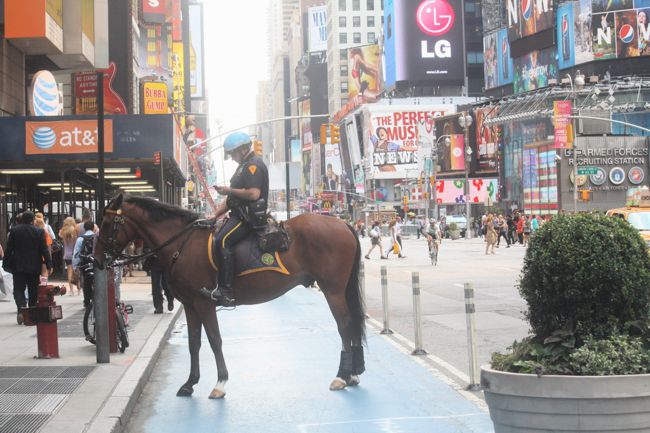
Whichever future turns out to be "the" future, it will necessarily be intermingled with instances of the present, the past, and indeed "alternate futures." These two candidates for "the" future — trains and bikes vs. self-driving cars — are absolutely guaranteed to coexist in at least one European city before 2020, for instance, and they will also share that city with "antique" human-driven cars. And, for that matter, horses. Police departments still use horses in most industrialized nations, and horse-drawn carriages are very popular with tourists in Chicago, New York, and probably numerous other cities.


Because the future is not distributed evenly, and it never will be.


Which is kind of awesome!

"Excuse me Sir but you can't park that bear there...." pic.twitter.com/KWIfn9EGK2

— Frank Drebin (@Frankie_Drebin) May 31, 2014

Even the idea that trains, in the future, would not be made of self-driving cars might in itself be a little ridiculous, at least in the United States. Why put new tracks across the country when we already have a fantastic network of interstate highways, and Republican partisanship makes it difficult just to maintain those? Just make a team of self-driving cars that work as a train when they have open road, but which disperse as autonomous units to perform deliveries in a city, and you get many of the benefits of high-speed rail without committing to new infrastructure costs which future political shenanigans may passive-aggressively de-fund.

It's a hub-and-spoke system with a movable hub. There's no reason at all why future hub-and-spoke systems shouldn't be recursive. (One of the nice things about debating "the future": in the absence of a specific deadline, you can move the goalposts anywhere you want.)

It's also not necessarily correct to assume that the future we get will either be the one we get through government or the one we get through corporations. This could also be a false dichotomy; we may create some futures through crowdfunding. Crowdfunding is successfully (and very surprisingly) giving both NASA and Virgin Galactic a run for their money right now.

Returning to Ironies of Automation, the paper shows its age with some sexist assumptions about pronouns, but it also shows its wisdom and relevance in this excerpt:

By taking away the easy parts of his task, automation can make the difficult parts of the human operator's task more difficult. Several writers (Wiener and Curry, 1980; Rouse. 1981) point out that the 'Fitts list' approach to automation, assigning to man and machine the tasks they are best at, is no longer sufficient. It does not consider the integration of man and computer, nor how to maintain the effectiveness of the human operator by supporting his skills and motivation. There will always be a substantial human involvement with automated systems because criteria other than efficiency, are involved, e.g. when the cost of automating some modes of operation is not justified by the value of the product, or because the public will not accept high-risk systems with no human component... This paper will discuss the possibilities for computer intervention in human decision making. These include instructing or advising the operator, mitigating his errors, providing sophisticated displays, and assisting him when task loads are high.

So while Google's building self-driving cars with no steering wheels, Volvo, Audi, and Mercedes-Benz are embedding self-driving technology in cars which still also function in the normal way. Odds are good these products will do much better in the marketplace, especially since Google's only making 100 no-steering-wheel robot cars in its first "production" run. (They're pursuing the same strategy of an extremely limited initial release that they used with Glass.)

However, although the cars that people drive may always need some degree of human control, it's unrealistic to assume that all self-driving cars will be the same size as our current cars, which by definition have to be big enough to fit people inside them. Why preserve an unnecessary design constraint? Think of all the useful things cars can do without having any people inside.


This is a perfectly appropriate size for a self-driving car:


And so is this:


If you're talking about a new technology which is still years away from widespread use, you shouldn't be underestimating human creativity.


Realization: "self driving car" is the "horseless carriage" of our time

— Yehuda Katz (@wycats) May 20, 2014

We could even end up with "self-driving cars" which bring back a horse-like form factor:


This is Big Dog, a robot built by Boston Dynamics in 2008. Google bought Boston Dynamics in 2013.

Unfortunately, and less speculatively, this is also a perfectly logical size for a self-driving vehicle:


In fact, the Israeli government currently uses robot bulldozers to smash homes with people inside. When you want to implement an inhuman policy, it's useful to have non-human agents.


And this might explain why people are so negative about Google's announcement.

google car features: - big friendly mouth with thousands of razor-sharp teeth - secretes sticky, sweet-tasting fluid which traps pedestrians

— direlog (@direlog) May 28, 2014

What's the difference between a clown car & Google's car? In a clown car, the joke is on the clowns because you watch everything *they* do.

— Anil Dash (@anildash) May 28, 2014

There are many perfectly reasonable reasons to be afraid of Google.

Anyone who works with computers learns to fear their capacity to forget. Like so many things with computers, memory is strictly binary. There is either perfect recall or total oblivion, with nothing in between. It doesn't matter how important or trivial the information is. The computer can forget anything in an instant. If it remembers, it remembers for keeps.

This doesn't map well onto human experience of memory, which is fuzzy. We don't remember anything with perfect fidelity, but we're also not at risk of waking up having forgotten our own name. Memories tend to fade with time, and we remember only the more salient events...

Unfortunately, we've let this detail of how computers work percolate up into the design of our online communities. It's as if we forced people to use only integers because computers have difficulty representing real numbers.

Our lives have become split between two worlds with two very different norms around memory...

Online, everything is recorded by default, and you may not know where or by whom. If you've ever wondered why Facebook is such a joyless place, even though we've theoretically surrounded ourselves with friends and loved ones, it's because of this need to constantly be wearing our public face...

It's interesting to watch what happens when these two worlds collide. Somehow it's always Google that does it...

One reason there's a backlash against Google glasses is that they try to bring the online rules into the offline world. Suddenly, anything can be recorded, and there's the expectation (if the product succeeds) that everything will be recorded. The product is called 'glass' instead of 'glasses' because Google imagines a world where every flat surface behaves by the online rules...

people hate the online rules!


The strategy Google shares with Facebook, of capturing as much personal data as possible, is both massively multiplayer automated stalking, and metadata kleptocracy.

We as citizens will absolutely need to make it unequivocally clear to Google that not only do the online rules not translate into the offline world, but also, the online rules don't belong in the online world either. The online rules don't belong anywhere, and it's high time we adjusted our data retention policies (at the level of law) to fit humans, rather than computers.

A lot of my fellow geeks are utterly fed up with Google, and I totally agree that we should resist Google's power, and pass privacy laws in the US that are as good as the privacy laws which Europe's had for a long time now. But European governments ignored those laws to spy on their citizens, collaborating with our own wildly out-of-control NSA. It's not going to be effortless. Effective resistance requires good strategy, and good strategy requires clear thinking. Google might deserve your poorly-articulated snark, but the rest of the planet deserves the best, most disciplined thinking we can achieve.

And there's another, simpler reason people are being negative: the face.

Google’s driverless car blatantly ripped off the Cozy Coupe pic.twitter.com/ajYcRifGXC

— James Kelleher (@etienneshrdlu) May 28, 2014

If this face came equipped with animatronic motors, allowing you to communicate basic emotions to people in other vehicles, then it'd be the best thing ever. After all, the huge number of car crashes worldwide, in every culture which has the technology, is not matched by a similarly huge number of people who can't walk down the street without knocking each other over. Cars dampen all the body language which make it safe to walk down a street. So if this face acted like a face, it'd be awesome.

But it's not. This blatant, Muppet-esque face is not animatronic, so it just looks utterly condescending.

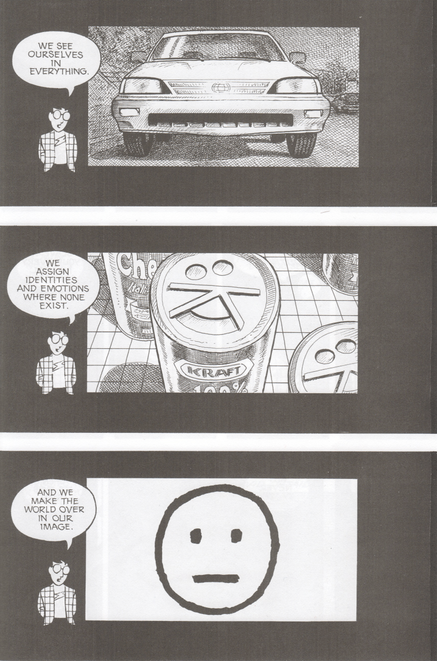
It's human nature to see faces in things.

This imperial priest is tired of all of everyones's bullshit. @FacesPics @facesinthings pic.twitter.com/5EfuGviF9z

— MrScottFletcher (@MrScottFletcher) May 4, 2014

Scott McCloud wrote (and drew) the best commentary on this I've ever seen in his masterful nonfiction graphic novel Understanding Comics.


It was a brilliant insight when McCloud first wrote about it, but it's common knowledge now: a car's "face" influences buying decisions. Cars with mean faces sell well, because they project power; cars with cute faces sell well, because they remind people of babies. But of course, they're not really faces; since they can't move, or form expressions, they're masks. And the mask which Google's put on its car is aggressively bland, dull, and literal.

Are their assumptions about visual design so coarse and unsophisticated that they don't think this looks manipulative and disingenuous? Or are they just that desperate to make it look safe? It's bizarre; Google's finally figured out that design matters, and yet they still don't understand that this means things should look good.

But I should probably explain something which a lot of people overlook when it comes to both Google Glass and the self-driving cars: each is primarily subterfuge.

Blake Masters took detailed notes on Peter Thiel's startup class at Stanford University. In one session of this class, Thiel apparently explained that monopoly is incredibly valuable, but must be hidden from the government:

One problem is that if you have a monopoly, you probably don’t want to talk about it. Antitrust and other laws on this can be nuanced and confusing. But generally speaking, a CEO bragging about the great monopoly he’s running is an invitation to be audited, scrutinized, and criticized. There’s just no reason to do it. And if the politics problem is quite severe, there is actually strong positive incentive is to distort the truth. You don’t just not say that you are a monopoly; you shout from the rooftops that you’re not, even if you are...

Let’s drill down on search engine market share. The big question of whether Google is a monopoly or not depends on what market it’s in. If you say that Google is a search engine, you would conclude that it has 66.4% of the search market. Microsoft and Yahoo have 15.3% and 13.8%, respectively. Using the Herfindahl-Hirschman index, you would conclude that Google is a monopoly since 66% squared is well over 0.25.

But suppose you say that Google is an advertising company, not a search company. That changes things. U.S. search advertising is a $16b market. U.S. online advertising is a $31b market. U.S. advertising generally is a $144b market. And global advertising is a $412b market. So you would conclude that, even if Google dominated the $16b U.S. search advertising market, it would have less than 4% of the global advertising market. Now, Google looks less like a monopoly and more like a small player in a very competitive world.

Or you could say that Google is tech company. Yes, Google does search and advertising. But they also do robotic cars. They’re doing TV. Google Plus is trying to compete with Facebook. And Google is trying to take on the entire phone industry with its Android phone. Consumer tech is a $964b market. So if we decide that Google as a tech company, we must view it in a different context entirely.

It’s not surprising that this is Google’s narrative. Monopolies and companies worried about being perceived as such tell a union story. Defining their market as a union of a whole bunch of markets makes them a rhetorical small fish in a big pond. In practice, the narrative sounds like this quotation from Eric Schmidt:

“The Internet is incredibly competitive, and new forms of accessing information are being utilized every day.”


The self-driving cars, and Google Glass, each serve several purposes for Google: they make recruiting easy, they keep top talent (and the founders) entertained, they serve as terrific R&D for businesses which might exist one day, and, best of all, they provide plausible arguments that Google is not a monopoly.

(Plausible does not mean true.)

Google Glass, and its new cars, remind me of the Newton I owned in 1996. It was great. I loved it. It was visionary, it was inventive, and it was cool to show my friends. But it just plain didn't work. The handwriting recognition was shit, the apps basically didn't even exist, and you couldn't integrate it with anything else on the planet without unbelievable hassle.


Products like this typically don't succeed in the marketplace. The same visionary who brought the world the iPad shut down the Newton project almost the minute he returned to Apple. But Apple was broke when that happened. The important difference between the Newton and Google's current indulgences is that Google doesn't need either Glass or its robot cars to succeed.

Google's making a smart move either way. IBM used to dominate tech until Microsoft took over; Microsoft used to dominate tech until Google took over; the history of tech giants is a history of near-monopolies owning platforms. So any well-informed tech monopoly realizes their platform could go under. Google's hiding their monopoly and building great intellectual property for the inevitable period in the future when their platform becomes as irrelevant as Microsoft's operating system "advantage" is today. The expertise they're building may end up more valuable than anything they've done on the web, especially since a lot of it should transfer to aerial drones with relative ease.

Google's self-driving car gathers 750 megabytes of sensor data per second. https://t.co/lNKEvIJ77G pic.twitter.com/9OFD6cRAqQ

— Vala Afshar (@ValaAfshar) May 26, 2014

If you didn't know, Google bought a ton of robotics companies in 2013. They're probably hoping for a monopoly on navigation systems, and they're building the database to back it up. But the future will be weirder than they, or anyone, can imagine.
05 Jun 20:07

The Rails/Merb Merge In Retrospect

by Giles Bowkett
This post discusses open source history critically. The post names the programmers involved using formal names — e.g., Mr. Foo or Ms. Bar — because open source has become a strange hybrid of software development and social media, and I want to balance my critique by showing respect for everybody involved.

Way back in 2008, at MountainWest RubyConf, somebody high-placed at EngineYard told me that the company funded Merb development because they hoped some of that work would end up in Rails. At the time, I thought the comment made no sense; Rails and Merb were fundamentally different projects with fundamentally different philosophies. But Yehuda Katz (then of EngineYard) announced the Rails/Merb merge only a few months later:

Rails will become more modular, starting with a rails-core, and including the ability to opt in or out of specific components. We will focus on reducing coupling across Rails, and making it possible to replace parts of Rails without disturbing other parts. This is exactly what Merb means when it touts “modularity”...

Rails will be retrofitted to make it easy to start with a “core” version of Rails (like Merb’s current core generator), that starts with all modules out, and makes it easy to select just the parts that are important for your app. Of course, Rails will still ship with the “stack” version as the default (just as Merb does since 1.0), but the goal is to make it easy to do with Rails what people do with Merb today.


This took longer than expected, but it happened, sort of. The initial site generator script is way more pleasant to use as a result, and replacing ActiveRecord with a REST or Mongo client got easier too. That's cool. But the Rails community largely didn't embrace Rails's newfound modularity the way Mr. Katz told us we should expect.


Much of the fun, creative energy in web dev moved to JavaScript, although it would be very silly to say Ruby is dead. Ruby's still alive, and there are very cool things happening in Clojure as well, and people will probably start having a lot of fun with Swift, too. There's never been a better time to be a polyglot programmer.

Despite all the new options, I still write Rails apps sometimes — partly because there's a lot of Rails work out there, and partly because I love Ruby (and still kind of love Rails). However, I think the modularization of Rails failed, and in this blog post, I'm aiming for a basic post mortem.

Personally, the people I've seen and worked with in Ruby haven't used Rails's breakout libraries and post-Merb-merge modularity to the extent that Mr. Katz evangelized. One way to understand that is the "Sinatra + ActiveRecord + [many other things]" problem. It's kind of a random tangent, but bear with me. When you need something tiny, Sinatra is awesome, but you can tell you've underestimated the scope of your project if you end up pulling ActiveRecord back in, and then you want migrations, or view helpers, and the bigger your little Sinatra project gets, the more you wonder if you shouldn't just have used Rails, because you're manually importing all its various features.

Sinatra's great for tightly-constrained services, but not so great for projects which might grow in scope, and that makes it a judgement call, because in theory, anything might grow in scope. There's a "tldr: just use Rails" disincentive to actually exploiting Rails's modularity in this fairly shallow and direct way, because you add cognitive overhead and complexity which you could have avoided just by using the more "batteries included" solution. That same disincentive exists with respect to any attempt to reconfigure Rails's architecture, even though it can definitely be worth the effort.

José Valim wrote a terrific book about all the amazing acrobatics you can pull off if you're familiar with the modular components of Rails, and if you compose software with these components, rather than simply building vanilla Rails apps. The only problem is that you kind of have to have José-Valim-level familiarity with Rails's internals to do it well. Mr. Valim's been on the Rails core team for years, and that's a pretty massive time investment at a pretty significant level of skill. So a lot of the modular power of Rails, a major goal which ate up a very significant amount of development time, sits untapped as remarkable power that nobody ever actually uses, because nobody has the years to spend to get on José Valim's level just so they can tackle a few edge cases in ways which will baffle every new programmer they ever onboard, going forward for the entire lifespan of their company.


I'm exaggerating here, and being completely unfair to Mr. Valim's book, but you get the idea. Speaking of shameless rhetorical self-indulgence, Rails's creator David Heinemeier Hansson often receives extremely justifiable criticism for making overly grand statements, but once upon a time, people used to talk a lot more about the intensely beautiful design work he did with Rails at the project's inception.

Paying too much attention to questionable social media shenaniagans, and/or conference talks, might be a mistake, but it's still worthwhile to really think about Rails's design, so think for a second about flow, context switching, and productivity. Rails constrains the problems you think about, in an ideal Rails app, to questions of business logic and flow between web pages. That was a perfect summation of the real work a web developer should be doing, back in 2005, when Rails was new, and it's still a decent approximation, although we now have to tack on mobile-friendliness and JavaScript framework integration like Ptolemaic epicycles. The way Rails can narrow the range of topics a programmer has to think about during their workday is great user experience design which results in better time management.

An ideal Rails app is as rare as an ideal anything else, but without a set of APIs that carefully constrain the problem space down to a manageable subset, it's quite difficult to even start conversations about what to build next. If the overwhelming majority of your web work is about business logic and flow between web pages, what you're going to build next will very probably be either business logic or flow between web pages. But if a substantial part of your web work is reconfiguring architecture, or inventing new architecture from scratch, then "what should we build today?" is a longer conversation, and one which poses challenges to staying focused and effective.

Even today, with the whole shoehorned-in aspect of mobile and JS framework stuff, having a simple canned architecture gives you phenomenal benefits in terms of concentration and peace of mind, at least at your project's outset. If you're dismantling Rails and building something new out of its parts, you're re-opening that can of worms, and that can be expensive, time-consuming, and aggravating. By programmer standards, it's very easy to estimate how long it will take to churn out some familiar chunk of business logic. Building a custom version of a very complex framework takes an unpredictable amount of time and adds a substantial amount of cognitive overhead to a project. It increases your risk of failure, delay, and burnout. If it goes well at all, it'll only be because somebody at your company takes elegant internal API design seriously, and does it well. Dunning-Kruger effects aside, this is a very rare skill.

But the Rails/Merb merge didn't give Rails any of this. In fact, it doesn't seem to have affected many Rails developers directly at all. Very probably, a few companies did take advantage of the new modularity, to solve a few very specific problems, but most people don't know how and don't have the problems which would make it worthwhile in the first place. So the basic problem here is that the Rails/Merb merge wasn't useful to a lot of people, and that it took too long. (In fact, given that many aspects of that modular rewrite still seem unfinished, even today, it might be more accurate to say that it is taking too long.) You have to give the Rails team credit for tackling technical debt, but in this instance, it might not have been worth the effort.

The irony is that Rails developers have formed their own, unofficial, unapproved hacks to supply a much more modest form of modularity in Rails, and Mr. Hansson vigorously opposed this practice about a year and a half ago. It's relatively rare in a Rails app to exploit post-Merb-merge modularity, but it's very common to break your app out into services, and to break god objects into smaller files. Many people who build a Rails app need to do this, sooner or later.

(As an aside, I recently built an unusual thing, namely a Rails app with no User model — the usual candidate for god object status — and was surprised to discover another object in the system creeping towards god object status instead.)

Many people have noticed that the Rails culture's prone to occasional dysfunction and drama. This is not unique to Rails; it's inherent to the social media aspects of open source. But these aspects sometimes work against the end goal of delivering excellent software. This failure to achieve consensus around the topic of modularity may be a perfect example of community dysfunction. Rails developers who developed common ways to make their architecture more modular, to solve problems they all shared, met with opposition from Mr. Hansson. Yet Rails core embraced a more arcane modularity which nobody turned out to want.

It's an interesting mistake, in my opinion. Great design implies the diligent application of exquisitely careful good judgement. Consider how Rails views squash their problem space down to an approximation of PHP, but Rails then expands back into a full OO system towards the back end. That was revolutionary when it first appeared. It suggested some very deep thinking about questions like "what kind of progamming is appropriate here?". The way the Rails project has handled questions like "what kind of modularity is appropriate here?" seems less deep to me, in comparison, and less well-balanced.

Any decent post mortem needs to also consider what, if anything, Rails lost as a result of its merge with Merb. Matt Aimonetti said it well:

the lack of competition and the internal rewrites made Rails lose its headstart. Rails is very much HTML/view focused, its primarily strength is to make server side views trivial and it does an amazing job at that. But let’s be honest, that’s not the future for web dev. The future is more and more logic pushed to run on the client side (in JS) and the server side being used as an API serving data for the view layer... Rails is far from being optimized to developer web APIs in Rails. You can certainly do it, but you are basically using a tool that wasn’t designed to write APIs and you pay the overhead for that.

The knee-jerk reaction to this might be that paradigms change, but the "new" evolution in the nature of web applications should not surprise you at all if you were paying attention during the browser wars of the late 90s, or if you were paying attention when Google bought Writely and turrned it into Google Docs, or if you thought about Microsoft's claim, to the Department of Justice and the courts, that the browser was part of the operating system, or if you read Bill Gates's essay Content Is King, written in 1996.

To quote some relevant commentary:

Microsoft is trying to provide web applications with the same performance as native applications...

This is exactly the nightmare scenario that Bill Gates, co-founder of Microsoft, feared would happen, that the web browser could substitute for the operating system, and that's why he aggressively went after Netscape Communications in the 1990s, resulting in an anti-trust conviction against Microsoft.


In other words, if you've been paying attention, you've been expecting this "new" landscape in web development for about eighteen years. I won't pretend to have Mr. Gates's level of strategic foresight, but I can say I did a presentation in 2006 explaining why JavaScript MVC was inevitable, four years before Backbone's first release. For some reason, though, Rails appears to have missed this boat, and the conversation among programmers seems to be limited to callback functions, threading, and curly braces.

I had a brief conversation on Twitter with Avdi Grimm:


This conversation took place before the release of Rails 4. Mr. Grimm's prediction proved incorrect. Although Rails 4 brought plenty of incremental improvements, as well as much-needed concurrency support, it remains a framework based on assumptions about what web programming is which simply are not true any more. Rails 4 is certainly an impressive accomplishment, but it's not the most
innovative thing in the world.

Nor should it be, necessarily.

There’s nothing wrong or shameful with nailing a single use case, like VB did for Windows desktop or PHP for web scripts. It’s beautiful!

— DHH (@dhh) December 29, 2012


I can't call PHP beautiful, but the basic sentiment is completely legit. But a lot of Rails developers have business models which require cutting-edge technologies. The cutting edge is also just a fun place to be. Here's what the cutting edge looks like in 2014:


This is Verold, a web app which competes with Unity, Cinema 4D, and Maya.

Returning to my discussion with Avdi Grimm, I said this:

@avdi and Rails 5 is a much more likely target for recapturing the lead than Rails 4 is. I saw @wycats lay out a plan for Rails 4 in like 09

— Giles Goat Boy (@gilesgoatboy) March 1, 2012


I was just being nice. Rails might never recapture the lead, unless Rails core undertakes some very serious re-examination of the project's design assumptions. That's hard to do, and they're probably still tired from the Rails/Merb merge. And Mr. Hansson may not decide to do the same kind of serious, difficult, incisive thinking that he did back in 2004, when he wasn't a millionaire and he had to prove himself. He did some amazing work in his early 20s, during a recession, when everybody works harder than normal, but he may not want to put his promising racing career on hold for a couple years so he can deal with new technological issues which he doesn't seem to understand or need to care about.

And to be fair, that's not a reasonable thing to expect from him, or indeed anybody. But it does contextualize his recent keynote presentation, at RailsConf 2014, about the alleged demise of TDD.


As Mr. Hansson and his co-author put it in their book Getting Real:

One bonus you get from having an enemy is a very clear marketing message. People are stoked by conflict. And they also understand a product by comparing it to others. With a chosen enemy, you're feeding people a story they want to hear. Not only will they understand your product better and faster, they'll take sides. And that's a sure-fire way to get attention and ignite passion.

In this context, TDD Is Dead just looks like attention-getting fluff to me. We live in a world where Nodecopter is old news. We have a framework which may in fact lag behind the cutting edge, and we have an unresolved tension about what the right level of modularity is in that framework. What's the value in dredging up a mid-2000s buzzword?


With apologies for the snark, I see an important lesson here.

Open source software has to balance two opposing forces: a strong, guiding vision in the service of a particular use case, vs. responding to, and respecting, the project's community. Rails favors the first force over the second. Quoting again from Getting Real:

Just because x number of people request something, doesn't mean you have to include it. Sometimes it's better to just say no and maintain your vision for the product.

Rails might be overbalanced in this direction, and underemphasizing the value of listening to its community. But you could easily argue instead that too many people tried to use Rails for too many inappropriate use cases. It's a judgement call. It will probably always be a judgement call. Rails seems to have chosen to err on the side of saying no, and that's a completely legit choice.

It could even be that the number one mistake in the Rails/Merb merge was that they didn't say no enough. If a company comes to you and tells you that they'll happily refactor your open source project for you, that might be a good time for saying no.

Keep in mind that when you send a pull request you're saying, "I wrote some code. I think you should maintain it."

— Nicholas C. Zakas (@slicknet) May 29, 2014


Another lesson to learn might be that user experience design is a much more important part of API design than programmers have traditionally realized. For the sake of argument, let's take a position which is so extreme as to be silly, and agree (for the moment) that nobody should ever have used Rails to make any kind of app other than a Basecamp clone. Let's say Rails is appropriate for one use case and one use case only. The question then becomes, why did so many people misuse it for so many additional purposes?

Maybe because it's a damn good idea to prioritize developer happiness, and treat API design the same way Apple treats user interface and product design. If your technology makes people's work fun, they're probably going to embrace it.

If you're building the next big thing in open source, or trying to, please remember this.

You might also like Rails As She Is Spoke, my book about Rails's design.
04 Jun 18:05

The Derp is Strong with This One

by Josh Marshall

There's quite a lot of this out there. But courtesy of TPM Reader TT, two posts from GateWayPundit, one of the country's most prominent rightwing blogs ...

10/13/13: "Horrible. Obama to Leave US POW to Rot in Afghanistan After Withdrawal."

6/3/14: "Figures. Obama Administration Promoted Bergdahl to Sergeant After He Reportedly Joined Taliban."

Along those lines here's a fun piece Tom Kludt just put together of Republicans racing to scrub their social media accounts and websites of praise for "war hero" Bowe Bergdahl.

03 Jun 23:44

You don't have to answer this, but....did they make Maleficent out to be a kindhearted person who was just misunderstood? I would honestly like to know because I've been worried about it since it was announced.

Yknow, as much as I would have liked the movie to trust us that she could be both an honest-to-god villain AND a sympathetic character - you guys know me, I love me some villains - that wasn’t really what the movie was about and once I came to terms with that, I was actually pretty okay with it. I mean, there’s different kinds of stories to tell and I want to see the version of this where she’s an “lol I do what I want” type villain but at the same time I feel that the version where she’s struggling with bitterness and pain and anger instead of being really evil, that’s a different kind of story but one that needs telling too. I don’t know when we’ll get a female-led movie where she’s allowed to really act out and be scary and mean, and I think it’s unlikely to come from Disney for a while anyway, and I might mourn the lack of that story but it doesn’t keep me from appreciating the stuff Maleficent got right.

I’m not convinced most of the characters in the story thought of Maleficent as evil as much as they thought that she was spooky and kind of weird. But I also recall being a kid who was constantly worried about people thinking I was weird or negative or not fun to be around, like I should have been this sunny kid with bouncy curls and rosy cheeks in order to be loved. And that was Disney’s whole brand for a while. We never got messy or abrasive princesses. But Maleficent did something great by showing BOTH a bouncy-curled rosy-cheeked princess AND a fabulous goth queen who doesn’t always trust, understand, or get along with other people, and is consumed by bitterness, and having the main relationship of the story be between those two people. 

I wish the movie had done more with that, the obvious discrepancy between Maleficent’s personal style and the twee CGI monstrosity pixies and gnomes that populated her world. But at the end of the day the movie doesn’t make Maleficent have to lose what makes her spooky and intimidating - she gets to be a protagonist regardless. Maybe I’m setting the bar low and maybe I’m reading in what I wanted to see, but that was how I took it. 

ANYWAY while I had a lot of issues with the actual construction of the movie - it had a pretty predictable plot that didn’t really get too deep into anything, a climax that lacked any real tension, and god I really hate the look of those CGI pixies, but I was really surprised by how much I enjoyed it. I actually dug the “revenge fantasy” angle. The movie knows that Angelina Jolie is the best part, and she’s very rarely NOT on screen, and that’s great because she’s amazing. And I’m really digging the initiative to spotlight types of loving relationships that aren’t romantic in Disney movies. And I love “bad mom” type characters who aren’t naturally nurturing or maternal but give it a shot anyway SO tl;dr I was a happy camper.

03 Jun 19:21

When is a priest not a priest? When he's molesting a child.

by Xeni Jardin
via NJ Star-Ledger


Rev. Terence McAlinden, with an alleged child victim, via NJ Star-Ledger

That's the argument made in the supreme court of Delaware by the attorney representing Rev. Terence McAlinden, a priest accused of serially molesting "a number of" boys. Read the rest

03 Jun 18:39

One Weird Trick to Get Everything You Want

You probably heard about the Facebook executive who complained about the proliferation of “stupid stories about how you should wash your jeans instead of freezing them.” It’s almost too easy to be snarky about a Facebook guy who worries the Internet is awash in silly sponsored content. 

Besides, we know that silly sponsored content is not a benign issue. MetaFilter founder Matt Haughhey has written thoughtfully about how Google’s opaque and inscrutable ranking systems have been killing his business. He admits that, “we were doing nothing in terms of SEO, as I find the whole business kind of gross." But because MetaFilter won’t play the ranking game, ad revenue has collapsed. Having thoughtful, high-quality content isn’t enough to get read.

The Internet is still full of great content. The problem is that the big Internet companies don’t do a good job of facilitating it. Well, that and advertisers and shameless self promoters are finding new and annoying ways to get in your face.

Last week, we wrote in defense of publishers’ right to get paid for advertising. But that’s just one part of the equation. The other half is providing a better way for quality content to be found. Or at least found without having to tart it up with stupid SEO tricks. 

image

I know that content syndication can be used and abused by some people for link building. But RSS is not an algorithm that can be gamed by advertisers and content hucksters. I know that it is still the best mechanism to find the content you want. You’re not going to be tricked into clicking on a link and you’re not having your newsfeed polluted with promoted content. 

And I think it is time to start talking about this. Sometimes I get the feeling RSS developers think of themselves caretakers of an established and respected institution. You know, the kind of institution that can keep catering to a dwindling number of dedicated and sophisticated followers but doesn’t bother attracting new users. RSS is not new technology. But it is outside of the mainstream content delivery that’s increasingly compromised by someone’s desire to sell you something. 

And if a Facebook executive is recognizing the mindlessness, other people are too. It’s time to reintroduce RSS to the world. How about telling people that there is a way to actually ask for content you want to see and actually have it delivered to you. It’s not a miracle or weird trick. Although it will probably seem that way to a few people. 

03 Jun 18:36

jtotheizzoe: kqedscience: Famous Sunset Paintings Reflect Key...


jtotheizzoe:

kqedscience:

Famous Sunset Paintings Reflect Key Air Pollution Events From the Past

Researchers in Greece recently found that sunset paintings by artists such as J.M.W. Turnerand Edgar Degas accurately reflect contemporary pollution events—specifically, the 54 major volcanic eruptions since 1522. As the industrial age dawned and man-made particles began to fill the air, the paintings tracked that too.”

Learn more from Danna Staaf at KQED Science.

Tracking atmospheric science through fine art? I Louvre this.

This is awesome.

03 Jun 18:33

Catholicism’s Crimes Against Humanity

by Andrew Sullivan

How could anybody hurt these beautiful little children? http://t.co/1KkcOWqCdW pic.twitter.com/Xr0YQeZq8P

— The Raven (@TheRavenxx) June 2, 2014


You may recall the kerfuffle recently when the UN Rapporteur on Torture tried to indict the Vatican for “crimes against humanity” because of the widespread scheme, orchestrated by the church hierarchy, to facilitate and cover up the mass rape and sexual abuse of children. Many argued that the very term “crime against humanity” was over the top, fueled by anti-Catholicism or secularism, and effectively undermined itself by its extreme language.

But what can possibly describe the following unless it is a crime against humanity?

In a town in western Ireland, where castle ruins pepper green landscapes, there’s a six-foot stone wall that once surrounded a place called the Home. Between 1925 and 1961, thousands of “fallen women” and their “illegitimate” children passed through the Home, run by the Bon Secours nuns in Tuam. Many of the women, after paying a penance of indentured servitude for their out-of-wedlock pregnancy, left the Home for work and lives in other parts of Ireland and beyond. Some of their children were not so fortunate.

More than five decades after the Home was closed and destroyed — where a housing development and children’s playground now stands — what happened to nearly 800 of those abandoned children has now emerged: Their bodies were piled into a massive septic tank sitting in the back of the structure and forgotten, with neither gravestones nor coffins.

A mass grave for eight hundred children, buried with no dignity, no humanity, no trace of decency. And the mass grave may well have been facilitated by rampant, disgusting and callous neglect:

According to documents Corless provided the Irish Mail on Sunday, malnutrition and neglect killed many of the children, while others died of measles, convulsions, TB, gastroenteritis and pneumonia. Infant mortality at the Home was staggeringly high. “If you look at the records, babies were dying two a week, but I’m still trying to figure out how they could [put the bodies in a septic tank],” Corless said. “Couldn’t they have afforded baby coffins?”

Special kinds of neglect and abuse were reserved for the Home Babies, as locals call them. Many in surrounding communities remember them. They remember how they were segregated to the fringes of classrooms, and how the local nuns accentuated the differences between them and the others. They remember how, as one local told the Irish Central, they were “usually gone by school age — either adopted or dead.” According to Irish Central, a 1944 local health board report described the children living at the Home as “emaciated,” “pot-bellied,” “fragile” and with “flesh hanging loosely on limbs.”

Let us call this what it is: a concentration camp with willful disregard for the survival of its innocent captives, a death camp for a group of people deemed inferior because of the circumstances of their birth. When we talk of mass graves of this kind, we usually refer to Srebrenica or the crimes of Pol Pot. But this was erected in the name of Jesus, and these despicable acts were justified by his alleged teaching.

To my mind, these foul crimes against women and children, along with the brutal stigmatization of gay people as “objectively disordered”, remain a testament to how the insidious, neurotic and usually misogynist fixation on sex has distorted and destroyed Christianity in ways we are only now beginning to recover from. For what we see here is the consequence of elevating sexual sin above all others, of fixating on human sexuality as the chief source of evil in the world, and of a grotesquely distorted sense of moral priorities, where stigmatization of the sexual sinner vastly outweighs even something as basic as care for an innocent child.

It seems to me that we have to move past the church’s current doctrines on sex if we are to fully seek justice for the victims of this pathology and if we are to ensure that never again is a phrase that actually means something. It is not enough to ask for a change in governance (and even that has been hard); what this evil signifies is the need to root out this pernicious obsession with sexual sin. This pathology – perpetuated by Benedict and the sex-phobic theocons – perpetuates the mindset that led to this barbarism. The nuns – and yes, this was abuse practised by women as well as men – did not ever seem to realize that Jesus himself was conceived, to all intents and purposes, out of wedlock – in a manner that may well have led his contemporaries to stigmatize him as illegitimate as well. They did not for a moment internalize Jesus’ emphatic insistence on the holiness of children as those most likely to enter the kingdom of Heaven. No, these precious images of God were consigned, after years of abuse and neglect, to unmarked early graves in a septic tank.

That is not a sign of a church gone astray. It’s a sign of a church given over to evil. A church that leaves young children to die of malnutrition and then dumps hundreds of them into a mass grave is not a church. It’s an evil institution that robs the word “church” of any meaning, and twists the Gospels into their direct opposite.

We failed these children in their short lifetimes. Never, ever forget them if we are to have a chance at restoring a Christianity worthy of Jesus.

03 Jun 14:46

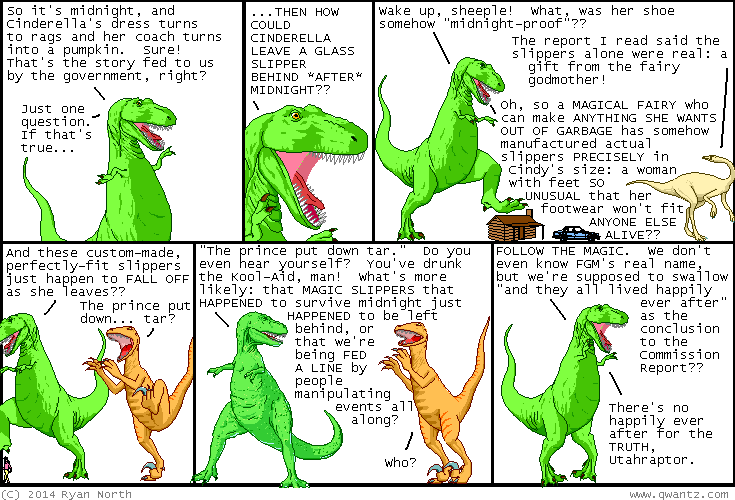
a prince dedicates the entire resources of his kingdom to tracking down a peasant and nobody gets rich?? PLEASE.

archive - contact - sexy exciting merchandise - search - about
← previous June 3rd, 2014 next

June 3rd, 2014: This comic was inspired by a Twitter post I made the other night when I first opened my mind and stumbled upon this conspiracy! Thanks to everyone who replied for pointing out other inconsistencies in the "official history". Together we'll bring the truth to light, I swear it.

– Ryan

02 Jun 22:11

The World Community Doesn’t Miss Bush

by Andrew Sullivan

Beinart gives the Bushies a reality check:

[W]hen Cheney says world opinion is “increasingly negative” and Rove detects “declining confidence” in the United States, it’s hard not to ask the obvious question: compared to when? In fact, while faith in the United States, and in Obama personally, has declined Obama Bushmodestly since 2009, it is still dramatically higher than when Cheney and Rove roamed the West Wing.

For more than a decade, the Pew Research Center has been asking people around the world about their opinion of the United States. The upshot: In every region of the globe except the Middle East (where the United States was wildly unpopular under George W. Bush and remains so), America’s favorability is way up since Obama took office. In Spain, approval of the United States is 29 percentage points higher than when Bush left office. In Italy, it’s up 23 points. In Germany and France, it’s 22. With the exception of China, where the numbers have remained flat, the trend is the same in Asia. The U.S. is 19 points more popular in Japan, 24 points more popular in Indonesia, and 28 points more popular in Malaysia. Likewise among the biggest powers in Latin America and Africa: Approval of the United States has risen 19 points in Argentina and 12 points in South Africa. (For some reason, there’s no Bush-era data on this question for Brazil or Nigeria).

02 Jun 21:55

How to Turn A “Good” Proposal Into An “Excellent” Proposal in Eight Admittedly Arduous Steps

by hjahren1
I’ve reviewed a lot of proposals lately and it has made me cranky, so here I am trying to teach the Hungry Man how to Fish and thus Eat for a Lifetime. I’ll be blunt: Have you been getting evaluations of “good” on your grant proposals? If yes, then you really need this information.

How to Turn A “Good” Proposal Into An “Excellent” Proposal in Eight Admittedly Arduous Steps

1. Do the Math.  You’ve already done the budget, right? Because budgeting work comes apart in your hands like dry f*cking cornbread, creating more and more crummy little tasks as you handle it until suddenly it’s done and you’re not totally sure what happened, but you do have an excel file with a grand total figure somewhere near the bottom. Write this big fat number on the back of your hand with a Sharpie and stare at it for a few days. You know what? That number represents a crapton of money by anyone’s standards. Divide that number by ten, or even a hundred. Now ask yourself, “What would it take to convince me to give someone that much of my money?” Uh-huh, I thought so. Listen: your proposal has to be well-nigh perfect to even have a chance of being discussed, let alone funded. Yes, proposal writing is the hardest part of the job, simply because there’s so much at stake for all parties concerned.  So get ready cause this is going to be slightly less fun than a goddam root canal.

2. Be Specific.  I don’t know about you, but before I give my money away, I want to be fully confident that the person I am giving it to has both a clue about what they’re doing and a plan for how to get there. Paragraphs explaining how Climate Change is Real or why Cancer is Bad are not helpful to me; if I am even considering giving you tens of thousands of dollars to study something then I probably believe it’s important even more than you do. What I want are the specifics of how you are going to get the question answered. I want to evaluate the details of your approach. You need to convince me that you’ve thought hard about it, considered your options, and visualized what success looks like from start to finish.

Let’s start with the Title. Here’s a sucky Title for a proposal:

“Characterization of Rat Vomit”

As a reviewer, I see this and think, Okay how about ‘rat vomit is gross?’ There, I just characterized it. Whoop-de-doo.

Here’s a better Title:

“Identification of Rare Amino Acids within Rat Vomit using Barfatron Energy Spectra”

As a reviewer, I see this and think, Golly, I didn’t know the Barfatron could do amino acids. Let’s see what the kids are up to in this one.

Note that the better Title states not only what you want to figure out, but how you propose to do it. Now I’m going to read your proposal in order to find out how many rats, how much puke, which amino acids and why those, how you correct for bile and saliva contamination, etc., etc. Ironically, we both know damn well that you won’t end up following this exact course of action, best-laid-plans and all, but proving to me that you can form a realistic plan is absolutely key.

3. Be Quantitative.  After you write anything, go back and replace all qualitative statements with quantitative ones. General Rule for All Scientific Writing: If it is worth taking up the space to say it, then it is worth saying precisely. Knowing and showing the numbers is basically the only thing that separates a Scientist from a Guy Selling Vitamins At The Mall. Both callings have their place, I suppose, but government agencies are better oriented towards funding the former.

Example time! Here’s a sucky Methods sentence:

“We will collect vomit from each rat in sufficient volume for analysis.”

Here’s a better version:

“Once a week during Year 2, a cohort of one hundred post-menopausal female rats will be monitored for pallor changes upon the administration of 150 mL of Woolworth’s ipecac solution. All esophageal expulsions produced during the twenty-four hours following the initialization of regurgitation will be collected within sterile 1L Lufthansa sick bags fastened to subjects’ ears using STAPLES’ staplers and staples.”

4. Tell Me Why Oh Why.  While your proposal’s Introduction has to be mighty short, it must argue in stringent terms that academia as we know it will come to a grinding halt unless someone does the work you propose. Tell about how you examined the shit out of the literature only to become aware of a gaping hole in the current state of knowledge even as it dawned on you that you – and really only you — are perfectly set up to rectify this serious collective intellectual oversight.

Get it? Here’s a sucky Introduction sentence:

“Numerous studies have characterized the inorganic acids in rat vomit [refs. 1-8], but to our knowledge, no work has been performed to identify rare amino acids.”

Here’s a better version:

“The chemistry of rat vomit remains the gold standard for diagnosis of tummy health, a measure of wellness that can be usefully extrapolated to every organism that has ever lived [ref. 1]. My survey of the literature revealed that amino acid concentrations seldom exceeded 99.9 kg/ml in both pre- and post-menopausal rat vomit [refs. 2-9]. These studies, though current, did not incorporate the contribution of rare amino acids, as their detection has only been made possible by recent advances in Barfatron technology. My previous work has demonstrated exhaustively within other contexts how rare amino acids actually control the whole damn world [refs. 10-12]. Here I propose to definitively quantify the contribution of rare amino acids to rat vomit across menopausal status, thus making possible a new definition of rat nausea, integrated across an energy spectrum ranging from gamma to radio waves.”

5. Consider The Funder’s Objectives.  Newsflash: Funding agencies don’t give away money just to experience the Rockwellian charm of playing Santa Klaus. The agencies, as well as those in their service, are actually trying to accomplish something. To get funding, you not only have to convince reviewers that you’re competent, you must also convince the agencies that you represent the wisest possible investment towards meeting their objectives. The only way to get a clear idea of what the program’s objectives are is to call or visit the Program Manager and ask her (or him, I guess) directly. She’ll start out by saying, “It’s simple: We want to fund the best science,” but keep her talking and you’ll eventually hear things like, “Wow, I’ve heard a lot of buzz over rare amino acids, tell me more,” or perhaps, “Yeah, but so much of the Barfatron work that we funded in the 1990s proved to be a dead-end.” These conversations are invaluable when you are deciding which grants to apply for. Writing a fundable proposal is a huge task, you can’t just shot-gun towards every solicitation you see, it just ain’t gonna work. You need to get feedback about your idea’s fit before you start, and that’s where talking to the Program Manager comes in.

6. Write it Well.  Okay, now you have to make all that super specific arcane shit interesting to read. The better written it is, the more of the proposal the reviewer will actually read. More reading equals more chance at gaining an informed review and useful suggestions. Beware of joining multiple PI grants where each “writes her/his own section” and then someone stacks it into a 15-page science Jenga: such piles usually collapse into rejectionland before they even hit the panel. It’s simply inescapable that near to the deadline, one of the PIs has to take the reigns for at least three days and read the whole thing out loud a few times to make sure that it flows well and makes sense. And they must also format it beautifully, with at least one dazzling figure or colorful illustration per page – which looks a lot better than any whole page of monolithic black text. Sound like too much work? Then let’s do some more math! Take the grand total dollar figure and divide it by 15 pages, and guess what, that’s how much money each page of your writing thinks it deserves. Ask your journalist friends how much they get paid per page. Upshot: proposal writing has to be the best writing of your career.

7. Gird Your Loins.  Steel yourself for a long haul, because most grants will have to go around at least two times. It’s rather like the revision process with a manuscript in that it’s quite rare when something gets accepted without any revisions. Odds are that your reviewers are going to have expertise very close to your own and the funding agency is counting on them to help you tweak your proposal into a plan with the maximum likelihood to succeed. As with papers, the objective is not to get past the reviewers, it is to learn something from them. The best way to show that you’ve done this is to include an explicit boxed paragraph before the Introduction stating how any revised proposal has been changed due to input gained during the previous cycle. Mayhaps thusly:

“Within the previous version of this proposal, Panelist #1 objected strongly to our request for one large yacht within which to sail rats back and forth between Oxnard and Catalina Island as a method for triggering seasickness prior to actual vomit collection. In this version, we have reduced costs drastically by substituting four semesters of support for one RA who will spend 10 hrs/wk sharply kicking each rat in the solar plexus until a glassy-eyed retching posture is achieved, in keeping with the suggestion of Panelist #2 that we ‘hit the little f*ckers until they blow chunks’.”

8. Don’t Lose Hope.  Buck up because it’s probably going to be okay. If you can get just one decent-sized grant before you go up for tenure, that may be enough; it sure will be if I’m reviewing your file. If you can get into the habit of writing two good grant proposals each year, you’ll improve rapidly with each cycle and likely get there in time. I’ll say it again: always talk to the Program Manager before writing, tell her your idea and pour your heart out. And remember that even though you’re an expert, you still have an awful lot to learn.

Guess what I’m psychic! Lots of people are going to say that the above advice is sort of good but also sort of wrong and that I should have instead specified x, y and z. The people who say that should go write their own blog posts and specify x, y and z. Then they should tweet me so that I can read & RT them.

And just in case someone is still reading, I feel moved to gripe about how I really, really hate the words “Characterization” and “Implications” to the point that I wish that they had never been invented by the Greeks or Lats or whatever, both being so vague as to be utterly useless. I don’t care how you ‘characterize’ something, I want to know what you measured. I don’t care what you think the ‘implications’ are, I want to know what you claim this means. For cripes sake, quit dancing around and say something, so I can either agree or disagree with you and we can both move on with our lives.

Fortunately for the world at large, I have lots more unsolicited advice to give out, such as what you should do after you get tenurewhether or not to have a baby and how to make cheese.  You also can’t comment on this page and here’s why.


return to unsolicited advice

←← return to my old stuff

←←← return to homepage

02 Jun 21:53

Watching my M.i.N.D

by Leah

watching my mind _web


02 Jun 05:15

Just posting this stupid, scribbledy comic for everyone who...


Just posting this stupid, scribbledy comic for everyone who commented and sent me notes after I responded to that ask the other day.  I didn’t mean to make a thing of it - I just couldn’t resist replying with snark to something so abrasively nonsensical.  Nevertheless, I ended up with an inbox full of kind/funny messages and, well, let’s just say a self-help book penned by Jack Handey himself couldn’t have done a better job of being that uplifting, bizarre and hilarious.  I just wanted to say thanks for making me laugh.

02 Jun 05:14

INTP Confession #783

Zephyr Dear

only two months? -___-

I spent the last two months trying to develop myself into a sociable, caring person. As a result, I turned into a highly emotional, unproductive idiot. In the end, It’s inevitable: I have feelings. It’s just that I’m not ready for them.

02 Jun 01:45

‘Don’t Be Google’

by John Gruber

In the real world, outside the technology sphere, Google is digging itself into a deep hole branding-wise. “Don’t be evil” is now a punchline.

01 Jun 23:45

The Trick That Makes Google’s Self-Driving Cars Work

by John Gruber

Alexis Madrigal:

Google’s self-driving cars can tour you around the streets of Mountain View, California.

I know this. I rode in one this week. I saw the car’s human operator take his hands from the wheel and the computer assume control. “Autodriving,” said a woman’s voice, and just like that, the car was operating autonomously, changing lanes, obeying traffic lights, monitoring cyclists and pedestrians, making lefts. Even the way the car accelerated out of turns felt right. […]

But there’s a catch. 

Today, you could not take a Google car, set it down in Akron or Orlando or Oakland and expect it to perform as well as it does in Silicon Valley.

Here’s why: Google has created a virtual track out of Mountain View. 

This is what I mean about these cars being a concept, not a real product. These cars are only real in the sense that a ride at Disney World is real. They’ve built a very clever Mountain View-size 25 MPH theme park attraction. Google could well be the company that eventually does make real self-driving cars, but they aren’t today. Who is to say that the cars they do have today are not to self-driving cars what the Microsoft Surface (the table-size one, not today’s tablets) was to touchscreen computing?

Show me something produced at mass market scale and price, which people can and want to buy.

01 Jun 18:27

Combing Your Hair and Brushing Your Teeth

by Sarah Lipton

Geoffrey Gale: tooth brush model

Geoffrey Gale: tooth brush model

Shambhala Times Updates from the Inside Out
Editor’s Column

by Sarah Lipton
Shambhala Times Editor-in-Chief

We like to race to the perceived finish line of vajrayana practice, but we cannot forget the importance of the foundations that allow us to travel that path.

In Sakyong Mipham’s book, Running with the Mind of Meditation, we are urged again and again to take care of our bodies and physicality. It’s not just the mind that needs caring for on the cushion. We have to take care of our bodies so that when we get up off the cushion we can engage fully with the world, and furthermore, be of benefit.

Parents know this, they have to take care of their own bodies so they have the strength and energy to keep up with their little children. Service workers of all kinds know this because they need their bodies to do their jobs. Bodhisattvas know this because without a pure, powerful vessel, they cannot help others to attain a state of wakefulness.

The Vidyadhara, Chogyam Trungpa Rinpoche consistently taught the importance of “combing our hair,” as James Gimian reminds us in True Command, “by which he meant the importance of beginning any study by retracing ones steps over the most basic ground of the topic at hand.” As we leap forward, we can only do so because we have taken care to prepare the ground (the launching pad and the landing pad).

Geoffrey Gale: eating a cookie

Geoffrey Gale: eating a cookie

As we engage this journey, we find ourselves unburdened, free to delight in our experience and our world. As the magic of the present moment opens up, we begin to enjoy the dance. It’s hard work, it takes a while, but it’s called a path for a reason. But finally, we can begin celebrating those moments of delight: early summer breeze, children’s laughter, a hawk flying by, the smile of your teacher, the light of the sun catching on a distant flower, eating a cookie and brushing your teeth.

Article inspired by the hot new music video from the whole Karme Choling Posse with: T-Biggs, G-Breezy, A-Train, F-bomb, G-Vu, Baby Silverman, Lil’ Kehn & Vitamin Z. Brush Cookie Brush!

~~
The Shambhala Times is the Shambhala community’s international news hub. We are all about communication, and we want to hear from you. Join the conversation, share your stories, ask your questions. We are in this together.

Make the Shambhala Times your homepage.

Donate to help those of us behind the scenes continue bringing you this wide array of news and features.

Get involved at your local Center by starting or writing for your Center’s blog.

Email us your stories, photos, videos, and news announcements.

Join us in the social mediasphere on Facebook and Twitter.

Volunteer your time as an editor, writer, tweeter, videographer, or photographer. Click here to see how.

Share your voice. Share your perspective. We want to hear from you.

Sarah Lipton and a spring turtle

Sarah Lipton and a spring turtle

~~
Sarah Lipton has been the Shambhala Times Editor-in-Chief for three years. She lives in a two-hundred year old farmhouse in the woods with her husband and large garden in North-Central Vermont. Besides running the Shambhala Times, Sarah spends her time writing books, gardening and providing leadership mentoring to leaders in her community. See previous editorials here.
01 Jun 02:39

womxxn: We went to this burger place for lunch (turned out to...


womxxn:

We went to this burger place for lunch (turned out to be a drag bar which was shitty in other ways) but the walls were papered with rolling stones covers and it just really becomes obvious when you see lots of magazine covers next to each other that men are treated as people and women are treated as objects.

30 May 15:41

On Styled Form Elements

by Anthony Colangelo

For almost 20 years, we’ve had the same input types and form elements we still use today: text fields and areas, password fields, select dropdowns, radio buttons, checkboxes, file fields, hidden fields, and the menagerie of button types including submit, reset, image, and plain old button.

All of these input types brought with them some styles and functions from both the operating system and browser in use. Much to our own chagrin, we (mostly) figured out how to fight that to achieve custom styles for basic and advanced elements.

Custom styling usually meant background images, pseudo-classes, weird vendor prefixes, and selectively hiding certain elements. I’m not going to get into the accessibility concerns of styling inputs with those tactics (this post can only be so long), but the complexity of input types and their implementation amplified cross-browser and platform issues. Each possible combination of browser and operating system brings its own styles and functions, some of which are hard to control, and all of which are inconsistent.

Even with that amount of stylistic complexity, the interactions of these early input types were pretty simple—click this, type into that box, check the other thing. Simplistic interaction allowed us to get a little crazy with custom styles without hurting the experience. Only the select dropdown, with its list of options, had a more advanced interaction.

As the web moved forward, though, we grew hungry for better interfaces. We built JavaScript-driven components on top of these basic input fields to achieve better experiences, and that worked fine for a while, up until everything changed when the modern mobile environment exploded in 2007.

The changing environment led to changing interactions—our adorable little calendar-like date picker was an absolute nightmare to use on a 3.5-inch touchscreen, and even dropdowns needed to be rethought.

The iPhone’s native drop-down control was a full-screen wheel-type interface, which was a much more natural interaction at its size. It’s not the perfect interface, especially when the number of options exceeds ten or so (don’t get me started on a listing of countries), but it was a big improvement over fiddling with a tiny, in-page drop-down list.

The Various Dropdown Interfaces of Apple Devices

Android’s drop-down interface was similar, but ever so slightly different—a modal listing of options which closes on selection.

Android’s Native Dropdown Interface

There was a native date picker in iOS—a three-segment drop-down interface, which was much better to use than its calendar-based predecessor.

The iOS Date picker

Standard select elements were well-supported on these new devices, but we didn’t have a way to leverage other built-in, native components, like the iOS date picker, on the web. Luckily, HTML5 came along and brought us some fantastic new input types. Types like date and range set the stage for browsers and operating systems to begin handling more and more complex interactions. Apple quickly introduced support for date in iOS 5, and gave us the ability to expose the native iOS date picker in the browser.

As support for these new input types grows, we can begin implementing them today with fallbacks when appropriate (or at least helpful hints, since unsupported input types become text fields). Dropdowns and date pickers are just a sampling of the things that are better handled by systems themselves—a device will always be able to make better decisions about its use than the device-agnostic web.

The simplistic interactions of early input types gave us room to experiment, but the more complex interactions of modern fields leave little room for that. There’s only so much we can control before the browser and operating system take over, and then we’re at their whim. The web isn’t stopping any time soon—we’re headed for more complex input types with even less control exposed.

That makes me wonder how much longer we’ll be fighting to style these elements. It’s time we stop breaking and faking input types and accept the ebb and flow of things.

30 May 08:16

Anti-abortion activist says Obama’s presidential library will be just like Heaven

by Fred Clark

Michael Bresciani is not a major influential voice within the teavangelical right, let alone within America as a whole. But this back-bench blogger for The Christian Post recently stumbled onto a statement that I think explains far more than he intended about the imaginary world inhabited by folks like him and the millions of other angry white evangelicals he’s trying to reach.

Michael Bresciani Says the ‘Ghosts of Millions of Aborted Children’ Will Haunt Obama’s Presidential Library,” Brian Tashman reports for Right Wing Watch. Tashman supplies a helping of Breciani’s own words, to give you a taste of the guy’s rhetorical style and the nuanced clarity of his thinking:

While Vlad was a murderer in real life who impaled his enemies on stakes, he became a legend after death. Millions have been thrilled by the stories of Count Dracula made popular by novelist Bram Stoker. Most great evil figures are not so lucky. Hitler, Mussolini, Stalin and others are known today mostly for their acts of barbarism and genocide.

History may not be so kind to Barack Obama. He is a gay enabler who with a few well-chosen words has dismissed mostly the entire Bible except the Sermon on the Mount and has abandoned civilization’s longest standing sanctified, God given ordinance – the marriage of one man and one woman.

What will we put in his presidential library? If someday his real birth certificate is found and a release of his school transcripts is made, they may be on display, but who will come to the library other than a few democrats and liberals and those of the LGBT persuasion. …

So, yeah, Bresciani is a birther who equates marriage equality with genocide and thinks Obama is Hitler, Stalin and Vlad the Impaler all rolled into one.

None of that, of course, is “controversial” for the folks at The Christian Post. That site is a click-factory — one which, lacking the SEO-savvy of Buzzfeed or Upworthy, pursues pageviews by constantly cranking the outrage-meter up to 11. That site’s steady stream of Hitler references, white-extremist conspiracy theories and fever-dreams doesn’t keep it from being seen as a respectable part of the white evangelical tribe, though. The white evangelical gatekeepers are quite comfortable condoning this cesspool as an acceptable, non-”controversial” forum for good, upstanding members of the tribe because, even though it’s basically a sanctimonious version of WorldNet Daily and a firehose spewing fevered lies, those lies are all of the proper partisan bent.

But I’m not interested here in rebutting Bresciani’s attempts to replace the lectionary with readings from Orly Taitz, Cliven Bundy and Phil Robertson. What I want to focus on, instead, is this accidentally revealing statement from his Christian Post rant. Speaking of President Obama, he writes:

Being the most active and highest ranking politician in history to wholeheartedly support abortions it is not impossible to imagine a presidential library haunted by the ghosts of millions of aborted children.

Ignore the awkward grammar there and just consider that image: Barack Obama’s presidential library “haunted by the ghosts of millions of aborted children.”

Bresciani says it “is not impossible to imagine” such a thing. I think he may have meant to say it was impossible not to imagine such a thing, although he fails to imagine it himself. Bresciani imagines that he has imagined this. And I imagine that’s true for most of his target audience as well. This idea of “the ghosts of millions of aborted children” is something they imagine that they have imagined, but have never really bothered to do so.

They should. This is important.

I’m not being facetious here — this matters. It matters a great deal that these folks have not, in fact, truly attempted to imagine this thing that they seem to think they have imagined.

So let us try to imagine it for them. As Bresciani said, this is not impossible to do. It is, however, much harder than he seems to think.

First, let’s just consider the sheer scope of this idea: millions of ghosts.

Bresciani isn’t wrong to cite a figure of “millions” there. During Barack Obama’s first term, there were more than 5 million abortions performed in the United States.

Oh, wait, I’m sorry — that’s the figure for the first term of President George W. Bush, during whose presidency the abortion rate that supposedly animates Bresciani’s grave concern was far higher than it has been during the Obama years. But there were 4.35 million abortions performed during Obama’s first term — with the number and the rate falling every year during his presidency, and that rate now falling, for the first time ever, below where it was before the Roe v. Wade ruling in 1973.

In any case, we are, indeed, going to need to imagine millions of ghosts.

That’s a bit much for a first step. It can be hard to imagine millions of anything, so let’s start smaller and work our way up. Let’s just picture one such ghost.

Yes, yes, I know — there’s no such thing as ghosts. Fine. They may be legendary, fictional, imaginary things, but we all still know what ghosts look like, don’t we? If I say “picture a unicorn” or “imagine a dragon” we can all do so even though none of us has ever seen an actual, real unicorn or dragon because there’s no such thing to be seen. We all know what ghosts look like.

But the problem here — and this is a huge problem — is that Bresciani’s ghosts cannot look like that. The ghosts that Michael Bresciani has imagined he’s imagining don’t look anything at all like any ghost you’ve ever imagined, heard of, read about or seen portrayed in the movies.

Let’s look again at those 4.35 million abortions performed between 2009 and 2012. These, remember, are the “children” whose ghosts we are being asked to imagine.

The vast majority of those abortions — 98.5 percent — were performed during the first 20 weeks of pregnancy, with 94 percent performed during the first 15 weeks.

So if you’re thinking of a “ghost” as anything like the ghosts you’re accustomed to imagining, you’ll need to reimagine these ghosts.

These ghosts will be much, much smaller than that — with the largest ones about the size of a quarter. Their heads make up about half their overall size. It may help to think of Casper the Friendly Ghost. That’s a cartoon, of course, and so we tend to think of Casper as an “unrealistic” portrayal of a ghost. But because he’s a cartoon, Casper is usually drawn with an overlarge head (about a third of his total size, usually). So it may help us to imagine Bresciani’s ghosts if we start with something like Casper, blur his face, shrink his body and limbs and …

Well, no — forget Casper. He’s still a bit too typically anthropomorphic for us not to be misled into inaccurately imagining the “ghosts of millions of aborted children” Bresciani has assigned us to imagine. Let’s try a picture instead.

That picture to the right is a rendering of a 12-week embryo — with the dime included for a sense of scale. That’s a good picture of what we need to imagine many of these millions of ghosts looking like.

So try, if you can, to imagine millions of these almost-dime-sized specters haunting a building at the University of Hawaii. They’re ghosts remember — so make them kind of white and shimmery and translucent. And since they’re ghosts, we can imagine them flying around — which is good, since they haven’t got legs and obviously can’t be walking.

That picture is still misleading in that it’s still too large and too well articulated for a great many of our millions of ghosts. That’s a picture from the end of 12 weeks, but many abortions are, in fact, performed at six weeks or earlier — so those ghosts would be even tinier, less-distinct spectral blobs.

And, of course, a small percentage of our ghosts would also be from abortions that occurred after 12 weeks, so we should also try to imagine a few hundred thousand of these tiny phantoms with disproportionate little limbs and with the early stages of male or female genitals.

The largest of our ghosts would thus have “brains” with more than a million neurons, although these would still be largely unformed. This also is important if we are to imagine these ghosts accurately. Most of our ghost stories involve the spirits of the departed who remain here in the world of the living because they want something. Hamlet’s father wanted vengeance. The ghosts of doomed lovers long to be reunited with their beloved. The ghosts of the wrongfully accused want justice.

These ghosts are not like that. Ghosts, the stories all say, seek something, but these ghosts are incapable of seeking. They do not want anything. They are not able to want anything, let alone to accost the living with their demands — or even to acknowledge the presence of the living or of their surroundings.

That’s the trickiest part of Bresciani’s ghost story. How could these millions of tiny ghosts find Obama’s presidential library? They’re all blind and deaf. They cannot speak, whisper, decide, seek, imagine or remember.

None of these ghosts ever took a breath. They never spoke or heard anyone else speak.

These ghosts, if we are to imagine them accurately, are incapable of doing anything on their own without the support provided by the women whose bodies hosted them and gave them life.

And that, I’m afraid, may mean that Bresciani is wrong. It may mean that it is, in fact, “impossible to imagine a presidential library haunted by the ghosts of millions of aborted children,” because it is, in fact, impossible to do what Bresciani’s fantasy requires us to do — to erase all those millions of women and remove them from the picture as irrelevant.

These women do not exist in Bresciani’s mind. But without them, this whole nightmare fantasy of his is impossible.

Erasing those women — eliminating them from our imagining — is probably the second-most horrifying thing about the ghost story that Michael Bresciani has assigned us to imagine.

Perhaps even worse than that, though, is this terrifying realization: Bresciani’s surreal imaginary haunting of the Obama presidential library provides an image of what the majority of white evangelicals insist that Heaven is like.

This is why it is important to try our best to imagine as accurately as possible the haunting that Bresciani has tasked us with imagining. Because doing so enables us to imagine — and to understand, perhaps better than they do themselves — what it is that millions of our fellow citizens believe that Heaven will be like.

These good people do not believe that “millions of aborted children” will become ghosts haunting some archive in Hawaii or Chicago. They believe those “children” will all go to Heaven along with all the “children” who were conceived and then miscarried (a third or more of all pregnancies). If what they believe is true, then Heaven will look exactly like what Bresciani asks us to imagine. Heaven will be every bit as disturbing as his haunted presidential library.

Let us, at least, cling to one ingredient from traditional ghost stories and imagine that these “children” will somehow be able to fly in this haunted Heaven. That’s still an unnerving image — the heavenly air filled with tiny blind, deaf, mute creatures devoid of thought, memory and emotion — but it’s still far less disturbing than the alternative image of all these heavenly “children” lying about as billions of tiny dots across the heavenly landscape.


30 May 08:13

Reince and Repeat, Again and Again

by Josh Marshall

Good Grief. Former TPMer Benjy Sarlin should really credit GOP Chair Reince Priebus for a layup or its journalistic equivalent for this article just posted at MSNBC. Priebus asked the crowd at the Republican Leadership Conference event in New Orleans today why the GOP isn't seen as the party of equality. “We’re the party of freedom and we’re the party of opportunity and we’re the party of equality, we’re the ones with that history,” said Priebus. “It’s the other side that has a shameful history, but you wouldn’t know it because we don’t talk about it.” Meanwhile, the keynoter at the event was Phil Robertson, the guy who became a folk hero/GOP martyr last year for saying gay men were gross and blacks actually had it pretty good during Jim Crow.

Read More →
29 May 20:43

Expand human consciousness with this quantum blog post

by Maggie Koerth-Baker
At Slate, Matthew Francis bemoans the way "quantum" has come to be pop culture shorthand for "mysterious mystery", applied liberally to any subject in order to increase the drama and/or gravitas.
29 May 18:42

Guy gets drunk, argues with his wife, fires a gun 9 times in the house (2 kids inside at the time) But wait! There's more! Grabbed his 5 y/o, threw him out the door, pointed a gun to his head. But wait! When the cops show up, he answers the door *with his gun*, *points it at them*, says “What? Oh really, are you going to shoot me?”. Was he A: Killed in a hail of gunfire or B: Talked down, taken into custody, and will get his guns back 'when he sobers up'. (Hint: He's a white Southern cop)

I’m going to go with B.

29 May 16:52

Narnia: You Will Never Come Back

by Ana Mardoll
[Narnia Content Note: Genocide, Religious Abuse, Chivalry, Racism, Slavery]
[Extra Content Note: Suicide, Isolation, Loneliness, Loss]

Narnia Recap: Our heroes meet Aslan and return to England.

Voyage of the Dawn Treader, Chapter 16: The Very End of the World

We might as well finish this chapter (and the book itself) out today. I have a lot of feels on this because, again, Lewis has cram-packed what could have been several chapters into one whoops-time's-up-pencils-down chapter that literally feels like his publisher called and said to wrap shit up now, but is probably just a function of the fact that I care about his characters whereas he seemed to care more about his plots and theologies.

   About two o’clock in the afternoon, well victualed and watered (though they thought they would need neither food nor drink) and with Reepicheep’s coracle on board, the boat pulled away from the Dawn Treader to row through the endless carpet of lilies. The Dawn Treader flew all her flags and hung out her shields to honor their departure. Tall and big and homelike she looked from their low position with the lilies all round them. And even before she was out of sight they saw her turn and begin rowing slowly westward. 

...and off the ship goes, back home for Narnia. Welp.

I mean, I know that Aslan apparently told them to do it this way, but I just still feel like this is a terrible plan. I would at the very least wait there until they couldn't see the boat anymore before turning around, but I'm sentimental like that, I guess.

   There was no need to row, for the current drifted them steadily to the east. None of them slept or ate. All that night and all next day they glided eastward, and when the third day dawned—with a brightness you or I could not bear even if we had dark glasses on—they saw a wonder ahead. It was as if a wall stood up between them and the sky, a greenish-gray, trembling, shimmering wall. [...] Then they knew that the wall was really a long, tall wave—a wave endlessly fixed in one place as you may often see at the edge of a waterfall. It seemed to be about thirty feet high, and the current was gliding them swiftly toward it. 
   [...] And suddenly there came a breeze from the east, tossing the top of the wave into foamy shapes and ruffling the smooth water all round them. It lasted only a second or so but what it brought them in that second none of those three children will ever forget. It brought both a smell and a sound, a musical sound. Edmund and Eustace would never talk about it afterward. Lucy could only say, “It would break your heart.” “Why,” said I, “was it so sad?” “Sad!! No,” said Lucy.

Sigh.

And then there's this. I get, on an intellectual level I really do get, the intent of this scene. This is supposed to be (imo) that really heart-breaking beauty, something so wonderful and immense and lovely and delighting that it breaks your heart to see or hear or taste or touch something so good in this world. It is supposed to be ineffable joy, and I get that. I also get that ineffable joy was a thing for Lewis and that I'm being an ass by complaining about what may well have been his favorite passage in this series. (At least, it would not surprise me if it were.)

Except. But. The thing is. We're back to the problems I had with the soothing story that was told to Lucy and which she asked to hear again and which Aslan was like "Sure! No problem! NOT NOW." No matter how hauntingly beautiful this moment is for the Pevensies, it would appear to be genuinely haunting and in such a way that, for me, detracts greatly from the beautiful part. The boys refuse to speak of it again. Lucy can "speak" of it only in the tiniest, vaguest, most distracted sense of the word, and seems profoundly affected in a way that reads to me as saddening or depressing or painful even as she asserts that the sound itself was not sad.

To me, this always read as though the absence of the sound was sad, after having heard it once, and I have to confess that a very big thing for me growing up (and to a certain extent now) is the pain of having or experiencing something lovely only to have it taken away again. (And I recall some folks expressing similar feelings about why they wouldn't want to try the magical Turkish Delight, if they knew they could never taste another piece after that one time.)

And on an intellectual level, I feel like I get Lewis' take on this. There are beautiful things in the world and sometimes we don't get to experience them as many times as we like. And this is doubly-so true for supernatural and spiritual events. Many people have ineffable joyous moments (religious or otherwise) in their lives only to find later that they can't recreate that precise moment later on--you are left with a memory to savor and you try to make do with that. I have experienced this myself, in fact.

But we're back to my personal, religious issues with this series in that the ratio of Ineffable Heart-Breaking Joy You Never Experience Again to Quiet Contented Joy That Sticks With You Over The Long-Haul is just too damn high for me to be comfortable with. It's like a relationship with Aslan, or embracing the Imperial Narnian Religion, is a series of quests for an adrenal spike, with each one taking you just a little higher but leaving you so much lower afterwards. The Pevensies lived as Kings and Queens and adults before losing Narnia and going back to being children. They came back and thought they might make a go of it again, only for Peter and Susan to be kicked out for (apparent) eternity. Now Edmund and Lucy have spent weeks, months, exploring new facets of this world and seeing and hearing some of the most beautiful things in creation and they too will be banished in a few short pages.

And then they'll go--and yes, I realize I am extrapolating based on my own experiences and other readers will have a different take on the world-canon and that's fine--live their lives as best they can, but they won't ever be able to share any of this with anyone because Narnian Christianity isn't English Christianity and most people in the Real World aren't going to be super-understanding about insisting that you've sailed to the edge of a flat world and seen heaven with your own eyes. So they'll be alone, physically and emotionally and spiritually, and in an attempt to recapture some of that lost ineffable joy they'll have Narnia Wednesdays with each other and the Professor and Jill, and that will work for awhile. But eventually all the stories will have been told and repeated and repeated again, and Susan will be the one who realizes she can't do this anymore and she'll leave, and the meetings will sour because there will always be that sense that this isn't enough, that it's not the same, and how can they continue on this way forever and ever?

And when you consider that Last Battle--and therefore their deaths--occurs when Lucy is still a very young woman, relatively speaking, I can't help but wonder how it ever could have worked except to drop a train on all of them. I don't think Narnia Wednesdays would have been enough to nurture those song-broken hearts, certainly not as they got older and jobs and spouses and children happened, and their group dwindled through injury and death, until eventually it was just Lucy and Eustace remaining, quietly crying in each other's arms as they tell each other, one more time, about the Dufflepuds and the story she still hasn't heard again, and the smell of Aslan's mane that they can never quite recapture.

What I am saying is, when I read these as a child, all this--the aging and de-aging, the banishment, the magic story, the sight of heaven, the heart-breaking music--all this seemed cruel. When the Witch gave Edmund candy only to deny him any more, we understood that to be a callous, cruel, manipulative act. Yet when Aslan promises a peace-giving story only to not deliver for years and years and years, how is that any kinder? I honestly don't have an answer to that, except to say that there's a reason why Lewis and I do not have religion in common.

   At that moment, with a crunch, the boat ran aground. The water was too shallow now for it. “This,” said Reepicheep, “is where I go on alone.”
    They did not even try to stop him, for everything now felt as if it had been fated or had happened before. They helped him to lower his little coracle. Then he took off his sword (“I shall need it no more,” he said) and flung it far away across the lilied sea. Where it fell it stood upright with the hilt above the surface. Then he bade them good-bye, trying to be sad for their sakes; but he was quivering with happiness. Lucy, for the first and last time, did what she had always wanted to do, taking him in her arms and caressing him. Then hastily he got into his coracle and took his paddle, [...] The coracle went more and more quickly, and beautifully it rushed up the wave’s side. For one split second they saw its shape and Reepicheep’s on the very top. Then it vanished, and since that moment no one can truly claim to have seen Reepicheep the Mouse. But my belief is that he came safe to Aslan’s country and is alive there to this day.

I note here two things. One, as has been pointed out already, I'm not entirely sure how this is meaningfully different from suicide. Which, for the record, I really don't have a problem with Reepicheep's actions here. But, I'm unclear why someone might think that suicide is a sin, but sailing into heaven knowing you're not coming back, isn't. They don't seem functionally different to me, but I digress.

Two, Lucy's picking up of Reepicheep and hugging him has always read to me here like she didn't obtain his consent first. And I don't care for that at all. I know she's supposed to be a child in this book, but she was once an adult queen who ruled over many, many Animals, and she should understand that picking them up with her greater human size in order to cuddle them is not a thing she should be doing without their permission.

   The children got out of the boat and waded—not toward the wave but southward with the wall of water on their left. They could not have told you why they did this; it was their fate. [...] At last they were on dry sand, and then on grass—a huge plain of very fine short grass, almost level with the Silver Sea and spreading in every direction without so much as a molehill.   [...] But as they went on they got the strangest impression that here at last the sky did really come down and join the earth—a blue wall, very bright, but real and solid: more like glass than anything else. And soon they were quite sure of it. It was very near now.
   But between them and the foot of the sky there was something so white on the green grass that even with their eagles’ eyes they could hardly look at it. They came on and saw that it was a Lamb.
   “Come and have breakfast,” said the Lamb in its sweet milky voice.
   Then they noticed for the first time that there was a fire lit on the grass and fish roasting on it. They sat down and ate the fish, hungry now for the first time for many days. And it was the most delicious food they had ever tasted.

Something something something theologies. I don't really have a lot of feels on this part, partly because it's so rushed, and the description of the sky tangibly meeting the ground just makes me think of that Star Trek episode which is probably not where Lewis wanted my brain to go. But... really? A flat earth that doesn't act like a flat earth and yet is anyway, but also the sky stretches down to the ground and is a solid piece? Okay. Wev. I'm guessing Lewis didn't care about this part much more than I do, since he spends almost no time on it here.

   “Please, Lamb,” said Lucy, “is this the way to Aslan’s country?”
   “Not for you,” said the Lamb. “For you the door into Aslan’s country is from your own world.”
   “What!” said Edmund. “Is there a way into Aslan’s country from our world too?”
   “There is a way into my country from all the worlds,” said the Lamb; but as he spoke his snowy white flushed into tawny gold and his size changed and he was Aslan himself, towering above them and scattering light from his mane.
   “Oh, Aslan,” said Lucy. “Will you tell us how to get into your country from our world?”
   “I shall be telling you all the time,” said Aslan. “But I will not tell you how long or short the way will be; only that it lies across a river. But do not fear that, for I am the great Bridge Builder. And now come; I will open the door in the sky and send you to your own land.”

I SHALL TELL YOU RIGHT AFTER THAT STORY I NEVER READ YOU. TRU FAX.

I mean, again, something something theologies, and I totally get that this is the Jedi Truth (i.e., blatant lies) thing where "I shall be telling you all the time" means stupid evasive shit like "you will see me in the miracle of the sun rising every morning and also in the beauteous happenstance of there being a Gideon's Bible in your hotel room of all places what were the odds god must be trying to get your attention yes you personally" and... okay. I sound like I'm mocking this. I'm not trying to do that, I'm sorry.

But. Here is the thing. Words mean things to me. And a deity saying "I will tell you this thing" is not, to me, being honest if, if, that really means "stuff will happen to you that has many, many valid explanations, but I expect you to interpret that stuff with exactly the right expectation and I'll be over here invisible in the corner drumming my fingers impatiently at you." And that may be unfair of me, but I've seen absolutely nothing from Aslan to make me think that he wouldn't be doing precisely that.

And all this comes back around to Susan who apparently wasn't "[told] all the time" or at least probably wasn't told in a way that was valued and meaningful to her, which kinda comes around to making me royally pissed off that Aslan can't or won't just say "I'm Jesus, mmkay?" I mean, we give the Left Behind series a lot of well-deserved rotten tomato throwing, but say what you will about Reverend Billings, he did at least leave a template-prayer for new believers to recite. That Aslan does not do this may make his religion deeper and more meaningful and more interesting than Billings' "say the magic words, you're good to go" country club, but it also points to a greater willingness to let people, good people, drop away forever if they didn't respond properly to your numinous "telling that isn't telling".

My two cents, mind you, and this isn't really a religion blog, I also grant. But it is a blog about feminism and included in that ideology is strong feels for Informed Consent, and Aslan (as written on page and not as potentially fan-ficced out in the Missing England Years) isn't pinging the Informed Consent meter for me at all.

   “Please, Aslan,” said Lucy. “Before we go, will you tell us when we can come back to Narnia again? Please. And oh, do, do, do make it soon.”
   “Dearest,” said Aslan very gently, “you and your brother will never come back to Narnia.”
   “Oh, Aslan!!” said Edmund and Lucy both together in despairing voices.
   “You are too old, children,” said Aslan, “and you must begin to come close to your own world now.”

ALL THE FEELS.

   “It isn’t Narnia, you know,” sobbed Lucy. “It’s you. We shan’t meet you there. And how can we live, never meeting you?”
   “But you shall meet me, dear one,” said Aslan.
   “Are—are you there too, Sir?” said Edmund.
   “I am,” said Aslan. “But there I have another name. You must learn to know me by that name. This was the very reason why you were brought to Narnia, that by knowing me here for a little, you may know me better there.”

ALL THE ANGRY FEELS. 

   “And is Eustace never to come back here either?” said Lucy.
   “Child,” said Aslan, “do you really need to know that? Come, I am opening the door in the sky.” 

She might not need to know it, but Eustace might like to know. Given that he's standing right there. Hey, you could also ask for his Informed Consent while he's there, but no, it's fine. 

   Then all in one moment there was a rending of the blue wall (like a curtain being torn) and a terrible white light from beyond the sky, and the feel of Aslan’s mane and a Lion’s kiss on their foreheads and then—the back bedroom in Aunt Alberta’s home at Cambridge.

They don't even walk through the doors anymore. He just flings them through without even letting them take a final look and walk through under their own power. 

   Only two more things need to be told. One is that Caspian and his men all came safely back to Ramandu’s Island. And the three lords woke from their sleep. Caspian married Ramandu’s daughter and they all reached Narnia in the end, and she became a great queen and the mother and grandmother of great kings. The other is that back in our own world everyone soon started saying how Eustace had improved, and how “You’d never know him for the same boy”: everyone except Aunt Alberta, who said he had become very commonplace and tiresome and it must have been the influence of those Pevensie children.

Aunt Alberta the feminist. Who doesn't love her child once he converts to Narnian Christianity.

And that's the end of this book. I... I kinda don't know how to sum up a book that we've been doing for 19 months. I mean, on the one hand, if you've come all this way, there's nothing I'm going to say here and now about my issues--my issues with banishing the children (especially Because Puberty), and my issues with informed consent, and my issues with the equivocating Lion-Jesus, and my issues with all the hating-of-feminists-and-liberals, and all my issues with Narnian government--that is not going to either convince you if you're not already on-board or entertain you if you are. We've done these issues to death, I'm sure.

Yet. But. However.

I guess I want to point out one more time that we spent three chapters shuffling around the islands of the Dufflepuds, looking at lackluster scenery porn and water pumps. Whereas we summed up making the children ineffably sad, kicking them out of Narnia forever, alluding to Christianity in ways that numerous readers missed let alone poor Susan, and also haha a nice little throwaway joke summing up how awful Eustace was at the start of all this and how much better he is as a good conservative Christian boy to the point where of course his liberal feminist mother can barely tolerate him anymore.

That's three chapters to celebrate racism and colonialism and to put girls in their place (which isn't to say that the rest of the book doesn't do these things too) and a handful of sentences to in some way, any way, comfort the Pevensie children on their forever-loss that they'll be sorta-but-not-really helped through by invisible, intangible, probably-silent-except-maybe-in-their-heads-which-is-not-the-same-thing Lion-Jesus. Maybe. If they continue to attend Narnia Wednesdays faithfully.

And... conceptually I can understand how this can happen for non-awful reasons. It's easy to get bogged down writing the middle of a book, and it's just as easy to wrap up a little too quickly when you're done. We're already pretty certain that Lewis either had no real editor at all, or not one who was willing to tell him to cut the drossy stuff and thrash out the plotholes a bit better (or, alternately, Lewis had one and just didn't listen to him). I realize there are many, many possible reasons for caring more about footling around Celebrate Colonialism Island than on Peace That Passeth A Good Fish Dinner Inlet. And yet.

If, if, the differences between the time spent on these islands indicate differences in importance in the author's mind, then we really are at the possible conclusion that we have an author on our hands who cared more about outlining a theocracy which is based on colonialism, torture, and exploitation, than on elaborating a theology based on comforting the comfortless and healing the afflicted. Aslan gives these children what may well be the worst news of their life and then offers them no time to process, no space to deal, no opportunities to speak or ask real questions or even just drink the scenery in one more time. Instead it's just a mane-brush, a forehead-kiss, and being forcibly ejected from a place that is clearly Home to them.

For what they believe will be Forever.
29 May 02:45

measureyourlifeincake: so im filling out an application for...


measureyourlifeincake:

so im filling out an application for this GLSEN thing and i just sort of

29 May 02:45

using vim


using vim

29 May 02:44

sbosma: Polypheme and Odyssea, my combatants for Jenn Woodall’s...


sbosma:

Polypheme and Odyssea, my combatants for Jenn Woodall’s FIGHTZINE, featuring an all-female cast of fighting game characters. These ended up being closer to Dark Souls enemies (maybe my Ornstein and Smough), but hey. 

I picture these two as invulnerable from the front and weak to the rear, with Polypheme’s shield and spear, and Odyssea’s gun keeping the player at bay. I imagine you’d get a few seconds to wail on their weaker side before being skewered on Polypheme’s flaming trident and hurled across the screen.

I knew I wanted to do a pair from the beginning, but I couldn’t really figure things out. I tried out some stuff with a tandem bow, one holding and aiming, the other drawing back the arrow, but visually it didn’t work. Things didn’t really develop until I drew Polypheme’s giant shield, and even then, it wasn’t until the shield became a face with a mouth that the pair clicks. The shield became a cyclops later, after looking at some Indian puppet masks, I think. She became Polypheme, and the other became Odyssea. The trident was a sword originally, but, Polyphemus, being the son of Poseidon, already has a link to the trident. The flaming part of the trident is a small nod to the flaming wooden stake Odysseus uses to blind the cyclops. 

I have a big reference folder full of matchlock guns from different time periods, culled from a few trips down the ol’ Google images rabbit hole, so that popped up. It seems mindlessly scanning Google images or Tumblr or whatever would just be a timesink and nothing else, but you never know. It pays off to keep track of the things you find visually stimulating, just in case.

These are two disparate examples of how I design characters — sometimes a lot of narrative choices go into the character, like in Polypheme, and sometimes it’s just a collection of interesting shapes, patterns, etc, like with Odyssea. The first is active, where I’m trying to fulfill some mental picture, the second is reactive, where I’m building the narrative after the shapes come together. They both have their merits.
I’m happy to add this piece of tonal dissonance to what is otherwise shaping up to be a very fun zine.