Shared posts

07 Jul 22:03

A Country That Would Kill To Host The World Cup, Ctd

by Andrew Sullivan
Zephyr Dear

umkay but Rio's stadium was built on slave labor and nobody gives a shit.

Even though Qatar’s 2022 World Cup arenas are being built on the backs of abused South Asian laborers (like everything else there and in other Gulf states), Justin Martin makes a counterintuitive case for letting Qatar keep the Cup:

Without its World Cup and the microscopes it attracts, Qatar would have less pressure over the next decade to improve civil liberties and basic human rights.

And what happens in Qatar doesn’t stay there. Other countries in the region pay close attention to Qatar’s domestic and diplomatic moves. The country is the wealthiest nation in the Arab Gulf and, by many metrics, the world. Doha is the Dubai of yesteryear, albeit with less hedonism, and Qatar has invested more proactively in its country’s education, healthcare, and publicly available research than other Gulf countries. Qatar’s English-language Doha News is one of the most independent and outspoken domestic news organizations in the Arab world. These positives are available for other nations in the region to see partly due to coverage of Qatar’s World Cup preparations. …

Human rights improvements in Qatar are afoot, but the country will not—cannot—become Sweden overnight. I am not saying that postponing civil liberties is ever acceptable, and yes, “justice delayed is justice denied,” but the paradox surrounding the push to relocate the Qatar World Cup is that doing so would both delay and deny the very progress critics claim to support.

07 Jul 19:11

How Google Maps Hackers Can Destroy a Business at Will | Business | WIRED

07 Jul 18:29

The Tears Of An Elephant

by Andrew Sullivan

Thailand's Elephant Hospital and Mahout School

Yesterday, there was a strikingly good reported piece in the NYT magazine on the growing evidence that consciousness does not have some kind of radical break between humans and every other species on the planet. And by consciousness, at varying levels, I mean, for example, the ability to feel fear, or joy, or anxiety, or even grief. This is emphatically not about anthropomorphism. It’s about the reality of creation:

A profusion of recent studies has shown animals to be far closer to us than we previously believed — it turns out that common shore crabs feel and remember pain, zebra finches experience REM sleep, fruit-fly brothers cooperate, dolphins and elephants recognize themselves in mirrors, chimpanzees assist one another without expecting favors in return and dogs really do feel elation in their owners’ presence. In the summer of 2012, an unprecedented document, masterminded by Low — “The Cambridge Declaration on Consciousness in Human and Nonhuman Animals”[PDF] — was signed by a group of leading animal researchers in the presence of Stephen Hawking. It asserted that mammals, birds and other creatures like octopuses possess consciousness and, in all likelihood, emotions and self-awareness.

And then I come across this rather beautiful story about an elephant around my own age, captured in his infancy, chained and shackled his entire life, until he is released by an animal welfare group:

Fitted with painful shackles for nearly his entire life, Raju had been forced to walk the dusty roads of India, interacting with tourists in exchange for coins and food. His body bears the signs of malnutrition and the scars of physical abuse — but the emotional toll was no less profound. Late last week, a team led by the UK-based animal charity, Wildlife SOS, intervened to liberate Raju from his cruel keeper. As it started to become clear that they were there to help him, the elephant wept.

Wept? I was doubtful until I read other tales of exactly this phenomenon: in a book from Jeffrey Masson, When Elephants Weep, and a recent story about a newborn elephant calf, rejected by its mother, who then cried uncontrollably for five hours.

Does weeping mean in elephants what it does in humans? We cannot know, of course. But when it is occasioned by the kind of event that prompts human tears, it does not seem to me to be indulging in anthropomorphism to posit that something like grief or relief (or some elephantine version of either) is behind it. And that, to my mind, tells us a huge amount empirically about the way we treat animals in our society: we treat countless living creatures as if they had no feelings and as if we shared nothing in our experiences. That’s not just based on untruth; it is the kind of thing that future generations may well look back on in horror and disbelief.

To see what is in front of one’s nose …

(Photo: Tears run down the face of Motala the elephant. She is crying from the pain as vets clean up the damaged tissue that is all that is left of her front left foot. She is a patient at the Elephant Hospital where vets and doctors hope she will recover from extensive damage when she stepped on a landmine on the Thai/Burma border. The hospital was founded by Khun Soraida Salwala, and the NGO Friends of the Asian Elephant (FAE). By Peter Charlesworth/LightRocket via Getty Images)

07 Jul 00:12

Longing For A Better Class Of Tycoon

by Andrew Sullivan

Pondering the strange phenomenon of the super-rich claiming to be a persecuted minority – the venture capitalist Tom Perkins and Kenneth Langone, the co-founder of Home Depot, for example, both “compared populist attacks on the wealthy to the Nazis’ attacks on the Jews” – James Surowiecki looks back to when the one-percent weren’t so obtuse:

A century ago, industrial magnates played a central role in the Progressive movement, working with unions, supporting workmen’s compensation laws and laws against child labor, and often pushing for more government regulation.

This wasn’t altruism; as a classic analysis by the historian James Weinstein showed, the reforms were intended to co-opt public pressure and avert more radical measures. Still, they materially improved the lives of ordinary workers. And they sprang from a pragmatic belief that the robustness of capitalism as a whole depended on wide distribution of the fruits of the system.

Similar attitudes prevailed in the postwar era, as [sociologist Mark] Mizruchi has documented. Corporate leaders formed an organization called the Committee for Economic Development, which played a central role in the forging of postwar consensus politics, accepting strong unions, bigger government, and the rise of the welfare state. … Corporations supported policies that might have been costly in the short term in order to strengthen the system as a whole. The C.E.D. called for tax increases to pay for the Korean War and it supported some of L.B.J.’s Great Society. As Mizruchi put it, “They believed that in order to maintain their privileges, they had to insure that ordinary Americans were having their needs met.”

That all changed beginning in the seventies, when the business community, wrestling with shrinking profits and tougher foreign competition, lurched to the right. Today, there are no centrist business organizations with any real political clout, and the only business lobbies that matter in Washington are those pushing an agenda of lower taxes and less regulation.

06 Jul 18:05

I just realized one of the things that’s really bothering me about the Hobby Lobby/Wheaton...

I just realized one of the things that’s really bothering me about the Hobby Lobby/Wheaton College decisions:

They imply that employees’ compensation is a favor.  Like a company paying you for your work isn’t compensating you for the productivity you added, it’s Dad giving you some pocket change and a pat on the head if you promise to only spend it on healthy snacks.

When… no.  A company’s employees aren’t its children.  They’re people trading labor for compensation.  That compensation shouldn’t come with idealogical strings, not unless I’m allowed to shop at Hobby Lobby and say “here’s my money for your goods, but I’ll take it back (and keep the goods) if you spend on anything that violates my moral principles.”

…Actually, I’d like to do that, but that’s not my point.

05 Jul 22:06

Gents For Rent

by Andrew Sullivan

When Ted Peckham arrived in Depression-era New York as “a foppish Midwestern arriviste,” he saw dollar signs in the would-be female patrons of “the Stork Club and the Mirador, the Cotton Club and the Savoy.” His Guide Escort Service set up wealthy ladies with men who would “hold coats but never hands” for a night in exchange for some cash:

The illusion of male dominance, however, needed to be maintained. If women were to pay the men directly—and, worse, pay their own checks—the role reversal would turn off both the clients and the escorts. So women would fill two envelopes with cash, one the escort’s fee and the other her budget for the evening, and her date then used her money to pay waiters and bartenders, reasserting his superficial control of the evening.

In January, 1938, an anonymous “girl reporter” for the Hartford Courant sampled the service, reporting that her rather gloomy escort, “Mr. Smith,” was in it for the money, and considered it unglamorous hard work. By handling the money on dates, he kept some control, although only over how much his date drank. The women held the real power, and had to be kept happy. “After three complaints an escort is dropped,” he explains. “Women complain because they don’t draw a Clark Gable for $10.”

But men still controlled the city’s night life and its social codes—men like the columnist Lucius Beebe, the “orchidaceous oracle of café society,” and, less subtly, the bouncers and gangsters guarding the doors at the Stork Club and the Rainbow Room. Single women, especially in multiples, especially of uncertain age, were unwelcome. Even when they were guests at an upscale hotel, women alone could not freely visit all the public rooms. Peckham saw college graduates with no cash to take women out and women with cash but no men to take them, and the solution was simple: he would “bring these two desolate and palpitating groups together.”

05 Jul 17:14

Magic mushrooms "amplify brain's dreaming areas"

by Rob Beschizza
A new study reveals not merely what millions of Americans already knew—that shrooms expand your mind—but how it happens. Read the rest
05 Jul 08:01

American flag: Made in China

by drew

american-flag

In a metaphor for our globalized economy, this American flag, one of the most popular flags sold online, was made in China. Happy Independence Day.

05 Jul 08:01

New book! Birthday sale!

by Avdi Grimm

TL;DR: New book project, The Rake Field Manual. Today only, buy early access to it at half-price ($12.50) with coupon code HAPPY0X22. Or get any of my other books and videos at half price with code BDAY0X22. Or get your first three months of RubyTapas for the price of one by signing up using this link.

Hi folks! It’s that time of year again. The time of year when I celebrate another revolution around the sun by announcing new projects and putting everything on sale!

Oh, and drinking lots of beer and playing Badminton all afternoon, but sadly our yard isn’t big enough to invite you all over for that part.

The Rake Field Manual

First off! It’s been way too long since I started a new project. I’ve mentioned it once or twice on Twitter, but today I’m officially announcing my new book project, The Rake Field Manual.

Some of you may have seen the video/blog post series I released about advanced Rake. In the past year as I have transitioned my digital bookbinding toolchain over from GNU Make to Rake, I’ve learned a lot about the power and flexibility of the Rake build tool. Of course I had used Rake for many years in conjunction with various Ruby projects. But as it turns out, I had barely scratched the surface of what it is capable of.

So in this book I’m going to share what I’ve learned, and no doubt learn even more along the way. It will be laid out in a “cookbook” style, each short chapter addressing a real-world automation problem with a practical Rake solution. However, I don’t want the book to only be applicable to people who are already familiar with Rake. So I will be structuring the recipes in such a way that if you read it from the beginning, you’ll get a solid Rake tutorial starting with basic principles.

Here’s are some example chapters:

I also believe that Rake is applicable far beyond automating just Ruby project builds. In order to give the book the widest potential audience, I’ll be constraining most examples to use a small subset of Ruby 1.9 features. In addition, in the finished product I’ll include an appendix containing a brief introduction to just enough Ruby to understand the examples in the book.

I’m not announcing a timeline for this book; it’ll be done when it’s done. A lot of that will hinge on the feedback I get from readers. And that’s where you come in.

As a self-publishing author, I don’t get publisher advances to cover the cost of writing a book. Instead, in the past I’ve pre-sold my books while they were in an early state, both to get reader feedback and to fund the writing process.

I’m doing that again with The Rake Field Manual, but this time I’ll be collaborating with early readers more closely than ever before. Early buyers of this book will receive immediate access to the working Github repo where I’m writing it. There, you’ll be able to see the daily changes as I make them, report errata, and file issues requesting coverage of topics that are important to you. More than any other book I’ve written, the direction of this one will be guided by the input of my readers.

Oh yeah, one other thing: I’ve decided to donate 10% of the proceeds from this book to the Weirich Fund, in honor of the man who gave us Rake (and so much besides).

Every year I throw a big sale on my birthday, and this year is no exception. Today only, you can purchase early access to The Rake Field Manual as I write it at half price, only $12.50. Just use coupon code HAPPY0X22 when you check out.

So if you want to support my work, give me a sweet birthday present, support a good cause, help guide the evolution of my new book, and get a great deal, buy it now!

Buy The Rake Field Manual

Sale on other products

What about the rest of my books and videos, like Confident Ruby, Exceptional Ruby, and The Making of Cowsays.com? They are all on sale too! For one day, take 50% off of anything in my store using the coupon code: BDAY0X22 (note that this is a different code).

One more thing: if you’re not already a RubyTapas subscriber, today only you can get your first three months for the price of one by signing up using this link: http://rubytapas.com/bday2014

Thanks for all the business over the years! Happy hacking!

04 Jul 19:58

"When we took Shakespeare’s ‘Measure for Measure’ into a maximum security woman’s prison on the West..."

“When we took Shakespeare’s ‘Measure for Measure’ into a maximum security woman’s prison on the West Side…there’s a scene there where a young woman is told by a very powerful official that ‘If you sleep with me, I will pardon your brother. And if you don’t sleep with me, I’ll execute him.’ And he leaves the stage. And this character, Isabel, turned out to the audience and said: ‘To whom should I complain?’ And a woman in the audience shouted: ‘The Police!’ And then she looked right at that woman and said: ‘If I did relate this, who would believe me?’ And the woman answered back, ‘No one, girl.’ And it was astonishing because not only was it an amazing sense of connection between the audience and the actress, but you also realized that this was a kind of an historical lesson in theater reception. That’s what must have happened at The Globe. These soliloquies were not simply monologues that people spoke, they were call and response to the audience. And you realized that vibrancy, that that sense of connectedness is not only what makes theatre great in prisons, it’s what makes theatre great, period.”

- Oskar Eustis on ArtBeat Nation (he told the same story on Charlie Rose)
04 Jul 19:56

From FB July 04, 2014 at 01:59PM

Time for my curmudgeonly holiday status.

The 4th of July is a bourgeois holiday. What does that mean? It means that it originally celebrated the independence of one ruling class from another ruling class, but not the freedom of all peoples from ruling classes. Somehow, we tend to celebrate it as if it were the latter, or at least a step in that direction.

That is the result of ideology, that blinds us to how little freedom we actually have, and what has been done in the name of our “progressive” ideals. One needn’t even look abroad for that, as the independence of our ruling class from the British ruling class meant only that the indigenous people of this land would be killed by Americans rather than Brits.

So on this July 4th, instead I celebrate all forces, militant or peaceful, that have tried to actually secure freedom for all peoples from ruling classes. I’m humbled by your sacrifices, and apologize that our species is still too young to appreciate them. Some fine day, comrades.

04 Jul 09:41

commandersheena: In one of my film classes last semester we had...


commandersheena:

In one of my film classes last semester we had to tell a story in 3 pictures for a mini assignment so my friend and I did this

04 Jul 00:31

Trans Pacific Partnership meeting switched from Vancouver to Ottawa, ducking critics

by Cory Doctorow


What could make the secretive Trans Pacific Partnership process even less legit?

Moving it at the last minute, under cover of darkness, from Vancouver to Ottawa, in order to avoid critics of the treaty and how it is being negotiated. The TPP is a secretive treaty that allows corporations to sue governments that enact environmental, health and governmental regulations that interfere with their profits. It also calls for vastly expanded Internet spying and censorship in the name of protecting copyright.

Only trade negotiators and corporate lobbyists are allowed to see the drafts of the agreement (though plenty of these drafts have leaked) -- often times, members of Congress and Parliament are denied access to them, even though the agreement will set out legal obligations that these elected officials will be expected to meet. Read the rest

04 Jul 00:16

Study: People prefer electric shocks to being alone with their thoughts

by Cory Doctorow


Matthew writes, "A new paper in Science reports that when people are asked to entertain themselves with their own thoughts for 15 minutes, many resort to giving themselves painful electric shocks they'd previously said they'd pay to avoid." Read the rest

03 Jul 21:59

Sometimes I feel like the Internet is one person and I get so upset about how that person is...

Sometimes I feel like the Internet is one person and I get so upset about how that person is treating me.

"Nice one minute, nasty the next, then you act like it never happened and show me 500 hours of cat videos?  I don’t get you, Entire Internet.”

03 Jul 04:10

Colorado's booming legal weed economy

by Cory Doctorow


It's not just the $10M in taxes the state's earned in four months -- it's also the $12-40M in law enforcement savings from not busting and imprisoning pot smokers. Read the rest

03 Jul 04:01

music-geek-fandom-freak: catladyinwaiting: actual german...


music-geek-fandom-freak:

catladyinwaiting:

actual german compound nouns:
Staubsauger (vaccuum cleaner, literally “DUST SUCKER”)
Vorhang (curtain, literally “HANGS IN FRONT”)
Wasserkocher (kettle, literally “WATER BOILER”)

AS SOON AS I SAW “HAND ANKLE” (Handgelenk) I KNEW THESE WERE GERMAN TO ENGLISH TRANSLATIONS.

02 Jul 18:49

mattahan: Cannot be stressed enough.


mattahan:

Cannot be stressed enough.

02 Jul 18:49

Why the perversion of ‘religious liberty’ and RFRA ticks me off

by Fred Clark

Alfred Smith got fired from his job as a counselor in an alcohol rehab clinic because he went to church on Sunday and drank wine during communion.

That’s not exactly what happened. But it is exactly parallel to what happened.

Smith, who is Native American, got fired from his job as a counselor at a drug rehab clinic because he participated in Native American religious rituals involving peyote. Then he got turned down for unemployment benefits because peyote is an illegal substance in Oregon.

That seems wildly unjust. Even during Prohibition, sacramental wine was never illegal. How could Oregon’s ban on peyote — even in religious rituals — be viewed as anything other than a clear violation of Alfred Smith’s free exercise rights guaranteed by the First Amendment?

The case went all the way to the Supreme Court. The majority opinion, written by Justice Antonin Scalia in 1990, said “Tough luck, Mr. Smith.”

The court ruled that Oregon’s law prohibiting all use of peyote was a reasonable and generally applicable law. It wasn’t intended to target Native American religions specifically — they were just collateral damage. If a generally applicable law just so happened to have unfortunate side effects for religious minorities, well, then it sucks to be them, I guess.

That struck a lot of us as outrageous. A big messy trans-partisan coalition — the ACLU, everyone mentioned anywhere in the Handbook of American Religions — raised holy hell about this for the next three years. That produced two tangible results.

First was Hialeah — or, more formally, Church of Lukumi Babalu Ay v. City of Hialeah. The Florida city didn’t like having a Santeria congregation around and so, walking through the door that Justice Scalia had opened for them in the peyote ruling, they passed a generally applicable law involving the slaughter of animals that just so happened to also have the side effect of outlawing the religious practices of an unwanted religious minority.

To Hialeah’s dismay, the high court flip-flopped. Lower courts had all upheld the city’s anti-slaughter statute citing the clear precedent Scalia had provided in Employment Division v. Smith (the peyote case). But the Supreme Court blinked and balked and reversed itself, pulling a 180 with a unanimous ruling that the city’s statute was an unconstitutional violation of the First Amendment rights of religious minorities.

The fig-leaf excuse for this reversal was that such discrimination was the transparent intent of Hialeah’s law. That was distinct from the peyote case, the court said, because Oregon’s law hadn’t been specifically intended to burden the free exercise of Native Americans.

As though the link between peyote and Native Americans is supposedly too obscure to have occurred to anyone. As though the history of the western United States were pristine of any hint of bias toward Native Americans.

But it’s churlish to focus on the flimsiness of the pretext. The good news was that the court reversed itself — three years of very loud, very public argumentation had rendered its previous position indefensible. That can happen. It happens a lot, actually.

Later that same year, 1993, Congress passed RFRA — the Religious Freedom Restoration Act — a short, specific legislative response to correct the injustice established by Employment Division v. Smith.

In 1993, no one who supported RFRA believed that it said or meant what Justice Alito and the majority of the Supreme Court creatively discovered it to newly mean in the Hobby Lobby ruling. This inelastic law, tailored to remedy a specific ruling — one the court itself later repudiated (without quite admitting it) in Hialeah — has now been stretched beyond the breaking point.

This is a law that says, clearly, that the rights of religious minorities cannot be erased by “generally applicable laws” that just so happen to make their religious practices illegal. It defends the right of Native American religious groups to use peyote in their religious rituals. It defends the right of Santeria congregations to sacrifice chickens.

Or, rather, it used to do those things. Now it does the opposite.

Now, Alito says, RFRA defends the religious liberty of states who seek to outlaw peyote, and it defends the “religious liberty” of nice little Florida cities who just want the religious freedom to not have those weird Santeros hanging around.

The City of Hialeah should go back to court. Justice Alito has just made it clear that this time they’d win.

02 Jul 18:28

Map Of The Day

by Andrew Sullivan

NSA_spying_authority

The latest Snowden leak lists the countries where the NSA is allowed to spy, which is to say pretty much everywhere:

Presumably, the NSA preemptively asked for (and got) authority in most of these countries before it had a specific reason. Although, it’s certainly possible that at some point the NSA decided it really needed explicit permission to spy in San Marino, Saint Lucia, the Grenadies, Samoa, Palau, and other island nations that do not present an immediately obvious intelligence draw.

The second thing you’ll notice is the only four nations not included on the list: the United Kingdom, Canada, Australia, and New Zealand. (There is also a fifth, South Sudan, although it was not yet independent as of 2010 and I’d bet everything I own that they’re now on the list.) Those four countries, all fellow Anglophone nations of significant English descent and former members of the British Empire, are members with the United States in an agreement known as 5-Eyes. … But the vast, vast majority of the world is not part of 5-Eyes, and that means that they’re subject to NSA spying on their government, whether they like it or not.

Waldman considers how the rest of the world must be reacting to this news:

I suspect that when most Americans hear that we’re spying on people’s phone and e-mail conversations in almost every country in the world, they think, well, that’s just what we have to do — we’re the United States. As citizens of the global hegemon, we take certain things for granted, like the fact that our soldiers will be stationed in dozens of countries around the globe, or that everyone everywhere should speak English. …

But we should be aware that if you live in another country and you hear that the United States might be reading your e-mails — or that, in what seems to be a test run for later application in other places, the NSA is recording the audio of literally every cellphone conversation in the Bahamas — you’re going to be uncomfortable, to say the least, about the reach of U.S. power. I’m not talking about violent, flag-burning anti-Americanism, but about a far more common feeling, widespread even among people who like American music and movies and share many of our values. It’s the feeling that the United States treats the rest of the world like its subjects, people whose liberties and sometimes even lives can be swept aside whenever we find it in our interest.

02 Jul 18:17

Pandora's Box

by Josh Marshall

As Ed Kilgore explains here, the Hobby Lobby decision truly opens a pandora's box potential litigation in a new 21st century version of the culture war, in which your ability to opt out of public law is untethered from what your religion actually says or even the factual basis of your claims. Of course, the government shouldn't be in the position of adjudicating the internal structure of your religious beliefs. But that's one of many reasons why giving a broad ability to opt out of the law based on any religious scruple you claim is so unworkable in a democratic context.

Read More →
02 Jul 00:10

davidmalki: In 2009, I wrote this comic strip! Then, lots of...


davidmalki:

In 2009, I wrote this comic strip!

Then, lots of people asked for the bumper sticker pictured in the comic – “I was an honor student; I don’t know what happened” – so I made it too!

There is a particular trajectory that sometimes happens with funny phrases. They become popular; then they become common; then they become anonymous.

Recently I was talking with someone who started a new T-shirt website. Their designs were all copies of common slogans, including one that originated with a friend of mine. I pointed this out to them, and they honestly didn’t see the difference between someone specific having created a particular design, and anyone at all being able to make and sell their own version of it because they saw it out in the world somewhere.

Think of any slogan you’ve seen on multiple different T-shirts or stickers, in gift shops, or at conventions, or in truck stops, or tourist stores. Who was the first person to think of the phrase “FBI – Female Body Inspector”? I don’t know how you’d ever find that out.

If you were to put that on a shirt of your own, nobody would stop you. It’s neither novel nor artful, but you could do it all you like. To be unique, you’d have to drill down the parody well even further – e.g., Flannel & Beard Inspector.

But somebody did come up with that phrase, and somebody was the first to put it on a T-shirt, and somebody else did copy them. The phrase “female body inspector” is not trademarked in the United States, according to a USPTO search I just did.

So, because there’s no trademark, and the originator is not vigorously pursuing copyright claims against other versions, it’s essentially impossible now for anyone to claim ownership of it. (Unless someone trademarked a particular visual design incorporating those words – but the only reason I could think of for that would be if it were in a TV show or something, and featured a character or something else from the show.)

Maybe that’s okay! Maybe the culture is benefited by everyone in the world being allowed to make “Female Body Inspector” T-shirts to their hearts’ content. It’s not something I personally want to buy, or wear, or make; I don’t want to hawk anything that I don’t feel is original or artful, and also, come on. But maybe the ability to sell that design royalty-free is what’s keeping horrible tourist shops in business. God bless them, may they sell sleepy-sombrero-man vulgar cactus pots until the earth opens up to swallow them whole.

ANYWAY. I made the above sticker. People rip it off all the time. But yesterday I found a Zazzle seller who went one amazingly lazy step further:

They didn’t quite copy my slogan, they just put my own photograph of the product onto a series of mugs.

Probably they found the photo on imgur or somewhere, and so to them it’s just one more anonymous piece of fodder to be mindlessly thrown onto every imaginable print-on-demand item in the vain hope of making a few pennies here, a few pennies there. The only real winner is probably Zazzle. 

I complained about these other Zazzle products using my slogan, but I don’t know if they’ll side with me – when it comes to copyright claims, trying to prove ownership of an un-trademarked slogan presents a certain burden. I do think this particular claim (about the product above) is a good one since they’re literally using my photograph, and photographs are protected under copyright.

It’s worth fighting because having “vigorously defended” one’s intellectual property is a necessary part of proving in court (if it were to ever come to that) that your IP qualifies for protection in the first place, as opposed to being simply lost to the public commons like “Female Body Inspector.”

Besides spending loads of money on trademarks or truckloads of money on litigation, though, there’s little any of us can do. We can send emails, we can make snarky tweets, we can hover over our ideas like dragons on a pile of gold.

But in the end, speaking completely pragmatically, the best way to ensure one’s creative livelihood even in an age where ideas are so easily copyable is to always be creating, always coming up with new ideas. Staying one step ahead.

It’s with that in mind that I’d like to present for sale an all-new, original mug design. Check it out on Zazzle.

01 Jul 21:42

Frustration vs. Video Game Violence in Real-Life Aggression

by Jamie Madigan

Much to the annoyance of many gamers, whether video game violence causes real-world violence is a frequently studied topic in psychology. A definitive answer to this question, though, is still missing despite the fact that psychologists have been studying it for decades.

Or rather, there’s a lot of disagreement. Many politicians, researchers, and children advocacy groups point to lab studies, surveys, and meta analyses1 that show violent and aggressive behaviors follow exposure to violent games, and that their case is incontrovertible.2 Other researchers say that they can …controvert it. Is “controvert” a word? Let’s say “controvert” is a word. They do this by pointing to other studies and meta analyses that fail to show a link, as well as flaws in the theory and experimental designs of the opposing camp.3

I’ll get into the details of that debate another time, but the point is that the results of research on violence and aggression in games are mixed. There are several possible reasons why, but when I recently surveyed this literature it occurred to me that one may be that these studies have historically taken a very unsophisticated view of video games. Games differ widely in their design and so they surely differ widely in the ways that they interact with us and affect us psychologically. Some research, for example, shows that the context of the violence matters, and that shooting zombies while defending a teammate may affect our internal mental state differently than shooting the same zombies with the same weapons for no other reason than for sport.4

Glider Pro

Glider Pro is an example of a nonviolent game typically used in research.

But it might be even more fundamental than that. A 2004 study by several of the biggest supporters of the “video game violence leads to real-world violence” camp found the results they were looking for when they had some subjects play a nonviolent game and others play a violent one. The researchers found that those who played the violent game had more aggressive thoughts and moods than those who played the nonviolent one. But let’s take a closere look. In the nonviolent game, Glider Pro 4, players use just two keyboard keys to guide a paper airplane through a simple, two-dimensional environment. The violent game, Marathon 2, is a standard first-person shooter where players uses a mouse and 20 keys to navigate through a complex, three-dimensional environment.

Marathon 2

Marathon 2 is typical of the violent games used in research.

There is a possible problem with this design. The researchers concluded that the violent nature of Marathon 2 was to blame for the increase in aggressive thoughts and mood, but it might have been that the complex nature of the controls were too much for new players to feel like they could do what they wanted in the game. This could then lead to frustration and a slightly hostile mood. In research parlance, this difference in the control complexity between the games is known as a “confound” because it offers an alternative explanation for the results.

This is exactly the thought that Andrew Przybylski (pronounced “Shuh-Bill-Skee”) and his colleagues (pronounced “colleagues”) had, and it lead them to an interesting study that was just published in the Journal of Personality and Social Psychology.5 In that study, they wondered how much frustration over one’s inability to master game controls contributed to aggression, as opposed to the violent content of a game.

Przybylski and his colleagues used self-determination theory as a guiding framework for their research. In short, this theory posits that people are motivated to play video games to the extent that they scratch three psychological itches: the need to feel competent at what you’re doing, the need to feel like you have meaningful choices when deciding how to do it, and the need to feel connected and related to others in the process. The researchers posited that when controls are difficult to master, it thwarts the need for competence. This leads to frustration. Frustration leads to anger. Anger leads to hate. Hate eventually leads to blowing up Alderaan just to show some uppity princess who’s boss.

To test this idea, Przybylski and his colleagues conducted a series of seven experiments, including a recreation of the Glider Pro 4 vs. Marathon 2 study described above. They also modified Half-Life 2 Deathmatch to create a nonviolent version where opponents were painlessly tagged and teleported to a penalty box instead of being blown to bloody bits. My favorites, though, were Studies 3 and 6, where they had subjects play the most nonviolent game imaginable, Tetris, but then screwed with them.

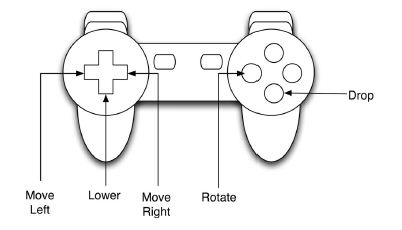
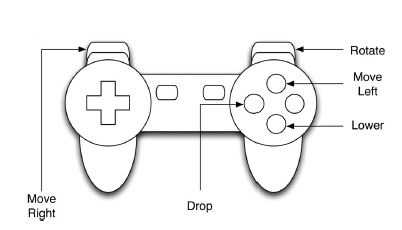
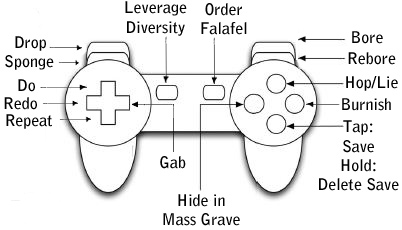
In Study 3, half the subjects played Tetris with normal, intuitive controls (see Figure 1) while half of them played with controls that were deliberately made to be counter intuitive and difficult to master right off the bat (see Figure 2). Just imagine trying to remember that the triangle button was for moving left, but that the left trigger was for moving right and the square button was for instantly dropping a block to the bottom of the screen –all under constant time pressure. In study 6, the researchers moved beyond thwarting competence just by making the controls tricky; they actually increased the difficulty of the game. Subjects once again played Tetris, but for some of them the researchers thwarted their sense of competence by modifying the game so as to analyze the situation at the bottom of the board then give them the absolute worst possible block. Need a long, skinny block to slide into a 1×4 gap and complete four rows at once? Screw you. Here’s a 2×2 block. Feeling aggressive now?

Figure 1

Figure 1, taken from Przybylski (2014)

All throughout the seven experiments, the researchers included measures of both control mastery, competence in general, and aggressive thoughts, emotions, and mental states. The short version of the results is that video games could make people feel aggressive and think violent thoughts simply by thwarting their sense of competence, either through difficult to master controls or general difficulty. This was true even in the absence of violent imagery.

Figure 2

Figure 2, taken from Przybylski (2014)

This makes a lot of sense to me. Many of us have been in multiplayer matches where your team just plain sucks, and no matter what you do you can’t keep the opposition off the capture points or away from your flag. That undermining of your competence is frustrating and leads to rage quitting. So can difficult to use controls in any game. Just recently I was playing through the new Thief game and got frustrated with it when I couldn’t line Garrett up to jump up and grab a dangling rope so I could get him away from a patrolling guard. I actually pounded my desk in frustration after the third attempt because I felt that this should be SO SIMPLE yet I couldn’t do it.

Figure 3

Figure 3, not actually taken from Przybylski (2014)

It’s worth noting that Przybylski et al.’s 2014 paper doesn’t address the question of whether or not violent games can make one violent, either in the short or long term. For example, it didn’t look at whether violent and nonviolent games with equal difficulty and frustration potential could affect children the same or differently. But that wasn’t necessarily the intent, Przybylski told me in an e-mail. The point was to show that games are complex, as are our interactions with them, and there are many theories about what makes for fun, frustrating, or enjoyable game beyond just how much red is on the screen. Alternative explanations for the effects of video game violence abound, and psychologists studying video games needs to better understand their nature and systems before designing research on them. This is why some of the best research on video games and psychology is starting to come out of people who grew up with the hobby and now getting established at universities and labs.

The violence in video games scene needs to move beyond simply “do they or don’t they” and look more carefully into what qualities of the game might or might not be more important for a variety of outcomes.

Follow me on Twitter, Facebook, or RSS.

01 Jul 20:56

Why does refactoring make code simpler?

Last week, I wrote about methods with consistent return values, and how they’ll make your code simpler. But how does that happen? How can the right refactoring make your code easier to work with? What makes good abstraction good, and bad abstraction bad? I mean, you can’t just blindly rearrange your code and end up with quality software.

If you can learn why these techniques work, you’ll be better able to understand where your code needs help. And you’ll be able to use the right tools where they matter most.

What’s the hardest problem in software development?

“There are only two hard problems in Computer Science: cache invalidation and naming things.”

— Phil Karlton

Sure, that quote is everywhere. But there’s actually a harder problem in real-world software development: managing complexity. Complexity in software development has a few different definitions. At its core, though, the complexity of a program is the amount of stuff you have to keep in the front of your mind while you’re working on it.


As you write more software, you’ll be able to keep more stuff in your head at once. But even the best devs have limits. If your project is too complex, you’ll overload what your mind can handle, and you’ll start forgetting about different areas of your program. And the worst bugs show up when you make a change in one part of your project without realizing how the change will affect a totally different part of the same project.

Simplifying through assumptions

If you had photographic memory, and could remember how all the different parts of your program fit together, you’d have a lot fewer bugs, right? Memory can be hard to build. But you can get a lot of the same benefits from being able to focus on one thing at a time.

Many best practices in software development are about reducing the number of things you have to keep in your mind at once. A few examples:

  • Consistency in your return values means you only have to think about how to deal with one kind of data, instead of different kinds of data in different situations.

  • Abstraction is a way to hide code behind a simpler interface. With good abstractions, you can just think about how the abstraction should act, and you don’t have to worry about how it works on the inside.

  • Testing can keep you from accidentally breaking code in one area while you’re working in another. You can assume that anything you accidentally break will be caught. This means you can focus just on the code you’re working on, and fix anything you break later.

  • Test-Driven Development will help you write code that will work the way you expected it to work. You can concentrate on writing the simplest possible implementation of your method that passes the tests. If it’s too simple and doesn’t actually work as you’d expect, your tests will catch it.

When you use these techniques in the right way, you can make some good assumptions. With these assumptions, you don’t have to keep anywhere near as much in the front of your mind. You can write better, more reliable code, because you don’t have to worry about the nearly infinite consequences your code could have on the system.

On the other hand, using these techniques in the wrong place will hide code that you actually need to see. By hiding the code, the assumptions you make will sometimes be wrong. This makes it even more likely that you’ll end up breaking it!

That’s why bad abstractions are worse than no abstraction at all, and why you can’t just throw “extract method” at code until it magically becomes good.

Right refactoring, right place

Clear code is code that’s up-front about what it’s doing. Showing what you’ll need to know is as important as hiding what you don’t need to know. When you perform a refactoring, or use a software best practice, you should think about the code you end up with, and how well it’s helped you reduce complexity. Are you helping the rest of the code make good, simplifying assumptions? Or are you burying essential knowledge behind a too-simple interface?

P.S. I wrote a book about learning Rails without feeling overwhelmed. Get a free 38-page sample here.

01 Jul 01:18

Hobby Lobby: Your Thoughts, Ctd

by Andrew Sullivan

The in-tray remains full of your insights. One reader writes:

Your first reader’s reaction - that it’s troubling the Court made a point to protect only an evangelical Christian belief – is really interesting. This whole case hinges on construing the Religious Freedom Restoration Act, and RFRA was a direct legislative response to very similar reasoning in Smith v. Oregon.

In that majority opinion, Justice Scalia said Smith had no constitutional right to exercise the religious practice in question (use of 1024px-Peyote_Cactuspeyote in a Native American ritual). Or rather, he said the state of Oregon’s interest in preventing abuse of peyote outweighed Smith’s religious freedom. He made a point of saying part of the balancing act was the fact that the religion Smith adhered to was not widely practiced, and therefore very few people’s religious rights were trammeled by Oregon’s law.

The dissent put the question to Scalia: what happens if a state outlaws use of sacramental wine in the interest of preventing alcohol abuse? Scalia’s explicit reply was: oh please, that will never happen because Catholicism, and other denominations, have so many adherents. Such a law could never be supported democratically, so the issue would never arise. He stood the Religion Clauses on their head; they weren’t there to protect religious minorities from the democratic will of “overweening majorities”; they were there to do just the opposite. Many, many people found that outrageous, and Congress (very much including Democrats) passed RFRA as a direct rebuke to Scalia’s opinion.

So, Hobby Lobby is now the second modern case I know of that singles out a widespread religious practice for protection, while denying it to similar practices of smaller faiths. And this case did it while being decided on the basis of legislation passed as an explicit disavowal of that first case. That’s a nifty bit of bendy logic to pull off, and a bit of a “fuck you” to the legislative branch.

Another reader reiterates the fair and important point that this was not about contraception as such, but contraception believed to be a form of abortion:

You stated: “The notion that the executive branch has the right in wartime to seize an American citizen and torture him into incoherence strikes me as a more important question than whether someone can have access to free contraception if her employers disapprove.”

What this ignores, and what most of the responses to the SCOTUS ruling on the Hobby Lobby case ignores, is that the thing that makes this more important to the religious right is that these people think the morning-after pill kills babies (and they believe this even of intrauterine devices); whereas the enemy who is tortured into incoherence is (1) still alive, in most cases, and (2) the corporate entity may be paying for it at a remove, but their taxes are not labeled as “for torturing prisoners.” I’m not defending their crazy views, mind you; but unless we realize that they really, really think this, and that’s what they’re upset about, I don’t see any way of effectively putting this to rest, the way we pretty much have done with blood transfusion refusers and snake handlers.

I hope at least some liberals grasp that being required to finance something you believe to be murder is a legitimate area of conscientious objection.

01 Jul 00:58

3D printed Princess Bubblegum crown

by Cory Doctorow


The Princess Bubblegum Crown, $30 from Etsy's Carry The What, is a pretty sweet fashion accessory for the Adventure Time fan who's got everything. You can download and print your own, if you've got a 3D printer.

01 Jul 00:41

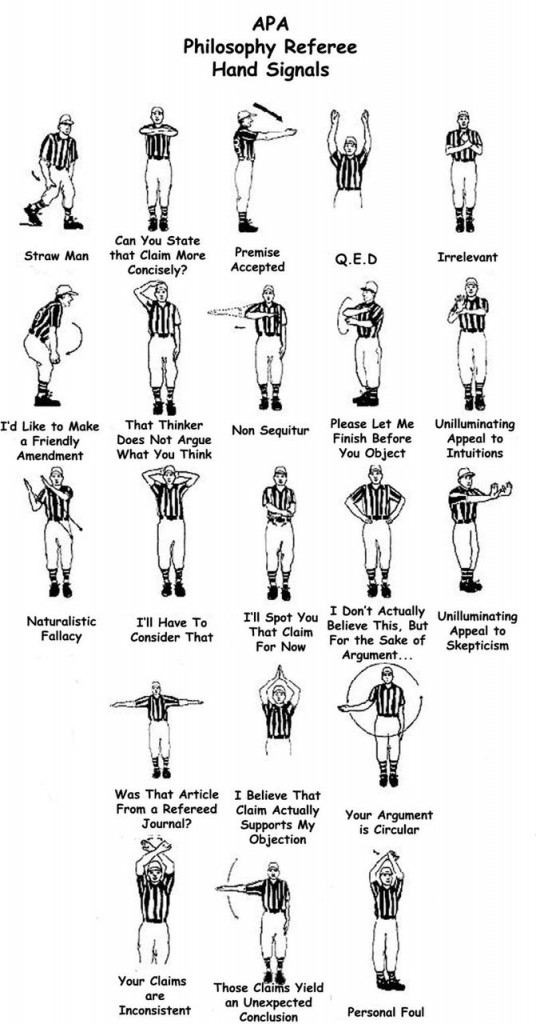
Philosopher referee hand-signals

by Cory Doctorow
30 Jun 04:01

What’s Your Favorite Way to Earn Money?

by Steve Pavlina

One thing that a lot of employee-minded people suffer from is opportunity blindness. They’re surrounded by fun and expansive ways to earn plenty of money, but they have a hard time seeing those opportunities. They’ve been socially conditioned to think that getting a job is the one and only way to earn money for them. They complain about a lack of opportunities. But the reality is that they’re blinded by their own limiting beliefs and an inflexible attitude.

Earning money from a straight salary is just one of many ways to generate income. There are many others though.

Here are some ways I’ve earned income in the past (some of these are still active for me):

  • straight salary
  • tutoring
  • cash for simple jobs
  • shoplifting
  • buying and reselling products (buy low, sell high)
  • web consulting
  • contract programming and design
  • personal coaching
  • advertising sales (direct)
  • advertising sales (commissions)
  • affiliate commissions
  • joint-venture deals
  • licensing (software)
  • royalties (computer games)
  • book royalties
  • cash advances from publishers
  • donations
  • paid speaking
  • barter
  • interest on bank accounts
  • certificates of deposit
  • stock investing
  • stock trading (short term)
  • mutual funds
  • direct sales (online products)
  • direct sales (physical products)
  • live events (selling registrations)
  • co-creative projects (split the income)

I’ve probably forgotten a few others, but suffice it to say that I’ve experimented a lot with different ways to earn income during the past 22 years.

Some of these approaches were terrible matches for me. I found them so boring or tedious that I could hardly motivate myself to do them. Others were enjoyable but just didn’t pay well at all.

Along the way I discovered the kinds of income streams I like best. I like income streams that:

  • engage my creativity (I get paid to create something)
  • feel stimulating
  • involve some risk (it’s more fun that way)
  • are flexible and adaptive (so I can tweak them and experiment in different ways)
  • have a low downside and a high potential upside (I hate having a fixed ceiling on the upside)
  • are social (working with people, not just doing solo work all the time)
  • tie into my path of personal growth (I love testing new streams because I always learn something)
  • contribute positively to society

Presently my favorite way to earn money is from doing live events, such as the upcoming Conscious Life Workshop in August. There are several things I really like about this type of income stream:

  1. I get paid to create. When I was a computer game developer, my favorite part of the work was game design. I loved working in the space of pure creativity — the space of ideas. Anything was possible, but there were also practical constraints to deal with. I love designing live experiences too, such as games and exercises to help people transform their lives. Applying my creativity to workshop design is a great way to distinguish my workshops from what other people in the personal growth field are doing. I love to create holistic, immersive, fun, interactive, and stimulating experiences. I like to keep attendees in the sweet spot of stimulation, much like a good computer game does — not overwhelmed and not bored, but fully engaged. This is based in large part on lessons I learned from game design. I love that I can leverage my previous career lessons to benefit this one. I also feel like I’ve just scratched the surface here in terms of what’s possible; there are so many more ideas I’d like to try.
  2. I never know how much I’ll earn in advance. If I had a straight salary, I’d probably die of boredom. It’s much more fun to have some suspense in my income. I can’t predict how many registrations will come through. The unpredictability makes it fun. Every registration is a surprise.
  3. It’s fun to earn money in frequent but sizeable chunks. As each registration comes in, I sometimes like to associate it with a pretend prize, like I won something on a game show. Oooh, a new iPad. There’s a meditation retreat in Sedona. And here comes a new bike. Even if I don’t actually spend the money that way, it’s fun to fantasize about what could be done with each sale… or with the net proceeds from an event. In reality I tend to be fairly frugal financially relative to my income, but I see no need to be frugal in my imagination.
  4. Every sale represents a new social connection. My workshops generate lots of repeat business, so quite often I recognize the names on the registrations as they come in. To me this represents either a new potential friend I’ll get to meet in person, or an existing friend I’ll get to see again. One sale for my first 2009 workshop even turned out to be my future girlfriend.
  5. Every sale represents a potential transformation. People sign up for workshops because they’d like to change or improve something about their lives. Live events pack in so much more transformational potential than books, online courses, or home study courses, in large part because they surround you with like-minded people who are working on similar transformations. So when each registration comes through, I also love to think about the person whose life will change from being there. Every sign-up means new positive ripples.
  6. I get paid well in advance of doing most of the work. It does take some work to scout for venues, negotiate contracts, create the event web page, and get the order processing set up. But since we have to book events and start taking registrations far in advance to give people enough time to make travel plans (about 30% of our workshop attendees fly in from outside the USA), I do most of the detailed planning work closer to the actual event. This is sort of like getting an advance from a publisher to write a book. It’s nice to know that there will be real people in the room to benefit from the time and energy I invest in the event. I don’t have to do all the work “on spec” on hope that people will sign up.
  7. I can customize the event for the actual attendees. I get a chance to hear from a lot of the people who are registering to learn what they want to get out of the event. Sometimes I have a separate auto-responder that gets sent out a little while after people register; it invites them to email me back with more information about their personal challenges and what kind of transformation they’d like to see. I read and review all of this feedback when I do the detailed design work for the event. This allows me to custom-tailor the material and exercises for the people who actually signed up. Because of this I never do the same workshop the same way twice. Every event is a different experience.
  8. There’s some risk but not too much. I do have to put some skin in the game by taking a little financial risk to book a new event, but so far I’ve never lost money on an event. The risk is enough to make it interesting. There’s a part of me that still likes to entertain thoughts like, what if no one signs up? Having some risk makes it more stimulating for me.
  9. I get paid for doing something that used to scare me. That’s something I especially love about getting paid for public speaking. I used to dislike it very much. In my youth I was one of the worst in my class at it. I used to wish there’d be an earthquake on the day I had to give a 5-minute speech or presentation, hoping that I wouldn’t have to do it then. Eventually I recognized that facing fear is part of my path of growth, and I invested heavily in overcoming this fear and turning it into a valuable skill. Now I absolutely love speaking and doing live events, and I often speak at other people’s events for free, just for fun. Knowing that I used to fear and resist speaking adds an extra edge of sweetness to the experience every time I do it. It also validates for me that I’m walking my talk. I know that investing in personal growth pays off because otherwise I wouldn’t even be able to do what I can do now.
  10. I grow from doing workshops. A major lesson I learned many years ago is that my writing and speaking has to keep pace with my own path of growth. It’s difficult for me to write and speak on topics that I feel I’ve pretty much mastered. There’s no growth for me in that type of sharing, so the work becomes stale and boring. The best creative energy flows through me when I’m surfing on the edge of my comfort zone or when I’m writing and speaking about topics that I’m actively exploring. Even though I’ve experimented with income generation a lot already, it’s still a topic that’s of great interest to me today. Lately I’ve been exploring co-creative income strategies (including being involved in a co-creative workshop in Bucharest last year and a co-creative, soon to be released new product). Doing a workshop to help people explore fun, creative, and engaging ways to earn money aligns very nicely with my own path of growth right now. I fully expect to enjoy some transformational gains from the workshop too, just as I’ve experienced from previous workshops.

Your favorite way to earn money will probably be different from mine. My goal isn’t to encourage you to copy my approach but rather to copy the general idea behind it. The idea is to align your income generation strategies with your personality. I love stimulation, creativity, and a bit of mystery, and I find it much easier to earn money when I weave these aspects into my income streams. If my income streams were fixed and secure, I’d be so bored that the motivation to do the action steps would drain out of me.

Do you find it easy to earn money? If so, then I’d say you probably have a good alignment between your income strategies and your personality. But if it seems like earning money is a struggle and if you’re frequently pushing against the urge to procrastinate, then you’re probably missing the sweet spot. Maybe you’re a very security-minded person who’s stressing out over too much risk. Or perhaps you’re a highly creative, stimulation-loving person who’s trying to use someone else’s mind-numbingly boring “system” to generate income in the most uncreative ways.

If you had told me in the early 1990s that I’d love earning income from doing live personal growth events, I’d have thought you were nuts. That’s the benefit of experimentation. If I hadn’t kept trying new ways of earning income, I wouldn’t have found such a delightful sweet spot.

What you’re really looking for is a strategy for earning income that is both motivating and effective.

If it’s motivating you’ll actually do it. You’ll take the necessary action steps. You’ll do the work because you like it. Procrastination shouldn’t be a serious issue.

If it’s effective you’ll get good results with it (i.e. a very nice income). Positive results will help fuel your motivation as well, which in turn will generate even more positive results. That’s the sort of upward spiral that will keep you going.

I enjoy public speaking to such a degree that I’d do it for free. I know because I still do a lot of speaking for free, even if it means traveling to another city just to speak for an hour or two. But when I can also generate substantial income from it, it’s even sweeter. That makes it easier to justify doing more immersive events, like a 3-day workshop.

Have you discovered an income strategy that really hits the sweet spot for you? If so, what is it? How did you discover it? I’d love to hear your feedback if you feel like sharing.

Incidentally, helping you align your personality with your income generation strategies is something we’ll be working on together at the Conscious Life Workshop, along with many other personalized techniques to discover your unique path to abundance. So if this is an area where you want to work on some inspiring transformation together, then hop on a plane to Vegas and join us. :)


Conscious Life Workshop (CLW)


Aug 22-24, 2014

Golden Nugget Hotel & Casino, Las Vegas


CLW is a powerful new lifestyle design workshop. At CLW you'll explore and discover how to make your path with a heart financially sustainable. Learn how to center your life around doing what you love while you generate abundant income from your interests to fuel your desired lifestyle.


Learn more...


Registration: $597


Steve Recommends


Site Build It! - Start your own money-making website

Lefkoe Method - Eliminate a limiting belief in 20 minutes

PhotoReading - Read books 3 times faster (discount for my readers)

Paraliminals - Condition your mind for positive thinking and success (discount for my readers)

Getting Rich with Ebooks - Use ebooks to create streams of passive income

Sedona Method (FREE audios) - Release emotional blocks in a few minutes

The Journal - Record your life lessons in a secure private journal

Life on Purpose - A step-by-step process to discover your life purpose


If you've found Steve's work helpful, please donate to show your support.

Get Steve's Free newsletter

Uncopyrighted by Steve Pavlina

30 Jun 03:53

Speaker for the Dead, introduction, in which we solve a mystery by studying its genetics

by noreply@blogger.com (Will Wildman)
It's been a hell of a ride, hasn't it?  This is the final Speaker for the Dead post, and July is a novel-writing month, so I wouldn't count on a lot of new blog content during that time.  After that, I may return with Ender's Shadow, the retelling of Ender's Game from Bean's perspective, which I still consider to be Card's best novel (I just think that's a lower bar than I used to).  Or maybe I'll move on to something else entirely.  Maybe something good?  Or at least better?  Erika the Blogqueen has contemplated doing a series on Mistborn; I've got like eighteen books partly read lying around my apartment and half of Wheel of Time that I inherited from a former roommate.  We'll keep you posted on our post-July posting plans.

(Content: ableism, partner abuse, racism. Fun content: y'all like point-form lists, right?)

Speaker for the Dead: p. ix--xxii
Introduction

So... Speaker for the Dead, eh?  What was up with that?  It takes some careful planning to create a story where all of the problems exist solely because people would literally rather die than ask a direct question.  As I belaboured back in chapter fourteen, Ender was in a much better position to play an antagonist who proves to be a friend than he was to be the hero, yet he's presented to us as the hero because he's the only one who isn't afraid of the truth.  This needs explaining, and in the spirit of Speaker for the Dead, I'm going to argue that we can figure out what caused this atrocity by tracing back its evolutionary history to a catastrophic plague the 1980s.
Speaker for the Dead is a sequel, but it didn't begin life that way--and you don't have to read it that way, either.  It was my intention all along for Speaker to be able to stand alone, for it to make sense whether you have read Ender's Game or not. Indeed, in my mind this was the "real" book; if I hadn't been trying to write Speaker for the Dead back in 1983, there would never have been a novel version of Ender's Game at all.
Interesting premise.  Let's summarise Speaker for the Dead by chapter:

  1. Pipo rescues young Novinha from sadness by taking her in as his daughter (in a weirdly romantic relationship with her pseudo-brother), then is horribly murdered by the mysterious primitive aliens.
  2. Ender Wiggin is super-smart and philosophical and a three-thousand-year-old war hero, and people have very strong opinions on the morality of being an alien because his ultra-brilliant sister wrote an essay about fjords a couple of months ago.  He also owes a mysterious debt to someone.
  3. Novinha hides all the science that somehow led to Pipo's confrontation and death, and also breaks up with her pseudo-brother to protect him, but also summons Ender Wiggin to cross the galaxy to solve the mystery that she believes must never be solved.
  4. Ender Wiggin's girlfriend is the internet and he's super rich and he carries the last survivor of his accidental genocide. 
  5. Ender Wiggin breaks up with his newlywed pregnant sister to cross the galaxy in a private star cruiser in hopes of protecting aliens.  His best student figures out the truth and devotes her life to serving his sister's family.
  6. Novinha's children are terrible.  Ender arrives and immediately astonishes the mayor with his knowledge and history, learns that Libo died after all, scares children because the Bishop has told them he's the devil, and befriends one of Novinha's kids.
  7. Novinha's children are terrible.  Ender enters their home, subdues them by physical force or argument, refuses to leave, and tells them how foolish they are for not understanding their little brother.  Novinha's dead husband used to beat her.
  8. Novinha comes home.  Ender tells her he knows everything, she's a terrible mother, and he will redeem her.
  9. Ender's literal internet girlfriend Jane reveals that all of Novinha's kids were fathered by Libo.  Libo's kids, Miro and Ouanda, are bad at science.
  10. Ender befriends the local monastic sect because he was besties with their founder two thousand years earlier.  Jane distracts Ender, so he switches her off for a bit.
  11. Being cut off from Ender for an afternoon utterly devastates Jane and she spends the equivalent of 50,000 years in recovery, then sparks an interstellar police action.
  12. Ender is super rich, Novinha is obsessed with him, and her children are fractionally less terrible now that they're obsessed with him as well.
  13. The aliens demand to meet with Ender because he is everything.  Ela reveals to Ender that she's secretly been doing real science for years.
  14. Miro and Ouanda take Ender to meet the aliens.  Ender tells them that they're terrible scientists, and the aliens then reveal everything to him because he's so important.
  15. The government locks down the planetary computers, but they save some vital information because Ender is special.  Ender makes the entire colony sympathise with a dead abuser by explaining that he couldn't have kids and his wife cheated on him.
  16. Everyone tells each other everything now that Ender is there.  Miro wants to run away to the forest to marry his sister, but grievously injures himself instead through terrible science.  The colony rebels because Ender is so special that he can completely prevent any consequences to rebellion for the next thirty years.
  17. The aliens tell Ender everything else they haven't said.  Ender teaches them how not to be terrible warmongering savages, signs a contract, and ritually murder-metamorphoses an alien volunteer to seal the deal.
  18. Miro is permanent disabled and shoved in temporal storage for later.  Ender gets the girl, brings civilisation to the primitive aliens, learns that his sister is uprooting her family to come meet him, and revives the last survivor of his war crime, clearing his conscience.
Now, on the one hand, this synopsis does make it clear that there wouldn't be much of this book left without Ender there.  On the other hand, without Ender's Game as background, Ender literally never earns anything--he's just a brilliant rich straight white male ex-soldier poet-priest whose very presence elicits awe even from people who claim to hate him.  I'm curious if anyone has read Speaker and not Ender's Game, and whether they found Ender remotely sufferable.  I find him aggravating and I've read about all the harsh childhood and suffering and abuse that is supposed to have turned him into who he is in this book.  (I've even read Ender in Exile, y'all.  Never let it be said I'm not dedicated.)

Back to the introduction.  Card explains that the 'speaker for the dead' concept is the result of his dislike for eulogies that erase anything uncomfortable about the dead person and therefore make them less like real people in memory.  He insists that the only story worth telling (despite it being unknowable) is the story of what the person meant to do with their life.  I'm a little unclear on how this is possible--surely, if the true story is unknowable, then the speaker has to take a guess at it, and in doing so they still erase the real person in favour of an explanation that makes sense to them and is therefore "much easier to live with", which is exactly the problem he has with 'normal' eulogies?

This really gets to the heart of the problem, because Card insists that intentions are all that matter to morality, but even he admits that we can never really know what a person's intentions were.  In that case, the logical conclusion seems to be that we can never know how moral a person is, and maybe then we end up at the traditional Christian 'judge not', but Ender's assertion seems instead to be that everyone has good intentions all the time and therefore they are ultimately good even if shallow outsiders think they're 'bad' just because they do stuff like start bar fights and abuse their families.

The next point is interesting:
So when I thought of the idea of an alien species which, in order to reproduce, had to slaughter each other in terrible intertribal wars, it was only natural that I decided the story should be told from the viewpoint of a human scientist studying them.  Only gradually, over several years, did I develop the idea of the piggies and their strange lifecycle, and the intertribal war receded in importance--so much so that I didn't need to make it an issue in Speaker for the Dead at all.
This explains a fair bit--the wars (which play some kind of vital role in Little One society by allowing males to go tree without having to be selected by the females, circumventing their usual honor-related system) seem like they should be a bigger deal, and everything that happened to Pipo and Libo would make more sense if the Little Ones specifically required speedy, violent death, but that wasn't the story Card wanted to tell.  He also couldn't quite bear to get rid of it (and it does allow for that great scene where civilised white Ender teaches primitive little Human about non-aggression treaties and peaceful alliances), so it stayed in some vestigial form, an offshoot that evolution doesn't really need but hasn't had cause to eliminate either.

Originally the role was the Singer of Death, but Card's wife pointed out that all of his acclaimed works had some kind of music thing going on, so he ditched that and attached instead to the only one that didn't: the short story of Ender's Game.
What if Ender Wiggin comes to an alien world as a Speaker of Death, and accidently gets caught up in the mystery of why these piggies are slaughtering each other? It had a delicious symmetry to it--the man who, as a child, destroyed one alien species now has a chance to save another.
On the one hand, I think Card made the smart choice here by having the ultimate threat be 'scared humans with guns' rather than having to understand why the primitive aliens keep slaughtering each other when it's actually harmless.  On the other hand, the story we have got is basically 'humans colonise a planet wrong, so Ender teaches them to colonise it right and the primitive natives are much better off, and this makes other humans angry'.  At no point do we seem to have any hope of 'humans discover the aliens are actually handling their own affairs just fine and if they'd stop trying to force the aliens into human institutions we'd all float on okay'.  One way or another, regardless of whether the endless reproducto-war is centre stage or an afterthought, we're pretty sure that Ender needs to save these people from their ignorance.

Card set up the deal for Speaker of Death in 1983, only to find:
...that the book was unwritable.  In order to make the Ender Wiggin of Speaker make any kind of sense, I had to have this really long, kind of boring opening chapter that brought him from the end of the Bugger War to the beginning of the story of Speaker some three thousand years later!  It was outrageous.  I couldn't write it.
Card then details the short conversation that abruptly led to him having a contract to do a novel of Game before Speaker, but I'm left confused.  That's quite literally what this book does for the first few chapters: show us Ender of three thousand years later, rich and respected and forgotten, and tell us all about his childhood achievements.  What made the original 'outrageous' draft so different?  (Card acknowledges that Ender Wiggin wasn't really a full character until he fleshed out Ender's Game, which is a fair point and presumably made a difference in trying to approach Speaker, but that's not a problem with the story of Speaker, that's a reminder that you have to know your characters before you can write them, or you'll be visibly flailing to figure out their deal on the page.)

With Ender's Game written, he approaches Speaker again, starting with Ender arriving on Lusitania to speak the death of "an old lout named Marcão", but two hundred pages in found it hollow, even after adding Novinha, Pipo, and Libo.  Card was on a trip with a friend and former student, Gregg Keizer, who took some time to read the manuscript of Speaker.
He had many good ideas. Of course, most of them dealt with small fixes for problems in the manuscript as it now stood. One comment he made, however, illuminated everything for me. "I couldn't tell Novinha's kids apart," he said. "I couldn't remember which was which."
This, Card tells us, was the key.  Novinha's kids were "nothing but placeholders", like a younger sister in another novel whom he would forget existed for hundreds of pages at a time until he finally decided to retcon her into dying in infancy, because I guess the death of a baby sister is exactly the same as her never existing?  But he couldn't just cut her kids:
Because I wanted Novinha to be voluntarily isolated, I had to have her be otherwise acceptable to her neighbors. In a Catholic colony like Lusitania, this meant Novinha needed to have a bunch of kids.
Wait, what?  There's an entire sect of teacher-administrators on this planet whose whole deal is that they are married without children.  (I'm not entirely sure what to make of the assertion that Novinha is and had to be voluntarily isolated, given that we're told she was isolated from a young age because no one took the time to understand her and for the rest of her life no one tried to stop Marcos from beating her--Card's insistence that Novinha literally signed up for physical abuse still horrifies me.)
Once you've read Speaker, of course, you'll wonder what the story would be without Novinha's children, and the answer is, It wouldn't be much!
Novinha's children, in order of relevance:
  • Miro: informed almost-protagonist, fails to get useful information, gets permanently injured trying to run away to marry his sister, gets put in storage so people don't have to deal with him being all physically disabled at them.
  • (Honorable mention because she's not Novinha's kid: Ouanda: like Miro, but female and therefore less important.  Does basically nothing of consequence; exists mostly to assist Ender, be told she's screwing up, and create angst for Miro.)
  • Ela: runs the actual household and does the actual science.  Gives Ender vital information a few times and tells everyone that all of their problems are Novinha's fault.
  • Olhado: gives Ender vital information several times and likes him first.  Records key incidents with his cyborg eyes because a pocket camera just wouldn't feel sci fi enough.
  • Grego: poster child for broken household, violent, needs proper physical discipline from a strong man.
  • Quim: religious zealot, shows that even Ender's least-rational fanatical enemies like his work.
  • Quara: like Grego, but female and therefore less important.  Quiet, needs signs of affection from a strong man.
Card goes on to complain that genre heroes never seem to have parents and we never see them grow up and become parents either, and he's not wrong about that.  Showing protagonists as part of a larger family makes a big difference and we could do with more.
The romantic hero is unconnected. He belongs to no community; he is wandering from place to place, doing good (as he sees it), but then moving on. This is the life of the adolescent, full of passion, intensity, magic, and infinite possibility; but lacking responsibility, rarely expecting to have to stay and bear the consequences of error. [....] Only when the loneliness becomes unbearable do adolescents root themselves [....] many fail at adulthood and constantly reach backward for the freedom and passion of adolescence. But those who achieve it are the ones who create civilization.
Card decided that, if he couldn't write a parent's perspective, he could at least write the perspective of an adult who feels responsibility to a family, and thus this book was an opportunity to show"the miracle of a family in transformation".  This, at least, explains a little more of why Novinha is such a non-entity in her family.  Card had already decided that the caring adult was Ender, and Novinha was 'voluntarily isolated', so there was no hope of her actually doing anything for her kids.

This undertaking, Card wants us to know, was haaaaard:
Most novels get by with showing the relationships between two or, at the most, three characters. This is because the difficulty of creating a character increases with each new major character that is added to the tale.
Characters A and B just have an A-B relationship, he explains, but add C and you've got A-B, A-C, B-C, and A-B-C.  And we change all the time depending on who we're dealing with, so A might be a very different person with B than with C, and so each one is multiplied and it's so hard.
What happens, then, when you start with a family with a mother, a dead father, and six troubled children, and then add a stranger who intrudes into the family and transforms every one of them?
In this book?  Apparently you reduce half of them to caricatures and ignore the relationships that aren't with Mighty Whitey.  Quick, someone tell me how Ela's relationship to Miro changes as a result of the transformative impact of Ender's presence on both of them over the course of the story.  (I'm pretty sure they talk to each other... once in the whole novel?  Was it once?)
I sat there with Gregg, assigning some immediate and obvious trait to each of the children that would help the reader keep track of them. Oh, yes, Olhado is the one with the metal eyes; Quara is the one who says outrageous things after long silences; Grego is the violent one; Quim is the religious fanatic; Ela is the weary mother-figure; Miro is the eldest son, the hero in the others' eyes. These "hooks" could only serve to introduce the children--I'd have to develop them far beyond that point--but having found those hooks, I had a plan that would let me proceed with confidence.
I'm not sure I have anything left to say about how far these characters have been developed beyond the lines above that I haven't already said over the last six months and three weeks.  Perhaps it will suffice that ppfffbbfbttthaaaaahaaaahahahahaha.

Card notes as well that Jane wasn't in any of the original outlines for Speaker; Ender's computer uplink wasn't sentient (I guess he personally hacked all the things?), but Card started the idea and just enjoye it too much, finding that she brought Ender to life.  This is one of those moments where someone almost has an epiphany and then just barely misses it and runs in the opposite direction: Jane made Ender more interesting because Jane is interesting and Ender's just got a lot of backstory.  Sure, Jane's computer powers are a plot device, but no less than Ender's magical intuition.  Jane could have made a fascinating protagonist, knowing everything and incapable of doing anything without human assistance.

She did apparently get spun off to play a major role in the third book, which came out of nowhere when Card's agent told him she had sold the 'Ender trilogy' to an English publisher.  Card immediately realised that, in the same way that he had turned the Speaker idea into a book by jamming Ender into it, he could turn his concept for another story, 'Philotes', into the third book (Xenocide) by the same process.

Just in case anyone got their hopes up, I'm not reading Xenocide.
Besides--and here you are about to learn something truly vile about me--having a third book would mean that I didn't have to figure out some way to resolve the two loose threads that I knew would be dangling at the end of Speaker: what happens to the hive queen? And what happens to the fleet that Starways Congress sends?
Gotta say, not sure that's more vile than the stuff you happily publish about them disgusting homosexuals, Card.  I mean, sure, self-deprecation can be comedy gold, but it kind of plays better when you're not actually terrible?

There's more rambling that doesn't strike me as vital to our purposes, except that Card loops back to the same thing he said in the last intro, that the story in the book is the result of the reader interpreting and transforming with their mind the materials that the author has put there.  "I hope my tale is true enough and flexible enough that you can make it into a world worth living in."

Flexible, you say?  Flexible.  Okay then.  Let's bend it.

What would Speaker for the Dead become if we cut Ender out of the story and split his part among other people?
  • Chapters 2, 4, and 5 get ditched entirely, along with their obsession with sniping at Calvinist theology that matters so little for the rest of the book.
  • Chapters 6 through 8 can get enormously condensed, because we don't need any time to fawn over the pageantry surrounding Ender's arrival or his invasion of the Ribeira house.
  • Chapter 9: Someone else has to be doing the actual investigation.  I nominate Ela, the only person on the planet who actually does her job (unlike Novinha the UnScientist, or Miro and Ouanda the Missionaries).  The only thing Ela needs to discover in order to set everything off is that she and her siblings were fathered by Libo, not Marcos.  There are a score of ways this could happen, since she's a biologist.  For whatever reason (her insistence on studying Descolada in case it comes back, for example, or her desire to ensure that none of her siblings are going to die from Marcos' disease) she realises that Libo was their father, and this begins unravelling everything she thought she knew about her family history.  Much like Ender, once she knows Novinha didn't hate Libo, she has to figure out why else she would try to cut him out, and steadily comes back to the way Descolada files have been locked away.
  • Chapter 10 can get cut.  So can 11, if scientists elsewhere in the galaxy catch Miro and Ouanda's meddling with the aliens without needing Jane's help, because at least one other scientist also does their job.
  • The rest of Ender's meddling is substantially reworked.  I'm going to suggest that Ela tries to engage Miro with some of the things she's discovered, but he is too removed from the family and focused on his work to particularly care.  Ela argues that he's just repeating what their mother did, hiding in science because she rejected her family, he says it's not his responsibility to fix her mistakes (he considers his future family with Ouanda to be the only one he needs to care about), and we get into those same issues Card was talking about with adolescent heroes never dealing with consequences or families, and the way adulthood means dealing with the situation you are in rather than running off to somewhere fresh.  Miro considers literally moving into the woods with Ouanda and cutting humanity off, since no one else can come through the fence without their clearance.
  • There is still a need for the critical point where Ela confronts people with the truth--the colony knows it will be locked down, and Miro resolves to run away, but Ela drags him and Ouanda and Novinha together (maybe others? Ye Must Love Reapers?) to reveal all that she knows.  Miro and Ouanda have the stark choice to either flee or to try to understand and fix things like responsible adults.
  • Miro, who is his mother's repetition, stays with her and tries to hash things out about why she did everything she did (they both broke so many rules of good science for bad reasons) while Ela and Ouanda go into the woods to resolve the science mystery.  (They agree that if Ouanda comes back with answers, they will rebel to defend the Little Ones, but if they get ritually murdered like Pipo and Libo, Miro will go to stand trial without her to protect the colony.)  As in the book, they know the government has left them with all-or-nothing options and so they, like Ender, toss aside their not-even-half-assed attempts at secrecy, but keep to other anthropological good practice like 'Don't remake other societies in your own image'.  They're also damned sure going to tell the Wives that they think they could, with permission, save the lives of the Mothers with a scalpel, some thread, and a mashed yam, rather than let the males keep that fact to themselves.
  • I don't particularly care if one of them has to carve Human open to seal the contract or not.
  • In a final optional twist, Novinha realises her childhood dream of becoming a Speaker for the Dead to help humanity understand the Little Ones, but not before she (with Bruxinha's permission, if she mentions Libo's infidelity with her) Speaks the death of Marcos herself.
At this point, we've covered the same ground in substantially less time and with fewer asides to talk about how much Calvinists suck and partner abusers are sometimes just misunderstood, which should leave some room to deal with the arrival of the deadly Evacuation Fleet, rather than leaving that for another book.

So now we've got Card's own account of why the hell Ender was in this book: he didn't actually realise he needed to write the other characters until someone read his manuscript and told him to write the other characters.  He was more prepared to write an entire 'prequel' novel about Ender's childhood than he was to figure out what anyone on Lusitania was thinking or doing.  They didn't matter until they were set pieces, the boy with cyborg eyes and the girl who doesn't talk and the young woman trying to be sister and mother and scientist all at once.  He got halfway through the first draft before he acknowledged that they needed some attention.  He already knew which character he identified with: the white guy from another land.

And that, as best I can tell, is what the hell was up with that.  /speakerpulpit
29 Jun 05:31

flagdemoness: Dragon...


flagdemoness:

Dragon Rats!!

http://www.deviantart.com/art/Dragon-Rats-464041682

Go check out DragonsAndBeasties on Deviantart!