Shared posts

18 Oct 08:06

A Prayer for You When Silly Religious Dogmas Are Trying to Kill Your Arousal

by Ev'Yan Whitney

I hear it all the time:

“My religious upbringing is a major inhibiting force of my sexuality.”

And. . .

“I was taught against my sexuality by my [pastor, priest, rabbi] for so long that even though I no longer practice or believe in [religion], I can still hear their voices loudly in my head while trying to have sex.”

And. . .

“They [pastors, priests, rabbis] were so adamant in sex only being experienced between husband & wife that it’s hard for me to make love to my long-term committed partner—even though we love each other & want to spend the rest of our lives together.”

And. . .

“I can’t masturbate without thinking that what I am doing is wrong in the eyes of God.”

Me too.

Even after all of these years, even in the practice of the work I do. . . the feelings of sinfulness, of depravity, of being impure, implanted by passionate sermons & dogmatic beliefs, still rise up inside of my mind & body.

And it hurts. And it’s stupid. And it kills my libido.

But when it happens, I take in a deep breath & exhale. And while I am letting air spill from my lungs, I envision that those ugly thoughts & ancient, misguided beliefs are being expelled from me, like hot steam from a whistling tea kettle.

And then, I say a prayer—to God, to Aphrodite, to Source, or to Whomever it is that is listening Here—one that acknowledges, honors, & recenters my sexual beingness.

It changes nearly every time I conjure the words, but it often sounds a little like this. . .

My sexuality is good.
My sexuality is pure.
My sexuality is Holy.
Because it was created by You.

The juicy things I’m feeling in my body—they were created by You, for Your pleasure, with Your Great Love.

The juicy things I’m feeling in my body—they were created by You, for my Pleasure, with your Great Love.

And through these juicy feelings, through my arousal & my eager search for pleasure, I worship You;
I worship this Body that You have created;
I worship the richness of feeling & being;
I worship the gorgeousness of erotic energy.

For my Glory. For Yours.

I know with my whole heart that You would not create such impulses, such desires, such layers of feeling as a morbid test that proves my devotion to You. I know with all my heart you are kinder, graceful, more sensual than that.

I know with my whole heart that sexual energy is just one other way to commune with you.

And so I do. With all of my might, with all of my heart, with all of my body & soul.

Thank you.

/ / /

Sometimes, this prayer works. Sometimes it wards off those heavy, dark ideas of sin & impurity, leaving absolutely no trace of their slimy, unwelcome sensations.

Sometimes, the prayer, even when said with sincerity, isn’t enough. Sometimes I need a shower to cleanse myself back to a place of sexual liberation, & then I can come back to conjuring sex magic.

And sometimes. . . I need to say “Not today” to my sexual urges; sometimes I need to cease & desist & give space for those harsh feelings to dissipate—allowing however much time is needed: hours, days, weeks, as hard as it is.

The point for the prayer (aside from wanting to get my groove on without those libido-killing thoughts in the back of my head) is that I am consciously rewriting my own spiritual history; that I am making beautiful space for my spirituality to form in a holy, accepting, sex-celebrating container; that I am honoring the holiness of erotic energy in a way that I’ve never been taught to before.

It helps. It’s not a permanent fix, but it helps.

My prayer for you. . .

May you know peace in your sexuality.
May you find a spiritual practice that celebrates its sacredness.
May you celebrate the beauty of erotic energy as a form of worship.
May you feel always at ease that your sexuality is good, holy, & pure.

(Important Note: That’s the way it’s supposed to be.)

27 Jun 22:38

"I did things in my 30s that were ignored by the world, that could have been quickly labeled a..."

I did things in my 30s that were ignored by the world, that could have been quickly labeled a failure. Here’s a classic example; in 1974 I did a movie called Phantom of the Paradise. Phantom of the Paradise, which was a huge flop in this country. There were only two cities in the world where it had any real success: Winnipeg, in Canada, and Paris, France. So, okay, let’s write it off as a failure. Maybe you could do that.

But all of the sudden, I’m in Mexico, and a 16-year-old boy comes up to me at a concert with an album - a Phantom of the Paradise soundtrack- and asks me to sign it. I sign it. Evidently I was nice to him and we had a nice little conversation. I don’t remember the moment, I remember signing the album (I don’t know if I think I remember or if I actually remember). But this little 14 or 16, whatever old this guy was… Well I know who the guy is now because I’m writing a musical based on Pan’s Labyrinth; it’s Guillermo del Toro.

The work that I’ve done with Daft Punk it’s totally related to them seeing Phantom of the Paradise 20 times and deciding they’re going to reach out to this 70-year-old songwriter to get involved in an album called Random Access Memories.

So, what is the lesson in that? The lesson for me is being very careful about what you label a failure in your life. Be careful about throwing something in the round file as garbage because you may find that it’s the headwaters of a relationship that you can’t even imagine it’s coming in your future.


- Paul Williams  (via albinwonderland)
27 Jun 00:51

Reverse engineering Ross Douthat

by John Quiggin

Responding to the latest attempt to breathe some life into the zombie of “reform conservatism”, Matt Yglesias noted a revealing silence on climate change. As he observed

The thought process that ended with this approach is easy enough to understand. Whether climate change is a massive conspiracy orchestrated by Al Gore, 99 percent of scientists, and a dazzling array of foreign governments or a genuine problem is hotly debated inside the conservative movement. Whether or not fossil-fuel producers should be hampered in their activities by regulatory concern about pollution, by contrast, is not controversial. For smart, up-and-coming conservatives to mention climate change, they would have to pick a side on the controversial issue. Do they sound like rubes by siding with the conspiracy theorists, or do they alienate the rubes by acknowledging the basic facts and the coming up with some other reason to favor inaction? The optimal choice is not to choose.

I made much the same point a year ago in response to Ramesh Ponnuru’s <a href=””http://www.nationalreview.com/corner/349428/missing-point-conservative-reform”>plaintive observation that “To be a good reformer [in liberal eyes] a conservative has to agree that the vast bulk of conservatives are insane.”

In this NYT piece, Ross Douthat tries to respond to Yglesias. He ends up both confirming the point regarding climate change and illustrating the true nature of reform conservatism.

Since Douthat can’t refute Yglesias’ point about the craziness of the Republican base, he doesn’t try. Rather, he dismisses the point as “silly” and moves straight to his own apologia for lining up with the crazies. This is rather challenging. As Douthat admits, its not long since Republicans like John McCain were on the sane side of this debate. And it’s not as if the recent evidence (that is, the evidence coming from science rather than the rightwing parallel universe) has changed anything.

Still, Douthat tries desperately to claim that, in following his party where it leads, he is merely responding to the changed circumstances of the post-2008 economic slump. Supposedly, a relatively modest slowdown in economic growth means that it is now imperative to do nothing about climate change.

The best way to understand Douthat’s piece is by reverse engineering his argument as a constrained minimization problem The objective is to minimize the craziness he needs to embrace, subject to the constraint that he must end up in line with the denialist conspiracy theorists who dominate the base. The best approach is to combine the most inflated estimates of the cost of mitigation, with the rosiest projections of the implications of doing nothing.

This is “reform conservatism” in a nutshell. The Republican party is a coalition of crazies, racists and plutocrats. But there is a political requirement to talk about policy in a way that is not obviously crazy, racist or pro-rich. The task of conservative1 intellectuals is to square this circle.


  1. Corey Robin would say that this has always been the true function of conservatism. I’m more inclined to believe that a genuinely conservative approach to politics has some potential merit, not realized in actually existing conservatism. 

26 Jun 22:30

Why isn't there one single universal 'share' icon?

by Xeni Jardin
pix

It makes no sense.

Sharing to a social network or via email is a ubiquitous action nowadays but designers have still not been able to reach a consensus on what symbol to use to represent it. Not only does each major platform use a different icon, but they've each witnessed changes over the years.

Pixelapse explores.

[via Buffer]

26 Jun 22:16

28 Strangers vs 600,000 DCers

by Andrew Sullivan

That’s the measure of this country’s commitment to democratic self-government. The duly elected officials of Washington DC have been moving ahead with plans to decriminalize possession of marijuana, reducing the current penalties from $1,000 and a one-year jail-sentence to a $25 civil fine and a 60-day jail sentence for public smoking. The latest public opinion polls put support for outright legalization in the District at 63 percent:

Washingtonians of every age, race and ethnicity — teenagers and seniors, blacks and whites — registered double-digit increases in support of legalization. Even among those who oppose legalization, nearly half support relaxing punishment for marijuana possession to a fine of $100 or less.

So you have close to unanimity of the city’s residents and voters behind the current proposal. But in America – unlike any other democratic country on the planet – the voters in Washington DC can simply be over-ruled by a handful of congressmen from other parts of the country on the House Appropriations Committee. And so this condescending douchebag from Maryland gets to preach to Washingtonians as if we were incapable of running our own lives:

“Congress has the authority to stop irresponsible actions by local officials, and I am glad we did for the health and safety of children throughout the District,” Representative Andy Harris, the Maryland Republican who proposed the provision, said in a statement.

It’s all for the children! But wait! The House Committee can only remove funding for implementing any such change in the law; it cannot actually change the law. And the only parts of the new law that require funding for enforcement are – yep! -the penalties:

Eliminating the previous criminal penalties … costs nothing. So by preventing funding for DC’s decriminalization law, House Republicans could end enforcement for the few penalties that remain. That would leave DC with decriminalization but no ability to enforce civil fines or jail time — something that looks very similar to outright legalization.

Somehow I doubt that an act of brazen contempt for democracy will lead to a triumph of democracy. The full House will have to vote on this at some point. But, in the last days of Prohibition, you never know.

Update from a reader on Twitter:

@sullydish & don’t forget, they also ban DC from doing needlexchange, which spreads HIV & has caused 1000s of deaths

— Maia Szalavitz (@maiasz) June 26, 2014

26 Jun 22:07

Charitable fundraising: wise as serpents, innocent as doves

by Fred Clark

Tom Jacobs reports on two new studies on the psychology of charitable fundraising. The most effective appeals, these studies suggest, focus on a single child — and that single child can’t be too photogenic.

It seems that potential donors are most likely to give if an ad or mailing prompts them to feel empathy for the children the appeal says the charity is helping. That’s good — empathy is a Good Thing. It’s easier for people to feel empathy with an individual than with a group — an individual child presents us with a story, a group presents us with a statistic. But it’s apparently harder for us to feel empathy for a child who seems too attractive:

“Attractiveness had a negative effect on the help she was extended when her need was not severe,” researchers found in a study published in the Journal of Consumer Research. “Despite her young age, participants apparently believed that the attractive child was better able than the less-attractive child to secure the care and nurturance she required from adults because of her social competence.”

It seems unseemly for charities to consider factors like this. We don’t like to think of them reading publications like the Journal of Consumer Research. We want them to be focused on the most effective ways to help people, not the most effective ways to manipulate potential donors.

But because of that, we’ve come to measure their efficiency and their priorities by commending those charities that spend the least on “overhead” — meaning things like administration and fundraising. That expectation of low overhead means those charities have to make sure their fundraising is as efficient and effective as possible so that it doesn’t consume too large a share of their time and resources. And that means paying attention to studies like those Jacobs tells us about.

Even the most purely altruistic and mission-focused charitable organizations have to do fundraising. That means hiring people who know how to do that — professionals who know how to get results. Their profession, necessarily, involves a different set of skills, knowledge and experience than the profession of the others who work directly on the mission of the charity. And that means their profession also involves a different set of values — values that don’t always easily align with the altruism of the rest of the organization.

I’m reminded again of the dilemma a friend told me about from his days at World Vision. They had found that the imagery that produced the largest response from donors — by far — was a picture of an older, benevolent white man surrounded by poor dark-skinned children. The whiter the man and the darker the children, the bigger the response.

Using such imagery meant reinforcing condescending, colonial attitudes that undermined their mission. But not using such imagery meant having to spend more time and resources on fundraising and not bringing in as much money to fund their projects.

Alan Sader takes up the white man’s burden in one of those inescapable TV ads for Child Fund International.

The benefits of using such colonial imagery were significant and measurable: More people responded by writing checks, and they wrote bigger checks. The detriment of such imagery was harder to measure — the way it undermined the dignity and independence of those served by the charity, the way it substituted a kind of patriarchal benevolence for the justice the organization saw as its mission, the ugly, corrosive racism — is there any other word for it? — that seems to fuel it.

My friend made the case that in the long run, the harm caused by that imagery and the ideology it implied would outweigh the apparent short-term benefits. That was a strong argument, but it was ultimately a statement of faith not backed up by solid evidence or data that could be measured. The existing data weighed against it. That data clearly showed that refusing to rely on such images would mean the agency had X fewer dollars to spend on digging wells, health clinics, schools and economic development. And X was a pretty big number.

See, I am sending you out like sheep into the midst of wolves; so be wise as serpents and innocent as doves. …

26 Jun 21:45

moonsmilk: Stardust the Super Wizard is terrifying. So good!!


moonsmilk:

Stardust the Super Wizard is terrifying.

So good!!

26 Jun 21:31

As Virginia Hughes noted in a recent piece for National...


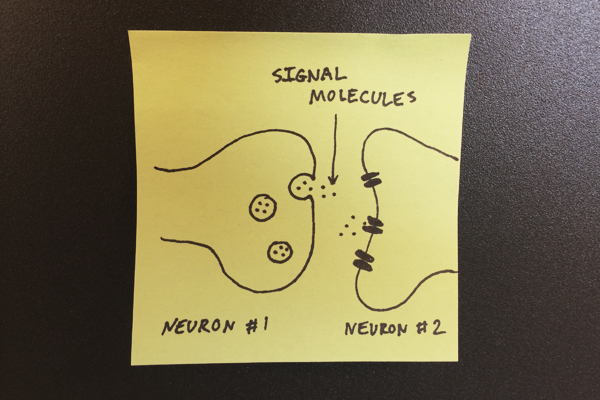
As Virginia Hughes noted in a recent piece for National Geographic’s Phenomena blog, the most common depiction of a synapse (that communicating junction between two neurons) is pretty simple:

Signal molecules leave one neuron from that bulby thing, float across a gap, and are picked up by receptors on the other neuron. In this way, information is transmitted from cell to cell … and thinking is possible.

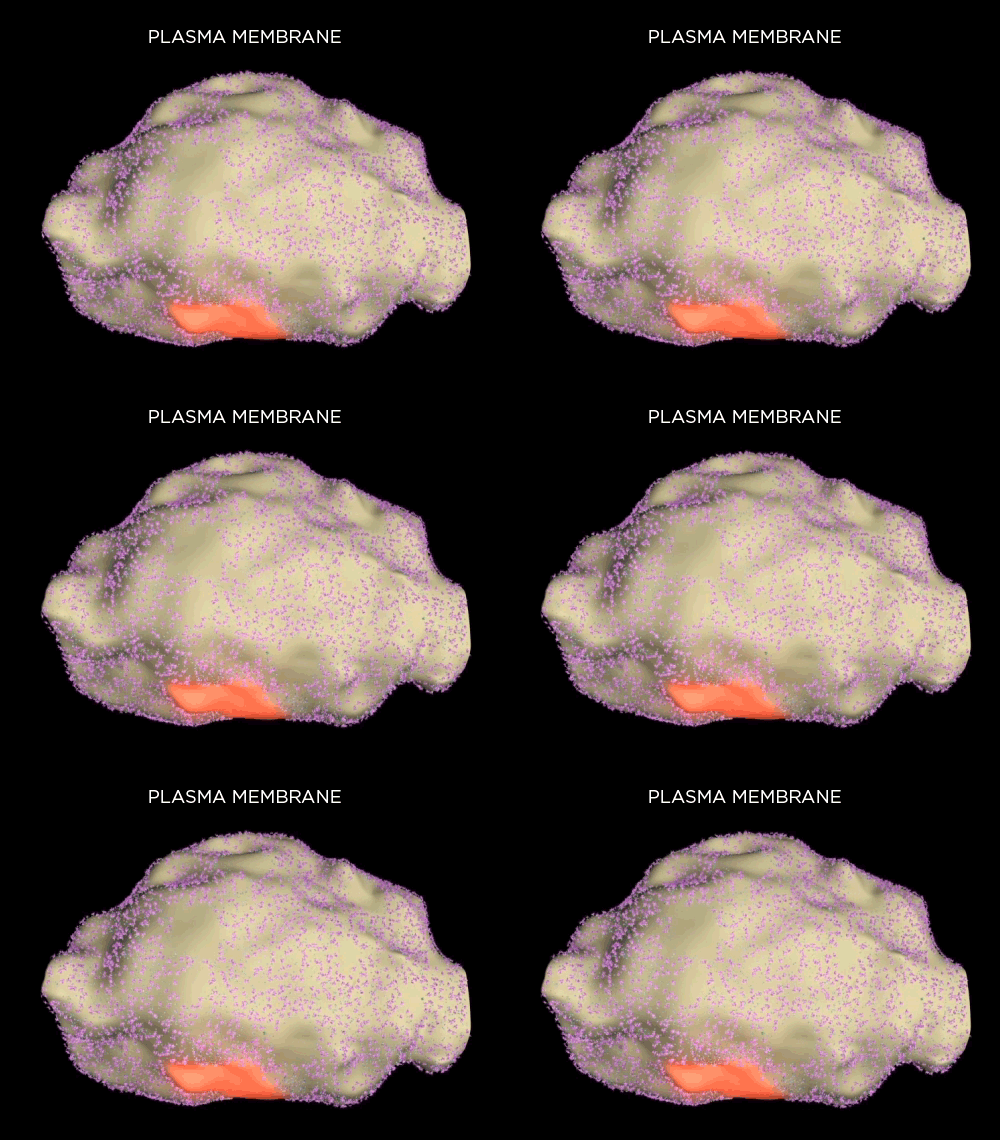
But thanks to a bunch of German scientists - we now have a much more complete and accurate picture. They’ve created the first scientifically accurate 3D model of a synaptic bouton (that bulby bit) complete with every protein and cytoskeletal element.

This effort has been made possible only by a collaboration of specialists in electron microscopy, super-resolution light microscopy (STED), mass spectrometry, and quantitative biochemistry.

says the press release. The model reveals a whole world of neuroscience waiting to be explored. Exciting stuff!

You can access the full video of their 3D model here.

Credit: Benjamin G. Wilhelm, Sunit Mandad, Sven Truckenbrodt, Katharina Kröhnert, Christina Schäfer, Burkhard Rammner, Seong Joo Koo, Gala A. Claßen, Michael Krauss, Volker Haucke, Henning Urlaub, Silvio O. Rizzoli

25 Jun 17:50

Let’s Talk “Lo$ing Faith”

by Elizabeth Stoker

I was pumped to see an excellent set of established and emerging theologians had put out a report on money’s role in politics. You can download “Lo$ing Faith in our Democracy” here. Among the theologians I was excited to see involved were D. Stephen Long and Charlie Camosy, as well as William T. Cavanaugh, whose Eucharistic work I riffed on in my reflection on Maundy Thursday. Does it live up to the hype?

Yeah. It does. For starters, here’s the big consensus issue that forms the theological spine of the whole report:

If there was one principle that our theologians agreed on, it was that the needs of the poor must remain front and center. A number of them substantially focused their teaching on this principle. And they generally felt that the current role of money in politics does not take into account the needs of the poor.

Given the tendency of some theological approaches to resist ‘creative politics’, that is, the use of politics to restructure and reform, I was pumped to see the creative impulse alive and well here, operating under an intent to serve the vulnerable. Another neat note: there was open resistance to pure “procedural justice”, i.e.. the framework that judges distributional programs by their methods of procedure rather than outcome. Most of these procedurally just systems are hooked into desert theory, which is rife with theological problems.

On the subject of God’s love of the poor, Ron Sider dropped this explosively beautiful chunk of wisdom, which rang in my soul like the tone of a bell:

Amazingly, the Bible declares that God so identifies with the poor that when we care for the poor and needy, we truly minister to God Himself (Proverbs 19:17). On the other hand, religious people who neglect God’s summons to care for the poor are not the people of God at all. God rejects their worship (Amos 5:21-24; Isaiah 58:3-7). Those who do not feed the hungry and clothe the naked go to hell (Matthew 25:44-46). Jeremiah declares that we simply do not know God properly if we do not care for the poor. (Jeremiah 22:16). Do these hundreds of biblical verses mean God is biased toward the poor? No. The Bible explicitly forbids God’s people to be biased toward the poor (e.g. Leviticus 19:15). But does God’s lack of bias mean that God is neutral in historical situations of injustice? Again, no.

Precisely because God cares equally for both oppressor and oppressed, God sides with the oppressed to end the oppression so that oppressed and oppressor may become whole. The analogy of good firefighters helps us understand how God is not biased but sides with the poor. Good firefighters do not spend equal time at every house in the city. They focus on burning houses. But their focus on burning houses does not mean they care more about some people than others.

Very interesting — especially the ultimate goal of community wholeness. There are a lot of ways of conceptualizing this — geographically is one novel way — but there is also the matter of treatment and conceptualization. Thinking of the poor as us seems here a necessary and required theological practice, and in that case, how must our politics follow? I personally think this has fascinating implications for means-tested programs: if we’re to work toward wholeness, it would appear that programs serving all of us together might be more conducive to the goal of blending the community in unity than ticky-tacky means-tested programs. Here I’m thinking of, say, universal healthcare, a universal child allowance, and/or universal basic income. Fantastic food for thought on the theological grounding of those policies. And here’s Cavanaugh, pressing on:

The ‘option for the poor,’ therefore, is not an adversarial slogan that pits one group or class against another. Rather it states that the deprivation and powerlessness of the poor wounds the whole community. The extent of their suffering is a measure of how far we are from being a true community of persons. These wounds will be healed only by greater solidarity with the poor and among the poor themselves.” It is a fundamental Catholic principle that the poor should not only be served but that the voice of the poor should be heard. The current equation of political speech with money virtually ensures that this principle will be violated, and the interests of those with access to money will prevail in the “marketplace of ideas.”

Very deep theological thinking about the amplification of political thought based on nothing but available funding — this is basically what weakens Christian leftism, by the way; there just isn’t a donor base. Income inequality seems a natural issue to solve the current state of affairs back to here, which seems fair given that the whole document is interested in understanding the right role of money in political life, which means both that money does have the potential to serve good purposes in politics, and that it currently isn’t doing so.

There’s a meaty section on corporations and political speech that I won’t quote here for length, though it’s worth reading. I thought I detected a bit of slippage in the use of the term corporation/corporate when it came to Cavanaugh’s critique of the other theologians’ deep suspicion of corporate personhood. Yes, corporate personhood has a place in Christianity in the sense that corporate bodies of people (like churches and so on) have a divine purpose, but ‘Corporations’ as such do not actually seem to be corporate in the way that we think of integrated bodies of people ideally being. Therefore I would retain some level of suspicion as to whether or not we should imagine them to operate theologically as corporate bodies of people do. (Which isn’t the total substance of Cavanaugh’s critique, but rather a response to it that preserves the good thought of the theologians he himself responds to. Now, group hug.)

There’s a very engaging meditation by Long near the end on land ownership in the OT and systems of debt and distribution; he uses this to meditate on what can be a dismaying fixation on process by some motivated parties:

That the procedures must be fair is clear in the several texts that demand unbiased courts (Leviticus 19:15; Deuteronomy 1:17 and 10:17-19; Exodus 23:2-8). That distributive justice (i.e. fair outcomes) is also a central part of justice is evident not just from the hundreds of texts about God’s concern for the poor…but also in the meaning of the key Hebrew words for justice (mishpat and tsedaqah). Time and again, the prophets use mishpat and tsedaqah to refer to fair economic outcomes. Immediately after denouncing Israel and Judah for the absence of justice, the prophet Isaiah condemns the way rich and powerful landowners have acquired all the land by pushing out small farmers (Isaiah 5:7-9). It is important to note that even though in this text the prophet does not say the powerful acted illegally, he nevertheless denounces the unfair outcome. In another text, Isaiah denounces the powerful who used “unjust laws” to “deprive the poor of their rights” (Isaiah 10:2). The prophet even declares that God will send Israel and Judah into captivity for their economic injustice.

Excellent. Anyway, I just wanted to point you fellas toward this, as it’s a great document full of really readable thought. I didn’t quote any of the outstanding Jewish analysis here because I wanted to keep the quotations tight to the Christian ethical analysis I usually forward, but there is fantastic Jewish work in the report that’s well worth incorporating into our discourse. Happy reading!

24 Jun 19:04

midasflesh: David Hellman (of A Lesson Is Learned, Braid, and...


midasflesh:

David Hellman (of A Lesson Is Learned, Braid, and Second Quest!) did this terrific incentive cover for Issue 7.  That issue is out TOMORROW :0

tomorrow!!  TOMORROW

24 Jun 17:23

Starbucks is not actually funding an employee scholarship

by Maggie Koerth-Baker
24 Jun 06:00

One Year, Two Years, What’s the Difference?

by John Gruber

JR Raphael, writing for Computerworld:

When a company promises two years of free mobile data service with a device, you expect them to deliver. So what happens when a promise suddenly evaporates after you’ve purchased a product?

That’s the situation owners of Google’s LTE Chromebook Pixel are finding themselves facing right now. The LTE model of the Pixel went on sale from Google’s Play Store last April for $1450. At the time, the product was advertised as coming with a free two-year mobile broadband plan from Verizon — 100 MB per month, with the option to purchase more data on a pay-as-you-go basis as needed.

Fast-forward to one year later, and Pixel LTE owners are discovering their data plans have been disconnected. The option to pay for data remains, but the free 100 MB per month mysteriously vanished just one year into the promised two-year period.

Just a flat-out reneging.

That this story is only breaking in June, two months after it started affecting Chromebook Pixel owners, seems telling regarding the device’s popularity.

23 Jun 20:13

Correction Of The Day

by Andrew Sullivan

“In stories published June 3 and June 8 about young children buried in unmarked graves after dying at a former Irish orphanage for the children of unwed mothers, The Associated Press incorrectly reported that the children had not received Roman Catholic baptisms; documents show that many children at the orphanage were baptized. The AP also incorrectly reported that Catholic teaching at the time was to deny baptism and Christian burial to the children of unwed mothers; although that may have occurred in practice at times it was not church teaching.

In addition, in the June 3 story, the AP quoted a researcher who said she believed that most of the remains of children who died there were interred in a disused septic tank; the researcher has since clarified that without excavation and forensic analysis it is impossible to know how many sets of remains the tank contains, if any. The June 3 story also contained an incorrect reference to the year that the orphanage opened; it was 1925, not 1926,” – the AP.

23 Jun 00:35

Liquid Surveillance

by Peter Watts

Cool term, huh?  Liquid surveillance. I learned it from Neil Richards’ 2013 paper “The Dangers of Surveillance” in the Harvard Law Review (thanks to Jesus Olmo for the link); it’s a useful label for that contemporary panopticon in which “Government and nongovernment surveillance support each other in a complex manner that is often impossible to disentangle.” My recent IAPP talk looked at privacy from a biological point-of-view; I’d recommend Richards’ overview for its legal and historical perspective on the same subject.

But while we come at the issue from different directions, both Richards and I disagree profoundly with David Brin. We both think that privacy is something worth protecting.

As a number of you have noticed, the good doctor took exception to my Scorched Earth talk of a while back. We’ve since gone  back and forth over email a few times. David was miffed by my failure to give him a heads-up when I posted my transcript, and fair enough; that was thoughtless of me. He also objects to my simplistic “rainbows and unicorns” caricature of his transparent society. Also fair enough(1), these days anyway; the dude does seem to have changed his tune since back in 2003 when he expressed the hope that the authorities would “let us look back”. Nowadays he takes the more defiant stance that we’ll fucking well look back whether they “let” us or not.

My argument wasn’t so much that we shouldn’t look back as it was that the silverbacks would come down hard on us when we did. I wholeheartedly endorse David’s current perspective, even though he sometimes gets so caught up in his own heroic defiance that he has an unfortunate tendency to describe the rest of us as mere “whiners” in comparison.


Quibble Appetizer

He uses the word repeatedly— here, when he engages me, and here, where he takes on the URME line of surveillance-foiling full-face masks.  Privacy advocates— hell, people who walk down the street wearing masks— are just a bunch of moaners who keep “whining don’t look at me!‘”

I think Dr. Brin might be protesting a bit too much. Has he ever worn a mask in public, or (like Ladar Levison of Lavabit) given the finger to authorities who show up with their hands out? These are not craven acts. Wearing a mask in public is the very opposite of hiding: it doesn’t avoid attention, it draws it. It’s not just a middle finger raised to a gauntlet of cameras; it’s an invitation to any badge-wearing thug within eyeshot, even in those places where wearing a mask isn’t outright illegal.  It’s about as whiney, moany, and hidey an act as— well, for example, as getting out of your car during a protocol-violating border search to ask what’s going on. (Or as David puts it on his blog, “scream and leap”.)

I’m quibbling, though. So the dude slants his semantics for dramatic effect; I’m Mr. Unicorns-&-Rainbows, so I can’t really complain. Besides, I think Dr. Brin and myself are pulling in the same direction. We’re both outraged by abuse of power; we both regard our governments as— if not an outright enemy— an adversary at least, a group organism whose interests cannot be counted on to align with those of its citizens. We both think it needs to be resisted (and if we don’t, I’m sure David will set me straight, because this time at least I’ve given him a heads-up.)

I still think he’s dead wrong about privacy, though.


The Trouble With Transparency

I’ll give him some points right out of the gate. The use of cell phone cameras has depressed the number of incidents of police misconduct, has even resulted in charges now and then.  That’s a positive development.

I don’t know how long it will last.  Laws written by cats have a way of adapting when the mice figure out a workaround.  Sneak cameras into factory farms and you may get public outrage, grass-roots momentum, the passage of more humane animal-treatment laws.  Then again, you might get laws that outlaw undercover journalism entirely, redefine anyone who documents the abuse of agricultural animals as a “domestic terrorist”. Record video of police assaulting civilians and you’ll certainly get a lot of front-page coverage for a few days. You may even get public enquiries and actual charges, at least until the next Hollywood celebrity overdoses on horse tranquillizers and moves the spotlight.

But how much of that theater results in conviction?  The Mounties who killed Robert Dziekański in the Vancouver International Airport got off the hook, despite video footage of their actions.  James Forcillo is back on the job after repeatedly shooting a crazy man to death in an empty streetcar, despite hand-held recordings from multiple angles establishing that the victim was not a threat. (He’s since been charged; conviction, in my opinion, is unlikely.) And the cops who vandalized, robbed, and assaulted bodega owners in Philadelphia were never even charged, despite video showing them cutting the local securicam wires before partying down.

Of course, anyone can google for newspaper headlines showing this corrupt cop or that crooked politician getting away with murder. That’s called arguing by anecdote and— while the anecdotes are valid in and of themselves— you can’t hang rigorous statistics off that kind of cherry-picking. My sense is that we’re in an arms race here; the authorities are still coming to terms with the presence of ubiquitous civilian surveillance at street level, the cops haven’t quite internalized the fact that they might be suddenly accountable in a way they never were before, but I expect countermeasures to these countermeasures. (Which, now that I think of it, serves as a rejoinder to David’s suggestion that I’ve never heard of Moore’s Law. I confess the term does sound familiar— but I think it applies to both sides in the struggle, so rather than a monotonic climb to a transparent utopia, I see something more cyclical. Maybe that’s just the ecologist in me.)  Brin himself points to a patent that would let the authorities shut down every inconvenient cell-phone and tablet within reach (interestingly, he proposes a response similar to my Cylon Solution from back in March).  I expect that generally, those in charge will figure out how to put back whatever rocks we manage to turn over.

But that’s just my sense of things, and I could be wrong. So let’s be optimistic and grant the point.  Let’s assume that our cell phones and skeeterbots permanently level the playing field down here at street level, that cops no longer get away with assaulting civilians whenever they feel like it, that our masters and their attack dogs finally have to treat us with a modicum of respect.

It will be an improvement. Not a game-changing one. Because even in this optimistic scenario, society is only transparent down here on the street, where the cell phones are. Elsewhere, the glass in the windows is all one-way.

Take a Man’s Castle, for starters. Even Brin draws the line at domestic privacy: his Transparent Society ends on our doorsteps, explicitly allowing that our homes, at least, will remain unsurveilled. It may have seemed a plausible extrapolation back in the nineties, before Moore’s Law and Surveillance Creep produced such a litter of unholy love-children: the television in your bedroom that reports your viewing habits and the contents of your thumb drives back to corporate headquarters. The back doors built into every Windows operating system from Xp on up. The webcam that counts the people in your living room, so that it can shut down your TV if it sees four faces when your subscription to Game of Thrones is only licensed for three. And of course the government, lurking overhead like a rain-swollen overcast sky, turning all of corporate America into its bitch with a wink and a National Security Letter (and even an actual warrant on rare occasions). The Internet of Things has barely even got off the ground, and these are only a few of the intrusions we’re already facing.

And don’t even get me started on LOVEINT

David, dude— it was a beautiful dream back in 1998, and how I wish it had turned out that way. But do we have back-door access into Dick Cheney’s web-surfing habits? Did I miss some memo about the White House camera feeds going public-domain last week? That giant supercomputer complex going up in the Utah desert: when it goes online, will they be using it to help mothers keep track of their wandering children? Do we know what books David Cameron keeps on his Nook, do we know what passages of Mein Kampf he tends to linger over?

Will any of these insights be within our grasp in the foreseeable future?

And that’s just in people’s homes, in the private little bubble that we all agree should remain sacrosanct. Is it better when you step outside, and lose not just the reasonable expectation of privacy but of anonymity to boot? If you were attending a rally to protest— oh, I dunno, illegal drone strikes on foreign nationals— would you feel not the slightest chill when informed by one of our Boys in Blue that yes, you’re perfectly free to exercise your right to public dissent— but before you do we’re going to take down your name and address and bank details and employment history and phone records and any past interactions you may have had with Law Enforcement stretching back into childhood? Would it make you feel any better to know that no Boys in Blue were exploited in the making of this film, that all those data— and orders of magnitude more— were collected by an unmarked autonomous quadrocopter talking to a computer in the desert?

Is it okay that someone without any relevant qualification can access psychiatric records of people in other countries, the better to arbitrarily restrict their freedom of movement? Is it acceptable that people who’ve never been convicted of any crime— who’ve never even been charged with anything— have lost jobs, been turned down for educational programs, been denied travel, all because the police keep records of everyone they come in contact with for whatever reason, then hand those data out at the drop of a hat? Would all that somehow be redressed, if only we had guerrilla cellphone footage of some asshole behind a desk stamping REJECTED on a job application?

Don’t count on enlightened legislation to turn the tables. The original surveillance program that grew into PRISM and Stingray was regarded as illegal even by many in the Bush Administration; the White House went ahead and did it anyway. None of those folks will ever be held accountable for that, any more than they’ll be charged with war crimes over the waterboarding of prisoners or the dispatch of flying terminators to assassinate civilians without due process.

I have a friend who practices law in California. The last time we hung out she told me that what disillusions her the most about her job, the thing she finds most ominous, is the naïve and widespread fairytale belief that the law even matters to those in power— that all we have to do to in order to end government surveillance is pass a law against it, and everyone will fall into line. It’s bullshit. Only mice have to obey the law. The cats? They can take it or leave it. (I passed that message on to Canada’s Privacy Commissioner when we chatted after my IAPP talk. In response, she could only shrug and spread her hands.)

The damnable thing about David Brin is, he’s right: If the watchers watch us, we should damn well be able to watch them in turn.  Where the argument fails is in his apparent belief that both sides will ever have comparable eyesight, that an army of cellphone-wielding  Brave Citizens (as opposed to the rest of us moaning whiners) is enough to level the playing field. Yes, Moore’s Law proceeds apace: our eyesight improves over time. But so does theirs, and because their resources are so vastly greater, they will have the advantage for the foreseeable future. (Of course, if someone’s planning on crowd-sourcing their own supercomputer complex in the desert— complete with legislation-generating machinery to legally protect its existence and operations on behalf of the 99%— let me know.  I’d love to get in on the ground floor.)

Don’t get me wrong: I agree that we should look back whenever we can. Even when the gorillas beat the shit out of you. Looking back is necessary.

But it is not sufficient.


The Opacity Alternative

If we can’t level the field by spying on the authorities, the obvious alternative is to try and limit their ability to spy on us. Neil Richards argues not only that privacy can be protected but that it must be, because personal privacy is essential to a functioning democracy. His argument seems compelling to me, but I’m not a legal scholar (and I’m not entirely sold on the whole democracy thing either), so I’ll leave it to Richards to defend Richards. Brazil, at least, seems to be on board with his outlook, given the recent passage of their “Internet Bill of Rights“.

For my part, it just burns my ass that these fuckers arrogate unto themselves the right to watch me from the grasses.  I don’t like being targeted.  I don’t like being prey. So it resonates when Edward Snowden tells us that we don’t have to ask the government to give us back our privacy: we can take it.

Brin’s response is: Tough noogs, Bub. The Internet Never Forgets.  You can’t burn data to the ground when they’ve already been copied and recopied and stored in a million backup repositories throughout a network designed to remain operational after a nuclear war.

He’s got a point.

My porn-surfing habits from 2011 are probably immortal by now. I’ll never be able to disown this blog post no matter how many religious conversions I experience down the road. CSIS probably knows all about that little sniper reticle I superimposed on the forehead of a cat-cuddling Stephen Harper last decade. Those ships have sailed.

But that doesn’t mean we have to keep launching new ones.

There’s no shortage of online posts listing the various ways one might protect one’s privacy, from asymmetrical haircuts to sticking your cell phone in a Faraday Cage. Some are really obvious: if you don’t want your TV spying on you, don’t get a smart one(2). (Dumb TVs are cheap these days— we just bought one a couple of weeks back— because everyone’s clearing their warehouses to make room  for new devices that come with HAL-9000 as standard equipment.  When you can’t get a dumb TV any more, go dumber: my last 47-incher was basically just a monitor with a bunch of input jacks.) Keep your deepest secrets on a computer that’s completely isolated from the internet. Encrypt everything. Stay the fuck away from Facebook.

Start a Cylon Solutions boutique that specializes in backlash technology, machinery too dumb to be used against you(3). Start a franchise. Make it a thing. Hell, if vinyl staged a comeback decades after the entertainment industry banished it to the wilderness— if analog tech has become cool again for no more than the audio aesthetic— how much more potential might there be in a retro movement founded on the idea of keeping Harper and Obama out of our bedrooms?

Of course, not everyone cares enough to put in the extra effort. I was ranting to a friend the other day as she booted up her smart TV, ran down the usual list of grievances and suspicions and countermeasures. She listened patiently (as you know, I do tend to go on sometimes), and finally drawled “You know, your arguments all make sense, but I just don’t really care.”  A lot of people, seduced by the convenience of the tech and unwilling to make their own soap from scratch, are indifferent to the panopticon. I wish them well.

But to many of us the Snowden revelations have provoked a backlash, a renewed interest in drawing a curtain back across our lives. That backlash seems to be provoking an uptick in privacy measures that are actually easy to use, convenient enough for even the surveillantly-indifferent to embrace. Cyberdust is a free app that encrypts and anonymizes your communiqués, then burns them to the ground after they’ve been read no matter how often David Brin weighs in on the impossibility of such a feat (although you may want to stay away from Snapchat for the time being). Chrome’s new “End-to-End” encryption add-on has got so much recent press it’s barely even worth embedding a link. (Let us take a moment to reflect on the irony of Google in the role of privacy advocate.) And Snowden’s gift has also weakened the nonelectronic channels through which government spying often passes— the security letters, the secret back-room demands for data which corporations were only too happy to turn over before their clients knew what they were doing. Now it’s out, and customers are deserting in droves; see how Apple and Facebook and Microsoft have seen the light at last, now that their bottom lines are threatened. See how they’ve all pledged to give up their evil ways and join the Occupy movement. It’s not just Teksavvy and Lavabit any more; now even the lapdogs are showing a couple of teeth. (Whether they actually bite anything remains to be seen, of course.)

There may even be some utility yet to be squeezed out of direct legislation, notwithstanding my skepticism about cat-authored laws. Sure, if you tell  the spooks they can’t spy on you, they’ll just do it anyway and lie to Congress about it afterward.  But what if you pass a law that cuts their budget— reduces their allowance so they can’t afford to spy on you, whether they’re allowed to or not? We’re about to find out, if the House of Representatives’ recent amendment to a Defense appropriations bill makes it past the Senate.

If worst comes to worst, just break the law.  It serves them, not us, and they can’t put all of us in jail.

Yes, they are vast and mighty and all-seeing, and we are small and puny, but we are scattered and so very many in number. We can’t keep the spooks out if they really want us— but they don’t really want most of us. The only reason They See All is because the technology makes it so damn easy to target everyone, to err on the side of overkill. Tangle up that driftnet enough and cost:benefit changes; at some point they’ll go back to using longlines.

There are things we can do, is what I’m saying. It’s what Edward Snowden is saying, too.  It’s what Neil Richards and  Bruce Schneier and Ann Cavoukian and Micheal Geist are saying. It what activist organizations like the Electronic Frontier Foundation and national governments like Brazil and a myriad others are saying. We’re saying we can burn things, and here’s how. We’re saying we can take it back.

We’re saying that David Brin is wrong.

About this, anyway.  Because— and I’ll say it again— I am totally on board with the way the man rallies his troops to join battle on one front. What I diss is his unconditional surrender of the other.

To me, that’s the very opposite of being a Brave Citizen.


Deleted Scenes and Extras

In a way I believe Ed Snowden’s inspirational example has misled us, misled me. In hindsight I think I was wrong to write that he “looked back”— as though he was one of us, just some guy on the street staring at the gorilla.  He wasn’t. He was the gorilla; he was a trusted part of that network, he was Agent Smith, he was one of the watchers. That’s the only way he had access to all that information in the first place: not through “souseveillance”, not by looking back, but simply by being a gorilla who happened to grow a conscience. We can’t aspire to follow his example because no matter how hard we stare, we will never enjoy the access he once had.

In a way, that doesn’t even matter—because whether Snowden was a true metawatcher or just a gummint voyeur plagued by a sense of ethics, the real metric of progress is whether the Society has grown more Transparent in the wake of his revelations. Will the next Ed Snowden have an easier time, or a harder one, casting a spotlight on the powerful? Does anyone really believe that the keyholes he peeked through haven’t since been plugged?

Obama, finally exposed, utters mealy-mouthed platitudes about transparency and accountability while continuing to lie about PRISM and Stingray and all those other programs with Le Carré names. Debate is suddenly “welcomed”, our leaders are suddenly willing to contemplate new restraints on their unbridled power. And yet their minions continue to lean on local law enforcement to keep their yaps shut about ongoing surveillance efforts, rewarding them with AVs and machine guns for their cooperation. And over in that dark corner, Thomas Drake— a conscience-afflicted NSA employee who leaked unclassified documents to the press concerning the unconstitutional and illegal surveillance by the US government on its citizens— found himself charged with espionage by the simple expedient of taking unclassified documents found on his computer, reclassifying them after the fact, and then laying charges for possession of retroactively-forbidden fruit.

Think about that. If the state doesn’t like what you’ve done, it will reverse-engineer reality to make you a criminal. The law itself becomes quicksand, rewritten on the fly to favor the house: more than once US courts have thrown out suits alleging violation of amendment rights simply because the programs committing those offenses are “state secrets”. If the court doesn’t know a program exists, it can’t pass judgment on what that program may have done to you; and if the program is secret, the court is not allowed to acknowledge that it exists.

In the light of such Kafkaesque rationales, it’s hard to avoid the conclusion that criminality may ultimately be inevitable to anyone who truly values their privacy. Even if your countermeasures are legal today, they may not be tomorrow. If you’re not a criminal now, you might be then.

Might as well say Fuck the Law, and take your countermeasures. Avoid the rush.


(1) Although seriously: artistic license, right? A cheap laugh before a cold audience. I say it was worth it.

(2) You could always get a smart TV, put tape over its eyes, and keep it isolated from the web— but how long before the onboard AI simply refuses to run your favorite shows until you “confirm your identity” through an internet link?

(3) Brin urges his own Brave Citizens to adopt similar tactics, albeit to prevent the cops from protecting their own “privacy” rather than to further the protection of your own.

23 Jun 00:25

fandom thoughts

Zephyr Dear

hmmm which one benefits capital more hmmmmm

So, here’s a thought:

The types of fandom that are most often considered traditional and acceptable, and which are often either male-dominated or coded as masculine, tend to be acquisitive, whether in terms of knowledge (obscure trivia) or merchandise (collectibles). Whereas, by contrast, the types of fandom most often considered insincere, non-serious or “unreal”, and which are often either female-dominated or coded as feminine , tend to be creative, such as making costumes, writing fanfic and drawing fanart. 

Which is arguably an interesting expression of gender dynamics within fandom, in the sense of being a direct response to gender representation within the canon of particular franchises: namely, that because men, and particularly straight white cismen, are so ubiquitous within popular narrative(s), they have less need to create personal fan interpretations in order to see themselves represented, or to correct/ameliorate stereotypical portrayals; whereas women - and, indeed, members of any other group likely to suffer from poor representation - do.

Which isn’t to say that it’s impossible to be both an acquisitive and a creative fan - not by any stretch of the imagination. Nor am I trying to say that the only reason someone might be an acquisitive fan is because they’re complacent about issues of bias and representation, or that the only reason someone might be a creative fan is because they want to address an issue in the canon. Some people like to collect, some like to make, and some like both, or neither. It’s fine! But I do think that, when it comes to conversations about Fake Geek Girls and what being a “real fan” means - conversations which tend to be strongly gendered - the split between acquisition/creation tends to follow gender lines, too: that guys who know All The Facts and buy All The Merch are the REAL fans, whereas girls who just dress up and tell silly headcanon stories aren’t, and that maybe, there’s an interesting reason for why this might be. 

22 Jun 20:32

The Bears Want To Eat Her

by Ihnatko

Here’s what happened with Windows 8, in one sentence: Microsoft asked too much of its users.

I could write thousands of words more on the subject, and come to think of it…I have. It’s a complicated subject. Microsoft needed to make Windows relevant in a new, multitouch world, and with an installed user base consisting roughly of (everybody who uses a computer) – (Macs + Linux), adoption of W8 was never going to be instantaneous. Historically, Microsoft has always had three major editions of Windows in play at once: the newest one, which everyone who buys a new PC runs; the one before that, which runs on the majority of PCs because IT departments have certified it and users have been trained on it; and then the one before that, because many people and companies are desperate cheapskates who’d rather cover up a desktop’s Packard-Bell logo with tape than consider springing $500 for a new computer that isn’t made of sticks and animal hides.

See, I didn’t say “Microsoft asked too much” as a slam against Windows 8. It just illustrates a problem that’s faced by big companies with popular products and a large installed customer base. For many (even most) Windows users, the amount of effort required to get spun up with the changes Microsoft made didn’t seem worth the benefits of staying up-to-date…particularly with such a high cost of admission.

Tonight, it suddenly occurred to me that this same problem is the reason why my comic book buying has gradually tailed down to almost nil. It’s not a reaction to the quality of their books. They’ve just…made it too hard.

DC keeps rebooting things. A few years ago, they decided to restart the entire DC Universe from Day One. I don’t think that’s a dumb idea; done right, it’s a helpful bit of periodic housecleaning. “The DC Universe” is a 75-year-old machine with thousands of moving parts, with new characters and concepts bodged in here and there throughout. A reboot lets the company’s editors and writers rebuild everything so all of these pieces fit together harmoniously. But: I honestly have no idea who most of these characters are any more, and they move around in a world where I don’t instinctively understand the laws of physics.

I need to read lots of comics before I can get my bearings back…and I don’t even know where to start. It’s not an insurmountable challenge but do I want to even bother? Particularly after hearing that DC is going to perform another screwy system-wide time-leap at the end of the year?

My obstacle with Marvel is that I have no idea how to get a single unit of story from them. Stories start in the middle and they’re resolved later (sometimes after months) in another book entirely. Marvel’s “Avengers” books are such a mess that they often include a little chart of what books you need to buy and what order you need to read them in. Good lord!

Or, the story is all carbs and no protein. “I’ve just had a shattering revelation that will fundamentally change my relationships with the most trusted people in my life!” a character exclaims in Issue #3. Issue 4, 5, 6 go by without any hints about what that revelation was, and what effects it had. To learn that, I’m supposed to go to that character’s solo book. But which one? He’s got four. I’m left with a series that describes a sequence of events but delivers no story.

Overall, Marvel comics make me feel like Dr. Hackenbush in “A Day At The Races,” getting scammed at the racetrack. He’s trying to buy a tip on a horse. But every piece of paper Chico’s character sells him is no good unless he buys another piece of paper that explains what the other one means. The tip is in code; the codebook requires the use of a second codebook; the second codebook requires information only available in a breeders’ guide…hilarity ensues! Because it’s Hackenbush who has to dish out for all of these books, and not me.

I rarely get to the end of a Marvel comic and feel like the curtain has closed and the lights in the theater have come up. It’s frustrating and unsatisfying. And Marvel isn’t entirely immune to DC’s troubles, either. Marvel’s story continuity is deeply contaminated with characters who are someone’s son in an alternate-reality, but a future alternate reality, from an Earth that’s a parallel-Earth to the Earth of that alternate reality, who traveled back in time to reach this character who turns out to be a clone of a robot of…

ENOUGH!!!!!

See what I mean? I just want to get a single, satisfying unit of entertainment. When I was a kid, I could get that by just buying and reading the issues of a series, in numerical sequence. Years later, I could get it by waiting for a story arc to be collected into a trade paperback.

Now? It’s just too hard. I have to do lots of research to get myself oriented and then track a story across many titles to get the whole story.

(This would all be bad enough even if each comic (which just takes 15 minutes to read) didn’t cost $4. Now it costs a fortune to get that Beginning, Middle, and End. How many of these stories are worth $68?)

Reading comics requires a lot of work, a lot of money, and a lot of faith that the work and the money will pay off by the end.

Which isn’t to say that there’s no reason for a sane person to read comics. I suppose it might still be worth the effort to me if all of this were still new. And of course, there are still tiny islands inside DC and Marvel that are free from this kind of madness…to say nothing of the other publishers.

I guess it’s just easier to let go of something I used to love after I’ve worked out the reasons why it no longer makes me happy.

“I’m surrounded by bears and other animals that want to eat me,” says Sue Aikens, one of the regulars featured in National Geographic Channel’s reality series “Life Below Zero.” “And I don’t want them to.”

She’s not using a metaphor. She lives all alone in an isolated camp in the Arctic.

I love this (paraphrased) quote because it’s brilliant storytelling in just two lines. You instantly know the characters, the situation, and the stakes. It wouldn’t be half as effective if it were surrounded by tinsel and flashing lights and clouds of purple smoke. It’s an aspirational ideal of simplicity for all authors.

When an author tries to obscure a solid premise or doesn’t stick to the basic path of “Beginning, middle, end end” I wonder if it’s an artistic choice or if it’s a sign that they doesn’t know how to make something good out of something simple and clear.

22 Jun 20:22

Truculent TV Summaries

dignityisforotherpeople:

Game of Thrones: Nothing means anything, but in a really complicated way. That’s how you know it’s realistic.

Mad Men: Everyone’s clothes are super on point, and they’re dead inside. That’s how you know it’s realistic.

Breaking Bad: If you make enough bad choices, you become the villain. That’s how you know it’s morally realistic.

The Wire: Everyone is bad, but also good, but there are institutions, so everything is bad. That’s how you know it’s realistic.

Hannibal: The self is a fractured organ that speaks in symbols, mostly about how it wants friends, but only has murder. PS, sometimes animals can be symbols, like dogs. Do you like dogs?

BRB DYING FOREVER AT HANNIBAL

21 Jun 16:15

"Why do the anti-authoritarians not confine themselves to crying out against political authority, the..."

Why do the anti-authoritarians not confine themselves to crying out against political authority, the state? All Socialists are agreed that the political state, and with it political authority, will disappear as a result of the coming social revolution, that is, that public functions will lose their political character and will be transformed into the simple administrative functions of watching over the true interests of society. But the anti-authoritarians demand that the political state be abolished at one stroke, even before the social conditions that gave birth to it have been destroyed. They demand that the first act of the social revolution shall be the abolition of authority. Have these gentlemen ever seen a revolution? A revolution is certainly the most authoritarian thing there is; it is the act whereby one part of the population imposes its will upon the other part by means of rifles, bayonets and cannon — authoritarian means, if such there be at all; and if the victorious party does not want to have fought in vain, it must maintain this rule by means of the terror which its arms inspire in the reactionists. Would the Paris Commune have lasted a single day if it had not made use of this authority of the armed people against the bourgeois? Should we not, on the contrary, reproach it for not having used it freely enough?

Therefore, either one of two things: either the anti-authoritarians don’t know what they’re talking about, in which case they are creating nothing but confusion; or they do know, and in that case they are betraying the movement of the proletariat. In either case they serve the reaction.


- Frederick Engels, x (via qualifiedyetsluttynurse00)
21 Jun 16:08

Open Wireless Movement's router OS will let you securely share your Internet with the world

by Cory Doctorow

Open Wireless Movement, a joint project of the Electronic Frontier Foundation, Fight for the Future, Mozilla, Free Press and others, will reveal its sharing-friendly wifi router firmware at the HOPE X conference in NYC next month. The openwireless operating system allows you to portion out some of your bandwidth to share freely with your neighbors and passersby, while providing a high degree of security and privacy for your own communications.


The Open Wireless Movement's goals are to both encourage the neighborliness that you get from sharing in your community, and undermining the idea that an IP address can be used to identify a person, establishing a global system of anonymous Internet connectivity. The project includes an excellent FAQ on the myths and facts about your legal liability for things that other people do with your network. Read the rest

21 Jun 05:58

Steve Wozniak wants you to support Mayday.US and get money out of politics

by Cory Doctorow

Apple co-founder, nerd legend, and all-round Good Guy Steve Wozniak has recorded an excellent video explaining why he's supporting Larry Lessig's Mayday.US super PAC, which is raising $5M to elect lawmakers who'll promise to vote to abolish super PACs and effect major campaign finance reform.

Read the rest
21 Jun 05:57

freakyfauna: Remojadas Double-Faced, Triple-Eyed Head. Found...


freakyfauna:

Remojadas Double-Faced, Triple-Eyed Head.

Found here.

20 Jun 19:56

Wot I Think: The Fall

by Alec Meer
Zephyr Dear

I am a sucker for anything named "The Fall."

The Fall is a game in which an incomprehensible and bad-tempered Mancunian drives an infinite parade of session musicians into despair.

No, sorry, that’s wrong, The Fall is a game in which Gillian Anderson adopts an almost impeccable English accent and tries to catch a serial killer while uttering cryptic and/or highly assertive bon mots at dipshit police officers.

No, sorry, sorry, The Fall is a sci-fi point and click adventure with shooty bits in which a fancy survival suit’s AI tries to overcome the three laws of robotics in order to progress through a dangerous facility and save its injured human occupant. I spent a great deal of time swearing at it, but I loved it anyway.
… [visit site to read more]

20 Jun 18:57

"Love also expressed strong opinions about the role of gender in science and medicine. Surgical...

"Love also expressed strong opinions about the role of gender in science and medicine. Surgical oncology, especially breast cancer surgery, was far from an exact science. ‘Often,’ she preached, ‘the result is that the values of a white, middle-aged man are imposed on a patient who is female and maybe older or younger, maybe white and maybe not.’ To an older widow, Love recalled, a young male surgeon recommended removal of the breast: ‘Well, you’re elderly and you’re widowed - you don’t need your breast anymore. Why don’t you just have a mastectomy?: It’ll be easier.’ He could not fathom an elderly woman who might want to keep her breast. In a 1994 interview with NBC’s Dateline, Love recounted another example. When a young patient asked her male surgeon what a reconstructed, postmastectomy breast would feel like, he reassured her, ‘It will feel perfectly normal, no different from your other breast.’ Actually, mastectomies sever nerves in the chest and axilla. The new breast and the area surrounding it feel odd and different, numb and insensitive, attached to the body but not really part of it. The doctor had misconstrued her question. What he was telling the young woman was that it would feel normal to the touch of any man. It would feel normal to him.” 

- Bathsheba’s Breast: Women, Cancer and History, by James S. Olson, Chapter Ten: The Breast Cancer Wars, pg. 198

20 Jun 18:40

Kotaku: $900 Blade Runner Gun Looks Totally Worth It

by Ihnatko

Kotaku: “$900 Blade Runner Gun Looks Totally Worth It”.

Having read the article and seen the pictures, I have absolutely no argument whatsoever with that headline.

What is it about movie props that triggers the lizard/monkey/Ferengi parts of our brains? Our powers of critical thought abandon us, replaced with the single urge: WANT.

(“Our” = “geeks”; but I feel I know you well enough to just assume.)

The Blade Runner blaster is just…I have no words. I support all measures of gun control except for those that would make it difficult for me, personally, to own this gun, specifically.

What a marvel of design! It should have received its own Oscar. How do you design a prop that has a clear, familiar function but is emphatically from a future world that includes flying cars and replicants? This blaster reflects the fact that gun technology might change in 50 years, but a cop’s relationship with his or her gun will stay the same. It can’t look like the remote control for your smart sous vide machine. This weapon needs to reassure the user (and communicate to its target) of its ability to project lethal, irrecovable force.

It’s badass without going overboard, is what I’m saying. If I were a movie bad guy, I wouldn’t worry too much about a hitman who draws a chromed revolver with redundant tri-color laser sights and custom “angel of justice” grips. That’s the kind of gun that you’d give to a cop played by Hasselhoff.

The Blade Runner blaster is a weapon fit for a Harrison!

The above photo reflects a fact that I have the right kind of friends. Namely: the kind who might show up at a dinner party with the Blade Runner blaster she just bought. This isn’t the model mentioned in the Kotaku article. It’s a garage prop, I think, handmade by someone who’s such a big fan of that prop that they wanted to make one for themselves, and got so good at it that they made a few for others to defray the expenses.

Of course, the most famous of the blaster-obsessives is Adam Savage. So famous is he that when you type “Adam Savage” into Google, “…Blade Runner” is the first autocomplete.

Watch the video. It’s a fascinating look at how obsessive these prop fans and rebuilders are (he said, quickly adding that “obsessive” isn’t always a negative thing). It delights me to think of a “Star Wars” propmaker assembling Han Solo’s blaster out of handfuls of whatever components they had around the workshop, checking their final work, and then thinking “forty years from now, hundreds of people will band together to try to figure out which component from which model kit or plumbing assembly I used for this detail.”

Screen Shot 2014-06-20 at 12.37.28 PM

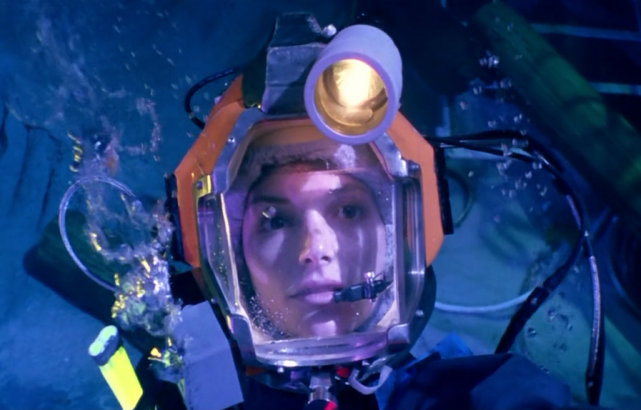
I’ve asked myself if I’m as fond of any one movie prop as Adam is about this blaster. My instinctive answer is “the deep-dive helmets from ‘The Abyss‘.”

“The Abyss” doesn’t take place on a future-Earth. But the prop designers’ challenge was much greater than the one faced by the “Blade Runner” crew. All of actors performed their underwater scenes themselves, for real, in a forty foot tank. So the priorities for the dive helmets were, in order of importance:

  1. Keep the actors alive.
  2. Be comfortable enough to wear every day during months of shooting.
  3. Allow the actors to act.
  4. Look real cool.

I’m dazzled by the engineering challenge. “Allow the actors to act” was a big deal for James Cameron. It meant that these helmets needed to achieve the first two goals while still allowing the camera to see the actors’ faces and hear their voices. Another director would have just had the actors loop all of their dialogue back in later, instead of capturing it live on-set. But then, I suppose another director would have thought “we’ll do the underwater scenes with a combination of stunt divers and principal actors on a dry effects stage” instead of “Obviously, we’re going to buy an abandoned nuclear power facility, convert the retaining vessel into the world’s largest and deepest underwater shooting set, and get all of our actors certified with ‘master’ ratings.”

And yet, the designers achieved the “look real cool” thing. These helmets weren’t fiddly movie props. They were sturdy, functional dive equipment built to the same standards as working production hardware.

Would I spend years trying to build my own? Naw. But I’m cheered to think that if one came up at auction, the bidding wouldn’t be nearly as competitive as the bloodbath that ended with the $270,000 sale of an original Blade Runner blaster.

It’d likely still sell for way more than I could afford, but at least it would be a dollar figure that I could easily translate into units of work. “Six columns. I write six columns that I otherwise wouldn’t — this helmet’s gotta give me topics for at least two — and it’s paid for.” It’d be a nice little fantasy. But no, no, not even then.

I think an Abyss dive helmet on a shelf in my living room would mock me every time I got back home. “Congratulations on being soooooo careful with money that you didn’t cave in to temptation and buy that $7 takeout burrito for dinner today. Really. Your folks would be so proud. Oh, they still think I’m just a piece of interesting junk that you picked up at the MIT Flea Market for $12, right?”

But…the Blade Runner replica is different! It has LEDs! It’s…it’s a tech item! I’m practically obligated to acquire one for a review, right?

(I bet the maker is one of those selfish stinkers that don’t loan things out, either.)

(…)

(Perhaps I should get a burrito for dinner tonight.)

20 Jun 18:22

Is synaesthesia teachable?

by Jason Weisberger

A recent study at the University of Amsterdam shows that some aspects of synaesthesia can be acquired, temporarily anyways.

Read the rest

20 Jun 15:11

Anyone stupid enough to download Yo deserves the security threat it represents

by Xeni Jardin
The so-silly-it's-not-worth-mocking app Yo was hacked by some college students. Caveat downloader. The texting app, which does nothing but ping your friends with the word "Yo" (or another single word of your choosing) has reportedly netted $1 million in funding already, from high-profile investors, and about a quarter million users as of today. Read the rest
20 Jun 05:17

"I don’t like Tom Cruise but I watched it for Emily Blunt and it was surprisingly really good and..."

“I don’t like Tom Cruise but I watched it for Emily Blunt and it was surprisingly really good and badass.”

- literally everyone who has seen Edge of Tomorrow (via theladyelsa)
19 Jun 21:38

Friends and family mean well, but the stereotypical ex-bashing...


Friends and family mean well, but the stereotypical ex-bashing isn’t necessarily what people want or need

19 Jun 19:11

California's cell-phone kill switch is a solution that's worse than the problem

by Cory Doctorow


As the California legislature moves to mandate "kill switches" that will allow owners of stolen phones to shut them down, the Electronic Frontier Foundation sounds an important alarm: if it's possible for someone to remotely switch off your phone such that you can't switch it back on again, even if you're physically in possession of it, that facility could be abused in lots of ways. This is a classic War on General Purpose Computation moment: the only way to make a kill-switch work is to design phones that treat their possessors as less trustworthy than a remote party sending instructions over the Internet, and as soon as the device that knows all your secrets and watches and listens to your most private moments is designed to do things that the person holding it can't override, the results won't be pretty.

There are other models for mitigating the harm from stolen phones. For example, the Cyanogen remote wipe asks the first user of the phone to initialize a password. When it is online, the device checks in with a service to see whether anyone using that password has signed a "erase yourself" command. When that happens, the phone deletes all the user-data. A thief can still wipe and sell the phone, but the user's data is safe.

Obviously, this isn't the same thing as stolen phones going dead and never working again, and won't have the same impact on theft. But the alternative is a system that allows any bad guy who can impersonate, bribe or order a cop to activate the kill-switch to do all kinds of terrible things to you, from deactivating the phones of people recording police misconduct to stalking or stealing the identities of mobile phone owners, with near-undetectable and unstoppable stealth. Read the rest

19 Jun 16:30

"Wherever perfectionism is driving, shame is riding shotgun. Perfectionism is not about healthy..."

“Wherever perfectionism is driving, shame is riding shotgun. Perfectionism is not about healthy striving, which you see all the time in successful leaders, it’s not about trying to set goals and being the best we can be, perfectionism is basically a cognitive behavioral process that says if I look perfect, work perfect, and do everything perfectly, I can avoid shame, ridicule, and criticism. It’s a defense mechanism.”

-

"Why Doing Awesome Work Means Making Yourself Vulnerable"

So, I’ve been waiting for someone to explain this extremely simple concept to me my entire life.

(via kelsium)

Hooooly shit I needed to read this article.

(via rouxfully)

"When I interview leaders, artists, coaches, or athletes who are very successful, they never talk about perfectionism as being a vehicle for success. What they talk about is that perfectionism is a huge trigger, one they have to be aware of all the time, because it gets in the way of getting work done."

Yyyyyyyyep.

(via rumplestiltsqueer)