"Nonwhite and women leaders who engage in diversity-increasing behaviors in the highest organizational ranks are systematically penalized with lower performance ratings for doing so," the study’s authors wrote in the research. "Our findings suggest that nonwhite and women leaders may increase their own chances of advancing up the corporate ladder by actually engaging in a very low level of diversity-valuing behavior."
Shared posts
20 Jul 20:08
For Some, Fostering Diversity Comes With a Price
For Some, Fostering Diversity Comes With a Price:
20 Jul 05:08
King James Programming
King James Programming:
"Instead, we define how an integer can be transformed into an angel of the LORD"
19 Jul 20:23
stammsternenstaub: m-m-mad-madness: engineer—cat: lumoblaze: ...
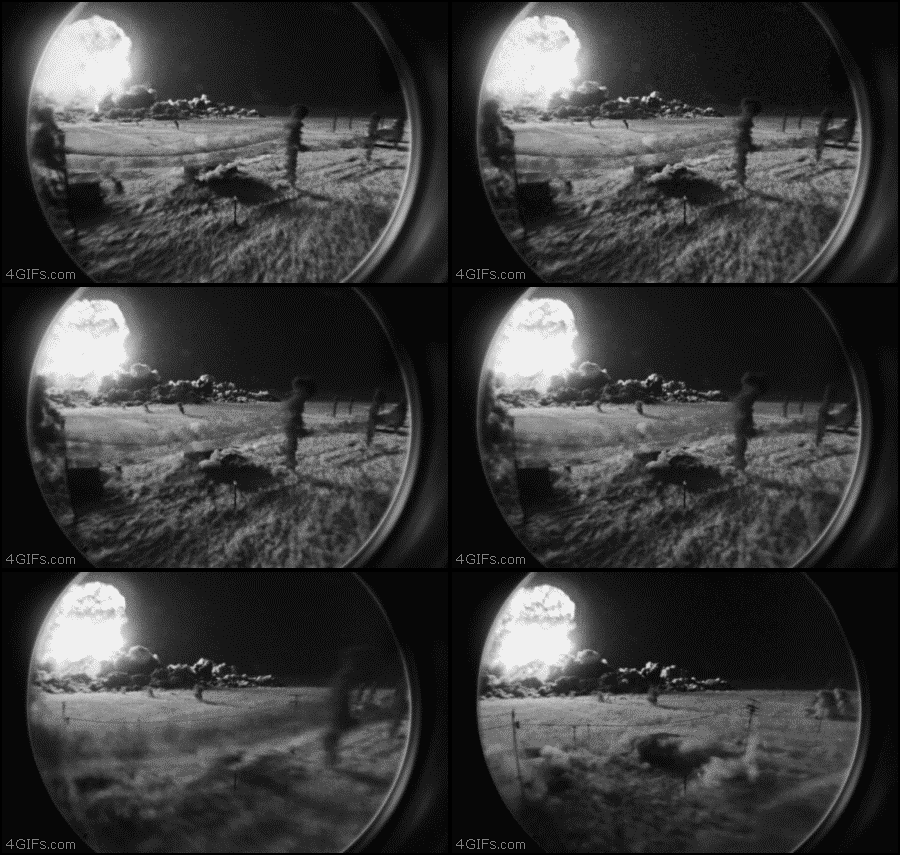
As close as you will ever be to a nuclear explosion
THIS IS FUCKING TERRIFYING
No thank you.
The columns of smoke in the foreground are telephone poles boiling
This is way cooler to look at than it should be
Science side of Tumblr would like to add:
Heat is generally transmitted in 3 forms: conduction, convection, radiation.
The fact that the telephone poles and wires are boiling away well before the shockwave hits them indicates that the heat from the explosion has not reached them by convection (much slower than the speed of sound) or by conduction (at best, comparable to the speed of sound), but purely by radiation. In other words: the explosion is bright enough to boil everything.
reblogging again for what engineer—cat said
19 Jul 00:06
stuffman: People have written a lot of touchy-feely pieces on this subject but I thought I’d get...
People have written a lot of touchy-feely pieces on this subject but I thought I’d get right to the heart of the matter
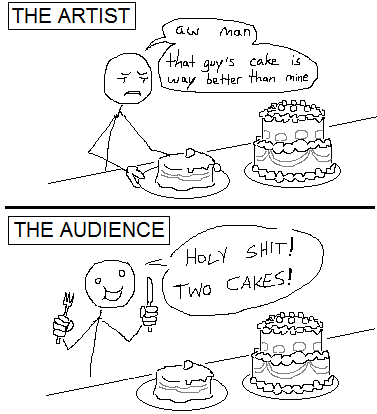
This is 1000% more motivating than every preachy “real writers write every day” post on all of Tumblr.
19 Jul 00:03
stuffman: People have written a lot of touchy-feely pieces on this subject but I thought I’d get...
People have written a lot of touchy-feely pieces on this subject but I thought I’d get right to the heart of the matter
17 Jul 17:52
Gods and genre
by Nicola Griffith
I hadn’t intended to start blogging here until next Thursday, when my novel Hild comes out in the UK, but, hey, I saw the news about Marvel’s Thor and couldn’t resist.
So: Thor is now a girl. This changes everything. Sort of.
Let’s ignore the fact that Thor is a god, and mere mortals shouldn’t expect gods to behave like us, because if you take that thought train too far we end up wondering why gods are identified as one sex or another in the first place. And then we have to get into a long and complicated discussion of how religion works and next thing we know the wheels have come off. Today I’d rather stick to the notion of Thor as entertainment. (I can’t speak for tomorrow…)
Entertainment—just like religion—reflects culture rather than leading it. You could make a different argument, perhaps, about Art with a capital A but, again, for today let’s avoid those derailing possibilities and stick to entertainment. And comics, and the films based on them, are first and foremost entertainment.
Traditionally comics were supposed to entertain boys and young men, though girls and women have always also read them. Girls, though, were basically ignored as a demographic by creators and powers-that-be so comics were designed with the sensibilities of boys in mind. At least this is what I used to think until reading Saladin Ahmed's Buried Badasses: The Forgotten Heroines of Pre-Code Comics. Go read it. Women—and people of colour—were catered for, and advertised to, in comics until the fifties and America's moral panic over, well, everything. But in the last sixty years, and now, not so much. (This is currently true in much entertainment media. See, for example, women in film or women in literature stats.)
The results are apparent in the art. The bodies of comic book characters of both sexes are anatomically impossible. And women are ridiculously sexualised. If you have no clue what I’m talking about go read Jim Hines’ Cover Posing posts—be sure to click through to the group pose wherein our own Charlie Stross bares more than most of us would probably like.
So will Thor be drawn differently? The writer of Thor, Jason Aaron says. "This is not She-Thor. This not Lady Thor. This is not Thorita. This is THOR. This is the THOR of the Marvel Universe."
The preliminary art isn't terrible: the new Thor shows no cleavage, no bare midriff or thighs. But if her breasts get any bigger they will overbalance her. And I would like to have seen her posed in action mode instead of in a pose that takes up little space. The armour, of course, could be better--but it could be better in almost every comic I've ever read, where improbable isn't a glitch it's a feature.
So what if Marvel really means it? What if the new Thor behaves exactly like the Thor we know?
Call me wary. Old habits are hard to break, and these particular habits run deep in the f/sf genre in every medium. Genre—like gender—is a reflection of culture (and etymologically they come from the same root).
Think for a moment about the terms Hard SF and Soft SF. Or, actually, to save you effort, here’s a short (and deliberately provocative, sorry1) snippet I wrote for Science Fiction Studies five years ago:
Hard Takes Soft, Still
SF as a genre is terrified of the body. As a result, its depictions of physical pleasures are rare. Historically, writers and readers seem to prefer their characters to pop nutrition pills rather than delight in a gourmet meal, dwell 24/7 in sterile environments rather than wander through a wood, and jack into virtual sex rather than touch another human being.
When SF does dare mention sex, the focus is on the intellectual and emotional aspects of the experience. SF still subscribes to Cartesian dualism: the mind is pure, adamantine, and noble, the body bestial, soft, and squicky. (I have talked about this at length elsewhere: see my essay “Writing from the Body.”) Even a hint of body-to-body sex can be enough to earn an sf novel an Approach With Caution warning—that is, categorisation as soft SF.
In this regard, the world-view of the SF Old Guard has a lot in common with that of the cultural guardians of Old Iceland. Embedded in the Icelandic sagas is that society’s tendency to divide the world—politics, intelligence, gender, sexuality, the physical properties of objects—into hvatr (hard) and blauôr (soft). Hard equates to bold, independent, powerful, vigorous, sharp, dry, and decisive; soft to weak, powerless, dull, moist, and yielding.
Guess which was deemed the more admirable quality.
Guess which kind of SF, hard or soft, is privileged critically.
For the Old Guard, a novel’s hardness depends to some degree on the biological sex of bodies entwined. Women are perceived as literally and metaphorically softer than men. If the viewpoint character having sex in an SF novel is a woman, the squick factor is doubled. If she’s having sex with another woman, the Old Guard passes out.
Consider reviews of my second novel, Slow River (1995), in which much real estate was devoted to denouncing (I’m paraphrasing) the “exclusively and explicitly lesbian sex.” The thing is, there’s plenty of heterosex; reviewers just couldn’t see past the (to them) Othersex. Given the way they carried on, you’d be forgiven for thinking it was porn. Certainly many dykes read the reviews, thought “Woo-hoo, one-handed reading!” and bought the book. Then they sent me pissed off emails: Where’s all the sex??
Consider, too, a well-known experiment: put ten engineers in a room, three of them women. Ask observers how many are female; they will say “half.” The Other blots out the Norm. (Yes, this experiment is ancient as these things go—dating from the 1960s or 1970s, I think. No doubt observers in today’s brave new world would require as many as, gasp, four women to qualify as “half.”)
This is as true now as it was then. It’s the twenty-first century, yet still I have never seen Slow River—a novel stuffed with shiny hardware, chemistry, and extrapolations about the future—labeled as hard SF. The Old Guard still rules.
Given my brief Hard Takes Soft was a necessarily simplistic argument—in the real world nothing is uniform. But what's interesting to me, five years later, is that it already feels a little out of date. For starters, I’d change "is privileged critically" to "was privileged critically." Now I'd say, on balance, that the automatic privileging of hard sf over soft is no longer something to bet on unthinkingly. The world is changing. Again. A look at history shows many pendulum swings—each accompanied by much agitation from the peanut gallery ranging from complaints of the established citizenry to the destruction of civilisation, never mind all-white, for-boys comics—and I think this is one such. Notions of gender are undergoing a seismic shift—see, for example, my recent post about the word Wife—and the genre is moving with it. The great boulder is rocking in its cradle.
My hope is that soon it’ll be thundering downhill, unstoppable. My hope is that we can look back in five years and see the Thor news as a twitch in the seismograph. But so very much depends on how the artists draw her.
Discuss.
1 It was for the symposium, Sexuality in Science Fiction, a "mosaic of position papers" edited by Rob Latham and the brief was that we be pithy and provocative.


16 Jul 18:38


Aperture Tag Is A Whole New Portal Game… Without Portals
by Nathan Grayson

A Portal game without portals? “Why, that’s like removing puppies from the Puppy Bowl,” you might say. “What is even the point?” The point, fellow small dog enthusiast, is paint. Physics-affecting paints (think bouncy gel, etc) were part of Portal 2, but they weren’t the main focus. Paid standalone mod/game Aperture Tag: The Paint Gun Testing Initiative puts them front and center, and it looks like sticky, slippery, hundreds-of-feet-in-the-air-hurtling fun. It’s out now, and a trailer’s below.
Ronald.phillips likes this
16 Jul 18:19


Overweight Americans Have the Lowest Risk of Premature Death
by Lisa Wade, PhD
Last year the Journal of the American Medical Association released a study aiming to determine the relationship between body mass index and the risk of premature death. Body mass index, or BMI, is the ratio between your height and weight. According to the National Institutes of Health, you are “normal weight” if your ratio is between 18.5-24.9. Everything over that is “overweight” or “obese” and everything under is “underweight.”
This study was a meta-analysis, which is an analysis of a collection of existing studies that systematically measures the sum of our knowledge. In this case, the authors analyzed 97 studies that included a combined 2.88 million individuals and over 270,000 deaths. They found that overweight individuals had a lower risk of premature death than so-called normal weight individuals and there was no relationship between being somewhat obese and the rate of early death. Only among people in the high range of obesity was there a correlation between their weight and a higher risk of premature death.
Here’s what it looked like.
This is two columns of studies plotted according to the hazard ratio they reported for people. This comparison is between people who are “overweight” (BMI = 25-29.9) and people who are “normal weight” (BMI = 18.5-24.9). Studies that fall below the line marked 1.0 found a lower rate of premature death and studies above the line found a higher rate.
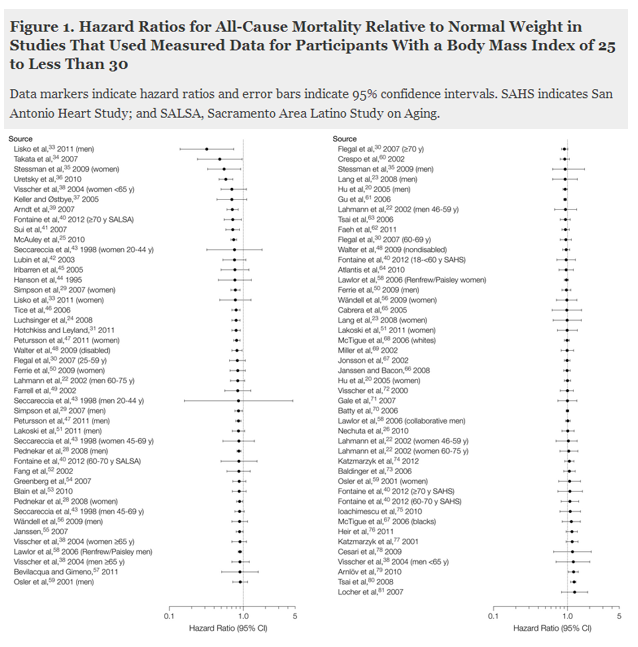
Just by eyeballing it, you can confirm that there is not a strong correlation between weight and premature death, at least in this population. When the scientists ran statistical analyses, the math showed that there is a statistically significant relationship between being “overweight” and a lower risk of death.
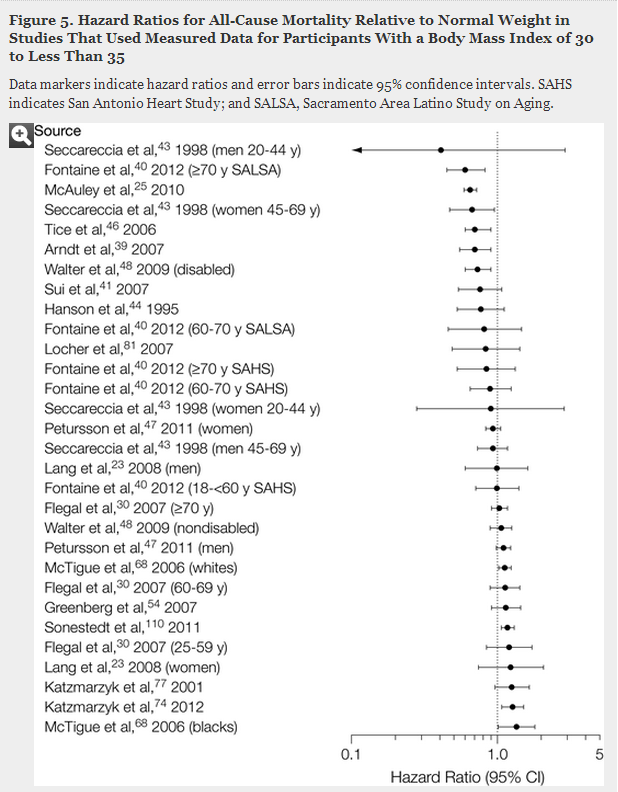
Here’s the same data, but comparing the risk of premature death among people who are “normal weight” (BMI = 18.5-24.9) and people who are somewhat “obese” (BMI = 30-34.9). Again, eyeballing the results suggest that there’s not much correlation and, in fact, statistical analysis found none.
Finally, here are the results comparing “normal weight” (BMI = 18.5-24.9) and people who are quite “obese” (BMI = 35 or higher). In this case, we do see a relationship between risk of premature death in body weight.
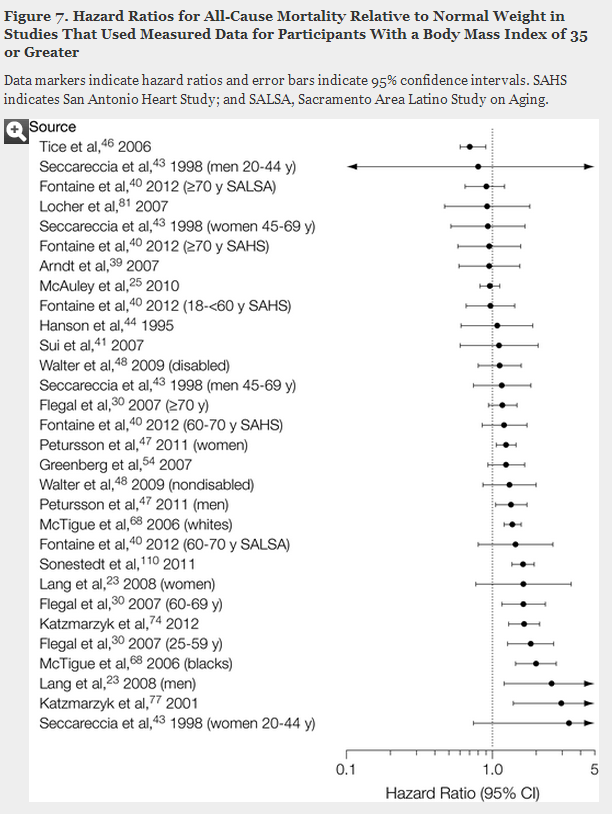
It’s almost funny that the National Institutes of Health use the word normal when talking about BMI. It’s certainly not the norm – the average BMI in the U.S. falls slightly into the “overweight” category (26.6 for adult men and 25.5 for adult women) — and it’s not related to health. It’s clearly simply normative. It’s related to a socially constructed physical ideal that has little relationship to what physicians and public health advocates are supposed to be concerned with. Normal is judgmental, but if they changed the word to healthy, they have to entirely rejigger their prescriptions.
So, do we even have an obesity epidemic? Perhaps not if we use health as a marker instead of some arbitrary decision to hate fat. Paul Campos, covering this story for the New York Times, points out:
If the government were to redefine normal weight as one that does not increase the risk of death, then about 130 million of the 165 million American adults currently categorized as overweight and obese would be re-categorized as normal weight instead.
That’s 79%.
It’s worth saying again: if we are measuring by the risk of premature death, then 79% of the people we currently shame for being overweight or obese would be recategorized as perfectly fine. Ideal, even. Pleased to be plump, let’s say, knowing that a body that is a happy balance of soft and strong is the kind of body that will carry them through a lifetime.
Lisa Wade is a professor of sociology at Occidental College and the co-author of Gender: Ideas, Interactions, Institutions. You can follow her on Twitter and Facebook.(View original at http://thesocietypages.org/socimages)
16 Jul 03:38


The Best Of The Dish Today
by Andrew Sullivan
#ZionStandUp for Israeli @ashlisade: “Kill Arab children so there won’t be a next generation” https://t.co/jr11iwxNUF pic.twitter.com/2hSZAwyMuJ
— David Sheen (@davidsheen) July 10, 2014
The great thing about a blog is that in real time, you can amend and clarify your thoughts. So a couple of things about my long post today about the history of gay America in the last few decades. The title was meant to be a way of reminding everyone that AIDS was absolutely instrumental and central to all of it. That’s all. I believe that there can be no history of gay rights which isn’t in some ways a history of the plague. But, of course, it doesn’t sum up all gay history. My post was prompted by two remarkable pieces – Walter Armstrong’s and Tim Murphy’s – and they are both centered on gay men.
I just want to make clear that I was not intending in any way to erase the critical and central contributions of lesbians in this movement and in the AIDS crisis, which are indisputable. I wanted merely to tell the story from the gay male perspective, because that is where the plague hit hardest, and that is what I can write about personally. So please do not mistake it for a balanced history; it is more of a memoir of a movement and its extraordinary twists and turns.
I don’t know why but I have felt its weight this summer very acutely, perhaps because it seems so remote from so many today, and I cannot but feel, like many in my generation, as if I need to write this down in case people forget it. (I did already, of course, but long ago now.) Even in Provincetown, a place devastated, waves and waves of gay men arrive today for whom it means close to nothing. And the emotional bond of those years makes reading histories of the movement that simply erase it before 2008 not just frustrating; but some kind of assault on what we did and how we did it. An assault on my loved ones, so many of whom are no longer here.
Anyway … we covered a lot of other ground today as well. The conflict in Gaza kept coming up – and readers pushed back in defense of the Israelis, even as I tried to explain my serious moral qualms. (The tweet above, for example, is one of countless collected by David Sheen of teen Israelis making duck faces and calling for the genocide of Arabs. Yes, genocide. In bikinis. And you thought Max Blumenthal is making it up?) Plus: an amazing beard of the week; all the accents in the British Isles; and the strange low-but-high voice that straight guys use when chatting up women.
The most popular post of the day was “Understanding The Permanence Of Greater Israel“, followed by “The Astonishing, Actual History Of The Gay Rights Movement.”
Many of today’s posts were updated with your emails – read them all here. You can always leave your unfiltered comments at our Facebook page and @sullydish. 17 more readers became subscribers today. You can join them here - and get access to all the readons and Deep Dish - for a little as $1.99 month. One writes:
I don’t pay for the LAT or NYT or WSJ or WaPo, or any newspaper, but I pay for my Dish
subscription. I think, at a very cursory level, it’s probably because I find the big newspapers to be very commoditized and the Dish is, well, unique. However, it wasn’t till I read this long piece in the Columbia Journalism Review about Jeff Bezos’ efforts to transform the Washington Post, that a few things really clicked within me about what makes The Dish unique and worth paying for compared to these mainstream publications. First, even though that linked piece is long, it can be summed up with a few snippets from it:
Editors and reporters talk about the Post becoming a “global” paper. They say that the Post will create a news “bundle” that will repackage all the elements of the print newspaper in a way that readers will pay for in digital form. Using tablets and other devices, Bezos aims to recreate the intimate, cohesive, and somewhat linear consumption experience of old media in a way that makes sense for digital…. An editor added: “I think Bezos wants us to be everything for everyone, the same way Amazon is.” …
The journalism isn’t what he (Bezos) plans to revamp, or necessarily invest significant new funds in—the new hires notwithstanding—at least initially. His main focus is the pipeline: reaching the maximum number of customers by putting the Post’s journalism in a package (a tablet, a mobile site) that will draw the greatest number of readers.
It’s pretty funny right? The “journalism isn’t what he plans to revamp.” Rather, Bezos just wants to figure out how to get as many people as possible to read this thing in digital format, rather like a candy company pushing its latest confection. Perhaps, if they truly stepped back and evaluated the shoddy essence of the core product – the, ahem, journalism – they might realize that their product quality is no longer good enough to convince customers to pay for it. In my mind, that is absolutely the difference between the Dish and the major dailies.
A soul and a conscience – all institutions, big and small, need them to be have real credibility and relevance with whom they seek to serve. And especially those that seek to inform and explain the world to us in a democracy so that we may do our part as citizens. The Dish has both, which is why it is worth paying for.

Subscribe here and see you in the morning.
16 Jul 01:11
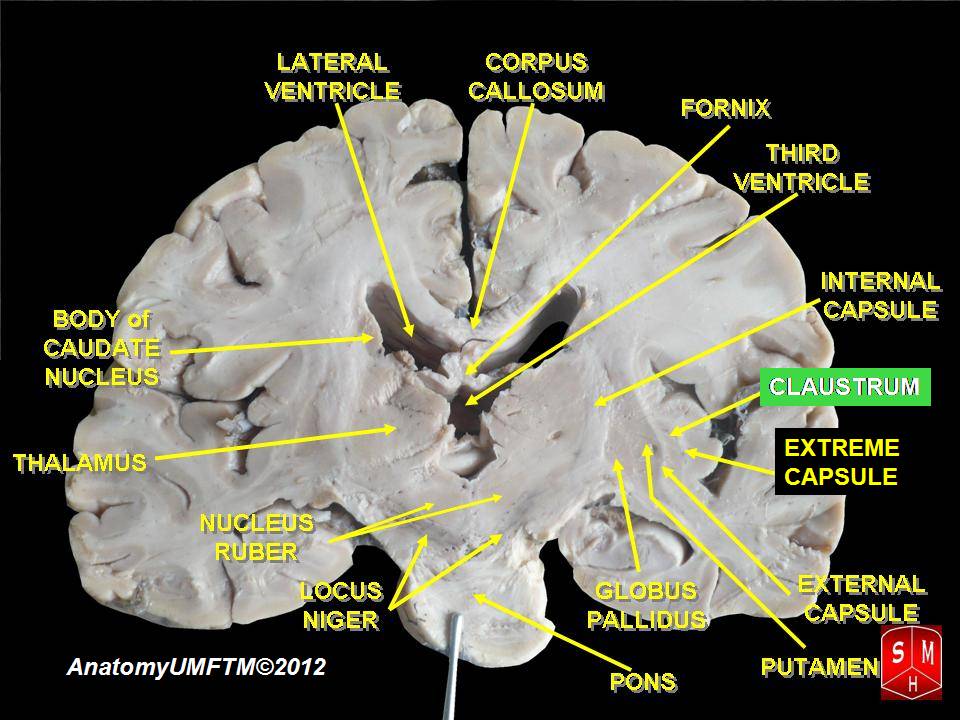

Sleepwalk to Enlightenment
by Peter Watts
Illo credit “Anatomist90″, over at Wikipedia
Judging by the number of links I’ve received, a lot of you are already familiar with this paper on consciousness and the claustrum. Or at least you’re familiar with the tsunami of popsci coverage it’s received.
For the rest of you, the tale goes something like this: 54-year old female epileptic, seizure-free for four years at the cost of her left hippocampus. Now that reprieve has expired; the seizures have returned, and a team of neurologists led by Mohamad Z. Koubeissi have sown electrodes throughout her head to get the lay of the land and figure out what to do next. One of those electrodes edges up against the claustrum, a filamentous tangle of neurons thought to play a role in coordinating crosstalk between different parts of the brain.
When Koubeissi et al juice that particular electrode with 14mA of current, consciousness stops.
At least, that’s the way a thousand newsfeeds put it. More precisely, the body stops moving. The voice, which has been repeating the word “house” as a kind of baseline metric of awareness, trails off after a few seconds. The fingers, which have been snapping rhythmically, grow motionless. The patient sits glassy-eyed, to all appearances unaware and insensate. Inside her skull, the frontal and parietal lobes fall into mindless synchrony; not the synchronized call-and response of the consciousness state, but a mirrored lockstep incompatible with the operation of the global workspace.
Kill the current and everything return to normal. The patient reanimates, with no recollection of what happened during the down time.
The press is calling it a breakthrough. An off-switch for consciousness, never before discovered. The Daily Mail, CBS, a myriad others have weighed in on the findings (although most of them seem to have mainly siphoned the bullet points off the New Scientist article that got there first). “…only a matter of time when we can create computers and machines that also contain a form of consciousness,” opines the Washington Post. “Their accidental discovery could lead to a deeper understanding of … how conscious awareness arises,” Discovery.com chimes in.
They keep using that word. I don’t think it means what they think it means.
No, the caption doesn’t say what those asterisks are. I’m guessing, statistical significance?
If I wanted to be glib I’d point out that a rock to the head serves as a perfectly effective off-switch for consciousness, and I’m pretty sure we stumbled across that result long before the latest issue of Epilepsy & Behavior hit the stands. It would admittedly be a cheap shot; after all, the claustrum effect is somewhat subtler. The victim didn’t keel over like a puppet with severed strings; she remained upright, eyes open, “awake but not conscious”. That’s kind of cool. And the claustrum’s involvement is nicely consistent with the whole Global Workspace model, the idea that consciousness somehow emerges from the integration of different brain processes talking to one another. It’s a good paper. The stats are solid, even conservative (although it would have been nice if they’d told us what those asterisks were supposed to represent in Fig. 1).
But closer to understanding “how conscious awareness arises”? I don’t think so.
What we have here is another neural correlate. Those are useful things to have, but all they tell us is that consciousness doesn’t manifest unless the machinery is ticking a certain way. They don’t get us any closer at all to the Hard Problem, which is: why does that particular flavor of ticking machinery wake up? When all those subcortical structures— the brain stem, the thalamus and hypothalamus, the ACG— start talking to the frontal lobes just so, why does it feel like this? It’s just computation, after all. Circuits in meat. Why does it feel like anything?
I don’t know if we’ll ever figure that one out.
I have other reservations. Prior to flipping the switch, Koubeissi et al got their patient to start repeating the word “house”, and to snap her fingers. They did this, we are told, to ensure that it really was consciousness that was being interrupted— that those milliamps hadn’t just induced some kind of motor paralysis that stilled the body even though the mind was active. K et al‘s reasoning was that paralysis would kick in instantly when the current hit; the fact that the speech and the finger-snaps trailed off gradually is supposed to take the paralysis confound off the table.
Yet there’s nothing in the paper to explain why this “off switch” couldn’t also activate instantaneously (once again, I cite my rock to the head). It seems a significant omission in the rationale, especially given that this “switch” has never been documented before. Besides, if the results had hailed from a conscious-but-paralyzed individual, wouldn’t she have been able to report as much after the fact?
Speaking of confounds, here’s another one. It wasn’t just “conscious awareness” that went down for the count; it was cognition. The patient showed no response to stimuli during the vacant intervals; Koubessi’s team may not have induced unconsciousness so much as catatonia. (Interestingly, they also reported a “slowing of spontaneous respiratory movements” during the tereatment. This would seem to suggest that autonomic— i.e., nonconscious— processes were also affected. Unless the procedure itself was so stressful that the patient was breathing hard to begin with.)
Koubeissi et al unleashed a shotgun blast, insufficiently precise for high-resolution insights. This is no criticism; they weren’t performing a controlled experiment, just a routine diagnostic procedure that happened to yield valuable and unexpected results. But by that same token we should be careful about the conclusions we draw. (The fact that the patient’s brain was atypical— having lost half its hippocampus to a previous operation— has been dutifully noted in most of the coverage I’ve seen.)
What I’d really like to see would be a stimulus which shut down consciousness but left the cognitive and reactive circuits intact: a scenario in which the patient continued to repeat “house” while the current flowed, until— still unconscious— she processed and accommodated a new request to start saying “yoga” instead. I’d like to see her wake up when the current stopped, look around, and ask in a puzzled voice, “Why am I saying yoga? I thought I was saying house.” Now that would tell us something.
What, you don’t think that’s realistic? You think consciousness and volition go hand in hand, that the body can’t parse the house-to-yoga transition without some little guy behind the eyes to make sense of it all?
I’ve got one word for you: sleepwalkers.
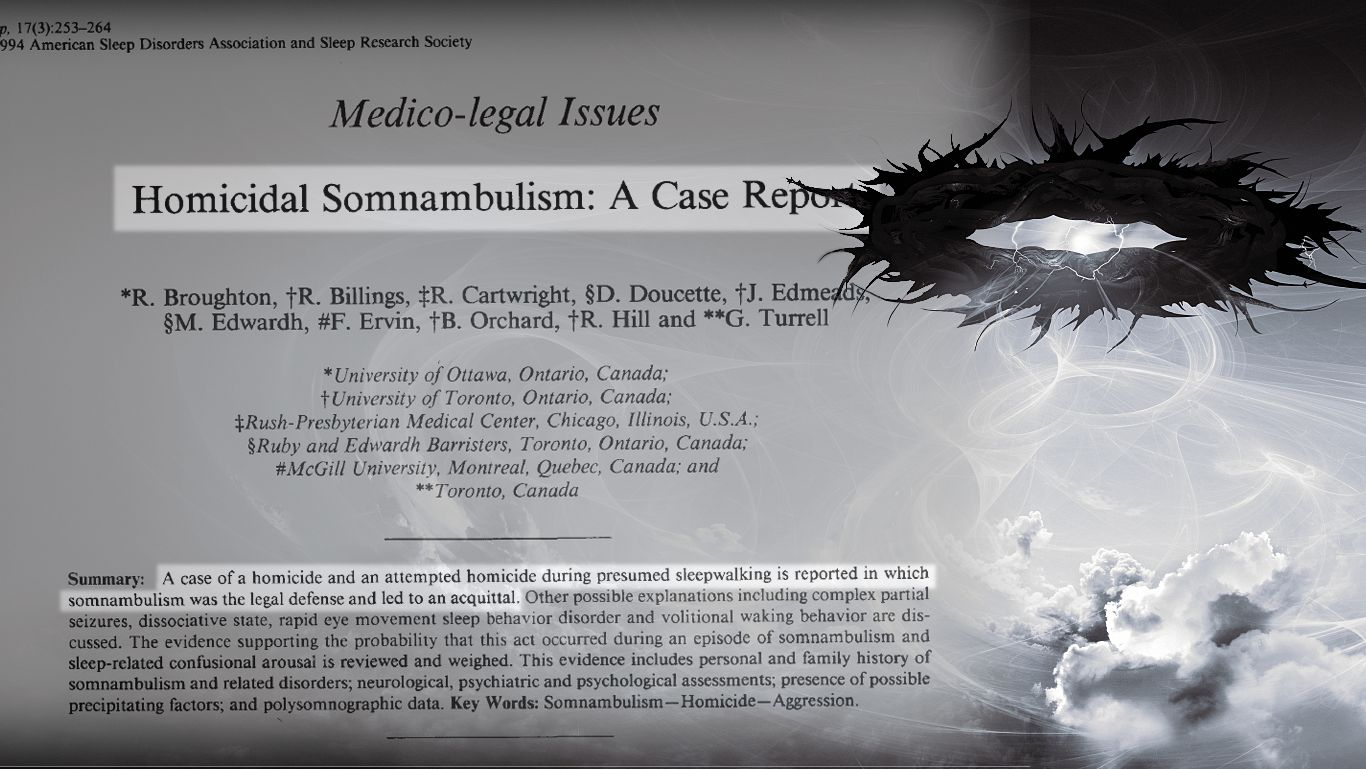
It’s possible to sleepwalk your way though a repeated series of sexual encounters with complete strangers (note to philanderers: don’t try this at home). It’s possible to drive across town and stab your mother-in-law to death, unconscious the whole time. “Homicidal somnabulism” is enough of a thing to warrant its own Wikipedia page.
So forget epileptics with pieces cut out of their brains. You want to find an off-switch for consciousness? Reserve the departmental MRI for the graveyard shift and put out ads for sleeping automatons. Some of them, short of spare cash, might just see the flyer some 3 a.m. and call you up.
Even if they don’t know they’re doing it.
15 Jul 23:02

Comcast promises quick action against scapegoat
by Mark Frauenfelder
After this audio recording of an infuriatingly aggressive Comcast representative arguing with a customer went mega-viral, Comcast, which instructs its employees not to take no for an answer, is now throwing its representative under the bus because he refused to take no for an answer.
Read the rest
15 Jul 18:19


The Astonishing Actual History Of The Gay Rights Movement
by Andrew Sullivan
[Re-posted from earlier today]
I don’t care for the “right side of history” argument with respect to gay rights for a few reasons. It’s horribly condescending to people who have a sincere view against gay equality; it presupposes some sort of inevitability where there isn’t any; and it fails to understand the nature of history. History is never as dull as the concept of “progress” would have you believe. It is always, as Oscar Wilde once put it, crowded with incident.
In no case is this truer than for gay America. Our story, if presented as a Hollywood screenplay, would be dismissed as too outlandish, too melodramatic and implausible, to be taken seriously. And yet it happened, and remains with us – so close it is hard to see it, and with several sharp twists and turns.
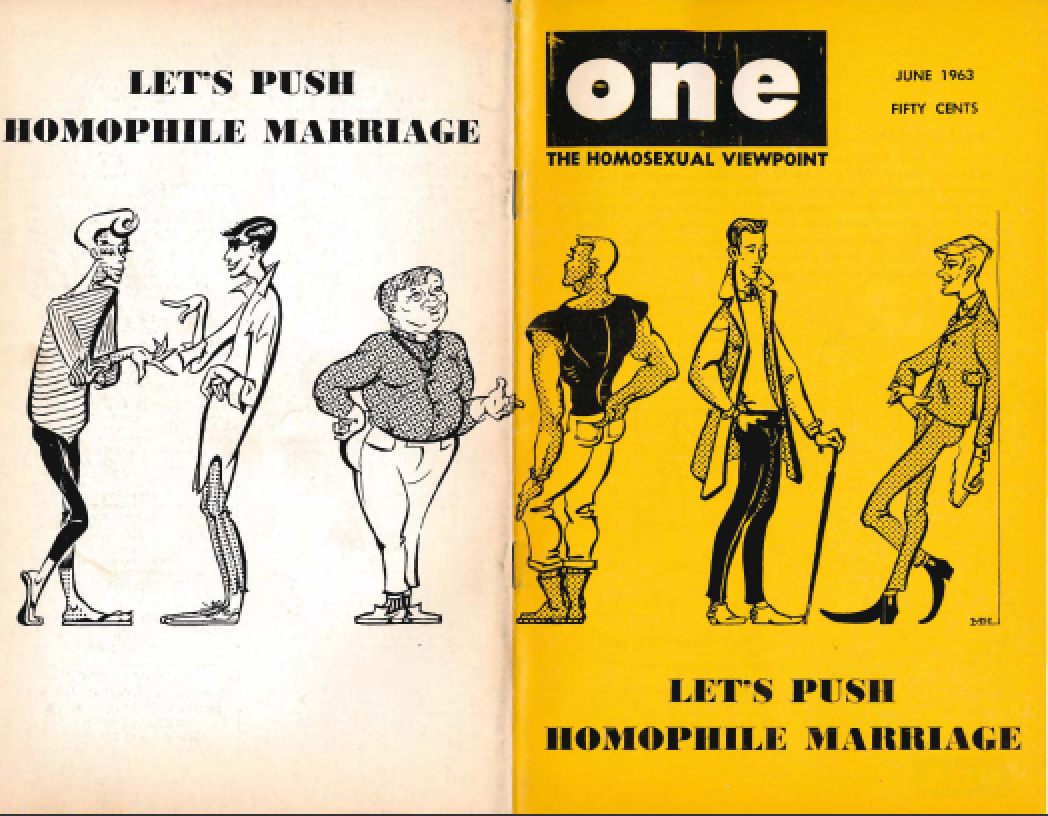 From the extraordinary repression of the 1950s – the McCarthyite era when all gay people were threats to the republic – to the liberation of the 1960s and the frenzied libertinism of the 1970s, you had one powerful narrative. After centuries – no, millennia – of brutal sanctions against the love of one man for another, an unprecedented, ebullient flowering took place. In small enclaves, an openly gay culture began to thrive and express itself with all the understandable abandon of the suddenly free. It was still very much a subcurrent, among so many other social shifts in that era, and was surrounded by hostility and discrimination and stigma. But the sense of outsiderdom partly intensified the joy and the solidarity. The gay ghettoes of the 1970s and early 1980s did not much care about the world beyond them for a while. Freedom – even in one, small place – was exhilarating enough.
And then the plague. It is, quite simply, impossible to conceive of a more dramatic reversal. If gay men had finally struggled free from the internalized notion that they were sick, or enemies of God, or all but asking for divine retribution for their sins, that paradigm closed in with terrible, ironic ferocity. What else could explain a plague of that brutality and specificity but the wages of Satanic perversion? Jerry Falwell could not have dreamed of a more perfect scenario. Pat Buchanan, with his usual flair, intoned that the gays had declared war on nature and nature had therefore declared war on them. And in some dark way, many of us were tempted to believe it.
It would be absolutely understandable if gay men had simply collapsed under the weight of this paradigm. Some quietly did, their deaths hastened by shame and self-loathing and anger. “Tell my mother I hate her,” was one of my dying friend’s last wishes, as he languished alone in his hospital bed. My closest friend at the time both showed extraordinary courage in the face of his physical disintegration and yet also  painted on his naked back the words “Diseased Faggot.” The horror of the disease was compounded a million times by stigma. But the plague was also simply terrifying and terrorizing. No one knew what medieval bacteria would suddenly destroy his brain or liver or digestive system. No one knew who would be next.
I remember the intensified Provincetown summers of the early 1990s, where I had come to learn how to die. Each year, the band of infected brothers would come together and talk medications, buyers’ clubs, and drug trials, and care for the sick and mourn the dying and go to countless memorial services for the steadily mounting dead. (I suspect I will never go to as many memorial services in my seventies, if I last that long, as I did in my early thirties.) Some of us were intermittently crippled by the huge doses of experimental drugs we were then taking to keep the terror at bay. But we got past the nausea and the night sweats and the diarrhea to try and live before we died. We had a ramshackle night club in an abandoned house on Shank Painter Road, which we called the “Love Shack.” And every time you danced there with someone, you lost yourself in the eternal present, acutely aware that they might not come back next year, or you might not. It gave everything an intensity, a vividness, and an astonishingly fearful mindfulness.
Yes, medical progress was there, if tantalizingly distant for more than a decade. But in a perverse twist, as the medical gains fitfully continued, the deaths mounted. The worst year for deaths from AIDS was 1995 in a plague that had begun fifteen years before. And then, just as it seemed it couldn’t get worse, came the bewildering news of the breakthrough in treatments, the joy of those suddenly become Lazarus, and the deeper grief we had put off until the emergency was over. I sank into a deep depression that I subsequently came to understand as survivor guilt. Others – given a new lease on life but utterly bewildered about what to do with it – turned to drugs and sex and oblivion. Someone once observed that the members of ACT-UP after 1996 had three fates: they were either dead, crystal meth addicts or professional AIDS activists. What we had experienced during our most formative years simply made living hard, terribly hard, in the wake of survival.
Walter Armstrong has a wonderfully perceptive piece about this phenomenon that I recommend highly. The sexual oblivion of meth had its greatest appeal and took its greatest toll on the survivors:
Crystal methamphetamine took hold in urban gay communities in the late 1990s, soon after the first effective HIV drugs converted many death sentences and restored our generation to so-called normal life. Caring for the sick, burying friends and lovers, mourning the loss of entire sexual and social networks, and protesting in the streets had consumed much of our youth. Investment in the future, career building, saving money and all the other rigmarole of a middle-class US life had been jettisoned. The end of the crisis also meant an end to the intense sense of purpose and solidarity. Normal life could not compete.
As with other populations struggling with PTSD, a minority was collectively committing suicide, after surviving a war.
All of this was understandable, even predictable, given the powerful pressures crashing in on gay life. What was entirely not predictable is that the survivors also did something astonishing. Using the institutions and self-knowledge and smarts that had somehow defeated the  plague, gay men charted a future when nothing like this would happen again, when gay men would never be parted from their spouses on their death beds, when gay men’s physical and psychological health would never be treated as insignificant, when gay men would never suffer the indignity that so many endured in front of our eyes. And so we built the case for marriage equality and for open military service as a recognition of the self-worth our survival had given some of us, and to pay some kind of tribute to those who had fallen.
We went, in other words, from about the deepest hole you can imagine to a determination not just to get out of it, but to see the mountaintop in our lifetimes. I do not know exactly where this act of will came from. It was not inevitable. It was, in fact, highly improbable. A few generations of licking of wounds would have been understandable. So would a collective in-turning in grief and pain and memory. But it didn’t happen. And today, we look out at that mountaintop … and may be forgiven for feeling vertigo.
Within the next few years, it is perfectly possible to conceive of an America in which marriage equality exists in every state and in which HIV is on a fast track to disappearance. If I had told my best friend before he died that this would happen in twenty years, his eyes would have widened into saucers. And we talk so much about how this has changed America, that we don’t often examine how it has impacted gay men themselves – how it is possible psychologically and emotionally to have come from such depths to such heights in so short a period of time, and stay sane and balanced and happy.
The younger gay generations know nothing of it, of course.
Because gay kids do not have gay parents, by and large, they have not been told stories of the dark days of courage and cowardice, and of unspeakable devastation and trauma. The average gay 22  year-old today simply assumes that marriage is his civil right, and has only passing interest in how it came about. As for the AIDS years, he is about as informed as the average straight guy. And this is not a bad thing as such. The whole goal of all this ordeal was to create a world with only the trace of a robust equality, and not of lingering and persistent pain.
And yet the trauma of plague still reverberates in our heads – and that includes the young as well as the old. Sex for most of us has always been synonymous with fear – and that fear has had remarkable resilience over the decades, even as the reasons for it have waned. In another new must-read, Tim Murphy shows how this overhang is still with us, even for those who never went through the trauma of the worst years:
Over coffee and pie at the Blue Stove in Williamsburg not long ago, Adam, 33, a writer and filmmaker I know, mentions that he is exactly the same age as the pandemic. “The terror was at its height when I was coming of age, postpuberty,” he says. “The message from TV shows that was drummed into us as gay boys was that we could get this disease and die and make our parents very sad. I developed this intense fear when I was having sex with someone and not even doing anything risky. I’d still freak out the next day.”
And, of course this did not just make all sex fraught with anxiety on both sides, it also divided us into two camps, the positive and the negative. For a while, I vowed never to date someone negative, and sought sex partners online via HIV-positive sites. And within the HIV world, I often left condoms behind, as impediments to the full sexual intimacy I craved and to the HIV solidarity rubber-free sex generated. And then I was famously dragged out in public and shamed for this by HIV-negative activists who opposed my politics. It was a sign that the negative-positive divide was still deep and  occasionally vicious. It still is. On the hook-up and dating apps, you see the following phrases all the time: “Drug/Disease-Free For Same”; “Clean”; “Negative for Same”. Since no one has tangible instant proof of being HIV-negative, it’s not particularly effective in HIV prevention. But it instills the divide that has stalked gay men during the plague and after.
But that too is now collapsing. The revolution of the last couple of years is a Rubicon. We now know that any HIV-positive man on meds is no more infectious than someone who is HIV-negative. We also know that an HIV-negative man who is on Truvada cannot get infected. This means that there is no more HIV divide in the gay world – or rather that its empirical basis has just been completely erased. Which means, quite simply, that gay men for the first time since 1981 can live without fear of HIV if they so wish.
And this of course is just one more bewilderment. As we adjust to marriage equality and all that comes with it, we are suddenly offered the chance for an infinitely less anxious and less dangerous sex life as well. Men whose entire sexual identities have been wrapped, literally, in rubber, now have to navigate an entirely new world. Of course there is resistance:
Another HIV longtimer—a Chelsea store manager named Steve, 58, diagnosed in 1996—tells me frankly that, though he supports Truvada usage in theory, it mostly just pisses him off on a visceral level.
“I was at the Eagle a couple months ago,” he says, referring to the West Chelsea leather bar, “and this hot little muscly Latin guy told me that he was on PrEP and that I could fuck him raw. Boom, he just said it so easily.” Steve has lost many people he loved to AIDS. He finds even the effervescent celebrations of Gay Pride tough to witness. “I want people to understand why they’re able to take this right now,” he says. “It’s on the backs of people who have died and suffered. All that needs to be learned and honored.”
It does indeed. But I have no doubt that the beleaguered gay men of the early 1990s would be amazed and thrilled that we have come this far. They did not die hoping that their legacy would be sustaining fear in future generations for ever.
But bewilderment is not out of place. I think of the year I arrived here, and had to sign a box in my immigration form denying that I was a “communist”, “criminal” or a “homosexual”. In that year, 1984, the AIDS epidemic was just beginning to stalk the land, culling, by the time it  was finally stymied, five times as many young men as died in the Vietnam War in roughly the same amount of time. I remember the exhilaration of coming out in the 1980s and the terror of watching men my own age die horrible, humiliating deaths in front of me. I remember finding out that I was HIV-positive and immediately knowing that, for that reason, I could be deported instantly, and living in America in that limbo for twenty more years, with no guarantee of success. I remember the deaths of my friends and lovers; and the shift in 1996 as long-term survival seemed possible for the first time. And I remember the countless speeches I would give to gay audiences about marriage equality, and the glassy-eyed, incredulous stares that came back at me. I remember my military friends, in constant fear and trepidation, fired at will, struggling to square their often conservative dispositions with a sexual identity that labeled them “queer.”
I remember … and I forget. I forget because in many ways, forgetting is the only way I can actually live with some measure of freedom from a past that will never let go of me and a future that still blinds with the abundance and clarity of its light. I am not alone. We are on this mountaintop together, even as so many dead lie round.
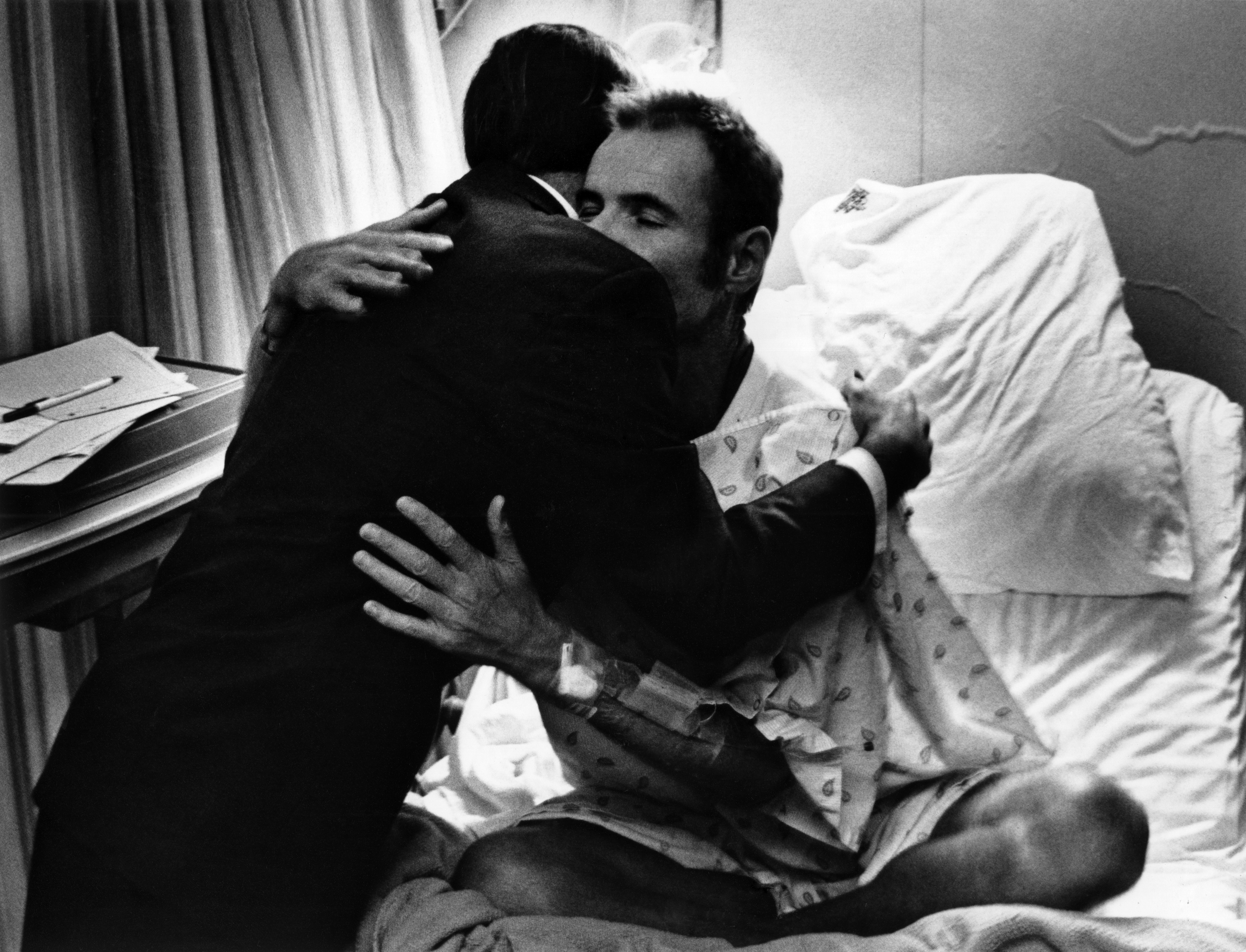
(Photos: The cover of One Magazine, June 1963; Dr. Richard DiGioia goes to George Washington Hospital to check on his patient, Tom Kane, on September 25, 1992. Kane is deaf. Dr. DiGioia hugs Kane before leaving. By James A. Parcell/The Washington Post via Getty Images; Thousands of people gather to view the AIDS Memorial Quilt on display on the Washington Monument grounds 10 October, 1992 in Washington, DC. By Renaud Giroux/AFP/Getty Images; A couple participates in a symbolic group commitment ceremony for same-sex couples to kick off National Gay Pride Month at The Abbey bar and restaurant on June 4, 2008 in West Hollywood, California. By David McNew/Getty Images; Seth Keel, center, is consolded by his boyfriend Ian Chambers, left, and his mother Jill Hinton, during a concession speech during an Amendment One opposition party on Tuesday, May 8, 2012, at The Stockroom in downtown Raleigh, North Carolina. Amendment One, which would ban gay marriage in the state, was well ahead at the polls. By Travis Long/Raleigh News & Observer/MCT via Getty Images; Former US Army Lt. Dan Choi (L), a gay rights activist and opponent of “Don’t ask Don’t Tell”, arrives at the E. Barrett Prettyman Federal Courthouse March 28, 2013 in Washington, DC. By Brendan Smialowski/AFP/Getty Images; Michael Knaapen and his husband John Becker react outside the US Supreme Court in Washington DC on June 26, 2013. By Mladen Antonov/AFP/Getty Images.)
Nikkidum, Adam Victor Brandizzi and 2 others like this
14 Jul 23:35


Wealth, Acclaim, and Fancy Catered Lunches (or, Why I’m a Teacher)
by Ben Orlin
Zephyr DearIt's one of those, Your job actually benefits society, so we don't need to compensate you as much, things.
Occasionally, friends ask me why I teach.

You could ask the same of any profession. Why did you become a grant-writer, a therapist, a sanitation engineer? Why dentistry? Why human resources? In crude and reductive terms, I see four basic justifications for any vocation:
- Compensation. Take air traffic controllers. They work longish hours in a maddeningly stressful workplace, but take home excellent money (over $100,000 per year) and can look forward to a long, well-pensioned retirement.

- Perceptions. Compared with air traffic controllers, most professors earn less money. But they draw another sizable benefit: prestige. Humans are social creatures, invested by nature in what others think of us. High status is no small thing.

- Quality of life. A pleasant workplace, friendly coworkers, reasonable hours, a short commute—all those little frills around the edges of a job sometimes matter as much as the job itself.

- Enjoyable work. The broadest of my four categories. We draw different pleasures from our various jobs—for social workers, the altruistic feeling of helping others; for mechanics, the pleasure of solving puzzles; for trial lawyers, the adversarial thrill of the courtroom. But almost all of us find some small joy in work.

Under this framework, why teach?
Compensation? The salary is solid, and district jobs offer great benefits, but I’m certainly not “maximizing the earnings potential” (to use that leaden and calculating phrase) of my math degree. In short: not my main reason.

Perceptions? Teaching is far from high-status. To be honest, the profession’s relatively low esteem bothers me more than its relatively low pay. (I feel obligated to mention the well-worn fact that in Finland and South Korea, two countries with model educational systems, teaching is absolutely venerated.)

Quality of life? Now we’re getting closer. In Oakland, my working conditions weren’t always the best: 11-hour days, 20-minute lunches, windowless rooms, needing to budget time for bathroom breaks. But I loved my colleagues, and as anyone can tell you, the vacation schedule is fabulous. I worked—drumroll!—a 200-day year. That’s an extra eight weeks off to travel, to write, to spend with family.

But the real reason I teach? In a dozen disparate ways, I enjoy the work.
I teach because I love people, and every school is full of dynamic, interesting people—they’re called “students.”

I teach because I love ideas. My own education brought me into contact with a million delightful puzzles, questions, and connections. It gives me a kick to share them with others.

I teach because teaching is an art. Just as every good book contains a piece of the author’s soul, every good class contains a piece of the teacher’s. There’s joy in that act of creation.

I teach because it makes me smile when I can help someone reach a new understanding.

My answer mingles the romantic (because it’s beautiful, it’s sacred, it’s my calling!) with the pedestrian (because I’ve got rent to pay, and I never learned to code, and I’m addicted to summer vacation, and even though I enjoyed every subject in college I didn’t love any of them enough to pursue a PhD). So it always is. The pedestrian gets us through the day, and the romantic helps us make sense of a career.
The future is a big, misty continent, and I can’t pretend I’ve got it all mapped. But teaching pays the bills, gives long breaks, surrounds me with great people, and lets me do something I love. When picking a profession, that’s a pretty good place to start.
14 Jul 23:08

Idle No More game: defend traditional land from oil pipelines
by Cory Doctorow
Idle No More is a quick RPG created by a Canadian Metis activist in which you defend traditional territory from encroaching oil pipelines. Read the rest
14 Jul 17:10

If ‘evangelical morality’ harms others and can’t justify itself, is it ‘unfair’ to mention that it’s losing the argument?
by Fred Clark
Let’s assume, for the sake of argument, that Alan Noble is not being disingenuous in his recent Atlantic essay, “Is Evangelical Morality Still Acceptable in America?”
That stipulation is a bit of a stretch, since Noble generally seems like a fairly bright man, and thus the self-serving obtuseness he affects here seems to be a pose. But let’s pretend the pretense is genuine and treat his faux-naive argument as genuine naiveté. Let us answer his question as though he didn’t already know.
Noble presents “evangelical morality” as under siege. He isn’t responsible for the subtitle of his essay, but the copy editor who supplied that did a good job summarizing Noble’s question: “People who disagree with same-sex marriage and birth-control use have been met with accusations of bigotry. Are some Christians being unfairly shamed out of the public square?”
Here is his conclusion:
If the evangelical worldview is deemed invalid in the public sphere, then the public sphere loses the value of being public. American discourse will be marked by paranoid conformity, rather than principled and earnest disagreement. And our ability to prophetically speak to one another and to our nation’s troubles will be restrained.
The right framework here is one of pluralism: the ability of many different kinds of people to live out their faith in public with and among those who deeply disagree with them.
Pluralism, bravo. Excellent. Robust, “principled and earnest disagreement” in the “public sphere” and the public square. Yes. Good. Three cheers for pluralism and wave the Patheos flag.
Noble, rightly, believes that everyone should have the right to participate in such disagreements and in such public arguments. Where he goes wrong — and rather weirdly wrong at that — is in his insistence that the right to participate in such public discourse carries with it the right to be rewarded for winning such arguments even when you’re losing them. The freedom to disagree, for Noble, means the freedom to have a losing argument afforded the same dignity, merit and respect as the arguments it is losing to.

Pluralism does not mean bumper bowling.
Ultimately, then, Noble’s argument is profoundly disrespectful of evangelical Christianity. He insists that “the evangelical worldview” must be treated like a small child in a T-ball game in which no one keeps score, no one makes an out, and everybody gets to run the bases even after three strikes. He wants evangelicals to have the freedom to disagree, but he will not allow them the mature freedom to lose an argument.
Nor will he allow anyone else the freedom to notice that “evangelical morality” is losing the argument.
Consider two such arguments that “evangelical morality” is currently losing — and losing quite badly: 1) The advocacy of “purity culture,” and 2) The denial of civil marriage for same-sex couples.
Noble desperately want to avoid the substance of these losing arguments, and to ignore the consequences of them. That’s not a luxury that everyone has. Both of these arguments have been pressed, forcefully and incisively, by the very people who bear those consequences. For them, these disagreements are not abstractions to be pondered in an essay for the Atlantic. They are, rather, sources of real, tangible and measurable harm — harm inflicted on them. Noble’s abstract appeal to a perpetually unsettled disagreement would mean, for them, perpetual harm — without respite, without hope, without end.
And so Noble does his best to distract us from these real people — to keep the focus elsewhere, on some abstract, ethereal dispute between advocates of “tradition” and the cruel juggernaut of “progressives.” Doing that requires Noble to maintain that disingenuous pose in which he pretends not to understand any motive for these so-called “progressives” other than their blind devotion to a creed of progress. He can’t allow himself to admit or to acknowledge any substantial motive for this challenge to “tradition,” because to do so would require him to acknowledge the real harm that is being done to real people by the traditions he wants to defend.
But again, let’s play along with Noble’s pretense, and respond as though he really doesn’t understand why “evangelical morality” has lost the argument. So, then.
Dear Alan Noble:
Evangelical morality is not losing the argument because it is insufficiently “progressive.” Evangelical morality is losing the argument because it is insufficiently moral.
Evangelical morality has, rather, demonstrated itself to be immoral — to be a source of harm to real people. Those people — rightly, justly, and understandably — are demanding that this harm stop. “Evangelical morality” insists that this harm continue, but has thus far been unable to offer any reason why it should. Defenders of evangelical morality are free to keep trying to come up with some plausible justification for such harm being done to others, but they are not free to mandate that everyone else ignore the failure of their attempts to do so thus far.
Because of those two things — the real harm being done to real people and the utter failure to provide any credible basis for inflicting such harm — this “evangelical morality” is, in fact, increasingly being “shamed out of the public square.” This is not happening because the public square is dominated by progressive chauvinists. This is happening because such immoral “evangelical morality” is, in fact, shameful.
Malady579 likes this
14 Jul 15:05

Scientific journal retracts 60 papers linked to sock-puppet peer review
by Maggie Koerth-Baker
This is just a crazy level of fraud. A Taiwanese computer scientist has been caught creating more than 100 fake email accounts that allowed him to "peer" review his own research.
Read the rest
14 Jul 03:51
"As many as 15 percent of freshmen at America’s top schools are white students who failed to meet..."
“
-
As many as 15 percent of freshmen at America’s top schools are white students who failed to meet their university’s minimum standards for admission, according to Peter Schmidt, deputy editor of the Chronicle of Higher Education. These kids are “people with a long-standing relationship with the university,” or in other words, the children of faculty, wealthy alumni and politicians.
According to Schmidt, these unqualified but privileged kids are nearly twice as common on top campuses as Black and Latino students who had benefited from affirmative action.
”-
Ten myths about affirmative action (via linzyxxxxx)
This is EXTREMELY blatant on college campuses. The fact that these things need to be clarified is sad.
(via newwavefeminism)
Legacy is the real affirmative action…and yet we don’t see certain types of entitled people suing to dismantle that.
(via invisiblelad)
13 Jul 21:27


The Depths Of Writing
by Andrew Sullivan
Looking back at the writing and publication of his book The Life You Save May Be Your Own, Paul Elie recalls the advice he received from the editor and poet Jonathan Galassi – “Go deeper. You need to go deeper”:
I asked him what he meant, and he explained, roundabout but in such a way as to draw clear lines between the literary text and all the other kinds of writing that washed up against the pilings of our office. What I’d written was too journalistic. It made too much of superficial connections. It was boosterish in style—it was trying to put the idea of a “school” of American Catholic writing over on us instead of trusting the material. And (again, all this was conveyed indirectly) it didn’t get to the bottom of what made these people a school, or what made them Catholic writers, or what made them Catholics at all, or why what they believed mattered to them or us.
Roger Straus liked it too—and Jonathan and FSG signed up the book. And day and night for a thousand days and nights I sought to go deeper, starting by moving my point of entry into the story back nearly half a century—to the moments where those four writers themselves turned, in their different ways, to literature and to religious belief in their own efforts to go deeper. And somewhere in the middle of those thousand days and nights, I concluded that the experience of depth—intellectual, emotional, spiritual depth—is the central literary experience. It is what makes literature literature, and what makes us read literature, and write it.
“Go deeper.” It’s not advice a writer can outgrow or set aside as unnecessary. Augustine asked, “Who understands his sins?” Likewise, what writer can truly say, “I’ve gone deep enough”?
13 Jul 20:13
Bullshitting about Gaza
by Chris Bertram
I wonder if Israel’s cheerleaders realize the damage they do their own cause when they write things like “Israel, unlike Hamas, isn’t trying to kill civilians. It’s taking pains to spare them” and “But in the Gaza war, it’s clear that Israel has gone to great lengths to minimize civilian deaths. The same can’t be said of Hamas.” Both sentences are taken from William Saletan’s extraordinary “The Gaza Rules”. At the time of writing this blogpost, the current death score is 159-0. If I may mix vernaculars, Saletan is plainly an asshole, but here he is just taking the piss. Anybody who is not parti pris can see that the Netanyahu government has partially contrived and partially been trapped by a domestic political climate that requires them to kill numbers of Palestinians in order to satisfy the Israeli electorate. Of course there’s the usual blather about “operatives” and “terrorist infrastructure”, but it is hard to take seriously the idea that anyone believes this as a description of Israeli aims. In fact nobody does, but lots of people in political power in the West think they have to go along with the story and pay lip service to Israel’s “right to defend itself”, even though concretely this takes the form of airstrikes against densely populated urban areas with predictable civilian deaths. Meanwhile, those who speak for the Israeli government go around claiming that no state could tolerate missiles being fired into its territory and that any state would have to retaliate. This is false, indeed absurd: much of British policy in Northern Ireland in the 1970s and 80s was deplorable, but though the IRA fired plenty of mortar rounds across the border, nobody seriously contemplated taking out “terror operatives” by aerial bombardment of civilian housing in the Irish Republic.
There’s an excellent piece on the background to the latest events in the Jewish Daily Forward , by J.J. Goldberg. Goldberg demonstrates that the Israeli government knew that the three murdered teenagers were dead from the start, and so that the search for them (which resulted in further deaths) was just politics and public relations. Goldberg argues that the claim that Hamas was responsible for the kidnap and murders was weak. The pretext for the current attack on Gaza — rocket attacks — is likewise bogus. Hamas hadn’t fired any rockets since November 2012 and had been actively trying to stop other jihadi groups from doing so, but the Israeli demand for vengeance forced them underground and meant they could no longer do this. In other words, Israeli demands for action against Hamas were the proximate cause of the very rocket attacks that now serve as a pretext for action.
I can’t help thinking that Israelis have a better friend in Goldberg who exposes the bullshit than in Saletan who manufactures it.
13 Jul 20:00
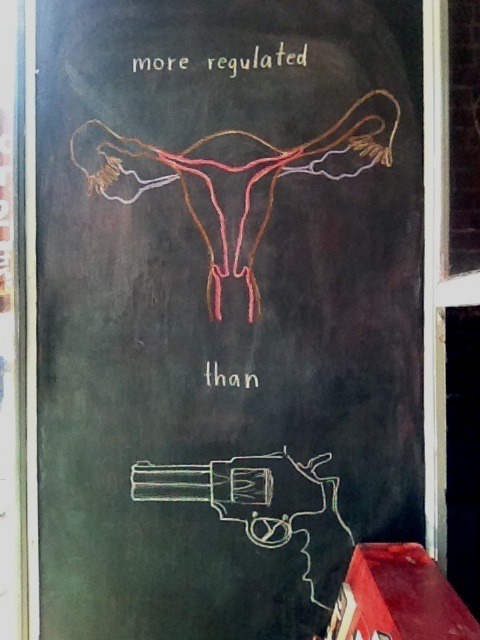
There’s nothing else I can add.This is so sadly spot-on...
There’s nothing else I can add.
This is so sadly spot-on that I’m speechless.
11 Jul 19:24
Richard Linklater and “Boyhood”
by Scott
Movie fans in NYC and LA, do me a favor. Go ahead and see Dawn of the Planet of the Apes on Friday night when it opens. But after you’ve given yourself Saturday to cleanse your mental palette, go to one of the 5 theaters that is screening Boyhood on its opening weekend and see this film which currently has at 100% rating among film critics.
That’s right: 100%.
Several people I know whose judgment I trust have seen the movie and told me it is truly special. But then, you don’t have to look much further than its writer-director to know that. Richard Linklater is a treasure to those of us who love stories with richly detailed characters and emotionally resonant narratives.
Some propaganda to compel you to get off the Barcolounger and deposit your derriere in a theater somewhere over the next month as Boyhood expands its run.
First, Peter Sciretta from /film with this: 107 Reasons You Need to See Richard Linklater’s Boyhood.
Actually Peter doesn’t provide 107 reasons, but he does include this nifty behind-the-scenes video:
Then check out this fantastic Grantland feature on Richard Linklater.
A 50+ minute interview with Linlater [video].
Rotten Tomatoes with Richard Linkater’s 5 favorite films.
A Variety essay on why Linklater deserves a Best Director Oscar for Boyhood.
A heartfelt and thoughtful open letter from a /bent contributor to Richard Linklater about Boyhood.
Here is the international trailer for Boyhood:
Listen. We complain about the state of contemporary movies. Fine. We can do that and justifiably so for many reasons. But when something special comes along like Boyhood by someone like Richard Linklater, one of the finest contemporary independent filmmakers who has brought us such terrific films as Dazed and Confused, Bernie, Me and Orson Welles, Before Sunrise, Before Sunset, and Before Midnight, it is an obligation to support this effort.
Go see Boyhood. If you love it, spread the word.
11 Jul 17:34


Quote For The Day
by Andrew Sullivan
“No single explanation exists for why the War for the Greater Middle East began and why it persists. But religion figures as a central element. Secularized American elites either cannot grasp or are unwilling to accept this. So they contrive alternative explanations such as “terrorism,”  a justification that impedes understanding. Our leaders can proclaim their high regard for Islam until they are blue in the face. They can insist over and over that we are not at war with Islam. Their claims will fall on deaf ears through much of the Greater Middle East.
Whatever Washington’s intentions, we are engaged in a religious war. That is, the ongoing war has an ineradicable religious dimension. That’s the way a few hundred million Muslims see it and their seeing it in those terms makes it so. The beginning of wisdom is found not in denying that the war is about religion but in acknowledging that war cannot provide an antidote to the fix we have foolishly gotten ourselves into.
Does the Islamic world pose something of a problem for the United States? You bet, in all sorts of ways. But after more than three decades of trying, it’s pretty clear that the application of military power is unlikely to provide a solution. The solution, if there is one, will be found by looking beyond the military realm — which just might be the biggest lesson our experience with the War for the Greater Middle East ought to teach,” – Andrew Bacevich, speaking truth to power.
(Photo: Seen through splintered bullet-proof glass, US soldiers from 2-12 Infantry Battalion examine their damaged Humvee after an Improvised Explosive Device (IED) detonated on the vehicle, following a patrol in the predominantly Sunni al-Dora neighborhood of southern Baghdad 19 March 2007. By David Furst/AFP/Getty Images.)
11 Jul 00:38
“The Secret of Effective Motivation”
by Scott
A guest post from my colleague and friend Tom Benedek:
In approaching character development and story, we are always dividing things between the internal and external motivations of our characters. The protagonist deals with an external conflict AND an internal conflict. Generally, plot elements are in front. In constructing a story, it may be the plot that pops into our heads first. BUT, the motivation of our characters, the internal “Whys?” of what the plot means to them, will drive the story. Scott Myers and yours truly will keep repeating that character drives plot. We can use many examples from fine film stories, movies, scripts to make this point clear.
But, now we have some actual science on this. Yes, scientists have proved this in a set of experiments. In a study of cadets at West Point, the U.S. Military Academy, they found that more ultimately succeeded if they were internally engaged in the work they were doing for its own sake than if they were more concerned with just the result of their success. The scientists are calling them internal and instrumental motives.
Here is a small excerpt from the July 4, 2014 New York Times:
THE SECRET OF EFFECTIVE MOTIVATION
Here are two kinds of motive for engaging in any activity: internal and instrumental. If a scientist conducts research because she wants to discover important facts about the world, that’s an internal motive, since discovering facts is inherently related to the activity of research. If she conducts research because she wants to achieve scholarly renown, that’s an instrumental motive, since the relation between fame and research is not so inherent. Often, people have both internal and instrumental motives for doing what they do.
What mix of motives — internal or instrumental or both — is most conducive to success? You might suppose that a scientist motivated by a desire to discover facts and by a desire to achieve renown will do better work than a scientist motivated by just one of those desires. Surely two motives are better than one. But as we and our colleagues argue in a paper newly published in the Proceedings of the National Academy of Sciences, instrumental motives are not always an asset and can actually be counterproductive to success.
We analyzed data drawn from 11,320 cadets in nine entering classes at the United States Military Academy at West Point, all of whom rated how much each of a set of motives influenced their decision to attend the academy. The motives included things like a desire to get a good job later in life (an instrumental motive) and a desire to be trained as a leader in the United States Army (an internal motive).
How did the cadets fare, years later? And how did their progress relate to their original motives for attending West Point?
We found, unsurprisingly, that the stronger their internal reasons were to attend West Point, the more likely cadets were to graduate and become commissioned officers.
Also unsurprisingly, cadets with internal motives did better in the military (as evidenced by early promotion recommendations) than did those without internal motives and were also more likely
to stay in the military after their five years of mandatory service — unless (and this is the surprising part) they also had strong instrumental motives.So, scientific research seems to prove that character is more important than plot. Our readers/ audiences won’t stop caring about plot. But those twists and turns of story must be driven by strong internal character stories. Our characters need real and concrete reasons for how they behave within the constraints of the stories we spin. That’s what keeps people watching/reading. The other interesting thing that leaps out for me from this study – what we write must matter to us personally. Calculating what ought to work in the marketplace is not enough. We have to be internally motivated to write what we write. This is at the heart of the best storytelling.
No better way to grapple with all this, tell the story that you must tell and develop, of course, a solid story outline with great character hooks than the six-week Screenwritingmasterclass.com Prep: From Concept To Outline class. The next one starts next week: Wednesday, July 16.
I am looking forward to working fellow writers through this great curriculum this summer. You can have a solid story outline to start writing this Fall through the writing exercises in this class.
For more information on the Prep workshop, go here.
10 Jul 17:42


kateordie: Prepare yourselves appropriately, because this is...
Prepare yourselves appropriately, because this is happening.
Batgirl is getting a relaunch by Cameron Stewart, Brenden Fletcher and Babs Freakin’ Tarr. You know, your actual favourite artist who drew the Bosozoku Sailor Scouts? SHE’S DRAWING BATGIRL. I’ll calm down… eventually?!
I’m really enjoying this costume AND/OR comic AND/OR creative team!
09 Jul 17:38
No, *I’ll* tell you the answer!
by Jason

If you bet a startup will fail, you’ll be right most of the time, but not because you’re insightful. (The Critic)
If you bet only on huge ideas, you’ll be wrong most of the time, but because in high tech the financial successes are orders of magnitude larger than failures, this is still a profitable bet. (The Professional Investor)
If you bet only on small, conservative ideas, and stay focussed, you’re most likely to actually succeed, with normal-sized outcomes. This is the best bet for sustainable personal fulfillment and freedom, which after all is the core promise of entrepreneurship. (The Bootstrapper)
In one lifetime you have only a few at-bats at startup-hood, because successful, sustainable companies take 7-10 years to build (yes, even today), and big, change-the-world startups are just as emotionally devastating and just as difficult to solve the product/market/profit equation as little, insignificant ones, so the only endeavors worth your time are big audacious startups. (The VC-backed Founder)
Since all startups are hard and unlikely to survive, you should make only large bets on huge ideas. Risks are high, thus potential returns must be proportionately high to be worth your precious time.
Or no, since all startups are hard and unlikely to survive, you should make conservative choices and retain total control to minimize the risks you absolutely have to take.
Or no, since personal fulfillment is the only true measure of success, you should avoid the world of valuations and evaluations and just build something you enjoy.
Or no, since personal happiness is achieved by doing something that other people will envy or respect, you should use external valuations as the yardstick and money as the way to keep score.
Richard Branson proves that a life of luxury and fun is the goal. Warren Buffet proves that money won’t make you happy but purpose and people do.
Peter Thiel and Elon Musk prove that smarts and persistence trumps luck and timing. Yet every VC will tell you they’d rather be lucky than good.
So…
When are you going to stop, take a breath, think quietly, shut out the cacophony of expectations and press releases and chest-thumping and “disruption” and biased storytelling, and decide what’s right for you?
And then, harder still, when will you truthfully be comfortable and confident in your choice?
Because those who can, are truly rich.
08 Jul 23:11

Seeking ‘religious liberty’ just like Elijah at Kishon
by Fred Clark
Robert Knight is kind of a journeyman utility infielder of the religious right. I forget which team he’s with these days — might be the Family Research Council, might be Concerned Women of America or one of the others. It’s one of those groups that insists that good Christians must have no fellowship with unrighteousness and no communion with darkness.
Except for the Unification Church, because the Moonies’ newspaper is a reliable source of right-wing partisan hackery and that’s what’s most important, after all. And so Robert Knight regularly writes for The Washington Times.

Executing prisoners as an expression of religious liberty.
Knight’s latest column seems like it should’ve been easy. It’s a standard babykillerbabykillerbabykiller attack directed at Hillary Clinton. Knight has been writing variations of this same attack since the early 1990s, so you’d think he’d have it down by now. Alas, though, Knight gets his Canaanite religions confused and manages somehow to get all of his biblical allusions backwards.
The former secretary of state, Knight writes, has “the religious sensibilities of the priests of Baal or the rulers of Sodom and Gomorrah.”
Baal? When you’re trying to paint your political opponents as evil baby-killers, it doesn’t work to accuse them of secretly believing in fertility gods. Molech is the Canaanite god you need to invoke here. When you’re accusing the baby-killers of killing babies to honor their false god of baby-killing, you should always use Molech. A veteran player like Knight really should know that by now.
But the bigger problem with Knight’s column is that his two biblical allusions there both work against what he’s trying to argue. Hillary Clinton, he’s asserting, is a murderous proponent of mass-death. Like every opponent of those who are “pro-life,” she must therefore be pro-death.
To reinforce this accusation, Knight references two stories from the Bible: the story of the priests of Baal, and the story of Sodom and Gomorrah. Both of those stories contain the element Knight wants to introduce here: mass slaughter and a feast for proud death.
But, oddly, the people Knight tries to associate with Clinton are the victims of that mass-slaughter.
Here’s how that story of Sodom and Gomorrah ends:
Then the Lord rained on Sodom and Gomorrah sulfur and fire from the Lord out of heaven; and he overthrew those cities, and all the Plain, and all the inhabitants of the cities, and what grew on the ground.
And here’s what happened to those priests of Baal — 450 of them, according to 1 Kings 18:
Elijah said to them, “Seize the prophets of Baal; do not let one of them escape.” Then they seized them; and Elijah brought them down to the Wadi Kishon, and killed them there.
These are two stories it’s probably best to avoid if you’re trying to argue that being “pro-life” is the paramount ethical principle.
More to the point, if you’re trying to present yourself as a champion of “religious liberty,” then comparing yourself to Elijah at the Wadi Kishon doesn’t really strengthen your case.
That suggests that your idea of “religious liberty” only applies to whatever sect you think of as the true religion. The followers of false gods, you’re saying, don’t deserve this freedom. They don’t have the same rights as the followers of the One True Religion. The only rights they have are the rights to be rounded up, dragged to the river, and killed.
That’s hard to reconcile with the slogan of “religious liberty.” It’s not easy to square with the slogan of “pro-life” either.
08 Jul 22:29


The D'oh to End All D'ohs
by Josh Marshall
Back in the late 90s at The American Prospect I edited an article and became interested in the somewhat obscure but high-stakes debate over whether to destroy the last stocks of the smallpox virus, which was finally eradicated in nature in the 1980. The Russians and the US both have remaining stockpiles, under intense technical and security protection at two laboratories, one in each country. So that's where the debate still remained - except for the vials of smallpox virus in a cardboard box a government scientist found while cleaning out a storage closet near Washington last week.