Haven't read enough of this guy to give a full endorsement, but so far I really like this writer. The end is apparently a teaser for his upcoming book?
From now on the great political battles will be fought between nationalists and internationalists, nativists and globalists. .. Well, maybe. But describing the division this way .. gives the elite side of the debate .. too much credit for being truly cosmopolitan.
Genuine cosmopolitanism is a rare thing. It requires comfort with real difference, with forms of life that are truly exotic relative to one’s own. .. The people who consider themselves “cosmopolitan” in today’s West, by contrast, are part of a meritocratic order that transforms difference into similarity, by plucking the best and brightest from everywhere and homogenizing them into the peculiar species that we call “global citizens.”
This species is racially diverse (within limits) and eager to assimilate the fun-seeming bits of foreign cultures — food, a touch of exotic spirituality. But no less than Brexit-voting Cornish villagers, our global citizens think and act as members of a tribe. They have their own distinctive worldview .. common educational experience, .. shared values and assumptions .. outgroups (evangelicals, Little Englanders) to fear, pity and despise. .. From London to Paris to New York, each Western “global city” .. is increasingly interchangeable, so that wherever the citizen of the world travels he already feels at home. ..
It is still possible to disappear into someone else’s culture, to leave the global-citizen bubble behind. But in my experience the people who do are exceptional or eccentric or natural outsiders to begin with .. It’s a problem that our tribe of self-styled cosmopolitans doesn’t see itself clearly as a tribe. .. They can’t see that paeans to multicultural openness can sound like self-serving cant coming from open-borders Londoners who love Afghan restaurants but would never live near an immigrant housing project.
You have values, and your culture has values. They are similar, and this isn’t a coincidence. Causation here mostly goes from culture to individual. And even if you did pick your culture, you have to admit that the young you who did was’t especially wise or well-informed. And you were unaware of many options. So you have to wonder if you’ve too easily accepted your culture’s values.
Of course your culture anticipates these doubts, and is ready with detailed stories on why your culture has the best values. Actually most stories you hear have that as a subtext. But you should wonder how well you can trust all this material.
Now, you might realize that for personal success and comfort, you have little to gain, and much to lose, by questioning your culture’s values. Your associates mostly share your culture, and are comforted more by your loyalty displays than your intellectual cleverness. Hey, everyone agrees cultures aren’t equal; someone has to be best. So why not give yours the benefit of the doubt? Isn’t that reasonable?
But if showing cleverness is really important to you, or if perhaps you really actually care about getting values right, then you should wonder what else you can do to check your culture’s value stories. And the obvious option is to immerse yourself in the lives and viewpoints of other cultures. Not just via the stories or trips your culture has set up to tell you of its superiority. But in ways that give those other cultures, and their members, a real chance. Not just slight variations on your culture, but big variations as well. Try to see a wider landscape of views, and then try to see the universe from many widely dispersed points on that landscape.
Yes if you are a big-city elite, try to see the world from Brexit or Trump fan views. But there are actually much bigger view differences out there. Try a islamic fundamentalist, or a Chinese nationalist. But even if you grow to be able to see the world as do most people in the world today, there still remain even bigger differences out there. Your distant ancestors were quite human, and yet they saw the universe very differently. Yes, they were wrong on some facts, but that hardly invalidates most of their views. Learn some ancient history, to see their views.
And if you already know some ancient history, perhaps the most alien culture you have yet to encounter is that of your human-like descendants. But we can’t possibly know anything about that yet, you say? I beg to differ. I introduce my new book with this meet-a-strange-culture rationale:
Everyone without exception believes his own native customs, and the religion he was brought up in, to be the best (Herodotus 440bc)
The future is not the realization of our hopes and dreams, a warning to mend our ways, an adventure to inspire us, nor a romance to touch our hearts. The future is just another place in space-time. Its residents, like us, find their world mundane and morally ambiguous. (Hanson 2008a)
You, dear reader, are special. Most humans were born before 1700. And of those born after, you are probably richer and better educated than most. Thus you and most everyone you know is special, elite members of the industrial era.
Like most of your kind, you probably feel superior to your ancestors. Oh, you don’t blame them for learning what they were taught. But you’d shudder to hear of many of your distant farmer ancestors’ habits and attitudes on sanitation, sex, marriage, gender, religion, slavery, war, bosses, inequality, nature, conformity, and family obligations. And you’d also shudder to hear of many habits and attitudes of your even more ancient forager ancestors. Yes, you admit that lacking your wealth your ancestors couldn’t copy some of your habits. Even so, you tend to think that humanity has learned that your ways are better. That is, you believe in social and moral progress.
The problem is, the future will probably hold new kinds of people. Your descendants’ habits and attitudes are likely to differ from yours by as much as yours differ from your ancestors. If you understood just how different your ancestors were, you’d realize that you should expect your descendants to seem quite strange. Historical fiction misleads you, showing your ancestors as more modern than they were. Science fiction similarly misleads you about your descendants.
New habits and attitudes result less than you think from moral progress, and more from people adapting to new situations. So many of your descendants’ strange habits and attitudes are likely to violate your concepts of moral progress; what they do may often seem wrong. Also, you likely won’t be able to easily categorize many future ways as either good or evil; they will instead just seem weird. After all, your world hardly fits the morality tales your distant ancestors told; to them you’d just seem weird. Complex realities frustrate simple summaries, and don’t fit simple morality tales.
This book presents a concrete and plausible yet troubling view of a future full of strange behaviors and attitudes. You may have seen concrete troubling future scenarios before in science fiction. But few of those scenarios are in fact plausible; their details usually make little sense to those with expert understanding. They were designed for entertainment, not realism.
Perhaps you were told that fictional scenarios are the best we can do. If so, I aim to show that you were told wrong. My method is simple. I will start with a particular very disruptive technology often foreseen in futurism and science fiction: brain emulations, in which brains are recorded, copied, and used to make artificial “robot” minds. I will then use standard theories from many physical, human, and social sciences to describe in detail what a world with that future technology would look like.
I may be wrong about some consequences of brain emulations, and I may misapply some science. Even so, the view I offer will still show just how troublingly strange the future can be.
This makes me slightly optimistic. Previously, my working assumption was that the reason politics reflected high-income values was just campaign finance shenanigans. This graph suggests maybe part of the reason is that high-income people vote more.
Shitty that more poor people don't vote. But still nice that maybe democracy is functioning? idk
did you know the only income bracket where the majority of the members voted in the 2014 election was people who make more than $100,000 a year? i didn’t.
Only in the most secure segment of Americans did Pew find that a simple majority planned to support Republican candidates. As financial security decreased, the category that benefitted most was not the Democrats, but rather “OTHER/NOT SURE” – indicating that the person being surveyed was not heavily engaged in the political process, and unlikely to vote:
John Halpin, an analyst at the Center for American Progress who runs its “States of Change” project, provided figures derived from the Current Population Survey to The Intercept that show how large the voting disparities are between whites without a college degree (typically referred to as working class) and those who graduated college. In 2010, for instance, turnout among white working-class voters was 41.9 percent. For those with college degrees, the turnout was 63.5 percent. In 2012’s presidential election, 57 percent of working-class whites participated, while 79 percent of those holding college degrees took part.
Also, It is not because they are sad or being harassed. They actually have a gland that empties into their eyes that helps them get rid of too much salt that they collect living in the salty water. You can only see their tears when they are out of the water on land, and the tears also help keep sand out of the turtle’s eyes. The tears of the tortoises are an essential contribution of salt and minerals for the butterflies survival and the turtles work with them like a friendship & open their eyes for them to drink without hesitation.
Butterfly: Man I’m so hungry bro.
Turtle: I gotcha homie. *Opens eyes*
Butterfly: Thanks man.
That’s friendship.
This may be one of the most adorable animal facts I’ve ever heard.
I think I kinda agree. My working theory is that part of the cult success of Mulholland Drive is from people falling asleep trying to watch it the first time, having weird dream/memories about it, and then convincing other people to try to finish it with them.
This is really cool. I always assumed motion planning was slow because the algorithms suck, but this is an interesting way to solve the same problem. Watch the video for brief altera fpga cameo.
New computer processor allows for fast, energy-efficient robot motion planning in cluttered environments (credit: Duke Robotics)
Duke University researchers have designed a new computer processor that’s optimized for robot motion planning (for example, for quickly picking up and accurately moving an object in a cluttered environment while evading obstacles). The new processor can plan an optimal motion path up to 10,000 times faster than existing systems while using a small fraction of the required power.
The new processor is fast enough to plan and operate in real time, and power-efficient enough to be used in large-scale manufacturing environments with thousands of robots, according to George Konidaris, assistant professor of computer science and electrical and computer engineering at Duke.
“When you think about a car assembly line, the entire environment is carefully controlled so that the robots can blindly repeat the same movements over and over again,” said Konidaris. “The car parts are in exactly the same place every time, and the robots are contained within cages so that humans don’t wander past.”
But for uncontrolled environments (such as homes), robot motion planning has to be a lot smarter and able to learn in real time. That would save the time and expense of custom-engineering the environment around the robot, said Konidaris, who presented the new work yesterday (June 20) at a conference called Robotics: Science and Systems in Ann Arbor, Mich.
Duke Robotics | Robotic Motion Planning
Collision detection in real time
Most existing approaches for robot motion planning rely on general-purpose CPUs or computationally faster but more power-hungry graphics processors (GPUs). Instead, the Duke team specifically designed a new processor for motion planning.
“While a general-purpose CPU is good at many tasks, it cannot compete with a processor specially designed for just a single task,” said Daniel Sorin, professor of electrical and computer engineering and computer science at Duke.
Konidaris and Sorin’s team designed their new processor to perform collision detection — the most time-consuming aspect of motion planning — requiring thousands of collision checks in parallel. “We streamlined our design and focused our hardware and power budgets on just the specific tasks that matter for motion planning,” Sorin said.
The key was to use an FPGA (field-programmable gate array) integrated circuit, which can be configured by a designer for customized uses.
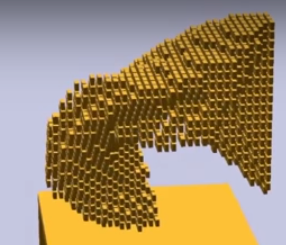
The robot-motion processor selects the set of voxels swept by the robot arm and this set is used to build specialized circuits in an FPGA integrated circuit to detect collisions and optimize motions in real time during operation (credit: Duke Robotics)
The technology works by breaking down the arm’s operating space into thousands of 3D volumes called voxels (volume pixels). The algorithm then determines whether or not an object is present in one of the voxels contained within pre-programmed motion paths. Thanks to the specially designed hardware, the technology can check thousands of motion paths simultaneously, and then stitch together the shortest motion path possible using the “safe” options remaining.
Game-changer
“The state of the art prior to our work used high-performance, commodity graphics processors that consume 200 to 300 watts,” said Konidaris. “And even then, it was taking hundreds of milliseconds, or even as much as a second, to find a motion plan. We’re at less than a millisecond, and less than 10 watts. Even if we weren’t faster, the power savings alone will add up in factories with thousands, or even millions, of robots.”
Konidaris also notes that the technology opens up new ways to use motion planning. “Previously, planning was done once per movement, because it was so slow,” he said, “but now it is fast enough that it could be used as a component of a more complex planning algorithm, perhaps one that sequences several simpler motions or plans ahead to reason about the movement of several objects.”
The new processor’s speed and power efficiency could create many opportunities for automation. So Konidaris, Sorin and their students have formed a spinoff company, Realtime Robotics, to commercialize the technology. “Real-time motion planning could really be a game-changer for robotics,” said Konidaris.
This research was supported by the Defense Advanced Research Projects Agency and the National Institutes of Health.
Abstract of Robot Motion Planning on a Chip
We describe a process that constructs robot-specific circuitry for motion planning, capable of generating motion plans approximately three orders of magnitude faster than existing methods. Our method is based on building collision detection circuits for a probabilistic roadmap. Collision detection for the roadmap edges is completely parallelized, so that the time to determine which edges are in collision is independent of the number of edges. We demonstrate planning using a 6-degree- of-freedom robot arm in less than 1 millisecond.
Every year, graduating Engineering students receive an Iron Ring at a private and voluntary “Ceremony of the Calling of an Engineer”. The ceremony calls upon all Engineering graduates to uphold the principles of professionalism and to perform their work to the best of their ability. The first ceremony, also known as the Kipling Ritual, was held in 1925. Every year hundreds of practicing and graduating engineers receive their ring at the ceremony which is closed to the public. In order to get your ring you must have graduated from an accredited Engineering program.
"I used ecoutils to confirm that the python I was using had a funky openssl version that was breaking everything." - me, happy customer.
You know that old quote:
The wider the net you cast, the wider the variety you catch.
Was it a wise old fisherman? Or a dogged Python programmer? Either
way, words don't come much truer than those.
Few, if any, programming languages have embodied the description
"general-purpose" as wholly as Python. And with the wide net of that
applicability comes a wide variety in use -- and environments.
Library and framework developers rarely get to control how their code
is used, and thus have to think about how their code fits into the
whole ecosystem. From writing hybrid code for Python 2 and 3 to
inserting shims for Pythons without threading support, there's no rest
for the rigorous. Until now.
Ecosystems differ. Widely. Academic Python tends to be more
Windows-heavy, corporate Python will probably forever be entrenched in
Python 2, and one can never predict the arrival of that oddball user
with the super old version of Python on Cygwin. But these
are generalities and we can do better.
Enter ecoutils. ecoutils is a pure-Python module
that, using nothing but builtins, generates a semantic, Python-centric
profile of the environment that's running it. This includes:
Host operating system: Windows, OS X, Ubuntu, Debian, CentOS, RHEL, etc.
Language version: 2.5, 2.6, 2.7, ..., 3.4, 3.5, ..., etc.
Executable runtime: CPython, PyPy, Jython, etc., (plus build date and compiler)
Features: 64-bit, IPv6, Unicode character support (UCS-2/UCS-4)
Built-in library support: OpenSSL, threading, SQLite, zlib, and more
User environment: umask, ulimit, working directory
Machine info: CPU count, hostname, filesystem encoding
Now, instead of crossing platform support bridges when users bring
them to you, you can be proactive. Now, instead of guessing how
developers are using the code, you can design for their needs and
watch those needs change.
ecoutils only gets more valuable when code goes to production. If you
manage your own machines, you know the risk of version drift and
missed boxes only goes up with machine number and time. If you don't
manage your machines, it's just a matter of time until someone is
being trained on your boxes.
When run as a module, ecoutils calls get_profile() and prints a
JSON-formatted profile. On my fully-updated Ubuntu 14.04LTS machine,
python -m boltons.ecoutils yields:
Weighing in at just over 1KB, it's not too daunting! ecoutils is part
of the boltons package, so pip install boltons and
see how yours compares.
By virtue of being in boltons, the ecoutils module is also fully
standalone, and can be used without the rest of the boltons
package. ecoutils has been tested with Python 2.6, 2.7, 3.4, 3.5, and
PyPy on Ubuntu, Debian, RHEL, OS X, FreeBSD, and
Windows. File an issue if something seems to be
broken. Compatibility is the goal.
Now, ecoutils is really just part of the solution. Sure you can write
out a quick profile it at the top of every log file, and you won't
regret it. However, real ecosystem management means running a sort of
Python analytics shop.
For those familiar with browsing the Internet, your browser is a
virtual machine that has likely been participating in a similar
arrangement all day today. Like Google Analytics or Piwik,
the setup involves collecting relevant data, and then sending it to a
central server for storage and querying.
Collection is handled by ecoutils. As far as transmission is
concerned, in development environments, we have a dead-simple,
side-effect-minimizing, single-file HTTP client that sends ecoutils
profiles to a central analytics server on application startup.
Push or pull, all the data is stored in a simple SQL (or JSONL)
format, as demonstrated by espymetrics, the example
project for my Enterprise Software with Python course. Nothing
more enterprise than having literally dozens of environments by
design, and even more than that by debt.
One last note, data management is all about audience and context. If
you're an administrator in a professional setting, the data above is
great. But there are understandably some cases where you might want
something less identifiable. get_profile has a scrub flag that
handles that. See the docs for details.
Originally designed for easier remote administration across multiple
environments, a little bit of info has had far-reaching impacts. For a
few examples from my work at PayPal, this approach enabled us to:
Deprecate and remove production Python 2.6 support from our
framework, simplifying our build matrix without customer impact.
Actively engage new users attempting to use our framework with
unsupported Pythons or OSes.
Improve utilization through designing for observed CPU counts.
In practice, ecoutils combines well with psutil data to
go even further in utilization.
Some of you probably came here expecting to read yet another great
post about virtualenv, tox, and maybe even
conda envs. I'm glad you've already heard of them,
because they're a big part of the story. If you haven't yet explored
these tools, check them out, because they are invaluable for
cross-version Python testing and packaging.
Also, if you're working on an open-source library, I can vouch for
Travis CI (Linux) and Appveyor (Windows) as
very valuable providers for cross-platform testing. I use both of them
on boltons, and it makes it easier, not harder, for
contributors to submit pull requests with confidence. Most outfits
can't afford to have a team member leading support for each platform,
like we do at PayPal.
Python is more than just an expressive, succinct programming
language. In a diverse world, Python is a tremendous force, made so by
its wide deployment, cross-platform support, and external library
integrations. Python gives you SQLite, JSON, SSL, Unicode, and much
more, but with many necessary strings attached to Python version,
build, or environment. ecoutils offers an experienced look at the
real features that affect the value of Python components and teams.
Don't leave ecosystems and their constituents to chance, whim, or
fad. Collect the data that makes your ecosystem unique, and make
measured decisions based on the realest demand: actual usage.
When that server seems slow, remember to
donate to Wikipedia. And maybe volunteer, because
money alone does not make servers run fast. ↩
Everyone’s seen this picture a million times in the last 12 hours, but you have to hear the story of how it happened:
Neil Leifer, possibly the best sports photographer of his generation, covered Ali for Time and Sports Illustrated from the early 1960s through Ali’s fight against Larry Holmes.
NEIL LEIFER: “How good was Ali at self-promotion? Let me tell you a story that shows his genius. After he turned pro, Sports Illustrated did a piece on him. They assigned a free-lance photographer named Flip Schulke, and Ali—he was Cassius Clay then—asked, ‘Who do you work for?’ Schulke told him he did a lot of work for Life. This was when Life was the biggest magazine in the country, and Ali wasn’t that big then. He’d won the gold medal, but that was it. There was no reason for Ali to be in Life magazine, so when he said, ‘Man, how about shooting me for Life,’ Schulke told him, ‘I’d love to, but I’d never get it past the editors.’
Well, Ali accepted that, but a few minutes later, he was asking questions again. ‘Tell me some of the photographs you’ve done.’ And Schulke explained that he did a lot of underwater photography; that was his specialty. And Ali thought of something on the spur of the moment, which shows what an absolute genius he was. His eyes widened, and he told Schulke, ‘I never told nobody this, but me and Angelo have a secret. Do you know why I’m the fastest heavyweight in the world? I’m the only heavyweight that trains
underwater.’ Schulke said, ‘What do you mean?’
And Ali explained, ‘You know why fighters wear heavy shoes when they run? They wear those shoes because, when you take them off and put the other shoes on, you feel real light and you run real fast. Well, I get in the water up to my neck and I punch in the water, and then when I get out of the water, I’m lightning fast because there’s no resistance.’ Schulke was skeptical, but Ali swore it was the truth, and to prove his point, he told Schulke, ‘Tomorrow morning, you can see me do it. I do it every morning with Angelo, and no one’s ever seen it before. I’ll let you photograph it for Life magazine as an exclusive.’
So Schulke called up Life and suggested the piece, and I think they ran five pages of Ali up to his neck in a swimming pool. And the two things I remember most about that were, first, Ali couldn’t swim, not a bit; and second, Ali had never thrown a punch underwater in his life. It was a total bullshit story he made up, but it got him in Life, and Life didn’t do it as a joke. They were convinced he trained underwater. Now that’s a genius you don’t see in people very often. Genius and a bit of a con man, too.”
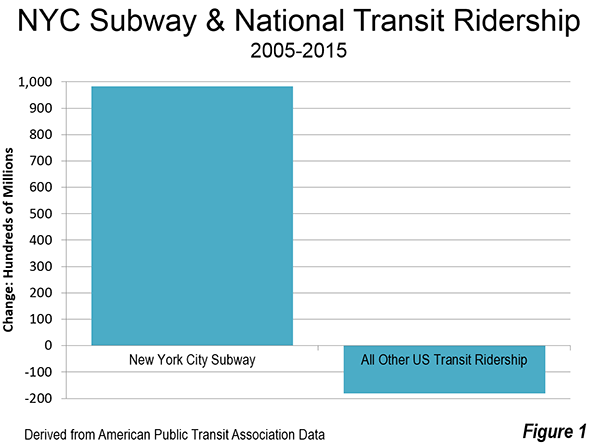
Perhaps the most incredible thing about the New York City Subway has been its utter dominance of the well-publicized national transit ridership increases of the last decade. According to annual data published by the American Public Transportation Association (APTA), ridership on the New York City Subway accounts for all of the transit increase since 2005. Between 2005 and 2015, ridership on the New York City Subway increased nearly 1 billion trips. By contrast, all of the transit services in the United States, including the New York City Subway, increased only 800 million over the same period. On services outside the New York City subway, three was a loss of nearly 200 million riders between 2005 and 2015…
That is from Wendell Cox. And note that use of the NYC system peaked in the late 1940s!
surprisingly enough, he was shot to death in Vancouver. ftp everywhere, I guess.
Paul Boyd (the animator) was shot and killed by a police officer. He was having a mental breakdown related to his bipolar disorder. He was shot 8 times during a manic episode
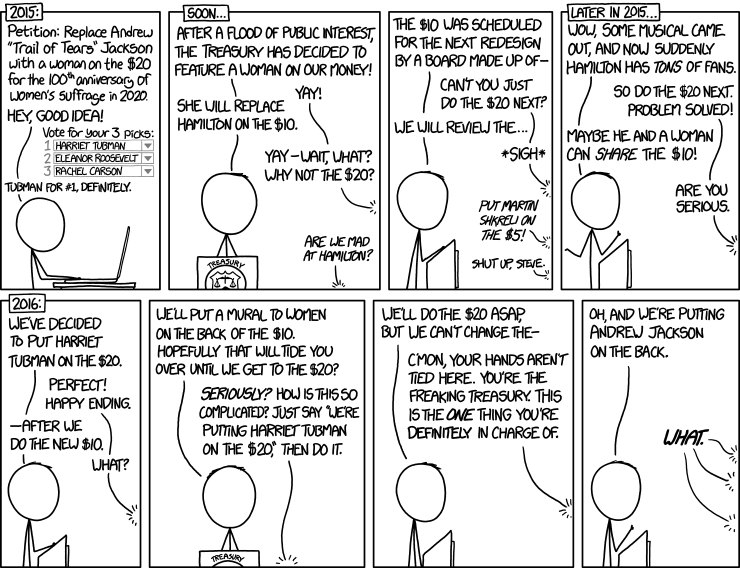
Sorry for the xkcd share, but this is a 100% accurate description of this process. They are really going to move Andrew "Trail of Tears" Jackson to the back of the $20 and put Harriet Tubman on the front.