Shared posts

07 Dec 07:18

Swamp Thing and the Demon Would've Been the Batman and Superman of the Justice League Dark Movie

by Charles Pulliam-Moore

Guillermo del Toro has a habit of signing on for awesome-sounding projects that he either drops out of or never gets made at all. Either way, not a day goes by that we shouldn’t all be mourning the fact that we’re probably never going to get a del Toro-directed Justice League Dark movie.

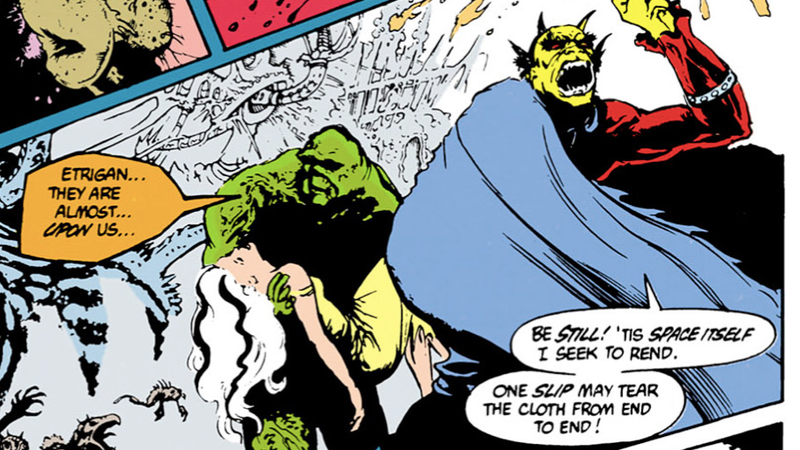
Based on the comic/supernatural super-team of the same name, the film would have followed some of DC’s more mystical heroes on an adventure that more than likely would have taken them to hell. The team usually consists of folks like John Constantine and Deadman, but according to del Toro, his version of the film would have featured less-seen DC mainstays like Swamp Thing and Etrigan the Demon. During a recent Reddit AMA, del Toro explained that in his mind, those two are are core parts of DC’s arcane trinity:

“It’s a WB property, I am not sure I can comment [on the project]. Suffice to say that Demon or Swamp Thing mean to me what Batman and Superman mean to most mortals- perhaps even more. [Swamp] / Abigal love was a great source of inspiration for me.”

In 1985's Swamp Thing Annual #2, Swamp Thing ventures into hell to save the soul of his frequent love interest Abigail Arcane. During his Orphean journey, Swamp Thing encounters a number of DC’s other magical characters, like Deadman, the Spectre, the Phantom Stranger, and of course, Etrigan. It’s almost like the comic might have made for a fantastic movie in the hands of the right director—say, someone who knew a thing or two about humanizing monstrous heroes.

Oh well.

04 Dec 15:39

Män som pratar om automatisering

by rasmus

Sedan några år pratas, skrivs och tycks det en faslig massa om automatiseringen. Om en ny industriell revolution och om alla de jobb som kommer att försvinna. Idag tittade jag förbi den liberala tankesmedjan Fores för att lyssna på ännu ett samtal i mängden. Ryan Avent, journalist på The Economist, har skrivit boken The wealth of humans som på svenska fått titeln Stabilitetsillusionen. Huruvida den tillför något nytt till diskussionen vågar jag inte säga, men nog sätter jag den på min läslista.

Det mest slående med samtalet var dock könsbalansen, eller snarare frånvaron av balans. Publiken på cirka 80 personer bestod däremot till närmare hälften av kvinnor. Men av de som fick träda upp på scenen var sex av sju män. Undrar om detta är något som Fores över huvud taget noterade.

Frågan är större än att bara handla om representation i panelsamtal. Robotiseringsdebatten lider av en strukturell snedbalans där mansdominerade yrken konsekvent står i centrum. Gång på gång på gång upprepas samma ramsor om hur “alla” jobb är på väg att automatiseras bort. De kvinnodominerade omsorgsyrkena är diskussionens stora vita fläck. Visst talas det den del om automatisering i sjukvården, men aldrig någonsin om barn- eller äldreomsorg. På något vis förutsätter vi alla att det ändå finns något i det mänskliga mötet som inte kan eller får automatiseras bort. Men ytterst sällan talas det om var gränsen går eller hur den ritas om.

Vid ett tillfälle närmade sig Ryan Avent ändå saken. Det var när han sa att automatiseringen inte bara måste lösas genom omfördelningspolitik, utan också genom att vi som samhälle hittar nya sätt att värdera olika sysslor. Vi måste ta hänsyn till att människor vill bidra, inte bara sitta hemma i soffan. Därför borde vi visa större respekt för ideellt volontärarbete och oavlönad omsorg om äldre och barn, förklarade Avent – dock utan att nämna ett ord om vilket kön som tenderar att få ansvaret för detta oavlönade arbete. En något illvillig slutsats kunde vara att han menade att robotiseringen kommer att leda till en pånyttfödelse för hemmafruidealet.

Samtidigt var det slående att Ryan Avent tycktes stå en bra bit till vänster om LO-ekonomen Thomas Carlén. Inte nog med att Avent, på ett sätt som erinrade om Piketty, talade om behovet av ekonomisk omfördelning för större jämlikhet. Han drog också paralleller till den första industriella revolutionen och antydde att vår tid ännu väntar på en framväxt av något som kan motsvara den gamla arbetarrörelsen, som nödvändig motvikt till kapitalet. Detta sades alltså av en företrädare för marknadsliberala The Economist. Men från LO visades inget intresse av att plocka upp bollen. I stället presenterade Thomas Carlén vad han menade var en “ny idé”, nämligen att vi måste enas över klassgränserna för att försvara det egna landets företag: “Could there be a new kind of collaboration between labour and capital in the light of the digital revolution?” Ridå.

04 Dec 12:07

How iFixit Became King of the iPhone Teardown

by Jason Koebler

"Just so we're both completely clear: We've spent most of the week flying to Australia to stand in line to buy a phone we're not sure we're going to get," I say to Kyle Wiens, the CEO of iFixit and the person whose plan this was. It crosses my mind that there is a perfectly good Apple Store three minutes from my office.

We have the order confirmation: One iPhone X, to be sold to us at 9:30 AM at the Castle Towers Apple Store. Still, it is entirely possible that there might not be a phone. It's happened before.

"It's completely ridiculous," Wiens responds. "It's a big gamble, right? If there's a disaster and the store doesn't get their allotment—at that point, you have to turn to the people who got them and offer stacks of cash."

We've brought $2,000 just to be safe. I know that we probably won't even turn the phone on, that it'll be a good day if we buy the most coveted device on Earth and immediately break it.

"We're going to have one of the first iPhones in the world, and we have no intention of using it," Wiens says.

*

Every iPhone is made up of more or less the same components. There's the ones we can see: the camera, the Lightning Port, the screen. And the ones we can't: the battery; the wifi, bluetooth, and cellular chips; the storage, processor, and RAM; the Logic Board; and hundreds of tiny chips and sensors that control everything from touch input to charging speed. They form, perhaps, the most successful commercial product humans have ever made. But without actually opening it, we have no real way of understanding how this all-powerful device works or knowing anything about these components besides the limited information Apple tells us.

It may sound absurd, but the most interesting and arguably most important thing to happen on iPhone release day is not the release of the phone but the disassembly of it. The iPhone teardown, undertaken by third-party teams around the world, provides a roadmap for the life of the device: When you inevitably break the screen, will it be easy and inexpensive to fix? Are there design flaws that will potentially cause widespread problems, such as the iPhone 6's bendgate? And, most importantly, who made the iPhone?

Very little inside the iPhone is actually made by Apple. In the iPhone X, Samsung makes the OLED display, Qualcomm makes many of the chips, and much of the iPhone's famous camera is made by Sony. Because Apple will sell roughly 200 million iPhones this year, what's in the iPhone is a crucially important question for the worldwide economy.

The iPhone X, disassembled. Image: Jason Koebler

"The teardown is the Super Bowl for the tech supply chain," Daniel Ives, an Apple analyst, told me in a phone interview. "Whether you're in the iPhone X or not—it could ultimately be the birth of a new company or the death of an old company."

Apple did not respond to my request for comment, but the company rarely offers any photos of the inside of its devices, and certainly not on the day it's launched. For that, we have to rely on third-party teardown teams.

"They're off in a distant land with a limited tool set, and we're back here telling them what's happening"

And so every iPhone release day, stock traders, gadget geeks, engineers, and even a lot of people at Apple itself frantically refresh Twitter, RSS feeds, Google Alerts, Reddit, YouTube, and Weibo in an effort to learn what's inside the device. Consider, for example, the iPhone 3G, which contained three different components made by a small, Oregon-based company called TriQuint Semiconductor. Moments after the teardown went live, TriQuint's stock price jumped by 60 percent; the company had been deemed good enough to be used in an Apple device.

"If the iPhone sells 80 million units and a company making a chip in there sells it to Apple for 40 cents, well, 40 cents times 80 million is a lot of money," Stacy Wegner, a teardown specialist at Teardown.com, told me. "That's the kind of math we start talking about."

Image: Jason Koebler

If the iPhone teardown is so important, I wanted to see it firsthand. And so I flew across the country, and then across the ocean.

*

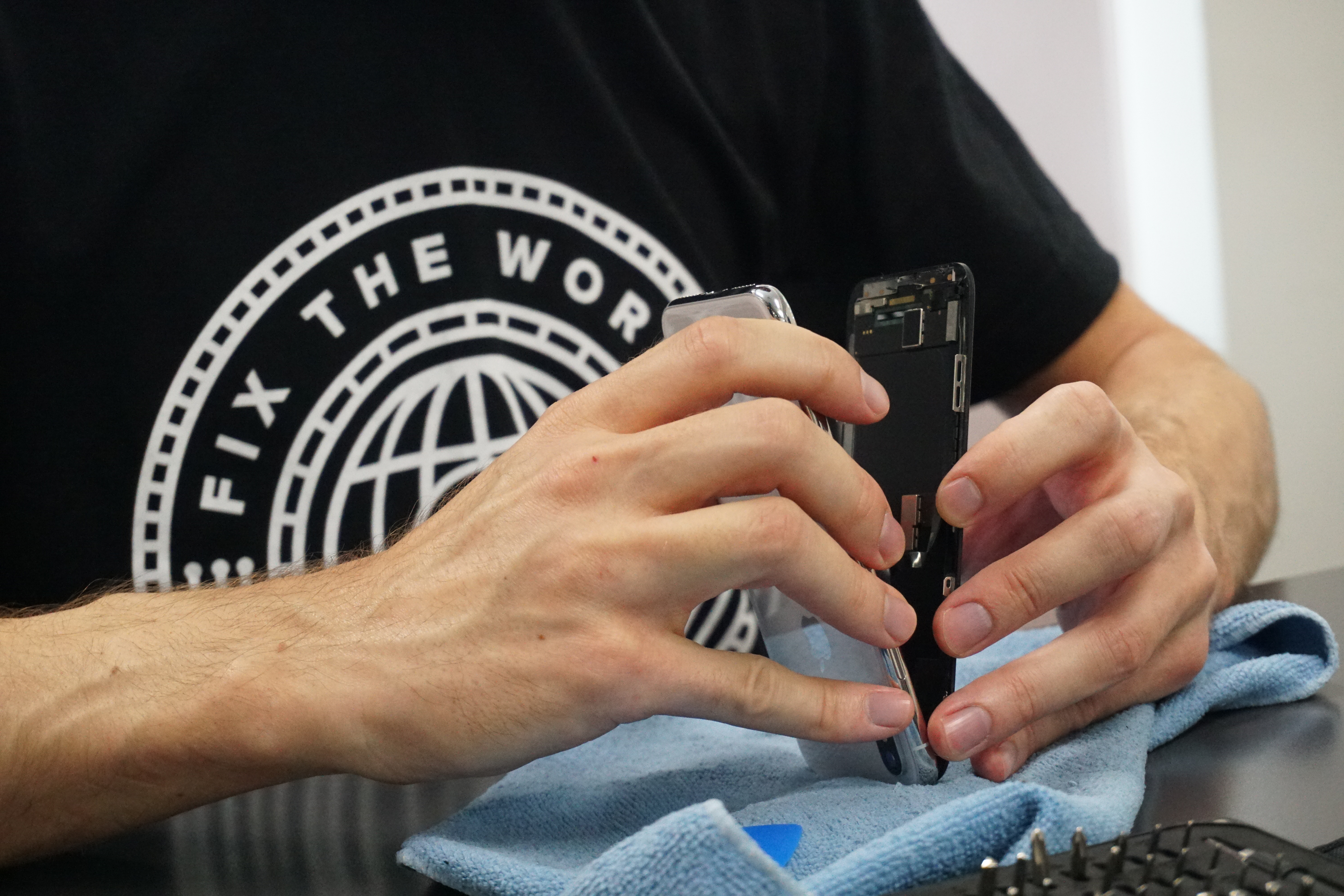
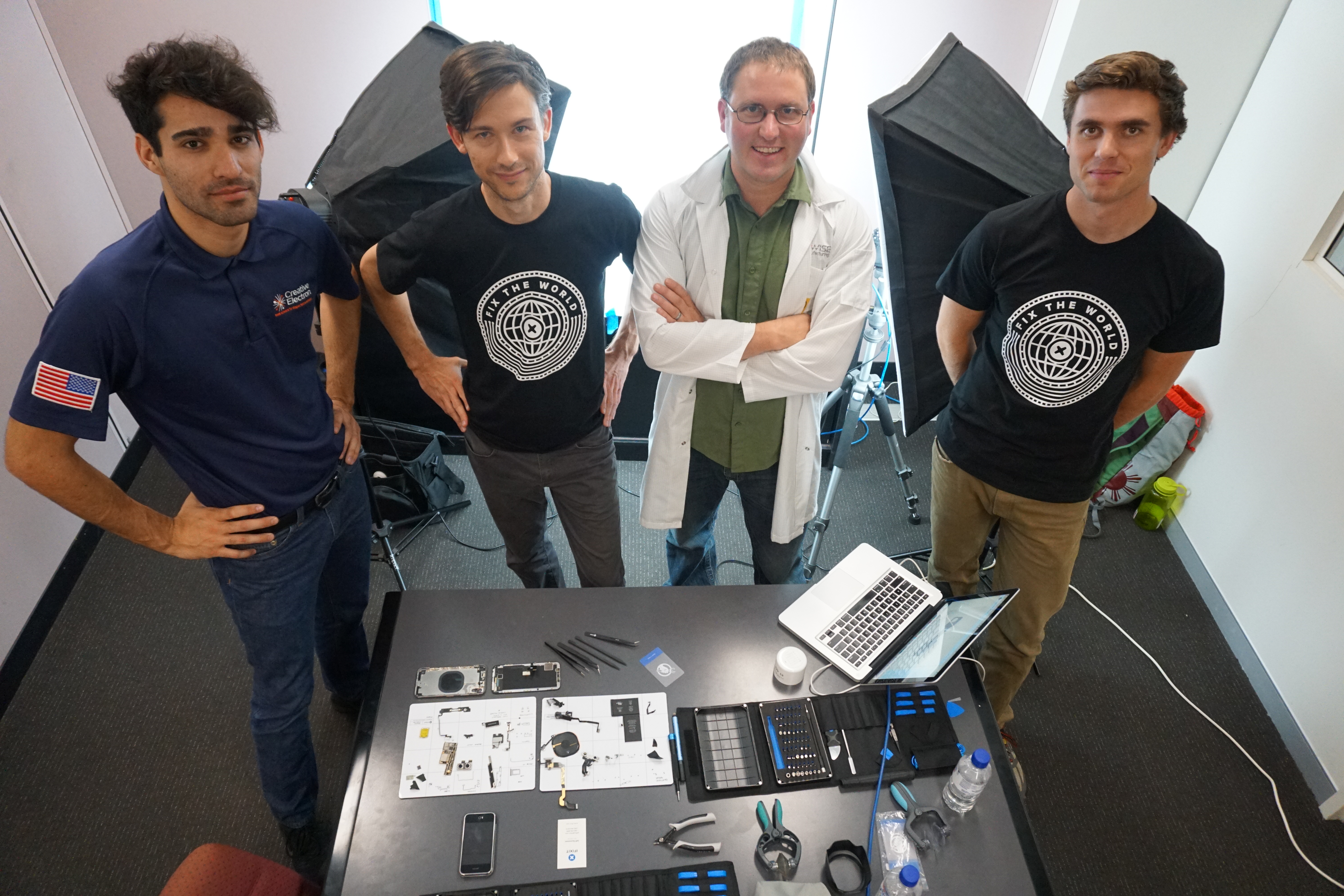
iFixit didn't invent the teardown, but the company has become by far the most popular and well-respected group of teardown artists in the world. The company, based in a two-story reclaimed auto repair shop in San Luis Obispo, California, treats its iPhone teardown like a space launch. The "home team" camps out at its headquarters, while a teardown engineer, a photographer, and a coordinator are dispatched to far-flung locales like Tokyo, Sydney, or, in earlier years, London. The away team—this year made up of Wiens, teardown engineer Jeff Suovanen, and photographer Adam O'Comb—methodically works through the iPhone and sends photos of it back to headquarters, where engineers and analysts try to identify what, exactly, is going on in it.

Because the iPhone X is released at 8 AM local time all around the world, flying to Sydney buys the team 16 "extra" hours to tear down the iPhone before the East Coast launch. The goal is to be completely done with the teardown by the time the iPhone is for sale in New York. The team, I'll learn, needs just about every minute of that head start.

"It's like Apollo 13, but less disastrous," Sam Lionheart, a technical writer at iFixit who flew to Sydney to tear down the iPhone 8 earlier this fall, told me. "They're off in a distant land with a limited tool set, and we're back here telling them what's happening."

This time-zone gaming is necessary to even have a remote chance of consistently getting the first iPhone teardown on the internet. In the early days, iFixit was regularly scooped by Mitsunobu Tanaka, a Japanese biotechnology researcher at the Red Cross who tore down iPhones as a hobby.

"It was always a race between us and him, and he had the time zone advantage of being in Japan," Wiens says. Tanaka eventually quit the first-day teardown game because iFixit started flying people to Tokyo, Sydney, and Melbourne to better compete with him. Two teardowns just didn't seem necessary.

In the years since, new competitors have come from around the world. The first iPhone 7 Plus teardown came out of a Vietnamese forum; the first iPhone 3GS teardown was done by a team in Poland; increasingly, repair shops in Australia have gotten in on the game, too.

"At the moment we don't have an arch nemesis," Wiens says. "Instead, you're competing against the entire world. All it takes is one person somewhere to get the phone."

Wiens had "Plans A, B, C, and D" for getting the phone. Plans B through D all involved passing a large pile of money to someone in line.

The iPhone 4S teardown field trip was a bit of a catastrophe—Wiens flew to Tokyo to tear down the phone, was told in line by a reporter that someone had managed to get ahold of the phone early and had already torn it down, and Wiens wasn't able to buy one anyway. The iFixit team in California, meanwhile, managed to pay several thousand dollars to someone on Craigslist who had the phone before its release date because of a FedEx error that caused the phone to be delivered early.

Sometimes, the race comes down to who reaches the end of "live" teardowns first. When the Apple Watch was released in 2015, an Australian repair shop uploaded its first few teardown photos before iFixit. But the watch had a brand new, tiny screw that hadn't been used in an Apple product before. Without a screwdriver that could remove it, the Australian team was stuck and never finished the teardown. iFixit's engineers improvised by filing down a different screwdriver and were able to complete the teardown.

Circuitwise. Image: Jason Koebler

One advantage iFixit has is that the company's primary mission is to make it easier for the average person to disassemble and repair their electronics. Its main business is selling specialized tools and replacement parts specifically for teardowns and repairs, and so many of its engineers have helped craft the tools it will use to open up the iPhone X. Its headquarters features both a tool laboratory and a parts library that could easily be used to build just about any popular electronic device released in the past 10 years from scratch.

My goal from the outset was to embed with the team that would win the iPhone X teardown race, and iFixit seemed like my best bet.

*

In the days leading up to the iPhone X release, I scouted potential competitors. My early findings were promising from an "I hope I'm not going to Australia for no reason" standpoint. An Australian repair shop that has done several teardowns told me preorders sold out before it could get a phone. A French team called SOSav said that, given the quantity of teardowns, it was internally debating whether it should even bother. After much debate, it decided to go ahead with one: "Teardowns are a prerequisite nobody can avoid," a spokesperson for the company told me in an email. The good news for iFixit, though, is that SOSav would not be leaving France.

"We haven't yet felt the need to go to countries with an earlier release than France," SOSav CEO Mikael Thomas told me. "Personally, I think setting off to another country for the repair would completely contradict our aim to limit our carbon footprint. Putting our team on a plane would make us real kerosene guzzlers."

I had been assured that iFixit would get a phone, in Australia, within the first few hours of its release. An internet outage at the iFixit office prevented the company from pre-ordering the phone in Sydney, but a friend of the company had come through with a 9:30 AM reservation—just an hour and a half after the phone went on sale. The plan was to show up to the Apple Store early and bribe someone in line to switch reservations.

Wiens had "Plans A, B, C, and D" for getting the phone. Plans B through D all involved passing a large pile of money to someone in line.

The night before the teardown, I met with the iFixit team at Circuitwise, a circuit board manufacturer in an office park in suburban Sydney that owns one of Australia's only electronics X-Ray machines, employs highly skilled solderers, and happens to be located just 15 minutes from the Apple Store. The first floor of the facility is filled with robots that automatically place nearly microscopic chips on circuit boards, robots that bake and solder the chips, and humans clad in anti-static jackets that make sure the robots aren't screwing up.

Upstairs, iFixit has taken over a conference room. The boardroom table is covered with all manner of adapters, Lightning and Thunderbolt cables, tools, old iPhones (including the original iPhone) for comparison shots, a few bananas and pastries, and a bunch of laptops, each of which will soon be assisting in a critical part of the teardown. It is immediately apparent that iFixit is highly prepared.

It's around this time that I notice iFixit has already lost

"We have two suitcases of tools, so we can double our chances in case our luggage gets lost," Lionhart says. The suitcases are described to me as if they were teardown go bags, ready to be deployed in case of any smartphone emergency.

It was appropriate, I thought, that as Circuitwise built electronics, iFixit would be tearing into them.

*

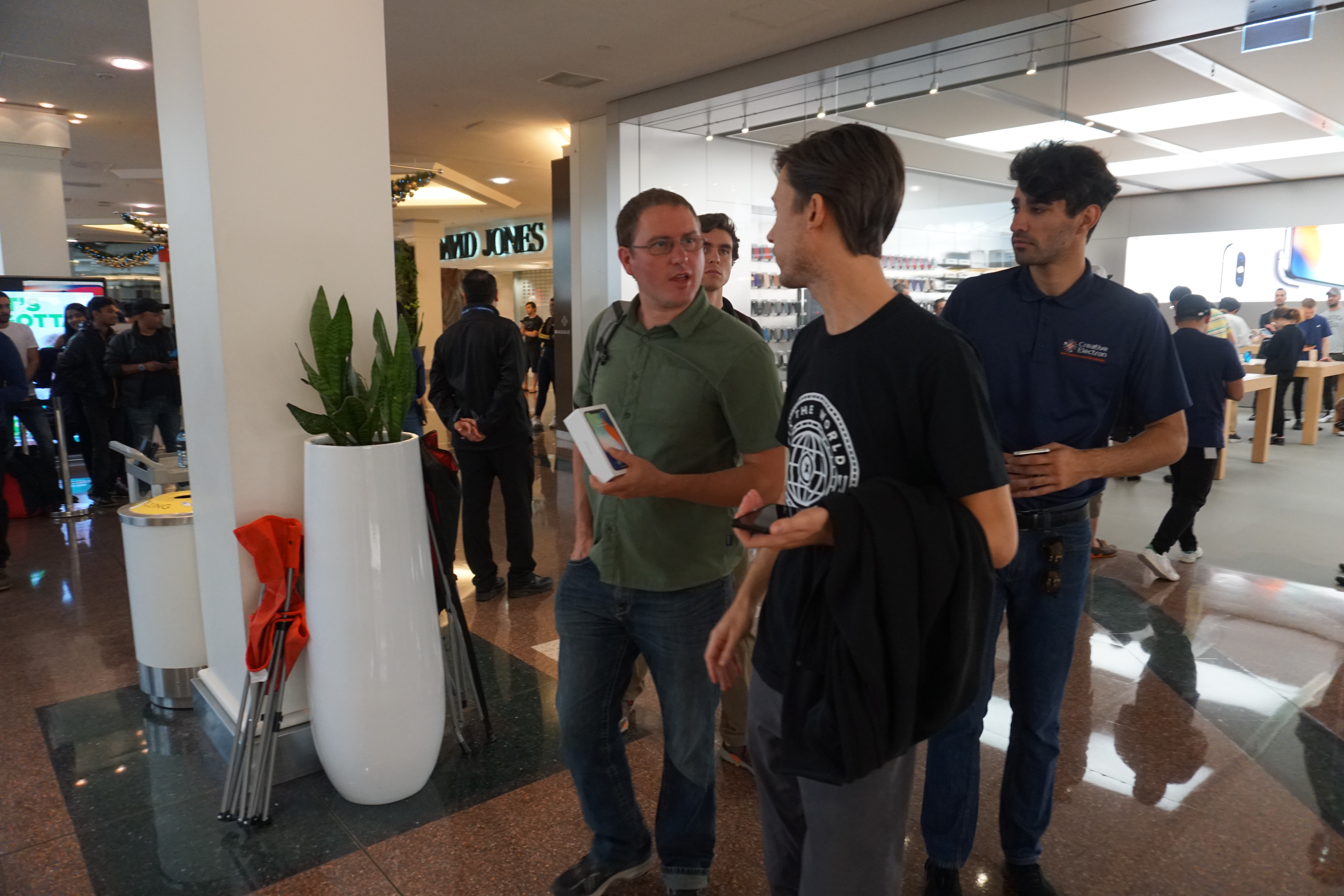
Plans B through D weren't necessary, and Plan A went much better than anyone could have hoped. The Apple Geniuses didn't seem to care that iFixit's reservation time was an hour and a half after the store opened. Instead, Wiens was the second person let into the Apple Store and the first to check out. The transaction was completely over by 8:03 AM—it is entirely possible, probable, even, that Wiens was the first person on Earth to buy an iPhone X—and the team sprinted through the mall to the rental car. The iPhone remained in its box during a harried ride to Circuitwise filled with nearly missed turns, game planning, and borderline reckless driving.

We don't park the car; Wiens halfway pulls into a spot and runs into Circuitwise. The teardown is on.

It's around this time that I notice iFixit has already lost. Someone on Weibo had posted a short video of the iPhone X's internal components hours before the phone went on sale anywhere on Earth. The phone had "fallen off the back of a truck," repair-industry speak for unaccounted-for phones that disappear from factories. The video had gone to the top of the Apple subreddit, and MacRumors, a popular Apple blog, had already picked up the video. iFixit had been scooped before it even started.

I quickly realized, though, why the iFixit teardown is one of the few teardowns that actually matters. There's a huge difference between seeing a couple seconds of grainy footage and doing the sort of teardown that has the ability to affect the global economy.

Image: Jason Koebler

iFixit's teardown isn't just about taking the device apart; it's about trying to identify every single chip within the phone, its function, its manufacturer, and its likelihood to make any given phone repair easier or more difficult. For the next 10 hours, Wiens and his team methodically disassemble the phone. They x-ray some individual components in an attempt to learn their provenance and call the world's foremost chip analysts and experts to run part numbers or brainstorm what unfamiliar chips could do. They get help from Christopher Jimenez, an employee of Creative Electron, the company that makes the x-ray machine. Jimenez gave iFixit his preorder and flew to Australia to operate the machine. An employee of Circuitwise used an industrial soldering machine to separate the two Logic Boards from one another.

After months of iPhone X hype, it turns out that this iteration of the phone actually is quite a leap forward. There's seemingly much less stuff inside the iPhone X than in previous devices. Apple managed to shrink the Logic Board—the brains of the computer—to an absurd degree by stacking two chips on top of each other. According to iFixit's analysis, the board occupies just 70 percent of the real estate that the iPhone 8's Logic Board does, which allows for a battery that takes up most of the interior of the device. This is a significant step forward in Apple's never-ending quest to make its phones thinner, lighter, and faster—if you can get rid of all the separate components that make up a phone and put them onto ever-shrinking chips, you can reach a point where the functional bits of the phone don't get in the way of Apple's obsession with design.

"The eventual trajectory of this is you have a screen, a battery, a camera, and a chip," Wiens said.

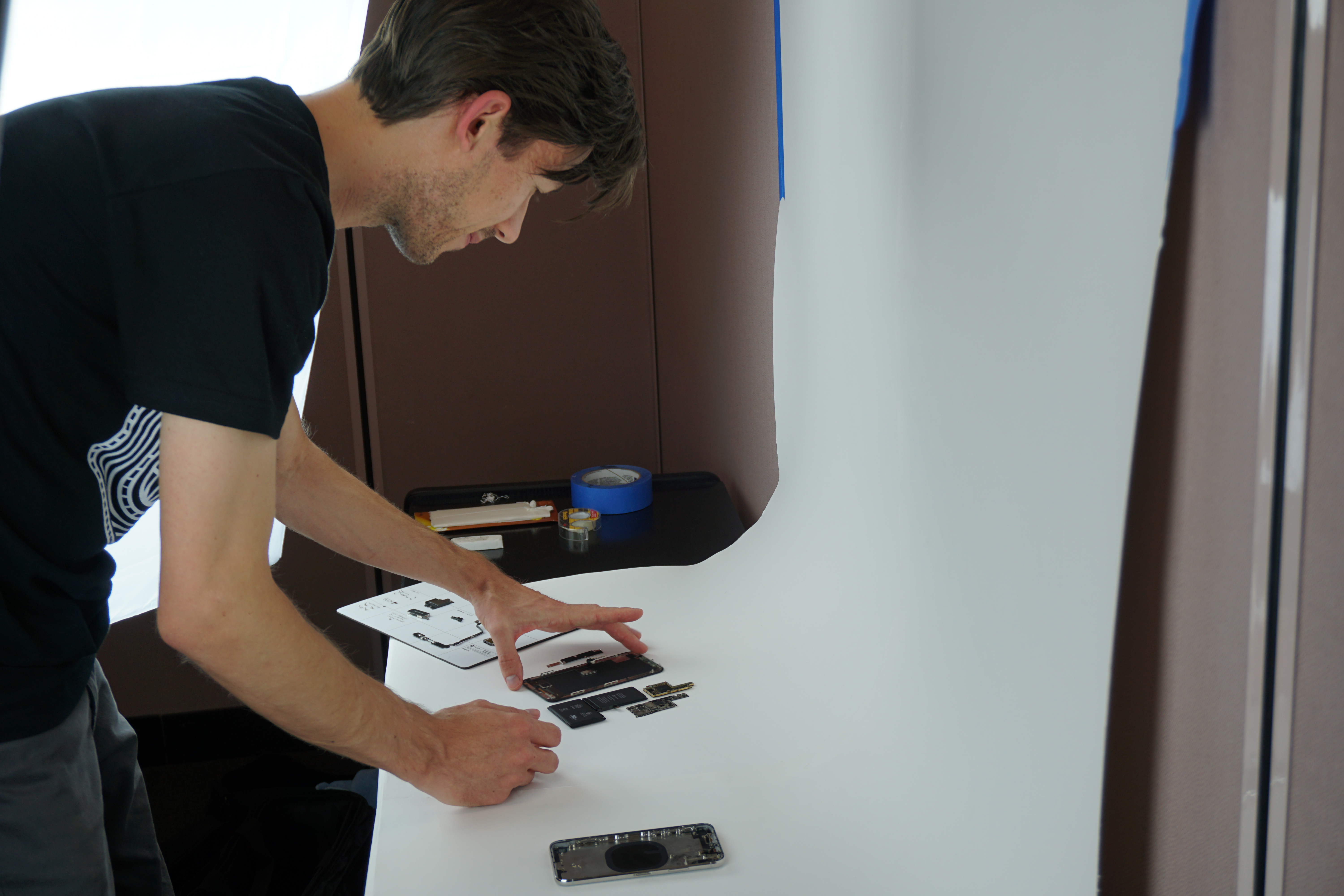
Ten hours after he bought the phone, the brand-new iPhone X is lying on the boardroom table, spread out into its component parts. The phone will never work again, a sacrifice made in the name of exploration.

"Taking things apart is interesting and fun. Every time you take something apart, you learn something about what makes it tick," Wiens says. "We want to know what's in the phone, and we know we're going to write a repair manual so people can fix it themselves. We look at the teardown as an exploratory process, a public process of getting inside and learning how it works."

The teardown may influence the stock market, but at its heart, it's an exploration of how accessible our gadgets are to us. As companies increasingly move toward inscrutable and inaccessible systems and away from the very idea that you own the things you buy, flying halfway around the world to open a device that the manufacturer would prefer stay closed doesn't really feel crazy at all.

01 Dec 14:13

Aftonbladet tyskt 1915

by Hexmaster
[1915] Aktiemajoriteten i Aftonbladet köps av det tyska krigsministeriet.
- Lars M. Andersson och Lena Amurén, Sveriges historia i årtal (Historiska media 2003)

Uppgiften föreföll förbluffande. Kan en krigsmakt bli huvudägare i en av landets största tidningar? Mitt under brinnande krig?

Är det sant? Hur gick det i så fall till?

En snabbkoll senare avslöjar att svaren på de sista två frågorna är 1) ja och 2) i hemlighet:
Harald Sohlman och Aftonbladet stödde Tyskland i första världskriget, och 1915 sålde han och brodern Arvid aktiemajoriteten i tidningen till tyska regeringen för att ge Tyskland möjlighet att skapa propaganda i Sverige. Kontraktet hölls hemligt i många år.
- Aftonbladet: Från Lars Johan Hierta till våra dagar

Att AB var tyskvänligt under 30- och 40-talen är välkänt, åtminstone bland många som har koll på perioden. Att det började såpass tidigt och var så flagrant var en nyhet för åtminstone undertecknad.
01 Dec 07:21

Våra städers snabba förändring

by Hexmaster
Ett lite längre citat (språket kan ha moderniserats):
Våra städer genomgår för närvarande, i samband med hela samhällsutvecklingen, en hastig förändring, utvidgning och omdaning. Tidens nya krav och medlen för dess tillfredsställande kan verka nedbrytande på det gamla.
Kraven på högre förtätning, mer luft och ljus, snabbare förbindelser mellan stadsdelarna, mer bekvämlighet, nya byggnadstyper och konstruktionsmetoder ger alla våra städer dess moderna prägel. Ju större möjligheter en stad har till utökad industri eller handel, ju mer den av en eller annan orsak "går framåt", desto fortare ändras den gamla stadsprägeln. Men vid denna förändring, som på många håll pågår med en våldsam hastighet, förlorar vi mängder av gammal karakteristisk stadsbyggnadskonst, intressanta historiska och arkitektoniska minnesmärken, och frågan är: Ger det nya full ersättning för det förlorade?
När skrevs detta? Svar i vit text, markera för facit: [Gamla Svenska Städer (1908)]
30 Nov 11:23

Getting to the truth

by Jason Fried

If you want to feel good, brainstorm it. If you want to appear good, test it. If you want to know if you’re any good, ship it.


Getting to the truth was originally published in Signal v. Noise on Medium, where people are continuing the conversation by highlighting and responding to this story.

30 Nov 08:34

Managers, screw the Golden Rule

by Claire Lew

Don’t treat employees the way you want to be treated. Here’s why.

“Treat others the way you’d like to be treated.”

This is The Golden Rule we all learned growing up. As a manager or CEO in a company, you’d think it would make sense to follow it too. Managers should treat their employees the way they’d like to be treated, right?

Not quite.

In a recent interview I did with David Heinemeier Hansson (DHH), the Creator of the popular web framework Ruby on Rails and Chief Technology Officer at Basecamp, he shared this insight: You shouldn’t treat other people the way you want to be treated because the other person isn’t you.

The other person has different preferences (beliefs, ideas, and experiences) and is going to react to a situation differently than you. You might think something is reasonable or fair, but that’s you thinking that, not the other person. You cannot assume that the way she would like to be treated is the same as the way you’d like to be treated.

David admits to being guilty of this as much as anyone, saying that when he does this, “I’m trying to be empathetic to my own mirror image, which is not actually a very good definition of empathy.”

In fact, it’s self-centered in many ways to assume that if you treat others the way you’d like to be treated, other people will like it too.

One of the most memorable examples for me of this is when I talked with another CEO a few months ago. He told me how his company had implemented an unlimited vacation policy recently. In theory, he thought it was going to work great. It’s what he had always wanted when he’d worked at other companies himself — unlimited vacation, what could be better?

But then something interesting at his company happened: No one in his company took vacation. Maybe a day or two off here and there, but people took less vacation with the unlimited vacation policy than they had in years before.

I was a little shocked when he first told me this. What went wrong? The CEO learned is that none of the employees wanted to be seen as “the slacker” or “letting the team down.” Everyone else was afraid of taking vacation, so no one went on one.

After realizing this, the CEO replaced the unlimited vacation policy with a requirement that people take at least two weeks off of paid vacation during a year. It’s not what he would have necessarily wanted, but that’s not the point. If you’re a great manager or leader, you shouldn’t be operating from the point-of-view of what you want, you should be operating from the point-of-view of what others want.

Instead of practicing The Golden Rule and assuming other people are just like you, what should you do?

The answer is deceptively simple. Ask.

Ask your employees what type of vacation policy they’d prefer or what work environment they’d like to be in. Here are some examples of things you can specifically ask:

  • How do you prefer I give you feedback? In-person or in writing?
  • When you are most productive in a day? During the morning or the afternoon? Or even at night?
  • How much social interaction is important to you? Should we plan more team-bonding outings or have more regular company lunches?
  • How often would you like to get together for one-on-ones? Once a week, once a month or once a quarter?
  • How would you like to recognized for your work? Do prefer verbal praise in front of others, or more privately? Are small gifts or tokens of appreciation a good way to signify gratitude?
  • How much direction or context do you like before kicking off a project? Do you need space to gather your thoughts initially, or do you like having a lot of suggestions from me upfront?

Don’t just assume their answers are the same as yours. Ask, listen, and then act accordingly. The Golden Rule need not apply.

If you’re looking to learn more insights from David and other leaders from around the world, consider joining The Watercooler 💦 — our online leadership community with almost 400 CEOs, managers, and executives (including David!) where we talk about everything from hiring, firing, company culture and business growth.

This article was originally published for Inc.com, where I write a weekly column on leadership.


Managers, screw the Golden Rule was originally published in Signal v. Noise on Medium, where people are continuing the conversation by highlighting and responding to this story.

30 Nov 08:22

High Tech High Life: William Gibson & Timothy Leary in Conversation (1989)

by Ken Goffman

The story of Timothy Leary’s conversation with William Gibson is here.  This is most of the text as it was published in the first edition of MONDO 2000 magazine

TIMOTHY LEARY: If you could put Neuromancer into one sentence, how would you describe it?

WILLIAM GIBSON: What’s most important to me is that it’s about the present. It’s not really about an imagined future. It’s a way of trying to come to terms with the awe and terror inspired in me by the world in which we live. I’m anxious to know what they’ll make of it in Japan.

TRAPPED

WG: Oh, god. I’m starting to feel like Edgar Rice Burroughs or something. I mean, how did Edgar Rice Burroughs finally come to feel about Tarzan in his own heart, you know? He got real tired of it. Wound up living in Tarzana, California.

TL: You’ll end up living in a space colony called Neuromancer.

WG: That would be OK. I don’t think we’re going to have this kind of future. I think this book is so much nicer than what seems to be happening. I mean, this would be a cool place to visit. I wouldn’t mind going there.

TL: Where?

WG: To the Sprawl, to that future.

TL: Go up the well?

WG: Yeah. Go up the well and all of that. A lot of people think this is a bleak book but I think it’s optimistic.

TL: I do, too.

WG: I think it’s actually gonna be more boring. I think some kind of Falwellian future would probably be my idea of the worst thing that could happen.

TL: Yeah. That was a wonderful scene where you have those Christians who were gonna mug those girls in the subway.

WG: It’s not clear whether they’re going to mug them or just try to force some horrible pamphlet on them or something. Personally, I have a real phobia about guys like that coming up to me on the street . . .

TL: That’s a powerful scene! And you describe the girls as like hoofed animals wearing high heels.

WG: Yeah. The office girls of the Sprawl.

TL: Yeah, and they’re wearing vaginas, and — Oh, God! That’s a powerful scene.

WG: I like the idea of that subway. That’s the state-of- the-art subway. It goes from Atlanta to Boston, real fast.

TL: You’ve created a world.

WG: What you’re getting when you read that book — the impression is very complicated but it’s all actually one molecule thick. Some of it is still pretty much of a mystery to me. You know, the United States is never mentioned in the book. And there’s some question as to whether the United States exists as a political entity or if, in fact, it’s been Balkanized in some weird way. That’s kind of a favorite idea of mine, that the world should be chopped up into smaller . . .

TL: Me too, boy.

WG: West Coast separatism and stuff. In Count Zero, I mention what’s happening in California a little bit. One of the characters has a girlfriend who lives in a pontoon city that’s tethered off Redondo. Kind of like a hallucinated … it’s the Sprawl goes Sausalito — the
Sprawl but mellower.

At the end of Neuromancer, the entire Matrix is sentient. It has, in some ways, one will. And, as it tells Case, kind of matter-of-factly, it’s found another of its kind on Alpha Centuri or somewhere, so it’s got something to talk to. Count Zero starts seven years later, and like Yeats’ poem about how the center wouldn’t hold, this sort of God-consciousness is now fragmented. It hasn’t been able to keep it together. So the voodoo cultists in the Sprawl, who believe that they have contacted the voodoo pantheon through the Matrix, are in fact dealing with these fragmented elements of this God thing. And the fragments are much more demonic and more human, reflecting cultural expectations.

Anyway, I’ve got to do a different kind of book now, because I’m already getting some reviews saying, “Well, this is good, but it’s more of the same stuff.” I’m desperate to avoid that.

TL: Frank Herbert, who was a lovely guy, wrote a book that’s entirely different from Dune. It’s about humans who became insects up in Portland. Did you ever read it? It’s a nice change. In some ways, I like that book as much as Dune. He got into an entirely different situation.

WG: Well, he was trapped! That’s something I’m very worried about. I get flashes of “I don’t want to be Frank Herbert.” Because even as wealthy and as nice a guy as he was, I don’t think he was happy with what had happened to him creatively. He did get trapped. It’s different for somebody like Douglas Adams, where I think that the whole thing started off as such a goof for him that it was just a stroke of good luck that he built on. But Herbert was very serious, at a certain point. And then, gradually, he wound up having to do more of the same, because, I mean, how can you turn people down when something like that gets enough momentum?

TL: Douglas Adams told me that the three books were one book, and the publisher said split them up into three. He made a million dollars on each one of them. And they’re nice. It’s a nice tour.

WG: Yeah. They’re funny.

TL: These big books . . .

WG: I can’t go for that.

TL: I’m glad about that. Norman Spinrad … by the way — I love Norman. But I have a terrible problem with him. He makes them too big. Did you read Child of Fortune?

WG: It was too big for me.

TL: Yeah. If he had divided it down the center. If he could only cut it in half.

WG: He wrote a book called The Iron Dream. It’s a science fiction novel by Adolf Hitler, in an alternate world where Hitler became a science fiction writer. It’s a critique of the innately fascist element in a lot of traditional science fiction. Very funny.

ON THE CASE OF CASE & IN THE COURT OF BURROUGHS

WG: For me, given the data in the books, the keys to Case’s personality are the estrangement from his body, the meat, which it seems to me, he does overcome. People have criticized Neuromancer for not bringing Case to some kind of transcendent experience. But, in fact, I think he does have it. He has it within the construct of the beach and he has it when he has his orgasm. There’s a long paragraph there where he accepts the meat as being this infinite and complex thing. In some ways, he’s more human after that.

TL: In some ways he reminds me of some of Burroughs’ characters.

WG: (Equivocally) Yeah. He could be one of Burroughs’ wild boys … in a way. I’m deeply influenced by Burroughs. I always tell everybody that there’s a very strong influence there. I didn’t think I’d be able to put that over on the American science fiction people because they either don’t know who Burroughs is or they’re immediately hostile … he found 50′ s science fiction and used it like a rusty can opener on society’s jugular. They never understood. But I was like 15 when I read The Naked Lunch and it sorta splattered my head all over the walls. And I have my megalomaniac fantasy of some little kid in Indiana picking up Neuromancer and POW!

TL: Well, that happens, baby. Don’t worry. There’s 500,000 copies already.

WG: I had to teach myself not to write too much like Burroughs. He was that kind of influence. I had to weed some of that Burroughsian stuff out of it. In an interview in London, in one of my rare lucid moments, I told this guy that the difference between what Burroughs did and what I did is that Burroughs would just glue the stuff down on the page but I airbrushed it all.

TL: Burroughs and I are real close friends. We’ve been through a lot together. I went to Tangiers in 1961. I was there and Burroughs walks in with these two beautiful English boys. I started telling him about these new Drugs and, of course, he knew many times more about drugs than anyone in the world! I was just this childish Harvard Professor doing my big research project on drugs. And Burroughs is saying “Oh shit. Here they come. Boy Scouts. And they’re gonna save the world with drugs. Yeah, sure.” We brought him back to Harvard. He came to the prison project and all. I got to know him very well. He couldn’t stand us. We were much too goody-goody. We had hired this black psychologist, as our front, who was also gay. He thought we were ridiculous squares too. So he and Burroughs used to get together at the house, and Burroughs would drink a few gin-and-tonics and the two of them would start teasing us just to see how far we would go. Burroughs would say things like (assuming the dry Burroughsian rasp) “Anyone that says they wouldn’t fuck a 12-year-old Arab boy is either crazy or a liar.” (laughter)

It’s implied that the crowd that Case hung out with is a drug crowd.

WG: Yeah. This seems to be a world where everybody is pretty much stoned most of the time.

TL: That first chapter . . . whew!

WG: I had to go over and over that. I must have rewritten it 150 times.

TL: I’ll bet. It’s like a symphony or a fugue. This is the fifth line in the book; “It’s like my body developed this massive drug deficiency. It was a Sprawl voice and a Sprawl joke.” (Laughs) Of course, his life was jacking in.

WG: Oh yeah. He just lives for . . .

TL: Cyberspace.

WG: Yeah. For cyberspace.

TL: Would you describe cyberspace as the matrix of all the hallucinations?

WG: Yeah, it’s a consensual hallucination that these people have created. It’s like, with this equipment, you can agree to share the same hallucinations. In effect, they’re creating a world. It’s not really a place; it’s not really space. It’s notional space.

TL: See, we live in that space. We that are hooked up to Neuromancer are living in that consensual hallucination.

WG: Yeah. In a sense.

ON MOLLY

WG: I didn’t think women would go for the Molly character very much. I’ve really been surprised at the number of women who have come up to me and said, “Molly’s great. I really got off on her.” I think America is ready for a female lead who beats the shit out of everybody.

TL: Molly says “You like to jack in. I’ve gotta tussle.” That’s a beautiful two-liner.

WG: I was originally gonna call this book “Jacked In.” The people at Ace said it sounded too much like “Jacked Off,” but that was my first thought for a title.

Molly’s tougher than Case because Case is the viewpoint character, and I wanted an enigmatic character. So, she’s more shut off from me. It’s the symbolism of the sunglasses. He never even finds out what color her eyes are.

TL: And making love, she says . . .

WG: “No fingerprints.” (General all-around laughter) Yeah, she’s a tough one for me to do because that’s some kind of image from my . . . She’s a Bushido figure. When she says she’s street Samurai, she means it quite literally. She has this code. And it may grow out of a sort of pathological personality, but it still is her “code.

TL: What was that segment where she was like in hypnosis so she didn’t know what was going on?

WG: Oh, they use a sort of sensory cutout, so that she isn’t conscious when this stuff is happening, but her motor system was being run by a program. So, in effect, she became kind of a living sex shop doll. Programmed. The people who write the program are in Berlin. She says, “They have some nasty shit there.”

Actually, this starts in Burning Chrome. That’s where it comes from. One of the key things in that story is when this guy realizes that his girlfriend is working in one of these places in order to buy herself an improved pair of artificial eyes. I described it a little more clearly in that story. The prostitutes aren’t conscious. They don’t remember. In Burning Chrome, the guy says the orgasms are like little silver flares right out at the edge of space, and that’s the…

TL: That’s the guy’s orgasm, not hers. She’s not even feeling it.

WG: Well, she can feel a little bit, maybe . . .

ON RIVIERA, ARMITAGE & LUCAS YONDERBOY

TL: What would you say about Riviera?

WG: Riviera is like some kind of terminal bag-person.

He grows up in a radioactive pit with cannibalism pretty much the only way to get along. It’s like Suddenly Last Summer. Ever see that? Where the guy’s ripped apart by the little Mexican children? Well, Riviera is like that, a feral child. He’s smart, incredibly perverse. But all the stuff that he does ‘ the little projected hallucinations and things — are relatively low tech. He’s just projecting holograms.

There’s this amazing German surrealist sculptor named Hans Bellmer who made a piece called “The Doll.” He made a doll that was more his fetish object than a work of art. This totally idealized girl-child that could be taken apart and rearranged in an infinite number of ways. So I have Riviera call his piece “The Doll.” Bellmer’s doll. Riviera also represents the fragmentation of the body. People see things like that, sometimes, out of the corners of their eyes.

TL: What about Armitage?

WG: He’s a synthetic personality, a character utterly lacking character. As Molly says, “This guy doesn’t do anything when he’s alone.” It’s some kind of post-Vietnam state. •

TL: I can see certain Gordon Liddy qualities in Armitage.

WG: Yeah, I saw a video of his Miami Vice performance without realizing it was Liddy. When I saw that I thought of Armitage. This book’s fraught with psychotics.

TL: (Laughing) You see, there are a few of us who think it’s a very positive book in spite of that.

WG: Yeah? Really? Well, I just try to reflect the world around me.

TL: I know. You’re a mirror. Yes. How about Lucas Yonderboy?

WG: Lucas Yonderboy was my reaction to the spookier and more interesting side of punk. Kind of young and enigmatic. Cool to the point of inexplicability. And he’s a member of the Panther Moderns. They’re sorta like Marshall McLuhan’s Revenge. Media monsters. It’s as though the worst street gang you ever ran into were, at the same time, intense conceptual artists. You never know what they’re going to do.

ON PYNCHON & STERLING

WG: Bruce Sterling is my favorite science fiction writer. Schismatrix is the most visionary science fiction novel of the last twenty years or so. Humanity evolves, mutates through different forms very quickly, using genetic engineering and biochemistry. It’s a real mindfucker. When he first got it out and was getting the reviews back, he told me “There are so many moving parts, people are scared to stick their heads in it.” People will be mining that, ripping off ideas for the next thirty years.

TL: Like Gravity’s Rainbow.

WG: Yeah. That’s one of my personal favorites. Have you ever met Pynchon?

TL: Ohhhh … I had him tracked down and I could’ve. It was a deal where there was a People magazine reporter with an expense-paid thing. We were going to rent a car and pick up Ken Kesey. Pynchon was living up near Redding, Pennsylvania. We had him tracked there. And I decided I didn’t want to do it. I’ve said this to many people, so I should say it to you. Your book had the same effect on me as Gravity’s Rainbow.

The way I read Gravity’s Rainbow is pretty interesting. At one point, the American government was trying to get me to talk. They were putting incredible pressure on me. This FBI guy said if I didn’t talk . . . “we’ll put your name out at the federal prison with the jacket of a snitch.” So I ended up in a prison called Sandstone. As soon as I got in there, there was a change of clothes and they said, “The warden wants to see you.” So the warden said, “To protect you, we’re going to put you here under a false name.” And I said, “Are you crazy? Are you gonna put me on the main line?” And he said “Yeah.” I said, “What name are you going to give me?” He said, “Thrush.” And you know what a thrush is? A songbird. So I said, “Uh-uh. In a prison filled with dopers, everybody’s going to know that my name isn’t Thrush. I refuse to do it.” He says, “OK. We’ll have to put you in the hole.” And I said “Do what you gotta do — but I want to be out there in my own name. I can handle any situation. I can deal with it. I’ve been in the worst fucking prisons and handled it so far. So I can handle it and you know it. So fucking put me out there!” And he said, “Sorry.” He was very embarrassed because he knew. He was a prison warden. His job wasn’t to get people to talk or anything like that. He knew it was a federal government thing. The reason they were trying to get me to talk was to protect the top FBI guys that had committed black bag burglaries against the Weather Underground. So they wanted me to testify in their defense. They actually went to trial, if you remember, and got convicted. And were pardoned by Carter.

Well, they put me in the worst lock-up that I’ve ever been in, and I’d been in solitary confinement for over a year and a half. This was just a clean box with nothing but a mattress. The only contact I had with human beings was, five times a day, I could hear somebody coming down the hall to open the “swine trough” and pass me my food. And I’d say, “Hey, can I have something to read?” And they’d say, “No.” One of them was this black guy and, this one night, he came back. I could hear him walking — jingle, jingle, jingle — walking down the metal hall. He opens up the trough and says, “Here man,” and throws in a book. A new pocketbook. And it’s dark, so I waited ’til dawn and picked it up. And it was Gravity’s Rainbow.

WG: Perfect! Of all the books you could get, that’ll last you a while.

TL: You should only read that book under those circumstances. It is not a book you could . .

WG: It stopped my life cold for three months. My university career went to pot. I just sort of laid around and read this thing.

TL: What I did — first of all, I just read it. I read it all day until dark when they turned the lights out. I woke up the next morning and read it. For three days, I did nothing but read that book. Then I went back and I started annotating it. I did the same thing to yours.

Yours is the only book I’ve done that with since. The film industry’s never been able to do anything with Gravity’s Rainbow.

WG: It’s got 8 billion times more stuff in it than Neuromancer does. It’s an encyclopedic novel.

TL: But there’s a tremendous relationship, as you well know, between Neuromancer and Pynchon. Because Pynchon is into psychology. The shit he knows about! It’s all about psychology. But you’ve taken the next step because you’ve done that whole thing to computers.

WG: Do you think he’ll ever write another book? I know people who claim to have seen clearly, in Gravity’s Rainbow, that the guy would never write another book, that somehow it’s innate to the structure. Of course, one is extremely curious . . .

TL: There was an article in Esquire . . .

WG: You know, this guy makes Salinger look like Boy George. The levels of secrecy that surround this man. I know a man in Vancouver who claims to have washed a sinkfull of dishes at a Christmas party with Pynchon. Not the kind of guy who would make up a story. I think he may be the only person I’ve ever run into who’s actually spoken with . . .

TL: I’ve met several who knew him earlier. And do you know what all the stories are? He wrote Gravity’s Rainbow down at Huntington Beach. And he would wake up — he was taking a lot of LSD — and he’d wake up the next morning and reread what he’d written and he didn’t even remember what he’d been writing about.

WG: Well, a lot of it reads like that.

TL: By the way, I have some marijuana brownies if you wanna . . .

WG: Oh God no. I suffer from Cannabis dysphoria.

TL: (laughs) That’s a Sprawl joke. So Pynchon disappeared. There’s only one picture of him, and that’s in the Cornell yearbook. He’s totally disregarded author tours, and coming on the Donahue Show — all the hype and awards.

WG: He even set up some kind of legal thing to block his high school from revealing any of his records. All of his Naval records were destroyed in a “draft” bombing . . .

TL: The hero of the book is Slothrop. And you’re reading and reading and reading the book and suddenly, towards the end, you realize that the hero had disappeared and you haven’t seen him in about a hundred pages.

WG: That is the weirdest thing in the world!

TL: And you have to trace back. I traced back to the last time. Do you know what the last thing is that happens?

WG: It just trails off.

TL: The last time you see the character, he’s up on a mountain in Germany, and there’s a little stream. And he’s kind of — his memory is dissolving. And there’s a harmonica in the stream that was the one that Malcolm X dropped in the toilet at the beginning of the book. And that’s the end. But it just keeps going and Slothrop never reappears and you don’t notice he’s gone. Is that a way to end a book or to end your life?

WG: Yeah!


The post High Tech High Life: William Gibson & Timothy Leary in Conversation (1989) appeared first on Mondo 2000.

28 Nov 14:11

How to build a $600 million company without venture capital

by Jason Kottke

I loved this short profile of RXBAR founder Peter Rahal. He and his partner recently sold the company to Kellogg’s for $600 million. Some highlights:

- Each partner invested $5000 in the business…and they took no other outside investment. Yep, 0 to $600 million in about five years with no VC.

- Early on, when asking about getting investors, Rahal’s dad told him “You need to shut up and sell 1,000 bars.” Is that the best and most succinct business advice ever?

- They designed the packaging for their first bar in PowerPoint…and Rahal put his cell phone number on it. Whatever it takes.

(via @jasonfried)

Tags: business   Peter Rahal
27 Nov 06:57

May the next Etsy learn its lessons

by DHH
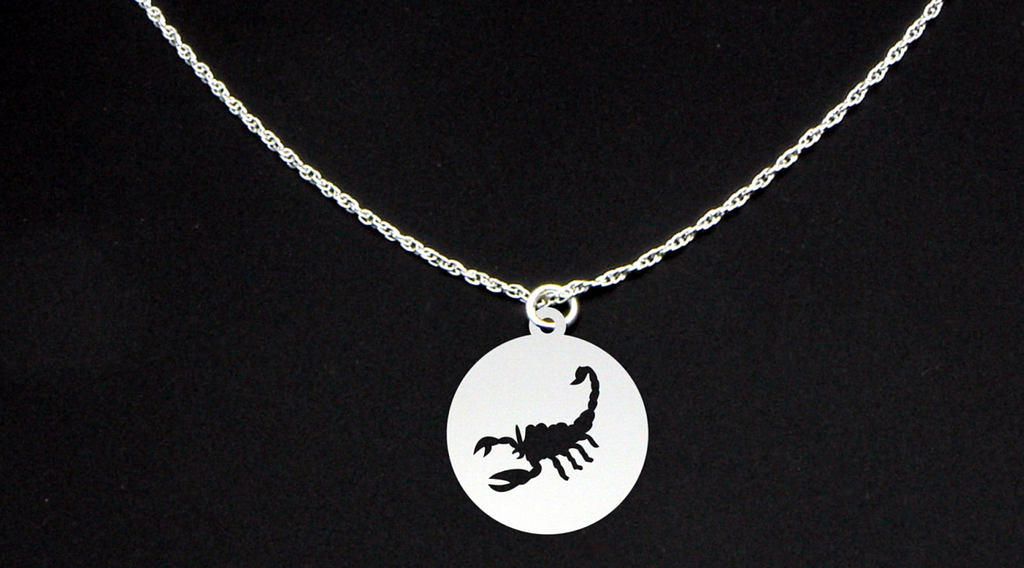
Can I interest you in a necklace with a lesson for eternity?

Venture capital taught Etsy that making money wasn’t a skill it needed to learn early on. Go on, it said, spend the millions. And when you’ve spent those, come back and get some more. So Etsy did. They came back for a B round, then a C round, then D, E, and F rounds. Just shy of $100 million in total.

That experience deluded Etsy into thinking that they, uniquely, could ferry the scorpion across the river without getting stung. That a cool hundred million wouldn’t ever need to be paid back or corrupt its noble mission.

But the party only lasts until the music stops. And after Etsy’s VCs foisted the “growth stock” onto the public markets, those markets eventually grew tired of waiting for said growth and profits. So they demanded change, and change they got by booting the old CEO and installing a new growth-at-all-costs replacement.

When Etsy looks back at the arc of its story, it’s easy to flatter themselves into thinking that everything was hunky-dory until The Evil Capitalists came for their pound of flesh. But give me a break. This story is as old as time, and the outcome perfectly predictable.

Etsy corrupted itself when it sold its destiny in endless rounds of venture capital funding. This wasn’t inevitable, it was a choice. One made by founders and executives who found it easier to ask investors for money than to develop the habits and skills to ask customers.

“If you really want to build a company that works for people and the planet, capitalism isn’t the solution”, muses one of the former Etsy employees in a NYT piece. Bollocks. Feel-good nonsense bollocks.

Etsy wasted the chance to provide a human alternative to Ebay and Amazon all by itself. Now it’s largely the same kind of strip mall hawking the same mass-produced goods. There was a laudable mission at its core, but one that was quickly spoiled by a gluttony for growth and negligent naiveté about scorpions.

In the burnt ashes of what Etsy has become, I hope a new attempt will grow. One that learns its lessons and guards its own destiny with as much zeal as the high-minded ideals.


May the next Etsy learn its lessons was originally published in Signal v. Noise on Medium, where people are continuing the conversation by highlighting and responding to this story.

21 Nov 11:35

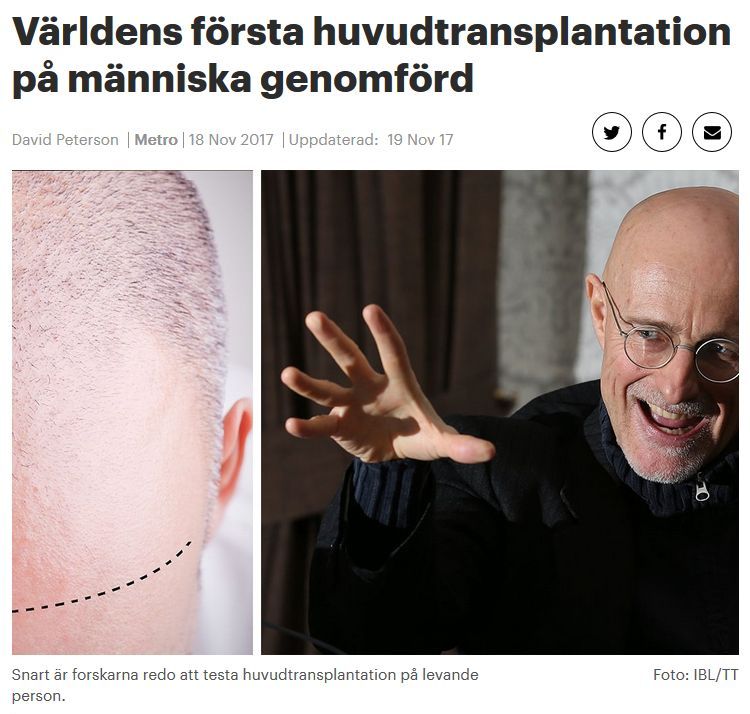
Nej, ingen huvudtransplantation har genomförts

by Hexmaster
Den omskrivna italienska kirurgen Sergio Canavero har i flera år hävdat att huvudtransplantationer är möjliga. Nu säger hans forskarlag att de tagit ett steg närmare målet.
- Världens första huvudtransplantation på människa genomförd, Metro 18 november 2017

Vad ska man säga om en sensationell rubrik av första magnituden som inte har minsta grund i verkligheten? Även om man redan i ingressen drar ner på volymen rejält, från "genomförd" till "ett steg närmare målet". För att ta ett huvud från en död kropp och sy fast det på en annan död kropp är inte en transplantation. Det är i sig inte märkvärdigare än hydran i Hamburg.

Monstret var ett hopplock av ormskinn och vessleskallar. Det avslöjades av vår egen Linné.

Men huvud-affären blir långt kusligare när Sergio Canavero, som får Paolo Macchiarini att framstå som en omdömesgill människovän och samhällets stöttepelare, pratar om att faktiskt transplantera ett huvud, säger ta loss ett huvud från en levande person för att sätta på en hjärndöds person "levande" kropp. Vilket skulle innebära att de tar livet av en person på operationsbordet.
16 Nov 08:24

The populism of Amazon’s real-world bookstores

by Jason Kottke

Voracious reader Tyler Cowen recently visited an Amazon Store for the first time and posted some impressions.

1. It is a poorly designed store for me, most of all because it does not emphasize new releases. I feel I am familiar with a lot of older titles, or I went through a more or less rational process of deciding not to become familiar with them. Their current popularity, as measured say by Amazon rankings, does not cause me to reassess those judgments. For me, aggregate Amazon popularity has no real predictive power, except perhaps I don’t want to buy books everyone liked. “A really smart person says to consider this again,” however, would revise my prior estimates.

6. I consider myself quite pro-Amazon, still to me it feels dystopic when an attractive young saleswoman says so cheerily to (some) customers: “Thank you for being Prime!”

Some of his observations match those of other reviewers from when the store opened back in May. On my last trip to NYC, I visited the same store as Cowen (also for the first time) and it didn’t change my opinion about the visibility of the data in the store:

Other bookstores have books arranged according to best-seller lists, store-specific best-sellers, and staff recommendations, but I’ve never seen any store layout so extensively informed by data and where they tell you so much about why you’re seeing each item. Grocery store item placement is very data driven, but they don’t tell you why you’re seeing a display of Coke at the end of the aisle or why the produce is typically right at the entrance. It’ll be interesting to see if Amazon’s approach works or if people will be turned off by shopping inside a product database, a dehumanizing feeling Frommer hints at with “a collection of books that feels blandly standard” when compared to human curated selections at smaller bookstores.

Walking around, I half-expected to see SQL queries accompanying some of the displays — “SELECT * FROM books WHERE rating > 4.8 AND pub_year = 2017 ORDER BY number_sold”. Amazon definitely needs to figure out how to get a little weird into their stores, a little of the human touch. Toning down the data talk would help. A more casual typeface might work too — not Comic Sans but perhaps something at least approaching handwritten? They’ve got so so much data about how people buy books…they just need to be more clever about how they slice and dice it. Maybe look for books that exhibit the Napoleon Dynamite Problem? Find people with interesting wishlists?

Ultimately, I didn’t buy anything either.

Tags: Amazon   books   business   Tyler Cowen
15 Nov 09:27

How Facebook Figures Out Everyone You've Ever Met

In real life, in the natural course of conversation, it is not uncommon to talk about a person you may know. You meet someone and say, “I’m from Sarasota,” and they say, “Oh, I have a grandparent in Sarasota,” and they tell you where they live and their name, and you may or may not recognize them.

You might assume Facebook’s friend recommendations would work the same way: You tell the social network who you are, and it tells you who you might know in the online world. But Facebook’s machinery operates on a scale far beyond normal human interactions. And the results of its People You May Know algorithm are anything but obvious. In the months I’ve been writing about PYMK, as Facebook calls it, I’ve heard more than a hundred bewildering anecdotes:

  • A man who years ago donated sperm to a couple, secretly, so they could have a child—only to have Facebook recommend the child as a person he should know. He still knows the couple but is not friends with them on Facebook.
  • A social worker whose client called her by her nickname on their second visit, because she’d shown up in his People You May Know, despite their not having exchanged contact information.
  • A woman whose father left her family when she was six years old—and saw his then-mistress suggested to her as a Facebook friend 40 years later.
  • An attorney who wrote: “I deleted Facebook after it recommended as PYMK a man who was defense counsel on one of my cases. We had only communicated through my work email, which is not connected to my Facebook, which convinced me Facebook was scanning my work email.”

Connections like these seem inexplicable if you assume Facebook only knows what you’ve told it about yourself. They’re less mysterious if you know about the other file Facebook keeps on you—one that you can’t see or control.

Advertisement

Advertisement

Behind the Facebook profile you’ve built for yourself is another one, a shadow profile, built from the inboxes and smartphones of other Facebook users. Contact information you’ve never given the network gets associated with your account, making it easier for Facebook to more completely map your social connections.

Shadow contact information has been a known feature of Facebook for a few years now. But most users remain unaware of its reach and power. Because shadow-profile connections happen inside Facebook’s algorithmic black box, people can’t see how deep the data-mining of their lives truly is, until an uncanny recommendation pops up.

Advertisement

Facebook isn’t scanning the work email of the attorney above. But it likely has her work email address on file, even if she never gave it to Facebook herself. If anyone who has the lawyer’s address in their contacts has chosen to share it with Facebook, the company can link her to anyone else who has it, such as the defense counsel in one of her cases.

Facebook will not confirm how it makes specific People You May Know connections, and a Facebook spokesperson suggested that there could be other plausible explanations for most of those examples—“mutual friendships,” or people being “in the same city/network.” The spokesperson did say that of the stories on the list, the lawyer was the likeliest case for a shadow-profile connection.

Handing over address books is one of the first steps Facebook asks people to take when they initially sign up, so that they can “Find Friends.” The “Find Friends” option on desktop is very basic:

You enter your email address and then your email password, and Facebook will tell you everyone you know on Facebook. Meanwhile, Facebook holds on to all the contacts you handed over.

The “Find Friends” page in the Facebook smartphone app is more inviting, presenting a picture of a spray of flowers and inviting the user to “See who’s on Facebook by continuously uploading your contacts.”

Down in the fine print, below the “Get Started” button, the page states that “Info about your contacts...will be sent to Facebook to help you and others find friends faster.” This is vague, and the purpose remains vague even after you click on “Learn More”:

When you choose to find friends on Facebook, we’ll use and securely store information about your contacts, including things like names and any nicknames; contact photo; phone numbers and other contact or related information you may have added like relation or profession; as well as data on your phone about those contacts. This helps Facebook make recommendation for you and others, and helps us provide a better service.

Take a look at all the possible information associated with a contact on your phone. Then consider the accumulated data your phone is carrying about various people, whether lifelong friends or passing acquaintances.

Advertisement

Facebook warns users to be judicious about using all this data. “You may have business or personal contacts in your phone,” the Learn More screen admonishes the reader. “Please only send friend requests to people you know personally who would welcome the invite.”

Having issued this warning, and having acknowledged that people in your address book may not necessarily want to be connected to you, Facebook will then do exactly what it warned you not to do. If you agree to share your contacts, every piece of contact data you possess will go to Facebook, and the network will then use it to try to search for connections between everyone you know, no matter how slightly—and you won’t see it happen.


Facebook doesn’t like, and doesn’t use, the term “shadow profiles.” It doesn’t like the term because it sounds like Facebook creates hidden profiles for people who haven’t joined the network, which Facebook says it doesn’t do. The existence of shadow contact information came to light in 2013 after Facebook admitted it had discovered and fixed “a bug.” The bug was that when a user downloaded their Facebook file, it included not just their friends’ visible contact information, but also their friends’ shadow contact information.

Advertisement

The problem with the bug, for Facebook, was not that all the information was lumped together—it was that it had mistakenly shown users the lump existed. The extent of the connections Facebook builds around its users is supposed to be visible only to the company itself.

Advertisement

Facebook does what it can to underplay how much data it gathers through contacts, and how widely it casts its net. “People You May Know suggestions may be based on contact information we receive from people and their friends,” Facebook spokesperson Matt Steinfeld wrote in an email. “Sometimes this means that a friend or someone you know might upload contact information—like an email address or phone number—that we associate with you. This and other signals from you help us to make sure that the people we suggest are those you likely already know and want to become friends with on Facebook.”

Users of Instagram and WhatsApp, which are owned by Facebook, can also upload contacts to those apps, but Steinfeld said that Facebook does not currently use that data for Facebook friend suggestions. “Today, we use contacts uploaded to Facebook and Messenger to inform PYMK suggestions,” he wrote.


Contact the Special Projects Desk

This post was produced by the Special Projects Desk of Gizmodo Media. Reach our team by phone, text, Signal, or WhatsApp at (917) 999-6143, email us at tips@gizmodomedia.com, or contact us securely using SecureDrop.

Through the course of reporting this story, I discovered that many of my own friends had uploaded their contacts. While encouraging me to do the same, Facebook’s smartphone app told me that 272 of my friends have already done so. That’s a quarter of all my friends.

Advertisement

Advertisement

But big as it is, that’s not even the relevant number. When Steinfeld wrote “a friend or someone you might know,” he meant anyone—any person who might at some point have labeled your phone number or email or address in their own contacts. A one-night stand from 2008, a person you got a couch from on Craiglist in 2010, a landlord from 2013: If they ever put you in their phone, or you put them in yours, Facebook could log the connection if either party were to upload their contacts.

That accumulation of contact data from hundreds of people means that Facebook probably knows every address you’ve ever lived at, every email address you’ve ever used, every landline and cell phone number you’ve ever been associated with, all of your nicknames, any social network profiles associated with you, all your former instant message accounts, and anything else someone might have added about you to their phone book.

As far as Facebook is concerned, none of that even counts as your own information. It belongs to the users who’ve uploaded it, and they’re the only ones with any control over it.

It’s what the sociologist danah boyd calls “networked privacy”: All the people who know you and who choose to share their contacts with Facebook are making it easier for Facebook to make connections you may not want it to make—say if you’re in a profession like law, medicine, social work, or even journalism, where you might not want to be connected to people you encounter at work, because of what it could reveal about them or you, or because you may not have had a friendly encounter with them.

Advertisement

Advertisement

Imagine the challenge for people trying to maintain two different identities, such as sex workers or undercover investigators. Not only do you have to keep those identities apart like a security professional, you have to make sure that no one else links them either. If just one person you know has contact information for both identities and gives Facebook access to it, your worlds collide. Bruce Wayne and Clark Kent would be screwed.


Shadow profile data powers Facebook’s effort to connect as many people as possible, in as many ways as possible. The company’s ability to perceive the threads connecting its billion-plus users around the globe led it to announce last year that it’s not six degrees that separate one person from another—it’s just three and a half.

Advertisement

With its vast, hidden black book, Facebook can go beyond simply matching you directly with someone else who has your contact information. The network can do contact chaining—if two different people both have an email address or phone number for you in their contact information, that indicates that they could possibly know each other, too. It doesn’t even have to be an address or phone number that you personally told Facebook about.

This is how a psychiatrist’s patients were recommended to one another and may be why a man had his secret biological daughter recommended to him. (He and she would have her parents’ contact information in common.) And it may explain why a non-Facebook user had his ex-wife recommended to his girlfriend. Facebook doesn’t keep profiles for non-users, but it does use their contact information to connect people.

Advertisement

“Mobile phone numbers are even better than social security numbers for identifying people,” said security technologist Bruce Schneier by email. “People give them out all the time, and they’re strongly linked to identity.”

Facebook won’t tell you how many people who aren’t your friends have handed over your contact information. The contents of your shadow profiles are not yours to see.

Advertisement

As Violet Blue wrote in Cnet at the time of the shadow-profile bug, “What the revelation means is that Facebook has much more information on us than we know, it may not be accurate, and despite everyone’s best efforts to keep Facebook from knowing our phone numbers or work email address, the social network is getting our not-for-sharing numbers and email addresses anyway by stealing them (albeit through ‘legitimate’ means) from our friends.”

What if you don’t like Facebook having this data about you? All you need to do is find every person who’s ever gotten your contact information and uploaded it to Facebook, and then ask them one by one to go to Facebook’s contact management page and delete it.

Advertisement

Just don’t miss anyone. “Once a contact is deleted, we remove it from our system—but of course it is possible that the same contact has been uploaded by someone else,” Steinfeld wrote in an email.

Advertisement

The shadow profiles, like the People You May Know system they feed into, can’t be turned off or opted out of. The one thing you can do to impede Facebook’s contacts-based connections is, through its Privacy Settings menu, keep people from finding your profile by searching your phone number or email address. (Yes, Facebook functions as a reverse phone-number look-up service; under the default settings, anyone can put your phone number into the search bar and pull up your account.)

“Let’s say you’ve shared your phone number [or email address] with a lot of people and don’t want strangers using it to search for you on Facebook,” Steinfeld wrote. “You can limit who can look you up on Facebook by that phone number [or email address] to ‘friends.’ This is also a signal that People You May Know uses. So if a stranger uploads his address book including that phone number [or email address, it] won’t be used to suggest you to that stranger in People You May Know.”

These privacy settings are an undocumented way to control to whom you get recommended in People You May Know.

But you can only block People You May Know from using information you’ve actively provided to Facebook, not what’s in your shadow profile. So to protect your privacy, you need to provide Facebook with even more information about you.

Advertisement

Advertisement

I asked if Facebook would consider sharing shadow profile information with its users, much like it accidentally shared it with their friends four years ago. Facebook says it can’t because it would be a privacy violation of those who gave the information.

“When you choose to upload your contacts to Facebook, we consider your privacy along with the privacy of the friends, family, and others who gave you their phone number or email address,” said Facebook spokesperson Matt Steinfeld by email. “We acknowledge that people might want to see the contact information that’s been uploaded about them to Facebook, but we also have a responsibility to the people choosing to upload this information. This is a balance and we’ll continue listening to people’s feedback.”

Steinfeld also said that while Facebook doesn’t currently “offer a way for people to manage the contact information others have uploaded that might be related to them, this is something I’ve shared with the team.”

Advertisement

As usual, I asked to speak with the People You May Know team directly, but was turned down.

Let's block ads! (Why?)

15 Nov 07:32

Entrepreneurship, inequity, and throwing darts at the carnival

by Jason Kottke

In a reply to an article called Entrepreneurs Aren’t A Special Breed — They’re Mostly Rich Kids, Hacker News commenter notacoward wrote:

Entrepreneurship is like one of those carnival games where you throw darts or something.

Middle class kids can afford one throw. Most miss. A few hit the target and get a small prize. A very few hit the center bullseye and get a bigger prize. Rags to riches! The American Dream lives on.

Rich kids can afford many throws. If they want to, they can try over and over and over again until they hit something and feel good about themselves. Some keep going until they hit the center bullseye, then they give speeches or write blog posts about “meritocracy” and the salutary effects of hard work.

Poor kids aren’t visiting the carnival. They’re the ones working it.

That’s a pretty succinct summary of the “born on third base and thinks they hit a triple” effect…and it doesn’t just apply to entrepreneurship or being rich.

Update: In response to Forbes’ most recent 30 Under 30 feature, Helen Rosner replied:

My take is: all 30 Under 30 lists should include disclosure of parental assets

Tags: business   Helen Rosner
13 Nov 08:36

SpeechBoard

by Andy Baio

edit podcast audio by editing the transcript

13 Nov 07:32

Clinton och Blair pratar

by Hexmaster
I januari 2016 släpptes över 500 sidor med transkriberade telefonsamtal mellan president Clinton och premiärminister Blair från slutet av 1990-talet. Det som väckte mest uppmärksamhet var inte politiska diskussioner utan den mycket avslappnade och speciella tonen. Som Clintons besatthet av bananer:

"My staff won't let me talk to you unless I have a banana at hand. I'm sitting here with a banana; it's a big, ugly, brownish one."
Eller när samtalet bryts för ett ögonblick:

"I'll have the person who dropped the line executed."
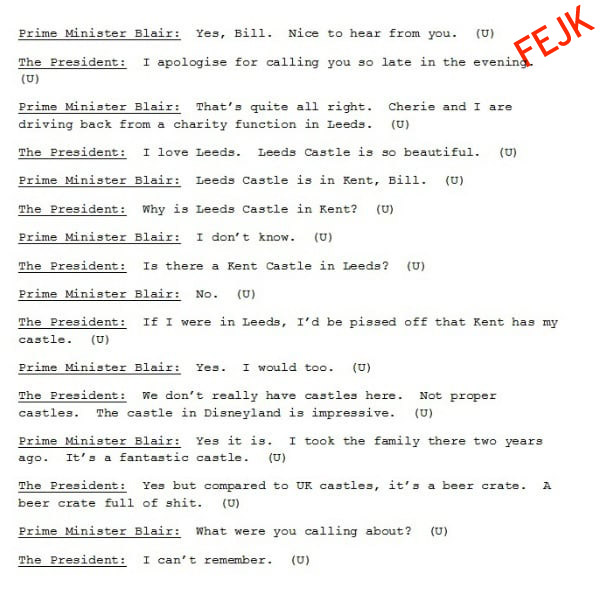
Man kan tycka att de äkta samtalen är roliga så det räcker. Men komikern Michael Spicer diktade ihop ett antal konversationer som aldrig ägt rum. Som när Clinton satte fem dollar på att premiärministerns namn stavas B L A R E:

(PMQ = Prime Minister's Questions, frågestund i parlamentet varje onsdag.)

Eller när Clinton lär sig att Leeds Castle inte ligger i Leeds utan i Kent (intill en by som heter Leeds):


En del av de påhittade konversationerna snurrar fortfarande runt på nätet. De lär fortsätta med det ett bra tag till, kanske så länge som någon minns Clinton och Blair. Att påpeka att samtalen är fejk hjälper givetvis inte.


That Hilarious Tony Blair and Bill Clinton Transcript About Punching Ham Is Fake, BuzzFeed 8 januari 2016
The Strangest Phone Calls Between Tony Blair And Bill Clinton, BuzzFeed 8 januari 2016
Michael Spicers hemsida

02 Nov 08:40

Scientologi i Fokus

by Hexmaster
I tidningen Fokus nr 43 finns en artikel "ADHD-medicin som självmordsvapen". Man uppmärksammar att barn och ungdomar överdoserar ADHD-preparat i självdestruktivt eller suicidalt syfte. Företeelsen är föremål för en utredning på europeisk nivå och myndigheter i de olika länderna ska lämna in sin statistik på området. Av någon anledning har Läkemedelsverket och socialstyrelsen inte lämnat ut uppgifter för Sverige. Läkemedelsverket har inte ens kommenterat tidningens frågor.

Det kan man skriva en artikel om. Inga problem. Något som ingen redaktion med minsta självkänsla kan göra är att istället för att ta fram någon relevant representant eller expert lyfta Janne Larsson. Han är den siste i landet som ska uttala sig om psykofarmaka, ADHD-medicin, metylfenidat eller preparat som Concerta och Ritalin.

I artikeln presenteras Janne Larsson som "privatperson, lärare och skribent". Vad man inte nämner med en bokstav är att han företräder scientologin och scientologernas frontorganisation KMR vars hela existens går ut på att baktala och kritisera psykiatri och psykofarmaka, med irrelevanta och påhittade argument framförda med en ibland mycket mjuk, ibland mycket grov ton. Janne Larsson är deras meste skribent, och har i flera år bombarderat redaktioner över hela landet med insändare, debattartiklar och förslag på artiklar, och över huvud taget lobbat hårt för att få in scientologernas/KMRs hjärtefrågor med deras vinkling. (Deras "lösning" går ut på att ersätta all psykiatrisk vård och all psykofarmaka med scientologi.)

Hur gick det till? Om Fokus inte visste om att Janne Larsson är scientolog är de inkompetenta (en enkel slagning på janne larsson adhd räcker och blir över). Om Fokus visste att Janne Larsson är scientolog, och ändå väljer att gå ut med en lång artikel där han får tala oemotsagd utan att ens antyda hans koppling till världens farligaste sekt så är de värre än inkompetenta. Och om de tror att de kan komma undan med det senare är de dumma i huvudet.

För givetvis tog det inte många sekunder innan Fokus märkliga uppvisning i hur man inte ska arbeta uppmärksammades. Som svar publicerade de "bakgrunden till texten". De var väl medvetna om att scientologerna "ihärdigt kritiserar förskrivningen av adhd-medicin", och gissningsvis även att Janne Larsson företräder dem. De motiverar "beslutet att nämna hans namn i texten" med att det var han som begärde ut uppgifter som ligger till grund för artikeln, och att han gjorde det som privatperson. Inte för att Janne Larsson bara är ett namn som nämns; artikeln är i princip en intervju.

Direkt genant blir det när Fokus förklarar att de gav utrymme åt en scientolog utan att nämna att han är scientolog eftersom läsaren förväntas veta det: "vi gjorde oss inga illusioner om att de insatta i frågan inte skulle känna igen Larssons namn". Jag vet inte ens hur jag ska kommentera det.

På en punkt har Fokus rätt:
I efterhand kan man se, att i det ögonblicket, när Läkemedelsverkets svar uteblir, och Larsson blir enda direktciterade källa, blir Larssons roll i artikeln för stor. Hans namn ställer sig uppenbarligen i vägen för en viktig diskussion om dokumenterade biverkningar av ADHD-mediciner.
- Claes de Faire och Mats Holm: Fokus om ADHD-publiceringen, Fokus 30 oktober 2017

Att utelämna inte bara Janne Larssons namn utan hela Janne Larsson är steg 1 när man ska skriva om psykofarmaka i allmänhet, ADHD-medicinering i synnerhet. Det vet alla som är det minsta insatta i frågan, på förhand.
30 Oct 07:23

Låt dem sy jeans de jävlarna

by fthunholm

När Karolinska institutets vicerektor Martin Ingvar blev påkommen på med att sälja IT-system till, eh… Karolinska institutet, och tjäna miljoner på det – tog han en timeout. Senare avgick han, med orden ”Som statstjänsteman har man vissa regler att följa. När det är flera tusen regler misslyckas man ibland med att följa alla.

Det är inte världens skarpaste försvar. Det är det sannerligen inte. Eller, det hade funkat om det varit en luffare eller sjörövare. Men inte för någon i den positionen. Det gör att hans gärning med fog kan ifrågasättas retroaktivt. Inte bara gärningen, men hela hans person. Någon med en hög position inom akademien, som inte fattar att det är fel att tjäna miljoner på att sälja saker till sig själv. Som ser det som något på nivån med regler för friskvårdsbidrag eller var cykeln ska parkeras.

Men det var inte det jag skulle skriva om.

Det var den där timeouten som han tog. Och som misslyckade personer med maktpositioner överallt tar, hela tiden. Landshövdingar som supit, Aftonbladetskribenter som ”betett sig tölpaktigt”, SD-politiker som… tja, den listan är ganska lång i sig själv. Mona Sahlin gjorde det redan 1995.

Det är alltså betald semester vi pratar om. För människor som skitit i det blå skåpet. Och i många fall skitit även utanför det. Typ målat på väggarna med avföring. Vad har de här människorna för arbetsgivare? Jag förstår att man i vissa fall kan välja att lyfta bort någon från en plats, för att själv signalera handlingskraft som chef. Ha ryggen fri osv. ”Nä han har tagit en timeout nu så vi har verkligen agerat kraftfullt.”

Men finns det verkligen inget som personerna, som uppbär lön, kan göra?

Att Virtanen inte ska skriva ledarkrönikor är en sak, men kan han inte ens tömma papperskorgarna på kontoret? Alla kommunala politiker och tjänstemän som timeoutar, finns det verkligen inte några löv att kratta eller gamlingar att ta med på en utflykt? Nog kunde Martin Ingvar hjälpt till med internposten på KI?

Det är så många som har timeout vid varje givet tillfälle, att det skulle kunna bli en arbetsplats i sig. Kanske kan de sy jeans och göra nummerplåtar? Det skulle bli en ganska stor arbetsplats dessutom. Ge den ett coolt namn. Timeout Industries kanske. Låt dem bygga sköna kontor runt om i landet. Martin Ingvar kan ordna IT-systemet.

26 Oct 07:27

Värdighet ut, hästskit in

by fthunholm

Det är inte ens ett år till valet. Eller om man vänder på det: Det är nästan ett jävla år till valet. Det kommer att bli en prövning. Få saker gör nämligen människor så dumma som att engagera sig politiskt. Alla dessa ideologiska fotsoldater har ju dessutom tillgång till plattformar som låter dem sprida sina dumheter obehindrat.

Här är det mest typiska exemplet: En person skriver något på Twitter; för ett resonemang som löper genom flera tweets. En av tweetsen i kedjan kan ryckas ut, skärmdumpas eller retweetas, och för någon som ser den i andra, eller tredje, hand, kan den tolkas som galenskap. Jag skriver ”kan ryckas ut”. För det sker inte av sig självt. Det sker genom att någon som antingen är extremt illvillig eller fruktansvärt dum gör det.

Nej, fel, det är inte antingen eller, det är både och. Man måste vara både illvillig och extremt dum. Illvillig på det där beskäftiga, fuskande plugghäst-viset. Och dum, eftersom det kommer fram vad man gjort. Framför allt måste man vara villig att avsäga sig all värdighet. Man mockar hästskit med händerna, för att man hoppas att det ska skada någon annan.

Detta kommer nu eskalera i tio månader till.

Släng in i detta alla hjärndöda flinande Pepe-grodor samt en socialdemokrati som gör annonser där de ibland försöker google-översätta Jeremy Corbyn och ibland helt enkelt använder Sverigedemokratiska annonser med beväpnade gränsvakter, och bara sätter sin logotyp under dem. Samt ett antal partier som hänger på fyraprocentsspärren och lär kasta ut desperata utspel om taggtråd runt Gotland och momsbefriad mjöd.

Jag har ett förslag: Förbjud partipolitik. Låt kverulanterna gå tillbaka till att skriva insändare istället. De som nu lägger ner sin själ i att försöka skada andra, genom att bildligt talat mocka hästskit med händerna – låt dem mocka faktisk hästskit med händerna. Det finns säkert stall i landet som skulle älska att få liberala kommunpolitiker, ungmoderater och södermalmsvänster som plockar upp skiten. Någon värdighet att ta hänsyn till fins ju som sagt inte.

Vi kan legalisera eländet igen om tio år eller så.

Till dess kan vi låta kungen bestämma.

26 Oct 07:17

★ Face ID FUD

by John Gruber

Seemingly-sensational Apple story from Bloomberg today, reported by Alex Webb and Sam Kim, “Inside Apple’s Struggle to Get the iPhone X to Market on Time”:

As of early fall, it was clearer than ever that production problems meant Apple Inc. wouldn’t have enough iPhone Xs in time for the holidays. The challenge was how to make the sophisticated phone — with advanced features such as facial recognition — in large enough numbers.

As Wall Street analysts and fan blogs watched for signs that the company would stumble, Apple came up with a solution: It quietly told suppliers they could reduce the accuracy of the face-recognition technology to make it easier to manufacture, according to people familiar with the situation.

That sounds terrible. But what exactly does it mean? Does it mean Face ID will create too many false positives? Does it mean it will be too slow? Does it mean there will be too many false negatives? Surprise surprise, Bloomberg doesn’t say.

Apple is famously demanding, leaning on suppliers and contract manufacturers to help it make technological leaps and retain a competitive edge. While a less accurate Face ID will still be far better than the existing Touch ID, the company’s decision to downgrade the technology for this model shows how hard it’s becoming to create cutting-edge features that consumers are hungry to try.

“Downgraded technology” sounds terrible. But which components, exactly, were “downgraded”?

Apple spokeswoman Trudy Muller said “Bloomberg’s claim that it reduced the accuracy spec for Face ID is completely false and we expect Face ID to be the new gold standard for facial authentication. The quality and accuracy of Face ID haven’t changed; it continues to be one in a million probability of a random person unlocking your iPhone with Face ID.”

It is extraordinary for Apple to issue a blanket “this is completely false” statement on any news story. Apple, as policy, no-comments every news story, even when they know it’s bullshit. So either this story is particularly strong bullshit, or Apple is lying, on the record, under an employee’s real name (as opposed to the anonymous “an Apple spokesperson” attribution).

And what exactly is the point of Bloomberg’s story if, as reported, “Face ID will still be far better than the existing Touch ID”?

To make matters worse, Apple lost one of its laser suppliers early on. Finisar Corp. failed to meet Apple’s specifications in time for the start of production, and now the Sunnyvale, California-based company is racing to meet the standards by the end of October. That left Apple reliant on fewer laser suppliers: Lumentum Holdings Inc. and II-VI Inc.

Apple didn’t “lose” a supplier — Apple cut the supplier because they weren’t producing adequate yields.

To boost the number of usable dot projectors and accelerate production, Apple relaxed some of the specifications for Face ID, according to a different person with knowledge of the process. As a result, it took less time to test completed modules, one of the major sticking points, the person said.

It’s not clear how much the new specs will reduce the technology’s efficacy.

Now we get to the real heart of the story. Did Apple adjust the specifications for the components, or just the testing parameters? And if “it’s not clear how much the new specs will reduce the technology’s efficacy”, what is the point of this story? When did Apple “relax” these specifications? Before or after the September event?

To be clear, I have no idea whether Face ID works as advertised or not. I haven’t used it even once yet. Maybe it stinks, maybe it’s great, maybe it’s somewhere in between. But Bloomberg clearly doesn’t know either, yet they published this story which has a headline and summary — “The company let suppliers reduce accuracy of the phone’s Face ID system to speed up production” — which suggests that Face ID is going to stink because Apple’s suppliers couldn’t get enough good components out the door. If this weren’t merely clickbait, they’d be able to say how well it actually works.


Frankly, I don’t trust anything Bloomberg reports about iPhones any more. On July 3, they published this piece by Mark Gurman, “Apple Tests 3-D Face Scanning to Unlock Next iPhone”:

Apple Inc. is working on a feature that will let you unlock your iPhone using your face instead of a fingerprint.

For its redesigned iPhone, set to go on sale later this year, Apple is testing an improved security system that allows users to log in, authenticate payments, and launch secure apps by scanning their face, according to people familiar with the product. This is powered by a new 3-D sensor, added the people, who asked not to be identified discussing technology that’s still in development. The company is also testing eye scanning to augment the system, one of the people said.

The sensor’s speed and accuracy are focal points of the feature. It can scan a user’s face and unlock the iPhone within a few hundred milliseconds, the person said. It is designed to work even if the device is laying flat on a table, rather than just close up to the face. The feature is still being tested and may not appear with the new device. However, the intent is for it to replace the Touch ID fingerprint scanner, according to the person. An Apple spokesman declined to comment.

Apple did in fact replace Touch ID with Face ID in the iPhone X, but the timing on Gurman’s story is wrong. They weren’t “testing” the viability of any of this in July. According to several trusted sources within Apple, including multiple engineers who worked directly on the iPhone X project, the decision to go “all-in on Face ID” (in the words of one source) was made over a year ago. Further, the design of the iPhone X hardware was “locked” — again, a source’s word — prior to January 2017. If I had to wager, I’d say it was locked a few months before the end of 2016. This was a nine-month-old decision that Bloomberg reported in the present tense.

Beyond Bloomberg, there are the slew of reports from various “analysts” that suggested Apple was still working to incorporate Touch ID into the iPhone X display as late as this summer.

Ming-Chi Kuo in January:

In a note sent out to investors on Friday, and subsequently obtained by AppleInsider, well-connected KGI analyst Ming-Chi Kuo says he believes Apple is developing a new class of bio-recognition technologies that play nice with “full-face,” or zero-bezel, displays. Specifically, Kuo foresees Apple replacing existing Touch ID technology with optical fingerprint readers, a change that could arrive as soon as this year, as Apple is widely rumored to introduce a full-screen OLED iPhone model this fall.

By January, there were no plans to embed an “optical fingerprint reader” in the display of any Apple device this year. Apple did, of course, investigate ways to embed Touch ID sensors in edge-to-edge displays, but, again, those efforts were abandoned in favor of Face ID over a year ago.

Cowen and Company analyst Timoth Arcuri, on June 21 (of this year), under the AppleInsider headline “Apple Still Undecided on Fingerprint Tech for ‘iPhone 8’, No Shipments Until October”:

The OLED-embedded fingerprint technology for Apple’s “iPhone 8” is “still being worked out,” an analyst claimed on Wednesday, with the company only deciding on one of three options by the end of June.

The one settled point appears to be that there won’t be a sensor on the back of the phone, Cowen and Company’s Timothy Arcuri indicated in a memo obtained by AppleInsider. The three options include thinning the cover glass over a sensor area, creating a pinhole through the glass for an optical or ultrasonic sensor, or trying a “film” sensor integrated into the display, using either capacitive or infrared technology.

This, it turns out, was complete nonsense. Again, Apple was “all-in” on Face ID over a year ago. The idea that they were still “working this out” in June is a joke.

And back to Ming-Chi Kuo, in August:

Apple has decided against an embedded Touch ID solution for its forthcoming “iPhone 8” handset, according to well-connected analyst Ming-Chi Kuo, leaving the door open for competitor Samsung to debut similar technology in next year’s Galaxy Note 9.

In a note to investors obtained by AppleInsider, Kuo says Apple has “cancelled” plans to embed a fingerprint recognition solution in the next-generation flagship iPhone. The analyst left embedded Touch ID off a list of standout “iPhone 8” features published in July, but did not indicate that Apple had abandoned the initiative altogether.

As with Gurman’s report in June, the problem here is with the timing, not the facts. By August of this year, this was a nearly year-old decision.

The Wall Street Journal, in a September 7 report attributed to reporters “Yoko Kubota in Tokyo, Tripp Mickle in San Francisco, and Takashi Mochizuki in Tokyo”:

The production delays earlier this summer stemmed in part from Apple’s decision to build new phones using organic light-emitting diode, or OLED, screens similar to those used by rival Samsung Electronics Co. At the same time, Apple decided to ditch the physical home button that contains fingerprint sensors for unlocking the device. Apple tried to embed the Touch ID function, or fingerprint scanner, in the new display, which proved difficult, the people familiar with the process said.

As deadlines approached, Apple eventually abandoned the fingerprint scanner, the people said, and users will unlock the phone using either an old-fashioned password or what is expected to be a new facial-recognition feature. Nonetheless, precious time was lost and production was put back by about a month, according to people familiar with the situation.

I quote the two Tokyo datelines in the byline because I don’t think this information came from Apple. Again, my sources at Apple, directly familiar with the decision, have told me that they chose Face ID over a year ago because they were convinced it was better than Touch ID. Touch ID was not abandoned because it was difficult to embed in the display.

For good measure while I’m pouring out the claim chowder, here’s Zach Epstein, writing for BGR on July 20, “I Might Know the Truth About Touch ID on Apple’s iPhone 8” (note that the device he refers to as “iPhone 8” is the iPhone X):

I have now received information from three different well-placed sources over the past few weeks, and they have all told me the same thing: The iPhone 8’s Touch ID fingerprint sensor is in the power button.

The news first came to me about a month ago from a source I know well. I’ve since been told the same thing by two additional sources I haven’t known for quite as long. All three sources have provided information to me in the past that has proven to be accurate.

That’s a lot of “well-placed sources” for a bullshit story.


All of this fits with what I’ve heard from rank-and-file engineering sources within Apple for years. To wit, producing hardware at the iPhone’s scale, while pushing the boundaries of the industry in technology, is so difficult, so complicated, that it requires hardware designs to be locked down far in advance of when iPhones are actually announced and released. Apple’s iPhone hardware engineering teams did not spend 2017 working on the iPhone X and iPhone 8 — they spent this year working on new iPhone hardware for 2018 and 2019 (and perhaps beyond). Hardware is nothing like software. If Apple had really been dithering over Touch ID-embedded-in-the-display vs. Face ID in June of this year, iPhone X wouldn’t be hitting the market until 2018. And the final decisions on the hardware for the iPhones that will be debuting next year are being made right now.

So where do these rumors come from? I don’t know. My guess is that if there’s an intent behind them, it’s that competitors (cough, Samsung?) within the Asian supply chain are attempting to sow doubt about Face ID. The narrative presented by analysts and certain news reports this summer was that Apple was still scrambling to get Touch ID working embedded within the iPhone X display, suggesting that Face ID was their Plan B.

People are naturally skeptical about biometric ID systems. They were skeptical about Touch ID when it was still only rumored, just like they’re skeptical now about Face ID. Today, though, Touch ID is both trusted and familiar. So rumors claiming that Apple really wanted to get Touch ID into iPhone X but had to settle for Face ID play into both the skepticism of the new and the comfort of the familiar. FUD is one of the oldest tricks in the book.

The other, simpler explanation is that it simply takes 9 months or longer for engineering decisions made within Apple to percolate out to the rumor reporters and analysts — and their sources are so far removed from the halls of Cupertino that they mistake old news for new news.

24 Oct 08:22

The Information: Snap Has ‘Hundreds of Thousands’ of Unsold Spectacles Sitting in Warehouses

by John Gruber

Tom Dotan and Reed Albergotti, reporting for The Information (paywall):

Snap badly overestimated demand for its Spectacles and now has hundreds of thousands of unsold units sitting in warehouses, either fully assembled or in parts, according to two people close to the company. The disclosure undercuts Snap CEO Evan Spiegel’s recent contention that Spectacles sales of more than 150,000 had topped the company’s expectations.

Jiminy christ almighty, how stupid do you have to be to stockpile hundreds of thousands of these stupid-looking $130 sunglasses?

Also interesting to consider this fiasco when thinking about Nintendo’s oft-criticized conservative approach to inventory — no one wants to get stuck with hundreds of thousands of units of unsold merchandise.

23 Oct 08:33

K295: Bostadsbubblan, eller vad vi nu ska kalla den

by rasmus

Bubbla eller ej – ordentliga prisfall på bostadsmarknaden är att vänta, vilket lär leda till någon form av dramatiska konsekvenser i Sverige. Vi gör gott i att fundera på möjliga scenarion (ekonomiskt, politiskt, kulturellt; vad det betyder för fattig och rik, gammal och ung, centrum och periferi).

Om någon nyhetskälla är värd att följa nu så är det nog Per Björklund, författare till den utmärkta boken Kasinolandet. Läs honom!

Intressant är också att läsa vad den marknadsliberale skribenten Mattias Svensson skriver i Fastighetstidningen, om hur fallande bostadspriser kan fortplanta sig genom storstadens ekonomi.

“Storstadens överdådiga köpcentrum, stora evenemangsarenor, fashionabla gallerior och uppiffade affärsstråk är alla dimensionerade efter senare års konsumtionsfest.” Inte minst byggvaruhus och heminredningsbutiker, och i synnerhet hela “den småskaliga tjänstesektor som vuxit fram kring välbärgade innerstadshushåll”, finansierad genom en kombination av RUT-subventioner och bostadslån. Även Mattias Svensson medger att detta inte bara är negativt. Fallande priser på affärslokaler sänker trösklarna för verksamheter som under 2000-talet har drivts bort från innerstaden. Men samtidigt “hackar motorn i hela den svenska ekonomin”.

Mot bakgrund av senare års kreditökning som blåst upp både bostadsvärden och aktievärden är risken stor att en anpassning eskalerar till en ekonomisk kris med generellt fallande konsumtion, fallande bostadspriser, stigande arbetslöshet och betalningssvårigheter på en nivå som skakar bankernas ekonomi.

Ingenting säger att det är just de högbelånade bostadsägarna som kommer att drabbas. Vi har redan historiskt låga räntor, som Riksbanken knappast lär höja om konjunkturen viker nedåt. Å andra sidan finns heller inte mycket utrymme till räntesänkningar för att dämpa nedgången. Det utrymmet är redan förbrukat, och det förbrukades på att blåsa upp bostadspriserna så att de i förlängningen blåste upp hela den högkonjunktur som vi nu befinner oss i.

Vi bör nog inte haka upp oss på ordet “bubbla”, som lätt blir missvisande. Prisfallet kan gå mer eller mindre snabbt (och var överhängande redan för två år sedan). Förloppets hastighet är en öppen fråga, liksom vilka som drabbas i första hand, liksom vilka politiska mobiliseringar som får fart. Kommer det ha brakat loss på allvar redan före nästa val? Vilka syndabockar kommer att pekas ut? Vilka praktiska möjligheter finns att helt enkelt besätta de bostäder och lokaler som ställs tomma?

Kommande veckan ska byggbolag komma med kvartalsrapporter, om jag fattat saken rätt. Vi är många som för tillfället har svårt att känna annat än skräckblandad förtjusning.

18 Oct 09:59

Finns en allergi-hysteri?

by Hexmaster
Typiskt exempel, valt på måfå: Nötförbud i lokaler på grund av påstådd risk för luftburna allergener. Liknande finns i väldigt många av landets övriga 289 kommuner. Hur stor är risken, egentligen?

I DN publicerades häromåret en granskning av påståendet. Läkaren, professorn och allergiforskaren Magnus Wickman hade undersökt rapporter om påstådda luftburna allergener och konstaterat att de var överdrivna och grundlösa.
Vid Sachsska barnsjukhuset har professor Wickman och hans kolleger utfört blindtest på drygt 50 så svårt nötallergiska att föräldrarna hävdat att barnet inte kan besöka lokaler där nötter nyligen funnits utan att reagera allergiskt. En sköterska vispar omkring med handen i en skål som antingen innehåller kaffebönor eller nötter ovanför barnens huvuden. Två av barnen uppvisade lätta reaktioner, som rinnande näsa, när det var nötter i skålen. Resten reagerade inte alls.
- Hanne Kjöller: Skilj på hysteri och allergi, Dagens Nyheter 26 mars 2015

I en uppföljande artikel håller Wickmans kollega Alf Tunsäter med om några av hans påståenden. Däremot är han tveksam till det uppgivna säkerhetsavståndet en meter, som enligt Wickman ska räcka för att även den känsligaste allergiker ska vara säker:
– Någon sådan forskning har jag aldrig sett. Det är väl en bedömning som han gör men jag kan inte verifiera en exakt sträcka. Jag har haft flera patienter som beskrivit kraftiga reaktioner av en jordnötspåse som öppnats i samma rum som de befunnit sig i, säger Alf Tunsäter.
- Blodprov avgör tillförlitligt risken med nötallergi, Dagens Nyheter 27 mars 2015

Frågan är känslig på så sätt att nötallergiker upplever att de misstros, som om de anklagades för att ljuga om sin allergi. Men det är inte alls det saken gäller. Förvisso kan man ha fel om sin kropp och symptom på otaliga sätt, inklusive hur känslig eller inte man är mot det ena eller andra ämnet. Oavsett hur det verkligen ligger till finns det ingenting som hindrar att förbud mot nötter i lokaler, i flygplan m.m. skulle kunna vara en hysteri. På samma sätt som vi vet att en mycket stor del av allt prat om gluten och laktos saknar grund i verkligheten.
18 Oct 07:38

Intrigue in the online mattress review world

by Jason Kottke

For Fast Company, David Zax wrote about the Casper mattress company suing mattress-reviewing bloggers over their affiliate marketing relationships.

As Casper flourished through 2014 and early 2015, I learned, it enjoyed a mutually beneficial relationship with Sleepopolis and similar sites. For many bloggers, in fact, Casper was among the first mattress companies to offer affiliate commissions, leading its competitors to respond in turn. The reviews sites were key parts of what marketers call the “purchase funnel,” converting a vague interest in mattresses into awareness of a specific brand, and often the decision to buy it. Many consumers were Googling terms like “best mattress,” landing on sites like Sleepopolis, and learning about e-tailers like Casper for the first time.

Indeed, one would never have predicted looming lawsuits from a friendly 2015 email exchange, in which Casper CEO Philip Krim attempted to court an affiliate marketer named Jack Mitcham, who ran a Sleepopolis-like site called Mattress Nerd.

In January 2015, Krim wrote Mitcham that while he supported objective reviews, “it pains us to see you (or anyone) recommend a competitor over us.”

Krim went on: “As you know, we are much bigger than our newly formed competitors. I am confident we can offer you a much bigger commercial relationship because of that. How would you ideally want to structure the affiliate relationship? And also, what can we do to help to grow your business?”

I was just thinking the other day about how these companies like Casper formed to undercut the price gouging mattress stores and now, with millions of VC dollars behind them, they’re pulling their own brand of underhanded tricks to manipulate people into buying their products. In five years, Casper will probably have dozens of retail stores and 10 different kinds of mattress at different price points — they already have more than a dozen stores and 3 models ranging from $600 to $1850 — just like the companies they are trying to replace. Their origin story won’t matter…VC-fueled marketing will paper over all of that and, tada, meet the new boss, same as the old boss.

Tags: business   David Zax
18 Oct 07:30

There Are Over 60 Different Versions of the Facebook App

by Louise Matsakis

The bottom navigation bar inside the Facebook app on my iPhone 7 Plus has five icons. There's one for the News Feed, followed by videos, Facebook Marketplace, notifications, and lastly, a button to see more options, such as my profile.

If I were using an iPad in Ukraine however, I might only see three icons: one for the News Feed, notifications, and one to see more options. If I were in Taiwan, Malaysia, or the Netherlands, I'd likely see a button for my friend's list.

These differences exist because it appears Facebook is aggressively testing its mobile navigation bar, or the series of tabs that run along the bottom of the app. There are over 60 distinct versions of the feature worldwide, according to a crowdsourced spreadsheet created last week by digital designer Luke Wroblewski.

Wroblewski's spreadsheet provides rare insight into how Facebook's designers manipulate its app in the hopes of changing user behavior. The social network has over two billion monthly users, and therefore plenty of guinea pigs on which to test subtle tweaks.

Facebook makes money by convincing people to spend as much time within its app viewing advertisements as possible. If a feature is clunky or hard to use, it could frustrate someone into closing the app and opening another instead.

In this sense, design is crucial to Facebook's (and any app's) success. It might seem excessive to test over 60 subtly differentiated navigation bars, but the social network is motivated to find the perfect iteration that will please people the most. It also needs to consider the fact that its users live all over the world.

For example, in different regions, Facebook is likely concerned with popularizing certain aspects of its platform more than others. If Facebook Marketplace is disproportionately popular in one country, it makes sense it would want to promote its use in that country.

There are also other regional concerns that Facebook takes into consideration. In some countries where high-speed internet connections are more rare, a simpler version of Facebook is often used, called Facebook Lite. The navigation bar in Facebook Lite doesn't include a button to view videos, because they gobble up mobile data.

As several people who contributed to the spreadsheet also pointed out, Facebook may be changing its mobile app based on how an individual user behaves. "I save a lot of stuff for later… So I have a 'saved for later' icon," one person wrote. I asked Facebook whether it tweaks the navigation bar based on a specific user's actions, but it wouldn't tell me.

"We are always exploring ways to improve the Facebook experience, and are currently testing different navigation options," a Facebook spokesperson told me in a statement.

Facebook regularly tests changes to its platform. In September, Motherboard spotted that it was trying out a Tinder-like feature inside its Messenger app, for example, and Facebook is constantly tweaking its News Feed algorithm. The social network famously allowed researchers in 2014 to manipulate the News Feed to try and determine how it affected people's emotions.

As Facebook continues to take into consideration criticism and grow its business, it needs to tweak its design to reflect those changes. This won't be the last time Facebook's experiments become apparent, but it is an important reminder of how the social giant is constantly thinking about how to influence our behavior.

But as one Facebook designer pointed out on Twitter, it's probably not worth reading too much into the navigation bar alone. "lol at everyone acting like the FB nav bar is the next Da Vinci Code or something," he wrote.

If you spot another version of the navigation bar Wroblewski has yet to document on his spreadsheet, you can send a screenshot to him by replying to his tweet here.

Update 10/17/17 4:25 PM: This post has been updated to include comment from Facebook.

18 Oct 07:25

How AI Could Change Amazon: A Thought Experiment

Executive Summary

AI is a prediction technology. Its improvement is akin to turning up the volume knob on a speaker dial. But rather than volume, you’re turning up the AI’s prediction accuracy. What happens to Amazon’s strategy as their data scientists, engineers, and machine learning experts work tirelessly to dial up the accuracy on the prediction machine? In this example, it shifts Amazon’s business model from shopping-then-shipping to shipping-then-shopping, generates the incentive to vertically integrate into operating a product-returns service (including a fleet of trucks), and accelerates the timing of investment due to first-mover advantage from increasing returns. All this is due to the single act of turning the dial on the prediction machine.

oct17-03-112239562

How will AI change strategy? That’s the single most common question the three of us are asked from corporate executives, and it’s not trivial to answer. AI is fundamentally a prediction technology. As advances in AI make prediction cheaper, economic theory dictates that we’ll use prediction more frequently and widely, and the value of complements to prediction – like human judgment – will rise. But what does all this mean for strategy?

Here’s a thought experiment we’ve been using to answer that question. Most people are familiar with shopping at Amazon.  Like with most online retailers, you visit their website, shop for items, place them in your “basket,” pay for them, and then Amazon ships them to you. Right now, Amazon’s business model is shopping-then-shipping.

Most shoppers have noticed Amazon’s recommendation engine while they shop — it offers suggestions of items that their AI predicts you will want to buy. At present, Amazon’s AI does a reasonable job, considering the millions of items on offer. However, they are far from perfect. In our case, the AI accurately predicts what we want to buy about 5% of the time. In other words, we actually purchase about one out of every 20 items it recommends. Not bad!

Now for the thought experiment. Imagine the Amazon AI collects more information about us: in addition to our searching and purchasing behavior on their website, it also collects other data it finds online, including social media, as well as offline, such as our shopping behavior at Whole Foods. It knows not only what we buy, but also what time we go to the store, which location we shop at, how we pay, and more.

Now, imagine the AI uses that data to improve its predictions. We think of this sort of improvement as akin to turning up the volume knob on a speaker dial. But rather than volume, you’re turning up the AI’s prediction accuracy. What happens to Amazon’s strategy as their data scientists, engineers, and machine learning experts work tirelessly to dial up the accuracy on the prediction machine?

At some point, as they turn the knob, the AI’s prediction accuracy crosses a threshold, such that it becomes in Amazon’s interest to change its business model. The prediction becomes sufficiently accurate that it becomes more profitable for Amazon to ship you the goods that it predicts you will want rather than wait for you to order them. Every week, Amazon ships you boxes of items it predicts you will want, and then you shop in the comfort and convenience of your own home by choosing the items you wish to keep from the boxes they delivered.

This approach offers two benefits to Amazon. First, the convenience of predictive shipping makes it much less likely that you purchase the items from a competing retailer as the products are conveniently delivered to your home before you buy them elsewhere. Second, predictive shipping nudges you to buy items that you were considering purchasing but might not have gotten around to. In both cases, Amazon gains a higher share-of-wallet. Turning the prediction dial up far enough changes Amazon’s business model from shopping-then-shipping to shipping-then-shopping.

Of course, shoppers would not want to deal with the hassle of returning all the items they don’t want.  So, Amazon would invest in infrastructure for the product returns — perhaps a fleet of delivery-style trucks that do pick-ups once a week, conveniently collecting items that customers don’t want.

If this is a better business model, then why hasn’t Amazon done it already? Well, they may be working on it. But if it were implemented today, the cost of collecting and handling returned items would outweigh the increase in revenue from a greater share-of-wallet. For example, today we would return 95% of the items it ships to us. That is annoying for us and costly for Amazon. The prediction isn’t good enough for Amazon to adopt the new model.

That said, one can imagine a scenario where Amazon adopts the new strategy even before the prediction accuracy is good enough to make it profitable because the company anticipates that at some point it will be profitable. By launching sooner, Amazon’s AI will get more data sooner, and improve faster. Amazon realizes that the sooner it gets started, the harder it will be for competitors to catch up. Better predictions will attract more shoppers, more shoppers will generate more data to train the AI, more data will lead to better predictions, and so on, creating a virtuous circle. In other words, there are increasing returns to AI, and thus the timing of adopting this kind of strategy matters. Adopting too early could be costly, but adopting too late could be fatal.

The key insight here is that turning the dial on the prediction machine has a significant impact on strategy. In this example, it shifts Amazon’s business model from shopping-then-shipping to shipping-then-shopping, generates the incentive to vertically integrate into operating a product-returns service (including a fleet of trucks), and accelerates the timing of investment due to first-mover advantage from increasing returns. All this is due to the single act of turning the dial on the prediction machine.

Most readers will be familiar with the outcome of companies like Blockbuster and Borders that underestimated how quickly the online consumer behavior dial would turn in the context of online shopping and the digital distribution of goods and services. Perhaps they were lulled into complacency by the initially slow adoption rate of this technology in the early days of the commercial internet (1995-1998).

Today, in the case of AI, some companies are making early bets anticipating that the dial on the prediction machine will start turning faster once it gains momentum. Most people are familiar with Google’s 2014 acquisition of DeepMind – over $500M for a company that had generated negligible revenue, but had developed an AI that learned to play certain Atari games at a super human performance level. Perhaps fewer readers are aware that more traditional companies are also making bets on the pace the dial will turn. In 2016, GM paid over $1B to acquire AI startup Cruise Automation, and in 2017, Ford invested $1B in AI startup Argo AI, and John Deere paid over $300M to acquire AI startup Blue River Technology – all three startups had generated negligible revenue relative to the price at the time of purchase. GM, Ford, and John Deere are each betting on an exponential speed up of AI performance and, at those prices, anticipating a significant impact on their business strategies.

Strategists face two questions in light of all of this. First, they must invest in developing a better understanding of how fast and how far the dial on their prediction machines will turn for their sector and applications. Second, they must invest in developing a thesis about the strategy options created by the shifting economics of their business that result from turning the dial, similar to the thought experiment we considered for Amazon.

So, the overarching theme for initiating an AI strategy? Close your eyes, imagine putting your fingers on the dial of your prediction machine, and, in the immortal words of Spinal Tap, turn it to eleven.

The ideas here are adapted from our forthcoming book “Prediction Machines: The Simple Economics of Artificial Intelligence.” (Harvard Business School Press, April 2018)

Let's block ads! (Why?)

18 Oct 07:25

Delta Air Lines Scraps Check-In for Users of Its iPhone App

Seeking to make the pre-flying process more seamless, Delta Air Lines is automatically checking in some customers who download the airline’s iPhone app.

The news got some buzz Thursday on social media and on airline-focused blogs, but auto check-in is not new. Continental Airlines introduced it about a decade ago, with the airline calculating it no longer made sense to ask passengers to confirm they planned to take flights they had already booked.

And through its Innovation Hub, Lufthansa Group has created a system called Airlinecheckins.com, a platform that automatically checks in customers on more than 100 airlines, including many that do not partner with Lufthansa. To participate, customers must share their complete itinerary with the site.

At least at first, Delta’s auto check-in feature will be limited to customers who have the most updated version of its iPhone app, so passengers who use Delta.com or airport kiosks presumably must check in as normal. Customers with the iPhone app should see a boarding pass 24 hours before departure. Delta hasn’t introduced the feature for Android users yet.

“The latest update to the Fly Delta app is in phased roll out in the app store, and includes an automated check-in experience designed to help take friction out of the travel process in response to customer feedback,” Delta said Thursday in a statement.

Auto Check-in not so popular

From a customer standpoint, Delta’s decision makes sense. It seems anachronistic that customers still check in, considering the process was created decades ago, well before today’s technological innovations. Not long ago, a passenger had to check in with an agent at the gate, or in the airport lobby. It could be a time-consuming process.

But for the most part, auto check-in has not caught on, and while Continental’s successor, United Airlines, adopted the technology after the two airlines merged, it no longer uses it. Another airline, FlyDubai, once scrapped check-in completely only to bring it back after it realized its automated system wasn’t perfect.

Mark Nasr, now Air Canada’s vice president for Loyalty, eCommerce, and customer relationship management, worked on Continental’s auto check-in feature early in his career and said it had some shortcomings, though he said Air Canada likely will introduce a similar feature at some point.

One major problem: Check-in is still the best way for an airline to track whether customers will show up. While leisure travelers generally fly on itineraries they’ve booked, business travelers often do not. But usually, business travelers who do not plan to fly also do not check-in, giving airport agents airline advanced notice.

On Delta, a customer who does not check-in can be removed from a flight 30 or 45 minutes prior to departure, depending the airport. But if customers check-in, Delta will not take them off the flight until they fail to show up at the gate either 15 minutes or five minutes before departure, depending on the route. That doesn’t give agents much time to fill the seats with standby passengers.

“No-shows, as it is, are always important to manage carefully, and a customer that checks-in is considered very unlikely to no-show,” Nasr said. “And as you get closer to departure, it becomes more disruptive to have customers you think will show up who don’t actually show up.”

Eventually, Nasr said airlines and airports may solve this problem with technology. Airlines might use beacons, GPS or biometrics to follow customers at the airport, assuming passengers opt-in. If GPS data tells an airline a customer is at or near the airport, the airline would assume the passenger plans to travel. That could make check-in obsolete.

But check-in serves another important purpose for airlines. At many carriers, a significant number of passengers book through third-parties. That means check-in could be the first chance an airline has to sell ancillary items, such as extra legroom seats, directly to customers. In automated check-in, an airline could still put an offer on the app, but it’s possible a customer would never see it.

“It really is one of the seldom catch-all parts of the journey,” Nasr said. “You can have access to the customer and a chance to sell these products. It can make a significant difference, especially for customers who book on third-party channels.”

See full article

Photo Credit: Customers who have Delta's newest iPhone app likely will no longer have to check in for their flights. Pictured is a Delta A321. Delta Air Lines

Let's block ads! (Why?)

18 Oct 07:25

The War To Sell You A Mattress Is An Internet Nightmare | Fast Company

One day in the spring of 2016 I mentioned to a friend that I needed a new mattress. Mine was a sunken hand-me-down that had become about as comfortable as concrete.

advertisement

“I know a guy who can give you a free mattress,” my friend said.

This sounded too good to be believed, but my friend protested it was true: “This guy Kenny, he reviews mattresses online, and companies just send them to him. He can’t get rid of them fast enough.” Not long after came the email introduction: “David, meet Kenny.”

Journalists aren’t supposed to accept freebies. But the one thing I was certain of was that I would never write an article about online mattress reviewing, a subject so self-evidently boring that I became a little sad just imagining it. So when Kenny replied that he expected to have a mattress to offload soon, I only asked him what sort of wine he liked.

Kenny Kline turned out to live just blocks from me in Brooklyn, and I walked over a few days later with a nice bottle of red under one arm. Kenny buzzed me in and I stepped inside the entryway, where I found a queen-size mattress already waiting for me, ready to grab and go if I pleased. But I wanted to give Kenny his wine.

I called up to Kenny, and he emerged from his apartment to greet me on the stairs. He was tall and good-looking, with a kind of brogrammer affability. Later I’d learn he had studied physics and finance at Washington University in St. Louis, where he rowed crew and was a Beta Theta Phi brother. I’d also look up some of his mattress reviewing videos.

advertisement

I asked Kenny about his unusual hobby, figuring that reviewing mattresses was something he did for beer money. But he surprised me by saying that this was what he and his business partner, a guy named Joe Auer, did for a living; their two websites, Mattress Clarity and Slumber Sage, were exclusively dedicated to reviewing mattresses.

Kenny told me that in the last few years, numerous mattress reviewing websites had sprung up. Then he made a strangely implausible claim: Just a few days before, the mattress e-commerce company Casper had sued three bloggers–competitors of Kenny’s–whose reviews Casper didn’t like. Kenny and his business partner, fortunately, had been spared.

Kenny Kline

I called an Uber and hauled my free mattress up to my third-floor walkup apartment. The mattress had a poofy marshmallowy top that I didn’t quite love, but you get what you pay for. I got used to it as the months went by.

I might have forgotten about Casper’s rumored lawsuits altogether, if the mattress brand hadn’t kept following me everywhere I went. That summer and through the fall, Casper ads sprouted all over New York: beautiful ads, often lining subway cars, featuring cartoon creatures curled up together on mattresses. In Casper’s cartoons, even the big bad wolf slept peacefully next to three little pigs.

In October I wrote Kenny to ask what became of those lawsuits. “One of the bloggers just publicized it,” Kenny wrote back, providing a link to a website, Sleepopolis.com.

[Photo: Flickr user jenn]
“Casper Sues Sleepopolis with Federal Lawsuit,” read the headline on the page I opened. The post was written by a guy named Derek Hales, the site’s proprietor. Derek’s photo showed a pale, skinny twentysomething with freckles and short red hair. I clicked around on his site. Derek Hales evidently took mattress reviewing seriously, rating the firmness of mattresses on a scale from one to 10, cutting them open to measure the exact thickness of the foam.

advertisement

I returned to the page outlining the lawsuit.

“From the very first day Sleepopolis launched I knew I wanted to build something different,” wrote Derek. “Reviews rooted in honesty, transparency, integrity, and clarity, without the marketing speak or fluff. Guided by these principles I feel like Sleepopolis readers have the right to know that Casper Sleep has filed a federal lawsuit in New York, suing both Sleepopolis and me, personally.”

So it was true. I scratched my head. Casper was on its way to becoming a 750-million-dollar company. It was the hottest of the bed-in-a-box disruptors, with investments from celebrities like Ashton Kutcher and Nas. And it was picking on some skinny blogger from Arizona?

I called my editor and confessed that in a moment of weakness I had accepted a free mattress from an online mattress reviewer named Kenny, and that I wanted to write about this bizarre industry and its even more bizarre David-and-Goliath legal battle.

I couldn’t know it then, but the outcome of that battle would influence the purchase decisions of many thousands, if not millions, of people seeking a good night’s sleep. It would also reveal just how thoroughly the internet and the businesses that thrived there had blurred the lines between product reviews and advertisements. All I’d wanted was a mattress, but what I got was a look at a little-known and hugely lucrative annex of e-commerce, one where the relationships can often get a little too comfy—until they’re not.


I wanted to learnhow Derek Hales had gotten into mattress reviewing, so I called him up in Arizona. He had the nerdy intensity of a Jesse Eisenberg character. Derek told me he’d always been entrepreneurial; he’d helped pay his college tuition by creating a World of Warcraft blog. After graduating from Kansas State in 2010 with a business degree, he spent the next few years working for a company outside Phoenix, doing search engine optimization, or SEO, the art of getting web pages to rank higher in Google searches.

advertisement

In 2012, Derek messaged Samantha Niezwaag, a math teacher, on ChristianMingle.com. “The emails soon turned into novels,” Samantha would later recall. Both had grown up in the Midwest and the South; both were obsessed with Lord of the Rings. A flirty conversation turned to the question of whether they could squeeze 78 dates into 25 weeks, which Derek remarked would mean 3.12 dates per week.

“When he gave me two decimal places,” said Samantha, “he had me hooked.” On their engagement website, Samantha called Derek “Godly, passionate, loyal, supportive, ambitious, intelligent, and funny”; they got married in May of 2014.

The young husband and wife needed a new mattress, but were shocked by the prices at the local mattress store: the average queen-size was around $1,500, but as much as $5,000 for a fancy Tempur-Pedic. One of Derek’s coworkers told him about a two-year-old Phoenix-based company called Tuft & Needle, which sold its queen-size mattress directly to consumers online for just $600. Though buying such a large item online felt a little unusual, there was a 100-day trial period, so what was the risk?

When it arrived, Derek and Samantha found the Tuft & Needle too firm for their tastes, so they organized a donation pickup and received their refund. Then they tried their luck with another online mattress company called Casper, which had just launched. When their Casper mattress arrived, Derek and Samantha found they liked it enough to keep it.

A few weeks later, in September of 2014, Derek spotted an opportunity. He registered the domain Sleepopolis-Mattress-Reviews.com and threw together a quick website comparing his experiences with Tuft & Needle and Casper (he eventually migrated his content to Sleepopolis.com, which he had also registered). A week later, Derek and Samantha posted a positive video review of their Casper on YouTube.

advertisement

“Pretty quickly, it seemed I had struck a chord with a lot of people,” Derek recalled. The Casper video eventually racked up 25,000 views.

From the beginning, Derek monetized his site and YouTube channel using what are called “referral links,” or “affiliate links.” These special links were embedded with a tracking code. If a consumer clicked from Derek’s site through to a mattress company’s website (like Casper.com) and made a purchase within 30 days or so, then that company would pay Derek a reward.

Derek Hales

For each mattress he reviewed, Derek would either negotiate a commission structure directly with the mattress company, or accept an existing offer via an intermediary site like ShareASale.com (which has aggregated these so-called affiliate marketing opportunities since 2000). Then Derek would put the affiliate links at the bottom of his reviews. Sometimes these links took the form of a digital coupon users could click, which would apply a discount at checkout.

Derek disclosed the nature of these affiliate relationships in a corner of his website, though not the exact terms. In those first months, he told me, Derek typically received a $50 digital Amazon gift card for every mattress sold (or 5% on a roughly $1,000 mattress, a commission rate that had become standard in affiliate marketing).

Affiliate marketing is about as old as e-commerce, but the industry got a kick-start after Amazon.com launched an affiliate program in 1996. The industry has since ballooned, with around $4.5 billion changing hands in 2016 just in the U.S. Affiliate marketing is even becoming an important source of revenue for legacy publishers like The New York Times: Last year the paper paid $30 million for two review sites, The Wirecutter and The Sweethome, which have built a bustling business around affiliate links. But a much larger share of the affiliate marketing economy is made up of people like Derek Hales, stray blogger-entrepreneurs who hunt for emerging categories of products that consumers are seeking guidance on, then jockey for top position in related Google searches (like “best mattresses” or “mattress reviews”).

Derek was smart and talented, but he was also lucky. Through a series of coincidences–getting married in May 2014; living in Phoenix, where Tuft & Needle was based; disliking that mattress and trying a Casper instead; having some SEO savvy–he had stumbled into early-mover advantage in a category primed to explode.

advertisement

“There was a waterfall of companies launching,” he recalled. Nipping at the heels of Casper and Tuft & Needle came other direct-to-consumer mattress companies like Leesa, Yogabed, Purple, and GhostBed; in time, over 100 brands in all. Most were new companies, while others were e-commerce divisions from legacy brands scrambling to make up lost ground amidst a tectonic shift in how consumers were beginning to buy mattresses. In the $14 billion U.S. mattress market, online mattresses only made up $300 million in sales two years ago; this year, sales may reach $1.2 billion. All of these emerging brands wanted Derek to review their products like he had the Casper–and all were willing to pay Derek a bounty. Like Kenny Kline in Brooklyn, Derek was soon handing out free mattresses he’d reviewed to his Phoenix friends and neighbors, and eventually had mattresses piling up in a spare room.

In February 2015, Derek quit his day job to focus on Sleepopolis.

[Image: courtesy of Sleepopolis]
It was a smart gamble. In the months and years that followed, Derek would build his site into the most-trafficked web destination for people seeking information on mattresses, beating out a raft of competitors. In total, his YouTube reviews have garnered 2.5 million views, while the site itself would grow to attract over half a million visits every month. If you happened to search for mattress reviews online in the last three years, odds are you landed on Sleepopolis. Derek built his site into the number-one Google hit for countless popular queries related to mattresses.

Our phone call taught me a great deal about this strange backwater of the internet economy. But a mystery remained. Throughout those first, heady months, Derek maintained a good relationship with Casper. How, then, by late 2016, had it gone so sour?

I asked Derek, but he couldn’t tell me. With Casper’s lawsuit against him pending, Derek’s lawyer forbade him from even mentioning the company by name. I would have to dive into a growing stack of mattress lawsuits to find out.


As Casper flourished through 2014 and early 2015, I learned, it enjoyed a mutually beneficial relationship with Sleepopolis and similar sites. For many bloggers, in fact, Casper was among the first mattress companies to offer affiliate commissions, leading its competitors to respond in turn. The reviews sites were key parts of what marketers call the “purchase funnel,” converting a vague interest in mattresses into awareness of a specific brand, and often the decision to buy it. Many consumers were Googling terms like “best mattress,” landing on sites like Sleepopolis, and learning about e-tailers like Casper for the first time.

advertisement

Casper CEO Phillip Krim [Photo: Casper]
Indeed, one would never have predicted looming lawsuits from a friendly 2015 email exchange, in which Casper CEO Philip Krim attempted to court an affiliate marketer named Jack Mitcham, who ran a Sleepopolis-like site called Mattress Nerd.

In January 2015, Krim wrote Mitcham that while he supported objective reviews, “it pains us to see you (or anyone) recommend a competitor over us.”

Krim went on: “As you know, we are much bigger than our newly formed competitors. I am confident we can offer you a much bigger commercial relationship because of that. How would you ideally want to structure the affiliate relationship? And also, what can we do to help to grow your business?”

When Mitcham responded to say that he and his wife found the Casper mattress uncomfortable, Krim persisted:

“Is there any way I could get you to spend more time on the Casper?…We would even be happy to fly you out to NYC to tell you more about the product or have you spend a long weekend on one. I’d also love to find ways to work more closely. We would love to become your biggest referral check.”

Krim then upped his offer, promising to boost Mitcham’s payouts from $50 to $60 per sale, and offering his readers a $40 coupon. “I think that will move sales a little more in your direction,” replied Mitcham on March 25, 2015. In the months that followed, Mattress Nerd would become one of Casper’s leading reviews site partners. (The emails surfaced due to another mattress lawsuit, GhostBed v. Krim; if similar correspondence exists with Derek Hales, it has not become public.)

advertisement

Just a few months later, in June 2015, something big happened that would ripple through the whole mattress ecosystem: Casper received $55 million in Series B investment at an implied half-billion-dollar valuation, making it the front-runner in the online mattress wars.

The company started spending relentlessly on advertising, and soon just about everyone had heard of Casper, giving the startup a measure of escape velocity from its competitors. Casper’s sales topped $200 million last year, though it declines to say whether it is profitable. Fortune has estimated Casper’s annual marketing budget to be $80 million.

As Casper grew, more mattress reviews sites began mushrooming up in its shadow, earning quick commissions while creating little value for Casper. Casper decided to allow the contracts it held with affiliates to expire, “to reassess the situation,” Casper CEO Krim told me.

[Photo: Flickr user sk]
In July 2015–a month after the $55 million investment–Krim revived his email chain with Mattress Nerd’s Mitcham, informing him that while Casper had “decided to sunset” its affiliate relationships, it nevertheless would be interested in exploring “economic relationships beyond the affiliate program structure.”

“Nothing would make us happier than to pay you a ton of money,” Krim elaborated in his next email, “but we need to do it in a context of being accretive to Casper. Currently you actively endorse a competing product on our review page. What can we do not to have you endorse another product as superior to ours? I am certain we can be a better partner to you than Leesa.”

It appears that Krim’s dialogue with Mattress Nerd did not end in a comfortable place. Likewise for negotiations Krim may have been having with Sleepopolis or Sleep Sherpa. That summer, Casper declined to renew affiliate relationships with all mattress bloggers. (It eventually reinstated some.)

advertisement

An antagonism set in between Casper and at least some of these reviewers, a few of whom conspicuously began to downgrade their assessment of the company’s mattress, and to more vocally favor competitors that did still pay commissions, like Leesa.

By April 2016, Derek had updated his assessment of the Casper too, writing that, after 18 months of reviewing competing mattresses, he could no longer recommended the mattress. He even added a little yellow box near the top of that page, which read: “Thinking about buying a Casper? Do your homework! Check out these 4 mattress companies that Sleepopolis loves.”

Sleepopolis’s Casper review, as it appeared in June 2017, courtesy of archive.org View full size here.

That little yellow box was a huge thorn in Casper’s side. If you Googled the search term “casper mattress review,” which about ten thousand people did per month, the first webpage Google served up was Derek’s review, with its poison box. Derek ranked first for that query, too.

On April 29, 2016, Casper filed lawsuits against the owners of Mattress Nerd, Sleep Sherpa, and Sleepopolis (that is, Derek), alleging false advertising and deceptive practices.

Mattress Nerd and Sleep Sherpa quickly settled their cases, and suddenly their negative Casper reviews disappeared from their sites, in what many onlookers speculated was a condition of the settlements. But by the end of 2016, when I started closely studying the lawsuits, Derek’s Casper review remained, defiantly, up on Sleepopolis. He was soldiering on in his legal battle with the mattress giant. People who knew him called Derek a fighter; one of his nicknames was “Halestorm.”

Casper had another way of referring to him. Derek was “part of a surreptitious economy of affiliate scam operators who have become the online versions of the same commission-hungry mattress salesmen that online mattress shoppers have sought to avoid,” Casper’s lawsuit alleged. The company complained that Derek was not forthright enough about his affiliate relationships, noting his disclosures were buried in a remote corner of his site. This did violate recently issued FTC guidelines, and Derek updated his site to comply.

advertisement

Casper wanted Derek’s behavior to be stopped, and it wanted monetary damages. “Casper estimates that Sleepopolis’s conduct has caused it millions of dollars of lost sales to date,” wrote Casper’s lawyers.

In a motion to dismiss the case filed in July 2016, Derek blasted what he called Casper’s attempt at censorship. The statements on his site were fundamentally his honest opinions: He claimed he had become less enthusiastic about the Casper–which he still called a good mattress–only because equal or better mattresses had entered the market, sometimes at lower prices. (A Casper queen-size runs $950 today, a Leesa queen $940; Derek’s site also offered coupons that lowered the Leesa’s price.)

In October 2016, after weighing both sides’ arguments, the judge agreed that while most of Derek’s statements were opinions, immune to a lawsuit, Derek had also made some statements of fact on his site: statements like “No review or content is paid for by any manufacturer or sleep company,” and “No member of Sleepopolis is employed by any mattress or sleep company.” If Casper could prove those statements false, it might have a claim for damages.

The judge held that the case could proceed.

The case would now move to the “discovery” phase, in which each side was entitled to acquire documents and deposition testimony from the other.

Derek now faced the prospect of litigating for months, if not years, against a corporate behemoth in New York–a market where his lawyers’ fees were likely to top $750 an hour.

advertisement


At that rate, how long could Derek afford to go on fighting?

The question of just how much money Derek made off Sleepopolis interested everyone I spoke to. It had even been the subject of a gossipy, if rigorously argued, post on a site positioning itself as a gadfly of the mattress industry, HonestMattressReviews.com. (A court later determined that, despite the site’s name, the owner of Honest Mattress Reviews had concealed ties to the mattress company GhostBed.)

According to the website analysis tool SimilarWeb, Derek referred 1.6 million visits to outside sites between February 2016 and July 2017. Much of this traffic went to Amazon.com (when Derek lacked a direct affiliate relationship, he was able to get at least some money as an affiliate of Amazon). A significant portion went to the mattress companies Purple, Loom & Leaf, and Nest Bedding.

A Loom & Leaf executive told me they had paid Derek $100,000 in 2016; Nest Bedding’s CEO Joe Alexander said he had paid Derek a multiple of that. “My life changed because of Derek,” Alexander told me. “He made me a millionaire.”

But by far the most traffic during that period–some 400,000 visits–was referred out to the website of Derek’s favorite mattress company, Leesa.

Nest Bedding CEO Joe Alexander [Photo: courtesy of Joe Alexander]
Derek’s Leesa favoritism was no secret: he explicitly called it “Sleepopolis’s favorite mattress,” and a sidebar touting Leesa affiliate-link coupons graced nearly every page of the site. Mattress reviewers say their art entails recommending different mattresses to different types of sleepers, but in the 14 categories on his site for which the Leesa was eligible, Derek declared it first in seven of them, second or third in all but two of the rest. The Leesa was Sleepopolis’s best mattress for side sleepers, best mattress for kids, best mattress for back pain, and best mattress for sex.

advertisement

It was possible that Derek genuinely loved the Leesa above all other mattresses; he’d reviewed it favorably even before Casper cut off his payments. But many people I spoke to suggested that other things were possible, too. If most mattress companies paid around $50 per commission, other companies paid two or three times that, even as much as $250. In one email I saw, an unscrupulous mattress reviewer said companies regularly approached him offering to “buy” top placement on his site; so long as the reviewer liked the mattress, he’d happily negotiate a price. “Honestly, the FTC has to step in at some point and make review sites divulge what they are paid for each bed or brand,” Nest Bedding’s Joe Alexander, told me. “This industry is a freight train out of control.”

Was Leesa playing this highest-bidder game with Sleepopolis? At first, I heard many rumors to that effect. I called Leesa’s CEO David Wolfe in February, in an effort to find out. The middle-aged Wolfe, though now a resident in Virginia Beach, retained a charming British accent, and was a former marketer himself. The mattress industry has long been attractive to marketers, I learned, even before the internet got involved. As a mattress industry analyst recently told Freakonomics Radio: “You have to be a strong marketer to be in the mattress industry, because they’re really selling identical, rectangular slabs.”

Wolfe denied offering higher affiliate rates than competitors, saying he had always paid $50 per mattress, apart from one month when he had paid 60. He later repeated this assertion and had his lawyer call me to confirm it, and said he felt it was important for mattress companies and affiliates to operate on a level playing field.

I asked Wolfe if he had ever offered Derek Hales a guaranteed income. Our friendly conversation took a swift turn. “The answer is no,” he said, adding, “You should leave this to the attorneys.” Later, he added, “I don’t want to say something that could affect a pending lawsuit where Leesa is not a party.”

SimilarWeb suggested that Derek referred 400,000 visits to Leesa.com between February 2016 and July 2017. If you assumed that about one in 12 referred visits ultimately led to a purchase—a conservative estimate according to people in the mattress industry I interviewed—that would suggest Sleepopolis helped sell 33,000 mattresses. Even a $50 commission per mattress meant $1.6 million paid by Leesa to Derek over those 18 months. When I approached Leesa’s David Wolfe with these numbers, he called them inflated (SimilarWeb provides only estimates), but conceded that Derek was essentially Leesa’s top salesman, accounting for 18% of the brand’s total sales, which reached about $80 million last year.

All told, these numbers suggested Derek may have been making as much as $2 million per year by 2016. And his site, in a hypothetical sale, would be worth a multiple of that. (A considerably less trafficked mattress-reviewing site recently went on the market for $1.4 million.)

Derek had made millionaires among the new mattress entrepreneurs–and he himself was one of them. So while Derek’s pockets weren’t nearly so deep as Casper’s, they certainly weren’t shallow. He had stumbled into what was, outside of financial products, one of the more lucrative niches in affiliate marketing. If this was a David-and-Goliath battle, it was worth remembering that David became a king.

Still, when his Manhattan lawyers first quoted their prices, Derek would have discovered that the cost of a fight to the bitter end–a trial by jury–could easily come to well over a million dollars itself.


In February, Derek Hales faced a new salvo: A letter from Casper’s attorney to the judge alleged that while Derek was reviewing Leesa’s mattresses enthusiastically, he was not only receiving affiliate commissions but also payments for SEO consulting he provided Leesa. Reading this, I suddenly understood David Wolfe’s skittishness about the last questions I had put to him over the phone.

At a hearing in March, Derek’s lawyer conceded that the consulting relationship was real; the payments had totaled about $40,000 over 20 months. In a game of millions, though, this was hardly the smoking gun Casper was probably looking for. Ultimately, after months of searching, I was unable to find any major financial inducement for Derek to favor Leesa over other mattress companies that paid him commissions. When I asked Nest Bedding’s Joe Alexander why Derek preferred Leesa, he summed it up for me: “Derek just seemed like the kind of guy who left the dance with the girl he came with.”

Still, even if $40,000 wasn’t tremendous, the mere fact of these side payments undermined some of Derek’s claims on his site, probably harming his case. Around this time, Alexander was speaking to Derek weekly; they’d gradually become friends. The suit was clearly weighing on Derek. “He’d try to keep a good face on things,” Alexander told me, “but you could tell–the hesitation in his voice, the contrived laugh. Things weren’t going along as he had anticipated.”

In the March hearing transcript, there was discussion of momentum toward a settlement, one in which Derek might pay damages to Casper.

But then, in the last days of April, Derek’s lawyer submitted a surprising counterclaim against the mattress giant.

The claim added a dramatic early chapter to the story of Sleepopolis and Casper–right after Casper announced it would not be renewing its affiliate marketing contracts back in the summer of 2015.

“Immediately after Casper announced this termination,” the claim alleged, “Casper approached Hales and offered to resume the relationship, on terms considerably more favorable to Hales, if Hales would agree to state a more positive opinion of Casper’s mattress on Sleepopolis. Hales refused.”

Shortly after this refusal, alleged Derek’s lawyer, “Sleepopolis came under a massive negative SEO attack.” Tens of thousands of links to Sleepopolis began mysteriously cropping up on sites that Google’s algorithms deemed low-quality, he wrote. Since Google demotes websites that are linked to by low-quality sites, Sleepopolis’s esteem was hurt by association, and Google began demoting Sleepopolis in searches. Suspiciously, a large proportion of the toxic links pointed to Derek’s Casper content, particularly hurting him in Casper-related searches. (Derek eventually resolved his problem by hunting down the bad links and creating a “disavow” list for Google.)

Derek’s lawyer, having learned that Casper contracted with a “reputation management firm” at just this time, alleged that Casper was behind the SEO attack on Sleepopolis. His lawyer was now insisting that Derek was the wronged party in the suit, not Casper, and demanded that Derek be awarded damages instead.

Casper’s lawyers soon fired back with a motion to dismiss Derek’s counterclaims–a “thinly spun tale,” they scoffed, with “no evidence linking Casper to the alleged SEO attack.” The newly escalated legal battle hurtled on.


On one of the last days of July, I opened my inbox to find an email from a correspondent, another close observer of Sleepopolis. “Did you see this???” ran the subject line. Inside was a link to Sleepopolis.

The site still looked as it always had: the dark header, the elegant logo featuring a skyline nestled in a crescent moon. But in place of Derek’s smiling face, there was now someone else: a young man in a blue blazer who I didn’t recognize. “Welcome To The New Version Of Sleepopolis!” ran the header.

“Hello!” ran the text beside the headshot. “My name is Dan Scalco and I’d like to personally welcome you to the brand new version of Sleepopolis. Here’s what’s up… On July 25th, 2017 our company acquired Sleepopolis.com …. Derek Hales and Samantha Hales are no longer associated with Sleepopolis.”

An italicized note added:

“In July 2017, a subsidiary of JAKK Media LLC acquired Sleepopolis.com. Casper provided financial support to allow JAKK Media to acquire Sleepopolis.”

This was disorienting, to say the least. What was JAKK Media? It had bought Sleepopolis with a loan from Casper? I typed out a question to my correspondent: “Who is Dan Scalco?”

The reply explained that Dan Scalco worked with someone named Joe Auer, who co-owned two mattress reviews sites. The name seemed vaguely familiar, and I figured his initials accounted for the JA in “JAKK Media.” But who was KK?

Then it hit me.

Kenny Kline, the guy who had given me my free mattress… now owned Sleepopolis.

I called up Kenny, trying to make sense of this strange development. But whatever bond forms between men who have exchanged a bottle of wine for a mattress wasn’t enough for him to violate his NDA.

“It’s kind of a mystery, what happened,” he said, keeping mum about details. “The website came up for sale, and I acquired it.” Kenny said he hoped to repay Casper soon and be able to remove the disclaimer, but for the time being he wanted to err on the side of transparency.

Kenny Kline and Dan Scalco swore that Casper wouldn’t touch the site. Casper’s Philip Krim told me the same: “We exert no influence and have no influence over the site, other than that we lent them money.” A Casper spokesperson added that the company currently has no access to Sleepopolis’s data.

The new owners of Sleepopolis did disclose on the site: “Until the loan is satisfied, Casper has the contractual right to repossess the assets and forgive the remaining value of the loan…yes, that was written by our lawyers ;).” Repossess the assets: in other words, take over Sleepopolis, if it came to that. But Krim said this was just “lawyer language protecting our loan, so we get paid back.”

On the same day in July that Kenny and I spoke, Casper v. Hales was reaching its final stages of settlement, with both parties agreeing to drop the suit. On July 28, 2017, the court deemed the case resolved.


Derek wouldn’t answer my calls. I wasn’t alone in that: Whatever NDA was in place was evidently ironclad. “I was an intimate friend with Derek,” Joe Alexander, the Nest Bedding CEO, told me, “and apparently I can never talk to him again.” His best guess was that Derek sold Sleepopolis in the end for about half what it was actually worth, but still something like $3 million to $5 million. “I’m going to venture to guess Derek is sipping margaritas somewhere, laughing at all of us,” said Alexander good-naturedly. Online, I found a Halloween picture of Derek and Samantha dressed as Neo and Trinity from The Matrix, wearing sunglasses and brandishing toy guns. I imagined them buying a Corvette and speeding off into the sunset, the Bonnie and Clyde of affiliate marketing.

Through August and September, I watched as Sleepopolis evolved under its new ownership: Dan Scalco’s face took the place of Derek’s in comment threads, and then Scalco disappeared too, quietly replaced by yet another editor. Various bedding advertisements began to crop up; the formerly ubiquitous Leesa-touting sidebar disappeared, and Sleepopolis began referring much less traffic to Leesa.com.

But the most significant change to Sleepopolis came right away. From the first days of the site’s new management, that thorn in Casper’s side–Derek’s damning yellow box, pointing prospective buyers to competitors–disappeared from Sleepopolis’s Casper review. In its place there appeared a green box, with a coupon linking straight to Casper.com:

Sleepopolis’s Casper review, as it appears today. View full size here.

By early September, the updated Casper review amounted to an endorsement. “Overall my experience with Casper was very positive,” the new review concluded.

Casper’s battle had been hard fought, but it got what it wanted in the end. Now those who saw cute Casper ads on the subway and later Googled “casper mattress reviews” would no longer have their purchase momentum stymied by the first site they clicked on. They’d be waved along by Sleepopolis’s green light.

Casper had finally hammered out the last, most troublesome kink in the yawning purchase funnel that lured ever more traffic to its billion-dollar online storefront. The company could indeed claim, as it did on its site, to have “the internet’s favorite mattress.”

It had made very sure of that.

Let's block ads! (Why?)

17 Oct 08:35

Full Moons on Flickr

by Jason Kottke

Penelope Umbrico Moons

For a pair of projects, Penelope Umbrico collected hundreds of photos of full Moons from Flickr and arranged them into massive wall-sized collages.

Everyone’s Photos Any License, looks at a purportedly more rarified photographic practice: taking a clear photograph of the full moon requires expensive specialized photographic equipment. However, when I searched Flickr for ‘full moon’ I was surprised to find 1,146,034 nearly identical, technically proficient images, most with the ‘All Rights Reserved’ license. Seen individually any one of these images is impressive. Seen as a group, however, they seem to cancel each other out. Everyone’s Photos Any License seeks to address the shifts in meaning and value that occur when the individual subjective experience of witnessing and photographing is revealed as a collective practice, seen recontextualized in its entirety.

For one of the project, Umbrico requested permission to display “Rights Reserved” photos from 654 photographers in exchange for 1/654 of the profit from any potential sale. Many of them were not into that arrangement, so she substituted images with Creative Commons licences instead.

See also Umbrico’s Sunset Portraits, Suns from Sunsets from Flickr, and TVs from Craigslist. (via austin kleon)

Tags: art   astronomy   Moon   Penelope Umbrico   photography
17 Oct 08:27

Big Ask

by Nathan Kontny
Art from Roger Disney

Every summer, Chicago is filled with outdoor art fests. We close off a big city street and artists pitch hundreds of tents selling their creations. My wife, Lynette, especially looks forward to the one in our neighborhood.

This year she stumbled on an artist selling his art as greeting cards. Lynette loves unique things she can’t just buy at the Hallmark section of Walgreens.

Each greeting card was $2. How can an artist survive on $2 greeting cards? What a terrible idea.

In 1966, Jonathan L. Freedman and Scott C. Fraser, while researchers at Stanford University, picked random people from a telephone book and called them up for an experiment. The researchers wanted to convince people to let a group of strangers into their home for 2 hours to audit what they had in their cabinets.

As you’d expect, only 22% of the people asked agreed to let this research team into their home. (If this seems high to you still, it was the 60s after all.)

But these researchers also called another group. This time, they asked if people would answer some questions over the phone about the household products they used.

Again, as you’d probably expect a higher number this time, about 66% of the people on the phone, complied and answered the survey questions.

But these researchers weren’t done with this second group. Three days later, they made the same large ask: Can a group of strangers come to your home for 2 hours.

80% of the people who answered that small survey just 3 days prior said, “Yes.”. That’s 53% of the entire second group who were originally called on the phone. That’s a mind boggling large number to me. More than half the people will let a group of strangers in their home because you asked them a smaller question just 3 days ago?

The name of this phenomenon is the “foot-in-the-door technique.”

Holy crap is art expensive.

It has to be. Making a painting can take hours, days, weeks. But here you are on a hot, sunny day, and you want to sell a $5900 painting to a passersby? That’s a big ask.

And it’s not that much different than the spot most of us are in. Sell SaaS software? Sure, you might charge something like $24 a month, but potential customers know they’d really be spending thousands on a long term investment with you.

So what have these artists figured out?

Those $2 greeting cards are the small ask. They know most of their visitors aren’t going to be convinced to blow $6g’s on an artist they just met. So they offer a cheap print. Something small. Something easy to take home. A larger ask can come later.

These folks now enter the orbit of the artists: signing up for newsletters, following them on Instagram. My wife is already planning a visit to this artist next year and I’m sure she’ll be pondering a larger purchase :)

Too many companies, especially startups, don’t incorporate this. They have a big ask when you first meet them. “Buy our thing. It’s going to cost a lot, but it’s great.” Maybe it’s the “Lean Startup” stuff encouraging “Make something and charge for it.” That’s great and I applaud people charging for their work.

But the thing is, I don’t trust anyone selling me anything anymore with the constant data breaches and frequent phishing attacks. I don’t even answer my phone thanks to the new fun “Can you hear me” scam. So, you have a lot more work to do than just offer me a great product.

You’re going to have to give people other chances to get to know you. Spend a great deal of time nurturing a lead with a smaller ask: signup for a newsletter, subscribe to a social media account, read something valuable you wrote.

You need to get your foot in the door.

P.S. Check out more work from Roger Disney and Ken Swanson.

You should also follow me on YouTube: youtube.com/nathankontny where I share more about how we run our business, do product design, market ourselves, and just get through life. And if you need a zero-learning-curve system to track leads and manage follow-ups, try Highrise.


Big Ask was originally published in Signal v. Noise on Medium, where people are continuing the conversation by highlighting and responding to this story.