
Psychologists terminated a study that showed the ease of implanting false memories of committing terrible, violent crimes in the recent past in their subjects -- the experiment was terminated because some subjects couldn't be convinced that they hadn't committed the crime after they were told the truth.
Read the rest
Chris PeBenito
Shared posts
11 Feb 14:49

Police interrogation techniques generate false memories of committing crimes
by Cory Doctorow
Luke.stirling likes this

27 Jan 14:18
 While law enforcement has been using license plate readers to track vehicles for a while, they never formed into a unified network. In fact, the Department of Homeland Security posited a 29-page document about a vehicle-tracking network, but the idea...


Justice Department is reportedly spying on millions of US cars
by Mat Smith
While law enforcement has been using license plate readers to track vehicles for a while, they never formed into a unified network. In fact, the Department of Homeland Security posited a 29-page document about a vehicle-tracking network, but the idea...
26 Jan 20:03
Omand Warns of "Ethically Worse" Spying If Unbreakable Encryption Is Allowed
by samzenpus
Press2ToContinue writes In their attempts to kill off strong encryption once and for all, top officials of the intelligence services are coming out with increasingly hyperbolic statements about why this should be done. Now, a former head of GCHQ, Sir David Omand has said: "One of the results of Snowden is that companies are now heavily encrypting [communications] end to end. Intelligence agencies are not going to give up trying to get the bad guys. They will have to get closer to the bad guys. I predict we will see more close access work." According to The Bureau of Investigative Journalism, which reported his words from a talk he gave earlier this week, by this he meant things like physical observation, bugging rooms, and breaking into phones or computers. "You can say that will be more targeted but in terms of intrusion into personal privacy — collateral intrusion into privacy — we are likely to end up in an ethically worse position than we were before." That's remarkable for its implied threat: if you don't let us ban or backdoor strong encryption, we're going to start breaking into your homes. 


Read more of this story at Slashdot.
26 Jan 14:28


Proposed Changes to 529 Plans Would Dampen Their Appeal
by Kristen Kuchar

In his State of the Union address Tuesday, President Obama proposed changes to 529 college plans that may force the 7 million families using them to rethink their college financial game plan.
Currently, you can make contributions to a 529 plan, invest those funds, and eventually withdraw the earnings tax-free as long as the money is used for education expenses such as tuition, room and board, or books. That makes it one of the more appealing ways to save for your child’s education. Plus, some states offer income-tax deductions on contributions.
But under the new proposal, investment gains in a 529 college savings plan would be considered ordinary income and subject to capital-gains taxes.
This would eliminate perhaps the most attractive feature of the mostly state-run plans. And as The New York Times points out, it would also impact how much federal financial aid a family would qualify for, because their income would be greater in a year when they withdraw funds from their 529 plan.
Why Eliminate a Popular Tax Break?
The White House says its goal is to simplify the tax code and consolidate education-related tax breaks to help the middle class pay for college. The president estimates that ending the 529 tax break would generate about $2 billion in revenue, and he wants to use that money to expand and make permanent the American Opportunity Tax Credit, according to the Times.
That refundable credit, as discussed in our Tax Guide for College Students, is available to undergraduates during their first four years of college. The maximum annual credit is currently $2,500 toward the cost of tuition, fees, and course materials, and $1,000 of the credit is refundable — meaning even if you have no tax obligation (for example, you only earned a few hundred dollars working part time freshman year), you can receive a $1,000 refund toward education expenses.
Obama’s plan would make the credit available for five years, open it up to part-time students, and increase the refundable portion to $1,500.
Why get rid of one educational tax break to expand another? Some critics argue that 529 plans disproportionately benefit wealthy families.
A reported 70% of 529 accounts are held by families with incomes greater than $200,000. And according to a report by Sallie Mae, 49% of families who plan to send a child to college aren’t even sure what a 529 savings plan is.
However, as Time points out, anyone is able to open a 529 account. In fact, 14 states are offering matching grants for contributions, aimed at encouraging low-income families to save.
And there are other ways to beef up that 529 account regardless of your income. We’ve covered other programs to help fund your child’s education, such as the Gift of College or LEAF, which allows family members and friends to give a gift directly to your child’s 529 plan. There are also credit cards that pay rewards directly into your college savings account.
What Does This Mean for You?
Good question. First of all, according to the Times, none of this is likely to pass with a Republican-controlled Congress. A spokesman for Rep. Paul Ryan, R-Wis., told The Wall Street Journal, “You don’t produce a healthy economy and an educated workforce by raising taxes on college savings.”
However, even if the plan somehow were to pass, it would not affect any prior contributions or investment gains you have already accumulated in a 529 plan. It would only affect new contributions.
An alternative way to achieve similar results is to save for college using a Roth IRA, which allows you to withdraw investment gains penalty- and tax-free for qualified education costs. The catch is that annual contributions to a Roth IRA are capped, currently at $5,500 per year, and subject to maximum income limits.
The post Proposed Changes to 529 Plans Would Dampen Their Appeal appeared first on The Simple Dollar.
Ronald.phillips and -1 others like this
23 Jan 13:15

Tesla Model S Hacked to Start Without Key
by l33tdawg
A vulnerability in the Tesla Model S fully electric luxury car allows an attacker to unlock the vehicle, start the engine and drive away with it. The report is the second one from Chinese security company Qihoo 360 regarding the security of this particular Tesla model.
In a different demonstration, researchers managed to bypass the car’s protection systems and change the lock state, turn on the headlights, honk the horn, as well as open and close the sunroof.
21 Jan 21:04
Progressive Insurance Dongle Hacked
Chris PeBenitoNot surprising at all.
'An attacker who controls that dongle has full control of the vehicle,' says Digital Bond Labs' Corey Thuen.
21 Jan 15:27


This Map Shows the Amount of Snow It Takes to Cancel School
by Melanie Pinola
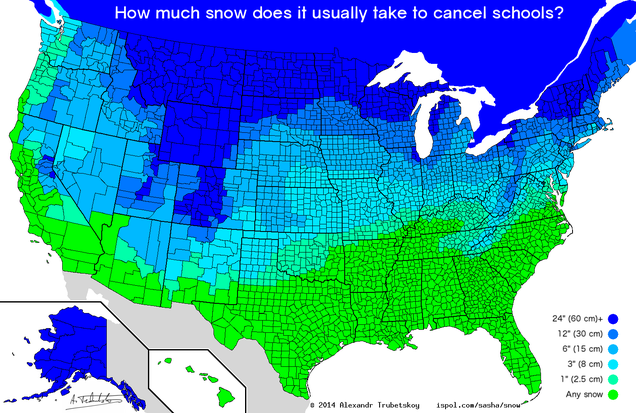
Snow days can be nightmares for working parents. Some areas tend to need very little snow to cause a school closing, while in other areas schools don't blink if there's two feet of snow.
Jvitak, Scott Weigand likes this
20 Jan 14:59

Marriott plans to bring Netflix to your hotel room TV
by Jon Fingas
Chris PeBenitoInteresting. Though I can see them blocking Netflix on the in-room internet access and charging $10 to watch.
The next time you're on a trip, you may have something to watch on the hotel room TV besides the usual so-so channels and on-demand movies. Marriott has confirmed to Bloomberg that it's trialing access to streaming services like Hulu, Netflix and Pandora on TVs in eight of its hotels. It's not certain what the company will charge (if anything) if it launches this feature in earnest, although it's reportedly mulling a few options that include a "premium" internet tier with TV streaming on top of the usual WiFi. That last choice might not be very popular when you can already curl up on the bed with your laptop at no extra cost. Having said this, Marriott hasn't committed to anything yet -- there's a lot left to decide before you can watch House of Cards on a big screen during your vacation.
Filed under: Home Entertainment, Internet, HD
Via: The Verge, Lucas Shaw (Twitter)
Source: Bloomberg (Daily Transcript)
15 Jan 19:20

Zombie cookie: The tracking cookie that you can’t kill
by l33tdawg
Chris PeBenitoI'm sure Turn is the only one nice enough to come forward to say they're leveraging that injected header.
An online advertising clearinghouse relied on by Google, Yahoo, and Facebook is using controversial cookies that come back from the dead to track the Web surfing of Verizon customers.
The company, called Turn, is taking advantage of a hidden undeletable number that Verizon uses to monitor customers' habits on their smartphones and tablets. Turn uses the Verizon number to respawn tracking cookies that users have deleted.
Tags:
14 Jan 14:53

Should cops be allowed to see bodycam footage before filing reports?
by Cory Doctorow
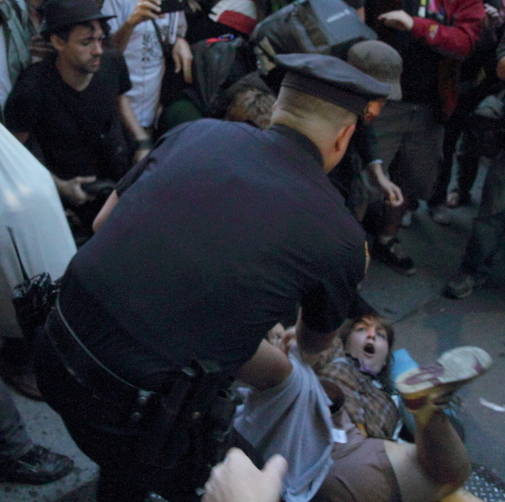 As bodycams roll out in more and more American police departments, officers are asking to be allowed to review footage of shootings before they file their reports, on the grounds that fallible memories from high-stress moments can be augmented by footage -- but of course, this would also help an officer know how much he can lie without getting contradicted by the video evidence.
Read the rest
As bodycams roll out in more and more American police departments, officers are asking to be allowed to review footage of shootings before they file their reports, on the grounds that fallible memories from high-stress moments can be augmented by footage -- but of course, this would also help an officer know how much he can lie without getting contradicted by the video evidence.
Read the rest
17 Dec 04:38

Judge says reporter can’t get public records about cops’ "stingray" use
by l33tdawg
A local judge in Arizona ruled Friday that the Tucson Police Department (TPD) does not have to disclose records related to the use of stingrays, also known as cell-site simulators, under the state’s public records act.
Tags:
05 Nov 16:53

Chip & PIN vs. Chip & Signature
by l33tdawg
Chris PeBenito@Method, we were talking about this recently.
The Obama administration recently issued an executive order requiring that federal agencies migrate to more secure chip-and-PIN based credit cards for all federal employees that are issued payment cards. The move marks a departure from the far more prevalent “chip-and-signature” standard, an approach that has been overwhelmingly adopted by a majority of U.S. banks that are currently issuing chip-based cards. This post seeks to explore some of the possible reasons for the disparity.
Tags:
03 Nov 17:58
 This is part of the 4-acres of spiderweb built by orb-weavers in a Baltimore Wastewater Treatment Plant. Experts CONSERVATIVELY estimate there were over 107-million spiders living in the webs, with a population density as high as 35,176 spiders per square meter. For reference, that's 35,175 spiders per square meter more than necessary to justify burning the building to the ground. Per the entomologist and arachnologist experts sent to investigate the problem:

Nuke The City, Do It Now: 4-Acre Spiderweb In Baltimore
This is part of the 4-acres of spiderweb built by orb-weavers in a Baltimore Wastewater Treatment Plant. Experts CONSERVATIVELY estimate there were over 107-million spiders living in the webs, with a population density as high as 35,176 spiders per square meter. For reference, that's 35,175 spiders per square meter more than necessary to justify burning the building to the ground. Per the entomologist and arachnologist experts sent to investigate the problem:
We were unprepared for the sheer scale of the spider population and the extraordinary masses of both three dimensional and sheet-like webbing that blanketed much of the facility's cavernous interior. Far greater in magnitude than any previously recorded aggregation of orb-weavers, the visual impact of the spectacle was was nothing less than astonishing. In places where the plant workers had swept aside the webbing to access equipment, the silk lay piled on the floor in rope-like clumps as thick as a fire hose. In some areas of the plant over 95% of space was filled with spider web. The webbing was so dense that it pulled 8-foot long fluorescent light fixtures out of place.Wait -- the workers just worked around them?! I thought the building was abandoned. At what point do you think employees gave up on a spider-free work environment and just let them have their way? Because I would have quit. Quit and sued the city for unsafe working conditions. Not only am I dealing with wastewater, but I have to cope with a spider infestation? Nobody gets paid enough for that. Unless it's over $40k with benefits, in which case that sounds reasonable and I'd like my old job back. One more shot after the jump of an 8-foot florescent light pulled out of place by the webs.
Corey Garst likes this
23 Oct 16:57


Alphonse Bertillon and the Identity of Criminals
by Miss Cellania
Chris PeBenitoIs it just me, or does this Bertillon guy look like Chris K?
Alphonse Bertillon was a French forensic documentarian who developed or improved upon several methods of identifying criminals and solving crimes. Some of those methods, such as the mug shot, are still in use today, while others, particularly anthropometry, were abandoned over time in favor of more accurate methods. Bertillon is considered by many to be the first forensic expert.
Bertillon’s self-portrait as a mug shot.
Bertillon was a school dropout, and having been trained in no particular field other than that of a soldier, he went to work as a records clerk at the Prefecture of Police in Paris in 1879. The son and brother of statisticians, Bertillon was appalled at the chaos in the criminal offender files. In his spare time, he began to work out a better method. In France at the time, there was a concern over recidivists, or those who committed crimes over and over. Recidivists could draw harsher sentences, but they were difficult to identify, because arrestees were only identified by name and address, and sometimes a picture. But appearance and addresses change, and anyone could lie about their name. With the Paris criminal records system as it was in 1879, if you couldn’t ascertain a suspect’s name, you couldn’t find him in the files, and therefore the rate of recidivism was unknown. Suspected, but unknown.
Anthropometry
An illustration from a book on anthropometry by Alphonse Bertillon.
Bertillon tackled identifying criminals by anthropometry, or the measurements of man. Anthropometry has plenty of uses, in the fields of medicine, anthropology, and engineering, and Bertillon developed another: forensic anthropometry, for the purpose of identifying recidivists and keeping records of criminal offenders. His system, called bertillonage, involved measuring dimensions of the head, face, long bones of the limbs, and other body dimensions. Bertillion entered these measurements into file cards for each arrestee, and sorted them by the offender’s size. A suspected recidivist could be matched by these measurements, and then his name could be cross-referenced to his criminal record.
The major flaw in bertillonage was the assumption that measurements were different for each individual. Bertillon knew, from the Belgian statistician Lambert Quetelet, that the chances of two people being the same height were four to one. Bertillon surmised that the more measurements of different body parts he added, the longer the odds were that two people’s measurements would match. However, several of the measurements he included in his system were directly correlated with an individual’s height.
Still, Bertillion’s system identified recidivists better than any method used previously. In 1884 alone, 241 recidivists were identified when they were rearrested in Paris. The system spread throughout France, and then to other countries. An unsavory side effect was the idea that a “born criminal” could be identified by anthropometry before any crimes were committed, which fed into the eugenics debate.
Sir Francis Galton had his mug shot taken by Bertillon.
Bertillion’s anthropometry measurements were eventually replaced by the more accurate identifier of fingerprints, introduced into forensic science by Sir Francis Galton in the 1880s. But anthropometry wasn’t the only innovation Bertillon made in police record-keeping.
Mug Shots
Bertillon also had a system for incorporating face descriptions into criminal files, which he called “portrait parle.” This involved classifying the shapes of the eyes, nose, mouth, and other features into a coded lexicon that could be used as shorthand. However, the code was extensive and hard to teach to all the police in France, so portrait parle was abandoned in favor of mug shots.
François Bertillon, the photographer’s two-year-old son, mug shot taken in 1893.
Police had been using photography to record criminal appearance since shortly after photography was invented, but it was Alphonse Bertillon who standardized the mug shot into the familiar full-face shot accompanied by a profile view of the same size. The profile view was added because Bertillon saw that the unique shape of the ear is an identifier. His method, adopted in Paris in 1888, was soon used throughout France and in other countries.
Handwriting Analysis
The mug shot of Captain Alfred Dreyfus.
Bertillon’s brief foray into the science of handwriting analysis was a complete failure. He was called to testify in the Dreyfus Affair, in which Captain Alfred Dreyfus was accused of spying on the French military for Germany. The chief evidence against Dreyfus was a document, which he denied writing. There were no competent handwriting experts available, so the famous forensic expert Alphonse Bertillon was summoned, although he had no expertise in handwriting analysis. Bertillon’s initial examination of the document was inconclusive, but he eventually testified that the handwriting was Dreyfus’s, although allegedly Dreyfus had tried to disguise his handwriting as someone else imitating his handwriting. In other words, Bertillon said that Dreyfus was trying to frame someone of framing him. This convoluted logic is attributed to either Bertillon’s confidence that Dreyfus was guilty, or to the French military leaning on the police investigator to find Dreyfus guilty. Later analyses confirmed that Bertillon’s testimony on the handwriting was full of errors.
Crime Scene Photography
Bertillon was also a proponent of crime scene photography. Photographing murder victims was important for capturing the ability to identify them before their bodies decayed or were disposed of. He developed a standardized technique of photographing a murder victim from above, in order to record the body’s position in situ before investigators disturbed the scene. Forensic measurements could be taken from the images any time afterward.
Although not all of Bertillon’s techniques panned out, he brought a sense of discipline to record keeping and crime investigation that opened doors for further developments in criminal justice.
This post was inspired by a picture found in an old issue of The Annals of Improbable Research, in which a cat is observing Bertillon at work.
21 Oct 13:04
Scammers Like These Are the Reason Everyone Has Dash Cams
Chris PeBenitoI've seen videos of scammers backing their car into yours to make it look like you rear-ended them, but this is a new type of crazy.
Mattdoc7 likes this
19 Oct 21:28

If you don't agree to the new Wii U EULA, Nintendo will kill-switch it
by Cory Doctorow
Chris PeBenitoI never had any interest in a Wii U, but now I REALLY don't have any interest in it.
When you bought your Wii U, it came with one set of terms-of-service; now they've changed, and if you don't accept the changes, your Wii seizes up and won't work. That's not exactly what we think of when we hear the word "agreement." Read the rest
Markku.lempinen, Luke.stirling likes this
15 Oct 14:43
 This is the massive 5,700+ game video game and console collection being sold by eBayer reel.big.fish. It includes every retail Nintento, Super Nintendo, Game Boy, Game Boy Color, Virtual Boy, N64, Gamecube and Sega Master System game sold in North America, plus a ton of of Game Boy Advanced, Sega Genesis, Sega Game Gear, Atari 2600 and Turbografx-16. It includes almost every popular console and at least some games from the last 30 years. You can download a document of all the systems games included HERE or check out the auction page HERE. Some more details while I practice robbing banks in Grand Theft Auto V to afford the $164,000 pricetag.

eBay Video Game Collection w/ Every NES, SNES, Game Boy, Game Boy Color, N64, Game Cube And Sega Game
This is the massive 5,700+ game video game and console collection being sold by eBayer reel.big.fish. It includes every retail Nintento, Super Nintendo, Game Boy, Game Boy Color, Virtual Boy, N64, Gamecube and Sega Master System game sold in North America, plus a ton of of Game Boy Advanced, Sega Genesis, Sega Game Gear, Atari 2600 and Turbografx-16. It includes almost every popular console and at least some games from the last 30 years. You can download a document of all the systems games included HERE or check out the auction page HERE. Some more details while I practice robbing banks in Grand Theft Auto V to afford the $164,000 pricetag.
5700+ games. Over 4000 from Nintendo. The majority from the golden age of gaming (1980's - 1990's) Multiple complete sets from Nintendo and Sega. Arguably every single retail (on store shelves) game released from Nintendo between 1985-2000 is represented here. That's just scratching the surface with many more from Sega, Atari, Playstation, Xbox and Turbografx. Including multiple systems (some modded), (every single N64 color variant) and custom hand built and painted shelves. Complete in Box Mario and Zelda sets.There are a ton more pictures and a video of the collection after the jump, which I'm not ashamed to admit made me more than a little moist in the nether regions. That or I pissed myself. Either way, I need to remember to change my underwear and tape my penis to my leg before my dentist appointment at 11. Keep going for my dreamworld.
13 Oct 12:51

Wasting Time through the Ages
by John Farrier
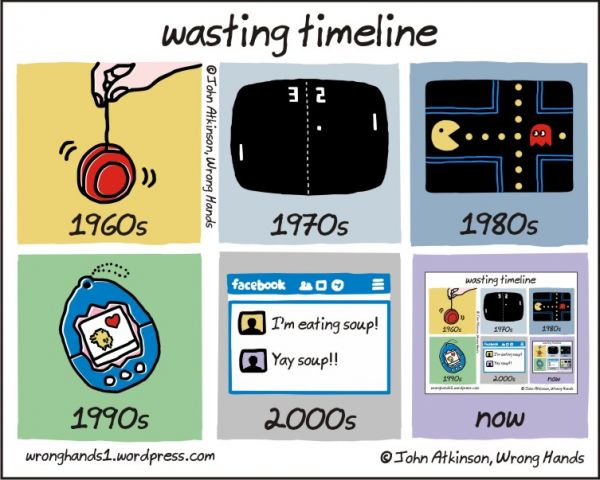

How will we waste time in the 2020s and the 2030s? Will we watch holographic simulations of computer users from the previous decades using their primitive virtual reality simulators and augmented reality heads-up displays?
Rafael Genaro likes this
09 Oct 19:26


A Brief History of 125 Years of Nintendo
by Kate Erbland
This year marks the 125th anniversary of Nintendo, the beloved Japanese video game company responsible for a whole slew of consoles that you’ve probably played more times than you can count (or are willing to admit—it’s okay, we love Mario, too). One hundred and twenty-five years is certainly a big birthday, especially for a company best known for their forward-thinking modern gaming systems. But if video games weren’t created until the middle part of the twentieth century (most video game historians point to the Cathode Ray Tube Amusement Device, created in 1947, as the first true “video game”), what exactly did Nintendo do in its early years?
Turns out, quite a bit.
Counting Cards

The company that would become “Nintendo” was founded in 1889 by entrepreneur Fusajiro Yamauchi as “Nintendo Koppai” (also known as the “Nintendo Playing Card Co. Ltd.," so you can probably guess where this is going), and was styled as a playing card company (see!) that mostly made Japanese playing cards called “Hanafuda.” The so-called “flower cards” have been a part of Japanese gameplay for centuries, and Nintendo had great success in manufacturing and marketing them. (The company still makes cards to this day.)
Despite the company’s success with playing cards, Yamauchi’s grandson Hiroshi eventually realized that Nintendo had probably gone as far as anyone possibly could with just cards. In 1956, the young go-getter was astonished to see that the massive United States Playing Card Company was run out of a small office. If that’s what they were working with, what could Nintendo possibly aspire to?
First up: character cards. Nintendo (quite sagely) picked up the rights to the Disney cabal of characters, putting them on their cards and driving sales, but that wasn’t quite enough. They needed to think bigger.
More Is More
Getty Images
The early sixties weren’t too kind to the ever-expanding Nintendo empire. The company, hellbent on mixing things up and pushing past just playing card sales, stretched itself too thin by getting involved with everything. Well, nearly everything.
Between 1963 and 1968, Nintendo began dabbling in such disparate industries as transportation (a taxi company), hospitality (a love hotel chain), and food (they specialized in ramen) under the umbrella of “Nintendo Co., Ltd.” None of these attempts at expanding into different industries worked out, and Nintendo soon needed to find something new to embrace.
Toy Story
After the mixed bag that was the '50s, Nintendo turned its attentions to toys, including the carnival-like “Love Tester” and the popular “Kousenjuu” light gun games, which paved the way for the company to turn their attentions to more light gun-based gaming. Slowly, the company moved towards more electronics-heavy games and toys, even though they couldn’t initially keep up with big names like Bandai and Tomy.
The Electronic Age
Nintendo steadily worked their way into the video game realm, but things really changed in 1974, when the company bought the distribution rights for the Magnavox Odyssey video game console. In 1975, the company set about making their own video arcade games, with Genyo Takeda’s “EVR Race.” By 1977, the company was making its very own consoles, originally styled as five different kinds of the “Color TV-Game.” (The first Color-TV Game console is responsible for bringing six different takes on Pong to the world.)
These consoles were partially designed by Shigeru Miyamoto, who would go on to design Donkey Kong for the company in 1981, a game-changer through and through. Once Donkey Kong hit the market—allowing Nintendo to enjoy licensing their own products to other companies—Nintendo had established itself as a force to be reckoned with in the burgeoning video game sector.
Once Nintendo’s dominance in the industry was recognized, the company began churning out inspiring new creations, from the handheld “Game & Watch” game series, to the “Family Computer” for home gaming (eventually launched as the NES outside of Japan), to the smash-hit that was the Game Boy (invented in 1989). The company’s success continued in the late eighties, thanks to the release of the Super Nintendo (SNES), which also helped kick off the infamous battle with rival Sega.
In 1994, Nintendo celebrated the sale of one billion game cartridges (a tenth of them attributed to Mario games alone). A series of missteps marred the rest of the '90s, including the disappointing Virtual Boy in 1995, but the company quickly rebounded with the Nintendo 64, the Game Boy Pocket, and the Game Boy Color.
To the Future
Getty Images
The aughts proved to be similarly fraught for the company with the disappointment of machines like GameCube and Game Boy Micro. This was briefly tempered by the success of the Nintendo DS and the New Super Mario Bros. game in 2006.
If there’s one thing that’s really changed things for the company, though, it’s the Wii, first introduced in 2006. The motion-controlled system has proven to be especially successful for Nintendo.
Next up for the company? A heavier reliance on glasses-free 3D displays, an interest in video compression, and games that fold in advanced face and voice recognition.
Happy 125th, Nintendo!
03 Oct 12:31


Unlocking The Bootloader On Sony's Xperia Z3 And Z3 Compact Causes Poor Low-Light Camera Performance Thanks To DRM [Update: Sony Updates Policy Text]
by Ryan Whitwam
Chris PeBenitoWell now I know I won't be buying a Sony device any time soon... if ever.
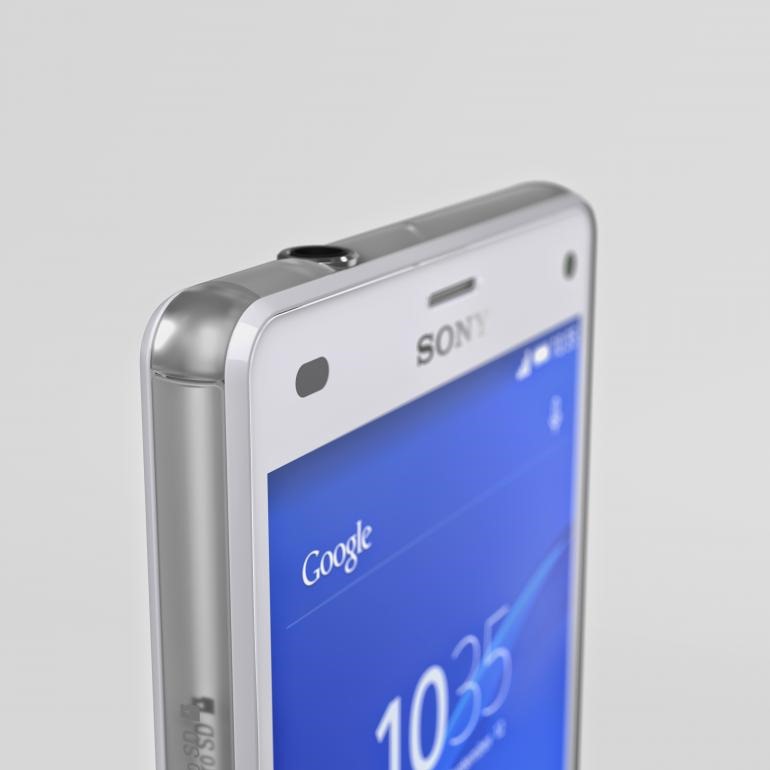 You know those scary warnings that show up whenever you unlock the bootloader on a phone? "We can't be held responsible... blah blah... reduced functionality... blah... fiery death... blah blah blah." Sometimes they aren't kidding. Users who have unlocked the new Xperia Z3 Compact have found that low-light camera performance drops considerably. It turns out to be because of DRM in Sony's image signal processing.

When the bootloader is unlocked, the device loses certain DRM security keys.
Unlocking The Bootloader On Sony's Xperia Z3 And Z3 Compact Causes Poor Low-Light Camera Performance Thanks To DRM [Update: Sony Updates Policy Text] was written by the awesome team at Android Police.
30 Sep 18:19
 This is a video from the BBC of an unclassified giant leech from Borneo swallowing a 78cm (~31-inch) blue worm like a string of spaghetti. *making phone call* Hello, honey? Cancel the Italian dinner reservations for tonight, I'm not doing pasta again for awhile.

Dammit Mother Nature: Giant Red Leech Swallows Worm Like A String Of Spaghetti
This is a video from the BBC of an unclassified giant leech from Borneo swallowing a 78cm (~31-inch) blue worm like a string of spaghetti. *making phone call* Hello, honey? Cancel the Italian dinner reservations for tonight, I'm not doing pasta again for awhile.
The Giant Red Leech is one of the biggest in the world. The specimen captured on camera was around 30cm long but experts believe they could grow larger. They have grown so big that they no longer simply suck blood but now actively hunt giant blue worms and suck them down like spaghetti. The worm it is eating is a whopping 78cm. The new footage shows the leech detecting a worm's trail and following the scent like a sniffer dog. When it encounters its prey it quickly latches on and moves its lips up and down the iridescent blue body. "It was either searching for an end to grab, or was working out whether it was too big to eat" said documentary director Paul Williams. "When it found an end it started to suck. It was incredible."Mother Nature never ceases to amaze me. And by amaze me I mean make me sick to my stomach. I can't even count how many interventions I've tried to hold for her, but every time I do she shows up with booze and gets me drunk and then my friends and family turn the whole things around on me. Clearly she's smarter than she looks, and she looks like a talking willow tree, so she must be a f***ing genius. Keep going for the disturbing video.
22 Sep 12:41
Fork of Systemd Leads To Lightweight Uselessd
by timothy
Chris PeBenitolol
An anonymous reader writes A boycott of systemd and other backlash around systemd's feature-creep has led to the creation of Uselessd, a new init daemon. Uselessd is a fork of systemd 208 that strips away functionality considered irrelevant to an init system like the systemd journal and udev. Uselessd also adds in functionality not accepted in upstream systemd like support for alternative C libraries (namely uClibc and musl) and it's even being ported to BSD. 


Read more of this story at Slashdot.
12 Sep 18:41
L.A. Vaccination Rates Still Plummeting Amid Pertussis Outbreak
by Miss Cellania
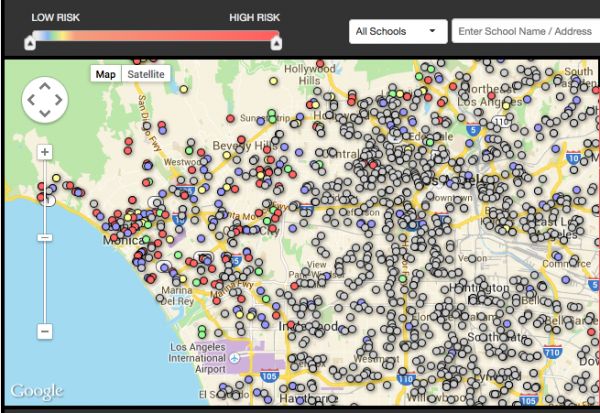
This map, interactive at the site, shows the vaccination rates for schools in Los Angeles. Thirteen schools in Los Angeles have opt out rates of 50% or more. That means more than half the children who attend are not following the prescribed schedule of immunization against measles, mumps, rubella, chicken pox, diphtheria, or pertussis (whooping cough). Many more schools have opt out rates just under 50%. That means that there is insufficient herd immunity at these schools, and children can contract these diseases and transmit them to babies and those with compromised immune systems -the people most likely to die from them. Children who have been vaccinated are also at risk, because some vaccines take years to gain peak immunity, and even then it’s not 100%. Being vaccinated will reduce the risk, however, and the best way to reduce the risk of disease is to vaccinate as many children as possible to reach herd immunity -the point where diseases hit roadblocks in contagion.
Keep in mind that the statistics on the map are for the percentage of parents who filed a “PBE,” or Personal Belief Exemption for immunizations. In many cases, that doesn’t mean the child is completely unvaccinated, but instead means that certain vaccines are skipped or delayed from the standard immunization schedule. But the current outbreak of pertussis is real. So far this year, almost 8,000 of cases of pertussis have been reported in the Los Angeles area, 267 people have been hospitalized, and three babies have died of the disease. The rate of measles is higher than it’s been for 20 years. The Hollywood Reporter has an extensive article about vaccinations and the parents who opt out. -via Metafilter
12 Sep 12:36
Woman in China Found to Have No Cerebellum
by Lisa Marcus
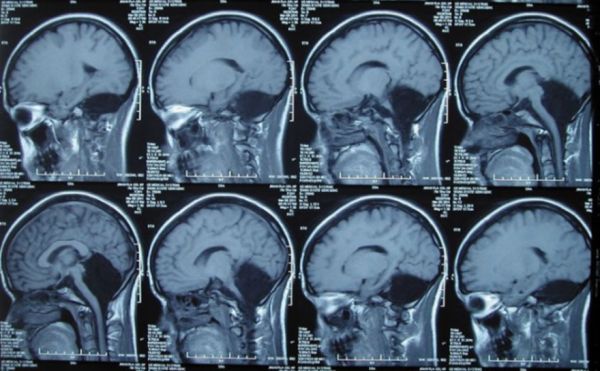
A 24-year-old woman from Shandong Province in China was recently admitted to a hospital after presenting with symptoms of dizziness and nausea. Once a brain scan was performed, it was discovered that she had no cerebellum, with the brain cavity that it normally fills instead replaced with cerebrospinal fluid. The patient is one of only nine people known to have lived with this condition.
The cerebellum is the area of the brain associated with motor control, timing, coordination and fine movement. The patient described a lifelong difficulty with balance, and her mother said she couldn't stand on her own until age four nor walk unassisted until age seven. Yet the woman was determined overall to have only "mild to moderate" symptoms and "slightly irregular" movement.
The woman's case is an important data set with regard to the study of neuroplasticity, in which one or more regions of the brain adapt to compensate for brain damage in another area. Learn more about this fascinating case at io9.
11 Sep 19:23


Dedicated Hangouts Dialer App Hits The Play Store With Phone Calling Functionality And Google Voice Integration, Requires Hangouts v2.3
by Bertel King, Jr.
Chris PeBenitoI don't have hangouts 2.3 yet, but it installed ok on my tablet, so that's cool.
 Update: Hangouts 2.3 is now rolling out to devices in stages. If you rather not wait, we can help you can download it manually. And as it turns out, this Dialer just links to a tab within the new Hangouts app. It is not a separate, standalone piece of software.

Hangout's Google Voice integration is finally happening. We started seeing functionality merge into Hangouts overnight, but there remain a few kinks to work out that we're hoping an upcoming app update will fix.
Dedicated Hangouts Dialer App Hits The Play Store With Phone Calling Functionality And Google Voice Integration, Requires Hangouts v2.3 was written by the awesome team at Android Police.