Washed up, Tomohide Ikeya
Mattalystaka dystopian chicken Matrix

 Virtual Free Range™
Eliminating the need for the physical space required for free-range livestock our Virtual Free Range™ gives livestock the experience of Free Range life while in the safe confines of our facility.Free Range life, though providing a diverse diet, exercise, and socialization, is inherently stressful to the animals. It can also result in a high loss for the producer due to injuries and predation.
Virtual Free Range™ combines the physical and psychological benefits of free range life with the safety and security of conventional agriculture. Chickens are free to roam, socialize and "eat" virtual food, which appears in the virtual world where their real food trays are located.
Previously, previously, previously, previously, previously, previously, previously, previously, previously.

Mattalyst"Nuts are available in the data but not included", because almonds are the devil.
Cutting animal products from our diet can significantly help water conservation efforts, but water policies focus on sustainable production rather than sustainable consumption, water management expert Arjen Y. Hoekstra says in a recent report.
According to data from the Water Footprint Network, a Dutch nonprofit research group Hoekstra co-founded, animal products demand considerably higher amounts of water than do most other food types. The selected foods below provide a representative example based on common diets.
Fruits and vegetables
Drink
Starch
Protein

Kyle Kim, Jon Schleuss, Priya Krishnakumar, Lorena Iñiguez Elebee, Len DeGroot, Raoul Ranoa, Anthony Pesce
Photos by Anne Cusack and Kirk McKoy, Los Angeles Times
U.S. averages are derived from weighted totals (in cubic meters per metric ton) of multiple farming methods, including grazing and industrial production.
Totals were converted to U.S. gallons per ounce (weight). Beverage values were additionally converted into fluid ounces using the USDA National Nutrient Database for Standard Reference.
All food items are assumed as fresh (unfrozen) and do not include water for cooking. Data for sheep meat in the U.S. are unavailable and global averages were used instead.
Food items were selected if typically eaten as part of a main meal. Some were omitted for simplicity (i.e., squash versus pumpkin). Nuts are available in the data but not included.
WaterStat, Water Footprint Network, Enschede, the Netherlands.
M.M. Mekonnen and A.Y. Hoekstra (2010), "The green, blue and grey water footprint of crops and derived crop products", and "...of farm animals and animal products," Value of Water Research Report Series No. 47 and 48, UNESCO-IHE, Delft, the Netherlands.
L.A. Times reporting

Real Vegan Cheese is made from the same proteins found in cow's milk, but they came from genetically modified yeast. But is it real? Vegan? Cheese?
The post Cow Milk Without the Cow Is Coming to Change Food Forever appeared first on WIRED.

Mattalyst0_o

MattalystThe UK has a special relationship with Spain.
[body_image width='1200' height='800' path='images/content-images/2015/04/16/' crop='images/content-images-crops/2015/04/16/' filename='the-man-behind-mamading-in-magaluf-876-body-image-1429178907.jpg' id='46614']Paul Smith. Photo by Tarek Serraj.
This article originally appeared on VICE Spain.
Thirteen years ago, Paul Smith left his hometown of Dagenham to look for a better life in Spain. Like many other adventure-seeking Brits, he settled in Magaluf, where he opened Pure, his first club,in 2009. Today, he is the proud owner of four bars on the strip of Punta Ballena, including Carnage—the Magaluf club that organized the blowjob contest everyone freaked out over last summer.
Seemingly overnight, Smith became the face of " mamading"—that's the term that's since been applied to the sport of performing sex acts in exchange for alcohol. In a strange twist, the Carnage scandal somehow led to the arrest of the Calvià Police Chief Jose Antonio Navarro, as well as of two more officers.
I was curious to understand what could tie a series of blowjobs to a police chief, so I got in touch with Smith. Over the phone, he claimed that the Calvi à police and the district's council have had it in for him ever since last summer, which apparently has driven him to change his route home every night and record it on his phone—just in case. He admitted that he sounds paranoid, but insisted he has evidence. Here is the rest of our conversation.
VICE: What
happened in the summer of 2014?
Paul Smith: Technology put me in my place. Not only me but
the whole of Magaluf. That video became viral and shamed us all. OK, I don't deny my part in it, but I don't think I deserve to take all the blame for what has been going on in
Magaluf, and this is what is happening at the moment. They are
blaming me for 35 years of bad publicity.
Everyone says that I'm a mafioso, that I'm like the baddie in films. What is it that makes me so evil? Because I organize booze cruises? What if somebody did something they shouldn't have in one of my clubs? I wasn't the first and I am definitely not the only one planning these drinking games.
But you asked to give a press conference straight after the scandal exploded.
The press was going crazy. Everyone was trying to get an exclusive—to talk to the girl, or to me. I didn't want to say anything, but then the council of Calvià told me that it would be best to organize for a press conference for PR purposes. They told me that in order to put an end to all the noise that the video had caused, I would have to talk.
So my lawyer and I met up with people from the council in an office outside Calvià. They assured me that if I didn't do the press conference things would get worse for me. Just before the meeting ended, I asked them if they would leave me in peace once I did it. They agreed. It all turned out to be a huge lie because they gave me a fine of 55,000 Euros [about $58,000] after the press conference.
And then somehow you got the local police chief in prison.
Yes. A few years ago, the police of Calvià put drugs on my premises in an attempt to shut it down. I had been warned by a person with a lot of contacts to be careful, because someone
wanted to shut us down. When it actually happened, I couldn't believe it.
Did you ever
tell the authorities?
I had CCTV footage of one of them actually placing drugs in my club, so I asked for a meeting at the Calvià police headquarters. I wanted to tell José Antonio Navarro, the head of the Calvià police, what his officers had done. Navarro attended that meeting along with his right-hand man. The other people there were my lawyer, some of my guys, and myself.
We sat down and my lawyer said that some people had placed drugs in my premises. We didn't tell them about the footage. They both laughed and said that it was all bullshit because that kind of thing doesn't happen. Then, all of a sudden, Navarro said, "Yes, we actually did it, but it was to train the sniffer dogs." Everyone went silent. It was unreal.
The video shows a Calvi
à police officer placing drugs in Smith's premises.
How come you only came forward with the incriminating footage last year?
I
didn't want any trouble, so we kept it all a secret for two years. I
was worried about the consequences of turning the police against me. I wanted to protect my business above
everything else.
But after the mamading incident at Carnage and the subsequent fine, I felt that I had put up with enough. They were using me as a scapegoat and I thought that this time I didn't have anything to lose. Thanks to the evidence that I gave to the judge, Navarro was arrested.
And now you think his people will come for you this summer?
Yes, I think so. I have a tough year ahead of
me. I have already been told that I am not wanted in Calvià after what happened
last summer. My booze-cruise business is probably one of the most legal endeavors of the sort in the area, but I think I'm still going to be blamed for a bunch of things this summer.
They aren't going to let me work peacefully.
Related: Like Magaluf, Ibiza is a major holiday destination for Brits. We sent host Clive Martin there to the Spanish city to investigate the magnetic appeal of "party island."
Street drinking has been banned in Magaluf now.
They made that decision last month and I have no
choice but to comply. I just hope that the law applies to everyone else
as well.
Do you feel that Magaluf might be changing for the better, since the mamading scandal?
Well, at the moment it looks like they are trying to attract a better type of tourist. They don't want hooligans. We have been dealing with hooligans for the past 35 years and it has worked. It has made Calvià one of the richest districts in Europe. So, I don't understand why they would want to change
things.
I mean, I understand that it'd be nice to clean Magaluf, show a bit more authority, and do things well. But don't punish the businesses—they are only giving people what they want. All we do is provide good music, reasonably priced alcohol, and a relaxed atmosphere.
All that the people who holiday here want is to have a good time. They want to leave their worries and problems at home. They want to come here for a while then go home with no memories. If you don't remember anything when you get home, it means you've had a good time.
Are you a mafioso?
No way! This couldn't be further from the truth. I'm
a family man and I work hard.
But you're not
a saint, either.
I don't think anybody is. No, I'm not a saint—I
do things. I don't always abide by the rules, but it's the same for 90 percent
of the people in this world. It's not just me.
MattalystBut at least I did my taxes. I even started on last year's!


I turned my frustration with myself into art.
I feel like this is really important for people to see. I’ve been saying depression and mess go hand-in-hand for years, but so many people feel like they’re alone in it. You’re not.
Christ…I feel this in my bones
It has now been zero days since I looked around my room after reading a post and burst into tears while trying to eat food that somehow tastes like nothing.
MattalystSo this dude seems to believe in everything *but* RSS, which is heartbreaking considering how great these all are.
Watch out for false prophets.
They come to you in sheep's clothing, but inwardly they are ferocious wolves
1 2 3 4 5 6 7 8 9 10 11 12 13 14 15 16 17 18 19 20 21 22 23 24 25 26 27 28 29 30 31 32 33 34 35 36 37 38 39 40 41 42 43 44 45 46 47 48 49 50 51
When you’re introduced to Saeed Torres in the new documentary (T)ERROR, you hear him bickering with the filmmaker, Lyric Cabral. The screen is black.
“I told you I didn’t want my face in that shit,” he says.
“Even if your face is shown, how would somebody come after you?” Cabral asks.
“You’d be surprised who knows me,” Torres insists.
The blackness lifts. Torres is dressed in a chef’s apron and a white headscarf, making hot dogs at an amateur basketball game, as if he were an all-American guy.
“I might not even make no fucking independent film,” he says, irritated.
Torres isn’t an all-American guy. He’s an FBI informant, one of more than 15,000 domestic spies who make up the largest surveillance network ever created in the United States. During J. Edgar Hoover’s COINTELPRO operations, the bureau had just 1,500 informants. The drug war brought that number up to about 6,000. After 9/11, the bureau recruited so many new informants — many of them crooks and convicts, desperate for money or leniency on previous crimes — that the government had to develop software to help agents track their spies.
Torres agreed to participate in that independent film, of course. In (T)ERROR, which has its New York premiere at the Tribeca Film Festival on April 16, he offers the rest of us an unprecedented look inside an FBI counterterrorism sting as it unfolds. The documentary is compelling for its intimate portrayal of a single informant who has played a key role in several major terrorism cases.
Video clip from (T)ERROR
Informants represent the manpower behind the FBI’s controversial stings, which are intended to find would-be terrorists before they attack. In the decade after 9/11, 158 defendants were prosecuted following these undercover operations, which are usually led by an informant and provide the means and opportunity for someone to attempt to commit an act of terrorism. A Human Rights Watch report in 2014 criticized the FBI for targeting “particularly vulnerable people, including those with intellectual and mental disabilities and the indigent.” Late last week, for example, the FBI arrested a mentally troubled 20-year-old in Topeka, Kansas, after he allegedly attempted to bomb Fort Riley with the help of two undercover FBI informants.
While there are more than 15,000 FBI informants, most are low-level operatives who provide scraps of information or tips about people in their community. Only a few of them at any time are high-level operators like Torres — professional liars who travel the country as agents provocateur in elaborate stings. They can make $100,000 or more for every case they work. Torres, a former Black Panther and convict who robbed New York City transit booths, is one of these operators, a freelance agent who portrays himself as a “radicalized Muslim,” as the government’s terminology puts it.
“I don’t like the word informant,” Torres says in (T)ERROR. “I consider myself a civilian operative.”
Torres was the informant behind FBI stings that targeted Tarik Shah, a Bronx jazz pianist who was convicted of providing material support for terrorists in 2007, after he pledged allegiance to Al Qaeda in front of an undercover agent, and Mohammed Ali Hassan al-Moayad, a Yemeni cleric in Brooklyn who bragged about his connections to Osama bin Laden. Al-Moayad pleaded guilty to conspiring to raise money for Hamas, and after he served six years behind bars, an appeals court overturned his conviction, ruling that he did not receive a fair trial. He then was deported to Yemen, where he received a hero’s welcome. Shah is in federal prison, serving a 15-year sentence.
(T)ERROR picks up Torres’s story after these stings (warning to readers: spoilers ahead). Living in a rundown apartment somewhere in the Northeast, he gets a call from the FBI. They want him to go to Pittsburgh to get to know a terrorism suspect — a 34-year-old white Muslim convert named Khalifah al-Akili.
“I need the money,” Torres tells Cabral and her filmmaking partner, David Felix Sutcliffe.
He packs up his car and his dog and moves into an FBI safe house around the corner from al-Akili’s apartment building. The cameras follow Torres for months as he struggles to gather any evidence that al-Akili poses a threat to national security. One of the remarkable aspects of this documentary — and of the way the FBI conducts its stings — is that Torres flatly admits that the target of his FBI operation isn’t dangerous. He isn’t on his way to becoming a terrorist.
“That dude ain’t going to bust a grape,” Torres tells his FBI handler in a phone conversation. “He ain’t going to throw rice at a wedding, believe me.”

The agents, apparently frustrated that Torres couldn’t build a case on al-Akili, bring in a second informant, Shahed Hussain, and tell Torres to make the introduction. Hussain is a con artist from Albany, New York, who was convicted of participating in a scam to give driver’s licenses to undocumented immigrants. He came to the U.S. from Pakistan in 1994, after being arrested in Karachi on a murder charge. Hussain had been used by the FBI before — he was the bureau’s undercover informant in an Albany terrorism case as well as in a sting that targeted the so-called Newburgh Four — four poor black men who plotted with Hussain to bomb synagogues in the Bronx and to fire Stinger missiles at airplanes, though only after Hussain had offered the lead defendant, a mentally troubled man named James Cromitie, $250,000 if he participated in the plot. (The four suspects received lengthy prison sentences.)
There’s no shortage of embarrassing moments for the FBI in its dozens of counterterrorism stings since 9/11. In Boston, an FBI informant who was working a counterterrorism case was caught on an FBI camera purchasing heroin, which wasn’t part of his assignment. In case after case, the FBI experiences so-called “recorder malfunctions” — usually at the most unfortunate time for the defendant, such as at the very beginning of the sting or, as in an operation involving a Baltimore teenager, when the target was attempting to back out of the plot. More recently, FBI agents accidentally recorded themselves calling the subject of their undercover investigation a “retarded fool” whose terrorist ambitions were “wishy-washy.”
As soon as Hussain is introduced into the al-Akili case, the FBI’s work is revealed as similarly ham-handed. Hussain blows the introduction by being overeager, giving al-Akili reason to suspect Torres and Hussain are government agents. Hussain hands al-Akili his business card, and a suspicious al-Akili subsequently Googles the phone number. His search brings up an FBI document from the Newburgh Four case — one that I had obtained and posted online as part of a story for Mother Jones. The FBI had never bothered to change Hussain’s cell phone number. Al-Akili discovers the story I wrote about Hussain — “The Making of an FBI Superinformant” — and realizes he’s the target of an FBI investigation.
Instead of cowering, al-Akili emails dozens of lawyers and journalists, including me.
“I would like to pursue a legal action against the FBI due to their continuous harassment, and attempts to set me up,” al-Akili wrote in the March 9, 2012 email.

“I felt I was almost obligated to expose these guys,” al-Akili told the filmmakers.
(T)ERROR becomes an intense spy game that plays out on screen, with each person double-crossing someone: Torres lying to and attempting to set up al-Akili for the FBI, and Cabral and Sutcliffe, in turn, turning the tables on the very subject of their film by approaching the subject of his investigation.
Cabral and Sutcliffe were even there when the FBI arrested al-Akili — not for terrorism but for having posed for a picture, in 2010, holding a rifle at a gun range. Since al-Akili had two previous felony drug convictions, he’d committed a crime by holding that gun. At his bond hearing, an FBI agent said Al-Akili had told informants that he wanted to join the Taliban in Pakistan. Al-Akili is now serving eight years in prison.
Near the end of (T)ERROR, Torres looks back on his work with the FBI agents in Pittsburgh.
“I told ’em,” Torres recalls. “I said, ‘I’m not here to entrap nobody.’ They’re trying to make me force this dude into saying something to support terrorism. I said, ‘This dude is not a fucking terrorist, man. He’s not even a pseudo-terrorist. He’s nothing but an oxymoron.’”
(T)ERROR would be disturbing enough if the case it followed were an isolated one. But it’s not. The announcement of a FBI sting like the one that targeted Khalifah al-Akili happens almost weekly now.
Disclosure: Laura Poitras, a founding editor of The Intercept, was a creative consultant to the makers of (T)ERROR.
Photos and Video: Stories Seldom Seen
The post The FBI Informant Who Mounted a Sting Operation Against the FBI appeared first on The Intercept.

Semper minimum ursi #waterbear #tardigrade
I want this to be the cover for the Holy Book of Tardigrade
this made me scream laughing, mid morning coffee.
MattalystNot so much math as logic, but that's a clever one, yes.

It didn't rise quite to the level of "The Dress"—the recent quandary that resulted in accusations of color-blindness across the Internet—but it still gave the education world its own viral moment over the weekend. A viral math question, in fact.
Last Friday, the Hello Singapore TV host Kenneth Kong posted a mathematical riddle to his Facebook page with the caption: "This question causes a debate with my wife .... and its a P5 question." The puzzle went viral across the country, with people ranging from perplexed adults to eager teenagers grappling with the simple question: "So when is Cheryl's birthday?"

The hysteria wasn't limited to Singapore. The question immediately made the rounds on Twitter—along with the hashtag #cherylsbirthday—and Reddit. It even made its way to the Australian Federation of International Students' Facebook page.
Without giving away the answer, here's a good starting point:
Albert knows the month, Bernard knows the number.
Albert knows that Bernard doesn't know.
Look at how many times each date appears.
Figure out which month Albert was told, and begin the elimination process.
The riddle worried some parents. "P5," known as "Primary 5" in the Singaporean education system, is the equivalent of 5th grade in the United States. Despite Singapore's internationally revered math proficiency, many parents were concerned that the question was far too advanced for their kids.
This prompted an investigation of sorts by Mothership.sg, a Singaporean news outlet. The organization obtained official confirmation (spoiler: the answer is included as well) from the executive director of the Singapore and Asian Schools Math Olympiad. According to the director, Henry Ong, the question was in fact for older "Secondary 3" students, or the equivalent of ninth grade here in the U.S. Ong also admitted that it was "a difficult question meant to sift out the better students."
Logical puzzles like this are common in Singapore. The country's math curriculum, which has a strong focus on logic-based problem solving, has been so successful that it's been adopted around the world, including in the U.S.
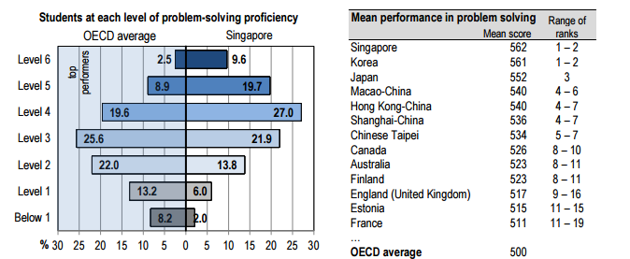
According to the latest report from the Program for International Student Assessment (PISA)—an exam designed to measure the math, reading, and science proficiency of 15-year-olds globally—Singapore's math competency essentially outshines that of the rest of the world:
Singapore scores highest in the PISA 2012 assessment of problem solving, with 562 points on the PISA proficiency scale. Only Korea has a similarly high score.
Singapore also has the highest number of top-performing students in problem solving: 29 percent of students reach proficiency Level 5 or 6 (the OECD average is 11 percent).
Performance in Problem Solving in Singapore
So what makes Singapore so good at a subject with which America's students have routinely struggled? Singapore's math instruction focuses heavily on mastery over rote memorization. Math students on the small island nation perform well because they understand the material deeply—not because they are studying for a specific test. Thus, they react well when "curveballs" are thrown at them in the form of confusing math questions.
Furthermore, the instruction of "Singapore Math"—as it's dubbed in the U.S. —uses a "layered" approach aimed at facilitating comprehension. Students digest the subject in stages, from the concrete to the pictorial and eventually to the abstract. This leads to conceptual understanding rather than numerical regurgitation: It's not just about getting the correct answer, but also about explaining one's thought processes.
U.S. students have made strides in math proficiency in recent years, but they still lag behind many of their peers internationally, falling at the middle of the pack in global rankings. In the same PISA report the U.S. placed 35th out of 64 countries in math.
And even though the "Cheryl's Birthday" question may be atypical of the average Singaporean classroom, perhaps it's still worth asking: Are you smarter than a (Singaporean) 10th-grader?
This article was originally published at http://www.theatlantic.com/education/archive/2015/04/the-math-question-that-went-viral/390411/


Paintings by Tasmanian artist Laura E. Kennedy where the frame normally becomes part of the painting.
Continue below to see more work from Laura:


Laura E. Kennedy: Website
MattalystAnd in case you're wondering what Thompson's life consisted of post-disbarment, Wikipedia has this gem:
"Thompson filed a law suit for $40 million against Facebook in the U.S. District Court for the Southern District of Florida on September 29, 2009. Thompson claimed that the social networking site had caused him great harm and distress by not removing angry postings made by users in several Facebook groups."

It makes me very happy that this exists.
The best part is, it wasn’t just a fanfic, it was a commissioned fanfic.
You'll never guess which animal picks up when you dial 9-1-1 on this children's telephone toy. (more…)
Mattalyst"Eight years of one demographically symbolic president is enough" - Wayne LaPierre


The 2015 NRA Convention concluded this weekend in Nashville, and despite the fact that attendees were not allowed to carry their guns every single place they wanted, even if they thought they saw an ISIS or a black person, the convention reportedly went off without a hitch! Or a safety! In fact, the convention seems to have gone off in the pants of many of the speakers and attendees, but in a good way! Let’s enjoy some jizz-soaked highlights, which are the natural product of what happens when so much gun-humping happens in one place.
Read more on NRA Convention Is Jizz-Soaked Festival Of Guns, Fear, Hillary-Hate, More Jizz…
MattalystYep, nailed them.
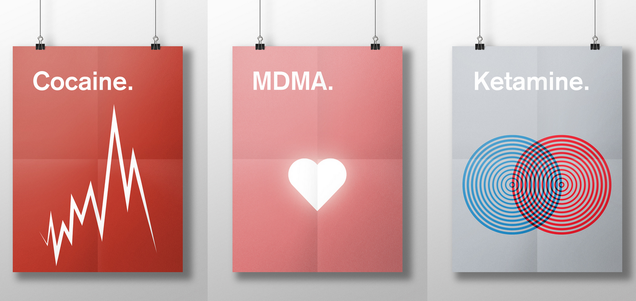
If you haven’t experimented long and hard with the full spectrum of mind-altering substances the guy behind Walmart can sell you, it’s difficult to work out what different highs will do to your grey matter. Sure, you could read Wikipedia; or, you can look at this wonderfully minimalist poster series instead.