created by Drew Tyndell
SUBSCRIBE: http://bit.ly/AdultSwimSubscribe
About Adult Swim:
Get your Adult Swim fix whenever and wherever you want at http://asw.im/1HjaIU, or by downloading the Adult Swim app. Binge marathons or watch selected episodes of many of your favorite shows including Rick and Morty, Robot Chicken, Venture Bros., Aqua Teen Hunger Force and many more. And check out the Live Stream, our block of live, interactive shows every weekday: http://asw.im/1W4jug
Connect with Adult Swim Online:
Download the APPS: http://www.adultswim.com/apps/
Visit Adult Swim WEBSITE: http://bit.ly/ASWebsite
Like Adult Swim on FACEBOOK: http://bit.ly/ASFacebook
Follow Adult Swim on TWITTER: http://bit.ly/ASTweet
Follow Adult Swim on INSTAGRAM: http://instagram.com/adultswim
Shapes 01 | Adult Swim Smalls
http://www.youtube.com/user/adultswim
Mahmoud
Shared posts
15 Dec 19:42

181208 - AI thinking about its own replaceability
181208 - AI thinking about its own replaceability
09 Dec 03:54


Ready
by Reza
Mahmoudpretty astounded with how much stuff of this tone this guy is able to produce. like, it's kinda funny, but i think i'd get depressed by my own work after a while?

Vvicked, Lani Evitts and 3 others like this
01 Dec 07:45
May I Please Enter | adult swim
by Adult Swim
Mahmoudnew resnick! (very relatable ending)
A lonely cowboy attempts to enter a nice house. He is successful.
Free Episodes: http://asw.im/6bUu5y
SUBSCRIBE: http://bit.ly/AdultSwimSubscribe
About Adult Swim:
Get your Adult Swim fix whenever and wherever you want at http://asw.im/1HjaIU, or by downloading the Adult Swim app. Binge marathons or watch selected episodes of many of your favorite shows including Rick and Morty, Robot Chicken, Venture Bros., Aqua Teen Hunger Force and many more. And check out the Live Stream, our block of live, interactive shows every weekday: http://asw.im/1W4jug
Connect with Adult Swim Online:
Download the APPS: http://www.adultswim.com/apps/
Visit Adult Swim WEBSITE: http://bit.ly/ASWebsite
Like Adult Swim on FACEBOOK: http://bit.ly/ASFacebook
Follow Adult Swim on TWITTER: http://bit.ly/ASTweet
Follow Adult Swim on INSTAGRAM: http://instagram.com/adultswim
May I Please Enter | adult swim
http://www.youtube.com/user/adultswim
Free Episodes: http://asw.im/6bUu5y
SUBSCRIBE: http://bit.ly/AdultSwimSubscribe
About Adult Swim:
Get your Adult Swim fix whenever and wherever you want at http://asw.im/1HjaIU, or by downloading the Adult Swim app. Binge marathons or watch selected episodes of many of your favorite shows including Rick and Morty, Robot Chicken, Venture Bros., Aqua Teen Hunger Force and many more. And check out the Live Stream, our block of live, interactive shows every weekday: http://asw.im/1W4jug
Connect with Adult Swim Online:
Download the APPS: http://www.adultswim.com/apps/
Visit Adult Swim WEBSITE: http://bit.ly/ASWebsite
Like Adult Swim on FACEBOOK: http://bit.ly/ASFacebook
Follow Adult Swim on TWITTER: http://bit.ly/ASTweet
Follow Adult Swim on INSTAGRAM: http://instagram.com/adultswim
May I Please Enter | adult swim
http://www.youtube.com/user/adultswim
14 Nov 08:29
Two Hundred Fifty Things an Architect Should Know
by slaporte
Mahmoudlol i wonder what the first poem masquerading as clickbait was (whitman almost certainly has something)
11 Nov 16:12
My review of the recent movie, Beirut
by As'ad AbuKhalil
Lebanon in US action movies: Beirut starring Jon Hamm
By
As`ad AbuKhalil
Lebanon often provided a venue for American and Western action films. In the 1950s and 1960s, it was a place of international intrigue and espionagewhere spies intersected with other spies, and where car chases on mountainous roads provided for good movie scenes. There were so many US and European movies shot in Lebanon in those times, with such titles: “The Sell-out”, “Masquerade”, “Man on the Spying Trapeze”, “Agent 505”, “Embassy”, among others. But that so-called peaceful Lebanon (where successive Israeli invasions and massacres don’t get a mention in Western movie accounts, and are rarely listed as the reason for undermining the old Lebanon—with all its flaws, inequities, and injustices) does not exist anymore. The Lebanese civil war provided a totally different venue for American action films that were to come in the 1980s.
While the Lebanese civil war was too complex for American films—and even for Western media and scholarly accounts, and while American films rarely if ever cover international conflicts and wars unless there is a white savior who can be inserted into the plot, the American military intervention in Lebanon in the 1980s and the bombing of US marine barracks in 1983 and the civil war phase where US was fighting alongside the Phalanges death squads, provided whole new scenarios for American action films, especially those which were produced by Israelis with tenuous or non-tenuouslinks to Mossad. America was ready to take revenge, if not in reality than on the silver screen.
The Delta Force series of movies starring Chuck Norris were written and produced by the Israeli propagandist, Menachem Golan (who had servedin the Israeli military). And the depiction of the Middle East was a vulgar variation of the stereotypes: religious fanaticism mixed with thuggery, and neighborhoods and streets are replicas of the worst Orientalist imaginations. Many of those movies had Israeli participation in set creations, production, and acting. Arabic words are often (mis)pronounced with Hebrew accents.
But one would think that times have changed and that Middle East depiction in films has improved a bit. The story line of the film, Beirut, was based on a script by well-known writer who was behind the Bourne plots starring Matt Damon. Yet, the plot is nothing more than a cliché that always finds its way in US movies about the Middle East. A good white Westerner is kidnapped by bloodthirsty Arabs. And the good white American in the movie is a CIA agent who of course knows the region better than its natives. But there are many elements of the movie that are woefully false, and often offensive.
Who, for example, would find a beach in Beirut where camels are strolling? And what is the deal with camels in Middle Eastern cities? Camels are wonderful animals who played a big part in the lives of ancient Arab nomads, but times have changed, and even in Saudi Arabia the percentage of the population which still is nomadic is miniscule (less than 5%). And in Lebanon, you would have to search for a days to find a camel (you can find some in the Biqa` valley, but it is almost impossible to find a camel in Beirut). And why would camels be in Beirut—and on the beach?
And the juxtaposition of the Lebanese civil war with the plot clearly reflected the ignorance of the writer about the civil war. People who did not live in a civil war situation assume that people fought daily, and that there were no truces and that normal lives did not find a way to coexist with war. There were often months of cease-fires that were rarely violated, and days of intense fighting were often followed by days of no fighting. Yet, the film assumes that fighting went on non-stop.
And the Palestinian militia members had names that were not recognizable although the group in question resembled that of Fath-Revolutionary Council (the Abu Nidal organization). But the notion that CIA forces or US embassy armed gunmen moved so freely in Beirut—especially in West Beriut as in the movie--and Lebanon is a figment of the imagination of the movie. The movie should have reminded Americans that, in fact, from 1975 until 1982, the US diplomatic and military presence in Lebanon was (officially through understandings between the CIA and Force 17 of the Fath Movement) under the direct protection of the PLO (the PLO assigned the Lebanese Arab Amry, which split off from the Phalanges-controlled Lebanese Army, to protect the US embassy in Beirut). It was only after the evacuation of the PLO forces from Lebanon that US embassy was attacked and US diplomats and intelligence agents were kidnapped (the assassination of US ambassador Francis Meloy in 1976 was undertaken by a Lebanese leftist group, and the PLO had nothing to do with the assassination). In the movie, the PLO is seen as rather less dominant than it actually was (militarily speaking). And American diplomats moved in those days extremely cautiously in Beirut (especially after the assassination of US ambassador Francis Meloy) and with close coordination with the PLO in areas of West Beirut. None of that was shown in the movie.
The movie also started with a high class party and an American CIA agent observed that Christians and Muslims sat apart during such social occasions. Anyone who would say that has never been to Lebanon, and probably obtained this idea from Israeli experts (the lead Palestinian child in the movie is in fact played by an Israeli actor, or an actor with an Israeli sounding name). Christians and Muslims mingled freely socially before, during, and after the war and the movie confused the later part of the civil war (where sectarian manifestations were quite pronounced) with the early phase of 1975-1982 when the Left vs Right was a key dimension of the war.
The movie also projected the current Islamic fundamentalist tide on the past, forgetting that secularism was the norm among Lebanese and Palestinians in West Beirut at that time. It was the Israeli invasion of 1982 which eradicated the PLO (and its great influence) from Lebanon and unleashed religious forces among Muslims of Lebanon and the region (Hizbullah never existed before the devastating and brutal Israeli invasion of 1982). There was a scene in the movie where Christian fighters were watching a program showing bikini-clad women, and the implication of the scene was that Christians are not as conservative as Muslims. In realty, bikini clad women could be found back then in predominantly Muslim West Beirut and (the exclusively) Christian East Beirut (the pro-US/pro-Phalange militias of the right managed to perpetrate whole sale massacres of the ethnic-cleansing type against Palestinian and Muslims Lebanese in the early 1975-76 phase of the war).
Also, in the early phase of the war 1975-76, the social scene among Muslims was much more secular than it became in the 1980s. Veiled women, and women wearing niqab were actually rare in those years. It was only in the 1980s, and especially after the Israeli invasion of Lebanon (and the Iranian Revolution and the spread of Wahhabi doctrine in the Muslim world) and the evacuation of the PLO which had a secularizing influence on Lebanese society, that veils became more common.
Also, Western accounts (fiction and non-fictions alike) of the Lebanese civil war always omits a basic fact: that US and Israel were heavily involved in the outbreak and prolongation of the war. The recent book by James Stoker, Spheres of Interference, (which is based on new US declassified documents) reveals the extent to which the right-wing death squads of Lebanon were heavily sponsored by the US and Israel. Just as US media today pretends that Israel (which bombed Syria well over 100 times) and which has links to various armed groups inside the country, is a bystander in the Syrian war.
There were references in the movie to bad elements in the CIA, and there were references to frictions between Mossad and the CIA. But the power of the Mossad was—typical in Western culture—highly exaggerated. The various stumbles, foiled attempts, and exposure especially in Dubai when the local polices plastered pictures of Mossad agents around the world don’t affect the image of the Mossad in the West. Finally, the movie talked about Israeli violence as if it was only directed at “terrorists”, while showing pictures of Israeli victims of Palestinian violence. But Arabs can never be victims—not in Western media or movies. And this movie was no different.
02 Oct 08:50
George Carlin The Tank Engine
by jwz
Apparently George Carlin narrated Thomas the Tank Engine -- this is a true thing that actually happened -- and someone has fixed it.
20 Sep 07:55
I simulated California housing and learned... about simulators
Mahmoudfelt this for real
Here's a post I've been thinking about for a while. I shared it privately with a few people last year, but wanted to find a way to present it that wouldn't be wildly misconstrued. No luck so far.
Summary: Inspired by some conversations at work, I made a variant of my previously popular SimSWE (software engineer simulator) that has our wily engineers trying to buy houses and commute to work. The real estate marketplace is modeled based on Silicon Valley, a region where I don't live but my friends do, and which I define as the low-density Northern Californian suburban area including Sunnyvale, Mountain View, Cupertino, etc, but excluding San Francisco. (San Francisco is obviously relevant, since lots of engineers live in SF and commute to Silicon Valley, or vice versa, but it's a bit different so I left it out for simplicity.)
Even more than with the earlier versions of SimSWE (where I knew the mechanics in advance and just wanted to visualize them in a cool way), I learned a lot by making this simulation. As with all software projects, the tangible output was what I expected, because I kept debugging it until I got what I expected, and then I stopped. But there were more than the usual surprises along the way.
Is simulation "real science"?
Let's be clear: maybe simulation is real science sometimes, but... not when I do it.
Some of my friends were really into Zen and the Art of Motorcycle Maintenance back in high school. The book gets less profound as I get older, but one of my favourite parts is their commentary on the scientific method:
-
A man conducting a gee-whiz science
show with fifty thousand dollars’ worth of Frankenstein equipment is not
doing anything scientific if he knows beforehand what the results of his
efforts are going to be. A motorcycle mechanic, on the other hand, who
honks the horn to see if the battery works is informally conducting a true
scientific experiment. He is testing a hypothesis by putting the question
to nature. [...]
The formation of hypotheses is the most mysterious of all the categories of scientific method. Where they come from, no one knows. A person is sitting somewhere, minding his own business, and suddenly - flash! - he understands something he didn’t understand before. Until it’s tested the hypothesis isn’t truth. For the tests aren’t its source. Its source is somewhere else.
Here's the process I followed. I started by observing that prices in Silicon Valley are unexpectedly high, considering how much it sucks to live there, and rising quickly. (Maybe you like the weather in California and are willing to pay a premium; but if so, that premium has been rising surprisingly quickly over the last 15 years or so, even as the weather stays mostly the same.)
Then I said, I have a hypothesis about those high prices: I think they're caused by price inelasticity. Specifically, I think software engineers can make so much more money living in California, compared to anywhere else, that it would be rational to move there and dramatically overpay for housing. The increase in revenue will exceed the increase in costs.
I also hypothesized that there's a discontinuity in the market: unlike, say, New York City, where prices are high but tend to gently fluctuate, prices in Silicon Valley historically seem to have two states: spiking (eg. dotcom bubble and today's strong market) or collapsing (eg. dotcom crash).
Then I tried to generate a simulator that would demonstrate those effects.
This is cheating: I didn't make a simulator from first principles to see what would happen. What I did is I made a series of buggy simulators, and discarded all the ones that didn't show the behaviour I was looking for. That's not science. It looks similar. It probably has a lot in common with p-hacking. But I do think it's useful, if you use the results wisely.
If it's not science, then what is it?
It's part of science. This approach is a method for improved hypothesis formulation - the "most mysterious" process described in the quote above.
I started with "I think there's a discontinuity," which is too vague. Now that I made a simulator, my hypothesis is "there's a discontinuity at the point where demand exceeds supply, and the market pricing patterns should look something like this..." which is much more appropriate for real-life testing. Maybe this is something like theoretical physics versus experimental physics, where you spend some time trying to fit a formula to data you have, and some time trying to design experiments to get specific new data to see if you guessed right. Except worse, because I didn't use real data or do experiments.
Real science in this area, by the way, does get done. Here's a paper that simulated a particular 2008 housing market (not California) and compared it to the actual market data. Cool! But it doesn't help us explain what's going on in Silicon Valley.
The simulator
Okay, with all those disclaimers out of the way, let's talk about what I did. You can find the source code here, if you're into that sort of thing, but I don't really recommend it, because you'll probably find bugs. Since it's impossible for this simulation to be correct in the first place, finding bugs is rather pointless.
Anyway. Imagine a 2-dimensional region with a set of SWEs (software engineers), corporate employers, and various homes, all scattered around randomly.
Luckily, we're simulating suburban Northern California, so there's no public transit to speak of, traffic congestion is uniformly bad, and because of zoning restrictions, essentially no new housing ever gets built. Even the 2-dimensional assumption is accurate, because all the buildings are short and flat. So we can just set all those elements at boot time and leave them static.
What does change is the number of people working, the amount companies are willing to pay them, the relative sizes of different companies, and exactly which company employs a given SWE at a given time. Over a period of years, this causes gravity to shift around in the region; if an engineer buys a home to be near Silicon Graphics (RIP), their commute might get worse when they jump over to Facebook, and they may or may not decide it's time to move homes.
So we have an array of autonomous agents, their income, their employer (which has a location), their commute cost, their property value (and accumulated net worth), and their property tax.
(I also simulated the idiotic California "property tax payments don't change until property changes owners" behaviour. That has some effect, mainly to discourage people from exchanging equally-priced homes to move a bit closer to work, because they don't want to pay higher taxes. As a result, the market-distorting law ironically serves to increase commute times, thus also congestion, and make citizens less happy. Nice work, California.)
The hardest part of the simulator was producing a working real estate bidding system that acted even halfway believably. My simulated SWEs are real jerks; they repeatedly exploited every flaw in my market clearing mechanics, leading to all kinds of completely unnatural looking results.
Perversely, the fact that the results in this version finally seem sensible gives me confidence that the current iteration of my bidding system is not totally wrong. A trained logician could likely prove that my increased confidence is precisely wrong, but I'm not a logician, I'm a human, and here we are today.
The results
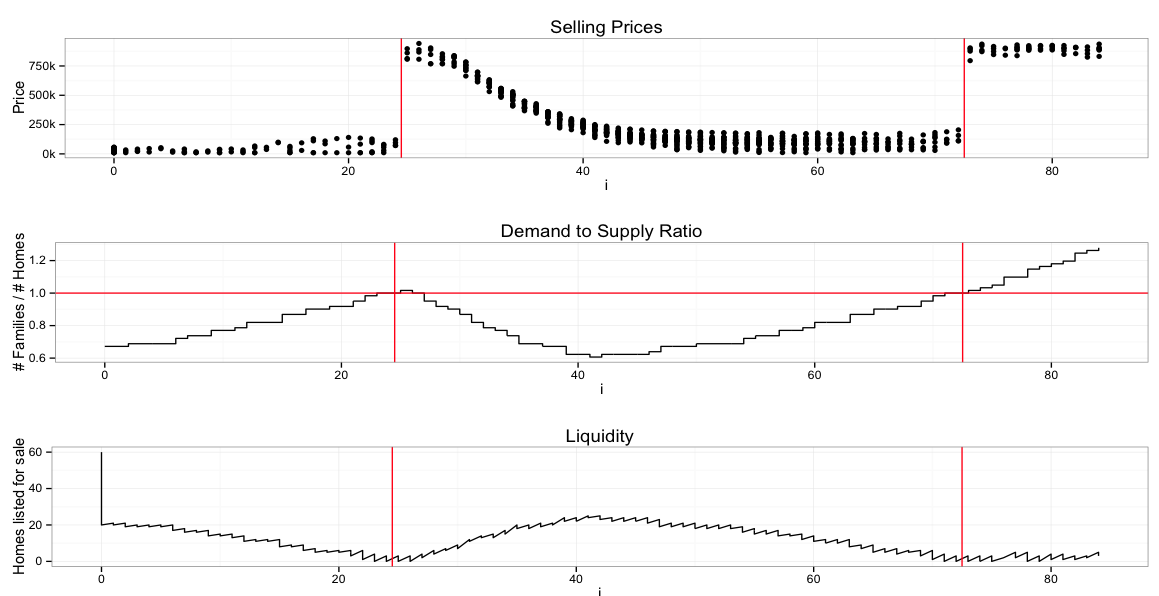
Let's see that plot again, repeated from up above.
The x axis is time, let's say months since start. The top chart shows one dot for every home that gets sold on the open market during the month. The red line corresponds to the 1.0 crossover point of the Demand to Supply Ratio (DSR) - the number of people wanting a home vs the number of homes available.
The second plot shows DSR directly. That is, when DSR transitions from <1.0 to >1.0, we draw a vertical red line on all three plots. For clarity there's also a horizontal line at 1.0 on the second plot.
The third plot, liquidity, shows the number of simulated homes on the market (but not yet sold) at any given moment. "On the market" means someone has decided they're willing to sell, but the price is still being bid up, or nobody has made a good enough offer yet. (Like I said, this part of the simulator was really hard to get right. In the source it just looks like a few lines of code, but you should see how many lines of code had to die to produce those few. Pricing wise, it turns out to be quite essential that you (mostly) can't buy a house which isn't on the market, and that bidding doesn't always complete instantaneously.)
So, what's the deal with that transition at DSR=1.0?
To answer that question, we have to talk about the rational price to pay for a house. One flaw in this simulation is that our simulated agents are indeed rational: they will pay whatever it takes as long as they can still make net profit. Real people aren't like that. If a house sold for $500k last month, and you're asking $1.2 million today, they will often refuse to pay that price, just out of spite, even though the whole market has moved and there are no more $500k houses. (You could argue that it's rational to wait and see if the market drops back down. Okay, fine. I had enough trouble simulating the present. Simulating my agents' unrealistic opinions of what my simulator was going to do next seemed kinda unwieldy.)
Another convenient aspect of Silicon Valley is that almost all our agents are engineers, who are a) so numerous and b) so rich that they outnumber and overwhelm almost all other participants in the market. You can find lots of news articles about how service industry workers have insane commutes because they're completely priced out of our region of interest.
(Actually there are also a lot of long-term residents in the area who simply refuse to move out and, while complaining about the obnoxious techie infestation, now see their home as an amazing investment vehicle that keeps going up each year by economy-beating percentages. In our simulator, we can ignore these people because they're effectively not participating in the market.)
To make a long story short, our agents assume that if they can increase their income by X dollars by moving to Silicon Valley vs living elsewhere, then it is okay to pay mortgage costs up to R*X (where R is between 0 and 100%) in order to land that high-paying job. We then subtract some amount for the pain and suffering and lost work hours of the daily commute, proportionally to the length of the commute.
As a result of all this, housing near big employers is more expensive than housing farther away. Good.
But the bidding process depends on whether DSR is less than one (fewer SWEs than houses) or more than one (more SWEs than houses). When it's less than one, people bid based on, for lack of a better word, the "value" of the land and the home. People won't overpay for a home if they can buy another one down the street for less. So prices move, slowly and smoothly, as demand changes slowly and smoothly. There's also some random variation based on luck, like occasional employer-related events (layoffs, etc). Market liquidity is pretty high: there are homes on the market that are ready to buy, if someone will pay the right price. It's a buyer's market.
Now let's look at DSR > 1.0, when (inelastic) demand exceeds supply. Under those conditions, there are a lot of people who need to move in, as soon as possible, to start profiting from their huge wages. But they can't: there aren't enough homes. So they get desperate. Every month they don't have a house, they forfeit at least (1-R)*X in net worth, and that makes them very angry, so they move fast. Liquidity goes essentially to zero. People pay more than the asking price. Bidding wars. Don't stop and think before you make an offer: someone else will buy it first, at a premium. It's a seller's market.
When this happens, prices settle at, basically, R*X. (Okay, R*X is the mortgage payment, so convert the annuity back to a selling price. The simulator also throws in some variably sized down payments depending on the net worth you've acquired through employment and previous real estate flipping. SWEs gonna SWE.)
Why R*X? Because in our simulator - which isn't too unlike reality - most of our engineers make roughly the same amount of income. I mean, we all know there's some variation, but it's not that much; certainly less than an order of magnitude, right? And while there are a few very overpaid and very underpaid people, the majority will be closer to the median income. (Note that this is quite different from other housing markets, where there are many kinds of jobs, the income distribution is much wider, and most people's price sensitivity is much greater.)
So as a simplification, we can assume R and X are the same for "all" our engineers. That means they simply cannot, no matter how much they try, pay more than R*X for a home. On the other hand, it is completely rational to pay all the way up to R*X. And demand exceeds supply. So they if they don't pay R*X, someone else will, and prices peak at that level.
When DSR dips back below 1.0: liquidity goes up and prices go back down. Interestingly, the simulated prices drop a lot slower than they shot up in the first place. One reason is that most people are not as desperate to sell as they were to buy. On the other hand, the people who do decide to sell might have a popular location, so people who were forced to buy before - any home at any price - might still bid up that property to improve their commute. The result is increasing price variability as people sell off not-so-great locations in exchange for still-rare great locations.
What does all this mean?
First of all, unlike healthier markets (say, New York City) where an increase in demand translates to higher prices, and demand can increase or decrease smoothly, and you can improve a property to increase its resale price, Silicon Valley is special. It has these three unusual characteristics:
- Demand is strictly greater than supply
- Most buyers share a similar upper limit on how much they can pay
- Other than that limit, buyers are highly price insensitive
That means, for example, that improving your home is unlikely to increase its resale value. People are already paying as much as they can. Hence the phenomenon of run-down homes worth $1.5 million in ugly neighbourhoods with no services, no culture, and no public transit, where that money could buy you a huge mansion elsewhere, or a nice condo in an interesting neighbourhood of a big city.
It means raising engineer salary to match the higher cost of living ("cost of living adjustment") is pointless: it translates directly to higher housing prices (X goes up for everyone, so R*X goes up proportionally), which eats the benefit.
Of course, salaries do continue to rise in Silicon Valley, mostly due to continually increasing competition for employees - after all, there's no more housing so it's hard to import more of them - which is why we continue to see a rise in property values at all. But we should expect it to be proportional to wages and stock grants, not housing value or the demand/supply ratio.
In turn, this means that a slight increase in housing supply should have effectively no impact on housing prices. (This is unusual.) As long as demand exceeds supply, engineers will continue to max out the prices.
As a result though, the market price provides little indication of how much more supply is needed. If DSR > 1.0, this simulation suggests that prices will remain about flat (ignoring wage increases), regardless of changes in the housing supply. This makes it hard to decide how much housing to build. Where the market is more healthy, you can see prices drop a bit (or rise slower) when new housing comes on the market, and you can extrapolate to see how much more housing is appropriate.
At this point we can assume "much more" housing is needed. But how much? Are we at DSR=2.5 or DSR=1.001? If the latter, a small amount of added housing could drop us down to DSR=0.999, and then the market dynamics would change discontinuously. According to the simulation - which, recall, we can't necessarily trust - the prices would drop slowly, but they would still drop, by a lot. It would pop the bubble. And unlike my simulation, where all the engineers are rational, popping the bubble could cause all kinds of market panic and adjacent effects, way beyond my area of expertise.
In turn, what this means is that the NIMBYs are not all crazy. If you try to improve your home, the neighbourhood, or the region, you will not improve the property values, so don't waste your money (or municipal funds); the property values are already at maximum. But if you build more housing, you run the risk of putting DSR below 1.0 and sending property values into free fall, as they return to "normal" "healthy" market conditions.
Of course, it would be best globally if we could get the market back to normal. Big tech companies could hire more people. Service industry workers could live closer to work, enjoy better lives, and be less grumpy. With more market liquidity, engineers could buy a home they want, closer to work, instead of just whatever was available. That means they could switch employers more easily. People would spend money to improve their property and their neighbourhood, thus improving the resale value and making life more enjoyable for themselves and the next buyer.
But global optimization isn't what individuals do. They do local optimization. And for NIMBYs, that popping bubble could be a legitimate personal financial disaster. Moreover, the NIMBYs are the people who get to vote on zoning, construction rules, and improvement projects. What do you think they'll vote for? As little housing as possible, obviously. It's just common sense.
I would love to be able to give advice on what to do. It's most certainly a housing bubble. All bubbles pop eventually. Ideally you want to pop the bubble gently. But what does that mean? I don't know; an asset that deteriorates to 30% of its current price, slowly, leaves the owner just as poor as if it happened fast. And I don't know if it's possible to hold prices up to, say, 70% instead of 30%, because of that pesky discontinuity at DSR=1.0. The prices are either hyperinflated, or they aren't, and there seems to be no middle.
Uh, assuming my simulator isn't broken.
That's my hypothesis.
19 Sep 04:41

Click here to go see the bonus panel!
Today's News:
Saturday Morning Breakfast Cereal - Modern Epic
by tech@thehiveworks.com
Click here to go see the bonus panel!
Hovertext:
It occurred to me after drawing this that's it's basically a summary of The End of History.
Today's News:
Roslyn , Tindalostalbot likes this
05 Sep 23:58
Clamdy Canes, clam-flavored candy canes
by Rusty Blazenhoff

ONE SHELL OF A CANDY From the personified clam on the package to the clam taste, you’ll wonder how Christmas existed without Clamdy Canes. They’re a candy clamity! We all celebrate holidays in our own way and if your holiday tastes like the sea, this is for you. Add a little sand for extra clam realness. If anyone complains, just tell them to clam up. Each candy cane is 5-1/4" tall with gray and white stripes.
A box of six is available for $4.95.
01 Sep 02:27
Culture Shock in Silicon Valley
by Elisabeth Handler

Recently, City Hall hosted a group of Swiss college students participating in an“International Program Experience” – a six-week work/live immersion into the US tech world. IPE brings students and a professor to the US for six weeks, and in addition to learning about the local area, teams of students engage in pro bono work on research/
development projects with local companies. This is part of the students’ third and final year studies at Lucerne School of Information Technology in Switzerland.
Two of this year’s students, Ursulina Kolbener and Matthias Perrolaz, posted their impressions of the difference between the US and European ways of doing things. The post is in German, so we will summarize some of their observations. We found this an interesting lesson in cross-cultural communication!
- The gaps are enormous — America has homeless people, and also provides food in enormous portions, in restaurants and for sale in grocery stores.
- Courtesy on American freeways allows merging cars and last-minute lane-changes, but also allows people to cancel business meetings at the last minute.
- American are friendly when you meet, but might not remember you the next day.
- Where the Swiss concentrate on details and delivering a perfect product with modesty, Americans lead with their strongest pitch and focus on the positives, not the challenges.
Their conclusion? The diversity of San Jose contrasted with their initial perception of Silicon Valley as solid nerd country. But in fact, the authors did see a unifying principle: Be the next unicorn!
We look forward to what their projects bring to the participating companies they will be working with – Twitter, Swisscom, Varian, Valora and some early-stage start-ups.
The post Culture Shock in Silicon Valley appeared first on City of San Jose.
30 Aug 15:53
 "Apologies to any contributors who aren't employees of Palantir, but to those who are, please find jobs elsewhere and stop helping Palantir do horrible things"
Major Open Source Project Revokes Access to Companies That Work with ICE
by jwz
Mahmoud@stephen, e.g., https://github.com/palantir/blueprint/issues/2870
"Apologies to any contributors who aren't employees of Palantir, but to those who are, please find jobs elsewhere and stop helping Palantir do horrible things"On Tuesday, the developers behind a widely used open source code-management software called Lerna modified the terms and conditions of its use to prohibit any organization that collaborates with ICE from using the software. Among the companies and organizations that were specifically banned were Palantir, Microsoft, Amazon, Northeastern University, Motorola, Dell, UPS, and Johns Hopkins University. [...]"Recently, it has come to my attention that many of these companies which are being paid millions of dollars by ICE are also using some of the open source software that I helped build," Jamie Kyle, an open source developer and one of the lead programmers on the Lerna project, wrote in a statement. "It's not news to me that people can use open source for evil, that's part of the whole deal. But it's really hard for me to sit back and ignore what these companies are doing with my code." [...]
Before he changed the license, Kyle left a comment on Palantir's Github asking the company to stop using the software. "Apologies to any contributors who aren't employees of Palantir, but to those who are, please find jobs elsewhere and stop helping Palantir do horrible things," Kyle wrote last week, linking to an article in The Intercept about the company's collaboration with ICE. "Also, stop using my tools. I don't support you and I don't want my work to benefit your awful company." [...]
After Kyle discussed his concerns with some of the other lead developers on the Lerna project, they assented to a change to the Lerna license that would effectively bar any organization that collaborates with ICE from continuing to use the software. This led to some developers calling the change illegitimate and lamenting that it technically meant the project was no longer open source. [...]
"I've been around the block enough to know how every company affected is going to respond," Kyle told me. "They're not going to try and find a loophole. I kinda hope they do try to keep using my tools though -- I'm really excited about the idea of actually getting to take Microsoft, Palantir or Amazon to court."
As for the hate he has received online about how open source projects shouldn't be politicized, Kyle said this misses the point.
"I believe that all technology is political, especially open source," he told me. "I believe that the technology industry should have a code of ethics like science or medicine. Working with ICE in any capacity is accepting money in exchange for morality. I am under no obligation to have a rigid code of ethics allowing everyone to use my open source software when the people using it follow no such code of ethics."
Previously, previously, previously, previously, previously, previously, previously.
Taylor Swift likes this
29 Aug 21:13
Dunkin' Donuts comes to San Jose
by Joshua Santos
Mahmoudlol big things happening
The famous east-coast doughnut chain has finally made its way to San Jose. A former Arby's at 5519 Snell Ave has become the first Dunkin' Donuts in Silicon Valley. I'm sure transplants will appreciate the location, and they might nab a few new converts as well (sorry, my personal favorite is still Psycho Donuts).
This is the first of several new locations. Next up will be a second San Jose shop on Winchester Boulevard towards the end of the year or early 2019. Franchise owners are also scouting Milpitas, Sunnyvale, and other Silicon Valley cities for further expansion.
The San Jose Dunkin' Donuts is now open everyday from 5am to 10pm.
Source: SVBJ


This is the first of several new locations. Next up will be a second San Jose shop on Winchester Boulevard towards the end of the year or early 2019. Franchise owners are also scouting Milpitas, Sunnyvale, and other Silicon Valley cities for further expansion.
The San Jose Dunkin' Donuts is now open everyday from 5am to 10pm.
Source: SVBJ


22 Aug 04:33


Prenda Lawyer Pleads Guilty in Pirate Bay Honeypot Case
by Ernesto
 Over the past several years, so-called copyright trolls have been accused of various dubious schemes and actions, with one group as the frontrunner.
The now-defunct Prenda Law grabbed dozens of headlines, mostly surrounding negative court rulings over identity theft, misrepresentation and even deception.
Most controversial was the shocking revelation that Prenda uploaded their own torrents to The Pirate Bay, creating a honeypot for the people they later sued over pirated downloads.
The accusation was first published here on TorrentFreak. While some disregarded it as a wild conspiracy theory, the US Department of Justice took it rather seriously. These and other allegations ultimately resulted in a criminal indictment, which was filed in 2016.
The US Government accused two of the leading Prenda lawyers of various crimes, including money laundering, perjury, mail and wire fraud. This week one of the defendants, Paul Hansmeier, pleaded guilty to two of the counts.
Hansmeier signed a plea agreement admitting that he is guilty of conspiracy to commit mail fraud and wire fraud, as well as conspiracy to commit money laundering.
The plea agreement comes with a statement of facts which includes a description of the Pirate Bay honeypot scheme. In addition, it describes how Hansmeier and his colleague John Steele generated millions of dollars by threatening BitTorrent users who allegedly downloaded pirated porn videos.
“Beginning no later than in or about April 2011, HANSMEIER and Steele caused P.H. to upload their clients’ pornographic movies to BitTorrent file-sharing websites, including a website named the Pirate Bay in order to entice people to download the movies and make it easier to catch those who attempted to obtain the movies.
“As defendants knew, the BitTorrent websites to which they uploaded their clients’ movies were specifically designed to aid copyright infringement by allowing users to share files, including movies, without paying any fees to the copyright holders,” the agreement reads.
From the plea agreement
After extracting IP-addresses of account holders who allegedly shared the files Prenda created and uploaded, they asked courts for subpoenas to obtain the personal info of their targets from ISPs. This contact information was then used to coerce victims to pay settlements of thousands of dollars.
Prenda Law went to great lengths to hide its direct involvement in the uploading of the material as well as its personal stake in the lawsuits and settlements, according to the plea agreement.
Both attorneys obscured their involvement by creating several companies, which were then used to file lawsuits against alleged pirates. In addition to running a honeypot, Prenda also began creating their own porn movies, which were then shared on file-sharing sites as bait.
“Shortly after filming the movies, HANSMEIER instructed P.H. to upload the movies to file-sharing websites’such as the Pirate Bay in order to catch, and filed lawsuits against, people who attempted to download the movies,” the plea agreement reads.
Hansmeiers’ guilty plea applies to a count of wire fraud and mail fraud, as well as a count of money laundering. Both come with a potential jail sentence of 20 years as well as hundreds of thousands of criminal fines.
Previously, the Prenda attorney filed a motion to dismiss, which was denied. This decision is currently under appeal and the present plea agreement is conditional, meaning that Hansmeier has the right to withdraw it if he wins that.
This please agreement comes after fellow Prenda attorney John Steele agreed to a similar deal last year.
It’s rather unique that information provided by The Pirate Bay team is being used to help build a criminal case in the US. And with both lawyers having personally signed a statement of facts that confirm the honeypot scheme, there can be little doubt that Pirate Bay’s allegations were indeed true.
Finally, there is also some good news for the victims of the Prenda copyright-trolling scheme. The plea agreement specifically states that those who were hurt by the scheme are entitled to get the maximum restitution possible.
“Defendant understands and agrees that the Mandatory Restitution Act […] applies and that the Court is required to order the defendant to pay the maximum restitution to the victims of his crimes as provided by law,” it reads.
—
A copy of Hansmeier’s plea agreement is available here (pdf).
Source: TF, for the latest info on copyright, file-sharing, torrent sites and more. We also have VPN reviews, discounts, offers and coupons.
20 Aug 02:05
Life After Death on Wikipedia
by slaporte
Mahmoudreally cool. also livestreamed: https://www.youtube.com/watch?v=lvgzS0fWtJU&index=2&list=PLsuhXm2zs07JuSfrNentA3DxAbaFO7ay2&t=0s
40-50 hours of work
17 Aug 06:27
Story Circle, Three Act Structure, and more. Writing for TV in UNDER A MINUTE!
by Phil Matarese
Mahmoudsome good points here
Animals on HBO Fridays at 11:30pm
15 Aug 08:08
Dr. Pat | Adult Swim
by Adult Swim
Mahmouddada goin strong 2k18
Created by Sam Hochman
Watch more on the Adult Swim livestreams: http://asw.im/f1Dag
SUBSCRIBE: http://bit.ly/AdultSwimSubscribe
About Adult Swim:
Adult Swim is your late-night home for animation and live-action comedy. Enjoy some of your favorite shows, including Robot Chicken, Venture Bros., Tim and Eric, Aqua Teen, Childrens Hospital, Delocated, Metalocalypse, Squidbillies, and more. Watch some playlists. Fast forward, rewind, pause. It's all here. And remember to visit AdultSwim.com for all your full episode needs. We know you wouldn't forget, but it never hurts to make sure.
Connect with Adult Swim Online:
Visit Adult Swim WEBSITE: http://bit.ly/ASWebsite
Like Adult Swim on FACEBOOK: http://bit.ly/ASFacebook
Follow Adult Swim on TWITTER: http://bit.ly/ASTweet
http://instagram.com/adultswim
Dr. Pat | Adult Swim
http://www.youtube.com/user/adultswim
Watch more on the Adult Swim livestreams: http://asw.im/f1Dag
SUBSCRIBE: http://bit.ly/AdultSwimSubscribe
About Adult Swim:
Adult Swim is your late-night home for animation and live-action comedy. Enjoy some of your favorite shows, including Robot Chicken, Venture Bros., Tim and Eric, Aqua Teen, Childrens Hospital, Delocated, Metalocalypse, Squidbillies, and more. Watch some playlists. Fast forward, rewind, pause. It's all here. And remember to visit AdultSwim.com for all your full episode needs. We know you wouldn't forget, but it never hurts to make sure.
Connect with Adult Swim Online:
Visit Adult Swim WEBSITE: http://bit.ly/ASWebsite
Like Adult Swim on FACEBOOK: http://bit.ly/ASFacebook
Follow Adult Swim on TWITTER: http://bit.ly/ASTweet
http://instagram.com/adultswim
Dr. Pat | Adult Swim
http://www.youtube.com/user/adultswim
15 Aug 03:13
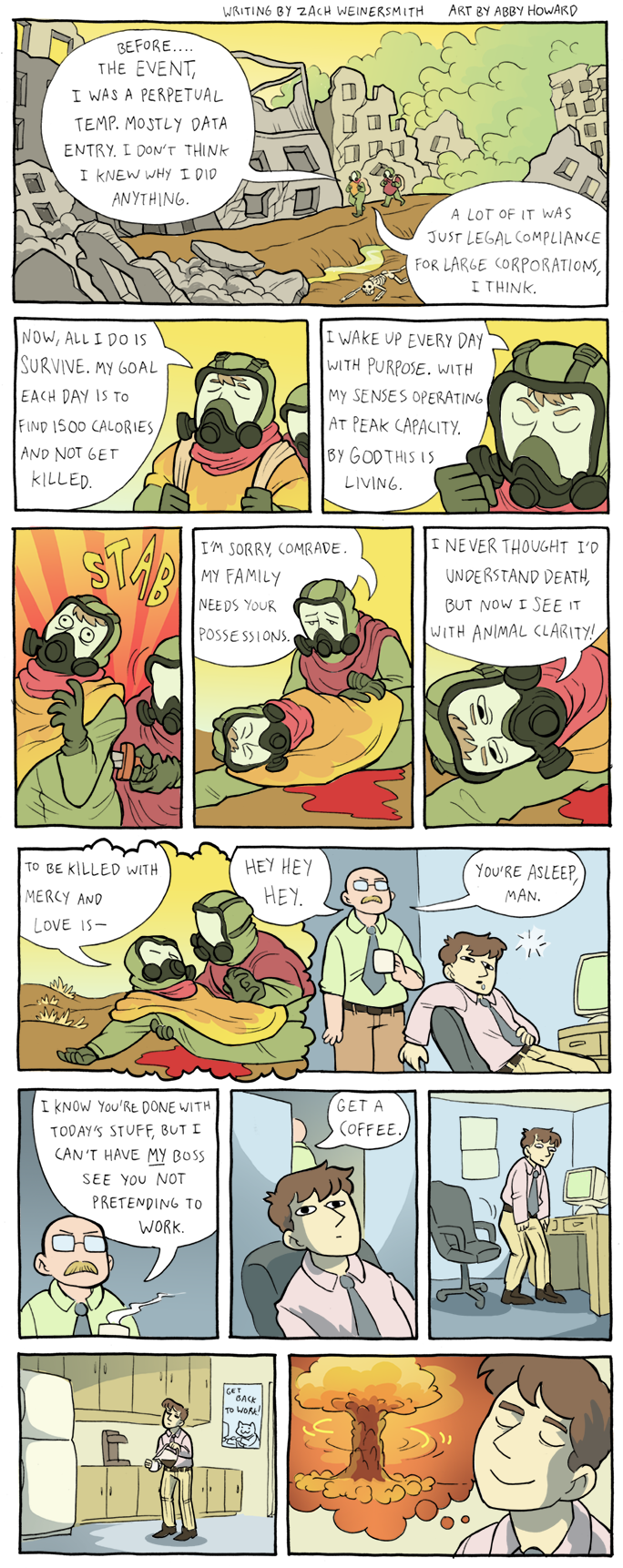
Click here to go see the bonus panel!
Today's News:
Dinosaur Empire 2 is out!
Saturday Morning Breakfast Cereal - The Event
by tech@thehiveworks.com
Mahmoudthis is the teal reason the fallout series is as popular as it is
Click here to go see the bonus panel!
Hovertext:
Why are you so favored as to get a comic drawn by Abby Howard? She has a new book out! See the blog below the comic.
Today's News:
Dinosaur Empire 2 is out!
Gustavo Peres, Roslyn and 5 others like this

11 Aug 08:44
How Turkey's Currency Crisis Came To Pass
by b
Updated below --- President Erdogan of Turkey often asserts that 'foreign powers' (meaning the U.S.) want to bring him down. He says that the 'interest lobby' (meaning (Jewish) bankers), wants to damage Turkey. He is somewhat right on both points....
09 Aug 05:42
How Zildjian Cymbals Were Created by an Alchemist in the Ottoman Empire, Circa 1618
by Josh Jones
Mahmouddefinitely one of my favorite stories, some issues with the video's retelling of it. for one, it wasn't _all_ about the gold, just general transmutation.

When it comes to musical instruments, there are brands and then there are legacies—names so unquestionably indicative of quality and craftsmanship that players swear by them for life. Martin Guitars, for example, have inspired this kind of loyalty among musicians like Willie Nelson and Johnny Cash. Martin's story—dating back to 1833—inspires book-length histories and documentaries. In the drum world, the longest-lived and most-storied brand would have to be Zildjian, the famed cymbal maker known the world over, beloved by the best drummers in the business.
But Zildjian is far older than Martin Guitars, or any other contemporary instrument manufacturer. Indeed, the company may be the world’s oldest existing manufacturer of almost any product. Though incorporated in the U.S. in 1929, Zildjian was actually founded 400 years ago in Constantinople by Armenian metalworker Avedis, who in 1622 “melted a top-secret combination of metals,” writes Smithsonian, “to create the perfect cymbal.” The short film above recreates in dramatic fashion the alchemy of Avedis’ discovery and the global history of Zildjian.
The brief Smithsonian history can seem a little sensational and may not be entirely accurate at points. Lara Pellegrinelli, writing at The New York Times, dates Avedis’ “secret casting process” to four years earlier, 1618. (The company itself dates its founding to 1623.) Pellegrinelli notes that Avedis' “new bronze alloy” pleased the Sultan, Osman II, who “granted the young artisan permission to make instruments for the court and gave him the Armenian surname Zildjian (meaning ‘son of cymbal maker’). The family set up shop in the seaside neighborhood of Samatya in Constantinople, where metal arrived on camel caravans and donkeys powered primitive machines.”
Zildjian cymbals were admired by Mozart and his contemporaries, and “what came to be known simply as 'Turkish cymbals’ were assimilated by European orchestras and, in the first half of the 19th century, into new military and wind band styles” of the East and West. In 1851, Zildjian cymbals set sail on a 25-foot schooner bearing the family name, bound for London’s Great Exhibition. Kerope Zildjian introduced the K Zildjian line of cymbals in 1865, still in production and widely in use today. (The old K's can still be heard in several major symphony orchestras.)
As the jazz scene took off in the 1920’s, many music shops exclusively carried Zildjians, and drummers like Gene Krupa helped refine and develop the famous instruments even further, making them thinner, more responsive, and able to cut through the big band sound. The story of Zildjian is the story of Western music and its unmistakable Eastern influence, an incredible history four centuries in the making, full of intrigue and brilliant innovation, and containing at its heart an alchemical mystery, a secret recipe still closely guarded by the Zildjian family.
Related Content:
Visit an Online Collection of 61,761 Musical Instruments from Across the World
Watch a Musician Improvise on a 500-Year-Old Music Instrument, The Carillon
Josh Jones is a writer and musician based in Durham, NC. Follow him at @jdmagness
How Zildjian Cymbals Were Created by an Alchemist in the Ottoman Empire, Circa 1618 is a post from: Open Culture. Follow us on Facebook, Twitter, and Google Plus, or get our Daily Email. And don't miss our big collections of Free Online Courses, Free Online Movies, Free eBooks, Free Audio Books, Free Foreign Language Lessons, and MOOCs.
09 Aug 01:52
Zuckerbubble expands by $10M/year.
by jwz
Mahmoudjeeeez
Your security is very important to us. My. My security is very important to us. To me.
Facebook Inc. spent $7.33 million last year protecting its chief executive officer at his homes and during his tour across the U.S. Last week, the social-media giant said it would provide an additional $10 million a year for him to spend on personal security.The cost for this year far exceeds what other firms will spend for their bosses and probably surpass the average annual compensation for S&P 500 CEOs.
Previously, previously, previously, previously, previously, previously, previously, previously, previously, previously.
05 Aug 23:20
mapsontheweb:How America Uses It’s Land.
MahmoudI did not realize there was this much timberland. The cows are less of a surprise, but still yeah, a lot.

04 Aug 09:01
Woman Actually Licks the Chef's Fingers
by Just For Laughs Gags
Mahmoudright hat, and you can get away with anything
Wow, this woman must really love the food. Why else would she willingly put the chef's fingers in her mouth? WATCH FULL EPISODES: https://www.facebook.com/jflgagsshow/
SUBSCRIBE: http://bit.ly/SubscribeJFL
Watch our latest pranks! https://www.youtube.com/playlist?list=UUpsSadsgX_Qk9i6i_bJoUwQ
Just for Laughs Gags Across the Internet:
Visit our store: http://bit.ly/1OJuRNO
JFL Comedy: https://youtube.com/watch?v=YEXmu89_E8o&list=PLoXkGkpREHNCcJbQVdOoKfttGJu0rqnIS
Twitter: https://twitter.com/jflgags
Facebook: https://facebook.com/jflgags
Instagram: https://instagram.com/justforlaughs/
Watch more JFL Gags!
Naughty Holiday Pranks: https://www.youtube.com/playlist?list=PLCL1mm9mxsALwD5RgNWdjXlC0OhHdRTvw
Latest Uploads: https://www.youtube.com/playlist?list=UUpsSadsgX_Qk9i6i_bJoUwQ
Best of JFL Gags Compilations: https://www.youtube.com/playlist?list=PLEB4EBCDDCF605225
Most Crazy Complex Pranks: https://www.youtube.com/playlist?list=PLCL1mm9mxsALbQK8D49X3orD95ujbK1dg
Girls in Bikinis Pranks: https://www.youtube.com/playlist?list=PLCL1mm9mxsALC0wVu_EPLGAKTI7ErlbAY
Filmed in Montreal, Quebec
Welcome to the world-famous Just for Laughs Gags channel, where we pull public pranks on unsuspecting Montreal residents and tourists.
Subscribe to our channel ▶▶ http://bit.ly/SubscribeJFL ◀◀ and stay up to date on our daily pranks!
SUBSCRIBE: http://bit.ly/SubscribeJFL
Watch our latest pranks! https://www.youtube.com/playlist?list=UUpsSadsgX_Qk9i6i_bJoUwQ
Just for Laughs Gags Across the Internet:
Visit our store: http://bit.ly/1OJuRNO
JFL Comedy: https://youtube.com/watch?v=YEXmu89_E8o&list=PLoXkGkpREHNCcJbQVdOoKfttGJu0rqnIS
Twitter: https://twitter.com/jflgags
Facebook: https://facebook.com/jflgags
Instagram: https://instagram.com/justforlaughs/
Watch more JFL Gags!
Naughty Holiday Pranks: https://www.youtube.com/playlist?list=PLCL1mm9mxsALwD5RgNWdjXlC0OhHdRTvw
Latest Uploads: https://www.youtube.com/playlist?list=UUpsSadsgX_Qk9i6i_bJoUwQ
Best of JFL Gags Compilations: https://www.youtube.com/playlist?list=PLEB4EBCDDCF605225
Most Crazy Complex Pranks: https://www.youtube.com/playlist?list=PLCL1mm9mxsALbQK8D49X3orD95ujbK1dg
Girls in Bikinis Pranks: https://www.youtube.com/playlist?list=PLCL1mm9mxsALC0wVu_EPLGAKTI7ErlbAY
Filmed in Montreal, Quebec
Welcome to the world-famous Just for Laughs Gags channel, where we pull public pranks on unsuspecting Montreal residents and tourists.
Subscribe to our channel ▶▶ http://bit.ly/SubscribeJFL ◀◀ and stay up to date on our daily pranks!
04 Aug 07:04
Value Pack: Home Improvement | adult swim
by Adult Swim
Created by Lord Spew
More Things: http://asw.im/1kQF3y
SUBSCRIBE: http://bit.ly/AdultSwimSubscribe
About Adult Swim:
Adult Swim is your late-night home for animation and live-action comedy. Enjoy some of your favorite shows, including Robot Chicken, Venture Bros., Tim and Eric, Aqua Teen, Childrens Hospital, Delocated, Metalocalypse, Squidbillies, and more. Watch some playlists. Fast forward, rewind, pause. It's all here. And remember to visit http://AdultSwim.com for all your full episode needs. We know you wouldn't forget, but it never hurts to make sure.
Connect with Adult Swim Online:
Visit Adult Swim WEBSITE: http://bit.ly/ASWebsite
Like Adult Swim on FACEBOOK: http://bit.ly/ASFacebook
Follow Adult Swim on TWITTER: http://bit.ly/ASTweet
http://instagram.com/adultswim
Value Pack: Home Improvement | adult swim
http://www.youtube.com/user/adultswim
More Things: http://asw.im/1kQF3y
SUBSCRIBE: http://bit.ly/AdultSwimSubscribe
About Adult Swim:
Adult Swim is your late-night home for animation and live-action comedy. Enjoy some of your favorite shows, including Robot Chicken, Venture Bros., Tim and Eric, Aqua Teen, Childrens Hospital, Delocated, Metalocalypse, Squidbillies, and more. Watch some playlists. Fast forward, rewind, pause. It's all here. And remember to visit http://AdultSwim.com for all your full episode needs. We know you wouldn't forget, but it never hurts to make sure.
Connect with Adult Swim Online:
Visit Adult Swim WEBSITE: http://bit.ly/ASWebsite
Like Adult Swim on FACEBOOK: http://bit.ly/ASFacebook
Follow Adult Swim on TWITTER: http://bit.ly/ASTweet
http://instagram.com/adultswim
Value Pack: Home Improvement | adult swim
http://www.youtube.com/user/adultswim
29 Jul 05:18
DC statehood gains support
by Sam Smith
Mahmoudonly 27 democratic senators care about basic political survival of their party
There are now 27 Democratic senators who support DC statehood, a movement this journal helped start 48 years ago
18 Jul 05:22
Big Bag in the French Concession
by stylites_admin
Mahmoudpower moves

Here is one of Pawnstar‘s regular clients outside of our shop with a rather massive, custom-made, bag.
14 Jul 04:10
More millennials are moving to San Jose than SF
by Joshua Santos
Based on 2016 immigration and emigration data, it looks like more San Jose is getting more traction among millennials. This generation is currently defined as those aged 22 to 37. In 2016, San Jose gained 5,496 millennials (this is net, immigration - emigration). On top of the list for net migration was Seattle, followed by Columbia and the only other Northern California city in the top ten, Sacramento.
Source: SVBJ


Source: SVBJ
