Shared posts

01 Mar 19:03

The Ukraine war shows the limits of US power

by Jonathan Guyer
A police officer stands in front of a large American flag as the sun rises in Jersey City, New Jersey, on September 11, 2021. | Gary Hershorn/Getty Images

America is still a superpower. But in the face of Russia, the US is not almighty.

Russia has violated Ukraine’s sovereignty and international law. The US response has been economic: sanctions against Russia that are the largest ever and yet simultaneously unlikely to alter the shape of Russian President Vladimir Putin’s aggression.

So, how should we think about the US as a superpower in 2022?

It’s too early to draw broad conclusions about what war in Eastern Europe means for the future of America in the world. But there are enough clues to suggest that America’s power has limits, and indeed it always has. With the Soviet Union’s demise, the United States achieved global dominance for a brief unipolar moment. Then President George W. Bush squandered it through destructive (and expensive) misguided regime-change wars. Subsequent presidents gaslit the American public on progress in the Middle East in two conflicts that killed hundreds of thousands. Despite all those unforced errors, the United States remains a superpower, though the limits of non-military power have been exposed.

Thomas Pickering, who served as ambassador to Russia from 1993 to 1996, says that the “caricature” of America as a superpower has obscured the way most Americans think about how the world works.

As a career diplomat over four decades, Pickering witnessed America’s global position change from the Cold War to the breakup of the Soviet Union to the height of US supremacy at the turn of the millennium. “If your assumption is that a superpower can do anything, anywhere, anytime it wishes, without suffering the consequences of risk and uncertainty, then you misperceived the current world situation,” he told me.

A superpower is not infallible and omnipotent. The United States will not send in troops but has shipped hundreds of millions of dollars of weapons to Ukraine, shepherded an international coalition to institute wide-ranging economic sanctions, and encouraged tech companies and global organizations like FIFA and the Olympics to pursue the cultural isolation of Russia. And yet the United States, even with the world’s largest military and most robust economy, has not been able to induce Russia toward a different path. So, Putin continues to deploy his army toward Kyiv. And stopping that incursion does not appear to be something America has the power to change without risking nuclear war.

Superpowers need to pick their battles and engage in the same tough choices as any other country — especially when confronted with an adversary with nuclear capability, such as Russia. And rather than grasping the complexity of world affairs, many Americans have internalized the shibboleths that the US has never lost a war and that the US never compromises with enemies, especially during a conflict. Neither is true.

Both factors show that, as a country, the United States has failed to recognize its own constraints, some of which have long existed and are simply accentuated by Russian aggression.

How the unipolar moment ended

When the Cold War ended in the ’90s, the United States possessed unrivaled economic and military power. Scholar Francis Fukuyama claimed the “End of History” and former Secretary of State Madeleine Albright asserted the centrality of American exceptionalism in her coinage, “the indispensable nation.”

Some argue that that unipolar moment was overstated. “Look, the Americans suffered from hubris after the end of the Soviet Union,” said Joseph Nye, a Harvard professor who has written widely about American power. “The unipolar moment, I think, was always illusory.”

At the end of the Cold War, the US did continue to hold itself out as the guarantor of security. “The United States appointed itself as responsible for peace, security, and democracy in Europe,” Stephen Wertheim, a historian of US foreign policy at the Carnegie Endowment for International Peace, told me. In response to ethnic cleansing in Bosnia, the United States, through NATO, took military action against Serbia. The intervention was relatively limited, and the outcome of it was a successful projection of US might.

But that unilateral moment, real or imagined, was short-lived.

The terrorist attacks on September 11, 2001, were not what challenged that global supremacy, argues Wertheim. Rather, it was the 20 disastrous years of overreach in America’s response. The invasions of Iraq and Afghanistan exposed the limits of US power.

It could be said that Osama bin Laden understood something about Americans that they didn’t understand about themselves, namely that in reaction to heinous terror attacks America would overreact. With the invasion and occupation of two countries, the US would face two decades of blowback that tore at the country’s seams, that undermined democratic values through the war on terrorism at home and abroad. “Basically, with the Iraq invasion, we bite off more than we can chew, and we get a comeuppance,” said Nye.

The United States, mired in the Middle East and Afghanistan, continued to expand its role as global policeman through a network of US bases and military commitments that, counterintuitively, detracted from US power. It’s at this time that China began to rise as a counterbalancing force and Russia reemerged as a power in Europe.

“As the wars in Iraq and Afghanistan have obvious problems, we start to enter into a gradual period of decline in belief that the United States can reshape other societies,” Wertheim explained. “One problem is that this led us to make commitments to Ukraine. That means that we suffer a loss of prestige when we don’t make good those commitments.”

 Evan Vucci/AP
President Joe Biden speaks about the end of the war in Afghanistan from the White House on August 31, 2021.

Now that the US is caught in a potential face-off with a nuclear superpower, it is clear that perhaps the biggest failure of recent years has been the de-emphasis on arms control and the reduction of nuclear weapons worldwide. President Barack Obama, who in his early life was a staunch anti-nuclear activist, negotiated a new START Treaty in 2011, which curbs and monitors the US and Russia’s nuclear warheads. That’s now been extended to 2026, but more is needed. Over decades, Washington and Moscow allowed the arms control regime to decline, which culminated in President Donald Trump’s withdrawal from the important 1987 Intermediate-Range Nuclear Forces.

“Slowly, the structures that kept US-Russian military competition visible and predictable fell away,” said Heather Hurlburt, of the think tank New America. “At the same time, Beijing” — itself a nuclear power — “is building up its arsenal and making it very clear that it’s not interested in the US-Soviet arms control model.”

And other global crises, such as the pandemic, have exposed the inability of the US to lead as the indispensable nation.

The lesser-discussed dynamics that have undermined US power

Now the United States and Europe are waging an economic war against Russia. Underneath that, one can see America’s failure to imagine a post-oil economy or a globally urgent set of policies to address the climate crisis. Even as sanctions hobble Russia, the international market depends on Russian energy resources — with inevitable knock-on effects that damage everyone else.

The human rights rhetoric from American leaders has also deluded Americans. Most US presidents, with the exception of Trump, have spotlighted abuses worldwide. But they have not stopped the American way of doing hefty business with prominent abusers like Russia and China. Europe also got comfortable with this equation, as Maximilian Popp writes in Spiegel International. It’s a contradiction that has empowered authoritarians like Putin.

While the US has failed to act assertively on the global crises that it cannot avoid — climate and pandemic, to name only two — the diplomatic corps have also been hollowed out. Trump can be blamed for some of this disintegration but not all of it.

Europe has wondered whether the problem wasn’t only Trump but, at its core, America. This is especially the case after the chaotic withdrawal from Afghanistan last summer. “The Afghanistan thing got to a deeper worry that they have about American power,” said Jeremy Shapiro of the European Council on Foreign Relations. Though European leaders may be muted about this issue now, he told me that there are concerns about American competence because of polarization in Washington, “because the Republicans and Democrats are playing domestic politics with everything.”

US democracy and America’s capacity to promote human rights worldwide are connected, says Suzanne Nossel, the CEO of PEN America. “It’s now hit home at a much deeper level, that those two things are intertwined and that our democracy is seen as teetering and crumbling at the edges, that we cannot be an effective force for democracy globally,” she told me.

A country that has depended on its standing as an economic force and a democratic authority worldwide is at its weakest and most dysfunctional in half a century or more. Hurlburt calls it “self-inflicted decline.” The combined result is that the US is effectively not showing up.

It’s good that Biden has ruled out putting US troops into Russia’s new war in Europe, a potentially endless conflict for a country that took two decades to leave Afghanistan. That decision lays bare a reality that American foreign policy circles have too often ignored. As Hurlburt put it, “Gravity applies to us just like everybody else.”

01 Mar 12:27

The New York Times: Pfizer Shot Is Far Less Eff...

The New York Times: Pfizer Shot Is Far Less Effective in 5- to 11-Year-Olds Than in Older Kids, New Data Show

The New York Times: Pfizer Shot Is Far Less Effective in 5- to 11-Year-Olds Than in Older Kids, New Data Show.

Pfizer Shot Is Far Less Effective in 5- to 11-Year-Olds Than in Older Kids, New Data Show

01 Mar 12:25

Ukraine official confirms urgent request for Western satellite data

by Eric Berger
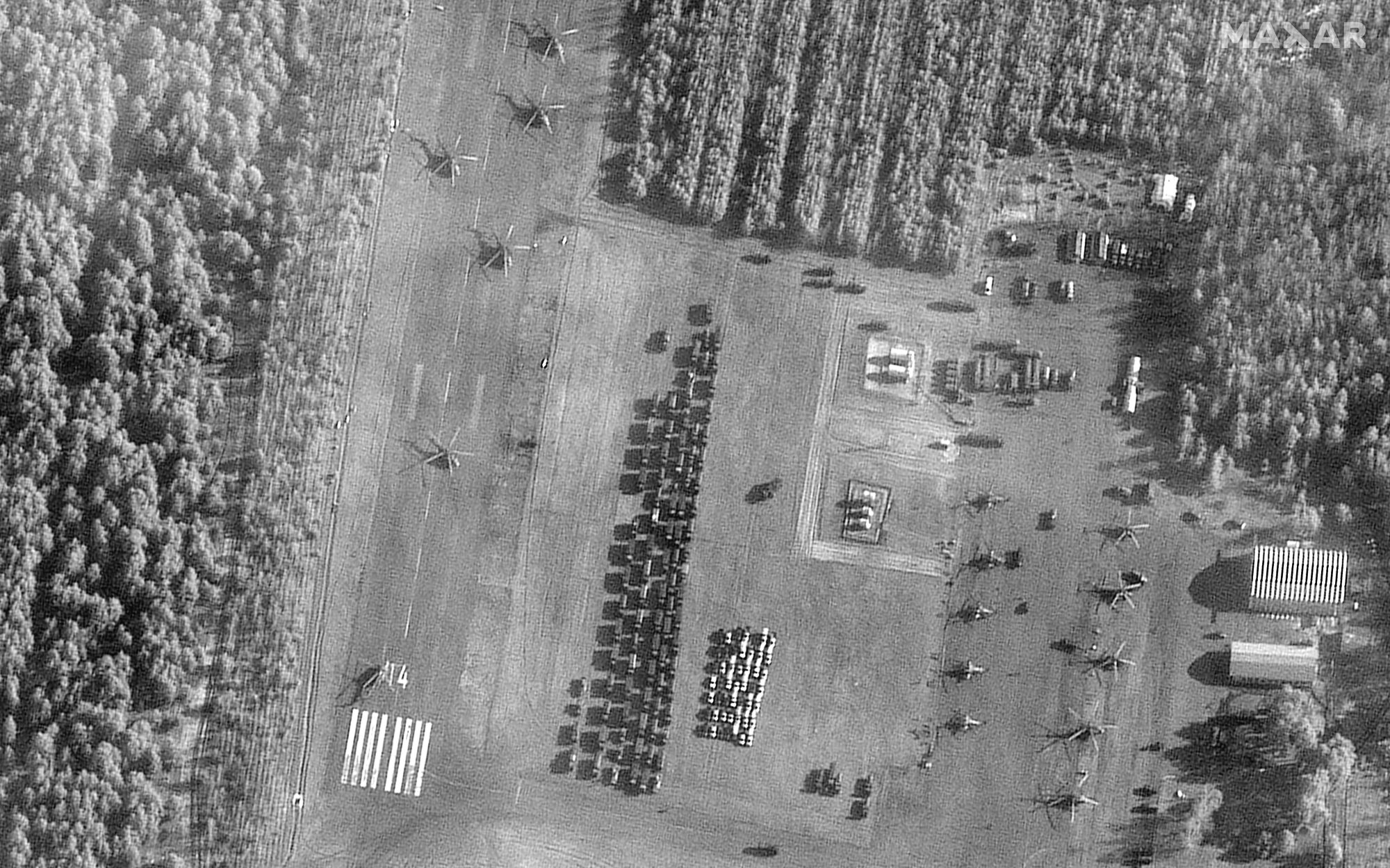
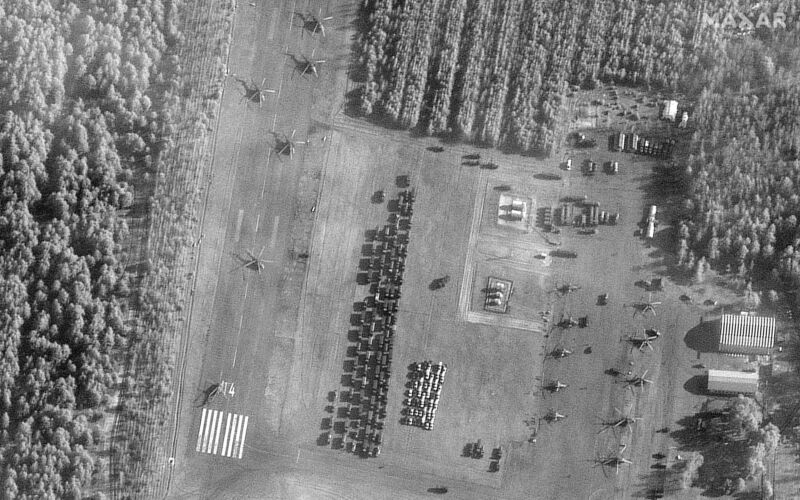
A Maxar satellite image shows the buildup of Russian vehicles and helicopers on an airfield in Belarus prior to the invasion of Ukraine.

Enlarge / A Maxar satellite image shows the buildup of Russian vehicles and helicopers on an airfield in Belarus prior to the invasion of Ukraine. (credit: Maxar Technologies)

Update, 10 am EST, 3/1/2022: On Tuesday, Mykhailo Fedorov, the vice prime minister and minister of digital transformation of Ukraine, confirmed that his country is seeking the cooperation of commercial satellite operators. The goal is to obtain data, particularly from synthetic aperture radar, about the movement of Russian vehicles so that Ukrainian forces can respond.

"We badly need the opportunity to watch the movement of Russian troops, especially at night when our technologies are blind in fact! SAR satellite data is important to understanding Russian troop and vehicles movements at night considering that clouds cover about 80 percent of Ukraine during the day," Fedorov wrote in a letter that he posted on Twitter.

Ukrainian entrepreneur Max Polyakov made the initial request on Monday night with an urgent plea saying, "We need the data now." His company, EOS Data Analytics, is offering to quickly analyze and process the data for use by the Ukrainian Defense Service. The company has set up a webpage here with more information.

Read 13 remaining paragraphs | Comments

01 Mar 12:22

Change in Common Household Types in the U.S.

by Nathan Yau

In the 1970s, the most common household type in the U.S. was a married couple with kids. But over time, as people wait longer to get married and have fewer kids (if any), it’s grown more common to live alone or with non-family.

Read More

01 Mar 12:21

War in the time of crypto

by Rebecca Heilweil
A woman walks past a cryptocurrency exchange point, “BitcoinUA,” in Kyiv, Ukraine.
A cryptocurrency exchange point in Kyiv, Ukraine, on January 24. | STR/NurPhoto via Getty Images

In the Russia-Ukraine conflict, which side is crypto helping? Both.

In times of crisis, there is no good; there’s only a best course of action, given the circumstances. Is crypto good in the context of Russia’s invasion of Ukraine? Is it bad? Neutral? It’s a hard question to answer.

Cryptocurrency is now a more mainstream part of the global financial system, which means that — for better or for worse — it’s inevitably a part of international conflict, too. This is on full display as Russian forces invade Ukraine. Some Ukrainians are also turning to crypto as an alternative to Ukrainian financial institutions, which are limiting people’s access to bank accounts and foreign currency. In a scenario where governments are in chaos, it’s difficult to rely on traditional banks, and there’s fear of surveillance. So a relatively anonymous system where no government is involved is appealing.

“The fact that it can’t be frozen, the fact that it can’t be censored, and the fact that it can be used without ID is very, very important,” Alex Gladstein, chief strategy officer at the Human Rights Foundation, told Recode. “And they are why bitcoin is such an important humanitarian tool.”

Millions of dollars in crypto have flowed in to support Ukraine’s army and hacktivist groups. Almost $100 million worth of crypto has been sent to support Ukrainians over the past several weeks, said Alex Bornyakov, Ukraine’s deputy minister of digital transformation, on March 9. The Ukrainian government itself is soliciting donations in crypto and has raised at least $54 million as of March 11. The Ukrainian government has already spent at least $15 million of the crypto it’s received, and has brought on several crypto companies to help, including FTX, Kuna, and a company called Everstake.

The government has also launched a website to centralize its crypto-based fundraising effort. This new website explains that Ukraine is indeed accepting several cryptocurrencies, including bitcoin and the meme-inspired dogecoin, to support its fight against Russia, and that it’s also open to fiat currency donations, too. (“Want to HODL? Send Cash,” the site says.) Because the country’s officials can’t make all the purchases they want using crypto, they sometimes convert some of these donations back into fiat currency to buy supplies.

Just how useful an avenue crypto is for people in crisis or organizations in need of donations is up for debate. You need a relatively sophisticated understanding of technology to use crypto, and if you weren’t already set up for it, the onset of a war might not be the moment to try to do it. Plenty of donations to Ukrainian groups are flowing in just fine using more traditional currencies — though one such group was banned from Patreon because fundraising for military equipment violates the platform’s rules.

“This is not a time for disrupting things. Folks have their lives disrupted already,” said Giulio Coppi, global digital specialist at the Norwegian Refugee Council.

All of the things that make crypto appealing to those under siege apply to those doing the sieging as well. Crypto is often used by bad actors, and could be exploited by Russia to avoid sanctions, which are currently the main weapon being employed by the US and its allies against Russia. Its prevalence in cyberwarfare also means people holding crypto could be a target for cyberattacks, and although one of the main appeals of crypto is that it’s supposed to be anonymous, it isn’t foolproof.

More broadly, cryptocurrencies are quite volatile. While proponents of the crypto space often argue that bitcoin and the like are some sort of “digital gold,” they’ve lost value amid global uncertainty, undercutting the argument that they’re a kind of safe haven. If you imagine a scenario where you take $1,000 out of Ukraine in a cryptocurrency and by the time you’re able to convert it back to cash it’s lost half its value, that’s not ideal. But what if crypto is the easiest way to get money in a crisis? Is it better than nothing at all?

Ukrainians are using crypto — but there are limitations

Right now, at least some Ukrainians escaping the country seem to be taking their crypto with them, which they hope to convert back into fiat currency once they arrive to safety. Others seem to be looking toward crypto as a way to store their wealth as Ukraine’s economy collapses; the country’s central bank suspended electronic cash transfers at the start of the invasion and is blocking Ukrainian citizens from withdrawing foreign currency for many types of transactions. In the last week of February, trading on the Ukrainian crypto platform Kuna reached its highest level since May 2021.

“In Ukraine right now, you can download a bitcoin wallet open source — totally unconnected from your ID — and you can generate an address via a QR code or an alphanumeric string,” Gladstein explained. “You can paste that to me, I can send you $1,000, and it goes through in a few minutes.”

Using crypto in the middle of a crisis isn’t necessarily easy. For one thing, you need an internet connection and a working device. You also need to know how to use crypto, which has a steep learning curve and is something people aren’t going to be able to pick up quickly in moments of crisis. There are thousands of cryptocurrencies, and they don’t all work the same way. Crypto also has to be available to buy: In February, even wealthier Ukrainians were reportedly having trouble buying Tether, a digital currency that’s pegged to the US dollar. And if you’re only converting other assets you own into crypto now, the rest of the financial system needs to be working, too.

“It might work for some people, but they need first to unfreeze their assets, transfer them into digital currency, and then manage to get out [of the country], which is actually the main problem right now,” Coppi said. “And then when they’re out, hope it hasn’t devalued too much.”

That means that for now, crypto might be most helpful to the people who already have it. That could account for millions of people in Ukraine, which has spent the last few years aggressively promoting its own domestic cryptocurrency industry. In February, the country’s parliament passed a law “legalizing” crypto, and Ukraine now ranks fourth in the world in terms of crypto adoption, according to the blockchain research company Chainalysis.

Ukrainian army soldier seen at an ATM machine in Mayorske. Andriy Andriyenko/SOPA Images/LightRocket via Getty Images
A Ukrainian soldier at an ATM in Mayorske on December 11, 2021.

As the conflict continues, supporters of Ukraine are sending even more crypto into the country. On social media sites and platforms like Telegram, people — including leaders of the country’s burgeoning crypto sector — are sharing their crypto wallet addresses and soliciting donations. One NGO supporting the Ukrainian military has reportedly raised several million in cryptocurrency, and groups are using crypto to buy a motley collection of military equipment, medical supplies, and even a facial recognition app. Some of these fundraising efforts have been active for months, but picked up steam in early March.

To be sure, if you’re looking to send crypto to help in Ukraine, it’s important to check if the people on the receiving end want it and are equipped to handle it. Notably, neither the Ukrainian Ministry of Defense nor the National Bank of Ukraine appear to be directly accepting cryptocurrency donations right now.

Other aspects of Ukraine’s crypto fundraising plans are still up in the air. People were initially promised a free digital token in exchange for their crypto, but officials now say that donors will receive an NFT in support of the Ukrainian army instead. Given crypto’s volatility, it’s also worth remembering that the amount of the donation in crypto isn’t set in stone and could drop fast.

“If they don’t ask you for it, don’t send it,” Coppi said.

Russia can also take advantage of crypto

The heroic version of crypto in crisis — one that paints it as an alternative for people in dire situations — obfuscates the darker side of the space. It’s a very pertinent side, in particular, with regard to Russia.

Even before Russia’s invasion of Ukraine, the United States government was worried that cryptocurrencies could dull the impact of economic sanctions. Iran has used bitcoin mining to bypass trade embargoes, according to research from the blockchain analytics firm Elliptic.

Multiple countries have hit Russia with heavy sanctions. In some corners, that’s caused concern that Russia could use crypto to circumvent sanctions and move money undetected. As the New York Times outlines, the Russian government has been developing a digital ruble, and Russia has been building tools to help hide the origins of digital transactions. Basically, if sanctions are meant to keep countries and businesses from dealing with Russia, crypto would be a way to get around them. Michael Parker, a former federal prosecutor, told the Times it would be “naive” to think Russia hadn’t gamed out a scenario where sanctions were imposed and it would have to find alternatives.

People in masks walking by a currency exchange. Alexander Nemenov/AFP via Getty Images

People walk past a currency exchange office in central Moscow on February 24.

To avoid this scenario, Mykhailo Fedorov, Ukraine’s vice prime minister and minister of digital transformation, has called for crypto and blockchain platforms to block the addresses of Russian users. The Biden administration is also weighing how it might sanction Russian cryptocurrency assets, and has already urged crypto exchanges to ensure that specific, sanctioned individuals and organizations from Russia aren’t using their platforms. Four senators, including Sens. Elizabeth Warren and Mark Warner, wrote to the Treasury Department earlier this month to ask how crypto is impacting sanctions enforcement.

While cutting off Russia’s access to crypto could have real repercussions for the country — crypto has become increasingly popular in Russia, which is also the world’s third-largest bitcoin miner — it may not be possible. Not all exchanges confirm the identity of their customers, and it’s generally difficult to track the origin of cryptocurrency transactions. Whether a cryptocurrency exchange legally has to comply with sanctions may depend on where they’re registered and where they operate. Many exchanges have rebuffed calls for them to freeze Russian accounts, and others have argued that crypto isn’t a realistic option for people looking to evade sanctions.

Crypto can also be used to fundraise for bad actors. Just as pro-Ukrainian groups have been able to get funding via crypto, so have pro-Russian separatist groups in Ukraine, including in 2014, when Russia invaded and annexed the Crimean Peninsula, said Jess Symington, the head of research at Elliptic. “The pro-Russian groups were particularly active around the 2014 conflict,” she said.

Russia has heavy ties to crypto-linked cybercrimes and illegal activity such as money laundering and ransomware. According to one analysis from Chainalysis, three-quarters of the money made through ransomware attacks in 2021 went to hackers linked to Russia. In January, the Ukrainian government was targeted by a series of cyberattacks that disguised themselves as ransomware that demanded bitcoin, before destroying data on government computers.

“Capital flight by economically distressed Ukrainians, or even Russians, is a very different thing than the Russian state attempting to launder money or evade sanctions,” said Alex Zerden, a former Treasury Department official under the Obama and Trump administrations.

Coppi, from the Norwegian Refugee Council, warned that people putting their money in crypto may become unsuspecting victims in cyberwarfare, and not only in the Russia-Ukraine conflict. “Most conflicts are going to be more and more about cyberwarfare,” he said. “You risk becoming a target.”

That being said, it’s not as though other currencies can’t be used for unsavory activities. “US dollars are used for a lot of really great economic activities,” Zerden said. “It’s also used to buy drugs and weapons and, you know, engage in human trafficking, right?”

Bitcoin maybe isn’t digital gold

One of the big arguments that crypto proponents have long made is that cryptocurrencies have the potential to act as “digital gold.” That means that, unlike fiat currencies, bitcoin can’t be diluted because there’s only going to ever be a set number of bitcoin, and that investing in cryptocurrencies is a way to diversify your portfolio in the face of volatility. Theoretically, that’s supposed to mean that bitcoin is a way to hedge against inflation, or that if the stock market crashes, bitcoin won’t. This theory hasn’t entirely proven to be true. Crypto has shown itself to be super volatile, and it often moves with stocks. The current conflict has highlighted crypto’s volatility.

Bitcoin fell when Russia invaded Ukraine, as did the S&P 500 — it didn’t act differently from major US stocks. And as the S&P 500 rebounded later in the week, so did bitcoin.

“That’s removing the perception that people had that cryptocurrencies could be used as a hedging asset against these kinds of macroeconomic conditions,” said Hugh Harsono, a digital currency researcher.

Still, cryptocurrency advocates say bitcoin can be better than the alternatives — like cash, bank accounts, or other physical assets, like gold or real estate — because it’s beyond the control of any one institution and easily transportable. And while crypto may be volatile, it can be less volatile than some countries’ fiat currencies or markets. Earlier this year, the Turkish lira became more volatile than bitcoin, which prompted some people in Turkey to cash in their fiat currency for bitcoin and Tether.

“You’re worried that bitcoin went down 10 percent today or whatever,” Gladstein, from the Human Rights Foundation, said. “What are your other options for Ukrainians? What are they going to do? Put it in the Ukrainian stock market? Are they going to put it in a house? Are they going to bring the house with them?”

The extent to which people in Russia are turning to crypto right now is unclear. In the days just before and after the invasion, trading between rubles and bitcoin surged on Binance, one of the world’s most popular cryptocurrency exchanges. But data from Chainalysis suggests that crypto activity in rubles in March is lower than what it was at the end of February, and is much lower than its record level. There could still be a lot of crypto in Russia overall, however. While the Russian government has not been as welcoming to crypto as Ukraine, Russian people may have more than $200 billion worth of crypto, according to an estimate from the Kremlin made before Russia invaded Ukraine.

Crypto is a part of war now, like it or not

This isn’t the first time people have turned to crypto amid an international conflict, but it does feel like the first time crypto is front and center, so much so that some have even called Russia’s invasion of Ukraine the world’s first crypto war.”

This is largely thanks to crypto proponents who have rallied in support of Ukraine and tried to find a role for crypto. The cryptocurrency exchange FTX, for instance, has given the equivalent of $25 to every Ukrainian user on its platform to use as they please, according to its CEO Sam Bankman-Fried. One of the co-founders of the Russian protest band Pussy Riot, ​​Nadya Tolokonnikova, has organized a fundraising effort to sell 10,000 NFTs of the Ukrainian flag. Vitalik Buterin, the Russian-born founder of ethereum, has encouraged people to donate to humanitarian efforts in the country with crypto.

Of course, some of crypto boosters’ efforts to inject the digital assets into a war effort have been a little cringeworthy. It doesn’t really help for a bored ape NFT person to express solidarity with Ukraine. Given the scamminess of parts of the space, it’s also hard to know which projects are actually going to help people in Ukraine and which ones are just money grabs by opportunists.

For now, we don’t know how crypto will shape international conflict, or whether it will ultimately help or hurt. People fleeing war zones might find a unique use for crypto, but they’ll need to figure out how to use it first. There are already plenty of other ways to raise and move money that don’t involve digital currencies. And while crypto may make it easier to sidestep sanctions, countries were evading sanctions long before bitcoin arrived.

What we do know is that bitcoin and other cryptocurrencies are now a real factor in global economies and in conflicts. Whether it’s good or bad in wartime, crypto is doing what its proponents say it does — giving people a way to work outside of traditional financial institutions — and there’s no sign that will change anytime soon.

Update, March 15, 2:30 pm ET: This piece was updated to note that Ukraine’s government has launched a website focused on its cryptocurrency fundraising efforts.

Update, March 7, 1:15 pm ET: This piece was updated to include new information about the role of cryptocurrency in the Russia-Ukraine war and to reference the most recent data available about the Ukrainian government’s crypto fundraising efforts.

01 Mar 00:56

After Ukraine recruits an “IT Army,” dozens of Russian sites go dark

by Dan Goodin
After Ukraine recruits an “IT Army,” dozens of Russian sites go dark

Enlarge

Cyberspace is feeling the strain of Russia’s deadly invasion of Ukraine: multiple sites tied to the Kremlin and its allies in Belarus have been unavailable to all or at least major parts of the Internet in recent days.

The outages began last week with the defacement of Russian websites and picked up steam over the weekend, following a call from Ukraine’s vice prime minister for the formation of an “IT Army” to target Russian interests.

A call to arms

“There will be tasks for everyone,” Vice Prime Minister Mykhailo Fedorov wrote. “We continue to fight on the cyber front. The first task is on the channel for cyber specialists.”

Read 15 remaining paragraphs | Comments

28 Feb 20:29

As War Rages On In Ukraine, Don’t Forget The Real Victims: Disney’s Profits

by Mike Masnick

Like many of you, I’m sure, I’ve spent the past week following the news of Russia’s invasion of Ukraine and feeling mostly helpless about such tragic events. On the other hand, Disney wants you to remember the real tragedy happening here: how this invasion might negatively impact its profits. As Jamie Love points out on Twitter, Disney Music Group’s Peter Jansson sent an email to a public mailing list to highlight what really matters here: the lack of royalties that will be coming from Russia and Ukraine.

If you’re unable to see that, it’s a screenshot of an email to a mailing list that says:

As the disaster between Russia and Ukraine escalates, I wanted to give a heads up to all my fellow Music Publishers on the list (and this probably extends to all labels as well). Now that the U.S. and the U.E. have implemented SWIFT banking sanctions against these two countries… don’t expect to see any monies coming from the Russian society (RAO) or the Ukrainian society (UACRR) any time soon in the foreseeable future, including reciprocal payments to U.S. PROs.

This is a big blow for us at Disney, as this is most apparent with ENCANTO, as all the songs from the movie have been translated and released in Russian and Ukranian, and we have been noticing quite a lot of UGC uploads on YouTube in both these languages given the extreme popularity of these songs.

We have seen growing revenues from both Russia and Ukraine over the past two years, but this may well eradicate all of this growth. We hope that UACRR will still exist after the outcome of this, as they have been a good partner for us in the past several years.

There’s so much to comment on here, starting with just the general insensitivity of this. Yes, obviously, any company that does business in the region should be looking at the overall impact of the invasion on its own books, but putting it out on a mailing list in such stark terms just looks incredibly insensitive at this moment.  Also, “we hope that the Ukrainian collection society will still exist” rather than “we hope Ukraine still exists” seems worth highlighting.

Second, as Jamie also notes, this comes just weeks after the big labels lobbying group, IFPI told the US government that Ukraine (and Russia) were a haven for piracy and should be kept on the ridiculous USTR’s Special 301 list. In that filing, they repeatedly trash Ukraine and insist that it’s nearly impossible for “the copyright industries” to make any money there. This seems to be a lie, given Peter’s comments above.

Third, it shouldn’t go without commenting that here we have Disney excited about user generated content uploads after a decade or two of complaining about how they were destroying the music industry. I am reminded, not for the first time, how just a few years after Jack Valenti compared the VCR to “the Boston Strangler” that Hollywood was making more money from home movies than the box office. The whole copyright industry spent years complaining about UGC uploads “killing” their industry, and yet, here we are.

Fourth, it was just a few months ago that Radiolab had an excellent episode about how piracy helped spread freedom in oppressed countries, and it sure feels like in today’s world, Disney and the like would prefer oppression and profits to supporting freedom.

Anyway, as you think of the struggle of the people of Ukraine this week, don’t forget to share some sympathy for the Mouse’s “big blow” to its profits.

28 Feb 20:04

The Smithsonian Is Reopening Three Museums That Had Been Closed by Covid

by Tori Bergel
The Smithsonian announced plans to reopen three of its popular museums: the Anacostia Community Museum, the National Postal Museum, and the National Air and Space Museum’s National Mall location. The museums, which had been temporarily closed due to staffing shortages brought on by Covid-19, will reopen to the public in March. The Anacostia Community Museum is […]
28 Feb 19:07

Toyota shuts down all Japanese production after supplier is hacked

by Jonathan M. Gitlin
Mostly finished automobiles on a moving track.

Enlarge / A worker walks near a Toyota Motor Corp. Crown vehicle manufactured on the production line of the company's Motomachi factory on July 30, 2018, in Toyota, Japan. (credit: Tomohiro Ohsumi/Getty Images)

The world's largest automaker is suspending production at a third of its factories, according to Reuters. Toyota says it will temporarily stop making cars at its Japanese factories after one of its suppliers was hacked.

The supplier in question is called Kojima Industries, which makes composite and plastic parts for Toyota, both for car interiors and also parts for Toyota's hybrid and fuel cell electric vehicles. Reuters quotes a Toyota spokesperson who described the event as a "supplier system failure."

Consequently, on March 1, Toyota will halt 28 production lines at 14 factories across Japan.

Read 4 remaining paragraphs | Comments

28 Feb 19:06

Ukraine asks Musk for Starlink terminals as Russian invasion disrupts broadband

by Jon Brodkin
A Starlink satellite dish mounted on a roof.

Enlarge / The new version of Dishy McFlatface. (credit: Starlink)

SpaceX is sending Starlink user terminals to Ukraine after a request from a government official. Mykhailo Fedorov, Ukraine's vice prime minister and minister of digital transformation, used Twitter to make a direct plea to SpaceX CEO Elon Musk on Saturday, writing:

@elonmusk, while you try to colonize Mars—Russia try to occupy Ukraine! While your rockets successfully land from space—Russian rockets attack Ukrainian civil people! We ask you to provide Ukraine with Starlink stations and to address sane Russians to stand.

About 10 hours later, Musk responded, "Starlink service is now active in Ukraine. More terminals en route." A bit later, Fedorov sent a tweet thanking Musk and another tweet thanking Ukraine's ambassador to the US, Oksana Markarova, "for swift decisions related to authorization and certification that allowed us to activate the Starlink in Ukraine."

We asked SpaceX for details on how many Starlink user terminals are being sent to Ukraine and how they're being distributed and will update this article if we get any information. Starlink was recently used to provide broadband in parts of Tonga that were cut off from Internet access by the tsunami.

Read 7 remaining paragraphs | Comments

28 Feb 17:05

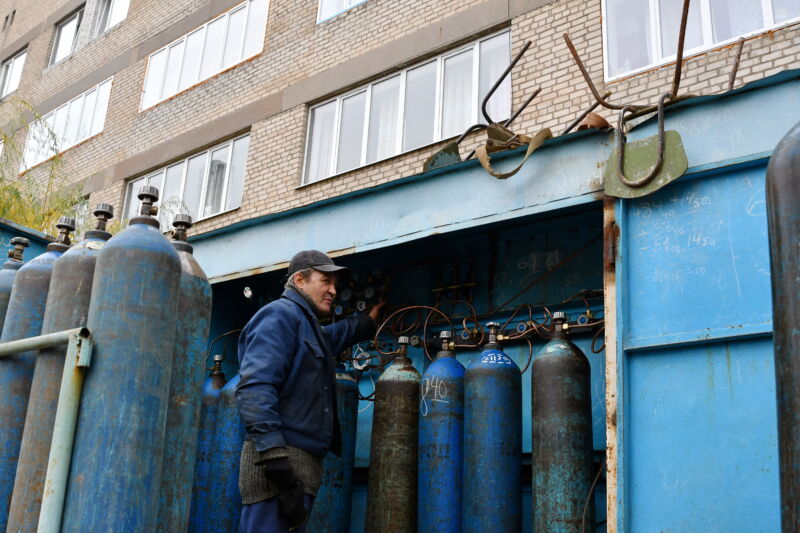
Majority of Ukrainian hospitals could run out of oxygen today as omicron rages: WHO

by Beth Mole
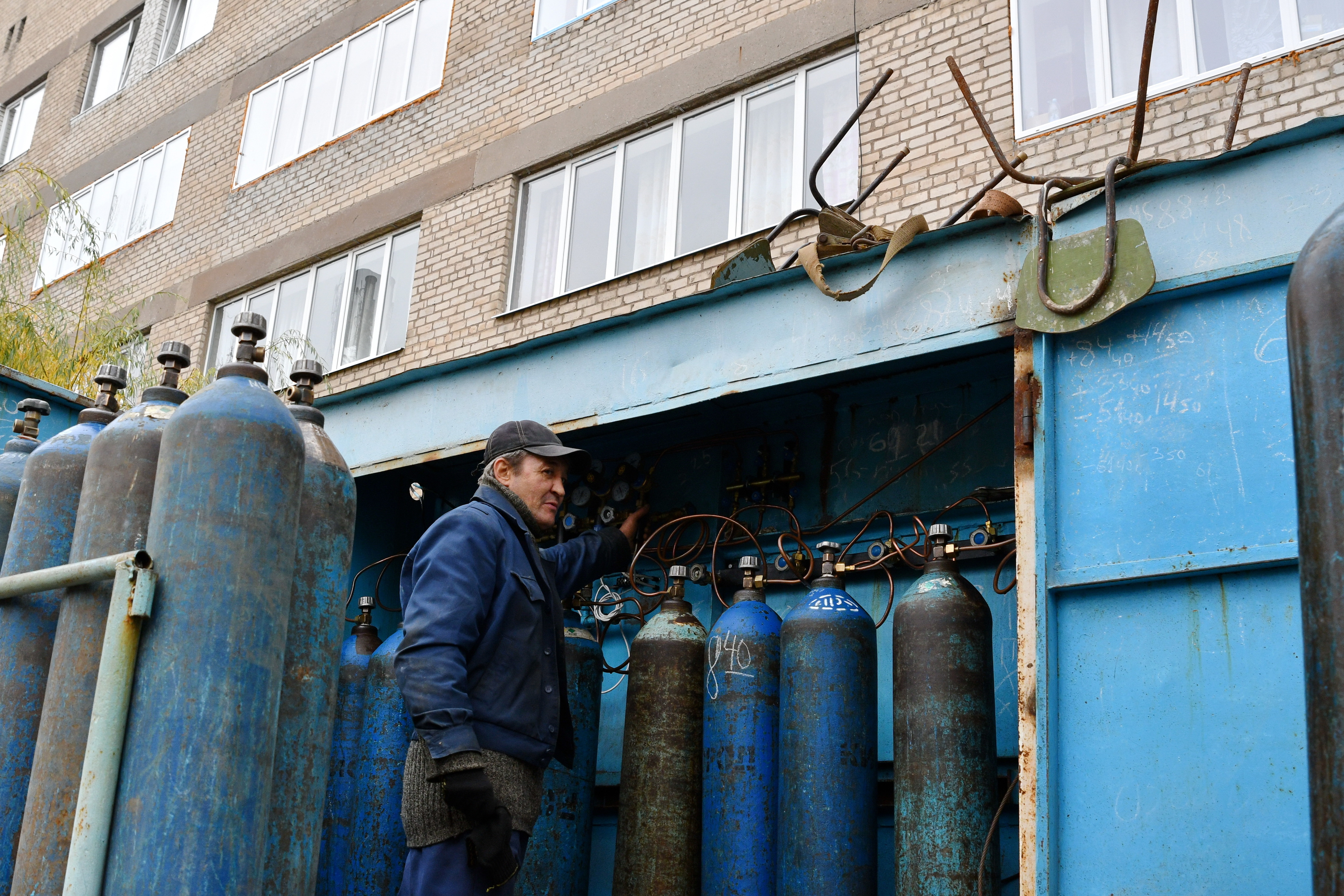
A worker is seen servicing oxygen cylinders for COVID-19 patients in Kramatorsk city hospital.

Enlarge / A worker is seen servicing oxygen cylinders for COVID-19 patients in Kramatorsk city hospital. (credit: Getty | SOPA Images)

The majority of Ukrainian hospitals could run out of life-saving medical oxygen as soon as today, putting at risk the lives of thousands of critically ill patients amid the pandemic, the World Health Organization warned Sunday.

The United Nations agency said it is looking into ways to increase supplies, which would likely require a safe-transit corridor through Poland. "It is imperative to ensure that lifesaving medical supplies—including oxygen—reach those who need them," WHO Director-General Dr. Tedros Adhanom Ghebreyesus and WHO Regional Director for Europe Dr. Hans Kluge said in a joint statement.

Amid the Russian attack and invasion, trucks are currently unable to transport oxygen supplies from producers to hospitals across Ukraine, including the capital of Kyiv, the WHO reported. The onslaught is also hampering the production of medical oxygen in the country. Several manufacturers of medical-oxygen generators are running low on zeolite, a critical production component that is imported. Safe transport of zeolite into Ukraine is also needed. Drs. Tedros and Kluge also warned that patients are at risk because hospitals are facing power shortages, and ambulances transporting patients are at risk of being caught in crossfire.

Read 3 remaining paragraphs | Comments

25 Feb 19:25

What is it

by Reza

25 Feb 18:05

Why the US won’t send troops to Ukraine

by Zack Beauchamp
US soldiers fire from an M1 Abrams main battle tank during an international military exercise in Bavaria, Germany.
US soldiers training in Germany on January 27, 2022. | Armin Weigel/Picture Alliance/Getty Images

Nuclear weapons are containing the Ukraine war. They also helped cause it.

In 1990, Iraq invaded Kuwait in a naked war of territorial aggression. The next year, the US and an allied coalition intervened under the auspices of the United Nations Security Council, repulsing the Iraqi invasion. Today, as Russia is engaged in a similar aggressive war against Ukraine, there is no similar American effort in the offing — even as Ukrainian leaders have pleaded for Western assistance.

There are many dissimilarities between the situations in 1991 and 2022, but the biggest one is this: Saddam Hussein, rather famously, did not have nuclear weapons. Vladimir Putin has approximately 6,000 of them. And that makes all the difference.

Both before the invasion and afterward, the Biden administration has consistently ruled out the deployment of US troops. “Let me say it again: Our forces are not — and will not — be engaged in the conflict with Russia in Ukraine,” the president said in a Thursday address. Despite the warnings of American involvement from commentators on the Trumpist right and “anti-imperialist” left, there are no signs of this policy changing. Nuclear weapons are the chief reason why.

The logic of mutually assured destruction that defined the Cold War still works, to some degree: Russia’s arsenal makes any direct intervention in Ukraine riskier than any rational American leader could tolerate. In a sense, then, Russia’s nuclear weapons make it less likely that the conflict will kick off World War III.

But in another sense, Russia’s nuclear arsenal also helped create the conditions where Putin’s invasion could happen in the first place.

Political scientists call this the “stability-instability paradox,” the notion that nuclear deterrence has had the paradoxical effect of making certain kinds of conventional warfare more likely. Russia can be relatively confident that the United States and its allies won’t come to Ukraine’s defense directly, because such a clash carries the threat of nuclear war. This could make Putin more confident that his invasion could succeed.

Putin himself has suggested as much. In his speech declaring war on Wednesday night, he warned that “anyone who would consider interfering from the outside” will “face consequences greater than any you have faced in history” — a thinly veiled threat to nuke the United States or its NATO allies if they dare intervene.

“This is about the clearest evidence I have ever seen for the stability-instability paradox,” Caitlin Talmadge, a professor at Georgetown University who studies nuclear weapons, writes of Putin’s speech. “Putin’s behavior suggests that revisionist actors [can] use their strategic nuclear forces as a shield behind which they can pursue conventional aggression, knowing their nuclear threats may deter outside intervention.”

The nuclear balance between the United States and Russia, one of the Cold War’s defining features, is coming back to the forefront of international politics. We can only hope that things don’t get scarier from here.

How nuclear weapons make US involvement in Ukraine unthinkable

Nuclear weapons are the only weapons humanity has yet devised that, deployed at scale, could swiftly wipe out our entire species. The risks of conflict between two nuclear-armed powers are so great that virtually any rational leader should, in theory, seek to avoid one.

This is especially true of the United States and Russia, who together control an estimated 90 percent of the world’s nuclear warheads. The issue is not merely the size of their arsenals but also their structure — both countries have robust “second strike” capabilities, meaning each can sustain a devastating nuclear first strike from the other side and still retaliate. The US and Russia maintain second strike capabilities in part through the so-called “nuclear triad”: bombers armed with nuclear bombs, submarines equipped with nuclear missiles, and land-based missile launchers.

The result is that neither the US nor Russia can hope to “win” a nuclear war. Even if one nation struck first, decimating major military bases and population centers, the other would still be able to launch a devastating nuclear counterattack on their enemy’s homeland from (for example) submarines out to sea. The only way to win is not to play.

This appears to be the reason the Biden administration has been so adamant on avoiding any kind of involvement in Ukraine; the risks of any direct intervention are far too high.

Nuclear Test USA - Castle Galerie Bilderwelt/Getty Images
An image of an American nuclear test in 1954.

Conventional warfare between nuclear powers does not necessarily escalate to nuclear conflict: see the 1999 Kargill conflict between India and Pakistan, the 2018 battle between US special forces and Russian mercenaries in Syria, or the recent border clashes between India and China. But the risk of such a conflict escalating to nuclear use is always there, especially if one side believes that vital national interests or its very survival is at stake.

For Putin, the Ukraine war seems to fit the bill. A significant US or NATO intervention in the conflict would, by sheer fact of geography, pose a threat to the territorial integrity of the Russian homeland. Were it to turn the tide of the war in Ukraine’s favor, Russia could very conceivably use its nuclear arsenal against its NATO enemies.

“Their nuclear strategy envisions possible first use if they are losing a conventional conflict or facing an existential threat,” Nick Miller, an expert on nuclear weapons at Dartmouth University, explains.

We have no guarantee that deploying US troops to Ukraine would, in fact, lead to nuclear warfare. But the risks would be high, very likely exceeding the most dangerous moments of the Cold War, like the Cuban missile crisis. There are scenarios where you could imagine an American leader launching a conflict with a nuclear power — if it was necessary to protect the US homeland, for example — but defending Ukraine, which isn’t even a formal US ally, simply isn’t one of them.

How nuclear weapons helped make the Ukraine war possible — and could make it much worse

Some leading scholars look at the logic of deterrence and conclude that nuclear weapons are actually a good thing for the world. This “nuclear revolution” theory, most commonly associated with the late political scientist Kenneth Waltz, holds that the spread of nuclear weapons will spread peace by expanding deterrence. The more countries can make aggression unthinkably risky, the less likely war will become.

The evidence for this theory is spotty. While nuclear deterrence does seem to have played a role in preventing the Cold War from turning hot, examining other cases — including smaller nuclear armed states like India, Pakistan, Israel, and North Korea — leads to a much more complicated picture.

The stability-instability paradox is one of these complications. In its most classic form, the paradox argues that two countries with nuclear weapons can be more likely to engage in small-scale conflict. Because each side knows that the other doesn’t want to risk a wider war given nuclear risks, they can feel more confident engaging in smaller provocations and assaults. What looks like nuclear stability actually breeds conventional instability.

Ukraine is not a nuclear state, but the NATO alliance has three of them (the US, Britain, and France). Because NATO states don’t want a wider war with Russia, one that carries a risk of a nuclear exchange, they’re less likely to intervene in a conflict they might otherwise join. Putin knows this; his public threat to use nukes against any intervening country suggests he’s counting on it.

So what we’re seeing is a kind of twist on the classic paradox: Putin is relying on nuclear fear to allow him to get away with invading a country (Ukraine) that a nuclear-armed third party (NATO) might otherwise want to defend.

This dynamic is familiar from the Cold War; it’s in part why the Soviets could send troops to Hungary in 1956 and Czechoslovakia in 1968 to suppress popular anti-communist uprisings without real fear of Western intervention.

Prague Spring uprising of 1968 TASS/Getty Images
A Soviet Army unit in Czechoslovakia in 1968.

To be clear, the stability-instability paradox is not an ironclad law of international relations; scholars disagree about exactly how frequently it actually causes conflict. But neither is nuclear deterrence: There are several near-miss examples where a nuclear exchange was just barely avoided.

In 1983, for example, Soviet Lt. Col. Stanislav Petrov was alerted by an early warning system that a US nuclear strike was likely incoming. Had Petrov informed his superiors of that message, it’s very likely they would have launched missiles in response. Yet Petrov and his staff correctly concluded this was a false alarm and chose to say nothing — potentially saving hundreds of millions, if not billions, of lives.

Nuclear deterrence depends on both sides having good information and making rational decisions. But in a conflict like the one we’re seeing in Ukraine, taking place near the borders of NATO members, the risks of accidents, misperceptions, and miscalculations inches incrementally higher. For example, says Miller, “you can imagine a Russian jet straying into NATO airspace accidentally” and sparking a wider conflict.

Without a NATO presence inside Ukraine, the risks of such a disaster remain extremely low; Miller cautions that “both sides have a strong incentive to avoid direct conflict and avoid minor incidents escalating.”

But the fact that we’re even talking about it illustrates how nuclear weapons, by their very nature, make the world a riskier place. While they likely are playing a major role in keeping the US out of the Ukraine conflict directly, they helped create the conditions where Russia could launch the war in the first place — and, in the very worst case, could escalate to complete disaster.

25 Feb 18:03

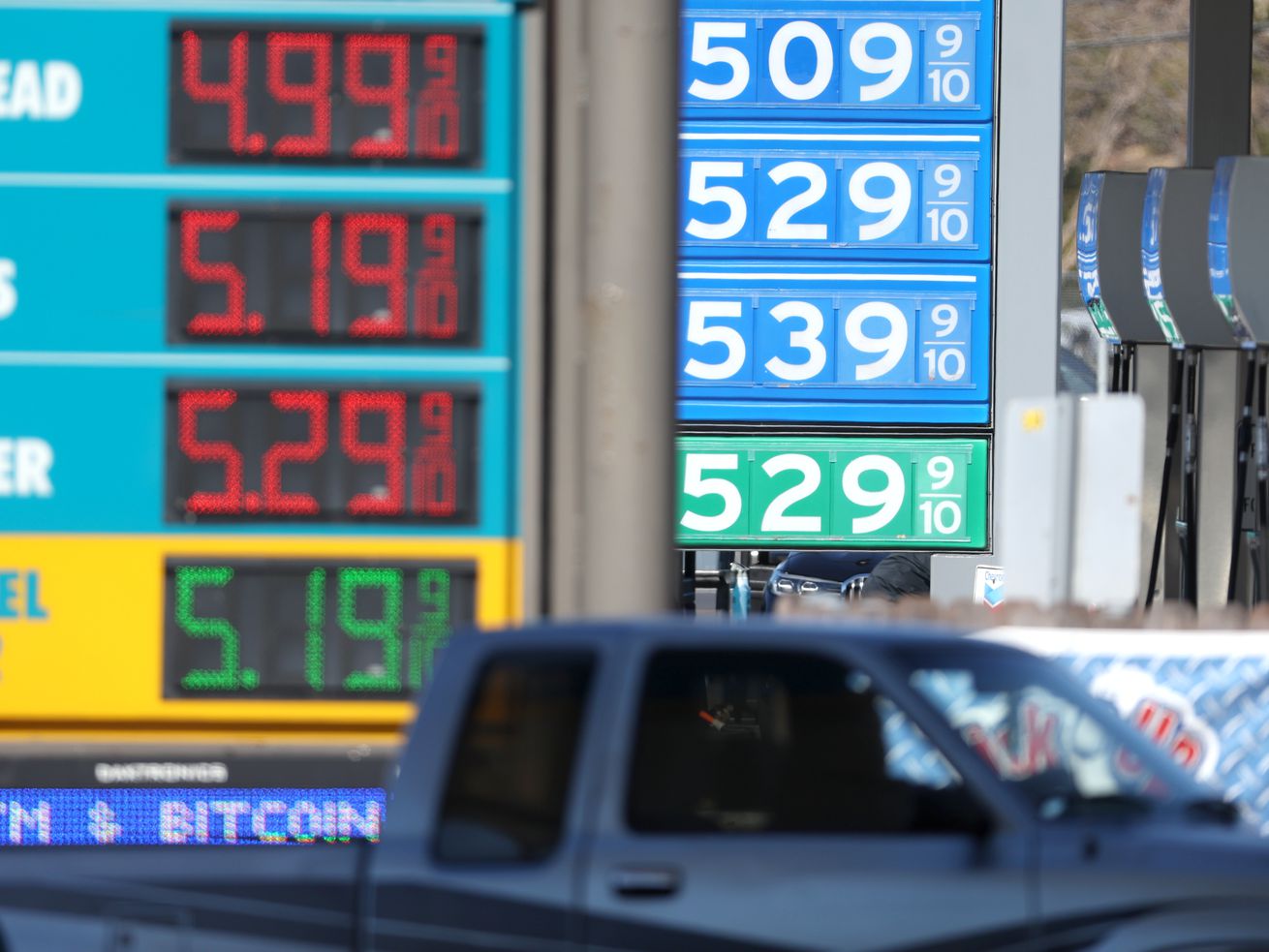
Yup, the Russian oil ban means gas prices are going to suck

by Emily Stewart
A gas prices sign.
Gas prices over $5 a gallon displayed at gas stations in Mill Valley, California, on February 23 amid the escalating conflict between Russia and Ukraine. | Justin Sullivan/Getty Images

Russia’s war is going to make gas and a lot of things more expensive.

The backdrop of global and domestic inflation in the United States was already worrying. Now, Russia’s invasion of Ukraine and the global reaction to it stand to make the situation worse — including sending gas prices soaring.

The conflict has roiled global markets, causing stock market turmoil, sending oil prices higher, and injecting even more uncertainty into an already off-balance worldwide economy. It’s also sparked concerns that inflation, already running hot, could run even hotter.

In the United States, the Consumer Price Index, which measures the average change in prices consumers pay for goods and services, was up by 7.5 percent over the past year in January. That’s a 40-year high. The hope was that inflation would soon start to come down, and that factors driving it, such as high gas prices and supply chain woes, would finally pass. Now, it appears that the situation could be quite the opposite.

“What we’re observing is essentially an energy price shock and a financial markets shock that comes on the back of this already concerning inflation environment, an environment in which global supply chains are already stressed and in which there is already some degree of uncertainty as to the outlook,” said Gregory Daco, chief economist at EY-Parthenon. “It’s not just a shock in isolation, it’s a shock in that context.”

Russia is one of the biggest oil and gas producers in the world, and any disruptions stand to have a major impact on prices — disruptions we’re already seeing. On Tuesday, President Joe Biden announced that the US would ban imports of Russian oil, natural gas, and coal. The United Kingdom has said it will scrap Russian oil imports as well. These maneuvers prompted a spike in oil prices, which have already been on the rise, and the situation is sure to have ripple effects across the global economy.

In early February, JPMorgan analysts projected that disruptions to oil flows from Russia could push oil prices to $120 per barrel, which, indeed, it already has. (For context, oil was priced in the $60 per barrel range a year ago, and started 2020 in the $70s and $80s.) Some analysts have warned that worst-case scenario oil prices could hit $200, and Russia has warned that $300 oil prices could be on the horizon, depending on what Europe, which is much more reliant on Russian oil and gas than the US, does.

In the US, Russian oil made up about 3 percent of shipments in 2021, according to Bloomberg, and when you include other petroleum products, that rises to 8 percent. That’s not a ton, but it’s not nothing, either. Major oil companies, such as Shell and BP, have said they’ll stop buying oil and gas from Russia and curb business with the country, which is causing volatility and prices changes as well. Europe is starting to move away from its dependence on Russia, too.

Americans — already dealing with high gas prices and annoyed at the rising costs of heating their homes — are in for a bumpy ride. Gas prices matter not just for people filling up the tanks of their cars but also because of shipping and transportation. The conflict could also translate to high diesel prices and jet fuel for airplanes. “The inflation machine is just not going to slow down,” said Patrick De Haan, head of petroleum analysis at GasBuddy.

According to AAA, the average price of gas nationally is $4.17 a gallon, up significantly from $2.66 a year ago. That number now stands to climb even higher, especially as the summer months approach, which will put more people on the road. As the New York Times points out, the last time gas prices were so high was during the 2008 financial crisis, when — adjusted for inflation — a gallon was priced at about $5.37.

Joe Brusuelas, chief economist at accounting and consulting firm RSM, told CNN in February that the Russia-Ukraine conflict could push inflation to 10 percent year over year, driven in part by gas. By his calculation, an increase in oil prices to $110 could increase consumer prices by 2.8 percent over the course of a year. Alan Detmeister, an economist at UBS, told the New York Times that oil at $120 per barrel could mean inflation at 9 percent in the coming months.

“It becomes a question of: How long do oil prices, natural gas wholesale prices stay elevated?” he told the Times. “That’s anybody’s guess.”

In remarks at the White House on Tuesday, President Biden acknowledged that the Russia-Ukraine conflict and measures the US and Europe have taken to push back against Russia will be felt domestically. “This decision today is not without cost here at home,” he said, referring to the Russian oil ban.

The Biden administration has promised to try to protect Americans from a spike in gas prices. Over the weekend, Secretary of State Anthony Blinken told CNN that the US is “talking to our European partners and allies to look in a coordinated way that prospect of banning the import of Russian oil while making sure that there’s still an appropriate supply of oil on world markets.”

Still, the options on oil supply are limited, at least in the immediate term. “The president has insinuated that he’s got it, he’s going to do everything he can,” said De Haan in February, but it’s not clear what other strings Biden can pull on. Striking a new nuclear deal with oil producer Iran could help, but it’s no silver bullet, nor is it clear it’s very likely to happen. “It’s no Russia, in terms of oil supply,” De Haan said. The US has also begun weighing whether it could look to Venezuela.

Higher oil prices could dampen on economic growth. People and companies having to spend more on oil and gas could reduce spending in other areas, and that could cut into GDP. By one estimate, a long-term increase in gas prices could cost the typical household in the US $2,000 per year.

There are other areas where the Russia-Ukraine conflict could show up in consumer prices. Russia is the largest wheat exporter in the world. As the Times notes, Russia and Ukraine make up 30 percent of global wheat exports, and Ukraine is also a major exporter of corn, barley, and vegetable oil. Disruptions to any of that could lead to disruptions in the commodities markets, therefore pushing up prices eventually at the grocery store. The conflict has caused wheat prices to surge. Bloomberg reported in February that the Biden administration isn’t yet going to impose sanctions on Russia that would impact aluminum, which would throw a wrench in the global supply, though aluminum and metal prices have already gone up.

“It’s a combination of a set of commodities that are being produced either in Ukraine or Russia that have been affected,” Daco said. He warned that if further sanctions are imposed on Russia, it could affect aluminum and commodities prices even more. “It’s a wide spectrum of agricultural, energy, and other commodities.” On Tuesday, Russian President Vladimir Putin signed a decree banning the exports of some commodities, which could have major global ramifications.

Reuters reported that the White House has warned the microchip industry about the possibility that Russia will curb access to some of the materials it sources from Ukraine and Russia and to look into diversifying the supply chain. A chip shortage and kinks in the semiconductor supply chain have contributed to higher prices and challenges across a number of industries, including cars and phones.

To be sure, there’s still plenty of uncertainty around what will happen in the Russia-Ukraine conflict and its economic consequences. Brusuelas told MarketWatch in February that the inflationary pressures depend “on the severity of sanctions and what happens on the ground.” The US and Europe have hit Russia with severe sanctions that will devastate the Russian economy and likely have a widespread impact on economic conditions around the world. In other words, economic uncertainty, including inflation, is probably not going away anytime soon.

In the United States, this will be a headache for the Federal Reserve, which is already on track to likely start to raise interest rates in an effort to combat inflation and otherwise roll back some supports for the economy.

“Energy prices mean that inflation is going to stay well above the Fed’s target in 2022, and that’s going to stiffen the Fed’s resolve to normalize monetary policy this year,” Bill Adams, chief economist for Comerica Bank, told Vox. “Inflation was drastically above the Fed’s target in 2021 and had looked like it was about to slow in 2022, but the surge in energy prices caused by the invasion is going to keep inflation higher for longer.”

Adams did, however, note that the US economy is quite strong at the moment, despite inflation. Jobs are coming back, and supply chain problems are being worked out.

“The big picture is that the US economy is strong and is well-positioned to absorb a shock like higher energy prices or disruptions to commodity supply from the Russia-Ukraine war,” he said. “We’re in a better position to absorb this shock than, for example, in 2006-2007 when energy prices were jumping but consumer balance sheets were much more stressed than they are today.”

Still, for Americans already navigating inflation, the current crisis is likely going to push prices up before they come down.

Update, March 8, 2022: This story was updated to include new economic developments stemming from the war in Ukraine.

24 Feb 20:35

How my Chicago Auto Show tweets reignited the debate over unsafe vehicle design

by AJ LaTrace

Shortly after entering the Chicago Auto Show this past weekend, I saw a pickup truck that seemed almost comically large, so I asked my friend to take a photo of me standing next to it. As we continued through the show, the very large front ends with massive grills and headlights on pickups and SUVs were a recurring theme and we took photos of the two of us standing in front of a handful of vehicles from Chevrolet, GMC, Ram, and Ford. 

I posted the photos to Twitter, expecting that there would be some kind of reaction to them, but the thread ended up taking a life of its own, with more than 8,500 “likes” and more than a thousand retweets. The responses ranged from declarations that all large trucks should be permanently banned from city streets, to cynical comments questioning my manhood.

https://platform.twitter.com/widgets.js

But there were also many impassioned responses about how these truck and SUV designs endanger the the lives of people walking and biking. They noted that the height and shape of the front end makes it all-but-certain that a struck person won’t go over the hood, but will instead be crushed under the vehicle.

Some well-established names in the bicycle industry also chimed in on the thread. Bike blogger and social media influencer John Watson (aka John Prolly) of Prolly is Not Probably and The Radavist warned of the upcoming 9,000-lb Hummer EV. And Keither Bontrager, an innovator who along with Gary Fisher is credited with inventing the modern mountain bike, posted numerous replies, including one of a Tiktok video of a person driving a large truck who was unable to see a Corvette directly in front of him in traffic without looking at a special video screen. 

https://platform.twitter.com/widgets.js

It’s virtually impossible to ignore the increasing size of trucks and SUVs on the roads today. And seeing these vehicles up-close hammered home just how ridiculous this all is. People have been hauling boats and stacking plywood in pickup beds for decades, so why does a truck need to have a front end that comes up to my shoulders (and I’m 6’1?)? The sad truth is that it may just boil down to design language and aesthetic. 

“My first week in Detroit, I was driving through downtown and seeing the fist of Joe Louis, and remember thinking that’s what this truck should look like: a massive fist moving through the air,” said GMC Sierra HD lead designer Karan Moorjani in an interview with Muscle Cars & Trucks. “We spent a lot of time making sure that when you stand in front of this thing it looks like it’s going to come get you.”

The front end of a new Ram truck vs a 36-year-old adult man. Photo: AJ LaTrace

Not only is the vehicle meant to be imposing — it’s intentionally designed to look intimidating. The truck is meant to be an extension of the driver’s ego, and what’s being expressed is pure, unbridled aggression. Moorjani says that the “pissed-off feel” and exaggerated proportions of the truck’s design is to make the vehicle as menacing as possible. “There’s something really mean and violent about an all-black truck,” Moorjani said to Muscle Cars & Trucks.

The irony is that a black 2022 GMC Sierra 3500 HD in the Denali trim like the one on display at the auto show costs around $85,000. Not only does the truck appear “pissed off,” but it’s also incredibly expensive. 

Pedestrians have good reason to be concerned about these types of vehicles being driven through city streets. Not only is the vehicle proportioned like a massive fist in the air, but the enormously large front end on contemporary pickup trucks and SUVs obscure the field of view for drivers. Indianapolis news station WTHR ran a segment in 2020 about the blind spots of these large vehicles and how dangerous they can be. To illustrate how difficult it is to see pedestrians directly in front of the vehicle, it was only when the reporter sat nine children in a row in front of a Chevy Tahoe that the driver was able to see one of the kid’s heads. 

This driver couldn't see any children until nine kids were lined up in front of their truck. Image: WTHR
This driver couldn’t see any children until nine kids were lined up in front of their truck. Image: WTHR

Buyers of these large trucks say that newer vehicles have front-facing cameras and other features like automatic braking to help prevent deadly crashes. But as Keith Bontrager asked in one of his responses to my thread, “What’s the driver’s response time when they have to look at a forward-facing grille cam to decide whether it’s safe to go?”

https://platform.twitter.com/widgets.js

In Chicago, children and other road users have been seriously injured or killed by drivers in SUVs who may have been unable to see them due to vehicle design, which also reduced the chance of the victim surviving the impact. For example, last July off-duty police officer Michael Leverett reportedly ran a stop sign in the West Ridge neighborhood, fatally striking Hershel Weinberger, 9, on his bike. The design of his truck, a lifted Toyota Tundra with bull bars, which exacerbate pedestrian and bike crashes, almost certainly contributed to the tragedy.

The officer’s truck with Hershel Weinberger's bike under it. Image: WGN News
Leverett’s truck with Hershel Weinberger’s bike under it. Image: WGN News

From some of the responses to my thread, it’s clear that in this incredibly divided country the act of simply discussing truck design as it relates to the safety of bystanders can quickly devolve into a culture war. It’s sad that this topic can’t be explored in a rational way without the toxic polarization that taints so many other efforts to reach consensus. However, it’s clear that decisive measures are needed to make new trucks and SUVs safer for those outside of the vehicle. 

In Illinois, trucks have separate registration and license plate guidelines, but there’s only a $5 difference between registering a pickup and a standard passenger car. However, within the city of Chicago, truck owners pay $225 for a city sticker, versus $95 for a typical passenger vehicle. And perhaps the Chicago City Council could impose other rules or restrictions for non-commercial trucks and SUVs with the intent of improving safety for vulnerable road users. 

But at a national level, it’s tough to say how much political will there would be for revised design and safety standards for these types of vehicles. However, the danger is real and concern is valid and the problem only seems to get worse with each new model year. One thing’s for sure: If decisions about vehicle design are purely left to the market to decide, the aggressive “pissed off” design language of American pickup trucks will be around for many years to come, contributing to countless traffic deaths. 

24 Feb 17:06

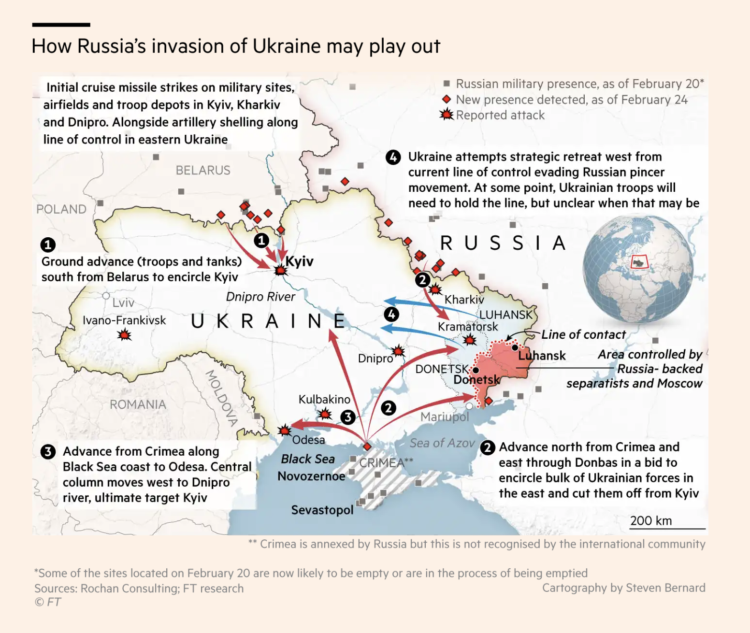
Map of invasion in Ukraine

by Nathan Yau

This map by Henry Foy and Steven Bernard for Financial Times shows a timeline of Russian military presence. The gray squares represent a presence as of February 20, red diamonds represent a presence four days later, and bang symbols represent reported attacks.

Tags: Financial Times, Russia, Ukraine, war

24 Feb 17:05

USPS sticks with decision to buy inefficient 8.6 mpg trucks

by Jonathan M. Gitlin
The Next Gen Delivery Vehicle looks adorably goofy, but the vast majority of these new mail trucks will belch almost exactly as much carbon dioxide into the air as the old Grumman LLV trucks.

Enlarge / The Next Gen Delivery Vehicle looks adorably goofy, but the vast majority of these new mail trucks will belch almost exactly as much carbon dioxide into the air as the old Grumman LLV trucks. (credit: USPS)

In February 2021, the United States Postal Service made a controversial decision to replace its fleet of aging and inefficient mail trucks with a new fleet made up almost entirely of new, inefficient diesel mail trucks. Although the vast majority of USPS delivery routes are ideally suited for electric vehicles, the USPS decided that a mere 10 percent of the planned order would be battery electric.

In early February 2022, that decision resulted in severe criticism from the US Environmental Protection Agency and the White House Council on Environmental Quality, who accused the Postal Service of failing to properly examine the environmental impact of its decision, as required by law.

This week, the USPS released its final record of decision and record of environmental consideration for the Next Generation Delivery Vehicle purchase. And it's bad news for anyone who cares about climate change or air pollution, as the Postal Service has dug in and refuses to alter its plans. That means that 90 percent of the 50,000-165,000 NGDVs that are being ordered will use gasoline and will only average 8.6 mpg (28.86 L/100 km) when used with air conditioning.

Read 6 remaining paragraphs | Comments

24 Feb 16:46

What happens when Americans stay in the same house forever?

by Jerusalem Demsas
Drawing of a young family chained to a house burdened by mortgage payment.
Getty Images/iStockphoto

Americans used to move a lot; now they don’t. It could be causing a social crisis.

At the heart of America is a packed bag.

“Go west, young man, and grow up with the country,” newspaper editor Horace Greeley once exclaimed. A proponent of westward expansion, Greeley rightfully struck at the heart of a particularly American brand of freedom: the ability to get the hell out of dodge.

And while freedom of movement has never been equally distributed, potentially the most defining migration the nation has ever seen was the Great Migration, when millions of Black Americans fled the South, Jim Crow the wind at their backs.

Isabel Wilkerson, the historian and author of The Warmth of Other Suns, captured the essence of this mass movement: “They did what human beings looking for freedom, throughout history, have often done. They left.”

But what happens when leaving is no longer an option? In the US, that’s what we’re witnessing right now: “Americans, it seems, are finding themselves increasingly locked into places that they wish to escape,” two psychologists grimly proclaim in a new paper studying the cultural effects of residential stagnation. Study authors Nicholas Buttrick and Shigehiro Oishi cite research showing that when you compare today’s Americans to people in the 1970s, people who said they intended to move from a place are 45 percent less likely to have actually done so.

The paper finds that as residential mobility has gone down, so have “levels of happiness, fairness, and trust among Americans.”

How could declining mobility lead to these changes? Buttrick and Oishi explain that moving to a new place severs social bonds, and in a new town, far from home, newcomers are forced to define themselves with “context-free personality traits (i.e., ‘I am hardworking’ or ‘I am intelligent’)” rather than by their relationships to locals like they might in their hometown (i.e., “my sister owns the butcher shop downtown”).

Importantly, all that researchers have found are correlations: No one has yet established that declining mobility causes any psychological changes. And another caveat — while some data exists related to how much Americans were moving in the 1700s and 1800s, it is only since 1948 that the researchers have a “reliable annual rate of residential mobility ... mak[ing] it difficult to draw strong conclusions regarding the cultural effects of residential mobility in the longer term.”

Another note of caution is that residential mobility is not independent of economic growth, settlement patterns, religiosity, and more. In other words, it could be something else that is driving some or all of this correlation.

The authors are aware of this and note that while things like unemployment and GDP growth have cyclical patterns, mobility rates have been declining steadily since 1948 through booms and busts alike.

And the psychologists’ work builds on a body of economic and political science literature that has raised the alarm for decades about declining interstate mobility and its negative effects on financial and personal freedom.

Buttrick and Oishi delineate the cultural markers of a mobile society (“individualism, optimism, and tolerance”) and a stable society (“security, and a strong sense of the difference between ingroups and outgroups”). This growing shift toward the latter could explain much of what has happened to America’s political system in recent decades.

What happens when people want to move but can’t

“Unfathomable” — that’s the word Buttrick and Oishi use to describe the rate at which Americans in the 1700s and 1800s exchanged communities:

Throughout the 19th century, as many as 40% of Americans may have moved year over year. For example, in one Illinois county, only about 20% of households living there in 1840 stayed to 1850; in a different Ohio city, only 7% of people voted in both the 1850 and 1860 elections in the same district; in the Jamaica Plain neighborhood of Boston, only half of household heads enumerated in 1880 could be found in 1890; and in New York City, “Moving Day,” the First of May, was an unofficial city holiday (Fischer, 2002).

Today, that’s not the case. While the majority of Americans are happy where they are — according to Gallup survey data in 2016, 74 percent of Americans rated their current residence as ideal — this growing bloc of “trapped” or “stuck” communities has concerning cultural effects.

Buttrick and Oishi’s big takeaway: When people move less, it affects culture. Less dynamism, increased aversion to risk, suspicion of outsiders, cynicism, unhappiness, and “people who feel less free to live their social lives as they see fit.”

Looking at a survey of 16,000 Americans, the authors find that people who want to move but remain at the same address the following year are more likely to disagree that “hard work can help a person get ahead,” even when controlling for a bunch of factors like socioeconomic status, health, age, race, and more.

“Wanting to move but being unable to leave leads people to wonder about whether their other efforts in life will be rewarded,” the researchers write.

Americans have historically been defined by our willingness to move for greener pastures, and, despite some pessimistic narratives, Americans are pretty welcoming to outsiders. Buttrick and Oishi cite research showing that Americans are very individualistic, very trusting of strangers, egalitarian, optimistic, and risk-taking, and “to a degree unmatched by other nations” believe that technology can solve big problems. And Americans are “unusually likely to believe that all people everywhere are essentially the same.”

But, the authors argue, much of that has been changing in parallel with declining interstate mobility. We could be left with much more stable communities that are much less trusting of outsiders. To put a finer point on it, if you’re stuck in a place where you don’t want to be, it has broader implications for your ability to pick your social networks. You are stuck with the family and friends that you happen to be near.

That, in turn, leads to a lot more loyalty toward one’s in-group. If it’s extremely difficult to make new friends, it’s extremely costly to lose any of the ones you have or alienate them. This increased importance of in-group relations can be accompanied by decreased openness and increased xenophobia, because newcomers simply cannot draw on a reservoir of reputation that they have been cultivating for decades.

The policies helping kill the American dream

So why is all this happening? What is keeping Americans stuck? Even as localized recessions (that would have previously sent people running for economic opportunity elsewhere) hit, people stay put. Even as wage premiums for college degrees and higher-paying jobs concentrate in a handful of cities, low-income workers remain in stagnating pockets of the country.

The authors don’t identify any causal factors.

But I, and many economists, argue that this is because of the walls of red tape that states have put up. Specifically, two types of regulations: zoning restrictions on how land can be used, and occupational licensing requirements.

The former severely limits the supply of housing, particularly in in-demand labor markets, driving up the price of housing. New research shows that for many people, moving to many economically flourishing cities could mean taking a financial hit, as the increased cost of housing dwarfs a substantially larger salary.

And the latter can discourage people from moving to states where regulations make it costly to keep doing their jobs. According to the Captured Economy project at the centrist Niskanen Center, “today, around 25 percent of American workers need a state license to do their job — up from 10 percent in 1970.” These regulations make it really hard for workers like cosmetologists or contractors to move to different states due to the financial and time costs of getting a new license. According to the libertarian Institute for Justice (IJ), “on average these laws require nearly a year of education and experience, one exam, and over $260 in fees.”

And while these laws are enacted under the guise of consumer protection, as IJ finds, there are many ridiculous discrepancies that show that reasoning to be a farce: “[I]n most states, it takes 12 times longer to get a license to cut hair as a cosmetologist than to get a license to administer life-saving care as an emergency medical technician.”

And it’s not just the housing costs and occupational licenses that are reducing interstate mobility. As Yale Law professor David Schleicher details, “differing eligibility standards for public benefits, public employee pensions, homeownership tax subsidies, state and local tax laws, and even basic property law doctrines” make it hard to move from declining regions as well.

With all of these regulations piling up and increases in the opportunity costs of moving, interstate mobility could continue to decline and the US might reach a damning future where to move, you have to be rich.

Stability has benefits, too — America just needs to better balance them with the benefits of mobility

Having a preference for stability isn’t bad. In fact, most people, even the individualistic, age into stability. Perhaps when they have children and want to stay put for them to attend school, or when they grow older and change that would have once felt exciting now feels alienating.

Residential stability also provides important bonds. Buttrick and Oishi theorize that “people who have just moved to a place may be less interested in coming together for long-term action and may be less interested in investing in their communities.” So while movers may be optimistic, idealistic, and willing to make friends with new people, the non-movers may promote the type of social cohesion that makes that all possible.

“Areas with more residential mobility tend to have lower levels of social capital,” Buttrick told me. “If you just get to a place, it’s really hard to embed yourself in a community.”

But it doesn’t have to be that way.

“There are some American institutions that are relatively good at getting people integrated into a community,” he added. For example, “megachurches are one of these cultural responses to residential mobility — they’re big, they don’t take a lot of time, and they get you into a deep community quickly without having to incur a lot of costs.”

At the end of the day, it’s about balance. It’s not that everyone should be moving all the time, but that they should always have the option.

If the psychologists are right and individualists overwhelmingly want to leave small towns and rural America, it could severely unbalance the country. And not just unbalance the country because the nonconformists have all fled for the superstar cities, but because it’s often only the better-off mavericks who are able to leave. This type of economic residential segregation can have serious consequences for the children who grow up in disinvested communities.

While stability can sound great in theory, what it means in practice is different depending on the circumstances. A stable white-picket-fence suburb could be great for some people, but if “stable” means trapped in a high-poverty neighborhood, that’s a policy failure. Research has found that while declining interstate mobility may be due to changing preferences for white Americans, Black Americans are increasingly unable to move when they expect to.

And there’s an asymmetry — while being forced to stay somewhere is almost entirely negative, being forced to move can actually benefit those who relocate. One recent study by UC Berkeley’s Emi Nakamura and Jón Steinsson and Norwegian School of Economics’ Jósef Sigurdsson, looked at what happened to households that were forced to move after their town was covered with lava.

In 1973 a volcano erupted, causing an Icelandic town’s inhabitants to be evacuated — and while many people returned if their homes were still standing, for those whose homes were destroyed, that was significantly less likely. The authors found that children whose families were forced to leave following the destruction of their homes were more likely to have a “large increase in long-run labor earnings and education ... specifically, we estimate a causal effect of moving of $27,000 per year, or close to a doubling of the average earnings of those whose homes were not destroyed.”

Of course the trauma and shock of having to leave your home behind and the associated economic costs with that are borne heavily by the adults in this situation. Nevertheless, this natural experiment reveals that, on net, the costs of moving, even under traumatic conditions, might be compensated for.

No one is suggesting forcibly moving Americans via strategic lava flows. But there are costs to taking the steps that would allow more mobility: for example, loosening zoning restrictions leads to increased construction and neighborhood change in the places that people want to move to. These costs are unequivocally worth it.

America is aging and biasing our political and cultural institutions against risk-taking, new ideas, and new groups of people. Further tilting the scales against openness and dynamism could mean dwindling social and economic mobility and generations of Americans growing up in a country where freedom of movement belongs only to the rich.

24 Feb 12:32

New York investigation into Trump’s business looks imperiled after prosecutors quit

by Andrew Prokop
Former President Donald Trump gestures as he leaves Trump Tower in Manhattan on May 18, 2021. | James Devaney/GC Images

Prosecutors Carey Dunne and Mark Pomerantz had been investigating whether Trump’s real estate valuation practices were fraudulent. Now they’re out.

Donald Trump may be about to escape legal peril yet again.

A long-running investigation into Trump’s business practices from the Manhattan district attorney’s office appears to have been derailed, as the two lead prosecutors, Carey Dunne and Mark Pomerantz, resigned Wednesday. A New York Times report suggests they did so because the new district attorney, Alvin Bragg, told them “he had doubts about moving forward with a case” against Trump.

The big question is why. Did Bragg legitimately conclude that the case against Trump, which he inherited from former district attorney Cyrus Vance, was weak?

Or did he get cold feet about taking on the powerful former president?

The Manhattan district attorney office’s investigation into Trump, briefly explained

This investigation dates back to 2019, and it has already resulted in some charges. Last July, prosecutors indicted the Trump Organization and its chief financial officer, Allen Weisselberg, for tax fraud, alleging they hadn’t properly paid taxes on “fringe benefits” Weisselberg received as part of his salary. A trial on these charges is expected to begin later this summer.

But prosecutors were trying to make a broader case against Trump himself, on a different matter: his company’s real estate valuation practices. They had a theory, backed by copious public evidence and the testimony of former Trump lawyer Michael Cohen, that Trump overvalued certain properties when he sought loans and insurance policies, but undervalued those assets for tax purposes, so he’d owe less in property taxes. Prosecutors could have potentially charged him with tax fraud, bank fraud, or insurance fraud.

The challenge would have been proving that Trump knew his company was breaking the law. He could have argued that everything the company was doing was approved by his CFO and legal team, experts in such matters, and that he therefore thought such practices were very legal and very cool.

That’s why, it seemed, prosecutors zeroed in on Weisselberg, the company CFO. If Weisselberg flipped, perhaps he could offer testimony that Trump knowingly broke the law. They tried for months to turn him into a cooperating witness, and finally indicted him on the separate fringe benefits matter when he wouldn’t play ball.

Meanwhile, the real estate valuation probe continued to move forward. But Vance, the longtime Manhattan DA, decided not to run for reelection in 2021. Alvin Bragg, the former chief deputy attorney general of New York state, was elected to succeed him, and took office this January. Bragg, who ran on a criminal justice reform platform, has already been embroiled in controversy due to a memo he sent instructing prosecutors to avoid seeking jail sentences for a series of crimes.

All that is the context for this latest dramatic turn. The Times also reports there was “a monthlong pause in [prosecutors’] presentation of evidence to a grand jury,” perhaps suggesting that Bragg was reviewing the case, before he eventually told the prosecutors he had doubts about it, apparently spurring their resignations. The probe isn’t officially dead yet, but its future doesn’t really look bright after this development.

What does it all mean?

So what happened here? It’s impossible to say without getting a clearer idea of the evidence prosecutors amassed, but there are two main possibilities.

First is the possibility Trump critics fear — that Bragg is killing a strong investigation for his own reasons, whether those reasons may be fear of taking on the powerful, philosophical skepticism of aggressive prosecutions, or something else. However, it is worth noting that Bragg’s reelection interest in deeply liberal Manhattan would likely be served by aggressively prosecuting Trump, so if anything, this hurts his political future.

Second is the possibility that Bragg is killing a weak investigation. There have long been doubts about the case Vance’s team was trying to build. The indictment of Weisselberg and the Trump Organization was rather unusual: neglecting to pay taxes on fringe benefits is a criminal act, but it is rarely enforced so aggressively. As mentioned, Trump’s knowledge would be hard to prove without a high-level cooperator. Still, the prosecutors who quit clearly believed in their case.

The truth could also lie in the middle — the case might not be definitively weak or strong but rather somewhere in between. So this could just be a genuine difference of opinion about the case, with no nefarious behavior necessary.

The bigger picture, of course, is that Trump appears to be preparing to run for president again in 2024, after attempting to steal the election last time. Both liberals who loathe Trump and Republicans who hope to return their party to some semblance of normalcy have been hoping he’ll be removed from contention somehow, and criminal charges in the Manhattan probe were one way that could happen.

Many Trump critics are so convinced he is such a blatant criminal that they believe “getting” him on even small-ball charges would be laudable, as Al Capone was taken down for tax evasion. While Vance was still in office last year, the former president’s estranged niece, Mary Trump, told the New Yorker, “It’s incredibly urgent that Vance prosecutes Donald now.”

But that prosecution now looks significantly less likely to materialize.

24 Feb 12:31

Russia has launched its war in Ukraine

by Jen Kirby
People stand around a damaged structure caused by a rocket on February 24, 2022 in Kyiv, Ukraine. Overnight, Russia began a large-scale attack on Ukraine. | Chris McGrath/Getty Images

Putin declared a “special military operation” in Ukraine. Fighting quickly broke out in a devastating new chapter for Europe.

Russia’s long-looming invasion of Ukraine has officially begun.

Russian President Vladimir Putin announced Thursday morning local time that he was launching a “special military operation” in Ukraine, a move that was followed up by reports of explosions around cities, including Kharkiv in eastern Ukraine and the capital Kyiv.

The Ukrainian foreign minister confirmed soon after that “Putin has just launched a full-scale invasion of Ukraine. Peaceful Ukrainian cities are under strike.” By the afternoon in Ukraine, Russian troops and tanks had entered the country on three fronts. Dozens of Ukrainians have already died in the conflict, according to local reports.

Putin’s attempt to redraw the map of Europe could lead to the most devastating conflict on the continent since World War II. It could cost thousands of civilian lives and create hundreds of thousands of refugees fleeing the violence in Ukraine.

Putin’s declaration came while the United Nations Security Council held a special session in New York on the Ukraine crisis, and bombing began shortly thereafter, according to news reports. In his address, Putin claimed “to defend people who for eight years are suffering persecution and genocide by the Kyiv regime,” a reference to a false claim about the government in Ukraine. Putin claimed that the Russian military seeks “demilitarization and denazification” but not occupation. He demanded Ukraine lay down its weapons or be “responsible for bloodshed.”

Exactly what’s happening on the ground in Ukraine is hard to know. Russia has already used misinformation tactics and may jam up local communications. But it’s hard to interpret what Putin said as anything other than a full declaration of war.

The tension over Ukraine has been building for months but escalated quickly this week when, on Monday, Putin delivered an hour-long combative speech that essentially denied Ukrainian statehood. He recognized the independence of two breakaway regions in eastern Ukraine where Moscow has backed a separatist rebellion since 2014 and sent so-called peacekeeping forces into the region. As experts said, that was likely just the beginning, setting the stage for a much larger conflict.

Putin’s escalation comes after the United States warned, again and again, that a larger invasion by Putin was imminent, and after the US and its European allies imposed significant — but far from all-encompassing — sanctions on Moscow.

“President Putin has chosen a premeditated war that will bring a catastrophic loss of life and human suffering,” President Joe Biden said in a statement following Putin’s announcement. “Russia alone is responsible for the death and destruction this attack will bring, and the United States and its Allies and partners will respond in a united and decisive way. The world will hold Russia accountable.”

But Ukraine — and the world — is in a perilous and unpredictable moment. Hours before Putin’s announcement, Ukrainian President Volodymyr Zelensky delivered an impassioned speech against war, one directed to a Russian audience, as a final plea: “War takes away guarantees for everyone,” he said. “No one will have any kind of guarantees of security. And who will suffer from that the most? People.”

Ukraine is under siege

We are still learning the extent of Putin’s bombardment as his war unfolds. Amid hours of bombing, Russians have entered Ukraine from the north, south, and east, “assaulting by land, sea and air,” according to Reuters. Now Ukrainians are fleeing major cities, and lines are growing at the country’s border with Poland, as reports of civilian deaths are just becoming clear.

The Ukrainian government said on Thursday that more than 40 soldiers had been killed.

Russian troops landed in at least two Ukrainian cities, Mariupol and Odessa, where local authorities report that 18 people were killed. The capital of Kyiv appears to be Russian troops’ next target.

President Zelensky said Thursday that Russian forces were trying to seize control of Chernobyl, the site of a 1986 nuclear disaster. Ukraine’s foreign ministry warned this could become “an ecological disaster.”

“This is a deliberate, cold-blooded, and long-planned invasion. Russia is using force to try to rewrite history,” NATO Secretary General Jens Stoltenberg told reporters. The alliance will meet today to plan for ways to strengthen the defense of neighboring NATO countries Estonia, Lithuania, Latvia, and Poland.

Zelensky convened a Ukraine security council meeting in the early hours of Thursday and imposed martial law, according to news reports. In a video, Zelensky urged Ukrainians not to panic. “We are ready for everything. We will defeat everyone. Because we are Ukraine.”

Russia has remained defiant and insists that is not actually launching a full-scale war.

The roots of the current crisis grew from the breakup of the Soviet Union

Over the last few months, Putin had amassed close to 190,000 troops near the Ukrainian border, a force that military analysts said was clearly prepared and ready to launch an invasion.

Such an invasion would — and does — contravene security agreements the Soviet Union made upon its breakup in the early ’90s. At the time, Ukraine, a former Soviet republic, had the third-largest atomic arsenal in the world. The US and Russia worked with Ukraine to denuclearize the country, and in a series of diplomatic agreements, Kyiv gave its hundreds of nuclear warheads back to Russia in exchange for security assurances that protected it from a potential Russian attack.

But the very premise of a post-Soviet Europe is also helping to fuel today’s conflict. Putin has been fixated on reclaiming some semblance of empire, lost with the fall of the Soviet Union. Ukraine is central to this vision. Putin has said Ukrainians and Russians “were one people — a single whole,” or at least would be if not for the meddling from outside forces (as in, the West) that has created a “wall” between the two.

Last year, Russia presented the US with a list of demands, some of which were nonstarters for the United States and its allies in the North Atlantic Treaty Organization (NATO). Putin demanded that NATO stop its eastward expansion and deny membership to Ukraine, and also made other demands for “security guarantees” around NATO.

The prospect of Ukraine and Georgia joining NATO has antagonized Putin at least since President George W. Bush expressed support for the idea in 2008. “That was a real mistake,” Steven Pifer, who from 1998 to 2000 was ambassador to Ukraine under President Bill Clinton, told Vox in January. “It drove the Russians nuts. It created expectations in Ukraine and Georgia, which then were never met. And so that just made that whole issue of enlargement a complicated one.”

Ukraine is the fourth-largest recipient of military funding from the US, and the intelligence cooperation between the two countries has deepened in response to threats from Russia. But Ukraine isn’t joining NATO in the near future, and Biden has said as much. Still, Moscow’s demand was largely seen as a non-starter by the West, as NATO’s open-door policy says sovereign countries can choose their own security alliances.

 Evgeniy Maloletka/AP
Demonstrators with Ukrainian national flags and posters march in the center of Kharkiv, Ukraine, on February 5. Kharkiv is Ukraine’s second largest city, just 25 miles from some of the tens of thousands of Russian troops massed at the border.

Though Putin has continued to tout the threat of NATO, his speech on Monday showed that his obsession with Ukraine goes far beyond that. He does not see the government in Ukraine as legitimate.

“Ukraine is not just a neighboring country for us. It is an inalienable part of our own history, culture and spiritual space,” he said, per the Kremlin’s official translation. “Since time immemorial, the people living in the south-west of what has historically been Russian land have called themselves Russians.”

The two countries do have historical and cultural ties, but as Vox’s Zack Beauchamp explained, Putin’s “basic claim — that there is no historical Ukrainian nation worthy of present-day sovereignty — is demonstrably false.”

As experts noted, it is difficult to square Putin’s speech — plus a 2021 essay he penned, and other statements he’s made — with any sort of realistic diplomatic outcome to avert conflict. It was, essentially, a confession that this wasn’t really about NATO, said Dan Baer, the acting director of the Europe Program at the Carnegie Endowment for International Peace and a former ambassador to the Organization for Security and Cooperation in Europe. “It was about that he doesn’t think Ukraine has a right to exist as a free country,” he said before Putin’s escalation Wednesday night.

This is the culmination of eight years of tensions

This isn’t the first time Russia has attacked Ukraine. In 2014, Russia annexed the Crimean Peninsula and invaded eastern Ukraine and backed Russia separatists in the eastern Donbas region. That conflict has killed more than 14,000 people to date.

Russia’s assault grew out of mass protests in Ukraine that toppled the country’s pro-Russian President Viktor Yanukovych, which began over his abandonment of a trade agreement with the European Union. US diplomats visited the demonstrations, in symbolic gestures that further agitated Putin.

President Barack Obama, hesitant to escalate tensions with Russia any further, was slow to mobilize a diplomatic response in Europe and did not immediately provide Ukrainians with offensive weapons.

“A lot of us were really appalled that not more was done for the violation of that [post-Soviet] agreement,” said Ian Kelly, a career diplomat who served as ambassador to Georgia from 2015 to 2018. “It just basically showed that if you have nuclear weapons” — as Russia does — “you’re inoculated against strong measures by the international community.”

Since then, corruption has persisted in the Ukrainian government, and the country ranks in the bottom third of the watchdog group Transparency International’s index.

Ukraine’s far-right presence has grown and become somewhat normalized, and there are government-aligned fascist militias in the country. But Moscow has drawn out those issues to advance false claims about genocide and other attacks on civilians as a way to legitimize the separatist movement in eastern Ukraine and to create a pretext for invasion. In his prerecorded speech shared on the eve of the bombardment of Ukraine, Putin said he sought the “de-nazifacation” of Ukraine.

To be clear: The Ukrainian government is not a Nazi regime and has not been co-opted by the far right. Zelensky is Jewish; he speaks proudly of how his Jewish grandfather fought against Hitler’s army.

Yet, days earlier, Putin used these sorts of claims as part of his explanation for recognizing as independent the so-called Luhansk People’s Republic and the Donetsk People’s Republic, the two territories in eastern Ukraine where he has backed separatists since 2014. “Announcing the decisions taken today, I am confident in the support of the citizens of Russia. Of all the patriotic forces of the country,” Putin said before moving troops into the regions for “peacekeeping” purposes.

At the time, most experts Vox spoke to said that looked like the beginning, not the end, of Russia’s incursion into Ukraine.

“In Russia, [it] provides the political-legal basis for the formal introduction of Russian forces, which they’ve already decided to do,” Michael Kofman, research director in the Russia studies program at CNA, a research organization in Arlington, Virginia, said at the time. “Secondarily, it provides the legal local basis for Russian use force in defense of these independent Republic’s Russians citizens there. It’s basically political theater.”

It set “the stage for the next steps,” he added. Wednesday, those next steps became clear.

How the rest of the world is responding

The United States and its allies around the world have condemned Russia’s invasion on Ukraine. Germany’s Chancellor Olaf Scholz called it a “dark day for Europe.”

“The events of last night mark a turning point in the history of Europe,” said French President Emmanuel Macron.

All leaders have vowed consequences for Russia. As President Biden said: “The world will hold Russia accountable.”

So far, however, the US and its allies have not imposed additional penalties on Russia, something Biden and other world leaders promised after placing the first round of sanctions on Moscow earlier this week. Biden is meeting with Group of Seven leaders this morning, and is scheduled to address the nation on Russia’s “unprovoked attack” early on Thursday afternoon.

The United States has said it will not involve troops in any Ukrainian conflict, though the US has shored up its presence on NATO’s eastern flank. Biden had previously said that the US will continue to provide defensive support for Ukraine, and some are calling for the US and its partners to provide more lethal aid to the largely outmatched Ukrainian army.

Russia largely knows that the US and its partners to not want to commit themselves military, and, early Thursday as he launched his invasion, he offered an ominous warning as he touted Russia’s nuclear arsenal: “There should be no doubt that any potential aggressor will face defeat and ominous consequences should it directly attack our country.”

NATO has vowed to protect its members from any Russian aggression. Experts said NATO also had other options, including activating the NATO Response Force, a 50,000 troop unit modernized after the 2014 Crimea invasion.

Yet these are largely defensive measures — which means most of the punishment against Russia will come in the form of sanctions, which are likely to include penalties on Russia’s financial institutions and oligarchs and potentially export bans on high-grade technologies. This will likely be the harshest sanctions possible ever directed at Russia or a major power like it, but that will come with potential costs to the global economy, and especially to Europe and the United States. The price of oil has already risen to more than $100 per barrel.

The prospects of a settlement with Russia are impossible to contemplate as bombs are falling on Ukraine, but the US and its allies are going to have to do careful diplomacy to isolate and put pressure on Russia in the long term. The US and its allies are also likely going to have to decide how much they want, or can, support Ukraine as it tries to battle Russia.

“The real question, I think, is going to come down to what extent the West can and will try to support and supply a long-term insurgency against Russia,” said Paul D’Anieri, an expert on Eastern European and post-Soviet politics at the University of California Riverside. “And what level of success does Russia have in fighting back against? Unfortunately, it seems like the best strategy for peace right now is when enough Russians die, that the Russians decide it’s not worth it anymore.”

24 Feb 12:29

Pixel 7 leaks show Google finally has a consistent phone business

by Ron Amadeo
Two phones side-by-side.

Enlarge / Behold the Pixel 7 Pro. It looks just like the Pixel 6. (credit: OnLeaks x Smartprix)

The Pixel 6 is just a few months old, but the first leaks of the Pixel 7 designs are out. Google seems to have sent the CAD files to the case manufacturing industry recently, since both Steve Hemmerstoffer (aka OnLeaks) and David Kowalski (aka xleaks7) have posted Pixel 7 renders today.

These unofficial render leaks are usually based on measurements Google needs to send to third parties in order to have accessories (like cases) ready for their release dates. That means the shape of everything should be accurate down to the millimeter, but finer details (like materials, colors, or the placement of camera lenses inside a camera block) could still be up in the air.

Even with those caveats, there's no getting around the big picture presented by both renders: the Pixel 7 looks like the Pixel 6. We loved the Pixel 6 design, so bringing that forward to the Pixel 7 is the best outcome we could have hoped for. The upcoming mid-range Pixel 6a is expected to also follow the same design motif. We actually ended the Pixel 6 review by saying, "Hopefully, this is a new beginning for Google Hardware: the start of a stable, cohesive product roadmap, consistent hardware design, and significant year-to-year process." So far, it looks like we're getting all that stability and consistency that we were hoping for.

Read 4 remaining paragraphs | Comments

24 Feb 12:29

Musk says he wants to install Steam games in Tesla infotainment centers

by Kyle Orland
A car drives through a video game landscape in a heavily photoshopped image.

Enlarge / Drive through the Lands Between in style... (credit: Aurich Lawson / Tesla / FromSoft)

Since Tesla first introduced in-car gaming with a 2019 port of Cuphead, the list of games available on its "Tesla Arcade" platform has slowly grown to include just under 20 games. Now, though, Tesla CEO Elon Musk has expressed interest in expanding that list of Tesla-compatible games to include the tens of thousands of titles available on the Steam gaming platform.

In true Musk style, the informal announcement of those plans came via a thrown-off tweet in a thread expressing admiration for CD Projekt Red's Cyberpunk 2077 (a game that has previously been demoed running on the infotainment system for the Model S Plaid). "We’re working through the general case of making Steam games work on a Tesla vs specific titles," Musk wrote. "Former is obviously where we should be long-term."

A car's infotainment center may seem like an odd fit for many of the high-end games available on Steam. But Tesla cars have long sported high-end graphics cards at the heart of both their Media Control Units (for the infotainment console) and the Electronic Control Units used to power the cars' autopilot self-driving systems.

Read 3 remaining paragraphs | Comments

23 Feb 18:40

Why is Putin attacking Ukraine? He told us.

by Zack Beauchamp
People from the Donetsk and Luhansk regions, the territory controlled by pro-Russia separatist governments in eastern Ukraine, watch Russian President Vladimir Putin’s address at their temporary home in the Rostov-on-Don region of Russia on Monday, February 21. | Denis Kaminev/AP

In a recent speech, the Russian president laid out the nationalist ideas that animate him — and helped cause the Ukraine crisis.

Perhaps the biggest question behind the current crisis in Ukraine is this: What is Vladimir Putin thinking?

The Russian president’s decision to deploy large numbers of troops to eastern Ukraine has already triggered new Western sanctions on Russia. A full invasion could lead to land warfare on a scale Europe hasn’t seen since World War II, a bloody and devastating conflict for Russians and Ukrainians alike. What could justify even threatening that?

Putin’s clearest answer yet came in a speech delivered on Monday. He believes that Ukraine is an illegitimate country that exists on land that’s historically and rightfully Russian: “Ukraine actually never had stable traditions of real statehood,” as he puts it.

The overtures to the West from the current government of Ukraine are an attempt to stand up to this false regime, as is its antagonistic stance toward Moscow. This combination — an anti-Russian regime in what Putin views as rightfully Russian territory populated by rightfully Russian people — is unacceptable to him.

“Ukraine might have remained a sovereign state so long as it had a pro-Putin government,” says Seva Gunitsky, a political scientist at the University of Toronto who studies Russia. “Reuniting the lands formally would probably not have been at the forefront of the agenda if Putin felt he had enough political support from the Ukrainian regime.”

Putin’s basic claim — that there is no historical Ukrainian nation worthy of present-day sovereignty — is demonstrably false. However, this does not mean Putin is lying: In fact, Russia experts generally saw his speech as an expression of his real beliefs.

The speech is consistent with a body of statements from the Russian president going back years, ranging from a 5,000-word essay on Ukrainian history published last year to a 2005 speech declaring that “the collapse of the Soviet Union was a major geopolitical disaster [in which] tens of millions of our co-citizens and compatriots found themselves outside Russian territory.”

That Putin truly believes in aggressive Russian nationalism does not make a larger invasion inevitable. Depending on how you interpret the finer points of his views, it is possible to imagine off-ramps or Western concessions that could avert the worst possible outcomes.

But it does mean that simply reducing Russia’s motivation to one clear grievance — fear that Ukraine may join NATO or a simple aggressive desire to seize Ukrainian land — is a mistake. In Putin’s mind, these factors are inseparable in a complex historical and ideological narrative.

Understanding the current crisis, and perhaps even resolving it, depends on taking these nationalist ideas seriously.

History, according to Putin

The central contention of Putin’s speech on Monday is that Ukraine and Russia are, in historical terms, essentially inseparable.

“Ukraine is not just a neighboring country for us. It is an inalienable part of our own history, culture and spiritual space,” he said, per the Kremlin’s official translation. “Since time immemorial, the people living in the south-west of what has historically been Russian land have called themselves Russians.”

What we now call Ukraine, he says, “was entirely created by Russia or, to be more precise, by Bolshevik Communist Russia.” In this questionable narrative, a trio of early Soviet leaders — Lenin, Stalin, and Khrushchev — carved land away from Russia and several nearby nations to create a distinct and ahistorical republic called Ukraine. The creation of Ukraine and the other Soviet republics was an attempt to win the support of “the most zealous nationalists” across the Soviet Union — at the expense of the historical idea of Russia.

This illustrates what Putin means by “the virus of nationalism.” Ukrainian nationalism, in his view, is an infection introduced to the Russian host by the Bolsheviks; when the Soviet Union collapsed, and republics from Ukraine to Estonia to Georgia declared independence, the virus killed its host.

 Chris McGrath/Getty Images
People hold signs and chant slogans during a protest outside the Russian Embassy in Kyiv, Ukraine, on February 22.

In reality, these countries have longstanding ethnonational identities distinct from Russia. But Putin does not accept this, treating the former Soviet republics — and, above all, Ukraine — as parts of Russia stolen from the motherland as a result of communist machinations.

“Radicals and nationalists, including and primarily those in Ukraine, are taking credit for having gained independence. As we can see, this is absolutely wrong,” he says. “The disintegration of our united country was brought about by the historic, strategic mistakes on the part of Bolshevik and Soviet leaders ... the collapse of the historical Russia known as the USSR is on their conscience.”

As a result, Putin cannot see post-Soviet Ukraine as a real country; in his view, it has no real history nor national tradition to unite it. Instead, he sees it as a playground for oligarchs who deploy anti-Russian demagoguery as a smokescreen for their corruption. “The Ukrainian authorities — I would like to emphasize this — began by building their statehood on the negation of everything that united us,” he says.

Russian control over Ukraine, he argues, has been replaced by a different kind of foreign rule: that of the West. After the 2013 Euromaidan protests, which toppled pro-Russian leader Viktor Yanukovych, “Ukraine itself was placed under external control ... a colony with a puppet regime.”

The ominous implication of this historical narrative is that the Ukrainian government, in its current form, is both illegitimate and intolerable.

It is illegitimate because Putin views Ukraine as a rightful part of Russia separated purely by an accident of history. It is intolerable because Ukraine’s government seeks to legitimate itself by courting conflict with Russia, both oppressing its native Russian speakers and menacing Russia’s borders.

A Western-backed government like this, Putin warns, threatens the very survival of the Russian state. In the speech’s most paranoid passages, he warns of Ukraine acquiring nuclear weapons with Western assistance, joining NATO, and ultimately serving as a launching pad for an American assault on Russia.

“This is not about our political regime or anything like that. They just do not need a big and independent country like Russia around,” he says. “This is the source of America’s traditional policy towards Russia.”

A military assault is not Putin’s only fear. He calls the Ukraine Maidan movement a “coup d’état” undertaken “with direct assistance from foreign states”; there is no doubt he fears a similar movement against his own government. Bringing Ukraine to heel — demonstrating that a pro-Western protest movement in Russia’s historical heartland cannot succeed — is vital to protecting his own government.

“I think the bigger threat for him is a regime threat, not an actual military invasion,” Gunitsky explains. “He thinks the West wants to subvert his regime the way they did in Ukraine. That’s why NATO is only a part of threat.”

In the Russian president’s mind, there is a seamless connection between Russian nationalism and Russian security interests. Putin believes that the current Ukrainian government threatens Russia for reasons bound up in their imperial past; restoring Russian control over territories that he believes it rightfully owns would be one way of ending the threat.

This thinking is most clearly on display in the most ominous line in Putin’s speech: one that can, in context, can plausibly be read as a threat to bring Ukraine back under Moscow’s direct rule.

“You want decommunization? Very well, this suits us just fine. But why stop halfway? We are ready to show what real decommunization would mean for Ukraine.”

 Anatolii Stepanov/AFP via Getty Images
Residents collect water from a well in the town of Schastia, near the eastern Ukraine city of Lugansk, on February 23, after the town’s pump stations were knocked out of power by shelling.

What Putin’s worldview means for Ukraine

Putin’s narrative is twisted history.

For one thing, it is simply incorrect to say that Ukraine has no independent national identity separate from Russia. Kyiv, the Ukrainian capital, was built centuries before Moscow. At the end of World War I, Ukraine declared independence from Russia; it was put back under Soviet rule by force.

“Putin is no historian,” Timothy Snyder, a Yale University historian of Eastern Europe, writes in the Financial Times. “Ukraine has its own distinct and fascinating history and Ukrainians have as much a right to a future as anyone else.”

It is not merely manipulation by elites that led people in former Soviet republics, from Estonia to Ukraine to Georgia, to attempt to exit Moscow’s orbit in the 1990s — it was real anger with Soviet repression and colonialism. And it’s Putin’s behavior, not some kind of elite Ukrainian manipulation, that has driven up support among Ukrainians for a tighter link with the West.

Yet Putin’s belief in the notion of Russian victimhood depicted in the speech appears to be sincere, consistent with his long public record.

“I am convinced that Putin was ‘speaking from the heart,’” says Alina Polyakova, the president of the Center for European Policy Analysis think tank. “Most of this was in his essay on Ukraine from last year.”

In that essay, Putin argued that “the formation of an ethnically pure Ukrainian state, aggressive towards Russia, is comparable in its consequences to the use of weapons of mass destruction against us.” In his 2014 speech announcing the annexation of Crimea, a Ukrainian territory that remains under Russian occupation, he argued that “it was [historically] impossible to imagine that Ukraine and Russia may split up and become two separate states.”

In a 2007 speech in Munich, Putin warned that the American-led global order was one in which “no one felt safe.” Russia and the world, he said, had reached “a decisive moment” for moving away from it. And, of course, there was the 2005 speech lamenting the end of the Soviet Union as a “geopolitical disaster” because (among other reasons) it led to ethnic Russians living in independent states outside Russian borders — like, for example, Ukraine.

But the fact that Putin has long harbored nationalist grievances does not clarify how far he is willing to go in pursuit of these ends.

A panel of leading Russia experts convened by Columbia University on Tuesday afternoon all agreed that Putin’s speech struck a belligerent nationalist tone and that it represented his sincere thinking on the topic. But they disagreed on the implications: most notably, whether Putin could be placated with Western concession and whether he is truly serious about using an invasion to rectify what he sees as historical crimes against Russia.

Fyodor Lukyanov, a leading Moscow-based foreign policy analyst, argued that Putin really wants the West to listen to his concerns about Ukraine and come to the negotiating table. “From the beginning,” he argued, the buildup on Ukrainian borders “was not a preparation for war.” Rather, it was a reaction to the fact that “all attempts by Russia in previous years to offer a more or less normal discussion about security arrangements were simply ignored.”

Stephen Sestanovich, a former US diplomat who worked on Russia issues, argued that the speech proved the opposite: that “Putin’s focus is less the European security order and more a kind of obsession with Ukraine as an illegitimate state that makes it almost impossible to imagine serious negotiations.” He agreed that Putin may not escalate much further in Ukraine, but that’s because the West had called his bluff by refusing to grant any major security concessions.

By contrast, the RAND Corporation’s Samuel Charap argued that an invasion was all but inevitable: Putin’s aggressive speech, together with his forward military deployments, signaled a clear intent to mount an all-out assault. And Kadri Liik, a senior policy fellow at the European Council on Foreign Relations, claimed that Putin’s revanchist nationalism was at odds with the Russian public.

“A real large-scale war for Ukraine would be hugely unpopular,” she said. It “would be the beginning of the end of Putin’s rule, and I think he might know that.”

There is no straight line from Putin’s speech to any one course of action. The basic difficulty in analyzing the risk of an all-out invasion of Ukraine — that a Russian bluff and Russian preparation for an invasion look extremely similar — remains in place even after the Russian deployment to eastern Ukraine.

Yet the speech helps shed light on a critical aspect of the crisis: why Putin is doing this. Fail to understand the sense of historical grievance, and the way that it shapes his view of the “threat” from Ukraine, and you fail to understand why he’s willing to play such a high-stakes game today.

Any solution to the crisis needs to take his worldview seriously — and figure out what, exactly, can be done to address it.

23 Feb 18:26

The absurd Supreme Court case that could gut the EPA

by Ian Millhiser
The Longview Power Plant, a coal-fired plant in Maidsville, West Virginia, on August 21, 2018. | Spencer Platt/Getty Images

Nothing is at stake in West Virginia v. EPA — yet somehow everything is at stake.

West Virginia v. Environmental Protection Agency is a case about an environmental regulation that no longer exists, that never took effect, and that would not have accomplished very much if it had taken effect. If the plaintiffs prevail in their case, they will be in the exact same position they are in right now. It is a case about nothing.

Yet West Virginia could also be the most consequential environmental case to reach the Supreme Court in a very long time. The plaintiffs in this case, and in three other consolidated cases, seek an opinion from the Supreme Court that would do considerable violence to the Environmental Protection Agency’s power to, well, protect the environment. And if the Court indulges them, the fallout from this decision could wreak havoc throughout the federal government.

The cases involve the Clean Power Plan, an Obama-era effort to fight climate change. When this plan was announced in 2015, it was widely touted as President Barack Obama’s most ambitious climate policy initiative. Obama’s EPA predicted that, by 2030, the Clean Power Plan would lower carbon emissions from power plants by about a third below where they stood in 2005.

When the Clean Power Plan was announced, the coal industry and many red states treated it like the apocalypse, warning that the plan would cause “tens of millions of tons of lost coal production, thousands of lost jobs in the mining industry, and rippling unemployment effects for those dependent on the coal industry.” Four days before Justice Antonin Scalia’s death temporarily deprived Republicans of a majority on the Supreme Court, the Court voted along party lines to suspend the plan.

Less than a decade later, however, things look — well, different. Although the Clean Power Plan was blocked too fast for it to accomplish anything, the energy sector achieved its 2030 goals for emissions reductions by 2019. As the EPA explained in 2019, many power companies retired older, dirtier coal-fired plants because they were more expensive to operate than technologies such as natural gas or renewable energy. (Coal executives also complained that unrelated Obama-era rules restricting mercury emissions also led them to shut down coal plants.)

As it turns out, the plan’s original goals were too unambitious to matter. Market forces and other regulations achieved those goals, and they did so much faster than anticipated.

Nevertheless, a small army of litigants are now in the Supreme Court asking the justices to strike down the Clean Power Plan — which, again, is not in effect right now, which never really took effect, and which President Joe Biden’s administration does not plan to reinstate.

But while it’s not at all clear that the Supreme Court has any business hearing this case — federal courts do not have jurisdiction to hear lawsuits where there is no live dispute between the two parties — the stakes in this case are still quite high. The plaintiffs challenging the nonexistent Clean Power Plan rely on arguments that, if taken seriously by the Supreme Court, could permanently strip federal agencies like the EPA of much of their authority to regulate.

And so we wait, to see whether the Court will use a case about nothing to ensure that the Biden administration never does anything meaningful to fight climate change.

The Supreme Court is not supposed to hear cases about nothing

As a general rule, a plaintiff who wishes to challenge a federal policy must show that they were injured in some way by that policy, or federal courts are not allowed to hear their case. This limit is supposed to bind all levels of the federal judiciary, including the Supreme Court. If, the day before the Supreme Court hands down a major decision, the policy that animated that suit ceases to exist, then the Court typically must dismiss the case (with a few complicated caveats).

In Lujan v. Defenders of Wildlife (1992), the Supreme Court laid out several hurdles that all plaintiffs must overcome if they wish to bring their case before a federal court. Among other things, a plaintiff must not only show that they are injured in some way by the defendant’s actions, this injury must be “actual or imminent” and not “conjectural” or “hypothetical.“

The West Virginia plaintiffs’ best argument that they clear the bars established by Lujan flows from an opinion a federal appeals court handed down the day before President Joe Biden took office, in January 2021. That lawsuit, American Lung Association v. EPA, challenged a Trump-era rule, euphemistically named the “Affordable Clean Energy” (ACE) rule, which replaced Obama’s Clean Power Plan with weaker standards.

In American Lung Association, the appeals court determined that Trump’s EPA relied on a “mistaken reading of the Clean Air Act” when it repealed the Clean Power Plan and replaced it with a different policy. This decision didn’t simply strike down the ACE rule, moreover, it also arguably struck down the Trump administration’s decision to repeal the Clean Power Plan. Thus, for a brief moment, the American Lung Association decision appeared to breathe life into the Obama administration’s zombie plan.

But if Clean Power Plan stans hoped to see this policy implemented, their hopes were swiftly dashed. Shortly after American Lung Association was handed down, Biden’s EPA announced that it did not read that decision to reinstate the plan. “As a practical matter, the reinstatement of the CPP would not make sense,” the EPA explained in a very brief memo, in large part because, as already mentioned, its goals were already accomplished.

Then, to cement this understanding, the EPA asked the appeals court to stay the parts of its decision that arguably reinstated the Clean Power Plan while the EPA writes an entirely new rule — and the appeals court granted this request in a February 22, 2021, order.

The result is that there is currently no rule in effect governing the power plants that would have been regulated by the Clean Power Plan. Trump’s rule is dead, and the only court order that could be read to reinstate the Obama-era rule has now been stayed.

In theory, the appeals court could lift its stay — although the EPA has given no sign that it will ask the court to do so. And it is still possible that whatever new rule the EPA comes up with will injure the West Virginia plaintiffs in some way.

But recall that Lujan does not permit plaintiffs to bring a federal lawsuit if their injury is merely “conjectural” or “hypothetical.” All that the West Virginia plaintiffs have right now is conjecture that, at some point in the future, either the EPA or an appeals court might take some hypothetical action that might injure them in some way.

That’s not a valid basis to sustain a federal lawsuit.

If the Court doesn’t dismiss the West Virginia case, it could fundamentally alter the balance of power between the elected branches and a GOP-controlled judiciary

The West Virginia plaintiffs ask the Court to answer a few closely related questions: Does the federal Clean Air Act permit the EPA to implement the Clean Power Plan (assuming, of course, that the EPA actually wanted to do so)? And does the Constitution permit Congress to delegate such authority to a federal agency?

The Clean Air Act requires certain power plants to use the “best system of emission reduction” that can be achieved with currently available technology, while also accounting for factors such as cost. But the question of what the “best system” is to reduce emissions at any given moment is a moving target — the technology that exists today is a great deal more sophisticated than the emissions-reduction technology that existed in the 1970s.

So Congress tasked the EPA with monitoring technological advancements, and imposing stricter emissions standards on power plants when new developments make it possible for those plants to achieve more ambitious emissions reduction goals.

The Clean Power Plan was supposed to be the Obama-era EPA’s best effort to comply with this obligation, but the coal industry and red states argued it had overstepped the Clean Air Act’s bounds.

Now the West Virginia plaintiffs raise several different legal arguments against the nonexistent Clean Power Plan, several of which could permanently hobble the federal government’s power to regulate if adopted by the Court.

A brief filed by several senior red-state officials, for example, rests heavily on the “major questions” doctrine, a legal doctrine that is currently fashionable among Republican judges but that was also invented entirely by judges and has no basis in any statute or provision of the Constitution.

The major questions doctrine claims that there are fairly strict limits on federal agencies’ power to hand down particularly impactful regulations. As the Court most recently stated in NFIB v. OSHA (2022), “we expect Congress to speak clearly when authorizing an agency to exercise powers of vast economic and political significance.” And several of the plaintiffs in West Virginia argue that the Clean Air Act isn’t sufficiently clear to justify a regulation like the Clean Power Plan.

One problem with this major questions doctrine is that it is vague. The Court has never explained what constitutes a matter of “vast economic and political significance,” or just how “clearly” Congress must “speak” to permit an agency to issue significant regulations. So, in practice, the major questions doctrine largely just functions as a veto power, allowing judges to justify blocking nearly any regulation they do not like. If a judge doesn’t like a particular regulation, they can just claim that it is too big.

The unusual history of the Clean Power Plan, however, should give the justices some pause about their ability to determine which regulations have vast significance. Seven years ago, the argument that the Clean Power Plan would require much of the energy industry to remake itself in order to comply with a new government mandate seemed plausible. Now the Clean Power Plan looks like a dud.

If the army of policy experts, industry analysts, advocates, and coal executives who all evaluated the likely impact of the Clean Power Plan in 2015 were so wrong, why should we trust nine lawyers in black robes to get this answer right?

Other briefs in the West Virginia case suggest that the Clean Power Plan violates the “nondelegation doctrine,” another judge-created doctrine that limits Congress’s power to delegate the power to issue binding regulations to federal agencies. This doctrine is even more vague than the major questions doctrine, and even more capable of being applied selectively to strike down regulations that a particular panel of judges do not like.

As Justice Neil Gorsuch described nondelegation in 2019, a federal law authorizing an agency to regulate must be “‘sufficiently definite and precise to enable Congress, the courts, and the public to ascertain whether Congress’s guidance has been followed.” How “precise” must the law be? That’s up to judges to decide.

Notably because this doctrine outright forbids Congress from delegating certain powers to an agency, a Supreme Court decision that struck down the Clean Power Plan on nondelegation grounds could permanently strip Congress of its power to authorize the EPA to issue major regulations in the future. Indeed, depending on how broadly the Supreme Court worded such a decision, it could impose drastic new limits on every single federal agency.

In any event, the issues at stake in West Virginia can be summarized fairly concisely. It is a case about a regulation that does not exist, that never took effect, and that would have imposed obligations on the energy industry that it would have met anyway. It also involves two legal doctrines that are mentioned nowhere in the Constitution, and that have no basis in any federal statute.

And yet, West Virginia could wind up permanently hobbling the government’s ability to fight climate change.

23 Feb 17:19

Changes

by Reza
23 Feb 15:31

EV coach drives from California to Seattle and back using public chargers

by Jonathan M. Gitlin
The Van Hool CX45E that completed the 1,700-mile round trip.

Enlarge / The Van Hool CX45E that completed the 1,700-mile round trip. (credit: ABC Companies)

An electric coach just completed a 1,700-mile (2,743-km) trip from Newark, California, to Seattle and back. The journey was a demonstration of battery-electric transport and was organized by the coach operator MTRWestern and ABC Companies, the US importer for Van Hool coaches.

What makes this trip noteworthy—some might even say amazing—is that it relied on public fast chargers. The coach averaged 280 miles (450 km) between charging stops, with some stretches of over 300 miles (482 km).

The coach in question is a Van Hool CX45E and uses a Proterra battery pack similar to the one that powered a Proterra bus that completed a 1,101-mile (1,772-km) journey on a single charge in 2017. Van Hool picked Proterra as its battery supplier later that year.

Read 3 remaining paragraphs | Comments

23 Feb 15:29

Ahmaud Arbery’s killers convicted on federal hate crimes charges

by Jamil Smith
Attorney Benjamin Crump, center, holds up the arms of Ahmaud Arbery’s parents, Wanda Cooper-Jones, left, and Marcus Arbery, right, outside the federal courthouse in Brunswick, Georgia, on February 22, as the three men convicted of murder in Ahmaud Arbery’s fatal shooting have been found guilty of federal hate crimes. | Lewis M. Levine/AP

The three white defendants were already convicted in the killing of the unarmed Black jogger. This trial focused on their history of “racial resentment,” and its role in the killing.

Twenty-five-year-old Ahmaud Arbery was Black, unarmed, and out for a run in a Georgia neighborhood near where he lived when three white men chased him down, and accosted, assaulted, and shot him dead nearly two years ago. Whether that all happened because the victim was Black, well, that’s something a lot of people feel they already know.

The effects of racism are often more visible than racist intent. Perhaps that is one reason the prosecutors dodged the topic of racial motives almost entirely in the state murder trial of Travis McMichael, now 36; his father, Gregory, 66; and William “Roddie” Bryan, 52 — the men who carried out what has been labeled a modern-day lynching in broad daylight. Each was convicted in November of an array of charges related to Arbery’s fatal shooting that day, including malice murder, felony murder, and false imprisonment. In January, all received life sentences in Georgia state prison, with the McMichaels having no chance at parole.

On Tuesday, a jury also convicted the men of hate crimes and other charges in a separate, second federal trial brought by the Department of Justice. Federal prosecutors argued that the men were driven to kill Arbery because of “a fatal dose of racial resentment and racial anger.” The jury — reportedly consisting of three Black people, eight white people, and one Hispanic person — agreed.

The conviction is significant for many reasons, in particular that it recognizes the role of race in the attack and killing of the unarmed young Black jogger and all but ensures the defendants will serve additional prison time. The prosecution and verdict also comes on the heels of Attorney General Merrick Garland’s recent efforts to combat hate crimes, which have spiked during the pandemic.

The difference between the Georgia murder trial and the federal hate crimes trial mattered, particularly since neither race nor racism was raised as a factor by the prosecution in the murder trial, save for a mention in district attorney Linda Dunikoski’s closing statement. Howard Law School professor Justin Hansford said that amounted to a “whitewashing of this trial,” telling Vox after the verdict that the tactic played to those afraid to talk about race.

The federal hate crimes charges made such avoidance impossible.

If the murderers have already been convicted, why was there another trial?

Federal hate crime prosecutions, for those victimized, can offer not only a promise of additional punishment for offenders but also an acknowledgment of the role bigotry played in a crime. That can be a powerful thing.

The defendants are also all pursuing appeals of the life sentences they received in their Georgia trial. (While many states have their own hate crime laws, Georgia did not have one at the time of Arbery’s death.) If they are successful, whatever federal sentences they will now receive would not be redundant.

The trial almost didn’t happen: Federal prosecutors initially thought they’d sealed a plea deal for two of the defendants, the McMichaels, to avoid having to try the hate crimes case at all.

The terms of the deal would have required both of the McMichaels to plead guilty to one charge of the government’s multi-count indictment: the part alleging that it was “because of Arbery’s race and color” that they interfered with Arbery’s right to enjoy the use of the public road on which he was jogging.

Then, late last month, US District Court Judge Lisa Godbey Wood took the rare step of refusing the plea deal struck by the US Department of Justice. Because that proposed deal collapsed, so did their admissions of guilt.

According to the Associated Press, Wood rejected the government’s plea deal because it locked her into adding 30 years of prison time (atop the McMichaels’ existing life-without-parole sentences), and she felt that Arbery’s family should have a say at the sentencing.

 Stephen B. Morton/Getty Images
Ahmaud Arbery’s mother, Wanda Cooper-Jones, attends the murder trial of Travis McMichael, his father, Gregory, and William “Roddie” Bryan in Georgia in November.

Arbery’s family, who had previously objected to any plea deal being struck, disagreed with a provision allowing Travis McMichael to transfer immediately from state prison to federal custody — where, they argued, conditions wouldn’t be as tough for him or his father, were he to join him. “Please listen to me,” Wanda Cooper-Jones, who is Arbery’s mother, told the judge, per AP. “Granting these men their preferred choice of confinement would defeat me. It gives them one last chance to spit in my face.”

The two-week federal trial did shine a light on race. Federal prosecutors presented reams of evidence, including racist text messages and social media posts, in their attempts to show that racism was a motivating factor for the men when they chased down Arbery and shot him. One text sent by Travis McMichael months before Arbery’s killing stated, “We used to walk around committing hate crimes all day.”

What did “justice” really look like in this case?

That hate crime prosecutions are uncommon, and became even rarer during the Trump administration, matters.

The Justice Department data is somewhat surprising. There were 647 “hate crime matters,” as they were termed, investigated by US attorneys’ offices between 2005 and 2009. Fewer reports — 597 — were investigated between 2015 and 2019, marking a decrease of 8 percent. In total, however, of nearly 1,900 suspects investigated between 2005 and 2019, 82 percent were not prosecuted. The overwhelming majority of those cases were not pursued for lack of evidence.

However, 85 percent of defendants convicted of a hate crime were sentenced to prison, with an average term of more than 7.5 years.

Convicted in their federal trial, Bryan and the McMichaels are likely looking at considerably more time than 7.5 years; it could explain their willingness earlier to plead guilty to committing crimes against Arbery because he was Black in exchange for 30 years’ imprisonment.

The federal conviction of the McMichaels and Bryan may seem like a strong indicator of the viability of hate crime laws to administer criminal punishment and accountability. It sounds like a reason to argue that the system works.

Scott Hechinger, a former public defender, had a different perspective. “To me, the trials underscore how ill-equipped the criminal legal system, process, and punishment is to achieve accountability and healing,” said Hechinger, who is now the executive director of Zealous, a national advocacy and education initiative that uses media and the arts to combat systemic injustice. “Ahmaud Arbery’s killers were sentenced to life without the possibility of ever being released. Sentenced to death in prison. Yet still, his killers remain unrepentant and indignant. Meanwhile, even worse: Arbery’s family remains unwhole, unhealed, traumatized.

“I hope that this second trial, which may result in a verdict that their crimes were actually motivated by racial animus, brings some closure to the family,” Hechinger said before the trial began this month. “I fear that it won’t. I fear that the worst possible outcome may be new expansion and harsher application of federal criminal laws and sentences that we know from experience, always disproportionately get enforced against Black and brown people and people of lower socioeconomic statuses.”

A guilty verdict and additional prison time may help give the Arbery family some peace, and that is significant. The more central question of this federal trial, amid continuing debates about the effectiveness of hate crime laws, is whether such laws have a deterring effect on racist violence. (Research suggests they don’t.)

The challenges of proving racism inside a courtroom

What is a hate crime prosecution supposed to prove? And who is it even protecting?

Bryan Adamson, a professor of the First Amendment and civil rights at the Case Western Reserve University School of Law, noted that a second trial can be necessary when the deprivation of someone’s civil rights results in death. The men in this case were convicted of hate crimes charges as well as kidnapping charges; the McMichaels also faced and were convicted on charges of using a firearm in the crime.

Adamson told Vox that federal prosecutors had a much different hill to climb than their counterparts in the state’s trial. However, the burden of proof is, in a sense, was also on the defense this time around.

“Prosecutors are going to have to demonstrate, by direct or by circumstantial evidence, that the defendants were motivated by the race of Ahmaud. That brings in some nuances and issues regarding proving motivation, which can be a challenge,” Adamson said before the trial began. “The prosecution has to put it front and center, but the defense then has to attempt to present a case that shows that there was anything else but race that motivated them to do what they did.”

 Stephen B. Morton/Getty Images
Travis McMichael during his sentencing in Georgia on January 7.
 Stephen B. Morton/Getty Images
Greg McMichael at his sentencing hearing on January 7.

Bryan and the McMichaels claimed in state court that they were attempting a citizen’s arrest for a series of alleged burglaries for which they suspected Arbery, though they had no evidence. They argued their encounter was legal based on a Georgia code, since repealed, that dated back to 1863 — a law that “was basically a catching-fleeing-slave law,” Cornell University criminal law expert Joseph Margulies told NPR in October. Even the excuse that the men hoped would absolve them was stained by racism.

Adamson believed before trial that the defendants may try recycling elements of that failed criminal defense: They have argued that they were concerned about the crime in their neighborhood and the safety of property in the area. Many of the defense’s efforts leading up to the hate crimes trial were directed toward keeping evidence out of the case — including testimony from Bryan that Travis McMichael uttered a racial slur after fatally shooting Arbery, as well as racially offensive texts allegedly sent from Bryan’s phone. The texts ultimately were presented to the jury.

Update, February 22, 2022: This story has been updated to reflect the February 22 conviction of the defendants on federal hate crimes charges.

23 Feb 15:23

Medical, Home Alarm Industries Warn Of Major Outages As AT&T Shuts Down 3G Network

by Karl Bode

It was only 2009 that AT&T heralded its cutting edge 3G network as it unveiled the launch of the iPhone (which subsequently crashed AT&T's cutting edge 3G network). Fast forward a little more than a decade and AT&T is preparing to shut that 3G network down, largely so it can repurpose the spectrum it utilizes for fifth-generation (5G) wireless deployments. While the number of actual wireless phone users still using this network is minimal, the network is still being heavily used as a connectivity option for some older medical devices and home alarm systems.

As such, the home security industry is urging regulators to delay the shutdown to give them some more time to migrate home security users on to other networks:

"The Alarm Industry Communications Committee said in a filing posted Friday by the FCC that more time is needed to work out details. A delay of at least 60 to 70 days could help some customers who have relied on AT&T’s 3G network, although arrangements remain to be negotiated, the group said.

“It would be tragic and illogical for the tens of millions of citizens being protected by 3G alarm radios and other devices to be put at risk of death or serious injury, when the commission was able to broker a possible solution but inadequate time exists to implement that solution,” the group said.

If you recall, part of the T-Mobile Sprint merger conditions involved trying to make a viable fourth wireless carrier out of Dish Network (that's generally not going all that well). T-Mobile's ongoing feud with Dish has resulted in T-Mobile keeping its 3G network alive a bit longer than AT&T. So the alarm industry is asking both the FCC and AT&T for a little more time, as well as some help migrating existing home security gear temporarily on to T-Mobile's 3G network so things don't fall apart when AT&T shuts down its 3G network (currently scheduled for February 22).

AT&T gave companies whose technology still use 3G three full years to migrate to alternative solutions. And it's not entirely clear how many companies, services, and industries will be impacted by the shut down. But there's an awful lot of different companies and technologies that still use 3G for internet connectivity, including a lot of fairly important medical alert systems. Nobody seems to actually know how prepared we truly are, so experts suggest the problems could range anywhere from mildly annoying to significantly disruptive:

Again, this is all something that could have been avoided if we placed a little less priority on freaking out about various superficial issues and a put a little more attention on nuanced, boring policy issues that actually matter.

23 Feb 15:21

A Rally to Support Trucker Convoys Is Planned for DC

by Andrew Beaujon
One to three thousand people intend to gather near the Washington Monument on Tuesday, March 1, for a rally to oppose vaccine mandates and support trucker convoys in Canada. The application to the National Park Service was made by Kyle Sefcik, an MMA fighter and independent candidate for governor in Maryland as well as an […]
23 Feb 14:07

Trump's Truth Social Bakes Section 230 Directly Into Its Terms, So Apparently Trump Now Likes Section 230

by Mike Masnick

When Donald Trump first announced his plans to launch his own Twitter competitor, Truth Social, we noted that the terms of service on the site indicated that the company -- contrary to all the nonsense claims of being more "free speech" supportive than existing social media sites -- was likely going to be quite aggressive in banning users who said anything that Trump disliked. Last month, Devin Nunes, who quit Congress to become CEO of the fledgling site, made it clear that the site would be heavily, heavily moderated, including using Hive, a popular tool for social media companies that want to moderate.

So with the early iOS version of the app "launching" this past weekend, most people were focused on the long list of things that went wrong with the launch, mainly security flaws and broken sign-ups. There's also been some talk about how the logo may be a copy... and the fact that Trump's own wife declared that she'll be using Parler for her social media efforts.

But, for me, I went straight to checking out the terms of service for the site. They've been updated since the last time, but the basics remain crystal clear: despite all the silly yammering from Nunes and Trump about how they're the "free speech" supporting social network, Truth Social's terms are way more restrictive regarding content than just about any I've ever seen before.

Still, the most incredible part is not only that Truth Social is embracing Section 230, but it has literally embedded parts of 230 into its terms of service. The terms require people who sign up to "represent and warrant" that their content doesn't do certain things. And the site warns that if you violate any of these terms it "may result in, among other things, termination or suspension of your rights to use the Service and removal or deletion of your Contributions." I don't know, but I recall a former President and a former cow farming Representative from California previously referring to that kind of termination as "censorship." But, one of the things that users must "represent and warrant" is the following:

your Contributions are not obscene, lewd, lascivious, filthy, violent, harassing, libelous, slanderous, or otherwise objectionable.

That might sound familiar to those of you who are knowledgeable about Section 230 -- because it's literally cribbed directly from Section 230(c)(2), which says:

No provider or user of an interactive computer service shall be held liable on account of any action voluntarily taken in good faith to restrict access to or availability of material that the provider or user considers to be obscene, lewd, lascivious, filthy, excessively violent, harassing, or otherwise objectionable...

That's almost word for word the same as 230. The only changes are that it removes "excessively" from "violent" and adds in "libelous" and "slanderous," -- subjects in which Devin Nunes considers himself something of an expert, though courts don't seem to agree.

Hell, they even leave in the catch-all "otherwise objectionable," even as some of their Republican friends in Congress have tried to remove that phrase in a few of their dozens of "Section 230 reform" bills.

So it's not at all surprising, but potentially a bit ironic that the man who demanded the outright repeal of Section 230 (even to the point of trying to stop funding the US military if Congress didn't repeal the law) has now not only embraced Section 230, but has literally baked a component of it (the part that he and his ignorant fans have never actually understood) directly into his own service's terms.

It's so blatant I almost wonder if it was done just for the trolling. That said, I still look forward to Truth Social using Section 230 to defend itself against inevitable lawsuits.

There are some other fun tidbits in the terms of service that suggest the site will be one of the most aggressive in moderating content. It literally claims that it may take down content that is "false, inaccurate, or misleading" (based on Truth Social's own subjective interpretation, of course). You can't advertise anything on the site without having it "authorized." You need to "have the written consent, release, and/or permission of each and every identifiable individual person in your Contributions." Does Truth Social think you actually need written permission to talk about someone?

There's also a long, long list of "prohibited" activities, including compiling a database of Truth Social data without permission, any advertising (wait, what?), bots, impersonation, "sexual content or language," or "any content that portrays or suggest explicit sexual acts." I'm not sure how Former President "Grab 'em by the p***y" will survive on his own site. Oh right, also "sugar babies" and "sexual fetishes" are banned.

Lots of fun stuff that indicates that like 4chan, then 8chan, then Gab, then Parler, then Gettr that have at times declared themselves to be "free speech zones," every website knows that it needs to moderate to some level, and also that it's Section 230 that helps keep them out of court when they moderate in ways that piss off some of their users.