Shared posts

18 Mar 15:37

What happened to Build Back Better?

by Li Zhou
Senator Joe Manchin, a Democrat from West Virginia and chairman of the Senate Energy and Natural Resources Committee, speaks during the 2022 CERAWeek by S&P Global conference.
Sen. Joe Manchin (D-WV) is a crucial vote on whatever the next potential iteration of Build Back Better looks like. | Aaron M. Sprecher/Bloomberg via Getty Images

Three possible scenarios for what comes next for Biden’s social agenda.

In recent weeks, President Joe Biden has tried to resurrect the legislation formerly known as Build Back Better, the social spending and climate bill Sen. Joe Manchin (D-WV) effectively killed in December when he said he wouldn’t support it.

So far, not much has changed. Biden’s efforts include ditching the name and rebranding the policies as measures to curb inflation. Senate Democrats are also holding hearings on issues like prescription drug prices to try to keep talks going. And Democrats, on the whole, have signaled a willingness and political motivation to get something done while they remain in control of Congress.

Few lawmakers, however, seem to have any clue how to actually move it forward. “The answer is I don’t have the foggiest idea,” Sen. Mark Warner (D-VA) told Vox.

Because no Republicans support the bill and because Democrats have a very narrow Senate majority, all 50 members of the caucus need to be on board to pass it via a process known as budget reconciliation. And Democrats are still struggling to piece together a bill that could get this degree of support, given longstanding opposition from holdouts like Manchin.

Earlier this month, Manchin indicated that there were provisions he’d potentially be open to — including reducing prescription drug prices, reforming the tax code, and addressing climate policy — but there’s no explicit agreement yet about what a plan could look like.

“I hope that we will do some of the bill and that we’ll get some key investments in,” said Sen. Raphael Warnock (D-GA). “Look, folks ought to get in the room and figure out what that is.”

Here are three possible routes Democrats could take as they try to salvage the legislation.

Scenario 1: Democrats could agree on a deficit-reducing deal

Much like the previous bill, any potential agreement hinges on Manchin.

In early March, Manchin effectively put a new offer on the table, saying he’d be willing to consider legislation that focuses on prescription drug prices, tax reforms, and climate investments as long as half the revenue it raises is targeted to paying down the deficit.

“Half of that money should be dedicated to fighting inflation and reducing the deficit,” he told reporters. “The other half you can pick for a 10-year program, whatever you think is the highest priority. Right now, it seems to be the environment.”

If Manchin is serious about his proposal, it’s possible that Democrats could come together on a plan that counters the deficit and funds a smaller slate of new policies.

Thus far, however, Manchin has only outlined this plan in broad strokes — stopping short of offering details regarding changes to the tax code that he’d like to see and declining to say whether he’d back the House bill’s approach to reducing prescription drug prices.

In the House bill, the prescription drug and tax provisions would raise $1.5 trillion over 10 years, according to the Joint Committee on Taxation. Were half this revenue dedicated to deficit reduction and combating inflation, there would still be $750 billion left over to cover new spending. This funding would be sufficient to pay for the $555 billion in clean energy tax credits and job investments that were previously part of BBB.

Already, Rep. Pramila Jayapal (D-WA), the chair of the Congressional Progressive Caucus, has said she’s willing to engage in negotiations on this proposal, though she wants specifics before moving forward.

Senate Finance Chair Ron Wyden (D-OR) echoed this support. “I think we can work with it,” he told Vox regarding Manchin’s plan.

The big question, however, is whether Manchin will stick by this position. Previously, Manchin had offered his own proposal to the White House, only to retract it when negotiations got dicey. Last summer, too, he laid out certain provisions he’d consider — including support for opioid addiction treatment and authority over a clean electricity standard — but found other problems once several of those conditions were met.

And even if Manchin is actually on board with this approach, there are questions about whether Sen. Kyrsten Sinema (D-AZ) would be willing to support it since the provisions she’s previously pushed back on were those addressing prescription drug prices and corporate taxes.

Unlike Manchin, however, Sinema backed both the prescription drug policies in the House bill and the White House’s framework on BBB, which included many of the tax provisions that made it into the final bill.

“We need to get together on the parts we agree on and pass it,” Sen. Elizabeth Warren (D-MA) told Vox. “We have a lot that we still need to pass before the midterms.”

Scenario 2: Lawmakers turn to bipartisan bills instead

If Democrats aren’t able to reach a deal on a reconciliation bill, it’s possible they turn to bipartisan alternatives on some of the issues they hoped to address, like lowering prescription drug prices.

Previously, Sens. Wyden and Chuck Grassley (R-IA) had reached an agreement on legislation that would limit the out-of-pocket prices seniors on Medicare would have to pay for drugs. Warnock is also leading a bill that could cap the monthly price of insulin at $35, a proposal that has gotten positive feedback from some Republicans, according to Kaiser Health News. And Sen. Mitt Romney (R-UT) has expressed an interest in working on the expanded child tax credit and bringing back direct monthly payments for families.

There are major risks, however, to going this route.

For one, the policies that Democrats will be able to pass will likely be much narrower. Wyden and Grassley’s bill did not enable Medicare to negotiate drug prices like the budget bill would, for example. That’s a major reform that could significantly curb drug prices given the body’s negotiating power. Romney’s child tax credit policy would also impose more work requirements for people to receive the benefit, which Democrats’ proposal did not.

Additionally, there’s no guarantee any bipartisan bills would be able to secure the 60 votes they need to advance in the Senate. Even though several of these bills have Republican support, getting 10 GOP members to sign on in the Senate will still be a challenge.

The follow-up to voting rights legislation has underscored these hurdles.

Because Democrats weren’t able to pass a voting rights bill on their own, the focus has shifted toward bipartisan talks to reform the Electoral Count Act. That measure is expected to be far more limited than the bill Democrats proposed, and it has yet to move forward in either the House or the Senate.

Scenario 3: No version of Build Back Better passes

The darkest scenario for Democrats is that no version of Build Back Better, or any of the policies it includes, is able to pass.

This option could be the most likely one given how the party has struggled to agree on a bill since talks began last June. After expressing his opposition to the previous version of the bill, Manchin has yet to support another concrete proposal, meaning any new discussions could have the same outcome as the ones that took place last year.

Democrats also have a packed spring schedule and a limited window to get legislation done before this fall’s elections.

In the coming weeks, the Senate will be focused on the confirmation hearings for Supreme Court nominee Ketanji Brown Jackson, so it probably won’t revisit BBB until mid-April at least. Congress also has to work out the differences between the House and Senate versions of the US Innovation and Competition Act, a bipartisan bill aimed at investing in the US supply chain. And lawmakers are still weighing additional action sanctioning Russia for its invasion of Ukraine along with a standalone bill that provides more pandemic relief.

That doesn’t leave much time for Democrats to work out their differences on BBB.

With BBB in flux, Democrats increasingly appear to be pointing to their other achievements like the American Rescue Plan and the bipartisan infrastructure bill as they try to make their case to voters ahead of the midterms.

“We’ve already passed the huge infrastructure bill and notice that it was not with the support of the majority of Republicans … and, of course, the Rescue bill, which did not get a single Republican,” Sen. Mazie Hirono (D-HI) said.

17 Mar 11:24

Why Aren’t There More Dogs at the Doctor’s Office?

by Catherine Halley

Dogs have long been known for their incredible sense of smell. As the earliest domesticated animals, they have also developed unique skills for working closely with humans and reading our social cues. Together, these traits allow them to excel at detecting, locating, and alerting humans to volatile compounds–or, in other words, scents. In some fields, dogs are considered the “gold standard” for identifying and distinguishing target scents across a variety of contexts. We encounter these kinds of working dogs all the time, on search and rescue teams, bomb squads, drug enforcement agencies, and even conservation projects. Scent detection dogs in these fields regularly feature as heroes alongside their human counterparts in books, movies, and news articles. As these stories portray, there is likely no greater feeling than the touch of a cold canine nose when one is buried in an avalanche or the rubble of a collapsed building.

Behind the scenes, scent detection dogs have also been able to accurately detect infection, including C. difficile (a bacterial infection often acquired in healthcare settings) and malaria, in both human patients and biological samples. They can also identify many types of cancer, including (but likely not limited to) skin, lung, breast, and bladder cancers. For example, one study tested dogs for the detection of both lung and breast cancer in breath samples collected from patients. Following a 2-3 week training program, the five dogs were able to distinguish positive lung cancer samples from negative samples 99% of the time, and positive breast cancer samples from negative samples 88-98% of the time. Interestingly, each of the dogs included in this study were household dogs with only a basic obedience class and the drive to work in their toolkit. As this example illustrates, trained animals have similar–or in some cases, higher–success rates than medical devices and laboratory procedures.

Weekly Newsletter

[contact-form-7]

Dogs can work through many samples quickly, at a low cost, with minimal or no interaction with patients. For example, healthcare workers can collect breath, sweat, urine, or blood samples for dogs to process, rather than having the dog examine patients directly. This allows the dogs to work with minimal environmental distraction, and bypasses the necessity to work directly with patients who may be uncomfortable around dogs. Despite these advantages, the chances are low that your routine blood draw or breast biopsy is being examined by a dog in the laboratory. For now, the only dogs you’ll meet in the hospital hallway are mood-boosting therapy dogs, and service dogs aiding their handlers (also both worthy canine causes).

As we enter the third year of the COVID-19 pandemic, with no clear or simple end in sight, biomedical scent detection dogs in the healthcare industry seem to have a lot to offer. Surges in the virus overwhelm COVID testing sites and strain hospitals, with rapid spread and cases of severe illness. In addition to the direct effects of the pandemic, intense demands on healthcare systems around the world have reduced our ability to maintain control of the spread of other viruses such as malaria and HIV, disrupt preventative or routine care, and delay surgeries for chronic conditions. Countries will likely face backlogs on healthcare demands for years to come, even when the pandemic is under control. Utilizing dogs in healthcare settings has the potential to help us get caught up with these delayed procedures such as cancer screenings.

In addition, and more to the point, there is evidence that dogs can quickly and accurately detect COVID-19 infection. “Scientists […] suggest that canines could help to control the pandemic because they can screen hundreds of people an hour in busy places such as airports or sports stadiums, and are cheaper to run than conventional testing methods […]” notes science journalist Holly Else in Nature NEWS. While PCR tests take 1-2 days to deliver results to a patient, and rapid antigen tests have limited availability, these dogs could be a valuable asset in preventing further spread of the virus. No more waiting with bated breath for results or wondering whether someone on the same flight caught the virus since their test. This raises the question: if K9s are a common fixture on police forces, why aren’t they working regularly with our medical teams?

Although animals have shown promise in the medical diagnostics field since the early 2000s, the process for getting regulatory approval to deploy them in healthcare settings has been unclear.

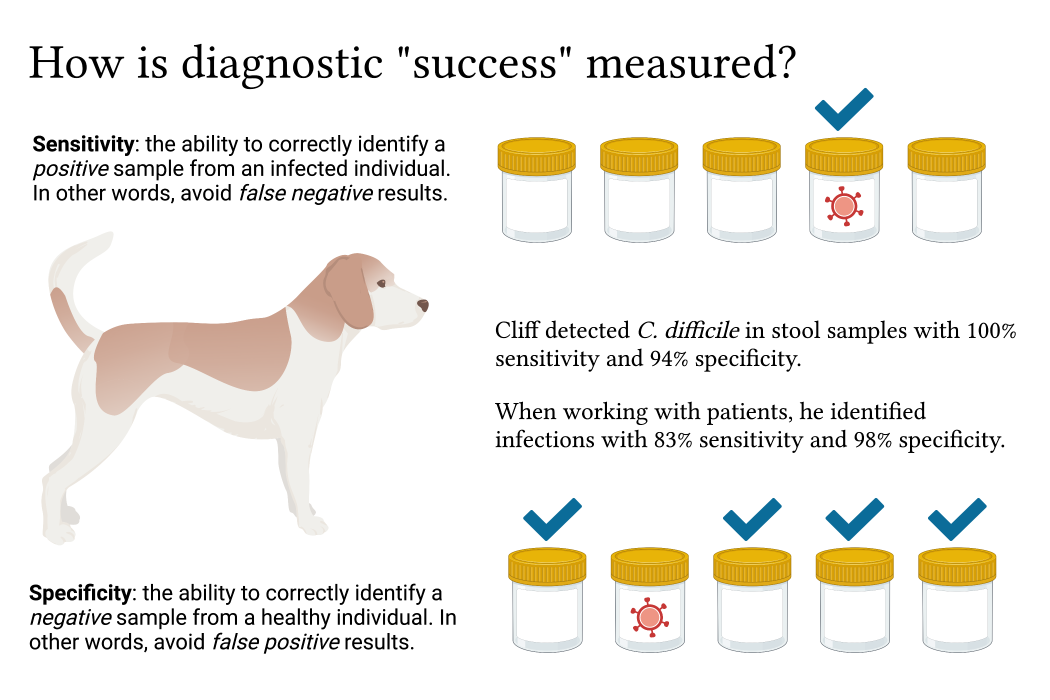
As with all preliminary scientific findings, there is still a need for large-scale, reproducible studies before researchers make broad claims regarding the usefulness of dogs in diagnostics work. The concerns around deploying biomedical detection dogs for COVID-19 testing indicate that dogs may be working with too few samples, or that there is a lot of variability in the success between individual trained dogs. In many previous studies for the detection and diagnosis of infection or disease, the goal was to provide a “proof of principle”, or show that dogs can identify positive samples, rather than run numerous trials with a variety of dogs and patients. While it’s promising that a beagle named Cliff can identify samples contaminated with a bacterial infection at nearly 100% accuracy, does this mean that every trained dog can do the same? Spoiler alert: sadly, no. Scientists are working hard to increase their sample sizes and understand causes of variability in their studies, which could stem from the handlers, patients, or environment.

The image shows a drawing of a beagle on the left, facing two sets of five containers. In each set, one container is marked with a red image of a virus. Text reads: sensitivity: the ability to correctly identify a positive sample from an infected individual. In other words, avoid false negative results. Specificity: the ability to correctly identify a negative sample from a healthy individual. In other words, avoid false positive results. Cliff detected C. difficile in stool samples with 100% sensitivity and 94% specificity. When working with patients, he identified infections with 83% sensitivity and 98% specificity.
Mena Davidson/Created with BioRender.com

However, most of the obstacles to establishing a reliable canine workforce in laboratories and hospitals stem from regulatory challenges–specifically, gaining Food and Drug Administration (FDA) approval of dogs as “medical devices”. Although animals have shown promise in the medical diagnostics field since the early 2000s, the process for getting regulatory approval to deploy them in healthcare settings has been unclear. In their paper in Food and Law Drug Journal, Lawyers Matthew Avery and Makenzi Galvan note that:

because FDA’s regulatory purview covers the manufacture and use of diagnostic devices, animals that perform analogous diagnostic functions should also fall within the scope of FDA’s regulatory authority. Development and commercialization of animal-based diagnostics is likely to be stymied by the uncertainty over how the current regulatory regime for diagnostic tests will be applied to animals.

How is a protocol meant for standard medical equipment such as a defibrillator or blood pressure cuff applied to live animals?

Animals inherently have a level of unpredictability beyond that of electrochemical devices and laboratory assays. Scientists running these studies may be in the dark about effects of the handler’s presence on the dogs, and even the identity of the compound that the animals are detecting and signaling for. This may be part of what makes the dogs so good at their job–they can pick up on volatile compounds that scientists haven’t identified or developed an assay for, and they can do it in real time in many different locations and circumstances. However, it also introduces the possibility that animals may introduce false positives or negatives based on factors that scientists or handlers aren’t aware of, such as a secondary odor based on coexisting conditions, diet, or perfume.

Current regulatory guidelines are unable to handle this variability in test outcomes. Although the current evidence suggests that the use of biomedical scent detection dogs may result in efficient, non-invasive, and cost-effective diagnoses for patients, there are no standardized methods for determining the potential risks of misdiagnoses, which could result in additional unneeded testing or a lack of necessary treatment. Avery and Galvan argue that until this type of method for assessing the efficacy of animal-based diagnostics exists, “there are no guarantees that animal-based diagnostics will increase patient outcomes […].” In other words, because the guidelines for developing and evaluating these types of tests haven’t been written, the FDA is unable to approve them for use. Animals will very rarely, if ever, meet the standards designed to approve medical equipment.

Dog sniffing the used masks on January 18, 2021 in Bolzano, Italy. These dogs are trained to sniff the Covid-19 infections by Molecolar Dog Italy, a company created on the purpose to work with the Bolzano local health organization, the first in Italy to perform this kind of investigations. Masks are put into single paper cups by the students and taken away from the class, then if the dogs sniffs a potential Covid-19 case, he/she crouches in front of the infected cup and the student undergoes a swab to confirm the infection.
Covid-19 detection dog trained by Molecolar Dog Italy sniffing used masks in Bolzano, Italy. Alessio Coser/Getty

The establishment of a new set of guidelines for the approval of biomedical scent detection dogs requires the FDA to write a document that addresses training methods, evaluation of dogs once trained, and the procedures to submit the animal-based diagnostic test for approval. For example, the US Department of Homeland Security (DHS/FEMA) has issued guidelines for the use of dogs in Search and Rescue, and the US Department of Agriculture (USDA/APHIS) has issued a risk assessment for the use of dogs in conservation work. In particular, Search and Rescue dogs must undergo rigorous testing with their handlers, which includes obedience, independent search, alert behavior, and agility. These dogs must be able to quickly and systematically search an area, take directions when searching an area that the handler cannot access, and reliably alert such that handlers can hear the signal when out of sight. Notably, Search and Rescue dogs originated in the 1800s with the well-known and beloved St. Bernard in the Alps, responsible for rescuing over 2,000 people in the treacherous winter conditions of an alpine pass. Although St. Bernards are no longer used for this purpose, the guidelines for this canine profession have continued to improve and expanded to include familiar working breeds such as the labrador retriever, golden retriever, German shepherd, Belgian malinois, and border collie. In comparison to Search and Rescue, biomedical scent detection is still in its infancy.

Biomedical scent detection dogs would require this type of specific training regimen and evaluation for approval to work as part of a medical team. Even without an FDA guidance document, scientists continue to work toward developing their own set of standardized approaches to researching and deploying biomedical scent detection dogs for routine screenings and future pandemics. In Disaster Medicine and Public Health Preparedness, lead author Cynthia M. Otto and colleagues point out the particular advantages to using scent detection dogs for diagnostic testing in the first stages of a pandemic, when a “flexible and rapidly deployable disease screening and testing response” is a necessity for preventing uncontrolled spread. The authors have compiled a list of best practices for biomedical scent detection training, such as the use of “samples obtained from a diversity of people with varying ethnicity, age, gender, concurrent illness that represent the population”, “negative samples from individuals with symptomology similar to the disease in question” such as the common cold or flu, and positive samples from mild and asymptomatic cases.

The authors also outline action items for the future of the biomedical scent detection field, including research support, establishment of standard training procedures and locations, and evidence of beneficial outcomes for the use of dogs in healthcare settings. They conclude that “more research is needed as well as government and community investment into the infrastructure to implement and monitor the effectiveness of this approach.” This final claim gets at the heart of the regulatory issue that scientists face when trying to gain approval for the use of dogs as medical devices–the government and community must buy in and support the use of working dogs in this context. To achieve an FDA guidance document, community members can submit topics for guidance development or pre-written drafts of a suggested guidance. The FDA centers will then determine whether a guidance will be further developed, at which point a selected guidance will be drafted by a special working group, finalized, and issued. In this way, invested community members may work together with the necessary government agencies to progress the establishment of animal-based diagnostic tools such as biomedical scent detection dogs by scientists and healthcare workers.

Scientists are already at the forefront of scent training and animal-based diagnostics–with an FDA guidance document in hand, dogs would be free to enter the healthcare workforce. It may require many more years in the making, but the odds of encountering a working biomedical scent detection dog in a laboratory, hospital, or airport are creeping up. Although we’re all eager to believe that there will be no “next pandemic”, it looks like we’ll be more prepared with canine companions by the sides of healthcare professionals in the future. As the first animals to join the ranks of human society, dogs just keep finding new ways to go above and beyond keeping their end of the deal. As the popular saying goes, “we don’t deserve dogs,” but we sure are lucky to have such good dogs keeping us company.


Support JSTOR Daily! Join our new membership program on Patreon today.

The post Why Aren’t There More Dogs at the Doctor’s Office? appeared first on JSTOR Daily.

17 Mar 00:55

Whoops: Google announced Chrome OS Steam alpha, but it’s not ready yet

by Scharon Harding
Google shared this image during its Games Developer Summit keynote yesterday.

Enlarge / Google shared this image during its Games Developer Summit keynote yesterday. (credit: Google)

Google yesterday said that the "Steam on Chrome OS" alpha had launched, but it turns out that Steam on Chromebooks isn't actually ready for testing.

During the Google for Games developer summit keynote yesterday, Google product director Greg Hartrell said, "The Steam alpha just launched, making this long-time PC game store available on select Chromebooks for users to try." He encouraged people to visit the Chromebook community forum for more information. But at the time, as many noticed, there was no alpha or new information there.

While it may have seemed like a low-key announcement for Steam on Chrome OS, which Google hasn't updated the public on since announcing the Valve partnership in 2020, it turns out that Hartrell misspoke. Steam on Chrome OS is not yet available for testing. It should be soon, however.

Read 3 remaining paragraphs | Comments

16 Mar 14:26

Once again, America is in denial about signs of a fresh Covid wave | Eric Topol

When it comes to Covid, the United States specializes in denialism. Deny the human-to-human transmission of the virus when China’s first cases were publicized in late 2019. Deny that the virus is airborne. Deny the need for boosters across all adult age groups. There are many more examples, but now one stands out – learning from other countries.

In early 2020, with the major outbreak in the Lombardy region of Italy that rapidly and profoundly outstripped hospital resources and medical staffing, Americans expressed confidence that it won’t happen here. That it couldn’t happen here. And then it did.

Fast forward two years of the pandemic: the United Kingdom and Europe have provided five unmistakable warnings to America that a new surge was occurring. Within weeks, each time, the United States experienced a new wave, some not as severe (such as with the Alpha variant), some worse (Delta and Omicron variants). From this Covid track record over two years, it is palpable: what happens in the UK and Europe doesn’t stay in the UK and Europe.

In the past couple of weeks, the UK and several countries in Europe, including Germany, France and Switzerland, are experiencing a new wave. At least 12 countries, geographically extending from Finland to Greece, are experiencing new increases in cases, some quite marked, such as Austria exceeding its pandemic peak, and Finland with an 85% increase from the prior week. Many of these countries are also showing a rise in hospital admissions.

This is the sixth warning from the UK and Europe to the United States.

Indications within the United States support the idea that new wave is already getting started. Wastewater surveillance is relatively sparse in the United States, but 15% of the 410 sites where it was conducted between 24 February to 10 March 2022 showed a greater than 1000% increase compared with the prior 15-day period. Also, the BA.2 variant is gaining steam in the United States and is now accounting for more than 30% of new cases.

The root cause for the new wave is hard to pin down. Certainly, the BA.2 variant is known to have increased transmission, at least about 30% more than its sister lineage, Omicron BA.1. With the concomitant reduction of mitigation restrictions and waning immunity protection of vaccines, that transmission advantage will increase. This “BA.2 triad” of factors is thus hard to dissect, as they are clearly interdependent. Rather than focusing on what precisely is driving the new wave, the imperative is to drive some preventive action.

As with the first five warnings from the UK and Europe, the United States did not take heed. Instead of proactively gearing up with non-pharmaceutical interventions (masks, quality of masks, distancing, air filtration, ventilation, aggressive testing, etc.), it just reacted to the surges when they were manifest. Now we are at a point with very low vaccination and booster rates, only 64% of the populations has had two shots, and 29% three shots. That puts the United States at 65th and 70th in the world ranking of countries, respectively.

Indeed, the people who need protection the most, besides those who are immunocompromised, are the 65-plus group. The US has a booster rate of 65% in this age group, whereas the UK and many European and Asian countries exceed a 90% booster rate for people 65 and over.

This is a critical issue, because there is a substantial dropdown of protection, from 90-95% with a third shot to 75-80% without a booster, versus Omicron hospitalization and death. The problem of lack of adequate vaccination in the United States is compounded by not having any plan for a fourth dose. The Israeli study of over 1 million people age 60 and over showed a 4.3 fold enhanced protection versus severe illness from Omicron compared with those receiving three shots.

Not only is there a gaping hole in our immunity wall, but the $58bn budget of the American Pandemic Prepared Plan (AP3) advanced by the White House to comprehensively address the deficiencies was gutted by the Senate, reduced to $2bn, now threatening to cancel the order of more than 9.2m Paxlovid pills, the Test-to Treat program announced at the State of the Union address, along with better data, wastewater surveillance, efforts to develop a pan-coronavirus vaccine, research on long Covid, and many other critical public health measures.

We haven’t even seen a new, major variant yet, but there are too many reasons to believe that is likely in the months ahead, owing to extensive animal reservoirs and documented cases of spillover to humans, a large number of immunocompromised people in whom the virus can undergo accelerated evolution, rare but increasingly seen co-infections, and lack of containment of the virus globally. That, in itself, requires preparedness. Unfortunately, we have a mindset that the pandemic is over, which couldn’t be further than the truth, as I wrote about in the epidemic of Covid complacency.

Add to all this is what is happening in China, which has fully relied on a zero-Covid policy, resulting in very little natural immunity, and vaccines that have weak efficacy against Omicron. Now this country is facing major outbreaks in two of its most populous cities, Shanghai and Shenzhen, and undoubtedly the whole country will be affected. We learned in 2019 that what happens in China doesn’t stay in China.

The time for American Covid denialism is long past.

16 Mar 11:06

Florida health official put on 2-month leave after urging staff to get vaccine

by Beth Mole
Florida Gov. Ron DeSantis speaks during a press conference before newly appointed state Surgeon General Dr. Joseph Ladapo at Neo City Academy in Kissimmee, Florida.

Enlarge / Florida Gov. Ron DeSantis speaks during a press conference before newly appointed state Surgeon General Dr. Joseph Ladapo at Neo City Academy in Kissimmee, Florida. (credit: Getty | SOPA images)

Florida is allowing its top public health official in Orlando to return to work after a two-month suspension related to an email he sent to his staff noting their abysmal COVID-19 vaccination rate and urging them to get vaccinated.

Dr. Raul Pino, the health administrator for Florida's Orange County, sent the email to public health employees on January 4 as the state was seeing a surge of COVID-19 cases amid the omicron wave of the pandemic. The email noted that less than half of the 568 employees at the county's public health office were fully vaccinated against COVID-19. Only 77 of them had gotten a booster shot, Pino added. He called the staff's vaccination rate "pathetic" and wrote that it was "irresponsible" not to be vaccinated at that point.

“I have a hard time understanding how we can be in public health and not practice it,” he wrote, according to Click Orlando.

Read 4 remaining paragraphs | Comments

16 Mar 11:06

OAN sues AT&T, says being kicked off DirecTV may force it to shut down

by Jon Brodkin
OAN host Dan Ball urges viewers to contact AT&T.

Enlarge / Dan Ball, host of One America News show Real America. (credit: One America News)

One America News might have to shut down because of DirecTV's decision to drop the right-wing network from its channel lineup, OAN said in a lawsuit against DirecTV and its owner AT&T.

DirecTV recently said it will drop OAN after their carriage contract expires in early April. DirecTV will also drop AWE (A Wealth of Entertainment), as OAN and AWE are both owned by Herring Networks. In a lawsuit filed on March 7 and reported by the Daily Beast on Friday, Herring Networks alleged that breach of contract and other violations were committed by AT&T, DirecTV, and AT&T Board Chairman William Kennard.

"As a result of the conduct of AT&T, AT&T Services, DirecTV, and Kennard, OAN and AWE might be forced off the air because Herring will no longer be able to broadcast OAN and AWE via DirecTV and Herring presently has limited alternative carriage options," the lawsuit said. The nonrenewal "will result in damage to Herring exceeding $1 billion" if it isn't reversed, the lawsuit said. The complaint was filed in California Superior Court in San Diego County and seeks both injunctive relief and financial damages.

Read 16 remaining paragraphs | Comments

16 Mar 11:05

Researcher uses Dirty Pipe exploit to fully root a Pixel 6 Pro and Samsung S22

by Dan Goodin
Stylized illustration of a robot holding a smart tablet.

Enlarge (credit: Getty Images)

A researcher has successfully used the critical Dirty Pipe vulnerability in Linux to fully root two models of Android phones—a Pixel 6 Pro and Samsung S22—in a hack that demonstrates the power of exploiting the newly discovered OS flaw.

The researcher chose those two handset models for a good reason: They are two of the few—if not the only—devices known to run Android version 5.10.43, the only release of Google's mobile OS that's vulnerable to Dirty Pipe. Because the LPE, or local privilege escalation, vulnerability wasn't introduced until the recently released version 5.8 of the Linux kernel, the universe of exploitable devices—whether mobile, Internet of Things, or servers and desktops—is relatively small.

Behold, a reverse shell with root privileges

But for devices that do package affected Linux kernel versions, Dirty Pipe offers hackers—both benign and malicious—a platform for bypassing normal security controls and gaining full root control. From there, a malicious app could surreptitiously steal authentication credentials, photos, files, messages, and other sensitive data. As I reported last week, Dirty Pipe is among the most serious Linux threats to be disclosed since 2016, the year another high-severity and easy-to-exploit Linux flaw named Dirty Cow came to light.

Read 14 remaining paragraphs | Comments

16 Mar 11:04

New York Times Begins The ‘Wordle’ IP Purge, Gets ‘Wordle Archive’ Taken Down

by Dark Helmet

There are lots of reasons to have fallen in love with Wordle. The simple nature of the game. The ability to post spoiler-friendly brags for how you did on any given puzzle. The clean design. But here at Techdirt, we obviously became smitten with how Wordle’s creator, Josh Wardle, professed no interest in the ongoing monetization combined with zero interest in wrapping any IP around the game. In fact, the couple of times that other folks out there attempted to build Wordle clones or apps that had similar names and monetize them, Josh handled it all as kindly as possible.

But then Josh sold Wordle to the New York Times. When that happened, we wondered aloud:

It will be interesting to see if suddenly “IP issues” start becoming a bigger deal to the NY Times than they were to the original developer…

Which brings us to the present, a few weeks later, with the New York Times getting ‘Wordle Archive,’ a site to go and play past Wordle puzzles, to “voluntarily” shut down.

Wordle Archive was a service dedicated to the preservation of previous Wordle answers, allowing fans to dip into the backlog and play older puzzles, dating all the way back to the first one. However, the service has since been shut down at the request of the New York Times, as announced by an update on the application’s webpage.

The announcement thanks fans for their interest in the Wordle Archive and thanks them for their feedback throughout its life. It goes on to explain the situation and tell fans that its own original game, Word Grid, is still available for those that are interested in playing something similar. However, it is no longer possible to access that version of Wordle Archive, which many fans have used.

And so it has begun. An app created for others to have some simple and innocent fun by a man who very clearly had no interest in bullying others over intellectual property concerns is now in the hands of a media company that has decided to take the exact opposite route. And this will likely be the first move in a larger conflict, so long as the public backlash doesn’t get the Times to reverse course. There are plenty of other related apps and sites harkening back to Wordle. Will the Times be going after those as well? Probably, yes.

The shutdown does raise questions about similar games and services. In the time since Wordle saw its own explosive popularity, other games with similar mechanics have emerged. One clear example of this is Lewdle, which is essentially Wordle using strictly lewd words. Other similar games have also popped up, using similar restrictions or some other sort of twist on the formula.

And so the legacy of Wordle moves from one of pure enjoyment and care-free fun into the realm of intellectual property enforcement and corporatization.

Yay.

16 Mar 11:03

The Senate just voted to make daylight saving time permanent. Good.

by Brian Resnick
Sunrise in New York City.
If daylight saving time is extended all year long, sunrises and sunset will occur later all year long. | Gary Hershorn/Getty Images

The case against changing clocks is less about extending sunsets later all year and more about staying consistent.

It’s happened: On Tuesday, the US Senate voted unanimously to make daylight saving time permanent beginning in 2023. Perhaps the unambiguous results were influenced by the fact that most of us just turned clocks forward on Sunday, and the disruptiveness of it is still on the lawmakers’ minds.

While in recent years various states have passed pieces of legislation that would extend daylight saving time hours, this vote by the US Senate is the biggest move yet. If the legislation proceeds to the House and then the president, Americans will no longer have to change their clocks twice a year. (It’s not currently clear that the House will take on the legislation at all.)

The benefits of extending daylight saving time all year — or just keeping standard time all year — are more widespread than avoiding the hassle of resetting the clocks (even if many timepieces these days do this automatically).

At most, it could potentially also improve our collective health, and possibly prevent some automobile accidents. It would at least prevent some groaning and hassle as people lose an hour of sleep when daylight saving time starts in the spring. And who wouldn’t want that?

Daylight saving time started to conserve energy. It didn’t work.

Daylight saving time in the US started as an energy conservation trick during World War I and became a national standard in the 1960s. The idea is that in the summer months, we shift the number of daylight hours we get into the evening. So if the sun sets at 8 pm instead of 7 pm, we’d presumably spend less time with the lights on in our homes at night, saving electricity.

It also means that you’re less likely to sleep through daylight hours in the morning since those are shifted an hour later too. Hence “saving” daylight hours for the most productive time of the day.

But this premise never seemed to pan out. The presumed electricity savings of taking advantage of more daylight in the evening turns out to be unclear or nonexistent.

What’s more, not only is daylight saving time ineffective, the name is just confusing.

Daylight saving time — and yes, it’s “saving time” and not “savings time”— begins in the spring, just as the increase in daylight hours starts to be noticeably longer. What’s more, the number of daylight hours that fall upon our vast, beautiful country isn’t affected by the practice. Those are determined by the tilt of Earth’s axis and our planet’s position in its orbit around the sun. And those, we are quite powerless to change.

Extending daylight saving time year-round would mean later sunsets year-round

So if the House and the president actually go through with this, what will change?

Blogger and cartographer Andy Woodruff decided to visualize this with a great series of maps. The goal of these maps is to show how abolishing daylight saving time, extending it all year, or going with the status quo changes the number of days we have “reasonable” sunrise and sunset times.

Reasonable, as defined by Woodruff, is the sun rising at 7 am or earlier or setting after 5 pm (so one could, conceivably, spend some time in the sun before or after work).

This is what the map looks like under the status quo of twice-yearly clock shifts. A lot of people have unreasonable sunrise times (the dark spots) for much of the year:

Daylight saving time as currently observed. Andy Woodruff

Here’s how things would change if daylight saving were abolished (that is, if we just stuck to the time set in the winter all year). It’s better, particularly on the sunrise end:

If daylight saving time were abolished. Andy Woodruff

And here’s what would happen if daylight saving were always in effect. The sunrise situation would actually be worse for most people. But many more people would enjoy after-work light.

If daylight saving time were always in effect. Andy Woodruff

The case for consistency

Individuals might differ on which of the above maps they prefer. But it matters less whether we keep daylight saving time year-round or abolish it completely; the real benefits come from not flip-flopping back and forth twice a year.

It’s more this: Sleep scientists continually advocate that, for optimal health, people should stick to the same sleep schedule every night, going to bed and waking at the same hours each day. When we shift clocks forward one hour in the spring, many of us will lose that hour of sleep. In the days after daylight saving time starts, our biological clocks are a little bit off. It’s like the whole country has been given an hour of jet lag.

One hour of lost sleep sounds like a small change, but we humans are fragile, sensitive animals. Jet lag can mess with our metabolism; extreme versions of it can contribute to diabetes or obesity. But in the short term, jet lag dulls our mental edge.

And when our biological clocks are off, everything about us is out of sync. Our bodies run this tight schedule to try to keep up with our actions. Since we usually eat a meal after waking up, we produce the most insulin in the morning. We’re primed to metabolize breakfast before even taking a bite. It’s more efficient that way.

Being an hour off schedule means our bodies are not prepared for our actions at any time of the day.

One example: driving.

In 1999, researchers at Johns Hopkins and Stanford universities wanted to find out what happens on the road when millions of drivers have their sleep disrupted.

Analyzing 21 years of fatal car crash data from the US National Highway Transportation Safety Administration, they found a very small but significant increase in road deaths on the Monday after the clock shift in the spring: The number of deadly accidents jumped to an average of 83.5 on the “spring forward” Monday compared with an average of 78.2 on a typical Monday.

And it seems it’s not just car accidents. Evidence has also mounted of an increase in incidences of workplace injuries and heart attacks in the days after we spring forward.

Many Americans might not welcome extending daylight saving all year. There was a year in the 1970s when daylight saving time lasted for 16 months, and not everyone was pleased. Polling at the time found that just 30 percent of Americans approved of the change after it began. According to the Washington Post, “parents were suddenly sending their kids to school in the cold and the dark for months on end,” which drove the negative sentiment.

But for those thinking “I don’t want later sunset times all year long!” or “I don’t want to start my day in the winter amid darkness!” know that it’s always been possible for our society to just ... gradually change school or work start times depending on the season.

16 Mar 10:59

NameGrapher to explore past baby name trends

by Nathan Yau

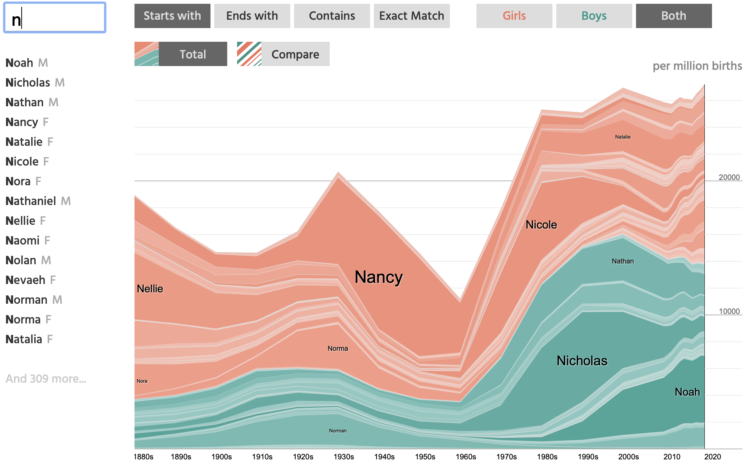
NameGrapher is an interactive chart that lets you explore historical trends for baby names in the United States. Search for a name, and the chart updates as you enter more letters.

The chart is from Martin and Laura Wattenberg, and if it looks familiar to you, it’s because it’s an updated version of the now defunct NameVoyager they made in 2005. The new version, which also uses a stacked area chart to show name totals for boys and girls over time, also provides a few more search options and lets you compare multiple time series at once.

I’m glad it’s back. The NameVoyager was one of the first visualizations I ever saw, and it felt like something special was lost when the site shut down.

Tags: baby names, Laura Wattenberg, Martin Wattenberg

15 Mar 17:15

The US Tried Permanent Daylight Saving Time in the ’70s. People Hated It

by Andrew Beaujon
The sun rose at 8:27 AM on January 7, 1974. Children in the Washington area had left for school in the dark that morning, thanks to a new national experiment during a wrenching energy crisis: most of the US went to year-round daylight saving time beginning on January 6. “It was jet black” outside when […]
15 Mar 17:14

Tesla hikes prices on all cars, with cheapest Model 3 now nearing $50K

by Tim De Chant
Tesla Model 3.

Enlarge / Tesla Model 3. (credit: Salwan Georges/The Washington Post)

Tesla raised prices last night on every model it sells. The move comes just a week after the company increased prices for its long-range battery packs by $1,000. The new increase means that the cheapest Tesla, a Model 3 with rear-wheel drive, now costs $46,990 before taxes and fees, a jump of $2,000.

CEO Elon Musk tweeted that the company is “seeing significant recent inflation pressure in raw materials and logistics.” Prices are up in several sectors of the economy, of course, though economists are debating what is driving them higher. For electric vehicles like Teslas, the main culprits today could be nickel and cobalt prices, which have shot through the roof in recent weeks, though Tesla has also made a habit of increasing prices in recent months.

Both nickel and cobalt are key elements in the lithium-ion batteries commonly used in today’s EVs. Nickel helps boost a cell's energy density, while cobalt stabilizes the microscopic structure. Battery chemistries that use the metals are often referred to according to the proportion of metals they use. A common one is NMC, which stands for nickel, manganese, and cobalt, while Teslas often use NCA, or nickel-cobalt-aluminum. Tesla doesn't disclose its NCA ratio, but other companies use NMC chemistries with ratios of 8-1-1, 6-2-2, or 5-3-2.

Read 7 remaining paragraphs | Comments

15 Mar 15:38

Ford ships Explorers without chips for rear-seat HVAC controls

by Tim De Chant
Cars on an assembly line.

Enlarge / A Ford Explorer sports utility vehicle (SUV) sits for a final inspection at the Ford Motor Co. Chicago Assembly Plant in Chicago on Monday, June 24, 2019. (credit: Daniel Acker / Bloomberg)

Ford’s new Explorer has had a rocky few years. Its rushed initial launch was marred by production problems that resulted in several recalls. When the chip shortage hit, Ford idled the Chicago Assembly Plant for four weeks last July and for another week in February.

Now, the chip shortage has struck the Explorer again, this time in the back seat. Ford has said that it will be shipping Explorers without rear-seat heating and air conditioning controls because the company doesn’t have semiconductors on hand, according to a report in Automotive News.

The rear HVAC can still be controlled by the driver or front-seat passenger, but those being chauffeured around will have to voice their requests rather than tap them in. (Parents may see this as a feature or a bug, depending on their children.)

Read 7 remaining paragraphs | Comments

15 Mar 15:37

Fourth shot “is necessary” Pfizer CEO says as experts monitor BA.2

by Beth Mole
A man in an open-collared suit addresses a woman in a matching chair.

Enlarge / Pfizer Chairman and CEO Dr. Albert Bourla speaks onstage at the 2022 SXSW Conference at JW Marriott Austin on March 14, 2022, in Austin. (credit: Getty | Chris Saucedo)

While US health experts closely monitor upticks of COVID-19 cases in Europe as well as the global rise of the omicron subvariant BA.2, Pfizer is renewing calls for fourth doses of COVID-19 vaccine.

In an interview Sunday on CBS' Face the Nation, Pfizer CEO Albert Bourla said that a fourth dose—aka a second booster—is "necessary."

"The protection what we are getting from the third [doses], it is good enough—actually, quite good for hospitalizations and deaths," Dr. Bourla said. But, "it's not that good against infections" with omicron, and "it doesn't last very long." He reported that Pfizer is "working very diligently" to come up with a new dose that will protect against all variants and provide longer-lasting protection.

Read 8 remaining paragraphs | Comments

15 Mar 11:48

Police Block Highway Exits as Trucker Convoy Rolls Up I-395

by Andrew Beaujon
A convoy of truckers and others who oppose President Biden, vaccine mandates, and lots of other stuff got off the Capital Beltway Monday and drove up I-395 toward downtown DC, where police say they’ve closed roads and exits into downtown. They're here. Truck convoy on I-395N just before the 14th Street Bridge. Quite loud. Police […]
14 Mar 17:22

Cops Have So Much Extra Military Gear They’re Giving It Away To Ukraine Freedom Fighters

by Tim Cushing

Cops love military gear. For years, they’ve cultivated a mindset that pits them against the public in a war against crime — a “war” that justifies any collateral damage to the public and its trust in its protectors. The federal government has embraced this combative stance, handing out excess military gear to law enforcement agencies, provided they’re willing to say things about “terrorism” or “war on drugs.”

This transfer of military power costs nearly nothing (if you don’t count the public’s trust… and really, nobody in law enforcement thinks that’s worth tabulating). If you’ve got a self-proclaimed war on your hands, the only solution is war gear. And it’s all free — “free” as in “taxpayers’ lunches” and “from accountability.” US war machines march on, overly-outfitted by US military surplus efforts that give small town agencies a chance to play God of War on their home turf.

Now that the Russian government has turned seemingly the entire world against it, US police agencies are pitching in to help war efforts that don’t involve raiding the wrong address to recover minimal amounts of marijuana. Ukraine’s government has been asking for help and cops are stepping up to contribute. If you’ve already obtained it for free and found it’s far more than is actually needed to engage in local law enforcement efforts, why not give it to an entity far more deserving of US military largesse?

Law enforcement agencies in several states have all announced in recent days that they’re donating dozens of pieces of body armor, such as ballistic helmets and vests. Some of the departments and their respective local partners—one of which is a top defense contractor with U.S. and Ukrainian government contracts—say the donations will be distributed to Ukrainian citizens under siege by the Russian military. 

Please hold your applause. Forever.

These aren’t agencies sacrificing gear needed by their own officers for the greater good. These are agencies giving away excess military gear they don’t actually need but were able to acquire because oversight of this Defense Department program is almost nonexistent. And, in some cases, what’s being given away might be useless, if not actually dangerous.

The Vice report quotes the Colorado Department of Safety, which states the 80 sets of body armor and 750 helmets being sent to Ukraine are “beyond life cycle.” Meanwhile, in Pennsylvania, donations include bulletproof vests that are “no longer under warranty.” It’s the law enforcement equivalent of asking the poor to get by on donated cans of pumpkin pie filling and lima beans. Sure, the bags weigh a lot, but what purpose do the donations serve?

In other cases, agencies are donating military uniforms, which are slightly more useful in combat situations (and have no expiration date) but raise questions as to why law enforcement agencies have them in the first place. They’re not members of the US military. So why are they able — with the DoD’s blessing — to dress like they are?

While it’s true this military surplus will probably be both appreciated and somewhat useful, the donations raise even more questions about the Defense Department’s 1033 program and the seemingly-excessive amount of military gear police departments can acquire with little to no effort or justification.

And there’s no oversight of this transfer of military equipment, despite the fact it’s being handled by a federal contractor. No one appears to know whether this is legal or not and the Defense Department has flatly stated it has neither asked nor encouraged law enforcement agencies to redistribute goods acquired through its 1033 program.

That vendor is a Sarasota-based Global Ordnance, a defense contractor and commercial arms and equipment distributor, whose sales reached nearly $200 million in 2020.  Along with its subsidiary Global Military Products (GMP), the company has won at least a half-billion dollars in Defense Department contracts over the past decade, according to USAspending.gov, the Treasury Department’s government spending tracker. The company also signed a “cooperation agreement” with Ukrainian state-owned defense conglomerate Ukroboronprom last September worth up to $500 million. 

Global Ordnance vice president for human resources Carrie Morales told VICE News that the equipment wasn’t requested by the Pentagon, but that the company has “a lot of people in Ukraine and other parts of Eastern Europe” and that the donation is part of the company’s “humanitarian efforts.”

While it’s admirable US law enforcement agencies are pitching in to help stop an authoritarian from erecting USSR v. 2.0, these charitable contributions are highlighting questions that demand answers from the Defense Department and its downstream beneficiaries. Why are cops getting so much gear that they have no problem giving it away? And why are they still in possession of so much outdated gear — something that could prove fatal for officers who think they’re protected by the best the US military has to offer? And if these contributions fail to protect Ukraine recipients, who is at fault? If Congress isn’t willing to take a closer look at this, expect “caveat emptor” to usurp accountability for these well-meaning, but possibly harmful, donations.

14 Mar 14:17

Google “hijacked millions of customers and orders” from restaurants, lawsuit says

by Tim De Chant
Google “hijacked millions of customers and orders” from restaurants, lawsuit says

Enlarge

Google is being sued by a Florida restaurant group alleging that the tech company has been setting up unauthorized pages to capture food orders rather than directing them to the restaurant’s own site.

Google uses “bait-and-switch” tactics to get customers to place takeout or pickup orders through “new, unauthorized, and deceptively branded webpages,” according to the lawsuit, filed on behalf of Left Field Holdings, a restaurant company that runs Lime Fresh Mexican Grill franchises. On those pages, customers are prompted with large buttons to order with food delivery companies like GrubHub, DoorDash, or Seamless.

“Google never bothered to obtain permission from the restaurants to sell their products online,” the lawsuit says. “Google purposefully designed its websites to appear to the user to be offered, sponsored, and approved by the restaurant, when they are not—a tactic, no doubt, employed by Google to increase orders and clicks.”

Read 10 remaining paragraphs | Comments

14 Mar 14:16

Big ISPs Avoided 2020 Law Banning Predatory Modem ‘Rental’ Fees By Simply Calling Them… Something Else

by Karl Bode

When you’re a natural telecom monopoly in America you get away with a lot.

Take for example broadband ISP Frontier Communications, which has spent the last few years stumbling in and out of bankruptcy while dodging no shortage of scandals, including allegations of subsidy fraud. A few years back, Frontier got a light wrist slap for fraudulently charging its customers a “rental” fee for modems they already owned (something ISPs like Comcast also have a long history with).

The company also paid a tiny $900,000 fine in 2020 to Washington State AG Bob Ferguson for using other completely bogus fees to rip off the company’s captive subscriber base. The problem was bad enough that Congress even passed a law (the Television Viewer Protection Act (TVPA)) specifically banning companies from charging you rental fees for things you already own.

Two years later, and Consumer Reports has found that most ISPs are just tap dancing around the law’s restrictions. In some cases by simply renaming the surcharge… something else:

“Frontier FiOS used to charge me a router fee, although I have my own router. Now they don’t have that explicit fee, but they do charge an ‘Internet Infrastructure Surcharge’ ($6.99) and a ‘Frontier Secure Personal Security Bundle’ ($5.99 after ‘discount’),” a customer in Torrance, California, wrote.

So while Frontier did remove one predatory fee, they simply replaced it with another, bullshit, predatory fee they’d already been fined for by State AGs:

“After the router fee was made illegal by the act of Congress, I quickly called up Frontier to have the fee removed, which they did going forward,” wrote a customer in Flower Mound, Texas. “However, a few months later, Frontier increased their infrastructure charge (another bogus fee) about $3 or $4 if I recall correctly. So in my mind, Frontier did a bait and switch and is just trying to play the bogus fee game but not calling it a router fee any longer.”

The 2020 bill banning the practice had to be hidden in a broader legislative package to make it past a corrupt Congress and be signed by Trump (who I’d guarantee had no idea it existed). And now that it’s formally a law, the FCC under Democratic control is dithering and engaging in a drawn out public comment period before acting on what’s very obvious billing fraud and false advertising.

When the agency does act, it will culminate in a fee that’s a tiny, tiny fraction of the money Frontier made off of predatory fees. A fee that, if history serves, may be reduced or eliminated entirely with some clever lawyering. And this is just one subset of fees. Studies have shown up to 45% of cable and broadband bills are comprised of bullshit, sneaky fees with completely made up names.

This has been a problem in the industry for decades, with ISPs like Centurylink (now Lumen) and at one point charging users a completely made-up “Internet Cost Recovery Surcharge” just to fatten their wallet. Other ISPs charge “regulatory recovery fees” that are just nonsensical ways to fatten revenue dressed up with a name to trick users into falsely blaming government.

The fees serve several functions: one, they allow ISPs and cable companies to advertise one price, then charge consumers a much higher rate. They also allow ISPs to pretend that broadband prices aren’t increasing, because they can point to their static advertised rate. They’re used to help feed Wall Street an insatiable need for quarter over quarter improvements, while doing nothing to better service.

The underlying problem is that, with the occasional exception, U.S. regulators and politicians generally approve of using bullshit fees to rip off consumers. They’re rampant in everything from telecom and banking to the airline and hotel industries. When the occasional policymaker with a backbone does act, it’s always years late and several billion dollars short of having any meaningful impact.

This is, of course, a feature and not a bug.

14 Mar 13:08

A new Supreme Court case allows the justices to fix one of their worst anti-worker decisions

by Ian Millhiser
The US Supreme Court and the Authority of Law Statue in Washington, DC, on February 21. | Stefani Reynolds/AFP via Getty Images

Circuit City v. Adams is one of the most indefensible decisions of the modern era. Its shadow hangs over the Court this month.

Laws mean nothing if they cannot be enforced against people who violate them, which is why there is an entire branch of government — the judiciary — whose job is supposed to be applying the law to individual cases. But at least when it comes to employment law, the Supreme Court has spent the last two decades permitting most employers to immunize themselves from lawsuits through a practice known as “forced arbitration.”

Forced arbitration allows an employer to order its workers to sign away their right to sue the company, or lose their jobs. Instead, any disputes must be resolved in a private arbitration process that gives extraordinary advantages to corporate parties over individuals. (Forced arbitration is also very common in ordinary consumer transactions, but your bank or cellphone company can only refuse to do business with you if you refuse arbitration. Your boss can most likely fire you.)

In the final two weeks of March, the Supreme Court will hear three cases asking just how much power companies have to force their workers into arbitration.

The first two, Morgan v. Sundance and Viking River Cruises v. Moriana, are fairly narrow. But the third case, Southwest Airlines Co. v. Saxon, involves one of the original sins of the Court’s forced arbitration jurisprudence. The Federal Arbitration Act of 1925, the statute the Court relies on in forced arbitration cases, explicitly exempts “workers engaged in foreign or interstate commerce.” But, in Circuit City v. Adams (2001), a 5-4 Court held that most workers engaged in foreign or interstate commerce can be forced into arbitration.

The issue now before the Court in Saxon is whether workers who load and unload cargo from airplanes count among the rare workers who are not vulnerable to forced arbitration under Circuit City. Under existing law, answering this question is needlessly complicated — although it is worth noting that a Trump-appointed judge wrote the lower court’s opinion holding that these workers are not subject to forced arbitration.

But if the Court actually followed the text of the Arbitration Act, then this wouldn’t be a difficult case at all. Indeed, if the Court cared about what the Arbitration Act actually says, none of its decisions enabling forced arbitration would apply to workers.

Forced arbitration hurts workers

Congress enacted the Arbitration Act to, in the late Justice Ruth Bader Ginsburg’s words, permit “merchants with relatively equal bargaining power” to resolve disputes through private arbitration. And, when used by parties with relatively equal power, arbitration is benign and can even be beneficial. Resolving a dispute through arbitration can be quicker and less expensive, and merchants within a particular industry can select an arbitrator who is more familiar with that industry than most judges.

Starting in the 1980s, however, the Court started to read the Arbitration Act to permit companies to require ordinary consumers and employees to agree to arbitration as a condition of doing business with that company. Under Circuit City and Epic Systems v. Lewis (2018), an employer can order an employee to agree to forced arbitration or else immediately be fired.

Employers, moreover, have powerful incentives to do so. A 2015 study of forced arbitration in the workplace, for example, found that workers are a little more than half as likely to prevail before an arbiter as they are to prevail in litigation against their employer.

And when workers do prevail in arbitration, they are typically awarded about a fifth as much money as a worker who prevails before a judge.

There may be some instances where workers would prefer arbitration to litigation. Arbitration is common in unionized workplaces, for example, in part because the union can help ensure that a fair and impartial arbitrator will be selected to hear a dispute. And opponents of forced arbitration typically do not object to agreements to arbitrate a dispute after that dispute arises — a new federal law prohibiting forced arbitration in sexual misconduct cases, for example, targets “predispute” arbitration provisions where workers are often forced to sign away their right to sue before they are even contemplating legal action against their employer.

But there’s a reason many employers try to force workers into arbitration before a dispute arises. When workers are forced into arbitration, their employers are far less likely to suffer meaningful consequences if they break the law.

Circuit City is egregiously wrong

To understand why the Court’s decisions allowing workers to be exploited in this way are wrong, it helps to be familiar with two provisions of the Arbitration Act and a small amount of constitutional history — and specifically how the Supreme Court has changed its interpretation of the word “commerce” over time.

The first relevant provision says that an agreement to arbitrate disputes typically shall be “valid, irrevocable, and enforceable.” Importantly, this provision only applies to contracts pertaining to a “transaction involving commerce.”

The second relevant provision is the one exempting workers from the Arbitration Act. It provides that “nothing herein contained shall apply to contracts of employment of seamen, railroad employees, or any other class of workers engaged in foreign or interstate commerce.” Notice that this language also uses the word “commerce.”

The word “commerce” also appears in one of the most important provisions of the Constitution — a provision that permits Congress to “regulate commerce ... among the several states.” This is the constitutional provision that gives Congress much of its authority to regulate private businesses.

But the scope of Congress’s power over interstate commerce, and the proper meaning of the word “commerce” itself, has historically been one of the most contentious questions in American law.

Beginning in the late 1800s, conservative Supreme Court justices started reading the word “commerce” very narrowly. Under this now-discredited reading of the Constitution, the power to regulate interstate “commerce” included the power to regulate the transportation of goods across state lines, but it did not include the power to regulate manufacturing, agriculture, or other methods of producing these goods.

The Court abandoned this narrow reading of the word “commerce” in 1937, however. Under the modern reading of the Constitution, Congress’s authority to regulate commerce extends broadly to all “activities that substantially affect interstate commerce.”

Recall, however, that the Arbitration Act was enacted in 1925, when the antiquated reading of the Commerce Clause was still ascendant. Thus, as the Arbitration Act was originally understood, it did not apply at all to employment contracts involving workers engaged in manufacturing, agriculture, or anything else other than the transit of goods (and people) across state lines.

Again, the Arbitration Act only extends to contracts “involving commerce.” And in 1925, that word was understood quite narrowly.

This historical understanding of the word “commerce” also explains why the Arbitration Act exempts “seamen, railroad employees, or any other class of workers engaged in foreign or interstate commerce.” This provision broadly exempts all workers who were understood to be subject to congressional regulation in 1925.

Indeed, this is the best way to read the Arbitration Act. The Congress that enacted the law in 1925 couldn’t possibly have known that the Supreme Court would shift its understanding of the word “commerce” a dozen years later. And the lawmakers who voted for the Arbitration Act most definitely could not have anticipated that, 76 years after the Act became law, the Supreme Court would abruptly decide to apply it to all workers.

Even if the Arbitration Act is read anachronistically — giving the word “commerce” its modern definition and not the definition that prevailed in 1925 — the law still should be read to exempt all workers.

Under this anachronistic reading, the reference to contracts “involving commerce” must be read quite broadly — broad enough to encompass nearly every workplace in the United States. But, under the modern reading of the word “commerce,” the exemption for “workers engaged in foreign or interstate commerce” must also be read just as broadly to encompass every employee of these workplaces.

The point is that, in either reading of the word “commerce,” the Arbitration Act must be read to exempt all employment contracts. If the Act is broad enough to encompass nearly all workplaces, then so is the provision exempting “workers engaged in foreign or interstate commerce.”

Circuit City’s error is that it did not apply a consistent reading of the word “commerce” to the entire Arbitration Act. It read the provision stating that the Arbitration Act applies to any contract “involving commerce” using the modern understanding of the word “commerce,” extending the scope of the law to nearly every workplace in the nation.

But Circuit City also read the provision exempting “workers engaged in foreign or interstate commerce” using the antiquated meaning of the word, ensuring that only workers engaged in the transit of goods would be exempted.

By changing the definition of the word “commerce” midway through the statute, the Court’s conservative majority effectively rewrote a narrow federal statute with a broad exemption for all workers, and turned it into a broad federal statute with a narrow exemption for only some workers.

Circuit City makes an easy case needlessly difficult

The particular question in Saxon, the case currently pending before the Supreme Court, involves Latrice Saxon, a supervisor for Southwest Airlines who manages workers who load and unload cargo onto airplanes that travel across state lines. Her job also sometimes requires her to load and unload that cargo herself.

Saxon, in other words, does not actually transport goods across state lines. But she does do work that makes it possible for her employer to transport goods across state lines. So, under Circuit City’s mangled understanding of the Arbitration Act, Saxon is an edge case. It is not immediately clear if Saxon qualifies as a worker “engaged in foreign or interstate commerce” under the extremely narrow definition of those words embraced by five justices in Circuit City.

A federal appeals court determined that Saxon does qualify as a worker engaged in interstate commerce under Circuit City — though, notably, the lower court placed great significance on the fact that Saxon herself spends a considerable amount of time loading and unloading cargo. The lower court concluded that this would be a much harder case if Saxon merely supervised other workers who perform the physical act of placing cargo on airplanes and removing other cargo.

And it would be; one of the many reasons the Court abandoned the antiquated definition of the word “commerce” in the 1930s is because it’s really not possible to draw a clear line between workers who transport goods and workers who do other forms of labor.

What about a human resources manager who hires and fires workers who load cargo onto planes, but who never actually loads cargo themselves? How about a dispatcher who assigns truck drivers to transport goods across state lines, but who never actually drives a truck themselves? How about a factory worker who loads goods into crates, so that those crates can then be loaded onto airplanes? What about a corporate executive who oversees a company that earns 2 percent of its profits from transporting goods across state lines? Or an insurance salesperson who sells policies to airlines which insure cargo that travels across state lines?

There aren’t really clear answers to any of these questions under the fabricated legal rule the Court invented in Circuit City. So long as Circuit City remains good law, judges will necessarily have to draw arbitrary lines between workers deemed to be close enough to the transit of goods to keep all their legal rights intact, and workers deemed so far removed from such transit that they are vulnerable to forced arbitration.

This is a bad way to do law. The better approach is to overrule Circuit City, and to interpret the Arbitration Act as it was written.

Saxon offers the Court a chance to do so, although Republican justices have historically been great fans of forced arbitration, so that outcome is unlikely.

There still is a good chance that even this Court will hold that Saxon is not subject to forced arbitration. But if the Court rules narrowly, future judges will undoubtedly be forced to make arbitrary decisions about who is exempt from the Arbitration Act.

13 Mar 13:11

Delta-omicron recombinant virus no reason for panic, health experts say

by Beth Mole
Transmission electron micrograph of a SARS-CoV-2 virus particle isolated from a patient sample and cultivated in cell culture.

Enlarge / Transmission electron micrograph of a SARS-CoV-2 virus particle isolated from a patient sample and cultivated in cell culture. (credit: Getty | BSIP)

Researchers in France have reported the first compelling genetic evidence of a recombinant SARS-CoV-2 virus that contains elements of both the omicron coronavirus variant and the delta variant. However, health experts at the World Health Organization and elsewhere have been quick to note that such a recombinant virus is expected to arise and, so far, there's no reason to be worried about the hybrid.

The delta-omicron recombinant—a combination of the delta AY.4 subvariant's backbone and the omicron BA.1 subvariant's spike protein—has been circulating at very low levels since at least early January 2022 in France. Researchers have also reported a smattering of cases in Denmark, Germany, and the Netherlands. So far, epidemiology data on the recombinant's spread does not raise any red flags, and the variant does not appear to cause more severe disease, according to WHO technical lead Maria Van Kerkhove, who addressed the variant in a press briefing this week. However, researchers are in the process of conducting more studies on the recombinant and will be monitoring it closely, as the organization does with other new variants, she noted.

Coronaviruses are known to recombine, and researchers fully expected that such recombinant SARS-CoV-2 viruses would crop up from time to time. Generally, recombination can happen when two variants infect one person at the same time and invade the same cells. In this scenario, the cellular machinery that viruses hijack to make clones of themselves can sometimes abruptly switch from translating the genetic code of one of the variants to the code of the other, resulting in a mosaic virus.

Read 4 remaining paragraphs | Comments

11 Mar 20:01

PG&E will pilot bidirectional electric car charging in California

by Jonathan M. Gitlin
A woman charges an electric car

Enlarge / If you're going to charge your car at home, why not also use it as a storage battery when it's just parked there? (credit: Monty Rakusen/Getty Images)

Disaster preparedness is becoming a bit more mainstream as the effects of climate change and the fallibility of human institutions become more clear. The auto industry has followed this trend, with more than one automaker pointing to the fact that an electric vehicle is essentially a giant backup battery that could power your home for a few days in the event of an emergency.

Now, Pacific Gas and Electric (PG&E) will begin testing bidirectional charging in California with new pilot programs announced this week at General Motors and Ford.

Bidirectional charging got its first big boost after the 2011 Tōhoku-Oki earthquake, and in 2017, Nissan told Ars that several thousand EV-to-grid installations had already been completed in Japan. But at the time, the company had no immediate plans to enable the function here in the US. Since then, Nissan has conducted other vehicle-to-grid experiments, such as powering a convenience store.

Read 3 remaining paragraphs | Comments

11 Mar 19:33

WHO, US worry Ukrainian biological lab samples could spill, go to Russians

by Beth Mole
A health care worker carries test tubes while on duty in the bacteriological laboratory at the Lviv Regional Laboratory Centre of the State Sanitary and Epidemiological Service, Lviv, western Ukraine.

Enlarge / A health care worker carries test tubes while on duty in the bacteriological laboratory at the Lviv Regional Laboratory Centre of the State Sanitary and Epidemiological Service, Lviv, western Ukraine. (credit: Getty | Future Publishing)

The World Health Organization has advised officials in Ukraine to destroy any high-risk pathogens housed in public health laboratories in order to prevent their release amid the Russian onslaught, according to a report by Reuters.

The agency said that it has worked with Ukrainian officials for years to promote security practices at its laboratories to prevent "accidental or deliberate release of pathogens." As part of that longstanding work, "WHO has strongly recommended to the Ministry of Health in Ukraine and other responsible bodies to destroy high-threat pathogens to prevent any potential spills," the agency said in an email to Reuters. The WHO did not clarify when it made that recommendation or if it was carried out.

The news follows Senate testimony on Tuesday by Victoria Nuland, US Undersecretary of State for Political Affairs, who said that the US is "quite concerned" that Russian troops will seek out Ukraine's biological research laboratories to seize control of any potentially dangerous samples.

Read 6 remaining paragraphs | Comments

11 Mar 19:31

COVID ups risks of dementia, cognitive impairment, and decline in older survivors

by Beth Mole
Health care workers treat a COVID-19 patient at Hartford Hospital in Hartford, Connecticut, on Monday, Jan. 31, 2022. Photographer: Allison Dinner/Bloomberg via Getty Images.

Enlarge / Health care workers treat a COVID-19 patient at Hartford Hospital in Hartford, Connecticut, on Monday, Jan. 31, 2022. Photographer: Allison Dinner/Bloomberg via Getty Images. (credit: Getty| Bloomberg)

People over 60 who survive COVID-19 have higher risks of dementia, mild cognitive impairment, and cognitive decline—particularly if they had severe COVID-19—according to a study out this week in JAMA Neurology.

The study followed over 1,400 older COVID survivors in Wuhan, China, who were among some of the first people in the world to be hospitalized for COVID-19. The patients were discharged between February 10 and April 10, 2020, from three COVID-19–designated hospitals in Wuhan. Researchers followed their neurological health for a full year afterward.

Their experiences in that year do not bode well for the rest of the world. The study authors, led by neurologist Yan-Jiang Wang of the Third Military Medical University, found that long-term cognitive decline is common after an infection with the pandemic coronavirus, SARS-CoV-2. As such, health care systems around the world need to prepare for what could be a substantial increase in the number of people requiring dementia care.

Read 9 remaining paragraphs | Comments

11 Mar 19:29

Router and modem rental fees still a major annoyance despite new US law

by Jon Brodkin
Network cables plugged into a modem.

Enlarge (credit: Getty Images | Jill Ferry Photography)

Consumer Reports wants the Federal Communications Commission to take a closer look at whether Internet service providers are complying with a US law that prohibits them from charging hardware rental fees when customers use their own equipment. In a filing submitted to the FCC this week, Consumer Reports said it asked members about their Internet bills and got over 350 responses, with some suggesting violations of either the letter or spirit of the law.

"Some contain allegations that the law is being violated, whereas others state the new statute is being respected. Many more stories suggest that ISPs dissuade consumers from using their own equipment, typically by refusing to troubleshoot any service disruptions if consumers opt not to rent the ISP's devices. Such practices result in de facto situations where consumers feel pressured or forced to rent equipment that they would prefer to own instead," Consumer Reports told the FCC.

Consumer Reports' filing came in response to the FCC asking for public comment on the implementation of the Television Viewer Protection Act (TVPA), which took effect in December 2020. In addition to price-transparency rules for TV service, the law prohibited TV and broadband providers from charging rental or lease fees when "the provider has not provided the equipment to the consumer; or the consumer has returned the equipment to the provider."

Read 21 remaining paragraphs | Comments

11 Mar 19:25

Farmers Unions, Right To Repair Coalition Files FTC Complaint Against John Deere

by Karl Bode

Not only have corporate efforts to monopolize repair resulted in a flood of proposed state and federal laws, the idea was also included in the Biden Administration’s recent executive order on monopoly power and competition. Said order urged the FTC to tighten up its rules on repair monopolization efforts, whether it’s ham-fisted DRM, or making repair manuals, parts, and diagnostics hard to come by.

At the receiving end of much of the movement’s ire has been John Deere, whose draconian repair restrictions on agricultural equipment often result in customers having to pay an arm and a leg to get their tractors repaired. Promises by the company to improve things haven’t materialized, resulting in the company getting hit with numerous, simultaneous lawsuits.

Last week, a coalition of right to repair advocates, hand in hand with several farmers unions, filed their first formal complaint with the FTC, putting the agency’s recent promises to the test:

“While historically Deere has outcompeted rivals to win farmers’ and ranchers’ business, in recent years it has resorted to leveraging its monopoly power in the market for large agricultural equipment to dominate the repair market for its equipment,” the complaint says. “

A farmer who purchases Deere equipment today may not realize that Deere, under the guise of technological advancement, has made it impossible for farmers to make important repairs themselves or to go to an independent repair shop. Even where purchasers of Deere equipment are aware that Deere requires important repairs to be performed only by Deere-authorized technicians, Deere’s market dominance leaves these purchasers little to no choice but to submit to Deere’s terms.”

The repair asks the FTC to formally acknowledge that John Deere has attempted to monopolize repair through the combination of restrictive, unnecessary DRM and its exclusive repair network, which often forces rural tractor owners to travel hundreds of miles simply to repair their own equipment.

A recent report by US PIRG found that mass consolidation in dealerships has resulted in one dealership chain for every 12,018 farms and every 5.3 million acres of American farmland. That consolidation is clearly by design, and part of the company’s attempts to force Americans to pay significantly more money to repair essential equipment.

Recognizing that this movement isn’t going anywhere and hoping to avoid legislation forcing their hand, several companies like Apple have slowly backed away some of their harsher repair restrictions. Companies that continue to force the issue simply find they’ve driven additional support to a movement that quickly shifted from niche nerd fare to the mainstream.

10 Mar 13:41

The toll Russia’s war is taking on Ukrainian civilians, in photos

by Bita Honarvar
Marina Yatsko and her boyfriend Fedor grieve in a Mariupol, Ukraine, hospital after medical staff were not able to save her 18-month-old, Kirill, who was killed by shelling on March 4. | Evgeniy Maloletka/AP

Russian bombing destroyed a maternity hospital in Mariupol. Families across the country have been split apart, as more than 2 million refugees flee.

Mariupol is in crisis. Russia has bombarded the city of 400,000 for a week, and efforts to establish a humanitarian corridor — a safe passage out for civilians — have so far failed. Ukrainian officials have accused Russia of shelling the evacuation route, effectively trapping people inside Mariupol who have already been cut off from water and electricity and cellphone service for days. Food and medicine are running out, adding to a situation the United Nations has described as “dire.”

The crisis is still unfolding, but images and videos from the city show the harm already wrought in the two weeks since Russian President Vladimir Putin ordered a “special military operation” in Ukraine.

Associated Press photojournalists Mstyslav Chernov and Evgeniy Maloletka captured images of a man rushing a wounded toddler into a Mariupol hospital Friday, and they captured the hospital workers trying, and failing, to save 18-month-old Kirill. They captured the grief of Kirill’s mother, and his mother’s boyfriend, and the hospital workers who now must prepare for triage. “Show this to Putin,” a doctor said, according to Maloletka and Mstysalv.

 Evgeniy Maloletka/AP
Marina Yatsko, left, runs behind her boyfriend Fedor, who is carrying her 18-month-old son Kirill into a Mariupol hospital on March 4.
 Evgeniy Maloletka/AP
Medical workers try to save 18-month-old Kirill.
 Evgeniy Maloletka/AP
Medical staff react after trying unsuccessfully to save Kirill’s life.
 Evgeniy Maloletka/AP
Marina and Fedor mourn over Kirill.

On Wednesday, five days later, a Russian strike destroyed a maternity hospital in Mariupol.

 Evgeniy Maloletka/AP
Ukrainian emergency workers and volunteers carry an injured pregnant woman away from a maternity hospital in Mariupol that was destroyed by shelling on March 9.
 Evgeniy Maloletka/AP
An injured pregnant woman walks down the stairs to make her way out of the destroyed hospital.

These scenes are repeated across Ukraine. In Kyiv, thousands are still trying to flee, as skirmishes and shelling continue on the outskirts of the city, in places like Irpin. In Kharkiv, heavy shelling has destroyed homes, and forced residents underground, into subways.

The full toll of the war so far is difficult to know, but the United Nations has estimated more than 1,300 civilian casualties, as of March 8. More than 470 civilians have died, the UN said, though the actual figure is likely much higher. Almost 2 million civilians have escaped to Poland, Moldova, and Romania in two weeks, making this Europe’s largest refugee crisis since World War II. Most are women and children, as the men stay in Ukraine to fight.

Becky Bakr Abdulla, an adviser to the Norwegian Refugee Council who is currently based in Poland, said that most refugees she has contacted told her they fled Ukraine without a plan. And yet, she added, “there was no sign of them thinking that they would be able to return anytime soon.” —Jen Kirby

 Chris McGrath/Getty Images
A member of a Territorial Defense unit guards a barricade close to the eastern frontline in Kyiv on March 5.
 Vadim Ghirda/AP
A Ukrainian serviceman takes a shooting position as he looks at approaching vehicles in Irpin, on the outskirts of Kyiv, on March 9.
 Sergei Supinsky/AFP via Getty Images
Members of the Ukrainian Territorial Defense Force stand guard next to anti-tank structures blocking the streets of central Kyiv on March 6.
 Chris McGrath/Getty Images
A woman shelters behind a building as smoke and flames rise from a chemical warehouse that was hit by Russian shelling on the eastern front line near Kalynivka village in Kyiv on March 8.
 Evgeniy Maloletka/AP
A young girl sits in an improvised bomb shelter in Mariupol on March 7.
 Evgeniy Maloletka/AP
People queue up to receive a hot meal in a Mariupol bomb shelter on March 7.
 Dimitar Dilkoff/STF/AFP via Getty Images
A woman hugs her cat inside a subway wagon in a Kyiv underground metro station used as a bomb shelter on March 8.
 Laurent Van der Stockt for Le Monde/Getty Images
Two people help another evacuate from Irpin as the city comes under heavy shelling on March 6.
 Wolfgang Schwan/Anadolu Agency via Getty Images
Civilians walk past the burned-out shell of a car as they flee Irpin on March 8.
 Marcus Yam/Los Angeles Times via Getty Images
Irpin residents evacuate as Russian forces advance and continue to bombard the town with artillery on March 6.
 Chris McGrath/Getty Images
Irpin residents flee heavy fighting via a destroyed bridge as Russian forces enter the city on March 7.
 Vadim Ghirda/AP
A family runs over the tracks as they race to board a Lviv-bound train, in Kyiv on March 3.
 Emilio Morenatti/AP
Aleksander, 41, presses his palms against the window as he says goodbye to his 5-year-old daughter at the Kyiv train station on March 4.
 Bulent Kilic/AFP via Getty Images
A family on an evacuation train says goodbye to a young man staying behind at the central train station in Odesa on March 6.
 Vadim Ghirda/AP
Children look out of the window of an unheated Lviv-bound train, in Kyiv on March 3.
 Chris McGrath/Getty Images
A woman gestures as she looks out the window of a train carrying women and children fleeing fighting in Bucha and Irpin on March 4.
 Emilio Morenatti/AP
A crowd of people push to get on a train to Lviv at the Kyiv station in Ukraine on March 7.
 Adria Salido Zarco/Anadolu Agency via Getty Images

People crouch and comfort each other aboard a train in Lviv as they prepare to leave the country on March 7.

10 Mar 13:39

Russia reportedly strikes Ukraine maternity hospital as health care attacks mount

by Beth Mole
A nurse waits as another staff places sand bags near the window for protection in Kramatorsk City Hospital in eastern Ukraine.

Enlarge / A nurse waits as another staff places sand bags near the window for protection in Kramatorsk City Hospital in eastern Ukraine. (credit: Getty | SOPA Images)

The World Health Organization has verified 18 Russian attacks on health care resources in Ukraine, including attacks on health care facilities, health workers, and ambulances, WHO Director-General Dr. Tedros Adhanom Ghebreyesus said in a press briefing Wednesday. The verified attacks, which are all in violation of international humanitarian law, involved 10 deaths and 16 injuries.

The latest tally came as reports circulated online that Russian forces had carried out a "direct strike" on a maternity hospital in the Ukrainian city of Mariupol.

Ukrainian President Volodymyr Zelenskyy tweeted video footage of the wreckage, writing, "People, children are under the wreckage. Atrocity!" The footage shows a person walking through a hallway, passing room after room in ruin. The brightly colored rooms have their windows blown out, furniture destroyed, and other rubble strewn about. The video captures glimpses of flipped beds, a crib, a pink changing table, a small child-sized cot, and a trail of blood on the debris littering the floor, though no injured people are seen.

Read 5 remaining paragraphs | Comments

10 Mar 13:39

Endurance shipwreck has finally been found in pristine condition

by Jennifer Ouellette
This is the stern of the good ship <em>Endurance</em>, which sank off the coast of Antarctica in 1915 after being crushed by pack ice. The Endurance22 expedition has located the shipwreck in pristine condition after nearly 107 years.

Enlarge / This is the stern of the good ship Endurance, which sank off the coast of Antarctica in 1915 after being crushed by pack ice. The Endurance22 expedition has located the shipwreck in pristine condition after nearly 107 years. (credit: Falklands Maritime Heritage Trust/NatGeo)

In 1915, intrepid British explorer Sir Ernest Shackleton and his crew were stranded for months on the Antarctic ice after their ship, Endurance, was crushed by pack ice and sank into the freezing depths of the Weddell Sea. Today, the Falklands Maritime Heritage Trust and National Geographic announced the discovery of this famous shipwreck, nearly 107 years later, 3,008 meters down, roughly four miles (6.4 km) south of the ship's last recorded position.

The shipwreck is in pristine condition partly because of the lack of wood-eating microbes in those waters. In fact, the Endurance22 expedition's exploration director, Mensun Bound, told The New York Times that the shipwreck is the finest example he's ever seen; Endurance is "in a brilliant state of preservation." The expedition has released the first images of the wreck—the first time anyone has laid eyes on Endurance since its sinking a century ago. Bound et al. included shots of the stern (with "ENDURANCE" clearly visible), the rear deck and ship's wheel, and parts of the deck and hull.

A survival story

Endurance set sail from Plymouth on August 6, 1914, with Shackleton joining his crew in Buenos Aires. By the time they reached the Weddell Sea in January 1915, accumulating pack ice and strong gales slowed progress to a crawl. Endurance became completely icebound on January 24, and by mid-February, Shackleton ordered the boilers to be shut off so that the ship would drift with the ice until the weather warmed sufficiently for the pack to break up. It would be a long wait. For 10 months, the crew endured the freezing conditions. In August, ice floes pressed into the ship with such force that the ship's decks buckled.

Read 10 remaining paragraphs | Comments

10 Mar 13:38

Obi-Wan Kenobi premiere trailer: Familiar faces meet deadly Inquisitors

by Sam Machkovech
Screenshot from trailer for upcoming Star Wars TV series.

Enlarge / Finally, we see Ewan McGregor return to the role of Obi-Wan Kenobi in... Disney+'s Obi-Wan Kenobi, debuting May 25. (credit: Disney / Lucasfilm)

Disney+ is about to fill its shortest-ever gap between live-action Star Wars TV series, thanks to a six-episode run of Obi-Wan Kenobi starting May 25. And with less than three months to go, Lucasfilm has finally dropped its first substantial look at the return of Ewan McGregor to the Star Wars universe.

The long-rumored series, which has been hovering in fans' minds since it leaked in 2019, is finally emerging as a real thing after production slowdowns (which somehow hit before a worldwide pandemic). Tuesday's 90-second trailer is much beefier than the tease we saw a few months ago, and the new footage includes sweeping images of the TV series' environments while teasing us with plot developments to come. In terms of callbacks to familiar content, we get an intriguing look at Kenobi's inevitable cave-exile future, which includes the character spying on what appears to be a childhood version of Luke Skywalker as flanked by Uncle Owen and Aunt Beru (played by the same actors from the series' prequel film trilogy). "Stay hidden," Kenobi suggests in the trailer's narration.

  • Fifth Brother, as played by Sung Kang (The Fast & The Furious: Tokyo Drift), is on the Jedi hunt. [credit: Disney / Lucasfilm ]

Seconds later, a Palpatine-like voice makes clear that Jedi are to be hunted, as per the prequel-series mandate of Order 66. In the case of Kenobi, certain events may compel this Jedi to leave his hiding place. "Their compassion leaves a trail," the voice says. "The Jedi code is like an itch. They cannot help it." And at least one familiar hunter, Fifth Brother (a character who debuted in the CGI-animation series Star Wars Rebels), emerges in brand-new, live-action form with a wicked, superspinning red lightsaber to get on with such a hunt. (Though this character looks much like the Grand Inquisitor in the above saber-filled image, Disney's press notes say this fella is indeed Fifth Brother, as portrayed by Sung Kang of The Fast & The Furious: Tokyo Drift fame.)

Read 2 remaining paragraphs | Comments

09 Mar 15:12

The secret US mission to bolster Ukraine’s cyber defenses ahead of Russia’s invasion

by Financial Times
The secret US mission to bolster Ukraine’s cyber defenses ahead of Russia’s invasion

Enlarge (credit: gwengoat | Getty Images)

Months before the Russian invasion, a team of Americans fanned out across Ukraine looking for a very specific kind of threat.

Some team members were soldiers with the US Army’s Cyber Command. Others were civilian contractors and some employees of American companies that help defend critical infrastructure from the kind of cyber attacks that Russian agencies had inflicted upon Ukraine for years.

The US had been helping Ukraine bolster its cyber defenses for years, ever since an infamous 2015 attack on its power grid left part of Kyiv without electricity for hours.

Read 22 remaining paragraphs | Comments