The Federal Communications Commission is expected to "ban all sales of new Huawei and ZTE telecommunications devices in the US" on national security grounds, Axios reported today.
The FCC previously banned Huawei and ZTE equipment from being used in telecom networks that receive subsidies from the Universal Service Fund, but an order proposed by Chairwoman Jessica Rosenworcel would go further. Citing anonymous sources, Axios reported that it would prevent Huawei and ZTE from getting any new products approved by the FCC.
The FCC declined to provide specific details on the proposal when contacted by Ars today. But the FCC said the proposed order would update and strengthen its "covered list" equipment rules and fulfill a statutory mandate that Congress imposed on the commission in the Secure Equipment Act of 2021.
Nearly 7 million women of childbearing age live somewhere with limited or zero access to maternity care.
America is already littered with maternity care deserts — places without a hospital that contains a labor department and practicing OB/GYNs — and these deserts are expanding.
According to a new report from the March of Dimes, the number of counties in the United States that meet their definition of a care desert had grown in 2022 compared to 2018, the last time the group surveyed the maternity care landscape.
Nearly 7 million American women of childbearing age now live in a county with either no maternity care services or with limited services, the report’s authors found. One-third of US counties are a maternity care desert, more than half of them classified as rural. And in 2020, more than 146,000 babies were born in these counties.
March of Dimes
While they make up only about 9 percent of births, these are mothers who already have less access to medical care and who are more likely to struggle with chronic health conditions like heart disease or diabetes. They are more likely to live in rural areas, where these care deserts are concentrated. They live in areas with more tobacco and drug use. They are more likely to deal with hypertension during their pregnancy.
Black women and American Indian women are especially at risk of either serious complications or death in pregnancy. One in four births of American Indian babies occurs in a county with no or limited maternity services, as do one in six Black babies’ births. They were found to be more likely to have received inadequate prenatal care and experienced higher mortality rates than their white and Hispanic peers.
Peterson-KFF Health System Tracker
All told, about 900 Americans died in 2020 from complications related to childbirth. Another 50,000 or more women experienced severe pregnancy-related complications. Four of five of those deaths were from preventable causes. In terms of scale and rate, America’s maternal mortality dwarfs the issues of other wealthy countries, and these gaps in maternity care shoulder much of the blame.
Peterson-KFF Health System Tracker
It is yet another way in which US health care is an outlier among its international peers. And the increase in the number of maternity care deserts has been driven at least in part by the profit-centric nature of the American health system, unique among wealthy nations.
Two trends drove the decrease in access to maternity care: A reduction in the number of obstetric providers and hospitals either eliminating these services or closing entirely. The losses are directly the result of the financial incentives — or rather, disincentives — that the US health system has set up for pregnancy-related care, as I wrote earlier this year.
Some hospitals try to argue that closing a maternity ward is not financially motivated, but labor and delivery services don’t make money for them. More than 40 percent of births in the US are covered by Medicaid, and the program’s low reimbursement rates are frequently cited to explain a hospital’s decision to close its OB department.
There has also been a general trend toward consolidation and specialization among hospitals. It’s usually cheaper to deliver babies at maternity departments with a high volume of births than those in communities with declining birthrates. The less active labor units will sometimes enter a downward spiral before they close: Birthrates drop, making it harder to staff the unit and more expensive to maintain these services. The staff’s skills atrophy with infrequent deliveries, and hospitals cite that risk when justifying their decision to close a maternity ward.
As a consequence of these closures, people in labor sometimes have to travel half an hour or even much more to reach another hospital where they can have their baby. If they have any complications, this inconvenient access to emergency care can make the situation life-threatening for both, as the March of Dimes report highlighted.
According to the group, nearly 300,000 women with high-risk pregnancies lived in counties without high-level obstetric beds in 2020. And almost 80,000 infants admitted to neonatal intensive care units were born to families that lived in counties without NICU beds. At a state level, Wyoming does not have any NICU beds at all.
The March of Dimes proposed a variety of policy ideas to address America’s inadequate access to maternity care: making more people eligible for Medicaid, making midwife care more widely available and authorized, and improving insurance benefits. This report and other data showing that the maternal mortality rate increased during the pandemic make the case for urgent action to protect the country’s mothers and their babies.
You may recall that, back in 2016, a lawsuit was filed against the US federal judiciary and how it charges for PACER. If you don’t know, PACER is the court system’s electronic filing/records system, that allows users to access documents in federal court. It looks and acts like it was designed in the 1990s, and charges absolutely ridiculous amounts to use. Every “page” costs $0.05, and that includes for any searches that you do (with a somewhat arbitrary definition of a “page.”) The problem is that the law that enables the judiciary to charge for PACER pretty clearly says that the courts can only charge “reasonable fees” and can do so only to the extent necessary to fund the PACER system itself.
But that’s not what happened. The judiciary turned the ridiculous PACER charges into a sort of boondoggle account to use on all sorts of other things. Some of that spending may have been useful (courts have admitted to spending it on flat screen monitors for juries, and “the latest audio technology”) but it’s still not what the law allows, and if those things are important, they should be allocated by Congress, not by misuse of PACER fees.
the Court does not see how flat-screen TVs for jurors or those seated in the courtroom, which are used to display exhibits or other evidence during a court proceeding, fall within the statute as they do not provide the public with access to electronic information maintained and stored by the federal courts on its CM/ECF docketing system.
In 2020, the US Court of Appeals for the Federal Circuit (CAFC) again sided with the plaintiffs and upheld the lower court’s ruling.
It seems that now, two years later, and six years after the case began, the federal judiciary has finally agreed to settle the case and refund PACER fees for many users. It has put together a $125 million fund, and will refund up to $350 for fees paid for PACER between April 2010 and May of 2018, and if there are leftover funds, it will be divvied up among those who paid more than $350 during that period. That should hopefully reimburse more casual users. It won’t be that big of a relief for really heavy PACER users, but it is still a big step in the right direction.
Of course, the judiciary is still charging the same basic fees for PACER. At least, for now. Congress has toyed with making PACER free to the public (which it should be, since these are public documents). Also, earlier this year, the judiciary also announced that it would… at some unknown point in the future… stop charging for searches (for some users, if they ever launch a new PACER).
Buckle in, because there are essentially two ways to write this post but both of them start off the same way. Regular readers here will be familiar with Nintendo’s now years-long war on emulation. The whole thing is ultimately quite stupid, because there is no indication that emulator and ROM sites ever really had a negative impact on Nintendo’s business. Despite that, first with the release of Nintendo retro-consoles and then back catalog games on modern platforms like the Switch, Nintendo went on a legal and DMCA spree trying to end Nintendo emulation on the internet so it could, in some cases, release its own far shittier product. The point here is that, no matter the context, Nintendo hates the idea of having its games emulated.
So imagine the company’s reaction to when Valve released a video showing off how useful its Steam Deck handheld console is, while including a cameo for a Nintendo Switch emulator!
You had to be pretty eagle-eyed to spot the reference in the less than three-minute YouTube clip, but Twitter gaming insider Nibel did, and pointed it out in a tweet that immediately blew up. The Yuzu thumbnail on the home screen is only visible for a split second, but it’s absolutely there, and presumably was downloaded by whoever at Valve assisted in making the YouTube video.
Before the end of the day, Valve removed the video and swapped it with a new one in which the Yuzu thumbnail has been replaced by art for Portal 2. But the damage was done: One of the biggest gaming companies in the world had officially broached the taboo subject of video game emulation. “Streisand effect is strong with this one,” wrote one commenter. “I will definitely be emulating Switch on the Steam Deck.”
And here’s where we could choose a path on what we believe or don’t believe about how this all went down. On the one hand, Valve was very quick to remove the video and replace it with one sans the emulator appearance. It’s also entirely reasonable to think that whoever had put the video together in the first place hadn’t really paid attention to the icons that were appearing on the Deck and didn’t think anything of releasing the video. And we’ve seen many, many times that even tech companies don’t understand the Streisand Effect, or attempt to elude it.
If the above is true, then Valve accidentally notified the world of a useful feature of the Steam Deck: the ability to run emulators. This also doesn’t really represent a major threat to Nintendo, as emulating the Switch on the Deck is not really a replacement for a Switch generally. At most, you’ll have some really dedicated pirates, but far more tinkerers and hobbyists, checking out how it all works. One big happy accident that doesn’t really harm Nintendo.
Or, if you’re the tin-foil hat type of folk, Valve did all of this on purpose and only pantomimed the scramble to replace the video to take advantage of the Streisand Effect. It’s not like there isn’t a market already for emulation on the Steam Deck, after all.
The Steam Deck, meanwhile, has become a hotspot for all types of other emulation besides the Switch, including the Game Boy Advance, GameCube, and PS2. If you’ve ever heard anyone espouse the virtues of Valve’s new Switch competitor, its capable emulation abilities have likely been listed among its main perks. Normally Valve doesn’t make that explicit, however. I can only imagine how quickly founder Gabe Newell started getting phone calls from Nintendo’s lawyers, though of course we don’t currently have any evidence the latter was involved in getting the video taken down.
Personally, I don’t believe this was done purposefully. As they say, it’s always better to assume incompetence as opposed to malicious intent. But at the end of the day, emulation on a Steam Deck simply doesn’t replace the console versions of Nintendo’s products. I do expect Nintendo to freak out about this… but it shouldn’t.
The US has taken its next step in its boldest efforts yet to disrupt China's military by blocking access to memory chips and chip-making equipment that are crucial to modern defense systems like stealth aircraft, satellites, and cruise missiles. The Wall Street Journal reported yesterday that US chip equipment suppliers have withdrawn dozens of employees with key expertise and paused business activities at Yangtze Memory Technologies Co. (YMTC), "China's leading memory chip maker."
This is different from previous actions the US has taken by targeting specific technologies or individual firms, the Journal reported. Among key suppliers that "people familiar with the matter" told WSJ were halting operations are two major US firms, KLA Corp. and Lam Research Corp. Just weeks ago, the investment advising company The Motley Fool suggested that Lam Research "may be one of the most important companies in the world," noting that Intel is a key customer and that it serves a global market. Reuters reported that KLA losing its China market has restricted the company from its "largest geographic market, bringing in $2.66 billion in sales."
YMTC and Lam Research didn't respond to Ars' or WSJ's requests for comment. KLA Corp. chief communications officer Randi Polanich confirmed to Ars that "as of now, we cannot comment."
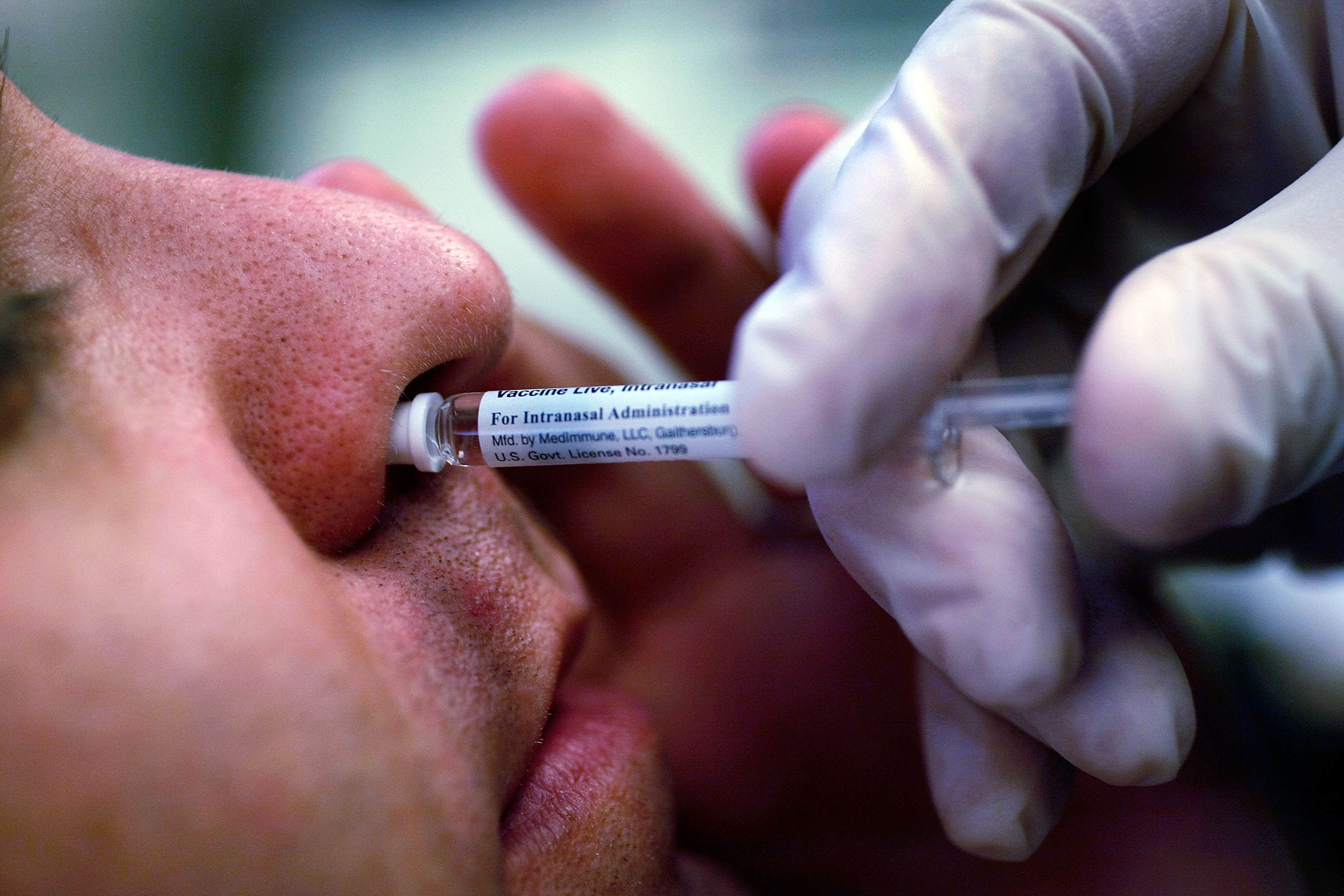
Enlarge / A man receives an H1N1 nasal flu spray vaccine at an urgent care center on October 16, 2009, in Lake Worth, Florida. (credit: Getty | Joe Raedle)
The nasal version of the Oxford/AstraZeneca COVID-19 vaccine failed an early-stage clinical trial, dashing hopes for better infection prevention and forcing researchers to re-think the design.
Many experts have hyped the potential of nasal COVID-19 vaccines. They argue that snorting the shots could encrust the nasal mucous membranes with snotty antibodies—namely IgA—and other immune defenses that could blow away SARS-CoV-2 virus particles before they have the chance to cause an infection. Currently, the shots given intramuscularly in arms provide robust systemic immune responses that prevent severe disease and death but spur relatively weak antibody levels on mucous membranes and, relatedly, don't always prevent infection.
Researchers at the University of Oxford hoped to easily adapt their existing COVID-19 vaccine for such an infection-blasting schnoz spritz. The Oxford/AstraZeneca vaccine is a viral vector-based design, using a weakened, benign virus to carry the genetic code of the SARS-CoV-2 spike protein to human cells. The benign virus, in this case, is an adenovirus, a type best known for causing mild cold-like illnesses in humans, though the specific virus used in the vaccine was isolated from chimpanzees. (This vaccine has not been authorized in the US but is used in dozens of countries worldwide.)
Part of a 1939 poster for the New York State Department of Health.
America’s STI crisis is actually a maternal care crisis.
Across the board, sexually transmitted infections are on a “shocking” upward trajectory, according to public health experts. Preliminary data from 2021 that the Centers for Disease Control and Prevention released in September shows upticks in cases of gonorrhea and chlamydia — but outpacing them is a disease that the US at one point nearly succeeded in eliminating: syphilis.
Syphilis is a sometimes-fatal infection caused by a spiral-shaped bacterium that leads to skin rashes in its early stages and, in its later stages, complications ranging from neurologic problems to cardiovascular disease. About a quarter of people with a syphilis infection who don’t get treated have serious complications — including death in around 10 percent of cases.
Most concerning is the data on who is getting infected with syphilis: Case rates in women and babies rose almost threefold between 2017 and 2021 — a much larger increase than the rise among men, and larger still than the uptick in other sexually transmitted infections. In that time range, the number of syphilis cases in women rose from two per 100,000 people to seven per 100,000, and the number of infants born with congenital syphilis — not including those who died before birth — increased from 24 to 74 per 100,000.
“This is an alarm. ... Why are we not scared of syphilis?”
The abrupt rise of the infection in women and babies ought to sound an alarm. When a baby has syphilis, it’s usually because it was infected while in the womb; about 40 percent of pregnancies in people with syphilis result in the death of the fetus or newborn. In the US, prenatal care involves syphilis testing, so delivering a baby while having untreated syphilis signals that the mother faced a barrier to getting prenatal care. When many people are delivering babies with congenital syphilis, it’s a sign that America’s health care system is failing women on a larger scale — especially women of color, who according to the data have the highest rates of infection.
To understand syphilis’s explosive rise — and why experts are worried about containing it — it’s helpful to understand the infection itself, the risks it poses, and the gaps in the US health care system that are allowing it to surge.
Syphilis is easy for both patients and providers to miss
It’s worth saying upfront that the early stages of syphilis are pretty easy to treat. A single shot of penicillin does the trick — and for people allergic to penicillin, two weeks of the cheap and widely available antibiotic doxycycline also works very well to clear the infection.
But if a syphilis infection isn’t interrupted by treatment, the disease usually progresses in three stages. The first begins with a single, painless bump that generally shows up a few weeks after infection. This bump is usually located where the bacteria that causes the infection first entered the body — usually in or around the mouth, genitals, or anus, but occasionally on other skin sites like the hands.
After three to six weeks, the bump goes away on its own, and within another few weeks, a more widespread rash shows up, often on the palms and the soles of the feet. This second stage can also include other symptoms that look a lot like the flu; fever, swollen lymph nodes, and sore throat aren’t uncommon. But whatever symptoms the person has, they also go away on their own, even if they don’t get treated.
Over the course of these first two stages and for about a year afterward, a person living with syphilis is contagious. Usually, the infection spreads through contact with a sore during sex, although it can also spread through kissing if a person has an oral sore. Pregnant people with syphilis infections can pass the infection on to their babies while they are in the womb.
Once the second stage is over,the infection goes into hiding in what experts call the “latent stage” of infection. This period, during which people have no signs of infection, can last for years or even decades.
In some people, latent syphilis infection might never cause another problem for them. But in others, it can reappear in a third stage of infection. At this point, it can affect multiple organ systems, causing a range of problems so diverse that the infection has earned the moniker “the Great Pretender”: It can cause brain disease that looks like psychosis, nerve disease that looks like stroke, eye disease that looks like conjunctivitis, and a variety of other problems.
Syphilis’s squirreliness means some people never realize they’re infected at all. “They don’t even know if it’s a problem because it doesn’t hurt, burn, or itch,” said Irene Stafford, an OB-GYN and syphilis researcher at the University of Texas Health Science Center at Houston.
In a recent review of records from 8.2 million blood donations in the UK, 316 donors tested positive for a past or current syphilis infection, and 60 percent of them were unaware of their infection.
It’s not just people with syphilis who often overlook infections: Health care providers miss the diagnosis with some regularity. According to a CDC spokesperson, among all the cases of syphilis in newborns the agency counted in 2021, 8 percent were born to mothers whose infections were undiagnosed despite getting timely maternal care.
That’s in part because so many providers don’t ask about patients’ sexual history, but it’s also because syphilis testing itself is notoriously pretty complicated. The best available tests only show whether a patient has ever had syphilis by measuring their level of antibodies against the bacteria. A provider might make a syphilis diagnosis in one visit if they find a characteristic rash during an exam — but otherwise, they have to repeat the test weeks to months later to determine whether the antibody level is rising or falling.
That means that even if a provider orders the right test and understands the result, they likely cannot make a diagnosis or treat the infection if a patient doesn’t come back for at least one more visit. This results in many missed opportunities for catching and treating infections — and many more opportunities for onward transmission of the disease. And it’s why routine health care, particularly during pregnancy, is so critical.
Health care guidelines recommend syphilis screening tests for people at high risk for either getting infected with syphilis or having severe consequences from an infection — including people with HIV infection and pregnant people, for whom testing is required in all but eight states.
Waning funding for sexual health and prenatal care clinics is contributing to rising congenital syphilis rates
In the year 2000, syphilis rates among Americans were at an all-time low, with 80 percent of the nation’s counties entirely syphilis-free. The disease largely affected men who had sex with men. The rates had dropped so low because of “massive behavior change due to the AIDS epidemic,” said Jeffrey Klausner, an infectious disease doctor specializing in HIV and STIs at the University of Southern California’s medical school. Many men in these communities responded to HIV’s devastation with widespread increases in condom use and decreases in numbers of sexual partners and group sex. That helped bring syphilis numbers down.
In absolute numbers, the majority of syphilis infections continue to occur among men who have sex with men. And while their infection rates have risen steadily since 2000, that uptick has been sluggish compared with the meteoric increases among women and babies.
Why are case numbers back up now? And why is syphilis affecting so many women? It’s likely due to the convergence of a few trends:
As treatment advances changed HIV from a death sentence into a chronic but manageable condition — and as HIV PrEP, medicine that reduces the risk of HIV infection, became more widely used among men’s sexual networks in the early 2010s — the urgency to use condoms faded. Meanwhile, sexual risk-taking increased as the internet simplified hookups. Some women have sex with members of these networks, increasing their risk for infection.
From 2004 onward, funding for dedicated STI clinics and public health in general began to drop, reducing access to sexual health services for low-income Americans in particular. “If you adjust for inflation, those funds have fallen by 41 percent over the past 20 years,” said Elizabeth Finley, who directs communications at the National Coalition of STD Directors.
“Those things come together and create the perfect conditions for rapid rises in sexually transmitted infections, and then spill over into populations like young women of reproductive age through their male partners,” said Klausner.
At the same time, the health care system is in a weaker position than ever to respond to the rising tide of infections, he said. State and local public health departments have few resources for testing and following up in pregnant women, and manyclinicians — except those who specialize in men’s sexual health — are often unaware of syphilis’s resurgence and don’t know how to diagnose or treat it.
Catching more cases requires better prenatal care access and addressing other intersecting public health crises
The two trends above are made worse by a third: Prenatal care, which can catch infections, is becoming increasingly unavailable nationwide. Hospitals with birth centers have been closing at an astonishing rate, obstetricians have been leaving rural communities for urban centers, and in 2020, about 11 percent of American women were uninsured.
As the below March of Dimes map of US maternity care access in 2020 shows, these trends have disproportionately affected the South and the Plains states, leaving 7 million women of childbearing age with limited access to care (counties in yellow and orange, defined as having fewer than two birth centers and fewer than 60 OB-GYNs for every 100,000 births) or in an outright maternity care desert (counties in red, defined as having no birth centers or OB-GYNs).
It’s in these health care system fissures that syphilis has begun to claw its way back. The system intended to catch syphilis in pregnancy is failing, largely because the women at highest risk for infection aren’t getting prenatal care.
Although the epidemic has spread to nearly every state in the US, rates are highest across the South and in the West. Just eyeballing CDC data (compare the map below with the map above), you can see there’s a lot of overlap between regions that in 2020 had the highest rates of congenital syphilis and those with the least access to prenatal care.
This CDC map shows how huge swaths of the country went from having no cases of congenital syphilis in babies in 2011 (in pale yellow) to upward of 25 cases for every 100,000 babies born by 2020 (dark blue).
It’s also easy to see how syphilis is impacting certain racial and ethnic groups more than others.In the last five years, congenital syphilis rates have increased precipitously among babies born to Native American, Pacific Islander, Hispanic/Latino, and Black Americans, due largely to a combination of rural health care strain and systemic racism, said Robert McDonald, a medical epidemiologist who works on syphilis prevention efforts at the CDC.
Sometimes pregnant people don’t get the care they need because the clinic is too far away — but other times, it’s because they’re afraid to.
For example, people with addiction disorders may avoid seeking prenatal care out of the legitimate fear they could be arrested for using drugs while pregnant, said McDonald.
Addiction disorders also increase the risk of getting infected with syphilis to begin with: According to a 2019 report, an increasing proportion of heterosexual syphilis transmission is associated with drug use, especially methamphetamine and heroin use.
In different parts of the country, the reasons pregnant women with syphilis don’t get prenatal care may be different, said McDonald. Substance use may be a particularly important barrier in rural areas and in Western states, while geographic distance from health care plays a larger role in the South, he said. In one of her studies, Stafford found pregnant women nationwide were more likely to fall out of syphilis care if they engaged in transactional sex or substance use, were experiencing homelessness, or had undiagnosed or untreated psychiatric illness.
So while improving funding for sexual health clinics and maternal care would help, it’s not enough to just make the care these places offer more geographically available across the board. The care also needs to be tailored to the specific reasons mothers aren’t seeking care, and must be bolstered with wraparound services aimed at reducing the health impacts of addiction disorders, homelessness, trafficking, and mental illness.
That’s a tall order in a country that can’t even agree that everyone has a right to basic health care services to begin with.
There’s still hope for reducing syphilis transmission
Covid-19 likely exacerbated the syphilis crisis because it required state and local public health officials to reassign most of their sexual health staff to pandemic-related roles, said Finley. It also led to abbreviated hours at many STI clinics, and resulted in many appointments taking place as telehealth visits — during which it’s more complicated to order the kind of lab work that would catch a syphilis case early. “We know that the pandemic played a role just because that failsafe failed,” she said.
So what can be done to rein in this alarming surge in STI cases?
A 2017 study suggested that in the sexual networks of men who have sex with men, using a single dose of doxycycline as post-exposure prophylaxis — sort of like a “morning after” pill — reduced syphilis cases by 73 percent. The CDC hasn’t yet issued guidance broadly recommending the practice, in part because it’s not yet clear what its impact could be on antibiotic-resistant “superbugs.” Still, sexual health experts think the strategy has enormous potential for reducing syphilis transmission in key communities, provided patients can overcome its side effects, which include gastrointestinal upset (i.e., bellyaches) and sun sensitivity.
“I do not think it’s a silver bullet — I do think it’s another tool in the toolkit,” said Philip Chan, a Brown University infectious disease doctor who directs the largest sexual health clinic in Rhode Island.
However, studies of so-called “doxy-PEP” haven’t yet included heterosexual women, and doxycycline isn’t safe for use during pregnancy. That means it will be some time before it has an impact on syphilis rates in women and infants.
Improving funding for STI clinics would also make a big difference, said Finley, who imagines federal dollars dedicated to sexual health care in the same way they are for HIV care and family planning. “The federal government has widely recognized and invested in clinical services as a part of their prevention and public health strategies, and we haven’t seen the same thing happen with STDs,” she said.
Another model for syphilis prevention already exists in the way most states now handle another sexually transmitted infection: HIV. The CDC recommends opt-out testing for HIV, which means patients in all health care settings are routinely tested for the infection unless they request not to be. Stafford doesn’t know of a national effort to make this happen for syphilis, although some states — like California — have rolled out their own campaigns to expand syphilis testing.
“We don’t have what HIV has,” said Stafford, “all these ads and all this money and all this media.”
“This is an alarm,” she said. “Why are we not scared of syphilis?”
Clarification, 3:20 pm: Per new information from the CDC, 8 percent of congenital syphilis cases in 2021 involved mothers whose infections were undiagnosed despite timely maternal care.
We’ve been writing about journalist Jason Leopold for many years, either focused on his FOIA adventures or the amazing (and important) scoops he achieves through them. If you look back through our archives, you’ll see that Leopold knows how to use freedom of information laws basically better than anyone, and thus wields them effectively to help better inform the public of just what our government is up to. That, of course, is the entire point of freedom of information laws in the first place. Our government is supposed to be transparent with us over what they do. FOIA makes that possible, and it only works when it’s used. And Leopold uses it.
Years back he was called a “FOIA terrorist” by a government official, which is just laughable no matter how you look at it. But Leopold has adopted the moniker as his own now.
One thing that he’s clearly learned is that when the government stalls and denies, it often makes the most sense to just sue. Under the federal FOIA, agencies have a very short term before they need to respond, and they almost never actually comply with that (often taking years, rather than weeks). At some point, you just need to sue to force the matter.
So, that’s what happened in this case, where he sued the DOJ back in April 2021 due to their FOIA shenanigans. I won’t go into all of the details, but Leopold was seeking information on the January 6th insurrection, and what was happening inside the DOJ following that date. He filed a FOIA with the Executive Office of Immigration Review. There were some disagreements over which agencies/departments he should be filing the FOIA requests over, but eventually the government handed over some documents he had requested (again, which belong to the public). Leopold’s lawyer asked for fees over having to have filed the lawsuit, and it appears that the EOIR and the DOJ are being incredibly and ridiculously petty about it, and filed an opposition to the fee request by just attacking Leopold personally.
It’s a really bad look for the government to go after a journalist for literally using the law for what it’s supposed to be used for (and for which the government has resisted obeying that law).
The filing opens by saying that they didn’t even have anything interesting to hand over to him in response to the FOIA. Basically, they seem very put out that they had to obey our FOIA law and give Leopold what he asked for. That it wasn’t something juicy does not matter. I don’t see anywhere in FOIA where it says that the government only has to hand over stuff that makes for juicy scoops. The way that journalists like Leopold find the important stories is by requesting lots of documents and figuring out what’s actually newsworthy. I mean, this entire paragraph seems unbecoming for the DOJ to file:
EOIR had initially withheld only one e-mail chain under Exemption 5. But after Plaintiffs
pressed the agency, EOIR relented for the sake of transparency and judicial and party economy
and determined to make a discretionary release of the requested material. Unsurprisingly, given
EOIR’s role, the record did not include information of great social value. To the contrary, it
included discussion drafts of an e-mail to EOIR personnel in the Washington, DC area telling them
to go home early because of the curfew Mayor Bowser had imposed on January 6, 2021. It is no
different than the type of e-mail chain that many managers throughout the region may have sent
to employees on that day. Instead of contributing something valuable to the public, the released
e-mail chain provides Plaintiffs and the public little more than the satisfaction of reviewing the
emails of EOIR leadership.
The DOJ shouldn’t be getting snarky about the contents of the document they were required to hand over by law. But the filing gets worse.
Despite accomplishing almost nothing by filing this suit against EOIR, Plaintiffs seek to
have the taxpayer finance it.
That framing is so obnoxious. The taxpayers pay you to do your job, DOJ and EOIR. And you didn’t. And that’s why Leopold had to file the FOIA request in the first place. Don’t try to pretend that this is some sort of scam on the taxpayer.
The DOJ makes its various legal arguments for why it believes the fee request is improper, but can’t resist oddly petty personal attacks on Leopold. It keeps insisting that it was crazy of Leopold to seek records from EOIR regarding January 6th, but as Leopold explains he’d heard rumors of numerous people within the DOJ — including those with no obvious connection to everything that was happening — were either planning to resign or to publicly side with Donald Trump. Given that, it makes perfect sense to send the FOIA broadly to many different DOJ divisions. But the DOJ just seems really mad that he sent one to EOIR.
But then it basically says that the DOJ shouldn’t pay his legal fees… because he sends so many FOIA requests:
Indeed, as this Court has explained, “almost a quarter of th[is] district’s entire civil docket”
is comprised of FOIA cases and FOIA plaintiffs like Jason Leopold and Buzzfeed, Inc. “create
much of that backlog.” Am. Ctr. for L. and Just. v. U.S. Dep’t of Homeland Security, 573 F. Supp.
3d 78, 83 (D.D.C. 2021). Jason Leopold self-identifies as the “FOIA Terrorist,” see
https://twitter.com/JasonLeopold (bio) (Sept. 19, 2022), and one report calls him “the most active
individual FOIA litigator in the United States today,”
https://foiaproject.org/2021/01/13/foialitigators2020/. According to the report, Leopold is second
only to the New York Times in total cases filed by media plaintiffs between 2001 and 2020, even
though he only started filing cases in 2012.
Again, this is Leopold’s job. He’s an investigative journalist, who has been successfully using FOIA to bring tremendous transparency about our government’s actions to the people they, in theory, represent. Complaining about the fact that he’s good at his job and that the government is bad at its job of responding to FOIA requests is quite an argument.
And, really, it’s the height of arrogance for the DOJ to complain that so many FOIA cases are filed in this court. If the government did its job and responded to FOIA requests fully and in a timely manner, that wouldn’t happen. Don’t blame Leopold for your own failures, US government.
The DOJ then argues that it shouldn’t have to pay legal fees… because the document it eventually turned over wasn’t that newsworthy. But what kind of standard is that? You only get legal fees if you happen to find the government was hiding the really newsworthy stuff? That makes no sense at all, and actually discourages FOIA requests and transparency by saying that (1) the gov’t will withhold documents, and (2) then make it more expensive for you to force them to comply with the law… That can’t be how this works.
Plaintiffs do not provide a single example of how the information
demanded was used. And EOIR cannot fathom what is newsworthy about the those e-mails.
The DOJ also argues that because Buzzfeed (who Leopold worked for at the time of the FOIA request) is a bigger media organization, it doesn’t need legal fees:
Buzzfeed Inc. is a for-profit organization reporting that it delivers significant profitability to its investors from its advertising, content,
commerce, and other revenue. See Buzzfeed Inc. Investor Presentation, August 2022,
https://investors.buzzfeed.com/static-files/740e1de3-921f-4e48-9f51-61bc177fa38f
This whole thing seems petty. All of it could have been avoided if the government had just done what the law requires in the first place. The DOJ seems to be demanding all sorts of passes that it would be unlikely to offer anyone if the roles were somehow flipped.
The case appeared to divide the Court’s Republican-appointed majority, with Justices Clarence Thomas and Neil Gorsuch inclined to uphold the state law, and Justices Samuel Alito and Brett Kavanaugh opposed to it. That means that the Court’s three liberals — Justices Sonia Sotomayor, Elena Kagan, and Ketanji Brown Jackson — could have an outsized ability to shape the outcome in Pork Producers.
But, while the three Democratic appointees initially seemed inclined to uphold California’s law, potentially forming a majority with Thomas and Gorsuch in the process, at least two of them seemed to vacillate by the end of the argument. Indeed, by lunchtime, both Kagan and Jackson appeared to be looking for a way to decide this case narrowly, putting the extraordinarily difficult constitutional questions raised by Pork Producers off until another day.
The most likely result is a narrow loss for the state, which will send the case back down to a trial court to determine whether the coalition of pork producers that challenged the law are correct that it will have severe economic effects on the nation’s pork markets. But that outcome is far from certain. And, if the Court does punt the case back down to a lower court, it very well may do so as a way to delay resolution of this challenging case.
California wants to ban pork that was produced under conditions it sees as inhumane
In 2018, California’s voters enacted Proposition 12, a ballot initiative that imposes strict animal welfare requirements on much of the meat sold in California. Among other things, Prop 12 forbids the sale of any pork in California unless the farm that produced that pork provided its breeding sows with at least “24 square feet of usable floor space per pig.”
The overwhelming majority of pork produced in the United States is produced outside of California. So this law primarily impacts pork farmers in the other 49 states.
The pork industry’s lawyers speak of Prop 12 in almost apocalyptic terms, claiming that it will “increase farmers’ production costs by over $13 per pig, a 9.2% cost increase.” They also claim that it is “impracticable” for pork farmers to know in advance which cuts of pork will ultimately be sold in California — so the farmers will have no choice but to raise all of their pigs in compliance with Prop 12.
But this claim — essentially an argument that California’s law could raise the price of bacon by nearly 10 percent in all 50 states — has never been tested. And at least some large pork producers have put out statements that seem to contradict the pork industry’s alarming economic claims. For this reason, the easiest way for the Court to resolve the Pork Producers case would be to simply send it back down to a trial court and require the pork industry to actually prove that their economic predictions are reliable before the case proceeds.
Should the pork producers do so, however — or should the Court decide to bypass this trial and rule immediately on the constitutional questions presented by the case — then the justices’ decision could transform each state’s relationship with the other 49 states. The justices spent Tuesday morning struggling with the question of just how much one state’s law may impact the economy of other states. And they received few good answers to this question.
The dormant commerce clause, briefly explained
The Constitution provides that “Congress shall have power” to “regulate commerce ... among the several states.” This provision does not simply allow Congress to regulate the nation’s economy; it’s also long been understood to prohibit states from enacting laws that could significantly impede free trade throughout the Union.
As the Supreme Court explained in Hughes v. Oklahoma (1979), the commerce clause addresses “a central concern of the Framers that was an immediate reason for calling the Constitutional Convention”: the Framers’ belief that “the new Union would have to avoid the tendencies toward economic Balkanization that had plagued relations among the Colonies and later among the States under the Articles of Confederation.”
This principle, that the Constitution prohibits states from interfering too much with the whole nation’s economy, is known as the “dormant commerce clause.” It is also one of the most confusing and often-contradictory areas of the Court’s jurisprudence.
That confusion was on full display Tuesday morning, as the justices struggled to draw a line that would demarcate just how far a state may go in enacting laws whose economic impacts spill over to other states.
Timothy Bishop, the lawyer for the pork producers, conceded early in Tuesday’s argument that states may ban products altogether from their marketplaces. California could, if it wanted, prohibit all sales of pork within its borders altogether — much like it already bans the sale of heroin or, in nearly all circumstances, cocaine.
But, as several justices pointed out, an absolute ban on pork sales in California would have significant economic impacts on pork producers in other states. Californians buy approximately 13 percent of all pork sold in the United States. So pork farmers outside of California would lose a significant chunk of their consumers if California enacted such a ban.
Nevertheless, no one at Tuesday’s oral argument, including Bishop, contested that such a ban would be constitutional. And that raised an awkward question for Bishop: Why should California be allowed to ban pork altogether — and effectively deprive out-of-state pork farmers of a significant percentage of their consumers — but not be allowed to enact a less strict regulation that still permits some pork to be sold in California?
At the same time, many of the justices raised concerns that, if California is allowed to enact a law which could potentially change how pork is produced throughout the nation, then other states could respond by enacting their own laws attempting to impose their political views upon the whole nation.
Justice Kagan, for example, suggested we could be headed toward a future where blue states forbid the sale of goods produced by non-union labor — while red states respond with their own laws forbidding the sale of goods that are made by unionized workers. Justice Amy Coney Barrett worried about states prohibiting the sale of goods produced by unvaccinated workers; or by employers who won’t pay for gender-affirming surgery for transgender employees. Justice Brett Kavanaugh imagined a red state that bans the sale of fruit picked by undocumented immigrants.
Their point was that, if California is allowed to effectively decide how pig farms will be run in all 50 states, that could permit the very kind of “economic Balkanization” that the Court warned about in Hughes. Every state could start using their own laws to impose their will on their neighbors. And manufacturers might have to choose between selling their products in California (and complying with California's left-leaning rules) or selling their products in Texas (and aligning with Texas’s conservative values).
But none of the justices seemed sure where to draw the line to prevent this kind of dystopia from emerging, while also permitting states to enact the kind of ordinary economic regulations that have existed for many years.
Can states pass laws simply to enforce their own sense of what is moral?
One issue that came up frequently during the Pork Producers argument was whether a state is allowed to enact a law like Prop 12 simply because it wants to make a moral statement. That is, could the voters of California declare that “we believe that the conditions in many pig farms are immoral, and we refuse to let any product produced in these immoral conditions be sold in our state?”
Under current law, the answer to this question is “no.” In Lawrence v. Texas (2003), the Supreme Court struck down a Texas law banning “sodomy.” Among other things, Lawrence held that “the fact that the governing majority in a State has traditionally viewed a particular practice as immoral is not a sufficient reason for upholding a law prohibiting the practice.”
But Lawrence was also decided before Presidents George W. Bush and Donald Trump appointed a total of five extraordinarily conservative justices to the Supreme Court. And it is fairly likely that a majority of the current Court agrees with the position Justice Antonin Scalia took in his Lawrence dissent — that laws justified by moral disapproval of activities such as “bigamy, same-sex marriage, adult incest, prostitution, masturbation, adultery, fornication, bestiality, and obscenity” are permissible.
Indeed, even liberal Justice Kagan appeared uncomfortable with Lawrence’s flat declaration that states may never enact a law solely to ban a practice they view as immoral. Many states, she noted, ban the sale of horse meat. But such laws are rooted primarily in the “feelings of disgust” that many people feel toward the consumption of horses, and not in any concerns that horse meat is unhealthy, unsafe, or otherwise should be banned for reasons other than moral revulsion.
At the same time, if a state may enact any restriction on interstate trade simply because they believe that restriction is morally justified, then the dormant commerce clause ceases to function in any meaningfully way. Every blue state could potentially ban the sale of goods produced by workers who do not have access to abortion care, on the theory that promoting women’s equality is a moral good. Meanwhile, every red state could ban the sale of goods produced by workers who had an abortion, on the theory that abortions are immoral.
The question of just how far a state can go before it does too much to reshape behavior in other states so flummoxed the justices that at least one member of the Court, Gorsuch, seemed to throw up his hands and insist that the Court get out of the dormant commerce clause business altogether.
At one point, Gorsuch compared the test the Court announced in Pike v. Bruce Church (1970), which held that a state law should be struck down if it imposes a burden on commerce in other states that “is clearly excessive in relation to the putative local benefits,” to the sort of “freewheeling balancing test” that the Court used to strike down economic regulations during its Lochner era — a period in the late 19th and early 20th centuries that is now widely viewed as discredited even by justices who are typically hostile to economic regulation.
Fortunately for the justices, however, they have a way to put off resolution of this case for at least a year or two. Because the pork producers’ argument rests on their claim that Prop 12 would have harsh economic impacts on pork farmers in the other 49 states, their lawsuit will almost certainly fail if this claim is disproven. The justices may be able to dodge this case, in other words, by sending it back down to a lower court to resolve this factual dispute.
Should the pork producers prove their economic arguments, however, it is likely that this case will be back before the justices in reasonably short order. And, if Tuesday’s arguments are any sign, the justices have no idea what to do with the Pork Producers case if they actually have to decide it.
The Good Country Index is an effort to highlight and rank the countries that are doing good for the rest of the world. Select the metrics that are pertinent to you, and the ranks adjust accordingly.
I just heard about this project, but it’s been around since 2014. Still relevant.
Enlarge / In green, the Kia Niro hybrid; in white, the Kia Niro EV. (Kia Niro PHEV not pictured) (credit: Jonathan Gitlin)
Kia provided flights from DC to San Diego and back, plus two nights in a hotel so we could drive the new Niros. Ars does not accept paid editorial content.
LEUCADIA, Calif.—The Kia Niro isn't a flashy car. It doesn't have a weird origin story like its stablemate, "the boar with a backpack." There are no sporty pretensions, nor designs on exploring Moab off the grid. Instead, it's just been an affordable family crossover, quietly going about its way as efficiently as possible, with hybrid, plug-in hybrid, and battery electric vehicle versions.
The Niro fills the lower end of Kia's electrified offerings in the US, and for model year 2023, there's a new second-generation Niro that's on sale. As before, there are hybrid, plug-in hybrid, and BEV versions available, and they've actually even gotten a little cheaper, at least once you account for four years of inflation.
Kia's design team always gives its work interesting names, and the Niro's design philosophy is called "Joy for Reason." But if you didn't find the first Niro offensive, you're unlikely to do so with the new one. Perhaps the most notable feature is the contrasting section that runs behind the rear door along the D pillar. It's not just there for looks—it's a functional aeroblade that controls airflow at the rear of the car to minimize drag and increase efficiency, and it can be body-colored should you prefer.
The scope of federal pardons is relatively limited. But descheduling the drug could be another story.
In a surprise move just a month before the midterm elections, President Joe Biden announced Thursday that he’s taking considerable steps to overhaul America’s federal marijuana laws — including pardoning everyone convicted of simple marijuana possession at the federal level.
The development was a surprise; although Biden campaigned on decriminalization and expunging cannabis convictions, the administration has largely remained quiet on marijuana reform.
“As I’ve said before, no one should be in jail just for using or possessing marijuana,” Biden tweeted. “Today, I’m taking steps to end our failed approach. Allow me to lay them out.”
Biden’s first step was to pardon all prior federal offenses of simple marijuana possession. His reasoning was a nod to the many justice and equity discussions happening around cannabis arrests nationally: “Sending people to jail for possessing marijuana has upended too many lives — for conduct that is legal in many states. That’s before you address the clear racial disparities around prosecution and conviction. Today, we begin to right these wrongs,” Biden tweeted.
Second, he called for governors to do the same at the state level. His third step is to initiate an administrative review of federal marijuana scheduling — the federal classification system that underlies the criminalization of marijuana as a controlled substance at the federal level. “We classify marijuana at the same level as heroin — and more serious than fentanyl. It makes no sense,” Biden wrote.
After Biden’s announcement, other agencies quickly followed suit with next steps. The Justice Department issued a statement that it “will expeditiously administer the President’s proclamation” on pardons, and work with the Department of Health and Human Services to launch a scientific review of how marijuana is scheduled under federal law.
But was this announcement a massive leap forward in federal cannabis policy? Or is it more style than substance, an attempt to drum up support for Democrats ahead of the midterms? Here’s a quick overview of Biden’s action, federal cannabis policy, and the administration’s ever-evolving stance on marijuana legalization.
So just how many people did Biden pardon?
Biden signed an executive order to pardon citizens and lawful permanent residents convicted of simple marijuana possession under federal law and DC statute.
Simple possession occurs when a person has a small amount of a substance on their person or available for their own use. The New York Times reported that the pardons will affect about 6,500 people convicted of simple marijuana possession between 1992 and 2021 under federal law, as well as thousands more under DC code, White House officials said on a call with reporters.
That’s a comparatively small number; most convictions for simple possession occur under state and local laws. According to the ACLU, there were 8.2 million marijuana arrests between 2001 and 2010, 88 percent of them for simply having marijuana. The federal government often charges marijuana cases as conspiracies, meaning there was an agreement between two or more people to violate a federal drug law, rather than simple possession: The New York Times reported that, according to the US Sentencing Commission, only 92 people were sentenced on federal marijuana possession charges in 2017, out of nearly 20,000 drug convictions.
Biden’s presidential authority is limited to issuing pardons for federal convictions; he can’t overturn a record for a marijuana offense at the state or local level. However, BOWL PAC founder Justin Strekal, a longtime cannabis lobbyist in Washington, DC, and the former political director for the National Organization for the Reform of Marijuana Laws, says it’s a step in the right direction, no matter how small: “Could Biden have gone further?” he told Vox. “Yes. But now citizens around the country can leverage that example to build pressure on state and local officials to follow in his footsteps, as some governors already have.”
Biden urged governors to do as he did and review marijuana possession convictions at a state and local level as well. Some governors were far ahead of him: California’s Gavin Newsom and Colorado’s Jared Polis have already issued pardons for low-level cannabis convictions in their states, and Illinois Gov. J.B. Pritzker expunged nearly half a million marijuana arrest records and pardoned thousands more at the end of 2020.
Wasn’t there a bill to legalize cannabis? Does this mean weed is legal now?
Hold on to your lighters — you won’t necessarily be able to spark up in the streets just yet, though cannabis is legal in some form in 37 states.
Meanwhile, federal marijuana legalization has essentially been stopped in its tracks, in part because of the complexities of adopting banking, regulation, and criminal justice reform to accompany legal weed, even though public opinion (even among Republican voters) and state policies are on board with legalization.
However, under the federal Controlled Substances Act, marijuana is classified as a Schedule 1 illegal drug with no medical uses, on par with heroin and LSD, and above fentanyl, which is Schedule 2. Rescheduling marijuana for research was an oft-repeated promise of Biden’s presidential campaign.
Biden’s call for a review of marijuana’s scheduling could dramatically reshape federal policy and ultimately clear the way for legalization — but only if it is removed from the law entirely, not just rescheduled as a Schedule 2 drug. This would be the piece that would allow all the dominoes to fall into place for nationwide legalization with sales to adults over 21 without a prescription, allowing banks to do business with the cannabis industry, and more.
In the meantime, there are several pieces of federal legislation attempting to address the myriad issues around cannabis. They include:
The Marijuana Opportunity Reinvestment and Expungement (MORE) Act, which also would deschedule cannabis from the Controlled Substances Act and enact criminal and social justice reforms, including the expungement of prior cannabis convictions. It was approved by the House in December 2020, marking the first time Congress moved to end federal marijuana prohibition. (The bill failed to advance in the Senate.)
The Secure and Fair Enforcement (SAFE) Banking Act, which has been passed by the House six times since it was first introduced in 2013. If the SAFE Banking Act were signed into law, federal regulators would be prohibited from handing down penalties to banks serving licensed marijuana businesses; those businesses would then be able to access financial services like checking accounts and accept payment with credit or debit cards.
The States Reform Act, framed by Republican lawmakers as an alternative to Democratic-led reform proposals. It would end federal prohibition and regulate cannabis under various agencies, including the Agriculture Department and the Food and Drug Administration, for growers, consumers, and medical marijuana patients, while allowing states to determine their own policies on commerce and other aspects of legalization. It attempts to bridge the partisan divide by including expungements for those with nonviolent cannabis convictions.
The Cannabis Administration and Opportunity Act, a sweeping bill that aims to delist marijuana from the Controlled Substances Act while recognizing existing state laws; it would enact banking reform, criminal justice reform, and automatic expungement of federal records for nonviolent marijuana crimes.
Whether Biden’s announcement will goose cannabis reform in Congress remains to be seen, but Thursday’s action was undoubtedly a massive boost to the quest to end federal prohibition.
Didn’t Biden fire people for smoking weed?
Dozens of young White House staffers got a nasty surprise in 2021 when they were dismissed after background checks due to admitted marijuana use; the Biden administration initially had indicated that recreational use of cannabis would not be disqualifying. Employee conduct guidelines were also updated to potentially deny security clearance to people who invested in cannabis companies. “Wait, so do I get my job at the WH back?” one former staffer asked on Twitter on Thursday. That remains to be seen.
I thought President Biden was “tough on crime,” and specifically, anti-weed. So how did he come to support cannabis reform?
Over his nearly four decades as a senator from Delaware, Biden was a prominent Democratic leader in spearheading America’s war on drugs. He has long defended his record of being “tough on crime” — including advocating for large increases in federal funding for the drug war and enacting federal policies that disproportionately criminalized low-level drug offenses.
Under the Reagan administration, he worked to create the Office of National Drug Control Policy and in a now-infamous 1989 television interview at the height of the “Just Say No” era, then-Sen. Biden criticized a plan from President George H.W. Bush to escalate the war on drugs as not going far enough. “Quite frankly, the president’s plan is not tough enough, bold enough, or imaginative enough to meet the crisis at hand,” he said, calling not just for harsher punishments for drug dealers but to “hold every drug user accountable.”
Other examples of punitive legislation that Biden helped to enact include the Comprehensive Crime Control Act, which expanded federal drug trafficking penalties and civil asset forfeiture, allowing police to seize someone’s property without proving the person is guilty of a crime. He sponsored and co-authored the Anti-Drug Abuse Act of 1986, which ratcheted up penalties for drug crimes and created a massive sentencing disparity between crack and powder cocaine, fueling significant racial disparities in incarceration. And 1994’s Violent Crime Control and Law Enforcement Act, partly written by Biden, imposed harsher sentences and increased prison funding, contributing to the growth of the US prison population from the 1990s through the 2000s.
But in later years, Biden softened his stance on drugs; in 2007, he backed the Second Chance Act, which provides monitoring and counseling services to former prison inmates. In his last few years in the Senate, he supported eliminating the sentencing disparity between crack and powder cocaine.
In 2020, the number of Americans who supported legalizing cannabis reached a record high, according to Gallup, with 68 percent supporting marijuana legalization. When Biden launched his presidential campaign, his platform reflected the nation’s changing attitude toward cannabis, with support for marijuana decriminalization, rescheduling, and expungements for low-level cannabis convictions.
However, even as he campaigned on marijuana reform, Biden contemplated the possible negative effects of cannabis legalization. “The truth of the matter is, there’s not nearly been enough evidence that has been acquired as to whether or not it is a gateway drug,” Biden said at a town hall in November 2019.
“Biden has evolved a tremendous amount to get to the point where he would take this significant an action,” Strekal says. “And I think this move helps find a pathway to 60 or more votes in the US Senate to agree on a cannabis legalization package.”
Genine Coleman, a longtime cannabis policy activist who serves as executive director of the advocacy group Origins Council, points to a change in an international treaty known as the Single Convention on Narcotic Drugs of 1961 as the reason behind Biden’s evolving stance on marijuana.
In December 2020, the United Nations Commission on Narcotic Drugs voted to change the scope of control of cannabis and cannabis-related substances following recommendations by the World Health Organization in 2019. “WHO came out with findings that cannabis does indeed have medical use and value,” Coleman says, “so they recommended that the UN Commission consider rescheduling the 1961 convention.”
That prompted a process for signatories on the treaty, including the United States, to review the scheduling of cannabis. “So it’s not totally coming out of nowhere,” Coleman says. “It’s actually something that got prompted about two years ago.”
So is this a ploy to get voter support for the midterm elections? Or is it a real shift in policy direction?
Nishant Reddy, CEO and co-founder of A Golden State and Satya Capital, has served as an advisor to Sen. Cory Booker (D-NJ) on cannabis policy. Reddy was pleasantly — but not entirely — surprised by Biden’s announcement.
“We’re just a few weeks away from midterm elections, so I do think there’s a little bit of strategic political play with this,” Reddy says. “That being said, it’s an exciting step in the right direction for those who are facing the negative consequences of unfair policing regarding cannabis.”
Attorney David Holland, a partner with Prince Lobel Tye LLP and the executive director of Empire State NORML, sees it as Biden moving toward cementing his progressive legacy, rather than attempting to gain voter support.
“Biden doesn’t stand to gain anything by it, per se. This is only the midterm; he’s got another couple years to go,” Holland said. “I think he’s trying to align himself with progressive politics that undo at least some of the harms of the drug war, and to set up a platform for two years from now that shows him to be a leader in causes relating to equity, justice, economic development, and so on.”
News of the pardons is dominating media coverage, but Holland says the most meaningful part of Biden’s announcement is the review and possible change in the federal status of cannabis as a controlled substance. “He’s setting the stage for future action,” says Holland. “There is definitely a paradigm shift coming over the next two years going into the 2024 election.”
Aaron Sinclair, of Dave’s World Heating and Cooling, installs a heat pump at a customer’s home in Standish, Maine, in 2018. | Brianna Soukup/Portland Portland Press Herald via Getty Images
So you want a heat pump. But can you find anyone to install it?
Brian Stewart knew he wanted all the gas out of his home. He figured his townhouse in the Portland, Oregon, area was one of his biggest personal contributions to climate change — its water heater, furnace, fireplace, and stovetop all ran on fossil fuels. Switching to electric appliances would be more energy-efficient, and would slash his footprint by plugging into a grid that’s increasingly powered by renewables.
Some of the home changes he knew he could do himself, but to replace the gas furnace and a gas-powered water heater for electric heat pumps, he had to call in contractors. Each one he spoke to tried to talk him out of swapping the furnace and heater. They were skeptical that an electric replacement would be as reliable, and insisted he’d need a backup gas furnace just in case.
“You could be super excited about [electrifying your home], but if the contractor you talk to says, ‘In my house, I wouldn’t do that,’ it’s hard to have the confidence to say, ‘I don’t believe you,’” Stewart said.
But Stewart stood by his research and kept making calls. Eventually, he found a contractor who was enthusiastic about replacing the gas with electric heating, ventilation, and air conditioning (HVAC). He hasn’t had to pay a gas bill since then, estimating the full project saved him $1,000 a year in natural gas and gasoline bills.
Most people aren’t, like Stewart, climate-minded consumers eager to go renewable. Many home replacements and repairs are unplanned emergencies, like the furnace that breaks in the middle of a winter freeze. Typically, a homeowner might call whoever installed or maintains the gas furnace. And that contractor might not be able to help them go electric — or suggest that they should in the first place.
A federal push is coming to electrify more homes. The residential sector contributes to about a fifth of the US’s greenhouse gas emissions, and many of those homes (about half) still run on fossil fuel for heat and power. If they switch to electricity, they’re slashing those emissions by plugging into an increasingly renewable energy grid.
The cost of changing existing infrastructure, especially inside the home, is a difficult thing to surmount. Democrats this summer approved billions of dollars in federal funding as part of the Inflation Reduction Act (IRA) to bring down that cost, by including incentives for all of the electric appliances and accessories needed, like heat pumps, insulation, wiring, circuit breakers, and induction cooktops.
The economics are finally all aligning to propel electrification forward. The biggest hurdle yet is the people problem. The IRA’s investments won’t be successful unless the people who will be closest to carrying out its ambitions — the electricians, plumbers, and other kinds of HVAC specialists — are on board with the clean energy transition, too.
Too many contractors are giving out the wrong information about heat pumps
Brian Stewart’s experience with contractors drove him to start a volunteer-based group, Electrify Now, to help others in the Portland area navigate electrifying their homes. He’s heard stories from people across the country who’ve encountered resistance when trying to switch off of gas. And one of the most pervasive myths people seem to hear is that a heat pump won’t work in cold climates.
Heat pumps actually work like a two-way air conditioner, using electricity and a chemical refrigerant to transfer heat into and out of a building. Since heat pumps are up to 4.5 times more efficient than gas, environmentalists have rallied around them as the better alternative to combusting a fuel inside the home. The myth that the equipment won’t work in cold places persists because as recently as about 20 years ago, it was true for most technology.It’s one reason heating oil is much more common in New York and gas furnaces throughout the North. Today, with better refrigerants and compressor technology, these systems work just fine in subzero temperatures (indeed, heat pumps are already thriving in Maine and chilly northern Europe).
This has led to contractors’ understandable, if dated, bias against electric heat pumps. Their advice is simply based on what they’ve always done. They see an old or broken gas or oil furnace and swap it with another, even if the electric replacement could wind up saving the person far more money. In most cases, contractors are just unfamiliar with heat pumps, since only 10 percent of households used them as their main source of heating as of 2015, according to the Energy Department.
Ideally, when a furnace or water heater needs replacing, a contractor and the consumer should consider all the options, including an electric system. They would need to figure out exactly the type of heat pump that may work (there are ductless and mini-splits, for example, or bigger units might be needed to run AC). But an important step that Sealed, a company that finds and vets contractors to electrify people’s homes, says contractors sometimes miss is evaluating the space for insulation and energy efficiency. A heat pump won’t work well if it’s in a space with drafty windows, for instance. Installed incorrectly, the heat pump won’t work well, which then confirms the contractor’s bias that the technology is inferior when they get a late-night call.
The problem of learning curves holds true for more than just heat pumps. EVs have faced a similar uphill climb with the middlemen closest to selling the technology to consumers. Sierra Club in 2019 sent undercover volunteers to 900 car dealerships and discovered the vast majority weren’t selling any EVs and that some “dealerships were not even trained or had proper knowledge of EVs they were selling.”
These kinds of hurdles can make even the most motivated climate-minded consumers doubt what they should do. For instance, Adam Beitman, head of electricity communications at the think tank RMI, has tried to replace his water heater and HVAC system with electricity in Washington, DC. Multiple contractors told him a new system wouldn’t fit. His own research suggested that wasn’t true, and the hunch was confirmed by one experienced HVAC installer.
But when Beitman found a water heat pump through Home Depot, his consultation with an installer sounded straight from a gas industry ad. “I don’t know about climate and all that,” he remembers the contractor saying. “I’m old-school. I like gas. Been doing it 30 years. I think you should reconsider.”
Training for contractors can close the learning gap
There are contractors out there who are excited about heat pumps. Larry Nissman is one of them. As an environmental director for Phoenix Mechanical, he serves the Westchester County area in New York, where oil-burning furnaces used to be far more common than electricity to heat the home, especially in older buildings. In the past five years, Nissman says, the company started getting a lot more requests for electric HVAC systems, another name for heat pumps.
“I use one in my own home, and I probably saved $900 this winter compared to what I would have spent to use oil,” he said. “I use my house as an example to illustrate to people what you might expect.”
Nissman also uses his home as an example because he’s frustrated that utilities and heat pump manufacturers aren’t giving him actual case studies to use with customers. If they did, he said, it would help fight skepticism and ignorance around heat pumps and let him tell homeowners exactly how much they could save.
This isn’t some revolutionary idea. “You get some training from the manufacturers,” he said. “They’ll introduce, for example, a new piece of equipment, a new heat pump, and they’ll come into our office and tell us about it. And then we go out in the field and actually install one at someone’s house and work through the learning curve, mostly with wiring and controls. And then as you do more and more of them, you become more comfortable.”
Soon, contractors will have more incentive to seriously consider electric alternatives. The IRA is spending billions over its 10-year life span to bring down the cost of both EVs and heat pump adoption. In 2023, according to the electrification-focused nonprofit Rewiring America, homeowners will become eligible for a range of cash rebates and tax credits to improve energy efficiency and go electric, including up to $2,000 for heat pumps for water and heating and cooling, $1,600 available for air sealing and insulation, and additional incentives for middle-class and lower-income households, such as$4,000 for electric panels and $2,500 for new electric wiring.
The law also includes $200 million for states to set up new training programs for contractors, on top of $20 million available through the bipartisan infrastructure law. These can be designed by states however they choose, but where experts said the training is most sorely needed is in understanding of the basic benefits of a heat pump, how much it can save consumers, and the climate benefits. There’s an added incentive for contractors to get up to date on their HVAC technology because the law also offers a rebate for every electric HVAC system they install in middle- and lower-income households.
Being a better-educated customer will help
There’s a lot that has to go into fully electrifying the home: While sometimes just swapping out an appliance is enough, in other cases, the electrical panel may need to be able to handle more load, the wiring may need to be changed, and insulation improved. This kind of project is bound to require multiple contractors.
Hopefully, the day is coming when finding an expert to install electric HVAC systems isn’t so hit-or-miss. Ten years down the line, Ari Matusiak of Rewiring America hopes the burden won’t be on consumers to vet contractors, but on policymakers to ensure electric systems win out on their merits alone.
“I think when we look back at the [Inflation Reduction Act], we’ll say that the United States went from being a fossil fuel market to being an efficient electric market,” he said. Households, he hopes, will become the biggest beneficiary of the transition.
In the meantime, though, I surveyed experts about what their advice would be to find a contractor who is enthusiastic about electric technology.
One of the most important questions for a person to ask is how many times the contractor has installed electric heat pumps. If the answer is only a few, or they try to talk you out of it, it’s a sign they don’t have the experience you’re looking for. It’s also important to make sure you’re getting a consultation on how to improve energy efficiency in the home through insulation; Sealed recommends having that done at least once every 10 years.
Also be wary of being upsold on technology you don’t necessarily need. Older homes may need new wiring and an electrical panel capable of handling more wattage, but if you already have some electric appliances, like a hybrid gas stove and electric oven, you may not need it, Stewart explained. He suggests asking for a specific test called a load calculation, which will tell the contractor if you really need to spend thousands of dollars on a new breaker box.
The moral argument for going through all these headaches for an electric household is that it lessens your contribution to environmental pollution and climate change. But there’s also a purely selfish reason for it: It saves you in the long term, while making a more comfortable environment inside the home.
In fact, Sealed CEO Lauren Salz is confident that moral arguments aren’t needed. Contractors don’t need to be climate warriors; they just need to be informed on the merits of the heat pump.
“People are getting heat pumps because they think it’s great to have a combined heating and cooling system,” she said. “They like that they’re super quiet. And a lot of homeowners are also concerned about just the health of having oil and gas in their home.” Above all, she said, people are getting heat pumps because they want a “higher quality of life.”
Kent Nishimura / Los Angeles Times via Getty Images
Californians passed a landmark law that bans cages for pigs. Now the Supreme Court could overturn it.
The Supreme Court regularly makes decisions that directly affect the lives of tens of millions of Americans. But next week, the Court will hear oral arguments in a case that could decide the fate of millions of pigs.
The case — National Pork Producers Council v. Ross — hinges on a simple question: Can California set its own standards for how pigs are treated on farms, even when they’re raised in other states?
The case centers, quite literally, on how sausage gets made in the US. Each year, over 6 million female breeding pigs, or sows, are raised in “gestation crates” — narrow metal crates that confine the pigs so tightly they’re unable to turn around for the duration of their four-month pregnancies (and they have about four pregnancies in their three- to four-year lifetimes). As the pioneering animal welfare scientist Temple Grandin once put it, the crates are akin to forcing a human to live much of their life in an airline seat.
The American Public Health Association says confining pigs so intensively also increases their stress levels and weakens their immune systems, which makes them more susceptible to infectious disease. (And given the ease with which some zoonotic viruses can pass from swine to humans, that threatens us as well.)
In 2018, over 62 percent of California voters supported a state ballot measure called Proposition 12 that would ban the crates and require sows be raised with at least 24 square feet of space. Importantly, the measure applied whether or not the pigs had been raised in California, so all whole, uncooked pork sold in the state would be required to be produced according to California’s standard. Given the vast size of the state’s market, it’s having a transformative effect for pigs across the country — just as California’s stricter emissions standards for automobiles have changed the way cars are made nationwide.
The law has similar provisions for cage-free eggs and crate-free veal, which have already gone into effect — the challenge in the Supreme Court only covers pork, which will go into effect in five months. (Disclosure: The ballot measure effort was led by the Humane Society of the United States, an organization I worked for from 2012 to 2017.)
The win was a watershed moment for the movement against factory farming, with some 1 million pigs, 40 million hens, and tens of thousands of calves to be taken out of cages each year once the law is fully implemented. It also built momentum to banish cages for hens from other states in the following years.
“What may seem like a small, incremental change on paper, to the life of that pig, it’s immense,” says Chris Green, executive director of Harvard Law School’s animal law and policy program.
The agriculture industry backlash was inevitable, asserting it would cost pork producers $293 million to $347 million to comply — a cost they said would invariably raise the price of pork not only for Californians, but for all Americans. In the years after it passed, meat trade groups filed threeseparatelawsuits against the pork provision. Each challenge argued the same point: California’s ban imposes an unfair burden on out-of-state pork producers, who produce most of the pork sold in California. (California produces a lot of dairy and eggs but less than 1 percent of the nation’s pork, while consuming around 13 percent of it.)
The pork producers argued that retrofitting their barns to be crate-free would be too costly, and that they couldn’t easily segment crate-free pork from crated pork they might be able to sell in other states. That purported inability forces them to raise more of their pigs crate-free than needed, a cost they say will have to be passed on to consumers nationwide. However, several major pork producers now say they can comply (more on this later).
All three lawsuits weredismissed by lower courts, but the Supreme Court took up the one filed by the National Pork Producers, the industry’s main trade group, and the American Farm Bureau Federation, an insurance company and agriculture lobbying group.
While it might be easy to assume that a conservative-dominated Court will rule in favor of business interests, it’s hard to predict how the case will ultimately turn out. Animal welfare questions don’t adhere to party lines as neatly as you’d think. Democrats are only a little more likely to say cruelty to farm animals is a moral concern, and plenty of red and purple states have passed laws to reduce the suffering of farm animals. A group of conservative thinkers filed an amicus brief in support of California’s animal welfare law while Biden’s Justice Department filed one in opposition.
“Anyone who says they know what’s going to happen is lying to you or themselves,” says Green.
The Court’s ruling won’t be delivered for months, but wherever it lands will have long-term effects on the welfare of the animals we factory-farm for food, potentially setting back the movement to improve their conditions by decades — or propelling it forward.
The pork industry’s contradictory argument against California, explained
The animal welfare activists have a straightforward case: Pigs and other animals raised for food are thinking, feeling animals — like dogs and cats — and shouldn’t be treated like mere widgets in a factory. Plenty of scientific research has concluded what is intuitive to laypeople: Confining animals in tiny cages for years on end is really bad for their well-being, as noted by the 378 veterinarians and animal welfare scientists who filed an amicus brief in support of California’s law.
That straightforward case has been successful at chipping away at the practice of cage confinement: 14 states have banned cages to some degree, especially for egg-laying hens, and hundreds of food companies have been switching to cage-free eggs. In 2008, under 5 percent of hens were raised cage-free; today, 35 percent are. The egg industry now welcomes a cage-free future, with the biggest producers investing heavily in cage-free barn construction, generally not opposing cage-free state legislation, and in some cases even supporting it.
But the pork industry hasn’t been so amenable to change, and has continually invoked a legal doctrine called the dormant commerce clause to challenge California’s law. As I wrote in an explainer last year about the industry’s lawsuits against Prop 12:
The industry’s core argument is that Prop 12 violates the “dormant commerce clause,” a legal doctrine meant to prevent protectionism, or states giving their own businesses preferential treatment over businesses in other states. Industry groups argue that because most US pork is produced outside California, the financial and logistical burden of complying with Prop 12 falls mostly on out-of-state producers, and that those burdens outweigh any of the law’s supposed benefits.
On the surface, they have a point. Overhauling the housing of a million pigs or more is a costly logistical nightmare. Many crate-free sows today are raised with 16 or 18 square feet of space; California’s law requires 24 square feet. Adapting to a patchwork of norms and regulations isn’t easy.
In a separate but similar lawsuit filed by the North American Meat Institute in 2019, a spokesperson for the largest US pork producer, Smithfield Foods, wrote (under penalty of perjury): “It is no exaggeration to state that the expense and complications of complying with Proposition 12 may cause Smithfield to conclude it is no longer viable to do business in California.”
Other major pork producers similarly wrote in the lawsuit that compliance with Proposition 12 would be just too costly and would significantly hamper their operations. Some went so far as to say, like Smithfield Foods, that it may force their partial or total exit from the California marketplace.
But now many in the industry say they can comply, including five of the largest pork producers: Tyson Foods, Smithfield Foods, Seaboard, Hormel, and Clemens Food Group. It’s a confusing course reversal that also weakens the National Pork Producers Council’s argument that Prop 12 is overly burdensome.
Jim Monroe, vice president of corporate affairs for Smithfield Foods, says he doesn’t see any inconsistency between the statements, writing in an email that “there is no doubt it will be more challenging to supply Californians with affordable pork with this law in place.” Monroe said the regulatory climate and escalating cost of doing business in California were factors in Smithfield Foods’ recent decision to shutter its Los Angeles County slaughterhouse. “The standards proposed are arbitrary, not based on science and require considerable time and expense without yielding any improvements to animal care,” he added.
(The National Pork Producers Counciland Tyson Foods declined an interview request for this story; Hormel and Clemens Food Group did not respond to a request for comment.)
Even California says big pork producers are hard at work to comply. As noted by Civil Eats, an official with California’s state agriculture agency visited 10 hog farms and slaughter plants across the country over the last year and reported that some of the nation’s largest pork producers were constructing new barns and overhauling old ones to be California-compliant, and had already implemented tracing systems to separate conventional pork from the California-bound pork.
While the National Pork Producers Council has written a great deal about the difficulty of tracing California-compliant pork, the largest producers have long advertised their sophisticated traceability systems. As Richard Sexton, a UC Davis agricultural economist, recently told the Guardian, “Products are being differentiated in a whole variety of ways: organic, GMO-free, different properties related to animal welfare, antibiotic-free.”
The increased cost for Californians will be somewhat modest, around an 8 percent hike, according to Sexton and two colleagues, and almost no change in retail price outside California. In an amicus brief to the Court, Sexton and another UC Davis economist also stressed that the pork producers’ claim that the costs of Prop 12 compliance would be felt by all pork producers, not just those selling into California, is flat-out wrong: “Not only are [the pork producers’] arguments flawed as a reflection of basic economic incentives, but they are factually implausible.” Their research was funded, in part, by the National Pork Board, a USDA-administered program that promotes US pork, as well as the California Department of Food and Agriculture.
The price increase may be tough for Californians at a time of high inflation, especially for food, but it’s important to remember that the price of conventional meat is artificially low, due to animals who are forced to live in the most miserable conditions imaginable, and to workers who toil in dangerous conditions to raise and slaughter them. Rural citizens who live near hog farms also bear the brunt of the industry’s lightly regulated air and water pollution.
How the conservative Court might think about the case — and animal welfare
It wouldn’t be a shock if all or most of the conservative justices side with the meat industry, as several business groups (like the Chamber of Commerce) and 20 mostly red state attorneys general filed an amicus brief in support of the pork producers (15 attorneys general from mostly blue states filed an amicus brief in support of California). California is also the right wing’s favorite punching bag.
But there are some reasons to believe that the justices won’t rule along predictable political lines. Justice Clarence Thomas has said the dormant commerce clause — the legal doctrine continually invoked by the pork producers to argue its case — “has no basis in the text of the Constitution, [and] makes little sense.” Justice Neil Gorsuch has called it a source of “judicial activism.” At the same time, the liberal Justice Elena Kagan wrote the decision when the Court struck down a California farm animal welfare law in 2012, and in 2010, when the Court struck down a federal animal cruelty law, the conservative Justice Samuel Alito dissented.
And animal welfare hasn’t been as ensnared in the culture war as other issues on the Supreme Court’s docket, such as immigration and affirmative action. That becomes clear when reading the amicus brief in support of California’s animal welfare law written by Megan Wold, a former law clerk for Alito. The brief was filed on behalf of other conservative thinkers, including former George W. Bush speechwriter Matthew Scully, University of Notre Dame law professor O. Carter Snead, and writer Mary Eberstadt.
Wold wrote that voters’ support for Proposition 12
reflects concerns of ancient lineage in Western moral thought. Western philosophers and religious leaders have considered the treatment of animals to be an appropriate and important subject of inquiry for millennia. They have explained how human decency demands that animals be treated with basic respect for their needs, natures, and dignity as living creatures, and why humans are morally bound not to participate in or facilitate animal abuse.
Last week, the Washington Post conservative columnist Kathleen Parker also made a passionate plea for the Court to side with the animals, writing “... the justices that make up the high court’s conservative majority have a rare opportunity to align themselves not only with their liberal counterparts but with some of history’s greatest ethicists and philosophers.”
Fervent support for animal welfare is not uncommon among conservatives: Bob Dole championed important amendments to the Animal Welfare Act in 1985; Rick Santorum may be vehemently opposed to LGBTQ rights but is also vehemently opposed to cruelty to dogs and horses. Even if their primary motive is to slash government spending, dozens of Republican members of Congress have voted to curtail government-funded animal research experiments in recent years.
While Big Pork is behind the challenge to California’s animal welfare law, many farmers (who tend to be conservative) are in support of the law, saying that it could help level the playing field in an industry that is dominated by meat giants that cut costs by mistreating animals. One of the largest meat companies, Perdue Farms, also supports the animal welfare law (Perdue mostly raises chickens for meat but also owns Niman Ranch, a higher-welfare pork company).
If the Court does side with the National Pork Producers Council, it could have lasting, devastating consequences for the future of farm animal welfare in the US. It would not only condemn nearly a million pigs a year to extreme confinement, but it could also inspire others in the animal agriculture industry to challenge similar state laws, or dissuade state lawmakers and food companies from moving on the matter. Some observers say the effects could be felt far beyond animal welfare, too, endangering state laws that cover renewable energy or product safety.
In the past two decades, we’ve witnessed a rapid shift away from cages, supported by voters, consumers, corporations, and policymakers of a number of political stripes. If California’s animal welfare law is eventually overturned, it will certainly be a setback for the anti-factory farming movement, but not the death knell.
If you’ve ever tried to build a “smart home” you’ve probably run face first into no shortage of problems.
Gear is expensive, overly complicated, and more often than not different devices don’t play well together. It’s a sector filled with various walled gardens by gatekeepers looking to lock you into one ecosystem, placing the onus on consumers to figure out which devices work together, and spend countless calories trying to fix interoperability issues when they inevitably arrive.
The resulting mess has slowed adoption by those who (quite understandably) find dumb home tech (ordinary door locks, for example) to be the smarter option.
While various standards have tried to unify the space, they’ve not been particularly successful. In part because the central control of all these devices has been fractured across different standards and technologies (Zigbee, Z-Wave, Wi-Fi, and Bluetooth) all jostling for primary control despite none of them working particularly well.
Enter Matter, a new open-sourced connectivity standard created by over 200 companies that’s attempting to bring some sanity to the space. Version 1.0 of the standard was launched on October 4, opening the door to a certification process for gear makers:
“What started as a mission to unravel the complexities of connectivity has resulted in Matter, a single, global IP-based protocol that will fundamentally change the IoT,” said Tobin Richardson, President and CEO of the Connectivity Standards Alliance. “This release is the first step on a journey our community and the industry are taking to make the IoT more simple, secure, and valuable no matter who you are or where you live.
Why should you care? If you care about your home tech working well, Matter — assuming it can find widespread adoption — should help simplify absolutely everything. The standard provides a way for smart home tech like your smart fridge and your door lock to talk directly to each other, either over Wi-Fi or a Thread, an IPv6-based low-power mesh networking protocol.
As a result, setup for everything based on the standard should be simpler. Less reliant on everything first heading to the cloud, you should also have greater control over what your devices are actually doing. And, it gives gatekeeper power a swift kick in the ass, letting you control multiple smart home devices using a variety of different systems and voice-enabled assistants.
That’s of course assuming it all works. The standard has major support from Apple, Google, Amazon, and Samsung, which certainly helps. Still, a lot of platforms and products aren’t going to support it, placing the onus on consumers to do their research when shopping for smart home gear over the next few years.
Right now, supported tech included smart plugs and switches, smart thermostats and HVAC controls, smart light bulbs, smart sensors, media devices and smart TVs, and connected locks. The Connectivity Standards Alliance (CSA) says it’s working to expand both the number of supported devices, and the categories of supported smart home tech.
There’s still going to be no shortage of interoperability headaches when it comes to building a smart home, but if all goes well Matter should be a significant improvement for the space overall.
So, we were just talking about the Supreme Court agreeing to take some cases that could determine the future of the internet (as in, potentially ruining it), but before that it may be on the path to could destroy some of the basics of art. Next week, the Supreme Court will be hearing oral arguments in the Andy Warhol Foundation v. Lynn Goldsmith case. We’ve been writing about this case for a few years now, and it’s so important that we filed an amicus brief with the Supreme Court in the case to highlight some of our concerns regarding what will happen if they get this wrong (we don’t do that very often).
There’s a lot of background here, but it’s worth understanding it to understand what’s at stake in the case — so I’m going to just copy and paste the background stuff from our 2019 article when the district court made the right call (before the 2nd Circuit screwed it all up). Here’s the background:
Photographer Lynn Goldsmith took a bunch of photos of Prince in 1981. In 1984, Vanity Fair magazine (owned by Conde Nast) licensed Goldsmith’s photographs for an article the magazine was doing about Prince. The magazine then commissioned Andy Warhol to do a painting of Prince based on Goldsmith’s photographs. That resulted in this 1984 spread:
Apparently Warhol actually created a bunch of paintings based on Goldsmith’s photographs, most of which have been sold, and a few of which are now in the Warhol museum. You can see all the images in the original complaint in this case.
After Prince died, Vanity Fair reran its article, and then teamed up with some other Conde Nast publications, and put out a special magazine called “The Genius of Prince” using one of Warhol’s other portraits.
There was some procedural oddness in all of this — because Goldsmith claims that she knew about none of this until after that “The Genius of Prince” magazine came out (even though she had licensed a photograph to Vanity Fair, it appears that there was some confusion about that, and at least Goldsmith claims she was never aware of the Warhol portrait based on her photograph back in the 1980s). Goldsmith contacted the Andy Warhol Foundation about the portrait, arguing that it was infringement. The Foundation then filed for declaratory judgment against Goldsmith. It made a bunch of arguments, including that the statute of limitations (three years) had run out, but most of the case focused on the 2016 magazine, which made it still well within the statute of limitations.
Anyway, as noted, the district court made what seems clearly the right call: this is obviously transformative fair use, and not infringement. Unfortunately, the 2nd Circuit (which historically has been pretty good on fair use) decided to flip over the table and say “nope, not fair use.” As we said, this was an example of actual cancel culture, in that it was literally using the power of the law to cancel some important culture.
The Warhol Foundation appealed to the Supreme Court, and they agreed to take the case (which is why we filed our amicus brief). The oral arguments are next week. But for this article, I wanted to highlight a fantastic article in The Atlantic by Paul Szynol saying that if the Supreme Court upholds the 2nd Circuit ruling it could wreck American art.
That may sound like hyperbole, but it’s well argued. This is a hugely important case that will have wide reverberations regarding whether or not creators can rely on fair use in the future.
If you head over to Google Scholar, you’ll be greeted with an invitation to “stand on the shoulders of giants,” an old (as in medieval) homage to the trite but essential idea that art and science build on existing work. (Google presumably uses it because Newton referenced it in one of his letters.) If you’re a jazz musician, you channel a rich library of standards. If you’re an architect, you apply principles from earlier periods (or, in some tongue-in-cheek cases, other areas of culture). If you code, you leverage existing libraries. And so on. No one starts from scratch; no one creates in a vacuum: “A hundred times every day,” Einstein wrote, “I remind myself that my inner and outer life are based on the labors of other men, living and dead.”
But what if you’re barred from the building blocks that would allow you to create your project?
This is so, so important and… so, so little understood at times. It’s also, somewhat oddly, something that often seems to be understood by new artists… but forgotten by more established ones. Everyone learns to create by copying others and then building, changing, modifying, putting our own stamp on things. That’s how basically all creativity works. Even if you’re doing something truly new and different (and it would be hard to argue that’s true in this particular case), you have to truly understand what’s been done to know how to do something different.
Copyright has always been messy around this. So much of learning to be creative relies on, basically, infringing on copyrights. Most of the time this is ignored — in what’s known as copyright toleration. But lately, copyright toleration seems to be getting wiped out by greedy copyright holders who want to get paid for every little use. And, now they’re looking to take fair use down with them.
Szynol does such an amazing job highlighting just how fundamental all of this is to culture:
One of the favorite shibboleths among advocates of free expression is that ideas are as free as the air. By itself, though, that maxim leaves out the reason for its own importance. Ideas need to remain free, because ideas like to connect to other ideas. They like to find different media, different combinations, different modes of expression, different audiences. The invitation to stand on the shoulders of giants is literally built into stained glass at the Chartres Cathedral, making the glass itself an example of the kind of meld that happens when ideas remain free to join other bodies. To a large degree, fair use lets that happen by allowing not only ideas but their expressions to meld, too. It’s not just Warhol and Prince. Fair use is the doctrine that allows us to record broadcast materials, permits filmmakers to incorporate clips of existing materials into their projects, and makes it possible for Google to show thumbnails of images when we do a search. Without it, our cultural experience would be markedly different, and certainly not better.
As he also notes, this entire case is really about those who view art as expression vs. those who see art as property. This is the key point we tried to raise in our amicus brief. Copyright long ago became the land that the 1st Amendment forgot. Just by screaming “copyright” entire industries were able to stop judges from even considering the 1st Amendment implications of the law, and the ability to use copyright to silence expression in the name of protecting “property.”
But copyright (in the US at least) was never meant to be a “property” right. It was created to benefit the public, and that meant by giving them access to works.
And, as the article notes, in this case, the expression is clearly different and quite transformative from the original (a key aspect of American fair use):
Warhol’s image transforms prince from the vulnerable and uncomfortable three-dimensional person we see in Goldsmith’s photo into a floating, two-dimensional, disembodied face emerging from smooth, richly saturated color. The same faint sadness lingers in both images, but, aesthetically, the two are far apart. Warhol’s image isn’t a mere replica, in other words—it adds substantial expressive content that conceptually and aesthetically distinguishes it from Goldsmith’s image. The similarities that are there are, in turn, immaterial: They’re mostly the mere result of Prince looking like, well, Prince, rather than Goldsmith’s interpretation of him.
Even if the two images were the same, moreover, their meanings would still be different. Goldsmith’s image highlights Prince’s androgyny and vulnerability. Warhol’s underscores the cold commodification of cultural icons. New meaning is the touchstone of conceptual art—it’s why Duchamp’s urinal isn’t a urinal anymore—and the touchstone of a fair-use analysis, too: If the secondary user adds new meaning, the use is eligible for the fair-use exception. And of course Warhol has to invoke Prince—and the photo of Prince—if he wants to comment on both the musician and the way he’s portrayed in the media.
There’s also a really good discussion on the impact big Supreme Court cases on fair use can have on culture (which you should go read…). But the bigger point is that he notes that Lynn Goldsmith probably doesn’t think she’s trying to destroy fair use and wreck American art, but that might be the end result either way.
The Goldsmith camp could argue that it’s not attacking the broader doctrine of fair use but merely a single use that isn’t fair in the first place. That argument would be persuasive if this kind of use had already been deemed outside the bounds of the doctrine. But it hasn’t been; indeed, that’s precisely the question. Goldsmith is asking the Court to banish this type of use, and, by virtue of that prohibition, to constrain the doctrine itself. The challenge is directed not only at these images or this particular type of use, in other words, but at the shape and structure of fair use itself—which, from the perspective of anyone who advocates for free and open expression, is an attack on fair use itself.
This process usually happens out of sight, in courtrooms, private settlements, studios, and edit rooms. When content creators remove elements because they worry about lawsuits, they cover up their tracks, and we don’t see the empty spaces left behind. We don’t know what we don’t see, so we don’t miss it. But a diminished fair use leads to diminished content and a diminished cultural experience. And, to quote Roger Waters, is this the life we really want?
So, off we go. Next week the Supreme Court gets to hear the arguments, and hopefully decides to overturn the 2nd Circuit and go back to supporting fair use, and recognizing it as a basic building block of culture.
Enlarge / It's not specific to Framework, but a number of Framework-owning Linux enthusiasts saw a kernel quirk set their screens flickering this week, potentially with lasting damage. (credit: Andrew Cunningham)
For desktop Linux users, updating to a new Linux kernel typically carries relatively small, contained risks: wonky drivers, GRUB pain, maybe a full wipe and reinstall. For one subset of laptop owners on rolling release distributions, however, kernel version 5.19.12 could cause actual LCD screen damage.
"After looking at some logs we do end up with potentially bogus panel power sequencing delays, which may harm the LCD panel," wrote Intel engineer Ville Syrjälä in a discussion on the issue. "I recommend immediate revert of this stuff, and new stable release ASAP. Plus a recommendation that no one using laptops with Intel GPUs run 5.19.12."
The conflict between Linux kernel 5.19.12 and Intel GPU drivers, captured by Michael Kan.
One day later, kernel 5.19.13 was released. But there's a distribution chain between kernel work and distribution desktops, and certain laptop owners were caught up in it.
When last we checked in with One America News (OAN), it was trying (with the help of numerous Republican AGs) to pretend that DirecTV’s decision to boot the barely watched conspiracy network from its cable lineup was part of a vast, diabolical cabal to censor conservatives (it wasn’t). It then decided to attack Verizon, right before that cable provider kicked it to the curb as well.
That has left the conspiracy theory peddling network to try and survive amidst a crowded market of right-wing propaganda mills that flood the zone with endless gibberish and victimization porn. But OAN is also apparently hoping to leverage old TV antennas and over the air broadcasts to keep its reach alive:
OAN is signing up partners to broadcast on so-called “subchannels.” OAN airs on free, over-the-air channels in about 30 markets and plans to be in about 100 by the end of this year, according to a person familiar with the company’s strategy who asked not to be identified because the plans aren’t public. The markets include Pittsburgh; Las Vegas; Wichita, Kansas; Jacksonville, Florida; and Birmingham, Alabama.
A government mandated shift to digital broadcasting freed up airwaves for TV station owners to create multiple additional new channels. These “subchannels” are predominantly filled with reruns of old sitcoms and gameshows. Now, viewers will get to enjoy unhinged election conspiracies, race-baiting disinformation, and programming that undermines public health messaging.
While not insubstantial, the channel’s range will remain constrained. Only about 15% of US households still use over the air antennas, and while that’s up from 10% in 2010, it’s still a tiny fraction of the already small reach the far right wing propaganda outlet saw on traditional cable.
Despite making a lot of headlines for its batshit claims (like the idea COVID was crafted in a North Carolina lab), the news channel never really saw all that many actual viewers. One estimate pegged daily viewership at around 14,000 a few years ago, and that was before the channel got kicked off of DirecTV and Verizon, its biggest distributors.
Enlarge / Tech decommissioning businesses have been transformed from what some describe as a collection of "man with a van" outfits into a regulated industry. (credit: Lorne Campbell, Guzelian, and SWEEEP Kuusakoski)
Mick Payne remembers the moment the madness of the way we dispose of our data was brought home to him.
The chief operating officer of Techbuyer, an IT asset disposal company in Harrogate, was standing in a large windowless room of a data center in London surrounded by thousands of used hard drives owned by a credit card company. Knowing he could wipe the drives and sell them on, he offered a six-figure sum for all the devices.
The answer was no. Instead, a lorry would be driven up to the site, and the data-storing devices would be dropped inside by authorized security personnel. Then industrial machines would shred them into tiny fragments.
Enlarge / This Kiwibot robot is waiting to be loaded with my muffin. Afterward, a worker carried it across the street on the scooter. (credit: Timothy B. Lee)
I’d been following the robot for about five minutes when it seemed to get hopelessly lost.
The four-wheeled vehicle, the size and shape of a large cooler, was navigating the campus of Howard University in Washington, DC. A digital display on the front showed a pair of pixellated cartoon eyes, but the robot was struggling to understand its surroundings.
The robot repeatedly stopped, turned around, retraced its steps, and turned again. When it reached an intersection, it seemed afraid to cross the street. Instead, it turned around and went back for some 200 feet before freezing once again.
Enlarge / The Pixel 7 Pro colors. The gold one on the end is called "hazel." (credit: Google)
The Google Pixel 7 and 7 Pro have been officially unveiled. While these phones were technically officially announced forever ago, Google came clean about all the details today. The big news is that the prices aren't changing: It's $599 for the Pixel 7 and $899 for the Pixel 7 Pro, which still makes both phones a very good deal. The devices ship on October 13, and Google is also doing a little better with the device's country distribution.
First, though, the phones. The Pixel 7 is an evolution of the Pixel 6, with the same sizes, prices, and basic design. That's actually a first for Google. The company's hardware division has dramatically changed phone hardware year to year, which often wasn't by choice since it would bounce from one manufacturer to another. Now, though, Google Hardware has matured to the point where operations are stable enough to make an iterative flagship, and that's probably going to be the story of the Pixel 7.
So what changes are there over the Pixel 6? The headline feature is the new aluminum camera bar, which replaces the old glass and plastic camera bar from the Pixel 6. The Pixel 6's one big sheet of glass over the camera lenses could lead to some light glare across your photos, so these smaller, more isolated lenses seem designed to prevent that. Google says the 7 Pro camera bar is polished aluminum, while the base model Pixel 7 has a sandblasted matte finish.
The Pixel Watch colors, and their default bands. There are three watch body colors here: black, silver, and gold.
Google is clawing its way back into wearable relevance. Today the company took the wraps off what is officially its first self-branded smartwatch: the Pixel Watch. Google started revamping its wearable platform, Wear OS, in partnership with Samsung. While Wear OS 3, the new version of Google's wearable platform, technically launched with the Galaxy Watch 4 last year, this is the first time we'll be seeing an unskinned version on a real device.
First up: prices. Google is asking a lot here, with the Wi-Fi model going for $349 and the LTE version clocking in at $399. The Galaxy Watch 4, which has a better SoC, and the Apple Watch SE, which has a way, way better SoC, both start at $250. Google is creating an uphill battle for itself with this pricing.
Google and Samsung's partnership means the Pixel Watch is running a Samsung Exynos 9110 SoC, with a cheap Cortex M33 co-processor tacked on for low-power watch face updates and 24/7 stat tracking. This SoC is a 10 nm chip with two Cortex A53 cores and an Arm Mali T720 MP1 GPU. If you can't tell from those specs, this is a chip from 2018 that was first used in the original Samsung Galaxy Watch. For whatever reason, Google couldn't get Samsung's new chip from the Galaxy Watch 4, an Exynos W920 (a big upgrade at 5 nm, dual Cortex A55s, and a Mali-G68 MP2 GPU). It's hard to understand why this is so expensive.
Today's Google show saw the launch of the Pixel 7 and Pixel Watch, but Google really seems to wish its Pixel Tablet was also ready to go. The company spent a while talking about its upcoming tablet, which won't ship until 2023. The big news is the unveiling of the dock that this thing will sit on, turning it into a sort of Google Smart Display.
The Pixel Tablet has pogo pins on the back, and the other half of that connection is a "charging speaker dock." Click the tablet into a magnetic dock, align everything with the pogo pins, and now you've got a smart display with a beefier speaker. Besides the bigger scale, it looks almost indistinguishable from a Nest Hub once it is all hooked up, providing a bit of hardware lineup cohesiveness.
It doesn't seem like much is happening on the software side of things, though. The rumor mill has been rightfully pitching this device as a "smart display," and we know Android 13 includes a "hub mode" that seems custom-designed for the Pixel Tablet to kick it over into an interface you can see from across the room. Everything Google showed today while the tablet was in docked mode looked like the normal Android phone/tablet interface.
Enlarge / The morning fog leaves a layer of dew on cannabis rows in Petrolia, California, August 3, 2022. (credit: Getty | The Washington Post)
President Biden on Thursday announced that he is pardoning all prior federal offenses of simple marijuana possession and encouraged state governors to do the same for state offenses. He also directed federal officials to review how marijuana is classified under the Controlled Substances Act.
"There are thousands of people who have prior federal convictions for marijuana possession, who may be denied employment, housing, or educational opportunities as a result," Biden said in a statement. "My action will help relieve the collateral consequences arising from these convictions."
The blazing announcement means that all prior charges, convictions, and not-yet-prosecuted offenses will be pardoned. The Justice Department will set up an administrative process for those affected to obtain a certificate of pardon.
Enlarge / Chairs for people who want to be vaccinated stand in the waiting room at the Mainz Vaccination Center. Currently, demand for COVID-19 booster vaccinations at vaccination centers and doctors' offices is low. (credit: Getty | picture alliance)
The dreaded winter COVID wave may already be upon us—and based on early signs, we may be in for a rough time.
As people head indoors amid cooling weather, several European countries are seeing upticks in COVID-19 cases, hospitalizations, and deaths. Though the situation in the US remains quiet for now, trends in the US tend to echo those in Europe.
So far, the rise in cases is driven by a familiar foe: the omicron subvariant BA.5, which has maintained a relatively long reign as the globally dominant variant. But a thick soup of omicron subvariants is simmering on the back burner, loaded with sublineages—notably from BA.2. and BA.5—converging on alarming sets of mutations. Some sublineages—such as BQ.1.1, an offshoot from BA.5, and XBB, derived from BA.2 strains—are the most immune evasive subvariants seen to date.
In July, an HIV-positive man became the first volunteer in a clinical trial aimed at using Crispr gene editing to snip the AIDS-causing virus out of his cells. For an hour, he was hooked up to an IV bag that pumped the experimental treatment directly into his bloodstream. The one-time infusion is designed to carry the gene-editing tools to the man’s infected cells to clear the virus.
Later this month, the volunteer will stop taking the antiretroviral drugs he’s been on to keep the virus at undetectable levels. Then, investigators will wait 12 weeks to see if the virus rebounds. If not, they’ll consider the experiment a success. “What we’re trying to do is return the cell to a near-normal state,” says Daniel Dornbusch, CEO of Excision BioTherapeutics, the San Francisco-based biotech company that’s running the trial.
The ostensibly quaint world of Irish dancing has been rocked by allegations of competition fixing and cheating, with some parents and teachers saying there is a code of omertà akin to The Godfather and The Sopranos.
The Irish Dancing Commission, a governing body known in Irish as An Coimisiún Le Rincí Gaelacha (CLRG), has appointed a former judge to investigate claims that prominent dance schools and teachers have rigged competitions, it emerged this week.
It is alleged that at least 12 teachers in Ireland and other countries conspired to ensure certain dancers scored highly in international tournaments, known as feiseanna. Dance teachers adjudicate dance competitions, from small, local affairs to international events.
The Irish Independent, which broke the story, said in one case a teacher and a competition judge appeared to be exchanging sexual favours for higher scores. It quoted insiders who spoke of unusual scoring patterns at competitions and cosy relationships between teachers and judges.
Several parents and teachers, speaking anonymously, told the paper the tight-knit industry was like the mafia, with one former Riverdance star citing the HBO show The Sopranos. A US-based teacher said she was afraid to ask one of the allegedly crooked judges for a favour. “Because once you do, you’re indebted to them for life. It’s like The Godfather.”
The Dublin-based CLRG said in a statement that in July it had received allegations, with supporting documentation, of grievous breaches of its code of conduct. “Such unethical behaviour cannot and will not be tolerated by this organisation.”
Because of the potential extent of the allegations and to ensure fairness and transparency it had hired a former appeal court judge to investigate, who will have full access to CLRG records, it said. “The process will no doubt be difficult and arduous, but this grossly unethical behaviour must be eliminated from our competitions, dance schools and governing organisations.”
Any member found to have engaged in gross misconduct will be subject to due and full process under the organisation’s disciplinary procedures, it said. “This process has already started and the principles of natural justice apply.” The Guardian contacted the CLRG for additional comment on Thursday.
From modest roots in parish halls, Irish dancing has become a highly competitive, global phenomenon that draws the Irish diaspora and people with no Irish heritage.
The CLRG organises Ireland’s regional and national championships as well as the World Irish Dancing Championships, which in April drew 3,500 dancers to Belfast. There are qualifying competitions in the US, UK and Australia.
Sign up to First Edition
Archie Bland and Nimo Omer take you through the top stories and what they mean, free every weekday morning
Privacy Notice: Newsletters may contain info about charities, online ads, and content funded by outside parties. For more information see our Privacy Policy. We use Google reCaptcha to protect our website and the Google Privacy Policy and Terms of Service apply.
The Irish Independent said screenshots of text conversations that showed 12 teachers requesting or offering to fix competitions were passed to the governing body in July.
The paper said it had seen additional screenshots, not yet shared with the commission, that appeared to implicate at least six other teachers. The texts made no mention of payments. However, teachers and competitors said a school with a reputation for success can charge higher fees.
It is difficult to understate how downright evil the big book publishers are. If you think the RIAA and MPA are bad (and, they are), the book publishers take it to new super villain, mustache-twirling levels. George Washington University libraries have put out an alert to students and faculty that Wiley, one of the largest textbook publishers, has now removed 1,379 textbook titles that the library can lend out. They won’t even let the library purchase a license to lend out the ebooks. They will only let students buy the books.
Wiley will no longer offer electronic versions of these titles in the academic library market for license or purchase. To gain access to these titles, students will have to purchase access from vendors that license electronic textbooks directly to students, such as VitalSource, or purchase print copies. At most, GW Libraries can acquire physical copies for course reserve, which severely reduces the previous level of access for all students in a course.
This situation highlights how the behavior of large commercial publishers poses a serious obstacle to textbook affordability. In this case, Wiley seems to have targeted for removal those titles in a shared subscription package that received high usage. By withdrawing those electronic editions from the academic library market altogether, Wiley has effectively ensured that, when those titles are selected as course textbooks, students will bear the financial burden, and that libraries cannot adequately provide for the needs of students and faculty by providing shared electronic access.
For years now, we’ve noted that if libraries didn’t already exist, you know that the publishers would scream loudly that they were piracy, and almost certainly block libraries from coming into existence. Of course, since we first noted that, the publishers seem to think they can and should just kill off libraries. They’ve repeatedly jacked up the prices on ebooks for libraries, making them significantly more expensive to libraries than print books, and putting ridiculous limitations on them. That is, when they even allow them to be lent out at all.
They’ve also sued the Internet Archive for daring to lend out ebooks of books that the Archive had in its possession.
And now they’re pulling stunts like this with academic libraries?
And, really, this is yet another weaponization of copyright. If it wasn’t an ebook, the libraries could just purchase copies of the physical book on the open market, and then lend it out. That’s what the first sale right enables. But the legacy copyright players made sure that the first sale right did not exist in the digital space, and now we get situations like this, where they get to dictate the terms over whether or not a library (an academic one at that) can even lend out a book.
This is disgusting behavior and people should call out Wiley for its decision here.


/cdn.vox-cdn.com/uploads/chorus_asset/file/24103273/Screen_Shot_2022_10_12_at_12.18.15_PM.png) March of Dimes
March of Dimes
/cdn.vox-cdn.com/uploads/chorus_asset/file/24103280/maternal_mortality_rate_per_100_000_live_births_nbsp_by_race_and_ethnicity_2018_2020.png) Peterson-KFF Health System Tracker
Peterson-KFF Health System Tracker
/cdn.vox-cdn.com/uploads/chorus_asset/file/24103279/maternal_mortality_rate_deaths_per_100_000_live_births_2020_or_latest_year.png) Peterson-KFF Health System Tracker
Peterson-KFF Health System Tracker



/cdn.vox-cdn.com/uploads/chorus_asset/file/24102815/Screen_Shot_2022_10_12_at_10.21.57_AM.png)
/cdn.vox-cdn.com/uploads/chorus_asset/file/24102818/Screen_Shot_2022_10_12_at_10.39.04_AM.png)
/cdn.vox-cdn.com/uploads/chorus_asset/file/24103090/Screen_Shot_2022_10_12_at_11.40.06_AM.png)