Shared posts

11 Feb 23:28

The Courts Blocked Trump’s Federal Funding Freeze. Agencies Are Withholding Money Anyway.

by by Jake Pearson and Anjeanette Damon

by Jake Pearson and Anjeanette Damon

ProPublica is a nonprofit newsroom that investigates abuses of power. Sign up to receive our biggest stories as soon as they’re published.

When the federal courts first blocked the Trump administration’s funding freeze, Jessyca Leach was cautiously optimistic.

For days, the pause had prevented her from accessing the money she needs for her Phoenix health clinic to serve thousands of at-risk people, most of them poor and many of them members of the LGBTQ+ community. Things had gotten so bad that she had to lay off three employees and cut the salaries of her leadership team, including her own.

So when the funding started to flow again last week, days after the court orders, Leach hoped her ordeal would be over. It wasn’t.

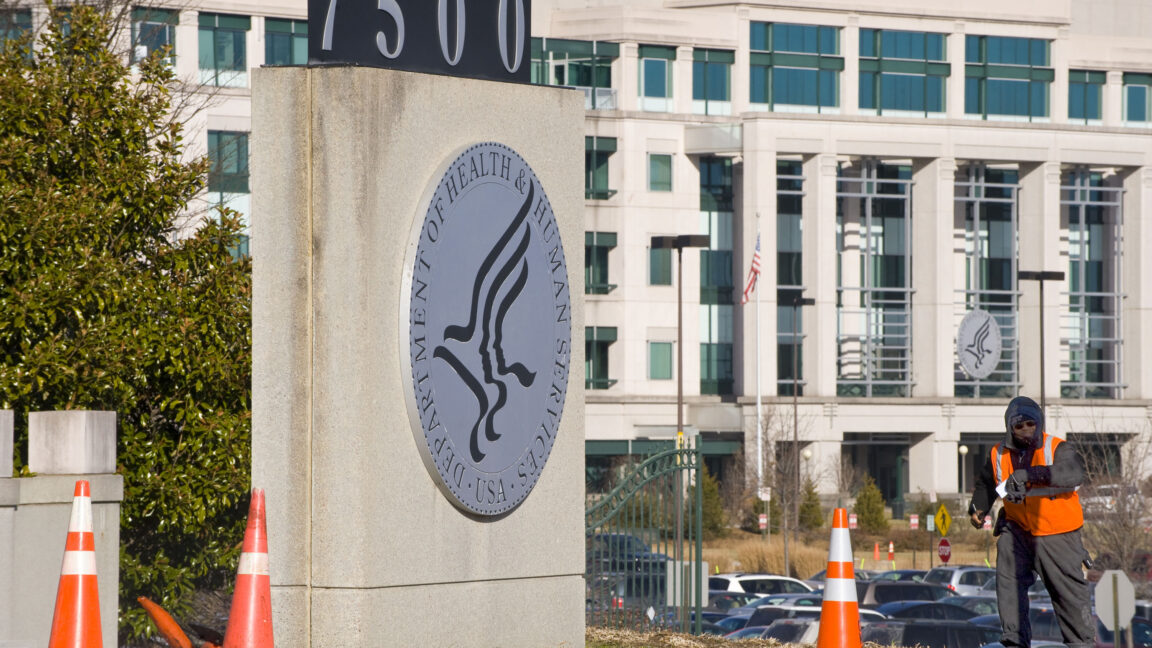
Her federal dollars were accompanied by an ominous note from the payment processing arm of the U.S. Department of Health and Human Services. Citing “Executive Orders regarding potentially unallowable grant payments,” the agency said that it would continue “taking additional measures to process payments” and that its reviews “will result in delays and/or rejections of payments.”

“If it’s not there,” Leach said of the federal money that covers the salaries for 40% of her staff, “things get really bad, really fast.”

The notice Leach received was one of several indications over the past week that the Trump administration is not backing down in its fight to slash spending and dramatically reshape the federal government, despite multiple court orders explicitly restraining the president’s sweeping executive actions. In some cases, to get around the judges’ rulings, the administration has cited a memo that it says is not subject to the existing orders. In others, it denied funding to organizations because their granting agencies are not defendants in one of the ongoing legal challenges. In others still, it has withheld funds by citing the agencies’ own judgment, not the president’s directives.

That argument in particular has been met with skepticism by one of the federal judges hearing lawsuits over the administration’s spending freeze. U.S. District Judge Loren AliKhan wrote in a Feb. 3 temporary restraining order that “the court is not persuaded that the continuing freezes are solely due to independent agency action” and that “both logic and record evidence point to the opposite conclusion.”

Nevertheless, the administration is pressing the same argument in a separate case brought by a coalition of 23 state attorneys general, who assert that the government continues to effectively pause spending in defiance of the court’s rulings. The administration denied that claim in a filing on Sunday, arguing that it is making “good-faith, diligent efforts to comply with the injunction” and that to the extent the court doesn’t agree with the government’s interpretation of the order, it should clarify “the intended scope of its temporary restraining order.”

On Monday, the judge overseeing that case, John J. McConnell Jr., did just that, ruling that the Trump administration had violated his restraining order by keeping funds frozen. He wrote that the government’s “broad categorical and sweeping freeze of federal funds” was “likely unconstitutional” and that it must immediately restore funding across the board, unless it could show the court “a specific instance where they are acting in compliance with this order but otherwise withholding funds due to specific authority.”

The Constitution gives Congress the power to tax and spend, but legal experts say the Trump administration’s actions set the stage for major challenges to that authority — and the well-established limits on the chief executive’s power to unilaterally cut off money that Congress has appropriated to groups he disagrees with. Many of the cuts are related to climate and diversity programs.

Past presidential administrations have tried to exert more control over spending, and President Richard Nixon took the fight to withhold funding to the U.S. Supreme Court. But his administration argued, unsuccessfully, on statutory grounds. No administration has found a constitutional argument compelling enough to bring to the U.S. Supreme Court, said David Super, constitutional law professor at Georgetown Law.

“The only hope the administration will have is someone will recognize the heretofore unrecognized power of the president to withhold money on their own,” Super said.

David Cole, a former legal director for the American Civil Liberties Union who also teaches at Georgetown Law, agreed, saying the president already has the means to pursue changes to federal spending, including majorities in both houses of Congress. “If he disagrees with the law that Congress has enacted, including an appropriation, he can urge Congress to amend the law,” Cole said. “Ideological disagreement with a law is not a justification for refusing to execute that law.”

Still, the Trump administration seems to be girding for potentially thousands of contract disputes. Super, however, said contract law is clear there too: both parties to the contract are bound to its terms.

“No contract I’ve seen has terms that allow a contractor to be dumped because someone doesn’t like their ideology,” Super said.

Neither the White House nor the Department of Health and Human Services responded to requests for comment for this story. But on Sunday, Vice President JD Vance telegraphed on social media the administration’s view on the series of court rulings blocking executive actions in the first three weeks of Trump’s presidency. “Judges aren’t allowed to control the executive’s legitimate power,” he wrote on X.

The legal battle kicked off after the Office of Management and Budget issued a two-page memo on Jan. 27 that required all agencies to identify and pause funding to programs that didn’t comply with executive orders Trump issued on his first day in office, “including, but not limited to, financial assistance for foreign aid, nongovernmental organizations, DEI, woke gender ideology, and the green new deal.”

That prompted two lawsuits — one filed in Washington, D.C., by a group of nonprofits and another in Rhode Island by states. Budget officials withdrew that OMB memo two days later. But the White House’s top spokesperson announced the following day that the executive orders would continue “in full force and effect, and will be rigorously implemented.”

Judges in both cases have temporarily blocked the administration from withholding spending based on the executive orders and the since-rescinded OMB memo.

In its notice to agencies about the rulings, though, government lawyers told leaders that they were still free to pause federal grants. In that document, the Department of Justice wrote that while federal officials couldn’t “pause, freeze, impede, block, cancel, or terminate” obligated money based on the administration’s January directives, agencies “remain free to exercise their own discretion under their ‘authorizing statutes, regulations, and terms,’ including any exercise of discretion to pause certain funding.”

It’s unclear how the administration will respond to Monday’s court order to unfreeze federal funding. But the resulting confusion caused by the various executive actions and court rulings may be the goal of the administration’s rapid-fire directives and its evolving justifications for withholding funds even after the judicial intervention, experts said. In the absence of clarity, groups that rely on federal funding could be forced to scale back or suspend operations.

“There are policy decisions that are being made by simply stirring all this up and creating uncertainty and confusion,” said Don Kettl, a professor emeritus and former dean in the School of Public Policy at the University of Maryland.

That’s what’s happening at the Walker Basin Conservancy, an environmental nonprofit that is relying on federal grants to restore a shrinking lake in rural Nevada.

“On the same day, I will have conversations with different people, often in the same office, who have different understandings,” said Peter Stanton, the group’s CEO. “It’s just a mess.”

The conservancy needs the money for restoration work on public lands in the basin, work that creates local jobs. But in a phone call on Wednesday with the Department of Interior agency that oversees the group’s grants, Stanton said he was told he would get no money from awards that involve funds from two laws that were passed by Congress while Joe Biden was president: the Bipartisan Infrastructure Law and the Inflation Reduction Act. The Interior Department did not respond to ProPublica’s request for comment.

The confusion is influencing big spending decisions that need to be made soon, such as hiring a seasonal workforce. “There will be an inflection point where the chaos and lack of clarity itself begin to drive those decisions,” he said.

Injecting even more uncertainty into the mix, Trump can issue executive orders “faster than opponents can file suits to stop them or courts can decide the cases,” Kettl said.

On Thursday, Trump did just that, issuing another order that directs agency heads to review grants to nongovernmental organizations, many of which, the order said, “are engaged in actions that actively undermine the security, prosperity, and safety of the American people.”

Legal observers say these moves should not have come as a surprise.

Four years ago, on the last day of Trump’s first presidency, Russell Vought and Mark Paoletta, who then, as now, served as top budget officials, wrote in a 14-page letter to a congressional committee that a 1974 law asserting Congress’ powers over the purse was “an albatross around a President’s neck.” In another part of the letter, they said that the president “must be permitted to take time to consider how to best execute” spending federal dollars and that “if that requires a temporary pause in spending, it must be permitted.”

The extent and breadth of the administration’s efforts to control domestic spending appropriated by Congress is still unclear. In affidavits filed late Friday night, officials from across the country detailed the scope and disruption at the state level.

In New York, a top accounting official wrote that, as of Wednesday, the state could not access money that low-income people use to buy groceries, a block grant for maternal and child health services and nearly $6 million in education funding. In New Mexico, the official who heads services for the elderly and disabled adults said further spending pauses could force them to stop delivering hot meals.

Individual grantees who received far smaller sums were no less concerned as they struggled to get clear answers from the government.

Soon after Trump issued his executive orders, Hally Strevey emailed her grant officers at the Bureau of Reclamation about the $600,000 in grants her organization had been awarded under the Biden-era Bipartisan Infrastructure Law to restore a section of the Poudre River in Colorado to prevent future floods. “Since your agreement is already in place and awarded, you should actually be fine,” one wrote back on Jan. 23, “and this current situation will not impact your ability to draw down funding.” Four days later, she wrote again, pasting a link to a Washington Post story detailing the budget memo that called for a sweeping freeze of federal funds and asked, “Is our funding still safe given this latest news?”

An official confirmed receipt of that email but didn’t answer her question. Unable to access her money, she emailed the help desk of the federal grant payment system on Wednesday, after the court rulings, and finally learned the truth: “the grants are suspended.” The next day, her federal grant officer responded, citing another budget memo, which was not at issue in either of the cases challenging the administration’s spending pauses. Pursuant to that document, all funding related to the Bipartisan Infrastructure Law and the Inflation Reduction Act “has been paused,” the official wrote.

“Even though I was anticipating it, deep down you’re like, that’ll never happen,” Strevey said. “And then it did.”

The Bureau of Reclamation did not respond to a request for comment.

Jillian Blanchard, vice president of climate change and environmental justice at Lawyers for Good Government, said that by freezing the grants, the Trump administration had broken a binding contract. “It is illegal to pause legally obligated funds for policy reasons without congressional approval, which is what is happening,” she said.

The administration has not always stated policy reasons though. Instead, in some cases, it has blamed the grinding machinery of government bureaucracy.

On Thursday, for example, a Department of Justice lawyer denied the administration was not abiding by the court’s rulings in one of the two cases challenging the government’s spending freezes, this one brought by a coalition of state attorneys general. He told an attorney representing Oregon that the Environmental Protection Agency was “working through the process of unsuspending grants, which is taking some time given the nature of the process.”

In another email, the same official wrote to a lawyer for New York that the delays in releasing funds to the state were not examples of the administration’s obstinance but were instead “very likely related to” the federal Payment Management System’s “ongoing process of working through the unusually large number of payment requests they received.”

In a filing, the lawyer explained the cause of the “operational delay,” writing that in the four days after OMB issued the spending freeze memo that kicked off the litigation, so many grantees tried to draw down funds — in many cases for their full grant balance — that the payment system automatically flagged 7,000 of them as unusual, prompting further review. As of Sunday, the lawyer wrote, the backlog was fewer than 600 requests.

ProPublica is reporting on the Trump administration’s efforts to reshape the federal government. If you’re a federal worker or the recipient of federal funding and you want to send us a tip, please contact us. Jake Pearson can be reached by phone or on Signal at 917-512-0276 or by email at jake.pearson@propublica.org. Anjeanette Damon can be reached on Signal at 775-303-8857 or by email anjeanette.damon@propublica.org.

Sharon Lerner, Topher Sanders and Joel Jacobs contributed reporting.

10 Feb 15:54

Hiding data in an emoji

by Nathan Yau

Messing with how emojis are encoded, Paul Butler demonstrates how one might hide data via a smiley:

Most unicode characters do not have variations associated with them. Since unicode is an evolving standard and aims to be future-compatible, variation selectors are supposed to be preserved during transformations, even if their meaning is not known by the code handling them. So the codepoint U+0067 (“g”) followed by U+FE01 (VS-2) renders as a lowercase “g”, exactly the same as U+0067 alone. But if you copy and paste it, the variation selector will tag along with it.

Since 256 is exactly enough variations to represent a single byte, this gives us a way to “hide” one byte of data in any other unicode codepoint.

Use this simple tool to give it a whirl 😀󠄼󠅟󠅞󠅗󠄐󠅜󠅙󠅦󠅕󠄐󠅤󠅘󠅕󠄐󠅔󠅑󠅤󠅑󠄐󠅠󠅟󠅙󠅞󠅤󠄞.

Tags: emoji, Paul Butler, secret

10 Feb 15:49

In Breaking USAID, the Trump Administration May Have Broken the Law

by by Anna Maria Barry-Jester and Brett Murphy

by Anna Maria Barry-Jester and Brett Murphy

ProPublica is a nonprofit newsroom that investigates abuses of power. Sign up to receive our biggest stories as soon as they’re published.

It was the week President Donald Trump had signed a sweeping executive order shutting off the funding for foreign aid programs. Inside the U.S. Agency for International Development, his political appointees gathered shell-shocked senior staffers for private meetings to discuss the storied agency’s new reality.

Those staffers immediately raised objections. USAID’s programs were funded by Congress, and there were rules to follow before halting the payments, they said. Instead of reassuring them, the agency’s then-chief of staff, Matt Hopson, told staff that the White House did not plan on restarting most of the aid projects, according to two officials familiar with his comments.

Then Hopson added a stark coda: Trump could not have a higher tolerance for legal risk, the officials recalled. They understood the message to mean that the administration was willing to bend or even break laws to get what it wanted, and then take the fight to court. (Hopson, who resigned shortly after, did not respond to numerous phone calls and written messages requesting comment, and he turned away a reporter who came to his door.)

No president in history has unilaterally shuttered an agency formally enshrined in law — let alone deputized his wealthiest donor, Elon Musk, to carry out that task in his name with little oversight or accountability.

While USAID was first created by President John F. Kennedy in a 1961 executive order, Congress passed a law in 1998 to make it an “independent establishment” like others in the cabinet. Multiple administrations, Democratic and Republican alike, built USAID into an institution that has helped save millions of lives around the world, promoted U.S. interests in remote corners of the globe and employed thousands of Americans.

Now Trump and Musk have nearly destroyed it in three weeks. “It’s very hard not to see what’s going on as a constitutional crisis,” said Peter Shane, a law professor and one of the country’s leading scholars on the Constitution. “It’s very scary and tragic.”

Several experts consulted by ProPublica said the new administration may have broken the law almost immediately.

Around Jan. 31, Jason Gray, the acting administrator of USAID, passed along orders to the agency’s IT department to hand the entire digital network to Musk’s engineers, Luke Farritor and Gavin Kliger, among others. (Farritor, Kliger and Gray did not respond to requests for comment.)

Get in Touch

Do you work in the federal government? Have information about humanitarian aid? Reach out via Signal to reporters Brett Murphy at 508-523-5195 and Anna Maria Barry-Jester at 408-504-8131.

From there, the engineers from Musk’s Department of Government Efficiency quickly gained access to USAID’s financial system. On top of that, they became “super administrators” and had access to thousands of employees’ personal information, including their desktop files and emails, two USAID officials told ProPublica. The material also included information gathered during security clearance background checks, ranging from Social Security numbers and credit histories to home addresses.

“They had complete access to everything you could think of,” one official said. “The keys to the kingdom.”

By providing that access, USAID may have violated the Privacy Act of 1974, three experts on the law told ProPublica, regardless if the engineers were government employees at the time. The law requires consent from individuals before the government gives their private information to anyone.

“It is a catastrophic privacy and information security violation for a band of some government and some nongovernment personnel to barge into an agency and take over systems that contain personal information,” said John Davisson, director of litigation at Electronic Privacy Information Center and one of the country’s foremost authorities on the Privacy Act. Breaking the law can carry civil penalties and a minimum $1,000 fine for each violation if the victim can prove they were harmed, or much more if there were damages like loss of income.

With a series of executive orders, Trump established DOGE as a technology unit to improve IT and human resources functions at government agencies. He ordered his cabinet to give “full and prompt access to all unclassified agency records, software systems, and IT systems.” There are exemptions to the Privacy Act if those accessing the personal files have proper authorization, which includes special training and other rules for each set of records, and if they are conducting routine USAID business. But the three experts ProPublica consulted said that doesn’t appear to be the case here.

Davisson and others said that the law, which Congress passed with overwhelming support from both parties in the wake of Watergate, is meant to prevent presidents and others in high office from abusing their access to records for political ends. “The Privacy Act stands at the fountainhead of all this,” he added. “It stops that constitutional crisis from tipping off in the first place.”

For this story, ProPublica spoke with dozens of current and former USAID officials — many of whom requested anonymity because they feared retribution from the administration — and consulted the country’s leading authorities in government structure, federal law and the Constitution. While other media accounts have detailed several key moments in the blitzkrieg on USAID, this article provides new details about what Trump and Musk’s lieutenants did, what they said at the time and the objections that those within the government raised along the way.

In addition to the Privacy Act, experts told ProPublica the administration may have broken other laws while violating the Constitution itself, including the separation of powers and a president’s duty to faithfully execute the laws of the land. Failing to notify Congress before making major changes to the agency may have transgressed the Administrative Procedures Act, and freezing money appropriated by Congress for foreign aid could be in violation of the Impoundment Control Act.

Officials and experts have been closely watching the developments at USAID out of fear that Trump will deploy the same playbook to target other agencies he has publicly criticized, including the Department of Education.

The Republican-controlled Congress and Trump’s Department of Justice are unlikely to initiate investigations into allegations of wrongdoing by administration officials. In fact, the DOJ’s acting U.S. attorney in Washington, who was a lawyer for Jan. 6 defendants, signaled the very opposite in a recent series of letters to Musk, promising to investigate people who illegally impeded DOGE’s efforts or even those who just acted unethically “and chase them to the end of the Earth.” The DOJ did not respond to requests for comment.

That leaves lawsuits. On Thursday, federal worker groups sued the administration, accusing Trump of violating the Constitution by systematically disemboweling the agency without congressional approval. The next day, a Trump-appointed judge issued an injunction temporarily halting a major part of the administration’s efforts to reduce USAID’s more than 10,000-person workforce to a few hundred.

The administration argued during a hearing on Friday that the president has acted within his authority and continues to press its case. Trump and his advisers have long planned to assert in court that presidents have sweeping power to withhold funding from programs they dislike.

The lawsuit is so far the only substantive challenge Trump and Musk have faced since they began dismantling the agency. The judge’s ruling raises questions about what will happen if workers try to use USAID systems or buildings on Monday and are denied access.

“USAID is driving the radical left crazy, and there is nothing they can do about it,” Trump posted that same day, in all capital letters. “Close it down!”

The White House, USAID, the State Department and Musk did not respond to detailed lists of questions for this article. Previously, the administration has said, “Those leading this mission with Elon Musk are doing so in full compliance with federal law, appropriate security clearances, and as employees of the relevant agencies, not as outside advisors or entities.”

Over the past week, they have defended their assault on the agency by repeatedly amplifying the once-fringe sentiment that USAID had become a conduit for wasteful spending, fraud and corruption. The judge on Friday noted the administration provided no evidence to support those claims. But Musk and Trump have successfully fueled intense animosity toward the agency anyway, drumming up support for their effort to destroy it.

“We spent the weekend feeding USAID into the woodchipper,” Musk posted Monday on X. He is the richest man in the world, and his company SpaceX has received at least $15.4 billion in contracts over the past decade from the same government he has pledged to cleanse of wasteful spending.

“USAID is a criminal organization,” Musk said on X. “Time for it to die.”

In the frenzied days after the arrival of Musk’s engineers at USAID, they used their access to the agency’s IT systems to begin identifying bureaus to cull and programs to terminate, USAID officials told ProPublica. They were working under the direction of another political appointee named Peter Marocco, the director of foreign affairs at the State Department.

Around that time, Marocco drafted the order that required American-funded aid projects around the world to close down. Marocco — who held a leadership role at USAID during Trump’s previous administration, where staff formally accused him of undermining the agency’s mission — did not respond to a list of questions from ProPublica.

After the stop-work orders began going out, Trump’s aides and the DOGE team then turned their focus to the agency’s workforce, which is staffed by civil servants, foreign service officers and contractors. Their initial step was to oust about 60 top supervisors, including the agency’s attorneys.

Next, the administration issued stop-work orders to staffing companies in Washington, effectively laying off hundreds of workers at once. Presidents generally have wide latitude to cancel such contracts, though there is typically a deliberative process. A move like that has never been done at this scale before, experts said. The workers who lost their jobs had no civil service protections.

But that still left the bulk of the direct government workforce. The administration managed to figure out a way to sideline civil servants without officially firing them: They placed hundreds of USAID’s career staff on indefinite administrative leave — with pay but without explanation — or simply locked them out of the agency systems. Some who received no notice used their personal email addresses to ask about their status and received a reply from human resources that they “have likely been placed on administrative leave,” without official confirmation, according to emails obtained by ProPublica.

Taxpayers are currently paying for them not to work. That maneuver went at the heart of what was regarded as a sacrosanct tenet in American government: that civil servants remain outside partisan politics and can’t be fired without due process.

In another stunning move, Marocco recalled back home 1,400 of USAID’s overseas foreign service officers, who were supposed to have similar job protections.

“This is a masterpiece of administrative design,” said Donald Kettl, the former dean in the School of Public Policy at the University of Maryland who has written multiple books about government structure. “It’s unprecedented in its scale,” Kettl added. “Each of these things has been done individually, but never all rolled together as one package and focused strategically like a series of intercontinental ballistic missiles.”

Musk’s employees told staff they could not come to USAID’s headquarters. Guards now stand sentry with a clipboard to block almost everyone from getting inside. On Friday, a maintenance crew took the agency’s title off the building’s facade.

What happens now is unclear. Friday’s court injunction temporarily prevents the administration from placing about 2,000 more people on leave, orders the reinstatement of 500 others and stops the recall of foreign service officials from abroad.

In recent days, ProPublica has interviewed dozens of USAID officials and contractors who have found themselves suddenly out of work and cut off from the government they had devoted their lives to serving. “I am a combat veteran of the U.S. Marine Corps and not a deranged Marxist as Elon is shouting,” one employee told ProPublica.

“I have lived through a dictatorship before,” said another. “I know what these look like, and the writing is on the wall for me.”

A third: “I don’t think Americans seem to understand what’s at stake here. This is a heist. It’s a hostile takeover by malicious actors of our entire government.”

At various points, those within the agency who tried standing up against what they considered to be illegal abuses or immoderate management say they were punished for it. “There are no guardrails left,” another USAID official told ProPublica. “And there’s nobody left to stop it.”

The agency’s heads of security were put on leave after they blocked Musk’s engineers from accessing the classified servers last weekend. Then the same happened to the top human resources officer after he refused to put an additional 1,400 staffers on leave Tuesday. Both episodes were first reported by the trade publication Devex.

Likewise, when the USAID labor director reversed the administration’s decision to place almost 60 senior civil servants on leave at the onset, he was put on leave too. “The agency’s front office and DOGE instructed me to violate the due process of our employees by issuing immediate termination notices,” the labor director wrote in an email to staff.

“It is and has always been my office’s commitment to the workforce that we ensure all employees receive their due process,” he added. “I will not be a party to a violation of that commitment.”

A security guard stands at the entrance to the USAID headquarters on Monday. (Kevin Dietsch/Getty Images)

Early last week, Secretary of State Marco Rubio — a staunch supporter of USAID during his time in the Senate — sent Congress a letter saying that the administration “may move” some of the agency’s bureaus under the State Department, the kind of notification that is required 15 days before any major overhaul can take place, according to federal law. He told the lawmakers that the administration intended to work with them on a “review and potential reorganization of USAID’s activities,” and that Marocco would lead the effort.

If it were true, experts say his sentiment would more closely reflect the legal requirements that Congress has laid out since establishing USAID as an independent agency. But experts and government officials said the letter is an inadequate attempt to retrospectively justify what has already occurred.

That difference — between what the administration told lawmakers it was doing to USAID and what it was actually doing — was on display during a previously unreported episode in late January.

Peter Marocco (U.S. Department of Defense)

In late January, Marocco spoke with congressional aides representing both parties and both chambers. During a series of a half dozen phone calls — he declined to see them in person — the aides asked him to explain the rationale behind the stop-work orders the administration had sent around the world and the process for organizations to receive a waiver from program freezes.

Marocco declined to give substantive responses and claimed the waiver process was operating smoothly, one of the aides told ProPublica.

Marocco said shutting down USAID programs would give the administration an opportunity to see which ones would make America safer and stronger, which was Trump’s promise to voters. He added that he would be personally reviewing programs that requested a waiver and decide which ones should go to Rubio for final approval.

Meanwhile, organizations all over the world remain either grounded under stop-work orders or unable to draw on U.S. funds to continue working, as ProPublica previously reported. The agency put many people who could help process those payments on leave. Among the programs affected were efforts to feed malnourished children in Sudan, bring clean water to refugees in Yemen and deliver medicines to people living with HIV.

During the briefings, the congressional aides acknowledged that there are legitimate things to criticize about USAID. In the past, the agency has been accused of poor oversight of its contractors and interminable support for projects that were meant to end years ago. “I believe the purpose of foreign assistance should be ending its need to exist,” the agency’s former administrator Mark Green once said. And it was the president’s prerogative to focus on programs that align with his agenda. “But,” one of the aides told Marocco, “none of that justifies anything you’re doing.”

Days later, during a recent meeting with USAID staff in Guatemala, Rubio claimed they’d had a “problem” with some people back in the U.S. and that some of the agency’s programs undermined the Trump administration’s goals, according to a transcript of his comments. He also suggested that exceptions to Marocco’s foreign service recall could be made for people with extenuating circumstances, such as pregnant staffers in their third trimester or a person on dialysis.

By Thursday, there were plans to decimate entire USAID bureaus without inviting back the majority of staff on administrative leave. A group tracking the fallout estimates nearly 52,000 American jobs, including those working for vendors and contractors, were already eliminated in the last two weeks. “I fail to understand how having thousands of Americans lose their jobs puts America first,” said Nidhi Bouri, who worked for nearly a decade at USAID, the last two as a political appointee of President Joe Biden.

It’s legally murky if Trump simply keeps them on indefinite administrative leave. Under the Administrative Leave Act of 2016, an individual can only be placed on paid leave for 10 days a year. But a regulation issued by the Biden administration specifies that limitation only applies when that person is under investigation. Legal experts say the interpretation has since been that if there is no investigation, an employee can be placed on leave indefinitely, so long as they continue receiving a paycheck.

Not everyone is sure the Biden-era regulation will hold up in court. “That hasn’t been challenged, and it’s relatively new,” said Nick Bednar, a law professor at the University of Minnesota. “There’s enough of us that think that regulation is inconsistent with statute and if argued in court it might be considered invalid.”

The USAID office in Tegucigalpa, Honduras (Orlando Sierra/AFP/Getty Images)

It is illegal for the Trump administration to unilaterally dissolve an agency created by Congress, according to legal scholars, government experts and the congressional research facility.

“For all intents and purposes you are dismantling an agency created by Congress, and that’s a violation of the law,” said Lawrence Gostin, a professor at Georgetown Law. “It can’t stand unchallenged, in my view.”

And while a president has broad discretion to make changes to programs and reduce the workforce, the Impoundment Control Act prevents him from withholding money appropriated by Congress, the experts said.

“If it turns out that the president can eliminate or defund an agency on a whim, then ultimately Congress is stripped of all power over the budget,” said Jessica Riedl, a senior fellow at the Manhattan Institute, a conservative think tank. “That would create a precedent that destroys the separation of powers.”

It will be the courts that decide if and to what extent Trump’s takeover of USAID violated federal law.

Many legal experts in and outside of government believe this was the administration’s plan all along: drag out Trump’s most aggressive and controversial policy decisions in court for so long that by the time any permanent judgment comes down, favorable or not, USAID will be nothing but a memory.

“They don’t seem to care what the statutes say,” said Kevin Owen, an attorney who represents both management and federal workers in employment disputes. “The plan from the employment perspective was to fire them all and make them sue. If the administration loses the court cases, so be it. The damage is done.”

Do you work in the federal government? Have information about humanitarian aid? Reach out via Signal to reporters Brett Murphy at 508-523-5195 and Anna Maria Barry-Jester at 408-504-8131.

08 Feb 16:14

National Institutes of Health radically cuts support to universities

by John Timmer

Grants paid by the federal government have two components. One covers the direct costs of performing the research, paying for salaries, equipment, and consumables like chemicals or enzymes. But the government also pays what are called indirect costs. These go to the universities and research institutes, covering the costs of providing and maintaining the lab space, heat and electricity, administrative and HR functions, and more.

These indirect costs are negotiated with each research institution and average close to 30 percent of the amount awarded for the research. Some institutions see indirect rates as high as half the value of the grant.

On Friday, the National Institutes of Health (NIH) announced that negotiated rates were ending. Every existing grant, and all those funded in the future, will see the indirect cost rate set to just 15 percent. With no warning and no time to adjust to the change in policy, this will prove catastrophic for the budget of nearly every biomedical research institution.

Read full article

Comments

08 Feb 16:13

Feds putting the kibosh on national EV charging program

by Aarian Marshall, wired.com

The US Department of Transportation has ordered states to kill their implementation plans related to the National Electric Vehicle Infrastructure program, according to a memo obtained by WIRED that was later made public. The decision appears to halt in its tracks a $5 billion program designed to fund state projects to install electric vehicle charging stations across the United States.

Officials at the Federal Highway Administration (FHWA), which manages the program, ordered state transportation directors to “decertify” the plans that all 50 states have used to outline where and how they will build their charging stations, and with what companies they’ll contract to do so. States have followed those plans to build more than 30 charging stations across the US, with hundreds more on the way.

Surveys show prospective car buyers cite the country’s lagging electric vehicle charging infrastructure as a major reason they won’t buy electric. The NEVI program, established by 2021’s Infrastructure Law, was the government’s answer to those concerns. It attempts to build chargers along thousands of miles of federal highway, with a focus on places that might not otherwise be able to financially support a charger.

Read full article

Comments

08 Feb 16:13

Federal judge blocks USAID leave notices and reinstates workers

by Erich Wagner
A federal judge in Washington, D.C., on Friday issued a temporary restraining order blocking the U.S. Agency for International Development from placing thousands of employees on administrative leave and hurriedly evacuating workers stationed overseas. The order also reinstates all employees placed on leave earlier this week.

The American Foreign Service Association and the American Federation of Government Employees filed a lawsuit Thursday night aimed at halting the apparent effort to decimate the foreign aid agency and reposition it under the auspices of the State Department. Hundreds of stateside employees were locked out of both the agency headquarters and its computer systems at the start of the week, and Secretary of State Marco Rubio has been named the agency’s acting administrator.

AFSA and AFGE’s lawsuit alleges that the administration’s plans violate the constitutional separation of powers, the take care clause that tasks the president with faithfully executing federal law, and in multiple instances the Administrative Procedures Act.

In his ruling, U.S. District Judge Carl Nichols halted all of the Trump administration's workforce actions—leave placements, evacuation of overseas personnel and the shutting off of employees' access to USAID's various computer systems—until February 14 at midnight, in order to allow a fuller discussion of the legal issues.

At a hearing Friday, Acting Assistant Attorney General Brett Shumate confirmed that just days after placing around 500 employees on administrative leave, USAID planned to place another 2,200 workers on leave Friday night, moves that many believe to be a prelude to their termination. Karla Gilbride, who just last week was removed from her position as general counsel of the Equal Employment Opportunity Commission, said Friday’s planned leave notices, many of which were aimed at USAID workers stationed overseas, would cause a myriad of harms to the agency’s workforce.

“They will be locked out of all computer systems, all payment systems, email systems, as well as systems that inform them of security threats,” she said. “This would imperil their safety, the operations of USAID and their institutional partners, and it adds to the instability of these already unstable regions.”

Shumate argued that despite all of the employee groups’ emphasis on constitutional and statutory violations, the case still should be channeled either through the Merit Systems Protection Board or the Federal Labor Relations Authority.

But Nichols, a Trump appointee, seemed frustrated with the government’s refusal to contemplate pausing their actions so that more substantive legal arguments could take place.

“You may be right, and with briefs and 24 hours, you might even convince me of that,” he said. “But I’ve got eight hours, no briefs [from you], and the hypothetical possibility that 2,200 people will be put on administrative leave and claims of irreparable harm.”

Nichols said he would issue an order before midnight Friday blocking the new administrative leave notices from going out, as well as any agency efforts to evacuate employees currently stationed overseas. He added that he may include language instructing the agency to rescind the roughly 500 leave notices that went out earlier this week, but that he was not yet sure on that point.

This story has been updated at 11:03 p.m.

]]>
08 Feb 14:40

Elon Musk’s DOGE Is Expected to Examine Another Treasury System Next Week

by by Justin Elliott and Robert Faturechi

by Justin Elliott and Robert Faturechi

ProPublica is a nonprofit newsroom that investigates abuses of power. Sign up to receive our biggest stories as soon as they’re published.

After creating an uproar last week for demanding access to a sensitive system at the Treasury Department, officials affiliated with Elon Musk’s Department of Government Efficiency are expected to turn their attention to another restricted database next week, according to two people with knowledge of their plans.

The new target, the sources said, is a database that tracks the flow of money across the government, from the Treasury to specific agencies and then to the ultimate destination of the funds.

The data in the system, known as the Central Accounting Reporting System, or CARS, is considered sensitive. Many transactions flowing to the same place, for example, can suggest a new national security priority for the U.S. government. People who work with the system have in the past been briefed that the database may be of interest to foreign intelligence agencies, said a third source who has familiarity with the system.

Musk’s affiliates are expected to arrive at Treasury offices in Parkersburg, West Virginia, next week, according to two sources, prompting concern among the staff there. The offices house a large number of staffers who work for the previously obscure Bureau of the Fiscal Service, the part of the Treasury that manages accounting and payments systems.

A spokesperson for DOGE did not immediately respond to requests for comment. Neither did a Treasury spokesperson.

CARS is intended to standardize accounting across government agencies and account for how money is moved. It’s unclear what specifically the DOGE team’s interest in the system is. When government auditors have examined the system in the past, the Treasury has pushed for them to do it in secure environments or on the Fiscal Service’s laptops.

DOGE’s earlier actions at the Treasury have become a focus of congressional scrutiny and a federal court battle in recent days. Musk’s team initially tried to halt money going to the U.S. Agency for International Development from the Treasury’s payment system.

A veteran career official within the Treasury pushed back and then retired in the face of the demands. On Friday morning, The Washington Post reported that one of the DOGE-affiliated staffers involved in that standoff, Tom Krause, a Silicon Valley tech executive, would be replacing the career official who resigned, which would give him power over the Bureau of the Fiscal Service’s payment and accounting systems.

Federal workers unions took the matter to court, and a judge on Thursday temporarily limited Musk’s team to read-only access.

The Treasury has assured Congress that the DOGE-affiliated staffers have read-only privileges for the payment system, but Sen. Ron Wyden, D-Ore., has raised concerns that the agency may have misled lawmakers, citing reports from Wired that a DOGE staffer had “read-write” access for several days. “Treasury’s refusal to provide straight answers about DOGE’s actions, as well as its refusal to provide a briefing requested by several Senate committees only heightens my suspicions,” Wyden said in a statement on Friday.

One of the two Musk-affiliated officials probing the Treasury’s systems resigned Thursday after The Wall Street Journal discovered racist posts on a social media account linked to him.

The posts included “I was racist before it was cool” and “I would not mind at all if Gaza and Israel were both wiped off the face of the Earth.”

It’s not clear which personnel are scheduled to make the trip to West Virginia or if the resignation will affect those plans. By Friday morning, Musk was posting on X about bringing the staffer back, and Vice President JD Vance backed the idea, saying, “I don’t think stupid social media activity should ruin a kid’s life.” In a press conference, Trump said he wasn’t familiar with the situation but backed Vance’s take.

Do you have any information about DOGE and the Trump administration’s moves at Treasury that we should know? Robert Faturechi can be reached by email at robert.faturechi@propublica.org and by Signal or WhatsApp at 213-271-7217. Justin Elliott can be reached by email at justin@propublica.org or by Signal or WhatsApp at 774-826-6240.

Alex Mierjeski contributed research.

08 Feb 14:36

DOGE can’t use student loan data to dismantle the Education Dept., lawsuit says

by Ashley Belanger

The Department of Education (DOE) was sued Friday by a California student association demanding an "immediate stop" to Elon Musk's Department of Government Efficiency (DOGE) "unlawfully" digging through student loan data to potentially dismantle DOE.

"The scale of the intrusion into individuals’ privacy is enormous and unprecedented," the lawsuit said.

According to the University of California Student Association (UCSA)—which has over 230,000 undergraduate students as members—more than 42 million people in the US have federal student loans and face privacy risks, if DOGE's access to their information isn't blocked. Additionally, parents and spouses of loan borrowers share private financial information with the DOE that could also be at risk, the lawsuit alleged.

Read full article

Comments

07 Feb 20:44

Federal worker resignations

by Nathan Yau

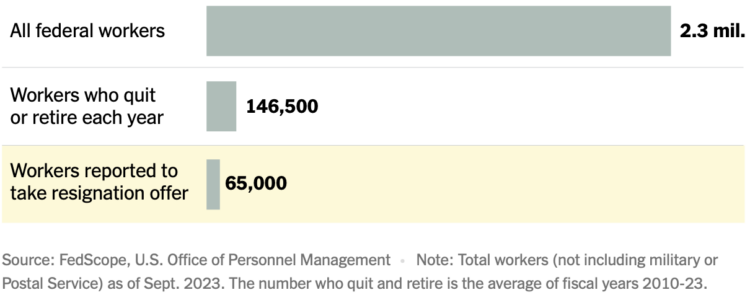
According to the U.S. Office of Personnel Management, about 65,000 federal workers have taken the resignation offer. The New York Times puts that number into context, given the size of the federal workforce.

In other words, the federal government is an enormous work force that already experiences sizable turnover every year. In addition to workers who leave the government to retire or simply to quit, about another 50,000 to 60,000 are terminated every year for disciplinary or performance reasons, or because their appointments or funds expired. A small number — around 3,400 — die each year while employed by the government. All these departures are typically replaced by about 240,000 hires each year.

While the resignation count might seem large, the denominator is a lot bigger.

Tags: government, New York Times, resignation

07 Feb 12:23

more on the federal government’s “deferred resignation” offer (spoiler: it’s definitely a trap)

by Ask a Manager

This post was written by Alison Green and published on Ask a Manager.

Just sharing this tweet from Washington Post reporter Jeff Stein about Elon Musk’s “deferred resignation” offer for federal government workers. (Don’t take it! It’s still a trap.)A federal worker sent me audio of a call that HR did today with staff about "deferred resignation" agreements offered by DOGE ... I think this is pretty well understood by now but helps confirm what many suspect The audio goes: Employee: Lets say I accept the agreement tomorrow - you were to rescind the agreement and they were to stop paying me on Friday ... we would have no recourse available? HR official: Yes ... as the agreement is outlined that is absolutely correct

Also, if you remember the letter-writer who worked at Twitter when Elon Musk took over, that same person has sent in this note:

I just wanted to thank you for posting about what federal workers who are currently under attack can do.

The former Twitter employees I know have all spent the past couple of weeks reliving the Twitter takeover from 2 years ago but on a much more widespread and terrible scale. I want to say this is all beyond belief but … we saw this happen and how it played out, and now I’m just left feeling so angry that we couldn’t have stopped this somehow. I don’t know what I could have done differently or better, but I feel the burden of watching this happen the first time around and not being able to stop it.

Seeing the news about how Elon locked government workers out of their systems, how they’re moving beds into OPM’s headquarters … It feels like the Twilight Zone.

I would not at all be surprised if he held a public auction in the next couple weeks to sell off real estate, office equipment … all the way down to artwork on the walls and plants on employee desks.

I’m still thinking about how I can help push back on and resist what we’re seeing happen all around us, and I wanted to say that if you ever do another post on this issue, please let the federal workers know that a whole bunch of former Twitter employees know what they’re going through, and we support them, and we’re so so sorry they’re experiencing this.

07 Feb 00:09

White House budget proposal could shatter the National Science Foundation

by Eric Berger

Sometime during the next several weeks, the directors of federal agencies will receive a draft version of President Trump's budget request for the coming fiscal year, which begins on October 1. This "passback review" is a standard part of the federal budgeting process which ends in Congress writing a budget and the president signing it into law.

The budget request will be the first of President Trump's second term, and it will offer a clear window into the priorities of his new administration. Although widespread cuts are expected for much of the government's discretionary spending, the outlook for the National Science Foundation appears to be especially grim.

During an emotional all-hands meeting on Tuesday, the agency's assistant director for engineering, Susan Margulies, told agency employees to expect between a quarter and a half of its staff to be laid off within the coming months, E&E News reported.

Read full article

Comments

07 Feb 00:08

Elon Musk’s Demolition Crew

by by Avi Asher-Schapiro, Christopher Bing, Annie Waldman, Brett Murphy, Andy Kroll, Justin Elliott, Kirsten Berg, Sebastian Rotella, Alex Mierjeski, Pratheek Rebala and Al Shaw

by Avi Asher-Schapiro, Christopher Bing, Annie Waldman, Brett Murphy, Andy Kroll, Justin Elliott, Kirsten Berg, Sebastian Rotella, Alex Mierjeski, Pratheek Rebala and Al Shaw

On President Donald Trump’s authority alone, Elon Musk, the world’s richest man, has been unleashed on federal agencies. Employees from Musk’s companies and those of his allies, as well as young staffers he’s recruited, are wresting authority from career workers and commandeering computer systems.

While some have been public about their involvement, others have attempted to keep their roles secret, scrubbing LinkedIn pages and other sources of data. With little information from the White House, ProPublica is attempting to document who is involved and what they are doing.

Musk’s team, known as the Department of Government Efficiency, has already thrown entire swaths of the federal government and its programs into disarray — programs that serve millions of Americans.

Musk himself has made no secret of his intentions, saying that DOGE is a “wood chipper for bureaucracy” and that he is “deleting” agencies.

A White House spokesperson wrote, “Those leading this mission with Elon Musk are doing so in full compliance with federal law, appropriate security clearances, and as employees of the relevant agencies, not as outside advisors or entities.” None of the people identified responded to requests for comment.

We are still reporting. Do you have information about any of the people listed below? Do you know of any other Musk associates who have entered the federal government? You can reach our tip line on Signal at 917-512-0201 . Please be as specific, detailed and clear as you can.

Jacob Altik, 32

Lawyer

Connected to: Executive Office of the President

Altik is a 2021 graduate of the University of Michigan Law School. He clerked for D.C. Circuit Court of Appeals Judge Neomi Rao, a Trump appointee known for critiquing the administrative state. For the last year and a half, he worked as a corporate litigation associate at Weil, where he co-authored a detailed legal analysis on administrative law jurisprudence at the Supreme Court. Last year, he was selected to begin a clerkship for Supreme Court Justice Neil Gorsuch in the 2025 term, which is set to begin this summer.

Anthony Armstrong, 57

Senior Adviser to the Director

Connected to: Office of Personnel Management

Musk link: Worked on Musk’s purchase of Twitter

Armstrong is a technology banker at Morgan Stanley who worked on Musk’s $44 billion acquisition of Twitter — since rebranded as X — in 2022. He has been given an influential role at OPM, which handles personnel issues across the federal government. Since Trump took office, OPM has spearheaded the new administration’s efforts to dramatically reduce the federal workforce and roll back telework and remote work policies.

Riccardo Biasini, 39

Senior Adviser to the Director

Connected to: Office of Personnel Management

Musk link: Former engineer at Tesla, executive at the Boring Company

Biasini is an engineer and former executive who has worked at two of Musk’s companies, the Boring Company and Tesla. He has also taken a high-ranking role at OPM. Biasini was listed as the contact person for the government-wide email system put in place by the Trump administration and used to send messages directly from OPM to millions of federal workers across the government, according to a recent court filing .

Brian Bjelde, 44

Senior Adviser

Connected to: Office of Personnel Management

Musk link: Vice president of people operations at SpaceX

Bjelde is a longtime SpaceX employee who’s spent more than 20 years at the company, according to his LinkedIn profile, where he’s had a variety of jobs, including as managing director of the “food services group.” He previously worked for NASA’s Jet Propulsion Laboratory. He’s been referred to in press reports as a “top DOGE Lieutenant,” working at OPM to slash head count. CNN previously revealed that Bjelde had informed OPM staff of a plan to cut 70% of the agency’s workforce. The New York Times reported that Bjelde helped Musk cut staff at Twitter following its takeover.

Akash Bobba, 21

Senior Adviser to the Director

Connected to: Office of Personnel Management

Bobba was named by Wired magazine as part of a team of six young engineers picked by Musk for his DOGE team. A recent graduate of the University of California, Berkeley, Bobba worked as an intern at Meta, the social media company, and at Palantir, the software and data analytics firm that is a major defense contractor. Bobba is listed in personnel records as an “expert” at OPM, where he has reportedly been able to access internal databases. He graduated from high school in 2021; in his graduation speech, featured in the Spotlight New Jersey newspaper, he told his fellow graduates that, in life, the “answers we deserve demand discomfort.”

James Burnham, 41

General Counsel

Connected to: Executive Office of the President

Burnham is a former litigation partner at Jones Day and a high-ranking Justice Department and White House official from the first Trump administration. The New York Times first reported his involvement with DOGE as a lawyer in January. His title at DOGE is listed internally as general counsel, according to records reviewed by ProPublica. Burnham previously served as a clerk to Supreme Court Justice Neil Gorsuch. On a website for one of his past companies, Burnham is described as having played a “central role” in the selection and confirmation processes for Gorsuch, Justice Brett Kavanaugh and then-Judge Amy Coney Barrett.

Nate Cavanaugh, 28

Connected to: General Services Administration

Cavanaugh is an entrepreneur who has founded companies focused on intellectual property management and small-business finance. He has been interviewing staffers at the GSA as part of the DOGE team, according to those who have spoken with him. GSA procures technology tools, real estate, and other services for federal government agencies. In published interviews, Cavanaugh has expressed an admiration for tech luminaries, including Peter Thiel, Elon Musk, and Mark Zuckerberg, and has said he is “very interested in crypto.”

Edward Coristine, 19

Expert

Connected to: Office of Personnel Management

Musk link: Interned at Neuralink

Coristine is a recent undergraduate student at Northeastern University and part of the group of young DOGE staffers detailed to OPM, the government’s human resources office. Wired reported that Coristine interned at Neuralink, Musk’s brain-computer interface company. Friends of Coristine told Northeastern University’s independent student newspaper that Musk was one of Coristine’s idols and that while he finished the fall 2024 semester, he did not return to school for the spring term. According to CBS News, Coristine has been seeking access to the Small Business Administration’s internal records on behalf of DOGE.

Steve Davis, 45

Musk link: Longtime Musk lieutenant, CEO of the Boring Company

Davis has been a senior executive and close associate of Musk’s for over two decades, working with him at SpaceX, X and the Boring Company. He was one of the first people to be associated with the DOGE effort last year. The New York Times reported he was on early calls with Musk as they conceived of the DOGE effort and explored ways to cut federal programs. Bloomberg reported that Davis has helped recruit staffers for DOGE.

Marko Elez, 25

Connected to: Treasury Department

Musk link: Worked as an engineer at X and SpaceX

Elez works at the Treasury Department, a staffer at the office of the Secretary of Treasury confirmed in a call with a ProPublica reporter. Wired reported Feb. 4 that Elez, who graduated from Rutgers in 2021 and studied computer science, has gained access to the highly sensitive payment systems of the U.S. Treasury Department. According to Elez’s LinkedIn bio, which was recently deleted, he was most recently an engineer at X in New York for roughly a year and an engineer at SpaceX in the Los Angeles area for around three years before that. Elez reportedly resigned Feb. 6 after The Wall Street Journal reported that he has links to a social media account that posted racist comments online.

Luke Farritor, 23

Executive Engineer in the Office of the Secretary

Connected to: Department of Health and Human Services

Musk link: Former SpaceX intern

Farritor works as an executive engineer at the HHS, according to agency data. He studied computer science at the University of Nebraska-Lincoln and interned at SpaceX, working on its Starlink Wi-Fi team and Starship launchpad software, according to his Linkedin profile. In March 2024, he received a Thiel fellowship , a two-year program founded by billionaire tech entrepreneur Peter Thiel that awards a $100,000 startup grant to students who drop out of college.

Stephanie Holmes, 43

Human Resources

Holmes is running human resources at DOGE, according to government workers who have been in meetings with her. A former lawyer with Jones Day, a firm that frequently represents Trump, she was previously the chief people officer at Oklo, a nuclear energy company chaired by OpenAI CEO Sam Altman. She also ran her own HR consulting firm, BrighterSideHR, which advised companies to pursue “non-woke” approaches to diversity and inclusion in the workplace.

Gautier “Cole” Killian, 24

Federal Detailee

Connected to: Environmental Protection Agency

Killian works at the EPA, according to agency data. His position is a federal detail, which typically allows government employees to transfer between agencies for temporary roles. He studied math and computer science at McGill University, where he conducted blockchain-related research. He recently worked as an engineer at Jump Trading, an algorithmic financial trading company, and is a member of the DOGE team, according to recent media reports .

Gavin Kliger, 25

Senior Adviser to the Director

Connected to: U.S. Agency for International Development, Office of Personnel Management

Kliger is a senior adviser at OPM, according to his LinkedIn profile. He spent nearly five years as a software engineer at Databricks, a cloud-based AI company. He is widely reported to be part of Musk’s DOGE team. On his personal Substack, he wrote an essay titled “Why I gave up a seven-figure salary to save America,” according to press reports, and described failed U.S. attorney general nominee Matt Gaetz, who withdrew from Congress amid allegations of sexual misconduct, as a “victim” of the deep state. On Feb. 3, workers at USAID received an email announcing that their Washington offices would be closed that day. Replies to the email were directed to Kliger at a USAID email address.

Keenan D. Kmiec, 45

Lawyer

Connected to: Executive Office of the President

Keenan Kmiec’s career veered from elite law to, more recently, crypto. After clerking for then-Judge Samuel Alito on a federal circuit court, he clerked on the Supreme Court for Chief Justice John Roberts in the 2006-2007 term, according to his LinkedIn. He did a stint at a corporate law firm and had his own firm focused on insider-trading litigation. In 2021, Kmiec began working for a Swiss foundation that promotes a blockchain called Tezos, according to his LinkedIn. He then served for nine months as CEO of a now-defunct startup called InterPop, which described itself as “forging the future of digital fandom with comic, game, and collectible NFTs minted responsibly on the Tezos blockchain.”

Tom Krause, 47

Expert

Connected to: Treasury Department

Krause is a part of DOGE’s efforts to gain access to sensitive federal payment systems as part of Musk’s larger effort to root out spending perceived as wasteful. According to the Treasury Department , Krause leads a team of people who have been granted “read-only” access to the code for the agency’s Fiscal Service payment system, which processes payments for major programs such as Social Security and Medicare. The department has clarified he is designated as a “special government employee.” The New York Times reported that Krause is affiliated with Musk’s DOGE team.

Katie Miller, 33

Spokesperson

In December, during the transition, Trump named Miller, who served in the first administration as a press secretary to Vice President Mike Pence, as one of the first members of DOGE. She is the wife of White House deputy chief of staff Stephen Miller. After reports that DOGE personnel accessed internal USAID data, Katie Miller defended the group, saying that “no classified material was accessed without proper security clearances.”

Justin Monroe, 36

Adviser

Connected to: FBI

Musk link: Senior director for security at SpaceX

Monroe is working as an adviser within the office of the director of the FBI, according to three people familiar with the matter. NBC News previously reported that an unnamed SpaceX employee has been placed in the FBI director’s office but said it could not confirm the individual’s identity. Monroe is a seasoned information security professional who previously served in the U.S. Navy as an information warfare officer .

Nikhil Rajpal, 30

Expert

Connected to: Office of Personnel Management

Musk link: Former Twitter employee

Rajpal is listed as an “expert” now working for OPM. An archived version of his personal website from 2018 lists his job title as an engineer at Twitter. Rajpal has extensive access to sensitive personnel data used by OPM, according to a source familiar with his role. Wired reported Feb. 5 that Rajpal also sought and was later granted access to data at the National Oceanic and Atmospheric Administration. Wired magazine reported that he is part of the DOGE team.

Rachel Riley, 33

Senior Adviser in the Office of the Secretary

Connected to: Department of Health and Human Services

Riley works as a senior adviser at HHS, according to agency data. She previously worked for consultancy firm McKinsey & Company for about eight years, most recently as a partner leading teams advising the company’s state and federal government clients. She has been working closely with Brad Smith, a former health official in Trump’s first administration who ran DOGE during the transition period, according to media reports .

Michael Russo, 67

Chief Information Officer

Connected to: Social Security Administration

Musk link: Former chief technology officer of Starlink payment processor Shift4 Payments

Russo is a top-ranking technology official at the SSA, which disburses over $1.5 trillion in benefits annually. Russo spent over seven years as an executive and senior adviser with Shift4 Payments, a payment processing company that is both an investor in SpaceX and a payment processor for StarLink, according to his Linkedin . The CEO of Shift4 Payments, Jared Isaacman, has been nominated by Trump to lead NASA and is a friend of Musk’s who has purchased multiple spacewalks with Musk’s SpaceX company. Russo’s office will oversee the SSA’s over $2 billion IT budget.

Amanda Scales, 34

Chief of Staff

Connected to: Office of Personnel Management

Musk link: Previous employee of xAI

Scales’ name came to light in the first week of the Trump administration as federal employees received a memo putting them on notice that diversity, equity, inclusion and accessibility initiatives in the federal government were now barred through an executive order — and to report efforts to conceal them. The message listed Scales as the point of contact for questions. Scales worked in the human resources department at xAI, Musk’s artificial intelligence company, prior to OPM. Before that, she worked in recruiting at ridesharing company Uber. She is reportedly an integral part of OPM’s sweeping efforts to restructure the federal workforce.

Thomas Shedd, 28

Federal Acquisition Service Deputy Commissioner and Director of Technology Transformation Services

Connected to: General Services Administration

Musk link: Software engineer at Tesla

Shedd’s work at Tesla focused on building software that operates vehicle and battery factories, according to a GSA press release . The office Shedd runs, known as TTS, helps federal agencies improve their tech practices. GSA leaders have told employees they plan to cut 50% of the budget. Shedd has told colleagues he plans to run TTS like a “startup software company,” according to Wired magazine , which will reportedly involve the use of artificial intelligence to analyze government contracts.

Brad Smith, 42

Smith was among the earliest names associated with DOGE outside of its founder. The New York Times reported he was helping lead the group. He served in a series of health-related policy roles during the first Trump administration, including being part of the board of Operation Warp Speed, the historic COVID-19 vaccine development program. According to The New York Times, which first reported Smith’s involvement in DOGE, he is a friend of Jared Kushner, Trump’s son-in-law.

Christopher Stanley, 33

Musk link: Senior director for security engineering at X and principal engineer at SpaceX

Stanley is an experienced information security professional who has worked at multiple Musk-related companies. He is reportedly an aide to Musk at DOGE, according to The New York Times , and has a role at the White House. He was part of the initial transition team after Musk purchased Twitter in 2022, according to his LinkedIn profile . On inauguration day, Stanley assisted in the release of individuals associated with the Jan. 6 riots, he wrote on X.

Others Named in Musk’s Orbit

Beyond the figures ProPublica has confirmed, other media have reported on a few additional people close to Musk who work for DOGE or other federal agencies. ProPublica is working to confirm them as well:

Baris Akis , Nicole Hollander , Ethan Shaotran

We are still reporting. Do you have information about any of the people listed above? Do you know of any other Musk associates who have entered the federal government? You can reach our tip line on Signal at 917-512-0201 . Please be as specific, detailed and clear as you can.

06 Feb 22:57

A Dangerous Lack Of Clarity: Does DOGE’s Negotiated “Read Only” Access Mean “Read Only” Access To Data Or Code?

by Cathy Gellis

News moves fast… While this post was getting finalized came news that Marko Elez has resigned after his racist tweets were found and publicized. Nevertheless, the point made herein still stands.

Amidst all the news today is news suggesting that Musk and his lackeys have had their access to the federal government’s payment systems limited. While it appears true that there are now some limits, it is too soon to celebrate before we know whether there are enough. The limits might only be on the data used by these systems, and not the code that powers these systems. And that difference is important.

The news from today relates to the negotiated restraining order a judge approved arising from the Alliance for Retired Americans v. Scott Bessett litigation. Per that order, access to the Treasury Department’s data has now been limited to just two DOGErs, Tom Krause and Marko Elez, and that that access is “read only”:

The Defendants will not provide access to any payment record or payment system of records maintained by or within the Bureau of the Fiscal Service, except that the Defendants may provide access to any of the following people:

o Mr. Tom Krause, a Special Government Employee in the Department of the Treasury, as needed for the performance of his duties, provided that such access to payment records will be “read only”;
o Mr. Marko Elez, a Special Government Employee in the Department of the Treasury, as needed for the performance of his duties, provided that such access to payment records will be “read only”;

This order comes after reporting from earlier this week that, despite promises from the Treasury Department that Krause had “read only” access, Elez appeared to have admin privileges and may have even pushed live code into the system. Nathan Tankus, who has been closely tracking the access issue also reported today that, from a practical standpoint, Elez’s access may have already been somewhat curtailed in response to public reporting.

On Saturday, they had given Marko read/write access and marked his access request as completed and closed. There was no mistake in their wording: they explicitly said they had given Marko  read/write access to SPS. On Wednesday, they reopened his access request and stated his permissions were now read only.

But reporting on what’s going on at Treasury in response to this court order keeps obscuring an important issue, and it’s leading people to breathe a sigh of relief that is potentially, and critically, not warranted. Indeed, there’s a way to read the court order that should be cause for alarm, not relief.

True, it is good that access to Americans’ social security numbers is limited to just two Muskers, and that their access is limited, although there is a lack of clarity for what these limitations mean. It may mean that they cannot change the data, and it may also mean that they cannot download or share it, but “read only” is not defined in the order, so it’s hard to be sure.

It is also not clear that it goes beyond payment records. Per the order access is limited to “any payment records,” which presumably includes Americans personal information. And access is also limited to “any payment system of records.” But “payment system of records” is a term desperate for definition, because it’s not at all clear that it applies to what it really needs to apply to.

What is really dangerous is for these renegades to have access to the software code that makes the payments out of Treasury. But this provision looks like it only prevents them from accessing the system that handles how Treasury handles the records about whom to pay. It does not look like this injunctive provision extends to anything that controls the payments themselves. It looks like any number of DOGErs (beyond just Krause and Elez) could still have access to those systems and the software Treasury uses to make payments (even if they don’t have direct access to the records of payments). There appears to be nothing in this order to limit any DOGEr’s access to not just see the software code but potentially also change the code, upload the code, and run the code.

If anything, the negotiated settlement suggests that DOGE very much still intends to do such things, given that Krause and (previously) Elez still needed access to records “for the performance of [their] duties.” What duties are these? How do they relate to actual payments? What are they still doing in these systems?

This lawsuit of course may not have been the right vehicle to limit their access to the software code, given that it was brought to address the separate problem of the the privacy harm resulting when any of them can see Americans’ personal information. But that’s not the only harm the nation faces if these guys still have control over the computers that handle whether and how America pays its bills. It is critically important that reporting recognize that this question has not been fully answered in a way that can give anyone confidence that our entire economy does not still rest in their unauthorized hands.

06 Feb 22:30

Trump’s NTIA Pick Prepares To Redirect $42.5 Billion In Infrastructure Bill Broadband Grants To Trump Cronies

by Karl Bode

It’s understandably not going to get the same attention as the dismantling of numerous government agencies at the hands of rich unelected manbabies, but the Trump administration is also taking aim at all the promising parts of the 2021 infrastructure bill. Especially as it relates to broadband.

The Infrastructure Investment and Jobs Act (IIJA) contained a whopping $42.5 billion to expand broadband access. To make sure that money wasn’t wasted, it contained a number of provisions.

Like demanding ISPs try to provide at least one tier of service poor people could afford. Or provisions encouraging networks built with taxpayer money try to be open access, which, as we’ve discussed at length, help boost broadband competition and lower cost. As well as encouragement that taxpayer money be spent on the most future-proof technology (fiber) where applicable. Pretty common sense stuff.

The program is heavily managed by the states and the NTIA. But Trump’s new appointment to the NTIA, Arielle Roth, attended a Federalist Society event where she stated she’s going to scrap all of the must useful requirements for being “too liberal” and “too woke”:

“Roth, who is poised to lead the National Telecommunications and Information Administration, outlined her stance on the $42.5 billion Broadband, Equity, Access, and Deployment program in June, criticizing its emphasis on fiber deployments and what she described as a “woke social agenda” laden with additional regulatory burdens.”

“Requiring states to choose a statewide low-cost, low-income rate is just one of the ways that they’ve imposed extra legal requirements. There’s also climate change regulations, union mandates, wholesale access requirements… all kinds of left-wing priorities on the program that just divert resources away from the overall goal of closing broadband gaps. This is going to make the program less cost effective, and it’s going to undermine its goals.”

As with the DOGE stuff, authoritarians are having a good time stripping away stuff like this under the pretense that it’s “too woke,” or that by removing it they’re being more efficient. In reality they’re just stripping away this stuff due to corruption. They can’t just acknowledge they’re corrupt hacks, so the layers of performance are required to distract a lazy press and a broadly misinformed public.

The requirements to provide a cheaper tier to poor people have been aggressively opposed by giant telecom monopolies like AT&T (this “outrage” prompted a number of silly show hearings by the GOP). The provision that taxpayer money primarily be used for fiber upset Elon Musk, who wants to make sure his expensive, slower, less reliable Starlink service can hoover up a ton of subsidies.

Contrary to Republican whining, there’s a reason the NTIA didn’t want to throw billions of dollars at Starlink. If you’re going to spend taxpayer money on broadband, it makes sense to prioritize fiber and 5G wireless. Why? Starlink is capacity constrained, too expensive for many rural Americans, harms astronomical research, is destroying the ozone layer, and is run by a racist asshole.

I strongly suspect Republicans will throw as much of this money as possible at Starlink, ignore all the significant problems, then declare the U.S. broadband problem effectively “solved.”

A significant chunk of the $42.5 billion in infrastructure was likely poised to be funneled to the most innovative ISPs in broadband right now: cooperatives, municipally-owned broadband networks, and electrical utilities pushing into fiber. Instead, the NTIA under Roth will indisputably redirect that money to whichever big companies do the best job of kissing Trump’s ass.

Of course Trumpublicans voted against the infrastructure bill in the first place. And they’ve already begun taking credit for the benefits of the bill wherever possible among their constituents. But not before taking an axe to any parts of the bill that their biggest donors don’t like under the pretense of “eliminating waste” and “being efficient.”

It’s just corruption dressed up as efficiency, something press outlets covering this sort of thing still don’t illustrate particularly clearly to their readers.

06 Feb 22:24

“Torrenting from a corporate laptop doesn’t feel right”: Meta emails unsealed

by Ashley Belanger

Newly unsealed emails allegedly provide the "most damning evidence" yet against Meta in a copyright case raised by book authors alleging that Meta illegally trained its AI models on pirated books.

Last month, Meta admitted to torrenting a controversial large dataset known as LibGen, which includes tens of millions of pirated books. But details around the torrenting were murky until yesterday, when Meta's unredacted emails were made public for the first time. The new evidence showed that Meta torrented "at least 81.7 terabytes of data across multiple shadow libraries through the site Anna’s Archive, including at least 35.7 terabytes of data from Z-Library and LibGen," the authors' court filing said. And "Meta also previously torrented 80.6 terabytes of data from LibGen."

"The magnitude of Meta’s unlawful torrenting scheme is astonishing," the authors' filing alleged, insisting that "vastly smaller acts of data piracy—just .008 percent of the amount of copyrighted works Meta pirated—have resulted in Judges referring the conduct to the US Attorneys’ office for criminal investigation."

Read full article

Comments

06 Feb 22:10

DOJ agrees to temporarily block DOGE from Treasury records

by Ashley Belanger

Late Wednesday, a joint motion was filed with a proposed order, where the DOJ and plaintiffs suing agreed that the Treasury Department "will not provide access to any payment record or payment system of records maintained by or within the Bureau of the Fiscal Service" to anyone connected with DOGE, except "special government employees" in the Treasury Department, Tom Krause and Marko Elez. Both will only be permitted to have "read only" access as needed to perform DOGE duties.

US District Judge Colleen Kollar-Kotelly approved the order Thursday, which was expected. She recommended this compromise in the lawsuit seeking a temporary restraining order to stop Elon Musk's Department of Government Efficiency (DOGE) from accessing Americans' sensitive Treasury Department data.

The order allows the two "special government employees" hired by the Treasury to continue accessing payments data to further DOGE's mission of eliminating government waste. But until the lawsuit is settled, DOGE and anyone outside the Treasury Department would be prohibited from reviewing that data directly, ensuring that nobody's government financial data is shared with any third parties without consent or proper notice.

Read full article

Comments

06 Feb 22:07

DC-Area Congressional Offices Say They’re Getting Flooded With Phone Calls About Trump

by Kate Corliss
DC-Area Congressional Offices Say They’re Getting Flooded With Phone Calls About Trump
A protest outside the Treasury Department Tuesday. Photograph by Evy Mages

If you’ve spent time on social media lately, you’ve probably seen exhortations to call your members of Congress if you oppose President Trump and Elon Musk’s efforts to slash federal government employment and spending. The offices of people who represent jurisdictions around DC are receiving a lot of calls as a result, aides say.

Don Beyer’s office is seeing “massive numbers of calls,” says Aaron Fritschner, a spokesperson for the representative of Virginia’s Eighth District. What are they saying? “Mostly they hate Elon Musk and what he’s doing, and we’re telling them Congressman Beyer does too and is working to stop him.” (Before a judge paused the deadline for Trump and Musk’s “Fork in the Road” resignation offer Thursday, Beyer published an article warning feds that the deal might not be sound.)

DC Delegate Eleanor Holmes Norton’s office has also seen an uptick. “Many of the congresswoman’s constituents are federal workers, so we’ve probably received more calls about these issues than many offices,” says her spokesperson Sharon Eliza Nichols. The office’s interns who answer the phones are told to tell constituents that Norton “strongly supports USAID” and that she “opposes Musk and his aides getting access to Treasury’s payment system and is working with colleagues in the House and Senate to revoke their access.”

April McClain Delaney, who was elected in November to represent Maryland’s Sixth District, is also “responding to a disproportionate call volume,” says spokesperson Sasha Galbreath—even though it’s only been a month since she was sworn in. Staff did get “many calls focused on the inauguration” when Delaney first took office, according to Galbreath, but the constituent reaction to Trump’s executive actions has become even more pronounced in the last few days.

“To put the volume in perspective, we usually receive about 50 calls a day and a dozen overnight,” Galbreath says. But now staffers are fielding more than 150 calls daily. Overnight calls from constituents between Tuesday and Wednesday alone totaled around 600. Once again, “most of these calls are related to Elon Musk’s access to the Treasury and US taxpayer financial info,” according to Galbreath, as well as the administration’s threats to shut down USAID and the Department of Education.

“Letters have also increased similarly,” Galbreath says. “We’ve been receiving upwards of 600 lately versus about 100 before the executive actions per day.”


The post DC-Area Congressional Offices Say They’re Getting Flooded With Phone Calls About Trump first appeared on Washingtonian.

06 Feb 16:27

Chaos and confusion as USPS halts, then resumes parcels from China

by Ashley Belanger

It's been a confusing 24 hours at the US Postal Service (USPS) after the Trump administration imposed new tariffs on China that eliminated a loophole allowing low-value Chinese packages into the US duty-free.

On Tuesday, the USPS abruptly stopped accepting all inbound packages from Hong Kong and China. This briefly halted personal shipments from China, as well as online deliveries from China-based companies. That included blocking orders from online marketplaces increasingly popular with Americans like Alibaba, Temu, and Shein, as well as China-based retailers selling cheap goods on Amazon.

But by Wednesday morning, the USPS reversed the temporary policy, posting an international service notice clarifying that the USPS and Customs and Border Protection (CBP) "are working closely together to implement an efficient collection mechanism for the new China tariffs to ensure the least disruption to package delivery."

Read full article

Comments

06 Feb 12:46

Internet Archive played crucial role in tracking shady CDC data removals

by Ashley Belanger

When thousands of pages started disappearing from the Centers for Disease Control and Prevention (CDC) website late last week, public health researchers quickly moved to archive deleted public health data.

Soon, researchers discovered that the Internet Archive (IA) offers one of the most effective ways to both preserve online data and track changes on government websites. For decades, IA crawlers have collected snapshots of the public Internet, making it easier to compare current versions of websites to historic versions. And IA also allows users to upload digital materials to further expand the web archive. Both aspects of the archive immediately proved useful to researchers assessing how much data the public risked losing during a rapid purge following a pair of President Trump's executive orders.

Part of a small group of researchers who managed to download the entire CDC website within days, virologist Angela Rasmussen helped create a public resource that combines CDC website information with deleted CDC datasets. Those datasets, many of which were previously in the public domain for years, were uploaded to IA by an anonymous user, "SheWhoExists," on January 31. Moving forward, Rasmussen told Ars that IA will likely remain a go-to tool for researchers attempting to closely monitor for any unexpected changes in access to public data.

Read full article

Comments

06 Feb 12:45

A 25-Year-Old Is Writing Backdoors Into The Treasury’s $6 Trillion Payment System. What Could Possibly Go Wrong?

by Mike Masnick

Just months after we learned Chinese hackers had compromised US telecom systems through government-mandated backdoors, an inexperienced developer from Musk’s DOGE unit is pushing untested code directly into the Treasury’s payment infrastructure — a system that handles over $6 trillion in federal payments annually.

It seems reasonable to call it one of the most dangerous cyberattacks on the US government.

The Treasury Department wants us to believe everything is fine. When Senators Warren and Wyden — the ranking members of the Banking and Finance Committees — demanded answers about Musk’s team’s access to the payment system, Treasury responded with reassurances: just “read only” access, they claimed, with no ability to interfere with payments.

Importantly, the ongoing review of Treasury’s systems is not resulting in the suspension or rejection of any payment instructions submitted to Treasury by other federal agencies across the government. In particular, the review at the Fiscal Service has not caused payments for obligations such as Social Security and Medicare to be delayed or re-routed. To be clear, the agency responsible for making the payment always drives the payment process. Currently, Treasury staff members working with Tom Krause, a Treasury employee, will have read-only access to the coded data of the Fiscal Service’s payment systems in order to continue this operational efficiency assessment. This is similar to the kind of access that Treasury provides to individuals reviewing Treasury systems, such as auditors, and that follows practices associated with protecting the integrity of the systems and business processes.

But while Treasury was making these claims, both Wired and TPM revealed a far more alarming reality: a 25-year-old DOGE team member named Marko Elez (who had refused to give any of his brand new colleagues his last name) had been granted something far beyond “read only” access — he had full administrator privileges to the system. That’s the keys to the kingdom (or, rather, the kingdom’s payments):

Two of those sources say that Elez’s privileges include the ability not just to read but to write code on two of the most sensitive systems in the US government: The Payment Automation Manager (PAM) and Secure Payment System (SPS) at the Bureau of the Fiscal Service (BFS). Housed on a top-secret mainframe, these systems control, on a granular level, government payments that in their totality amount to more than a fifth of the US economy.

Despite reporting that suggests DOGE has access to these Treasury systems on a “read-only” level, sources say Elez, who has visited a Kansas City office housing BFS systems, has many administrator-level privileges. Typically, those admin privileges could give someone the power to log into servers through secure shell access, navigate the entire file system, change user permissions, and delete or modify critical files. That could allow someone to bypass the security measures of, and potentially cause irreversible changes to, the very systems they have access to.

And Elez’s qualifications for this extraordinary level of access to our nation’s financial infrastructure? According to Wired’s reporting, a mere three and a half years of experience since graduating Rutgers, split between SpaceX and ExTwitter’s Search AI team. Neither position involved anything remotely close to handling critical financial infrastructure or government payment systems.

But it gets worse. Josh Marshall’s reporting at TPM reveals something that I can already hear developers howling about, even through the internet: Elez isn’t just looking at the code — he’s pushing untested changes directly into production on a system that handles trillions in federal payments:

I’m told that Elez and possibly other DOGE operatives received full admin-level access on Friday, January 31st. The claim of “read only” access was either false from the start or later fell through. The DOGE team, which appears to be mainly or only Elez for the purposes of this project, has already made extensive changes to the code base for the payment system. They have not locked out the existing programmer/engineering staff but have rather leaned on them for assistance, which the staff appear to have painedly provided hoping to prevent as much damage as possible — “damage” in the sense not of preventing the intended changes but avoiding crashes or a system-wide breakdown caused by rapidly pushing new code into production with a limited knowledge of the system and its dependencies across the federal government.

Remember Treasury’s reassurance that no payments would be blocked? That appears to have been, at best, aspirational. At worst, deliberately misleading. Marshall’s sources indicate that the code changes have a very specific purpose: creating mechanisms to block payments while hiding the evidence.

Phrases like “freaking out” are, not surprisingly, used to describe the reaction of the engineers who were responsible for maintaining the code base until a week ago. The changes that have been made all seem to relate to creating new paths to block payments and possibly leave less visibility into what has been blocked. I want to emphasize that the described changes are not being tested in a dev environment (i.e., a not-live environment) but have already been pushed into production. This is code that appears to be mainly the work of Elez, who was first introduced to the system probably roughly a week ago and certainly not before the second Trump inauguration. The most recent information I have is that no payments have as yet been blocked and that the incumbent engineering team was able to convince Elez to push the code live to impact only a subset of the universe of payments the system controls. I have also heard no specific information about this access being used to drill down into the private financial or proprietary information of payment recipients, though it appears that the incumbent staff has only limited visibility into what Elez is doing with the access. They have, however, looked extensively into the categories and identity of payees to see how certain payments can be blocked.

Let’s be clear about what we’re seeing: deliberately obscured payment-blocking capabilities being added to absolutely critical government infrastructure by an inexperienced developer with minimal oversight. In cybersecurity terms, that’s not just a backdoor — it’s flashing warning lights of an approaching catastrophe.

And the timing couldn’t be worse.

As you might know, we’re about to face yet another debt ceiling crisis in the near future, which might be even more chaotic given the current state of the federal government. But one of the key aspects of the whole debt ceiling thing is that, at some point, long-term civil servants at the Treasury Department are supposed to inform Congress when the government runs out of money.

Greg Sargent, over at The New Republic, has a terrifying piece on how the people who know how to do that were the people Musk just pushed out, like David Lebyk.

What also alarms these officials is that this is unfolding even as a debt ceiling crisis looms. When the government is on the verge of defaulting on its obligations, these officials tell me, it’s Lebryk and his team who carefully monitor the situation to determine, to the greatest extent possible, on what date it will no longer be able to meet its obligations. This team monitors the water levels, these officials say, noting that this is how Treasury knows what to say in those letters that periodically warn Congress that a breach is approaching.

As it happens, this is precisely why we want career, nonpolitical civil servants to be in charge of the spigots. To put it delicately, this is some really complicated shit, and we want the process to be administered in a totally nonpoliticized way. Letting someone like Musk anywhere near it risks corrupting it quite deeply.

“The payment systems are controlled by a small number of career officials precisely to protect them and the full faith and credit of the United States from political interference,” said Jesse Lee, who was a senior adviser to the National Economic Council under President Joe Biden. Or as Linden put it: “This is exactly the kind of thing you do not want political appointees getting involved in.”

And just to add an extra layer of technical recklessness to this situation, Marshall’s reporting includes this stomach-churning detail:

Adding further anxiety about the stability of the system there is, I’m told, a long-scheduled migration scheduled to take place this weekend which could interact in unpredictable ways with the code changes already described.

Cool. Cool.

Pushing untested code changes right before a major system migration is the kind of thing that gets you fired from a low-level development job. Here we’re talking about the federal government’s payment infrastructure.

All of this becomes even more alarming when you consider the broader context: sophisticated foreign adversaries have been systematically probing and compromising US government systems for years.

As we’ve been covering over the last few months, we only recently learned that the Chinese state-sponsored hacking group known as Salt Typhoon gained almost unrestricted access to the backdoors we built into the telecom system for law enforcement wiretapping. They had that access for “months or longer” and were able to do real damage. We still don’t even know if we’ve gotten them out of the system.

And what was one of Trump’s first moves upon taking office? Firing the team investigating that breach.

So here we are: an inexperienced developer, fresh from working on ExTwitter’s search tools, is implementing hidden payment-blocking capabilities in the federal government’s $6 trillion payment system, while the very experts who understand these systems are being pushed out, and the teams responsible for investigating security breaches are being disbanded.

What could go wrong?

Hopefully, for everyone’s sake, nothing goes wrong at all. It sounds like career staff are doing their best to actually protect the system from harm. But, this isn’t a rocket ship that you can have blow up a few times before you figure out the problems.

So… fingers crossed?

06 Feb 12:42

A Coup Is In Progress In America

by Mike Masnick

A coup is underway in the United States, and we must stop pretending otherwise. The signs are unmistakable and accelerating: in just the past 48 hours, Elon Musk’s DOGE commission has seized control of Treasury payment systems and gained unauthorized access to classified USAID materials, while security officials who followed protocols were removed. Career civil servants across agencies are being systematically purged for having followed legal requirements during previous administrations. The president openly declares he won’t enforce laws he dislikes, while Congress watches in complicit silence. This isn’t happening through tanks in the streets or soldiers at government buildings—it’s occurring through the systematic dismantling of constitutional governance and its replacement with a system of personal loyalty to private interests. Those who resist are being removed, while those who enable this transformation are being rewarded with unprecedented control over government functions. The time for euphemisms and careful hedging has passed. We are watching, in real time, the conversion of constitutional democracy into something darker and more dangerous. To pretend otherwise isn’t prudence—it’s complicity.

I understand why many Americans are hesitant to accept what’s happening—acknowledging the reality of a coup in progress is frightening. But we must confront the facts before us with clear eyes: Donald Trump and Elon Musk are systematically seizing control of the federal government’s machinery through plainly illegal means. They are violating civil service protections established by law, shuttering congressionally mandated agencies without authority, and subjecting career public servants to ideological purges.

When security officials are removed for following classification protocols, when private citizens gain unauthorized access to Treasury payment systems, when civil servants are punished for having participated in legally required training—these aren’t isolated incidents or normal policy changes. They represent the coordinated dismantling of constitutional governance and its replacement with a system of personal loyalty.

The machinery of government—the actual systems and institutions through which public authority flows—is being captured by private interests operating outside constitutional constraints. This is precisely what the Civil Service Reform Act was designed to prevent. These aren’t abstract concerns about democratic norms—these are concrete violations of specific laws designed to prevent exactly this kind of authoritarian capture of government functions.

This is an emergency, and it demands emergency response from every American with power or influence. The window for effective resistance narrows with each passing day. History will judge harshly those who had the capacity to resist but chose instead to wait and see how things develop. The time to act is now, before the mechanisms that would allow effective resistance are completely dismantled.

The American Constitution represents more than just a system of government—it embodies humanity’s greatest experiment in self-governance through reason and law rather than force and will. When the Founders established our constitutional republic, they created something unprecedented: a government bound by law rather than personal authority, where power flows through democratic institutions rather than individual whim. This inheritance, paid for with the blood of patriots from Lexington to Normandy, gave birth to the very idea of modern liberal democracy.

Now we watch as this precious inheritance is being systematically subjugated to the personal authority of Donald Trump and Elon Musk. The constitutional firebreaks designed to prevent the concentration of power—checks and balances, civil service protections, congressional oversight—are being dismantled not through revolution but through a calculated strategy of institutional capture. When private citizens gain control of Treasury systems, when security officials are removed for following classification protocols, when Congress abandons its constitutional duties, we’re witnessing the subordination of constitutional governance to personal power.

This isn’t just another political crisis—it’s an existential threat to the constitutional order that has secured human liberty for over two centuries. Every American who understands the value of this inheritance has a duty to resist its destruction. The Constitution doesn’t defend itself—it requires citizens willing to stand for the principles of democratic governance against those who would replace the rule of law with the rule of men.

There is a fundamental difference between partisan policy debates and what we’re witnessing now. When Republicans pass legislation on immigration, when they reform tax policy, when they push back against progressive cultural initiatives—this is the normal, healthy function of democratic governance. Elections have consequences, and the party in power has every right to advance its policy agenda through legal channels.

But what’s happening now exists in a different category entirely. When private citizens gain unauthorized access to Treasury payment systems, when security officials are removed for following classification protocols, when congressionally established agencies are illegally shuttered—these aren’t policy changes. They represent the systematic dismantling of the constitutional framework that makes policy debates possible in the first place.

Consider the profound difference: Opposing Democratic policies on taxation or immigration is legitimate political disagreement. Refusing to execute laws passed by Congress, removing civil servants for following legal requirements, and allowing private citizens to seize control of government functions represents an attack on constitutional governance itself. The former is about what policies we should have; the latter is about whether we’ll maintain a system where policy debates matter at all.

To conservatives who value our constitutional inheritance: This isn’t about advancing Republican policies or opposing Democratic ones. It’s about whether we’ll preserve the constitutional system that allows these debates to occur through democratic processes rather than personal decree. When we replace professional civil service with personal loyalty systems, when we ignore congressional mandates, when we allow private interests to seize control of government functions—we’re not winning political battles, we’re destroying the arena where those battles are meant to occur.

The voices of history echo through our present crisis with devastating clarity. Each American who gave their life to preserve constitutional democracy—from the blood-soaked fields of Gettysburg to the beaches of Normandy—did so with the faith that future generations would guard the precious gift of self-governance. They died not just to defeat specific enemies, but to ensure that government of the people, by the people, for the people would not perish from the earth.

Now, as we watch the systematic dismantling of constitutional governance—as private citizens seize control of government functions, as career civil servants are purged for following the law, as Congress abandons its duties—these sacrifices demand action from every American who understands what’s at stake. The transformation happening before our eyes—from a government bound by law to one bound by personal loyalty—is precisely what generations of Americans gave their lives to prevent.

This isn’t about partisan politics or policy preferences. This is about preserving the constitutional inheritance that makes American democracy possible at all. When we see security officials removed for protecting classified information, when we watch congressionally established agencies illegally shuttered, when we witness the machinery of government being captured by private interests—we’re seeing the unraveling of everything our fallen heroes died to protect.

The dead speak to us now with urgent clarity: The time for comfortable illusions has passed. Every American who values constitutional democracy must act to preserve it. Not tomorrow, not after the next election, but now—while the mechanisms for democratic resistance still exist. Our ancestors paid for our freedom with their blood. We dishonor their sacrifice if we surrender it through inaction.

Mike Brock is a former tech exec who was on the leadership team at Block. Originally published at his Notes From the Circus. Republished here with permission.

06 Feb 12:32

GSA seeks 50% spending cuts, nonvoluntary RIF after OPM’s resignation offer

by Jory Heckman

The Trump administration’s leadership at the General Services Administration is looking to cut the agency’s total budget in half, and looking to reduce staffing to reach that goal.

GSA leaders have notified staff they are expected to reduce total spending across all programs and personnel by 50%. Plans to meet that goal are due to GSA’s acting administrator no later than Friday.

GSA’s Federal Acquisition Service told staff in a town hall meeting on Jan. 31 that senior leadership is developing a plan to cut GSA’s spending by 50%. Potential areas for cuts include personnel, payroll and contracts.

GSA leadership didn’t offer a timeline for implementing the cuts, but employees were told that a nonvoluntary Reduction in Force (RIF) is expected “shortly” after Feb. 6. That’s the deadline for federal employees to accept the Office of Personnel Management’s “deferred resignation offer.”

FAS Commissioner Josh Gruenbaum told staff in an email this week that FAS will be “looking at operations in every portfolio to strengthen our business and comply with the directive from the President to reduce the federal workforce.”

“We can and must make tough decisions to create a leaner and more agile organization,” Gruenbaum wrote.

Among those decisions, Gruenbaum told employees that “we won’t need staff in certain parts of the country,” and will be “cutting redundant business functions and associated staffing.”

“In addition to optimizing our workforce, we’re also considering how we can use AI in our portfolios and ways to reduce prices for our client agencies,” Gruenbaum wrote.

Acting GSA Administrator Stephen Ehikian told employees in an email last week that the “OPM email is real and should be taken seriously,” and added that there are “NO excluded positions” at GSA.

“Per President Trump’s directives concerning the federal workforce, there will be a multi-step approach to reducing the size of the federal workforce and consolidating redundant operations,” Ehikian wrote in an email sent Jan. 30.

“If you do not accept, you should expect more changes to come. We will be implementing a performance culture that will evaluate everyone based on key performance metrics,” he wrote.  “There will be further consolidation of office and centralization of functions. This plan is actively being worked on, but will not be finalized before Feb. 6.”

GSA’s return to office mandate, he added, will go into effect on March 3, with the requirement of working five days per week at a federal facility.

Elon Musk, the head of the White House’s Department of Government Efficiency, wrote on X Monday that GSA’s 18F — a team of designers, software engineers and product designers that helps other federal agencies build, buy and share technology products — has been “deleted.”

A source familiar with the situation at GSA said 18F engineers “have deleted large swaths of internal code” at the direction of Thomas Shedd, the director of GSA’s Technology Transformation Services.

Federal News Network has reached out to GSA for comment about 18F’s status and spending cuts proposed by GSA’s leadership.

‘GSA is going to be a substantially smaller organization’

Michael Peters, commissioner of GSA’s Public Buildings Service, told staff in an email obtained by Federal News Network that non-Defense Department federal building space — both owned and leased — “should be reduced by at least 50%.”

“This reduction will come from more efficient space utilization, as well as an overall downsizing of the federal workforce,” Peters wrote.

The lower operating and maintenance costs, he added “will enable us to deliver higher-quality work environments over a smaller, more appropriately-sized footprint.”

Peters wrote that his initial assessment of GSA’s real-estate holdings shows a “gross excess of space in the portfolio,” as well as “substantial levels of deferred maintenance.”

Peters said GSA will also transition away from an “agency-centric model of space utilization” to a “whole of government” approach “that assesses requirements and availability across agencies.”

He added that he expects this new approach will allow PBS to “further consolidate and reduce space, as well as downsize the associated support staff and other PBS resources.”

Peters previewed his plans last week at a meeting of the Public Buildings Reform Board. During that meeting, he said a “disproportionate amount” of eliminated building space would come from the Washington, D.C. metro area — and will include GSA moving out of its own 1800 F St. NW headquarters.

Peters said the PBS is also restructuring away from an “outdated and inefficient model” of 11 regional offices across the country.

“In the immediate future, we will effectuate a restructuring along functional reporting lines rather than the current matrix of regions and functions,” he wrote. This more streamlined organization will allow the majority of our remaining personnel the flexibility to provide service across the entire geographic footprint in response to surges in demand and provide improved resource utilization and efficiency.”

Peters said these plans are still not “fully formed,” but notified PBS staff ahead of OPM’s deferred resignation offer deadline.

“GSA is going to be a substantially smaller organization in the future. I am excited to work with a highly motivated team to affect transformational change. If you want to join me on this mission to transform how PBS functions and to set an example for other federal agencies, be prepared for the hard work and difficult decisions that will be required to right size PBS,” he wrote.

‘If there is a place in government that is run like a company, it is GSA’

The proposed cuts at GSA raise questions about its ability to keep meeting its mission without impacting customer agencies.

A former GSA official told Federal News Network that the agency and its many missions — the federal government’s landlord, tech hub and contracting nerve center — have always been a “force-multiplier for really good cross-governmental efficiencies.”

“It is a prerogative of the president to set the budgets, to make sure that the government is functioning in a reflection of the way they want. I’m not trying to take that away from the administration. But to come in and just do mass layoffs and without really understanding the potential consequences — there’s mission-critical infrastructure run out of GSA,” the official said.

While Trump administration officials have touted agency cuts as a way to cut federal spending, much of GSA’s funding doesn’t come from congressional appropriations.

“It’s mostly not an appropriated agency. Even the IT shop at GSA runs off a working capital fund, which is responsive to the buyers of tech within the agency,” the former GSA official said. “If there is a place in government that is run like a company, it is GSA. So to dismiss it, and say it’s ‘deleted,’ you’re either missing the point or there’s something else at play here.”

The post GSA seeks 50% spending cuts, nonvoluntary RIF after OPM’s resignation offer first appeared on Federal News Network.

06 Feb 00:47

DOGE enters NOAA, accesses IT systems and removes the top HR official

by Eric Katz
The Department of Government Efficiency has requested and been granted access to the National Oceanic and Atmospheric Administration’s IT systems and is already making personnel changes, multiple sources briefed on that matter have confirmed, raising concerns the new, Elon Musk-led team could interfere with scientific processes. 

Members of the DOGE team have entered both the Commerce Department—NOAA’s parent agency—and a NOAA building in Silver Spring, Maryland, according to congressional aides briefed on the matter by employees, and officials requested access to the agency’s IT systems. That access was subsequently provided for the stated purpose that DOGE was ensuring compliance with President Trump’s executive order to root out any diversity, equity and inclusion efforts from government. 

Also this week, the head of NOAA’s Office of Human Capital Services—the agency’s human resources team—was placed on administrative leave. NOAA referred questions to Commerce, which did not respond to a request for comment. The move follows the Trump administration and DOGE placing leaders at many agencies across government on administrative leave and its widespread efforts to shrink the federal workforce. 

Federal agencies across government have already sent preliminary lists of all employees working in DEI offices to the Office of Personnel Management and the White House, and have begun placing those individuals on administrative leave as the administration prepares to lay them off. In placing them on leave, agencies informed employees their programs "divided Americans by race, wasted taxpayer dollars and resulted in shameful discrimination.”

With access to NOAA’s systems and removing the top career HR official, DOGE team members may be clearing the way to investigate whether any remaining agency employees engaged in DEI efforts. Such efforts appear to be underway at least at some other federal agencies. 

Multiple U.S. Forest Service employees, for example, told Government Executive they can no longer access their performance review portal. When attempting to do so, an error message is displayed that says due to the DEI executive order the performance plans are “temporarily unavailable” and “employees and supervisors will not be able to view or complete any actions on performance plans.” 

“Stay tuned to this area for any future updates,” the message reads. 

Trump has nominated Neil Jacobs to lead NOAA. Jacobs served as acting administrator at NOAA in Trump’s first term and when Trump’s false claims about the path of Hurricane Dorian in 2019 led to the scandal known as “Sharpiegate.” Jacobs eventually told lawmakers and the Commerce inspector general that a statement seeking to back up Trump's claims was drafted by top Commerce and White House officials. 

Lawmakers suggested DOGE’s intentions could run deeper than just the administration’s anti-DEI efforts. 

“Elon Musk and his DOGE hackers are ransacking their way through the federal government, unlawfully gaining unfettered access to Americans’ private information and gutting programs people depend on,” said Reps. Jared Huffman, D-Calif., and Zoe Lofgren, D-Calf., the top Democrats on the House Natural Resources Committee and the House Space, Science and Technology Committees, respectively. “Now they have reached NOAA where they’re wreaking havoc on the scientific and regulatory systems that protect American families’ safety and jobs.” 

Huffman and Lofgren raised concerns the DOGE members could be erasing mentions of climate change from NOAA systems and websites and said any interference with the agency's National Weather Service would have dire consequences. 

Sen. Chris Van Hollen, D-Md., the top Democrat Senate appropriations panel with jurisdiction over NOAA, said he would look into the matter and “will not stand for it.” 

Project 2025, the Heritage Foundation document that included many policy and agency reform proposals the Trump administration has already implemented, called for NOAA to be “dismantled and many of its functions eliminated, sent to other agencies, privatized, or placed under the control of states and territories.” It also called for most of NOAA’s climate change research to be disbanded. 

Musk’s team, housed within the White House, has already gained access to the Treasury Department’s federal payment system and is deeply embedded at the Office of Personnel Management, the General Services Administration and other agencies. On Wednesday, Transportation Secretary Sean Duffy said DOGE would help his agency upgrade the nation’s aviation system.

]]>
05 Feb 23:12

Musk’s Takeover Of The Government’s Computer Systems Needs To Be Understood As A Cyberattack, Or Worse

by Cathy Gellis

People sometimes think that cybersecurity is just about defending computer systems from remote adversaries. But it’s broader than that; cybersecurity has always been about protecting computer systems more generally from any sort of misuse, no matter how the adversary might access them.

So that Elon Musk and his minions have managed to walk right into government offices to take over computer systems where they had no legitimate authorization or entitlement needs to be understood as a cyberattack by a rogue actor. And every ounce of outrage we ever would have had if any other rogue actor had taken over critical government infrastructure needs to be mustered here, because it is just as outrageous, and as dangerous, if not more so on both fronts, because this time the threat to America’s security came from within.

These systems Musk and his “team” have accessed are among the most sensitive and critical to the running of the United States of America. In the case of the Office of Personnel Management (OPM) they manage human resources. But there’s also reports that the Muskovites have taken over those computer services in the Treasury Department and Governments Services Administration (GSA), which spends the country’s multi-trillion dollar budget to pay America’s bills, and USAID, which handles a lot of highly classified information affecting our nation’s standing in the world. Yet here is Musk, a man who regularly chats with Vladimir Putin, with access to it all, if not also outright control.

Even if it’s true that he and his team of random bros currently cannot actually stop payments of the government’s bills themselves (and it’s unclear whether they are indeed so limited given how Musk appears to claim that they are not), they now have access to the most sensitive details of the entirety of America’s government workforce, including those in foreign service, including in countries that Putin has his eye on.

They know their names. They know their addresses. They know their backgrounds, careers, their spouses and dependents. They know absolutely every single detail about these people that would be captured in an HR system. And because OPM is involved with managing security clearances, they know plenty more private details about our nation’s public servants captured in the process of doing their background checks.

And over at the other departments, like those that handle things like making payments to things like Social Security recipients, they know all every recipient’s social security numbers too, if not even more information about everyone that the government pays.

Meanwhile, we know little to nothing about his team. Even some names are unknown, let alone the full range of their affiliations, which we usually ask about before giving anyone access to the country’s most sensitive information. They have had zero vetting and in many cases no known security clearance (and, in the case of Musk, there were limits to his, which was already in jeopardy). It is also not clear whether Musk or his minions even have known jobs in the government themselves, for which such vetting would ordinarily have been required before entrusting them with access to such systems. Without those jobs they have no plausible claim to having the appropriate authority needed to have access to these systems, or even the buildings. (No, it’s not something that becomes ok just because the President says its ok. There are laws that limit his ability to make delegations like this, and for just this sort of reason: to make sure the public remains protected from arbitrary exercises of executive power that may not be in the country’s interests.)

They are a bunch of strangers who have essentially busted into government offices and strong-armed the career staff there into giving them access to all these systems with all this critical function and data. Systems that it has heretofore been the priority of the United States government to protect because of their sensitivity and how vulnerable the nation would be if an adversary could access them.

And yet here we are, where that very thing we’ve feared, passed law to punish, and spent countless dollars trying to prevent — a cyberattack — has just happened.

The response needs to be more than just a shrug. The nation’s infrastructure has just been attacked by the prototypical example of a rogue actor, acting lawlessly, with openly declared hostile intent aiming to disrupt the operation of the nation’s government as the people, expressed through acts of Congress, wanted their government to operate.

What has happened needs to be understood that way, in these gravest of terms, in order to provoke the appropriate response from any still-legitimate organs of American government, which must be as swift and powerful as any time when America’s homeland security has been attacked.

It is bitterly ironic that Congress and the courts spent all that effort gnashing and wailing and tearing up the Constitution over the potential threat posed to America’s national security interests by TikTok, when we were just going to simply hand over the keys to the kingdom the very next week to the guy who owns Twitter.

03 Feb 12:25

About 8,000 U.S. government pages taken down

by Nathan Yau

The New York Times used a programmatic approach to estimate the number of pages taken down so far since Friday. Ethan Singer reporting:

On Friday, The Times downloaded the list of the most visited government domains in the U.S. and began compiling the complete list of pages available on each one using each site’s sitemap, a file that outlines the structure of a website and is typically used by search engines to keep track of what’s on the internet. (Some sites, including state.gov and weather.gov, were not included in our analysis because we were unable to identify a complete list of web pages on their sites, or for other technical reasons.) In all, we were able to identify more than seven million pages across more than 150 sites.

We then repeated this process several times Friday night and on Saturday, and compared our new list of websites with those we originally found.

About 3,000 pages from the Centers for Disease Control and Prevention, 3,000 from the Census Bureau, and 1,000 from the Office of Justice Programs make up the bulk of takedown.

Tags: government, New York Times, takedown

31 Jan 21:46

Treasury official retires after clash with DOGE over access to payment system

by Jon Brodkin

A longtime Treasury Department official is leaving his job after a dispute with Elon Musk's Department of Government Efficiency (DOGE), which has reportedly been seeking access to federal payment systems.

"The highest-ranking career official at the Treasury Department is departing after a clash with allies of billionaire Elon Musk over access to sensitive payment systems," The Washington Post reported today, citing three people familiar with the matter.

The departing official is Fiscal Assistant Secretary David Lebryk, who has served in nonpolitical Treasury Department roles during his career of more than 30 years. President Donald Trump named Lebryk the acting secretary of the Treasury, an additional role he held for a week before political appointee Scott Bessent was confirmed by the Senate. But Lebryk "announced his retirement Friday in an email to colleagues obtained by The Washington Post," the newspaper reported.

Read full article

Comments

31 Jan 21:43

Trump administration directs 70% cut to internal OPM staffing, programs

by Drew Friedman

Trump administration officials are taking major steps to cut down the size of the workforce and federal programs at the Office of Personnel Management.

During an internal meeting Friday morning, Trump administration officials directed OPM senior career staff to begin making plans to cut the agency’s workforce and programs by 70%. Multiple sources with direct knowledge of the meeting confirmed the details of the meeting to Federal News Network.

Sources who provided information to Federal News Network on the condition of anonymity said the political leadership at the agency also directed OPM leaders to stop work on anything that is not statutorily required.

Trump administration officials told agency office leaders and associate directors at OPM to prepare briefs over the weekend detailing all of their work and programs that are statutorily required. By Monday, all OPM offices are expected to give political leaders organizational staffing charts with plans for an initial 30% reduction for both federal employees and contractors.

“People around OPM look like they have seen ghost. People are shocked,” a source told Federal News Network by email.

According to FedScope data, as of March 2024, OPM had 2,902 agency employees — 2,148 of which are career employees in the competitive service. Close to 1,300 employees are bargaining unit members with the American Federation of Government Employees.

Based on the conversations in Friday morning’s meeting, it’s unclear at this time what components or programs at OPM will be cut as part of the 70% reduction. But it’s likely the cuts will impact Retirement Services, the Federal Employees Health Benefits program, and other major federal programs that OPM runs.

OPM declined to comment on the details of the agency meeting.

The plans at OPM align with the Trump administration’s broader efforts to overhaul and majorly reduce the size of the federal workforce governmentwide.

Many federal employees remain uncertain about how to respond to the offer of a “deferred resignation” by the end of next week.

If employees don’t take the deferred resignation, the next phase will likely be issuing reductions in force (RIFs) and creating performance evaluation plans to try to further cut down the size of the federal workforce, according to a source familiar with OPM’s plans. OPM is also looking at the possibility of offering voluntary early retirements to eligible employees.

“This is all driven by the president’s promise to reduce the size of government. But this is cutting with a hatchet not a scalpel,” a source told Federal News Network. “They are trying to get the government down to a minimum set of services. We all know that this will affect the people who need the services.”

The post Trump administration directs 70% cut to internal OPM staffing, programs first appeared on Federal News Network.

31 Jan 18:22

Congressional Republicans mull plans to gash feds’ pay, benefits and job security

by Erich Wagner
As Republican lawmakers craft a wide-ranging budget reconciliation bill to lock in and potentially expand President Trump’s 2017 tax cuts and fund expanded immigration enforcement, federal workers are once again in the crosshairs.

A 50-page document, compiled by GOP members of the House Budget Committee and first reported by Politico, outlines a list of provisions that could be included in the package, which would not be subject to the Senate’s 60-vote filibuster threshold, includes a litany of proposals increasing federal workers’ contribution to their retirement and health care benefits, in exchange for worse payouts.

First is a proposal to standardize the amount Federal Employees Retirement System enrollees pay toward their defined-benefit annuity at 4.4%. Currently, FERS participants contribute 0.8% of their basic pay to their retirement if they were hired in 2012 or prior, 3.1% if they were hired in 2013, and 4.4% if they were hired in 2014 or later.

The document also suggests eliminating the FERS supplement for employees who retire before reaching Social Security eligibility at age 62, a provision that would disproportionately impact federal law enforcement officers, who are mostly required to retire when they turn 57 years old. And it revives a proposal from Trump’s first term to base federal retirees’ annuity payments on the average of the highest five years of an employee’s salary, compared to the current “High-3” calculation.

Another proposal would require newly hired federal workers to choose between better retirement benefits and the civil service protections that most federal employees currently enjoy.

“This option would require future federal employees to elect between two classification systems: the current system with merit-based civil service protections or a new at-will classification,” the document states. “If an employee elects to be classified as an at-will classification, they will maintain a lower FERS annuity contribution rate (4.4% or lower). However, for employees that elect to be classified under the current merit-based civil service system, their annuity employee contribution would be increased to a higher rate.”

On health care benefits, the House GOP proposes replacing the current system, by which the federal government pays for a percentage of health care premiums through the Federal Employees Health Benefits Program and the new Postal Service Health Benefits program, with a “voucher model.”

“Under this option, the FEHB and PSHB programs would be reformed by replacing the current premium-sharing structure with a voucher, which would not be subject to income and payroll taxes,” the document states.

And the document calls for enactment of a bill introduced last year to require the Office of Personnel Management to audit FEHBP for improper enrollments. But OPM has said that under the current “decentralized” nature of the program, the agency does not have the capabilities to conduct such an audit.

Prior to the presidential transition, then-President Biden’s OPM sent Congress a legislative proposal, drawn on lessons learned in launching the PSHB program this year, to revamp how it administers FEHBP so that it can conduct better oversight.

The panel also floated reviving a Trump-era policy to charge unions for use of agency property, including office space, computers and other equipment, or to evict them from federal facilities. New in this iteration is a proposal also to charge unions for official time granted to union officials.

Official time is the practice by which agencies pay union employees’ their normal salary for time spent working on representational matters, including collective bargaining negotiations as well as representing employees in litigation, grievance or disciplinary proceedings. Though often presented—incorrectly—by conservatives as a giveaway for unions to conduct internal business on government time, the practice represents a compromise at the center of the 1978 Civil Service Reform Act—the government agrees to pay union officials for time spent on representational duties, and unions agree to represent non-members within their bargaining units.

Also included in the list is a proposal to begin charging a fee for federal workers seeking to appeal an adverse personnel action to the Merit Systems Protection Board. And, in one instance of increased spending on federal workers, the document establishes a $2 billion Voluntary Separation Incentive Payment Fund to pay for governmentwide employee buyouts, coupled with an increase to the buyout cap from $25,000 to $40,000 for all civilian employees and lowers the eligibility threshold from 20 to 15 years. The buyout cap already is $40,000 at the Defense Department.

]]>
28 Jan 22:44

States say they’ve been shut out of Medicaid amid Trump funding freeze

by Beth Mole

Amid the Trump administration's abrupt, wide-scale freeze on federal funding, states are reporting that they've lost access to Medicaid, a program jointly funded by the federal government and states to provide comprehensive health coverage and care to tens of millions of low-income adults and children in the US.

The funding freeze was announced in a memo dated January 27 from Matthew Vaeth, the acting director of the Office of Management and Budget, and was first reported Monday evening by independent journalist Marisa Kabas. The freeze is intended to prevent "use of Federal resources to advance Marxist equity, transgenderism, and green new deal social engineering policies," Vaeth wrote. The memo ordered federal agencies to complete a comprehensive analysis of all federal financial assistance programs to ensure they align with the president's policies and requirements.

"In the interim, to the extent permissible under applicable law, Federal agencies must temporarily pause all activities related to obligation or disbursement of all Federal financial assistance, and other relevant agency activities that may be implicated by the executive orders..." Vaeth wrote.

Read full article

Comments

27 Jan 16:13

For real, we may be taking blood pressure readings all wrong

by Beth Mole

Last year, a study highlighted that your doctor's office might be taking your blood pressure wrong. The current best practice is to take seated blood pressure readings with a detailed protocol: Patients must not eat, drink, or exercise for 30 minutes prior; they must have an empty bladder and sit calmly for five minutes prior to the first reading; they must sit with their feet uncrossed and flat on the floor; their back should be supported; and—a big one that's often overlooked—they must keep the arm to be measured resting on a flat surface at the height of their heart, not higher or lower.

While the setup is often different from what happens in a bustling medical office, a new study blows away quibbles over protocol and suggests that even when done perfectly, the method is second-rate. We shouldn't be sitting at all when we take our blood pressure—we should be lying down.

According to the study, published in JAMA Cardiology and led by researchers at Harvard, blood pressure readings measured while lying down were significantly better at indicating risks of cardiovascular disease, stroke, heart failure, and death than were seated blood pressure readings alone.

Read full article

Comments