Lindsey
Shared posts
The Weight of the Internet Will Shock You
Open source devs say AI crawlers dominate traffic, forcing blocks on entire countries
Software developer Xe Iaso reached a breaking point earlier this year when aggressive AI crawler traffic from Amazon overwhelmed their Git repository service, repeatedly causing instability and downtime. Despite configuring standard defensive measures—adjusting robots.txt, blocking known crawler user-agents, and filtering suspicious traffic—Iaso found that AI crawlers continued evading all attempts to stop them, spoofing user-agents and cycling through residential IP addresses as proxies.
Desperate for a solution, Iaso eventually resorted to moving their server behind a VPN and creating "Anubis," a custom-built proof-of-work challenge system that forces web browsers to solve computational puzzles before accessing the site. "It's futile to block AI crawler bots because they lie, change their user agent, use residential IP addresses as proxies, and more," Iaso wrote in a blog post titled "a desperate cry for help." "I don't want to have to close off my Gitea server to the public, but I will if I have to."
Iaso's story highlights a broader crisis rapidly spreading across the open source community, as what appear to be aggressive AI crawlers increasingly overload community-maintained infrastructure, causing what amounts to persistent distributed denial-of-service (DDoS) attacks on vital public resources. According to a comprehensive recent report from LibreNews, some open source projects now see as much as 97 percent of their traffic originating from AI companies' bots, dramatically increasing bandwidth costs, service instability, and burdening already stretched-thin maintainers.

Texas GOP Lawmakers Propose Amending Abortion Ban Linked to Deaths and a Rise in Sepsis Cases
by Kavitha Surana and Cassandra Jaramillo
ProPublica is a nonprofit newsroom that investigates abuses of power. Sign up to receive our biggest stories as soon as they’re published.
Texas Republicans have proposed changes to the state’s strict abortion ban they say would make clear that doctors can terminate pregnancies for serious medical risks without having to wait until a patient’s condition becomes life-threatening.
The legislation comes in response to a ProPublica investigation last fall that revealed how three Texas women died after they did not receive critical procedures during miscarriages. The reporting added to the testimonies and reports of dozens of women denied care during pregnancy complications and led to a statewide reckoning on the dire effects of the law.
The bill, which will have its first committee hearing in the state Senate today, represents a remarkable reversal for Republican leaders who had for years insisted no changes were needed. It was written by state Sen. Bryan Hughes, the author of the original ban who said just four months ago that exceptions for medical emergencies were “plenty clear.” Texas’ governor and lieutenant governor have signaled support for the bill.
It is part of a wave of legislation responding to public pressure after ProPublica’s reporting revealed preventable maternal deaths in states with abortion bans. Bills that have the most traction have been filed and championed by the same Republicans who passed the bans and they have earned a mixed reception.
A bill in Kentucky, for instance, has drawn alarms from critics who cast it as a Trojan horse. It creates modest exceptions to the state’s near-total ban while redefining abortion in a way that advocates fear could greatly restrict patients’ access to critical procedures even in emergencies. Democratic Gov. Andy Beshear vetoed the bill Tuesday, saying it failed to protect women or even clarify the state’s law, an action Republicans could vote to override this week.
The Texas bill however, has broader support and was written in consultation with Democrats, major anti-abortion groups, the Texas Hospital Association and the Texas Medical Association.
Some legal experts and reproductive health care advocates are calling it a significant step forward in a Republican-led state that has shown every sign of clamping down in support of its strict laws, even in the face of public outcry.
“We wish there was a lot more in the bill, but nothing that’s in the bill is bad,” said Bee Moorhead, executive director with Texas Impact, an interfaith-based coalition that sent 6,000 postcards to lawmakers, demanding change after ProPublica’s reporting.
“The basic point is that there are people who would die if this bill doesn’t pass, who would not die if it does pass,” she said.
The bill is intended to make it harder for prosecutors to win a case against a doctor who provided an abortion to a patient experiencing pregnancy complications. It no longer requires a patient’s condition to be “life-threatening.” Doctors can act if their “reasonable medical judgment” assesses a “serious risk to a major bodily function.” It also specifies that doctors do not need to wait until an emergency is “imminent” to terminate pregnancies.
“It goes a long way towards fixing the most serious problems with the Texas abortion law,” said Seth Chandler, a law professor at the University of Houston Law Center.
Others are skeptical that the changes would go far enough to reassure risk-averse hospitals and doctors. While the bill attempts to mitigate the criminal risk for providers handling pregnancy complications, it leaves intact the most powerful deterrent: steep penalties of up to $100,000 in fines, 99 years in prison and loss of medical license for those who violate the law.
It also leaves open the question of what constitutes a “serious risk.” Doctors previously told ProPublica the ban’s unclear language and stiff penalties have led to delays in care. In response to ProPublica’s reporting on preventable maternal deaths in Texas, 111 Texas OB-GYNs signed a letter blaming the deaths on the ban and urging lawmakers to “do something to make sure this never happens again.”
The Center for Reproductive Rights, which has represented 20 women suing the state after they were denied abortions and faced health risks, opposes the bill. The American College of Obstetricians and Gynecologists declined to comment on the bill. Many doctors are adopting a wait-and-see stance.
ProPublica parsed through the language and ran it by six legal experts and six doctors to assess how likely the legislation is to save lives. While some expressed tempered optimism that legislators recognizing there was a problem, most said broader changes would be needed to guarantee the protection of patients.
“Too Many Women Have Died”Texas’ abortion laws are among the strictest in the country. While the current laws have exceptions, they are written in a way that requires a patient’s condition to be “life-threatening” before receiving an abortion.
The result: Some doctors and hospitals have held back on treatments, waiting for the fetal heartbeat to stop or for patients to wind up in undeniable distress.
ProPublica has investigated three cases in which women in Texas died after doctors delayed care during miscarriages, finding that doctors have failed to provide critical procedures or delayed them while taking extra steps to record documentation, even when there was no fetal heartbeat and a patient’s condition was urgent.
Josseli Barnica was 17 weeks pregnant when she was diagnosed with an “inevitable” miscarriage at a Houston hospital in September 2021. Though her fetus was already pressing against her cervix, doctors waited 40 hours until the fetal heartbeat stopped to induce a delivery, putting her at serious risk of deadly infection. She returned to the hospital two days later with sepsis and died.
Nevaeh Crain, 18, also died from complications of sepsis after delays in care. In 2023, she was sent home from two hospitals while she showed signs of infection and then made to wait 90 minutes for a second ultrasound to confirm fetal demise as her organs were failing.
Sepsis has become a lot more common in these kinds of cases, ProPublica found, in a first-of-its-kind statewide analysis of hospitalizations for second-trimester pregnancy loss through 2023. After Texas banned abortion, sepsis rates spiked more than 50%.
In every preventable death in a hospital that ProPublica reported on, doctors did not perform procedures that are associated with abortion but are also critical for treating miscarriages.
As Porsha Ngumezi hemorrhaged in 2022, her doctor did not provide a dilation and curettage procedure, the standard way to empty the uterus that a dozen doctors told ProPublica would be the quickest way to stop the bleeding. She died, leaving behind a husband and two sons.
Supporters of the new legislation say it aims to prevent such outcomes.
Current law specifies that the woman must be suffering a “life-threatening” physical condition in order for doctors to intervene. The amendment strikes that phrase and says doctors can perform abortions if, using their reasonable medical judgment, they believe there’s a “serious risk of substantial impairment of a major bodily function” or “risk of death.” (Like federal law, Texas law defines major bodily functions as systems including the body’s reproductive, digestive, bowel, bladder, respiratory and neurological processes.)
The bill also states it should be viewed as consistent with recent rulings from the Texas Supreme Court, which state that the risk to a woman’s life or major bodily function does not need to be “imminent” for doctors to provide abortions under the law. That’s the most important change in the new bill, according to Joanna Grossman, a law professor at Southern Methodist University. She credited ProPublica’s reporting with pushing lawmakers to act.
“I think the GOP in Texas has been shamed a little bit by those stories,” she said. “If nobody is telling the stories of people with wanted pregnancies who are dying and suffering severe harm they can pretend that isn’t happening.”
The bill says an abortion may also be performed for ectopic pregnancies and for removing “a dead unborn child” after a miscarriage. It removes the “affirmative defense” that applied to certain exceptions in the civil code. That part of the law puts the burden of proof on the doctor to show the abortion was necessary — similar to claiming self-defense in a homicide case.
It seeks to insulate medical staff from being accused of “aiding or abetting” an abortion — so nurses and other colleagues don’t need to be afraid they could be prosecuted for participating in an abortion or discussing it.
Another part of the proposal says that the physician should try to preserve the fetus’ life but does not need to “alter or withhold” medical treatment if that delay poses a greater threat to the woman’s life or a major bodily function.
That is meant to show doctors that they can provide abortions for cases with known risks such as pre-viable premature rupture of membranes, or PPROM, when a patient’s water breaks before viability, even if the patient is still stable, said Amy and Steve Bresnen, two lobbyists involved in negotiating the bill for Texas Campaign for Mothers. The nonprofit, which has powerful Republicans on its advisory board, is focused on reproductive health.
Other changes specify that it’s not a violation of the law if a doctor provides a treatment to a pregnant patient and the fetus dies accidentally in the process. The Bresnens say these changes are intended to reassure physicians they shouldn’t delay treatments for other conditions, like cancer, out of fear they could be blamed for harming the fetus.
All of this should add up to a wide buffer for doctors in Texas to provide the same standard of care that major medical organizations recommend, the Bresnens said, because the exceptions will rely on the doctor’s “reasonable” judgment.
For prosecutors, “proving that no other reasonable physician would have done this is a high, high burden,” Steve Bresnen said.
Texas state Rep. Ann Johnson, a Democrat who signed on as a co-author of the bill, believes the amendment would give “all the tools in the medical toolbox” back to physicians.
“Do not delay, do not alter your treatment. Do not second guess it. Do exactly what you need to do to protect this woman,” Johnson said in describing the proposal.
At a press conference last week, Texas state Rep. Charlie Geren, a Republican sponsoring the legislation in the House, said the bill was the most important he has ever carried and acknowledged the toll of the abortion ban he and his colleagues passed four years ago.
“Too many women have suffered, too many women have died — if one woman has died, it’s too many and more have,” he said. “I have friends whose wives can no longer conceive because of the problems they went through with their first pregnancy and the delay that doctors faced in addressing the problem.”
“They Don’t Want to Run the Risk”But the law hasn’t changed in the one way doctors most want it to: It can still effectively send them to prison for life if found guilty of a violation.
“The criminalization of medical decision-making makes the stakes different than it has ever been,” said Tony Ogburn, an OB-GYN practicing in Texas. He was hopeful the bill might lead to some change, but warned, “I think people are still going to be overly cautious because of the severity of the potential outcome and the criminal penalties.”
ProPublica spoke with six OB-GYNs in the state who worried the amendments may not be enough to spur hospital systems to change their policies to make abortions more accessible for patients with medical risks. Besides leaving the threat of penalties in place, they noted that the amendment doesn’t explain what constitutes a “serious risk” to a major bodily function — the circumstance that would justify an abortion.
“It doesn’t really clear things up that much,” agreed Mary Ziegler, a law professor at the University of California, Davis School of Law and leading historian of the U.S. abortion debate. ”Hospitals are not advising doctors not to intervene just because they don’t understand the law — it’s that they don’t want to run the risk.”
The bill directs the State Bar of Texas and the Texas Medical Board to create courses to educate lawyers and doctors about when they can provide abortions under the exceptions. Both declined to comment on specifics. Doctors said it will be crucial to see what guidance comes out of that effort.
In South Dakota, a similar directive resulted in the state medical board collaborating with a professional association of doctors devoted to anti-abortion causes.
In any case, the changes in Texas law would still apply only to the narrowest of cases. Many doctors noted that Republicans have so far rejected efforts to make a broader health exception in the bill or include exceptions for fetal anomalies, rape or incest. The law still explicitly says a medical emergency can’t be based on any diagnosis that patients may harm themselves — effectively a ban on mental health exceptions.
Competing bills filed by Texas Democrats that have included some of those provisions so far have not received support from Republicans. Several Democrats have also filed legislation to better examine how the state’s abortion ban is affecting the maternal health crisis following ProPublica’s reporting.
Texas state Sen. José Menéndez introduced legislation to allow the state committee investigating maternal deaths to review deaths due to abortion, or a miscarriage if an abortion procedure or medication was administered. Currently, state law prohibits the committee from studying such deaths.
Another bill seeks to compel the state committee to report its findings to the CDC’s federal program tracking causes of maternal mortality. Both bills are currently pending in committee and have not been scheduled for a hearing.
Meanwhile, Texas Republicans continue to crack down on abortion in other ways. Another Republican bill filed by Hughes this session is aimed at stopping the flow of abortion pills through the mail as well as restricting online information about the procedure. And last week, the state charged a midwife and an associate with illegally providing abortions.
“I don’t think [the amendment] solves the larger problem of who can have an abortion and when they can have an abortion, and that it’ll be done in a timely manner for all those that need it,” Ogburn said. “There’s a lot of variables, which is why it’s really hard to legislate health care, and I think those decisions could be left to patients and their doctors.”
Ziva Branstetter contributed reporting. Mariam Elba contributed research.
Contempt Of Court
I think lots of people know the kind of person who thinks they’re more clever than they really are. The kind of person who thinks that they can outwit the system by playing stupid games. The kind of person who thinks that this kind of beating the system is because they’re smart. This kind of person is usually viewed as a dipshit. Donald Trump’s DOJ seems to be, as a group, acting like just that kind of dipshit.
Like that overconfident student who thinks they’ve discovered one weird trick to beat the system, the DOJ keeps playing increasingly transparent games in court — making patently ridiculous arguments while acting shocked and offended when judges see right through their obvious nonsense.
It is a form of contempt. Not necessarily in the legal sense. But it is a kind of obvious contempt for the very systems and institutions of our judicial system that they are supposed to be protecting as a part of the constitutional order. And while judges are often willing to give great leeway to bad actors in their courtroom, at some point the outright contempt for the court can turn into something judges will start calling out.
I’m reminded of a college classmate who exemplified this mindset perfectly. He’d spend countless hours finding elaborate ways to game every assignment and test, devising increasingly convoluted schemes to avoid doing the actual work. The irony was that his schemes typically required far more effort than simply completing the assignments properly would have taken. But he sure was proud of the ways he believed he was beating the system.
That same misguided energy now permeates Trump’s DOJ (indeed, I just looked up on LinkedIn if that classmate might now work for the DOJ — thankfully he’s not there). These officials pour tremendous effort into crafting obviously laughable legal arguments, filing misleading declarations, and playing semantic games with court orders — all while seemingly convinced of their own clever brilliance. Just like my former classmate, they’re expending more energy trying to game the system than it would take to actually fulfill their constitutional duties and serve the American people. The result is a particularly toxic form of institutional contempt — not just disregard for the courts, but a sort of smirking certainty that they’re somehow outsmarting the entire judicial system.
It is nearly impossible to keep track of all of the various lawsuits that have been filed against the plethora of illegal actions taken by the Trump administration in the last two months since inauguration (though kudos to folks like Just Security who have been tracking them as best as they can).
The Boasberg case represents a critical escalation in this pattern of contempt. While legal scholars debate what precisely constitutes a constitutional crisis, Corbin Barthold makes a compelling case that we’ve now crossed that threshold. When a federal judge explicitly orders planes carrying deportees to return and the administration simply ignores that order, we’re witnessing something qualitatively different from their usual games.
THE LONG-AWAITED CONSTITUTIONAL CRISIS has now arrived. It is time for a court to say so.
On Saturday night, James Boasberg, a federal judge in the District of Columbia, issued a pair of emergency orders. The government, he had just been told at a hastily convened hearing, was removing from the country, without due process, more than a hundred alleged gang members. The planes, he learned, were already in the air. To justify this stunning move, President Trump had issued a proclamation invoking the Alien Enemies Act of 1798.
At around 6:45 p.m., Boasberg orally ordered the planes turned around. “Any plane containing these folks that is going to take off or is in the air needs to be returned to the United States,” he ruled from the bench. “This is something that you need to make sure is complied with immediately.”
At 7:26 p.m., he issued a brief written order barring the government from relying on the Alien Enemies Act to remove noncitizens from the country.
The government ignored both orders.
This outright defiance marks a subtle, but notable, departure from the administration’s playbook the past few months. Until now, they’ve preferred more smirking forms of contempt — slow-walking court orders, playing word games with compliance, or burying judges in misleading declarations. But each of these smaller acts of contempt has apparently emboldened them toward more brazen defiance.
Even in this case with Judge Boasberg, the White House has been trying to claim that it’s not ignoring his orders.
A second administration official said Trump was not defying the judge whose ruling came too late for the planes to change course: “Very important that people understand we are not actively defying court orders.”
This argument, that the order came too late, is nonsense. But it’s notable how the administration is trying to insist it’s actually obeying orders in court, while doing wink, wink, nod, nod stuff out of court.
The administration’s attempts to characterize this as a routine “deportation” matter represent perhaps their most cynical wordplay yet (and one the media should stop repeating, though that’s a different issue). Deportation is a legal process with established due process rights. What happened here was something far darker: the US government engaging in what amounts to human trafficking, shipping people to El Salvador as forced labor without any due process. The mask slipped entirely when El Salvador’s President tweeted “Oopsie… too late” in response to Judge Boasberg’s order — a tweet that Secretary of State Marco Rubio and Elon Musk both found amusing enough to amplify:

The full scope of what’s happening deserves to be called out directly. Start with the legal sleight-of-hand: The administration has resurrected the Alien Enemies Act, a widely disparaged authoritarian relic that only applies during “a declared war” or “invasion” — neither of which exists. They’re wielding this zombie legislation to deny basic due process rights to people on American soil, shipping them to El Salvador (not even their country of origin) to become literal slave labor — all funded by US taxpayers.
The contempt deepens with their public justification. Without due process requirements, they don’t actually have to prove their claims that these people are gang members. And they can’t — because the claims are false for many of those shipped out. Reports show that many of the deportees have no gang connections at all. Any competent law enforcement official would recognize these allegations as nonsense.
But the most chilling display comes in their response to judicial oversight: when a federal judge attempts to restore basic due process rights, the administration not only ignores his order, but the Secretary of State publicly mocks it while coordinating with their partner in human trafficking. This isn’t just contempt of court — it’s contempt for the entire concept of legal constraints on executive power.
The administration’s response to Judge Boasberg perfectly encapsulates their broader strategy: when the facts aren’t on your side, attack the judge. Their characterization of Boasberg as a “radical left lunatic partisan” would be merely laughable if it weren’t so deliberately misleading. This is the same conservative judge who repeatedly ruled in Trump’s favor in other cases — ordering Hillary Clinton’s emails released, blocking the release of Trump’s tax returns, and limiting disclosures from both the Mueller investigation and the classified documents grand jury.
The contempt here operates on multiple levels: there’s the surface-level dishonesty of painting a conservative judge as a radical leftist, but more insidiously, there’s the implicit message that any judge who dares enforce the law against Trump must be acting from partisan motives. This fits a broader pattern where the administration’s lawyers aren’t just playing games with legal arguments — they’re actively working to undermine the legitimacy of judicial oversight itself.
The Boasberg case may be the most brazen example, but it’s far from isolated. Across multiple courts, judges are increasingly witnessing this administration’s attempts to treat the judicial system like a game they can cleverly exploit. Their contempt generally takes three forms, each more concerning than the last:
First, there’s the malicious compliance playbook — taking court orders so literally they become absurd. The Social Security Administration exemplifies this approach. When Judge Ellen Hollander blocked DOGE from accessing records, interim SSA head Lee Dudek responded by threatening to shut down the entire Social Security system, claiming his entire IT staff were somehow “DOGE affiliates.” This led to an increasingly furious series of clarifications from the judge, culminating in her observation that either Dudek was lying or the DOJ lawyers were.
Second, there’s the strategy of procedural manipulation — exploiting court customs and courtesy to gain tactical advantages. Take the EPA case, where officials used procedural games to try to circumvent judicial oversight. They asked for a routine 24-hour extension on a hearing (which opposing counsel typically grant as a professional courtesy), then used that delay to sneak in actions that would have been prevented by the pending TRO:


Third, we’re seeing increasingly more open defiance of court orders, coupled with attempts to delegitimize any judge who rules against them. The Perkins Coie case perfectly demonstrates this escalation. When Judge Beryl Howell issued a TRO blocking an obviously unconstitutional executive order targeting the law firm for representing Democratic interests, Attorney General Pam Bondi and OMB Director Russell Vought responded with explicit defiance:
The Executive Branch’s position is that Executive Order 14230 is permissible, and that the Court’s order was erroneous. The government reserves the right to take all necessary and legal actions in response to the “dishonest and dangerous” conduct of Perkins Coie LLP, as set forth in Executive Order 14230.
At the same time, the DOJ is trying to disqualify Judge Howell for… “hostility” towards the President, again setting up the idea that any judicial action holding them to account is driven by bias, rather than an actual respect for the Constitution.
The pattern of contempt continues across other cases, each fitting into these three categories of increasingly brazen defiance:
More malicious compliance games appear in the DOGE leadership saga, where pretend DOGE boss Amy Gleason filed a declaration claiming to run the agency even as Trump himself said in his address to Congress that Elon Musk runs it. When called on this discrepancy, Gleason’s response dripped with technically-accurate-but-misleading wordplay: “Elon Musk does not work at USDS. I do not report to him, and he does not report to me. To my knowledge, he is a Senior Advisor to the White House.” The contempt deepened when it emerged that Gleason was simultaneously appointed as an HHS consultant a week after being named DOGE head.
The EPA case shows how procedural games escalate to outright dishonesty. EPA boss Lee Zeldin, fixated on a deceptively edited Project Veritas video, illegally froze a Citibank account, and attempted to launch a grand jury investigation. When challenged in court, DOJ lawyers told Judge Tanya Chutkan they couldn’t provide evidence of any criminal violation because “this Court is not in a position to rule upon whether or not this termination was consistent with the contracts.”

Perhaps most telling is the transgender military ban case, where the administration’s contempt for judicial oversight is laid bare. The DOJ keeps insisting to the judge that there is no ban on transgender service members, while Secretary of Defense Pete Hegseth openly declares exactly the opposite:

These examples paint a clear picture of an administration that, like my college classmate from years ago, believes it’s brilliantly outsmarting the system while actually just making itself look increasingly desperate to avoid any accountability. But unlike that student’s academic games, these legal shenanigans carry profound constitutional implications.
What started as wannabe-clever-but-obvious attempts to circumvent court orders has evolved into something far more dangerous: a systematic effort to delegitimize judicial oversight itself. Each time they respond to a court order with malicious compliance, procedural manipulation, or outright defiance, they’re not just showing contempt for individual judges — they’re undermining the very concept of judicial review.
The progression is clear: first came the word games and barely-technically-accurate-but-misleading declarations, then the exploitation of court procedures and customs, and now increasingly open defiance coupled with attempts to paint any judge who enforces the law as politically biased. This is how institutional guardrails get dismantled — not through dramatic confrontation, but through a thousand small acts of contempt that gradually normalize the idea that court orders are merely suggestions to be cleverly evaded.
Trump has already effectively neutered congressional oversight. Now his DOJ appears determined to do the same to the judiciary, treating federal judges like frustrated professors whose rules are just obstacles to be gamed. But unlike my former classmate’s academic adventures, the stakes here aren’t just a passing grade — they’re the continued functioning of our constitutional system of checks and balances.
Judges are starting to catch on, calling out these games with increasing fury. But judicial anger alone won’t be enough. An administration that responds to court orders with winks, nods, and “technically accurate” lies isn’t demonstrating clever lawyering — it’s showing fundamental contempt for constitutional governance itself. Those who shrug this off as mere legal gamesmanship are missing the escalating danger: when government lawyers treat the judicial branch as a system to be cleverly gamed rather than an essential check on power, they’re not just failing their professional obligations. They’re actively participating in the dismantling of judicial review itself.
These officials seem convinced they can keep playing these games forever — or at least until there’s no independent judiciary left to play games with. At some point, judges need to stop writing angry opinions and start issuing contempt charges. And Congress needs to wake the fuck up before it’s too late.
Under Cover From Other Trumpy Bullshit, FCC’s Carr Quietly Starts Rubber Stamping AT&T And Comcast’s Policy Wishlist
When Trump FCC boss Brendan Carr was selected last November, I was quick to point out that the U.S. press was completely disinterested in what this meant for stuff like broadband consumer protection. Outlets at the time were quick to push quotes about what a “nice guy” Carr was. Few could be bothered to mention he’d be taking a hatchet to essential consumer, labor, media, and market protections.
Carr is already doing all sorts of terrible shit, whether it’s illegally leveraging FCC power to trample the First Amendment, bullying media companies that aren’t kissing Trump’s ass, or attacking FCC civil rights reforms. But he’s also now hard at work on rubber stamping AT&T and Comcast’s every last wish, in stark contrast to Trumpism’s pseudo-“populist” man of the people nonsense.
That of course means killing off the FCC’s inquiry in to predatory broadband usage caps. And killing popular net neutrality rules. And eliminating media consolidation limits so NBC Universal Comcast can get bigger and shittier. And eliminating all FCC inquiries into predatory fees. And eliminating enforcement of rules requiring that your broadband and cable company be transparent about pricing.
Carr is finishing a generational project by giant media and telecom companies to completely neuter the FCC so giant companies can fuck you and your family over without constraint. And you’d be hard pressed to find much mention of this fact in the highly consolidated U.S. press (some of them owned by… Comcast).
There’s a lot of this that won’t see much coverage in the clickbait era under the din of more terrible policies. One key policy agenda for Carr is to rubberstamp AT&T’s long-desired effort to eliminate any rules governing the country’s aging (and heavily taxpayer subsidized) copper-based DSL and phone lines:
“The Federal Communications Commission is making it easier for telcos to turn off old copper phone and DSL networks with four changes that relax requirements related to copper shutoffs. FCC Chairman Brendan Carr—who is also pushing a “Delete, Delete, Delete” initiative to get rid of as many rules as possible—said in an announcement today that agency rules have prevented providers from upgrading to faster networks.”
Carr (and AT&T’s) narrative here is bullshit.
Four years years ago AT&T, a heavily taxpayer subsidized company that has historically cheaped out on upgrading its broadband lines to fiber, effectively stopped selling DSL. While that’s understandable given the limitations of the dated copper-based tech, the problem is that thanks to concentrated telecom monopolization, many of these customers were left without any replacement options due to a lack of competition.
AT&T has, for decades, received countless billions in tax cuts, subsidies, merger approvals, and regulatory favors (remember how killing net neutrality, broadband privacy rules, or approving a wave of doomed mergers were all supposed to unleash untold innovation, job creation, and fiber network expansion? Yeah, AT&T doesn’t either).
In many states, AT&T has managed to lobby lawmakers into removing any requirement that the company continue servicing these users, many of whom are elderly folks still using traditional landlines used for 911 access. That’s been easier in some states than others. It was caught bribing Illinois lawmakers to pass such “reform.” California’s also been resistant to letting AT&T off the hook.
But thanks to Carr, AT&T will finally get what it wants: the ability to turn off these taxpayer-subsidized networks without having to worry about the pesky reality of what happens to users left in a lurch. Users suddenly without access will likely be shoveled off to more expensive wireless (likely congested due to, again, a lack of investment by AT&T in local rural fiber), or told to buy Elon Musk’s Starlink service, ignoring the fact it’s congested, expensive, and destroys the ozone layer.
There’s no substitute for future-proof fiber.
Again, it’s essential to note that AT&T has received untold billions of dollars in subsidies and tax breaks in exchange for near-Utopian promises of new fiber deployment. It received $42 billion alone from the last set of Trump tax cuts. It has spent untold millions of dollars lobbying to successfully defang the FCC and eliminate whatever’s left of consumer protections. It’s been accused of ripping off low income programs for the poor and rural school broadband programs.
Nobody’s ever done an audit of AT&T’s fraud, waste, and abuse because AT&T’s a trusted domestic surveillance partner effectively immune from meaningful government accountability. Instead of taking the company to task, we’re going to expedite their quest to terminate old people’s traditional copper 911 connections without much in the way of oversight.
The GOP’s telecom policy has long been to let terrible telecom monopolies do whatever they want, under the delusion that this will somehow result in amazing free market innovation. Instead, it routinely results in expensive, shitty, patchy broadband access provided by massive, unconstrained regional telecom giants. I hope you enjoy that sort of thing, because there’s a whole lot more of it headed your way.
You know, in service to “populism.”
Another Anti-Immigrant Lie Exposed: IRS Records Will Be Used To Track Down Undocumented Immigrants
Lots of lies are told about immigrants to stoke the always-smoldering fires of bigotry in this country. Trump and his fellow Republicans have told most of them. They claim immigrants commit more crimes than legal residents, something that has never been true. They claim immigrants are lazy, something anyone who’s ever worked with any immigrants knows to be demonstrably false.
Then there’s the stupid claims that not only do immigrants “steal” jobs, they also help themselves to taxpayer-funded social services while not bothering to pay their fair share of taxes, if they even bother to pay taxes at all.
This is also demonstrably false. Undocumented immigrants pay billions in taxes every year. In fact, there’s evidence immigrants are a net positive on the federal government’s balance sheet:
The Social Security Administration estimated in 2010, for example, that such immigrants contribute $12 billion per year more to the Social Security system than they take out, he noted.
If there’s anything proven to lower immigrants’ tax contributions, it’s harsh, vindictive anti-immigrant actions and policies. Trump and his administration should already be aware of this, considering what happened the last time he was in office.
[A]s the Trump administration cracks down on illegal immigration, there’s some anecdotal evidence that fewer immigrants using ITINs are choosing to file their taxes this year [2017].
“Many of our clients are telling us that in years past they felt more hope and more of an ability to have a pathway toward citizenship and lately there’s a lot less hope,” says Max Moy-Borgen, who runs the tax program at the Mission Economic Development Agency in San Francisco…
Overall, tax service providers in the San Francisco Bay Area say there’s about a 20 percent decline in the number of people filing with ITINs. There are similar reports from service providers in other areas of the country, according to Francine Lipman, who teaches tax law at the University of Nevada.
But actions speak louder than words, even well-researched words and a massive amount of anecdotal data. If Trump and his buddies truly believe most immigrants don’t pay taxes, they wouldn’t be deputizing the IRS to help ICE track down undocumented immigrants.
The Internal Revenue Service is nearing an agreement to allow immigration officials to use tax data to confirm the names and addresses of people suspected of being in the country illegally, according to four people familiar with the matter, culminating weeks of negotiations over using the tax system to support President Donald Trump’s mass deportation campaign.
Under the agreement, Immigration and Customs Enforcement could submit names and addresses of suspected undocumented immigrants to the IRS to cross-reference with confidential taxpayer databases, said the people, who spoke on the condition of anonymity out of fear of professional reprisals.
In a normal world, this wouldn’t even be considered an immigration enforcement option. The IRS is supposed to limit its sharing of this sensitive data and, historically, warrants or other court orders are needed to gain access to individual records. In this proposed agreement, ICE and other border control DHS components would have blanket access to any records pertaining to people subject to “final removal orders.”
Of course, final removal orders are pretty easy to obtain, especially when the orders coming from the Commander in Chief are to remove as many people as possible as quickly as possible. Plus, there’s a sizable asterisk attached to this single purported access restriction:
The agreement would authorize data verification for people “subject to criminal investigation” for violating immigration law.
If so, then it will never be limited to people subject to final removal orders, which would require requests for data to be signed off on by the director of the DHS or one of Kristi Noem’s appointed subordinates. This escape valve would allow ICE (and other DHS components) to access taxpayer data solely because an investigator believes a person might be in the country illegally.
Not that the IRS is on board with this. Or, at least, it wasn’t until very recently. As the Washington Post reports, a demand for data on 700,000(!) people the Trump administration claimed were in the country illegally was rejected by the IRS. IRS commissioner Doug O’Donnell, along with agency attorneys, stated the request was unlawful.
Then this happened.
O’Donnell retired the next day, after 38 years at the tax agency. His successor, Melanie Krause, quickly signaled an interest in collaborating with Homeland Security officials, The Post has reported.
Two weeks later, the Trump administration also replaced the IRS’s top attorney, who had voiced opposition to attempts to share taxpayer data across agencies, including by Elon Musk’s U.S. DOGE Service.
While this is all very terrible, you really can’t blame O’Donnell for retiring. All that did was accelerate the inevitable by a few days. Trump’s administration would likely have fired him anyway, just like it did the attorneys that backed O’Donnell’s refusal to turn over this data.
Equally as terrible is the rationale that underlies this massive data exfiltration project. Trump and his allies always knew their claims about immigrants were outright lies. But they served the purpose of putting them back in power. Now that the lies are no longer useful, they can simply be ignored so the Trump administration can leverage what it has always know (but never said) about immigrants: they’re honest, hard-working, and law-abiding. And now he’s going to punish them for nothing more than daring to continue to exist in the face of his increasing cruel, incredibly bigoted attacks.
Lawsuits targeting diversity efforts in science are multiplying
On March 5, Do No Harm, an organization that advocates against diversity, equity, and inclusion efforts in medicine, among other issues, sued the American Chemical Society for its Scholars Program, which provides financial support to chemistry students from underrepresented backgrounds. The complaint argues the program is illegal because it is not open to white and Asian students. Around two weeks later, Do No Harm also sued the University of Pennsylvania for its partnership with a database called the Black Doctors Directory, which allows patients to find Black physicians.
The lawsuits join a recent uptick in legal action against universities, departments, and professional societies that host programs intended to increase diversity across academia, including in the sciences. In May 2024, for example, White students at the University of Oklahoma sued their school, alleging the university discriminated against them by factoring in race when determining financial aid. In August, a conservative activist group sued the Department of Education over the Ronald E. McNair Postbaccalaureate Achievement Program, which provides mentoring and research support to underrepresented students pursuing doctoral degrees. Those cases followed the Supreme Court’s 2023 decision against factoring in race when considering college admissions, effectively striking down affirmative action.
“What's happened here is the organizations bringing these lawsuits, they're capitalizing on the fact that the US Supreme Court struck down race-conscious admissions,” said Vinay Harpalani, a professor at the University of New Mexico School of Law and an expert on affirmative action policies.

TCE Is Linked to Heart Defects in Babies, Cancer and Parkinson’s. Republicans in Congress Want to Reverse a Ban on It.
by Sharon Lerner and Lisa Song
ProPublica is a nonprofit newsroom that investigates abuses of power. Sign up to receive our biggest stories as soon as they’re published.
Although it was too late for him to benefit, Daniel Kinel felt relieved in December when the Environmental Protection Agency finally banned TCE. The compound, which has been used for dry cleaning, manufacturing and degreasing machines, can cause cancer, organ damage and a potentially fatal heart defect in babies, according to independent studies and the EPA. It has also been shown to greatly increase people’s chances of developing Parkinson’s disease.
Kinel and three of his colleagues were diagnosed with Parkinson’s disease. They all worked in a law office in Rochester, New York, that sat next to a dry cleaner that had dumped TCE into the soil. Kinel was diagnosed with the neurodegenerative condition at age 43, after working there for seven years. His three colleagues have since died. At least 15 of the firm’s partners developed cancers related to TCE.
“It felt good that we were finally getting rid of this terrible chemical,” said Kinel, whose symptoms now make it impossible to type, write or work as a lawyer. “My children and grandchildren would be protected.”
But his feeling of solace has been short-lived.
The ban has been challenged on multiple fronts since President Donald Trump assumed office for a second time in January. Republicans in the Senate and House introduced resolutions to repeal the ban, which was vulnerable to being overturned through the Congressional Review Act because it was issued shortly before the inauguration. Meanwhile, companies and trade groups have sued to stop the ban in court. A Trump executive order delayed the implementation of the ban until March 21. And last week, the EPA asked a federal appeals court to further delay the ban until the end of May.
TCE, short for trichloroethylene, is one of five toxic substances for which full or partial bans put in place by the EPA under President Joe Biden are now under threat. The Trump administration told the courts that it wants to review all five bans to determine whether they should be rolled back. Those banned substances include a deadly paint stripper called methylene chloride; PCE, a solvent that’s similar to TCE; carbon tetrachloride, which is used as a cleaning fluid; and the cancer-causing mineral asbestos. David Fotouhi, the lawyer Trump nominated to be second-in-command of the agency, tried to overturn the asbestos ban in October, when he was serving as an attorney for a group of car companies. The EPA classifies all of the recently banned chemicals as either carcinogenic or probably carcinogenic to humans.
But the EPA’s ban on TCE is in greater peril than the rest because it has yet to take effect. The prohibition on the chemical was to begin this year for all consumer uses and many industrial and commercial uses. The EPA allowed a more gradual phasing out for more than a dozen industrial uses, such as for some aerospace and defense applications. In those cases, the Biden EPA required employers to provide health protections for workers who come into contact with TCE. The Trump EPA’s recent petition to the federal appeals court to extend the ban’s delay would also mean that employers would not be required to implement the new health protections for workers.
Delaying the ban means that people will continue to be exposed to the chemical, which causes liver cancer, kidney cancer and non-Hodgkin lymphoma, as well as holes in infants’ hearts that can be fatal. While safer alternatives now exist for many of its uses, TCE has seeped into the drinking water of more than 17 million people in the U.S., according to data compiled by the nonprofit Environmental Working Group. Dangerous plumes of TCE have been identified in Woburn, Massachusetts; Wichita, Kansas; and Camp Lejeune Marine Corps base in North Carolina, where hundreds of service members developed Parkinson’s disease and cancer. There is another TCE plume on Long Island in New York, in the district abutting the one that EPA Administrator Lee Zeldin represented in Congress.
The idea that people will still be exposed to TCE infuriates Jerry Ensminger. This chemical “needs to go away,” said the retired Marine Corps master sergeant who’s an outspoken advocate for military families exposed to TCE. Ensminger’s daughter Janey died from leukemia when she was 9; Ensminger said Janey was conceived at Camp Lejeune and the family lived there during most of the pregnancy’s first trimester, then returned when she was 6. Ensminger recalled seeing workers on the base dip truck engines into vast metal vats of TCE in the late 1970s and early 1980s.
Scientists began raising concerns about the toxicity of TCE almost a century ago. The EPA’s work on the chemical proceeded slowly. In 1987, it deemed TCE a “probable human carcinogen.” In 2001, a draft EPA assessment found the chemical to be more toxic than previously thought and highly likely to cause cancer. The conclusion came under attack from some industry and government scientists. The Department of Defense, which is responsible for hundreds of TCE-contaminated sites, criticized the report as based on “junk science.” Two reviews by panels of independent scientists, however, found the assessment was sound. Still, the EPA didn’t begin drafting stricter regulations on TCE until the end of President Barack Obama’s administration.
Those efforts were dealt a blow during Trump’s first term when the EPA weakened a report on TCE’s effects on fetal heart abnormalities and stopped work on the new regulations. Nancy Beck, who before joining the first Trump administration had been a high-level lobbyist for the American Chemistry Council, an industry trade group, presided over the EPA’s chemical program when it pulled back from the TCE ban and, more broadly, retreated from rules that the chemical industry saw as burdensome.
After returning to the private sector, Beck was recently named the principal deputy assistant administrator in the EPA’s office of chemical safety and pollution prevention. She did not respond to requests for comment.
Her appointment has left environmentalists despairing over the fate of the long-awaited TCE ban.
“The same industry lobbyist who was in charge of EPA’s chemical program before is in charge of it again,” said Daniel Rosenberg, director of federal toxics policy at the Natural Resources Defense Council. “When she was there the first time, she moved heaven and earth to weaken the evaluation of the chemical and downplay the hazard TCE posed to people’s health. That appears to be where this is headed again.”
More than 100 groups representing public health, environment and community interests recently sent a letter to Zeldin urging him to reinstate the TCE ban. Referencing Zeldin’s proclaimed interest in clean water for every American, the letter noted that the EPA estimated its rule would produce $20 million in health benefits from reduced cancer rates and said that “delaying implementation of these rules will lead to preventable death, disease and incapacitation and increase medical costs and hardships to families and communities.” This week, environmental and labor groups filed a court brief opposing the EPA’s efforts to delay implementation of the TCE ban.
The EPA did not respond to questions about the TCE ban. Sen. John Kennedy, R-La., who introduced the resolution to repeal the TCE ban in the Senate, and Reps. Mariannette Miller-Meeks, R-Iowa, and Diana Harshbarger, R-Tenn., who introduced a resolution for its repeal in the House, also did not respond to inquiries from ProPublica. A spokesperson from the American Chemistry Council referred ProPublica to its press release from December, which acknowledged that the EPA had included “important adjustments” in the TCE ban to provide flexibility to affected industries.
In a press release about his bid to repeal the ban, Kennedy said that the “Biden administration waged war against America’s chemical producers,” and he urged Congress to “move quickly to take off the handcuffs that President Biden placed on Louisiana and U.S. businesses.” In the same release, Harshbarger described the TCE ban as “one of many examples of the Biden Administration’s overregulation.”
In a hearing about chemical regulation in the House in January, Harshbarger said that a company in her district, Microporous, which makes membranes used in lithium-ion batteries, is facing an “existential threat” from the TCE ban. The ban made an exception for the use of TCE for this purpose, allowing the battery industry to continue using it until 2044. Microporous, which has challenged the ban in court, did not respond to a question about why it needed 20 years to find a suitable replacement for TCE.
Since Trump’s inauguration, the EPA has been touting its efforts to roll back environmental protections. Earlier this month, the agency announced the “most consequential day of deregulation in U.S. history,” listing 31 rules it planned to step away from, related to oil and gas, air pollution and greenhouse gases. The agency celebrated the announcement with a 6,500-word press release that included praise from 61 industry leaders, CEOs and Republican politicians.
Still, some who have been focused on TCE were surprised that the Trump administration was delaying and reconsidering the recent ban. “I thought it was a done deal,” said Dr. Sara Whittingham, a retired United States Air Force flight surgeon who was diagnosed with Parkinson’s disease at 46. When she heard that the rule might be repealed, she was aghast. “What the heck, how can nobody care about this?” she said. “This should be a nonpartisan issue.”
Whittingham believes her disease may stem from the two years she spent as an aircraft maintenance officer at Kelly Air Force Base in San Antonio, Texas, from 1996 to 1998. Her office was above a shop where workers used TCE to clean engine parts.
Last week, Whittingham teamed up with two friends, both Air Force graduates who were diagnosed with Parkinson’s as women in their 40s, to urge people to pressure Congress to drop the resolutions.
“We signed up to go fight for our country,” she said, but now the attitude seems to be, “‘We don’t care about your health, you’ve already signed on the dotted line.’ It’s a kind of a kick in the face.”
Before being diagnosed with Parkinson’s, Whittingham had hoped that her children would follow her career path. But recently she discouraged her daughter, who is a senior in high school, from joining the military. The health risks, she said, were too high.
Bill to fast track approval of Trump and Musk agency cuts advanced by House committee
A House committee on Tuesday advanced legislation that would set up a process for Congress to approve President Donald Trump’s overhauls of federal agencies.
The Reorganizing Government Act of 2025 (HR 1295), which was approved in a 23-20 party-line vote, would resurrect a lapsed authority enabling the president to submit a plan for restructuring agencies that Congress must vote on within 90 days. Such a plan is not subject to the filibuster, meaning the Senate can clear it with a simple majority instead of the usual 60-vote threshold.
Still, the bill itself would need 60 votes for the Senate to pass it, which is unlikely.
“The reason they are pushing for this bill is because Donald Trump, Elon Musk and [the Department of Government Efficiency] have already been found consistently to be acting outside of the law in their mass layoffs and agency closures by the courts,” said Rep. Yassamin Ansari, D-Ariz. “Now, instead of defending their own powers, congressional Republicans are pushing forward this bill to hand over their powers to the president.”
Federal judges have found that many of Trump’s attempts to remove swaths of federal employees and eliminate agencies have been unlawful.
In contrast, Republicans argued that the measure would upgrade federal programs and promote congressional authority.
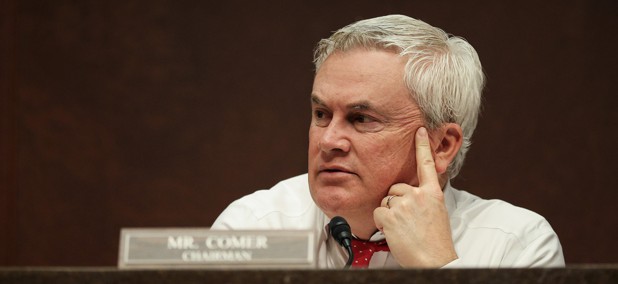
“Renewing the special reorganization authority requiring Congress to take an up or down vote on reorganization proposals by the president will help facilitate needed improvements in government operations,” said House Oversight and Government Reform Committee Chairman James Comer, R-Ky. “It will also allow Congress to have a say in how government reorganization is carried out. That should be what we want here.”
The GOP also emphasized that the administrations of Bill Clinton, George W. Bush and Barack Obama all requested a renewal of presidential reorganization authority.
Specifically, the bill would bring back such authority through Dec. 31, 2026. It also would remove a limitation on the authority that previously prevented presidents from using it to abolish or transfer an executive department or independent regulatory agency.
Between 1932 and 1984, presidents submitted more than 100 plans under this authority, including the establishment of the EPA and Federal Emergency Management Agency.
The panel also advanced by party-line the following bills that would affect federal employees:
- The Protecting Taxpayers’ Wallets Act (HR 1210), which would charge government worker labor unions a quarterly fee for using agency resources. Congressional Republicans have long criticized official time, which is when union officials at agencies are still paid their government salary while working on representational matters instead of their normal duties.
- The Preserving Presidential Management Authority Act of 2025 (HR 2249), which would authorize the president to terminate any provision of a federal employee collective bargaining agreement. The GOP has slammed a Social Security Administration collective bargaining agreement reached at the end of the Biden administration that locked in telework levels until 2029; although, the agency has largely suspended telework in an apparent violation of the contract.
- The Paycheck Protection Act of 2025 (HR 2174), which would prohibit agencies and the U.S. Postal Service from deducting any amount from an employee’s pay for labor organization dues, fees or political contributions.
“Taken together, these four bills would have a profoundly negative impact on federal workers and their ability to organize and have a voice in the workplace,” Daniel Horowitz, acting legislative director of the American Federation of Government Employees, wrote in a letter to committee leadership ahead of the markup.
Rep. Andy Biggs, R-Ariz., offered amendments to the trio of federal labor relations bills that he said would exempt the National Border Patrol Council from their requirements. The committee rejected them, however, with members generally arguing that there should not be carveouts in the measures.
This story has been updated with the vote outcomes for each of the measures.
Report: Boeing asks Trump admin to weaken penalties in 737 Max crash case
Boeing is trying to withdraw a plea agreement and obtain more lenient treatment from the Trump administration in a case involving two deadly 737 Max crashes, The Wall Street Journal reported today.
Boeing previously agreed to plead guilty to conspiracy to defraud the United States. Boeing could still plead guilty but face weaker penalties than it agreed to last year if the Justice Department and a federal judge agree.
Trump's Department of Justice "is reviewing numerous pending criminal cases that haven't yet gone to trial or been approved by courts," and "Boeing stands to benefit from fresh eyes at Trump's Justice Department, which is inclined to at least modify parts of the agreement," the WSJ wrote, citing people familiar with the matter. "Allowing Boeing to rescind its plea agreement, or lightening the company's punishment, would mark one of the most prominent examples of the Trump administration's lighter-touch approach to some white-collar enforcement."

You can now download the source code that sparked the AI boom
On Thursday, Google and the Computer History Museum (CHM) jointly released the source code for AlexNet, the convolutional neural network (CNN) that many credit with transforming the AI field in 2012 by proving that "deep learning" could achieve things conventional AI techniques could not.
Deep learning, which uses multi-layered neural networks that can learn hierarchical representations directly from data without explicit programming, represented a significant departure from many earlier traditional AI approaches that relied on hand-crafted rules and features.
The Python code, now available on CHM's GitHub page as open source software, offers AI enthusiasts and researchers a glimpse into a key moment of computing history. AlexNet served as a watershed moment in AI because it could accurately identify objects in photographs with unprecedented accuracy—correctly classifying images into one of 1,000 categories, like "strawberry," "school bus," or "golden retriever" with significantly fewer errors than previous systems.

Trump memo grants governmentwide firing power to OPM
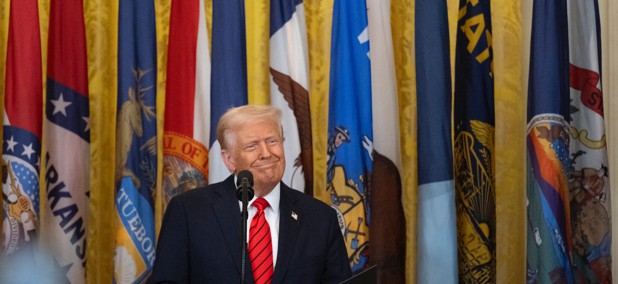
The memo, quietly published Thursday night alongside an executive order mandating agencies share data, particularly with Elon Musk’s Department of Government Efficiency, delegates to OPM the authority to fire federal employees based on “post-appointment conduct.”
A federal employee’s appointment occurs at the conclusion of their one-year probationary period, when their full civil service protections kick in. Prior to that point, the Office of Personnel Management has authority to determine whether a federal job applicant or new hire is “suitable” for federal employment, which generally refers to questions of their “character or conduct.”
But once an employee’s probationary period has ended, the authority to discipline or remove an employee rests solely with agency that employs them. Indeed, even if an employee threatens national security, only his or her employing agency may take action to suspend or remove them.
Trump’s memo expands who may remove employees for “conduct and character” reasons to include OPM, and tasks the HR agency with writing the regulations governing the agency’s ostensibly new power. Agencies may make referrals to OPM for approval, or the OPM director may reach down and order individual agencies to discipline or fire workers.
“In drafting the regulations, the director of OPM shall consider requiring that an employing agency must make a referral to OPM in order for the director of OPM to make a final suitability determination and take a suitability action regarding an employee based on post-appointment conduct,” the memo states. “The regulations shall additionally propose that . . . if the director of OPM issues specific instructions as to separation or other corrective action with regard to an employee, including cancellation of a personnel action, the head of the agency concerned shall comply with the director of OPM’s instructions within five work days of the final decision.”
While it is difficult to discern how narrowly—or sweeping—the ultimate authority will be until OPM issues those regulations, union officials and good government experts both warned that the memo amounts to a power grab by the DOGE-aligned officials atop OPM.
“Once you get your career appointment, it’s your agency’s job to do these assessments of your conduct or your performance,” said Jacque Simon, director of public policy for the American Federation of Government Employees. “This is: ‘No, I’m the king, and I will decide your suitability after you’ve gotten your appointment.’”
Don Kettl, professor emeritus and former dean of the University of Maryland School of Public Policy, said the measure could be an effort to create an end-run around recent court decisions blocking the mass firings of probationary workers.
“I would read this as at its core an effort for OPM to get back into the game,” he said. “The administration in general and DOGE in particular has been incredibly clever in their ability to shapeshift as needed to stay in the game, and as the courts have determined there are limits, DOGE and Musk have found ways to get around them.
“This could be read as a way to try to license the kind of role that Musk desired OPM to have at the beginning [of the administration] but was stopped by the courts, and according to this, it would give OPM the authority to be able to do what Musk wanted all along.”
]]>
Elon Musk Is Said To Be Getting The War Plan Against China
Update: After the NY Times reported this story last night, Donald Trump denied that Musk would be getting the China war plan, and now the NY Times is reporting that, while that was the original plan, it was scrapped because of the public outcry The Wall Street Journal is similarly reporting that the nature of the meeting changed because of the public revelation. We’re still running this article from Mike Brock that he wrote yesterday, because of the seriousness of this situation. Meanwhile, Elon Musk, continuing to show his anti-free speech instincts, has threatened whoever leaked the original story.
The New York Times reports that Elon Musk is about to receive access to one of America’s most sensitive military secrets: the Pentagon’s war plan for a potential conflict with China. Let that sink in for a moment.
The same Elon Musk who is currently CEO of Tesla, which operates a flagship factory in Shanghai that produces more than half of the company’s global deliveries. The same Elon Musk whose company has a $2.8 billion loan agreement with Chinese lenders. The same Elon Musk who has publicly stated that Taiwan should be a “special administrative zone” of China. The same Elon Musk who wrote a flattering column for China’s censorship agency and has consistently praised Chinese leadership on social media.
This isn’t just a routine conflict of interest—it’s a national security nightmare unfolding in plain sight.
According to the New York Times, Musk will be briefed Friday on the top-secret operational plan that includes “what Chinese targets to hit, over what time period” in the event of war. This information is so sensitive that it’s typically only shared with those directly in the military chain of command. Even presidents usually receive only the broad contours, not the specific operational details.
Defenders of this unprecedented access might argue that Musk’s role in the Department of Government Efficiency necessitates his understanding of defense capabilities to make informed budget decisions. But this justification collapses under scrutiny. Budget oversight has never required access to operational war plans—Congress has managed defense appropriations for centuries without such detailed briefings. Moreover, if budget efficiency were truly the goal, why not provide similar briefings to the Office of Management and Budget or congressional committees with actual constitutional authority over spending?
What this justification reveals is alarming: DOGE isn’t just about eliminating waste; it’s about fundamentally reshaping America’s defense posture with minimal oversight. We are witnessing the privatization of national security decision-making, where unelected billionaires with business conflicts receive information traditionally reserved for the military chain of command.
The historical precedents for such arrangements are uniformly disastrous. During the 1930s, German industrialists with international business ties were given increasing influence over military planning, ultimately subordinating national security to corporate interests. More recently, the revolving door between defense contractors and the Pentagon has raised serious ethical concerns—but never before has a sitting CEO of multiple companies simultaneously directed government “efficiency” efforts while receiving classified operational briefings.
This meeting represents an unprecedented blurring of lines between private business interests and national security. Musk simultaneously heads SpaceX, a major defense contractor receiving billions in Pentagon funds, while directing government efficiency efforts that could determine which competitors receive future contracts. In the Times piece, defense expert Todd Harrison noted, “Giving the CEO of one defense company unique access seems like this could be grounds for a contract protest and is a real conflict of interest.”
Most concerning is China’s explicit identification of Musk’s Starlink satellite network as an extension of the U.S. military—a view that puts his profound business interests in China in direct conflict with his privileged access to U.S. war planning. This is precisely the kind of conflict that led the Air Force to previously deny Musk an even higher security clearance, citing potential security risks.
The mechanisms through which this conflict could compromise national security are not theoretical. Knowledge of U.S. targeting priorities creates leverage that can be exploited in multiple ways. Chinese authorities, well aware of Tesla’s vulnerability in their market, could apply subtle pressure through regulatory actions against his Shanghai factory. Even without explicit coercion, Musk’s awareness of which Chinese facilities would be primary targets in a conflict could unconsciously influence his business decisions—perhaps steering Tesla investments away from areas identified as strategic targets, inadvertently telegraphing U.S. military priorities. The Chinese government, which maintains sophisticated intelligence operations, would analyze any such patterns for insights into U.S. planning.
What we are witnessing is, in fact, an oligarchical coup—a term I’ve repeatedly used here at Notes From The Circus, and one that becomes increasingly difficult to dismiss as hyperbole with each passing week. The transfer of core governmental functions to private interests with minimal oversight represents precisely the kind of capture that transforms democracies into oligarchies. When billionaires simultaneously direct government operations, receive classified briefings, and maintain private business empires—all with minimal accountability—we have moved beyond normal governance into something fundamentally different: rule by the wealthy few rather than democratically elected representatives.
The urgency of this situation cannot be overstated. This briefing is scheduled for today. By the time many of you read these words, one of America’s most closely guarded military secrets will have been shared with a businessman whose company depends on the goodwill of the very country those plans are designed to counter. Once this line is crossed, it cannot be uncrossed. The precedent it sets—that private citizens with business conflicts can access war plans—will be cited to justify even more egregious breaches in the future. With each successive norm violation, our capacity to be shocked diminishes, and the machinery of constitutional governance rusts further.
This unprecedented arrangement threatens not just domestic governance but international stability. America’s allies, already questioning U.S. reliability under Trump, will further distance themselves when they see sensitive security matters handled with such cavalier disregard for conflicts of interest. The Five Eyes intelligence alliance (US, UK, Canada, Australia, New Zealand), built on decades of mutual trust, faces particular strain as partner nations grow increasingly reluctant to share sensitive information that might find its way to private citizens with complex international business interests. Japan and South Korea, frontline states in any potential conflict with China, must now factor in the possibility that U.S. war planning is being influenced by private business considerations. Meanwhile, adversaries will be emboldened, seeing in this arrangement confirmation that U.S. national security has been subordinated to private financial concerns.
Congress, in light of its constitutional prerogatives, should immediately demand a full accounting of who authorized this briefing and under what authority. It should establish clear statutory limits on what information can be shared with DOGE personnel, require security clearance reviews for all private citizens given access to classified information, and mandate recusal from any matter involving countries where officials have substantial business interests. While it’s highly unlikely that the complicit Mike Johnson and the current GOP majority in Congress will undertake any of these actions, I make these suggestions for the sake of posterity and to make the ethical, legal, and constitutional point.
Public engagement remains our most viable path forward when institutions fail. History shows that citizen action has successfully preserved democratic guardrails even during periods of institutional capture. The Pentagon Papers revelations, which exposed government deception about Vietnam, demonstrated how courageous individuals can create accountability when formal channels fail. More recently, the post-9/11 surveillance revelations prompted significant reforms only after public pressure made inaction politically untenable. In both cases, the combination of whistleblowers, independent journalists, and sustained public attention created counterweights to unchecked executive power.
Similar citizen vigilance is required today, and it must be immediate and sustained. Support for independent journalism investigating these conflicts, advocacy for stronger ethics laws, attention to congressional oversight hearings (or lack thereof), and consistent pressure on representatives across party lines can create political costs for normalizing such conflicts. Professional associations like the American Foreign Service Association, the Military Officers Association of America, and the Intelligence and National Security Alliance should leverage their credibility to formally condemn this breach of security protocol. Retired intelligence officials, military officers, and national security experts—many of whom have spent careers protecting classified information—must speak out collectively, making clear that this is not a partisan issue but a national security emergency. Most importantly, voters must demand answers from candidates about where they stand on private influence over national security decisions.
Two plus two equals four. There are twenty-four hours in a day. And a businessman with billions in financial exposure to China should not have access to classified war plans against that same country. This is madness. Anyone who defends this is deranged. This isn’t a partisan observation—it’s a fundamental principle of national security that appears to have been casually discarded.
At stake here is more than just operational security—it’s the principle that national defense decisions should be made by democratically accountable officials sworn to uphold the Constitution, not by private citizens with competing financial interests. When we allow the line between public service and private gain to blur this dramatically, we undermine the foundation of democratic governance itself: that power flows from the people through their elected representatives, not from wealth and proximity to those representatives.
The question isn’t whether this represents a conflict of interest—it plainly does. The question is whether we still possess the collective will to defend democratic principles when they’re most threatened. The vigilance required to preserve constitutional governance doesn’t rest with officials alone—it falls to each of us to recognize, name, and resist the normalization of conflicts that strike at the heart of democratic accountability. If we cannot draw the line at giving war plans to businessmen with financial ties to potential adversaries, it’s difficult to imagine where we would draw it at all.
Our democracy’s survival requires not just awareness but action—not just concern but commitment. The Constitution’s promise of government by the people, for the people depends not on parchment guarantees but on citizens willing to stand for its principles when they are most threatened. This moment demands nothing less than our full engagement in the defense of democratic governance against its capture by private interests. That is both our inheritance and our obligation to those who will follow.
“The accumulation of all powers, legislative, executive, and judiciary, in the same hands… may justly be pronounced the very definition of tyranny.” — James Madison, Federalist No. 47
Mike Brock is a former tech exec who was on the leadership team at Block. Originally published at his Notes From the Circus.
Who’s your Papi? New tacos for Rockville
Big Papi’s Tacos, a Mexican restaurant chain from Frederick, is heading to downtown Rockville. The restaurant is moving into the former Domoishi Asian food hall space at 201 East Middle Lane, across the street from Rockville Town Square. Big Papi’s is best known for its quesabirria tacos, featuring slow-cooked meats and cheese with a consomé dip. You can also get your tacos filled with rockfish, shrimp, veggies or vegan chorizo, along with traditional Mexican sides. And for dessert: churros or tres leches. Big Papi’s will be just around the corner from Little Miner Taco, which opened last year on Maryland Avenue. Another nearby Mexican spot, Tequila, closed its doors in January after a very short run on North Washington Street.
The post Who’s your Papi? New tacos for Rockville appeared first on Store Reporter.
Trump signs order directing the Education secretary to shut down the department
Trump signed the order at a major White House ceremony, flanked by children seated at desks. It directs McMahon to “return education authority to the States, while continuing to ensure the effective and uninterrupted delivery of services, programs, and benefits on which Americans rely,” according to materials provided to States Newsroom on background ahead of the signing.
Trump spoke to an audience packed with top GOP state officials, and he cited Republican Govs. Greg Abbott of Texas, Mike Braun of Indiana, Ron DeSantis of Florida, Bill Lee of Tennessee, Kim Reynolds of Iowa, Jeff Landry of Louisiana, Brad Little of Idaho, Jim Pillen of Nebraska and Mike DeWine of Ohio.
Deena Bishop, commissioner of Alaska’s Department of Education and Early Development, was slated to attend, though she was not cited by Trump.
“After 45 years, the United States spends more money in education by far than any other country and spends, likewise, by far, more money per pupil than any country, and it’s not even close, but yet we rank near the bottom of the list in terms of success,” Trump said at the brief ceremony.
The order, which is sure to draw legal challenges, “also directs that programs or activities receiving any remaining Department of Education funds will not advance DEI or gender ideology,” referring to diversity, equity and inclusion.
Widespread reports ahead of the signing drew intense blowback from leading education groups, labor unions and congressional Democrats.
Rep. Bobby Scott, ranking member of the House Committee on Education and Workforce, noted that the department “was founded in part to guarantee the enforcement of students’ civil rights” in a statement Thursday.
“Legality aside, dismantling (the department) will exacerbate existing disparities, reduce accountability, and put low-income students, students of color, students with disabilities, rural students, and English as a Second Language (ESL) students at risk,” the Virginia Democrat added.
Title I, IDEA funds
The department’s many responsibilities include administering federal student aid, carrying out civil rights investigations, providing Title I funding for low-income school districts and guaranteeing a free public education for children with disabilities via the Individuals with Disabilities Education Act, or IDEA.
Speaking to reporters Thursday morning, White House press secretary Karoline Leavitt said Trump’s order directs McMahon to “greatly minimize the agency.”
She clarified that any “critical functions” of the agency, including on student loans, Pell Grants for lower-income college students, Title I, special education funding and enforcement of civil rights laws “will remain.”
“We don’t need to be spending more than $3 trillion over the course of a few decades on a department that’s clearly failing in its initial intention to educate our students,” Leavitt added, referencing “incredibly concerning” test scores on the National Assessment of Educational Progress.
The assessment found that average math and reading scores in 2024 for pupils in fourth grade and eighth grade were lower compared to before the coronavirus pandemic, in 2019.
Trump’s long-held campaign promise to move education “back to the states” comes despite much of the funding and oversight of schools already occurring at the state and local levels. The department also legally cannot dictate the curriculum of schools across the country.
Congress has the sole authority to shut down the department, and any bill to completely close the agency would face extreme difficulties getting through the narrowly GOP-controlled Senate, with at least 60 senators needed to advance past the filibuster.
However, it could be possible for the administration to take significant actions short of closure, such as moving some Education Department functions to other agencies.
Layoffs, buyouts
The agency has an annual budget of $79 billion in discretionary spending, or funds appropriated yearly by Congress.
The department has already witnessed mass layoffs, contract cuts, staff buyouts and major policy changes in the weeks since Trump took office.
Earlier in March, the department announced that more than 1,300 employees would be cut through a “reduction in force” process — sparking concerns across the country over how the mass layoffs would impact the agency’s abilities to carry out its core functions.
The department had 4,133 employees when Trump took office, but the cuts brought the total number of workers remaining down to roughly 2,183.
A group of 21 Democratic attorneys general quickly sued over that effort and asked a federal court in Massachusetts to block the department from implementing the “reduction in force” action and Trump’s “directive to dismantle the Department of Education.”
Lawsuit incoming
Opponents of the closure said it’s one more example of how Trump and billionaire Elon Musk, head of the temporary U.S. DOGE Service, are seeking to destroy the federal government as they reduce the workforce and spending.
“Donald Trump and Elon Musk have aimed their wrecking ball at public schools and the futures of the 50 million students in rural, suburban, and urban communities across America, by dismantling public education to pay for tax handouts for billionaires,” said Becky Pringle, president of the National Education Association, in a Wednesday night statement.
“Now, Trump is at it again with his latest effort to gut the Department of Education programs that support every student across the nation,” added Pringle, who leads the largest labor union in the country.
“If successful, Trump’s continued actions will hurt all students by sending class sizes soaring, cutting job training programs, making higher education more expensive and out of reach for middle class families, taking away special education services for students with disabilities, and gutting student civil rights protections,” she said.
Randi Weingarten, president of the American Federation of Teachers, one of the largest teachers unions in the country, kept her response to reports of the forthcoming order succinct.
“See you in court,” she said.
]]>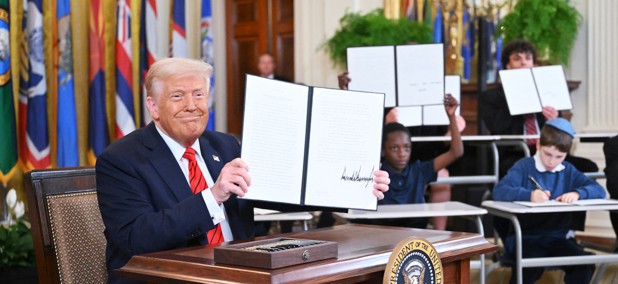
What’s behind the changed relationship between Jeff Bezos and Donald Trump?
In October 2019, Amazon sued the Pentagon, alleging that President Donald Trump had blocked the company from securing a $10 billion cloud-computing contract because of his animus toward The Washington Post and its owner Jeff Bezos—whom the US president derided as “Jeff Bozo.”
At the time, the dispute was just one example of the near-constant skirmishes between Trump’s White House and corporate America. But the episode left an enduring mark on Bezos, the Amazon founder and the world’s second-richest person.
Over the past year, Bezos has executed a sharp public reversal in his relationship with Trump—whom he previously criticised as a “threat to democracy”—that has surprised even longtime associates and has stunned the Post’s newsroom.
The October Story That Outlined Exactly What the Trump Administration Would Do to the Federal Bureaucracy
ProPublica is a nonprofit newsroom that investigates abuses of power. This story was originally published in our Dispatches newsletter; sign up to receive notes from our journalists.
In late October, ProPublica published one of its most prophetic stories in our history. You can be forgiven if you missed it at the time. There was a lot going on in the days before the election, and the headlines were dominated by seemingly consequential issues like the racist humor of a comedian who addressed Donald Trump’s rally at Madison Square Garden.
But if you weren’t among the several hundred thousand people who read our story, “‘Put Them in Trauma’: Inside a Key MAGA Leader’s Plans for a New Trump Agenda,” in real time, you may have seen it referenced since Trump took office in January.
The story drew on private recordings of a series of speeches given in 2023 and 2024 by Russell Vought obtained by our colleagues at Documented, a news site with a remarkable knack for uncovering information powerful interests would prefer remained secret.
Vought, a self-described Christian nationalist who served as the director of the Office of Management and Budget in Trump’s first term, was known for his provocative public pronouncements. But he went even further in private, envisaging a Trump presidency in which regulatory agencies would be shut down and career civil servants would be too depressed to get out of bed.
“We want the bureaucrats to be traumatically affected,” Vought said in one recording. “When they wake up in the morning, we want them to not want to go to work because they are increasingly viewed as the villains. We want their funding to be shut down so that the EPA can't do all of the rules against our energy industry because they have no bandwidth financially to do so.
“We want to put them in trauma.”
Vought spoke openly about the ongoing planning to defund independent federal agencies and demonize government scientists. “We have detailed agency plans,” he said. “We are writing the actual executive orders. We are writing the actual regulations now, and we are sorting out the legal authorities for all of what President Trump is running on.”
Vought argued that the radical steps were necessary because Trump’s opponents were themselves attempting to end democracy. “The stark reality in America is that we are in the late stages of a complete Marxist takeover of the country,” he said in one speech. “Our adversaries already hold the weapons of the government apparatus, and they have aimed it at us. And they are going to continue to aim it until they no longer have to win elections.”
It’s hard to imagine a more prescient piece of journalism. The story captured, as few did, the breadth and ferocity of the coming attack on the federal government. Vought has returned to his post as the budget office’s director, and his plans for eviscerating entire agencies and decimating the morale of federal workers have turned into reality. Trump 47 looks very different from Trump 45, just as Vought told his audiences that it would.
So why didn’t this story drive more of a national conversation when it appeared?
As a news organization that tries to spur change by bringing new facts to light, we think about this question a lot. Our job at ProPublica is to both get the story and get it into the heads of a critical mass of citizens and elected officials.
I’ve been an investigative reporter and editor for nearly three decades, and I still struggle to predict which of our stories will catalyze national conversations. Our 2018 story about the recording of a young girl in a immigration detention center prompted the Trump administration to end its policy of family separation at the border. Many other powerful stories fail to break through.
Part of the problem, of course, is the proliferation of media. Every day, dozens of important-sounding stories vie for readers’ attention along with the flood of posts on social media and texts from friends and colleagues. And that’s not to mention all the podcasts and multipart dramas on Netflix and HBO.
This was an issue long before Trump and his allies adopted a “flood the zone” strategy with multiple norm-challenging actions, but it seems even more acute right now.
It is often said of journalists that we write the rough draft of history. But our work differs from historians in a crucial aspect: Scholars typically are chronicling events after the outcome is clear. As journalists, we face a tougher challenge as we try to find the stories in the cacophony of daily events that tell us something about where we’re going.
A lot of what we do as reporters is akin to squinting through opaque windows at events unfolding in a very dimly lit room. We can see who is inside and how they’re moving, but our lack of context often prevents us from understanding what’s really happening. We default to assuming that the future will be roughly like the past, guessing that, say, Trump 47 will be roughly like Trump 45 with fewer guardrails.
Vought could not have been clearer that this was not the case, and he had the credentials that should have made what he was saying entirely credible. After all, Vought was the author of the plan in Trump’s first term to make it easier to fire large numbers of civil servants. He was a key member of Project 2025, the Heritage Foundation project that described in copious detail how a second Trump administration might unfold.
Still, there was at least one data point that perhaps prevented readers from viewing his speeches as predictive as they turned out to be. As our story made clear, Vought despises the Federalist Society for Law and Public Policy Studies, a core Republican ally in bringing conservative voices into the judiciary and federal law enforcement. We quoted him as asserting that “the vaunted so-called Federalist Society and originalist judges” were serving as a “Praetorian Guard” for the Democrats.
That view would seem to make him something of a fringe thinker in MAGA world, which relied on the Federalist Society to pick the judges who make up the conservative supermajority on the high court.
Things look different today. Seen against the backdrop of recent events, Vought’s disdain for the rule-of-law scruples of Federalist Society legal thinkers seems entirely in line with Trump’s recent post suggesting a federal judge shouldn’t have authority over his administration.
Just a few weeks ago, Danielle Sassoon, one of the Federalist Society’s bright lights, a Yale Law graduate who had clerked for conservative icon Antonin Scalia, resigned as acting U.S. attorney in the Southern District of New York rather than carry out orders from the Trump Justice Department. In refusing to drop the corruption case against New York Mayor Eric Adams, Sassoon wrote that she understood her duty as a prosecutor to mean “enforcing the law impartially, and that includes prosecuting a validly returned indictment regardless of whether its dismissal would be politically advantageous, to the defendant or those that appointed me.”
Many years ago, a New York Times investigative reporter and I were discussing a story we had worked on that had been sharply and justifiably criticized as new facts emerged. “I can be fair and accurate,” he said. “But fair, accurate and prescient is beyond me.”
It seems appropriate to give Vought the last word since the worldview he described has proven so accurate. What sounded grandiose in the preelection days seems today like a reasonable summary of the path Trump and his allies have chosen.
“We are here in the year of 2024, a year that very well [could] — and I believe it will — rival 1776 and 1860 for the complexity and the uncertainty of the forces arrayed against us,” Vought said, citing the years when the colonies declared independence from Britain and the first state seceded over President Abraham Lincoln’s election.
“God put us here for such a time as this.”
I’m not sure about the role of the almighty in ProPublica’s work in the coming years. But we feel equally strongly that we’re here for a “time such as this.”
Unilever Turns On Ben & Jerry’s CEO As It Tries To Lick Trump Administration’s Boots
I guess this is going to become a theme for who knows how long. For reasons I cannot begin to understand, the Trump administration’s distaste for any criticism of itself, as well as any politics it does not agree with, is resulting in many in corporate America folding into alignment with those desires. Whether it’s the capitulation to an anti-DEI stance or an exit from any kind of political entanglements, the general stance appears to be that all the boots must be licked as thoroughly as possible.
That puts companies like Ben & Jerry’s, famous for its social stances, in a tough spot. The company has not been shy about criticizing the Trump team, going all the way back to the first administration. Nor has it been shy about taking moral stances on conflicts around the world, with one such stance notably resulting in some level of backing from its parent company, Unilever.
While Ben & Jerry’s has decades of activism as part of its corporate tradition, Unilever appears to have tried to stamp that out starting in 2025. The parent company refused to allow B&J to issue corporate statements criticizing the Trump administration on matters of politics. This resulted in a lawsuit against Unilever, with B&J claiming that Unilever is contractually obligated to allow for B&J’s independent ability to make those statements as part of the acquisition. This ramped up even further more recently with the news that Unilever terminated B&J CEO David Stever as a result of his activism.
In an amended complaint filed Tuesday in New York, lawyers for the ice cream brand said that rules stemming from its 2000 merger “protects Ben & Jerry’s interests by precluding the unilateral removal of its CEO,” but Unilever did just that — “removing and replacing” CEO David Stever by not following the proper protocols and said it was because of the brand’s continued comments on progressive issues.
The lawsuit said that Unilever’s motive for the removal of Stever was due to his “commitment to Ben & Jerry’s Social Mission and Essential Brand Integrity … rather than any genuine concerns regarding his performance history.”
This elective censorship in order to appease ranking politicians ought to scare the hell out of everybody. Whatever you might think about B&J’s opinions on politics, we surely don’t want to foster an ecosystem of feigned group-think. The only thing that changed between 2024 and 2025 was the new presidential administration. The stances by B&J haven’t changed. The company’s desire to speak on those stances hasn’t changed. The type of rhetoric in those desired statements haven’t changed.
This is purely about Unilever deciding, counter-contractually as alleged, that it wants to bow at the altar of Donald Trump. And the tactics from Unilever appears to be decidedly heavy-handed.
Ben & Jerry’s initial lawsuit, filed in November 2024, alleged Unilever silenced its attempts to publicly support Palestinian refugees and resolutions to end military aid to Israel, where the company had done business since 1987.
It also alleged that Unilever threatened to dismantle Ben & Jerry’s board and sue members because the company’s management and board planned to issue a statement calling for “peace” and a “permanent and immediate ceasefire.”
This is a marriage of the free market and free speech, ideals that the conservative party in America has long championed. If people don’t like B&J’s politics, they’re free to buy a different brand of ice cream. If Unilever doesn’t like those politics, but are disallowed contractually from censoring them, then Unilever can sell the company to someone else, which is reportedly exactly what Unilever is doing.
If corporate America is simply going to rollover based on the whims of every change in administration, that kind of whipsawing on corporate stances is going to get real confusing, real fast. If this is only being done with this administration out of fear, which I believe is the case, that should be setting off all kinds of alarm bells.
And if the so-called speech-champions can’t be bothered to get out of bed to advocate for speech protections they don’t agree with, then we can cease calling them champions of speech, full stop.
Emails Reveal Top IRS Lawyer Warned Trump Firings Were a “Fraud” on the Courts
by Andy Kroll
ProPublica is a nonprofit newsroom that investigates abuses of power. Sign up to receive our biggest stories as soon as they’re published.
On Feb. 20, nearly 7,000 probationary employees at the Internal Revenue Service began receiving an unsigned letter telling them that they had been fired for poor performance.
Trump administration lawyers insist that the IRS and other federal agencies have acted within their authority when they ordered waves of mass terminations since Trump took office. But according to previously unreported emails obtained by ProPublica, a top lawyer at the IRS warned administration officials that the performance-related language in his agency’s termination letter was “a false statement” that amounted to “fraud” if the agency kept the language in the letter.
The emails reveal that in the hours before the IRS sent out its Feb. 20 termination letter, a fierce dispute played out at the agency’s highest levels.
Joseph Rillotta, a senior IRS lawyer, wrote that “no one” at the IRS had taken into account the performance of the probationary workers set to be fired. Rillotta urged that the language be struck from the draft termination letter.
If the falsehood wasn’t removed, Rillotta said he would file a report with the inspector general for the IRS.
Excerpt of an email written by IRS lawyer Joseph Rillotta (Obtained by ProPublica)No one appeared to respond to Rillotta’s first email. In a follow-up email, he said he was “pleading with you to remove the clause,” adding: “It is not an immaterial false statement, because it is designed to improve the government’s posture in litigation (to the detriment of the employees that we are terminating today).”
Because it was not true, he wrote, “That renders it, as I see it, an anticipatory fraud on tribunals of jurisdiction over these employment actions.”
Rillotta was again ignored. The IRS sent out the Feb. 20 termination notice with the disputed language in it, according to copies received by fired workers who shared them with ProPublica. The notice said the decision to fire the workers had taken “into account your performance” as well as administration guidance and “current mission needs.”
Excerpt of a termination notice sent to probationary employees at the IRS (Obtained by ProPublica)In fact, many of the employees had received laudatory reviews with no hint of any concerns.
Soon afterward, the inspector general for the IRS took preliminary steps to look into the matter, according to a person familiar with the effort who wasn’t authorized to speak with reporters. This person said they told the investigator that they agreed with Rillotta that the performance rationale was false.
Michelle Bercovici, a lawyer who represents federal workers, told ProPublica that Rillotta’s ignored warnings should make it easier for plaintiffs to show that the mass firings were “arbitrary and capricious,” the legal standard needed to invalidate a federal agency’s action. She added that the emails could also help plaintiffs recover attorneys’ fees from the government.
“When an agency acts based on false information, not only does it set the action up for being overturned,” she said. “It also means the agency is not going to have many defenses to its actions and could be liable for fees.”
Spokespeople for the Treasury Department and IRS did not respond to requests for comment. An Office of Personnel Management spokesperson referred ProPublica to a revised memorandum stating that OPM “is not directing agencies to take any specific performance-based actions regarding probationary employees.”
The terminations at the tax agency were among the deep cuts to federal agencies by the Trump administration and its Department of Government Efficiency, led by the billionaire Trump adviser Elon Musk.
Multiple federal lawsuits are now challenging the Trump administration’s mass firings. Last week, two federal judges temporarily blocked the IRS and other firings, but the lawsuits continue.
The issue of whether the performance rationale was legitimate has been central to the suits. One suit, brought by a group of labor unions, advocacy groups and other parties in California federal court, alleges that OPM directed the probationary firings and so “perpetrated one of the most massive employment frauds in the history of this country, telling tens of thousands of workers that they are being fired for performance reasons, when they most certainly were not.”
In response, administration lawyers denied that OPM directed agencies to fire probationary workers based on performance or misconduct. Instead, the filing says, “OPM reminded agencies of the importance of the probationary period in evaluating applicants’ continued employment and directed agencies to identify all employees on probationary periods and promptly determine whether those employees should be retained at the agency.”
The plaintiffs later expanded that suit to include the Treasury Department, which oversees the IRS, as one of the defendants. In mid-March, Judge William Alsup issued a preliminary injunction in the case, saying the administration’s probationary firings were based on “a lie.” Alsup ordered several federal agencies, including the Treasury, to reinstate thousands of fired employees. The Trump administration has appealed Alsup’s ruling.
Another suit, filed in Maryland federal court by nearly two dozen Democratic state attorneys general, also claims that the IRS mass firings were unlawful and should be reversed. (In that case, administration lawyers asserted that the mass firings were lawful.)
Court filings in both cases have partially revealed how the administration chose to make the legally questionable decision to fire probationary workers en masse on performance grounds..
At the IRS, the plan to fire probationary employees began in early February, according to an affidavit filed in the Maryland case.
A high-ranking Treasury Department official instructed a senior IRS personnel employee named Traci DiMartini to identify all probationary IRS employees and fire them “based on performance,” according to an affidavit DiMartini later filed in court.
DiMartini had “never heard of mass probationary employee firings,” she stated in her affidavit.
Excerpt of an affidavit filed in federal court by IRS human capital employee Traci DiMartiniWhen DiMartini asked the Treasury Department official why they were firing so many probationary employees, she was told that the order came from OPM, which was staffed by Trump appointees and members of DOGE.
In her affidavit, DiMartini confirmed what Rillotta wrote in his emails — that it was false to say probationary employees were fired for performance. DiMartini’s office “did not review or consider” any probationary employees’ job performance or conduct. Nor did the Treasury Department. “I know this because this fact was discussed openly in meetings,” DiMartini stated in her affidavit.
Excerpt of an affidavit DiMartini filed in federal courtAccording to DiMartini’s affidavit, OPM drafted the IRS mass-termination letter. While Treasury officials made several changes to it, the IRS’s personnel office where DiMartini worked “was not permitted to make any changes to the letter,” DiMartini’s affidavit said.
DiMartini refused to sign the mass-termination letter, according to her affidavit. The then-acting commissioner of the IRS, Douglas O’Donnell, also refused to sign the letter.
When thousands of affected IRS employees finally received the letter, it arrived from a generic email account. No agency official’s name appeared anywhere in the document.
Do you have any information we should know about the IRS, DOGE or the Trump administration’s mass firings? Andy Kroll can be reached by email at andy.kroll@propublica.org and by Signal or WhatsApp at 202-215-6203.
Casual White House Starlink Use Is A Cybersecurity Nightmare, A Transparency Problem, And A Weird Marketing Stunt
It’s best to view Elon Musk’s DOGE as an attack. While right wing propaganda (and gullible media outlets and politicians) frame DOGE as a “cost saving” effort at “improving government efficiency,” that’s just flimsy-ass cover for its real purpose: the dismantling of corporate oversight, environmental guard rails, consumer protection, civil rights, and the social safety net by weird zealots.
But DOGE is also just an incompetently run clown show.
There were already widespread concerns about Musk’s tween 4chan brats having widespread access to sensitive public information with no real oversight. But the randos that make up Trump and Musk’s rotating orbit of drooling sycophants also appear to be accessing this data using all manner of unsecured personal devices They couldn’t even launch the DOGE website competently with proper security.
Now there’s reporting out of the New York Times suggesting that Musk is casually integrating Starlink systems into the White House telecom network for no coherent reason outside of the fact it gives the illusion that it’s helping:
“Starlink, the satellite internet service operated by Elon Musk’s SpaceX, is now accessible across the White House campus. It is the latest installation of the Wi-Fi network across the government since Mr. Musk joined the Trump administration as an unpaid adviser.”
The New York Times falsely calls this a “Wi-Fi” network, when Starlink is Low Earth Orbit (LEO) satellite network. And in a complex as wired as the White House, there’s really no coherent reason to install it. The White House network is rife with gigabit capable fiber and gigabit-capable Wi-Fi that can far exceed anything Starlink delivers. Starlink would be a clearly inferior, slower, connectivity option.
According to the NY Times, one of Musk’s DOGE brats from X just decided one day to install a Starlink terminal on the White House roof, tripping security alarms and setting off a confrontation with Secret Service. All, purportedly, to “improve internet access” at probably one of the most well-connected buildings in the world.
There are only a few reasons to do this. One, is as a marketing stunt to help advertise Starlink as a miracle fix to a nonexistent problem. Two is to have a communications backchannel for stuff you don’t want tracked by any sort of White House network logging technologies. But even then, there are suggestions the Starlink traffic isn’t encrypted, creating a huge security risk:
“It was also unclear if Starlink communications were encrypted. At a minimum, the system allows for a network separate from existing White House servers that people on the grounds are able to use, keeping that data separate.”
It’s very rare, weird, and very dangerous to just mindlessly intermingle a private, and potentially unencrypted telecom connectivity option with existing White House systems and workflows, as numerous IT folks on Bluesky were quick to note:

And slapping a nontransparent comms channel on the roof of the White House so you and your weird authoritarian buddies can giggle about your illegal and unpopular dismantling of government functions is pretty far afield from all the “full transparency” they promised.
Again, if you don’t have any respect for the function of governance, you’re not going to be particularly careful as you and your earlobe nibbling tweens go about dismantling it. And if you have no shame or ethics, you also think nothing of leveraging your unelected influence to use the White House as a glorified marketing stunt. And if you’re incompetent, you’re going to be incompetent.
All very much in character for the fake government agency run by the fake super-genius engineer tasked with fake innovation and efficiency improvements.
Eight years later, new but familiar-looking PebbleOS watches appear
Certain watches can stay just as they are and people will keep buying them. The Casio F-91W, one of the continuously best-selling watches in the world, keeps the time on a readable display and offers a single daily alarm slot (unless you board-swap it). The Timex Weekender may last as long as non-digital watches exist.
What about the Pebble? Is there still room on people's wrists for the most exciting Kickstarter-backed tech of 2012–2016?
Eric Migicovsky, founder of the firm that was perhaps a bit too early to the smartwatch market, has made good on his pledge to find out and has made new Pebble watches available for preorder. The Core 2 Duo, "almost exactly a Pebble 2" with modernized chips, 30 days battery life, and a black-and-white e-paper screen, is $150 at preorder and is scheduled to ship in July. The Core Time 2, Migicovsky's "dream watch," is bigger, color, and metal and goes for $225 right now. Its release is slated for December.

People in this career are better at seeing through optical illusions
Optical illusions are great fun, and they fool virtually everyone. But have you ever wondered if you could train yourself to unsee these illusions? Our latest research suggests that you can.
Optical illusions tell a lot about how people see things. For example, look at the picture below.
 The Ebbinghaus illusion.
Credit:
Hermann Ebbinghaus
The Ebbinghaus illusion.
Credit:
Hermann Ebbinghaus
The two orange circles are identical, but the one on the right looks bigger. Why? We use context to figure out what we are seeing. Something surrounded by smaller things is often quite big. Our visual system takes context into account, so it judges the orange circle on the right as bigger than the one on the left.

Trump plan to fund Musk’s Starlink over fiber called “betrayal” of rural US
A federal broadband official departed the US government with a warning that a Trump administration plan will strand rural Americans with worse Internet access in order to help Elon Musk secure public money for Starlink.
"Stranding all or part of rural America with worse Internet so that we can make the world's richest man even richer is yet another in a long line of betrayals by Washington," wrote Evan Feinman, who had been a Commerce Department official and director of the $42.45 billion Broadband Equity, Access, and Deployment (BEAD) program since 2022.
As Politico reported, Feinman made the statement in "a blistering email to his former colleagues on his way out the door Sunday warning that the Trump administration is poised to unduly enrich Elon Musk's satellite Internet company with money for rural broadband."

Report: mRNA vaccines are in RFK Jr’s crosshairs; funding in question
Federal support for mRNA vaccine research appears in jeopardy after KFF Health News reported Sunday that officials at the National Institutes of Health have directed scientists to remove all references to the lifesaving technology from their grant applications. All such research is now under direct scrutiny from health secretary and long-time anti-vaccine advocate Robert F. Kennedy Jr.
A senior official at the NIH's National Cancer Institute confirmed to KFF that NIH acting Director Matthew Memoli "sent an email across the NIH instructing that any grants, contracts, or collaborations involving mRNA vaccines be reported up the chain to Health and Human Services Secretary Robert F. Kennedy Jr.’s office and the White House."
Further, two independent scientists told the outlet that they were informed by NIH officials that any mention of mRNA vaccines needed to be removed from their grant applications. One, a biomedical researcher in Philadelphia, said that the NIH had "flagged our pending grant as having an mRNA vaccine component." The other, a researcher in New York who works on vaccines but not mRNA vaccines, was told that background mentions of mRNA vaccine efficacy in their previous grant applications needed to be removed from future applications.
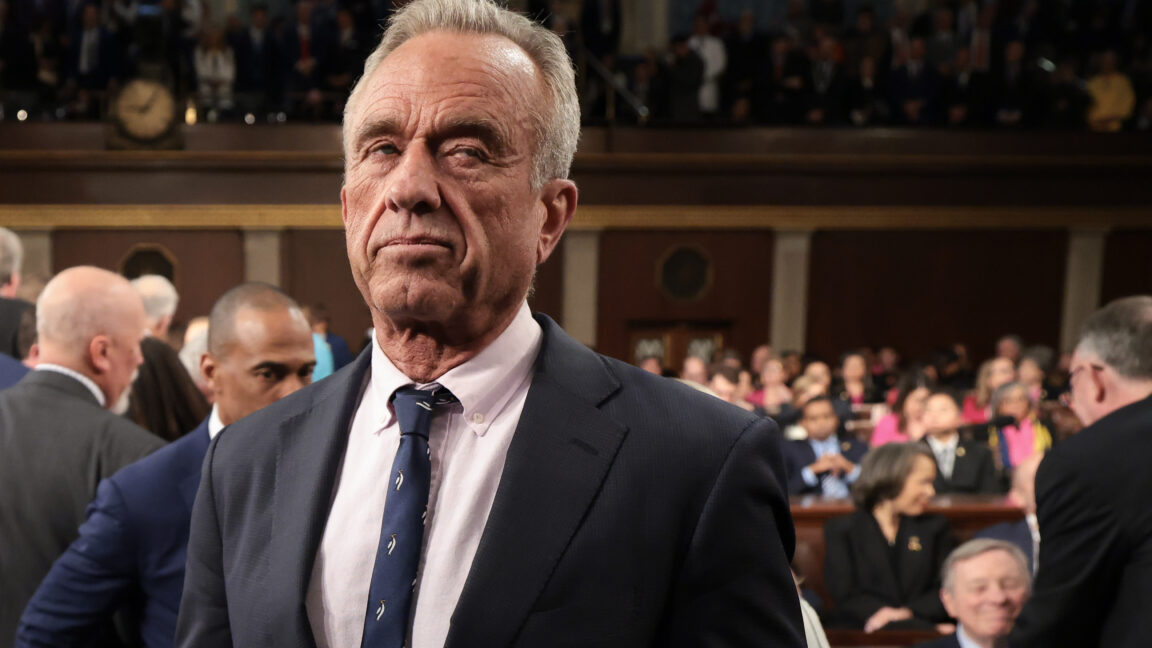
Brother Says It Was Falsely Accused Of Bricking Printers That Use Cheaper Third-Party Ink Cartridges
For years, more ham-fisted printer manufacturers have waged a not-so-subtle war on consumers by blocking the ability to use cheaper, third-party printer cartridges. HP and Canon have both been particularly obnoxious on this front, and continue to engage in the practice despite a growing pile of assorted lawsuits.
Brother has historically been one of the last major printer manufacturers that doesn’t engage in this practice, something that should be applauded.
Yet the company found itself on the receiving end of recent accusations that it too had begun bricking the printers of users who try to install third-party cartridges. The rumblings began courtesy of a YouTube video and several lazy subsequent articles about it claiming the company had done an about face.
But the accusations were entirely based on a 2022 Reddit post from a user who had problems after a firmware update. The problem wasn’t new, and it wasn’t clear Brother actually did anything differently.
Ars Technica managed to do actual reporting and ask Brother about it. The company repeatedly insists that absolutely nothing has changed in regards to the company’s treatment of third-party ink and toner cartridges:
“We are aware of the recent false claims suggesting that a Brother firmware update may have restricted the use of third-party ink cartridges. Please be assured that Brother firmware updates do not block the use of third-party ink in our machines.”
There are various claims peppered around Reddit by users who claim a firmware update blocked their use of third-party cartridges. But Brother says that while its software and hardware do check to confirm whether official Brother cartridges are installed (which might cause inadvertent bugs for some users), they don’t block their use in any way (FWIW I have an MFC-L3770CDW LaserJet that has never struggled to use cheap third-party toner).
It’s unfortunate for Brother, given, again, it’s one of the few remaining manufacturers not being an asshole on this subject. So far.
A few years ago, printer manufacturers took this tactic one step further, and began preventing users from being able to use a multifunction printer’s scanner if they didn’t have company sanctioned ink installed. Canon was hit with a $5 million lawsuit in 2021 for the practice, but was able to quietly settle it privately without facing much accountability, or having to change much of its behavior.
In 2022 HP was also hit with a lawsuit (pdf) for preventing scanners from working without sanctioned ink cartridges installed, and not being transparent about this with customers. HP has spent a few years trying to wiggle out of the suit, but hasn’t had much luck.
Lawsuits don’t seem to be deterring the behavior by most major companies. And given Trump 2.0 is turning most consumer protection regulators into the legal equivalent of damp roadside cardboard, there are fewer disincentives than ever for companies that want to goose their quarterly earnings by nickel-and-diming their loyal customers.
The Anti-DEI Agenda Is Reprogramming America
How a Push to Amend the Constitution Could Help Trump Expand Presidential Power
by Phoebe Petrovic, Wisconsin Watch
This article was produced for ProPublica’s Local Reporting Network in partnership with Wisconsin Watch. Sign up for Dispatches to get stories like this one as soon as they are published.
A behind-the-scenes legal effort to force Congress to call a convention to amend the Constitution could end up helping President Donald Trump in his push to expand presidential power.
While the convention effort is focused on the national debt, legal experts say it could open the door to other changes, such as limiting who can be a U.S. citizen, allowing the president to overrule Congress’ spending decisions or even making it legal for Trump to run for a third term.
Wisconsin Watch and ProPublica have obtained a draft version of a proposed lawsuit being floated to attorneys general in several states, revealing new details about who’s involved and their efforts to advance legal arguments that liberal and conservative legal scholars alike have criticized, calling them “wild,” “completely illegitimate” and “deeply flawed.”
The endeavor predates Trump’s second term but carries new weight as several members of Trump’s inner circle and House Speaker Mike Johnson have previously expressed support for a convention to limit federal government spending and power.
Article V of the Constitution requires Congress to call a convention to propose and pass amendments if two-thirds of states, or 34, request one. This type of convention has never happened in U.S. history, and a decadeslong effort to advance a so-called balanced budget amendment, which would prohibit the government from running a deficit, has stalled at 28.
Despite that, the lawsuit being circulated claims that Congress must hold a convention now because the states reached the two-thirds threshold in 1979. To get there, these activists count various calls for a convention dating back to the late 1700s. Wisconsin’s petition, for example, was written in 1929 and was an effort to repeal Prohibition. The oldest petition they cite, from New York, predates the Bill of Rights. Some others came on the eve of the Civil War.
A lawsuit being circulated claims that Congress must hold a convention to amend the Constitution now because the states reached the two-thirds threshold for calling one in 1979. However, they cite petitions going back hundreds of years, including this one from New York in 1789. ((<a href="https://digitalcollections.nypl.org/items/bcf4e50c-cd23-6423-e040-e00a18061eb6#/?uuid=bcf4e50c-cd24-6423-e040-e00a18061eb6">Via The New York Public Library</a>))“It is absurd, on the face of it, that they could count something that had to do with Prohibition as a call for a constitutional convention in 2025,” said Russ Feingold, a former Democratic senator from Wisconsin who co-wrote a book critical of convention efforts like this one. “They’re just playing games to try to pretend that the founders of this country wanted you to be able to mix and match resolutions from all different times in American history.”
To avoid the threat of a convention, the legislatures in some states like Colorado and Illinois have passed resolutions withdrawing their petitions. The draft lawsuit says those actions don’t count because “once the Article V bell has been rung, it cannot be unrung.” Nearly half the states the draft counts have rescinded their petitions.
The draft lawsuit is the work of the Federal Fiscal Sustainability Foundation, a low-profile nonprofit that has drawn support from balanced budget advocates and the conservative American Legislative Exchange Council. The group’s chair, David M. Walker, oversaw government accountability as U.S. comptroller general during both the Clinton and Bush administrations. The draft lawsuit is signed by Charles “Chuck” Cooper, a high-powered conservative lawyer in Washington, D.C., who represented Trump’s previous attorney general during the special counsel’s investigation into Russian interference in the 2016 election.
Walker and his team have shopped the lawsuit to over a dozen state attorneys general and Republican-controlled legislatures seeking to find states to serve as plaintiffs, according to emails obtained through records requests, public testimony and interviews. Alongside ALEC’s CEO, they met with members of the Utah attorney general’s office in 2023, trying to recruit the state to take the lead, and planned to meet with Texas Attorney General Ken Paxton, emails show. Lawmakers in Utah, Arizona, South Carolina and West Virginia have sought to get their states to join the lawsuit.
Walker declined to confirm the authenticity of the draft complaint and wouldn’t say which states have signed onto the lawsuit. But it mirrors the legal arguments Walker and his group have made, and the document’s metadata shows Cooper’s firm authored it. Neither Cooper nor his firm returned repeated requests for comment. An ALEC spokesperson said the group has merely provided a “forum” to “exchange ideas.”
Walker said an attorney general’s office has written its own version with “modifications.” He said he hopes the states will announce their intent to sue within the next two months and file shortly after.
Walker and the draft complaint say the convention is necessary to confront the national debt and would be limited to discussing fiscal responsibility.
“Some people think that the convention would get together to basically rewrite the Constitution. That’s totally false,” Walker said. “That has nothing to do with what we’re proposing. Under Article V, it’s just a separate way to get an amendment to the existing constitution.”
The legal effort is headed by David M. Walker, the former U.S. comptroller general, shown here in 2006, first image. The draft lawsuit is signed by Charles “Chuck” Cooper, an influential conservative lawyer in Washington, D.C., shown here in 2011. (First image: Chris Carson/AP. Second image: Paul Sakuma/AP.)Dozens of legal scholars and hundreds of civil society groups, organized by the government watchdog Common Cause, have warned that it would be exceedingly difficult to constrain a convention to just one idea and that calling one would expose the entire Constitution to revision. Some of them say the risk has grown under Trump.
“Nobody is observing any restraints on their power,” Georgetown law professor and convention critic David Super said. “If he continues to lose in the courts, one can imagine he will be trying to get a convention to adopt his view of presidential powers.”
Asked to respond, White House spokesperson Anna Kelly accused Wisconsin Watch of having “TDS” (Trump derangement syndrome) and being a “dark money” group. (Wisconsin Watch makes its donors public here.)
Sam Fieldman, of the campaign finance reform group Wolf-PAC, has individually worked with the foundation on the lawsuit. He said the process empowers states to check the federal government and change the Constitution if Congress fails to act.
“People who are claiming that this process will lead to tyranny are sitting here twiddling their thumbs while we are heading toward tyranny like a rocket right now,” Fieldman said.
“Fuzzy Math” and a “Time Machine”Throughout history, the Constitution has been amended 27 times, including to abolish slavery and provide women with the right to vote. An amendment must be approved by two-thirds of both houses of Congress. It then must be ratified by three-quarters of the states to become law.
The Constitution also offers another way: Congress can call a convention after two-thirds of state legislatures request one.
But Article V provides few other details. It does not say what constitutes a valid application or how to add them together to reach 34. Nor does it say how a convention should run. It does not enumerate specifics on delegates, such as who can serve and how states should select them, nor whether each state gets one vote or votes relative to population. And it does not specify whether a convention can be limited to specific issues.
As of now, the three-fourths ratification requirement still stands. Critics fear delegates could take the extreme step of lowering the threshold to make it easier for the amendments to pass, a scenario that proponents dismiss as “fear mongering.”
Fewer than half the states have laws or policies governing convention procedures. The majority of those would give state legislators, rather than voters, the ability to select delegates. They’d also permit each state one vote, according to a 2025 review by the Center for Media and Democracy, a progressive government watchdog.
The center obtained audio of former Republican Sen. Rick Santorum of Pennsylvania at a private ALEC workshop saying that because “most states are going to be controlled by Republicans,” rural and Republican voters will have “an outsize granted power” in a convention.
“We have the opportunity as a result of that to have a supermajority,” he said, even though “we may not even be in an absolute majority when it comes to the people who agree with us.”
Santorum did not return emails seeking comment.
Over the years, people from across the political spectrum have attempted to call conventions for various topics, such as campaign finance reform and congressional term limits. None of the advocates have tried to use states’ old calls that didn’t specify a topic to reach the required 34.
But during a 2020 ALEC presentation, a balanced budget activist named David Biddulph debuted a new theory: By combining old resolutions that generally called for a convention with ones for a balanced budget amendment, the nation already surpassed the threshold.
Illinois has since withdrawn its 1861 resolution. (1861 Ill. Laws 281-82, highlights added by Wisconsin Watch and ProPublica.)Biddulph said he based his theory on a paper authored by Robert Natelson, a former law professor who focuses on Article V, and published by the Federalist Society in 2018. But Natelson’s paper did not claim the threshold had been reached, and in an interview, he said he disagrees with activists claiming otherwise.
During the presentation, moderated by former Wisconsin Gov. Scott Walker, Biddulph announced that his organization, which became the Federal Fiscal Sustainability Foundation, was encouraging attorneys general to file suit against Congress.
Biddulph did not respond to repeated calls and emails seeking comment.
That same theory forms the basis of the draft lawsuit, which counts six petitions that called for a convention without stating a specific purpose alongside balanced budget ones to support their claim for a convention.
“They realize they will never get to 34 honestly now, so they are talking about a new math,” said Nancy MacLean, a historian whose book “Democracy in Chains” discusses the dangers of a convention. Some convention opponents, like Super, refer to this as the “fuzzy math” theory.
During a legislative hearing in Utah, Sharon Anderson, a conservative opponent of a convention, used a metaphor to criticize the counting method.
“A certain team, discouraged that they hadn’t scored the winning touchdown yet, devised a way to win the game,” Anderson said. “Instead of actually getting the ball into the end zone, they would basically add up all the yards they had gained until they totaled a distance needed to cross the goal line.”
But Natelson, a member of ALEC’s board of scholars who is cited repeatedly in the lawsuit, said if lawmakers had wanted to limit their calls to specific topics, they could have done so.
A Washington, D.C., newspaper, The Evening Star, ran an Associated Press article in 1929 detailing Wisconsin’s call for a constitutional convention. (Via Chronicling America)The second key part of the foundation’s legal argument is timing, which opponents like Super refer to as the “time machine” theory. Wisconsin passed a balanced budget amendment resolution in 2017, yet the draft instead includes the state’s Prohibition-era petition because it’s counting applications on the books between 1979 and 1998 — a period when the draft argues at least 34 existed.
Unmentioned, however, is that almost nobody during that period claimed that the nation had surpassed the threshold.
This is unlike recent debates over the Equal Rights Amendment, which would prohibit discrimination based on sex. Some argue that enough states have now approved the amendment, but the U.S. archivist declined to certify it because Congress explicitly set a deadline for ratification that states did not meet.
Getting States on BoardBiddulph and others began to enlist state support in 2022 with an email that announced: “The historic milestone of 34 Article V state resolutions calling for an amendment convention to propose a Balanced Budget Amendment (BBA) has finally been achieved, and surprisingly it happened over 40 years ago.”
The message, obtained by the Center for Media and Democracy and provided to Wisconsin Watch and ProPublica, asked states to pass a resolution demanding Congress call a convention and directing the state’s legislature and attorney general to “take such actions as will require Congress’s compliance.”
Republican state lawmakers in Utah and South Carolina responded within days, introducing measures incorporating some of the proposed language.
“We have a tremendous opportunity as a state to deal with an issue that is a very serious and grave moment in our nation,” Utah state Rep. Ken Ivory, a Republican who introduced the measure, said at a legislative hearing in February 2022. “It’s the power of the state to be able to deal with the excessive debt and the financial explosion and the swindling, as Thomas Jefferson said, the swindling of the future on a massive scale.”
Since the Utah hearing, Arizona and West Virginia have also introduced measures demanding Congress call a convention. West Virginia’s was the most explicit, resolving to “commence federal court action” against Congress, and advanced the furthest, passing the state House of Delegates before stalling in its Senate. So far, none of the resolutions has been adopted. West Virginia’s was reintroduced last month.
In February 2024, activists believed they were close to filing the lawsuit, emails obtained through a public records request show. The Senate presidents and House speakers in Utah and Arizona signed letters expressing their interest in joining a federal lawsuit against Congress to force a convention on fiscal issues.
In an email that was cc’d to the Arizona lawmaker who sponsored the state’s resolution, convention supporter Mike Kapic celebrated Utah’s and Arizona’s interest as a “win.”
“One more and UT says they’ll lead the filing in federal court,” Kapic wrote. “Then watch other states rush to file.”
It still hasn’t happened. The Arizona Legislature does not have standing to file a lawsuit on its own, a spokesperson for the state attorney general said, and the Democratic attorney general has not agreed to take the case.
A spokesperson for the Utah attorney general’s office declined to comment on whether the state had agreed to file the suit.
Ivory said by email that he is unaware whether Utah has any current plans to sue Congress. “New AG, New Congress, New President,” he wrote, adding that he believes “negotiations” may be taking place with Congress “with potential promising results,” but that he is not involved.
Alaska is the only state listed on the draft complaint, but the state attorney general’s office would not confirm whether it has joined.
In Congress, Texas Republican Rep. Jodey Arrington has also introduced resolutions to trigger a convention, including one he put forward last month. His office did not agree to an interview.
If Congress does call a convention, it would likely be up to delegates to keep it from creeping into other parts of the Constitution.
Historians generally agree that the 1787 constitutional convention itself was a runaway convention. Delegates met in Philadelphia to amend the Articles of Confederation, a process that required unanimity among states. Instead, they scrapped the entire document and drafted the Constitution, proposing a lower threshold for states to ratify amendments.
Mollie Simon contributed research.
Trump Halted an Agent Orange Cleanup. That Puts Hundreds of Thousands at Risk for Poisoning.
by Anna Maria Barry-Jester and Brett Murphy, ProPublica, and Le Van for ProPublica
Read this story in Vietnamese. Xem bài viết này bằng tiếng Việt.
ProPublica is a nonprofit newsroom that investigates abuses of power. Sign up to receive our biggest stories as soon as they’re published.
In mid-February, Trump administration leaders received a desperate warning from their diplomats posted in Vietnam, one of the most important American partners in Asia.
Workers were in the middle of cleaning up the site of an enormous chemical spill, the Bien Hoa air base, when Secretary of State Marco Rubio abruptly halted all foreign aid funding. The shutdown left exposed open pits of soil contaminated with dioxin, the deadly byproduct of Agent Orange, which the American military sprayed across large swaths of the country during the Vietnam War. After Rubio’s orders to stop work, the cleanup crews were forced to abandon the site, and, for weeks, all that was covering the contaminated dirt were tarps, which at one point blew off in the wind.
And even more pressing, the officials warned in a Feb. 14 letter obtained by ProPublica, Vietnam is on the verge of its rainy season, when torrential downpours are common. With enough rain, they said, soil contaminated with dioxin could flood into nearby communities, poisoning their food supplies.
Hundreds of thousands of people live around the Bien Hoa air base, and some of their homes abut the site’s perimeter fence, just yards from the contaminated areas. And less than 1,500 feet away is a major river that flows into Ho Chi Minh City, population 9 million.
“Simply put,” the officials added, “we are quickly heading toward an environmental and life-threatening catastrophe.”
They received no response from Washington, according to three people familiar with the situation.
Instead, Rubio and Peter Marocco, another top Trump appointee, have not only ordered the work to stop, but they also have frozen more than $1 million in payments for work already completed by the contractors the U.S. hired. The company overseeing the project is Tetra Tech, a publicly traded consulting and engineering firm based in the U.S., and a Vietnamese construction firm has been tasked with the excavation work.
Then, on Feb. 26, Rubio and Marocco canceled both companies’ contracts altogether before apparently reversing that decision about a week later, agency records show. As of Thursday, the companies had not been paid.
The Trump administration has told the courts repeatedly that its process to dismantle the U.S. Agency for International Development, which manages the project’s funds, has been careful and considered. But the botched situation at Bien Hoa is a stark example of the whiplash, conflicting messages and dire consequences that aid organizations worldwide have faced since early February.
Now, after losing several weeks because of the administration’s orders, the companies are scrambling — at their own expense — to secure the Bien Hoa site before it starts raining, according to documents reviewed by ProPublica and several people familiar with the current situation.
The USAID officials who would typically travel to the air base to provide oversight have been placed on administrative leave or prevented from traveling to check on the work. They’ve also been forbidden from communicating with the Vietnamese government or the companies working at the base, sources say, though they believe that directive was lifted after the contracts were recently reinstated. The confusion has left many at both the embassy and in Washington in the dark about where the situation stands.
To ascertain the current status of the work, ProPublica hired a reporter to visit the air base on Friday.
Workers are laboring in 95 degree heat, surrounded by toxic soil. The site has a skeleton crew of less than half of what they previously had, according to workers and documents reviewed by ProPublica. Some staffers found new jobs during the suspension. People working at the site told the reporter they are worried about completing the work before the rainy season descends and are terrified the U.S. will pause the work again.
Since 2019, the U.S. government has collaborated with Vietnam’s Ministry of Defense to clean up the Bien Hoa air base and agreed to spend more than $430 million for the project. Unlike other foreign aid programs, addressing Agent Orange is more akin to restitution than charity because the U.S. brought the deadly substance there in the first place. “The dioxin remediation program is one of the core reasons why we have an extraordinary relationship with Vietnam today,” a State Department official told ProPublica, “a country that should by all rights hate us.”
With enough contaminated soil to fill about 40,000 dump trucks, the Bien Hoa air base is the largest deposit of postwar pesticides remaining in Vietnam after a decadeslong cleanup campaign. Human rights groups, environmentalists and diplomats consider the cleanup work — along with disability assistance that the U.S. has provided to Agent Orange victims across the country — to be one of the most successful foreign aid initiatives of all time.
All of that was now in peril, the officials wrote in their Feb. 14 letter to USAID officials in Washington. “What immediate actions can be taken to avert a potential life-threatening incident while still maintaining compliance with the Executive Order and the suspension directives?” the officials wrote.
U.S. officials in Vietnam grew increasingly panicked. The ambassador sent a diplomatic cable to Washington, and Congress and USAID’s inspector general each received a whistleblower complaint, multiple people told ProPublica.
“Halting a project like that in the middle of the work, that’s an environmental crime,” said Jan Haemers, CEO of another organization that previously worked in Vietnam to clean up Agent Orange in the soil. “If you stop in the middle, it’s worse than if you never started.”
The Bien Hoa air base on the outskirts of Ho Chi Minh City, Vietnam, in 2018. Workers were in the middle of cleaning up an enormous chemical spill there when Secretary of State Marco Rubio abruptly halted all foreign aid funding. (Thomas Watkins/ AFP/Getty Images)The State Department said in a statement that the contracts at Bien Hoa are “active and running” but did not respond to detailed follow-up questions. Tetra Tech and the Vietnamese construction firm did not respond to questions for this story. The Vietnamese Embassy and Ministry of Defense did not return requests for comment. But the Vietnamese Ministry of Foreign Affairs made a statement on Feb. 13 that it was “deeply concerned” about USAID program suspensions, specifically mentioning the Bien Hoa project.
Trump’s aides, including billionaire Elon Musk, began dismantling the U.S. foreign assistance system almost immediately after the inauguration. They dismissed USAID staff en masse, issued sweeping stop-work orders, froze funds and eventually canceled most of the agency’s contracts with aid organizations around the world, leaving countless children, refugees and other desperately vulnerable people without critical services.
On Monday, Rubio boasted on X that they had cut 83% of USAID’s programs because they didn’t align with Trump’s agenda.
After terminating the contracts, Rubio, Musk and Marocco reversed several of their decisions in Vietnam, designating the Bien Hoa project as one of the few programs to survive, at least for now.
Every president since George W. Bush — including Trump — has made good on the American promise to repair relations with Vietnam by cleaning up Agent Orange and helping those sick or disabled from dioxin poisoning. In 2017, Trump landed at Danang Airport, a prior cleanup site, ahead of a free-trade meeting with Asia-Pacific countries. The U.S. now conducts $160 billion in annual commerce with Vietnam, which has also become a key partner against China’s growing influence in the South China Sea. The Pentagon and Vietnamese military now work together as well, including efforts to locate the remains of soldiers missing in action from the war 50 years ago.
“All of this is underpinned by the cooperation on Agent Orange,” said Charles Bailey, a former Ford Foundation representative in Vietnam who co-wrote a book on the country’s relations with the U.S. in the wake of the war. “It’s like pulling out one or two legs of the stool.”
The Bien Hoa project was formally launched and initial contracts signed during Trump’s first presidency. In another example of the administration’s confusing stance toward the project, Defense Secretary Pete Hegseth told his Vietnamese counterpart on a Feb. 7 phone call that Trump wanted to enhance defense ties by addressing war legacy issues, which include Agent Orange remediation. About half of the project’s funding comes from the Pentagon’s budget, though it’s funneled through USAID, so it was also caught up in the foreign aid freeze.
Environmental consultants, foreign policy experts and government officials said the episode in Bien Hoa shows the administration did not do a thoughtful audit. “One might imagine a less reckless government looking at what we’re doing carefully and then deciding what’s in our interest,” David Shear, a former U.S. ambassador to Vietnam under Barack Obama, told ProPublica.
“But,” he said, “this is government reform by meat cleaver.”
The mixture known as Agent Orange is a combination of two herbicides that the U.S. brought to Vietnam in huge volumes to kill off jungles and mangroves that hid opposition forces during the Vietnam war. The mixture contained dioxin, a deadly substance that not only causes a range of cancers and other illnesses, but is also linked to birth defects for babies exposed in utero. During the war, the U.S. sprayed more than 10 million gallons of the herbicides across vast swaths of the country, exposing U.S. soldiers as well as millions of Vietnamese people and their future children to the deadly toxic substance.
A treatment center for children with disabilities in Ho Chi Minh City in 2009. Many of them are from areas that were heavily sprayed with Agent Orange during the war. (Kuni Takahashi/Getty Images)Storage sites like the air bases of Danang and Bien Hoa were heavily contaminated as barrels leaked, broke or were otherwise mishandled. Over the decades, dust has blown the contaminated soil off the bases and abundant rains have pushed the dioxin into waterways and the densely packed surrounding neighborhoods, contaminating fish as well as ducks and chicken that people raise for food. Soil samples at the Bien Hoa base have shown dioxin at levels as high as 800 times the allowed amount in Vietnam.
For decades since the war, and despite extensive documentation of higher rates of cancers and birth defects among people who had been exposed to the chemicals, the U.S. denied the mass toll Agent Orange had taken on Vietnamese people — as well as on American veterans, as ProPublica has previously reported. But starting in the mid-2000s under President George W. Bush, the U.S. began earmarking federal dollars for dioxin remediation in Vietnam to clean up the contamination sites and the two nations’ troubled relationship.
The cleanup work is dangerous and laborious. People hired by the contractors wear extensive protective equipment in the sweltering humidity and must have their blood tested regularly for dioxin. When levels get too high, they are no longer allowed to work at the site. There are supposed to be extensive safety checks in place to ensure the dirt doesn’t poison military officials or the surrounding community.
The plan at Bien Hoa is to excavate a half-million cubic meters of the most contaminated soil and enclose it underground or cook it in an enormous furnace, which hasn’t been built yet, until the dioxin no longer poses a threat. The work requires extensive pumping and management of dioxin-contaminated water. Contractors are halfway through a 10-year project set to happen in stages, and the bulk of the excavation work must be done between December and April when there is less rain.
After Rubio first issued sweeping stop-work orders to aid organizations and contractors around the world in late January, workers from the site were told to stay home for weeks. The companies stopped receiving money to cover payroll and their past invoices. Huge mounds of tarp-covered dirt dotted sections of the base.
USAID and State Department staff scrambled to get the project back online through the State Department’s confusing waiver process and appealed to counterparts in the U.S. A group of Democratic senators sent a letter to Hegseth and Rubio urging them to pay the contractors. “It would be difficult to overstate the damage to the relationship that would result if the U.S were to walk away from these war legacy programs,” they wrote. They got no response.
One of the senators who signed the letter, Jeff Merkley, D-Ore., told ProPublica that abandoning the Bien Hoa cleanup is “a betrayal of the goodwill our two nations built over 30 years” and a “gift to our adversaries.”
Even off-season rains pushed the sites to the brink, two sources said, with water pooling up to the edge of protective aprons, threatening to spill out onto an active military runway after recent rainstorms.
Heavier rains typically start in April before the downpours of the rainy season in May.
The contractors are desperately trying to secure the contaminated dirt and pits before then, according to interviews this week with several people working there. But they are two months behind schedule.
“The problem is that the Trump administration has destroyed USAID, so it’s very unclear how we’re going to complete this project,” said Tim Rieser, a longtime aide to former Sen. Patrick Leahy, D-Vt., who led a bipartisan delegation to break ground in Bien Hoa in 2019. “The people making the decisions probably know the least.”
Alex Mierjeski contributed research.
DOGE’s Cuts at the USDA Could Cause US Grocery Prices to Rise and Invasive Species to Spread
Saudi Arabia Buys Everybody’s Sensitive Pokémon Go Location Data
During the great TikTok moral panic of 2022-2025 we noted repeatedly how it was very weird for the public, press, and lawmakers to singularly hyperventilate about the privacy and propaganda impacts of one specific Chinese-owned app while just completely refusing to do anything about the much broader problems that TikTok (and a thousand other companies) exploit every day.
The U.S. is awash in propaganda we do absolutely nothing about. And our corrupt refusal to pass a basic internet-era privacy law (or regulate data brokers) has resulted in a vast, largely unregulated, hyper-surveillance market for your every thought, browsing habit, or movement. Data that’s then routinely sold to any number of random nitwits, including right wing extremists and foreign intelligence services.
We were told repeatedly for years that TikTok posed some kind of very unique threat, even though that threat was not at all unique, and created by the government’s corrupt failure to protect consumer privacy.
The latest case in point: Pokémon Go owner Niantic is selling the game (and all of its collected data) to a company created by the Saudi Arabian government. According to the fine folks at 404 Media, the companies have made numerous blog posts about the acquisition, without any of them talking about what happens to the reams of sensitive location data the company has collected for years:
“Scopely, Niantic, and Savvy Games have collectively published six separate blog posts about the $3.85 billion deal, none of which specifically address what is happening with the location data of Pokémon Go’s 100 million players and none of which address how location data collected in the future will be handled under Scopely and its Saudi Arabian owners.”
Pokémon Go involves you wandering around in an augmented reality to real world places to combat virtual monsters, so it’s a little more detailed in the granular movement data it collects than many games. That data is now squarely in the hands of the Saudi Arabian government, which can then exploit this vast data repository in any way it wants without much in the way of oversight.
Like most data broker adjacent operations the companies involved are convoluted by design to minimize accountability and transparency. 404 Media notes how part of the $3.85 billion deal will involve Niantic spinning off its growing AI mapping business. The deal also involves transfer of Campfire and Wayfarer, two related tools that can also track Pokémon Go player movement in granular detail:
“What is happening here, then, is that an already very complicated and vast location data ecosystem that was previously controlled by only one American company (Niantic) has now become a far more complicated location data ecosystem controlled by an “American” company that is wholly owned by a Saudi Arabian conglomerate whose largest shareholder is the Saudi Arabian government.”
The U.S. refuses to pass a real privacy law for several reasons. One, we’re a corrupt embarrassment of country that routinely prioritizes making money over everything, including public safety, consumer privacy, and national security. Two, our government realizes a privacy law might prevent them from being able to buy U.S. consumer data; an easy end around for getting pesky warrants.
The Saudi Arabian government having easy and direct access to Americans’ sensitive data is every bit as bad as the Chinese government having proxy access to Americans’ sensitive data. And every bit as bad as the countless apps on your phones that are monetizing your movement and choices in granular detail with zero meaningful oversight during surging U.S. authoritarianism.
Yet curiously I’m going to bet the Pokémon Go purchase sees little of the mass hyperventilation that was reserved for TikTok. I’m going to bet guys like Trump FCC Brendan Carr, who was on TV pretty much every week screaming about the privacy ramifications of TikTok, won’t have much to say about Pokémon Go now being owned by the Saudi Arabian government.
Corruption generally means our outrage on this sort of thing is highly selective and phony. TikTok primarily became an exceptional target of ire because Facebook lobbyists wanted to eliminate a competitor, not because our corrupt Congress genuinely and uncharacteristically developed a sudden backbone on consumer privacy.
Of course, much like U.S. privacy law proposals, our big noisy stink about TikTok ultimately resulted in no action either. And now that the United States has elected a used car salesman as king, the hope of privacy laws — or competent regulators consistently protecting consumer interests — seems further away than ever.
We’re truly building something monstrous, and absolutely begging for a privacy scandal that makes the parade of weekly privacy scandals we’re intimately familiar with seem utterly adorable in comparison.