Shared posts

03 Jun 17:53

Some parts of Trump’s proposed budget for NASA are literally draconian

by Stephen Clark

New details of the Trump administration's plans for NASA, released Friday, revealed the White House's desire to end the development of an experimental nuclear thermal rocket engine that could have shown a new way of exploring the Solar System.

Trump's NASA budget request is rife with spending cuts. Overall, the White House proposes reducing NASA's budget by about 24 percent, from $24.8 billion this year to $18.8 billion in fiscal year 2026. In previous stories, Ars has covered many of the programs impacted by the proposed cuts, which would cancel the Space Launch System rocket and Orion spacecraft and terminate numerous robotic science missions, including the Mars Sample Return, probes to Venus, and future space telescopes.

Instead, the leftover funding for NASA's human exploration program would go toward supporting commercial projects to land on the Moon and Mars.

Read full article

Comments

03 Jun 17:53

Trump is planning to slash 107,000 federal jobs next year. See where

by Eric Katz
The Trump administration is looking to slash a net of 107,000 employees at non-defense agencies next fiscal year, which would lead to an overall reduction of more than 7% of those workers. 

Agencies laid out their workforce reductions in an expanded version of President Trump’s fiscal 2026 budget released on Friday, which includes both ideas they can implement unilaterally and proposals that will require congressional approval. If agencies follow through on their plans, the cuts will likely be even steeper, as the Defense Department and some other agencies did not include their announced cuts in the new budget documents. 

The cuts represent changes projected to take effect next year relative to fiscal 2025 staffing levels. The ongoing cuts that have already occurred were generally not factored into the current workforce counts and the White House noted those figures “may not reflect all of the management and administrative actions underway or planned in federal agencies.” 

Agencies are currently operating under a directive from Trump to slash their rolls, though those plans are largely paused under court order and awaiting resolution at the Supreme Court. 

Under the budget forecasts, the Education Department will shed the most employees, followed by the Office of Personnel Management, General Services Administration, Small Business Administration and NASA. Education has already moved to lay off one-third of its workforce, but those reductions in force are currently paused by a separate court order. 

The departments of Labor, Housing and Urban Development and Agriculture are also expecting to cut more than 20% of their workforces. 

The Trump administration will seek to eliminate more than 107,000 jobs across government, but the net impact is mitigated by targeted hiring at certain agencies and offices. The Transportation Department is the only agency to project an overall staffing increase, driven by hiring at the Federal Aviation Administration and for IT. The Homeland Security Department will seek to significantly staff up at Customs and Border Protection and Immigration and Customs Enforcement as the administration ramps up its border crackdown and deportation operations, though DHS will see an overall cut due to planned reductions at the Federal Emergency Management Agency—which is set to shed 13% of its workforce—and the Transportation Security Administration—which will cut around 6%. 

Many offices will be cut nearly entirely, such as the research and state forestry offices within USDA’s Forest Service. The department’s Natural Resources Conservation Service would shed nearly 4,000 employees, including two-thirds of employees providing technical assistance on conservation planning and forecasting on snowpack and water supply.  

HHS, which has already laid off 10,000 employees, would eliminate 10 offices entirely, though some of the impacted employees are being absorbed into the new Administration for Health America or other reorganized areas. NASA is planning to shutter its Science, Technology, Engineering and Mathematics Engagement office and would cut its Science office in half. DHS would eliminate its Countering Weapons of Mass Destruction office. Cuts at the Treasury Department would be driven by reductions at the Internal Revenue Service— which would zero out its Business Systems Modernization office—though the Bureau of Fiscal Service is also planning to slash one-quarter of its staff.

At the Interior Department, the National Park Service is planning to cut about 27% of its employees, Fish and Wildlife Service would cut 19% and U.S. Geological Survey would cut 32%.  

The full scope of the cuts across government will likely expand over time: The Veterans Affairs Department is set to shed more than 80,000 employees and layoffs—assuming a court injunction is lifted—are expected as soon as this month, though they are not a part of the budget. The Defense Department has said it will cut around 60,000 civilian employees, but it has yet to detail those plans in Trump’s budget. 

The chart above includes cuts related to international affairs in the State Department reductions, such as those taking place at the U.S. Agency for International Development and the Millennium Challenge Corporation. Workforce counts were made using employees’ current agencies. Trump proposed some significant shifts, such as consolidating wildland firefighters under the Interior Department and shifting the Bureau of Labor Statistics to the Commerce Department.

[[Related Posts]]

]]>
03 Jun 17:52

Homeland Security’s list of ‘sanctuary cities’ pulled down after sheriffs object

by Josephine Jack

Montgomery County, Rockville and Takoma Park among state jurisdictions on list

The post Homeland Security’s list of ‘sanctuary cities’ pulled down after sheriffs object appeared first on Bethesda Magazine.

03 Jun 16:01

White House budget request includes $45 million in additional DOGE funding

by Natalie Alms
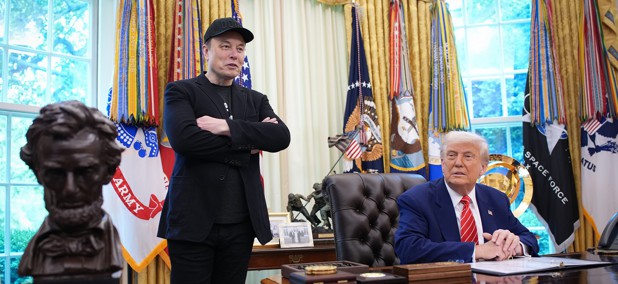
The Trump administration is seeking $45 million in funding for the Department of Government Efficiency next year, offering a hint of work to come even as Elon Musk steps back from the initiative. 

The administration’s budget request includes provisions for 150 DOGE employees, the majority of whom would be classified as reimbursable and funded by agencies. But an estimated $6 million would be set aside for compensation of the 30 employees directly paid from DOGE. 

The White House is asking for $10 million for a “software modernization initiative,” and an additional $35 million would come from agencies reimbursing DOGE for services, a setup that the U.S. Digital Service was using before President Donald Trump remade the organization into DOGE. That’s in addition to $22 million left over from this year.

So far, DOGE hasn’t garnered the $1 trillion in savings Musk promised when he came into the administration. Even so, it has tried to shutter entire agencies, helped lay off thousands of federal employees and worked with agencies to cancel government contracts.

During a Friday press briefing marking the end of Musk’s stint as a time-limited “special government employee,” Trump praised the businessman for doing a “fantastic job.” He pointed to retirement modernization as an accomplishment of DOGE — although work to bring federal retirement processes online started years prior to this administration. 

Musk will stay involved with the effort moving forward, the president said. 

“Elon’s really not leaving. He’s going to be back and forth, I think,” said Trump, calling DOGE Musk’s “baby.”

Since January, DOGE’s efforts to gather data across the government have raised privacy and ethics concerns, especially given that Musk’s businesses have been on the receiving end of regulatory scrutiny. Some of Musk’s businesses, like SpaceX, are also government contractors.

Musk himself said Friday that he anticipated “continuing to be a friend and advisor to the president and continuing to support the DOGE team.”

The budget documents released last week point to DOGE’s work on technology and software, stating that DOGE “transforms Federal technology and software, driving unprecedented efficiency and productivity.”

Even so, some government modernization work — like an effort to improve how the CDC tracks disease data — has suffered from the administration’s push to shrink the size of the government’s workforce. 

Trump set up Musk’s team as a temporary organization in what was formerly the U.S. Digital Service on his first day in office with a focus on government technology, as well as a direct reporting line into the White House. 

USDS was established during the Obama administration as a way to get private sector techies into government for short periods of time to help agencies with their technology. USDS helped staff various projects at agencies, like modernizing the SSA website.

Now, some of those agencies are struggling to fill staffing gaps left after DOGE laid off employees that were a part of USDS before it became DOGE. Others from what used to be the U.S. Digital Service before it became DOGE have left on their own accord. The Trump administration has also dismantled 18F, another internal tech consultancy housed at the General Services Administration.

New DOGE staff haven't necessarily been assigned to those projects previously worked on by the legacy USDS team, one current government employee not authorized to speak on the record told Nextgov/FCW. 

“The staffing gap has made projects completely come to a halt, or be delayed until after the hiring freeze, which realistically means we won’t have staff for this project for a year,” they said. “These are top priority projects that are projected to save millions of dollars, that we simply cannot staff anymore.”

The high-profile DOGE work has been done by those in the temporary DOGE organization or associates installed within agencies, as opposed to the few remaining legacy staff from USDS, one source familiar told Nextgov/FCW, estimating that about 30 such staff remain. The current government employee estimated that only 20 of those from the pre-DOGE organization remain. Prior to the start of the second Trump administration, the organization recently had over 200 employees.

Even as Musk eyes the exit, several DOGE associates and former employees at Musk’s businesses have been installed throughout the government in key tech and other leadership roles. Agencies were tasked with taking on DOGE leads in the executive order establishing DOGE in January. 

“The DOGE team will only grow stronger over time,” said Musk on Friday, comparing the efforts to Buddhism and calling it a “way of life.”

“We do expect, over time, to achieve a trillion dollars,” he said. DOGE’s tally of savings, currently estimated at $175 billion, has been reportedly riddled with flaws.

The temporary organization within USDS is set to sunset July 4 next year, although Musk noted that the president could extend that timeline. 

Asked what the biggest obstacle has been for DOGE, Musk said that “it’s mostly just a lot of hard work,” describing going through line items of the government’s spending.

He said that DOGE had been a “boogeyman” blamed for any cuts in government, even if DOGE wasn’t behind them, before pointing to the “banal evil of bureaucracy” as a problem.

]]>

03 Jun 16:00

Microsoft wants a version of USB-C that “just works” consistently across all PCs

by Andrew Cunningham

We've been covering the small, reversible USB Type-C connector since the days when it was just a USB Implementers Forum tech demo, and in the decade-plus since then, the port has gradually taken over the world. It quietly migrated from laptops to game consoles, to PC accessories, to Android phones, to e-readers, and to iPhones. Despite some hiccups and shortcomings, we're considerably closer to a single connector that does everything than we were a decade ago.

But some confusion persists. A weakness built into the USB-C from the very beginning was that the specification for the physical connector was always separate from the specifications for the USB Power Delivery specification for charging, the USB-C Alt Mode specification for carrying non-USB signals like DisplayPort or HDMI, and for the USB protocol itself (that is, the data transfer speed a given port is capable of).

All of these specifications were frequently grouped together so that individual USB-C ports could handle charging, display output, and data transfers (or some combination of all three at once), but they weren't required to go together, so occasionally users will still run into physical USB-C ports that fall short of the port's do-everything promise.

Read full article

Comments

02 Jun 19:01

Texas Cop Used Flock ALPR Cameras To Track A Woman Who Had An Abortion

by Tim Cushing

Here’s yet another worrying development in the world of privately-owned security cameras. Flock Safety has made aggressive in-roads in both the private and public sector, something aided greatly by the company’s ability to blend the two.

Much like Ring before it, Flock is pitching cheap cameras with local law enforcement buy-in, nudging residents towards leaving their cameras (some of which have license plate reader capabilities) open so law enforcement can search their plate captures without a warrant. Law enforcement agencies are also buying their own cameras to ensure people can’t travel very far without leaving at least a temporary record of their travels the government can access pretty much at will.

And this is how that meshing of public-private is playing out in real life. As Joseph Cox and Jason Koebler report for 404 Media, at least one law enforcement officer has used this meshed network of Flock ALPR cameras to help locate a woman who recently had an abortion.

On May 9, an officer from the Johnson County Sheriff’s Office in Texas searched Flock cameras and gave the reason as “had an abortion, search for female,” according to the multiple sets of data. Whenever officers search Flock cameras they are required to provide a reason for doing so, but generally do not require a warrant or any sort of court order. Flock cameras continually scan the plates, color, and model of any vehicle driving by, building a detailed database of vehicles and by extension peoples’ movements. 

Cops are able to search cameras acquired in their own district, those in their state, or those in a nationwide network of Flock cameras. That single search for the woman spread across 6,809 different Flock networks, with a total of 83,345 cameras, according to the data. The officer looked for hits over a month long period, it shows.

Some of these cameras were likely owned and operated by private purchasers. But even with those excluded, it’s still a massive data set the government can access without having to offer up much in the way of justification. The justification here (one that was reflected in access audits from Flock systems located as far away as Washington state) seems especially ominous and especially flimsy: “had an abortion, search for female.”

The Johnson County Sheriff’s Office claims this search was performed to help, not harm.

Sheriff Adam King of the Johnson County Sheriff’s Office told 404 Media in a phone call that the woman self-administered the abortion “and her family was worried that she was going to bleed to death, and we were trying to find her to get her to a hospital.”

“We weren’t trying to block her from leaving the state or whatever to get an abortion,” he said. “It was about her safety.” 

Even if that’s completely true, it’s not that comforting to know Texas law enforcement officers can perform the same searches for the purpose of prosecuting people who have sought abortions in nearby states where this is still legal. The justifications offered during the acquisition process always stresses the equipment will be used to deal with the most violent crimes. While utilizing the tech to search for a missing person is something most people would find acceptable, its proximity to the state’s recent abortion ban definitely isn’t an encouraging sign.

If these tools can be used this way, you can guarantee they will be used this way. Once one law enforcement agency gets the ball rolling on abortion arrests and weathers the press storm that it will provoke, the rest will follow suit, especially in areas populated by prosecutors with anti-abortion beliefs. Companies like Flock will just make everything easier for people looking to punish women for daring to explore their options and retain what’s left of their bodily autonomy.

01 Jun 12:43

Trump pulls Isaacman nomination for space. Source: “NASA is f***ed.”

by Eric Berger

The Trump administration has confirmed that it is pulling the nomination of private astronaut Jared Isaacman to lead NASA.

First reported by Semafor, the decision appears to have been made because Isaacman was not politically loyal enough to the Trump administration.

"The Administrator of NASA will help lead humanity into space and execute President Trump’s bold mission of planting the American flag on the planet Mars," Liz Huston, a White House Spokesperson, said in a statement released Saturday. "It's essential that the next leader of NASA is in complete alignment with President Trump’s America First agenda and a replacement will be announced directly by President Trump soon."

Read full article

Comments

31 May 22:33

This Week In Techdirt History: May 25th – 31st

by Leigh Beadon

Five Years Ago

This week in 2020, there was something of a spat between Donald Trump and Twitter. Trump announced a panel to study “anti-conservative bias” on social media, and went on some crazy Twitter tirades that raised complicated content moderation questions, and we wrote about what a mess the whole thing was. Then, Trump released a draft of an executive order about social media that was legally meaningless, and didn’t get any better in the official version. Mark Zuckerberg made some ridiculously wrong and self-serving statements about Twitter fact checking, and we explained why fact checking the president is not evidence of anti-conservative bias.

Ten Years Ago

This week in 2015, a disappointing Supreme Court ruling sided with patent trolls, while the Obama administration filed a totally clueless argument in another case about software copyrights. A judge in Ohio was getting fed up with Malibu Media, Richard Prince’s latest art project continued pushing the boundaries of copyright law, and Cox was facing a lawsuit from Rightscorp that they called “extortionate”. The UK government was going Full Orwell with its suppression of free speech, while a UN report came out strongly in defense of encryption and anonymity online. This was also the week that Silk Road mastermind Ross Ulbricht was sentenced to life in prison.

Fifteen Years Ago

This week in 2010, Lady Gaga joined the ranks of musicians who weren’t freaking out about piracy, while James Murdoch was giving confused lectures about copyright. We wondered why politicians kept using unlicensed music in their commercials, and why customs officers should be in charge of determining what counts as a copyright circumvention device. Infamous copyright trolls were out in force, with US Copyright Group threatening ISPs that refuse to cough up user names and commencing its mass lawsuit program for the producers of Hurt Locker, while ACS:Law was trying to get people who deny infringement to incriminate themselves. And one bizarre copyright fight broke out over the millennia old Tao Te Ching.

31 May 11:38

The Gmail app will now create AI summaries whether you want them or not

by Ryan Whitwam

Using Google products in 2025 means using (or avoiding) AI features, which are becoming a core part of the experience across the board. Last year, Gmail gained the ability to summarize emails on demand. Now, Google says AI summaries will be generated and displayed automatically in the Gmail app for Android and iOS.

Before this latest change, you had to tap the "Summarize this email" chip at the top of the screen to generate an AI summary of the message contents. Google has decided to make this automatic for emails "where a summary is helpful." That means messages that are longer or threads that contain multiple replies. The announcement is a bit vague about how much detail will trigger a summary, but it probably won't take much, as Google wants people interacting with AI features as much as possible.

Gmail's AI summaries use Gemini to generate a brief list of bullet points that break down the content of the thread. It appears at the top of the app, which may not be ideal. In the same way that AI Overviews appear at the top of search results and push the actual search results farther out of reach, Gmail's AI summaries take up valuable real estate at the top of the screen.

Read full article

Comments

31 May 11:34

CDC updates COVID vaccine recommendations, but not how RFK Jr. wanted

by Beth Mole

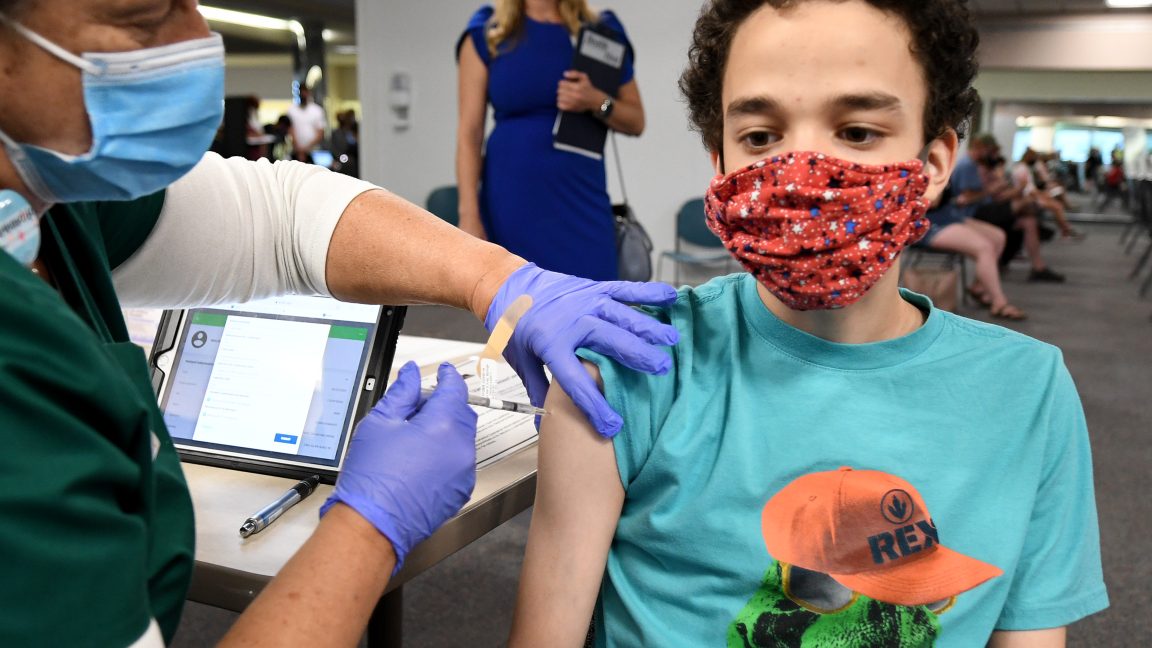
The Centers for Disease Control and Prevention on Thursday updated its immunization schedules for children and adults to partially reflect the abrupt changes announced by health secretary and anti-vaccine advocate Robert F. Kennedy Jr. earlier this week.

In a 58-second video posted on social media on Tuesday, May 27, Kennedy said he was unilaterally revoking the CDC's recommendations that healthy children and pregnant people get COVID-19 vaccines.

"I couldn’t be more pleased to announce that, as of today, the COVID vaccine for healthy children and healthy pregnant women has been removed from the CDC recommended immunization schedule," Kennedy said in the video.

Read full article

Comments

30 May 14:03

Trump designates MoCo, Rockville, Takoma Park as ‘sanctuary jurisdictions’

by Julie Rasicot

Plus: CVS in downtown Bethesda to close; Company’s bankruptcy paves way for GEICO move to Bethesda

The post Trump designates MoCo, Rockville, Takoma Park as ‘sanctuary jurisdictions’ appeared first on Bethesda Magazine.

30 May 12:49

VA-based DOGE associate gets ‘the boot’ after publicly discussing his work

by Natalie Alms
A former associate of the Department of Government Efficiency says that he was removed from DOGE after an interview where he discussed his work was published earlier this month.

Sahil Lavingia — an engineer, tech startup founder and CEO of Gumroad, an e-commerce platform for content creators — wrote in a recent personal blog that he “got the boot” from DOGE without warning the day after Fast Company published an interview in which he spoke about finding less inefficiencies than he expected in the government during his DOGE assignment as senior advisor to the chief of staff at the Department of Veterans Affairs. 

“I would say the culture shock is mostly a lot of meetings, not a lot of decisions,” Lavingia told Fast Company in the piece, which also noted that he noticed the number of mission-driven people working in government. “But honestly, it’s kind of fine—because the government works. It’s not as inefficient as I was expecting, to be honest. I was hoping for more easy wins.”

In the new post, Lavingia detailed his work extracting HR data to lay off employees at VA and working to implement artificial intelligence at the department as part of DOGE. The White House, Office of Management and Budget and VA didn’t respond to requests for comment.

President Donald Trump set up DOGE on his first day in office with a focus on tech. Since then, DOGE has also reviewed and cut government contracts at agencies and played a part in layoffs across the government — though Lavingia wrote that DOGE had no real authority there and the “real decisions came from the agency heads appointed by President Trump, who were wise to let DOGE act as the 'fall guy.'” DOGE associates have, however, led layoff efforts at several agencies before they got political heads. 

Lavingia worked for DOGE as a software engineer at the VA for just over 50 days, he wrote, but “was never able to get approval to ship anything to production that would actually improve American lives,” despite building several prototypes.

“In the end, I learned a lot, and got to write some code for the federal government. For that, I'm grateful,” he said in his blog post. “But I'm also disappointed. I didn't make any progress on improving the UX of veterans' filing disability claims or automating/speeding up claims processing, like I had hoped to when I started.”

Lavingia did review contracts, using a large language model to flag some for potential cancellation, he wrote. He also said he built tools to help the VA with its layoff efforts, and generally worked to speed up AI at the agency, specifically via an internal ChatGPT tool and a VA chatbot demo for the public on the VA website.

Lavingia wrote that he wanted to work at DOGE to make an impact, noting that he previously canvassed for Bernie Sanders’ presidential run in 2016. 

He previously applied for DOGE’s predecessor, the U.S. Digital Service, during the Obama administration, but discovered a difficult government hiring process, according to Fast Company. Government hiring has long been criticized for being arduous, and what was formerly U.S. Digital Service has done work to try and improve it.

The former member of Elon Musk’s team also wrote about frustration with a lack of knowledge-sharing in DOGE and what he called a lack of team culture. Lavingia said he pushed to open source his work when Musk asked about improving the public’s perception of DOGE during an all-hands meeting.

“The reality was setting in: DOGE was more like having McKinsey [management consulting] volunteers embedded in agencies rather than the revolutionary force I'd imagined,” the blog said. “It was Elon (in the White House), Steven Davis (coordinating), and everyone else scattered across agencies.”

This administration fired many who were already in USDS — which has acted as a type of internal tech consultancy for the government since 2014 — before it became DOGE. The General Services Administration has also since dismantled another of the government’s tech consultancy teams, 18F.

DOGE has been criticized for its work hoovering up government data, as well as its role in workforce layoffs, which have hurt some modernization efforts.

WIRED previously reported on the alarm bells Lavingia and his work set off for VA employees worried about DOGE’s lack of understanding of the agency and disregard for normal procedures.

“In meetings with the Office of the CTO, I discovered ambitious ongoing software projects like reducing veterans' benefits claims processing from 133 days to under a week,” wrote Lavingia. “I also learned that several of VA's code repos were already open-source, and the world's first electronic health record system, VistA, was built by VA employees over 40 years ago.”

]]>
30 May 12:46

Trump administration begins cracking down on federal employees' use of leave for voting

by Eric Katz
With some key primary elections at the state level occurring in the coming weeks, the Trump administration has begun notifying employees they can no longer use paid administrative leave to vote. 

The reminder, so far sent out at least to various agencies within the Agriculture Department, complies with an executive order President Trump signed on his first day in office. That order revoked a bevy of previously issued presidential actions, including an order President Biden signed early in his term to allow the leave category for federal employees looking to vote. 

In March, Trump signed another executive order calling on agency heads to “cease all agency actions implementing” Biden’s order and, within 90 days, lay out what steps they have taken to implement the new directive. 

“Effective immediately, Forest Service employees are not authorized to use administrative leave to vote or participate in voting related activities,” said a message received by employees and obtained by Government Executive

Other USDA employees reported being told verbally they could no longer use that form of paid time off for voting. The Interior Department has apparently removed implementation guidance on the leave-for-voting policy from its website. 

The Forest Service told employees they are still allowed to request taking their own personal vacation time for voting purposes. 

The Office of Personnel Management in 2022 began requiring agencies to provide federal employees up to four hours of administrative leave to vote in federal, state, local, tribal and territorial elections, which was available for use both on Election Day and during early voting. Additionally, agencies had to provide an additional four hours of paid leave to employees who serve as election judges or observers.

The time off was “subject to a determination by the agency that the employee can be relieved of duty during the specific period of time requested by the employee without significantly impairing mission-essential operations,” OPM said at the time.

In 2022, federal workers employed by several agencies reported difficulty in getting their employers to honor the policy. Ahead of the 2024 election, however, then-acting OPM Director Rob Shriver issued a memorandum reminding agency heads of the new voting leave rules.

Primary elections for the state legislatures and governors in New Jersey and Virginia will be held next month. 

]]>
30 May 12:46

USDA HQ employees told to work remotely so office building can house soldiers in upcoming military parade

by Sean Michael Newhouse
The Agriculture Department on Wednesday directed some employees in Washington, D.C., to work remotely for three weeks because one of its headquarters buildings will be used to house soldiers who are part of the upcoming parade celebrating the Army’s 250th anniversary, which coincides with President Donald Trump’s 79th birthday. 

The email obtained by Government Executive says that access to USDA’s South Building will be restricted to essential employees from June 1 through June 20 and that maximum telework is recommended for individuals who work in the building. The parade is scheduled for June 14. 

Despite the directive, the Trump administration has largely ended telework flexibility for federal employees, with officials arguing that the practice promotes inefficiency. In fact, some USDA employees on Wednesday were notified where they are being assigned to report for in-person work with a compliance deadline of June 2. 

A USDA spokesperson told Government Executive that the department has "more than adequate capabilities to accommodate America's finest." 

"USDA has done so during the past two inaugurations; this is in part due to our ideal location on the National Mall and the capacity of the building itself," the official said in a statement. "The Military provides the logistical support for eating, sleeping, showering and USDA provides the space. Over the coming weeks, USDA is proud to support this historic event...."

The Washington Post previously reported that service members participating in the parade would stay in General Services Administration and Agriculture Department buildings. An Army spokesperson also told the news organization that the event would cost an estimated $25 to $45 million. 

Government Executive has reported that USDA is planning to offload one of its two D.C. headquarters as part of a push to relocate employees to other parts of the country. 

USDA’s South Building, which was finished in 1936, was considered to be the largest office building in the world until the completion of the Pentagon in 1942.  

Eric Katz contributed to this report

]]>
30 May 12:42

OPM ‘merit’ hiring plan includes bipartisan reforms, politicized new test

by Erich Wagner
Federal job applicants will soon be quizzed on their favorite Trump administration policy as part of the hiring process, according to the Office of Personnel Management’s new “merit hiring plan.”

“How would you help advance the president’s executive orders and policy priorities in this role?” asks one of four essay questions that job seekers must answer if they are seeking any federal position GS-5 or above. “Identify one or two relevant executive orders or policy initiatives that are significant to you, and explain how you would help implement them if hired.”

The federal government’s dedicated HR agency published the plan via a joint memo from Vince Haley, director of President Trump’s Domestic Policy Council and acting OPM Director Charles Ezell. The document is a hodgepodge of bipartisan reforms developed under both Trump and former President Biden to accelerate and improve the hiring process, alongside plans to eradicate longstanding efforts to make the federal workforce more reflective of the American populace.

“The American people deserve a federal workforce dedicated to American values and efficient service,” they wrote. “Yet, federal hiring criteria long ago abandoned any serious need for technical skills and adherence to the Constitution. Instead, the overly complex federal hiring system overemphasized discriminatory ‘equity’ quotas and too often resulted in the hiring of unfit, unskilled, bureaucrats.”

The plan calls on agencies to end any use of “racial quotas and preferences” in the federal hiring process, including usage of demographic statistics in hiring, recruiting, retention and promotion decisions. And it requires agencies to cease collecting and disseminating statistics “regarding the composition of the agency’s workforce based on race, sex, color, religion or national origin.”

As part of the plan, OPM said it will expand its recruiting efforts particularly at religious colleges and universities, homeschooling and other faith-based groups, an apparently conservative spin on the Biden administration’s efforts to step up recruitment at historically black colleges and universities.

The aforementioned essay questionnaire, which will be required as part of the hiring process for most federal positions, also queries job applicants on their patriotism, “commitment to the Constitution” and the country’s “founding principles,” how they would improve government efficiency and about their overall work ethic.

Amidst these plans are efforts to advance bipartisan reforms to improve the pace and quality of the hiring process, including advancing skills-based hiring initiatives, shared certifications so that multiple agencies can hire from the same pool of applicants and shaving the length federal resume down to better reflect the hiring process in the private sector.

But one federal HR official said that taken together, this plan will make life harder for hiring managers and applicants alike.

“Everything in it will make it more difficult to hire, not less,” they said. “How the f--- do you define if someone is patriotic?”

The plan also calls on agencies to immediately cease allowing applicants to self-assess their skills and qualifications. But while that system has received criticism because it tends to incentivize job seekers to overstate their experience, an HR official said it still serves a critical purpose of sorting applications on the front-end of the process.

“If we don’t have them self-identifying what their skills are, then we have to go through and, instead of them answering the questions, we have to decide what their answer would have been and what their score should be,” they said. “We have to come through and individually make a paper matrix for each and every applicant and put the competencies they’re rated on, and then send that, along with all of the application packages, to a panel of two to three [subject matter experts], who have to go through and assign scores based on competencies. And then they have to get their s--- together, fill all that out and send it back to us, and then we have to manually put them into scores, to put them into a category, before we can create a certification. It’s f------ insane.”

Don Kettl, professor emeritus at the University of Maryland and former dean of its School of Public Policy, said that in the administration’s fervor to excise all things diversity, equity and inclusion from the hiring process, it failed to connect its process improvements to agency mission outcomes.

“I expected to find some linkage between hiring on one side and mission on the other, but there’s nothing in this about mission, and the one thing we know is we have a system where the process is out of sync with the mission,” he said. “To take what is clearly one of the most important efforts to look at the hiring process, and then to miss the single most important issue that needs to be solved, is a major missed opportunity.”

And the decision to cease data collection and monitoring of the demographic makeup of the federal workforce will hurt both those who study government and agency decisionmakers themselves, he said.

“I’m concerned about it, not because it would make it harder to pursue DEI goals as a matter of policy, but that in general, it’s important not to throw out information about what it is that you’re doing,” Kettl said. “It would be important to know whether or not you’re hiring 90% men for certain occupations . . . You don’t want to blind yourself to the implications of what you’re doing.”

]]>
30 May 12:41

Uniqlo arrives at the mall

by Store Reporter

Japanese retailer Uniqlo has opened its doors at Westfield Montgomery mall, filling the former Express space on the second level. The new store encompasses 12,000 square feet — about a third larger than the Pike & Rose location — allowing for a much bigger selection of sizes, colors and styles. Uniqlo, which carries clothes and accessories for men, women and kids, is fast-tracking its North American expansion with a goal of 200 U.S. locations by 2027.

The post Uniqlo arrives at the mall appeared first on Store Reporter.

30 May 12:41

Rockville has a new McDonald’s — but don’t try to sit down there

by Store Reporter

McDonald’s has opened at the site of the old Arby’s at 11710 Rockville Pike — but good luck finding a place to sit down. In a new concept being tested by the fast-food chain, all orders at this location must be placed at the drive-through, online or via a kiosk in the lobby. There are only five seats inside — two at a table, three at a bar. If you don’t snag one of them, you might have to eat in your car. Meanwhile, the Pike’s previous McDonald’s location near Nicholson Lane will soon reopen as Dave’s Hot Chicken.

The post Rockville has a new McDonald’s — but don’t try to sit down there appeared first on Store Reporter.

28 May 20:02

It was probably always going to end this way for Amazon’s Wheel of Time show

by Andrew Cunningham

Late on Friday, Amazon announced that it was canceling its TV adaptation of Robert Jordan’s Wheel of Time series, after several uncomfortable weeks of silence that followed the show’s third season finale.

Fans of the series can take some cold comfort in the fact that it apparently wasn’t an easy decision to make. But as we speculated in our write-up of what ended up being the show’s series finale, an expensive show with a huge cast, tons of complicated costuming and effects, and extensive location shooting only makes mathematical sense if it’s a megahit, and The Wheel of Time was never a megahit.

Adapting the unadaptable

I was sad about the cancellation announcement because I believe this season was the one where the show found its footing, both as an adaptation of a complex book series and as a fun TV show in its own right. But I wasn't surprised by it. The only thing I found surprising was that it took this long to happen.

Read full article

Comments

28 May 19:20

South Germantown Adventure Playground to close for renovations

by Courtney Cohn

Construction slated to begin in June

The post South Germantown Adventure Playground to close for renovations appeared first on Bethesda Magazine.

28 May 18:06

Verizon Asks Trump Admin To Destroy All Popular Phone Unlocking Requirements

by Karl Bode

If you’ve been around a while you might recall that Verizon used to be utterly obnoxious when it came to absolutely everything about using your mobile phone. Once upon a time, the company banned you from even using third-party apps (including basics like GPS), forcing you to use extremely shitty Verizon apps. It also used to be absolutely horrendous when it came to unlocking phones, switching carriers, and using the device of your choice on the Verizon network.

Two things changed all that. One, back in 2008 when the company acquired spectrum that came with requirements that users be allowed to use the devices of their choice. And two, as part of merger conditions affixed to its 2021 acquisition of Tracfone. Thanks to those two events Verizon was dragged, kicking and screaming, into a new era of openness that was of huge benefit to the public.

Now, with the Trump administration openly destroying whatever’s left of U.S. federal corporate oversight and consumer protection standards, Verizon sees an opportunity. As Jon Brodkin at Ars Technica notes, Verizon’s attempting to get the Trump administration to kill all unlocking requirements, in a bid to drag everyone back to the dark ages of cellphone use.

Verizon being Verizon, they can’t help but lie about it in a petition to the Trump FCC, claiming that they simply must be allowed to unfairly lock down mobile devices, because doing anything else harms competition and helps criminals:

“The Unlocking Rule applies only to particular providers—mainly Verizon—and distorts the marketplace in a critical US industry,” the Verizon petition said. “The rule has resulted in unintended consequences that harm consumers, competition, and Verizon, while propping up international criminal organizations that profit from fraud, including device trafficking of subsidized devices from the United States. These bad actors target and harm American consumers and US carriers like Verizon for their own profit, by diverting unlocked trafficked devices to consumers in foreign countries.”

Verizon, which quickly folded to Trump administration demands that it wasn’t sexist or racist enough in exchange for Frontier merger approval, has a long history of being completely full of shit on issues relating to consumer rights. And they’re particularly full of shit here.

Historical requirements on this front make it easier for you to bring any device you’d like to the Verizon network (assuming it doesn’t harm network security). Without them, Verizon could revert to only letting you use phones Verizon chooses and sells, jacking up the price for devices. Taking it further, we could easily return to the era where Verizon only lets you use apps approved or sold by Verizon.

These openness requirements are somewhat scattershot across carriers, which is why the Biden FCC had been proposing a uniform rule that would have required that all wireless providers unlock devices within 60 days of purchase.

Not only is that effort dead now thanks to Trump’s election, but Verizon’s pushing to eliminate all such requirements, driving progress violently backward. Verizon’s hoping that such rollbacks can be part of FCC boss Brendan Carr’s “Delete, Delete, Delete” deregulatory bonanza, in which he’s destroying longstanding consumer protection standards under the pretense of government efficiency.

Verizon even name drops Elon Musk’s DOGE efforts in their petition, insisting that longstanding and popular consumer protection standards on wireless devices are “the perfect example of the type of rule that the Commission should eliminate as part of the Department of Government Efficiency’s Deregulatory Initiative.”

Even if the rules aren’t destroyed by the Trump FCC, numerous recent Trump court rulings and executive orders make it all but impossible for regulators to enforce most consumer protection rules. But Verizon, ever a fan of crushing consumer protection standards and competition, wants to make doubly sure.

28 May 17:48

Trump signs executive orders meant to resurrect US nuclear power

by John Timmer

Currently, there are no nuclear power plants scheduled for construction in the US. Everybody with plans to build one hasn't had a reactor design approved, while nobody is planning to use any of the approved designs. This follows a period in which only three new reactors have entered service since 1990. Despite its extremely low carbon footprint, nuclear power appears to be dead in the water.

On Friday, the Trump administration issued a series of executive orders intended to revive the US nuclear industry. These include plans to streamline the reactor approval process and boost the construction of experimental reactors by the Department of Energy. But they also contain language that's inconsistent with other administration priorities and fundamentally misunderstands the use of nuclear power. Plus, some timelines might be, shall we say, unrealistic: three new experimental reactors reaching criticality in just over a year.

Slow nukes

The heyday of nuclear plant construction in the US was in the 1970s and 80s. But the 1979 partial meltdown at the Three Mile Island plant soured public sentiment toward nuclear power. This also came at a time when nuclear plants typically generated only half of their rated capacity, making them an expensive long-term bet. As a result, plans for many plants, including some that were partially constructed, were canceled.

Read full article

Comments

27 May 11:08

The Privacy-Friendly Tech to Replace Your US-Based Email, Browser, and Search

by Matt Burgess
Thanks to drastic policy changes in the US and Big Tech’s embrace of the second Trump administration, many people are moving their digital lives abroad. Here are a few options to get you started.
24 May 18:31

MCPS parents: Behavioral issues, lack of support creating unsafe classrooms  

by Ashlyn Campbell

Elementary school families report chair throwing, threats, hitting of other students

The post MCPS parents: Behavioral issues, lack of support creating unsafe classrooms   appeared first on Bethesda Magazine.

22 May 19:12

Judge bars Education Department from carrying out mass layoffs

by Eric Katz
Updated May 22 at 12:40 p.m.

The Education Department must retain the roughly 1,300 employees it previously laid off after a federal judge on Thursday called the dismissals unlawful and said the Trump administration must receive congressional approval to shut down the agency. 

President Trump, Education Secretary Linda McMahon and other administration officials have repeatedly stated they plan to eliminate the department and in March took its first significant step to that end by implementing widespread reductions in force. Those RIFs, Judge Myong Joun of the U.S. District Court for Massachusetts said, have made it “effectively impossible” for Education to carry out its legally required responsibilities. 

“Defendants argue that the RIF was implemented to improve ‘efficiency’ and ‘accountability’ in the department,” Joun said in issuing his preliminary injunction. “The record abundantly reveals that defendants’ true intention is to effectively dismantle the department without an authorizing statute.” 

As a result of the injunction, the Trump administration cannot carry out the March RIFs and must reinstate impacted employees “to restore the department to the status quo such that it is able to carry out its statutory functions.” It must provide updates to the court every week until the status quo in place prior to Jan. 20 is restored. Education is barred from carrying out Trump’s executive order to transfer functions out of the department. 

Those impacted by the layoffs were given until June 10 before they would be officially terminated, meaning they largely remain on the payroll on administrative leave. The RIFs impacted about one-third of Education's 4,133 employees, though incentive programs have led to an overall staffing reduction of 50%. 

The injunction is preliminary in nature, meaning a hearing on the full merits of the case is still forthcoming. Joun’s order will remain in effect until a final determination is issued, or a higher court overrules him should the administration appeal. 

The order resulted from combined lawsuits brought by 20 states, as well as a collection of public school districts, unions and advocacy groups. Joun found the plaintiffs demonstrated the department’s dismantling would negatively impact the states and “students, parents, teachers and core education programs.” 

"Today, the court rightly rejected one of the administration’s very first illegal, and consequential, acts: abolishing the federal role in education," said Randi Weingarten, president of the American Federation of Teachers, which helped bring the case. "This decision is a first step to reverse this war on knowledge and the undermining of broad-based opportunity."

Skye Perryman, president of Democracy Forward, which represented AFT and other unions in the case, also celebrated the decision. 

"“Today’s order means that the Trump administration’s disastrous mass firings of career civil servants are blocked while this wildly disruptive and unlawful agency action is litigated,” Perryman said. “No one’s lives are being made better by this administration’s attempted dismantling of the Department of Education."

Democrats in Congress have derided the Trump administration for pausing Education grants and otherwise delaying payments to state and local governments. The department was created by Congress in 1979 and Joun found efforts to unwind that action must similarly involve legislative action. The Trump administration conceded that point and said its legislative efforts to end the department were distinct from its efforts to improve efficiency at the agency, but Joun rejected that argument. 

“There is nothing in the record to support these contradictory positions,” the judge said, adding there was “no evidence” the layoffs made Education more efficient and in fact “the record is replete with evidence of the opposite.” 

A separate order from a federal judge in California has temporarily paused the Trump administration from carrying out any RIF actions, though that order is set to expire Friday. 

On Wednesday, McMahon reiterated to lawmakers her intention to eliminate her department and said she was embarking on its “final mission.” She noted Education had already recalled some employees who received RIF notices because their work was subsequently deemed essential. 

This story has been updated with additional comment

[[Related Posts]]

]]>
22 May 18:07

DOGE Used a Meta AI Model to Review Emails From Federal Workers

by Makena Kelly
DOGE tested and used Meta’s Llama 2 model to review and classify responses from federal workers to the infamous “Fork in the Road” email.
22 May 16:53

George Washington University student banned after pro-Palestinian graduation speech

A graduation speech at George Washington University has resulted in the graduate being banned from the campus after she used the platform to criticize the university’s ties to Israel and express support for Palestinians.

During Saturday’s commencement for the Columbian College of Arts & Sciences, part of GWU in Washington, DC, graduating senior Cecilia Culver delivered remarks to the graduating class of nearly 750.

Culver condemned the deaths of Palestinians in Gaza, criticized GWU’s connections to Israel, and urged the audience to withhold donations from the college and push for financial transparency, as well as for the college to divest from Israeli-linked companies.

“I am ashamed to know my tuition [fee] is being used to fund this genocide,” Culver said from the stage. “I call upon the class of 2025 to withhold donations and continue advocating for disclosure and divestment.”

Cecilia Culver’s graduation speech at George Washington University.

University officials later said Culver had not followed her pre-approved remarks. They later announced she would be barred from campus and university-sponsored events.

“The speaker’s conduct during Saturday’s Columbian College of Arts and Sciences celebration event was inappropriate and dishonest: the speaker submitted and recited in rehearsal very different remarks than those she delivered at the ceremony,” the school said in a statement. “The speaker has been barred from all GW’s campuses and sponsored events elsewhere.”

GWU also issued an apology, saying the speech had disrupted what was meant to be a celebratory occasion.

The incident has since gone viral, with one video of the speech gaining more than 1 million views. Many have praised Culver for taking a stand on behalf of Palestinians, but others have criticized her for “politicizing” a graduation ceremony.

skip past newsletter promotion

Sign up to Headlines US

Get the most important US headlines and highlights emailed direct to you every morning

Privacy Notice: Newsletters may contain info about charities, online ads, and content funded by outside parties. For more information see our Privacy Policy. We use Google reCaptcha to protect our website and the Google Privacy Policy and Terms of Service apply.

after newsletter promotion

At the event, many graduates loudly applauded and cheered for Culver, with several giving her a standing ovation. Associate dean Kavita Daiya also acknowledged her speech, saying the college supports diverse perspectives. Culver was also receiving a distinguished scholar award at the ceremony.

Culver said in an interview with The GW Hatchet that “there was just never any point where I was not going to say something”.

22 May 16:46

Verizon tries to get out of merger condition requiring it to unlock phones

by Jon Brodkin

Verizon petitioned the Trump administration to let it lock phones to its network for longer periods of time, making it harder for customers to switch to other carriers.

There are two rules that require Verizon to unlock phones more quickly than other major carriers. Verizon agreed to both rules and gained significant benefits in return—first in 2008 when it purchased licenses to use 700 MHz spectrum that came with open access requirements and in 2021 when it agreed to merger conditions in order to obtain approval for its purchase of TracFone.

The Biden-era Federal Communications Commission last year proposed a 60-day unlocking requirement that would apply to all wireless providers, which would have made AT&T and T-Mobile follow the same unlocking timeframe as Verizon. But now that the FCC is chaired by Republican Brendan Carr, it's looking to eliminate telecom regulations instead of making them stricter. Verizon sees this as an opening to seek an end to its unlocking obligations.

Read full article

Comments

21 May 13:49

Trump admin lifts hold on offshore wind farm, doesn’t explain why

by John Timmer

On Monday, the developer of a large offshore wind farm being built off the coast of New York announced that the federal government had lifted a hold it had placed on the project roughly a month ago. The entire process has been shrouded in mystery. The government never fully enunciated its justification for the hold and hasn't yet commented on the fact that it had been lifted, although there is some hint that it was coupled to a reconsideration of a cancelled natural gas pipeline.

Empire Wind is a large project being built off the southeast shore of Long Island by Equinor, a Norwegian energy company. The first of two phases, Empire Wind 1, will have an 800 MW capacity and has already received permitting and environmental approval. Equinor had started construction of the foundations for the towers that would hold the wind turbines and onshore facilities that would support this and future offshore projects.

All that changed in mid-April when Secretary of the Interior Doug Burgum announced via a social media post that the approval for Empire Wind had been rushed and his department would be reviewing it. A Fox News article published a few days later suggests that a review by the National Oceanic and Atmospheric Administration "found the Empire Wind approval process relied on rushed, outdated, and incomplete scientific and environmental analysis." But nobody else has indicated that any such report exists, despite requests from the press.

Read full article

Comments

21 May 13:48

3 Teens Almost Got Away With Murder. Then Police Found Their Google Searches

by Raksha Vasudevan
An arson attack in Colorado had detectives stumped. The way they solved the case could put everyone at risk.
21 May 13:34

IVF Clinic Bombing Suspect Was Linked to ‘Anti-Life’ Ideology. Experts Fear Its Growing Influence

by Manisha Krishnan
The 25-year-old died after authorities say he bombed a Palm Springs fertility clinic. Experts warn that online nihilism is fueling similar violence in the US and Europe.