A careful statistical examination of words from 6,000+ languages shows that humans tend to use the same sounds for common objects and ideas, no matter what language they’re speaking.
The article reports on findings of a research group led by Morten Christiansen of Cornell University, with colleagues from Argentina, Germany, the Netherlands, and Switzerland. The team "analyzed 40-100 basic vocabulary words in 62% of the world’s more than 6,000 current languages and 85 percent of its linguistic lineages."
The independence between sound and meaning is believed to be a crucial property of language: across languages, sequences of different sounds are used to express similar concepts (e.g., Russian “ptitsa,” Swahili “ndege,” and Japanese “tori” all mean “bird”). However, a careful statistical examination of words from nearly two-thirds of the world’s languages reveals that unrelated languages very often use (or avoid) the same sounds for specific referents. For instance, words for tongue tend to have l or u, “round” often appears with r, and “small” with i. These striking similarities call for a reexamination of the fundamental assumption of the arbitrariness of the sign.
Abstract
It is widely assumed that one of the fundamental properties of spoken language is the arbitrary relation between sound and meaning. Some exceptions in the form of nonarbitrary associations have been documented in linguistics, cognitive science, and anthropology, but these studies only involved small subsets of the 6,000+ languages spoken in the world today. By analyzing word lists covering nearly two-thirds of the world’s languages, we demonstrate that a considerable proportion of 100 basic vocabulary items carry strong associations with specific kinds of human speech sounds, occurring persistently across continents and linguistic lineages (linguistic families or isolates). Prominently among these relations, we find property words (“small” and i, “full” and p or b) and body part terms (“tongue” and l, “nose” and n). The areal and historical distribution of these associations suggests that they often emerge independently rather than being inherited or borrowed. Our results therefore have important implications for the language sciences, given that nonarbitrary associations have been proposed to play a critical role in the emergence of cross-modal mappings, the acquisition of language, and the evolution of our species’ unique communication system.
It seems to me as though they are making a brief for the role of sound symbolism in the evolution of languages. See:
The world learned the name of Arizona’s rookie long snapper Sunday night. That’s a bad sign.
The career of an average NFL long snapper is lengthy and anonymous. A snapping specialist can spend 10, 15 years with an organization without the majority of the team’s fanbase bothering to learn their name. The idea is that they’re so successful at their one job, nobody even notices they exist.
Which is why Sunday night’s NFL debut for Cardinals long snapper Kameron Canaday had to be a nightmare. The Cardinals had valiantly driven to set up a game-winning field goal attempt, but Chandler Catanzaro hooked the 47-yarder well left. NBC’s announcers quickly identified Canaday’s sub-par snap as part of the reason for the miss and Arizona’s loss.
Kameron Canaday, the rookie snapper ... You try to save a little money here and there, that snap was low and away and it just threw off the entire timing of that kick.
The implication was clear: The Cardinals’ decision to skimp on paying a few extra thousand dollars to find a quality long snapper had left them with Canaday, and Canaday had cost them their season opener. The cameras focused on the clean-shaven rookie from Portland State, the reason for Arizona’s shame.
Why is Canaday on the Cardinals’ roster? And did his snap actually doom Arizona? Let’s find out.
Long snapping is harder than you think.
A long snapper has one job. Well, really, two jobs: To deliver the ball to the punter on punts, and to deliver the ball to the holder on kicks. (This is often also the punter.)
For a long time, teams asked somebody already on their 53-man roster to do this job — a backup linebacker, or tight end.
But while a long snapper’s job is relatively easy in comparison to many football roles — they just have to master two motions and do basic blocking — it’s hard enough that somebody who doesn’t practice full-time might mess up.
If the snap is too slow, the kick could be blocked. If the snap is inaccurate, it could lead to a bad kick, or even worse, no kick at all, or a safety. If the snap’s spiral isn’t tight, the punter or holder could drop it. If the snap doesn’t rotate exactly 2.5 times in between the snapper’s hand and the holder’s hand, the laces of the ball won’t be facing in the right direction, which could cause the kick to spin off line.
So teams decided it was smarter to use one roster spot just for a dude to long snap perfectly than to have a backup who considered it his second or third responsibility. I don’t have more recent stats, but, in 2013, long snappers played a total of two non-snapping downs in the entire NFL.
They rarely make more than the minimum salary. But if you don’t mess up, you can keep your job for years. Basically, coaches don’t have to worry about their snappers. And it’s possible not to mess up.
So if job security is so good, why are the Cardinals starting a rookie from a school I’ve never heard of?
In the past 20 years, the Cardinals have only had three long snappers: Trey Junkin did it from 1996-2001, Nathan Hodel did it from 2002-2008, and Mike Leach (no relation to the Wazzu coach) did it from 2009 until last year. But Leach retired this offseason. To demonstrate how long a snapper can play for: Leach started his college career at Boston University, which dropped its football program in 1997.
That left the Cardinals in the maybe twice-a-decade position of needing a snapper. The task of finding one fell to special teams coach Amos Jones. He’d never looked for a snapper in his NFL career: The Steelers already had one when he was hired, and the Cardinals already had one when he was hired.
So how to decide from the hundreds of long snappers who didn’t get invited to the combine? Do you watch tens of thousands of kicks and punts from schools across the nation, putting a stopwatch to each snap and grading each one for accuracy? Most college snaps are successful — how do you even pick the best snapper by watching film?
So Jones took a shortcut. There is one critical distinction between the job of an NFL long snapper and a college long snapper: In college, the offensive line can release downfield as soon as the ball is snapped, meaning teams often ask their snapper to run downfield and contribute in the quest to stop the punt returner. In the NFL, the entire offensive line is restricted from going downfield until the ball is kicked, making the snapper a part of the team’s blocking scheme.
The two became friends, spending all August snapping alongside each other, but Canaday won the gig and the money.
Jones’ restricted search had two big benefits: It saved his team a lot of man-hours, and it gave the Cardinals someone who already knew how to do what they wanted.
Did they find the best long snapper available? Probably not. There are no reliable recruiting rankings of high school long snappers -- each camp offering to train your kid to be good at long snapping for money releases its own rankings saying their kids are the best — but I doubt the nation’s most talented snappers wound up at Portland State and Campbell. While the power teams in college football have 85 scholarships to give, FCS like Portland State and Campbell teams only have 65 — one less for a dedicated snapper.
But if Canaday did his one job perfectly every time, it wouldn’t matter.
So was Canaday’s snap bad?
It’s obvious that something goes wrong in between the ball leaving Canaday’s hands and Catanzaro making contact.
Holder Drew Butler had to knock the ball out of the air to control it, whereas the holder is supposed to field the ball cleanly. But is that because of a bad snap or a bad job holding by Butler?
It’s the snap. Look at where Butler holds up his hand as a target to Canaday:
And look at where he catches it:
Because the snap is so far outside, he has to shift his whole body forward to catch it. That’s bad because the kicker needs the holder to reliably place the ball in the spot he’s aiming for. The more he moves his body, the more difficult that is.
And because the snap was so low, Butler had to knock it to the ground to control it:
Butler actually does a really impressive job. In spite of the problematic snap, he manages to gets the ball up and in the position Catanzaro needs it to be in, tilted properly and with the laces out.
But according to Chuck Zodda of Inside The Pylon — I pay a lot of attention to special teams minutiae, Chuck REALLY pays a lot of attention to special teams minutiae, so follow him on Twitter if you like special teams minutiae -- there are two things wrong.
The whole thing took slightly longer than expected. A usual snap-to-kick is 1.2 seconds. This took 1.4.
And the placement of the hold was off by juuuuuuuuuust a little:
In short, low snap, Butler does well to recover, misses spot by maybe an inch, causes foot wrap by Catanzaro which draws ball due to spin
It’s possible for a kicker to adjust to a slightly longer snap-to-kick process, and it’s possible for a kicker to adjust to a slightly misplaced ball. Thanks to a great job by the holder, Catanzaro could have hit this kick.
But both problems force a kicker to act slightly differently. A kicker’s job is to perfect and replicate a specific, incredibly precise motion. Any sort of improvisation is bad, and this snap caused that.
For his part, Catanzaro blamed himself:
Catanzaro said missed FG was his fault, not long snapper Kam Canaday's. "It's on me. It's not on Kam at all."
A single snap cannot and should not define Canaday. He would not have earned an NFL job if he were not excellent at long snapping.
We can’t blame Canaday for having nerves, playing a large role in a game-winning attempt on national TV in his very first game. But long snappers can’t afford to have nerves. They have the NFL’s strangest job. Perfection is attainable, and comes with airtight job security. But anything less than imperfection can see them fired in a moment.
Eventually, Kameron Canaday will become anonymous. The question is why. If the Cardinals hang on to Canaday, he could snap there for years, achieving flawlessness in silence. But it would cost them virtually nothing to kick him to the curb, and if they believe Canaday’s inconsistency could cost them games, that’s what they will do.
Christopher Guest (Waiting for Guffman, Best in Show) is coming out with a new mockumentary for Netflix about a competition to determine the best sports mascot.
From Mark Forsyth’s The Elements of Eloquence, a reminder of the rules of adjective order that fluent English speakers follow without quite knowing why.
…adjectives in English absolutely have to be in this order: opinion-size-age-shape-colour-origin-material-purpose Noun. So you can have a lovely little old rectangular green French silver whittling knife. But if you mess with that word order in the slightest you’ll sound like a maniac. It’s an odd thing that every English speaker uses that list, but almost none of us could write it out.
That summer, she had a student who was obsessed
with the order of adjectives. A soldier in the South
Vietnamese army, he had been taken prisoner when
Saigon fell. He wanted to know why the order
could not be altered. The sweltering city streets shook
with rockets and helicopters. The city sweltering
streets.
Did anyone learn this in school? I sure didn’t. How do we all know then? My daughter’s kindergarten teacher had a great phrase she used when things got a bit tricky as her students learned to read: “the English language is a rascal”. (via @MattAndersonBBC)
Correlation does not equal causation, but the Rapids have been far worse since their $2.5 million man showed up on July 4th.
I hope this is one of those posts that I look back on in three or four months and laugh at. I hope that while I'm watching Sam Cronin lift the MLS Cup at the end of the year, I'll be thinking of just how silly I was to have any concerns about this ostensibly great Rapids squad. We've always been at war with Eastutah, after all.
I seemed to be one of the few people who was against the Tim Howard transfer from the beginning. I always thought it looked like a bit of a panic move; Alejandro Bedoya spurned the Rapids by claiming he wasn't interested in going to MLS at the time -- naturally, it only took a few months before a team that wasn't the Rapids came along and he decided he was going to come on over to the US after all -- and the Rapids were suddenly left with a very high allocation order spot and nobody to claim with it. Almost immediately, the talk of the town was Tim Howard, and that rumor stuck until it actually happened. There were no other options thrown out, no other rumors tossed into the mixer, nothing except Tim Howard from the first minute to the contract's signing. It was a lavishly expensive luxury signing for a team that absolutely did not need a signing of that caliber at a spot where they already had two good starters, especially after having one of the worst attacks in MLS the year prior.
I didn't relent in my hatred of the transfer at any point and I got some stick for it, especially early in the season when it looked like the Rapids weren't going to blossom into one of the better teams in the league. But I maintained my position.
In my mind, a good Rapids team wouldn't need Tim Howard to get much better so long as they had a goalkeeper who was at least league average. (You'll recall that they got rid of Clint Irwin for seemingly no reason to bring Howard in, and then brought him in anyway when MacMath ended up being one of the the best 'keeper in MLS this year. Smart!) The two teams with arguably the best goalkeepers in MLS over the past several years, RSL and DC United, haven't had their successes because of their goalkeepers, but because their teams were successful in addition to having great goalkeepers. Both teams have had down years recently where their GKs have performed at nearly the same level as normal, but the team around them has failed to perform! And on the same token, a bad Rapids team wouldn't need Howard either because it is a rare, rare time indeed that a GK is what carries an MLS team from worst to first all on his own. (Fayrd Mondragon is the closest I can come to thinking of an example of a GK doing that.)
Goalkeeper is the easiest position to get value in Major League Soccer, as the Rapids had proved with their shrewd signings of Clint Irwin and Zac MacMath the past several seasons. To spend $2 million on a goalkeeper in MLS is to draft a running back in the top 10 of the NFL draft: both unnecessary and, often, detrimental to the team as a whole. He's making nearly eight times the money of the second-highest paid GK in the league, and he has most certainly not been the best GK in the league since arriving. Among goalkeepers with the same or more games played as him, he is currently fifth in the league in SV% with a 74.4 rate. (That, by the way, is only 4% more than the man he replaced.)
It's like the post by Kevin McCauley linked in the previous paragraph said:
Any Rapids fan concerned about the money going toward Howard might be trying to talk themselves into it after Zac MacMath made a costly error during Sunday's game against D.C., but Howard can't just be a marginal improvement over MacMath to be worth his salary. He needs to be the best goalkeeper in the league. Based on the standard Hamid and Rimando have set, that's a high bar to clear.
In my opinion, it's completely fair to nitpick and harp on every minute detail of Howard's play, because his outrageous paycheck -- remember, eight times more than the next-highest paid GK in MLS -- is one of the most ridiculous contracts in MLS history, and it was given out by a team that had needs desperately more pressing than goalkeeper. If Tim Howard is making that level of bank at the expense of a DP slot that could have been used to boost one of the more anemic MLS attacks, he deserves every single smidge of scrutiny thrown his way. Unfortunately, it isn't just the play of Howard himself that is concerning.
Here's the thing: By pretty much every single metric, the Rapids have been a worse team since Howard was brought in. A sample of the easy metrics to follow:
Record
Win %
Goals For
Goals Against
Before Howard
9-2-5
56.25
1.19
0.69
After Howard
2-2-5
22.22
1.00
1.20
Players making millions in MLS are brought in to make their teams better all on their own. The exact opposite has happened with Timmy.
Before Howard was in -- and by the way, I was told more times that I can count that even if MacMath was doing well, he wasn't half the "back line leader" that Howard was -- the Rapids' defense was possibly the tightest in MLS, helping Zac to achieve his ridiculously good numbers. Since Howard's arrival, the defense has cratered. MacMath was facing a ridiculously low 3.4 shots per game -- 54 in his 16 appearances -- while Howard has had to face 4.7 shots per game -- 43 in nine appearances -- since his arrival. The team had not given up a single penalty kick with MacMath between the sticks; in the past nine matches, they've now given up four. (And leave it to Tim Howard to get a Team of the Week mention for saving a penalty in a game where he'd already let two in!)
The goals against number for the team has nearly doubled from .69 to 1.20. That's still a perfectly respectable number, but it puts just that tiny bit more onus on the offense and, well...
Yeah, even though Jermaine Jones' absence has obviously hurt the team on the other end, even the offense has gotten worse since Howard's arrival. Don't think that you can put any blame on Howard for the offense slowing down once he arrives? For $2.5 million you bet your ass I can put the onus on him to catch up and outplay the slowed attack. Shame the team doesn't have a spare few million lying around to buy someone that can actually score some goals.
Attendance hasn't even improved much, as predicted, with Howard's arrival because they already had a USMNT star on the team in Jones, and they were already nearly selling out every match because, stay with me here, the team wasn't a miserable pile of suck!
The team was playing unbelievably well, over their heads in fact, with MacMath in goal. The team decided to destroy a working camaraderie in the name of ticket sales, and they are paying the price.
The caveat, of course, is that it has only been nine games. For $2.5 million, you can't afford to be mediocre through nine, though. But hey, maybe they'll turn things around, win their next seven straight, and level the playing field on all those statistics above. If the team manages to pull itself up and rally around their new star GK to the tune of a strong finish to the season and perhaps even a playoff run, I'll never have been happier for having been wrong. Unfortunately, this is the Rapids, and we rarely get to have nice things. I won't be betting the farm on that MLS Cup run.
In his 1982 film, Koyaanisqatsi, director Godfrey Reggio sought to explain the relationship between human beings, nature and technology. He presented a gorgeous collage of scenic landscapes and rolling clouds, set against an equally riveting score. The movie said everything it needed without any spoken dialogue, which can be nearly impossible in cinema and music.
Jazz trio GoGo Penguin rescored the film in a one-off event this past fall, which makes total sense the more you assess the band’s art. Drummer Rob Turner, bassist Nick Blacka and pianist Chris Illingworth fuse classical and electronic elements while keeping with jazz’s improvised nature. Much like Koyaanisqatsi, GoGo Penguin’s music is full of subtle shifts that allow its composers to shine equally. For Man Made Object, the band’s third album, many of its 10 tracks started as electronic compositions, created on Logic and Ableton by the group’s percussionist.
GoGo Penguin opts for an energized sound on Man Made Object, conjuring pastoral imagery while loosely exploring scientific concepts. Between its title and multifaceted sonic approach, the LP seems directly influenced by Koyaanisqatsi, bringing to mind the same sorts of aerial views we see during the movie’s 86 minutes. The album comes on the heels of a revival of sorts for jazz music; where artists like Kendrick Lamar, David Bowie, Flying Lotus and Kamasi Washington fused the genre with their own blends of rap, rock, electronica and soul. The success of their respective LPs brought jazz back into mainstream view and made it more accessible for younger listeners.
Man Made Object resides in similar space. Much like the band’s first two albums—Fanfares and v2.0, the latter of which was shortlisted for a Mercury Prize Album of the Year—the band’s new album takes hold right away and sustains an upbeat groove. Even in its quieter moments, like those on “GBFISYSIH” and “Initiate,” they carry a reflective vibe without losing momentum. GoGo Penguin creates jazz in the same vein as Robert Glasper: It’s a piano-driven blend with all the traditional aspects you’d expect from the genre while still scanning as something refreshingly vibrant and contemporary. Theirs is a percussive strain of frenetic drum breaks and rock-infused instrumentals; like on “Smarra,” where a fluttering bass line takes center stage, ramping up the rhythm until it burns to a smoldering heap. It’s the best moment of an album filled with unique creative twists.
Yet despite these details, Man Made Object is largely devoid of standout, calling-card tracks. “Smarra” and “Protest” hit hardest at first glance, but the other tracks take longer to build up, one leading to the next for a unified listening experience. Man Made Object is tailor-made for laid-back enjoyment, to be consumed at a moderate volume without much fuss. It marks a nice step forward for a group that lives comfortably beyond artistic restraints.
okay, so this may not be everyone's cup of tea, but a few points:
- atul gawande is great as always. it's not a hardcore health policy discussion, though. i didn't realize how much he was involved in health policy in the 90s and, in particular, in the clinton white house.
- apparently rivers cuomo adopted some of gawande's checklist ideas when creating that bananas songwriting process that he talked about in the song exploder episode. (which gawande also name-checked.)
- gawande has good taste in music and is now friends with cuomo. and his 17-year-old daughter just released a track with a french DJ. her name is hunter gawande and i haven't looked it up yet.
Episode Info: I've wanted to do this interview for a long, long time.Atul Gawande is a surgeon at Brigham and Women’s Hospital. He's a professor in the Department of Health Policy and Management at the Harvard School of Public Health. He is executive director of Ariadne Labs, a joint center for health systems innovation, and chairman of Lifebox, a nonprofit organization making surgery safer globally. He's a New Yorker writer. He's the author of some of my favorite books, including Better: A Surgeon's Notes on Performance and The Checklist Manifesto. He's a MacArthur Genius. Atul Gawande makes me feel like a slow, boring, unproductive person. What makes it worse is that he's a helluva nice guy, too. And he knows more new music than I do. There haven't been many conversations on this podcast I've looked forward to more, or enjoyed as much. Among many other things, we talked about:- How Atul makes time to do all of the writing, large-scale research, and surgery he does- His time working in Congress and in the White House- His writing process and how it’s evolved since his early days writing for Slate- Why he hates writing and likes being edited (and why I am the exact opposite)- His thoughts on ignorance, ineptitude, why we fail at things, and what hand washing has to do with it- How effective Medicaid coverage is in improving health outcomes- The ways we need to more effectively deliver existing knowledge and technology rather than always focusing on the next big discovery- What he thinks we’ve learned so far from Obamacare- How Rivers Cuomo from Weezer has applied lessons from Atul’s writing to his music- His work with the Clintons, Jim Cooper, and Al Gore and thoughts on their private versus public personas- How all the different parts of his life — the writing, the surgery, the policy work — come together into one single engine for actually making change- What new albums he thinks everyone should listen toAnd so much more. Talking to Atul was a real pleasure. I hope you enjoy it too.Read more »
Episode Info: I've wanted to do this interview for a long, long time.Atul Gawande is a surgeon at Brigham and Women’s Hospital. He's a professor in the Department of Health Policy and Management at the Harvard School of Public Health. He is executive director of Ariadne Labs, a joint center for health systems innovation, and chairman of Lifebox, a nonprofit organization making surgery safer globally. He's a New Yorker writer. He's the author of some of my favorite books, including Better: A Surgeon's Notes on Performance and The Checklist Manifesto. He's a MacArthur Genius. Atul Gawande makes me feel like a slow, boring, unproductive person. What makes it worse is that he's a helluva nice guy, too. And he knows more new music than I do. There haven't been many conversations on this podcast I've looked forward to more, or enjoyed as much. Among many other things, we talked about:- How Atul makes time to do all of the writing, large-scale research, and surgery he does- His time working in Congress and in the White House- His writing process and how it’s evolved since his early days writing for Slate- Why he hates writing and likes being edited (and why I am the exact opposite)- His thoughts on ignorance, ineptitude, why we fail at things, and what hand washing has to do with it- How effective Medicaid coverage is in improving health outcomes- The ways we need to more effectively deliver existing knowledge and technology rather than always focusing on the next big discovery- What he thinks we’ve learned so far from Obamacare- How Rivers Cuomo from Weezer has applied lessons from Atul’s writing to his music- His work with the Clintons, Jim Cooper, and Al Gore and thoughts on their private versus public personas- How all the different parts of his life — the writing, the surgery, the policy work — come together into one single engine for actually making change- What new albums he thinks everyone should listen toAnd so much more. Talking to Atul was a real pleasure. I hope you enjoy it too.Read Less
This is a real trailer for a real film. It isn’t a spoof or a satire. Same Kind of Different as Me is distributed by Paramount Pictures and stars several Academy Award winners and nominees. It is a real film that people made on purpose.
Jefferson County Sheriff’s Office is seeking help in identifying two graffiti suspects captured on video by a passerby spraying messages in orange paint on rock outcroppings on Lookout Mountain.
“You guys know you are defacing property, right?” a man is heard saying while filming the two graffiti suspects.
The narrator of the video explains that he and his fiancée were hiking when they heard spray painting.
“They were just spray painting over there so I wanted to get them on camera,” the narrator of the video says.
The two graffiti suspects walk to a dirt parking lot. One of them asks: “You going to follow us home or what?”
“Don’t worry, I’m sure someone will see this and mark you guys,” the narrator says.
The Jefferson County Sheriff’s Office posted the video on Facebook asked anyone with information to call the tip line at 303-271-5612, or Metro Denver Crime Stoppers at 720-913-STOP (7867).
After a few hours, I couldn't take it any more. I slipped away like a thief, skulking about the house, searching for a place where it was quiet. I came across a half-lit room and saw my future brother-in-law sitting in there, staring out the window. Knowing him to be an introvert himself, I decided this was my best option for escape and sat down across the room, wrapping my arms around my knees. I remember hoping he wouldn't think I was intruding upon his own solitude before I allowed myself to zone out, letting my thoughts drown out the raucous laughter from downstairs, breathing deeply and feeling the tension drain away. I don't know how long it was before my now-husband came looking for me, but I remember him laughing at finding the two introverts seeking refuge together.
This happened to me a couple of weeks ago. I travelled to a friend's wedding but got to town a few days early to go see a show and meet up with some other friends. By the time the wedding rolled around, I had spent time with so many people in different social groups that I left after the ceremony and didn't stay for dancing and karaoke or anything (sorry!). I didn't even get to congratulate the bride (so so sorry!!)...I was just done. After that, I mostly just holed up in my hotel room, reading, and walked around by myself, even though there were so many other things I could have been doing with so many other people. Several years ago, I would have felt weird and horrible about this, but I know myself well enough now that I just roll with it...I read so much of a book I was enjoying that the time spent can hardly be considered a loss.
i enjoyed the dismissiveness of the gun fetishists on display here. the article is largely a rehashing of everything that's already been said, albeit well done.
The shooter in Orlando reportedly had, in addition to a handgun, a semi-automatic assault rifle in the general AR-15 family. (Press accounts indicate that it was a Sig Sauer MCX, or something very similar.) Such essentially military weapons—they come in many brands, with the minute distinctions among them a source of excitement to gun fetishists—were involved not only in Orlando but in many of the most recent major gun massacres, including San Bernardino, Newtown, and Aurora.
A couple of years ago, Haqq-Misra, of the Blue Marble Space Institute, proposed “a simple solution” for determining land use on Mars: let the people who make it there hash it out for themselves, with no interference from Earth. This idea was part of a larger proposal to “liberate Mars from the start,” he wrote in the Boston Globe. “Colonists arriving on a liberated Mars would relinquish their former status as earthlings and embrace a new planetary citizenship as martians.”
In this system, the new citizens of Mars would develop their own rules and regulations for land use (and every other form of law and order). No earthlings could own land on the planet, either. This system has the advantage of fitting with earth-bound legal precedents for making land claims—you have to live in the place first—and it excuses Earth from enforcing laws made on this planet more than 140 million miles away.
To attack someone because of their political beliefs is to embrace the logic of authoritarianism. To cite intentions and not actions as justification for violence is to embrace the logic of even worse beliefs and actors. We have to get them before we get us isn’t “direct action”; it’s mobocracy. And it runs counter to the liberal democratic ideal—the thing we’re defending in the first place.
Again, this isn’t a question of protest. Protest is a vital part of democratic life. It isn’t a question of resistance; everyone is entitled to stand against attack. This is a question of aggression. Donald Trump is an authoritarian, but the United States in 2016 isn’t Weimar Germany. Our democracy has deep roots and our institutions are sturdy, if aging. We don’t have private paramilitaries in the streets or an established order with a blind eye to reactionary violence.
There are times when political violence is effective, even permissible. Now is not one of those times
The other day I stumbled on a corner of British television previously unknown to me: The Jeremy Kyle Show. We have similar things in the U.S., like Jerry Springer, but Jeremy Kyle seems to have stumbled on a viral idea that our counterparts haven't yet discovered, namely the entertainment value of confessions and arguments in linguistic varieties that the host (and most of the audience) finds hard to understand.
I'm not sure what the American counterpart would be — maybe traditional Appalachian or Gullah accents? Hawai'i Creole? Somehow I don't think the concept really translates here.
you don't really have to read this. the "analysis" is just so bad, i had to share it.
One of the most enduring legacies of the next president will flow from a few words in Article II, Section 2 of the Constitution: the power to nominate justices to the Supreme Court. With the court still shorthanded after the death of conservative Justice Antonin Scalia, and with two of its sitting justices older than 80, the next president will shape the court, and through it the law of the land, for decades to come.
“The replacement for Justice Scalia will be a person of similar views and principles. This will be one of the most important issues decided by this election,” Donald Trump said in his convention speech last week.
“If you don’t believe this election is important, if you think you can sit it out, take a moment to think about the Supreme Court justices that Donald Trump would nominate and what that would mean to civil liberties, equal rights and the future of our country,” Bernie Sanders said this week at the Democratic National Convention.
And Hillary Clinton said in her acceptance speech at the Democratic National Convention: “We need to appoint Supreme Court justices who will get money out of politics and expand voting rights, not restrict them. And we’ll pass a constitutional amendment to overturn Citizens United!”
Clearly, the court will take a different shape under a President Trump than it would a President Clinton. But just how different, and how quickly? Very different and, if Clinton wins, very quickly. If Donald Trump is elected president, the Supreme Court may, seat by vacated seat, move rightward toward its most conservative position in recent memory. If Hillary Clinton is elected, the court may quickly become the most liberal it’s been in at least 80 years.
To look into the future of the court, I simulated 10,000 hypothetical future Supreme Courts (and their vacancies) under both a President Trump and a President Clinton, looking at what the ideology of the likely swing justice would be. (I used Martin-Quinn scores for justice ideology.) Specifically, I looked at the ideology of the court’s “median justice” in the scenarios, figuring that the person in the middle would be the person most likely to swing in tight cases.
Clinton’s Supreme Court leverage lies in the short term: She could appoint a left-leaning justice to replace the solidly conservative Scalia, at which point the median justice would almost certainly become either Justice Stephen Breyer or Clinton’s appointee, either being reliably liberal. Prior to Scalia’s death in February, the moderate Justice Anthony Kennedy was the median justice.
Trump’s leverage, meanwhile, lies in the medium term: Trump’s conservative pick to replace Scalia would almost certainly restore the status quo before Scalia died, with Kennedy as the median. However, the three oldest justices — Ruth Bader Ginsburg (83 years old), Kennedy (80) and Breyer (78 in August) — are liberal or moderate. Thanks to the relentless, unidirectional drumbeat of time, Trump would have a good chance to replace at least one of those justices, pushing the court in a conservative direction. On the other hand, the oldest of the three sitting conservative stalwarts — John Roberts, Samuel Alito and Clarence Thomas — is only 68.1
Any analysis of hypothetical scenarios like this has several assumptions baked in, assumptions that affect things like the findings above. Here are a few big ones I made, and why I made them:
Scalia’s seat on the court remains empty until the new president takes office. Merrick Garland, President Obama’s nominee and the chief judge of the U.S. Court of Appeals for the D.C. Circuit, recently set the record for the longest wait by a nominee for a Senate hearing, and there’s no end in sight. Senate Majority Leader Mitch McConnell said that “this vacancy should not be filled until we have a new president.” Given the evidence, I assumed just that: Whoever is elected president (including Clinton) will pick his or her own nominee to fill Scalia’s seat.
Whenever Future Trump has a seat to fill, I assumed he aims for a Scalia ideology-lookalike. In May, Trump said he plans to do as much: “Justice Scalia was a remarkable person and a brilliant Supreme Court Justice.” But I also assumed there’s some uncertainty in the ideology of the nominee, some noise in the selection.2
When Future Clinton has a seat to fill, I assumed she aims for a solidly moderate liberal — someone with an ideology just a bit to the right of Breyer, for example. (She has described her ideal justice as liberal on many issues.) Again, I assumed there’s some uncertainty in the ideology of a Clinton nominee.3
To simulate new vacancies on the court, I only forecasted justices’ deaths, not their retirements. That wasn’t to ignore the possibility of retirement, but to temper the model’s assumptions on when vacancies would open up. I used mortality probabilities from the Centers for Disease Control. The CDC data are just estimates for my purposes, and are calculated for the general population. They may somewhat overstate the probability of justices’ deaths, who are well off, have safe jobs and so forth. But when you consider that some recent justices — Sandra Day O’Connor, John Paul Stevens and David Souter — left via retirement rather than death, these probabilities are likely a fairly conservative estimate of court turnover. Death is its own kind of retirement.
If the simulation is accurate, the median justice during Trump’s or Clinton’s presidency could become one of the most extreme in almost a century. Some historical context: By the Martin-Quinn measure, one of the most liberal median justices of the last century was Thurgood Marshall, a champion for civil rights who argued that the death penalty was unconstitutional in all cases. One of the most conservative median justices was Byron White, who, despite being appointed by President Kennedy, dissented in the court’s liberal decisions in Roe v. Wade and Miranda v. Arizona.
VACANCIES*
IN FOUR YEARS
IN EIGHT YEARS
0
32.6%
5.7%
1
40.7
22.7
2
20.5
34.3
3
5.3
25.4
4
0.7
9.7
5
0.0
2.0
6
0.0
0.2
Chance of vacancies on the Supreme Court
* In addition to the seat left vacant by Scalia’s death
BASED ON DATA FROM THE CDC
These two hypothetical presidents may well desire even more more purely conservative or liberal justices than the one my model allows them. But Congress may not let that happen. My colleague Harry Enten has argued that getting another Kagan or Sotomayor confirmed, for example, has become “considerably more difficult.” This is thanks to Republican gains in the Senate and an increased importance of ideology over professional qualifications. What’s more, the 2016 race for control of the Senate looks close.
One thing is certain: This is a high-leverage election, judicially speaking. In addition to Scalia’s vacant seat, about one justice is expected to die in the next four years, and just over two in the next eight years.
plus, demagogue isn't really name-calling is it? it's a descriptive term. maybe i'm wrong on that.
Mike Pence appeared on ghostly apparition Hugh Hewitt’s radio show today and complained about President Obama calling Donald Trump a “demagogue:”
While speaking to conservative radio host Hugh Hewitt, Indiana Gov. Mike Pence took issue with Obama calling Trump a “demagogue” during his speech, saying that it made him feel disheartened.
“You know, I don’t think name calling has any place in public life, and I thought that was unfortunate that the President of the United States would use a term like that, let alone laced into a sentence like that,” he said.
Emphasis mine, because are you fucking kidding me? Has this half-wit not seen his own running mate’s Twitter account? Did he not watch any of the GOP debates? Here you go, Mike; try not to knock your head on the mahogany trim during your swoon:
Honest to dog, y’all, if I could add an immutable law to the universe, it might be to set a maximum level of hypocrisy that would make any creature exceeding it spontaneously combust. It might reduce every elected Republican Party official to an ash heap inside a week, but we could live with that, right? Open thread!
This is a banner year for the Denver metro transit system, with the opening of four rail lines serving places from Wheat Ridge to the airport and the Flatiron Flyer rapid bus route to Boulder.
But don’t call Denver a transit-rich city — not yet. Beyond the shiny trains that ferry suburban commuters to downtown and Tech Center jobs, and sports fans to games, the core city itself still struggles with transit gaps.
Commuters get on a bus along Colfax Ave. to head downtown, July 28, 2016. The RTD 15 and the 15L buses on Colfax run less than 10 minutes between buses.
RJ Sangosti, The Denver Post
Largely rooted in a bus network that is spread too thin, those shortcomings make travel between some of Denver’s most urban neighborhoods, job centers, recreation spots and nightlife districts cumbersome or downright unmanageable. Closer to the city limits, especially in east Denver neighborhoods that are miles from new and upcoming rail lines, transit access flickers.
Transit advocates point to Cherry Creek, home to high-paying desk jobs and even more lower-paying restaurant, hotel and retail jobs, as a big missed opportunity for a transit hub. Instead, it’s an area where several bus routes simply pass through. Many of those employees live in northeast Denver, notes Stuart Anderson of the nonprofit group Transportation Solutions.
“If you look at transit from there to the shopping center, it’s ridiculous,” he said. “You’ve got to take the 15 (on Colfax Avenue) to the 40, and then you’re stuck on Colorado Boulevard, and you’ve still got to get to Cherry Creek. It just isn’t served very well.”
Connections between Cherry Creek and downtown’s Union Station, where most of the rail lines go, similarly frustrate potential riders, despite years of pushing from Cherry Creek business leaders for a direct downtown shuttle.
Several riders who contacted The Denver Post for this story also cited myriad transit frustrations extending to most parts of the city: the need for more frequent service; lower fares; more routes designed on a grid instead of being geared to feed into downtown or rail lines; and circulator buses connecting common destinations in neighborhoods.
But public transportation advocates and riders see promise in recent moves by Denver city officials to take the reins — or at least share the wheel with the Regional Transportation District — when it comes to the city’s transit destiny, even if the question of how to pay for more expansions remains unanswered.
This summer, city officials kicked off a community effort to create the first citywide transit plan, which officials say will draw on traditional and innovative ideas. That follows on groundwork Denver has laid for its first project: the potential transformation of Colfax Avenue by 2022 into a bus rapid transit corridor, with more frequent and faster streetcarlike service in dedicated lanes during rush hour and fewer set stops.
Technological advances also give hope to some that Denver can improve transit access within the city. In some U.S. cities, especially those with cash-strapped transit agencies, partnerships with private companies are testing out dynamic routing. That technology relies on computer algorithms to build customized routes for smaller buses or vans based on where passengers need to go.
Such progress has been a long time coming, both for those who depend on transit to get around the city and a potential legion of would-be riders who want to ditch their cars more often. The latter group includes the transit-friendly millennials and some empty-nesters who have been flocking to the growing city, drawn by the appeal of an urban lifestyle.
After Kathryn Cuddihee, 28, moved to Denver three years ago with her husband, she gave transit a go to get to her social work job in Centennial. The Uptown resident stuck with it for a year and a half, she said, walking to a light rail stop downtown and then schlepping a mile on Arapahoe Road after getting off on the other end.
But she gave up and began driving, in part because fares shot up to $9 roundtrip, making transit less economical. Closer to home, she’s frustrated at the hassle and transfers involved in what she thinks should be easy trips by bus to Cherry Creek or even nearby Capitol Hill.
“The buses are inconsistent, infrequent and limited, and it would be nice to feel like we are living in a city that had rail dispersed throughout the various neighborhoods,” Cuddihee said.
Admittedly, she’s influenced by her experience: “Having lived in places like D.C. and Boston, it just does not compare to the systems there.”
RTD commuter bus heads downtown, along Colfax Ave., during the morning rush hour in Denver, July 28, 2016.
RJ Sangosti, The Denver Post
Streets at capacity
Denver isn’t as big as those cities, and its rail system is a newer, largely suburban commuter-focused system borne of RTD’s setup: It serves 2,340 square miles in eight counties.
But as the city absorbs more than 1,000 new residents each month, many of them attracted to its booming economy from larger cities on the coasts, it can’t help but invite such comparisons.
Advocates note that having the single regional agency carries benefits, particularly when it comes to marshaling the ambitious $5.3 billion FasTracks expansion — which continues to attract national plaudits — and balancing transit needs in disparate places.
But the metrowide system “has always been geared toward middle-class white workers,” in the view of Angie Rivera-Malpiede, a former RTD board member. She now is director of Northeast Transportation Connections, a Denver group that mostly focuses on helping low-income workers. “That was before millennials moved in. And the communities of the working poor got no incentives and were never looked at as a population to try to lure on the bus system.”
Officials including Mayor Michael Hancock acknowledge that streets such as often-choked Colorado Boulevard can’t absorb much more traffic.
In his July 11 State of the City address, which focused on disparities that persist despite the city’s success, he said his goal was that every resident would have “mobility freedom,” whether that meant access to more robust transit options, bike- and car-sharing systems such as Car2Go, or other alternatives to driving.
“Do we need more bus service? Yes. Do we have the money to do it? No,” said Rivera-Malpiede, who also is vice president of the Stapleton Foundation. “I think that’s the crux that we have at this point.”
Denver city officials — and participants in its 18-month Denver Moves: Transit planning process — hope to face that challenge head-on.
The Colfax corridor plan marks the first time in the modern era the city has taken the lead on a major transit project. For now, even as engineering is underway, funding for the $125 million to $135 million project isn’t pinned down. The city is working with RTD and Aurora on financing, which will include seeking federal funds.
The plan calls for reconfiguring Colfax for bus rapid transit, from the Auraria Campus through east Denver and possibly to the University of Colorado Anschutz Medical Campus in Aurora. It still faces skepticism from some residents about the reduction of automobile capacity on Colfax that will result from the new bus line, which would supplant much of RTD’s 15 Limited route.
While the citywide planning effort begins, smaller studies are examining the potential for improved bus access on several major streets in a more modest way, public works officials say.
Those include a tryout of a two-way bikeway configuration on Broadway, along with possible tweaks to its rush-hour transit lane. Multimodal studies are looking at potential improvements for Federal Boulevard from the north to south city limits and at Speer Boulevard/Leetsdale Drive through central and southeast Denver.
Commuters make their way downtown on a bus along Colfax Ave. in Denver, July 27, 2016.
RJ Sangosti, The Denver Post
Figuring out costs
So far, the city is still grappling with whether — and how — it might step up to pay for transit system improvements benefiting its neighborhoods.
RTD welcomes any increased involvement from Denver, spokesman Nate Currey said. The transit agency’s focus in the near term, as it works to find ways to finish unfunded portions of several lines — including the $110 million central corridor light rail extension in Denver — will be on seeking public input and using its own analysis to improve the way the current system works, he said. The goal: to attract more riders to what RTD has.
That will happen largely within RTD’s operating budget, which was $467 million last year.
Upcoming initiatives should improve riders’ experience, Currey said, including a full rollout of its smart card prepaid fare system on all services, years after other big transit agencies began offering it.
Denver city officials, including transportation director Crissy Fanganello, say the citywide transit planning effort will consider potential ways to foot the bill, but first its participants must set priorities.
One option would be to follow in the footsteps of Boulder, which for two decades has “bought up” additional local bus service from RTD as it built ridership for branded lines with names including HOP, SKIP, JUMP and BOUND. Last year, that city paid RTD about $500,000 to partially subsidize two routes, while Boulder County and the University of Colorado also bought up service. Englewood contributes to a circulator shuttle connecting businesses and hospitals to the Englewood light rail stop.
Or Denver could, as the City Council suggested exploring in its work plan this year, create its own transit authority to supplement RTD service. Independent of that, the city could seek voter approval for a supplemental transit sales tax on top of RTD’s 1 percent rate.
Fanganello is skeptical of the need for a city transit authority. Meanwhile, she and transit advocates — as well as council members — are big on exploring potential alternatives to new bus lines, especially options enabled by technology.
The city made one offering this year when it rolled out a new smart phone app, called Go Denver, that allows users to compare routes and costs using public transit, driving, taxis, car-sharing services, bicycling and other modes of getting around.
“We’ll look at all the options” to pay for any potential transit initiatives, Fanganello said. “We need to identify what the problems are. What are the potential solutions, and what needs to be part of that conversation?”
RTD commuter buses heads downtown along Colfax Ave. in Denver, July 28, 2016.
RJ Sangosti, The Denver Post
Narrowing transit gaps
Nonprofit transit groups already have begun exploring ways to reduce gaps by providing transportation to and from light rail stations. In central Denver, Anderson’s group, Transportation Solutions, has pilot programs in the works that include providing subsidized rides on Lyft Line, a version of the ride-sharing service that pools riders going the same way. The targets in one, a partnership with the University of Denver, will be students traveling to campus; and in another, people who work a mile or two from the Colorado and I-25 station.
And the group is working out a program with another provider to set up shared rides to the Cherry Creek area, using pickup meeting points near where workers live in other parts of Denver, Anderson said. Elsewhere, Northeast Transportation Connections and Mile High Connects are among nonprofits similarly working on “first-mile/last-mile” transit solutions.
Another model that uses technology has been pursued by companies including Boston-based startup Bridj. It explored a launch in Denver but has held off amid uncertainty about RTD’s involvement and other logistics. In Boston, Washington and Kansas City, Mo., Bridj vehicles shuttle customers between set service zones based on dynamic routes that a computer builds as users reserve rides.
Soon Bridj will expand to Austin, Texas.
“We’d been holding open a launch slot for Denver, but ended up deciding to use that launch slot in Austin due to the difference in expressed attitude towards mass transit innovation,” said Bridj CEO Matthew George. “We’re optimistic that we can work to change that in the coming months. We’d be in Denver in a heartbeat if invited in by RTD and the city.”
For now, Robby Long, a 27-year-old resident of City Park West, relies more on his bike than the bus. He recently completed a master’s program in urban and regional planning and works as a fellow at Transportation Solutions.
While he credits the architects of RTD’s FasTracks plan with having the right vision to serve metro growth in the next 20 years, he says Denver is right to take on the Colfax corridor plan and chart out a citywide transit strategy.
“I don’t know what will come out of the plan,” he said, “but I think that’s a recognition that RTD is not going to provide the level of service that’s necessary to fill in the transit gaps in the city. Another entity will need to take that on in order to make it practical for the densifying urban cores.”
what's funny about fournier is that most journalists ("journalists") would deny engaging in both-sides-do-it-ism, but fournier, ahem, owns it. he really thinks that's a fundamental principal, independent of facts.
Peak Fournier?
Own it, guys:
HRC wrong for stashing gov't email on covert server — then lying.
DJT wrong for asking Putin to steal email — then lying.
this was a weird article, with some interesting points. h/t mike.
There are now two separate American soccer cultures: one white, the other Latino. And while some of the Europhilia can be attributed to the relative newness of American soccer fandom (traditions, I suppose, have to start somewhere), it’s worth asking why soccer fans in a country with millions of immigrants from soccer-crazed countries in Central and South America would look so longingly toward Western Europe, or why the American media’s coverage of soccer culture, however scant, focuses on soccer bars in gentrified Brooklyn and fan organizations in majority-white cities like Portland, Ore., and Seattle.
we saw a large group of motorcyclists on saturday that just blocked a whole intersection in golden so they could all stay together as a group.
Denver police are asking for the public’s help in identifying the hundreds of motorcyclists who rode together through the metro area Sunday, strangling traffic downtown and on Interstate 25.
Investigators say the group “at times disregard(ed) traffic laws and compromis(ed) public safety.”
At one point, police say, they stopped and blocked all lanes of traffic on northbound I-25 near University Boulevard. The group was also seen disregarding red lights downtown and weaving in and out of cars on a crowded Park Avenue as fans headed to a Rockies game.
Anyone with information on the motorcyclists are asked to call 720-913-7867 or send video to Crimestoppers@denvergov.org. Tipsters can remain anonymous and are eligible for a reward of up to $2,000.
i choose to use this to buoy my hopes. barack and michelle are going to be crisscrossing the country this fall bringing that af-am number up. if trump can't beat romney's white men numbers by a lot, he's really got no chance.
Here's a fascinating comparison of the 2012 and 2016 presidential elections via Stuart Stevens. I'm not sure what the source is—someone's PowerPoint presentation, perhaps—but I assume the data was transcribed correctly. Here it is:
This is based on one poll, and it's pre-convention. Still, it sure explodes a lot of myths about Donald Trump. He's doing worse among white men than Mitt Romney and much worse among white women. He's doing slightly better among the middle-aged, but far worse among the elderly. And he's doing better among blacks.
On the non-surprising front, he's doing far worse among Latinos. Obama won them by 44 percent, while Clinton is winning them by 62 points. I wonder why?
This doesn't show how Trump is doing specifically among blue-collar white men (those with no more than a high school diploma), but I wonder if he's really as popular among this demographic as everyone thinks? Or, in the end, is he just going to perform in a pretty standard Republican way, but just a bit worse?
he thousand-hour life span of the modern incandescent dates to 1924, when representatives from the world’s largest lighting companies—including such familiar names as Philips, Osram, and General Electric (which took over Shelby Electric circa 1912)—met in Switzerland to form Phoebus, arguably the first cartel with global reach. The bulbs’ life spans had by then increased to the point that they were causing what one senior member of the group described as a “mire” in sales turnover. And so, one of its priorities was to depress lamp life, to a thousand-hour standard. The effort is today considered one of the earliest examples of planned obsolescence at an industrial scale.
Before you hear bad information on this from whining members of our progressive betters (in fact, I just heard some clown on Inners complain Kaine’s position on abortion is SOOOOOOO 90’s), Tim Kaine is pro-choice and anti-abortion.
What, you say? HOW CAN THAT BE?
Simple, if you have two functioning brain cells. He personally opposes abortion. Here he is in his own words:
Q: When you first ran as Lieutenant Governor, you were classified as a pro-life Democrat. You’re now not considered a pro-life Democrat. How would you describe your abortion position?
KAINE: People use labels all the time. But I’m kind of a traditional Catholic. I don’t like it personally. I’m opposed to abortion. And personally I’m opposed to the death penalty. I deeply believe, and not just as a matter of politics, but even as a matter of morality, that matters about reproduction and intimacy and relationships and contraception are in the personal realm. They’re moral decisions for individuals to make for themselves. And the last thing we need is government intruding into those personal decisions. So I’ve taken a position which is quite common among Catholics. I’ve got a personal feeling about abortion, but the right role for government is to let women make their own decisions.
Got it? He opposes abortion and as such WILL NEVER FUCKING HAVE ONE, but he doesn’t think it is the government’s job to tell women what to do with their bodies.
THAT’S THE VERY FUCKING DEFINITION OF PRO-CHOICE. You SUPPORT the right for someone to make a choice. Pro-choice does not mean, as the lunatic right will tell you, that you are pro-abortion. It simple means you think people should have a choice. He has a 100% rating from NARAL and Planned Parenthood. Now who you going to believe? Them, or some wankers on your fb feed?
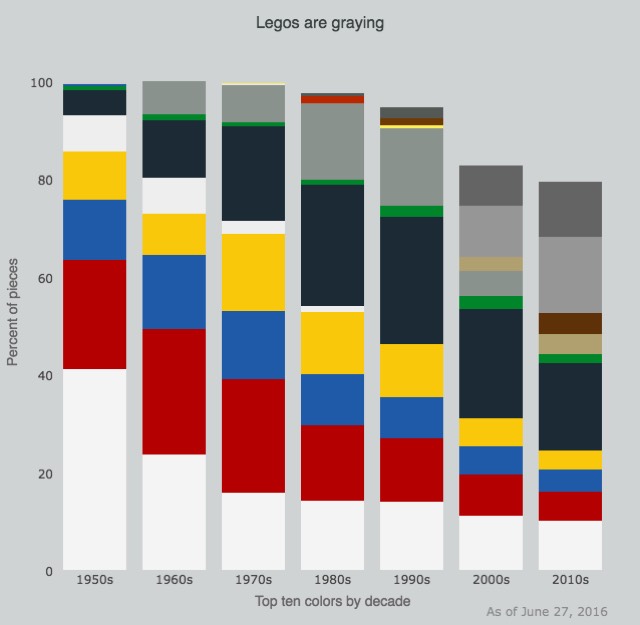
Life-long Lego fan Joel Carron recently analyzed a data set containing the types, colors, and number of pieces in every Lego set from the past 67 years and graphed the results. The shift in colors is the most striking thing to me: Legos are graying.
Legos have gotten darker, with white giving way to black and gray. The transition from the old grays to the current bluish grays (or "bley") is a hot-button topic for many Lego fans.
If you look at the dominant color palettes for all of the tie-in sets they're doing now, it's not difficult to see where those darker colors are coming from.
Truly, all you need to know about Andrew’s political and intellectual honesty is right there:
8:18 p.m. We have to answer this core question: how is it that liberal democracy in America is now flirting with strongman, ethno-nationalist authoritarianism? What happened to the democratic center?
It seems to me that the right bears the hefty majority of responsibility, moving from principled opposition to outright nullification of a presidency, trashing every important neutral institution, and now bad-mouthing the country they hope to “govern.” But the left’s abandonment of empiricism and liberalism – its rapid descent into neo-Marxist dogma, its portrayal of American history as a long unending story of white supremacy, its coarse impugning of political compromise and incrementalism, its facile equation of disagreement with bigotry – has also played a part. Liberal democracy needs liberal norms and manners to survive. Which is why it is now on life-support.
In between, moderate Christianity, once a unifying cultural fabric creating a fragile civil discourse, has evaporated into disparate spirituality on one side and fundamentalist dogma on the other, leaving us with little in the center to hold us morally together.
It seems to me that the right bears the hefty majority of responsibility, moving from principled opposition to outright nullification of a presidency, trashing every important neutral institution, and now bad-mouthing the country they hope to “govern.” But the left’s abandonment of empiricism and liberalism – its rapid descent into neo-Marxist dogma, its portrayal of American history as a long unending story of white supremacy, its coarse impugning of political compromise and incrementalism, its facile equation of disagreement with bigotry – has also played a part. Liberal democracy needs liberal norms and manners to survive. Which is why it is now on life-support.