kurtadb
Shared posts
Long Lives Made Humans Human, From the Paleolithic to Today.
The New Health Care: The Evidence Supports Artificial Sweeteners Over Sugar

Thom Yorke sings a pre-Radiohead version of High and Dry
While the members of On A Friday, the band that later became Radiohead, were on a break as they attended college, Thom Yorke was a member of a band called Headless Chickens. This is a video of a circa-1989 performance by the band of "High and Dry", a song that later on Radiohead's second album, The Bends, released in 1995.
Tags: music Radiohead Thom Yorke videoFifa's United Passions confirmed as lowest-grossing film in US history
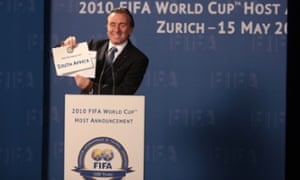
Fifa wanted to call it Men of Legend or The Dream Makers. But even a somewhat more toned down title has not been enough to stop United Passions being named as the lowest-grossing film in US box office history.
The Hollywood Reporter has now confirmed the self-congratulatory project, starring Tim Roth as controversial outgoing president Sepp Blatter, scored the puniest total of all time in North America. With a final weekend return of just $918 from 10 cinemas, Frederic Auburtin’s £17m drama - Fifa paid most of the costs - lines up ahead of such titans of modern cinema as 2012 vampire rock musical I Kissed a Vampire ($1,380) and 2013 animated adventure Last Flight of the Champion ($1,493).
Related: Fifa movie director calls his film 'a disaster'
United Passions was pulled from cinemas by its distributor after its appalling performance, so its record-breaking low will remain crystallised in history. Auburtin admitted earlier this week that the film, also starring Gerard Depardieu and Sam Neill, represented “a disaster” and said he regretted his involvement. Roth has said he did the movie to get out of a financial hole and admitted the knowledge that his son would one day play Blatter would have had his father “turning in his grave”. Meanwhile, Cannes president Thierry Fremaux revealed the movie was only screened at the film festival in May under pressure from Depardieu.
It was Auburtin who revealed those excruciating proposed titles. Critics have also not been kind: The Guardian’s Jordan Hoffman labelled United Passions cinematic “excrement”, adding: “As proof of corporate insanity it is a valuable case study.”
The film has done marginally better in Russia, the Blatter-approved beneficiary of the upcoming 2018 World Cup, where it has scored $158,000. It has not been picked up for distribution in football-loving countries such as the UK, Germany and Brazil and went straight to DVD in France.
Colorado judge bans "Bong-a-Thon" from townsite of Stoner
A Prairie Home Replacement
kurtadbweird. love the "literally your father's music," line. my dad is a huge thile fan.

Like Guy Noir, private eye, Garrison Keillor is preparing to turn out the light on the twelfth floor of the Acme Building and slip into the dark night of a city that knows how to keep its secrets. The longtime host announced Monday he would step down from A Prairie Home Companion, his 41-year-old public radio variety show, in a year’s time. But his retirement isn’t the death knell for the Keillor universe—the twilight of those Norwegian bachelor farmers, the last batch of Powdermilk Biscuits, Dusty and Lefty’s last roundup—because Chris Thile, the one-time child prodigy mandolinist for Nickel Creek and Punch Brothers, will take over in his stead.
Thile’s anointment will be a test of just why people feel so strongly about A Prairie Home Companion—some positive, some extremely negative, some just drowsy from the soothing tones of Keillor’s gravelly bass intonation. In a statement to the AP Monday, Thile said he and the incumbent “have lengthily discussed the future of the show with me as host and agree that we should give it a go. There are, for course, plenty of details to iron out, but I'm very excited!” Keillor, for his part, said he expected Thile to return the show to its roots as a musical variety show. If you listen to PHC regularly, it’s clear that Keillor cares a great deal about the music programming. He chooses the guests carefully, speaks to them with real interest and obvious research, and joins them for musical numbers. This may be a peculiar sort of music—it’s literally your father’s music—but it isn’t just window dressing in the way musical guests often can be.
But is that why listeners tune in week after week? I suspect not. What they want is to hear Keillor’s self-consciously cheesy skits—Guy Noir and the American Duct Tape Council and the old-school radio special-effects gags. And, of course, they want to hear Keillor’s soothing, mellow relation of that week’s news from the fictional Lake Wobegon. What Keillor is offering listeners is a set of comfy, musty, fusty, and dusty Midwestern roots: “The little town that time forgot, and the decades cannot improve.” It’s a place the listeners probably didn’t come from—these are coastal NPR elites, after all—and that never existed anyway, which is the attraction: familiar enough to soothe, fictional enough to be endearing.
The Lutheran church choir director; the wistfully aging parents; the above-average children; the matronly, melancholy, good-hearted waitresses; the thick, red-velveted town theater and its majestic old Wurlitzer—it’s this idealized image of middle America that either draws listeners in, hoping for a brief respite in their Saturday night, or drives them away, rolling their eyes at the cornball shtick. Peter Ostroushko is a great musician, but it’s unlikely 4 million listeners a week are tuning in to hear him play folk standards.
So the question is whether they’ll tune in to hear Thile do it. In some ways, Thile is a natural choice. Like Keillor, he’s a consummate showman with a flair for the whimsical, though his sensibility may skew closer to the twee than the corny. He loves roots music and has cred with musicians. He’s already a ubiquitous presence on public radio. But the Californian doesn’t have much of a claim on the Midwest, and it seems much of his success will hinge on his ability as a raconteur. Although Keillor says the news from Lake Wobegon will go the way of so many small-town news outlets and vanish, some fancy Keillor as a modern-day Mark Twain, and storytelling is a fundamental element of the show.
Even if Thile is a good fit for A Prairie Home Companion, A Prairie Home Companion is a curious fit for Thile. At 34, he’s less than half Keillor’s age and has a busy musical career. He has frequent gigs with Punch Brothers, your snobby bluegrass-fan friend’s answer to Mumford and Sons. Nickel Creek, the band he co-founded at 8, recently reunited after a hiatus. He’s a sought-after instrumentalist for other musicians and collaborates with symphonies and classical musicians like Edgar Meyer and Yo-Yo Ma. In 2012, he won a MacArthur Genius grant. Thile isn’t a lazy revivalist or formulaic pop-confectioneer—though he’s an earnest young man, his mandolin playing is truly astonishing, and Punch Brothers strives for musical innovation. A typical set might include a few bluegrass standards, a passel of originals, a dash of Debussy, and one of the all-acoustic Radiohead covers that have made the group Internet celebrities:
What will Thile have to sacrifice to take on the show, and how long will he do it? Having been a national star before he was even in his teens, Thile may be aging more quickly than the rest of us, but he still seems too young and ambitious for the velvet handcuffs of a weekly radio show that’s had a single host for the past four decades.
Of course, Keillor has never been quite as fusty and backward as his detractors like to assume—or as his fans like to imagine. Like Thile, he keeps a prickly, challenging interior under a crunchy, sugary shell. Even as Keillor plays with the nostalgia of old-time radio, he’s subverting those tropes and tweaking historical memory and the mores of small-town Minnesota. The show has long been a platform for its host’s progressive politics (this is public radio, after all), and anyone who doubts Keillor’s sharp edge should read his famous 2006 evisceration of a book by Bernard-Henri Levy, whom he describes as “a French writer with a spatter-paint prose style and the grandiosity of a college sophomore” with a “childlike love of paradox,” who “worships Woody Allen and Charlie Rose in terms that would make Donald Trump cringe with embarrassment.” (Timely!)
When I first read the Levy review, it was a revelation—I’d always suspected Keillor’s tongue was lodged in his cheek, but could never quite tell for sure, or how much. Reading him mow down Levy’s lazy stereotypes of Americans and America, it becomes clear how much A Prairie Home Companion is a loving skewering of many of the conventions that it seems to propagate.
Does earnest young Mr. Thile have the skepticism required to carry through this satire? Most listeners probably won’t care. But his success will likely hinge on whether he can offer a satisfying replacement for Keillor’s grandfatherly, Midwestern balm. If he can’t it will indeed be a very quiet week in Lake Wobegon, Minnesota, out there on the edge of the prairie.
This article was originally published at http://www.theatlantic.com/entertainment/archive/2015/07/garrison-keillor-prairie-home-companion-chris-thile/399077/

'I Urge You to Struggle': An Evening With Ta-Nehisi Coates
This article was originally published at http://www.theatlantic.com/video/index/398864/an-evening-with-ta-nehisi-coates/

Wilco's Star Wars Is a Random Act of Love

Why is the new Wilco album called Star Wars, and why is its cover a painting of a fluffy white cat? Here’s hoping that we never really find out. “I cry / at a joke / explained,” Jeff Tweedy sings four songs in, his voice a vampy impression of Bob Dylan’s as the band lays down a fuzz-rock flamenco backing. The rest of the song is a barrage of riddles: “It's a staring contest in a hall of mirrors / I sweat tears, but I don't ever cry.”
The song, “The Joke Explained,” is a worthy entry in Wilco’s long catalogue of songs that capture the idea of life as impossible to capture. Whether we’re all speakers speaking in code or one-way radios transmitting nonsense, Wilco’s adventuresome yet consistently tuneful music says that it’s normal and sometimes glorious to misunderstand and be misunderstood. As they’ve kept chugging into middle age, this core artistic premise has often been obscured by the dismissive description “dad-rock,” factually accurate though it may be (after all, Tweedy recently put out a record with his teenage son). Star Wars, the band’s ninth album, released by surprise and for free on the Internet, reminds that Wilco aren’t just reliable, safe rockers; they’re some of the most generous experimentalists to ever pick up guitars.
A crackling 33-minute trip, the album has way more in common with ‘90s indie pranksters like Pavement than it does with the Americana scene that Wilco’s long been associated with. While a few of these songs won’t stick in listeners’ heads for long, all of them feature a delightful sonic twist of some sort. You can tell what mood they’re in within a second of turning on the opener “EKG,” an instrumental whose migraine-frequency guitar stabs eventually lock onto a kraut groove that suggests liftoff into another world. In that world, we get a tune like “More…,” which sounds a bit like Tom Petty’s “Free Falling” except for the fact that its riffs pan between ears and the song drowns itself in distortion before the three-minute mark.
There’s precisely one track that sounds like the stereotype of a Wilco song—“Taste the Ceiling,” featuring acoustic strum, some soloing, and a tempo suited for lo-fi rom-com montages. It’s fine. Far more wonderful is the closer, “Magnetized,” which uses soft organ pulses and a theremin to portray love as something that warps a person as surely as an electromagnet warps a TV set. Another would-be ballad, “Where Do I Begin,” interrupts its lullaby for a punk-psychedelic eruption in its final seconds. I wish the band had rode that noise wave longer, maybe adding a soaring chorus on top of it. But doing so might have defeated the point of the album—ambitions low, surprise factor high.
The most fully formed thing here is “Random Name Generator,” which surges and struts as Tweedy riffs on the song title—his latest metaphor for the universe’s insane incomprehensible beauty. “I change my name every once in a while,” he sings with a touch of hair-rock hamminess, “A miracle every once in a while.” It’s impossible to know what he means for sure, but when I hear the song, I think about how this low-stakes, playful freebie of the album fits in with Wilco’s many reinventions over the years. Fans, at least, should be able to appreciate it deeply. “Your prayers,” Tweedy once sang, “will never be answered again.”
This article was originally published at http://www.theatlantic.com/entertainment/archive/2015/07/wilcos-star-wars-is-a-random-act-of-love/398993/

Eyes Wide Shut

“I’m in somebody else’s house. How did I get here?” says an elderly man, with deepening fear. He’s blind and deaf, scooting himself across a dusty floor on his knuckles, his voice growing more urgent as his thin fingers reach out to touch the walls of his own home. “Help me,” he cries. “I’ve wandered into a stranger’s house ... He’s going to beat me up!”
There are any number of scenes like this in Joshua Oppenheimer’s breathtaking new documentary The Look of Silence, in which a 44-year-old optometrist named Adi Rakun confronts the men who killed his brother in the 1965 Indonesian genocide of more than a million alleged Communists. The film is laden with similar moments: symbolic and resonant, but rooted in a grim reality. The man crawling on the floor is Adi’s father, who suffers from dementia and is trapped in a surreal nightmare.
The film, which opened for a limited U.S. release Friday, is the companion to 2012’s Oscar-nominated The Act of Killing, which offered a harrowing look at the aging perpetrators of the U.S.-backed genocide in Indonesia. Today, many of those men are still in power. Celebrated as national heroes, they brag openly about the mass murders they committed, reenacting for Oppenheimer in detail how they strangled, tortured, and beheaded people.
The first movie attempts to understand the circumstances that created an environment for such men to be revered, how the killers truly see themselves, and whether they’re capable of repenting for their actions. Released three years later, The Look of Silence switches to the perspective of the survivors and the victims’ families. It follows Adi, whose brother, Ramli, was among those murdered by paramilitary groups two years before Adi was born. With the help of Oppenheimer, who remains a largely invisible force behind the camera, Adi finally confronts his brother’s killers face-to-face. The documentary looks at what it’s like to live surrounded by the people who murdered your family—and how dangerous it can be to seek truth and healing in a country with a legacy of lying about and defending atrocities.
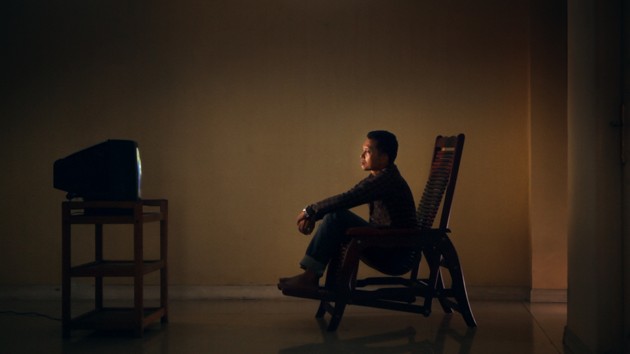
Though Adi didn’t witness firsthand the choking effects of violence, he grew up in a village that did. He learned of Ramli’s death from his mother (the only person who would speak about him), and, later, from Oppenheimer’s on-camera interviews with the perpetrators. The audience, in some ways, learns and processes facts alongside him. In scenes interspersed throughout the film, Adi sits quietly in an empty room before an old TV set. In one, he’s watching an excerpt from a 1967 NBC News report, where an Indonesian man tells a receptive American journalist how beautiful his country is now that it’s been cleansed of Communists. In other scenes, Adi watches two old men reenact with glee how they’d slit people’s throats, castrate them, and drag them through the fields to be dumped into the river.
But in the film’s most gripping scenes, Adi sits with his brother’s killers in real life—often while testing their eyesight—and asks them to take responsibility for their crimes. Before knowing Adi’s identity, most eagerly profess their deeds. One admits to bringing a woman’s head into a store to frighten the Chinese owners, and others to drinking their victims’ blood because it was the only way to avoid going crazy. “Both salty and sweet, human blood,” the death-squad leader, Inong, tells Adi, unprompted, during their exchange. “Excuse me?” Adi asks, as if unsure he’d heard correctly. “Human blood is salty and sweet,” Inong repeats.
After enough of these kinds of unimaginable details—both The Act of Killing and The Look of Silence are rife with them—it’s easy as a viewer to feel numb. Not from desensitization, but from the exhaustion of being pulled apart by competing emotions: horror, disgust, and disbelief on one hand, and admiration and empathy for Adi on the other, who never once even raises his voice with his guests. His bravery—there’s no other word for it—causes his family to balk once he tells them he’s been meeting with Komando Aksi death squad leaders. “Think about your children!” his wife warns him. His mother advises him to carry a butterfly knife or a club, and to not drink anything he’s offered in case there’s poison in the cup (“Tell them you’re fasting,” she says.)

In The Look of Silence, “blood-thirsty,” has literal meaning. “Eviscerating” and “heartrending,” too. To say that the film cuts deeply feels wrong, after hearing veteran executioners discuss how they removed the limbs of their victims. And so it’s no surprise that when the film ends, for many viewers, the only response that might feel right is to say nothing at all for a while.
But to do that is to do an injustice to the movie. Neither Adi nor Oppenheimer are passive witnesses to what they discover. While Adi’s job is to correct the vision of others, he also tries to rectify their flawed vision of themselves and their place in history. He tells the killers that their truth is mere “propaganda.” He tells his son that his teachers are lying when they say the Communists were evil and had to be crushed.
Oppenheimer’s own hand in the film is invisible but critical. Adi encouraged him to collect the stories of the killers, but Oppenheimer also paved the way for Adi to meet with them safely by ingratiating himself to leaders and paramilitary groups. After speaking with dozens of perpetrators, he came to understand their revisionism as a symptom of collective ignorance. “Because they’ve never been removed from power ... they try to take these bitter, rotten memories and sugarcoat them in the sweet language of a victor’s history,” Oppenheimer told me. If The Act of Killing strips away the facade to reveal the killers’ hypocrisy, The Look of Silence looks at the lies both the perpetrators and victims have told themselves for decades in order to survive.
Even for a film that chooses to convey horror in close-up, The Look of Silence’s message finds broad relevance across geopolitical lines. The film doesn’t shy away from the U.S.’s role in the genocide: In one scene, a murderer says he should be rewarded with a trip to the U.S. for his work; in another, a perpetrator says, “We did this because America taught us to hate Communists.” The Indonesian genocide, Oppenheiemer said, is as much America’s history as the mass killing of Native Americans. He thinks the film should also prompt viewers to think of America’s involvement in other wrongdoings, past and present, that allow its citizens to lead comfortable lives with cheap electronics, clothes, and oil.
And yet. “It’s very moving to me that the film is coming out in the United States this summer, after a particularly traumatic year in which we’ve been reminded again and again ... in unmistakable ways, of the open wound of race right here,” Oppenheimer said. The last thing he wants is for people to see The Look of Silence as “as a window into a far-off place about which we know little and care less.” The spirit of Indonesia’s anti-Communist killings, which lasted from 1965-1966, isn’t so foreign: Oppenheimer describes America’s history of racism in more global terms. White supremacists and the Klan were effectively “neo-Nazi paramilitary mobs” who carried out “state-sanctioned terrorism ” through lynchings and other acts of violence against blacks. He recalls his own childhood, going to high school in suburban Maryland, where his mostly white magnet school within a majority-minority school was effectively legal “apartheid.”
An American listening to Oppenheimer might feel defensive, or ashamed. But The Look of Silence is about how this impulse to turn away from blunt truths—about one’s country and history—harms progress and reconciliation. In Adi’s case, people would chastise him for bringing up “politics” or for “opening a wound” every time he talked about his brother, whose name had become verboten in his village as shorthand for the entire genocide. Before change can unfold at the top, transformation needs to happen at the bottom. “You can’t have democracy without community, and you can’t have community if everyone’s afraid of each other,” Oppenheimer said.
And change is happening. After The Act of Killing was nominated for an Academy Award, the Indonesian government finally acknowledged the genocide, saying that the country would deal with it in its own time. The Look of Silence has been screened over 3,500 times to more than 300,000 people in Indonesia, Oppenheimer said. Many of those people will be relatives of the killers, but the film offers a hopeful blueprint for how generations living in the shadow of past crimes can come together, and move forward.
All these lessons take time to materialize fully. The Look of Silence is an inherently political film, but not one that ends with a lengthy text crawl imploring the audience to do their part and change the world. Like its predecessor, it’s a devastatingly beautiful film about the power of cinema, and its ability to testify to some aspect of human nature with a veracity and elegance that escapes other mediums. Every scene weighs on the audience. But Oppenheimer and Adi manage to locate a lightness as well that lessens the burden.
This article was originally published at http://www.theatlantic.com/entertainment/archive/2015/07/look-of-silence-joshua-oppenheimer-documentary/398672/

Puerto Rico fact of the day
…because of an obscure law known as the Jones Act, which bans foreign vessels from shipping goods between U.S. ports, businesses in Puerto Rico have to use the U.S. merchant marine to import anything. They can’t just hire whatever boats and crew are available, which makes shipping even more expensive. The cost of transportation in Puerto Rico is twice that in the neighboring Caribbean nations…
New book: Thing Explainer

Queen of Carbon Science, Prof. Mildred Dresselhaus, Receives 2015 IEEE Medal of Honor
-- Read more on ScientificAmerican.com
Misty Copeland Is Promoted to Principal Dancer at American Ballet Theater

Supreme Court sends TABOR lawsuit back to appeals court
Oh Yes He Did
kurtadbnot sure if the pic is coming through. it's fun.
| America’s Biggest Threat? White People. |
Jun 262015
Black Jimmy Carter Add comments| America’s Biggest Threat? White People. |
A surprisingly fascinating theory for why Canada is so boring
kurtadbpeople don't think iceland is boring and it's REALLY REALLY white.

Why is Canada so boring? It's a question that Canadian journalist Jeet Heer tried to answer in a series of tweets that are both quaintly earnest (this is a Canadian writing about Canadianness, after all) and surprisingly insightful. The question, it turns out, gets to the very core of what it means to be Canadian. That might sound to Americans like the setup to a joke, but to the country's 36 million citizens it's a very real — and not totally settled — issue.
The full series of tweets is embedded below and well worth your time, but Heer lands on two theories. (As he clarifies, these apply to English-speaking Canada, not to the culturally un-integrated French-speaking Quebec.)
The nice theory: Canadians have cultivated an identity of boringness as an alternative to the two other cultures that loom so large for them: the British, whose empire they were a part of until relatively recently, and the noisy Americans to the south. "Canadian boringness isn't intrinsic: it's something we work at, cherish and reward," Heer writes. Because both of those cultural forces exert such power in Canada, cultivated boringness is another way of saying, "We are not British and we are not American."
The less nice theory: Canada's self-made image of boringness is really just shorthand for whiteness. In other words, Canadian culture emphasizes "look at how charmingly boring we are" as a polite way of saying "this is a white, Anglo nation." Or, as Heer put it, "The constructed mask of boringness is also the mask of whiteness." This, he suggests, "presents the county as being much whiter than it is" and is a way to exclude First Nations and ethnic minorities from Canadian identity.
There is probably real truth to both of these.
One point I will add is that I've noticed Canadians frequently describe their culture in contrast to American culture. But talking so much about how you are different from Americans is really just another way of talking around all the ways you're similar, and this preoccupation with highlighting the differences and downplaying the similarities has always felt telling to me.
Canadian writer Bruce McCall, in a great 2013 Vanity Fair piece on why Canada produces so many successful comedians, explained it as a kind of resistance to American culture. "It is impossible to fully express Canadian resentment of America's cultural dominance, and the sense of impotence and helplessness," he writes. "Humor — subversive, ironic, usually dark — is one of the very few weapons available to the oppressed." But that's not just a reaction to American identity, of course; it's also a way of dealing with the fact that it leaves very little room for a distinct Canadian identity. Cultivated Canadian boringness is perhaps a way of owning that problem, and making it the identity itself.
Here's Jeet Heer's full series of tweets on the subject:
If you made it to the bottom, as a reward, here is a great old Jim Carrey standup bit on American conceptions of Canada that speak to my earlier points:
Scalegalese: The Distinct Vocabulary of Antonin Scalia
kurtadbscalia reminds me of ayn rand. someone who thinks they stumbled upon a clever unifying theory of everything, and spends years and years scaffolding on that theory without ever taking it through its paces at the outset. but now they're stuck with it (and become increasingly crazy about it).

“Words have meaning,” Antonin Scalia insisted in 2013. “And their meaning doesn’t change.”
That second argument is something most linguists and lexicographers will, at minimum, quibble with. It is also, however, a foundation of Scalia’s particular approach to Constitutional interpretation. “I mean, the notion that the Constitution should simply, by decree of the Court, mean something that it didn’t mean when the people voted for it,” the associate Supreme Court justice explained to New York magazine’s Jennifer Senior—“frankly, you should ask the other side of the question! How did they ever get there?”
How indeed. Scalia is someone who loves words—not just as sources of literary performance (alliteration! puns! Kulturkampf! argle-bargle!), but also as sources of semantic stability. Words, Scalia believes, root us, collectively and epistemologically. So his famously saucy approach to language isn’t just about bringing literature to legalese, or about the schadenfreudic delights of sending reporters scrambling to dictionaries and thesauri when he issues a scathing dissent. It’s also a philosophical declaration about the unchanging nature of old truths, whatever document may enshrine them. As the speechwriter Jeff Shesol wrote in the New Yorker last year, “His approach has always been to reach for a dictionary; find, in one edition or other, a definition that drives toward his predetermined decision; and express, eyes wide with disbelief, utter amazement that anyone could even think of seeing it any other way.”
As a result, Scalia has cited, in his opinions, not just the Random House College Dictionary, but also Noah Webster’s American Dictionary of the English Language (publication date: 1828), Samuel Johnson’s Dictionary of the English Language (1773), and Timothy Cunningham’s A New and Complete Law Dictionary (1771). Because words have meaning. And their meaning doesn’t change.
It was itself meaningful, then, that in his dissent on Thursday in King v. Burwell, arguing against the Court’s latest upholding of Obamacare, Scalia concluded: “Words no longer have meaning if an Exchange that is not established by a State is ‘established by the State.’”
It was also meaningful that he added, of the majority decision:
“The Court’s next bit of interpretive jiggery-pokery involves other parts of the Act that purportedly presuppose the availability of tax credits on both federal and state Exchanges.”
And also that he called the Court’s upholding of Obamacare the result of “somersaults of statutory interpretation.”
And also that he concluded: “We should start calling this law SCOTUScare.”
On the one hand, of course, this is just Scalia being Scalia (and the rest of us being Scalia’ed). Jiggery-pokery! In one of his earliest dissents, in 1987’s Johnson v. Transportation Agency, Scalia quoted that linguistic ur-innovator: Shakespeare. Citing an exchange from Henry IV, the new associate justice invoked “spirits from the vasty deep.”
In Romer v. Evans, a 1996 case on LGBT discrimination, he declared that “the Court has mistaken a Kulturkampf for a fit of spite,” referring to “the German policies designed to reduce the role and power of the Roman Catholic Church in Prussia, enacted from 1871 to 1878 by the Prime Minister of Prussia, Otto von Bismarck.”
In PGA Tour v. Casey Martin, a 2001 case addressing the Americans with Disabilities Act’s place in professional sports, he referred to the notion of “Platonic golf.”
In 2009, he debated a presenting lawyer about the ontology of the word “choate.” (“There is no such adjective,” Scalia insisted. “I know we have used it, but there is no such adjective as ‘choate.’ There is ‘inchoate,’ but the opposite of ‘inchoate’ is not ‘choate.’”)
In his dissent in 2013’s Maryland v. King, a case that revolved around the constitutionality of taking DNA samples from arrest suspects, Scalia warned of the dangers of creating a “genetic panopticon.”
In his dissent against the striking down of the Defense of Marriage Act, Scalia famously categorized the majority opinion in the case as “legalistic argle-bargle.” (The term itself, its argliness and bargliness to the contrary, is not argle-bargle: It means, the lexicographer Ben Zimmer pointed out, “a description of ‘a verbal dispute’ or ‘a wrangling argument.’”)
And in that 2013 interview with New York magazine, Scalia used the word “ukase”—as in, the decision to strike down DOMA was “not at the ukase of a Supreme Court.”
His interviewer, Jennifer Senior—summoning the reaction most Americans would have to this creative diction—replied, simply: “What?”
“U-K-A-S-E,” Scalia answered, spelling it out. “Yeah. I think that’s how you say it. It’s a mandate. A decree.”
The Justice, the National Constitution Center notes, was correct. Merriam-Webster defines “ukase” as “a proclamation by a Russian emperor or government having the force of law.”
All of which—words have meaning. And their meaning doesn’t change—is classic Scalia. It’s words interpreted not just as conduits of meaning, but as solidifiers of it.
In The Second Amendment: A Biography, Michael Waldman notes that Scalia “has the feel of an ambitious Scrabble player trying too hard to prove that a triple word score really does exist.” But the stakes in his game, argle-bargle and jiggery-pokery notwithstanding, are high. Words, in the Court, are—or, at least, they can be—proxies for Constitutional interpretation. Justices can see them either as living, breathing, contextual things, or as things that are inscribed to their original coinage. There cannot, Scalia insists, be two sides to this argument. Elena Kagan, in a back-and-forth opinion-battle with Scalia last year, declared that “we must (as usual) interpret the relevant words not in a vacuum,” but instead with regard to their “structure, history, and purpose.”
A notion to which, in a flourish fitting of his great philosophical frustration, Scalia has now replied: “Pure applesauce.”
This article was originally published at http://www.theatlantic.com/entertainment/archive/2015/06/antonin-scalia-word-nerd/396845/

Scalia v. Spider-Man

Spider-Man has a secret identity: Peter Parker. Spidey is also a movie character played by actors—Tobey Maguire, Andrew Garfield, and, next, as Marvel announced on Tuesday, Tom Holland. And, this week, Spider-Man was revealed to have something of an acolyte in Justice Elena Kagan, of the Supreme Court, whose majority opinion in Kimble v. Marvel Enterprises demonstrated, in its concluding paragraph, how to properly cite a comic book—“Cf. S. Lee and S. Ditko, Amazing Fantasy No. 15: ‘Spider-Man,’ p. 13 (1962) (‘[I]n this world, with great power must also come—great responsibility’)”—even if she left off the exclamation point at the end of the quote. In this case, that great responsibility meant keeping in place a precedent that allowed Marvel to get out of a deal that it had signed with a toy inventor. The fight was over the rights to the Web Blaster, which allows a person to shoot foam webs from the wrist, sort of like Spidey. Originally, as Kagan noted, with a reference to the theme song of the animated nineteen-sixties “Spider-Man” series,
The parties set no end date for royalties, apparently contemplating that they would continue for as long as kids want to imitate Spider-Man (by doing whatever a spider can).
Kagan has a way of making a person sorry that, last year, the Supreme Court declined to hear an appeal in Shuster v. DC Comics, a case that concerned the origins of Superman. We might have learned what Justice Antonin Scalia thinks of General Zod. As it is, we got, on the same day as the Kimble decision, opinions from Scalia and Samuel Alito in another case, City of Los Angeles v. Patel, that had all the histrionics of comic books and none of the probing good sense. Scalia and Alito, along with Clarence Thomas, were in the minority on that one, which is just as well, as they were arguing against limits on expansive warrantless searches by the police. The case involved a city law that requires hotels to keep records of their guests’ names, the cars they drive, the number of people in their party and—this was the only part under dispute—allow the police to inspect those records at any time, without giving any reason, and without the hotel owners having any opportunity to object. Justice Sonia Sotomayor, in a strong majority opinion, wrote that the lack of a “pre-compliance review” meant that the law violated the Fourth Amendment’s prohibition on unreasonable search and seizure—especially because the hotel owners could be arrested. The more conservative justices didn’t see it that way. Here is Alito, laying out what sounds like a job for Spider-Man:
A murderer has kidnapped a woman with the intent to rape and kill her and there is reason to believe he is holed up in a certain motel. … When the police arrive, the motel operator folds her arms and says the register is locked up in a safe.
Alito does not specify whether the woman with the folded arms also has tattoos and a cigarette dangling from her mouth. What are the police to do? Actually, as Sotomayor pointed out, this example is nonsense—in a scenario such as the one Alito describes, the police would not need the law in question: they would have probable cause to demand the register and rush in, with Web Blasters and any other weapons that the L.A.P.D. might issue in hand.
In fact, Alito concedes that the police would have that right in these circumstances, even without this hotel-record law. His argument is that, because in many or most circumstances the police would be acting properly, the law is not in itself—“facially,” in SCOTUS-speak—unconstitutional. A facial challenge asks the Court to throw out the whole law. There is a school of legal thought, which Alito seems to endorse, that holds that facial challenges, invoking the Fourth Amendment, of statutes authorizing searches should almost never be permitted, or should at least be extremely hard to win. (The idea is that the circumstances of searches are so fact-dependent that courts need to look at the law “as applied.”) Sotomayor made it very clear that the majority wanted to put that view to rest.
“We first clarify that facial challenges under the Fourth Amendment are not categorically barred or especially disfavored,” Sotomayor wrote. In particular, she said, the Court’s precedents showed not only that “facial challenges to statutes authorizing warrantless searches can be brought, but also that they can succeed.” She also noted that there needs to be a strong justification for warrantless searches. This is not new, but it’s important to emphasize, because one effect of the Edward Snowden N.S.A. revelations is that some cases on the subject (Clapper v. A.C.L.U. is one) are probably headed the Court’s way.
Although Scalia dissented, he did agree about the Court’s openness to facial challenges. He just thought that, by any standard, the California law was perfectly reasonable. He, too, made an argument comic-book style, beginning with the basic terms of the debate. After noting that the law applies to “motels, hotels, and other places of accommodation,” he adds, “hereinafter motels”—and proceeds to write as though it is only the seediest of roadside locales that will ever possibly be affected by this law. He uses “motel” practically as an epithet. The best he has to say is that they “provide housing to vulnerable transient populations,” before describing them, presumptively, as dens for drug dealers, prostitution, and human trafficking, and as “rendezvous sites where child sex workers meet their clients on threat of violence from their procurers.” In sum, “motels provide an obvious haven for those who trade in human misery.” Hotels, and motels, are also havens for people making legitimate business trips, or attending political gatherings, or any number of assemblies—or a temporary fortress of solitude. Superheroes can be ambiguous figures, in constitutionalist terms. Their vigilantism suggests that the police can’t do the job, although, often enough, in the comic-book setup, cops are stopped by corruption, not a lack of state powers. And they tend to be outsiders who know what it means to be bullied by the majority; many story lines in recent decades have been built around civil-liberties nightmares like the Mutant Affairs Control Act (Cf. C. Claremont, Uncanny X-Men #181: “Tokyo Story,” 1984). Most inimical to the Scalia view might be the idea that one can have a hidden life and still be a good guy.
Scalia’s move is a little like taking a list of people who are incarcerated—defendants awaiting trial, immigrants about to be deported, those serving misdemeanor sentences, and convicted felons—and saying “hereinafter felons.” And it is the same rhetorical trick used when we are told that only foreign terrorists, or the most suspicious foreigners, or the people who talk to them, who are probably doing something that they shouldn’t themselves, are of interest to the authorities. It is another way of saying that innocent people shouldn’t be bothered if a law allows the police to riffle through their papers—or phone or e-mail records—because the police will generally go after only bad people. It ignores something that is as valuable to Aunt May as it is to a person with as many secrets as her nephew, Peter: privacy.
Sign up for the daily newsletter.Sign up for the daily newsletter: the best of The New Yorker every day.
Leos Carax’s Astonishing “Holy Motors”
kurtadbso weird and great.

Making movies is like playing a musical instrument—it helps to stay in practice. That’s why it’s such a wondrous surprise that Leos Carax’s new film, “Holy Motors” (which opens today at Film Forum and Film Society of Lincoln Center), seems at once so precise and so freewheeling, so exactingly conceived and yet so spontaneous. It’s the work of a filmmaker past fifty who hasn’t made a feature in thirteen years, and who at the start of the film, he dramatizes his own isolation and reëmergence in a scene that shows his hesitant, discreet return to a movie theatre. Despite or perhaps because of the passage of time, Carax has made a film of an extraordinarily youthful vigor. It’s all the more astonishing in that his subject is age, along with its inevitable frustration, degradation, disappointment, regret, and loss. It’s also a paean to a life in the cinema—not one devoid of sentimentality, but one in which the sentimentality is intensely and precisely motivated, like old war stories, by the price it exacts. It’s a movie that arises after the end of cinema, a phoenix of a new cinema. Few films have dramatized as wisely and as poignantly the art that, like the two reels at each end of the camera and the projector, gives with one hand and takes with the other. And few films give so harrowing a sense of staring death in the face and so exhilarating a sense of coming back to tell the tale with a self-deprecating whimsy.
It’s apt that “Holy Motors” tells the story of an actor. I remember an interview from decades ago in which Carax—one of the meteoric geniuses of the modern cinema, whose second feature, “Bad Blood,” from 1986, made when he was twenty-five, is an unrivalled profusion of precocious poetic virtuosity and romantic vision—said that the great privilege of making films is the possibility of working with actors. Most great directors are also expert at casting and, for that matter, at styling, costume, and makeup. Jean-Luc Godard (in whose “King Lear” Carax plays a small role) may be one of the cinema’s great philosophical intellectuals, but he also has also invented several great stars and picked clothing and hairstyles that remain iconic. So it is with Carax, who chose Denis Lavant—magician, mime, and acrobat— for his first feature, “Boy Meets Girl,” and, in “Bad Blood,” put him alongside two young women, Julie Delpy and Juliette Binoche, who made decisive impressions. Lavant is one of the key actors of recent decades, one who, like classic-era movie actors, conveys an entire world of inner fury in perfect immobility—but who is no Methodical thespian but a hurricane of physical energy and an epicure of grace.
Here, Lavant is the very subject of the film. He plays Monsieur Oscar, a potentate who, leaving home in the morning to the loving farewells of wife and children, enters a stretch limo under the watchful eyes of bodyguards and, once securely inside, talks via cell phone with a colleague about matters of high finance until, receiving a dossier from his driver, the elderly platinum beauty Madame Céline (Edith Scob, the star of Georges Franju’s 1959 drama of uncanny horror, “Eyes Without a Face”), he removes his disguise and dons another costume—as a broken-down elderly beggar who wanders onto the street and seeks help from passers-by. The deliberate indirection sets the film’s template: Oscar is actually an actor—albeit one who plays his roles and performs his scripted action in actual settings in and around Paris. He gets his roles and scripts in the back seat of the limousine, where he does his own elaborate makeup, eats his takeout meals, and, en route from location to location, engages in sharp and friendly banter with Madame Céline, who is also something of a personal assistant and a source of moral support. Oscar transforms the world into movies minus cameras, and Carax, unseen, supplies the camera.
For Carax, it’s not the cinema that’s done but just the old cinema (one that’s old not in years but in assumptions). His new one is as full of stories and plot lines as any classical drama, and it reprises many of the tropes of classical cinema (a hit man, a family saga of money and marriage, a topical and engagé political thriller), but it does so toward prismatic ends. On the one hand, the stories bursts onto the screen like the inner projections of a director’s imagination. On the other, they reveal the devastating sacrifice of an actor’s energy that these wild imaginings demand. The deepest and widest possible approach to life—namely, cinema—imposes the most hermetic of disciplines.
The filmmaker, in his solitude, contains multitudes, but it’s the actor who makes those multitudes real—who bears the emotional burden of each transformation, of each role, and who, in finding his many identities, runs the ultimate risk: losing his own. The devastating moral effect of costume and makeup becomes evident from the very first quick-change, and gives rise to a surprising comparison. Sofia Coppola’s “Somewhere” is also the story of an actor who spends lots of time in a car; that actor—an alienated one, who never successfully unifies his work and his private life, and for whom performing is mainly a means to a mercenary end—faces a primal moral terror and glimmer of enlightenment as he sits for a test of a full-head mask that turns him, under the camera’s gaze, into an old man. Oscar, by contrast, is an artist of consummate devotion, a master of disguise who finds terrifying reserves of passion in each character, not least in a character of exactly the kind of goofy fantasy that’s so often an object of derision. If Carax shows himself in a sort of monastic isolation, it also comes off as a variety of penance: he alone knows what he has put his actors through.
Entering a movie studio, Oscar dons a motion-capture suit that’s spangled with reflective sensors that lock into beams of light. The tumbles he does alone in scenes of fighting and evasion and the fury of his running on a comical treadmill make for some of the most glorious scenes of onscreen dance since the age of the great musicals. But the point is clear, and it’s similar to the one suggested by Coppola’s depiction of an action hero off-screen: even a C.G.I. fantasy, played persuasively, extracts from its performers as much of a psychological exertion as a physical one.
The anarchic gnome called “Merde”—the sewer-dwelling beast that Lavant played in a short by Carax for the compilation film “Tokyo”—passes through the Père Lachaise cemetery and interrupts a fashion shoot by the American photographer Harry T. Bone. With a signal act of comic violence, he carries off the model (Eva Mendes) with whom he’s instantly smitten. Here Carax doesn’t just mock the vulgar debasement of women by frivolous predators but, as in the motion-capture dance, he locates the authentic core of beauty and inner force that even those debased representations depend on. Once more, he seeks and finds the moral triumph of the performer.
Carax puts Oscar through nine (or ten) changes of character, and the ambiguity is itself a crucial part of the movie, which depends on the very question of what constitutes an identity, and whether there’s any such thing, for a movie person, as a true and livable life away from movies. For Carax, identity is a matter of imagination, and cinema is a crucial forge for imagination. The actor who leaves home in the morning to the halcyon calls of wife and children is already in costume and acting, and he returns home at night to give another kind of performance.
Running through the film are traces of Carax’s previous movies—the glossly elderly woman, as seen in “Boy Meets Girl” and “Bad Blood”; Michel Piccoli, here (as in “Bad Blood”) seen with a disarmingly blatant bit of makeup; the presence of the (now-shuttered) department store La Samaritaine, which was featured prominently in “The Lovers on the Bridge”; a performance by Nastya Golubeva Carax, his daughter with the late actress Katerina Golubeva (to whom the film is dedicated); and, of course, the character “Merde.” These are only a few of the insider references that give “Holy Motors” the feel of an artistic life being relived. Oscar’s scene with Carax’s daughter is a father-daughter fight of a searing poignancy, a vision of the kind of tiny but devastating soul-deaths that, in quick and passing moments, mark a child and a parent forever.
The wild joy of music comes in an interlude featuring a blues-slamming accordion-and-percussion band parading exuberantly through a church while playing (thanks to Mike D’Angelo for identifying it) a version of R. L. Burnside’s blues burner “Let My Baby Ride,” as captured in long and swinging tracking shots. Its tragedy comes to life in a performance (at the vestiges of La Samaritaine) by Kylie Minogue, another icon of the late eighties whose very presence, along with her role, conjures a return from the burning-up of lost time—and, again, its terrible price.
One aside in the film satirizes the making of movies with small digital cameras, yet the movie’s liberating and liberated spontaneity owes much to them (and, of course, to the cinematography of Caroline Champetier, who, having worked with Godard in the eighties, learned about lapidary filming on the wing). For all its visionary grandeur and technical wizardry, “Holy Motors” has the feel of handicraft. For all of its theatrical confection, it has the immediacy of a documentary. The long wait for its creation and the rapidity of its production conjure a sense of astonishing temporal density.
Carax sends viewers home with an extraordinary vision that answers the very question of the movie’s title. The primordial romantic Wordsworth wrote, “Dear God! The very houses seem asleep.” Carax shows, in a conceit as antic as wondrous, as goofy as transcendent, what if, before they dozed off, those walls could talk… This comical animism—a twist on a classic children’s movie—offers a glimpse at an atheistic beyond, at the physical world’s metaphysical dimensions. These images and sounds that reveal the mind in matter and the soul in bodies suggest Carax’s ultimate definition of the cinema, and it’s one of the best and grandest that a movie has ever offered.
USMNT vs. Germany: Final score 2-1, Americans stun the world champions
Simon Hofmann/Getty Images
The United States beat Germany. In Germany.
That's the U-S of A against the world champions away. And they won, 2-1. Bobby Wood did the honors, scoring the winner five days after doing the same against the Netherlands and sending the U.S. home from Europe with two wins from two matches ... AGAINST THE NETHERLANDS AND GERMANY.
The U.S. were generally dominated for the first half hour of the match. They couldn't keep the ball and saw Germany pass circles around them, pushing the ball into the final third with ease. The Americans did a bit better there, generally getting men behind the ball once their press broke down, but even then the world champions looked very dangerous and forced Brad Guzan into a good save, while another chance missed the frame.
Germany finally broke through with a gorgeous passing move that left the U.S. dumbfounded. Finally, a run in from the right unlocked the American backline and a square pass let Mario Götze tap the ball in for the go-ahead goal.
Even after the goal, there was no doubt that Germany were the better side, but the U.S. did better and began to play their way into the match. Then, a 30-pass passing sequence that lasted over 90 seconds ended with Michael Bradley hitting a gorgeous diagonal ball onto Mix Diskerud's chest. Mix brought the ball down expertly, then knocked the ball home for the equalizer.
The second half went even better for the U.S. They weren't out-played and, for stretches, even looked like the team that had a better grasp on what is was doing. Germany were missing several of their best players, including their entire first choice defense, but they were still stupendously talented.
If anyone looked more likely to score in the second half, it was certainly the U.S. They had a good opportunity when Gyasi Zardes got free, but he took a touch too many and saw his chance taken away by a great tackle. He had another look later, but his shot got blocked in front and a follow up effort missed the frame. Jordan Morris nearly scored, too, hitting a shot from 20 yards that barely went wide of the post just minutes after coming on as a sub.
The Americans' looked all set to win the match in the 83rd minute when a wonderful move sent DeAndre Yedlin down the right. Yedlin drove the Germany defense deep before dragging the ball back for an oncoming Bradley, who got to the ball at the penalty spot. He had almost all of the net to shoot at, but he managed to hit it right at the goalkeeper.
It looked like the U.S. would have to take a draw, which is a great result away to Germany, but then Wood struck. He used a clever touch to earn himself a bit of space then hit a rocket from 25 yards that got just inside the post for a beautiful goal.
The U.S. needed a bit of luck late on to hold on as a late Germany header hit the crossbar, but the ball didn't find the net and that's all that mattered. The final whistle went and the U.S. didn't just go to Germany and getting a result from the world champions -- they beat them.
Bacterial handprint
Tasha Sturm, a lab technician at Cabrillo College, had her 8-year-old son put his handprint on a prepared petri dish and then incubated it for several days. This was the result:

If you'll excuse me, I have to go wash my hands about 4,000 times. Bacteria is cooooool though:

(via colossal)
Tags: biology photography science Tasha SturmFox’s World Cup Streaming Options Are Terrible
kurtadbthis is super disappointing. also the swedish woman above looks a bit like brienne of tarth.

Photo by JEWEL SAMAD/AFP/Getty Images
The Women’s World Cup kicked off on Saturday with an exciting matchup between hosts Canada and the People’s Republic of China, which remained scoreless until Canada won a penalty in second-half stoppage time. The match aired in the U.S. on Fox Sports 1, and its Group A follow-up, which pitted New Zealand against the Netherlands, aired on Fox Sports 2.
 L.V. Anderson
I’m a cord-cutter, but I saw both games as they happened, on my computer, without resorting to pirated live-streams. That’s because I signed up for Fox Soccer 2 Go, a very stupidly-named service that allows people to stream every single 2015 World Cup match, live or on demand up to 7 days after it occurs, for the low price of $19.99 per month.
OK, $19.99 per month isn’t actually a low price, compared to most streaming services. And after using Fox Soccer 2 Go for a couple of days, I strongly doubt that it’s worth that much money. Apart from having a poorly designed website with a not-very-helpful FAQ section, Fox Soccer 2 Go has two glaring drawbacks: It shows neither a running score nor a game clock onscreen during games. This makes it very difficult to keep track of how many minutes are left in each half, which is kind of a crucial piece of information when you’re watching soccer. (It’s usually easy enough to keep track of the score in your head, but there are exceptions, like Germany’s 10-0 thrashing of the Ivory Coast on Sunday.) Additionally, Fox Soccer 2 Go features a different commentator from those who call the matches on Fox and its sports channels—so if you want to experience the chemistry and expertise of J.P. Dellacamera, Tony DiCicco, and Cat Whitehill, you’re out of luck.
So, what are your other options for watching the World Cup online? If you don’t want to pay anything and you don’t mind Spanish-language commentary, you can live-stream the Copa Mundial Femenina on NBC Sports Live Extra (also known as NBC Deportes en Vivo Extra). The bad news: There’s no replay after each game has ended, and just like Fox Soccer 2 Go, NBC Deportes doesn’t show the score or game clock onscreen.
If you have a cable subscription—or if you have a close friend or relative willing to give you their cable login information—you can stream the games on Fox Sports Go, which has the same commentary (and the same blessed score bug) that you’d find on TV. You can’t replay games after they’ve aired, though, so if your office prohibits streaming afternoon games while you’re working, you might be better off shelling out for Fox Soccer 2 Go.
All in all, Fox’s streaming options are a lot weaker than ESPN’s streaming options during the men’s World Cup last summer. WatchESPN is available on a wide variety of desktop and mobile platforms, shows on-demand replays of games for up to a few weeks afterwards, and shows you a running score and game clock while you’re watching. You could argue that at least Fox is giving cord-cutters a way to pay for live sports—which wasn’t yet an option with ESPN during last summer’s World Cup—but having to pay $20 a month for a mediocre sports-streaming service is not exactly a cable eschewer’s dream. Regardless of the drawbacks of Fox Sports Go and Fox Soccer 2 Go, soccer fans should get used to them—Fox has the rights to broadcast the men’s and women’s World Cups through 2026. Hopefully by then they’ll have figured out how to broadcast soccer over the Internet without forcing Americans to jump through unnecessary hoops.
Map Game: Where is Ireland?
kurtadbthis is a particularly easy one. but this game is kind of fun.

Arvada approves backyard dwarf goats
kurtadbbut only dwarf goats.
Author retracts study of changing minds on same-sex marriage after colleague admits data were faked
 In what can only be described as a remarkable and swift series of events, one of the authors of a much-ballyhooed Science paper claiming that short conversations could change people’s minds on same-sex marriage is retracting it following revelations that the data were faked by his co-author.
Donald Green, of Columbia, and Michael LaCour, a graduate student at UCLA, published the paper, “When contact changes minds: An experiment on transmission of support for gay equality,” in December 2014. The study received widespread media attention, including from This American Life, The New York Times, The Wall Street Journal, The Washington Post, The Los Angeles Times, Science Friday, Vox, and HuffingtonPost, as LaCour’s site notes.
David Broockman and Joshua Kalla, graduate students at University of California, Berkeley, were two of the people impressed with the work, so they planned an extension of it, as they explain in a timeline posted online yesterday:
As we examined the study’s data in planning our own studies, two features surprised us: voters’ survey responses exhibit much higher test-retest reliabilities than we have observed in any other panel survey data, and the response and reinterview rates of the panel survey were significantly higher than we expected. We set aside our doubts about the study and awaited the launch of our pilot extension to see if we could manage the same parameters. LaCour and Green were both responsive to requests for advice about design details when queried.
Earlier this month, they began a pilot of their extension. They soon realized that
The response rate of the pilot study was notably lower than what LaCour and Green (2014) reported.
When Broockman and Kalla contacted the firm they thought had performed the original study upon which the Science paper was based,
The survey firm claimed they had no familiarity with the project and that they had never had an employee with the name of the staffer we were asking for. The firm also denied having the capabilities to perform many aspects of the recruitment procedures described in LaCour and Green (2014).
After finding several other irregularities, the pair contacted Green, who was concerned, and they also asked Yale political science professor Peter Aronow to join their work. By May 16, the team had found other irregularities, and sent them to Green, who reviewed them and on May 17 agreed that
a retraction is in order unless LaCour provides countervailing evidence. Green also requests this report be made public concurrently with his retraction request, if this request is deemed appropriate.
Over the next two days, Green confronted LaCour and told the team that LaCour had
confessed to falsely describing at least some of the details of the data collection.
Green then added a note on May 19 to his website saying the paper was retracted, and submitted a retraction letter to Science:
I write to request a retraction of the above Science report. Last weekend, two UC Berkeley graduate students (David Broockman, and Josh Kalla) who had been working on a research project patterned after the studies reported in our article brought to my attention a series of irregularities that called into question the integrity of the data we present. They crafted a technical report with the assistance of Yale professor, Peter Aronow, and presented it to me last weekend. The report is attached. I brought their report to the attention of Lynn Vavreck, Professor of Political Science at UCLA and Michael LaCour’s graduate advisor, who confronted him with these allegations on Monday morning, whereupon it was discovered that he on-line survey data that Michael LaCour purported to collect could not be traced to any originating Qualtrics source files. He claimed that he deleted the source file accidentally, but a Qualtrics service representative who examined the account and spoke with UCLA Political Science Department Chair Jeffrey Lewis reported to him that she found no evidence of such a deletion. On Tuesday, Professor Vavreck and Michael LaCour for the contact information of survey respondents so that their participation in the survey could be verified, but he declined to furnish this information. With respect to the implementation of the surveys, Professor Vavreck was informed that, contrary to the description in the Supplemental Information, no cash incentives were offered or paid to respondents, and that, notwithstanding Michael LaCour’s funding acknowledgement in the published report, he told Professor Vavreck that he did not in fact accept or use grant money to conduct surveys for either study, which she independently confirmed with the UCLA Law School and the UCLA Grants Office. Michael LaCour’s failure to produce the raw data coupled with the other concerns noted above undermines the credibility of the findings.
I am deeply embarrassed by this turn of events and apologize to the editors, reviewers, and readers of Science.
Green tells Retraction Watch:
…Michael LaCour attended my summer workshop on experimental design in 2012 and proposed at that time a project that involved both canvassing and internet surveys. It sounded to me too ambitious to be realistic for a graduate student but in principle worthwhile. I later introduced him to Dave Fleischer, who heads up the LGBT canvassing operation in Los Angeles, and they struck up a collaboration. Several weeks after the canvassing launched in June 2013, Michael LaCour showed me his survey results. I thought they were so astonishing that the findings would only be credible if the study were replicated. (I also had some technical concerns about the “thermometer” measures used in the surveys.) Michael LaCour and Dave Fleischer therefore conducted a second experiment in August of 2013, and the results confirmed the initial findings. Convinced that the results were robust, I helped Michael LaCour write up the findings, especially the parts that had to do with the statistical interpretation of the experimental design. Given that I did not have IRB approval for the study from my home institution, I took care not to analyze any primary data — the datafiles that I analyzed were the same replication datasets that Michael LaCour posted to his website. Looking back, the failure to verify the original Qualtrics data was a serious mistake.
According to his website, LaCour will become an assistant professor at Princeton University in July. We’ve contacted him for comment, and will update with anything we learn.
Hat tip: Lila Guterman
Related
Why Would an Economic Analysis Want to Ignore American Slavery?
While Kevin Drum is focused on getting better, we've invited some of the remarkable writers and thinkers who have traded links and ideas with him from Blogosphere 1.0 to this day to contribute posts and keep the conversation going. Today we're honored to present a post from Ryan Cooper, national correspondent for the Week.
The next several years will see a rolling 150th anniversary of Reconstruction, my favorite period in American history. From about 1865 to 1877, American society as a whole tried reasonably hard to do right by the freed slaves, before getting tired of the effort and abandoning them to the depredations of racist terrorism. For the next nine decades, black Americans had few if any political rights under the boot heel of Jim Crow.
It's both a shining example of what can happen when a society really tries to right a past wrong, and tragic, infuriating failure of will. But most of all it's very interesting. Things were changing, social orders were being overthrown, historical ground was being broken. At a time when few nations had any suffrage at all, roughly 4 million freed slaves got the vote in a single stroke, perhaps the single starkest act of democratic radicalism in world history.
So it's weirdly fascinating to read conservative historiography of the 19th century, such as this piece by Robert Tracinski at the Federalist, as an example of how Darryl Worley-style historiography irons all the best parts out of American history.
He's interested in trying to prove that a "non-coercive" economy is possible, by which he means that taxes and spending could be dramatically lower than they are today. Thus he charts government spending as a percentage of GDP, finds that it was pretty low for most of the 19th century, and claims victory:
What the left wants is not just to make America’s economic history disappear. It needs to make America’s political system disappear: to make truly small, truly limited government seem like a utopian fantasy that can safely be dismissed. Please bear in mind that this latest example came up in the context of a discussion about the justification for government force. So what they want to describe as an unrealistic fantasy is a society not dominated by coercion.
One might think that when writing a paean to a noncoercive century, it might be a good idea to address the fact that for 60 percent of that century, it was government policy that human beings could be owned and sold like beasts, or that half or more of the national economy was based on that institution. But no, the word "slavery" does not appear in the piece. Neither does "Civil War" or "Reconstruction," which as a literal war against and military occupation of the South would seem fairly coercive.
So speaking of the 19th century as one notably free of coercion is not just utterly risible, it's also a cockeyed way to look at what was good or bad about it. The economy of the antebellum South was founded on the labor of owned human beings, extracted through torture. Slave masters set steadily increasing quotas for cotton picking, for instance, and would flog slaves according to the number of "missing" pounds. As Edward Baptist writes, they thus increased the productivity of slave cotton-picking by nearly 400 percent from 1860 to 1865.
It was akin to the Gulag system of Soviet Russia, except that it had all the power of the red-hot Industrial Revolution, including cutting-edge financial technology, behind it. That combination of slavery plus explosive economic growth and innovation made the antebellum South one of the most profoundly evil places that has ever existed — one that was an absolutely critical part of early industrial growth in both Britain and the North.
But on the other hand, the war that ended slavery, despite involving coercion in the form of organized mass killing, was therefore good! And so was Reconstruction, even though that involved extremely harsh measures against the likes of the KKK. Whether coercion is good or bad depends on just who is being coerced and why.
And that, in turn, puts the lie to conservative complaints that liberals always "blame America first." On the contrary, grappling with the pitch-black periods of history makes the positive notes shine all the brighter. As Ta-Nehisi Coates has written, the "epoch of slavery is…the quintessential romance of American history." It's just a romance difficult to detect in the GDP statistics.
Retiring: Some New Math for the 4 Percent Retirement Rule
kurtadbmore wade pfau

Wednesday Evening Open Thread
kurtadbless of a “Share” than a “Like"
D'Souza is the saddest, worst criminal alive, it's so entertaining
— Simon Maloy (@SimonMaloy) May 6, 2015
hard out there in Obama's America http://t.co/oXwQoN22y8 pic.twitter.com/UKLH8tStqe
— Simon Maloy (@SimonMaloy) May 6, 2015
From the NYPost article:
… D’Souza’s parole officer had included with the “summer vacation” request a recent Vanity Fair article about D’Souza — but the judge was unimpressed.
“With respect to the Vanity Fair article, the court has no immediate reaction other than the article suggests several fertile areas of discussion during Mr. D’Souza’s required therapeutic counseling,” wrote Berman…
Imagine a “celebrity boxing match” between Dinesh D’Souza and James O’Keefe III.
That would get me to sign up for cable, just to make sure I could access the pay-per-view…
***********
Apart from the Usual Gang of Sad GOP Klowns, what’s on the agenda for the evening?


Not everyone in this country is nice
People search frequently for it, roughly as often as searches for “migraine(s),” “economist,” “sweater,” “Daily Show,” and “Lakers.”
That is from an interesting Wonkblog article, using Google searches, trying to estimate the most racist regions of America. The rural Northeast and Midwest don’t do so well.
The pointers are from SV and AM.