Here is an actual sentence that appeared in a newspaper in 2015:
Police say Gray had been picked up for making eye contact with officers and then running away.
And then they killed him.


This space reserved for your ad.
kurtadband then they went on vacation.
Here is an actual sentence that appeared in a newspaper in 2015:
Police say Gray had been picked up for making eye contact with officers and then running away.
And then they killed him.
kurtadbyes?
Did Osama bin Laden name Al Qaeda after Isaac Asimov's Foundation series?
Meeting Dmitri Gusev here at Text By The Bay ("Rising sun", 4/25/2015) reminded me that I'd seen his name before. The context was a 2002 article in the Guardian, "What is the origin of the name al-Qaida?" (picked up on LLOG in "Copy-editing terrorism", 7/28/2005):
In October last year, an item appeared on an authoritative Russian studies website that soon had the science-fiction community buzzing with speculative excitement. It asserted that Isaac Asimov's 1951 classic Foundation was translated into Arabic under the title "al-Qaida". And it seemed to have the evidence to back up its claims.
"This peculiar coincidence would be of little interest if not for abundant parallels between the plot of Asimov's book and the events unfolding now," wrote Dmitri Gusev, the scientist who posted the article.
The author of the Guardian piece, Giles Foden, describes the parallels this way:
The Empire portrayed in Asimov's novels is in turmoil – he cited Gibbon's Decline and Fall of the Roman Empire as an influence. Beset by overconsumption, corruption and inefficiency, "it had been falling for centuries before one man really became aware of that fall. That man was Hari Seldon, the man who represented the one spark of creative effort left among the gathering decay. He developed and brought to its highest pitch the science of psycho-history."
Seldon is a scientist and prophet who predicts the Empire's fall. He sets up his Foundation in a remote corner of the galaxy, hoping to build a new civilisation from the ruins of the old. The Empire attacks the Foundation with all its military arsenal and tries to crush it. Seldon uses a religion (based on scientific illusionism) to further his aims.
So I asked Marc Sageman about this, and he responded that "it is the US media and US government that gave AQ its name around 1998", noting that "At the time, the group around bin Laden was simply known Al Jamaat al Sheikh, or the Sheikh’s group", and that "Originally, al-Qaeda referred to the military base that people sponsored by bin Laden trained at. It was not the name of an organization."
If Asimov's Foundation had been translated into Arabic, its title would plausibly have been al Qaeda, but apparently no such translation was ever published or even written. And there's no evidence that bin Laden or his followers ever read or were influenced by the English version.
Not the first time that a cute theory was killed by homely fact.
But apparently there are other world-historical figures for whom Asimov's Foundation was indeed a major influence — see Ray Smock, "Newt Gingrich the Galactic Historian", History News Network, 12/8/2011.
kurtadbi like this (so far)
Young Thug is not into literalism. He thrives in gray areas, animated by the electricity generated by the tension of his own contradictions, and he never, ever offers a straightforward explanation. Look how he handled the most surreal rap beef of 2015 in a recent Instagram message to Lil Wayne. "This is my idol. I won’t ever in my life swap words with him," Thug pledged—days away from releasing his imminent debut album, Carter 6, a title hijacked from Wayne, whose own Carter V languished in Cash Money purgatory. But then, in closing: "Ha haaa," punctuated with a trollish tongue wag. Like most everything Thugger has done in the last year and a half, it made people confused: What kind of god-level shade was this? Is he taking any of this remotely seriously? And what in fuck’s sake is his endgame with this album, the name of which changed days before its release to Barter 6 after Wayne threatened to sue? Barter 6 was already the year’s most controversial rap album—or "retail mixtape," as if the distinction really matters—before it even dropped.
But Barter 6 has almost nothing to do with Lil Wayne, save its provocative title (which I’m saying is more Treachery of Images than aimless troll, anyway) and a handful of scattered lyrical shots. Idol or not, Thug hasn’t directly emulated Wayne since his debut tape, 2011’s I Came From Nothing. But he’s always seemed to delight in playful misdirection, quietly reveling in the chaos provoked by his mere existence, from the vaguely gender-bending fashions to the pet names for his friends. Thug seems to recognize he power of his own mystique, headline-grabbing yet somehow unknowable: "Every time I dress myself, I go muhfucking viral," he crows, bemused, on "Halftime". And on Barter 6, Thug yet again dodges any easy narrative. Far from a public idol-killing, or zany sideshow, it’s composed, patient, even subtle—an album neither fans nor detractors saw coming.
Over the course of his three-part I Came From Nothing tape series, Thug’s now-singular voice took shape. The projects often felt like extended stylistic experiments, ranging wildly in quality—but when inspiration struck, it sounded like nothing else coming out of his Atlanta hometown, from guileless outsider-pop ballads to completely unclassifiable vocal performance clinics. By 2013’s 1017 Thug, Thug’s "weirdness" had become an easy hook, a rapper who sang and hollered odes to lean and compared his jewelry to Pokémon. Early 2014 singles "Stoner" and "Danny Glover" plopped Thug on the threshold of the mainstream, and Rich Gang, the Birdman-conceived duo of Thug and kindred spirit Rich Homie Quan, spawned the radiant single "Lifestyle".
There is no "Lifestyle" on Barter 6, nor is it particularly "weird." Opening track "Constantly Hating" unfurls gently, its impressionistic Wheezy beat leaving space between bass tremors for Thug to explore. There are hardly any big-name collaborators here: "Can’t Tell", with its T.I. and Boosie appearances, is the least integral track, despite its star power. It reflects none of the clamor of Thugger’s dramatic 2015. Instead, Barter 6 argues that his greatest asset all along was not his wackiness, his "outsider" status, or his surprising inner hitmaker—it’s not even his voice, or at least, not entirely. It’s Thug’s uncanny and singular way of piecing a song together, a skill he has doubled down on with this release: a way with vocal technique, melody, and detail-oriented composition that makes the bizarre seem approachable and the familiar feel new.
He plies those compositional talents here to the cohesive rap album, a format Thug had shown very little prior indication he was interested in at all. He treats the smallest compositional details with the care and craftsmanship of a chorus—everything here is a hook, from the ad-libs (a term that feels insufficient—Thug’s "ad-libs" are fully integrated into the song’s structure, to the point where we should probably just call them backing vocals) to the individual bars to the empty spaces. Barter 6 is not a world-conquering album; instead, it digs tunnels.
More than anything, Barter 6 feels like a 50-minute performance of what rap, as a form, can do: rap that need not transcend itself, towards High Art on one hand or commercial art on the other, in order to succeed in 2015. Thug’s rapping itself, known for its unpredictability, is sharper than ever; his voice feels clarified, strengthened. Take "Halftime", the most thrilling technical display here, on which Thug seamlessly snaps into a dozen different flows: casually extending the second syllable of "re-cy-cles" so that it threatens to throw the song off track entirely, pausing a beat, unleashing a quick guffaw, snapping back on beat. It's an almost-reckless balance-beam routine. He pauses only for an ingenious vocoder breakdown that melts his cries of "Havin’ the time of my muhfuckin’ liiiiiife" into semiotic ooze, suddenly giving the blood-red backdrop of the cover art an almost Lynchian cast, like the velveteen Black Lodge interior.
Every element exists for a reason, fitting like puzzle pieces into place over multiple listens: even the guest spots from presumable weed carriers like Duke (formerly MPA) and Yak Gotti put in work. Haunting, virtuosic final act "Just Might Be" gives Thug’s moments of silence the primacy of a hook: "That’s called breathing, that’s how you let that bitch breathe," he sighs after a verse of rapid-fire double-time, leading into a cathartic exhale that spans a full eight bars. This is the anti-"Let the Beat Build", on an album that’s the anti-Carter III.
And as for Thug’s widely-touted unintelligibility, Barter 6 argues that all we need to do is listen a bit more carefully: what may not be legible at first glance reveals itself patiently over time. In this sense, you are doing it wrong by asking Young Thug his thoughts on Ferguson point-blank, as one reporter did last fall. Thug bristled then, responding with what looked like apathy. But there is no ambiguity on "OD" when he cries, "RIP Mike Brown, fuck the cops" (nor was there, for that matter, on his gut-wrenching 2013 Trayvon Martin tribute). He will speak when he’s ready, and on his own terms: abstracted, maybe, but ultimately loud and clear.
kurtadbwhat do we think? lots of hate for these out there. i find myself not loving them because they’re so not distinctive, but i also am glad that they’re not particularly distinctive in a bad way. they look sharp out of context. they just don’t look like US jerseys. i so wish we had a consistent design.

The new United States women's national team kit is here. And you have to be told that it is a U.S. kit ahead of time because there's not much about it that screams America, seeing as it is a white kit with black trim and neon accents./cdn0.vox-cdn.com/uploads/chorus_asset/file/3631482/11149402_10207082328203452_1612101622352581610_n.0.jpg)
U-S-A! U-S-A! U-S-A!
The team will wear those kits at the Women's World Cup this summer. It will be their primary kit, while the blue kit that they debuted earlier this year will serve as their alternate option.
If there is good news from this new kit it is that Nike will sell them in men's sizes as well so both men and women can wear them this summer. That is a welcome change from past editions of USWNT jerseys.
Unfortunately, this kit comes as little surprise. U.S. Soccer has failed to establish anything that even resembles a brand over the last decade so Nike doesn't have anything to work off of. They don't have something to protect and promote. They don't have anything built-in to grow so they work from scratch and this is what we get.
kurtadbprediction: someone will buy this for cecilia and only i will read it.

The latest book from Amir Aczel, who has written previously about the compass, the Large Hadron Collider, and Fermat's Last Theorem, is Finding Zero: A Mathematician's Odyssey to Uncover the Origins of Numbers...in particular, the number zero.
Finding Zero is an adventure filled saga of Amir Aczel's lifelong obsession: to find the original sources of our numerals. Aczel has doggedly crisscrossed the ancient world, scouring dusty, moldy texts, cross examining so-called scholars who offered wildly differing sets of facts, and ultimately penetrating deep into a Cambodian jungle to find a definitive proof.
The NY Times has a review of the book, written by another Amir, Amir Alexander, who wrote a recent book on infinitesimals, aka very nearly zero. (via @pomeranian99)
Tags: Amir Aczel Amir Alexander books Finding Zero mathematicskurtadbshared for these notes on Njal’s Saga. i would have loved tackling this in my Law and Lit class, and i think we did do a very short excerpt of it. but it would have been interesting to devote more time to it.
1. Dead Wake: The Last Crossing of the Lusitania, by Erik Larson. My favorite of his books, fun and readable as you would expect, many interesting details including what happens to you in water at 55 degrees Fahrenheit.
2. Philip Glass, Words Without Music. “A lot of Einstein on the Beach was written at night after driving a cab.” An excellent memoir of both Glass’s early life and the New York creative world up through 1976 or so.
3. Colm Tóibín, On Elizabeth Bishop. A good example of a book I wish was longer than it was, it is shorter than its 199 pp. might indicate. As a poet I much prefer Bishop to her correspondent Robert Lowell; their letters collection by the way makes for superb reading and drama.
4. Njal’s Saga. I just taught this in Law and Literature, and on the re-read I enjoyed it more than expected. The core model is that arbitration is binding, provided the expected outcome does not stray too far from what violence would bring. The best way to go through the book is first to master the internal story of sections 121-145, then read to the end, and finally go to the beginning. A recommended guide is William Ian Miller’s “Why is Your Axe So Bloody?”; yes that is the same Miller who wrote very good books on disgust and humiliation.

In the past three years, many fans’ attitudes toward Disney’s takeover of the Star Wars franchise has gone from indignation to careful optimism to, as of today, outright frothing excitement. A new trailer for Episode VII: The Force Awakens—only the second bit of footage that’s been released—is why:
In contrast to the three prequels that resembled 70s and 80s originals in neither setting, tone, nor quality, this clip reminds of the originals in every frame. Many of the ingredients are literally the same. There’s Tatooine, or what looks like it. Star Destroyers, X-Wings, and Tie fighters. Luke, Leia, Han, Chewy, R2-D2, and even Darth Vader’s charred helmet. That John Williams theme.
The filmmaking, too, looks promising. Director J.J. Abrams has said that Episode VII would prioritize practical effects instead of CGI to recreate the tattered, tactile feel of the originals, and he appears to have delivered. He's also delivered some stunningly composed shots, actors who seem in the act of actually acting, and a sense of momentum that suggests this new movie will boast more pure competency than the three prequels combined.
This is a better shot than anything in the last three Star Wars movies pic.twitter.com/cMk7vaoVds
— Gilbert Cruz (@gilbertcruz) April 16, 2015
The new elements of Episode VII that have been revealed so far are objectively awesome-looking—and, also, extremely familiar. The new Tie designs, the apparent villain wearing a Vader-esque helmet, and the costumes for new actors John Boyega, Oscar Isaac, and Daisy Ridley all appear to be lightly tweaked versions of original-trilogy items. This, too, might be a corrective to the mistakes of the prequels, which were set a few decades before A New Hope and yet featured technology that seemed of an entirely different universe than the one that fans had come to know. Viewers couldn't help but wonder: Why weren't there any glimpses of junked Naboo fighters or pod racers somewhere in the original trilogy? By putting in a downed Star Destroyer, an upgraded Storm Trooper, the Millennium Falcon, etc., Abrams is in one way being a more conscientious storyteller than late-‘90s/early- aughts George Lucas was.
But: You could argue that what defines Star Wars isn’t merely the specific items like lightsabers and X-Wings. It's the fact that each film showed you something completely bizarre and fabulous. The Star Destroyers so familiar in this trailer were shocking and bold to audiences in 1977. Each subsequent film had similar moments of inventive brilliance, whether it was the image of Cloud City or Emperor Palpatine’s lightning fingers. The prequels, if nothing else, kept this part of the DNA; the Gungans and their underwater cities, for example, may not hold a high place in the cultural canon, but they were, at least, attempts at innovation. Episode VII, by contrast, has only shown us attempts at remixing, with soccer-ball R2-D2s and crucifix lightsabers and a new season for Imperial fashion. Maybe Abrams has a bold, new vision we've yet to see. Or maybe it will turn out that the galaxy far, far away has finally, in spirit, been conquered by the pandering, fan-servicing, sequel-obsessed universe of today.
This article was originally published at http://www.theatlantic.com/entertainment/archive/2015/04/the-star-wars-episode-vii-the-force-awakens-trailer-looks-awfully-awesomely-familiar/390738/


It didn't rise quite to the level of "The Dress"—the recent quandary that resulted in accusations of color-blindness across the Internet—but it still gave the education world its own viral moment over the weekend. A viral math question, in fact.
Last Friday, the Hello Singapore TV host Kenneth Kong posted a mathematical riddle to his Facebook page with the caption: "This question causes a debate with my wife .... and its a P5 question." The puzzle went viral across the country, with people ranging from perplexed adults to eager teenagers grappling with the simple question: "So when is Cheryl's birthday?"

The hysteria wasn't limited to Singapore. The question immediately made the rounds on Twitter—along with the hashtag #cherylsbirthday—and Reddit. It even made its way to the Australian Federation of International Students' Facebook page.
Without giving away the answer, here's a good starting point:
Albert knows the month, Bernard knows the number.
Albert knows that Bernard doesn't know.
Look at how many times each date appears.
Figure out which month Albert was told, and begin the elimination process.
The riddle worried some parents. "P5," known as "Primary 5" in the Singaporean education system, is the equivalent of 5th grade in the United States. Despite Singapore's internationally revered math proficiency, many parents were concerned that the question was far too advanced for their kids.
This prompted an investigation of sorts by Mothership.sg, a Singaporean news outlet. The organization obtained official confirmation (spoiler: the answer is included as well) from the executive director of the Singapore and Asian Schools Math Olympiad. According to the director, Henry Ong, the question was in fact for older "Secondary 3" students, or the equivalent of ninth grade here in the U.S. Ong also admitted that it was "a difficult question meant to sift out the better students."
Logical puzzles like this are common in Singapore. The country's math curriculum, which has a strong focus on logic-based problem solving, has been so successful that it's been adopted around the world, including in the U.S.
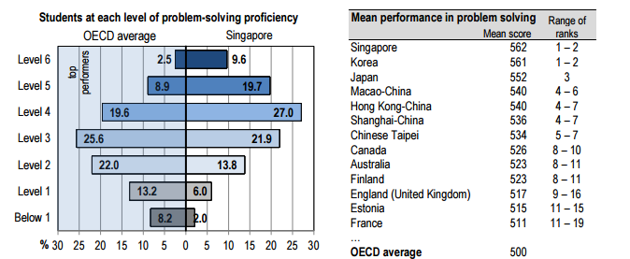
According to the latest report from the Program for International Student Assessment (PISA)—an exam designed to measure the math, reading, and science proficiency of 15-year-olds globally—Singapore's math competency essentially outshines that of the rest of the world:
Singapore scores highest in the PISA 2012 assessment of problem solving, with 562 points on the PISA proficiency scale. Only Korea has a similarly high score.
Singapore also has the highest number of top-performing students in problem solving: 29 percent of students reach proficiency Level 5 or 6 (the OECD average is 11 percent).
Performance in Problem Solving in Singapore
So what makes Singapore so good at a subject with which America's students have routinely struggled? Singapore's math instruction focuses heavily on mastery over rote memorization. Math students on the small island nation perform well because they understand the material deeply—not because they are studying for a specific test. Thus, they react well when "curveballs" are thrown at them in the form of confusing math questions.
Furthermore, the instruction of "Singapore Math"—as it's dubbed in the U.S. —uses a "layered" approach aimed at facilitating comprehension. Students digest the subject in stages, from the concrete to the pictorial and eventually to the abstract. This leads to conceptual understanding rather than numerical regurgitation: It's not just about getting the correct answer, but also about explaining one's thought processes.
U.S. students have made strides in math proficiency in recent years, but they still lag behind many of their peers internationally, falling at the middle of the pack in global rankings. In the same PISA report the U.S. placed 35th out of 64 countries in math.
And even though the "Cheryl's Birthday" question may be atypical of the average Singaporean classroom, perhaps it's still worth asking: Are you smarter than a (Singaporean) 10th-grader?
This article was originally published at http://www.theatlantic.com/education/archive/2015/04/the-math-question-that-went-viral/390411/

The aluminum soda can is a humble testament to the power and scope of human ingenuity. If that sounds like hyperbole, you should watch this video, which features eleven solid minutes of engineering explanation and is not boring for even a second.
More science/engineering programming like this please...I feel like if this would have been on PBS or Discovery, it would have lasted twice as long and communicated half the information. For a chaser, you can watch a detailed making-of from an aluminum can manufacturing company:
(via devour)
Tags: design videoInspired by the logo for Hillary Clinton's 2016 Presidential run, designer Rick Wolff created an entire uppercase alphabet for a typeface he's calling Hillvetica.
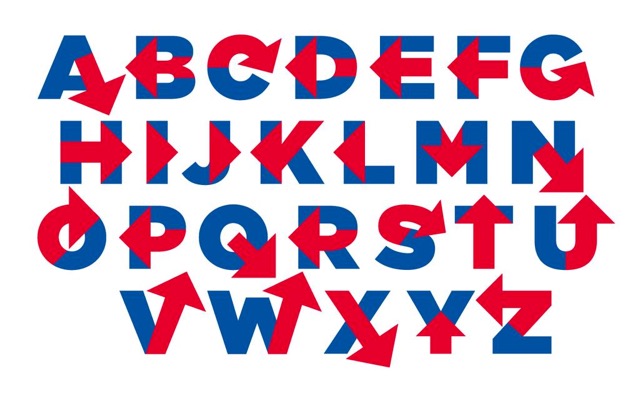
From his Twitter stream, it appears that Wolff is attempting to make an actual Hillvetica font so stay tuned. FYI, Pentagram partner Michael Bierut designed the logo. The simplicity is appealing, but overall I am not a big fan of the arrowed H.
Update: The Washington Post made a little text editor so you can write whatever you want in Hillvetica. The Clinton campaign has already put it to use:
Putting Hillary Bold to good use. http://t.co/NVtjlsoH5u pic.twitter.com/M3Q3nsWqyV
— Hillary Clinton (@HillaryClinton) April 14, 2015
Tags: 2016 election design Hillary Clinton logos politics Rick Wolff typography
Lawrence Altman, "Parsing Ronald Reagan’s Words for Early Signs of Alzheimer’s", NYT 3/30/2015:
Even before Ronald Reagan became the oldest elected president, his mental state was a political issue. His adversaries often suggested his penchant for contradictory statements, forgetting names and seeming absent-mindedness could be linked to dementia.
In 1980, Mr. Reagan told me that he would resign the presidency if White House doctors found him mentally unfit. Years later, those doctors and key aides told me they had not detected any changes in his mental abilities while in office.
Now a clever new analysis has found that during his two terms in office, subtle changes in Mr. Reagan’s speaking patterns linked to the onset of dementia were apparent years before doctors diagnosed his Alzheimer’s disease in 1994.
The paper in question is Visar Berisha, Shuai Wang, Amy LaCross & Julie Liss, "Tracking discourse complexity preceding Alzheimer's disease diagnosis: a case study comparing the press conferences of presidents Ronald Reagan and George Herbert Walker Bush", Journal of Alzheimers Disease 2015:
Changes in some lexical features of language have been associated with the onset and progression of Alzheimer’s disease. Here we describe a method to extract key features from discourse transcripts, which we evaluated on non-scripted news conferences from President Ronald Reagan, who was diagnosed with Alzheimer’s disease in 1994, and President George Herbert Walker Bush, who has no known diagnosis of Alzheimer’s disease. Key word counts previously associated with cognitive decline in Alzheimer’s disease were extracted and regression analyses were conducted. President Reagan showed a significant reduction in the number of unique words over time and a significant increase in conversational fillers and non-specific nouns over time. There was no significant trend in these features for President Bush.
Some relevant past posts:
"Jackson's Dilemma and Alzheimer's", 12/2/2004
"Writing style and dementia", 12/3/2004
"Nun study update", 8/27/2009
"Literary Alzheimer's", 11/13/2009
"Authorial Alzheimer's again", 12/15/2009
In this context, it's really too bad that the Alzheimer's Disease Neuroimaging Initiative didn't include any linguistic material — like a picture description task, or set of scripted questions — in its design.
That was major mistake, in my opinion, since a speech task would have been a tiny, low-cost, low-impact addition to the massive expensive and time-consuming (though no doubt valuable) tests that were designed into the project. But it might turn out that a minute of appropriately designed speech, collected at each visit, would have turned out to be a better predictor of the future time course of symptoms than the brain imaging and body-fluids testing. And the cost of finding out would have been negligible.
kurtadbthis should appeal to scientists who work with rodents
kurtadbwhew!
Want to watch a video of a man being killed?
If, like many people on Earth these days, you get some or all of your news online, that was one of your first choices this morning when you checked your favorite Web site. There it was, front and center, on the home page of my local paper, the Times, and on the BBC, and the Guardian, and the Wall Street Journal, and thousands of other news sites, as well as hundreds of thousands of Facebook pages and Twitter feeds: a freeze-frame showing a white policeman in the process of shooting a black man to death, with a play button you could click to watch the whole killing from start to finish. The killer, Officer Michael T. Slager, of the North Charleston Police Department, in South Carolina, shot his victim, Walter L. Scott, first with a Taser. Then, after Scott started to run away, Slager pointed his handgun and shot him in the back again and again. A few minutes earlier, Slager had stopped Scott for driving with a broken taillight; now he was putting him to death. Slager fired eight shots, and when Scott fell, he handcuffed him, binding his wrists behind his back and leaving him to die face down in the grass.
See the rest of the story at newyorker.com
Related:kurtadbMORE!
kurtadbis it me or does this happen in colorado with alarming regularity? it seems like pedestrians and cyclists are getting hit all the time, and all kind of people are getting hit-and-runned all the time.
kurtadbweird
kurtadbgood stuff

Someone pretending to be a Parisian hipster who only watches VHS versions of modern shows & movies like Game of Thrones and Interstellar created these VHS covers as an April Fools joke. These are actually pretty great. (via subtraction)
Tags: design movies TV
Just a minor anatomical error in @USC's full-page NYT ad… via @mike_yassa pic.twitter.com/0IxFBzPuFN
— Mo Costandi (@mocost) April 1, 2015
Time’s blog of the year is back at it:
Byron York, chief political correspondent for the Washington Examiner and Fox News contributor, has some questions about Harry Reid:
Per @jhinderaker, has any journalist looked into the specifics of Harry Reid's exercise equipment accident?
— Byron York (@ByronYork) March 29, 2015
Behind this somewhat enigmatic tweet lies a rather elaborate conspiracy theory. @jhinderaker is John Hinderaker, one of the proprietors of the conservative blog PowerLine, and he’s peddling a theory that the injuries Reid suffered while exercising in January weren’t an accident at all. To Hinderaker the official story is just a cover-up for an incident that involves Mafia violence — likely the fallout of what Hinderaker alleges to be long-running corruption on the part of the Nevada senator and Democratic Senate leader.
“When a guy shows up at a Las Vegas emergency room on New Year’s Day with severe facial injuries and broken ribs and gives as an explanation the functional equivalent of ‘I walked into a doorknob,'” Hinderaker writes, “it isn’t hard to guess that he ran afoul of mobsters.”
This is a wild theory that lacks any evidentiary basis. But its popularity on the right speaks to the fact that conservatives are convinced that Reid — who has grown wealthy enough while in office to make the Ritz-Carlton his DC residence — has used his decades in public office to corruptly enrich himself, and the media has given him a pass on it.
I’ll spare you the details, but Hindrocket claims that Reid’s injuries are the work of brass knuckles. There goes my sex swing theory.
Obligatory reminder of who Hindrocket is:
It must be very strange to be President Bush. A man of extraordinary vision and brilliance approaching to genius, he can’t get anyone to notice. He is like a great painter or musician who is ahead of his time, and who unveils one masterpiece after another to a reception that, when not bored, is hostile.
These guys…

Before we deal with the well-mannered moral monster that is David Brooks, we should dispense with some of the WeaselSpeak that has attended Mike Pence's successful attempt at killing his tourist economy. There is no doubt -- none -- that the law Pence signed is directly aimed at the rights of LGBT citizens -- and specifically, at their right to get married. It isn't about protecting the rights of the Amish in Decatur County to grow their beards, and it isn't about allowing the remaining members of the Kickapoo Nation to use whatever they want in their religious rituals. It is about allowing people to discriminate against their fellow citizens in thousands of private transactions. The history of this bill begins almost to the day on which Indiana's attempts to ban marriage equality failed in the courts. Its primary supporters admitted its real purpose right from jump.
Micah Clark of the American Family Association explained to The Indianapolis Star that the bill would allow small businesses to refuse services to same-sex couples and also that it would allow adoption agencies to refuse to place children with same-sex couples. The Indiana Family Institute made an end-of-year fundraising pitch that promoted the legislation, noting examples of small businesses who were facing discrimination complaints from same-sex couples.
And, if its purpose was as anodyne as Pence now makes it out to be, and if Pence is as blindsided by the backlash as he's now pretending to be, then why did he sign it in a secret ceremony in which he was surrounded by some of the state's most serious professional homophobes?
(And, not for nothing, but when you've lost Dan Quayle's old family newspaper, it's time to wonder how far off the diving board you've actually jumped.)
Which brings us to David Brooks, who would like all those hysterical gay people to start using their inside voices and to understand that their desire for equal protection under the law would be better served if they understood the feelings of the people who think they are sodomite insects who are all going to hell. No link because fk him, that's why.
As a matter of principle, it is simply the case that religious liberty is a value deserving our deepest respect, even in cases where it leads to disagreements as fundamental as the definition of marriage. Morality is a politeness of the soul. Deep politeness means we make accommodations. Certain basic truths are inalienable. Discrimination is always wrong. In cases of actual bigotry, the hammer comes down. But as neighbors in a pluralistic society we try to turn philosophic clashes (about right and wrong) into neighborly problems in which different people are given space to have different lanes to lead lives. In cases where people with different values disagree, we seek a creative accommodation.
"Morality is a politeness of the soul"? What kind of dog's breakfast is that? Jesus His Own Self said he brought not peace, but a sword. If Brooks wants to stand with religious-based bigotry, with the Micah Clarks of the world, he should just do so and stop wasting all of our time as a sewage-treatment plant for the worst instincts in our politics. "Neighborly problems"? If Brooks wants to say that discrimination against LGBT citizens is not really discrimination worthy of the law's attention, he should just say so, and stop wasting all our time putting Bull Connor in a $500 suit. Here's a "creative accommodation" for you. Don't be a bigot.
I have to go now. Moral Hazard, the Irish setter owned by David Brooks for photo-op purposes, is laying on his back out in the yard, without even the energy or inspiration to lick his own balls. I'm worried about him, frankly.
Below is a guest post by Marten van der Meulen, who is a teaching assistant for this course.
On March 30th, the Massive Open Online Course (or MOOC) Miracles of Human Language: an Introduction to Linguistics will start on Coursera. The course is facilitated by Leiden University, and is given by Marc van Oostendorp, professor at Leiden University and the Meertens Institute. Subscribing is still possible.
Miracles of Human Language (MHL for friends) aims at providing an introduction both to the content of linguistic studies and in the research aims and techniques used in linguistics. The different weeks cover different traditional subdisciplines of linguistics, such as phonetics and phonology (Week 1) and semantics and pragmatics (Week 4). Aspects of these subjects are explained in lecture videos. This is, however, only the framework: the course aims at doing much more.
Two ways are used to show participants more about the workings of linguistics. Firstly, every week features informants, who are queried about a certain aspect of their language (e.g. consonants, or politeness). These informants come from very different languages and language families, such as Basque, Gungbe and Mandarin Chinese. Using actual language users rather than merely written examples will make the languages more real for participants. Also, as participants will have to analyse the linguistic samples provided by the informants, this will give a glimpse into the methods of linguistic field work.
The other way in which MHL goes beyond traditional knowledge-based courses is by including discussions. In these discussions two teaching assistants, Marten van der Meulen and Inge Otto, ask questions of prof Van Oostendorp, based on the contents of the lecture videos of the week. In doing so, they not only delve deeper into the issues raised in the lecture videos, but they also show what kind of paths of thinking people can take after watching the videos. Additionally, we hope that participants will identify with the students in these discussions, thereby absorbing the material in a better way.
Finally, MHL strives at showing the breadth and depth of linguistics as a scholarly discipline. This is achieved by explaining about the different fields within linguistics, but also by interviewing real-life linguists. They are asked to explain about their own research, as well as comment on interesting questions in the field. We interviewed five very different linguists: Noam Chomsky (on general linguistics), Adele Goldberg (on the constructionist approach), Claartje Levelt (on language acquisition), Victoria Nyst (on sign language), and Barend Beekhuizen (on computational semantics).
All in all, we have tried to make a varied and exciting course, which will provide people with a basic understanding of linguistics, and which will hopefully inspire people to pursue further studies in linguistics in one form or other.

"It's not even April 1," a spokeswoman for Amazon told me this afternoon when I asked her to promise—legit, guarantee, pinky-swear promise—that the tech giant's Dash Button is a real product and not an April Fool's joke. She promised. "I guarantee you," said Kinley Pearsall, one of three people who confirmed as much. "It is real."
The button, designed to correlate with specific products around your house like paper towels and laundry detergent and Gatorade, is basically a physical manifestation of the one-click-to-buy feature on Amazon's site. You stick the buttons around the house—near the coffee maker, or in the pantry—and when you run out of one of your staples, you press it to wirelessly reorder that item. Amazon is partnering with 18 brands like Tide and Huggies—along with four connected-device partners (like Whirpool and Brita) that are working on technologies that might eventually enable your machines to re-order products for you. "If this is a hoax," Pearsall told me, "I have been working for a long time on a product that's not real."
These are weird and wonderful times in technology. The line between innovation and absurdity is thin. What's possible is, very often, incredible. Which helps explain why, while I was confidently telling my colleagues the Dash Button was almost certainly baloney, many of them were telling me how they hoped I was wrong. ("Really, really hope this isn't a prank," one chatted. "I'd def use them.")
Is pressing a button easier than using one-click buying from a smartphone app? I guess so, actually. People don't always want to pull out their smartphone right after using the last paper towel on the roll. And everybody knows what it's like to resolve to remember—but forget anyway—the item you need most on your grocery list. As far as modern conveniences go, the Dash Button potentially introduces a level of wireless integration that seems not unlike the glancification promised by the Apple Watch: a device not for telling time, but for telling you when to pull your iPhone out of your pocket.
There are still lots of questions. How do these buttons even work? According to Amazon, you set up Dash buttons one time by linking them to your Amazon Prime account and your wireless network; when the button is pressed it sends a signal to the cloud and updates your order. When the order goes through, a light blinks so you know it worked. The whole transaction takes about eight seconds and you have about 30 minutes to cancel your order if you change your mind. To avoid duplicate orders, Amazon won't process more than one press of a button per shipment—unless you specify otherwise in your account settings. The buttons are free (in beta, by invitation only) and Amazon tells me that they'll cover the cost of recycling the buttons by providing prepaid envelopes for returns. The battery life, Amazon says, will last for years.
They won't share how many of these things they expect to make, or how widely they hope Dash Buttons will be adopted. "We will continue to iterate and evolve the program," Pearsall said. "There are a lot of customers that this is going to make a lot of sense for."
This article was originally published at http://www.theatlantic.com/technology/archive/2015/03/the-amazon-button-is-real/389234/


Trevor Noah's ascent on The Daily Show has been steep—hired on as senior international correspondent four months ago, he'll take over the anchor's desk from Jon Stewart after just three appearances on the show, Comedy Central announced Monday.
Noah, who is 31, brings an unusual background to the job: He's from South Africa, the son of a black woman and a white man, speaks six languages, and may be better known overseas than he is in the United States. (To give The New York Times a comment about his appointment, he had to call from a tour stop in Dubai, where he relayed his reaction: “You need a stiff drink, and then unfortunately you’re in a place where you can’t really get alcohol.”)
He takes over from Stewart, who's concluding a 16-year tenure, after a series of more seasoned Daily Show hands left the running: Stephen Colbert to David Letterman's Late Show chair, Larry Wilmore to Colbert's slot, Jason Jones and Samantha Bee to TBS. Despite a social-media push for Jessica Williams, she said she wasn't ready for the gig. (Comedy Central hasn't set a start day for Noah yet.)
In morphing from an 11 o'clock hour helmed by Stewart and Colbert to a block of Noah and Wilmore, Comedy Central is conducting a remarkable and perhaps unprecedented transformation. Stewart and Colbert represented (albeit self-deprecatingly) two classic manifestations of white American masculinity—the Jewish wiseacre and the Christian blowhard. With Noah and Wilmore, the hour remains male, but becomes (a bit) younger, blacker, and more global in outlook. Even if that's not an intentional shift—“We talked to women. We talked to men. We found in Trevor the best person for the job,” Comedy Central President Michele Ganeless said—the effect is to set up a bold, even subversive experiment, extending the progressive politics espoused by the show into personnel decisions.
Noah's comedy often takes as themes both his racial and international identities. As he told NPR earlier this year, his very existence was a crime. "I was born in South Africa during apartheid, a system of laws that made it illegal for people to mix in South Africa," Noah said. "And this was obviously awkward because I grew up in a mixed family. My mother's a black woman, South African Xhosa woman ... and my father's Swiss, from Switzerland."
The Times reports that Noah gave no formal auditions other than his three segments. That's a little surprising. On The Daily Show, he's played the part of somewhat supercilious cosomopolitan, alternately chiding, lecturing, and mocking Stewart, who takes up the role of all-American rube. While the bits have laugh lines, they're not screamingly funny. At best, they force readers to confront uncomfortable realities about how the U.S. views Africa as a menacing monolith; at worst, they feel pedantic and stiff.
Noah's standup feels looser and, frankly, funnier. In this clip from the Apollo in London, Noah recounts his difficult childhood, with parents who had to remain apart and act wary around police. He also talks about trying being mistaken for Latino when in the United States, and about his ill-considered bid to learn German to impress his Swiss father. (It turns out that listening to Hitler speeches and adopting their diction produces uncomfortable reactions among present-day Germans.)
As the clip shows, Noah is an excellent mimic—a skill that sets him notably apart from Stewart. That's likely one of many changes to expect from the new Daily Show. The mixed results in Noah's segments suggest that he's very funny but perhaps not ideally suited to the current format. Revisiting news articles on Stewart's takeover from Craig Kilborn, one gets a similar sense: Stewart's show was eagerly anticipated, but no one knew what quite to make of the switch from the tall, bro-y, sometimes mean-spirited Kilborn to the short, nebbishy, affable Stewart.
But Noah's appointment fits with a franchise that has tended ever more serious under Stewart's direction. Stewart took time off from the show to direct Rosewater, a drama about the imprisonment in Iran of Newsweek reporter Maziar Bahari. As my colleague David Sims notes, Larry Wilmore's Nightly Show has made a point of attacking weighty topics with a light but erudite touch. And John Oliver's Last Week Tonight has quickly moved from an echo of Stewart's Daily Show into a fairly aggressive news operation, light on gags (though not laughs) and heavy on longer-form journalism. Oliver has even begun hiring journalists and focusing on original investigative work.
Opting for a more global look may be risky—after all, the point of Noah's segments so far has been that Americans neither understand nor care about the world beyond their borders. But Noah's ability to make connections between domestic and foreign phenomena should suit him well, and there was evidence that Stewart's shtick was reaching its limits. Built for skewering the follies of the Bush administration and the media, he outlasted Dubya and helped change the media, and he seemed mostly baffled and sad before more recent bleak news around the globe. Trevor Noah may be just the man to lead The Daily Show into international waters.
This article was originally published at http://www.theatlantic.com/entertainment/archive/2015/03/ladies-and-gentlemen-trevor-noah/389006/