Shared posts

29 Aug 13:10

Creating Chilling Effects On Speech Is A Feature, Not A Bug, Of The Surveillance State

by Mike Masnick
We've discussed a few times how the pervasive surveillance efforts of the NSA and others have tremendous chilling effects on how people communicate and how they act. We've discussed how this is a "cost" to the program that not many, especially those who are backing these programs, seem interested in measuring or even thinking about. Of course, implicit in our assumption is that these "costs" are things that are negatives of the program. Others would point out that for those in power, that's not so much a cost as a benefit. It's not a bug or an unintended consequence, but a feature. Chilling speech and clamping down on communications? Why that's a good thing for those in power.

Josh Levy, from Free Press, has a great guest post over at Boing Boing where he discusses how the NSA's surveillance regime is a huge attack on free speech, and how this is both inevitable, and for some, the intent of the program:

The chilling of free speech isn’t just a consequence of surveillance. It’s also a motive. We adopt the art of self-censorship, closing down blogs, watching what we say on Facebook, forgoing “private” email for fear that any errant word may come back to haunt us in one, five or fifteen 15 years. “The mind's tendency to still feel observed when alone... can be inhibiting,” writes Janna Malamud Smith. Indeed.

Peggy Noonan, describing a conversation with longtime civil liberties advocate Nat Hentoff, writes that “the inevitable end of surveillance is self-censorship.”

Hentoff stressed that privacy invasions of this magnitude are “attempts to try to change who we are as Americans.” In fact, they are attempts to define who we are as human beings.

Meanwhile, over at the Atlantic, Bruce Schneier has a post discussing the detainment of David Miranda, where he comes to similar conclusions, that these authoritarian police states clearly have no practical benefit, except to enable a powerful government to show off its power to invade your lives:
This leaves one last possible explanation -- those in power were angry and impulsively acted on that anger. They're lashing out: sending a message and demonstrating that they're not to be messed with -- that the normal rules of polite conduct don't apply to people who screw with them. That's probably the scariest explanation of all. Both the U.S. and U.K. intelligence apparatuses have enormous money and power, and they have already demonstrated that they are willing to ignore their own laws. Once they start wielding that power unthinkingly, it could get really bad for everyone.
Of course, Schneier sees some upside to this in the long run -- which is that such blatantly ridiculous activity seems to only embolden others to push back on this trampling of our rights. Hopefully, that pushback works, because the alternative is horrifying to those who believe in a free and open society.

Permalink | Comments | Email This Story


23 Aug 18:03

Incomes Drop Twice as Much During 'Recovery' as Recession...


Incomes Drop Twice as Much During 'Recovery' as Recession...


(Second column, 4th story, link)
Related stories:
23 Aug 04:09

Tax-Hungry State Officials Revive Indian Wars Over Cigarettes

by J.D. Tuccille

Get yer home-rolled cigarettesYou know the world has come a long way, baby — in a circle — when politicians try to tax that toasted taste right out of your smokes and find themselves fighting Indians in the process. Around the world, officials have tried to squeeze smokers (for their own good, of course) of as much cash as possible in return for allowing them to enjoy their chosen vice. The end result has been thriving black markets, whether in Europe or the United States. Complicating this matter in the U.S., though, are those little islands of quasi-sovereignty known as Indian reservations. As cigarette taxes have soared, Native Americans have perceived entrepreneurial opportunity in peddling and even manufacturing low-cost smokes for eager customers. Not so surprisingly, state officials have responded with attacks on tribal independence.

Technically, states are authorized to tax cigarettes sold on reservations to non-Indians, but they don't have the authority to enter reservations to collect that tax. That's courtesy of Oklahoma Tax Commission v. Citizen Band of Potawatomi, decided in 1991. There's a lot of hedging and on the other hand in that situation — some states claim a measure of legal power over tribal lands under Public Law 280 or similar measures. But, basically, a legal standoff is in place.

As you might guess, this infuriates some public officials. New York City Mayor Bloomberg went so far as to urge then-Governor David Paterson to "get yourself a cowboy hat and a shotgun" to collect cigarette taxes from Indian tribes and their customers.

You see, not just justice, but tax collection, truly is blind.

That approach doesn't work as well as you might think, so state officials have taken to leaning on tobacco companies. As part of an interesting analysis of the cigarette tax standoff, Ryan D. Dreveskracht summarizes a major tax collecting approach for Native American Times:

In 1998, the Attorneys General of 46 states, five U.S. territories, and the District of Columbia settled various legal actions involving antitrust, product liability, and consumer protection claims against the nation’s four largest tobacco companies.  (In the early years of the Bush Administration, the Department of Justice decided not to pursue claims against tobacco manufacturers for harm caused in Indian country).  The states wanted billions of dollars, and were likely right to demand it.  The tobacco companies, however, anticipated that they would have to substantially raise cigarette prices to pay for their financial obligations to the states.  They also knew that by raising their prices, other nonparticipating companies would have a competitive price advantage.

In settling the suits, the major tobacco companies got a sweetheart deal.  As part of the settlement agreement, states agreed to enact and “diligently enforce” escrow statutes that “effectively and fully neutralize[d]” competition from nonparticipating companies.  These statutes impose financial obligations on non-participating companies by requiring them to make escrow payments based on the number of tax-stamped cigarettes sold in a participating state.  Participating tobacco companies are not subject to these payments.  Nonparticipating companies, however – companies that have never been sued or found culpable for conduct giving rise to liability – are required to make the payments.

Further complicating matters, courts say that tribal imports of cigarettes from outside the U.S. are subject to state regulation.

But remember, tax laws may apply to tribal lands, but enforcement is another matter entirely. So if "nonparticipating companies" are actually based on reservations...

That's right, tribes including New York's Oneida Indians set up their own cigarette companies, cranking out smokes under their own brand names. Last year, Thomas Kaplan reported for the New York Times:

ONEIDA, N.Y. — The trucks lumber past cornfields and dilapidated farm houses, pull up to a onetime bingo hall and unload their cargo: boxes of tobacco imported from the Carolinas.

Inside, employees of the Oneida Indian Nation dump the shredded tobacco leaves into rolling machines and fashion them into cigarettes to be sold at a dozen tribal convenience stores midway between Syracuse and Utica.

The cigarettes, branded with names like Niagara’s and Bishop, sell for as little as $39.95 for a 10-pack carton — much cheaper than those at non-Indian retailers — and bring in millions of dollars a year to the tribe, which also has a resort casino, five golf courses and a multimedia production house.

“We tried poverty for 200 years,” the Oneidas’ leader, Ray Halbritter, said in an interview. “We decided to try something different.”

The article points out that New York's tribes have been the most aggressive with their home-rolled tactics, cranking out vast quantities of cigarettes to satisfy the demand in a state where taxes are the highest in the nation at $4.35 per pack, plus another $1.50 levied in New York City.

New York officials tried seizing reservation-made cigarettes — but the courts have ruled that out. The state also, says Dreveskracht "ramped up its enforcement by trailing vehicles that leave the Reservations, inspecting tax stamping agents’ inventories, and secretly conducting surveillance on Reservation smoke shops."

It could be worse. In 2003, Rhode Island state troopers flat-out invaded a reservation and battled tribal police and officials to shut a smoke shop. Members of the Narragansett tribe are still pissed.

Nothing brings out old-school authoritarianism and brutality in government officials like taxes.

By the way, Native Americans are fighting the feds over taxes, too, but I'll leave that for another day.

H/T to BroadSnark, who covered the often-overlooked cigarette tax battle between Native Americans and state officials on her blog.

22 Aug 21:39

Vocal NSA Critic Has Dinner With NSA Boss, Explains To Him That Abuses Are Inevitable

by Mike Masnick
Jennifer Granick, a well known (and brilliant) civil liberties fighter (currently at Stanford) recently co-wrote an article with Chris Sprigman about why the NSA's surveillance efforts were almost certainly both illegal and unconstitutional. Just a few weeks later, she got to have dinner with NSA boss Keith Alexander, which she's now written about. As you might imagine, it appears that they didn't agree on very much about the NSA's surveillance efforts. Basically, Alexander more or less argues that the NSA has to do what it does to "protect Americans" and that the agency is filled with good people who don't want to invade the privacy of Americans.
I have no doubt that Gen. Alexander loves this country as much as I do, or that his primary motivation is to protect our nation from terrorist attacks. “Never again,” he said over dinner. But it may be that our deep differences stem from a fundamental disagreement about human nature. I think Gen. Alexander believes that history is made by great individuals standing against evil. I believe that brave people can make a difference, but that larger inexorable forces are often more important: history, economics, political and social systems, the environment. So I believe that power corrupts and that good people will do bad things when a system is poorly designed, no matter how well-intentioned they may be. More than once, my dinner companions felt the need to reassure the DIRNSA that none of us thought he was a bad man, but that we thought the surveillance policies and practices were bad, and that eventually, inevitably, those policies and practices would lead to abuse.
She goes on to note that the NSA's (and the administration's) further defense of the efforts have only made her point even stronger (contrary to General Alexander's promise to Granick that the upcoming revelations would show that the NSA's actions were perfectly reasonable). As she notes later in the piece, the history of abuses is well known, even if Alexander likes to ignore it:

Of course, we see mission creep – once you build the mousetrap of surveillance infrastructure, they will come for the data.  First it was counterterrorism, then it was drug investigations, then it was IRS audits. Next it will be for copyright infringement.

And of course, there also will be both “inadvertent” and intentional abuse, inevitable but difficult to discover.  Bored analysts do things like spy on women using surveillance cameras and listen to American GIs overseas having phone sex with their loved ones back home.  Or an FBI agent may investigate strange but not unlawful emails on behalf of a family friend, leading to a sex scandal that brings down the Director of the CIA.  These surveillance tools and information databases may one day end up in the hands of a J. Edgar Hoover and a President demanding embarrassing information about her political opponents, information that, in an age of mass surveillance, the government most assuredly will have somewhere in its treasure trove.

There's a reason we make it hard for the government to spy on people. We know that the temptation to abuse such powers will be strong and abuse will inevitably occur. That's the nature of a free society. And it's a problem when people like General Alexander think that the best way to "protect" a free society is to take away the very factors that make it one.

Permalink | Comments | Email This Story


22 Aug 21:35

New Mexico Court: Christian Photographer Cannot Refuse Gay-Marriage Ceremony

Jts5665

Tyranny.

Today the New Mexico Supreme Court ruled that Christian photographers cannot decline to participate in gay-marriage commitment ceremonies, even though that state does not have gay marriage and the court acknowledged that providing services for the ceremony violated the Christian’s sincerely-held, traditional religious beliefs. This becomes one of the first major cases where religious liberty collides with gay rights, and could now go to the Supreme Court of the United States.

Elane Huguenin is a photographer in New Mexico. She and her husband Jonathan jointly own their family business, Elane Photography. Specifically, Elane is a photojournalist—using a carefully-planned series of photographs to tell a story and convey a message. She is also a devout Christian, who believes that marriage is the union of one man and one woman.

In 2006, Vanessa Willock contacted Elane Photography, asking Elane to photograph her lesbian commitment ceremony. It was a private commitment ceremony because New Mexico recognizes neither gay marriage nor gay civil unions. Elane thanked Willock for her interest, but explained that due to her religious beliefs she only does traditional weddings.

Willock filed a complaint against Elane with the New Mexico Human Rights Commission, citing a state law that does not allow discrimination on the basis of sexual orientation. The commission ruled Elane’s decision illegal, and imposed a fine of $7,000 to cover legal fees.

Elane took this matter to court, represented by Jordan Lorence of the Alliance Defending Freedom (ADF). The trial court upheld the fine, as did the court of appeals.

The New Mexico Supreme Court has now affirmed the lower courts, holding that Elane Photography is a “public accommodation,” and because they photograph wedding ceremonies they cannot refuse a gay-commitment ceremony (even if it is not a legal wedding).

In a concurring opinion, Justice Richard Bosson wrote Elane and Jonathan:

… now are compelled by law to compromise the very religious beliefs that inspire their lives… the result is sobering. It will no doubt leave a tangible mark on the Huguenins and others of similar views.

… At its heart, this case teaches that at some point in our lives all of us must compromise, if only a little, to accommodate the contrasting values of others. A multicultural, pluralistic society, one of our nation’s strengths, demands no less. The Huguenins are free to … pray to the God of their choice … But there is a price, one that we all have to pay somewhere in our civic life.

Bosson goes on to say having to violate your religious beliefs when they conflict with social issues like gay marriage “is the price of citizenship.”


In response to today’s decision, Lorence said in an ADF statement:

Government-coerced expression is a feature of dictatorships that has no place in a free country. This decision is a blow to our client and to every American’s right to live free. Decisions like this undermine the constitutionally protected freedoms of expression and conscience that we have all taken for granted. America was founded on the fundamental freedom of every citizen to live and work according to their beliefs and not to be compelled by the government to express ideas and messages they decline to support. We are considering our next steps, including asking the U.S. Supreme Court to right this wrong.

A recent Rasmussen poll showed that 85% of Americans support the right of a religious photographer not to participate in a gay-marriage ceremony.

A petition to the U.S. Supreme Court asking for review is due by mid-November.


Breitbart News legal columnist Ken Klukowski is senior fellow for religious liberty at the Family Research Council and on faculty at Liberty University School of Law. Follow him on Twitter @kenklukowski.


22 Aug 19:14

How Can People Say This Stuff With A Straight Face?

by admin

Joane Hayes-White has no shame:

San Francisco's fire chief has explicitly banned firefighters from using helmet-mounted video cameras, after images from a battalion chief's Asiana Airlines crash recording became public and led to questions about first responders' actions leading up to a fire rig running over a survivor.

Chief Joanne Hayes-White said she issued the order after discovering that Battalion Chief Mark Johnson's helmet camera filmed the aftermath of the July 6 crash at San Francisco International Airport. Still images from the footage were published in The Chronicle.

Filming the scene may have violated both firefighters' and victims' privacy, Hayes-White said, trumping whatever benefit came from knowing what the footage shows.

"There comes a time that privacy of the individual is paramount, of greater importance than having a video," Hayes-White said.

Any 5-year-old can figure out here that this has nothing to do with victim privacy -- this is all about shielding her organization from accountability from future screw-ups.  Somehow we have ended up in a completely backwards world where surveillance is aimed at private citizens doing private things but is banned for public officials doing public things.  Ms. Hayes-White is obviously just a puppet for the firefighters union, and she be treated with contempt.

22 Aug 04:30

Gore likens 'global warming' skeptics to racists, supporters of apartheid, homophobes...

Jts5665

Speaking of anti Science. Gore is a posterboy for that group.


Gore likens 'global warming' skeptics to racists, supporters of apartheid, homophobes...


(Second column, 22nd story, link)
Related stories:
21 Aug 21:33

NSA Program Found Unconstitutional Went On For 3 Years; Started Right After Telcos Got Immunity

by Mike Masnick
A further delve into the latest NSA surveillance bombshell from the WSJ highlights the ridiculousness of the claims that there were "no violations" by the NSA over the years. We've been aware for a while that the FISC ruled a certain NSA program unconstitutional, but the details had been kept secret. It only came out that something was found unconstitutional a year ago, through the efforts of Senator Ron Wyden. Since then, people have been digging for more. The DOJ finally has agreed to release a redacted version of the FISC ruling after fighting it for a while, but as we wait, some more details have been coming out. Last week's Washington Post story about abuses claimed that this particular program wasn't reported to the FISC for "many months."

Yet, as we mentioned last night, the WSJ article claims that the program actually went on for three years:
For example, a recent Snowden document showed that the surveillance court ruled that the NSA had set up an unconstitutional collection effort. Officials say it was an unintentional mistake made in 2008 when it set filters on programs like these that monitor Internet traffic; NSA uncovered the inappropriate filtering in 2011 and reported it.
No biggie. The NSA just illegally collected information that clearly violated the 4th Amendment (even the rubberstamp FISC says so!) for three years. But there's no abuse. No sir. No problems at all.

Marcy Wheeler, however, puts two and two together, and notes that the "start" of this admitted unconstitutional spying was in 2008 -- which is exactly when the telcos received immunity from all such cases involving warrantless wiretapping. And, so, she points out the administration and various NSA defenders may actually be using an incredibly twisted level of reasoning to claim that this program that violated the 4th Amendment doesn't count as a "violation" because since the telcos have immunity, there's no one to "prosecute" for breaking the law. Under this twisted interpretation, the government grants telcos retroactive immunity on such surveillance, and can then use that immunity to pretend that everything it does is legal since the telcos can't be prosecuted. If that turns out to be true, it's downright evil.

And, you wonder why the key part of CISPA was to basically extend blanket immunity on privacy violations between not just telcos and the government, but basically all tech companies. The more immunity the government grants, the more "legal" all its actions become. It's sickening.

Permalink | Comments | Email This Story


21 Aug 16:14

Grocer Fined for Selling Strawberries Too Cheaply!

by Nick Gillespie

Via the Twitter feed of Keep Food Legal, the nonprofit dedicated to "culinary freedom," comes this confusing tale of commerce from the U.K.: The supermarket chain Tesco was fined beacoup bucks (plenty o' pounds?) for the horrifying act of selling strawberries at half-price for longer than they sold them at full-price.

That sort of practice runs afoul of Britain's Office of Fair Trading, which says that having sales that last longer than the original price is offered is "misleading" to customers. Even on seasonal products that, you know, ripen and rot on the shelves.

Got that? The chain has been fined for making things cheaper (to show just how rotten the company is, they even threw in cartons of free cream in certain cases)!

It's a reminder about how agricultural and price-setting policy tends to be in most countries, including the U.S. Going back at least to FDR, ag policy almost always revolves around making things more expensive for consumers rather than cheaper. All in the name of fairness.

Read more about it here.

21 Aug 14:55

Bradley Manning Sentenced To 35 Years For Leaking Government Secrets

by Tyler Durden

This just in.

US court martial jails Bradley Manning for 35 years for leaking secret files to whistleblowing website Wikileaks http://t.co/fyUM53TlYA

— BBC Breaking News (@BBCBreaking) August 21, 2013

Hopefully by the time he gets out there will still be a United States.

And Glenn Greenwald's prompt and poignant response...

The US will never be able to lecture world again about the value of transparency and press freedoms without triggering a global laughing fit

— Glenn Greenwald (@ggreenwald) August 21, 2013

More from the WSJ:

Pfc. Bradley Manning was sentenced to 35 years in prison Wednesday, the culmination of a trial that posed tough questions about the balance between government secrecy and national security.


Pfc. Manning was facing a maximum 90-year sentence. The prosecution had asked for 60 years and the defense no more than 25.


After an eight-week court-martial, Pfc. Manning was convicted in July of espionage for downloading volumes of classified military and diplomatic information that he handed to the antisecrecy group WikiLeaks for public release. The presiding judge, Col. Denise Lind, rejected the U.S. government's most serious charge—aiding the enemy—which could have led to a much harsher sentence.


Pfc. Manning, 25 years old, won international notice after his May 2010 arrest at a U.S. military base in Iraq. Supporters, including WikiLeaks founder Julian Assange, hailed Pfc. Manning as a heroic whistleblower who risked his own freedom in an attempt to rouse opposition to American foreign policy and its "war on terror."


The prosecution cast Pfc. Manning as a low-level military analyst who recklessly released classified information that could be used against American troops and their allies around the world.


During the court-martial, Pfc. Manning defended his decision to release the information as an effort to spark a broad debate about American foreign policy. Last week, in a final appeal for leniency, he issued a public apology and cast himself as a misguided young soldier who didn't realize that his actions would hurt the U.S.


"I look back on my decisions and wonder how on earth could I, a junior analyst, possibly believe I could change the world for the better," he told the judge.

21 Aug 13:49

Guy Who Wrote Legal Memos Defending US Torture Defends NSA Because It Takes Too Long To Obey The Constitution

by Mike Masnick
John Yoo, of course, is somewhat infamous for being the author of the so-called "Torture Memos," while he was Deputy US Attorney General for President George W. Bush, giving the Bush administration a horrific legal "justification" for torture. It's no surprise, of course, that he's been spewing ignorant and ridiculous claims concerning other issues as well. We recently wrote about his claims that new media properties like Wikileaks have no First Amendment protections because they're "not the New York Times or the Wall Street Journal." Because in Yoo's demented world, only old school newspapers count. He also made factually incorrect claims, stating that Bradley Manning and Julian Assange "communicated regularly" when the record showed that was simply not true.

Not surprisingly, he's now strongly defending the NSA's activities spying on Americans because there appears to be no part of the Constitution that John Yoo won't spit on and pretend he's merely polishing it up. He argues that while the Justice Department should obey the 4th Amendment, it should not apply to military and intelligence agencies like the NSA:
Once we impose those standards [basic 4th Amendment respect for privacy] on the military and intelligence agencies, however, we are either guaranteeing failure or we must accept a certain level of error. If the military and intelligence agencies had to follow law-enforcement standards, their mission would fail because they would not give us any improvement over what the FBI could achieve anyway. If the intelligence community is to detect future terrorist attacks through analyzing electronic communications, we are asking them to search through a vast sea of e-mails and phone-call patterns to find those few which, on the surface, look innocent but are actually covert terrorist messages.
Except, that's not how it works. We have the 4th Amendment specifically to protect against government intrusion. We don't say "oh, it's okay because they need to do it." That's not how it works. There's no "exception" to the 4th Amendment for military and intelligence agencies.

Then he tries to argue that the "mistakes" are no big deal, because, hey, all of law enforcement makes mistakes.
Domestic law enforcement makes these errors too. Police seek warrants for the wrong guy, execute a search in the wrong house, arrest the wrong suspect, and even shoot unarmed suspects. We accept these mistakes because we understand that no law-enforcement system can successfully protect our communities from crime with perfection.
Actually, I'm not sure in what world Yoo lives in, but for the most part we don't accept those mistakes. We find them abhorrent and we work to stop them. And, this isn't "seeking the warrant for the wrong guy," or searching "the wrong house." This is collecting all information on everyone. There's a difference.

Then, there's the bogus "if we don't do this the terrorists will win" argument:
To end the NSA’s efforts to intercept terrorist communications would be to willfully blind ourselves to the most valuable intelligence sources on al-Qaeda (now that the president won’t allow the capture and interrogation of al-Qaeda leaders).
In Yoo's scary world, the ends justify the means. Of course, that way tyranny and dictatorship lie. You can justify anything under Yoo's rationale. If we want "the most valuable intelligence" to stop attacks, why not place cameras and microphones in everyone's house and cars and record it all with voice recognition software. After all, that would provide much more "valuable intelligence sources." There's a reason there are limits on government surveillance, and it appears that Yoo was absent that day at Yale law school when they taught that part. The rationale he gives has no limits, which is why it's not surprising that he's still pushing for torturing people, despite the fact that it's abhorrent and has never been shown to actually be effective.

And then... he explains why it's okay to ignore the Constitution on this one:
Increasing judicial oversight might reduce errors — though I am dubious — but in a way that would seriously slow down the speed of the program, which is all-important if the mission is to stop terrorists.
In other words, obeying the Constitution just takes too much time. What Yoo is missing is that's the whole point. We live in a world where there are risks, but we are supposed to live in a free country, where we don't invade everyone's privacy for the myth of some smidgen of greater protection. Law enforcement's job is supposed to be hard, because if it's not, there is much more abuse for almost no benefit. It's why we live in a country where, we're told, you're innocent until proven guilty. It's because we believe in protecting our rights, even if it means that sometimes someone gets away with a crime. However, in Yoo's world, it would be a hell of a lot more efficient if everyone was guilty until proven innocent, because that's a lot faster. And, as he notes, sure there are some mistakes, but the ratio would probably be reasonable, so what's the big deal?

Permalink | Comments | Email This Story


21 Aug 13:47

UK Home Office Says Miranda's Detention 'Fully Justified,' Attacks Press And Public For Condoning Snowden's Leaks

by Tim Cushing

For all the claims that the nine-hour detention of David Miranda was going to be "looked into," the Home Office seems to have already arrived at its conclusion: completely justified.

A Home Office spokesperson said: "The government and the police have a duty to protect the public and our national security. If the police believe that an individual is in possession of highly sensitive stolen information that would help terrorism, then they should act and the law provides them with a framework to do that. Those who oppose this sort of action need to think about what they are condoning. This is an ongoing police inquiry so will not comment on the specifics."
This is a rather chilling statement from the Home Office, one that implicitly declares inconvenient people to be terrorists. This, combined with Guardian Editor Alan Rusbridger's account of GCHQ officials forcing him to destroy hard drives while telling him the "debate" was "over" and he could "stop writing," indicates the UK government is through playing defense.

The statement doesn't limit itself to attacking the press. It also attacks the public for supporting the Guardian's efforts.
Those who oppose this sort of action need to think about what they are condoning.
This is an ugly sentiment for a government to be pushing. It declares its critics to be enemies of the state, bedfellows of terrorists, and announces its intent to go on the offensive to rein in its detractors.

The UK government, along with the US government, has seen its constituents' trust eroding at a rapid pace in recent months. And, like the US government, it seems to have no interest in rebuilding it. It would rather write off the loss and blame its victims.

The law that was abused to detain Miranda was hardly "abused." The language itself is abusive, seeing as it leaves the definition of "terrorist" to the imaginations of police officials. America's laws relating to terrorism are easily abused as well, and additions like the "Insider Threat" program point to more antagonistic actions in the future from an angered administration.

This is a watershed moment. We knew it when Miranda was detained. This statement from the Home Office seals it.


Permalink | Comments | Email This Story


21 Aug 12:59

Who’d a-thunk it?

by Mark J. Perry

About two weeks ago, Don Boudreaux started a great new series of posts on the Cafe Hayek blog with the theme “Who’d a-Thunk It?”, here’s a link to the inaugural post in that series. Don has graciously agreed to allow me to post items on CD under that same theme, so here’s my first one:

Under Venezuela’s late president and vocal critic of the market economy, Hugo Chavez’s socialist economic policies, which included nationalizing private farm land, redistribution of land, and government price controls on agricultural products, Venezuela went from being a net exporter of rice to a net importer of rice — with many of its imports coming from… the “imperialist USA,” a term Chavez frequently used to describe America.

21 Aug 00:39

When somebody hits you with that new ‘IPCC is 95% certain’ talking point on global warming, show them this

by Anthony Watts
People send me stuff. The IPCC has announced (via a “leak” campaign only to selected media outlets, such as Reuters, NYT, WaPo) that they are now 95% certain. From Reuters: Drafts seen by Reuters of the study by the U.N. … Continue reading →
20 Aug 16:47

UPDATE: Maine Gov. Declares: 'Obama Hates White People'...

Jts5665

So the Governor of Maine allegedly accuses Obama of being racist towards or hating white people and the media promptly accuses him of being racist towards or hating black people. Does that mean the media hates white people? This could go around in circles for a while.


UPDATE: Maine Gov. Declares: 'Obama Hates White People'...


(Second column, 7th story, link)
Related stories:
20 Aug 16:21

Also, Obamacare Is a Catastrophic Boondoggle

by Harvey

President Obama on Twitter: “Gravity exists. The Earth is round. Climate change is happening.”

Guess he’s hinting that he also wants laws to stop the first two.

Send to Kindle
20 Aug 14:58

Clinton foundation spent $50M on travel expenses...


Clinton foundation spent $50M on travel expenses...


(First column, 13th story, link)
Related stories:
20 Aug 14:55

Journalist For Time Magazine Announces His Eagerness To Defend US Drone Strike Killing Julian Assange

by Mike Masnick
We've already discussed the odd and somewhat sickening way in which certain mainstream journalists have been clearly cheering on the criminalization of investigative journalism, but Time Magazine's Michael Grunwald took it to a new and incredibly disgusting level this weekend, with a now deleted tweet in which he gleefully announced his eagerness to see the US kill Julian Assange, and then to defend the government for doing so:

In case you can't see that, it says:

I can't wait to write a defense of the drone strike that takes out Julian Assange.
This isn't just cheering on despicable government actions -- including the extrajudicial execution of a fellow journalist -- but it's saying ahead of time that no matter what the situation, he'll be right there to back up the official party line from the government. Today's modern journalist, Michael Grunwald, is going beyond the typical stenographer role of so many journalists covering the government, to the point where he's directly letting the government know that he'll be their propagandist backing up a despicable and heinous act.

This has nothing to do with whether or not anyone likes Assange. From all the reports, he seems like a perfectly dislikable individual. I don't agree with many of his views on the world or how he goes about doing certain things that he does. But I certainly support his ability to stay alive.

Of course, this isn't new territory for Grunwald and Time Magazine. In "defending" his tweet, he pointed to a column he wrote a few months ago, in which he directly supports taking away Americans' rights if it means stopping terrorists.

Eventually, Grunwald deleted the tweet, but not so much because it's despicable and indefensible, but rather because leaving it up, according to Grunwald "gives Assange supporters a nice safe persecution complex to hide in." Only an hour later did he apologize, saying that the original tweet was "dumb."

Either way, why would Time Magazine employ someone who flat out joyfully proclaims his eagerness to support the US murdering the head of a competing news organization -- one that has shown what a joke Time Magazine has been in terms of holding the government accountable. What major government abuse stories has Time broken lately?

Permalink | Comments | Email This Story


20 Aug 14:52

White House Says It Had 'No Role' In UK Detention Of David Miranda, But Did Have A 'Heads Up'

by Mike Masnick
Jts5665

Just like they had no idea the NSA was spying on innocent US citizens...

The White House has now come out with a statement insisting that it had no role in the detention of Glenn Greenwald's partner, David Miranda, but did say that UK intelligence gave the US "a heads up" that it "might" happen. Of course, ironically named White House spokesperson Josh Earnest also refused to say whether the US approved or disapproved of the detention.

Meanwhile, it's been noted by some that Miranda was, in fact, carrying a USB key that contained some relevant information, but Greenwald has said that he's not worried at all about it, because the data was encrypted:
"We both now typically and automatically encrypt all documents and work we carry – not just for the NSA stories," says Greenwald via email. "So everything he had – for his personal use and everything else – was heavily encrypted, and I'm not worried at all that they can break that."
Either way, under the rules in the UK, they could only detain Miranda to determine if he was involved in terrorist activities. Doing investigative journalism is not a terrorist activity unless you're an authoritarian police state. Either way, it really does appear that this abuse of power is likely to backfire big time on the UK (and the US, whatever its role). It's unlikely that it did anything to help stop the dissemination of this kind of information, but did reveal the thuggish tactics and police-state mentality by the UK government.

Permalink | Comments | Email This Story


20 Aug 13:49

British Snoops to The Guardian: Nice Little Newspaper You Got. It'd Be a Shame if Something Happened to It

by J.D. Tuccille

Alan RusbridgerThis morning, with regard to the detention of David Miranda, NSA-busting journalist Glenn Greenwald's partner, by British authorities at London's Heathrow airport, and the theft of his property by the same goons, I suggested that the whole infuriating incident was a crude effort to deter journalists from further scrutinizing the surveillance state. The unusual questioning of Miranda about Greenwald's journalistic endeavors for the full nine hours allowed under a British law targeted at potential terrorists was a strong indicator that intimidation was the ultimate goal, but not proof positive. Now, though, we have more evidence that British authorities are leaning heavily on The Guardian as well as Greenwald in an effort to shut off the flow of revelations that are almost as embarrassing to the U.K.'s GCHQ as to America's NSA. In fact, British spooks have actually been over to that newspaper's office to smash things. I kid you not.

According to Alan Rusbridger (pictured at right), editor of The Guardian:

A little over two months ago I was contacted by a very senior government official claiming to represent the views of the prime minister. There followed two meetings in which he demanded the return or destruction of all the material we were working on. The tone was steely, if cordial, but there was an implicit threat that others within government and Whitehall favoured a far more draconian approach.

The mood toughened just over a month ago, when I received a phone call from the centre of government telling me: "You've had your fun. Now we want the stuff back." There followed further meetings with shadowy Whitehall figures. The demand was the same: hand the Snowden material back or destroy it. I explained that we could not research and report on this subject if we complied with this request. The man from Whitehall looked mystified. "You've had your debate. There's no need to write any more."

During one of these meetings I asked directly whether the government would move to close down the Guardian's reporting through a legal route – by going to court to force the surrender of the material on which we were working. The official confirmed that, in the absence of handover or destruction, this was indeed the government's intention. Prior restraint, near impossible in the US, was now explicitly and imminently on the table in the UK. But my experience over WikiLeaks – the thumb drive and the first amendment – had already prepared me for this moment. I explained to the man from Whitehall about the nature of international collaborations and the way in which, these days, media organisations could take advantage of the most permissive legal environments. Bluntly, we did not have to do our reporting from London. Already most of the NSA stories were being reported and edited out of New York. And had it occurred to him that Greenwald lived in Brazil?

The man was unmoved. And so one of the more bizarre moments in the Guardian's long history occurred – with two GCHQ security experts overseeing the destruction of hard drives in the Guardian's basement just to make sure there was nothing in the mangled bits of metal which could possibly be of any interest to passing Chinese agents. "We can call off the black helicopters," joked one as we swept up the remains of a MacBook Pro.

That passage comes from a longer piece in which Rusbridger addresses the Miranda detention as an act of intimidation. He writes, "The state that is building such a formidable apparatus of surveillance will do its best to prevent journalists from reporting on it."

And, in fact, Reuters separately reports:

One U.S. security official told Reuters that one of the main purposes of the British government's detention and questioning of Miranda was to send a message to recipients of Snowden's materials, including the Guardian, that the British government was serious about trying to shut down the leaks.

That the act was intended as a public message certainly makes more sense than the suggestion that U.K. intelligence authorities are unaware that, in the Internet age, a story reported by an American reporter living in Brazil working with a colleague (Laura Poitras) in Germany, based on information delivered by a whistleblower who has taken refuge in Russia, can be cut off by threatening a single British newspaper. That's especially apparent when you consider that the British newsaper in question, The Guardian, is perhaps the most internationally diversified in the world, partially with the deliberate intention of evading the legal controls of any one jurisdiction. This wasn't a serious attempt to stop The Guardian from publishing stories about the intelligence community; it was a baseball bat across the knees as a lesson to all journalists.

Baseball batWhat's remarkable about this is that the NSA story is being heavily reported by a British newspaper subject to much tighter legal restrictions than those endured by American journalists. When the U.S. government snoops on reporters, it does so secretly and has to pretend at remorse when caught. British authorities smash your computers and threaten a regime of press regulation.

In fact, though, Rusbridger reports once taking former New York Times executive editor Bill Keller to task for not picking up on Wikileaks revelations, yelling, "we have the thumb drive, you have the first amendment." That may be self-congratulation, but it squares with the bizarre phenomenon of the Washington Post editorial page calling for an end to NSA revelations, many of which were appearing in the same newspaper's own pages.

If you're not going to use the First Amendment, what good is the damned thing?

But the Post continues to report the story, despite its editorial page. Just last week, it told us of privacy violations by the NSA and the relatively toothless nature of the secretive court intended to oversee all of this creepiness.

Intimidation often works. But really crude and public efforts to intimidate people who already expect the worst of you are a very likely bet to backfire.

20 Aug 04:10

Less than inconceivable

by noreply@blogger.com (Vox)
While liberals are staggered with the probability that the Lightbringer would be more accurately described as the Liebringer, I think the defense has a fairly credible case. Not a very flattering one, to be sure, but credible:
But just as it is utterly absurd to claim Director of National Intelligence James Clapper didn’t lie before Congress (and some reporters thankfully admitted that truth in the open), it has now become almost silly to insinuate or assume that the president hasn’t also been lying. Why? Because if that’s true — if indeed he hasn’t been deliberately lying — then it means he has been dangerously, irresponsibly and negligently ignorant of not only the government he runs, but also of the news breaking around him.

Think about three recent presidential declarations. A few weeks back, the president appeared on CBS to claim that the secret FISA court is “transparent.” He then appeared on NBC to claim that “We don’t have a domestic spying program.” Then, as mentioned above, he held a press conference on Friday to suggest there was no evidence the NSA was “actually abusing” its power.

For these statements to just be inaccurate and not be deliberate, calculated lies it would mean that the president 1) made his declarative statement to CBS even though he didn’t know the FISA court was secret (despite knowing all about the FISA court six years ago); 2) made his declarative statement to NBC but somehow didn’t see any of the news coverage of the Snowden disclosures proving the existence of domestic spying and 3) made his sweeping “actually abusing” statement somehow not knowing that his own administration previously admitted the NSA had abused its power, and worse, made his statement without bothering to look at the NSA audit report that Gellman revealed today.

So sure, I guess it’s possible Obama has merely been “wrong” but has not been lying. But the implications of that would be just as bad — albeit in a different way — as if he were deliberately lying. It would mean that he is making sweeping and wildly inaccurate statements without bothering to find out if they are actually true. Worse, for him merely to be wrong but not deliberately lying, it would mean that he didn’t know the most basic facts about how his own administration runs. It would, in other words, mean he is so totally out of the loop on absolutely everything — even the public news cycle — that he has no idea what’s going on.
The reason the Left has such a hard time understanding Obama's behavior is because they are inextricably wedded to a false assumption, which is that he is highly intelligent.  I have been pointing out for years that the guy not only isn't particularly bright, but he isn't even particularly interested in his presidential responsibilities.  It's hard for the media, particularly the political media, to understand that latter point because nearly everyone in the political game is in it for the power.

The reason the Right has such a hard time understanding Obama's behavior is because they are inextricably wedded to a different false assumption, which is that Obama has an agenda. He doesn't. He's never been in politics for the power. He doesn't give a damn about what he can do and he doesn't have a particular agenda. Forget the Republican paranoia; I don't think there has ever been a post-FDR president who was less likely to even think about seeking four more years.

Obama got into politics for the same reason rock stars get into music. He can't wait to get on the Clinton lecture circuit, have no responsibilities, get away from Michelle, and travel around the world with his very close male friends being applauded for walking on stage and reading his teleprompter. I still contend that if the decision had been left up solely to Obama, he would not have run for re-election. He not only made the second term Reagan look like a paragon of presidential engagement in his first term, but has rendered himself the lamest of ducks without even being crippled by a major internal scandal or losing the Senate.

Obviously, what Obama has been saying about the NSA is not true. But when one considers both his intelligence and his observable level of interest in his presidency, I think Occam's Razor strongly suggests that it is the alternative explanation that is the correct one and he has no idea what is going on in his administration.

It's not that Obama lied to you, my progressive friends, it's that you lied to yourself about him.

Posted by Vox Day.
20 Aug 03:14

Punk/Metal Icon Glenn Danzig Disses Obama, Calls Democrats “Fascists Disguised As Liberals”

by Damon W. Root

Has Obama lost the horror-punk vote? In an interview last week with Minneapolis City Pages, Glenn Danzig, the founder and driving force behind seminal punk and heavy metal bands The Misfits, Samhain, and Danzig, let loose on the Democratic Party and its acolytes for their support of censorship, drone strikes on U.S. citizens, and more.
You mentioned that "Mother" was about the PMRC. Were they a problem for you specifically?

Yeah, you know, Al Gore wanted to tell people what they could listen to and what they couldn't, what they could record. It was basically coming down to the idea that he wouldn't let anybody record any music that he didn't think you should be doing. There was going to be an organization that would tell you what you could and couldn't record. And certainly if you couldn't record it, you couldn't put it out. It was really fascist.

My view on Democrats is that they're fascists disguised as liberals, or liberal moderates. You're not allowed to say anything that they don't agree with. You're not allowed to do anything. Also, the whole Obama, "I can kill anybody with a drone with no trial," is kind of disturbing. I'm surprised that more people who are supposedly liberal aren't more disturbed by it. I think whatever Obama does is OK with them, because he's Obama. It's bullshit.

Read the whole interview here.

Related: "The Politics of Hardcore Punk."

19 Aug 14:10

Who’d a-Thunk It?

by Don Boudreaux

A corporate CEO proclaims that his concern is for the public interest while he endorses restrictionist trade policies that would increase his own company’s profits.  (HT Mark Perry)

Alas, Milton Friedman was correct when he observed that

The broader and more influential organisations of businessmen have acted to undermine the basic foundation of the free market system they purport to represent and defend.

17 Aug 14:28

Photographer Alleges Being 'Handcuffed to a Bench' and Attorney Requests 'Ignored' in Complaint Against LAPD

by Paul Detrick

Los Angeles photographer Shawn Nee says in a handwritten complaint filed August 16 against the Los Angeles Police Department that after he was detained for interferring with a police investigation, he was "handcuffed to a bench" by officers at the Hollywood Community Police Station and a detective "ignored" repeated requests by Nee to speak with his attorney.

Nee says that LAPD officers in Hollywood infringed on his first amendment right to take pictures from a public space on June 2, 2013. LAPD officers detained Nee while he took photos from a sidewalk 90 feet away, although Nee was never charged at the Hollywood station.

The complaint reads:

On June 2, 2013, Foster #2175, Palmer #2204, and Sergeant Rudy Vidal #23398, arrested me after photographing Foster and Palmer from a public sidewalk. Despite standing 90ft away, behind a cement-wall, two chain-link fences, a back yard, and a driveway, the officers claimed I interferred with their investigation. I was handcuffed, transported to the Hollywood Station, handcuffed to a bench and escorted to an interrogation room for questioning. Detective Mossi #34657 ignored my repeated requests to speak with my attorney. He also continued to question me despite invoking my right to remain silent multiple times. I was released without charge once Mossi learned my attorney's name. My detainment and arrest lasted approximately 1.5 hours.

The attorney Nee asked to speak with was Peter Bibring of the American Civil Liberties Union of Southern California, who is representing Nee in a lawsuit against the Los Angeles Sheriff's Department. That lawsuit alleges deputies have been detaining and searching photographers for taking photos.

Nee released an edited version of June 2nd's events which can be seen below. He told LA Weekly that he wants to wait to release the unedited version because he wants to catch the LAPD in their alleged lies:

16 Aug 15:45

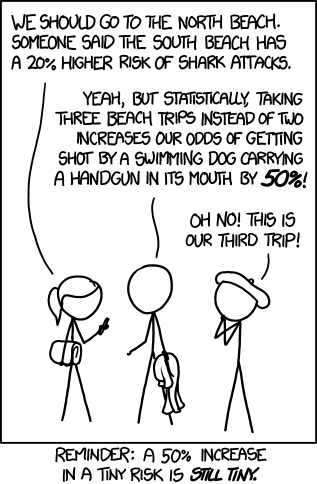
Increased Risk

You may point out that strictly speaking, you can use that statement to prove that all risks are tiny--to which I reply HOLY SHIT WATCH OUT FOR THAT DOG!
16 Aug 01:34

WH: Obama Acting Unilaterally to Raise Taxes Not an 'End-Around' Congress

On Thursday morning, White House deputy press secretary Josh Earnest assured reporters that when President Obama unilaterally attempts to raise cell phone taxes, that’s not an “end-around” Congress. That revelation prompted laughter from the press pool. President Obama has urged the supposedly-independent Federal Communications Commission to raise cell phone taxes to pay for increased broadband capacity for public schools.

“The FCC will decide whether another tax is applied? You're not making an end run around Congress in this case?” a reporter asked.

Earnest answered: “Well, I -- 'end-run' is not the word I would use. What I would say is that there has been -- (laughter) -- what we have seen from Congress is, we've seen a lot of stagnation and dysfunction and an inability to act on some rather obvious priorities of the American people. And so we have made pretty clear -- and I think the president has demonstrated a willingness -- to act on his own where he can, and where necessary to make progress on those priorities. And that's exactly what we're doing in this case.”


16 Aug 00:23

More Compelling Evidence that America's Corporate Tax System Is Pointlessly Destructive

by Daniel J. Mitchell

Daniel J. Mitchell

It’s probably not an exaggeration to say that the United States has the world’s worst corporate tax system.

We definitely have the highest corporate tax rate in the developed world, and we may have the highest corporate tax rate in the entire world depending on how one chooses to classify the tax regime in an obscure oil Sheikdom.

But America’s bad policy goes far beyond the rate structure. We also have a very punitive policy of “worldwide taxation” that forces American firms to pay an extra layer of tax when competing for market share in other nations.

And then we have rampant double taxation of both dividends and capital gains, which discourages business investment.

No wonder a couple of German economists ranked America 94 out of 100 nations when measuring the overall treatment of business income.

So if you’re an American company, how do you deal with all this bad policy?

Well, one solution is to engage in a lot of clever tax planning to minimize your taxable income. Although that’s probably not a successful long-term strategy because the Obama Administration is supporting a plan by European politicians to create further disadvantages for American-based companies.

Another option is to somehow turn yourself into a foreign corporation. You won’t be surprised to learn that politicians have imposed punitive anti-expatriation laws to make that difficult, but the crowd in Washington hasn’t figured out how to stop cross-border mergers and acquisitions.

And it seems that’s a very effective way of escaping America’s worldwide tax regime. Let’s look at some excerpts from a story posted by CNBC.

Some of the biggest mergers and acquisitions so far in 2013 have involved so-called “tax inversions” – where a US acquirer shifts overseas, to Europe in particular, to pay a lower rate.

The article then lists a bunch of examples. Here’s Example #1.

Michigan-based pharmaceuticals group Perrigo has said its acquisition of Irish biotech company Elan will lead to re-domiciling in Ireland, where it has given guidance it expects to pay about 17 per cent in tax, rather than an estimated 30 per cent rate it was paying in the US. Deutsche Bank estimates Perrigo will achieve tax savings of $118m a year as a result.

And Example #2.

New Jersey-based Actavis’s acquisition of Warner Chilcott in May – will also result in a move to Ireland, where Actavis’s tax rate will fall to about 17 per cent from an effective rate of 28 per cent tax, and enable it to save an estimated $150m over the next two years.

Then Example #3.

US advertising company Omnicom has said its $35bn merger with Publicis will result in the combined group’s headquarters being located in the Netherlands, saving about $80m in US tax a year.

Last but not least, Example #4.

Liberty Global’s $23bn acquisition of Virgin Media will allow the US cable group to relocate to the UK, and pay its lower 21 per cent tax rate of corporation tax.

And we can expect more of these inversions in the future.

[Mergers and acquisitions] advisers say the number of companies seeking to re-domicile outside the US after a takeover is rising. …Increased use of tax inversion has coincided with an intensifying political debate on US tax – with Democrats, Republicans and the White House agreeing that the current code, which imposes a top rate of 35 per cent but offers a plethora of tax breaks, is in need of reform.

I’ll close with a very important point.

It’s not true that the current code has a “plethora of tax breaks.” Or, to be more specific, there are lots of tax breaks, but the ones that involve lots of money are part of the personal income tax, such as the state and local tax deduction, the mortgage interest deduction, the charitable contributions deduction, the muni-bond exemption, and the fringe benefits exclusion.

There are some corrupt loopholes in the corporate income tax, to be sure, such as the ethanol credit for Big Ag and housing credits for politically well-connected developers. But if you look at the Joint Committee on Taxation’s list of so-called tax expenditures and correct for their flawed definition of income, it turns out that there’s not much room to finance a lower tax rate by getting rid of unjustified tax breaks.

So does this mean there’s no way of fixing the problems that cause tax inversions?

If lawmakers put themselves in the straitjacket of “static scoring” as practiced by the Joint Committee on Taxation, then a solution is very unlikely.

But if they choose to look at the evidence, they’ll see that there are big Laffer-Curve effects from better tax policy. A study from the American Enterprise Institute found that the revenue-maximizing corporate tax rate is about 25 percent while more recent research from the Tax Foundation puts the revenue-maximizing tax rate for companies closer to 15 percent.

I should hasten to add that the tax code shouldn’t be designed to maximize revenues. But when tax rates are punitively high, even a cranky libertarian like me won’t get too agitated if politicians wind up with more money as a result of lowering tax rates.

You might think that’s a win-win situation. Folks on the right support lower tax rates to get more growth and folks on the left support the same policy to raise more tax revenue.

But there’s at least one person on Washington who wants high tax rates even if they don’t raise additional revenue.

16 Aug 00:09

Quotation of the Day…

by Don Boudreaux

… is from page seven of Amity Shlaes’s 2013 biography of America’s 30th President, Coolidge:

Economic heroism is subtler than other forms of heroism and therefore harder to appreciate.

Indeed.  A truly heroic politician, for example, is one who refuses to cater to special-interest groups.  Benefits received by special-interest groups are quite visible (for instance, it’s easy to see the benefits to General Motors of the bailout it got in 2009 from Uncle Sam) while the costs of supplying these benefits, even though almost always much larger in total than the benefits themselves, remain mostly invisible.

In the case of the auto bailout, the output and businesses and jobs not created elsewhere because of the resources that were forcibly transferred to G.M. and Chrysler are not seen.  One cannot see what would have existed – but which is never actually created – because of such subsidies.  In addition, compared to the still-employed autoworkers and the new vehicles rolling off of G.M.’s and Chrysler’s assembly lines, the visibility of the weakened incentives of auto executives to get their companies to perform as efficiently as possible are invisible.  Also invisible is the line of causation from ever-greater government intrusion into the economy to the dampening and distortions of commerce caused by such intrusions.

Cowards play to the roaring crowd, and give the crowd what the crowd demands.  Cowards buy their cheap glory and security by coddling what is seen and loved, and by attacking what is seen and despised, without regard to the consequences that such coddling and attacking will have in the future.  In contrast, a true economic hero is someone who, even at great personal cost, appropriately deals with the unseen future – with the unnoticed and unappreciated potentials – no less than with the noticed and looming here and now.

(Calvin Coolidge, by the way, was himself hardly always an heroic politician – although compared to most in that profession so filled with scoundrels, posers, and ego-maniacs, Coolidge was generally quite good.)

15 Aug 01:47

How Government Helped Create the Megabanks, and What to Do About Them

by Peter Suderman

If you want to understand the growth of the nation’s biggest banks, it helps to understand the history of bank bailouts. Writing in National Affairs, James Pethokoukis of the American Enterprise Institute traces decades of big-bank expansionism, and the government-backed financial sector safety nets that made that expansion possible. It’s great piece that serves as a compact history lesson about U.S. banking intervention.

Big banks have long been business, but even still, their growth in recent decades is kind of staggering. In 1983, Pethokoukis notes, “the six biggest American banks had assets equal to 14% of the nation's GDP. Today, their assets equal a staggering 61% of GDP.” Not coincidentally, that growth corresponds rather well with a series of demonstrations that the government will prop up banks that fail. That started with the precedent-setting bailout of Unity Bank and Trust, a local Boston bank, in 1971. The Unity bailout ultimately failed when the institution folded in 1982, but more bailouts were on the way in coming years. And with those bailouts, Pethokoukis says, came a domino theory of financial-market interconnectedness which operated on the premise that if one bank fell, others would follow. From there, the idea of banks too big to fail was born.

In a [1984] congressional hearing investigating the bailout, the comptroller of the currency identified 11 bank holding companies, including Continental, as too essential to the financial health of the economy to be allowed to fold. Connecticut congressman Stewart McKinney summed up the testimony by coining a now-famous term: "Let us not bandy words. We have a new kind of bank. It is called too big to fail. TBTF, and it is a wonderful bank."

In effect, large financial institutions had grown beyond the government's ability to regulate. The various measures the government had put in place to protect consumers were no longer adequate for contending with the failure of a big bank. As a result, big banks simply could not be allowed to collapse.

It did not take long for banks to adjust their behavior accordingly. They realized that the bigger and more interconnected they became, the more essential they would seem in the eyes of regulators, and thus the more insulated from failure they would become. This increased security, in turn, afforded the big banks a huge market advantage over their smaller competitors, allowing them to bloat even more — thereby perpetuating a dangerous cycle of uncontrolled growth.

Is there a clear benefit to monster-sized financial institutions? Maybe not. As Pethokoukis argues, they may be more trouble than they’re worth.

Megabanks often argue that their size allows them to make use of economies of scale, which is the only way they can compete with massive foreign rivals and provide essential services to American companies working abroad. But there is little evidence that banks need multi-trillion-dollar balance sheets to realize such benefits. In fact, when a bank offers a supermarket of services, it may actually find diminishing returns from the added complexity of its operations. The financial crisis proved that banks can become both too big and too complex to function efficiently.

Former Merrill Lynch CEO John Thain noted this phenomenon in 2009, specifically with reference to the company's business in complex derivatives. "To model correctly one tranche of one [collateralized debt obligation] took about three hours on one of the fastest computers in the United States," Thain explained. "There is no chance that pretty much anybody understood what they were doing with these securities. Creating things that you don't understand is really not a good idea no matter who owns it." More recently, JPMorgan Chase — widely regarded as the best-run bank on Wall Street — suffered a loss of $6 billion when the derivatives gambling of a trader known as the "London whale" went south. The bank's CEO, Jamie Dimon, lamented that this investment strategy was "flawed, complex, poorly reviewed, poorly executed, and poorly monitored."

I’m far from sure that there’s anything inherently problematic with very large financial institutions. But there does seem to be a problem with banks that have bulked up in order to help ensure that they large enough that the government will step in, with taxpayer money, to keep them from failing. That’s bound to encourage irresponsible growth, and growth for its own sake, rather than the more prudent and careful growth that would be encouraged (though, of course, not guaranteed) under a less bailout-prone regime.

Is such a regime even possible? Pethokoukis argues, plausibly, that policymakers cannot be expected to stand by while megabanks fail. Even if you convince to say they will, they won't. There’s no way to tie their hands, no way to restrain them from intervention in an emergency environment, or what feels like one.

So “the only way to solve the problem of ‘too big to fail’”, he says, “may be to solve the problem of big banks, period — by taking pre-emptive action to make banks smaller, simpler, and safer.” That’s tough, and as he admits in his discussion of various policy alternatives designed with that goal in mind, inevitably there will be problems with any policy designed to keep banks down to a manageable size. But given the potentially expensive and/or catastrophic alternatives, it may be worth doing anyway. Certainly it’s worth considering. 

14 Aug 18:00

Did The NSA Think The Public Can't Do Math? Attempt To Downplay Data Collection Fails Miserably

by Mike Masnick
Last week we wrote about the NSA's ridiculous attempt to justify its surveillance efforts, including this really wacky callout designed to show just how "little" data the NSA collects.
Scope and Scale of NSA Collection

According to figures published by a major tech provider, the Internet carries 1,826 Petabytes of information per day. In its foreign intelligence mission, NSA touches about 1.6% of that. However, of the 1.6% of the data, only 0.025% is actually selected for review. The net effect is that NSA analysts look at 0.00004% of the world's traffic in conducting their mission -- that's less than one part in a million. Put another way, if a standard basketball court represented the global communications environment, NSA's total collection would be represented by an area smaller than a dime on that basketball court.
This was bizarre on a number of levels, not the least of which is the wacky basketball court-to-dime scale. Next time, maybe we can play "is it bigger than a breadbox" with the NSA. But, as for what any of this meant, it hasn't been at all clear. Since the NSA has already redefined basic English words like "collect," "target," "datamine," and "relevant" it's not at all clear what is meant by "touch." However, some are starting to dig into the numbers, and contrary to the NSA's attempt to suggest that this is "nothing to fear," a bit of analysis certainly suggests they're collecting quite a bit of info.

First up, we have Jeff Jarvis, who highlights a bunch of important comparative datapoints including that Sandvine claims that only 2.9% of US traffic is communication traffic and 68.8% of all email is spam -- meaning that it's entirely possible that the NSA collects nearly all non-spam email and it would still be within its 1.6% number. He also points out that 62% of traffic on the internet is considered entertainment, and we can assume that the NSA doesn't need to collect every copy of Game of Thrones that people are passing around (I'm sure one or two will do the job). He similarly points out that Google itself claims to only index approximately 0.004% of traffic on the internet, suggesting that the NSA may be collecting more info than Google indexes by two orders of magnitude.

Meanwhile, Sean Gallagher, over at Ars Technica, digs a bit deeper into the numbers, suggesting that the NSA's data collection is closer to being on par with Google, but still greater than Google:
The dime on the basketball court, as NSA describes it, is still 29.21 petabytes of data a day. That means NSA is "touching" more data than Google processes every day (a mere 20 petabytes).
Gallagher also looks much more closely at the recently revealed details of the Xkeyscore program, to show how that 1.6% of "touched" internet communications can cover pretty much everything important.
As a result, if properly tuned, the packet analyzer gear at the front-end of XKeyscore (and other deep packet inspection systems) can pick out a very small fraction of the actual packets sent over the wire while still extracting a great deal of information (or metadata) about who is sending what to who. This leaves disk space for "full log data" on connections of particular interest.
In other words, while the 1.6% number was put forth by the NSA to try to make people think this is no big deal, when you look at what it means, it suggests it's a very big deal indeed. In fact, the NSA may be collecting even more information that people had believed before.

Permalink | Comments | Email This Story