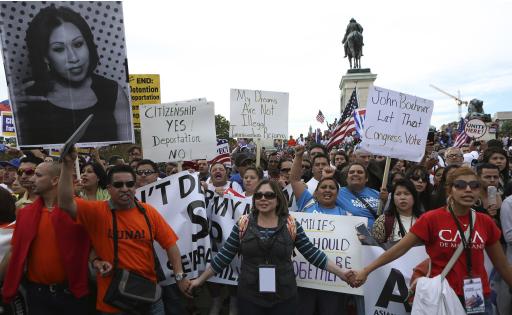
I apologize for the lengthy delay between posts. I was (as I’m sure some of you suspected) busy all last week packing up our survival gear. We sneaked out of town a couple of days ago, leaving at 2:30 AM and staying off the main roads to avoid bands of marauding anarachists. We’re now living in a hidden cabin at a remote location. (Don’t ask where. I’m not telling.) We’ll stay here until the government shutdown is over and we feel it’s safe to rejoin society.
I’ve been monitoring newscasts on my short-wave radio and reading the news online, so I’m not optimistic that we’ll be able to return home anytime soon. According to the last report I saw, the shutdown is so severe, only 83 percent of the federal government is still up and running. I’m not going to expose my young daughters to that kind of chaos. They could be psychologically scarred for life.
None of this was necessary, of course. The current crisis is the result of obstructionism by conservative legislators who refuse to accept the will of the majority on ObamaCare. The obstructionists claim they’re responding to thousands of constituents who are upset over some of ObamaCare’s minor inconveniences, such as having their existing insurance policies canceled by the federal government and being ordered to buy policies costing three to four times as much.
I don’t doubt that a handful of constituents objected to some of the law’s specific language, but as Rep. Nancy Pelosi correctly pointed out, they’re nothing more than anti-government extremists. Good citizens understand that they exist to fulfill the needs of the government. Good citizens understand that the Constitution guarantees the right of the majority to take whatever it deems necessary from the minority. Good citizens understand that our long tradition of prohibiting people from making their own economic decisions is the reason the United States became a great country in the first place. Unfortunately, some people aren’t good citizens, which is why we’re now expected to somehow survive as a society with only 83 percent of the federal government in operation.
Not knowing exactly what the impact of a government shutdown would be, I turned to CNN for an unbiased explanation. I quickly learned that gun permits won’t be processed, thus depriving citizens of the opportunity to obtain federal permission to exercise a right guaranteed by the Constitution. New passports might not be issued, which (as CNN pointed out) could force people planning their first-ever trip to Paris to cancel. Businesses won’t be able to obtain government loans, thus depriving the government of the ability to invest in promising companies like Solyndra. Garbage may not be collected in Washington, D.C. – a city known for producing extraordinary amounts of garbage. But according to CNN, perhaps the biggest impact will be a hit on our collective psyche as Americans.
A hit our collective psyche? That’s the worst CNN could imagine? Apparently CNN didn’t anticipate the anarchy that would follow a shutdown of 17% of the federal government.
I knew it was time to pack the van and head for the hills when I turned on the news and was shocked by the lawless antics of a gang of World War Two veterans. To make sure the public fully grasped that the shutdown had left the government bereft of funds and unable to perform crucial tasks, the government paid government workers to place government barriers in front of the open-air government monument to WWII veterans. As the government explained, government workers had to erect the government barriers to protect the public. I applauded the government’s decision and wished our local government were as prudent. There’s an open-air Civil War monument in downtown Franklin, but we never visit it because there are no government supervisors on duty.
Like most Americans, I expected the World War Two veterans to see the government barriers erected by the government workers to warn the public that there’s no functioning government in place and respond by mumbling to themselves, “I could deal with the Nazi mortars and tanks and grenades and machine guns during D-Day and Operation Market Garden and the Battle of the Bulge, but a wooden barrier? Every man has a limit.” But then the veterans pushed the barriers aside, walked over to the open-air monument and began looking at it — without government supervision. Anarchy had come to the United States of America.
By now, you may be asking yourself, “What does all this have to do with health and nutrition?”
Plenty. According to chatter coming in over my shortwave radio, there’s much more at stake here than just passports and garbage collection in Washington D.C. If the shutdown continues, it will only be a matter of time before the USDA is no longer on active duty. Once the USDA is incapable of handing out subsidies, the price of corn syrup will skyrocket — depriving all but the wealthiest Americans of a primary source of calories. Then, like dominoes falling, the same thing will happen with wheat and soybeans. Farmers might even respond to the lack of subsidies by refusing to continue producing vast surpluses. Vegans on the West Coast are reportedly hoarding soy-based meat substitutes in anticipation of a shortage.
Even if grains remain cheap and readily available for awhile, there’s a real threat that Americans will forget how many of them they’re supposed to eat. Stores and schools have enjoyed a steady supply of USDA MyPlate replicas for a couple of years now, but the plates don’t last forever. Without proper funding, the USDA won’t be able to produce replacements. Eventually, parents and kids will find themselves sitting down for a meal and staring at old-fashioned (read: no guidelines) plates, having no idea what to put on them. Officials in at least one city in the Northeast are preparing to distribute leftover posters of The Food Pyramid as a temporary emergency measure.
The science revolving around health and nutrition could also face an irreversible decline. As the shutdown drags on, fewer and fewer researchers will have access to the government grants that made it possible for them to conclude that Monsanto’s grain products are health food. Many will likely find real jobs during the shutdown, never to return. The generation of researchers still in training can hardly be expected to take their place after seeing how easily a career in government-sponsored nutrition research can be wiped out.
The effects on research are, in fact, already being felt. The next edition of the USDA’s Dietary Guidelines was due to be released in 2015 – just two years away. To meet that deadline, the Dietary Guidelines Committee ought to be hard at work already. But with only 83 percent of the federal government in operation and no end to the shutdown in sight, it’s possible the nation will be deprived of another set of guidelines telling them to eat less fat and more grains.
As the World War Two veterans demonstrated, without a fully-funded federal government, there’s also the possibility of outright disobedience, regardless of what guidelines are available. Realizing that the USDA school-lunch inspectors won’t be visiting anytime soon, rebellious school officials in some Southern states have reportedly begun allowing children to drink whole milk – the type that’s full of arterycloggingsaturatedfat -- instead of USDA-approved skim milk flavored with chocolate and high-fructose corn syrup. There are even reports of kids eating entire meals at lunch that don’t include any grain products.
Those are just a few of the grim scenarios we’re facing, and that’s why Chareva, the girls and I will remain hunkered down in our undisclosed location until the federal government is fully operational again. We miss our home, but the risks of living in a partially-regulated society are too great.
I hope you are all surviving this crisis.


 The
National Security Agency (NSA) and its national security
surveillance state fellow travelers like
Sen. Dianne Feinstein (D-Calif.) and
Rep. John Boehner (R-Ohio) have been propagating the meme that
whistleblower Edward Snowden is a traitor. Not just because he made
public their unconstitutional domestic spying operations, but also
because, they hint, his downloaded data must have fallen into the
hands of the Russian and Chinese spy agencies. Not so, says Snowden
in a
New York Times article today:
The
National Security Agency (NSA) and its national security
surveillance state fellow travelers like
Sen. Dianne Feinstein (D-Calif.) and
Rep. John Boehner (R-Ohio) have been propagating the meme that
whistleblower Edward Snowden is a traitor. Not just because he made
public their unconstitutional domestic spying operations, but also
because, they hint, his downloaded data must have fallen into the
hands of the Russian and Chinese spy agencies. Not so, says Snowden
in a
New York Times article today:

 The matter has been decried
[as] a situation of "zero tolerance" gone overboard. But Hutchinson
says there is no such policy:
The matter has been decried
[as] a situation of "zero tolerance" gone overboard. But Hutchinson
says there is no such policy:


 Why are the likes of Sen.
Dianne Feinstein
Why are the likes of Sen.
Dianne Feinstein 

 Courtesy of Walter Olson of the
Cato Institute and
Courtesy of Walter Olson of the
Cato Institute and 


 During yesterday's
 Right now, most of the problems with Obamacare's
online insurance exchanges are with the signup process,
particularly in the 36 exchanges being run by the federal
government. But there are deeper, more fundamental problems looming
even if the surface web-accessibility problems are largely
fixed.
Right now, most of the problems with Obamacare's
online insurance exchanges are with the signup process,
particularly in the 36 exchanges being run by the federal
government. But there are deeper, more fundamental problems looming
even if the surface web-accessibility problems are largely
fixed.