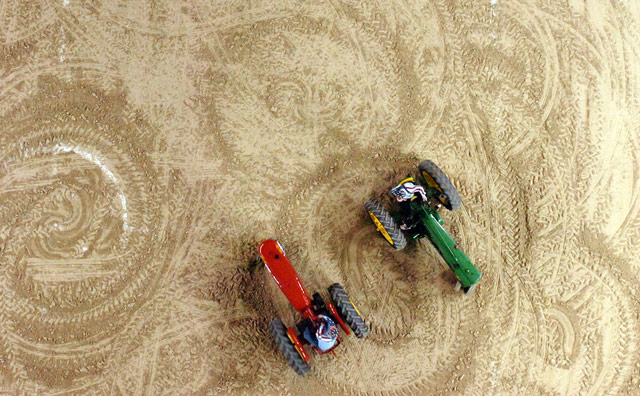
Nothing is more American than tractor square dancing.
The act is exactly what it sounds like. Four seated couples maneuver vintage tractors into daisy chains and do-si-dos in front of a live audience. It would be hard to squeeze more nostalgia into a performance that combines made-in-America machines with our "National Folk Dance."
Click through and check out the embedded video...that is some damn fine precision tractor driving.
Tags: dance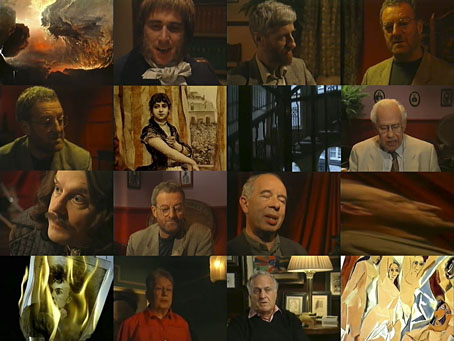
How does this sound? 100 minutes of solidly informative documentary about the use of drugs by artists from the early 19th century on; a production that calls upon a remarkable cast of contributors (see below), with music by David Gilmour, and the whole thing “devised and directed” by Storm Thorgerson, better known as one third of the great Hipgnosis design team.
The Art of Tripping was broadcast in two parts in 1993 during the Without Walls arts strand on Channel 4 (UK). David Gale was the writer, with actor Bernard Hill playing the part of the narrator and guide. The programme managed to deal with a contentious subject without indulging in hysteria or insulting the intelligence of the audience, a rare thing today. Twenty years ago it was still possible to make a documentary about a popular subject without having any low-grade celebrity-du-jour offering their wretched opinion. The contributors here who aren’t medical people are almost all writers of one kind or another; Thorgerson and Gale punctuate the proceedings with a few actors who impersonate various historical figures.
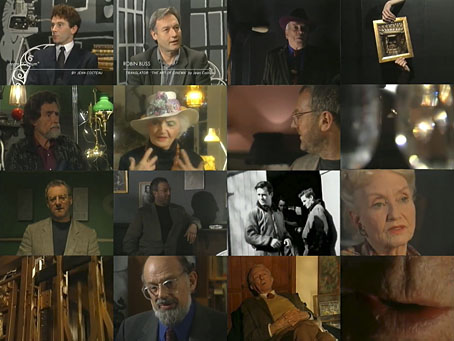
Without Walls was a very good series on the whole but this for me was a real highlight (no pun intended). In addition to it being a rare example of Storm Thorgerson working in television, the direction showed how it was possible to match the theme without recourse to cliché or flashy visuals. There isn’t a single moment of archive footage either. Thorgerson’s history of “socially unacceptable” drugs is structured as a journey through the levels of a multi-storey building, from ground floor to roof; being familiar with the director’s free-associative working methods I can imagine this being a result of thinking about getting high. Bernard Hill encounters the various commentators in successive rooms, each of which is furnished and lit to suggestively imply the drug in question. The use of lighting as a key motif is a smart one, and another metaphor, of course, for literal and symbolic (or spiritual) illumination. Editing effects are also deployed to thematically correspond to the different substances.
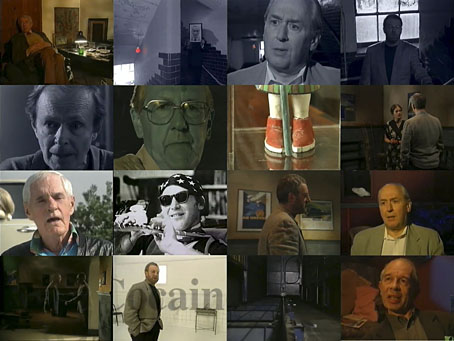
This would be very successful even without a wide range of contributors but Thorgerson and company assembled a stunning array of different writers, many of whom I’d never seen on TV before, and many of whom didn’t turn up again. Some of them fill dual roles, so JG Ballard is on hand to enthuse about Naked Lunch, and appears later talking about his bad LSD trip. Similarly, Brian Aldiss talks about Anna Kavan, and also about Philip K Dick. Below there’s a rough list of the drugs covered and the people involved. In the two decades since this was made many of the people involved have since died, the director included, so the film now has the feel of a historical artefact. The Art of Tripping can be see in full at YouTube. This is how good British television used to be.
Opium
Dr Virginia Berridge (author), Grevel Lindop (author), Marek Kohn (author), Dr EMR Critchley (author), Phil Daniels (as Thomas De Quincey), Dr Tony Dickenson (neuropharmacologist), Dr Ian Walker (author), Thom Booker (as Edgar Allan Poe), Dr Peggy Reynolds (author)
Hashish
Prof John Hemmings (author), Ronald Hayman (author), Patrick Barlow (as Theophile Gautier), John McEnery (as Charles Baudelaire), Jon Finch (as Gérard de Nerval), Bernard Howells (lecturer, King’s College, London), June Rose (author), John Richardson (author), Margaret Crosland (author), Danny Webb (as Jean Cocteau), Robin Buss (translator), David Gascoyne (poet), George Melly (collector, Surrealist art)
Mescaline
Prof Eric Mottram (University of London), Francis Huxley (nephew of Aldous Huxley), Jay Stevens (author), Laura Huxley (widow of Aldous Huxley),
Psilocybin
Brian Cory (as Robert Graves), Paul O’Prey (author)
Marijuana / Nitrous Oxide
Harry Shapiro (author), Carolyn Cassady (author), Prof Ann Charters (author), Allen Ginsberg (poet)
Kief
Paul Bowles (author)
Heroin
JG Ballard (author), Prof Avital Ronell (author), Hubert Selby Jr (author), Brian Aldiss (author)
LSD
Dr Oscar Janiger (experimental psychiatrist), Diana Quick (as Anaïs Nin), Prof Malcolm Lader (psychopharmacologist), Dr Timothy Leary (author), Todd Boyco (as Andy Warhol)
Amphetamine
Lawrence Sutin (author)
Cocaine
Robert Stone (author), Prof. Annette Dolphin (neuropharmacologist)
MDMA
Previously on { feuilleton }
• Storm Thorgerson, 1944–2013
• Hipgnosis turkeys
• Enter the Void
• Opium fiends
• La Morphine by Victorien du Saussay
• In the Land of Retinal Delights
• Haschisch Hallucinations by HE Gowers
• Storm Thorgerson: Right But Wrong
• Demon rum leads to heroin
• The art of LSD
• Hep cats
• German opium smokers, 1900
I wasn't aware of this: snowboarding numbers are down across the board...revenue from snowboarders is down, snowboard visits to resorts are down, sales of gear is down, the number of first-timers under 14 years-old is down, etc.
Tags: snowboarding sportsEach February I experience the unrestrained joy of attending the ski and snowboard trade show in Denver. Here's what I see when I walk the snowboard section: Underage snowboarders puking in the corridors after one too many keg stands-at 10 a.m. And overseeing all this fabricated youthfulness? Fifty-year-old white dudes in flat-brim caps, tight jeans, and designer flannel. Chuckleheads. Leveraging snowboarding's rebel cred, they modeled its image on skateboarding and aimed it almost entirely at teenagers.
That worked great for a while. Then snowboarding went mainstream-the X Games, Mountain Dew ads, Shaun White-and, inevitably, it lost a bit of its mojo. The first generation of riders got real jobs and started having kids, and snowboarding's image never matured to accommodate them.
As snowboarding went narrow, skiing went big. Today's skiers can choose to carve turns, launch off the slopestyle jumps, hammer bumps, navigate steeps, tour the backcountry, rip bottomless pow, race in a beer league, or just go skiing like a vacationer from Chicago or Boca Friggin' Raton. It's cool; there's a place for you and a group of likeminded folks who would love to have you. Cooler still if you're a lifelong enthusiast? Dabble in all the above. Skiing isn't golf; there's always some new adventure waiting for you.
But industrialized snowboarding hates diversity.

Carlos Barahona Possollo | Pelops and Poseidon | oil and gold leaf on wood | 2012
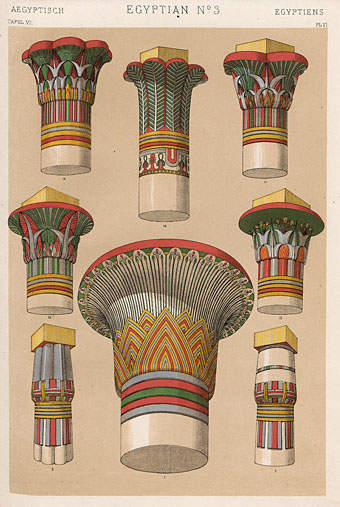
I’ve owned a facsimile of Owen Jones’ study of ornamental design for many years. Jones was an architect who helped in the planning of London’s Great Exhibition in 1851, and in the subsequent development of the Victoria & Albert Museum. The Grammar of Ornament (1856) originated from this work, a lavish guide to the history of ornament through the ages, and from all parts of the world. My facsimile is a large, heavy and unwieldy volume: nice to look at but difficult to use. One of the earliest posts here linked to an online copy but a recent addition to the archives at the University of Heidelberg is better quality, and also much more accessible.
What I’m hoping for now is that someone will do the same for Auguste Racinet’s Polychrome Ornament (1877), a book inspired by The Grammar of Ornament‘s example which is even more lavish. This Flickr set has copies of the plates but when anything at Flickr can be deleted on a whim it’s always better to have an alternative available.
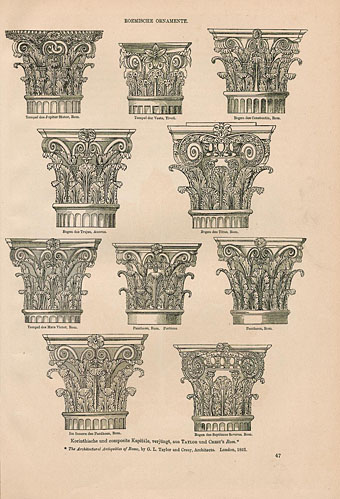
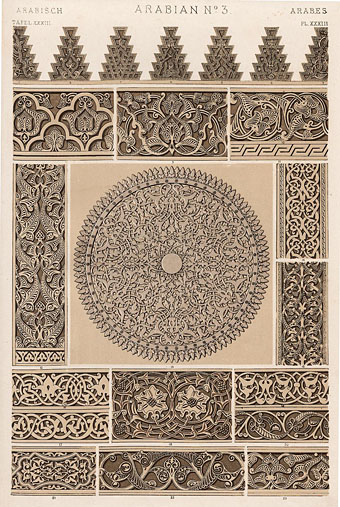
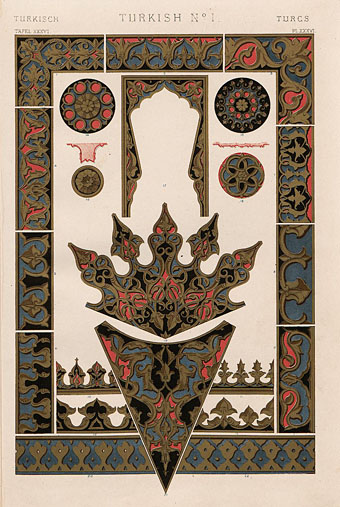
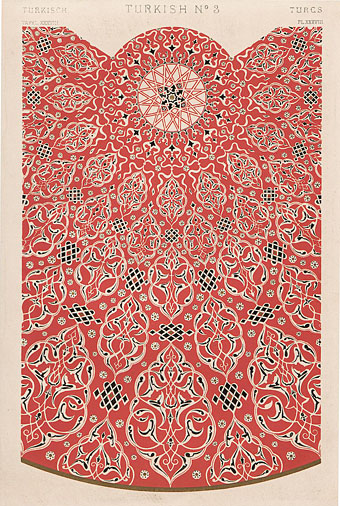
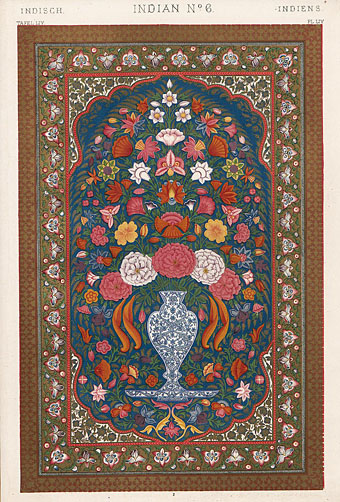
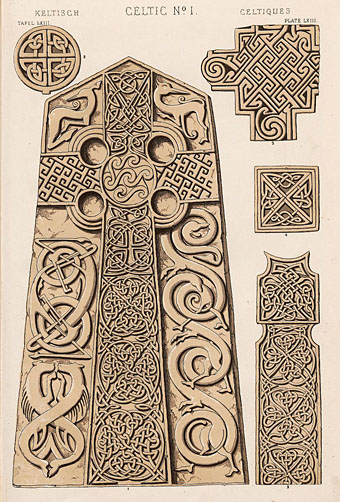
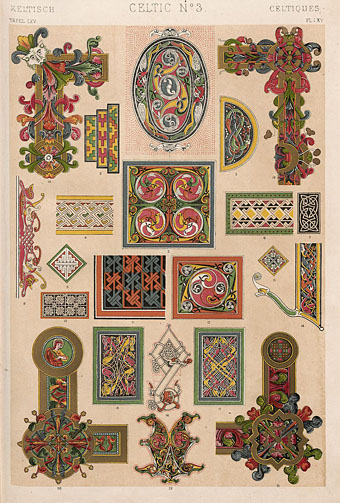

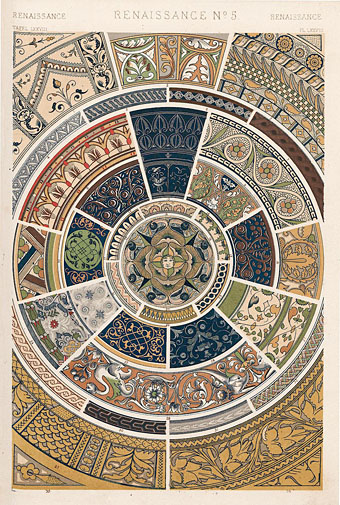
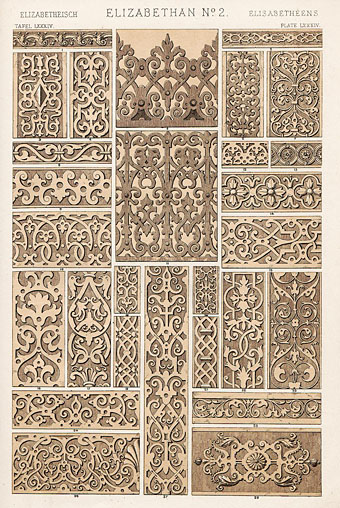
Previously on { feuilleton }
• Dekorative Vorbilder
• Combinaisons Ornementales
• Charles J Strong’s Book of Designs
• Styles of Ornament
• The Grammar of Ornament by Owen Jones



Artist Dennis Hlynsky films birds in flight and then uses After Effects to make their flight paths visible, like the contrails of high-flying jets.
That's only one of several videos...there are more at The Colossal and on Vimeo. Nice example of time merge media. (via colossal)
Tags: art Dennis Hlynsky time lapse videoProperty rights are primarily rights to exclude. If I “own” something, what that means is that it is legitimate for me to exclude others who may wish to use or consume it.
Exclusion, very obviously, carries externalities. My choice to exclude alternate uses of a resource affects those who might have benefited from those uses. By convention, we don’t usually refer to the effects of the exclusion at the core of a property right as an “externality”. One could argue, as is often argued of so-called “pecuniary externalities“, that the effect of property rights on alternative users is the sort of externality that should not be discouraged — because undoing the externality would amount to a mere redistribution rather than a welfare gain, or because the operation of the externality is part and parcel of the process by which the market system functions. But, as with pecuniary externalities, there are devils in details.
The social cost of the excluding alternative uses varies dramatically between resources. A Ferrari, for example, may be a costly and valuable resource, but it is plausible to claim that its owner’s exclusive control does not subject potential alternative users to real deprivation. On the other hand, the exclusive right to commercialize a potentially lifesaving medicine may impose huge costs on potential users deprived of access because a patent owner has chosen not to make a drug available where they live, or has chosen to set an inaccessible price. The new urbanists (Yglesias / Avent / Glaeser ) frequently argue that homeowners’ ability to exclude alternative uses of their neighborhoods (a kind of tacit property right) imposes very large social and economic costs by preventing higher-density alternative use of uniquely situated real estate.
I presume that most ordinary property rights don’t burden alternative users so much as to merit policy intervention. It is wise to simply tolerate very small externalities and address their consequences collectively, rather than create annoyances and transaction costs by trying to impose fine-grained discipline. We don’t tax humans for eating beans, despite the fact that methane is a powerful greenhouse gas.
But for some classes of property, most notably patents and real estate, a tax on the externalities of exclusion might be very sensible. You can frame it as a Pigouvian tax, or alternatively as a kind of user fee that compensates the state for its enforcement of a right to exclude despite external harms. But on what basis should such a tax be collected?
Usually property or wealth taxes are levied against the “market value” of an asset, with the scare quotes particularly appropriate. When property taxes are assessed against real property, some appraisal or estimation has to be made of what is often an entirely hypothetical value. Assessment procedures are vigorously contested and frequently reflect social and political concerns unrelated to the question of what a property “would” sell for. Patents are extraordinarily specialized and illiquid assets. Any bureaucratic value assessment would be a farce.
There is, of course, a much easier way to gauge what a property would sell for: Solicit from its owner a price.
The price at which an owner would be willing to sell a thing has a particularly valuable characteristic. It limits the burden to alternative users of the exclusion in a property right. If the price is set low, a user harmed by exclusion can simply purchase the thing and have at. If the price is set high, alternative users may be seriously burdened yet be unable to buy access.
So, for the sorts of exclusion that do impose substantial burdens to alternative users, a natural policy intervention would be to require property owners to declare a price at which they commit to sell the property (for some period of time), and levy a tax of some legislatively determined percentage against that actual, actionable price, rather than a hypothetical market value. Property owners could pay as much or as little tax as they choose. When they set their price, they face a trade-off, between the risk of being undercompensated for losing the asset if the price is too low, and an exaggerated tax burden if they set a price so high that the risk of sale is negligible or the required overcompensation extreme. The owner is free to choose how much she values certainty of continued ownership, but she must pay for that.
The price set by the property owner might constitute an option to buy for all comers, or just for the state. (I’m not sure which would be best. What do you think?)
This sounds very dry and complicated, but ultimately it’s a simple and natural scheme. Suppose that a drug company invents a cure for a rare tropical disease that could cure thousands in the developing world but only hundreds domestically. It might well be the case that the profit-maximizing commercialization strategy would be to make the drug available at a very high price domestically, but not sell it cheaply in poor countries, to prevent reimportation from cannibalizing sales. As long as the tax rate is material, the drug company would try to set its price no higher than the discounted value of domestic profits, less the discounted cost of the new tax. However, since the social value of the drug if the patent were not used to exclude is much higher than that market value of the profits, governments and nonprofits could pool funds to buyout the patent. In theory, this can happen already — governments and nonprofits could band together and negotiate with drug companies to buy out patents. But the coordination costs of that are very high, and once interest has been signalled the patent owner has every incentive to hold out for a price very near the drug’s social value, which is much higher than the market value it would otherwise have realized. A tax on enforcement of exclusion would force all patent holders to decide a value and precommit to a price without the negotiating advantage of knowing they have a captive buyer. Of course, if a company thinks a public-interest buyout is very likely, it might set its price high in hopes of earning a windfall gain from a sale. But there are limits to that strategy unless a swift buyout is certain. The cost in overpayment of taxes and the risk that a buyout won’t actually happen increases with the level at which the price is set.
Firms will set a dear price on patents with such high and unique social value that a prompt buyout is inevitable. But as long those patents are genuinely for new, nonobvious inventions — admittedly a weak point! — that’s arguably a feature, as the scheme creates incentives that don’t now exist for firms to develop goods with high social value but low market value. At present, there is no functioning market in public-interest sales of patents. Instead, firms understandably avoid high-social-value, low-market-value projects. Given the negotiating realities and political perceptions surrounding licensing or sale of patent rights to the public sector, the prospect of a high payout is offset by risks of outright expropriation and public relations catastrophes.
Urban property is another domain where the externalities associated with enforcing exclusive property rights are arguably very large. Suppose a developer or a city government believes that a neighborhood is horrifically underutilized, and wants to redevelop it at high density. Under this proposal, every parcel in the neighborhood would have a prearranged price. The developer (with or without a requirement of political buy-in) could plan to buy the lots she needs and those of near-neighbors with effective veto power, and then do with them what she will. As with patentholders, for most homeowners the best strategy would be to set the price at the actual value that would compensate them for the loss of the house and the trouble and heartache of eviction from their home (which might be a lot!), less the discounted cost of expected taxes. As with patents, some homeowners might strategically try to set very high prices in hopes of a windfall buyout, but again, that’s a costly and self-limiting strategy, unlikely succeed except in very rare cases where some parcel is so unique that alternative development plans that exclude it cannot compete. A real problem here is that this scheme would disadvantage property owners so cash poor they cannot afford any substantial taxation, who might set prices below what would actually compensate for the loss of property. But then these property owners have a hard time paying existing property taxes too. That devil would live in the detail of arranging the actual tax burden.
Just what should the tax rate on stated price be? Should it be a flat or progressive? I don’t know. Maybe some clever modeling can be done to try to elucidate the issues. Qualitatively things are pretty clear: the higher the tax rate, the more costly it will be to enjoy the rights of exclusion that come with property ownership. That’s already true with any sort of property tax. This new sort of property tax simply gives the owner the right to pay the tax in cash or in risk of being forced into a sale. A low tax rate, especially the status quo zero tax rate for patents, is very comfortable for property holders. It encourages people to set an infinite “sticker price” and so force potential buyers to reveal themselves as needful in bespoke negotiations. A high tax rate would be less comfortable. Owners would be forced to either pay up for the right to exclude or bear real risk that their property will be bought-out for a higher value use. In each domain — patents, real estate, whatever — legislators (or city councilpersons) would have to balance the social benefits associated with certain and inexpensively maintained property ownership, the social costs of excluding high-value alternative uses, and of course revenue requirements.
There are more radical, arguably better, solutions to problems created by socially costly exclusive use of real or intellectual property. But within the confines of incremental, neolibbish ideas, I think this one merits some consideration.
This proposal owes something to a recent conversation with Leigh Caldwell (@leighblue), the king of prices. The good ideas are his. The crappy ones are mine.
Related — elsewhere:
Update History:
"The activities of the painter, designer, illustrator, and constructivist, Vladimir Lebedev, encompass a very broad period: from the early 1910s through to the early 1960s, and, consequently, his stylistic [oeuvre] connects with many different trends and avenues of inquiry. In fact, Lebedev started his artistic career as a graphic designer when he was only 14 years old by designing postcards for the Fietta Art Store on the Bolshaia Morskaia in St. Petersburg (his home town); and only a few years later he was already a prolific illustrator of popular and children's magazines[..]
Consciousness of the material of the work (the ink, the print, the lightness of the paper, the brilliant color of the poster's chromolithography) is [..] a condition that unites the various artistic experiences and concerns of Lebedev's career. For example, Lebedev's activity as a caricaturist for the St. Petersburg satirical journal, 'Novyi Satirikon' (New Satyricon) might seem to be quite contrary to his experimental compositions for the posters that he designed for Okna ROSTA (the display windows of the Russian Telegraph Agency) just after the Revolution.
Chronologically, no more than two years divide these different endeavors since Lebedev began to work for 'Novyi Satirikon' in 1913, intensifying his contributions in 1917-18, while in 1920 he was already invited to participate in the Petrograd Okna ROSTA. Visually and stylistically, the two collaborations are very different, but, nevertheless, they both derive from a single sense of the integrity and inner logic of the graphic materials being employed."
['A Public Art: Caricatures and Posters of Vladimir Lebedev' by Nicoletta Misler IN: The Journal of Decorative and Propaganda Arts, Vol. 5, Russian/Soviet Theme Issue (Summer, 1987), pp. 60-75.]
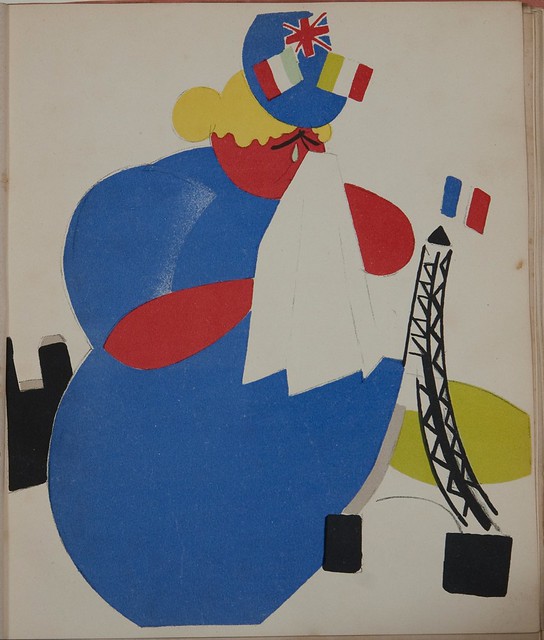
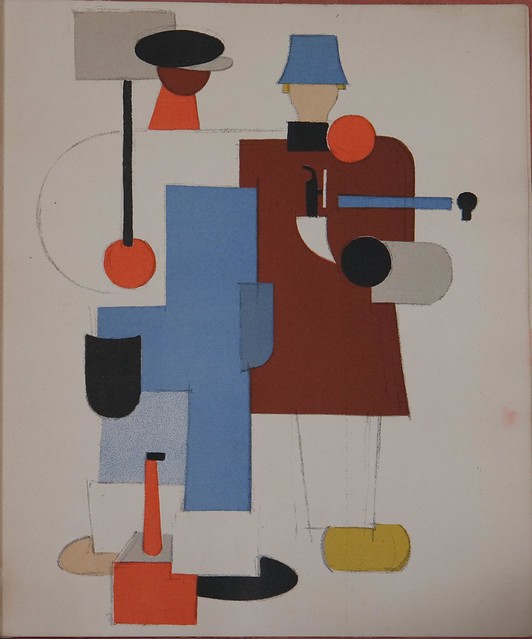
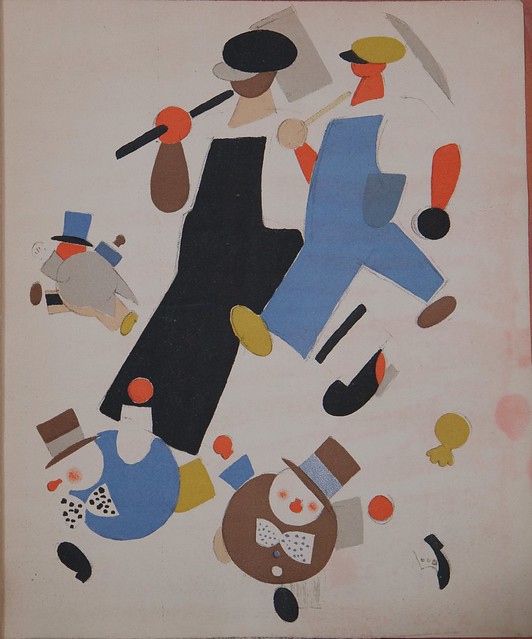
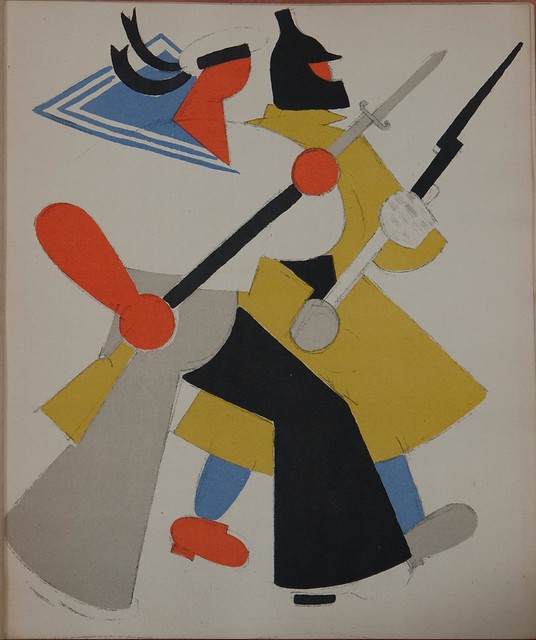
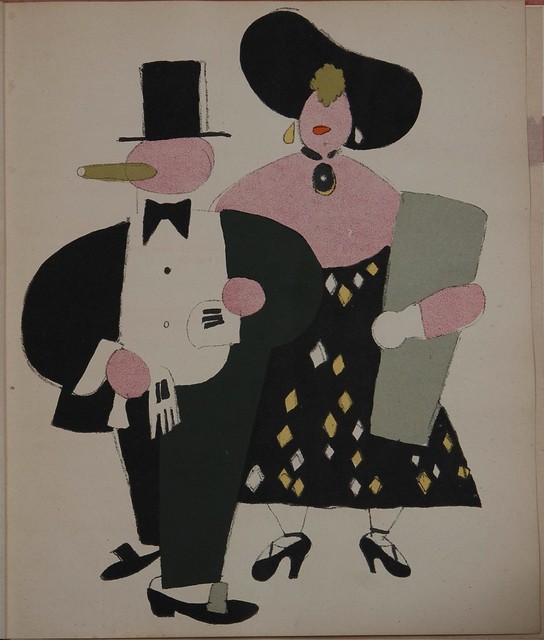
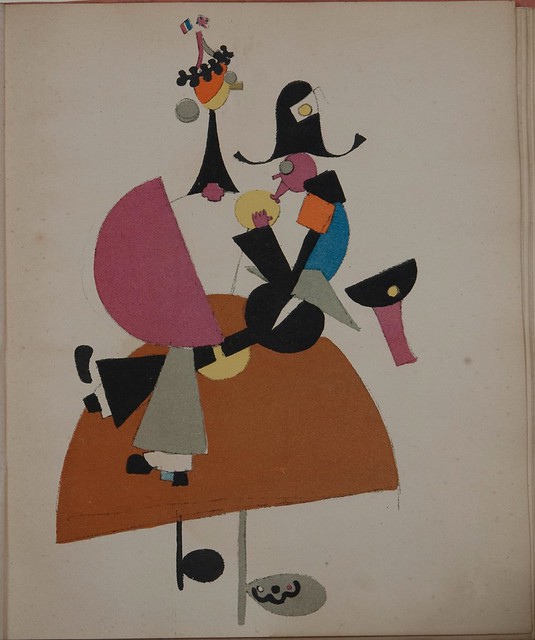
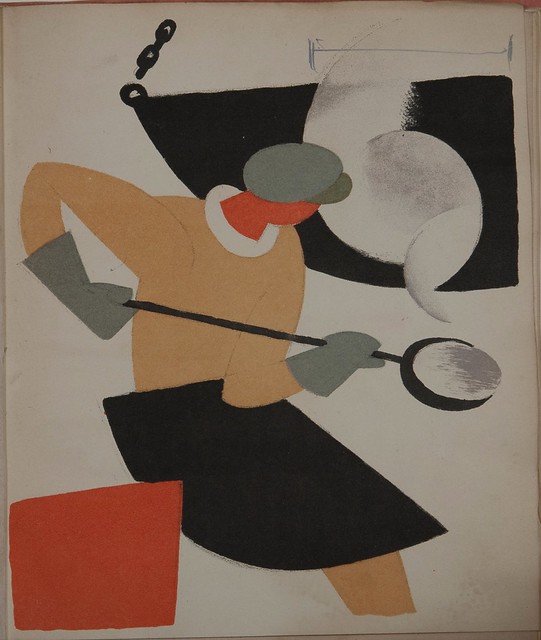
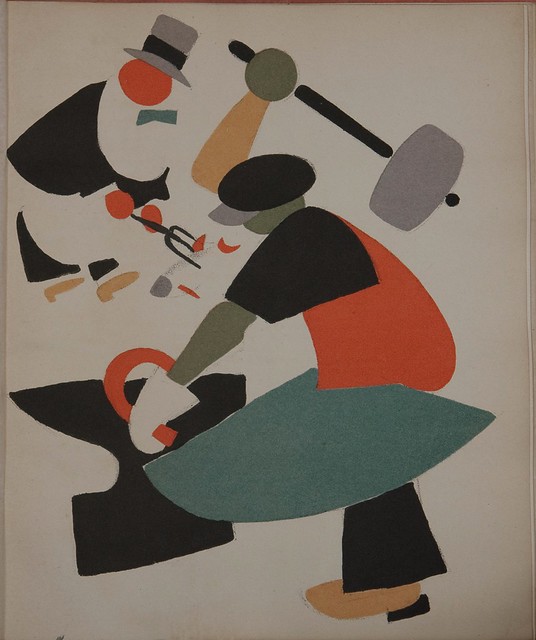
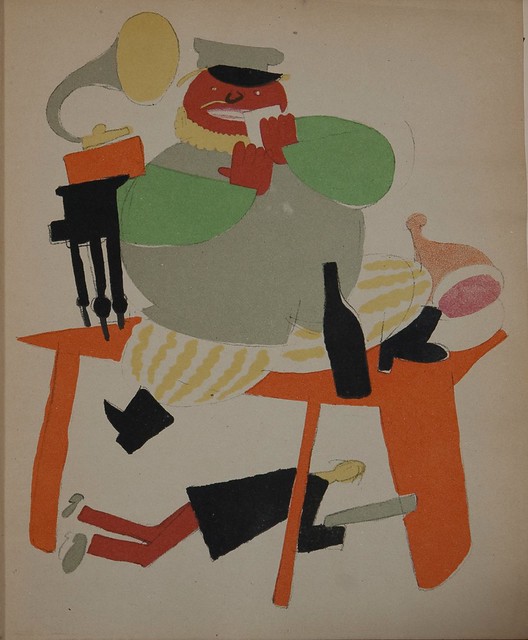
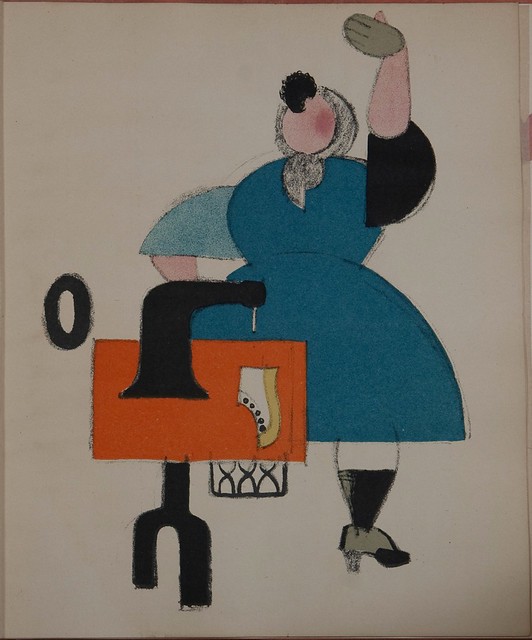
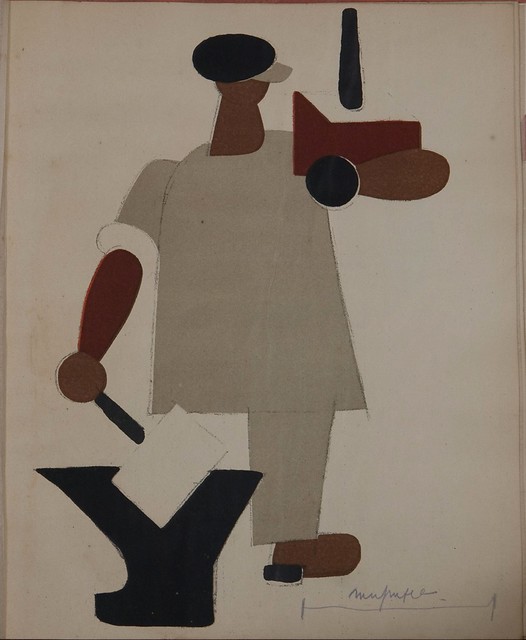
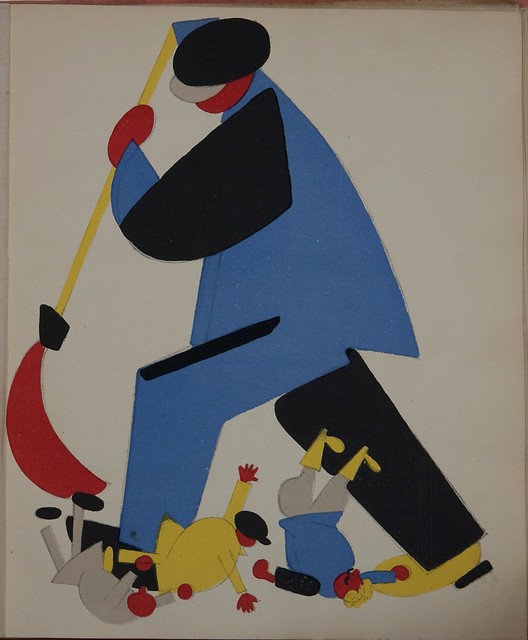
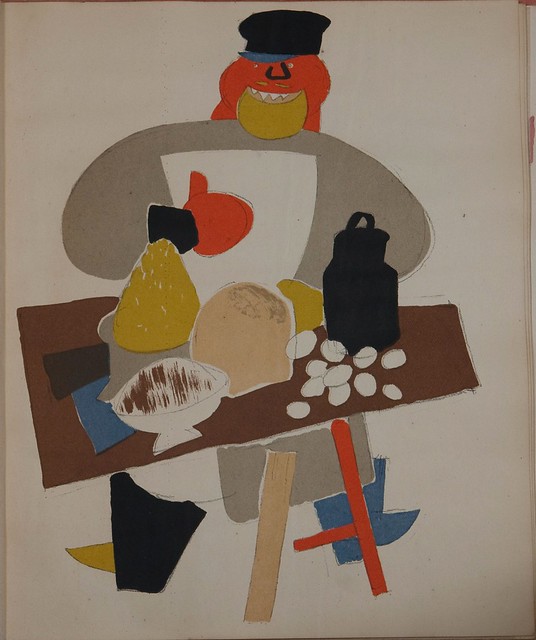
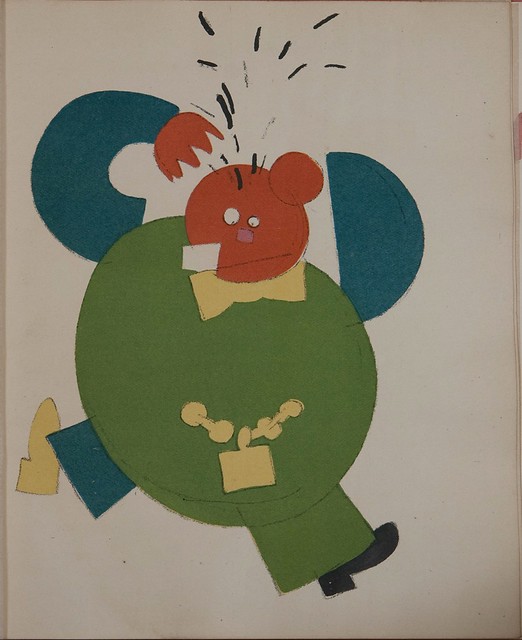
"In contradistinction to the satirical drawings of 1913-18, which, basically, still derive from the Decadent culture of the European and Russian Fin de Siècle, the ROSTA posters of 1920-22
rely on different external stimuli. These examples of "public art" are organized according to the juxtaposition of simple colored masses floating against the white background of the paper, i.e., they depend upon a much more abstract and austere formal arrangement for their effect.
True, some of the ROSTA posters are also satirical and caricatural, but they are very different from the drawings in 'Novyi Satirikon'. For many reasons, they signalled a turning point in Lebedev's artistic biography, and it is not by chance that they evolved after his encounter with cubism."
['A Public Art: Caricatures and Posters of Vladimir Lebedev' by Nicoletta Misler IN: The Journal of Decorative and Propaganda Arts, Vol. 5, Russian/Soviet Theme Issue (Summer, 1987), pp. 60-75.]
This is from W.V. Quine’s “intermittently philosophical dictionary,” Quiddities. (See earlier.)
Altruism is the main stem of morality and the primary concern of moral principles. The landlady says of her student lodgers that they are good boys, while knowing full well that they gamble, curse, drink, drive to endanger, and consort with loose women. What does she mean? Just that they are reasonably altruistic.
Altruism ranges from a passive respect for the interests of others to an active indulgence of their interests to the detriment of one’s own. It ranges from the barely erogatory on the one hand to the supererogatory on the other. What can be said for it?
Proponents of the moral order have long sought to heighten the persuasiveness of moral precepts by appealing to reason. A primitive but familiar argument invoked a myth of divine decrees enforced by sanctions, which consisted usually of reward or punishment after death. The myth itself was not sustained by any appeal to reason whose cogency we are apt to certify, but, granted the myth, the argument by appeal to it was indeed a rational argument to the effect that moral behavior is in one’s own interest.
Another familiar argument from self-interest is that we are all better off if we all respect one another’s interests. The fallacy is familiar too: any one of us may be even better off by infringing on another’s interests, if the rest of society behaves properly. The weakening of the fabric occasioned by the one man’s deviation is unlikely to harm him appreciably in his lifetime. Police and punishment are our way of redressing the balance by bringing further self-interest to bear.
Might we say then that self-interest does offer a rational warrant for altruism once we have instituted police and punishment? No, for two reasons. One, the penal code demands only erogatory altruism, leaving the supererogatory untouched. Second, self-interest condones even some unaltruistic cheating at the erogatory level, when the cheat sees his way to eluding police and punishment.
The enlightened moralist thus recognizes that self-interest, however enlightened, affords no general rational basis for altruism. Altruists are simply persons who prize the welfare of others outright and irreducibly, just as everyone prizes [their] own.
Some moralists feel that this lack of a rational justification on the basis of self-interest is a threat to morality. I say that such a justification would have been unworthy anyway, smacking of the venal and the sordid. Let virtue be its own reward.
We must simply recognize that there are drives other than self-interest, and admirable ones. Ethologists represent some altruistic drives as innate in man and other animals, and they explain them by natural selection as ways of safeguarding the gene pool through the protection of kin. But [humanity's] altruism is not always as abundant as we could wish, nor are arguments from self-interest the way to increase it. The way rather is to play on whatever faint rudiments of fellow-feeling [we] may be capable of, fanning any little spark into a perceptible flame. Try the formative years for best results.


An interesting Science News story (I’ve added italics and a link):
English speakers struggle to name odors. While there are words such as blue or purple to describe colors, nothing comparable exists to name odors. Even with familiar everyday odors, such as coffee, banana, and chocolate, English speakers only correctly name the smells around 50% of the time. This has led to the conclusion that smells defy words. Majid and Burenhult present new evidence that this is not true in all languages.
Majid and Burenhult conducted research with speakers of Jahai, a hunter-gatherer language spoken in the Malay Peninsula. In Jahai there are around a dozen different words to describe different qualities of smell. For example, ltpɨt is used to describe the smell of various flowers and ripe fruit, durian, perfume, soap, Aquillaria wood, bearcat, etc. Cŋɛs, another smell word, is used for the smell of petrol, smoke, bat droppings and bat caves, some species of millipede, root of wild ginger, etc. These terms refer to different odor qualities and are abstract, in the same way that blue and purple are abstract.
…Majid and Burenhult found that Jahai speakers could name odors with the same conciseness and level of agreement as colors, but English speakers struggled to name odors. Jahai speakers overwhelmingly used abstract Jahai smell words to describe odors, whereas English speakers used mostly source-based descriptions (like a banana) or evaluative descriptions (that’s disgusting).
I don’t know how convincing it is, but it’s certainly suggestive, and it’s the sort of thing I like to see linguists looking into.
Addendum. Charlotte Mandell (see this post) sent me this link to Robert Kelly interviewing poet Anne Gorrick about some long poems she’s written “that seem to have grown from a profound engagement with scents, perfumes, the chemistry of attraction and repulsion”; she says “I think it’s funny that we can all agree on what we see, what we hear, what we taste and feel. But not necessarily on what we smell. It’s as if we don’t have the language yet for the sense of smell, but we’re working on it.” There’s a lot of interesting stuff about how we react to smell. Thanks, Charlotte!
Pencil portraits of young men and women incarcerated on Rikers Island by Ricardo Cortés.

Cortés wrote an essay about the portraits and his experience at Rikers.
The grossest irony is that increasing levels of imprisonment may exacerbate the very problems it is intended to solve. Imagine a drug-dealer, a check forger, a prostitute or a burglar who comes to Rikers. They're often leaving family behind, possibly as the primary breadwinner, breaking up a critical support network and causing measurable damage to spouses, siblings, parents and especially children. They're losing a job during their incarceration, thus falling further behind in bills, rent, and ultimately housing. They're being released after their stay with little treatment or prospects for a new job; their completed sentence may stain their record such that it's even harder to find employment. And they're back on the street with the same personal struggles of addiction, domestic abuse, health issues and difficulty in finding sustainable housing and legal employment. It's not hard to guess what happens next.
(via @jessicalustig)
Tags: art crime prison Ricardo CortesI’m a little late getting to this, but check out Stan’s Introducing Indo-European Jones over at Sentence first:
…Jonathon Owen replied that he wished he’d been given a “leather jacket, bullwhip, and fedora” upon graduation, James Callan said he wanted to see an “Indiana Jones pastiche focused on a linguist”, and I felt it was a meme waiting to happen. So without further ado, let me introduce Indo-European Jones (or Indy for short).
It’s a lot of fun (“Nothing shocks me … I’m a linguist!”), and you can add to the meme yourself; he links to the blank image he used.
John CostelloUntil concussions turn their brains into swiss cheese.
Michael Lewis made the case in The Blind Side that football players are the smartest in sports because the game is complex and moves fast. For the New Yorker, Nicholas Dawidoff takes a look at what makes a football player smart.
Tags: football Michael Lewis NFL Nicholas Dawidoff sportsThe Redskins' London Fletcher is undersized and thirty-eight years old, but he's been able to play for so long because he is a defensive Peyton Manning: seeing the game so lucidly, yelling out the offensive play about to unfold, changing alignments before the snap, organizing the field in real time. Similarly, Lavonte David, who has been with the Tampa Bay Buccaneers for two years, is just two hundred and thirty-four pounds -- ten to fifteen pounds lighter than most at his position -- the Wonderlic scores out on the Internet for him are not especially high, and, like all players, he makes the occasional boneheaded play. But he possesses dedicated study habits and a football clairvoyance that, come Sunday, finds him ignoring the blocking flow only at the one moment during a game when the offense runs the ball away from it.
The Hall of Fame Minnesota Vikings defensive lineman Alan Page weighed two hundred and forty-five pounds, the dimension of a modern fullback. Even so, Page was terrifying. His forty-yard-dash time wasn't anything special, either, but he says that he could run down faster opponents because he always had sense where he was in relation to the blur of bodies around him-he could "understand the situation." Page is now an Associate Justice on the Minnesota Supreme Court. "Being a football player requires you to take your emotional self to places that most people shouldn't go," he said. "You wouldn't want to get to know the person who was in my head on a football field. I likely see some of these people in my current job -- those who can't control that person -- and they do not very nice things."
I asked him, "You could control that person on a field?"
"Most of the time," Page said.
The safety, standing at the rear of the defense, must compensate for the mistakes of others; football intelligence matters more at this position than any other on the defense. At five-eight, a hundred and eighty-eight pounds, the Bills safety Jim Leonhard, a nine-year veteran, is among the smallest and also the slowest starting defensive backs in the game. And yet, watching him on film, he appears to teleport to the ball. Leonhard's name seems to enter any conversation about football intelligence; he knows every teammate's responsibilities in every call, and understands the game as twenty-two intersecting vectors. "He'd walk off the bus and you'd think he was the equipment manager," Ryan Fitzpatrick said. "He's still in the league because he's the quarterback of the defense."
Amy Parker grew up with super health-conscious parents who provided her with a healthy diet and active lifestyle. But they also didn't vaccinate her and she was sick all the time as a kid.
As healthy as my lifestyle seemed, I contracted measles, mumps, rubella, a type of viral meningitis, scarlatina, whooping cough, yearly tonsillitis, and chickenpox. In my 20s I got precancerous HPV and spent six months of my life wondering how I was going to tell my two children under the age of 7 that Mummy might have cancer before it was safely removed.
This is the part that really gets to me: Parker wasn't vaccinated but was given so many antibiotics for her childhood illnesses that she became immune to them! [Hair-tearing-out noise]
My two vaccinated children, on the other hand, have rarely been ill, have had antibiotics maybe twice in their lives, if that. Not like their mum. I got so many illnesses requiring treatment with antibiotics that I developed a resistance to them, which led me to be hospitalized with penicillin-resistant quinsy at age 21 -- you know, that old-fashioned disease that supposedly killed Queen Elizabeth I and that was almost wiped out through use of antibiotics.
Update: Slate has corrected the passage above, taking out the part about Parker's resistance to antibiotics. It now reads:
My two vaccinated children, on the other hand, have rarely been ill, have had antibiotics maybe twice in their lives, if that. Not like their mum. I got many illnesses requiring treatment with antibiotics. I developed penicillin-resistant quinsy at age 21 -- you know, that old-fashioned disease that supposedly killed Queen Elizabeth I and that was almost wiped out through use of antibiotics.
People do not develop antibiotic resistance, microorganisms do. I regret the idiotic error and tearing out my hair. (thx @chrismize)
Tags: Amy Parker medicine vaccines


On New Year’s Day
Bless this my house under the pitch pines
where the cardinal flashes and the kestrels hover
crying, where I live and work with my lover
Woody and my cats, where the birds gather
in winter to be fed and the squirrel dines
from the squirrel-proof feeder. Keep our water
bubbling up clear. Protect us from the fire’s
long teeth and the lashing of the hurricanes
and the government. Please, no foreign wars.
Keep this house from termites and the bane
of quarreling past what can be sweetly healed.
Keep our cats from hunters and savage dogs.
Watch with care over Woody splitting logs
and mostly keep us from our sharpening fear
as we skate over the ice of the new year.
Marge Piercy
(first published Akros, No. 4, Spring 1981)
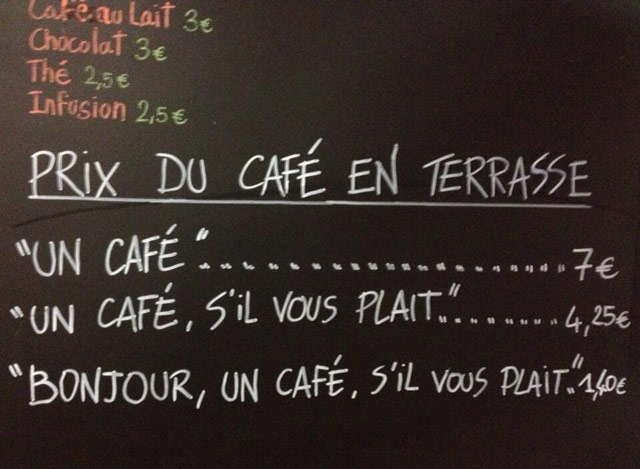
A cafe in Nice, France charges rude customers five times more for a cup of coffee than those who say hello and please.
"A coffee" will set you back €7, according to the sign, while "a coffee please" is a little more affordable, at €4.25.
If you want keep your expenses down, and stay friends with your local barista, however, the best option is "Hello, a coffee please," which will only cost you €1.40.
The manager says that although the pricing scheme has never been enforced, customer civility is up. Cheekiness is on the rise as well:
"Most of my customers are regulars and they just see the funny side and exaggerate their politeness," he said, adding "They started calling me 'your greatness' when they saw the sign."
(via eater)
Tags: economics food FranceJohn CostelloPutting up the Three-fingered-fox-signal on this one.

From popsci.com:
Data interpreter/designer Terrence Fradet created this lovely interpretation of colors through the filter of language. At the Fathom Information Design site, he has a more expansive history on color and language, but this is a short version.
Some languages explain the entire color spectrum in two or three words–eschewing everything except maybe “light” or “dark”–while others might classify more than 60 relatively obscure colors. The World Color Survey is a global database of color names and interpretations, and Fradet mined this data for his infographic. The results are grouped by geographic area and show the most-used words nearest to the center, reaching out to the most obscure variations at the end.
Of course one wishes there were more languages — maybe even a couple of familiar ones for comparison — but man, what a gorgeous thing. Click on the image to see it up close, hit the hyphen key to pull back.
In a clip from Eye of the Leopard narrated by Jeremy Irons, we see a female leopard kill a baboon. And then the leopard notices the baboon has just given birth to a tiny baby. Her reaction is unexpected:
Tags: Jeremy Irons videoFrom a blog about the science of dogs, a comparison of photos of purebred dogs from 1915 to those of today. You can see how much the dogs have changed in just under 100 years, in some cases for the worse. For instance, the difference in the Bull Terrier (aka the Spuds MacKenzie dog) is marked and a bit disturbing:
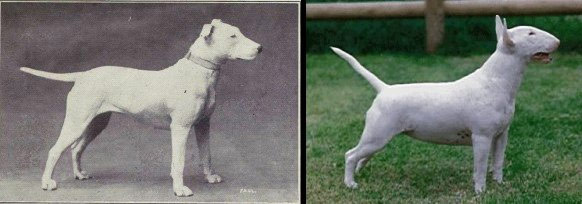
Pure breeding has also introduced medical problems for some breeds.
The English bulldog has come to symbolize all that is wrong with the dog fancy and not without good reason; they suffer from almost every possible disease. A 2004 survey by the Kennel Club found that they die at the median age of 6.25 years (n=180). There really is no such thing as a healthy bulldog. The bulldog's monstrous proportions makes them virtually incapable of mating or birthing without medical intervention.
(via @mulegirl)
Tags: biology dogs genetic scienceJohn CostelloAttn: Nat.

John CostelloDavid Sedaris always grated on me.
A few weeks ago, David Sedaris had a piece in the New Yorker about his recently deceased sister Tiffany.
In late May of this year, a few weeks shy of her fiftieth birthday, my youngest sister, Tiffany, committed suicide. She was living in a room in a beat-up house on the hard side of Somerville, Massachusetts, and had been dead, the coroner guessed, for at least five days before her door was battered down. I was given the news over a white courtesy phone while at the Dallas airport. Then, because my plane to Baton Rouge was boarding and I wasn't sure what else to do, I got on it. The following morning, I boarded another plane, this one to Atlanta, and the day after that I flew to Nashville, thinking all the while about my ever-shrinking family. A person expects his parents to die. But a sibling? I felt I'd lost the identity I'd enjoyed since 1968, when my younger brother was born.
On Wicked Local Somerville, a close friend of Tiffany's lets Sedaris have it with both barrels:
I found David Sedaris' article, "Now we are five," in the Oct. 28 New Yorker to be obviously self-serving, often grossly inaccurate, almost completely unresearched and, at times, outright callous. Some of her family had been more than decent, loving and kind to her. "Two lousy boxes" is not Tiffany's legacy. After her sister left with that meager lot, her house was still full of treasures.
And this:
Not only could Tiffany have been saved, she could have blossomed. While her friends had done pretty much all they could, at least half of her mental health issues stemmed from, or were exaggerated by, her poverty and unstable housing situation, but also from David's occasional mockery of her in his writings.
(thx, matt)
Tags: David Sedaris