Shared posts

29 Jun 18:41

Classical music needs to grow listeners not audiences

by Pliable

Dumbed down classical music has joined Top Gear on the list of British cultural exports. State broadcaster Radio France, which includes classical station France Musique among its seven national networks, has appointed Mathieu Gallet as its new president, and he has not been slow to import dumbing down from across the Channel. In a press interview M. Gallet has declared: “It’s not acceptable in Paris, for example, that the audience for France Musique is 1.2% compared with 3.5% for [commercial owned] Radio Classique," and promised he would “make a larger place for music and less for musicology". This despite the error of such thinking having been dramatically demonstrated by his broadcasting colleagues in Britain. Giving new audiences classical music without showing them how to listen doesn't make sense. Which explains why listening figures for classical radio - state and commercial stations combined - in the UK has plunged by 10.7% over twelve months. BBC Radio 3 and Classic FM chased audiences but lost listeners.

Despite this, efforts to reach new audiences continue to concentrate on changing the way classical music is presented - informal dress, applause between movements and now, more music and less musicology - with no effort at all devoted to changing the way audiences listen. Which is completely wrong: classical music needs to grow listeners, not audiences. One of the few people to understand this is composer and visionary Pauline Oliveros who is seen above. She is the founder of Deep Listening Institute; here is a description of Deep Listening from the Institute's website:
There’s more to listening than meets the ear. Pauline Oliveros herself describes Deep Listening as “listening in every possible way to everything possible to hear no matter what one is doing.” Basically Deep Listening, as developed by Oliveros, explores the difference between the involuntary nature of hearing and the voluntary, selective nature – exclusive and inclusive -- of listening. The practice includes bodywork, sonic meditations, interactive performance, listening to the sounds of daily life, nature, one’s own thoughts, imagination and dreams, and listening to listening itself. It cultivates a heightened awareness of the sonic environment, both external and internal, and promotes experimentation, improvisation, collaboration, playfulness and other creative skills vital to personal and community growth. Plus it’s a ton of fun.
With a piano in most homes, music education used to be about teaching people how to play an instrument. Now with classical music available to everyone via the internet, the focus should have shifted to teaching people how to listen. But it hasn't. In fact it has shifted the other way, to embrace the doctrine preached by Roger Wright at the BBC and Mathieu Gallet at Radio France of increasing availability at the expense of understanding. Which is foolish. Because audience data has shown time and time again that the key to the future of classical music is not changing the way it is presented - it is changing the way people listen.

Techniques such as Deep Listening are part of that change. John Cage - who was a major influence on Pauline Oliveros - spoke about 'cleaning the ears of the musically educated', an imperative that, in an age when music education has been replaced by music access, can be reappropriated as 'cleaning the ears of the musically conditioned'. Classical music must learn much from the ear cleaning exercises of Canadian composer, environmentalist, writer, and music educator R. Murray Schafer, and from his pioneering work on acoustic ecology - the relationship, mediated through sound, between living beings and their environment. Mathieu Gallet and and the rest of the dumbing down movement have it completely wrong. Classical radio does not need more music, it needs better listeners. And that will only happen through more understanding. Lutenist Hopkinson Smith had it exactly right when he said that classical music needs 'virtuoso audiences'.

Header photo comes via Art F City. Any copyrighted material on these pages is included as "fair use", for the purpose of study, review or critical analysis only, and will be removed at the request of copyright owner(s). Also on Facebook and Twitter.
27 May 19:32

The scars of war

by Jason Kottke

Speaking of WWI, the landscape of the Western Front in Europe still shows the scars from the war 100 years on.

WWI trenches today

Tags: photography   war   WWI
26 May 19:17

100 Views of a Drowning World

by Geoff Manaugh
[Image: Kahn & Selesnick, courtesy Yancey Richardson].

I've mentioned the work of artists Kahn & Selesnick before; their surreal narratives are illustrated with elaborately propped photos that fall somewhere between avant-garde theater and landscape fiction, with mountain glaciers, salt mines, alien planets, utopian cityscapes, and, as seen here, the slowly flooding marshes of an unidentified hinterland.

[Image: Kahn & Selesnick, courtesy Yancey Richardson].

These images are from a new project, called Truppe Fledermaus & The Carnival at the End of the World, that opened at New York's Yancey Richardson gallery last week. "Utilizing photography, drawing, printmaking, sculpture and performance," the gallery writes, "the artists create robust mythic realities for each project, building imaginary, character-driven fictions from kernels of obscure historical truth."
Kahn & Selesnick’s latest project follows a fictitious cabaret troupe—Truppe Fledermaus (Bat Troupe)—who travel the countryside staging absurd and inscrutable performances in abandoned landscapes for an audience of no one. The playful but dire message presented by the troupe is of impending ecological disaster, caused by rising waters and a warming planet, the immediate consequences of which include the extinction of the Bat, in this mythology a shamanistic figure representing both nature and humanity. In one sense, the entire cabaret troupe can be seen as a direct reflection of the artists themselves, both entities employing farce and black humor to engage utterly serious concerns.
The particular scenes shown here, all on display until July 3, 2014, are from a sub-series within the project called "100 Views of a Drowning World."

[Image: Kahn & Selesnick, courtesy Yancey Richardson].

Eccentric residents of a drowning landscape live lives indistinguishable from absurdist stagecraft, as they wander through seemingly wild landscapes that are actually ruins and that will eventually all disappear beneath the deceptively placid tidal flats flowing around them.

[Image: Kahn & Selesnick, courtesy Yancey Richardson].

These anonymous coastal dwellers simulate a nature that is already artificial—a kind of maritime grotesque of overgrown animal forms and humans buried beneath ropes and seaweed—and they set off on doomed expeditions through terrains whose original inhabitants have long been forgotten.

[Image: Kahn & Selesnick, courtesy Yancey Richardson].

Lone figures in boats look out into what will soon be sea, attempting to navigate land as if it is already an ocean.

[Images: Kahn & Selesnick, courtesy Yancey Richardson].

And others attempt to escape into some new strain of Romanticism, witnesses of large-scale terrestrial change who know that this moment on the Earth is rare—though not unique—for the extraordinary transitions that lie over the horizon.

[Image: Kahn & Selesnick, courtesy Yancey Richardson].

In the end, then, the idea is not that these characters' actions somehow represent or propose a new humanist response to climate change, or that the artists are offering us any sort of practical or ethical insight into what futures might face us in a drowned world, but that these absurd rituals and dreamlike antics instead simply illustrate "a world that is sinking into a marsh."

It is, as the show's title suggests, just a carnival at the end of the world.

[Image: Kahn & Selesnick, courtesy Yancey Richardson].

The Yancey Richardson gallery is on W. 22nd Street, over near the High Line; be sure to stop by before July 3. Here is a map and here are more images.
25 May 22:58

2 years of All Things Linguistic

Thursday marked the second anniversary of All Things Linguistic. Since I post daily and so much has happened since then, I have a LOT of favourite posts! Here are some of them. 

Explaining things: 

Writing systems: 

More technical: 

Debunking myths: 

Accents and Dialects: 

Pronouns: 

General Fun:

Outreach: 

Internet linguistics: 

Many things on because x: where it probably came from, why it’s not a preposition, when it won Word of the Year, and when I talked about it on CBC Spark

What makes an effective synonym for Benedict Cumberbatch? (my first article for The Toast)

The grammar of doge for The Toast, from which came this quote post (which currently has just over 13.7k notes, what?). The French doge example and why no one knows how to say “doge” were fun too, as of course was talking to the BBC about it

Assorted other internet linguistics:

Series: the protolinguist series was mostly last year, although the master post came up this year. This year I also started the linguistics jobs series, which is a still-ongoing collection of resources and interviews

Looking forward to another year with you all! 

25 May 22:55

George Maxwell, Colorado River irrigation and the “Asiatic menace”

by jfleck

When I first ran across the rantings of George Maxwell as the Colorado River Compact was being developed in the 1920s, their racism seemed almost comical. Here he is in a written submission to the 14th Meeting of the Colorado River Commission, Nov. 13, 1922 (pdf from University of Colorado):

The flood menace must not be used as a ‘stalking ox’ behind which to conceal a plan to create an Asiatic Menace in Mexico more dangerous by far to the United States of America than the original flood menace.

As between the submergence of the Imperial Valley by floods and the devastation of Southern California and Arizona in an Asiatic War, the loss of the Imperial Valley would be the lesser of the two evils.

Maxwell’s fear was that any water allowed to pass into Mexico would be used in the development of an “Asiatic” irrigation colony that would be used as a beachhead for an invasion of the United States. Here’s historian Eric Boime:

By 1923 his long, meandering letters to former acquaintances at the U.S. Geological Survey, sometimes spaced only twenty-four hours apart, fretted about “Asiatic cities” at the head of the Gulf of California, capable of launching “a fleet of aeroplanes [sic] with poison gas enough to wipe out the population of southern California some morning before breakfast.”

George Maxwell, picture courtesy Arizona State Library

George Maxwell, picture courtesy Arizona State Library

This is not just some crazy old racist. George Maxwell was a pioneer of the reclamation movement, one of the authors of the key legislation that brought federal policy and money to bear on the Colorado River. I’m intrigued by Maxwell because in the years after the 1922 approval of the Colorado River Compact, he was enormously influential in Arizona, persuading state officials not to ratify the compact – a stand that continues to echo in contemporary water management.

Boime, in his fascinating essay “Beating Plowshares into Swords”: The Colorado River Delta, the Yellow Peril, and the Movement for Federal Reclamation, 1901–1928 (Pacific Historical Review Vol. 78, No. 1, February 2009, paywalled) points out that Maxwell died penniless and ignored. But what I did not realize until I read Boime was the remarkable racial underpinnings of the early reclamation movement. The story of reclamation’s aspirations to social engineering has been often told – the way an empire of 160-acre farms would lure Americans from urban decay into an idyllic pastoral future, one family at a time. What I’d not previously understood was the rich, full racism of the vision.

Here, for example (as quoted in Boime) is the Imperial Board of Supervisors in a 1919 Congressional hearing:

“If we build an all-American canal, we will have [thousands of] free, prosperous Americans building homes and schoolhouses on land watered by water that has never touched a foreign soil and water that . . . Japs and Chinese have not used to bathe in.”

And here is Boime’s description of the views of no less a reclamation luminary than Elwood Mead, who headed the Bureau of Reclamation during the historic construction of the dam at Boulder Canyon (they named a big reservoir after him):

Mead perceived industrious, upwardly mobile Japanese to be the greatest menace to American rural life. If, in fact, Anglo-Saxon family farmers were the key to revitalizing the nation’s institutions, non-Anglo-Saxon family farmers would be the source of their ruin. Japanese agricultural success, Mead asserted, stemmed from “ancient, alien instincts” that would surpass the “American individualist [like] child’s play. . . . Anglo-Saxons and Mongolians cannot live side by side,” he argued, “and neither will give way to the other without a conflict.”

So yeah, George Maxwell may have been batshit crazy at the end (“aeroplanes with poison gas”) but his views on irrigation and race were not terribly far from the mainstream of his day.

Biographical background on George Maxwell from the Arizona State Library.

23 May 01:09

Phrasebooks for the Silk Road.

by languagehat

The International Dunhuang Project has an enjoyable post about phrasebooks “popular with travellers on the Silk Routes in the first millennium AD”:

For example, Pelliot chinois 5538 is a scroll with a series of phrases in Sanskrit and Khotanese, on the general theme of pilgrimage. Some of the phrases form conversations, like the following:

And where are you going now?
I am going to China.
What business do you have in China?
I’m going to see the bodhisattva Mañjuśrī.
When are you coming back?
I’m going to China, then I’ll return.

The conversations also cover practical matters:

Do you have any provisions for the road?
I do not like my provisions.
I’ll go with one or two horses.

There are more examples and a short bibliography if you want to learn more.

And while we’re on the subject, Christopher Culver has a post on “Guides to little-known languages from the French publisher L’Harmattan”; if you read French and have any interest in little-known languages, you’ll want to bookmark it: “If you are interested in the Finno-Ugrian or Turkic world, you can enjoy Yves Avril’s Parlons komi or Saodat Doniyorova’s Parlons karakalpak. The best (well, usually the only) guides to West African languages are written in French, and L’Harmattan covers this part of the world with such titles as Parlons baoulé (Ivory Coast), Parlons éwé (Togo) and Parlons mooré (Burkina Faso).” (Book links at Culver’s post.)

22 May 23:04

North Korea is really dark

by Jason Kottke

Back in January, an astronaut on the International Space Station took this photograph of the Korean Peninsula, which shows the stark difference in nighttime light levels in North Korea compared to the neighboring countries of South Korea and China.

Dark North Korea

I remember seeing a satellite photo several years ago, thought it was fake, then heard it had been photoshopped to accentuate the darkness, and dismissed the whole thing as a hoax. I can't believe the whole country is that dark. (via in focus)

Tags: North Korea   photography
17 May 02:36

Jeune et Jolie (2013) – Taking Your Sexuality Off-Grid

by Jonathan McCalmont
John Costello

"Firstly, while Jeune et Jolie works beautifully with a female character, the film was originally conceived with a male protagonist in mind. The reason for this is that Ozon reportedly wanted to make a film about adolescence as a period in which one feels bold and considered having this boldness manifest itself in a boy’s rejection of hetero-normativity and desire to sleep with older men. This phantom alternate version of the film invites comparisons between the journeys of straight women and gay men when they both choose to move beyond middle-class sexual mores but it also poses the question of how different cultures perceive sex work."

JJ1Art house film has always had a problematic relationship with female sexuality. Though art house directors are far more likely to construct their films around strong female characters than their Hollywood counterparts, their engagement with these characters’ sexualities is often limited to stripping an actress naked and posing her in a series of titillating tableaux such as those found in Abdellatif Kechiche’s Palme D’Or winning film Blue is the Warmest Colour. The further a female character ventures from the realms of male fantasy, the more likely it is that her sexuality will be turned against her and used as a sign of encroaching madness, alienation or spiritual collapse. In art house film, sad men may become murderers but sad women will always become prostitutes.

The tragedy of problematic narratives is that they frequently outlive the social attitudes that first informed them. For example, while the films of Luis Bunuel may have been informed by the remnants of his Jesuitical education, the phrases and characters he helped to develop in films like Belle de Jour passed into common usage and came to form part of the basic vocabulary of art house film. Used and revisited for decade after decade, the character of the fallen woman is now so familiar to art house audiences that directors no longer feel the need to spell out why promiscuous women are sad women… they just show us a female character having loads of sex and allow us to fill in the blanks. We have been trained through repetition and this training followed us out of the cinema and into our daily lives meaning that, without ever having been subjected to an argument about the evils of promiscuity, our first reaction to promiscuous women is to assume that there is something terribly wrong with them.

The alternative to allowing our culture to train us is to question the values embedded in stock cinematic phrases and champion works that set out to subvert stock phrases and use them to draw our attention to the sexism and racism that is perpetuated by our own intellectual laziness. Thankfully, while the 2013 Cannes jury was content to give the biggest prize in art house film to a work that presented sexually empowered women as hollow vessels and childlike victims, another director in competition set out to pick a fight with the myth of the fallen woman. The director in question is Francois Ozon and his film is Jeune et Jolie.


JJ4


The opening half of Jeune et Jolie is a maze of tired and sexist cinematic phrases. Set in one of those archetypal French holiday homes where kids enjoy enormous amounts of freedom while their attractive parents serve dinners at long tables and then relax amidst wine and cigarettes, the film revolves around a teenaged girl named Isabelle (Marine Vacth). Young, beautiful and yet somehow unworldly, Isabelle approaches her burgeoning sexuality with a surprising level of emotional detachment. We see her flirting with boys on the beach and we see her lining up a beautiful German boy as the one to take her virginity but when asked by her mother if she’d like to invite the German boy to dinner, Isabelle replies that he’s too much of a cunt. When the German boy tries to spend time with Isabelle outside of their date, Isabelle is cold to the point of outright hostility. This was not about summer romance but about satisfying a physiological need. To drive this message home, Ozon cuts to Isabelle reciting a poem about love with a gloriously dead-eyed expression.

Once back in Paris, Isabelle puts her details on a dating site and begins having sex with a string of older men who are only too happy to pay her for her time. While some of these men are sweet and others are terrifying, Isabelle keeps making dates and getting fucked for reasons that are never made entirely clear. Ozon shoots these sex scenes with an affectless eroticism that perfectly captures Isabelle’s impassive expression. We know that she is meeting with these men and that she is enjoying the sex, but we do not see happiness on her face. We know that these scenes are shot in a way that embraces the male gaze, but they are not in the least bit titillating. Vacth’s languid expression combines with the detached cinematography of Pascal Marti to conjure a veil of ambiguity that demands to be drawn back: What is Isabelle getting out of these sordid encounters? Does she need money? Is she unhappy? Is she actually enjoying them?


JJ2


Halfway through the film, Isabelle is having sex with one of her older lovers when his heart gives out. Terrified, Isabelle grabs her money and runs away only for the police to track her down. After confronting Isabelle’s mother with proof that her daughter has become an underage sex worker, the police search Isabelle’s room and find a huge stash of unspent money along with her online details and proof of the full extent of her activities. Horrified, shamed and confused, Isabelle’s mother uses violence and emotional pressure to force Isabelle to explain herself but when the girl refuses to show much contrition, they enlist a psychiatrist who also fails to elicit much of an emotional response. The closest Isabelle gets to breaking down is shedding a single tear over the old man who died beneath her… she cries because he was nice.

The film’s third beat is nothing less than a vicious assault on the myth of the fallen woman. Having spent half an hour establishing the extent of Isabelle’s sexual activities, Ozon systematically dismantles all of the received cinematic wisdom about why a woman would become a sex worker: Isabelle was not abused, she was not beaten, she was not mistreated, she was not in need of money, she was not addicted to drugs, and her emotional reactions to things are entirely normal. Isabelle is not a fallen woman, she is a woman who is in complete possession of her own sexuality and sleeps with older men for no reason other than because she enjoys it. She is a young woman who knows precisely what it is that she is doing.

After being discovered, Isabelle endures the attempts at parental discipline and the absurd reactions of older women who suddenly treat her as a threat to their marriages. Allowed out of the house by her parents, Isabelle goes to a party where she allows herself to be seduced by a very sweet young man from school. Initially, this relationship goes quite well and Isabelle’s parents embrace the young man to the point where they are happy to have him sleep over in their daughter’s bed. However, while Isabelle maintains that she quite likes the young man, she also recognises that a typical teenage relationship is not for her and so she casually dumps him and drifts back to the Internet. This plot development allows Ozon to attack another great unspoken shibboleth of European art house film, namely that everything will be alright as long as you limit yourself to the demands of bourgeois culture. Isabelle dumping her well-meaning boyfriend is reminiscent of the ending of Jean Renoir’s Boudu Saved From Drowning where the shambolic tramp is ‘saved’ from drowning and set on the path to middle-class bliss only to abandon this life by jumping in the water in heading for freedom. By transferring his attack from the myth of the fallen woman to the myth that everyone yearns to be middle class, Ozon is recognising that these myths are used to police female sexuality and that neither of them stand up to close scrutiny.


JJ5


The film ends with a magnificent scene in which Isabelle meets with the widow of her favourite lover. Played by Charlotte Rampling, the widow relaxes into an impassive expression similar to that of Isabelle. Dismissive of middle-class myths, the widow explains that she learned to accept her husband’s infidelities in much the same way as she would the personal failings in any person she loves. She then goes on to say how she envies Isabelle’s courage and wishes that she had followed through on her fantasies of having meaningless sex for money when she still could. As with Isabelle, these are not the words of a depressed or fallen woman but the words of a person who has come to terms with their sexuality and come to realise the oppressive limitations of our culture’s sexual mores. Isabelle responds to the widow’s advances and seems more than happy for the pair to have sex but the widow leaves before this happens. A rejection of middle class attitudes to sex does not necessarily entail a rejection of heterosexuality, but it certainly makes that option available to those who feel that way inclined.

There are a couple of interesting biographical details to note about the creation of this film:

Firstly, while Jeune et Jolie works beautifully with a female character, the film was originally conceived with a male protagonist in mind. The reason for this is that Ozon reportedly wanted to make a film about adolescence as a period in which one feels bold and considered having this boldness manifest itself in a boy’s rejection of hetero-normativity and desire to sleep with older men. This phantom alternate version of the film invites comparisons between the journeys of straight women and gay men when they both choose to move beyond middle-class sexual mores but it also poses the question of how different cultures perceive sex work.

Secondly, while the debate surrounding gay marriage has focused our attention on GLBT people who conform to bourgeois expectations and choose to settle down into more-or-less monogamous relationships, there are corners of the gay community that resent the idea that the increasing acceptance of homosexuality has come at the price of marginalising the people who have never felt comfortable in relationship structures developed to suit the needs of breeders. As a gay man, Ozon would doubtless have been aware of this tension not least because Jacques Nolot (one of his long-term cinematic collaborators) has devoted his directorial career to exploring the hinterlands of non-bourgeois LGBT relationships. For example, in La Chatte a Deux Tetes Nolot took what could have been a bleak or titillating film about a porno cinema and turned it into an examination of a space in which the normal laws of desire and emotion appear to be suspended… except of course that the cinema invariably follows you home. In Avant Que J’Oublie, Nolot explores the aftermath of a long-term gay relationship and the tensions between the legally protected family of the deceased and the friends and lovers who had both supported the deceased and thrived on his generosity.

One of the most depressing things about the rise of YA and the infantilisation of cinematic spaces is that while films aimed at young people naturally focus upon youthful relationships; the range of relationships on display is ridiculously narrow. How many films position their characters in love triangles and conclude with the main protagonist realising that they love one character more than another and agreeing to spend the rest of their lives with them? These types of complaints are now the lifeblood of Tumblr but while I am extremely sympathetic to the complaint that mainstream film and TV fail to reflect the diverse nature of human sexuality, I am resistant to the idea that this problem can be solved simply by including more LGBT characters or including the odd bisexual character in an otherwise heterosexual love triangle.


JJ6


In The History of Sexuality, Michel Foucault argues against the idea that European society has a tradition of repressing sexual matters and denying the existence of alternate sexualities. In fact, Foucault suggests that post-Reformation European society has been absolutely obsessed with sex because of the widespread belief that understanding the truth of sexuality will help us to understand the truth about human nature. What people often construe as expanding our understanding of human sexuality is actually little more than expanding the number of pigeonholes that people can be forced into. For Foucault, the impetus behind these mapping expeditions is not more freedom or less repression but greater power as such taxonomies invariably wind up being used by the state in much the same way as racial taxonomies are used to persecute the racially impure and psychiatric taxonomies are used to persecute epistemological dissenters. Even if we allow that Western states are unlikely to start shipping asexual people off to re-education camps, the ambiguities of categorisation are evident in Facebook’s recent decision to offer their users fifty different gender-related categories. On the one hand, this type of recognition must feel empowering to people identifying with non-conventional gender categories but is Facebook really interested in empowering its users or in obtaining ever-more precise data that could then be sold on to advertisers?

Foucault ends The History of Sexuality by arguing that the desire for accurate sexual categories is born of the desire to understand and thereby control human life. While these state and corporate-sanctioned identities may legitimise people’s needs and desires, the process of legitimisation cuts both ways as it is impossible to label oneself without also making oneself subject to the social expectations associated with that label. Jeune et Jolie is a fascinating and important film as it explores the binding nature of human sexuality and how even middle-class straight women can feel the weight of social expectation the second they step outside the narrow boundaries of the socially acceptable. The great thing about Jeune et Jolie is not just that it shows a young woman exploring her sexuality on her own terms, it is that it allows that exploration to happen whilst fully accepting the uncertainty, ambiguity and impermanence that lurks at the heart of human sexuality. Jeune et Jolie pointedly refuses to diagnose Isabelle and in so doing reminds us of the possibility of living free of even self-imposed social expectation.


Filed under: Art House, Film, French Film, Ozon
13 May 04:33

Creation clip from Noah

by Jason Kottke

This was one of my favorite scenes the film...Russell Crowe's Noah telling his children the creation story, which ends up being half supernatural and half evolution.

Worth watching for the special effects alone.

Tags: Darren Aronofsky   evolution   movies   Noah   religion   Russell Crowe   video
12 May 06:36

Gould's Birds of Asia

by peacay
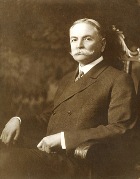
"[John] Gould (1804–1881) [photo], one of the most prolific ornithological artists of the 19th century, had a romantic enthusiasm for winged creatures, as well as a passion for natural history and an impulse to catalog. Drawing on his outstanding scientific and artistic talents, he embarked on a series of projects that would eventually make him the leading publisher of ornithological illustrations in Victorian Britain. Gould’s unparalleled career spanned five decades, during which he produced a series of books depicting birds from all over the world." [source]
The images below were sourced from the first two 
volumes of Gould's seven volume series on Asian birds.


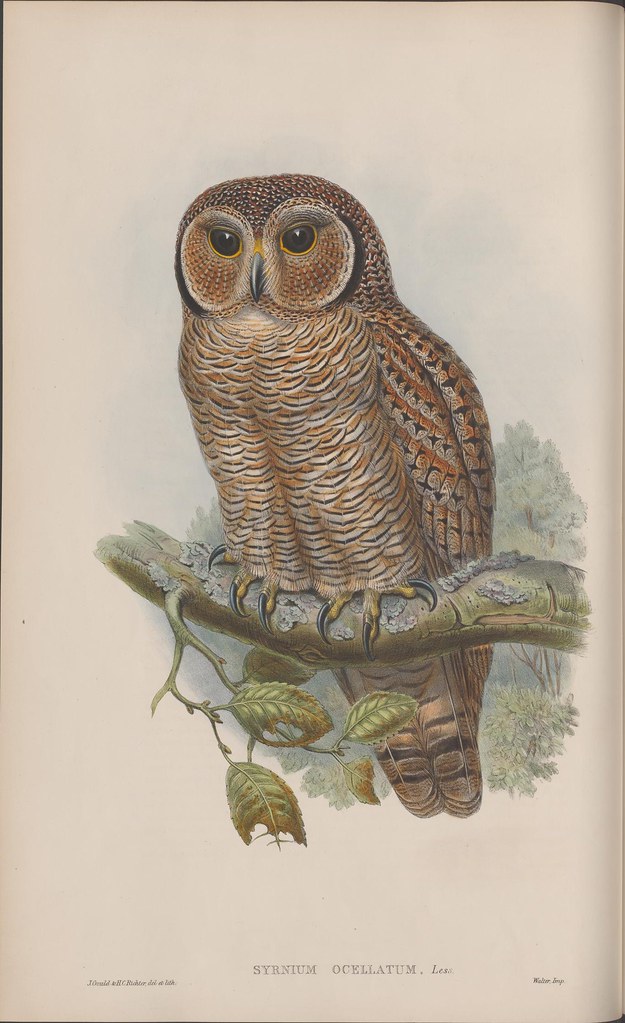
Gould natural history lithograph of owl on partial branch
species name: Syrnium ocellatum
common name: Mottled Wood-Owl
locale: NW India [info]


SE Asian owl sketch by John Gould 19th century
Phodilus badius
Oriental (or: Asian) Bay Owl
SE Asia [info]


two blue/black birds, one in flight, above the other resting on a branch: drawn by John Gould
Sitta formosa
Beautiful Nuthatch 
Bhutan, Bangladesh, Burma [info]


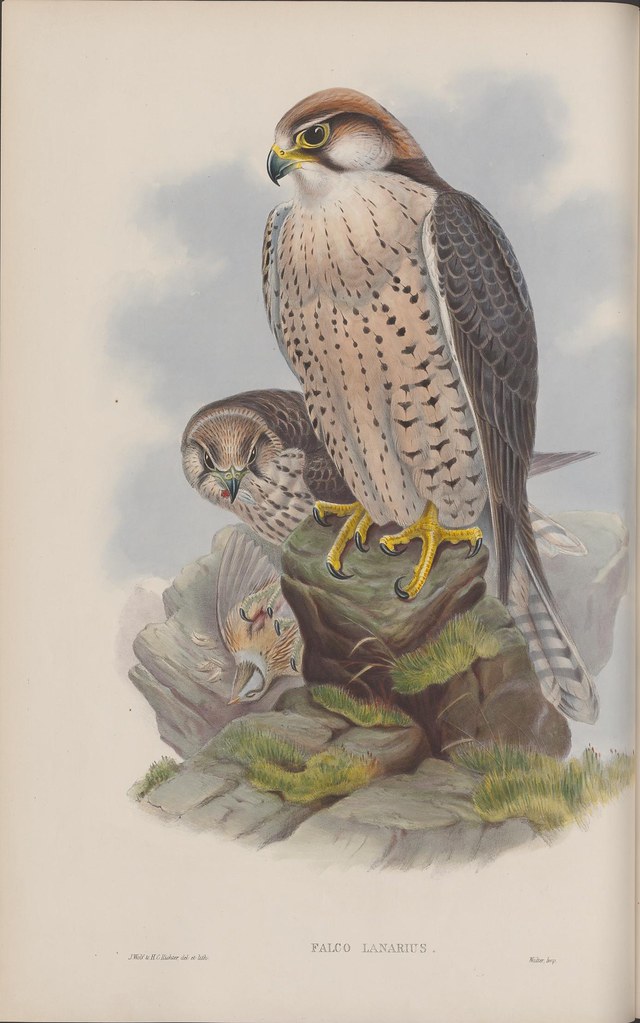
lithograph of an upright falcon on a rock with a hunched mate alongside - 19th century ornithology book illustration
Falco lanarius (deprecated)
Now: Falco biarmicus
Lanner Falcon
"breeds in Africa, southeast Europe and just into Asia" [info]


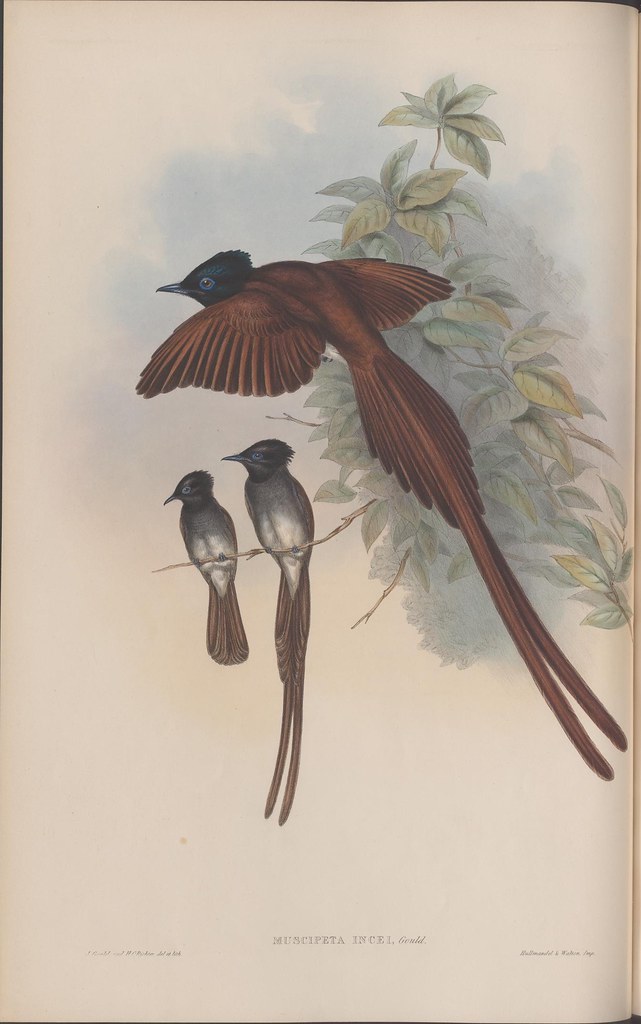
litho of 3 brown, long-tailed birds: 2 on a branch, one flying : 1800s science book colour sketch
Muscipeta incei (deprecated)
Now: Terpsiphone paradisi
Asian Paradise Flycatcher
Malaysia, Burma, India [info]


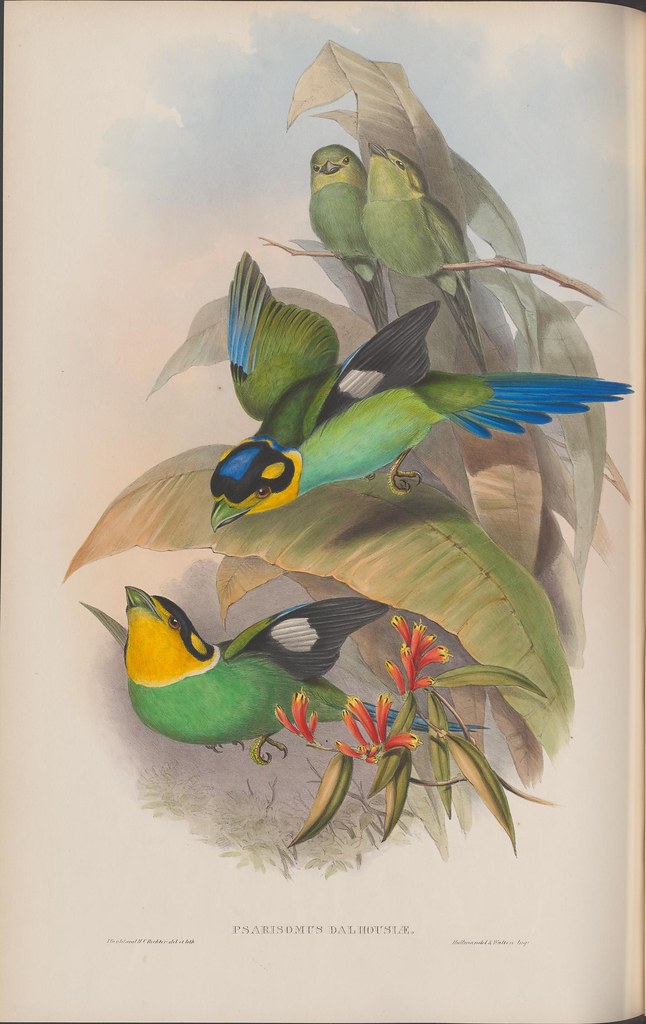
Psarisomus dalhousie
Long-Tailed Broadbill
SE Asia, India, Himalayas [info]


trio
Eurylaimus ochromalus
Black and Yellow Broadbill
Malaysia, Indonesia, Thailand [info]


drawing of bright yellow-orange bird on branch with purple flower
Oriolus broderipi (deprecated)
Now: Oriolus chinensis
Black-Naped Oriole
Phillipines, SE Asia, India [info]


2 blue birds with yellow plumes and body markings in branch - lithograph 1800s
Melanochlora sultanea
Sultan Tit
Nepal, Burma, Thailand, Malaysia [info]


Harpactes hodgsoni
Harpactes hodgsoni (deprecated)
Now: Harpactes erythrocephalus
Red-Headed Trogon
India, Nepal, Bhutan & SE Asia [info]


lithograph of blue/brown/green kingfisher sitting on a rock with a lizard in its beak
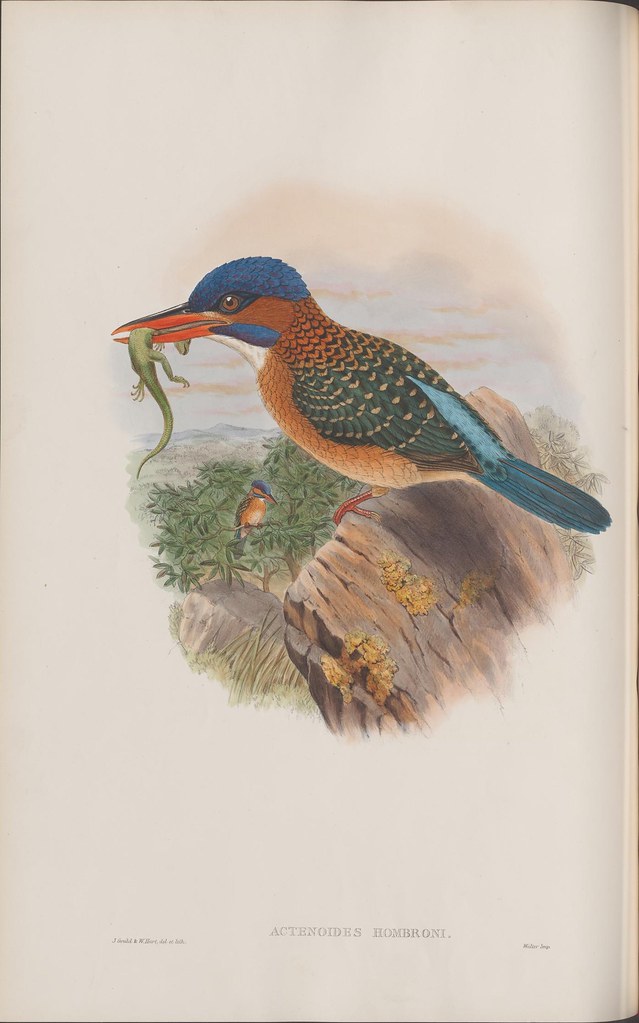
Actenoides hombroni
Hombron's (or Blue-Capped) Kingfisher
Mindinao Island, The Philippines [info]


Halcyon omnicolor
Halcyon omnicolor (deprecated)
Now: Todiramphus chloris (best guess)
Collared Kingfisher
Asia, Australasia [info]


upright grey & blue Asian bird on a tree stump in book illustration 1800s
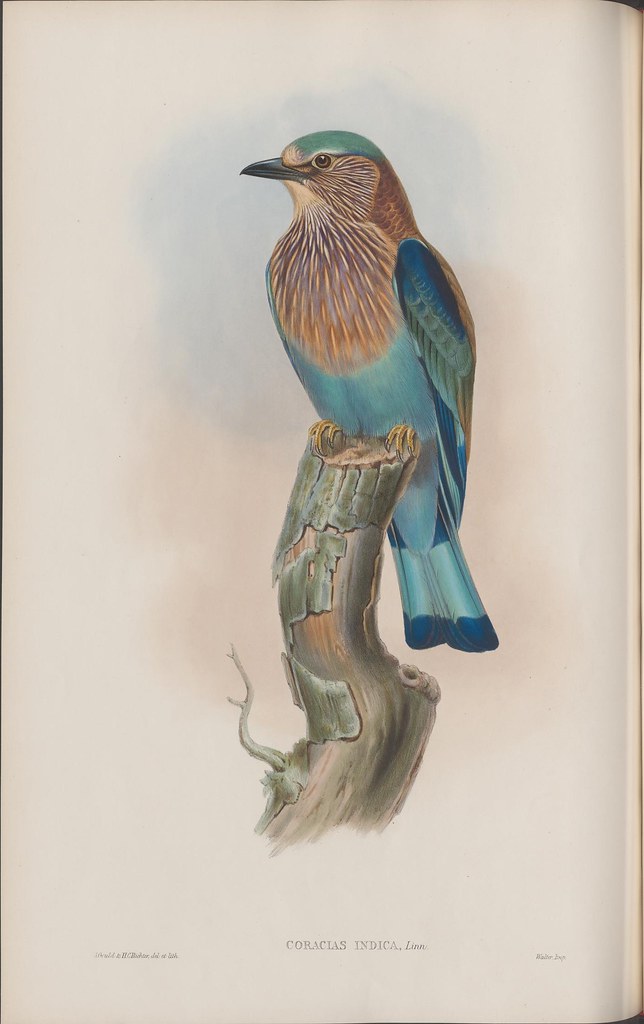
Coracias indica
AKA Coracias indica AKA Corvus benghalensis
Indian Roller
Far west to SE Asia [info]


lithographic sketch of two colourful birds of same species; one perched in tree, the other, hovering nearby, with an insect in its beak
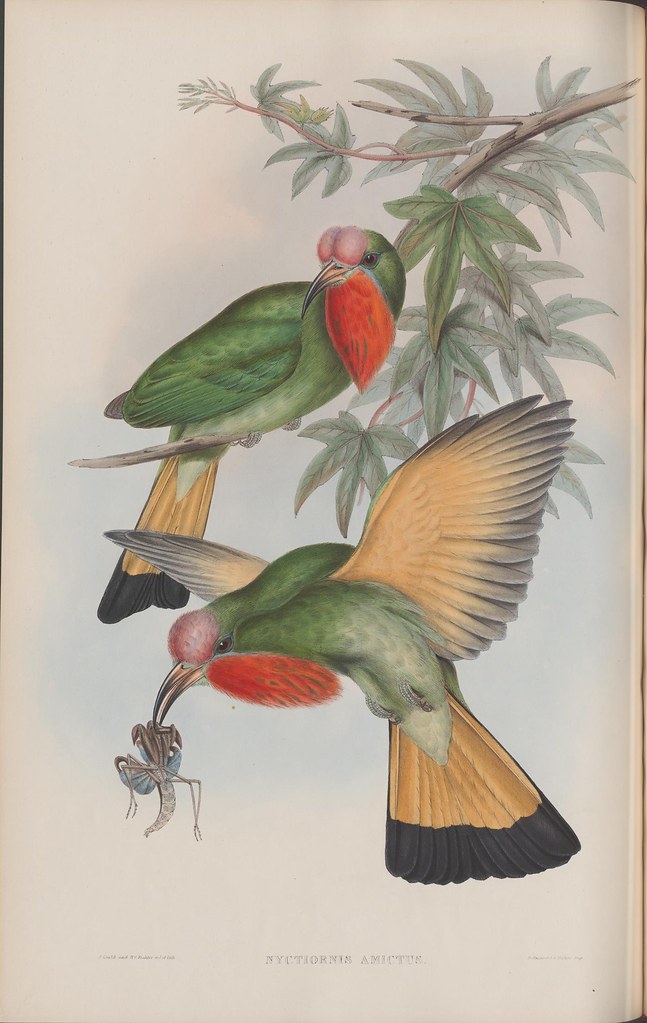
Nyctiornis amictus
Red-bearded Bee-eater
SE Asia [info]


book illustration by J Gould of 2 colourful birds and a plain 3rd bird active in tree branch
Nectarinia ignicauda (deprecated)
Aethopyga ignicauda
Fire-Tailed Sunbird
N India / Himalayas [info]


bright orange & bright yellow birds in flight actively trying to catch insects around flowering tree branch
Pericrocotus solaris
Grey-Chinned Minivet
Bangladesh across to China, Thailand and Vietnam [info]


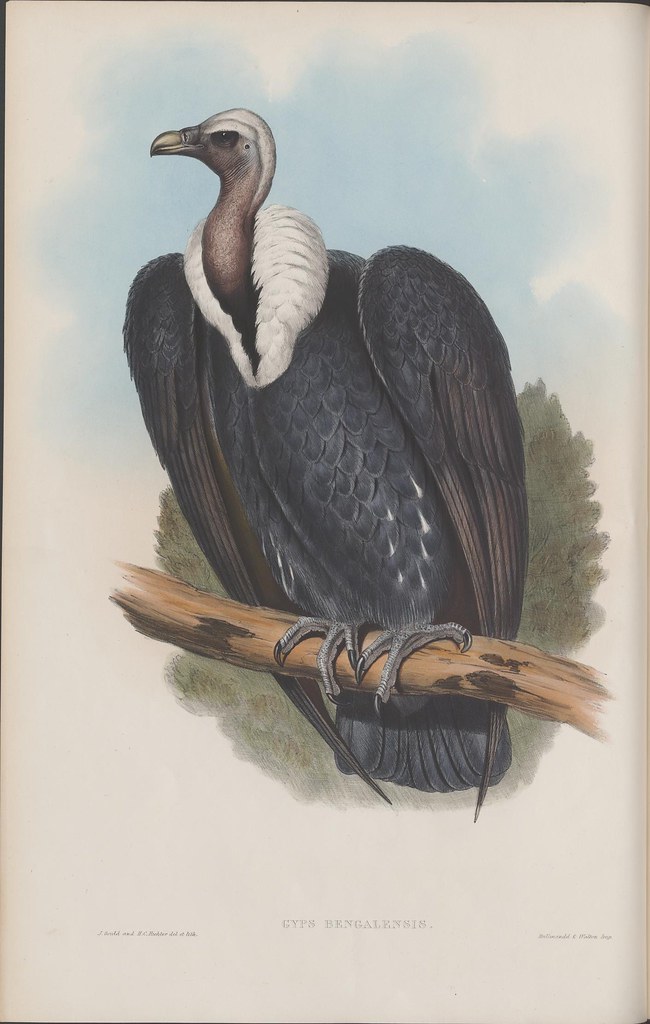
book sketch of large roosting black vulture with white shoulders
Gyps bengalensi
White-Rumped Vulture
Indian Sub-Continent and some East Asia [info]


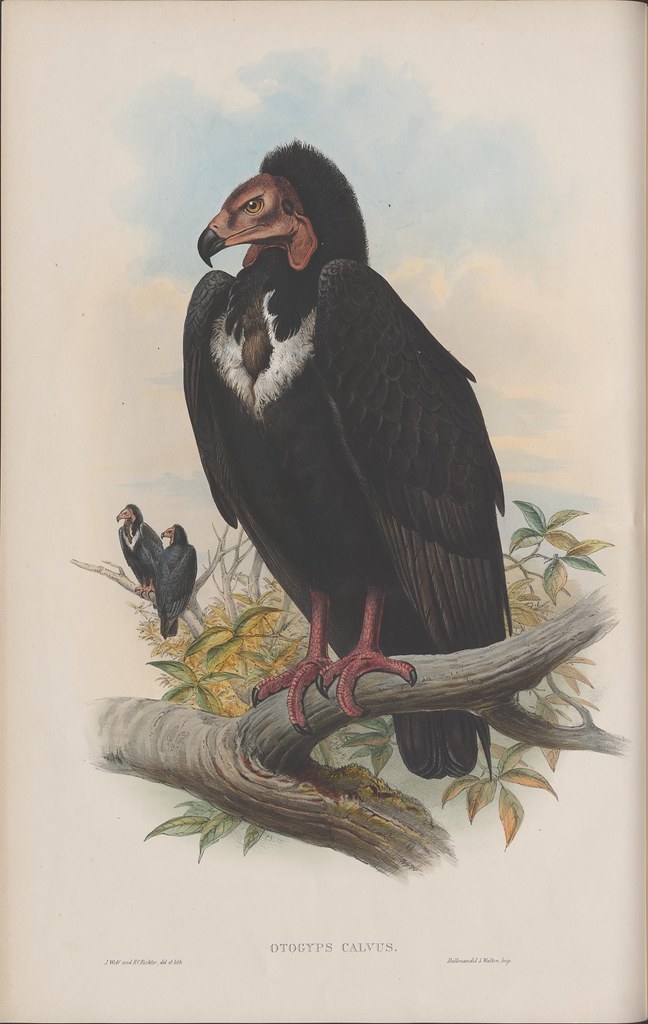
ugly great black plumed vulture on branch with two more vultures in the background
Otogyps calvus
Red-Headed Vulture
Indian Sub-Continent and some East Asia [info]


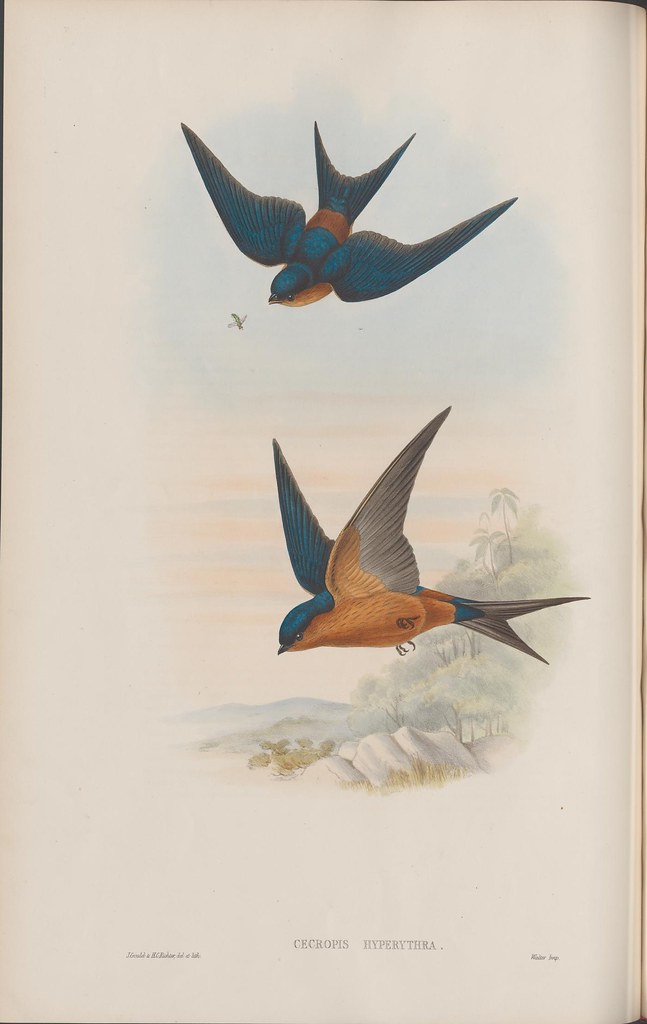
2 blue/brown short-winged birds in book illustration lithograph, in flight, chasing insects
Cecropis hyperythra
Sri Lanka Swallow
Endemic to Sri Lanka


litho of 2 small brown black white birds on pine tree branch
Parus rubidiventris
Rufous-vented Tit
N Asia: Nepal to China [info]


John Gould's contributions to ornithological scholarship and natural history publishing are renowned. He travelled all over the world collecting birds obsessively. The pencil, ink and watercolour sketches of Gould's beloved quarry provided the designs for his book illustrations. Gould was ably assisted in bringing these initial sketches to print-quality, colour plates, by his wife, Elizabeth Gould, until her death following childbirth in 1841. Subsequently, Gould hired artists - including Edward Lear{1} {2} (the greatest of all bird artists in my opinion) - to help turn his designs into lithographic plates: "I am happy to say that I am getting my Birds beautifully drawn by other artists and as I have always [done] I shall continue to make the sketches."^ {1841}

Two areas of Gould's extensive legacy are particularly noteworthy. Gould was largely responsible for putting ornithological studies in Australia on the map as a consequence of an extended visit in the late 1830s. Of the some 750 species of bird that live here in Australia, Gould is believed to have provided the first description for nearly half of them. He also published a book on the local non-feathered animal population, and again, recorded the first scientific description for about 40 of the species. In a country with such a high regard for their unique fauna, Gould holds a particularly special place in its history. That makes the following all the more galling (doubly so when one considers Gould's hopes in his will that his own copies of his various series on birds would remain in the family "in the nature of heirlooms"):
"John Gould's copy of 'The Birds of Australia', one of only 250 sets published, along with his 'Mammals of Australia', 'A Monograph of the Macropodidae' and 'Birds of New Guinea' were sold to an Australian bidder in 1987. Their owner subsequently broke up the volumes and auctioned 1213 plates individually."^
Charles Darwin consulted with Gould in relation to birds that were collected in the Galápagos Islands during the voyage of H.M.S. Beagle. Gould corrected Darwin's assessment of the unique species, providing pivotal analysis and identification of both birds and some animals. The information Gould provided - particularly about the variation of Galápagos finches - was combined with knowledge of the specific islands where each specimen was collected. Comparison between the island birds (and against comparable mainland species) was an important catalyst in Darwin's formation of the theory of evolution by natural selection. Gould's conclusions were published in Darwin's 'Zoology of the Voyage of H.M.S. Beagle' in ~1840.
11 May 15:26

Food pairing / gastronomy with a telescope

by cryptoforest
The theory of food pairing inspires little faith (see earlier) but when moving away from culinary applications perhaps it can be used to differentiate cuisines and cooking styles. How Chinese is Jamie Oliver? How similar are Mexican and Indian cuisines? How do French and Indian cooking differ? How unique is Rene Redzepi? 

The aim is to find a way to reveal the inner structure and logic of a cuisine, if such a thing exists, by comparing the way a cuisine or a cook combines ingredients with other cuisines and cooks. The first step is turn a collection recipes (a cookbook) into ingredient pairs, here is what a fragment of a looks like:
potato,pork,2
chicken,cucumber,1
chicken,grapeseed,15
chicken,milk,6
chicken,onion,9
chicken,pork,3
cucumber,grapeseed,3
cucumber,onion,2
cucumber,pork,2
grapeseed,milk,10
grapeseed,onion,11
grapeseed,pork,4
milk,onion,2
milk,pork,1
Two recipes use both potato and pork, one recipe combine chicken and cucumber, 15 recipes combine chicken with grapeseed oil and so on down the list. In a graph the pairs look like this:

The problem is in the data more than in the code. To get to lists of ingredients as recipes that are easy to process I am using Eat Your Books, a website that catalogs recipes and cookbooks. The ingredient lists are not complete (what exactly are 'cupboard ingredients'? a reference to the mock turtles of the soup) but they will do for my purpose.

Here is the graph of 'An Invitation to Indian Cooking' by Madhur Jaffrey (1975). It is pretty much what you would expect, a chaotic self-referential hairball with the core ingredients in the center with the rarer or less staple ingredients pushed to the edge. All graphs can be enlarged, the real information however is in the shape of the graph, not in the name of ingredients.


A different projection shows the connections differently, clearer on the eyes but not necessarily better: 
If you were creating something that would generate options for chefs you could take a book like "French Home Cooking: An Introduction to Classic French Cooking" by Paul Bocuse (1989) to generate diagrams like the following that shows what Indian (blue) and French (red) cuisines combine with potato and carrots.
It is of course bad practise to use one cookbook as representing an entire cuisine, but we are here in illustrative mode. Indian and French cuisine are national cuisines; how do they compare with someone like Rene Redzepi. With what ingredients does he (in green) combine the humble potato and carrot in his book "Noma: Time and  Place in Nordic Cuisine" (2010)? I a French manner.


But from the perspective of dry cooking this is still puny and close to home. The next image compares French and Chinese cuisines. The French is the Bucase book (blue), the Chinese (red) is Ken Hom's "A Taste of China" (1990). Again we are not actually comparing cuisines but cookbooks representing a certain regional form of cooking to a Western audience but the differences are real. Chinese and French cooking are worlds apart and only share some basics like vinegar, onion and pork. Chinese cooking comes across as much more homogenous and compact.

Now add Jamie Oliver's "The Naked Chef" (2000) to this French/Chinese data and see what happens: Jamie Oliver's cuisine is like a giant flesh eating amoeba devouring both cuisines whole and it still remains hungry. For now it is seems more French then Chinese.
Here is what happens when comparing Rene Redzepi (red) and Jamie Oliver. Even though the two appear to be opposites (the wild vs the supermarket, the avant-garde vs the popular) this graph does not really show it as you can see by the overlap. Both are Western chefs cooking Western food even when many ingredients are not shared.

The next image returns to the observation that Indian and Mexican food are historic twins. Would food pairing confirm this? Comparing Jaffrey (blue) with "Rosa's New Mexican Table" by Roberto Santibañez (2010) resulted in the following. The two cuisines are structured as separate spheres with a few heavily contested ingredients. Ingredients do not a cuisine make, as Rachel Laudan would possibly say as this graph seems to say.
 

In conclusion, to show that two similar bodies of recipes will overlap, I have compared Jaffrey with "50 Great Curries of India: Tenth Anniversary Edition" by Camellia Panjabi (2006). Both writers are of course using different ingredients but this image, in combination with the images above, do suggest a metric of displacement and uniformity: similar recipes will generate similar and overlapping hairballs.
 
 
10 May 00:39

Ejection 0.8 Seconds Before Impact

by Sylvia

The incident happened in 2003 but I only just saw the photograph and video on /r/aviation last week.
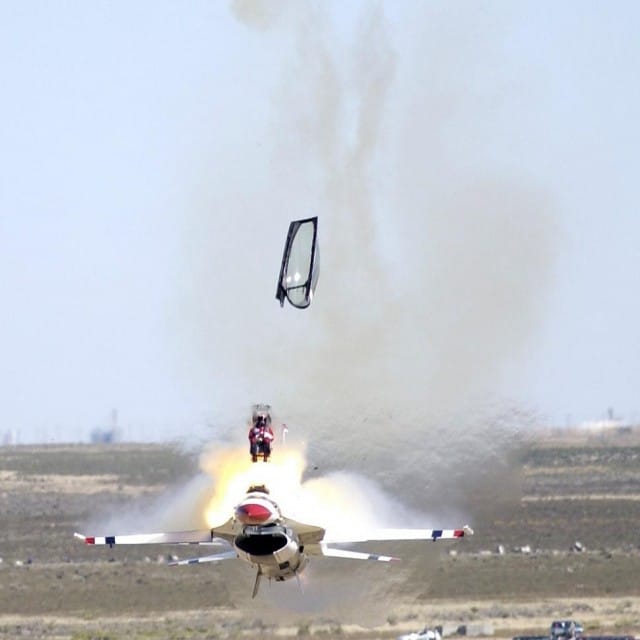
Thunderbird no. 6 ejection at Mountain Home airshow in 2003. Photo by SSgt Bennie J. Davis III – Still Photographer, USAF

This looks like a photoshopped picture or a stunt still from of a Hollywood movie but it is 100% legitimate.

The photograph was taken at the Mountain Home Air Force Base in Idaho, where the Thunderbirds were putting on an aerial display. The photographer snapped this photograph of 31-year-old Captain Chris Stricklin from the tower, capturing the exact moment when Captain Stricklin ejected from the F-16. Stricklin ejected less than a second before the F16 hit the ground.

The Thunderbirds are the air demonstration squadron of the United States Airforce, the equivalent of the Red Arrows of the UK Royal Air Force or the Blue Angels of the US Navy.

The Thunderbirds were formed in 1917 as an operational squadron. In 1953 they became the aerobatic display team in 1953, taking the name Thunderbirds from the southwestern US folklore around Luke Air Force Base, Arizona. They became the world’s first supersonic aerial demonstration team in 1956 but had to stop after the FAA banned all supersonic flight at air shows.

They tour the US and the world to perform air demonstrations but they apparently are able to rapidly integrate into an operational fighter unit. They fly F16 Fighting Falcons.

Their standard demonstration is documented on Wikipedia:

From the end of the runway the 4-ship Thunderbird team get ready to begin their take-off roll with the words “Thunderbirds, let’s run em up!” being retransmitted from the team leader’s mic through the PA system for the crowd to hear.

Diamond: Historically, as Thunderbirds 1 through 4 lift off, the slot aircraft slips immediately into position behind 1 to create the signature Diamond formation. Thanks to the 2009 upgrade to the Block 52, the Diamond now has more than enough thrust to continue to climb straight up into their first maneuver, the Diamond Loop.

Solos: Thunderbird 5 takes to the air next performing a clean low altitude aileron roll followed by 6 who performs a split S climbing in a near vertical maneuver rolling over and diving back toward show center pulling up just above the runway and exiting in the opposite direction.

Much of the Thunderbirds’ display alternates between maneuvers performed by the diamond, and those performed by the solos. They have a total of 8 different formations: The Diamond, Delta, Stinger, Arrowhead, Line-Abreast, Trail, Echelon and the Five Card. The arrowhead performs maneuvers in tight formation as close as 18 inches Fuselage to Canopy separation. They perform formation loops and rolls or transitions from one formation to another. All maneuvers are done at speeds of 450-500+ mph.

Stricklin was flying Thunderbird 6, performing the Split S manoeuvre as a part of his solo performance with the Thunderbirds.

The Split S (known in the RAF as the Half Roll and in the Luftwaffe as the Abschwung) is a dog-fighting technique used to disengage from combat. The pilot half-rolls his aircraft so that he’s flying upside down and then dives away in a descending half-loop, pulling out so that he’s flying straight and level in the opposite direction.
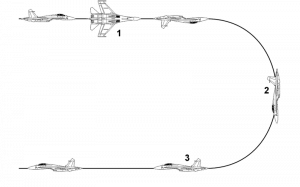
At the Mountain Home airshow as that Captain Stricklin did not have enough vertical space to pull out of the half-loop, leading to his last-second ejection. He had performed the Split S manoeuvre over two hundred times.

The astounding photograph was taken by a professional photographer at the control tower and was swiftly leaked to the public despite the fact that the military immediately locked down into an investigation. The photographer posted on the f-16.net message boards.

Thunderbird crash photo (head-on)

I have noticed all over the internet the shot I had taken of the Thunderbird crash at Mountain Home AFB, ID and though I am not at liberty to share the photo; it is out there. I would like to end some speculation and let you know the photo is real.

I’m a Still Photographer for the USAF and I was stationed at MHAFB during the air show. I was on the catwalk of the tower at Mtn Home along with another photog (video) and about seven other (military) spectators. I have shot the T-birds from the tower before and I was pretty excited to do it again (the sky was perfect blue). I followed Thunderbird 6 from takeoff and watched as he pulled into his maneuver. I then noticed something seemed to be wrong, his direction was a little off; he was pulling out and heading right towards the tower. At this point I figured two things: 1. He’s either going to fly past this tower and we’ll feel the heat or 2. This is going to be ugly… I waited for the aircraft to level and clicked the shutter, what I saw through the lens will never go away…

At the same time as I shot I seen a flash of light and horrific sound. I was shooting on high speed continuous and the next couple frames were a ball of fire and my feet, right before I ran. We all ran to the other side of the tower, I tried to get everyone in along with my partner and finally made it in myself. By the time we got inside the 16 had stopped sliding and rested about 100 ft in front of the tower. I then continued documenting the work of our base firefighters as they put out the flames. It was an experience and though I can’t officially make any comments to the matter, I would like to say Capt Stricklin saved lives… enough said.

For those who are wondering the image is not cleared for public release.

Also for those fellow photogs I was shooting with a D1x with a 300mm, 2.8 @ 1000 and 2000

Thanks,
SSgt Bennie J. Davis III
Still Photographer, USAF

The photograph was officially released a few days later, along with the video from the cockpit just before the crash.

Redditors have pointed out that his left arm twitches twice towards the eject lever before committing to the action.

Captain Stricklin sustained only minor injuries. The $20.4 million F16 was destroyed.

This video shows the view from the crowd:

The investigation results were released as a press release a year later:

PRESS RELEASE — Secretary of the Air Force, Directorate of Public Affairs

Release No. 0121045 – Jan 21, 2004

Thunderbirds Accident Report Released

LANGLEY AIR FORCE BASE, Va. – Pilot error caused a U.S. Air Force Thunderbirds F-16 aircraft to crash shortly after takeoff at an air show Sept. 14 at Mountain Home Air Force Base, Idaho.
The pilot ejected just before the aircraft impacted the ground.

According to the accident investigation board report released today, the pilot misinterpreted the altitude required to complete the “Split S” manoeuvre. He made his calculation based on an incorrect mean-sea-level altitude of the airfield. The pilot incorrectly climbed to 1,670 feet above ground level instead of 2,500 feet before initiating the pull down to the Split S manoeuver.

When he realized something was wrong, the pilot put maximum back stick pressure and rolled slightly left to ensure the aircraft would impact away from the crowd should he have to eject. He ejected when the aircraft was 140 feet above ground — just eight –tenths of a second prior to impact. He sustained only minor injuries from the ejection. There was no other damage to military or civilian property.

The aircraft, valued at about $20.4 million, was destroyed.

Also, the board determined other factors substantially contributed to creating the opportunity for the error including the requirement for demonstration pilots to convert mean sea level and above ground level altitudes and performing a manoeuvre with a limited margin of error.

For more information, contact the ACC Public Affairs office at (757) 764-5007 or e-mail acc.pam@langley.af.mil.

The QNH (sea-level altitude) vs QFE (altitude above the ground) is thus seen as a contributing factor.

Stricklin’s home base at Nellis is at 2,000 feet whereas Mountain Home is at 3,000 feet, so the altitude he selected would have been correct at his home base.

The contributing factor of requiring pilots to convert sea-level altitude information to altitude above ground for radio calls was immediately dealt with by the Air Force. Thunderbird pilots now call out MSL (Mean Sea Level) altitudes rather than AGL (Above Ground Level) altitudes and must climb an additional one thousand feet before performing the Split S manoeuvre.

A bystander reported that after the ejection, Stricklin stood silently by the canopy of the aircraft. Then he threw his helmet at the ground and stomped over to the wreckage. He knew that his time as a Thunderbird pilot was over.

However, I was pleased to see that in 2009, Stricklin was commended for his work on safety programmes in the USAF:

2009: CSAF Individual Safety Award – Lt. Col. Christopher Stricklin, 14th Flying Training Wing, Columbus Air Force Base, Miss.
Colonel Stricklin led and managed flight, ground, and weapon safety programs for 3,000 personnel, including 20 essential safety personnel who provided over 3,120 annual hours of on-call service. As a direct result of his efforts, flight mishaps were reduced in nearly every category; down 50 percent in Class A, 70 percent in Class C, 44 percent in Class E, and 50 percent in Controlled Movement Area Violations.

It makes sense to me; if I’d been that close to smashing into the ground, I’d be pretty thoughtful about flight safety too!


09 May 02:26

HBO’s ‘The Leftovers’ may doom new remake of ‘Left Behind’

by Fred Clark

The new Left Behind movie, starring Nicolas Cage as Rayford Steele, is scheduled for release on October 3.

It’s not a good sign that the film’s producers have only recently produced actual posters promoting the release, or that five months out they still haven’t cut an actual trailer.

What they’re offering as a “trailer” is, instead, what appears to be a low-budget segment of some Entertainment Tonight knock-off, featuring unrevealing interviews with members of the cast and crew:

Click here to view the embedded video.

That doesn’t look like the trailer for a major film that will be ready for theaters in five months. It looks more like the Kickstarter video for a project that’s struggling to meet it’s fundraising target.

Judging by that trailer, it seems this movie may faithfully adhere to the mantra of Left Behind typist Jerry Jenkins: Tell, don’t show.

The one promising thing about this new film (apart from Nic freakin’ Cage) is that the full cast list doesn’t include anyone in the role of Nicolae Carpathia.

On the one hand, this is disappointing — the Antichrist is the most interesting character in the book, and in the original movie adaptation Gordon Currie was the only member of the cast (or audience) who seemed to be having any fun. Currie made the only choice available to him for the role, camping it up. (Gordon Currie was fun. Tim Curry would have been amazing — “Oh, come on Buck, admit it, you liked it didn’t you?”)

On the other hand, while the initial unnerving excitement of the Rapture is inherently dramatic, the rest of Left Behind — the rest of the entire series, really — has no idea where to go after that or what to do with itself. The plot bogs down almost as soon as Rayford’s plane touches down.

The new movie seems more narrowly focused on the event of the Rapture itself and its immediate aftermath. That means its likely to deviate from the book at exactly the point where the book deviates from any hope of realistically portraying that event or its aftermath. It’s unlikely this new film will show us Nic Cage and Chad Michael Murray briskly walking past the flaming wreck of multiple plane crashes, ignoring the cries of the injured, so that they can quickly make their way back to the suburbs or to a working telephone (respectively).

Nic Cage may be a very strange actor, but he’s played heroes before and he’s been in movies with plane crashes before, and there’s no way he’d play this scene allowing Rayford to be the oblivious, solipsistic narcissist the book presents.

The biggest problem facing the new Left Behind movie, though, may be that three months before it hits theaters, the first season of The Leftovers debuts on HBO. That’s based on Tom Perrotta’s novel of that name, summarized here by NPR’s Fresh Air:

What if the rapture did actually occur? That’s the premise of Tom Perrotta’s latest novel, The Leftovers, which examines the aftermath of an unexplained rapturelike event in which millions of people around the globe inexplicably disappear into thin air.

Perrotta’s novel takes place after the rapture, in a small New Jersey suburb, where families are trying to get on with their lives. The Garvey family, for instance, didn’t lose any family members in the rapture but has fallen apart in the aftermath. The father, Kevin, watches as his teenagers change and his wife, Laurie, leaves his house to join a cult called “The Guilty Remnant,” whose members dress all in white and take a vow of silence.

The following trailer — an actual trailer — is Not Safe For Work (language, nudity, sexual situations and violence … it’s an HBO show), but all you need to see, really, is the first 30 seconds:

Click here to view the embedded video.

There it is. There’s everything that’s missing in the entire Left Behind series: Sudden bewildering chaos and a mother screaming in agony over the loss of her child.

Left Behind does not include any such mother, any such agony, chaos, bewilderment or loss.

Here’s a shorter, SFW teaser-trailer for the series, outlining The Leftovers’ premise of a world grappling with the instantaneous, unexplainable “departure” of 2 percent of the world’s population:

Click here to view the embedded video.

The Leftovers looks interesting. Whether or not it turns out to be any good, it’s an HBO show, so it’s going to generate some buzz. People will be talking about it — and talking about the questions it raises — all through July, August and September. What would that be like? What would you do? How would you react? What would happen to …?

Those questions are going to be kicked around in all kinds of settings right up until the Oct. 3 release date of the new Left Behind movie. So the audience for that movie — even the insular, culturally isolated core of its pre-existing fans — is going to enter the theater having given some thought to those questions. That audience will enter the theater having given more thought to those questions than Tim LaHaye and Jerry Jenkins ever did.

That mother’s voice from The Leftovers – her scream of “Sam!” — will set the bar for audiences’ expectation of what Left Behind shows as the aftermath and response to its Rapture. If the new movie is anything at all like the book it’s based on, those audiences are bound to be angrily disappointed.

08 May 18:53

Seaplane takes off from trailer

by Jason Kottke

What do you do when you have a seaplane without wheels, no water, and you need to take off? You put it on a trailer, drag it down the runway until you get the proper speed, and just pull back on the stick:

Damn, that's cool. I knew it was gonna take off and it still baked my noodle a little bit. I think this is why so many people (myself included) had trouble with the airplane on the treadmill question. All that really matters for takeoff and continued flight is the speed of the plane relative to the air -- how it gets to that point or what the surface is doing isn't really relevant -- but when you're observing it, it seems impossible. (via @deronbauman)

Tags: flying   video
07 May 22:44

Octopus opens jar from the inside

by Jason Kottke

Watch this octopus open a jar from the inside:

Octopuses are wicked smart. I like how, after he gets the lid off, he's content to just hang out in there. (via @tylercowen)

Tags: video
01 May 17:38

Cutaway illustrations of nuclear reactors

by Jason Kottke

Worlds Reactors 02

Worlds Reactors 01

Worlds Reactors 03

From the collection of The University of New Mexico, a big collection of cutaway diagrams of nuclear reactors.

Tags: energy   illustration
29 Apr 20:39

Molecular gastronomy in 1932

by cryptoforest

'Experimental cookery, from the chemical and physical standpoint' (1932) by Belle Lowe is meant for the domestic cook but I think the chemical detail would scare most of them. Molecular Gastronomy had antecedents.


29 Apr 12:36

The Fromond List [Herbys Necessary For A Gardyn]

by cryptoforest
"Our medieval ancestors actively encouraged weeds in their vegetable plots. The Fromond List, compiled by Surrey landowner Thomas Fromond in about 1525, is a list of “herbys necessary for a gardyn”. He recommends many of today’s weeds for sauces, salads, soups and so on." (source).

Here is the full list in original spelling, (source). The obvious thing to note is that the notion of a weed did not exist.
Herbys Necessary For A Gardyn By Letter

R. Rapes (Brassica Napns), Radyche, Rampsons (Allium ursinum), Rapouncez (Campanula Ranunculus), Rokettf (Hespcris matronalis), Rewe.

S. Sauge, Saverey, Spynache, Sede-wale (Valeriana pyrenaica), Scalaceh (? Sinapis arvensis), Smalache (Apium graveolens), Sauce alone (Erysimum Alliaria), Selbestryne, Syves (Allium Schceno-prasum), Soreft, Sowthistelt, Skabiose, Selia, Stycadose (Lavandula Sta'chas), Stanmarch (? Smyrnium Olusatrum).

T. Tyme, Tansey.

V. Vyolettf, Wermode, Wormesede (Erysimum chciran-thoides), Verveyfi.  
Of The Same Herbes For Potage

Borage, Langdebefe, Vyolettf, Malowes, Marcury, Daunde-lyoh Avence, Myntf, Sauge, Percely, Goldes, Mageron, Fenelt, Carawey, Rednettyff, Oculus Christi, Daysys, Chervelf, Lekez, Colewortes, Rapez, Tyme, Cyves, Betes, Alysaundr', Letyse, Betayn, Columbyn, Alia, Astralogia rotunda, Astralogia longa, Basillican, Dylle, Deteyfi, Egrymon, Hertestong, Radiche, White pyprr, Cabagez, Sedewale, Spynache, Coliaundr' Foothistyll, Orage, Cartabus, Lympons, Nepte, Clarey, Pacience.  
Of The Same Herbes For Sauce

Hertes tonge, Sorett, Pelytory, Pelytory of Spayh, Detey, Vyolettf. Pcrcely, Myntf.  
Also Of The Same Herbes For The Copp

Cost, Costmary, Sauge, Isope, Rose mary, Gyttofr', Goldez, Clarey, Mageron, Rue.*  
Also Of The Same Herbes For A Saladc

Buddus of Stanmarche, Vyolette flourez, Percely, Redmyntf, Syves, Cresse of Boleyn, Purselah, Ramsons, Calamyntf, Prime Rose buddus, Dayses, Rapounses, Daundelyon, Rokette, Red netteft, Borage flourez, Croppus of Red Fenett, Selbestry", Chykynwede.  
Also Herbez To Stylle

Endyve, Red Rose, Rose mary, Dragans, Skabiose, Ewfrace, Wermode, Mogwede, Betayii, Wylde Tansey, Sauge, Isope, Ersesmart (Polygonum Hydropiper).

  * Rue is added in fainter ink.

  * " Seynt Mar' Garlek " is added by another hand.  
Also Herbes For Savour And Beaute

Gyllofr' gentyle, Mageron gentyle, Basyle, Palma Christi, Stycadose, Meloncez, Arcachaffe, Scalaceley, Philyppendula, Popyroyatr, Germaundr', Cowsloppus of Jerusalem, Verveyh, Dyll, Seynt Mar' Garlek.*  
Also Rotys For A Gardyn

Persenepez, Turnepez, Radyche, Karettes, Galyngale, Tryngez, Saffron.
27 Apr 03:59

The Art of Jess Collins


The Art of Jess Collins

26 Apr 00:18

Maximin: ein Gedenkbuch by Stefan George

by John

maximin01.jpg

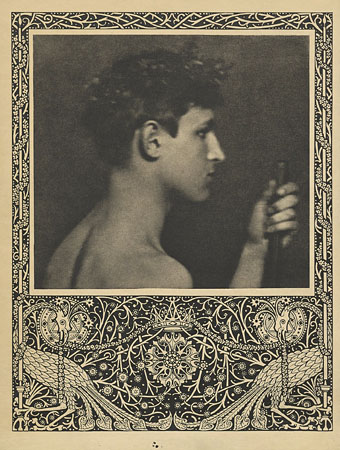
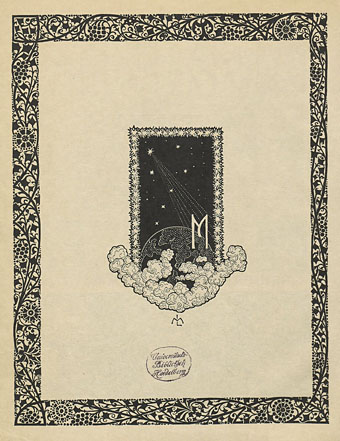
This is a strange and beautiful book, a loving paean to a dead boy-poet from another poet, Stefan George (1868–1933), published in 1907. The “Maximin” of the title was Maximilian Kronberger (1888–1904) who was around 14 when he met George; the older man was 34 at the time. George was apparently smitten by the boy, and devastated when he died from meningitis two years later. Maximin: ein Gedenkbuch (A Memorial Book) is the result, a collection of mournful poems, beautifully designed and illustrated by Melchior Lechter in that rectilinear Art Nouveau style which the artist made his own. The memory of the dead Maximin became for George a quasi-religious obsession which makes Maximin the bible of the homosocial cult that George subsequently encouraged.

maximin02.jpg

What’s most surprising about all this behaviour is that it did nothing at all to harm his reputation, even among the Nazis who later revered his poetry. George was a contemporary of Oscar Wilde but the pair were poles apart in character, George’s chilly, high-minded aestheticism preserving him from the brickbats aimed at Wilde and others. Nonetheless, the inherent camp that results from the combination of such a remote attitude combined with flagrant boy-worship secured for George a place alongside Wilde in Philip Core’s essential Camp: The Lie that Tells the Truth (1984):

Strangely enough his overtly (if classically) homosexual verses, his preference for beautiful youth, and his severe black-clad dignity, all became immensely popular in the land of brüderschaft (brothers’ love). The camp Classicism of his ‘academy’ of the spirit, in surroundings of neo-Classical kitsch, hit just the right middle ground between Edwardian sentimentality and Hitlerian Imperialism.

Maximin: ein Gedenkbuch may be browsed or downloaded at the University of Heidelberg. There’s a more academic examination of George’s homoerotics here. Further page samples follow.

maximin03.jpg

maximin04.jpg

maximin05.jpg

maximin06.jpg

maximin07.jpg

maximin10.jpg

maximin08.jpg

maximin09.jpg

maximin11.jpg

Elsewhere on { feuilleton }
The illustrators archive

Previously on { feuilleton }
The art of Melchior Lechter, 1865–1937

24 Apr 16:54

The Phantom Recipe Constructor [notes on food pairing](mini_edit 1)

by cryptoforest
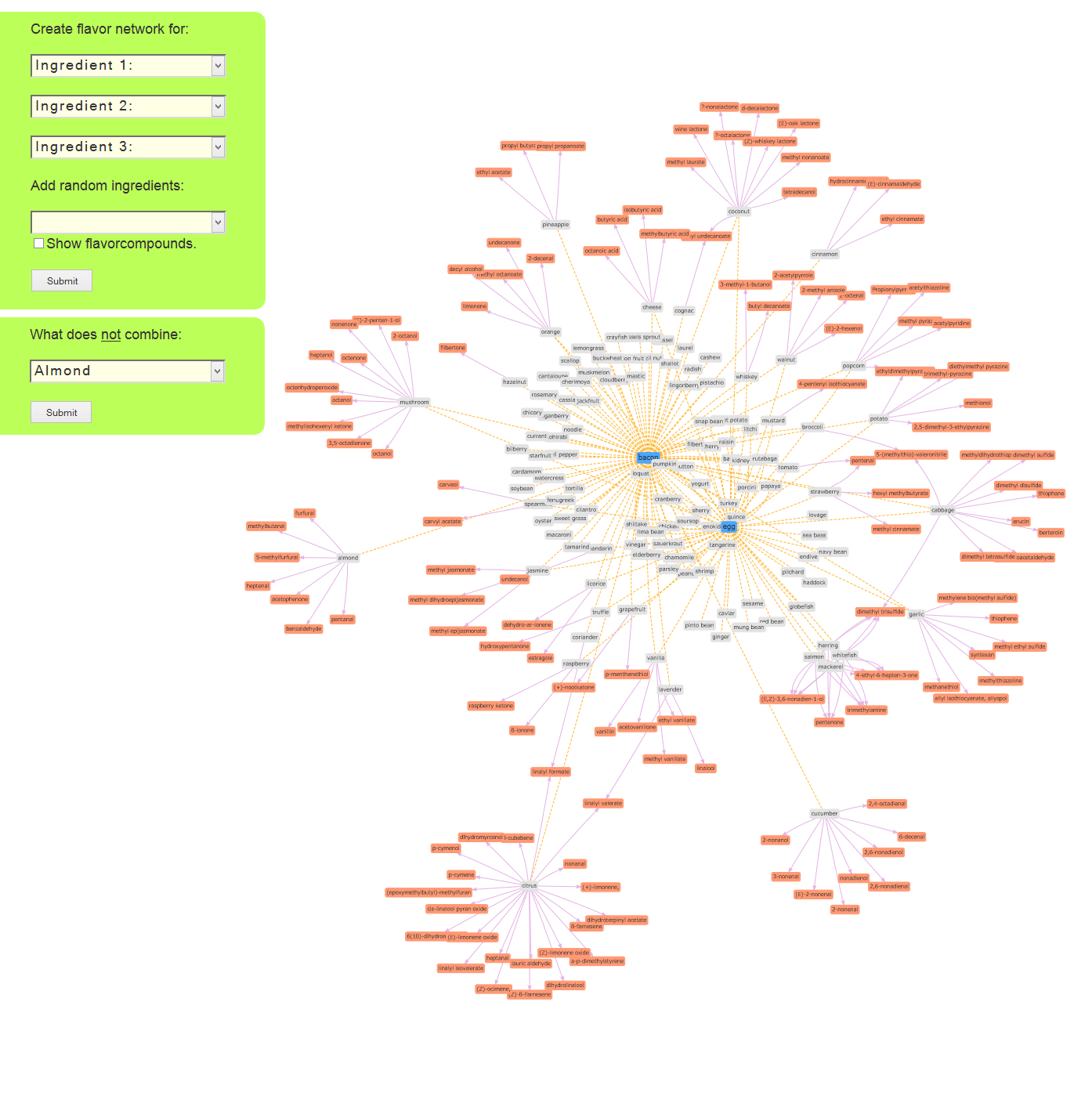
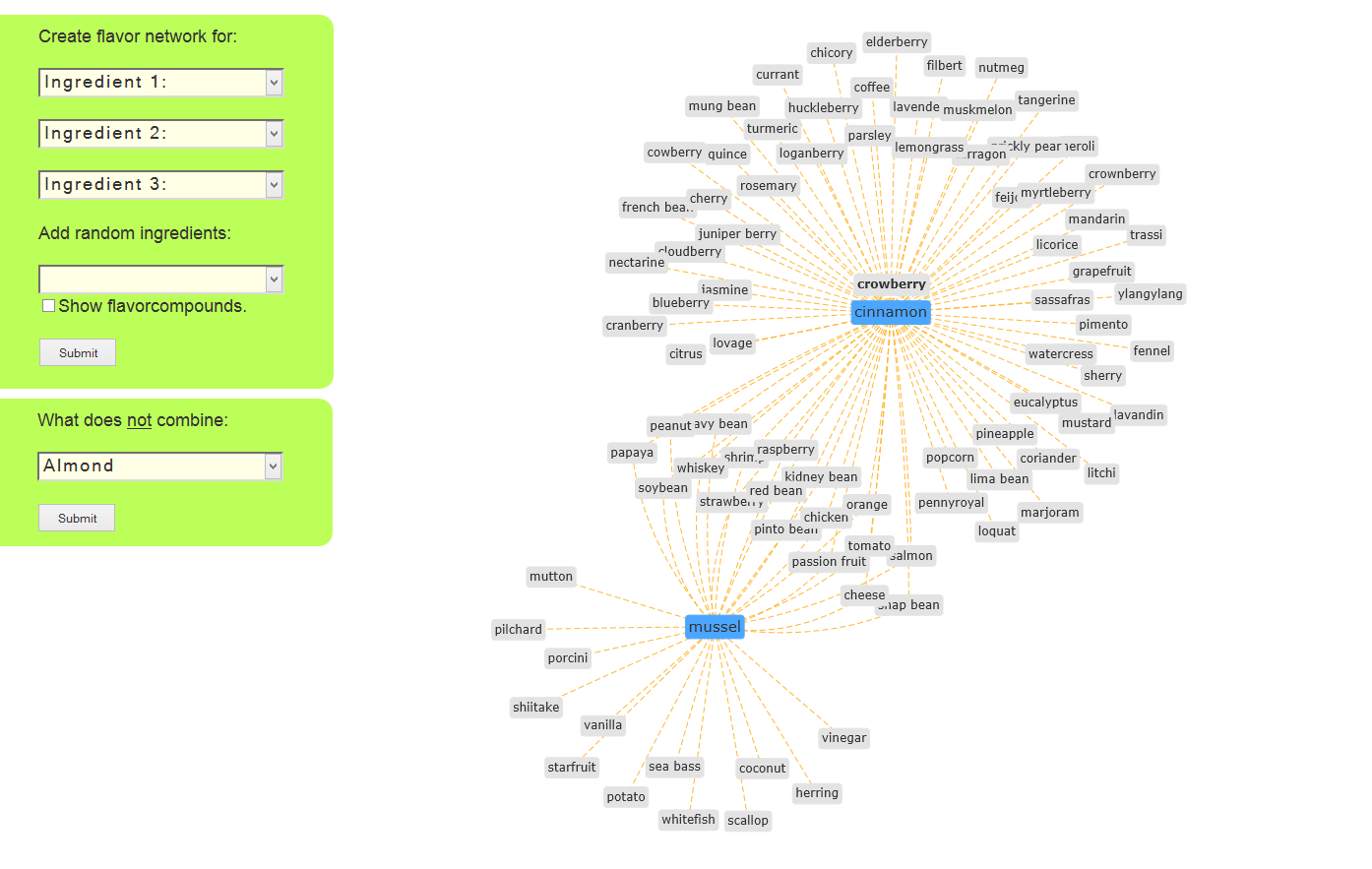
Over Easter I have been putting together a new page for Foodmap that allows the user to select 3 ingredients from a list (and/or 3 randomly chosen ones) to find out what foodstuffs are commonly used in combination with it. Optionally it can also display for some ingredients what odor compounds they contain. You might of heard of this as Food Pairing, a theory coming from within molecular gastronomy HQ that states that "foods combine well with one another when they share key flavor components". The ur-example is white chocolade with caviar.

Ever the keen student of Horace Walpole I named the project the Phantom Recipe Constructor and for me it was mostly the challenge of Proof of Concept: could I get the data into manageable shape and would it work as a service.

The question of whether it's working I will leave to your discretion. I would here like to share my reservations about the data, my use of it and the food pairing theory itself.

There are two sources of data:

- Flavornet, a website where some brave soul plowed through the scientific literature to create "a compilation of aroma compounds found in human odor space". I believe that these are the flacor components food scientists are using to pair foods that could be expected to taste well.

- A file with 220.000+ food pairs taken from a file provided as an extra to the 2011 paper 'Flavor network and the principles of food pairing' by Ahn, Ahnert, Bagrow and Barabási. In this they analyze 56,498 recipes from two US recipe repositories (Allrecipes and Epicurious) and a Korean one (Menupan). The latter "to avoid a distinctly Western interpretation of the world's cuisine", which is important but I wonder if Korean cuisine is not too much of a minority cuisine to be representative of anything but itself: its skews the results. Another issue is that some common ingredients are missing or underrepresented. Spinach has only 4 appearances and that is in dried form (never heard of before, maybe a Korean delicacy). Gherkin, eggplant, alfalfa, couscous are all not present. Not a major deal, but important to keep in mind. I use Allrecipes quite a bit when looking for example recipes for specific cuisines (Filipino say) and it is a great resource but once it is parsed straight and verbatim into a database to represent something larger than itself I wonder if its collections of family recipes and the latest inventions of amateur cook can live up to this claim. Not that I would know how to tackle this problem of representation: any recipe collection represents a paper reality and never really touches on what people actually eat. 

What the authors have done to collect recipes is as any programmer would solve the problem but I doubt if a historian would be satisfied with this make-do approach to data. There are a huge number of historic, out of copyright cookbooks available and if these could be processed and added to this data, classic flavor combinations might be better represented. It might even be used to trace changing tastes through the centuries. The data also has the huge gap of Indian and Chinese cuisines: the food of over 2 billion people is underrepresented. Adding all of the world's cuisine to a database would however also be a bad idea if it would not allow you to trace differences within culinary traditions, especially as tradition fall apart once you look closer. A workable solution would be to attempt to represent tiny sections of the food spectrum: food pairs of French cuisine between 1880 and 1940, food pairs of bestselling cookbooks in the 1980ties, food pairs in Anglo-Indian cuisine since 1800 and so on.

To add stupidity to the mix I have filtered (got rid of the pairs with a frequency less than 4) and butchered the data (turning boiled, cooked, fried and raw potato into one item: potato) to make it workable within the constraints of a webservice. I would need to look at it properly but I actually think that preparation method is a minor and/or random differentiator in this contect. If you select 3 ingredients, 3 random ingredients and want to see the flavor compounds your browser will show you what I mean (patience it will come). Preparation obviously does much to the taste to ingredients, this data is available in the data file but absent from the Phanton Recipe Generator.

ALL YOUR BASE ARE BELONG TO US & THE PHANTOM RECIPE CONSTRUCTOR IS FOR ENTERTAINMENT PURPOSES ONLY. 

My main problem with food pairing is that it is so horribly reductive. What tastes well shares common characteristics?! What a dull concept and a boring theory.  The presence of trimethylamine makes white cholocate and caviar taste well together? But it is a fact that comes out after the fact but might as well be explained as a random event.

Reason by analogy: A dating agency matching you with a future partner might select for you someone equally passionate about music only to find out that your tastes are far apart and incompatable. What you share is what separates you, music is not just sound, it is culture. A dating agency might not suggest a future partner because of different music tastes which may be insignificant once you would actually meet. What makes a good match is not determined by one shared commonality. It is about how differences and similarities balance and contrast each other overall. 
 
Opposites always attract: This is why the Phantom Recipe Constructor offers the reverse function: select an ingredient and it suggests what does not go with it.

The idea that flavors in a dish need to compliment each other is an implicit Western practice and Asian cuisines instinctively do the opposite. Given the ongoing and enthusiastic adaptation of Asian foods in the Western diet I predict that food pairing has little future anyway.

23 Apr 22:26

Image copy/paste

by Jason Kottke

Project Naptha is a browser extension that lets you copy text from images on the web.

Project Naptha automatically applies state-of-the-art computer vision algorithms on every image you see while browsing the web. The result is a seamless and intuitive experience, where you can highlight as well as copy and paste and even edit and translate the text formerly trapped within an image.

I was skeptical of this actually working, but it totally does...try it on xkcd or Frank Sinatra's "loosen up" letter to George Michael for example. The translation and editing features aren't enabled yet, but the project's creator is working on them. (via @tcarmody)

19 Apr 16:58

Cloths of heaven

by johno

Cloths of Heaven is Seb Lester’s interpretation of ‘Aedh Wishes for the Cloths of Heaven’, a poem by the renowned Irish poet W. B. Yeats. It is a continuation of his exploration of the theme of beauty in the context of letterform design. He has produced a limited edition screen print and also collaborated with The London Embroidery Studio to produce an embroidered piece, available as a small-run limited edition.

“Yeats’s poem references ‘embroidered cloths’ and ‘gold and silver threads’, so I wanted to try to make the screen print look like an exquisite and timelessly beautiful piece of highly ornamental needlework. I’ve drawn from Medieval, Renaissance and 18th-century sources but I have also tried to integrate personal, progressive and irreverent flourishing ideas. The result is a hybrid stylistic treatment that I think could only exist in the 21st century.”

Cloths_SebLester6

He explained that his relatively new-found love of traditional calligraphy has given him new insights into the Latin alphabet. “In calligraphy I have found a joyful and visceral way to construct letterforms. The letters that appear before my eyes as I write have a warmth and humanity that is very hard to achieve with computers. Calligraphy, combined with my knowledge of digital letterform design, has given me the confidence and I hope the understanding to explore and challenge preconceived notions about what constitutes correct flourishing and decorative ornament technique.”

More information at seblester.co.uk

Technical Specs:
‘Cloths of Heaven’ by Seb Lester, 2014, available as a print and embroidered artwork. Based on the poem ‘Aedh Wishes for the Cloths of Heaven’ by W B Yeats.

A2 (594mm X 420mm) limited edition screenprint, edition of 100.
Metallic gold ink on midnight blue Plike art paper, 330gsm.
Signed and numbered by the artist.

A2 (594mm X 420mm) limited edition embroidery, edition of 5.
Gold and silver thread on Italian midnight blue silk twill.
Each piece comes with a hand written, signed note of authenticity.


Sponsored by Hoefler & Co.
and


Cloths of heaven

18 Apr 03:02

The British Pathe archive

by Jason Kottke

Newsreel archivist British Pathé has uploaded their entire 85,000 film archive to YouTube. This is an amazing resource.

British Pathé was once a dominant feature of the British cinema experience, renowned for first-class reporting and an informative yet uniquely entertaining style. It is now considered to be the finest newsreel archive in existence. Spanning the years from 1896 to 1976, the collection includes footage -- not only from Britain, but from around the globe -- of major events, famous faces, fashion trends, travel, sport and culture. The archive is particularly strong in its coverage of the First and Second World Wars.

I've shared videos from British Pathé before: the Hindenberg disaster and this bizarre film of a little boy being taunted with chocolate. The archive is chock full of gems: a 19-year-old Arnold Schwarzenegger at a bodybuilding competition, footage of and interviews with survivors of the Titanic, video of the world's tallest man (8'11"), and the collapse of the Tacoma Narrows Bridge. And this film from 1956 showing how cricket balls are made by hand:

Tags: British Pathe   video
15 Apr 17:59

Drone selfies

by Jason Kottke

For the past couple of months, Amit Gupta has been playing around with taking moving self-portraits with a camera mounted on a drone. Here's an early effort. This past weekend, Amit's efforts crossed over into the realm of art. This is beautiful:

In the comments at Vimeo, Alex Dao dubbed this type of photograph a "dronie". We'll see if that catches on.

Update: More examples of dronies here.

Tags: Amit Gupta   drones   photography
14 Apr 15:38

Navy: using seawater for fuel

by Jason Kottke
John Costello

Even if this goes some way to solving peak oil, it's still a CO2 disaster. (Extracting sequestered CO2 from the ocean and putting it back in the air??)

The US Navy is working on technology to convert seawater into fuel to power unmodified combustion engines. They recently tested the fuel (successfully!) in a replica P-51 and hope to make it commerically viable.

Navy researchers at the U.S. Naval Research Laboratory (NRL), Materials Science and Technology Division, demonstrated proof-of-concept of novel NRL technologies developed for the recovery of carbon dioxide (CO2) and hydrogen (H2) from seawater and conversion to a liquid hydrocarbon fuel.

Fueled by a liquid hydrocarbon -- a component of NRL's novel gas-to-liquid (GTL) process that uses CO2 and H2 as feedstock -- the research team demonstrated sustained flight of a radio-controlled (RC) P-51 replica of the legendary Red Tail Squadron, powered by an off-the-shelf (OTS) and unmodified two-stroke internal combustion engine.

Using an innovative and proprietary NRL electrolytic cation exchange module (E-CEM), both dissolved and bound CO2 are removed from seawater at 92 percent efficiency by re-equilibrating carbonate and bicarbonate to CO2 and simultaneously producing H2. The gases are then converted to liquid hydrocarbons by a metal catalyst in a reactor system.

"In close collaboration with the Office of Naval Research P38 Naval Reserve program, NRL has developed a game-changing technology for extracting, simultaneously, CO2 and H2 from seawater," said Dr. Heather Willauer, NRL research chemist. "This is the first time technology of this nature has been demonstrated with the potential for transition, from the laboratory, to full-scale commercial implementation."

Discover has more, in slightly more accessible language.

Tags: physics   science   US Navy   water
11 Apr 03:22

List of verbs grouped by their syntactic processes

List of verbs grouped by their syntactic processes:

This list of verbs from English Verb Classes And Alternations: A Preliminary Investigation (Levin 1993) is a really useful resource if you’re looking to construct example sentences or experimental stimuli. 

For example, the spray/load alternation refers to a type of verb that can be found both of the following contexts:  

1. I sprayed paint on the walls.
2. I sprayed the walls with paint. 

3. I loaded hay into the truck. 
4. I loaded the truck with hay. 

Spray and load are classic examples, hence the name of the alternation, but Levin gives a longer list of English verbs that undergo the same process: 

adorn anoint arrange bandage bang bathe bestrew bind blanket block blot bombard brush carpet channel choke cloak clog clutter coat coil contaminate cover cram crowd cultivate curl dab dam dangle dapple daub deck decorate deluge dip dirty dot douse drape drench dribble drip drizzle drop dump dust edge embellish emblazon encircle encrust endow enrich entangle face festoon fill fleck flood frame funnel garland garnish hammer hang heap hoist imbue immerse impregnate infect inject inlay install interlace interlard interleave intersperse interweave inundate jam ladle lard lash lay lean lift line litter load lodge loop lower mask mottle mound mount ornament pack pad pave perch pile place plant plaster plate plug pollute position pound pour prick pump push put raise rake ram replenish repopulate rest riddle ring ripple robe roll rub saturate scatter scoop scrape season seed set settle sew shake shovel shower shroud siphon sit situate slather sling slop slosh smear smother smudge soak soil sow spatter speckle spew spill spin splash splatter splotch spoon spot spray spread sprinkle spritz spurt squash squeeze squirt squish stack staff stain stand stash stick stipple stock stop up stow strew string stud stuff suffuse surround suspend swab swaddle swathe sweep taint tile trim tuck twirl twist veil vein vest wad wash wedge whirl wind wipe wrap wreathe wring

The whole document is like that. It’s just fantastic.

09 Apr 22:35

Human Barbie dolls

by Jason Kottke
John Costello

I think this must be an April Fool's joke.

Let's get right to it. This is a real photo of a real human being:

Human Barbie doll

It hasn't been dramatically retouched or anything. Valeria Lukyanova has made herself into a human Barbie doll.

Her brand-new hair extensions, the color of Chardonnay, hang straight down, reaching her nonexistent hips. Her mouth is frozen in a vacant half-smile; the teeth are small and almost translucent. She's holding a handbag shaped like a lantern. A one-eyed smiling-skull pin perches on her sky blue top, pushed to the side by the veritable shelf of silicone around which her whole body seems arranged. In the flesh -- the little of it that she hasn't whittled away with what she says is exercise and diet -- Valeria looks almost exactly like Barbie. There might be some Loretta Lux-style postproduction to her photos, sure, but it's not crucial. This is live. This is happening.

She's also a recent convert to breatharianism (living exclusively on a diet of air), feels that humans are less beautiful now because of "race-mixing", and gets her nails painted with "a fractal pattern from the twenty-first dimension" that came to her in a dream. There is also a human Ken doll, Justin Jedlica, who has achieved his look through more than 100 plastic surgeries:

Human Ken doll

But there's a problem. Ken doen't like Barbie.

But you're not a fan?
I don't really get her. I don't get why people think she's so interesting. She has extensions. She wears stage makeup. She's an illusionist.

You've certainly had more surgeries. What's your favorite one?
My baby is my shoulders, because nobody has anything like them. I divided these so there's six pieces-front, middle, and back. Just like the actual anatomy.

Tags: Barbie   Justin Jedlica   Valeria Lukyanova
09 Apr 14:49

Surtsey and the tomato as weed

by cryptoforest
The island Surtsey arose from the sea, south of Iceland, in a volcanic eruption that took from 1963 to 1967 to complete. Like Krakatau it has been extensively monitored by ecologists and biologists studying biological succession.

Here is how John McPhee writes about in The Control of Nature (1990):
From Surtsey's inception, scientists of many disciplines have carefully observed the island, taking advantage of any number of exceptional opportunities - for example, to observe the very beginnings of the process of forest succession, as seeds from who knows where invade and colonize freshly forming soil. For many months, they watched intently for the first green shoot to make its appearance in the black grit. This could offer insight so deep it might extend illumination even as far as the Silurian world. At last, a leaf appeared, unfurled, and was followed by a vine - a tomato plant.
The first plant to arrive was actually sea rocket, but the story of the vagrant tomato is well known. Introduced by human defecation (it was well manured, yes) and removed. 

If you want to know history, know the plants.
08 Apr 17:43

REVIEW – The Hobbit: The Desolation of Smaug (2013)

by Jonathan McCalmont

TDoSFilmJuice have my review of Peter Jackson’s The Hobbit: The Desolation of Smaug, a film that rivals Iron Man 2 and Man of Steel for the title of Worst Film Ever Made.

Peter Jackson is a terrible loss to the special effects profession and a terrible addition to that of professional film direction. Right from the start, his films have been filled with technical excellence and entirely devoid of artistic merit. The flaw in Jackson’s approach to direction is most evident when you consider his adaptations of existing works:Regardless of whether we are talking about Lord of the Rings, King Kong or The Lovely Bones, the involvement of Peter Jackson means that the resulting film will invariably be worse than the source material.

  • King Kong took a very simple and elegant story and expanded it into a 187 minute-long monstrosity in which the elegance and drama of the original were entirely lost.
  • Lord of the Rings bent over backwards to put as much of the books on screen as possible but whenever Jackson was called upon to make an interpretative leap, his interpretations were invariably less interesting and more prosaic than those of conventional understanding.
  • The Lovely Bones made the most of Jackson’s mastery of visual effects to create an impressive vision of the afterlife but Jackson’s interpretation of the book mislaid the original horror and settled instead for a jarring combination of brutal violence and horrific sentimentality.

Jackson’s interpretation of The Hobbit is plagued by these exact same mistakes:

  • A short children’s book has been expanded into three over-long films thanks to tedious CGI action sequences that unbalance the plot and submerge the original drama.
  • Every time that Jackson is called upon to make an interpretative leap, his interpretations tend to be less interesting, more prosaic and prone to moving the film into the realm of fantasy cliche.
  • Having decided to transform a whimsical children’s story into a portentous epic, Jackson struggles with tone and so veers between horrific violence, grinding sentimentality and childish comedy.

My review of The Hobbit: The Desolation of Smaug focuses on two particular areas: The paucity of the writing and the intense ugliness of the visuals.

Of the writing I say:

Given that The Desolation of Smaug contains much less of The Hobbit than its predecessor, the joins between source and additional materials are far less noticeable. However, while this frees us from the first film’s bizarre tone changes, it does mean that the film comes to be dominated by an array of characters and sub-plots who owe a good deal less to Tolkien’s brilliance than they do to Peter Jackson’s fondness for fantasy clichés. The additional plotlines are not only thin and crippled with incredibly cheesy dialogue, they also feature a grand total of three lank-haired white dudes with soulful eyes, tragic backgrounds and a need for redemption when even one would have been too many. With so many unconnected characters and plotlines to follow, the film haemorrhages thematic focus and dramatic energy and so keeps relying on orc attacks to jump-start the plot and keep things moving.

Of the look of the film I say:

The root of the problem lies in the first film’s revelation that traditional sets, effects and make-up tend to look absolutely terrible when shot at 48 frames-per-second. In an effort to stop his film from looking like something shot between takes with an old-fashioned camcorder, Jackson has taken to replacing sets and actors with CGI backgrounds and figures. When a scene cannot be done entirely in CGI, Jackson limits himself to superimposing CGI over the sets and actors in an effort to make them look less real and so provide a more even distribution of unreality. What this means in practice is that all the actors wind up with enormous bulbous noses but at least it doesn’t look like they’re being interviewed on the set. The real problem occurs when Jackson switches entirely to CGI and creates the kinds of figures and landscapes that only exist in videogames. Lacking the weight and reality of actors and practical effects, the CGI character bounce around the screen in a manner all to reminiscent of the Legolas sequences in the original trilogy and the monster fights in Jackson’s laughable remake of King Kong. Taken on their own and in small doses, these digital inserts are technically impressive and reasonably well choreographed but, taken in the context of an extremely long film where they are allowed to continue for upwards of twenty minutes, their cartoonish lack of realism rapidly devolves from unintentionally funny to downright excruciating.

The reason why I consider The Desolation of Smaug to be one of the worst films ever made is that I believe in grading on a curve: Whenever people talking about the WORST. FILM. EVAH. their minds turn to Ed Wood and Uwe Boll despite the fact that both men were operating with comparatively small budgets and incredibly tiny pools of talent. How many great technicians and actors would answer the call if Uwe Boll approached them about working on his latest adaptation of a shitty video game? Now how many actors and technicians would answer the call if Peter Jackson asked them to fly to New Zealand and work on an incredibly expensive production of much-beloved and hugely successful books? Works like The Desolation of Smaug, Iron Man 2 and The Man of Steel operate with virtually unlimited budgets, unlimited good will and immediate access to the best writers, actors and technicians operating in contemporary cinema. To take all of those resources and turn them into a tedious mess like Desolation of Smaug is not only an obscene waste of money, it is also a sign of true directorial incompetence.


Filed under: American Film, Film, Science Fiction