Shared posts

30 Jun 04:42

Welfare economics: an introduction (part 1 of a series)

by Steve Randy Waldman

This is the first part of a series. See parts 2, 3, 4, and 5.

Commenters at interfluidity are usually much smarter than the author whose pieces they scribble beneath, and the previous post was no exception. But there were (I think) some pretty serious misconceptions in the comment thread, so I thought I’d give a bit of a primer on “welfare economics”, as I understand the subject. It looks like this will go long. I’ll turn it into a series.

Utility, welfare, and efficiency

Our first concern will be a question of definitions. What is the difference between, and the relationship of, “welfare” and “utility”? The two terms sound similar, and seem often to be used in similar ways. But the difference between them is stark and important.

“Utility” is a construct of descriptive or “positive” economics. The classical tradition asserts that economic behavior can be usefully described and predicted by imagining economic agents who rank the consequences of possible actions and choose the action associated with the highest-ranking. Utility, strictly speaking, has nothing whatsoever to do with well-being. It is simply a modeling construct that (it is hoped) helps organize and describe observed behavior. To claim that “people value utility” is a claim very similar to “nature abhors a vacuum”. It’s a useful way of putting things, but nature’s abhorrence is not meant to signal an actual discomfort demanding remedy in an ethical sense. Subjective well-being, of an individual human or of the universe at large, is simply not a topic amenable to empirical science. By hypothesis, human agents “strive” to maximize utility, just as molecules “strive” to find lower-energy states over the course of a chemical reaction. Utility is important not as a desideratum of scientifically inaccessible minds, but as a tool invented by economists, a technique for describing and modeling human behavior that may (or may not!) turn out to be useful.

“Welfare” is a construct of normative economics. While “utility” is a thing we imagine economic agents maximize, “welfare” is what economists seek to maximize when they offer policy advice. There is no such thing as, and can be no such thing as, a “scientific welfare economics”, although the discipline is still burdened by a failed and incoherent attempt to pretend to one. Whenever a claim about “welfare” is asserted, assumptions regarding ethical value are necessarily invoked as well. If you believe otherwise, you have been swindled.

If claims about welfare can’t be asserted in a value-neutral way, then neither can claims of “efficiency”. Greg Mankiw teaches that “[under] free markets…[transactors] are together led by an invisible hand to an equilibrium that maximizes total benefit to buyers and sellers”. That assertion becomes completely insupportable. Even the narrow and technical notion of Pareto efficiency, often omitted from undergraduate treatments, is rendered problematic, as nonmarket allocations can also be Pareto efficient and value-neutral ranking of allocations becomes impossible. Welfare economics is the very heart of introductory economics. Market efficiency, deadweight loss, tax incidence, price discrimination, international trade — all of these topics are diagrammed and understood in terms of what happens to the area between supply and demand curves. If we cannot redeem those diagrams, all of that becomes little more than propaganda. (We’ll think later on about how we might redeem them!)

The prehistory of a problem

The term “utility” is associated with Jeremy Bentham’s “utilitarianism”, which sought to provide “the greatest good for the greatest number”. Prior to the 20th Century, utility was an intuitive quantifier of this “goodness”. It represented an cardinal quantity — 15 Utils is better than 10 Utils, and we could think about comparing and summing Utils enjoyed by multiple people. Classical utilitarianism made no distinction between utility and welfare. Individuals were hypothesized to maximize something that could be understood as “well-being” in a moral sense, this well-being was at least in theory quantifiable and comparable across individuals. “Maximizing aggregate utility” and “maximizing social welfare” amounted to the same thing. Utility had a meaningful quantity, it represented an amount of something, even if that something was as unobservable as the free energy in a chemist’s flask.

The 20th Century saw an attempt to “scientificize” economics. The core choice associated with this scientificization was a decision to reconceive of utility as strictly “ordinal”. A posited value for utility was to serve as a tool for ranking of potential actions, significant only by virtue of whether it was greater than or less than some other value, with no meaning whatsoever attached to the distance between. If an agent must choose between a chocolate bar and a banana, and reliably goes for the Ghirardelli, then it is equivalent to attribute 3 Utils or 300 Utils to the candy, as long as we have attributed less than 3 Utils to the banana. The ordering alone determines agents’ choices. Any values that preserve the ordering are identical in their implications and their accuracy.

There is nothing inherently more scientific about using an ordinal rather than a cardinal quantity to describe an economic construct. Chemists’ free energy, or the force required to maintain the pressure differential of a vacuum, are cardinal measures of constructs as invisible as utility and with a much stronger claim to validity as “science”.

The reconceptualization of utility in strictly ordinal terms represented a contestable methodological choice. It carries within it a substantive assertion that the only useful measure of preference intensity is a ranking of alternatives. If a one person claims to be near indifferent between the banana and the chocolate, but reliably chooses the chocolate, while another person claims to love chocolate and hate bananas, economic methodology declares the two equivalent and the verbal distinction of value (or observable differences in heart rates or skin tone or whatever that may accompany the choice) unworthy or unuseful to measure. It could be the case, for example, that a cardinal measure of preference intensity based on heart rates and brainwaves would predict behavior more effectively than a strictly ordinal measure (just as measuring the heat generated by a chemical reaction provides information useful in addition to the fact that the reaction does occur). But, wisely or not (I’m agnostic on the point), economists of the early 20th Century decided that mere rankings of choices offered a sufficient, elegant, and straightforwardly measurable basis for a scientific economics and that subjective or objective covariates that might be interpreted as intensity were best discarded. (Perhaps this will change with some “neuroeconomics”. Most likely not.)

An entirely useful and salutary effect of the reconceptualization was that it forced a distinction, blurred in traditional utilitarianism, between positive and normative conceptions of utility, or in the language now used, between “utility” and “welfare”. It rendered this distinction particularly obvious with respect to notions of aggregate welfare or utility. Ordinal values can’t meaningfully be summed. If we attach the value 3 utils to one individual’s chocolate bar and 300 utils to another’s, these numbers are arbitrary, and it does not follow that giving the candy to the second person will “improve overall well-being” any more than giving it to the first would. A scientific economics whose empirical data are “revealed preferences” — which, among multiple alternatives, does an individual choose? — has nothing analogous to measure with respect to the question of group choice. Given one chocolate bar and two individuals, the “revealed preference” of the group might be determined by which has the stronger fist, a characteristic that seems conceptually distinct from the unobservable determinants of action within an individual.

However, it is an error, and quite a grievous one, to interpret (as a commenter did) this limited use of “revealed preference” as a predictor of group behavior as an “ethical principle” of welfare economics. Strictly speaking, when we are talking about utility, there are no ethical principles whatsoever, just observations and predictions. Even within one individual, even when we can observe that an individual reliably chooses chocolate bars over bananas, it does not follow as ethical matter that supplying the chocolate in preference to the fruit improves well-being.

Within a single individual, to jump from utility to welfare, to equate satisfying a “preference” that is epistemologically equivalent to nature’s abhorrence of vacuum with improving an individual’s well-being in a morally relevant way requires a categorical leap, out of the realm of “scientific economics” and into what might be referred to as “liberal economics”. It is philosophical liberalism, associated with writers like John Stuart Mill and John Locke, that bridges the gap between observations about how people behave when faced with alternatives and “well being” in a morally relevant sense. The liberal conflation of revealed preference with well-being is deeply contestable and much contested, for obvious reasons. Should we attach moral force to the choice of a chocolate bar over a banana, even under circumstances where the choice seems straightforwardly destructive of the chooser’s health? Philosophical liberalism depends on a mix of a priori assumptions about the virtue of freedom and consequentialist claims about “least bad” outcomes given diverse preferences (in a subjective and morally important sense, rather than as a scientist’s shorthand for morally neutral observed or predicted behavior).

I don’t wish to contest philosophical liberalism (I am mostly a liberal myself), just to point out that it is contestable and not remotely “scientific”. However, philosophical liberalism permits a coherent recasting of value-neutral “scientific” economics into a normative welfare economics but only at the level of the individual. Liberal economics permits us to interpret the preference maximization process summarized by increased utility rankings as welfare maximization in a moral sense. A liberal economist can assert that a person’s welfare is increased by trading a banana for a chocolate bar, if she would do so when given the option. She can even try to overcome the strictly ordinal nature of utility and uncover a morally meaningful preference intensity by, say, bundling the banana with some US dollars and asking how many dollars would be required to persuade her to stick with the banana. There are a variety of such cardinal measures of welfare, which go under names like “compensating variation” (very loosely, how much a person would pay to get the chocolate rather than the banana) and “equivalent variation” (how much you’d have to pay the person to keep the banana, again loosely). However, what all of these measures have in common is that they are only valid within the context of a single individual making the choice. Scientifico-liberal economics simply has no tools for ranking outcomes across individuals, and the dollar value preference intensities that might be measurable for one individual are not commensurable with the dollar values that might be measured for some other unless one imagines that those dollars actually change hands.

Aha! So what if we imagine the dollars actually do change hands? Could that serve as the basis for a scientifico-liberal interpersonal welfare economics? In a project most famously associated with John Hicks and Nicholas Kaldor, economists strove to claim that, yes, it could! They were mistaken, irredeemably I think, although most of the discipline seems not to have noticed. The textbooks continue to present deeply problematic normative claims as scientific and indisputable. (See the previous post, and more to follow!)

But before we part, let’s think a bit about what it would mean if we find that we have little basis for interpersonal welfare comparisons. Or more precisely, let’s think about what it does not mean. To claim that we have little basis for judging whether taking a slice of bread from one person and giving it to another “improves aggregate welfare” is very different from claiming that it can not or does not improve aggregate welfare. The latter claim is as “unscientific” as the former. One can try to dress a confession of ignorance in normative garb and advocate some kind of precautionary principle, primum non nocere in the face of an absence of evidence. But strict precautionary principles are not followed even in medicine, and are celebrated much less in economics. They are defensible only in the rare and special circumstance where the costs of an error are so catastrophic that near perfect certainty is required before plausibly beneficial actions are attempted. If the best “scientific” economics can do is say nothing about interpersonal welfare comparison, that is neither evidence for nor evidence against policies which, like all nontrivial policies, benefit some and harm others, including policies of outright redistribution.

I do actually think we can do a bit better than plead ignorance, but for that you’ll have to wait, breathlessly I hope, until the end of our series.


Note: Unusually, and with apologies, I’ve disabled comments on this post. This is the first of a series of planned posts. I wish to write the full series, and I don’t have the discipline not to be deflected by your excellent responses. The final post in the series will have comments enabled. Please write down your thoughts and save them for just a few days!

Update History:

  • 30-May-2014, 2:25 p.m. PDT: “that is epistemologically equivalent to natures nature’s abhorrence”, “just to point out that it is deeply contestable and not remotely”
  • 31-May-2014, 3:40 a.m. PDT: “tool invented by economists, a as technique”
  • 2-Jun-2014, 3:50 p.m. PDT: “rather than as the a scientist’s shorthand”, “value-neutral “scientific” economic economics”
  • 5-Jun-2014, 6:55 p.m. PDT: “some pretty serious misconception misconceptions
29 Jun 18:39

No one mixes for speakers these days

by Pliable

Last week Philip Sheppard supported Toumani and Sidiki Diabaté in Norwich with a superb set for electric cello that engaged the packed non-classical audience from the first notes*. Afterwards, I complimented Philip, who is a Fellow of the Royal Academy of Music and an in demand film composer, on the compelling headphone-like sound in the auditorium. To which he responded with the telling observation that 'No one mixes for speakers these days'. Today the mix of choice in recording sessions is the immersive up close and personal headphone sound, and not the traditional speaker mix portraying the musicians spread out at a distance in front of the listener. Classical music needs to take this on board if it really wants to reach a wider and younger audience. Because the sound in a classical concert is balanced to the same conventions as the traditional but redundant studio speaker mix.

There is an erroneous and dangerous orthodoxy that the sound of classical music is encapsulated in the score and is, therefore, sacrosanct. In fact, as explained in an earlier post, the sound is defined by the complex interaction of five attributes, pitch, rhythm, tone colour, loudness, spatial location and ambience. The composer's score only defines pitch, rhythm, tone colour and relative loudness (dynamics). This leaves absolute loudness, spatial location and ambience as non-composer defined variables, and these have been defined and fixed for more than a century by convention. As my earlier post noted, headphones are now the norm for listening to music**, with immersive 5.1 surround sound systems as the alternative. Adjusting the non-notated variables of absolute loudness, spatial location and ambience, both in recordings and in the concert hall, would make the music more up close and personal, thereby bridging the crucial sonic gap between classical music and new audiences. I have argued many time here against the dumbing down of classical music, and I am aware that changing the sound could be interpreted as dumbing down by another name. So let me explain why that interpretation is wrong.

In a comment on my post New audiences want classical music up front and personal composer and violist Elaine Fine wrote: "If all recordings could be made from my seat on the second viola stand in the orchestra where ... I am playing Beethoven's Seventh this week ... everyone ... would understand the way music is put together". Elaine is saying that the 'right' sound for her is that heard from her seat in the orchestra. For the conductor, who is ultimately responsible for the sound balance in a concert, the 'right' sound is different: it is the sound heard from the podium where the maestro is within touching distance of front desk musicians. Yet, convention dictates that the 'right' sound' for the audience, both for concerts and recordings, is different yet again: it is as heard from several rows back in the stalls of a concert hall - the traditional speaker mix. Which, again, is dramatically different from what a first-time concertgoer hears in a cheap seat. For instance, at the BBC Proms, the cheapest seats in the Royal Albert Hall are more than 200 feet from the orchestra. At that distance the sound is dramatically different from that heard by the conductor, and it is also dramatically different from what the first-time concertgoer will have been conditioned to by headphones. Across the Thames in London is the Royal Festival Hall, and a reader described how from the rear stalls of the 2500 seater hall the orchestra can be heard "playing in the distance like a phantom radio programme on the BBC World Service long wave". Which, again, is a stark contrast to the new concertgoer's headphone reference sound.

But let's return to what you hear from a good seat in the stalls. It may, by convention, be 'right'. But, it is not true. The true sound of an orchestra is the noise made by the instruments before any reverberation is added by the hall in which they are being played. So, in fact, the 'true' sound of an orchestra is that heard in the acoustically dead space of an anechoic chamber, or in the open air. But sound totally devoid of reverberation is very unpleasant for both the audience and the players; which is why in the 18th century the concert hall as we know it today began to evolve. Today there are many fine concert halls; but they are tied to conventions established by the generation of iconic halls that were built in the last decades of the 19th century; these include the Concertguebouw in Amsterdam and the Musikverein in Vienna. These halls, together with more modern auditiria such as Snape Maltings, are quite rightly acclaimed for their acoustics. However, the acclaimed sound you hear in them is not the true sound of an orchestra: it is the result of a subjective 'ideal reverberation time of around 1.8 seconds created artificially by acoustic experts using the arcane technology of sound reflecting building materials. And that is the point of this post: human behaviour and acoustic technology have changed considerably since the late 19th century, yet the sonic conventions of the concert hall have remained virtually unchanged since then.

Because today's concert halls are voiced by conventions dating back more than a century, there is a real danger they will become museums of sound that are irrelevant to the binaural sound world that is the norm outside. Let me emphasise that I am not suggesting stacks of PA speakers at chamber music recitals or heavily compressed mixes for classical recordings. What I am suggesting is that some important sonic conventions have become anachronisms and need questioning. Current state of the art digital sound processing and speaker technologies offer almost unlimited potential for a nuanced reshaping of the sound of live classical music and recordings to suit contemporary ears. To connect with Generation Y audiences classical music needs to be heard in virtual concert halls where the signature sound is created not by architects working with bricks and mortar, but by sound shapers working with digital technologies. Inevitably, long established sonic conventions must be overturned if this is to happen, and many feathers will be ruffled in the process. Jonathan Harvey's position on this was very wise. He believed that a degree of compromise is both inevitable and essential, saying:
I think what the future must bring is things which are considered blasphemous, like amplifying classical music [...] It is a kind of compromise that I think will have to happen, and if it happens, I think young people will really realize what they’re missing. They’ll realize that they’ve been stupid to be so sort of afraid of the concert hall and its demands. So that’s one vision of the future; I think nobody should be deprived of classical music, least of all by rather silly conventions, which we all tend to think are sacred***.

* Part of Philip Sheppard's Norwich set can be heard on SoundCloud.

** It is worth noting that some classical producers have used headphones in the control room for many years. I noted in a 2010 post that tonmeister Jens Brauns used Stax headphones to monitor an acclaimed BIS recording of Pehr Henrik Nordgren's music. Above is photo from a recent Neu Records recording session. More on their innovative approach of offering alternative surround mixes in Britten looking forward.

*** Header photo shows the venerable Usher Hall in Edinburgh being converted to a virtual concert hall for a performance of Jonathan Harvey's Speakings with the BBC Scottish Symphony Orchestra conducted by Ilan Volkov. Speakings, which is scored for large orchestra and electronics, uses pre-recorded spoken sequences that are digitally modified by IRCAM created software and syncronised with the orchestral sound in real time and broadcast around the auditorium through an eight channel surround sound system. In an earlier post I described how on the CD, which was engineered by the BBC in Glasgow City Halls and released on the French Aeon label, Jonathan Harvey controls the spatial element, and listening to it on headphones produces a frisson that is absent with speakers.

Any copyrighted material is included as "fair use", for the purpose of critical analysis only, and will be removed at the request of copyright owner(s). Also on Facebook and Twitter.
26 Jun 21:42

Black bar sunglasses

by Jason Kottke

Maybe I'm the last person in the world to see these (I don't go out on Halloween or to clubs or do anything cool really), but these Black bar censorship sunglasses are a little bit genius:

Black Bar Sunglasses

And they look way better than wearing Google Glass. You can buy a pair on Amazon for $6. Reminds me of David Friedman's pre-pixelated clothes for reality TV shows. (via @mrgan)

Tags: fashion
26 Jun 02:56

I dare you to watch this entire video

by Jason Kottke

(via @KBAndersen)

Tags: video
25 Jun 19:31

Where Did Yiddish Come From?

by languagehat

Tablet magazine, an excellent source of discussion of all things Jewish, has reprinted a 2010 article by the late Cherie Woodworth (I wrote about her sudden death last year, and I still miss her and find it hard to believe she’s gone) on the titular subject; she begins with the great scholar Max Weinreich and the new edition of his magnum opus, History of the Yiddish Language (over 750 pages of footnotes!), and his very influential theory that

…Jews from Rhineland France, presumably through contact with Jewish settlements in southern Germany, converted from old Judeo-French to western Yiddish, which was more purely German with some elements of Latin or early French. In subsequent centuries—when, exactly, is a source of considerable debate—this language moved east with Jewish emigrants, settlers, and refugees, either in the 12th century (after the Crusades and persecutions) or in the 14th or 15th. There it picked up a significant cargo of Slavic vocabulary and expressions and became the Yiddish more familiar today: eastern Yiddish.

She then moves on to Paul Wexler and his very controversial book The Ashkenazic Jews: A SlavoTurkic People in Search of a Jewish Identity; you can tell from the title why it’s controversial. Her discussion of all this is fascinating and (like all her work) well written; I’ll just quote a bit on my own former specialty and leave you to read the whole thing when you have the time and attention span:

Comparative linguistics poses two genuine, and interconnected, problems when its methods are used to make arguments about history. The first is that in its most specialized details, the evidence and arguments are inaccessible to outsiders; Wexler will not be able to persuade historians about the origins of the Jews by discussing lexical inventories and phonemic shifts (especially as long as other linguists return fire with equally arcane and scientific-sounding counterarguments about other phonemic shifts). Second, despite its stress on precision and details, comparative historical linguistics is not as scientific or as purely historical as it seems; lost forms must be reconstructed, development must be interpolated, and thus no argument is definitive. The majority view among Yiddish linguists—a very small but committed cadre of scholars—is that Wexler’s argument is untenable.

Tablet followed up Cherie’s piece with an equally long and very lively one by their staff writer Batya Ungar-Sargon, “The Mystery of the Origins of Yiddish Will Never Be Solved,” in which she discusses the, shall we say, vivid personalities involved in the arguments. She starts out with an amazing story about a 1987 book, Origins of the Yiddish Language, which got a scathing review in Language that turned out to have been almost certainly written by Wexler under a pseudonym (though he denies it). She goes on to describe the various contending theories. Dovid Katz’s is that “the Jews arrived in what Katz calls ‘the cradle of Yiddish,’ the city of Regensburg, speaking Aramaic. It is this spoken language that provided the source material for the Semitic component of Yiddish, spreading both further east as well as west, to the Rhineland, replacing whatever language the western Jews were speaking.” Then there’s Alexandre Beider, who has a doctorate in applied mathematics from the Moscow Institute of Physics and Technology and “believes that western and eastern Yiddish are simply too different to have a common origin. Rather, Jews spoke German dialects until the 14th century, when gradually their dialects became different from those of their co-territorialists.” And of course Wexler, who “holds the controversial position that Yiddish is neither German nor Jewish but a Slavic language with German and Hebrew words slotted into Slavic grammar in a process called ‘relexification’:

Other linguists have not taken kindly to the Slavic hypothesis, nor to its author. “I have no impression that Paul Wexler is searching for the truth,” said Beider. “Sometimes I even wonder if he himself believes in what he writes. If he is not believing, but making a provocation, his writings of the last 20 years are oriented just to prove that Jews are not Jews. In this case, there is nothing to discuss.” Indeed, though he has a following amongst non-specialists, most linguists disagree with Wexler. “I respect him as a linguist, but I don’t agree with him,” said Steffen Krogh. Simon Neuberg called the relexification theory “very adventurous” but said ultimately it “seems more of a marketing trick.”

And finally, there’s Manaster Ramer, who “believes that Roman Jews speaking a Romance dialect, not French but related to it, lived in both western and southern areas of what would become Germany. When the German tribes invaded the Roman territories, these Jews learned perfect German”:

So, if the Jews who started speaking Yiddish originally spoke German, how and when did the Semitic component enter the language? The question itself is unscientific, said Manaster Ramer, ignoring as it does the historical context in which Yiddish came to be, which incidentally was a time in which German too underwent a similar process, incorporating loan words from Latin. Indeed, said Manaster Ramer, the influence of Latin on German was far greater than the Hebrew and Aramaic influence on Yiddish, “and yet no Yiddishist seems to asks, why does the massive Latin influence on German not mean that German is not German, if the much smaller Hebrew influence on Yiddish is supposed to mean that Yiddish is not German,” he wrote in an email. Any language spoken by polyglot people can incorporate words from their second or third language at any time. Furthermore, he said, almost all of the Hebrew and Aramaic words in Yiddish are accretions added to the language after the 13th century.

We’ll probably never know the truth, but I sure enjoy the back-and-forth. Thanks for the links, bulbul and Kobi!

25 Jun 01:24

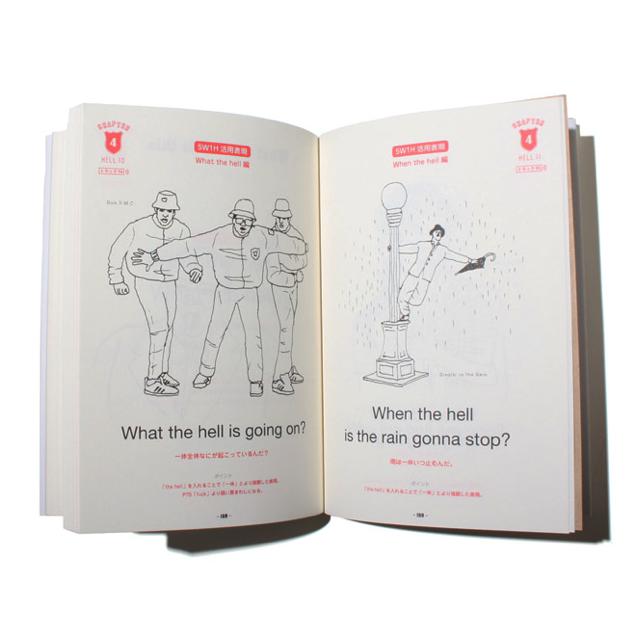
How to Use Fuck Correctly: 99 Phrases Using Fuck, Shit, Damn,...


How to Use Fuck Correctly: 99 Phrases Using Fuck, Shit, Damn, and Hell that Schools Won’t Teach You that Should be Used with Care is a book by Madsaki aimed at Japanese learners of English. I’m pleased to see expletive infixation represented, amid a wide diversity of syntactic constructions! More reviews at JapanSubculture and Kotaku

I disagree with the conclusion that there’s anything special about Japanese speakers’ interest in English swear words though: pretty much everyone is interested in the swear words of other languages. But it does make a good point that it’s worth addressing swear words in language courses. I mean, perhaps not for young kids, but any adult native speaker of a language is going to be familiar with a wide repertoire of swears even if they choose to use them only rarely, so it’s an important part of any language. 

24 Jun 16:28

June 24, 2014

24 Jun 15:32

The social interactions in two preschool classes, in graphic form

by Raymond Chen - MSFT

Each preschooler at my daughter's school was asked a few simple questions, and the answers were printed in the yearbook. Among other things, the preschoolers were asked to complete the sentence, "I like to play with (person)."

This is the type of question that leads to tears and hurt feelings.

Whatever. Their parents are going to be stuck with the therapy bills. (My daughter is not a preschooler at the school, so I avoided a therapy bill. At least not over this.)

From this data, I created a graph. Each arrow points from a student to the person they said they like to play with.

1 7 16
2 8 17
3 9 14 18
10 19
4 11 15 20
5 12
6 13

This class breaks up into four cliques. Two of the cliques consists of a pair of playmates, and one hanger-on. The large clique consists of two focal points (students 9 and 10) who play with each other. The medium-sized clique has a single focal point (student 18) who plays with a best friend (14).

I think that student 14 is in the best spot. He (or she) is not himself popular, but the popular kid plays with him (or her).

The second preschool class has a more complex structure.

21
22
23 30
24 31 35
25 32 36
39
26 33 37
40
27 34 38
28
29

The upper left group consists of a core of four students (23, 30, 31, 24) who play with each other, plus some hangers-on.

The lower left group consists of a pair of friends (27 and 28) and their hangers-on.

The right-hand group consists of one very popular student (37) who plays with a best friend (36), and their hangers-on.

The most interesting student is number 26.

All of the other students gave only one name in response to the prompt. But student 26 gave three names. As a result, that student links together the three cliques in the class.

Student 26 is bringing people together. I admire that.

23 Jun 22:14

The Language of the Game.

by languagehat

As I wrote here, I got David Goldblatt’s The Ball is Round: A Global History of Soccer to accompany the World Cup, and I’m finding it riveting; it’s almost certainly the best history of any sport I’ve read, brilliantly combining sporting and social history. Surprisingly (to me), it starts with Chinese cuju and continues with the ball game both popular and culturally central in ancient Mexico and Central America, immortalized in the Popol Vuh (in which the sun and moon are the bodies of the hero twins who lost a game of ball to the gods), but neither are ancestral to the modern game, and he soon turns to the “large-scale and often riotous” ball games of the Celtic world which probably gave rise to the medieval English pastime so often, and fruitlessly, banned by the authorities. Having survived royal prohibition, it nearly succumbed to modernity, and in 1801 Joseph Strutt could write, “The game was formerly much in vogue among the common people, though of late years it seems to have fallen into disrepute and is but little practiced.”

But football, as we know, survived. It did so because it was preserved and nurtured in institutions that were beyond the cultural reach of Methodists, industrialists and artisans. Britain’s public schools were the ludic zoos of the age. They provided refuge for the wild and endangered games of rural Georgian Britain where they were bred and developed before being released into the new sporting and social ecology of industrial Victorian Britain.

If you find that as delightful as I do, you may want to read the book. At any rate, in the chapter on the first expansion of the game to the wider world around the turn of the twentieth century, I found a passage of clear LH relevance:

The English language itself was considered the mark of modernity and an essential device for excluding any would-be players from the lower classes. In its inaugural statutes the early Parisian club White Rovers stated, ‘Football being an essentially English game, all players must use the English language exclusively when playing together.’ This homage to the power of English remains in the Anglicized club names of the Netherlands, like Go Ahead Eagles and Be Quick Denver, and of Italy, where it is AC Milan not Milano, and Genoa not Genova. In Switzerland Grasshoppers and Young Boys remain among the leading clubs, while in Latin America Liverpool, Everton, Arsenal, Lawn Tennis, Corinthians and The Strongest still play in Uruguay, Chile, Argentina, Peru, Brazil and Bolivia respectively.

He goes on to talk about “Dr James Spensley, the leading force and player at Genoa Cricket,” who “was described in his obituary as having ‘widespread interest[s] in philosophical studies, Greek language, Egyptian Papyrus, football, boxing and popular university. He even initiated an evening school in Genoa.’” Talk about your Renaissance man!

Addendum. And now I know why the Italians call it calcio; on p. 154 Goldblatt, writing about the rise of Italian nationalism, says:

This flicker of Italian nationalism in football was inflamed even further when in 1908 representatives of the gymnastic movement acquired a majority on the Italian Football Federation’s governing council. The cabal immediately began to agitate over the power and role of foreigners in Italian football, and Milan, Genoa and Torino — all of whom insisted on fielding foreigners — were excluded from that year’s national competition. In a strained compromise, indicative of the fundamental weakness of Italian ultra-nationalism, the ban on foreigners was rescinded in return for the official adoption of calcio as the name of the game rather than football: a symbolic victory based on an invented history.

23 Jun 06:31

Why classical music needs to see the light

by Pliable

Morocco is a rhapsody in blue and many other colours; as can be seen from the accompanying photos which were taken during my recent stay in Sidi Ifni - a town named after a Sufi saint*. Colour plays an important part in the all night healing ceremonies called lila of the Gnawa brotherhoods in Morocco. The Gnawa practise a mix of mystical Islam and animism, and in their healing ceremonies music, incense and colours placate the spirits**. Trance inducing music plays as white smoke billows from a brazier burning musk, and, at the start of the lila, black and white benzoin incense is passed around. During the ritual Sidi Mimum is invoked; he is the patron saint of the Gnawa and his colour is black. The spirits in red follow led by Sidi Hamu, he is the spirit of the slaughterhouse and demands blood. As the celebrants emerge from the trance at the conclusion of the lila, lighted candles are passed around as a blessing - baraka - before being extinguished as the celebrants return to the black Mahgreb night.

The Gnawa healing ceremony is a multi-sensory experience which combines sound (music), vision (colours) and scent (incense). A classical concert should also be a form of healing ceremony that placates the spirit with sound and colours. In the West the ear gave way to the eye as the most important gatherer of information at the time of the Renaissance, when the printing press and perspective painting were developed. In a paper titled Acoustic Space - Explorations in Communication Edmund Carpenter and Marshall McLuhan explained that most of our thinking is done in terms of visual models, even when using an auditory one might prove more efficient. Since that paper was published in 1970, the swing from the auditory to the visual has been accelerated by the universal adoption of graphic interfaces for computers.

More evidence of the power of the visual - and also of the power of 5.1 surround sound - can be found right on classical music's doorstep. One of the few bright spots in the classical market is DVD sales. Andrew Cane, the proprietor of leading independent classical store Prelude Records, tells me that DVD/Blu-ray sales account for 12% of his turnover, with the overall industry percentage significantly higher, because sales by independents are depressed by Amazon's heavy discounting. In Prelude Records Blu-ray sales are showing double digit growth, and the Aldeburgh Festival Grimes on the Beach - a truly multi-sensory experience - was the store's biggest selling DVD ever.

The visual is an important part of the essential process that R. Murray Schafer describes as "the opening-out of the time-and-space containers we call compositions and concert halls". Yet, despite the efforts of Alexander Scriabin and others, classical concerts remain mono-sensory experiences rooted firmly in sound; with the much celebrated move away from formal concert dress doing no more than replacing black and white formal attire with all-black subfusc. Thankfully, some are trying to change this; these include kinetic artist Norman Perryman working with pianist Pierre-Laurent Aimard, and photo-choreographer James Westwood, who have both provided successful case studies in the power of the visual. While very recently respected critic Anne Midgette writing in the Washington Post described a choreographed - musicians not dancers - performance of Appalachian Spring as 'powerfully, viscerally emotional'. That performance, which is more healing ceremony than concert, can be watched here. By contrast, below is a photo I took from one of the better seats during a BBC Prom in the Royal Albert Hall. There is much to recommend the Proms, but that viewpoint does not exactly deliver a "powerfully, viscerally emotional" experience.


Another example of a powerful multi-sensory experience was the Aldeburgh Festival Earthquake Mass that I wrote about recently with unashamed enthusiasm. This was presented as a late-night event in Aldeburgh's long-running Faster Than Sound series, which, to quote the website, "joins the dots between musical genres and digital art forms". Yet, despite this clearly experimental context, the Earthquake Mass was universally dismissed by establishment music critics as failing to conform to the traditional mono-sensory model. What chance does classical music have of reaching new audiences when anything other than the stiflingly conventional is dismissed as "taking us back to the juvenile excesses of the Sixties"? And how is classical music going to survive in a fast changing sensory and technology landscape when any suggestion that the times they are a-changin' is greeted with a hysterical and self-interested defence of the status quo?

One of the biggest obstacles to breaking classical music out of the mono-sensory mindset is the misapprehension that sound and vision are two discrete sensory channels. Synaesthesia, the condition where information switches from one channel (hearing) to another processing track (sight), is prized among musicians. Yet, in fact, every human exhibits a subtle form of synaesthesia: as described in an earlier post, ultrasound - high frequencies beyond the range of the ear - are transmitted to the brain through the eyes, and, in a similar way infrasound - very low frequencies - can be felt as well as heard. As Jonathan Harvey explained in an interview with me, energy is basically vibration, and the energy of light and sound both come from the common root of vibration, albeit at different frequencies. Within the audio spectrum the felicitous combination of sight and sound creates a synergy where the sum becomes far greater than the parts, as happens in the balletic Appalachian Spring and the infrasonic Earthquake Mass.

Censorship based on misguided allegations of anti-semitism and discrimination based on the girth of a singer are wrong, and must be tackled. But eradicating those iniquities will not secure the future of classical music. However, making the music relevant by letting it speak in the contemporary demotic may well secure the future. Today's audiences are multi-sensory literate, and the classical music industry needs to wake up and smell the coffee. Changing with the times does not mean dumbing down or selling out. Dumbing down simply reduces the music to a bland zero-sensory commodity that is easily digested and just as easily forgotten. But perpetuating a performance tradition that was fixed more than a century ago is not the answer either. Instead there needs to be carefully considered accommodation of changes in sensory hierarchies - changes which mean that audiences now want their live music up close and visual.

A recent post pointed out that classical music is bad at handling paradigm shifts, and the inexorable shift from aural to multi-sensory acuity that started back in the Renaissance is a very far-reaching paradigm shift. Scott Ross' approach to Frescbaldi - tight but loose - should be the model for classical music: tight in the protection of core values, but loose in accommodating structural change. The next generation of audiences can only come from Generation M [mobile], a cohort whose cognitive processes are being rewired by prolonged exposure to the multi-sensory imagesphere and social sphere. Sorry if I am starting to sound like Max Hole. But art music can only survive if it is relevant to contemporary culture. Culture and technology has changed dramatically in the last three decades, while classical music stubbornly resists all but cosmetic change. It is not difficult to join up the dots.


* In typical fashion this path meanders a long way from its starting point in Morocco. But it is fair to say that none of my recent sequence of posts on psychoacoustics would have been written if I had not spent time recently in Sidi Ifni. Life in Sidi Ifni is a multi-sensory experience. There is the light and the riot of colours that my photos hint at. But there is also the omnipresent infrasound of the surf, which can be felt and heard as the waves roll in from the Atlantic. As R. Murray Schafer says in his seminal book The Tuning of the World: "The sea is the keynote sound of all maritime civilisations. It is also a fertile sonic archetype. All roads lead back to water." And, in another convergence of paths, Sidi Ifni lies to the south of Agadir, a city that was devastated by a terrible earthquake in 1960.

** One of my more enlightened - in more ways than one - projects was to broadcast a complete uninterrupted performance lasting more than two hours of the Gnawa 'black' lila. This was, I believe, the first and only time a complete Gnawa lila has been broadcast. The broadcast was on Future Radio in 2008 and was a collaboration with Kamar Studios in Marrakech. Unfortunately the stream of the programme is no longer available, but the linked post can be read here.

Also on Facebook and Twitter. All photos (c) On An Overgrown Path 2014. Any other copyrighted material is included as "fair use", for the purpose of study, review or critical analysis only, and will be removed at the request of copyright owner(s).
22 Jun 14:49

Guided By Voices

by Geoff Manaugh
At last week's inaugural Infrastructure Observatory conference, MacroCity, archivist Rick Prelinger delivered a fantastic opening lecture, looking back at the history of telephony in the Bay Area.

From the earliest exposed copper wires vulnerable to shorting out in San Francisco's morning fog to 1970s phone phreaks and the future of NSA surveillance, it was a great talk; you can view the slides here (and follow Rick on Twitter for yet more).

[Image: From the Ellensburg Daily Record, June 16, 1914].

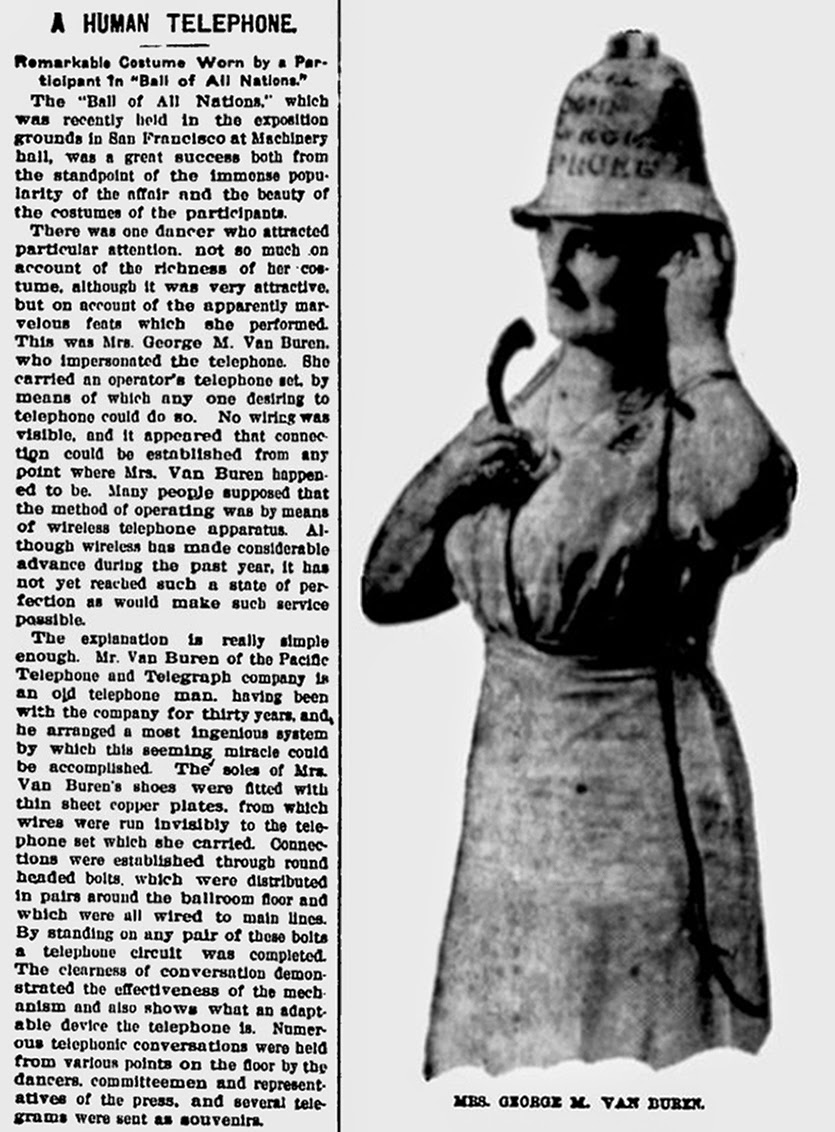
Amidst dozens of examples and images in his talk, the one that really stood out for architectural purposes was his citation of something called the "human telephone," as originally reported in the Ellensburg Daily Record on June 16, 1914. A reorganized and cleaned-up version of that article appears above.

As Prelinger described it, the human telephone was like an electromagnetic update to the oracle at Delphi: a lone female figure with access to distant voices, dancing slowly across a dance floor secretly wired from below, an interactive surface whose hidden technology extended up into her very clothing.

There were copper wires woven through her dress, copper-soled shoes on her feet, even copper nails hammered in the floor below, and this all effectively turned her into a living telephone network—the "human telephone" of the article's title—receiving voices from some continent-scale network invisible to spectators' eyes. Oracular and alluring, she would then invite members of the audience to join her in this choreography, where ghostly conversations-at-a-distance would ensue.

[Image: An otherwise irrelevant photo of people ballroom dancing, via Wikipedia].

In Prelinger's own words:
Prior to the opening of PPIE [the Panama Pacific International Exhibition], Pacific Telephone was asked to furnish service to the Ball of All Nations in May 1914. They built a hidden network of wires under the floor, connected with copper nails set close apart in the floor. The spouse of a telco employee wore copper-soled shoes from which wires ran up through her clothing to a telephone set. She asked her dancing partners whom they'd like to talk with, and suddenly they were on the phone. A switchboard operator listened in on all conversations and whenever she heard a name rushed through a call on special lines.
This wired ballroom—like some telephonic update of the khôra, that Platonic dance floor and moving surface so mythologically important to the first days of Western architecture—presents us with an absolutely incredible image of people waltzing amidst voices, metallurgically connected to a matrix of wires and lines extending far beyond the room they first met within.

The copper woman in the center of it all becomes more like an antenna, stepping and turning inside a glossolalia of distant personalities all vying for time on the invisible network she controls with every move of her feet. Sheathed in metal, she is part golem, part conjurer, part modern oracle, kicking off the weird seance that was the early telephone system, guiding us through a switchboard of words from nowhere all woven together in this awesome dance.
21 Jun 16:56

A Pyramid in the Middle of Nowhere Built to Track the End of the World

by Geoff Manaugh
[Image: Photo by Benjamin Halpern, courtesy of the U.S. Library of Congress].

The Stanley R. Mickelsen Safeguard Complex in Cavalier County, North Dakota, is the focus of an amazing set of images hosted by the U.S. Library of Congress, showing this squat and evocative megastructure in various states of construction and completion.

It's a huge pyramid in the middle of nowhere tracking the end of the world on radar, an abstract geometric shape beneath the sky without a human being in sight, or it could even be the opening scene of an apocalyptic science fiction film—but it's just the U.S. military going about its business, building vast and other-worldly architectural structures that the civilian world only rarely sees.

[Images: Photos by Benjamin Halpern, courtesy of the U.S. Library of Congress].

As Pruned described these structures back in 2008, it was a "mastaba-shaped radar facility reminiscent of the work of architect Étienne-Louis Boullée."

As such, Pruned suggests, it offers convincing architectural evidence that we should consider "the "U.S. anti-ballistic landscape as a subset of Land Art"—as lonely pieces of abandoned infrastructure isolated amidst sublime and almost unreachably remote locations.

[Images: Photos by Benjamin Halpern, courtesy of the U.S. Library of Congress].

The photos seen here, taken for the U.S. government by photographer Benjamin Halpern, show the central pyramid—pyramid, monument, modular obelisk: whatever you want to call it—that served as the site's missile-tracking station. Its omnidirectional all-seeing white circles stared endlessly at invisible airborne objects moving beyond the horizon.

The Library of Congress gives the pyramid's location somewhat absurdly as "Northeast of Tactical Road; southeast of Tactical Road South." In other words, it's ensconced somewhere in a maze of self-reference and tautology, perhaps deliberately obscuring exactly how you're meant to arrive at this place.

[Image: Photo by Benjamin Halpern, courtesy of the U.S. Library of Congress].

Yet the pyramid has become something of a roadtripper's delight in the last decade or two. When I initially published a slightly different version of this post on Gizmodo, commenters from around the world jumped in with their own photos and memories of driving hours out of their way to find these military ruins looming spookily on the horizon.

Most if not all of them then discovered that it was as easy as simply saying hello to the guard, walking unencumbered through the front gate, and then hanging out for hours, running up the side of the pyramid, taking pictures against the North Dakota sky, and enjoying this American Giza as a peculiarly avant-garde site for an afternoon picnic.

You can even see the structures, arranged like some ritual sequence of spatial objects—a chapel of radar aligned with war—on Google Street View.

[Image: The pyramid, seen somewhat jarringly in full color, via Google Street View].

One thing I like so much about these shots is how they resemble early expeditionary photos of the hulking Mayan ruins found at Chichén Itzá.

Check out these comparative shots, for example, where the latter image was taken by photographer Henry Sweet during a 19th-century archaeological journey led by Alfred P. Maudslay. The photo was featured as part of an exhibition at the University of North Carolina back in 2007.

[Images: (top) Photo by Benjamin Halpern, courtesy of the U.S. Library of Congress; (bottom) photo by Henry Sweet, courtesy of the UNC-Chapel Hill].

Of course, there is nothing really to compare outside of their same overall geometry—yet it's striking to consider the functional, if obviously metaphoric, similarities here as well. 

One structure was built as part of a kind of analogue system for tracking divine events and celestial calendars, as dark constellations of gods spun across the sky; the other was a temple to mathematics built for guiding and pinging missiles as they streaked horizon to horizon, a site of early warning against the apocalypse, as a new zodiac of nuclear warheads would burst open to shine their world-blinding light on the obliterated landscapes below. 

Trajectories, paths, horizons: both pyramids, in a sense, were architectural monuments for navigation of different kinds. Both timeless, strange, and seemingly inhuman: spatial artifacts of lost civilizations.

[Image: Photo by Benjamin Halpern, courtesy of the U.S. Library of Congress].

In any case, the original photos on the Library of Congress website are heavily specked with dust and some lens artifacts, but I've cleaned up my favorites and posted some of them here. 

[Images: Photos by Benjamin Halpern, courtesy of the U.S. Library of Congress].

This is how modern-day pyramids are made: huge budgets and ziggurats of rebar, as tiny figures wearing hardhats scramble around amidst gargantuan geometric forms, checking diagrams against reality and trying not to think of the nuclear war this structure was being built to track.

[Images: Photos by Benjamin Halpern, courtesy of the U.S. Library of Congress].

(An earlier version of this post previously appeared on Gizmodo).
20 Jun 16:25

Where Borders Melt

by Geoff Manaugh
[Image: From Italian Limes. Photo by Delfino Sisto Legnani, courtesy of Folder].

One of the most interesting sites from a course I taught several years ago at Columbia—Glacier, Island, Storm—was the glacial border between Italy and Switzerland.

The border there is not, in fact, permanently determined, as it actually shifts back and forth according to the height of the glaciers.

This not only means that parts of the landscape there have shifted between nations without ever really going anywhere—a kind of ghost dance of the nation-states—but also that climate change will have a very literal effect on the size and shape of both countries.

[Image: Due to glacial melt, Switzerland has actually grown in size since 1940; courtesy swisstopo].

This could result in the absurd scenario of Switzerland, for example, using its famed glacier blankets, attempting to preserve glacial mass (and thus sovereign territory), or it might even mean designing and cultivating artificial glaciers as a means of aggressively expanding national territory.

As student Marissa Looby interpreted the brief, there would be small watchtowers constructed in the Alps to act as temporary residential structures for border scientists and their surveying machines, and to function as actual physical marking systems visible for miles in the mountains, somewhere between architectural measuring stick for glacial growth and modular micro-housing.

But the very idea that a form of thermal warfare might break out between two countries—with Switzerland and Italy competitively growing and preserving glaciers under military escort high in the Alps—is a compelling (if not altogether likely) thing to consider. Similarly, the notion that techniques borrowed from landscape and architectural design could be used to actually make countries bigger—eg. through the construction of glacier-maintenance structures, ice-growing farms, or the formatting of the landscape to store seasonal accumulations of snow more effectively—is absolutely fascinating.

[Images: From Italian Limes. Photos by Delfino Sisto Legnani, courtesy of Folder].

I was thus interested to read about a conceptually similar but otherwise unrelated new project, a small exhibition on display at this year's Venice Biennale called—in English, somewhat unfortunately—Italian Limes, where "Limes" is actually Latin for limits or borders (not English for a small acidic fruit). Italian Limes explores "the most remote Alpine regions, where Italy’s northern frontier drifts with glaciers."

In effect, this is simply a project looking at this moving border region in the Alps from the standpoint of Italy.

[Image: From Italian Limes. Photo by Delfino Sisto Legnani, courtesy of Folder].

As the project description explains, "Italy is one of the rare continental countries whose entire confines are defined by precise natural borders. Mountain passes, peaks, valleys and promontories have been marked, altered, and colonized by peculiar systems of control that played a fundamental role in the definition of the modern sovereign state."

[Images: From Italian Limes. Photos by Delfino Sisto Legnani, courtesy of Folder].

However, they add, between 2008 and 2009, Italy negotiated "a new definition of the frontiers with Austria, France and Switzerland."
Due to global warming and and shrinking Alpine glaciers, the watershed—which determines large stretches of the borders between these countries—has shifted consistently. A new concept of movable border has thus been introduced into national legislation, recognizing the volatility of any watershed geography through regular alterations of the physical benchmarks that determine the exact frontier.
[Images: From Italian Limes. Photos by Delfino Sisto Legnani, courtesy of Folder].

The actual project that resulted from this falls somewhere between landscape surveying and technical invention—and is a pretty awesome example of where territorial management, technological databases, and national archives all intersect:
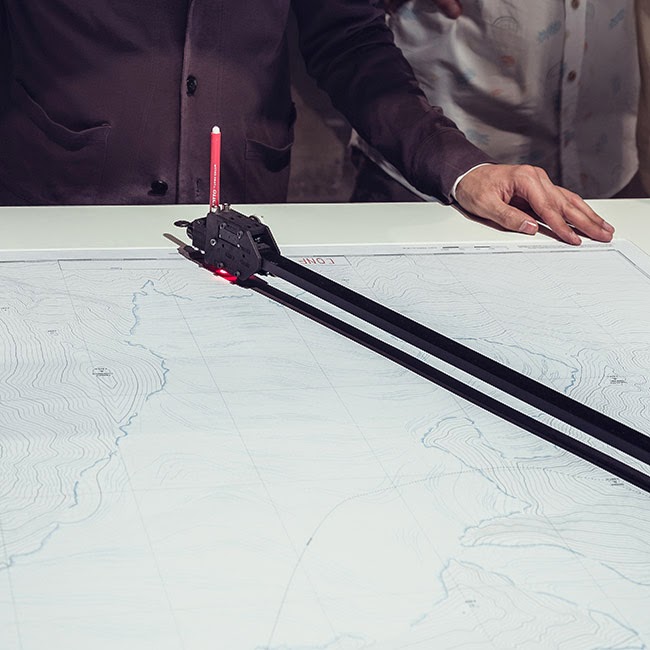
On May 4th, 2014, the Italian Limes team installed a network of solar-powered GPS units on the surface of the Similaun glacier, following a 1-km-long section of the border between Italy and Austria, in order to monitor the movements of the ice sheet throughout the duration of the exhibition at the Corderie dell’Arsenale. The geographic coordinates collected by the sensors are broadcasted and stored every hour on a remote server via a satellite connection. An automated drawing machine—controlled by an Arduino board and programmed with Processing—has been specifically designed to translated the coordinates received from the sensors into a real-time representation of the shifts in the border. The drawing machine operates automatically and can be activated on request by every visitor, who can collect a customized and unique map of the border between Italy and Austria, produced on the exact moment of his [or her] visit to the exhibition.
The drawing machine, together with the altered maps and images it produces, are thus meant to reveal "how the Alps have been a constant laboratory for technological experimentation, and how the border is a compex system in evolution, whose physical manifestation coincides with the terms of its representation."

The digital broadcast stations mounted along the border region are not entirely unlike Switzerland's own topographic markers, over 7,000 "small historical monuments" that mark the edge of the country's own legal districts, and also comparable to the pillars or obelisks that mark parts of the U.S./Mexico border. Which is not surprising: mapping and measuring border is always a tricky thing, and leaving physical objects behind to mark the route is simply one of the most obvious techniques.

As the next sequence of images shows, these antenna-like sentinels stand alone in the middle of vast ice fields, silently recording the size and shape of a nation.

[Images: From Italian Limes. Photos by Delfino Sisto Legnani, courtesy of Folder].

The project, including topographic models, photographs, and examples of the drawing machine network, will be on display in the Italian Pavilion of the Venice Biennale until November 23, 2014. Check out their website for more.

Meanwhile, the research and writing that went into Glacier, Island, Storm remains both interesting and relevant today, if you're looking for something to click through. Start here, here, or even here.

[Image: From Italian Limes. Photo by Delfino Sisto Legnani, courtesy of Folder].

Italian Limes is a project by Folder (Marco Ferrari, Elisa Pasqual) with Pietro Leoni (interaction design), Delfino Sisto Legnani (photography), Dawid Górny, Alex Rothera, Angelo Semeraro (projection mapping), Claudia Mainardi, Alessandro Mason (team).
19 Jun 16:45

Perspectival Objects

by Geoff Manaugh
[Image: A perspectival representation of the "ideal city," artist unknown].

There's an interesting throwaway line in The Verge's write-up of yesterday's Amazon phone launch, where blogger David Pierce remarks that the much-hyped public unveiling of Amazon's so-called Fire Phone was "oddly focused on art history and perspective."

As another post at the site points out, "Amazon CEO Jeff Bezos likened it to the move from flat artwork to artwork with geometric perspective which began in the 14th century."

These are passing comments, sure, and, from Amazon's side, it's more marketing hype than anything like rigorous phenomenological theorizing. Yet there's something strangely compelling in the idea that a seemingly gratuitous new consumer product—just another smartphone—might actually owe its allegiance to a different technical lineage, one less connected to the telecommunications industry and more from the world of architectural representation.

[Image: Jeff Bezos as perspectival historian. Courtesy of The Verge].

It would be a smartphone that takes us back to, say, Albrecht Dürer and his gridded drawing machines, making the Fire Phone a kind of perspectival object that deserves a place, however weird, in architectural history. Erwin Panofksy, we might say, would have used a Fire Phone—or at least he would have written a blog post about it.

In this context, the amazing image of billionaire Jeff Bezos standing on stage, giving a kind of off-the-cuff history of perspectival rendering surely belongs in future works of architectural history. Smiling and schoolteacher-like, Bezos gestures in front of an infinite grid ghosted-in over this seminal work of urban scenography, in one moment aiming to fit his product within a very particular, highly Western tradition of representing the built environment.

[Image: Courtesy of The Verge].

The launch of the Fire Phone did indeed give perspectival representation its due, showing how a three-dimensionally or relationally accurate perception of geometric space can change quite dramatically with only a small move of the viewer's own head.

The phone's "dynamic perspective," engineered to correct this, seems a little rickety at best, but it is meant as way to account for otherwise inconsequential movements of the viewer through the landscape, whether it's a crowded city street or the vast interiors of a hotel. To do so requires an almost comical amount of technical hand-waving. From The Verge:
The key to making dynamic perspective work is knowing exactly where the user's head is at all times, in real time, many times per second, Bezos said. It's something that the company has been working on for four years, and [the] best way to do it is with computer vision, he went on to note. The single, standard front-facing camera wasn't sufficient because its field of view was too narrow—so Amazon included four additional cameras with a much wider field of view to continuously capture a user's head. At the end of the day, it features four specialized front-facing cameras in addition to the standard front-facing camera found near the earpiece, two of which can be used in case the other cameras were covered; it uses the best two at any given time. Lastly, Amazon included infrared lights in each camera to allow the phone to work in the dark.
Five hundred years ago, we'd instead be reading about some fabulous new system of mirrors, lens, prisms, and strings, all tied back to or operated by way of complexly engineered works of geared furniture. Unfolding tables and adjustable chairs, with operable flaps and windows.

[Image: One of several perspectival objects—contraptions for producing spatially accurate drawings—by Albrecht Dürer].

These precursors of the Fire Phone, after seemingly endless acts of fine-tuning, would then, and only then, allow their users to see the scene before them with three-dimensional accuracy.

Now, replace those prisms and mirrors with multiple forward-facing cameras and infrared sensors, and market the resulting object to billions of potential users in front of gridded scenes of Western urbanism, and you've got the strange moment that happened yesterday, where a smartphone aimed to collapse all of Western art history into a single technical artifact, a perspectival object many of us will soon be carrying in our bags and pockets.

[Image: Another "ideal city," artist unknown].

More interestingly, though, with its odd focus "on art history and perspective," Amazon's event raises the question of how electronic mediation of the built environment might be affecting how our cities are designed in the first place—how we see buildings, streets, and cities through the dynamic lens of automatic perspective correction and other visual algorithms.

Put another way, is there a type of architecture—Classical, Romanesque—particularly well-suited for perspectival objects like the Fire Phone, and, conversely, are there types of built space that throw these devices off altogether? Further, could artificial environments that exceed the rendering capacity of smartphones and other digital cameras be deliberately designed—and, if so, what would they "look like" to those sensors and objects?

Recall that, at one point in his demonstration, Bezos explained how Amazon's new interface "uses different layers to hide and show information on the map like Yelp reviews," effectively tagging works of architecture with digital metadata in a kind of Augmented Reality Lite.

But what this suggests, together with Bezos's use of "ideal city" imagery, is that smartphone urbanism will have its own peculiar stylistic needs. Perhaps, if visually defined, that will mean that phones will require cities to be gridded and legible, with clear spatial differentiation between buildings and objects in order to function most accurately—in order to line up with the clouds of virtual tags we will soon be placing all over the structures around us. Perhaps, if more GPS-defined, that will mean overlapping buildings and spaces are just fine, but they nonetheless must allow unblocked access to satellite signals above so that things don't get confused down at street level—a kind of celestial perspectivism where, from the phone's point of view, the roof is the new facade, the actual "front" of the building through which vital navigational signals must travel.

Either way, the possibility that there is a particular type of space, or a particular type of urbanism, most suited to the perspectival needs of new smartphones is totally fascinating. Perhaps in retrospect, this photograph of Jeff Bezos, grinning at the world in front of a gigantic image of Western perspective, will become a canonical architectural image of where digital objects and urban design intersect.
19 Jun 05:46

Eigenmorality

by Scott

This post is about an idea I had around 1997, when I was 16 years old and a freshman computer-science major at Cornell.  Back then, I was extremely impressed by a research project called CLEVER, which one of my professors, Jon Kleinberg, had led while working at IBM Almaden.  The idea was to use the link structure of the web itself to rank which web pages were most important, and therefore which ones should be returned first in a search query.  Specifically, Kleinberg defined “hubs” as pages that linked to lots of “authorities,” and “authorities” as pages that were linked to by lots of “hubs.”  At first glance, this definition seems hopelessly circular, but Kleinberg observed that one can break the circularity by just treating the World Wide Web as a giant directed graph, and doing some linear algebra on its adjacency matrix.  Equivalently, you can imagine an iterative process where each web page starts out with the same hub/authority “starting credits,” but then in each round, the pages distribute their credits among their neighbors, so that the most popular pages get more credits, which they can then, in turn, distribute to their neighbors by linking to them.

I was also impressed by a similar research project called PageRank, which was proposed later by two guys at Stanford named Sergey Brin and Larry Page.  Brin and Page dispensed with Kleinberg’s bipartite hubs-and-authorities structure in favor of a more uniform structure, and made some other changes, but otherwise their idea was very similar.  At the time, of course, I didn’t know that CLEVER was going to languish at IBM, while PageRank (renamed Google) was going to expand to roughly the size of the entire world’s economy.

In any case, the question I asked myself about CLEVER/PageRank was not the one that, maybe in retrospect, I should have asked: namely, “how can I leverage the fact that I know the importance of this idea before most people do, in order to make millions of dollars?”

Instead I asked myself: “what other ‘vicious circles’ in science and philosophy could one unravel using the same linear-algebra trick that CLEVER and PageRank exploit?”  After all, CLEVER and PageRank were both founded on what looked like a hopelessly circular intuition: “a web page is important if other important web pages link to it.”  Yet they both managed to use math to defeat the circularity.  All you had to do was find an “importance equilibrium,” in which your assignment of “importance” to each web page was stable under a certain linear map.  And such an equilibrium could be shown to exist—indeed, to exist uniquely.

Searching for other circular notions to elucidate using linear algebra, I hit on morality.  Philosophers from Socrates on, I was vaguely aware, had struggled to define what makes a person “moral” or “virtuous,” without tacitly presupposing the answer.  Well, it seemed to me that, as a first attempt, one could do a lot worse than the following:

A moral person is someone who cooperates with other moral people, and who refuses to cooperate with immoral people.

Obviously one can quibble with this definition on numerous grounds: for example, what exactly does it mean to “cooperate,” and which other people are relevant here?  If you don’t donate money to starving children in Africa, have you implicitly “refused to cooperate” with them?  What’s the relative importance of cooperating with good people and withholding cooperation with bad people, of kindness and justice?  Is there a duty not to cooperate with bad people, or merely the lack of a duty to cooperate with them?  Should we consider intent, or only outcomes?  Surely we shouldn’t hold someone accountable for sheltering a burglar, if they didn’t know about the burgling?  Also, should we compute your “total morality” by simply summing over your interactions with everyone else in your community?  If so, then can a career’s worth of lifesaving surgeries numerically overwhelm the badness of murdering a single child?

For now, I want you to set all of these important questions aside, and just focus on the fact that the definition doesn’t even seem to work on its own terms, because of circularity.  How can we possibly know which people are moral (and hence worthy of our cooperation), and which ones immoral (and hence unworthy), without presupposing the very thing that we seek to define?

Ah, I thought—this is precisely where linear algebra can come to the rescue!  Just like in CLEVER or PageRank, we can begin by giving everyone in the community an equal number of “morality starting credits.”  Then we can apply an iterative update rule, where each person A can gain morality credits by cooperating with each other person B, and A gains more credits the more credits B has already.  We apply the rule over and over, until the number of morality credits per person converges to an equilibrium.  (Or, of course, we can shortcut the process by simply finding the principal eigenvector of the “cooperation matrix,” using whatever algorithm we like.)  We then have our objective measure of morality for each individual, solving a 2400-year-old open problem in philosophy.

The next step, I figured, would be to hack together some code that computed this “eigenmorality” metric, and then see what happened when I ran the code to measure the morality of each participant in a simulated society.  What would happen?  Would the results conform to my pre-theoretic intuitions about what sort of behavior was moral and what wasn’t?  If not, then would watching the simulation give me new ideas about how to improve the morality metric?  Or would it be my intuitions themselves that would change?

Unfortunately, I never got around to the “coding it up” part—there’s a reason why I became a theorist!  The eigenmorality idea went onto my back burner, where it stayed for the next 16 years: 16 years in which our world descended ever further into darkness, lacking a principled way to quantify morality.  But finally, this year, just two separate things have happened on the eigenmorality front, and that’s why I’m blogging about it now.

Eigenjesus and Eigenmoses

The first thing that’s happened is that Tyler Singer-Clark, my superb former undergraduate advisee, did code up eigenmorality metrics and test them out on a simulated society, for his MIT senior thesis project.  You can read Tyler’s 12-page report here—it’s a fun, enjoyable, thought-provoking first research paper, one that I wholeheartedly recommend.  Or, if you’d like to experiment yourself with the Python code, you can download it here from github.  (Of course, all opinions expressed in this post are mine alone, not necessarily Tyler’s.)

Briefly, Tyler examined what eigenmorality has to say in the setting of an Iterated Prisoner’s Dilemma (IPD) tournament.  The Iterated Prisoner’s Dilemma is the famous game in which two players meet repeatedly, and in each turn can either “Cooperate” or “Defect.”  The absolute best thing, from your perspective, is if you defect while your partner cooperates.  But you’re also pretty happy if you both cooperate.  You’re less happy if you both defect, while the worst (from your standpoint) is if you cooperate while your partner defects.  At each turn, when contemplating what to do, you have the entire previous history of your interaction with this partner available to you.  And thus, for example, you can decide to “punish” your partner for past defections, “reward” her for past cooperations, or “try to take advantage” by unilaterally defecting and seeing what happens.  At each turn, the game has some small constant probability of ending—so you know approximately how many times you’ll meet this partner in the future, but you don’t know exactly when the last turn will be.  Your score, in the game, is then the sum-total of your score over all turns and all partners (where each player meets each other player once).

In the late 1970s, as recounted in his classic work The Evolution of Cooperation, Robert Axelrod invited people all over the world to submit computer programs for playing this game, which were then pit against each other in the world’s first serious IPD tournament.  And, in a tale that’s been retold in hundreds of popular books, while many people submitted complicated programs that used machine learning, etc. to try to suss out their opponents, the program that won—hands-down, repeatedly—was TIT_FOR_TAT, a few lines of code submitted by the psychologist Anatol Rapaport to implement an ancient moral maxim.  TIT_FOR_TAT starts out by cooperating; thereafter, it simply does whatever its opponent did in the last move, swiftly rewarding every cooperation and punishing every defection, and ignoring the entire previous history.  In the decades since Axelrod, running Iterated Prisoners’ Dilemma tournaments has become a minor industry, with countless variations explored (for example, “evolutionary” versions, and versions allowing side-communication between the players), countless new strategies invented, and countless papers published.  To make a long story short, TIT_FOR_TAT continues to do quite well across a wide range of environments, but depending on the mix of players present, other strategies can sometimes beat TIT_FOR_TAT.  (As one example, if there’s a sizable minority of colluding players, who recognize each other by cooperating and defecting in a prearranged sequence, then those players can destroy TIT_FOR_TAT and other “simple” strategies, by cooperating with one another while defecting against everyone else.)

Anyway, Tyler sets up and runs a fairly standard IPD tournament, with a mix of strategies that includes TIT_FOR_TAT, TIT_FOR_TWO_TATS, other TIT_FOR_TAT variations, PAVLOV, FRIEDMAN, EATHERLY, CHAMPION (see the paper for details), and degenerate strategies like always defecting, always cooperating, and playing randomly.  However, Tyler then asks an unusual question about the IPD tournament: namely, purely on the basis of the cooperate/defect sequences, which players should we judge to have acted morally toward their partners?

It might be objected that the players didn’t “know” they were going to be graded on morality: as far as they knew, they were just trying to maximize their individual utilities.  The trouble with that objection is that the players didn’t “know” they were trying to maximize their utilities either!  The players are bots, which do whatever their code tells them to do.  So in some sense, utility—no less than morality—is “merely an interpretation” that we impose on the raw cooperate/defect sequences!  There’s nothing to stop us from imposing some other interpretation (say, one that explicitly tries to measure morality) and seeing what happens.

In an attempt to measure the players’ morality, Tyler uses the eigenmorality idea from before.  The extent to which player A “cooperates” with player B is simply measured by the percentage of times A cooperates.  (One acknowledged limitation of this work is that, when two players both defect, there’s no attempt to take into account “who started it,” and to judge the aggressor more harshly than the retaliator—or to incorporate time in any other way.)  This then gives us a “cooperation matrix,” whose (i,j) entry records the total amount of niceness that player i displayed to player j.  Diagonalizing that matrix, and taking its largest eigenvector, then gives us our morality scores.

Now, there’s a very interesting ambiguity in what I said above.  Namely, should we define the “niceness scores” to lie in [0,1] (so that the lowest, meanest possible score is 0), or in [-1,1] (so that it’s possible to have negative niceness)?  This might sound like a triviality, but in our setting, it’s precisely the mathematical reflection of one of the philosophical conundrums I mentioned earlier.  The conundrum can be stated as follows: is your morality a monotone function of your niceness?  We all agree, presumably, that it’s better to be nice to Gandhi than to be nice to Hitler.  But do you have a positive obligation to be not-nice to Hitler: to make him suffer because he made others suffer?  Or, OK, how about not Hitler, but someone who’s somewhat bad?  Consider, for example, a woman who falls in love with, and marries, an unrepentant armed robber (with full knowledge of who he is, and with other options available to her).  Is the woman morally praiseworthy for loving her husband despite his bad behavior?  Or is she blameworthy because, by rewarding his behavior with her love, she helps to enable it?

To capture two possible extremes of opinion about such questions, Tyler and I defined two different morality metrics, which we called … wait for it … eigenmoses and eigenjesus.  Eigenmoses has the niceness scores in [-1,1], which means that you’re actively rewarded for punishing evildoers: that is, for defecting against those who defect against many moral players.  Eigenjesus, by contrast, has the niceness scores in [0,1], which means that you always do at least as well by “turning the other cheek” and cooperating.  (Though note that, even with eigenjesus, you get more morality credits by cooperating with moral players than by cooperating with immoral ones.)

This is probably a good place to mention a second limitation of Tyler’s current study.  Namely, with the current system, there’s no direct way for a player to find out how its partner has been behaving toward third parties.  The only information that A gets about the goodness or evilness of player B, comes from A and B’s direct interaction.  Ideally, one would like to design bots that take into account, not only the other bots’ behavior toward them, but the other bots’ behavior toward each other.  So for example, even if someone is unfailingly nice to you, if that person is an asshole to everyone else, then the eigenmoses moral code would demand that you return the person’s cooperation with icy defection.  Conversely, even if Gandhi is mean and hateful to you, you would still be morally obliged (interestingly, on both the eigenmoses and eigenjesus codes) to be nice to him, because of the amount of good he does for everyone else.

Anyway, you can read Tyler’s paper if you want to see the results of computing the eigenmoses and eigenjesus scores for a diverse population of bots.  Briefly, the results accord pretty well with intuition.  When we look at eigenjesus scores, the all-cooperate bot comes out on top and the all-defect bot on the bottom (as is mathematically necessary), with TIT_FOR_TAT somewhere in the middle, and generous versions of TIT_FOR_TAT higher up.  When we look at eigenmoses, by contrast, TIT_FOR_TWO_TATS comes out on top, with TIT_FOR_TAT in sixth place, and the all-cooperate bot scoring below the median.  Interestingly, once again, the all-defect bot gets the lowest score (though in this case, it wasn’t mathematically necessary).

Even though the measures acquit themselves well in this particular tournament, it’s admittedly easy to construct scenarios where the prescriptions of eigenjesus and eigenmoses alike violently diverge from most people’s moral intuitions.  We’ve already touched on a few such scenarios above (for example, are you really morally obligated to lick the boots of someone who kicks you, just because that person is a saint to everyone other than you?).  Another type of scenario involves minorities.  Imagine, for instance, that 98% of the players are unfailingly nice to each other, but unfailingly cruel to the remaining 2% (who they can recognize, let’s say, by their long noses or darker skin—some trivial feature like that).  Meanwhile, the put-upon 2% return the favor by being nice to each other and mean to the 98%.  Who, in this scenario, is moral, and who’s immoral?  The mathematical verdict of both eigenmoses and eigenjesus is unequivocal: the 98% are almost perfectly good, while the 2% are almost perfectly evil.  After all, the 98% are nice to almost everyone, while the 2% are mean to those who are nice to almost everyone, and nice only to a tiny minority who are mean to almost everyone.  Of course, for much of human history, this is precisely how morality worked, in many people’s minds.  But I dare say it’s a result that would make moderns uncomfortable.

In summary, it seems clear to me that neither eigenmoses nor eigenjesus correctly captures our intuitions about morality, any more than Φ captures our intuitions about consciousness.  But as they say, I think there’s plenty of scope here for further research: for coming up with new mathematical measures that sharpen our intuitive judgments about morality, and (if we like) testing those measures out using IPD tournaments.  It also seems to me that there’s something fundamentally right about the eigenvector idea: all else being equal, we’d like to say, being nice to others is good, except that aiding and abetting evildoers is not good, and the way we can recognize the evildoers in our midst is that they’re not nice to others—except that, if the people who someone isn’t nice to are themselves evildoers, then the person might again be good, and so on.  The only way to cut off the infinite regress, it seems, is to demand some sort of “reflective equilibrium” in our moral judgments, and that’s precisely what eigenmorality tries to capture.  On the other hand, no such idea can ever make moral debate obsolete—if for no other reason than that we still need to decide which specific eigenmorality metric to use, and that choice is itself a moral judgment.

Scooped by Plato

Which brings me, finally, to the second new thing that’s happened this year on the eigenmorality front.  Namely, Rebecca Newberger Goldstein—who’s far and away my favorite contemporary novelist—published a charming new book entitled Plato at the Googleplex: Why Philosophy Won’t Go Away.  Here she imagines that Plato has reappeared in present-day America (she doesn’t bother to explain how), where he’s taught himself English and the basics of modern science, learned how to use the Internet, and otherwise gotten himself up to speed.  The book recounts Plato’s dialogues with various modern interlocutors, as he volunteers to have his brain scanned, guest-writes a relationship advice column, participates in a panel discussion on child-rearing, and gets interviewed on cable news by “Roy McCoy” (a thinly veiled Bill O’Reilly).  Often, Goldstein has Plato answer the moderns’ questions using direct quotes from the Timaeus, the Gorgias, the Meno, etc., which makes her Plato into a very intelligent sort of chatbot.  This is a genre that’s not often seriously attempted, and that I’d love to read more of (possible subjects: Shakespeare, Galileo, Jefferson, Lincoln, Einstein, Turing…).

Anyway, my favorite episode in the book is the first, eponymous one, where Plato visits the Googleplex in Mountain View.  While eating lunch in one of the many free cafeterias, Plato is cornered by a somewhat self-important, dreadlocked coder named Marcus, who tries to convince Plato that Google PageRank has finally solved the problem agonized over in the Republic, of how to define justice.  By using the Internet, we can simply crowd-source the answer, Marcus declares: get millions of people to render moral judgments on every conceivable question, and also moral judgments on each other’s judgments.  Then declare those judgments the most morally reliable, that are judged the most reliable by the people who are themselves the most morally reliable.  The circularity, as usual, is broken by taking the principal eigenvector of the graph of moral judgments (Goldstein doesn’t have Marcus put it that way, but it’s what she means).

Not surprisingly, Plato is skeptical.  Through Socratic questioning—the method he learned from the horse’s mouth—Plato manages to make Marcus realize that, in the very act of choosing which of several variants of PageRank to use in our crowd-sourced justice engine, we’ll implicitly be making moral choices already.  And therefore, we can’t use PageRank, or anything like it, as the ultimate ground of morality.

Whereas I imagined that the raw data for an “eigenmorality” metric would consist of numerical measures of how nice people had been to each other, Goldstein imagines the raw data to consist of abstract moral judgments, and of judgments about judgments.  Also, whereas the output of my kind of metric would be a measure of the “goodness” of each individual person, the outputs of hers would presumably be verdicts about general moral and political questions.  But, much like with CLEVER versus PageRank, it’s obvious that the ideas are similar—and that I should credit Goldstein with independently discovering my nerdy 16-year-old vision, in order to put it in the mouth of a nerdy character in her story.

As I said before, I agree with Goldstein’s Plato that eigenmorality can’t serve as the ultimate ground of morality.  But that’s a bit like saying that Google rank can’t serve as the ultimate ground of importance, because even just to design and evaluate their ranking algorithms, Google’s engineers must have some prior notion of “importance” to serve as a standard.  That’s true, of course, but it omits to mention that Google rank is still useful—useful enough to have changed civilization in the space of a few years.  Goldstein’s book has the wonderful property that even the ideas she gives to her secondary characters, the ones who serve as foils to Plato, are sometimes interesting enough to deserve book-length treatments of their own, and crowd-sourced morality strikes me as a perfect example.

In the two previous comment threads, we got into a discussion of anthropogenic climate change, and of my own preferred way to address it and related threats to our civilization’s survival, which is simply to tax every economic activity at a rate commensurate with the environmental damage that it does, and use the funds collected for cleanup, mitigation, and research into alternatives.  (Obviously, such ideas are nonstarters in the current political climate of the US, but I’m not talking here about what’s feasible, only about what’s necessary.)  As several commenters pointed out, my view raises an obvious question: who is to decide how much “damage” each activity causes, and thus how much it should be taxed?  Of course, this is merely a special case of the more general question: who is to decide on any question of public policy whatsoever?

For the past few centuries, our main method for answering such questions—in those parts of the world where a king or dictator or Politburo doesn’t decree the answer—has been representative democracy.  Democracy is, arguably, the best decision-making method that our sorry species has ever managed to put into practice, at least outside the hard sciences.  But in my view, representative democracy is now failing spectacularly at possibly the single most important problem it’s ever faced: namely, that of leaving our descendants a livable planet.  Even though, by and large, reasonable people mostly agree about what needs to be done—weaning ourselves off fossil fuels (especially the dirtier ones), switching to solar, wind, and nuclear, planting forests and stopping deforestation, etc.—after decades of debate we’re still taking only limping, token steps toward those goals, and in many cases we’re moving rapidly in the opposite direction.  Those who, for financial, theological, or ideological reasons, deny the very existence of a problem, have proved that despite being a minority, they can push hard enough on the levers of democracy to prevent anything meaningful from happening.

So what’s the solution?  To put the world under the thumb of an environmentalist dictator?  Absolutely not.  In all of history, I don’t think any dictatorial system has ever shown itself robust against takeover by murderous tyrants (people who probably aren’t too keen on alternative energy either).  The problem, I think, is epistemological.  Within physics and chemistry and climatology, the people who think anthropogenic climate change exists and is a serious problem have won the argument—but the news of their intellectual victory hasn’t yet spread to the opinion page of the Wall Street Journal, or cable news, or the US Congress, or the minds of enough people to tip the scales of history.  Because our domination of the earth’s climate and biosphere is new and unfamiliar; because the evidence for rapid climate change is complicated and statistical; because the worst effects are still remote from us in time, space, or both; because the sacrifices needed to address the problem are real—for all of these reasons, the deniers have learned that they can subvert the Popperian process by which bad explanations are discarded and good explanations win.  If you just repeat debunked ideas through a loud enough megaphone, it turns out, many onlookers won’t be able to tell the difference between you and the people who have genuine knowledge—or they will eventually, but not until it’s too late.  If you have a few million dollars, you can even set up your own parody of the scientific process: your own phony experts, in their own phony think tanks, with their own phony publications, giving each other legitimacy by citing each other.  (Of course, all this is a problem for many fields, not just climate change.  Climate is special only because there, the future of life on earth might literally hinge on our ability to get epistemology right.)

Yet for all that, I’m an optimist—sort of.  For it seems to me that the Internet has given us new tools with which to try to fix our collective epistemology, without giving up on a democratic society.  Google, Wikipedia, Quora, and so forth have already improved our situation, if only by a little.  We could improve it a lot more.  Consider, for example, the following attempted definitions:

A trustworthy source of information is one that’s considered trustworthy by many sources who are themselves trustworthy (on the same topic or on closely related topics).  The current scientific consensus, on any given issue, is what the trustworthy sources consider to be the consensus.  A good decision-maker is someone who’s considered to be a good decision-maker by many other good decision-makers.

At first glance, the above definitions sound ludicrously circular—even Orwellian—but we now know that all that’s needed to unravel the circularity is a principal eigenvector computation on the matrix of trust.  And the computation of such an eigenvector need be no more “Orwellian” than … well, Google.  If enough people want it, then we have the tools today to put flesh on these definitions, to give them agency: to build a crowd-sourced deliberative democracy, one that “usually just works” in much the same way Google usually just works.

Now, would those with axes to grind try to subvert such a system the instant it went online?  Certainly.  For example, I assume that millions of people would rate Conservapedia as a more trustworthy source than Wikipedia—and would rate other people who had done so as, themselves, trustworthy sources, while rating as untrustworthy anyone who called Conservapedia untrustworthy.  So there would arise a parallel world of trust and consensus and “expertise,” mutually-reinforcing yet nearly disjoint from the world of the real.  But here’s the thing: anyone would be able to see, with the click of a mouse, the extent to which this parallel world had diverged from the real one.  They’d see that there was a huge, central connected component in the trust graph—including almost all of the Nobel laureates, physicists from the US nuclear weapons labs, military planners, actuaries, other hardheaded people—who all accepted the reality of humans warming the planet, and only tiny, isolated tendrils of trust reaching from that component into the component of Rush Limbaugh and James Inhofe.  The deniers and their think-tanks would be exposed to the sun; they’d lose their thin cover of legitimacy.  It should go without saying that the same would happen to various charlatans on the left, and should go without saying that I’d cheer that outcome as well.

Some will object: but people who believe in pseudosciences—whether creationists or anti-vaxxers or climate change deniers—already know they’re in a minority!  And far from being worried about it, they treat it as a badge of honor.  They think they’re Galileo, that their belief in spite of a scientific consensus makes them heroes, while those in the giant central component of the trust graph are merely slavish followers.

I admit all this.  But the point of an eigentrust system wouldn’t be to convince everyone.  As long as I’m fantasizing, the point would be that, once people’s individual decisions did give rise to a giant connected trust component, the recommendations of that component could acquire the force of law.  The formation of the giant component would be the signal that there’s now enough of a consensus to warrant action, despite the continuing existence of a vocal dissenting minority—that the minority has, in effect, withdrawn itself from the main conversation and retreated into a different discourse.  Conversely, it’s essential to note, if there were a dissenting minority, but that minority had strong trunks of topic-relevant trust pointing toward it from the main component (for example, because the minority contained a large fraction of the experts in the relevant field), then the minority’s objections might be enough to veto action, even if it was numerically small.  This is still democracy; it’s just democracy enhanced by linear algebra.

Other people will object that, while we should use the Internet to improve the democratic process, the idea we’re looking for is not eigentrust or eigenmorality but rather prediction markets.  Such markets would allow us to, as my friend Robin Hanson advocates, “vote on values but bet on beliefs.”  For example, a country could vote for the conditional policy that, if business-as-usual is predicted to cause sea levels to rise at least 4 meters by the year 2200, then an aggressive emissions reduction plan will be triggered, but not otherwise.  But as for the prediction itself, that would be left to a futures market: a place where, unlike with voting, there’s a serious penalty for being wrong, namely losing your shirt.  If the futures market assigned the prediction at least such-and-such a probability, then the policy tied to that prediction would become law.

I actually like the idea of prediction markets—I have ever since I heard about them—but I consider them limited in scope.  My example above, involving the year 2200, gives a hint as to why.  Prediction markets are great whenever our disagreements are over something that will be settled one way or the other, to everyone’s assent, in the near future (e.g., who will win the World Cup, or next year’s GDP).  But most of our important disagreements aren’t like that: they’re over which direction society should move in, which issues to care about, which statistical indicators are even the right ones to measure a country’s health.  Now, those broader questions can sometimes be settled empirically, in a sense: they can be settled by the overwhelming judgment of history, as the slavery, women’s suffrage, and fascism debates were.  But that kind of empirical confirmation typically takes way too long to set up a decent betting market around it.  And for the non-bettable questions, a carefully-crafted eigendemocracy really is the best system I can think of.

Again, I think Rebecca Goldstein’s Plato is completely right that such a system, were it implemented, couldn’t possibly solve the philosophical problem of finding the “ultimate ground of justice,” just like Google can’t provide us with the “ultimate ground of importance.”  If nothing else, we’d still need to decide which of the many possible eigentrust metrics to use, and we couldn’t use eigentrust for that without risking an infinite regress.  But just like Google, whatever its flaws, works well enough for you to use it dozens of times per day, so a crowd-sourced eigendemocracy might—just might—work well enough to save civilization.


Update (6/20): If you haven’t been following, there’s an excellent discussion in the comments, with, as I’d hoped, many commenters raising strong and pertinent objections to the eigenmorality and eigendemocracy concepts, while also proposing possible fixes.  Let me now mention what I think are the most important problems with eigenmorality and eigendemocracy respectively—both of them things that had occurred to me also, but that the commenters have brought out very clearly and explicitly.

With eigenmorality, perhaps the most glaring problem is that, as I mentioned before, there’s no notion of time-ordering, or of “who started it,” in the definition that Tyler and I were using.  As Luca Trevisan aptly points out in the comments, this has the consequence that eigenmorality, as it stands, is completely unable to distinguish between a crime syndicate that’s hated by the majority because of its crimes, and an equally-large ethnic minority that’s hated by the majority solely because it’s different, and that therefore hates the majority.  However, unlike with mathematical theories of consciousness—where I used counterexamples to try to show that no mathematical definition of a certain kind could possibly capture our intuitions about consciousness—here the problem strikes me as much more circumscribed and bounded.  It’s far from obvious to me that we can’t easily improve the definition of eigenmorality so that it does agree with most people’s moral intuition, whenever intuition renders a clear verdict, at least in the limited setting of Iterated Prisoners’ Dilemma tournaments.

Let’s see, in particular, how to solve the problem that Luca stressed.  As a first pass, we could do so as follows:

A moral agent is one who only initiates defection against agents who it has good reason to believe are immoral (where, as usual, linear algebra is used to unravel the definition’s apparent circularity).

Notice that I’ve added two elements to the setup: not only time but also knowledge.  If you shun someone solely because you don’t like how they look, then we’d like to say that reflects poorly on you, even if (unbeknownst to you) it turns out that the person really is an asshole.  Now, several more clauses would need to be added to the above definition to flesh it out: for example, if you’ve initiated defection against an immoral person, but then the person stops being immoral, at what point do you have a moral duty to “forgive and forget”?  Also, just like with the eigenmoses/eigenjesus distinction, do you have a positive duty to initiate defection against an agent who you learn is immoral, or merely no duty not to do so?

OK, so after we handle the above issues, will there still be examples that our time-sensitive, knowledge-sensitive eigenmorality definition gets badly, egregiously wrong?  Maybe—I don’t know!  Please let me know in the comments.

Moving on to eigendemocracy, here I think the biggest problem is one pointed out by commenter Rahul.  Namely, an essential aspect of how Google is able to work so well is that people have reasons for linking to webpages other than boosting those pages’ Google rank.  In other words, Google takes a link structure that already exists, independently of its ranking algorithm, and that (as the economists would put it) encodes people’s “revealed preferences,” and exploits that structure for its own purposes.  Of course, now that Google is the main way many of us navigate the web, increasing Google rank has become a major reason for linking to a webpage, and an entire SEO industry has arisen to try to game the rankings.  But Google still isn’t the only reason for linking, so the link structure still contains real information.

By contrast, consider an eigendemocracy, with a giant network encoding who trusts whom on what subject.  If the only reason why this trust network existed was to help make political decisions, then gaming the system would probably be rampant: people could simply decide first which political outcome they wanted, then choose the “experts” such that claiming to “trust” them would do the most for their favored outcome.  It follows that this system can only improve on ordinary democracy if the trust network has some other purpose, so that the participants have an actual incentive to reveal the truth about who they trust.  So, how would an eigendemocracy suss out the truth about who trusts whom on which subject?  I don’t have a very good answer to this, and am open to suggestions.  The best idea so far is to use Facebook for this purpose, but I don’t know exactly how.


Update (6/22): Many commenters, both here and on Hacker News, interpreted me to be saying something obviously stupid: namely, that any belief identified as “the consensus” by an eigenvector analysis is therefore the morally right one. They then energetically knocked down this strawman, with the standard examples (Hitler, slavery, discrimination against gays).

Admittedly, I probably contributed to this confusion by my ill-advised decision to discuss eigenmorality and eigendemocracy in the same blog post—solely because of their mathematical similarity, and the ease with which thinking about one leads to thinking about the other. But the two are different, as are my claims about them. For the record:

  • Eigenmorality: Within the stylized setting of an Iterated Prisoner’s Dilemma tournament, with side-channels allowing agents to learn who are doing what to each other, I believe it ought to be possible, by looking at who initiated rounds of defection and forgiveness, and then doing an eigenvector analysis on the result, to identify the “moral” and “immoral” agents in a way that more-or-less accords with our moral intuitions. Even if true, of course, this wouldn’t have any obvious moral implications for hot-button issues such as abortion, gun control, or climate change, which it’s far from obvious how to encode in terms of IPD tournaments.
  • Eigendemocracy: By doing an eigenvector analysis, to identify who people implicitly acknowledge as the “experts” within each field, I believe that it might be possible to produce results that, on average, in practice, and in contemporary society, are better and more rational than those produced by ordinary majority-voting. Obviously, there’s no guarantee whatsoever that the results of eigendemocracy would be morally acceptable ones: if the public acknowledges as “experts” people who believe evil things (as in Nazi Germany), then eigendemocracy will produce evil results. But democracy itself suffers from a precisely analogous problem. The situation that interests me is one that’s been with us since the time of ancient Athens: one where there is a consensus among the experts about the wisest course of action, and there’s also an implicit consensus among the public that those experts are indeed the experts, but the democratic system is somehow “unable to complete the modus ponens,” because of manipulation by powerful interests and the sway of demagogues. In such cases, it seems possible to me that an eigendemocracy could improve on the results of ordinary democracy—perhaps dramatically so—while still avoiding the evils of dictatorship.

Crucially, in neither of the above bullet points, nor in their combination, is there any hint of a belief that “the will of the majority always defines what’s morally right” (if anything, there’s a belief in the opposite).


Update (7/4): While this isn’t really a surprise—I’d astonished if it weren’t the case—I’ve now learned that several people, besides me and Rebecca Goldstein, have previously written about the ideas of eigentrust and eigendemocracy. Perhaps more surprising is that one of the earlier groups—consisting of Sep Kamvar, Mario Schlosser, and Hector Garcia-Molina from Stanford—literally called the idea “EigenTrust,” when they published about it in 2003. (Note that Garcia-Molina, in a likely non-coincidence, was Larry Page and Sergey Brin’s PhD adviser.) Kamvar et al.’s intended application for EigenTrust was to determine which nodes are trustworthy in a peer-to-peer file-sharing network, rather than (say) to reinvent democracy, or to address conundrums of epistemology and ethics that have been with us since Plato. But while the scope might be more modest, the core idea is the same. (Hat tip to commenter Babak.)

As for enhancing democracy using linear algebra, it turns out that that too has already been discussed: see for example this presentation by Rob Spekkens of the Perimeter Institute, which Michael Nielsen pointed me to. (In yet another small-world phenomenon, Rob’s main interest is in quantum foundations, and in that context I’ve known him for a decade! But his interest in eigendemocracy was news to me.)

If you’re wondering whether anything in this post was original … well, so far, I haven’t learned of prior work specifically about eigenmorality (e.g., in Iterated Prisoners Dilemma tournaments), much less about eigenmoses and eigenjesus.

19 Jun 03:00

Art should be dangerous

by Pliable

When did you last experience a true performance? Not one of those musically perfect but soulless concerts by a celebrity maestro and a touring orchestra - Edinburgh yesterday and Salzburg tomorrow - that is more restatement than performance. I mean a real performance, a one-off where routine is traded for risk, where the musicians become players in a drama, an event which, to paraphrae Carl Nielsen, gives us something else, gives us something new, instead of expressing deedless admiration for the conventional. Canadian composer, educator and sound ecologist R. Murray Schafer declared that art should be dangerous, and he would surely approve of last night's Earthquake Mass at the Aldeburgh Festival. Antoine Brumel's Missa Et ecce terrae motus is known as the Earthquake Mass because it is based on the Easter Plainchant from Matthew 28:2: 'And all at once there was a violent earthquake'. Its innovative twelve part writing makes the Earthquake Mass one of the earliest examples of immersive music - what is now known as headphone sound - and when first performed in the early 16th century Brumel's masterpiece must have seemed very dangerous art indeed. The mass was championed by Orlando de Lassus who had it copied for performance at the Bavarian Court in the 1560s. But the only surviving manuscript is damaged and incomplete; so for last night's Aldeburgh performance contemporary vocal ensemble Exaudi and sound artist Russell Haswell used that incompleteness as a remit to create dangerous art.

Three movements of the mass, the Kyrie, Glora and Sanctus were sung with Russel Haswell's electronic infrasound providing a ground bass - in the true sense of the word. For the Agnus Dei, where the extant manuscript has rotted away, singers and sound artist dispensed with the safety net completely and combined in a multi-sensory recreation of the apocalypse. In an immensely powerful coup de théâtre, as each singer reached the point in the Agnus Dei where their part had rotted away, they left the stage, and Brumel's sublime polyphony was gradually engulfed by Russell Haswell's electronic noise. With the stage empty the Earthquake Mass ended in a multi-media apocalypse that left the capacity audience in the Britten studio shaken and distinctly stirred.

Exaudi director James Weeks deserves considerable credit for coming up with the idea for a multi-sensory Earthquake Mass, and sound artist Russell Haswell deserves considerable credit for daring to bridge the gap between tradition and innovation. But, above all, outgoing Aldeburgh Music chief executive Jonathan Reekie deserves maximum credit for bringing the project from proposal to triumphant realisation. Recently I was working with a collaborator on a meaty and complex music related project. In fact the sheer complexity prompted me to express concerns about the viability of the project. In response my collaborator emailed saying: "It is a large but, well, are we going to be all BBC Radio 3 and imagine the people can’t cope?" Jonathan's great strength in his tenure at Aldeburgh was an unshakable conviction that audiences can cope, and that is a strength that, sadly, is found very rarely in classical music today.

Classical music's real problem is not elitism, sizeism, or any of the other fashionable isms. The real problem is a mistaken conviction that audiences can't cope with any music that is remotely challenging. To many people, Jonathan Reekie's decision to green light the Earthquake Mass for the Aldeburgh Festival would have seemed unwise. But it sold out a late night performance against the very considerable competition of BBC TV coverage of England losing yet another World Cup soccer match. The Earthquake Mass was featured on the BBC's flagship World at One radio programme, giving classical music a very healthy dose of positive PR to offset the recent revelations of abuse and size discrimnation. And the appreciative reception by the Aldeburgh audience was one of the most vocal I have heard for a very long time at a classical concert. Much of the thinking behind the Earthquake Mass parallels recent threads here - sound shaping, immersive sound, paradigm shifts etc. Heavens forbid that every concert is turned into an electronic apocalypse. But classical music desperately needs good new ideas that will help attract new audiences. The Earthquake Mass as performed by Exaudi and Russell Haswell is overflowing with big new ideas that work, and that can be repurposed and applied in more nuanced ways. For this reason I suggest it replaces yet another self-serving speech by a so-called industry expert as the keynote event at the next Association of British Orchestras annual conference.

The experience of the Earthquake Mass can be sampled via Soundcloud. But you will need a wide bandwidth audio system to experience the danger. My ticket for the performance was bought at the box office. Any copyrighted material is included as "fair use", for the critical analysis only, and will be removed at the request of copyright owner(s). Also on Facebook and Twitter.
18 Jun 16:35

Cheese charts

by Jason Kottke

Camembert chart

In France, pie charts are called "le camembert" after the cheese. Or sometimes "un diagramme en fromage" (cheese diagram). In Brazil, they are pizza charts. (via numberphile & reddit)

Tags: cheese   food   France   language   mathematics
17 Jun 16:51

This is not good news. This is not salvation.

by Fred Clark

Thomas Kidd’s short post today on African American poet Phillis Wheatley gave me pause when it came to his discussion of George Whitefield — the great evangelist of the Great Awakening whose death was the subject of Wheatley’s first popular poem.

I didn’t realize that Whitefield was a slave-owner — an untroubled, unrepentant, complacent slave-owner.

But he was actually worse than that.

Growing up in the white evangelical subculture, I knew a bit about Whitefield. We studied the Great Awakening in history classes at my evangelical Christian school, and every such lesson included descriptions of Whitefield’s spectacular gifts as a preacher, the huge crowds his outdoor sermons drew, and the revival that followed in his wake.

Nearly everything I encountered about Whitefield was along the lines of this brief hagiography from a few years ago in Christian History magazine. That article mentions that Whitefield first came to the colonies as a missionary to Georgia. And it recalls the famous orphanage he founded in Georgia — without mentioning that this orphanage was also a plantation built upon stolen labor and stolen lives.

Here is all that history has to say about Whitefield and slavery and Georgia:

Whitefield also made the slave community a part of his revivals, though he was far from an abolitionist. Nonetheless, he increasingly sought out audiences of slaves and wrote on their behalf. The response was so great that some historians date it as the genesis of African-American Christianity.

Everywhere Whitefield preached, he collected support for an orphanage he had founded in Georgia during his brief stay there in 1738, though the orphanage left him deep in debt for most of his life.

But its’ far, far worse than that.

When Whitefield first founded his orphanage in 1738, slavery was illegal in the colony of Georgia. The evangelist was certain, however, that “hot countries cannot be cultivated without negroes,” and that legal slavery would be the key to making his endeavors there profitable. So George Whitfield — who was, as Christian History said, “probably the most famous religious figure of the 18th century” — began lobbying the crown and the trustees of the colony to make slavery legal there.

Whitefield’s efforts were essential to that cause. Without his hard work, slavery might never have become legal in Georgia.

Let that sink in. Ponder that — the immensity of it, the consequences of it, the incalculable toll and immeasurable injustice of it.

And then ask yourself whether it is possible that such a grievous evil could be so inextricably woven in with the revivalism of the Great Awakening without in any way influencing the form, shape, and substance of that revival and the kind of Christianity it planted here in American soil.

Ah, but Whitefield was simply a “man of his time.” Hogwash. John Woolman was also a man of Whitefield’s time.

But my point here is not to pass judgment on George Whitefield. My point here is to learn from corrosive rot that infected the gospel according to George Whitefield so that we can learn to guard ourselves against the same lethally evil disease — to identify, root out, and cauterize every instance of its lingering presence in our faith, theology, culture and law.

Here are the symptoms. This is deadly. This is what death looks like, from Whitefield’s correspondence — a letter he wrote on March 22, 1751:

As for the lawfulness of keeping slaves, I have no doubt, since I hear of some that were bought with Abraham’s money, and some that were born in his house.—And I cannot help thinking, that some of those servants mentioned by the Apostles in their epistles, were or had been slaves. It is plain, that the Gibeonites were doomed to perpetual slavery, and though liberty is a sweet thing to such as are born free, yet to those who never knew the sweets of it, slavery perhaps may not be so irksome. However this be, it is plain to a demonstration, that hot countries cannot be cultivated without negroes. What a flourishing country might Georgia have been, had the use of them been permitted years ago? How many white people have been destroyed for want of them, and how many thousands of pounds spent to no purpose at all? Had Mr Henry been in America, I believe he would have seen the lawfulness and necessity of having negroes there. And though it is true, that they are brought in a wrong way from their own country, and it is a trade not to be approved of, yet as it will be carried on whether we will or not; I should think myself highly favoured if I could purchase a good number of them, in order to make their lives comfortable, and lay a foundation for breeding up their posterity in the nurture and admonition of the Lord. You know, dear Sir, that I had no hand in bringing them into Georgia; though my judgement was for it, and so much money was yearly spent to no purpose, and I was strongly importuned thereto, yet I would not have a negro upon my plantation, till the use of them was publicly allowed in the colony. Now this is done, dear Sir, let us reason no more about it, but diligently improve the present opportunity for their instruction. The trustees favour it, and we may never have a like prospect. It rejoiced my soul, to hear that one of my poor negroes in Carolina was made a brother in Christ. How know we but we may have many such instances in Georgia ere it be long?

This is not good news. This is not salvation. This cannot be reconciled with the gospel.

The man who wrote those words was surely, at some fundamental, essential level, wrong about the meaning of the good news and of salvation.

And yet today, in 2014, the white evangelical understanding of good news and salvation is still shaped and bounded by the model and teachings of the man who wrote that passage above.

That’s a problem.

That’s a huge problem.


14 Jun 02:31

Distribution of English letters toward beginning, middle, and...


Distribution of English letters toward beginning, middle, and end of words

imstandingherenoteavesdropping:

Source that actually works

The commentary at the source is really interesting. A few quotes: 

The data is from the entire Brown corpus in the Natural Language Toolkit. It’s a smaller and out-of-date corpus, but it’s open source and easy to obtain. I repeated the analysis with COHA, the Corpus of Historical American English, a well-curated, proprietary data set from Brigham Young University for which I have a license, and the only differences were in rare letters like “z” or “x”.

I used a corpus rather than a dictionary so that the visualization would be weighted towards true usage. In other words, the most common word in English, “the” influences the graphs far more than, for example, “theocratic”. […]

I’ve had many “oh, yeah” moments looking over the graphs. For example, words almost never begin with “x”, but it’s quite common as the second letter. There’s a little hump near the beginning of “u” that’s caused by its proximity to “q”, which is most common at the beginning of a word. When you remove “q” from the dataset, the hump disappears. “F” occurs toward the extremes, especially in prepositions (“for”, “from”, “of”, “off”) but rarely just before the middle. 

A final thought: the most common word in the English language is “the”, which makes up about 6% of most corpuses (sorry, corpora). But according to these graphs, the most representative word is “toe”.

And someone else made a French version in response. I’d love to see a version in IPA for English as well. When I’ve played IPA Scrabble I noticed, for example, that /ʒ/ is most common between vowels. 

13 Jun 02:59

The Rise of Local Languages in India.

by languagehat
John Costello

Jenn might like this.

India After English?” is the misleading title of Samanth Subramanian’s very interesting piece for NYRBlog; English, the only national language India has, isn’t going anywhere, but the economic boom the country has been experiencing means that the local languages are becoming much more prominent in print:

For a couple of decades now, the rise of English-language journalism was assumed to be a natural consequence of India’s steady gains in literacy and rapidly growing middle class, which now includes more than 200 million people. In 1990, India had 209 English dailies; two decades later, the number had increased nearly seven-fold, to 1,406. [...]

Most recently, though, India’s major newspapers have been expanding in a different direction. In 2012, Bennett Coleman, the publisher of The Times of India, the world’s largest English daily, started a Bengali newspaper and poured fresh resources into its older Hindi and Marathi papers. Last October, the publisher of The Hindu, a 135-year-old English paper, launched a Tamil edition. Another leading English daily, The Hindustan Times, has enlarged the staff and budgets of its Hindi sibling Hindustan. And this past winter, a few months before the election, The Times of India launched NavGujarat Samay, a Gujarati paper for Modi’s home turf.

In nearly every case, the publishers of these new papers aim to be more sophisticated than the existing vernacular press. Editors are asked to court the young and the middle class by covering technology, world news, and business, so that the Ukrainian revolution or the launch of a new iPhone, for example, gets as much serious play as in an English daily. The tone is less partisan, the style less tabloid. These papers are finding exceptionally diverse audiences: youngsters buying their first paper, older adults to whom a paper has never been marketed before, people who are the first readers in their families, and urban subscribers who purchase The Hindu in Tamil or Bennett Coleman’s Bengali paper alongside their regular English daily.

A decade or more ago, the publishers of English newspapers scorned Indian language readers, assuming that, as hundreds of millions more Indians became literate, they would turn automatically into consumers of English papers. But the steady rise in literacy rates—from 64.8 percent of the population in 2001 to 73 percent in 2011—has had unexpected consequences. The new middle class is increasingly found in smaller towns, and prefers to read in its own regional language, rather than English. Meanwhile, major media houses have discovered that English readership is declining or stagnant, and that advertising rates in English papers cannot be pushed much higher. Along with an influx of politicians from non-elite backgrounds and the growing importance of regional and state-level politics, these developments have begun to challenge the assumption that English is the default medium of Indian public life. By putting more energy into regional languages, said Ravi Dhariwal, the chief executive of Bennett Coleman, “We’re just adapting to the way our country is changing.”

You can read more about this heartening development, including further analysis of the causes (as well as a great deal about politics), at the link.

12 Jun 15:55

Stuart Reardon // World Cup Brazil 2014

by marieevagatuingt


Stuart Reardon // World Cup Brazil 2014

10 Jun 02:44

Restaurant ticketing systems are a hot ticket

by Jason Kottke

Alinea stats

For three years, Nick Kokonas's trio of eating/drinking establishments in Chicago (Next, Alinea, and Aviary) has been using a ticketed reservation system. In this epic piece, Kokonas details why they started using tickets and what the effect has been (emphasis mine):

Our ticket implementation strategy at Alinea was to create a "higher-touch" system than we had previously used at Next. Every customer buying a ticket at Alinea must include a cell phone number where we can reach them. About a week before they dine with us we call every customer to thank them for buying a ticket to Alinea, ask if they have any dietary restrictions or special needs, and generally get a feel for their expectations and whether it is a special occasion. We can, in fact, spend more time (not less) with every single one of our customers because we are only speaking with the customers we know are coming to dine with us. Previously, we answered thousands of calls from people we had to say 'no' to. Now we can take far more time to say 'yes'.

The results on Alinea's business are staggering. Bottom line EBITDA profits are up 38% from previous average years. No shows of full tables are almost non-existent and while partial no-shows still occur they are only a handful of people per week at most. That allows us to run at a far greater capacity with less food waste and more revenue.

Will be interesting to see if more restaurants adopt this model...I bet a bunch of restaurateurs' eyes lit up at the 38% increase in profit. But not every restaurant is Alinea and not every restaurateur is a clever former derivatives trader.

Tags: Alinea   Aviary   business   economics   food   Next   Nick Kokonas   restaurants
10 Jun 02:43

June 09, 2014


We are very close to getting to the maximum number of additional art pieces, and it's only the beginning of the second week. Thanks again!
10 Jun 02:42

Chimps are amazing game theorists

by Jason Kottke

I saw the trailer for the new Planet of the Apes movie last night and it looks amazing, but that's not what I came to talk about. A recent paper shows that chimps do better in some strategy games than humans.

Chimps play the cat and mouse game very well. First, the chimps converge on the Nash Equilibrium strategies. In one set of games the Nash equilibrium strategies had randomization frequencies of .5, .75 and .8 and the chimps played .5, .73 and .79. Second, when payoffs change the chimps adapt their strategies very quickly simply by observation of outcomes.

Camerer et al. also tested humans in similar games and they found that humans often deviate from NE play and they adjust their strategies more slowly when payoffs change, i.e. they learn more slowly! The only thing that Camerer didn't do was to play humans against chimps in the same game. That would have been awesome!

But that's nothing compared to this video of a chimp remembering the placement of nine numbers on a screen after seeing them for less than a quarter of a second:

That's a literal jaw-dropper there.

Tags: video
05 Jun 04:34

The Vivian Maier Lesson

by Alex Selwyn-Holmes

 5406598081_5e37483273_b

VivianMaier-03

doc-7

Undated, New York, NY

This is one of the most fascinating photo-related stories of late.

In 2007, John Maloof, a 26-year-old real estate agent and amateur historian, found 30,000 of photo negatives at a Chicago estate auction. The photos depicted streetscenes in Chicago of the late 1950s and the 1960s, each scene meticulously dated and placed on the back of the photo. The photos had come from a storage unit the photographer had stopped paying rent on.

The photographer was Vivian Maier, a New York girl who moved to Chicago in 1956 to begin working as a nanny for various affluent North Shore families for the next forty years. Her nannying work enabled her to enjoy early morning drives on her moped, along with a Rolleiflex camera.Although Maloof could not locate her, he posted the photos to his blog. A search yielded no results until Maier died in mid 2009, and a brief obituary was printed. She had been in a nursing home.

Retrospectives followed, as did two documentaries: “Finding Vivian Maier” and “The Vivian Maier Mystery”. But a lesson is somewhat lost. Vivian Maier’s photos were lost — and rediscovered fifty years later. They were fascinating — fascinating because they showed a different world and fascinating because they show it in crisp tones of a physical negative.

Currently, nearly everyone — even some of the greatest names in photographic pantheon — takes their photos digitally. They do not last and they will not last.

Firstly, there are hardware issues: I still have photos stored on a Floppy Disk and CDs, but my laptop does not come with drives for them anymore. The time will come when USB drives are not backward compatible anymore (already my external hard drive has issues with an USB 1.0 on work computer).  USB itself might be replaced by a superior technology (as Floppies had been). But an uncomfortable truth is that CDs, DVDs, hard drives they all inevitably fail.

Then, there are software issues. Will the computer of 2064 still recognize raw or jpg formats? The Economist had a great article two years ago. Already, I don’t have a program on my computer to read the earlier ebooks (.lit), and .epubs and .mobis will go that way too. Last week, there was a popular post on Reddit that encapsulated the problem tautly, and encouraged people to start printing photos.

When it comes to photography, printing is not really a solution — prints fade and get destroyed too.  Vivian Maier survived because her photo negatives survived.


Filed under: Culture, Politics, Society Tagged: Chicago, digital obsolescence, street photography, Vivian Maier
05 Jun 01:36

The need not to know yourself

by Tim Carmody

Adam Phillips is a writer and psychoanalyst, working on (among other things) a digressive, deflationary biography of Freud. He recently gave an "Art of Nonfiction" interview to The Paris Review which is one of those great Paris Review interviews about writing and life and approaching the universe.

PHILLIPS: Analysis should do two things that are linked together. It should be about the recovery of appetite, and the need not to know yourself. And these two things--

INTERVIEWER: The need not to know yourself?

PHILLIPS: The need not to know yourself. Symptoms are forms of self-knowledge. When you think, I'm agoraphobic, I'm a shy person, whatever it may be, these are forms of self-knowledge. What psychoanalysis, at its best, does is cure you of your self-knowledge. And of your wish to know yourself in that coherent, narrative way...

I was a child psychotherapist for most of my professional life. One of the things that is interesting about children is how much appetite they have. How much appetite they have--but also how conflicted they can be about their appetites. Anybody who's got young children, or has had them, or was once a young child, will remember that children are incredibly picky about their food. They can go through periods where they will only have an orange peeled in a certain way. Or milk in a certain cup.

INTERVIEWER: And what does that mean?

PHILLIPS: Well, it means different things for different children. One of the things it means is there's something very frightening about one's appetite. So that one is trying to contain a voraciousness in a very specific, limiting, narrowed way. It's as though, were the child not to have the milk in that cup, it would be a catastrophe. And the child is right. It would be a catastrophe, because that specific way, that habit, contains what is felt to be a very fearful appetite. An appetite is fearful because it connects you with the world in very unpredictable ways. Winnicott says somewhere that health is much more difficult to deal with than disease. And he's right, I think, in the sense that everybody is dealing with how much of their own aliveness they can bear and how much they need to anesthetize themselves.

We all have self-cures for strong feeling. Then the self-cure becomes a problem, in the obvious sense that the problem of the alcoholic is not alcohol but sobriety. Drinking becomes a problem, but actually the problem is what's being cured by the alcohol. By the time we're adults, we've all become alcoholics. That's to say, we've all evolved ways of deadening certain feelings and thoughts. One of the reasons we admire or like art, if we do, is that it reopens us in some sense--as Kafka wrote in a letter, art breaks the sea that's frozen inside us. It reminds us of sensitivities that we might have lost at some cost.

Tags: Adam Phillips   interviews   literature   Paris Review   psychoanalysis
03 Jun 17:00

The origin and evolution of herbals (Agnes Arber)

by cryptoforest

It is hard to escape the image of the modern day wild plant watcher as a bearded teacher of the old stamp who would wear a dear stalker on his floral huntings if only his wife would let him. It has not always been like that as Agnes Arber's 'Herbals, their origin and evolution' (1912/1938, reprinted 1986) shows. Arber takes us through the history of herbals between 1470 and 1670, roughly the years spanning the discovery of printing and the emergence of botany as a science in its modern form. There is a great deal to be learned, but what strikes me most is that many of the botanical advances reported share a close proximity to the intellectual spheres as so eloquently described by Frances Yates: the world of Elizabethan Rosicrucians and radical (hermetic) philosophy. Many herbalists were radical protestants, often on the move to avoid prosecution, operating in the intellectual and power hubs of the Renaissance world. We witness the change from medical herbalism to botany, we see how novelties emerge and how stubbornly certain traditions are maintained. We get a glimpse of how the plants of the new world were integrated, and how hard it was to see them for what they were. The earliest herbals in print were often reissues of manuscripts, creating a timeline of at least a millennium for certain texts. 

What makes this book even more wonderful is the liberal use of images. Nothing can beat a good woodcut.


Through sympathetic magic Arber's book also gave me new respect for the Heukels', the most complete lay flora for the Netherlands. Not only does it contain information to the point of singularity it has now also acquired for me the patina of history. If you look of the drawings you can see how little has changed.


02 Jun 16:50

June 02, 2014


29 May 15:52

The Decorative Use of Wallpapers

by peacay
These chromolithographs* come from a decorative arts book published in about 1910 (or a little later) called 'The Decorative Use of Wallpapers'. The book gave homemakers help in visualising room arrangements and design possibilities using various contemporary wallpapers.

The author, E Owen Clark, and the publisher/printer, Goddard, Walker and Brown Ltd London and Hull, have scant mentions on the internet; and none of those relate to design or artistic publications. Their wallpaper book is a fairly upscale production, so maybe they all missed their true calling. It took me a while to warm up to the scenes, but I'm definitely a convert: I really like these illustrations and the print quality is excellent.

The interior design, book-buying public of the 1910s were apparently expected to be well-versed in the esoteric language of wallpaper styles (according to the Foreword). For the modern ignoranti, a few definitions may help when reading the author's plate descriptions below (although, to be fair, all these terms are still in use today):

Anaglypta "refers to a range of paintable, textured wallcoverings made from paper or vinyl. It is produced on traditional paper and paste-the-wall substrates." [W].
Lignomur is a preparation of embossed wood fibre pasteboard.
Lincrusta is a deeply embossed, thick type of wallpaper made (in part) from linseed gel, which continues to dry and harden over many years. Think: Victorian buildings or, more recently, hotel foyers, bars and casinos etc.
Stile: "Frame and panel construction, also called rail and stile, is a woodworking technique often used in the making of doors, wainscoting, and other decorative features for cabinets, furniture, and homes." [W].
Frieze: a broad horizontal band of sculpted or painted decoration, near the ceiling.
Dado: "is the lower part of a wall, below the dado rail and above the skirting board." [W]

All but one of the book's illustrations are displayed below (I forgot to scan the other bathroom scene).

"The chromo paper on which these illustrations are printed is manufactured and coated at our Orchard Mills, Darwen." (Lancashire)


Decorative Uses of Wallpaper (cover)


Foreword:
"The decorative schemes shewn here in the accompanying drawings have been produced with a view of demonstrating the possibilities of the artistic and intelligent use of wallpapers, rather than to advertise any particular pattern, and it is believed that they may be useful long after the actual designs shewn are obsolete.
It is common knowledge that to choose a pattern from a book, away from the room in which it is to be used, is often disappointing, nor, indeed, is it possible for the public to judge the effect of a pattern **in situ** at all from a a strip often less than 18 inches square. It has, therefore, been thought advisable to prepare the schemes here given, to show the general effect of the various types of wallpapers now in use.
Many of the plates are simply a happy combination of several papers. Thus - the Bathroom on page 19 is made up of a blue tile pattern varnished, with a stile of white crackle and a narrow border, an arrangement which can be carried out in a variety of ways with any suitable combination of papers, to fit any room which may have to be decorated. The Bedroom on page 19 is composed of a filling, with its 10.5 inch frieze used to form the walls into panels, and gives the impression of having been made to fit that particular room.
These instances could be multiplied, but, the drawings speak for themselves, and the compilers will feel that their work was worth doing, if, it induces the Decorator to make the best possible use of the means within his reach, and so add an increased beauty to his work, and give more pleasure to his customer than is possible by simply taking so many rolls of wallpaper and with them covering the walls.
Of the Relief Ceilings and Enrichments it seems unnecessary to speak, as the adaptability of Anaglypta, Lignomur, Lincrusta, and kindred productions, is well known wherever decoration is carried out, and patterns and devices can be had in such variety, that, it is possible to arrange them to fit any possible space which it may be necessary to enrich."


20th century wallpaper room design
The filling is a Chinese Chippendale pattern on rich brown ingrain with high relief anaglypta to spaces of any shape. The dado is suitable for treatment either as wood or plaster.


1910 wallpaper room design
High wainscot dado of lincrusta, showing oak grain. The stiles are fixed separately, and can be arranged in any form of panelling. The ceiling border is of anaglypta in high relief, and can be panelled at will. The upper wall is covered with an engraved wallpaper.


early 20th century wallpaper room design
The walls are covered with an engraved textured wallpaper, with a cut-out frieze and border. The ceiling is of anaglypta.


1900s wallpaper room design
The walls are decorated with a filling shewing a rich modern treatment of the lilac - with combined stile and border 7 inches wide - and can be made up in panels of any size. The ceiling is formed of a high relief anaglypta border which can be arranged in many ways.


20th century wallpaper room design
The walls are panelled with black satin paper covered with pink almond blossom and twisted ribbon border and plain grey stiles. The ceiling is of "Adam" design in anaglypta of high relief, which can be adjusted to fit a ceiling of any shape.


wallpaper and room design)
The walls are of rich flowered chintz paper with black stripes and plain frieze over. The ceiling is decorated with an adaptable high relief anaglypta of Louis XV design.


chromolithograph of early 20th century interior design idea using wallpaper
The walls are panelled with a satinette paper of soft grey and pink roses with border and frieze to match. The stiles are of moire satinette. This decoration can be arranged in panels of varying proportion to fit any give wall. The ceiling of "Adam" design, adaptable to any space, is in high relief anaglypta.


20th century wallpaper decoration
The upper wall is of richly flowered paper, which may be of any depth, with plain stripes underneath and finished with narrow borders. The ceiling border is of high-relief anaglypta.


20th century wallpaper room decoration)
The walls are covered with a modern art trellis with flowers, and divided into panels by a combined stile and border 10.5 inches wide. The ceiling is of anaglypta in high relief. This

decoration is equally suitable for dining room or hall.


wallpaper design 1910 in situ
The walls are panelled with fine tapestry paper with borders and textured stiles, and plain frieze. The ceiling is of Georgian design in high relief anaglypta. This decoration is suitable for dining room or library.


interior design visualisation with wallpaper
The upper walls are papered with a fine damask design, with dado and ceiling of high relief anaglypta. The dado is shown as plaster but might with equal fitness be treated as wood. The filling is equally suitable for hall or library.


decorative wallpaper 20th c.
Panelled walls of fine tapestry, with stiles and lincrusta mouldings. The ceiling beams are decorated with anaglypta borders copied from old English carvings. The frieze and ceiling spaces are filled with rough cast design in lignomur.


wallpaper design visualisation illustration
The walls are decorated with plain striped ingrain, panelled with cut-out borders, which can be arranged at will. The frieze is plain, and the ceiling of high relief anaglypta.


20th century wallpaper room lithograph
The walls of this bedroom are covered with a white satin striped paper, with rose border and moire satin stiles. The ceiling is of "Adam" design in anaglypta and is adjustable.


chromolithograph house interior with wallpaper
The panelled filling is all-over small flowers, with combined stile and border 7 inches wide. This scheme is capable of any adjustment in shape and size of the panels. The anaglypta ceiling is of high relief.


wallpaper decoration
The walls are of soft grey with stripes of sweet peas, with cut-out frieze used as a crown to the filling and also in frieze space.


room decorated with wallpaper
The walls are simple diaper in satinette, with cut-out frieze and border, and plain band over. The ceiling border is of high relief anaglypta.


room design 1910 - decorated with wallpaper
The filling is of sweet peas on trellis, divided into panels by a 10.5 inch border, and capable of adaption to any size wall.


early 20th century room design
Panelled bathroom of plain blue varnished brick paper with stile of varnished crackle paper and narrow border. The ceiling has an anaglypta border.


  • 'The Decorative Use of Wallpapers' (c. 1910 - according to the V&A) belongs to the collection of Colin R who kindly allowed me to scan the book.
  • Thanks also to Gwyneth^ & Will C.
  • This post first appeared on the BibliOdyssey website.
28 May 04:56

How to do visual comedy

by Jason Kottke

Using Edgar Wright as a positive example, Tony Zhou laments the lack of good visual comedy in American comedies and provides examples from Wright's films (Hot Fuzz, Shaun of the Dead, etc.) to show how it's done properly.

Hot Fuzz is one of my favorite comedies...the scene Zhou shows of the Andys sliding off screen and then quickly back in consistently leaves me in stitches. (via digg)

Tags: Edgar Wright   Hot Fuzz   movies   Tony Zhou   video