Shared posts

30 Aug 07:25

Privacy Protests

by schneier

Interesting law journal article: "Privacy Protests: Surveillance Evasion and Fourth Amendment Suspicion," by Elizabeth E. Joh.

Abstract: The police tend to think that those who evade surveillance are criminals. Yet the evasion may only be a protest against the surveillance itself. Faced with the growing surveillance capacities of the government, some people object. They buy "burners" (prepaid phones) or "freedom phones" from Asia that have had all tracking devices removed, or they hide their smartphones in ad hoc Faraday cages that block their signals. They use to surf the internet. They identify tracking devices with GPS detectors. They avoid credit cards and choose cash, prepaid debit cards, or bitcoins. They burn their garbage. At the extreme end, some "live off the grid" and cut off all contact with the modern world.

These are all examples of what I call privacy protests: actions individuals take to block or to thwart government surveillance for reasons that are unrelated to criminal wrongdoing. Those engaged in privacy protests do so primarily because they object to the presence of perceived or potential government surveillance in their lives. How do we tell the difference between privacy protests and criminal evasions, and why does it matter? Surprisingly scant attention has been given to these questions, in part because Fourth Amendment law makes little distinction between ordinary criminal evasions and privacy protests. This article discusses the importance of these ordinary acts of resistance, their place in constitutional criminal procedure, and their potential social value in the struggle over the meaning of privacy.

Read this while thinking about the lack of any legal notion of civil disobedience in cyberspace.

30 Aug 07:19

Pre-9/11 NSA Thinking

by schneier

This quote is from the Spring 1997 issue of CRYPTOLOG, the internal NSA newsletter. The writer is William J. Black, Jr., the Director's Special Assistant for Information Warfare.

Specifically, the focus is on the potential abuse of the Government's applications of this new information technology that will result in an invasion of personal privacy. For us, this is difficult to understand. We are "the government," and we have no interest in invading the personal privacy of U.S. citizens.

This is from a Seymour Hersh New Yorker interview with NSA Direcor General Michael Hayden in 1999:

When I asked Hayden about the agency's capability for unwarranted spying on private citizens -- in the unlikely event, of course, that the agency could somehow get the funding, the computer scientists, and the knowledge to begin making sense out of the Internet -- his response was heated. "I'm a kid from Pittsburgh with two sons and a daughter who are closet libertarians," he said. "I am not interested in doing anything that threatens the American people, and threatens the future of this agency. I can't emphasize enough to you how careful we are. We have to be so careful -- to make sure that America is never distrustful of the power and security we can provide."

It's easy to assume that both Black and Hayden were lying, but I believe them. I believe that, 15 years ago, the NSA was entirely focused on intercepting communications outside the US.

What changed? What caused the NSA to abandon its non-US charter and start spying on Americans? From what I've read, and from a bunch of informal conversations with NSA employees, it was the 9/11 terrorist attacks. That's when everything changed, the gloves came off, and all the rules were thrown out the window. That the NSA's interests coincided with the business model of the Internet is just a -- lucky, in their view -- coincidence.

30 Aug 06:03

Customs & Border Protection Considered Weaponizing Drones

by Jen Lynch and Jennifer Lynch

A Customs & Border Protection (CPB) report, released in response to EFF’s Freedom of Information Act lawsuit against the agency, shows CBP has considered adding weapons to its domestic Predator drones.

The report, titled “Concept of Operations for CBP’s Predator B Unmanned Aircraft System” and submitted to Congress on June 29, 2010 shows that, not only is the agency planning to sharply increase the number of Predator drones it flies and the amount of surveillance it conducts by 2016 (detailed further in a separate blog post tomorrow), but it has considered equipping its Predators with “non-lethal weapons designed to immobilize” targets of interest. (p. 63).

Predator drones, manufactured by General Atomics for the US military and first flown in Bosnia in 1995, have been designed to carry weapons in addition to surveillance equipment like live video and thermal imaging cameras and Synthetic Aperture Radar.  The Predator B drone flown by CBP is popular due to its ability to fly at high or low altitudes for up to 27 hours without refueling and its capacity to carry nearly 4,000 pounds of surveillance equipment or weapons. In fact, General Atomics markets them as providing “a long-endurance, persistent surveillance/strike capability for the war fighter.”

However, this is the first we’ve heard of any federal agency proposing using weapons on drones flown domestically. That CBP has, without broader public discussion, considered this step—combined with the fact that the agency (with Congress’ blessing, if the immigration bill is approved (pdf, p. 92)) is planning to sharply increase the number of drones it flies—should cause serious concern for Americans.

CBP needs to assure the public that it will not equip its Predators with any weapons—lethal or otherwise. Without first addressing this issue and the surveillance issues detailed in our companion blog post, the agency—and Congress—should halt the expansion of CBP’s Predator drone program.

Related Cases: 

Share this: Share on Twitter Share on Facebook Share on Google+ Share on Identi.ca Share on Diaspora  ||  Join EFF
30 Aug 05:57

Renowned Security Expert Bruce Schneier Joins EFF Board of Directors

by Rebecca Jeschke
Author and Critic Deepens EFF's Security Expertise as NSA Scandal Intensifies

San Francisco - The Electronic Frontier Foundation (EFF) is honored to announce the newest member of its Board of Directors: renowned security expert Bruce Schneier.

Schneier is widely acclaimed for his criticism and commentary on everything from network security to national security. His insight is particularly important as we learn more and more about the unconstitutional surveillance programs from the National Security Agency and the depth and breadth of data the NSA is collecting on the public.

"EFF is one of the leading organizations fighting the government's unconstitutional spying, marshaling legal and technological expertise to battle surveillance in the courtroom and in Congress," said Schneier. "I'm excited to work together with the board and the staff as we learn more about this spying and how we can shut it down."

Schneier's first bestseller, "Applied Cryptography," was described by Wired as "the book the National Security Agency wanted never to be published." He's written a number of other influential books – including "Secrets and Lies" and "Liars and Outliers" – which, along with his monthly newsletter "Crypto-Gram" and his "Schneier on Security" blog, have reached hundreds of thousands of people with candid and lucid analysis of security issues. Schneier has also testified to Congress about the long-range security threat of unchecked presidential power.

"Bruce is one of America's premiere technologists – the person both experts and the general public turn to when they need answers to tough security questions," said EFF Executive Director Shari Steele. "We are very proud to have him join our Board of Directors to help EFF meet the challenges of the years ahead."

In addition to Schneier, EFF's Board of Directors includes John Perry Barlow, Brian Behlendorf, John Buckman, Lorrie Cranor, David Farber, John Gilmore, Brewster Kahle, Pam Samuelson, Brad Templeton, and Jonathan Zittrain.

Contact:

Rebecca Jeschke
   Media Relations Director
   Electronic Frontier Foundation
   press@eff.org


Share this: Share on Twitter Share on Facebook Share on Google+ Share on Identi.ca Share on Diaspora  ||  Join EFF
28 Aug 05:42

French Gov't Runs Vast Electronic Spying Operation of Its Own

by timothy
Freshly Exhumed writes with this news (quoting The Guardian): "France runs a vast electronic surveillance operation, intercepting and stocking data from citizens' phone and internet activity, using similar methods to the U.S. National Security Agency's Prism programme exposed by Edward Snowden, Le Monde has reported. An investigation by the French daily [en français; Google translation] found that the DGSE, France's external intelligence agency, had spied on the French public's phone calls, emails and internet activity. The agency intercepted signals from computers and phones in France as well as between France and other countries, looking not so much at content but to create a map of 'who is talking to whom,' the paper said."

Share on Google+

Read more of this story at Slashdot.


28 Aug 05:39

MasterCard and Visa Start Banning VPN Providers

by Soulskill
Nyder sends this quote from TorrentFreak: "Swedish payment service provider Payson received an email stating that VPN services are no longer allowed to accept Visa and MasterCard payments due to a recent policy change. ... The new policy went into effect on Monday, leaving customers with a two-day window to find a solution. While the email remains vague about why this drastic decision was taken, in a telephone call Payson confirmed that it was complying with an urgent requirement from Visa and MasterCard to stop accepting payments for VPN services. 'It means that U.S. companies are forcing non-American companies not to allow people to protest their privacy and be anonymous, and thus the NSA can spy even more.'" Oddly, this comes alongside news that MasterCard has backed down on its financial blockade against WikiLeaks.

Share on Google+

Read more of this story at Slashdot.


28 Aug 05:34

Bolivian President's Plane 'Rerouted Over Snowden Suspicions'

by Unknown Lamer
niftydude writes with the latest news on the Edward Snowden saga. It appears that the Bolivian President's plane was denied access to French and Spanish airspace due to suspicions that Snowden was on board. Quoting a few pieces from the Guardian: "In an extraordinary move, France and Portugal revoked flight clearances for the Bolivian President's plane on Tuesday after representations were reportedly made by the U.S. State Department. Mr Morales was flying home from an energy conference in Moscow and his aircraft was hastily rerouted to Vienna, Austria. Bolivian Foreign Minister David Choquehuanca angrily denied that Mr Snowden was on the President's aircraft, a fact later confirmed by Austrian authorities, and said France and Portugal would have to explain why they abruptly canceled authorization for the flight. AP reports that Venezuela's foreign minister Elias Jaua has condemned the decision by France and Portugal to block the plane from its airspace. He claimed that changing a flight's route without checking on how much fuel was left in the plane, put Morales' life at risk." Spain claims they only agreed to allow the plane to refuel there if it were subject to search, and France did end up authorizing use of their air space today. In related news, Julian Assange and the general secretary of Reporters Without Borders Christophe Deloire published an Op-Ed today why Europe must protect Snowden. And: dryriver sends news that Ecuador discovered that their embassy in London was bugged, describing the incident as "another instance of a loss of ethics at the international level in relations between governments."

Share on Google+

Read more of this story at Slashdot.


28 Aug 05:17

Google Science Fair Finalist Invents Peltier-Powered Flashlight

by Soulskill
GTRacer writes "Ann Makosinski, a Canadian student competing in Google's Science Fair, submitted a flashlight which uses temperature differentials to power its LEDs. Her long-time interest is alternative energy because, '[she's] really interested in harvesting surplus energy, energy that surrounds but we never really use.' Using Peltier tiles and custom circuitry, her design currently runs for 20 minutes or so and costs $26. A win at the September finals in Mountain View and/or outside investment could fund further development."

Share on Google+

Read more of this story at Slashdot.


28 Aug 05:16

Technology, Not Law, Limits Mass Surveillance

by Soulskill
holy_calamity writes "U.S. citizens have historically been protected from government surveillance by technical limits, not legal ones, writes independent security researcher Ashkan Soltani at MIT Tech Review. He claims that recent leaks show that technical limits are loosening, fast, with data storage and analysis cheap and large Internet services taking care of data collection for free. 'Spying no longer requires following people or planting bugs, but rather filling out forms to demand access to an existing trove of information,' writes Soltani."

Share on Google+

Read more of this story at Slashdot.


28 Aug 03:26

Backdoor Discovered In Atlassian Crowd

by timothy
An anonymous reader writes "Recently published on the Command Five website is a technically detailed threat advisory (PDF) in relation to a recurring vulnerability in Atlassian Crowd. Tucked away inconspicuously at the end of this document in a section entitled 'Unpatched Vulnerabilities' is the real security bombshell: Atlassian's turnkey solution for enterprise single sign-on and secure user authentication contains an unpatched backdoor. The backdoor allows anyone to remotely take full control of a Crowd server and, according to Command Five, successful exploitation 'invariably' results in compromise of all application and user credentials as well as accessible data storage, configured directories (for example Active Directory), and dependent systems."

Share on Google+

Read more of this story at Slashdot.


22 Jul 06:06

A Random Bit Of Media Criticism

by Patrick Non-White

The wanton ignorance and depravity of NPR's coverage of the George Zimmerman trial knows no bounds.

4:34 pm eastern time. The drunken blockhead National Public Radio has assigned to cover the trial announces that because of Florida's "Stand Your Ground" law, George Zimmerman does not need to prove that he did not murder Trayvon Martin. This journalistic excrescence cannot go unaddressed.

First, George Zimmerman is not invoking Florida's "Stand Your Ground" law. He is invoking the ancient and time-honored doctrine of self-defense, that a man confronted by deadly force is entitled to use deadly force in return for the preservation of his life.

Second, and more importantly, the reason George Zimmerman does not need to prove that he did not murder Trayvon Martin is because ALL CIVILIZED JUSTICE SYSTEMS FROM AT LEAST THE TIME OF ROME have placed the burden of proof on the prosecution. In the archaic and outdated "English common law" from which our justice system derives, this was the first principle.

What this wine-soaked oaf could have said, and he'd still have been wrong though not nearly by as much, is that self-defense is an affirmative defense, with the burden on the defendant. In actuality, all a defendant needs to do in Florida is to introduce competent evidence that he was confronted by force sufficient to make a reasonable man fear for his safety. Then the burden shifts to the prosecution to prove beyond a reasonable doubt that the defendant did not act in self-defense.

It is no wonder that the average American is so confused by the laws that govern him. We lawyers bear much of the blame, and the courts and the legislatures bear more, but the average American is so ill-served by the press, even the serious press like NPR, that he might as well turn to television entertainment programs for understanding.

NPR could have dug up a retired Soviet judge from the Brezhnev era to cover this trial, and given him an undergraduate Russian major as a translator, and their listeners would be better informed than they are today.

Truly miserable.

A Random Bit Of Media Criticism © 2007-2013 by the authors of Popehat. This feed is for personal, non-commercial use only. Using this feed on any other site is a copyright violation. No scraping.

16 Jul 03:22

Facebook Leaks Out User’s Phone Numbers According to New Report

by David Pena

faceboook

Looks like Zuckerberg and his brainiac team have messed up yet again, and your phone number might be out on there on the internet somewhere for anyone to grab. A new report by Symantec, has reported that the social media outlet has been obtaining phone numbers without the user’s consent. Over they weekend, they also reported that Facebook was sending user’s phone numbers from the Android app to the their servers. Security breach!

According to the reports, Symantec also mentions that these actions occurred even if the user did not even log in. They mention that a significant number of users who downloaded the app were affected by this, and the app has been downloaded over 500 million times, so that is a pretty huge number. A spokesperson from Facebook says they are investigating this ordeal, and that a fix will soon follow. They also mentioned that the data collected was not processed, and has since been deleted. I am sure we can just take their word on that one.

This just adds to the whole NSA situation that has been talked about in the recent months, and if you do not think Facebook is working with the NSA, then you are still asleep. Facebook is the easiest way to learn any detail about a person, simply because we allow that to happen. I am not saying we allow personal information like phone numbers to be taken, but it is a social meia outlet that we use to meet people as well as stay in contact with people.

Zuckerberg is probably sweating in his hoodie right about now, but I am sure the billions of dollars he sits on will comfort those woes. Let us know what you guys think about this.

Source: Android Headlines

09 Jul 03:50

CyanogenMod details PushSMS – Secure messaging for Android

by Cory Gunther

With all the privacy concerns in the news as of late, many users have been seeking out ways to protect themselves. One group in general is the extremely popular CyanogenMod who recently launched “Privacy Guard” which blocks your info from all apps, and now it appears they’ll be putting their efforts into a secure and encrypted messaging service for Android smartphones and tablets.

Screen-Shot-2013-03-04-at-4.08.52-PM-540x4171

The popular developer Koush announced on the official +CyanogenMod Google+ page that they’ve built a service called PushSMS. Which will be an encrypted and secure messaging service similar to Apple’s iMessage in terms of security. In light of the recent NSA and PRISM news, many have found that iMessage is pretty secure, and even Apple can’t snoop in on what users send, so naturally developers are working on bringing that to Android.

Things get pretty technical and hard to understand for those normal folks, but he explains things a bit in a simple fashion with this statement below. Basically confirming a new push-based messaging service.

I’ve built out a secure/push based messaging plugin for CyanogenMod. Messages between two CyanogenMod will be encrypted end to end and sent over GCM. It’s built into the framework; so it works transparently, even with third party apps.

It’s basically PGP (encryption + authenticity) for text messages, built into the system.

3rd party apps and messaging clients will all be able to use this, and be completely encrypted and secure. Awesome right? It appears however that the service will only work with CyanogenMod devices, so you won’t get the same protection when messaging your friends using normal devices, or something other than CyanogenMod.

We’ll keep an eye on this, as it’s still under heavy development, but should be in nightly builds soon enough. Keep up the good work CyanogenMod!

06 Jul 00:29

How to Achieve Perfect Photo Color with a White Balance Cap

by Jason Fitzpatrick

The automatic white balance in digital cameras is, in most cases, a close-enough-but-not-quite solution. Read on as we show you how to use a white balance cap (both commercial and DIY) to achieve perfectly balanced color.


06 Jul 00:21

Go camping in an inflatable geodesic dome

by Janet Cloninger

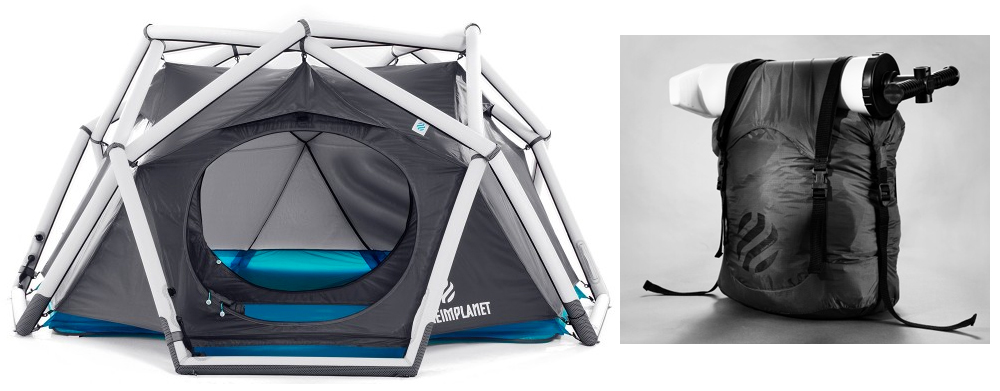
heimplanet-cave-tent

Geodesic domes have been used for everything from playground climbing equipment to homes, and now you can camp in one.  The Cave from Heimplanet doesn’t use poles, but instead uses inflatable tubes from which you suspend the tent.  It’s big enough to sleep 2-3 people, and it has storage pockets built in to help hold their gear.  The tent folds down into a pack 20″ x 12″ x 8″ and weighing 11.5 pounds.  (You’ll need to add a pump to your gear to inflate the tent.)  It opens into a structure that covers 54 square feet and is 40″ tall inside.  It costs €549.00 including 19% VAT, which converts to about $707.  I don’t know if they ship to the US, but you could contact them to ask about shipping or to see if they have international dealers.

Tagged as: Camping gear, Tent


Powered By WizardRSS.com | Full Text RSS Feed | Amazon Affiliate software for Amazon Store websites | Android Forums | Wordpress Tutorials
06 Jul 00:20

Is the new Canon EOS 70D a home-run for Canon?

by Leah Hallett

Canon-70D-Front-1

Canon have put themselves back in the game with the release of their latest innovative 20.2 Megapixel APS-C DSLR, the EOS 70D.  Due to be released on or possibly before September 13.  The 70D features a new ‘Dual Pixel CMOS AF’ sensor that is receiving very positive (pre-production) reviews.  The new ‘on-chip technology’ (new phase detection autofocus that utilizes the same sensor as the imaging sensor) produces class leading speed and accuracy by doubling the number of pixels available for the task.  The smoother, more accurate HD video continuous AF, even at lower light levels, gives a reported camcorder-esque experience.  The Dual Pixel AF offers an 80% coverage area of the articulating capacitive touch screen unlike previous models only covering a very limited area.

If you’re more optically viewfinder inclined, the mid-level 70D inherits the already excellent 19 point, all cross-type AF system of the Semi-Pro Canon 7D.  Although, unfortunately, it may not include the spot or expanded focus features of the 7D.  It does however have built-in Wi-Fi for sharing/remote control functions borrowed from the new Canon 6D full frame DSLR.   AF microadjustment, that was sadly lacking on the previous EOS 60D, has mercifully been added back. Continuous shooting is bolstered from 5.3fps to 7fps.

The 70D does this all in a slightly smaller body that remains essentially the same as the 60D with a few tweaks in the control layout.  Shutter life is not stated anywhere that I can find?  The jury is still out on noise in high ISO images, still waiting for production samples.  Hopefully the Digic 5+ image processor, first introduced with the 5D MKIII, will improve noise levels beyond that of the 60D.

Canon could hit one out of the park for video and live view shooters with the 70D and may have created new AF speed standards in the process!

The EOS 70D will have an estimated retail price, body only of $1199.00, body with EF-S 18-55mm f/3.5-5.6 IS STM $1349.00, body with EF-S 18-135mm f/3.5-5.6 IS STM $1549.00.  Battery Grip BG-E14 holds up to two LP-E6 batteries/six AA batteries for $270.00.


Tagged as: Digital Camera, Digital Video Camera, Photography


Powered By WizardRSS.com | Full Text RSS Feed | Amazon Affiliate software for Amazon Store websites | Android Forums | Wordpress Tutorials
06 Jul 00:15

NewerTech miniStack MAX 2.0TB 7200RPM “Quad Interface” Storage Solution review

by Janet Cloninger

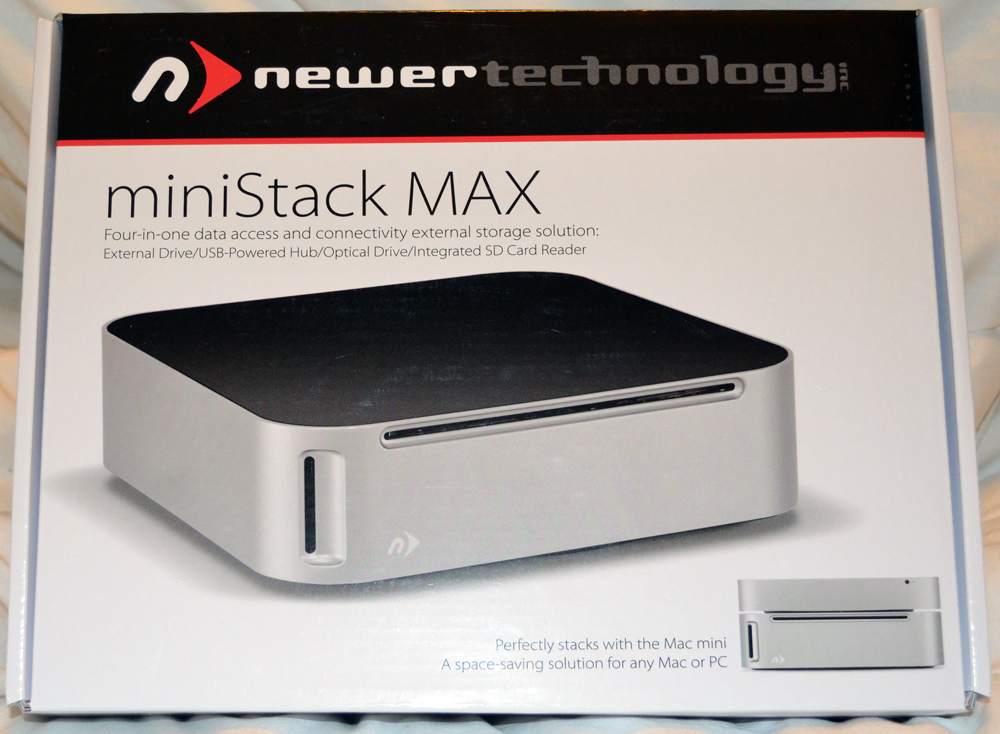
newertechnology-ministack-disk-1

Back in May, I posted a news item about the Newer Technology miniStack MAX.  As I said in that post, the miniStack MAX is “an external drive, SD card reader, one charging-only USB-A port, 2 USB 3.0 A ports, one USB 3.0 B port, eSATA port, 2 Firewire 800 ports, and an optical drive with DVD/CD read/write capabilities plus either Blu-ray read-only or read/write capabilities in a single, sleek aluminum case.”  I was bemoaning that I had just purchased an Apple USB SuperDrive, because the miniStack MAX offered so much more than that simple device.  The folks at Other World Computing (OWC for short) heard my wish for the miniStack Max for Mother’s Day, and they offered one to The Gadgeteer for review.  Luckily, Julie assigned it to me, so I passed along the SuperDrive to my daughter, and I got started discovering just how many things the miniStack MAX could do for me.

Images may be clicked for a larger view.

The miniStack MAX comes in a lot of configurations.  You can buy an empty enclosure and add your own hard drive (or SSD) and optical drive, or you can get it fully tricked out with a 4TB 7200RPM hard drive and a Blu-ray read/write optical drive.  OWC send me a very nicely equipped unit with a Blu-ray read, DVD/CD read/write optical drive and a 2TB 7200RPM hard drive.

All versions come with the USB 3.0 A ports, USB 3.0 B port, eSATA port, Firewire 800 ports, and the charging-only USB A port.

Tech Specs (as equipped)

  • 2.0TB Toshiba/HGST Deskstar™ 7K1000.D 7200RPM hard disk drive
  • 64MB drive cache
  • Hitachi-LG CA10N internal slim Blu-ray reader and DVD/CD writer
  • Bridge chipsets: JMicron 355 chipset with eSATA & FireWire 800 (1394B), JMicron 539 chipset with USB 3.0/USB 2.0
  • USB ports: two USB 3.0 A for data transfer or powering/charging devices, one 2.1A USB A for charging devices like the iPad
  • FireWire 800/400 ports (backward compatible with FIreWire 400 via connector or optional cable)
  • eSATA connector (cable sold separately)
  • Maximum data transfer rates: USB 3.0/2.0 – up to 300MB/sec; eSATA – up to 300MB/sec; FireWire 800/400 – up to 100MB/sec
  • Compatible with Windows, Linux, and Mac computers with the ability to support a USB 2.0, USB 3.0, eSATA, FireWire 800, or FireWire 400 connection

There are many more specifications that you can see at the OWC page.

In the Box

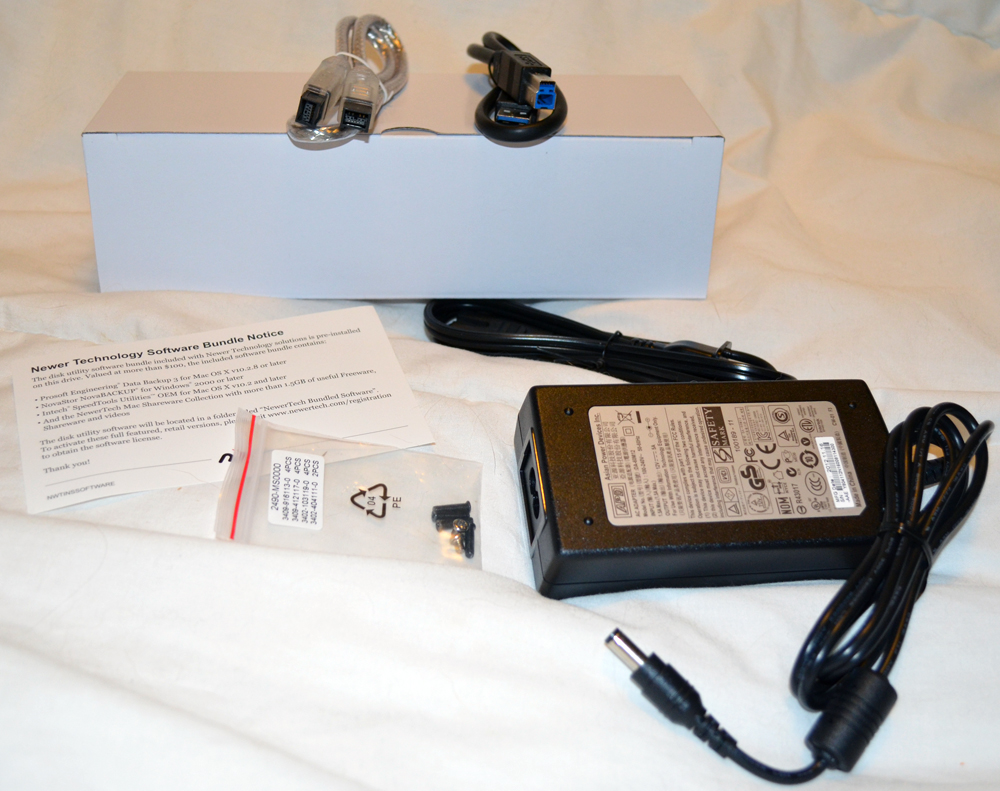
newertechnology-ministack-disk-2My miniStack MAX arrived with an AC power adapter, two cables, an info card about included software, manual (not shown), and a few small screws in a plastic bag.  I assume the screws were necessary to install your own drives, so I don’t need them.

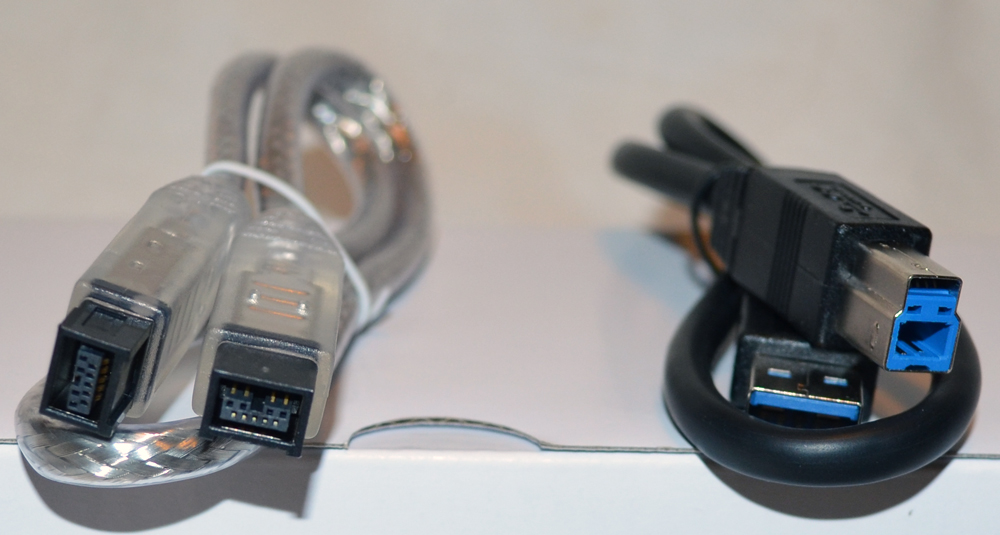
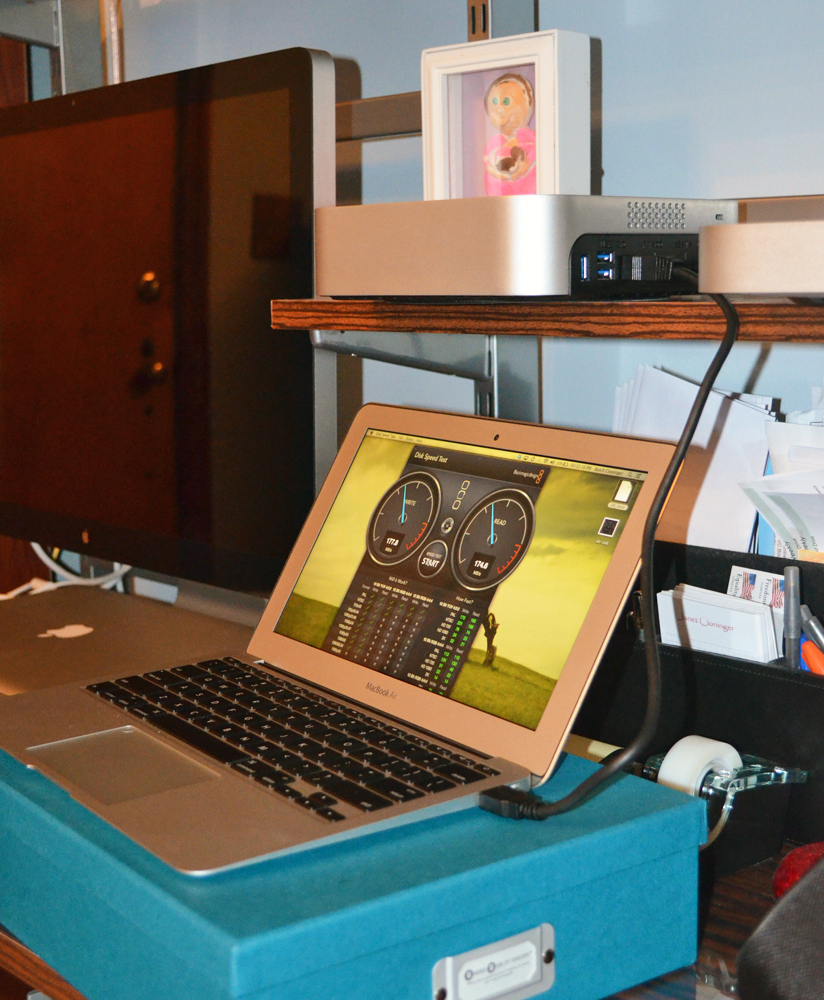
newertechnology-ministack-disk-3The two included cables are a Firewire 800 cable (left) and a USB A-to-B cable (right).  I’ll be testing the miniStack MAX with my two computers.  I have a Mac mini that has USB 2.0 and Firewire 800 ports and an 11″ MacBook Air with USB 3.0 ports.  Between the two, I’ll be able to check out how it performs with all but the eSATA connection.

newertechnology-ministack-disk-4The miniStack MAX has an aluminum-finished enclosure and a shiny, black plastic top.  It’s 7.7″ wide X  7.7″ deep X 2.33″ tall.  It has the exact footprint of Mac minis built since 2010, so I could stack it with my mini, if I wanted.  I have the room on my new desk setup, so I decided to set it beside the Mac mini for maximum airflow and cooling.

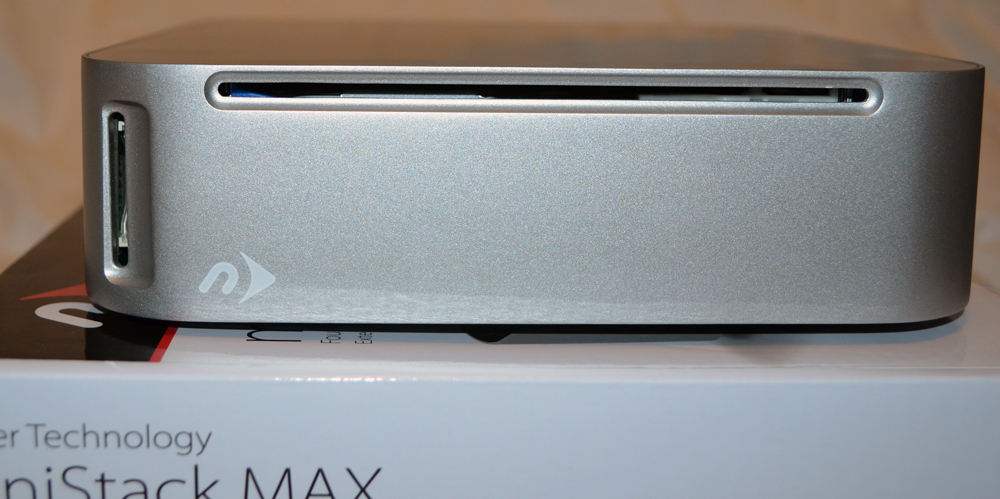
newertechnology-ministack-disk-5The front has a Newer Technology logo.  It also has the SD card reader at the left front and the slot-loading optical drive at the top.  My Mac mini has an SD card reader, but it’s on the back, so it’s difficult to use.  (All my cable controlling efforts make it a bit difficult to pull the Mac mini out to reach the card reader.)  Having one on the front of the miniStack MAX will be very convenient.

newertechnology-ministack-disk-6The sides of the device are plain, and the back has all the connectors.  From the left: powered (non-syncing) USB A charging port, stack of two USB A 3.0 ports, USB B 3.0 port, two Firewire 800 ports, eSATA port, DC power in, and a power switch.

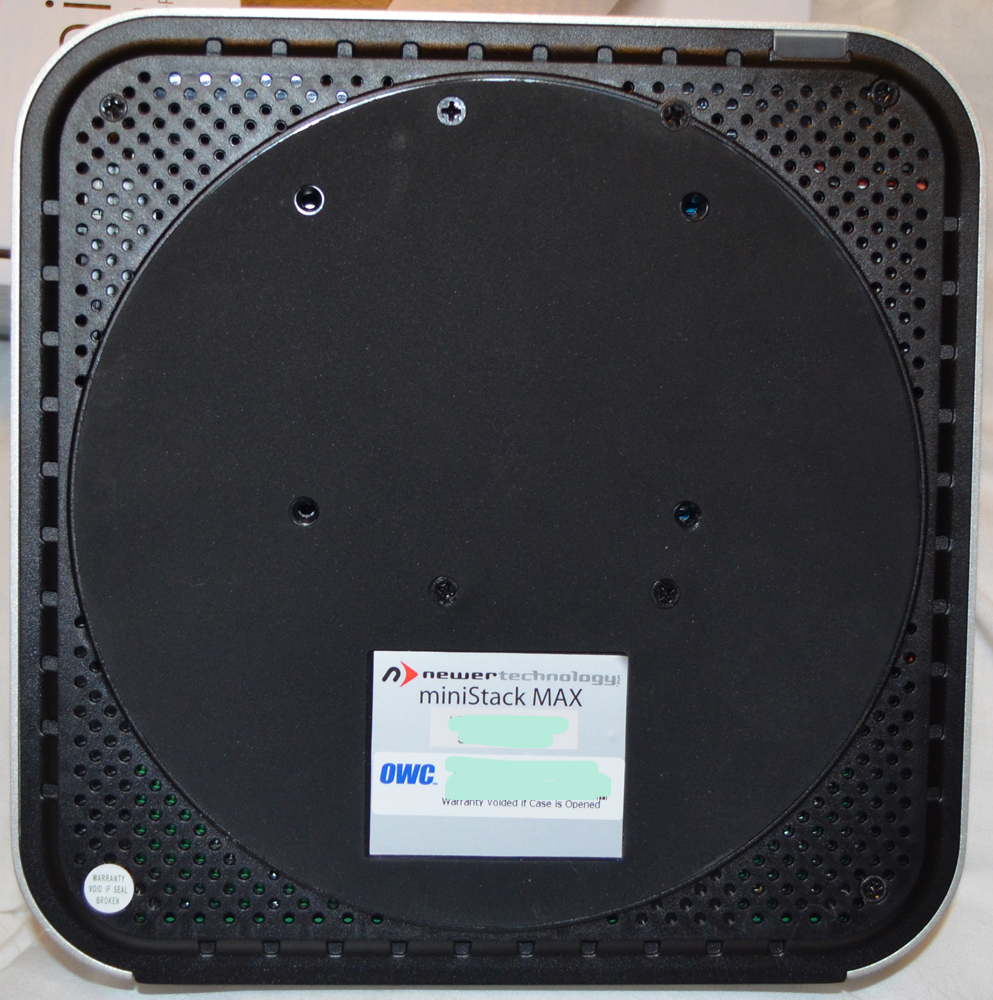
newertechnology-ministack-disk-7The bottom has screws so you can open up the enclosure to add your own drives.  My unit had everything pre-installed by OWC, and you’ll notice the label warns that opening the case voids the warranty.

Setup

newertechnology-ministack-disk-8Here’s the miniStack MAX sitting by my Mac mini.  If you enlarge the image, you’ll just be able to see a very faint, white status light at the bottom left of the miniStack MAX.  The light is on steady when the unit is powered and ready; it blinks with disk access.  It matches the pale white status light on the mini.

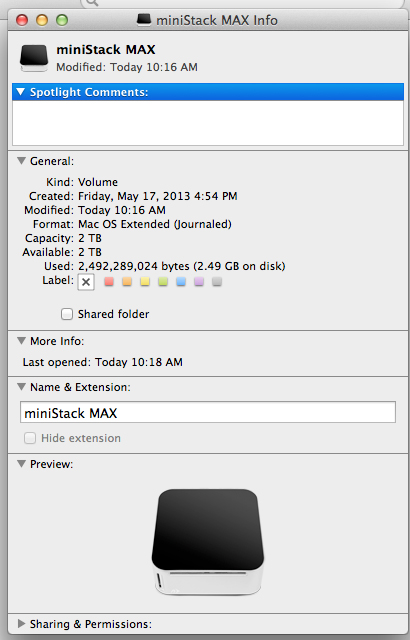
newertechnology-ministack-disk-9The disk came pre-formatted and ready for use with a Mac computer.  You can see that almost the entire 2TB of disk space is available to me.

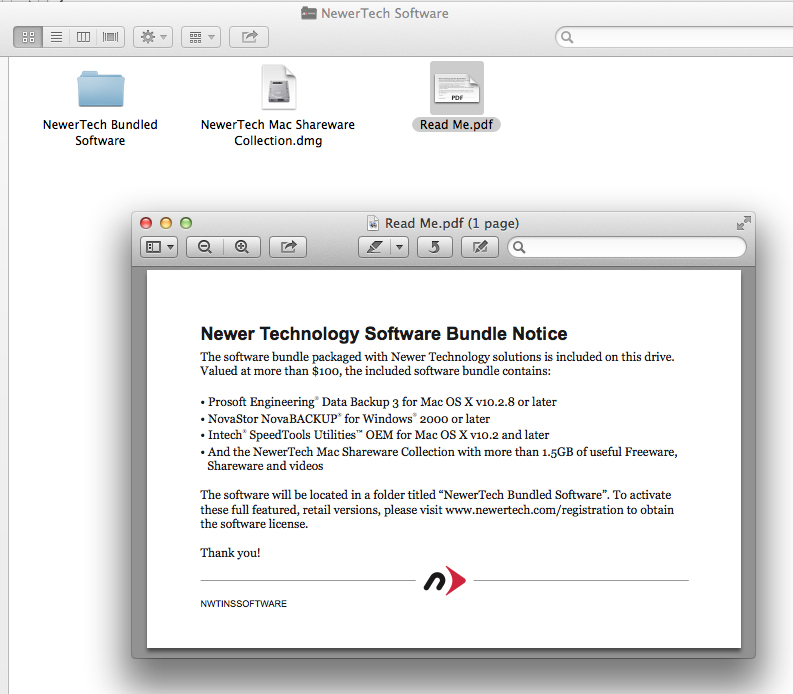
newertechnology-ministack-disk-10The 2.49GB of used space contains some software that Newer Technology includes.  Both Mac and Windows versions of the software are included.  After I got everything hooked up and working with my Mac mini, I tried to authorize this software by following the steps in the Read Me PDF file (and duplicated on the included card), but I wasn’t successful.  It kept telling me that it needed to create an account for me before it could authorize the software, but there was no way to create the account.  I didn’t waste too much time with the software, because I have my own backup utilities and the like.

Because I do intend to permanently use the miniStack MAX with my Mac mini, I decided I would start my evaluations with it.  After consulting the included manual, I realized that I would not be able to access all the features using only the Firewire 800 cable.  The Firewire cable only allows access to the internal hard drive.  To use the USB hub, SD card reader, and the optical drive, I needed to connect via USB.  Luckily, the USB 3.0 ports on the miniStack MAX are backwards compatible with USB 2.0, and I could connect both cables between the MAX and the mini.  (To connect the MAX to the computer via USB, I used the USB B port on the back of the MAX and the USB B-to-A cable to connect to one of the USB A ports on the back of my mini.)  With both cables connected, the Firewire handled hard disk access and the USB handled everything else.  I didn’t need to install any drivers – everything was ready as soon as I connected both the USB and Firewire cables and flipped the power switch.

USB hub and charger, optical drive, and SD card reader functions

I should mention how quiet the miniStack MAX is.  The specs say that the miniStack MAX uses the same MagLev fan used in the Mac mini, which “offers frictionless, whisper-quiet operation.”  I don’t hear the miniStack MAX or the Mac mini under normal circumstances; they really are whisper quiet.  The only time I hear anything from the miniStack MAX is while it is actively spinning up a disk in the optical drive.

Once both cables were connected, I was easily able to read my Class 10 SanDisk Ultra SD card to copy over pictures for this review.  The optical drive worked with my disks; I stuck in a DVD movie, and the mini’s DVD player popped up.  When I put in a Blu-ray movie, I could easily read the disk, but I couldn’t play the movie, as the mini didn’t have a native Blu-ray player.  I downloaded a trial of the Macgo Blu-ray player app to my Mac mini, and I was able to watch a Harry Potter Blu-ray with no problems.  Although it worked fine, I deleted the Macgo trial, because I won’t be watching Blu-rays on my 27″ Thunderbolt display when I have a huge HDTV and a Blu-ray player in the same room.  I’ll still be able to read Blu-ray data disks, though, should I ever need to.  Again, all of these functions, plus the USB hub functions (covered in the following paragraph), are through the USB connection.

The USB hub worked as you’d expect.  You plug in a USB device, and it’s ready for access.  You are basically replacing one USB port on the back of the Mac mini with two USB ports.

The powered, non-syncing USB port on the back of the Newer Technology device is a useful addition.  I do everything wirelessly through the Cloud on my iPad and iPhone, including backups and updating and installing apps, and I don’t like using the USB ports on my Mac mini to charge these devices.  With the MAX’s power-only USB port, I can charge my devices without iTunes popping up and trying to mess with my device setups.  That powered port is 2.1A, so it can even charge our iPads.  It charges the iPad as quickly as does Apple’s iPad AC charger.  It quickly charges our iPhones, too.

Hard drive tests with Mac mini

So we know the USB ports, card reader, and optical drives all work.  What about the 2TB hard drive?  I wanted to find a way to test the disk speeds, so I purchased the Blackmagic Disk Speed Test app from the Mac App Store.

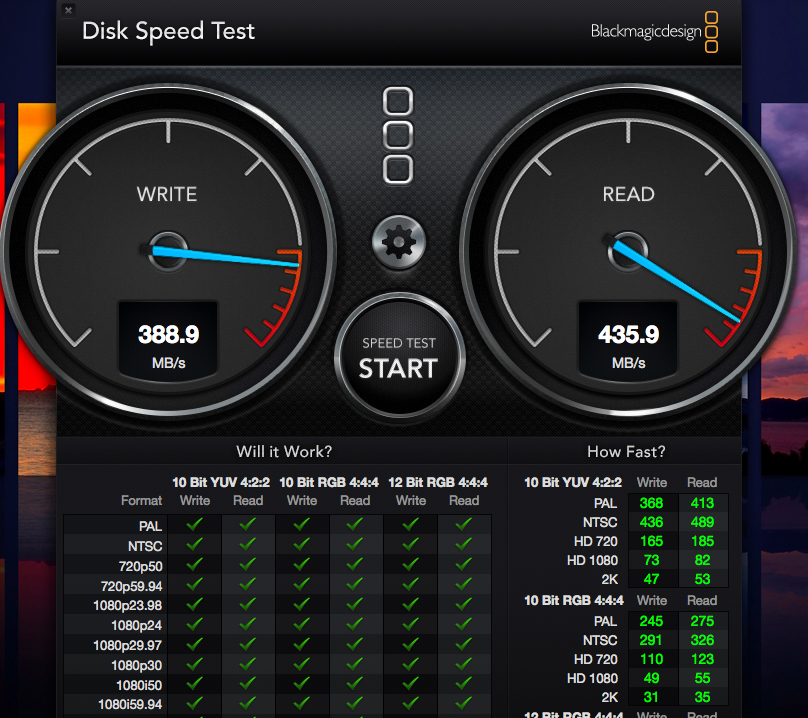
newertechnology-ministack-disk-11Here is the setup function for the Blackmagic app.  I chose the 5GB stress option, and I first selected one of the internal drives in my mini.  I chose the system drive; it is the standard 500GB 5400RPM drive that came with the computer.

Speed test for internal system disk in the Mac Mini

Speed test for internal system disk in the Mac Mini

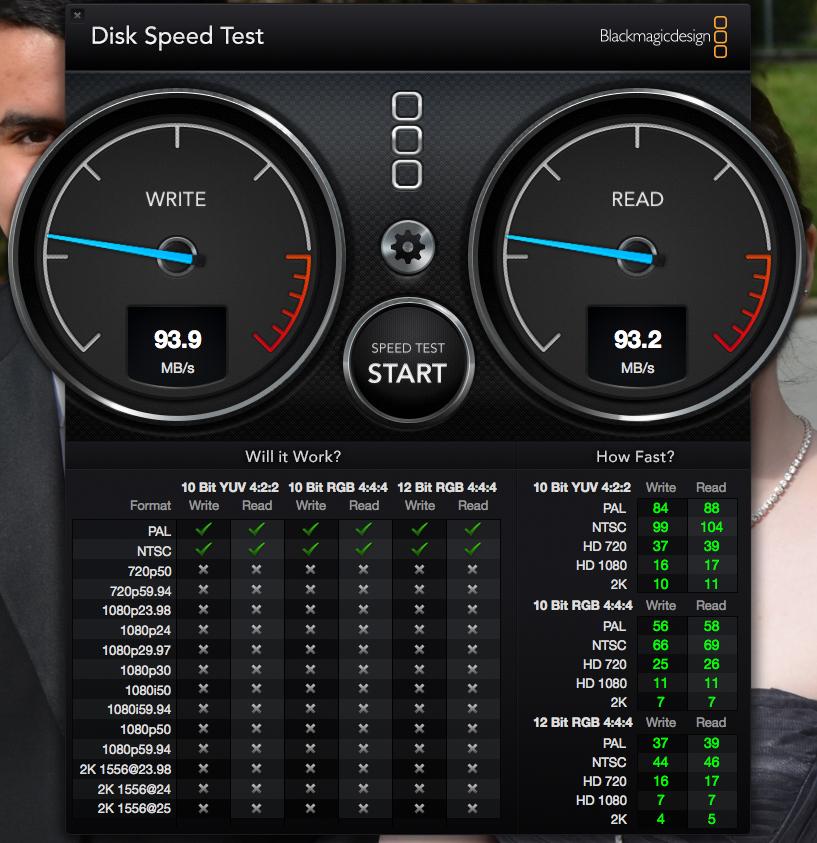
I started the test and let it run for a while as it continually did read and write tests.  Here you see the average speeds for the internal hard drive.

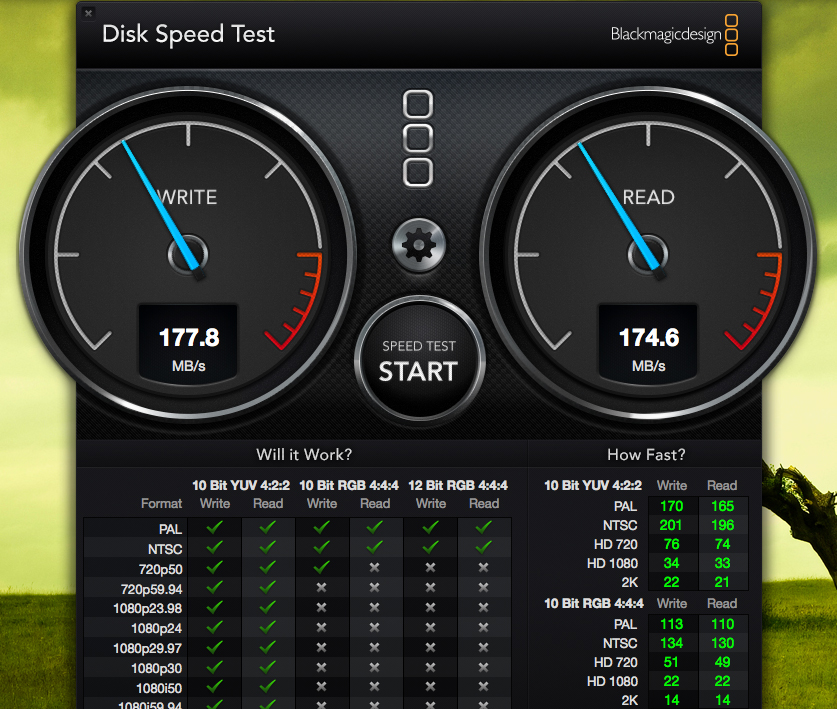
Speed test for miniStack Max attached to Mac Mini via Firewire 800

Speed test for miniStack Max attached to Mac Mini via Firewire 800

Next I did the 2TB drive in the miniStack MAX.  Remember these are through the Firewire 800 connection, with a maximum speed of 100MB/sec.  It’s slower than the internal hard drive, but not bad.

Hard drive tests with the MacBook Air

newertechnology-ministack-disk-14I then ejected the miniStack MAX from the Mac mini and hooked it up to the MacBook Air.  The Air has USB 3.0 ports, so I could use only the USB connector for everything – hard disk access, as well as USB hub, SD card reader, and optical drive access.

Speed test with MacBook Air internal SSD

Speed test with MacBook Air internal SSD

I started out testing the internal drive in the Air.  Remember, this is an SSD, and its speeds show how much faster it is than the hard drive in the Mac mini.

Speed test with miniStack Max attached to MacBook Air via USB 3.0

Speed test with miniStack Max attached to MacBook Air via USB 3.0

Then I tested the miniStack MAX through the USB 3.0 connection.  Although it’s about half the speeds of the Air’s SSD, it’s about 2-2.5 times faster than the Firewire 800 connection on the Mac mini!  And, it’s much faster than even the internal hard drive in the Mac mini.  (Maximum speed through USB 3.0 is 300MB/sec.)

Use as a backup disk

As I mentioned earlier, I intend to use the miniStack MAX with my Mac mini.  I want to use it primarily as a secondary backup for the data on the mini.  The mini is the location for all our personal documents and data, all our music and eBook files, and most importantly, all our pictures since we converted exclusively to a DSLR 10 years or so ago.  That data is very dear to me, and I do back it up daily on our Apple Time Capsule.  However, that Time Capsule is also the router for our home network, so I can’t just pop it in my bag and take it along for every trip.  The miniStack MAX will be much easier to quickly unplug and take with me when we’re on a trip, so I’ll have a copy of my backup with me.

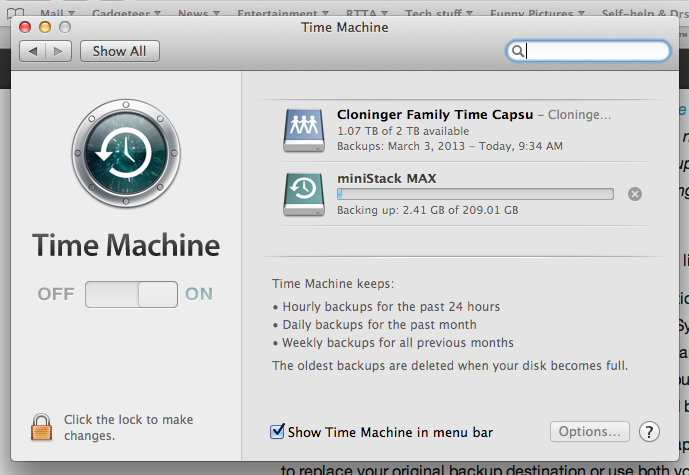
newertechnology-ministack-disk-17I set up my Time Machine software to do backups to both my Time Capsule and my miniStack MAX disk.  The software will alternate backups between the two disks; I have it set up to do daily backups, so a backup will get written to a disk every other day.  If I’ve just added a bunch of files, I can always force a backup to either or both of the disks.  The mini is connected wirelessly to the Time Capsule, and file writing is pretty slow.  When I did the first backup, I actually cabled up the mini to the Capsule with an Ethernet cable, and it still took about 5-6 hours to back up.  Because the miniStack MAX is already cabled up to the mini, I expected that the first full backup might take about the same time as that first backup to the Time Capsule through the Ethernet cable.  I was wrong.  Even using the Firewire connector, it took only about an hour to back up all 209GB of files on my mini.  Now that only incremental backups are being made, the backup procedure takes longer for the Time Machine software to set it up than for the actual writing of the files.

I’m thinking of starting over and partitioning the hard drive in the miniStack MAX.  That way, I’ll have an extra storage disk and a backup disk in one device.  Even if I decide not to partition it, it’s well worth having for just the backup function alone.

The miniStack MAX monitors the state of your computer, and it spins down when the computer is asleep.  The status light goes off the instant I put the mini to sleep.  More importantly, the status light comes on immediately when the computer wakes, so the miniStack MAX is instantly available.

Final impressions

The Newer Technology miniStack MAX disk does everything I hoped for.  It gives me an extra USB port (3.0, but can drop back to the slower USB 2.0 used by the mini), an easily accessible SD card reader, and an optical drive that adds the ability to read Blu-rays to the optical functions of the Apple SuperDrive it replaced.  Having an extra USB charger that doesn’t start up iTunes every time I plug in an iPhone or iPad is wonderful, too.  Hard drive access is fast through the Firewire 800 connection, and even faster when you can use USB 3.0.  I like having a secondary complete backup that’s always current, so I no longer have to rely on my husband remembering to bring our off-site backup disk home from his office so we can update it.  When I’m leaving for a while, I only have to unplug the miniStack MAX and bring it along so I’ll be covered in case something unfortunate happens at home while I’m gone.

The miniStack MAX is a very versatile product.  You can get it as an empty enclosure and add your own drives for a custom setup, or you can get it preloaded with the optical drive and hard drive that best suits your needs.  Other World Computing has just about every combination you can think of, so you’re sure to find what you need.  The unit I received was $330; it seems like a fair price to me when you consider I’m getting an optical drive with Blu-ray reader, USB hub and a USB charger, an SD card reader, and a 2TB backup drive.  I’m very happy with the miniStack MAX.  Don’t tell my family, but it may be my favorite Mother’s Day gift…

Tagged as: Blu-ray, External drive, optical drive, USB hub


Powered By WizardRSS.com | Full Text RSS Feed | Amazon Affiliate software for Amazon Store websites | Android Forums | Wordpress Tutorials
06 Jul 00:07

Keep your dog hydrated when you travel

by Janet Cloninger

to-go-bowl-pet-travel-bowl

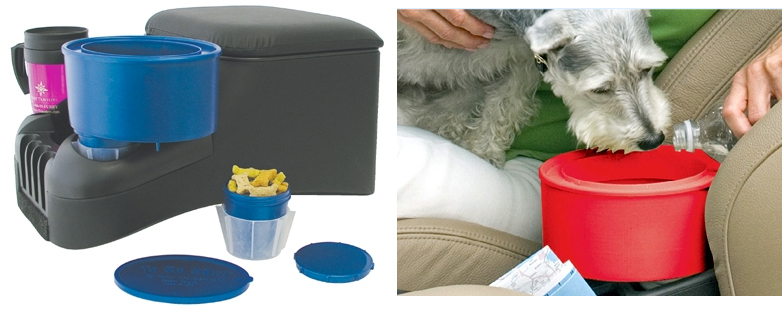
We always take our dog, Teddy, along when we travel.  He’s an anxious little guy, and his car seat is next to a window (won’t fit anywhere else in the car) so he’s always in the sun.  Those two things, combined with his heavy coat, keep him a little overheated as we ride along.  We stop and offer him water periodically, but he could get his own whenever he wanted it with a To Go Bowl in the car.  This kit consists of two bowls: a water bowl with a splash-preventing rim and a bottom bowl for snacks or a small portion of food.  Snapped together, the small bowl fits into a standard or XL car cup holder so your pet can have water any time.  Snap them apart, and the water bowl sits on a flat surface, so it’s great to use in the hotel room once you reach your destination.  The To Go Bowl is available in blue, red, or silver for $19.95 from Pet Travel Center.

Tagged as: Pet gear


Powered By WizardRSS.com | Full Text RSS Feed | Amazon Affiliate software for Amazon Store websites | Android Forums | Wordpress Tutorials
06 Jul 00:03

SlimScan receipt scanner stores in your wallet

by Julie

planon-slimscan

The Planon SlimScan SS100 is a credit card sized scanner that has been designed for scanning receipts and business cards. It’s about the same size as a stack of 3 credit cards at 2.0 x 3.1 x 0.12 inch, so it stores easily in a card slot in your wallet. Images are scanned at 300 dpi and can be organized into folders on the device and then downloaded to a computer using a USB cable with the provided software. The SlimScan has a rechargeable battery and enough memory to hold up to 600 2.75 inches x up to 36 inch scans with 24bit color. The scanner is priced at $99.99 which makes it an ok buy for someone who doesn’t already have a smartphone which can do the same thing without needing to carry (and charge another device).

Tagged as: Scanner


Powered By WizardRSS.com | Full Text RSS Feed | Amazon Affiliate software for Amazon Store websites | Android Forums | Wordpress Tutorials
05 Jul 21:23

Kahr is hitting the road

by MAC

Kahr Arms, soon to be formerly of NY, is planning a corporate move to Blooming Grove Township, Pennsylvania due most likely to recent legislation passed in NY known as the SAFE Act.  The SAFE Act places heavy handed draconian restrictions on law abiding citizens and is one of the most restrictive laws to pass anywhere in the nation.  Here’s just a few things the SAFE Act brings to the table of tyranny.

  • Bans possession of any “high capacity” magazine regardless of when they were made or sold.
  • Ammo background checks.
  • Creates a registry of sporting rifles, I mean “assault rifles”.
  • Requires background checks for all firearms transfers including between private sellers.
  • Bans the internet sales of “assault weapons”.
  • Includes a safe storage provision for firearms.
  • Requires handgun permit holders and registered “assault weapon” owners to renew permits every 5 years.

The passage of the SAFE Act was apparently more than Kahr was willing to stomach, so they’re hitting the road looking for a new home.  Similar flights from tyranny are taking place in Colorado where Magpul is pulling up its tent stakes and leaving to a new home which they’ve yet to identify.

Some would question the logic of these companies who have chosen to flee vs. staying to fight for the rights of the citizens.  I can see both sides of the argument, but I side with the decision to leave.  Nothing hurts a state more than loss of tax revenue.  If you want to get the governments attention, take money out of their pockets.  Right now the states are struggling to balance their budgets and losing a few million in revenue hurts.

I personally fled Illinois over a decade ago because of their anti-gun ways.  Sure, some have told me I took the easy way out, but I believe I made the right decision.  For the last 14 years I’ve been able to carry concealed, own machine guns, suppressors, SBR’s, and shoot on beautiful state ranges and on private property.  While living in Illinois they closed the only firing range within a reasonable driving distance (Fox Valley) thereby forcing me to drive to Wisconsin to enjoy a day at the range.  That’s why I moved to Indiana, and I’ll never look back.

So I can see why these companies would want to leave and I do support them in that decision.  The battle for our rights will fall on the shoulders of the good citizens of each state.  That, or you can vote with your tax dollars and move to a state that supports your Constitutional rights.

I wish Kahr and Magpul the best of luck in finding new homes.  Meanwhile, we need to dig in and continue the fight for our Constitutional rights.

In closing I’ll leave you with the comments of Combat Veteran and NY Law Enforcement Officer Aaron Weiss who addressed the New York politicians that pushed the SAFE Act through.


05 Jul 21:18

My Life Changer

by Matt

There have been a few mentions in articles here about my having been involved in a shooting. During my career, I have been involved directly in two, and indirectly in quite a few more. The more recent one in which I was directly involved was a much different event that has caused me to make many changes in the way I do things, both at work and at home. As the two year anniversary approaches, naturally I find myself contemplating it. I find writing this out to be somewhat therapeutic, but this is a long one so, if you choose to read it, please hang in there.

Also, as this is my story, some of my personal views may come out. Take those for what they’re worth, but please don’t try and lecture me about my opinions if they happen to differ with yours.


I have been a Deputy Sheriff for just over 17 years. I work in a very wide spread, mostly urban, metropolitan area that includes six incorporated cities, plus the unincorporated part of the county. The unincorporated parts of the county vary greatly, from tightly packed residential neighborhoods with lots of low income housing complexes, to large rural areas that are sparsely populated. My department provides service to the unincorporated parts of the county, in which about 560,000 people live.

The last 12 years of my career have been spent working patrol on swing shift (3pm-1am). I love swings, both because of the volume and variety of calls, but because the hours best fit my life outside of work. My department utilizes a computer aided dispatch (CAD) system and we all have computers in our cars. The cars are also equipped with a GPS locator system that is tied into the CAD, which has a mapping system that allows us to zoom in all the way to specific addresses, including the corresponding lot lines (similar to Google maps, but not as pretty).

It was a hot 100 degree early July night two years ago. That particular night, I was working our north central area, which is mostly residential housing, commercial properties and lots of low income apartments. It is a very small but diverse district, which routinely has the highest volume of calls for any of the patrol districts. It was almost 9pm and I had just finished dinner when I got sent to an incomplete 911 phone call at a local Motel 6. The caller said nothing and hung up. I told the dispatcher that I would handle the call solo because it sounded rather innocuous. While driving to that call, I got an update that on callback, the handicapped female in the room was asking for the fire department to assist her in getting dressed. The fire department advised us that deputies were not needed.

I began exchanging silly comments about that call with my dispatcher via the CAD messaging system. I have known my dispatcher for about 15 years and we have always been friendly. A few moments later, she dispatched me to another incomplete 911 call. This one said that a disturbance could be heard in the background and that someone had hung up. As a rule, when a disturbance is heard, the call takers will not call back. Initially when I was dispatched, I was sent by myself because no other units were available.

One of our canine units offered to cover me. He has a similar number or years of service with our department, but he and I had only recently begun working the same area and prior to this call, I think I had only been on maybe one or two other calls with him. Since as a canine unit, he covers the entire north part of the county, I had no idea where he was coming from. As I drove to the call, which was located in a fairly nice residential neighborhood, I continued to joke with the dispatcher about my previous call, asking how I could request a fire truck loaded with hot women to come get me dressed. She had similar concerns, but was instead looking for the calendar model type firemen instead. As I got within about a mile or two of my call, I decided to look at the CAD map and see about how far off my cover unit was. He appeared to about the same distance from the call as I was, perhaps a little further away. Since I had the map pulled up at this point, I zoomed it in to see where on the street the house I was going to was located.

As I got close to the call, I pulled to the side of the road around the corner from the call location to await my cover unit. That placed me a little more than two houses from the call location. I blacked my lights out and I cracked both windows a few inches so I would be able to hear if anything was going on. I advised my cover unit where I was waiting for him and then I closed my computer lid to avoid illuminating myself inside my dark car.

As I sat waiting for cover, I heard a male voice yelling and it sounded like it was coming from the area of my call. I could hear the yelling, but could not make out what was being said. My car was positioned so I could just see the corner of the front yard of the target house. It was fairly dark and there were no street lights near the house, but there was a light on at the front porch. In that dim light, I thought I saw some movement so I decided I needed to approach to see what was going on. I figured my cover had to be pretty close by now.

I put the car in drive, turned the corner onto the street, crossed the street and drove south against the left sidewalk (wrong side of the street). As I slowly approached the house, I saw a male walking from the north corner of the garage, down the short driveway, and south away from me on the sidewalk. It was poor lighting, but he appeared to be carrying a rifle. It looked to me like a rifle with a wood stock and what appeared to be a white sling. As previously mentioned, I am a gun nut, and the first thing that came to my mind was a presentation or parade type rifle, like an ‘03 Springfield or a Garand with a white patent leather sling.

Interior of modern cop car (not my department's, but ours are similarly setup)

Interior of modern cop car
(not my department’s, but ours are similarly setup)

When I saw him holding the rifle, I decided that it would not be prudent for me to go to a rifle fight with my pistol, so I hit the lock on my rifle rack and pulled my personal 14.7” LWRC M6A1-S from the rack. I charged it and put the forward vertical grip in my left hand. Since he was walking toward a parked car, I decided I would wait to see if he was just going to place his rifles in the trunk of the car. He did not. In fact he walked past the car and then started across the street heading deeper into the neighborhood and towards a very dark, unlit area. Open carry is not legal in my state, and we were responding to an unknown disturbance call in which this man was likely involved, so I could not let him just wander off into the darkness toting a rifle. I decided I would hit my lights and using my PA, tell him to put the gun down. I rested my rifle’s forend on the steering wheel, I hit the high beam switch first, then turned the lights on with my left hand and using my right hand, grabbed my PA mic and told him to put the rifle down and turn around with his hands up. At this time, he was approximately 40 yards from the front of my car.

Apparently, this man I had never once met, had other plans. As soon as I told him to drop his gun, he turned around, shouldered the rifle and fired a shot. I saw the muzzle flash, heard the report, saw sparks near the front of my car and heard the round impact my car. Still seated in my car, I shouldered my rifle and brought it up. I immediately noticed that in the stress of the moment, I had neglected to turn on my EOTech (why I switched to the Aimpoint PRO), but since my rifle has a fixed front sight, I decided to use the EOTech as a very large rear sight aperture. Of course, that whole thought process took about 1/8th of a second. I dropped the safety and clicked off several rounds directly through my windshield. I looked up and he was still standing and had the rifle still shouldered. Not knowing if the windshield was affecting my shots, or if the lack of having my EOTech on was causing me to miss, I decided I needed to move (another ½ second thought process).

I stuck the car in reverse and began backing out. This is the point that my in-car camera begins recording. In watching the video, this man can be seen firing two more rounds at me as I back my car out onto the adjacent street. Since the street I had been parked on previously is a four lane street that often has heavy traffic, I checked the oncoming lanes as I backed into the intersection. I cranked the wheel and backed across the road at an angle getting myself out of the direct line of fire. I activated my light bar, which is what activated my in car camera system, and the 30 second buffer is what captured the shots fired as I am backing. I grabbed my radio mic and voiced that I had exchanged gunfire, that the suspect was still armed and that I needed additional units.

I placed the mic back in the holder and exited my car with my rifle. It was at this point that I turned my EOTech on. I stayed on the driver side of my car, near the driver door, keeping the hood, and subsequently the engine, between me and the suspect. About 5-10 seconds later, my cover unit pulled up and stopped on my right and just slightly back from me placing his front bumper at about my front doors. He exited his car with his department issued 16” barreled Colt AR-15, equipped with nothing but iron sights. He saw the rather large hole in my windshield and asked if I was ok. I told him I was fine, I gave him a brief suspect description and pointed to the direction in which I last saw him.

About 2 seconds after the canine handler arrived, one of our CSI units pulled up to the left of my patrol car. Our CSI units are sworn deputies who have completed patrol training. Additionally, the one who showed up has several years patrol experience in one of our contract cities. He exited his truck and had to dig his rifle out of the back of the extended cab.

The windshield of my car

The windshield of my car

The CSI officer had just got his rifle out when we saw the suspect approaching us, only now he was armed with a handgun. He was walking at a very rapid pace. I looked past him and saw another male, who appeared to be wearing a black tank top and a pair of dark colored shorts, standing directly in our line of fire. I yelled at him to go back in his home, and thankfully he listened. I redirected my attention back to the suspect. At this time, he was about 40 yards from me and was holding the handgun down at his right side. He was still walking directly at us at a very brisk pace.

Both the canine officer and I began directing him to drop the gun and stop where he was. He repeatedly said “That’s not going to happen”. He kept approaching us at the same brisk pace, holding the gun down at his side. I recall having drawn an imaginary line on the street in the back of my head, and he was not going to come past that line because that would put him within range to easily hit us with his handgun. When he got to that line, I fired, as did the canine officer.

I remember thinking this as it happened, it was the weirdest thing. It was like my brain was controlling two guns. The canine officer and I both fired the same number of times, and almost in perfect unison. Thankfully, the CSI officer used his better judgment and did not fire. He was behind and between the canine officer and me, and if he had fired, he could very well have struck either of us.

Upon being shot, the suspect dropped immediately and began bleeding out very rapidly. I walked past my car with my gun still on him. As I arced around him, to get a better view of his hands, I could see that he was no longer holding the gun. I advised the other officers his hands were clear and then I got on the radio and requested the fire department for medical aid. The canine officer began looking for the handgun and the CSI officer was helping him.

About this time, a motor unit arrived. Since we had not yet contacted the house from which the 911 call had come, that was still a possible threat or a location with other possible victims. I grabbed the motor officer and we covered the front of that home until other units arrived and one of my coworkers relieved me at my position.

Through the investigation, it was found that I initially fired four rounds through my windshield and six rounds in the second engagement. The canine officer also fired six rounds during the second engagement. The investigators determined that one of my first four rounds struck the suspect in his right side causing a large laceration, but not hitting anything vital. They told me they were able to determine that because there was windshield safety glass embedded in his shirt at the location of that wound.

It was also found that what precipitated this event was that the 44 year old suspect, a man who had battled bi-polar disorder and schizophrenia his entire life, had just gotten into an argument with his elderly parents, with whom he lived. He told them he was going to kill himself which was why they called 911. When he heard that 911 had been called, he told them he was going to go out in a shootout with the cops.

mn-m44

Not the actual rifle, just same model.

I firmly believe, and after mentioning this theory to the canine officer, so does he, that the suspect was walking away from his home to set up an ambush for us, and that my early arrival may have very well saved our lives. The suspect was leaving the home with a loaded Mosin Nagant M44 bolt action rifle (coincidentally, I own the identical rifle), for which he was carrying spare ammo. What I saw that I thought was a white patent leather sling was actually a section of white rope he was using for a sling. He was crossing the street and heading to the darkest area on the street, which has an excellent view of his front doorstep providing him an excellent place from which to ambush us.

When I began replaying the incident in my head that night, something stood out in my mind as not adding up. When he fired his first shot at me, I remembered seeing sparks at about the same time as I heard the impact, but jacketed lead bullets don’t spark when they hit a plastic front bumper cover or plastic grill. I began examining the front of my car and was not able to find any holes, which further stumped me, until I heard what type of gun he was using. An examination of the ammo he had revealed it was steel core Russian surplus. What had happened was his elevation was off significantly. His first shot hit the street about eight feet in front of my car, causing the sparks when the steel hit the asphalt. That round ricocheted up and struck a frame member directly under my driver seat, leaving a ½” deep dent in the steel frame.

Some of the work related things this incident taught me consist of:

1) Had I relied on my department to issue me my gear, I would have been carrying a department rifle instead of my personal gun, and this incident would have played out very differently. At the time, our department issued 40 year old military surplus M16A1 rifles, with iron sights. It is not because they don’t care, but the budget is just not there to purchase 300 new rifles for every patrol deputy. The guns we got were free, and any long gun is better than no long gun. Since my shooting, I have tried to shoulder that full length rifle in my patrol car, and even with the seat back all the way (which is where I have it anyway since I am 6’3” tall), it would not have been possible to return fire from inside my car. My LWRC is significantly shorter in overall length and was easy to maneuver inside the cramped confines of my patrol car.

2) I am thankful that I have always taken range training serious, and that I have always practiced as if it were a real gunfight. I will continue to do so, and will make every effort to ensure others take their range time seriously as well.

3) I made some changes to what I carry on my gun belt, and I added a way to carry a spare AR magazine at all times (Blade-Tech Double Pistol & Rifle Combo Mag Pouch). I always had multiple spare mags in the trunk, but in case of a rapid deployment, like this incident was, I want to have a spare on me just in the off chance that it could turn into a prolonged firefight.

4) I retired my beloved, personally owned, blinged out Sig P220, and got a department issued P226 in 9mm. With the purchase of three 18 round flush fitting Mec-Gar mags, and with one of the issued 15 round Sig mags, I more than doubled the amount of pistol ammo I am carrying (from 25 to 70). Plus, I have the other two issued 15 round Sig mags as spares in my tac vest, along with my other 6 spare AR mags. Taking fire really made me paranoid about the possibility of running out of ammo. I do not plan on ever letting that happen.

5) I have played multiplayer first person shooter video games for many years (much to the amusement of my beat partners), but have always tried to play with a realistic mindset. I honestly think that the 80,000+/- simulated firefights I have been in on the computer helped me think very quickly when the real one happened. I never froze or stopped to think once during the incident. Firing through the windshield, backing the car out to get to a better place to engage him, staying behind cover, etc. All of that came naturally since those are things that I do when I play video games. Granted, video games don’t help with all the physical aspects of shooting a gun, but I feel they can definitely play a role in training your mind to react quicker when you are confronted with a real world gunfight, plus their just plain fun.

I made some changes in my personal life after this incident also:

1) I make sure my wife and kids know that I do not take them for granted. I make sure I tell them how much I love them every day, usually several times a day, and especially every day before leaving for work. As much as having coworkers killed in the line of duty over the years (7 on my agency during my career, 1 was a personal friend) has made me reflect on this, nothing drives it home like being involved in your own incident firsthand.

2) I used to be reserved when it came to sharing my opinion on matters of politics, but no more. I have become much more involved in the entire political process because one thing my career has taught me, is that the liberal policies that rule the state in which I live and work have bred an entire population of people for whom I spend 40 hours a week acting as their parent or babysitter. We need a society that promotes self-sufficiency, not dependency, and I am doing everything I can to spread that message. If you disagree with that assessment, you are entitled to your opinion, but I challenge you to spend a few shifts on a ride-along with a law enforcement agency in a large metropolitan city and experience the fruits of those policies firsthand. It was this unwillingness to be quiet that lead me to writing political commentary, which landed me a writing gig for Joe The Plumber, which in turn lead me to writing here, at The Bang Switch!

Three other cops were killed in the line of duty that very same night across the country. Two were killed in car accidents (one of which was a pursuit), and the third was shot to death. As the anniversary of this incident nears, I find myself thinking about them and how I could have easily been number four. The fact that I was not added to that list makes me very grateful for everything I have, and makes me appreciate even the smaller things much more.

Thanks for bearing with me during this very long account. Remember to take some time each day to appreciate the little things in your life, and lets all stay safe out there!
Matt


To address some things brought up in past discussions:
– No, I did not get a 72 hour “calming” period before talking to investigators, I was interviewed by the Homicide investigators that night, about 90 minutes after the shooting, after they finished their initial walk through at the crime scene. Prior to them, I had to tell my story to the deputy handling the main portion of the report and to several different supervisors each time a new one arrived.
– Yes, I had an attorney there but she only asked a couple of clarifying questions after the interview was over. As a cop, I cannot plead the fifth and must cooperate with the investigation if I hope to keep my job. Coincidentally, that is exactly what I would do anyway since I had nothing to hide.
– Yes, I was automatically put on paid administrative leave for the next five days, which was most definitely not a vacation like every seems to think. I finally fell asleep at about 5pm the next day after the adrenaline dump finally wore off, the following day I had to go to the range to get a loaner rifle since mine was now residing in the crime lab (shooting at a target of a man pointing a gun at you takes on a whole new meaning), the next day I got to go sit down with a shrink (oooh, yay!), the next day I had to go to the critical incident stress debriefing and talk about how the incident made me feel (because you know, cops really like sharing their feelings with their coworkers), and on the fifth day, I finally got to sit down with my wife and kids and try and forget about the whole thing

05 Jul 21:01

Two States, two very different paths.

by Joe

July 1st, 2013 brings a tale of two different paths.

One chooses Liberty, the other tyranny.

Indiana heads down the path of Liberty and repeals her decades old law pertaining to switchblades. For the first time since 1957, Hoosiers will legally be able to own and possess automatic knives. This year, thanks in part to Indiana, there will now be a majority of US States that don’t ban the ownership of automatic knives. Indiana residents should note at this time there is no state preemption on knife laws, so know your city and county ordinances. Next year the legislature is expected to add preemption language which should mirror the States preemption law regarding firearms.

In addition to automatic knives, Indiana hunters will be allowed to hunt using suppressors on their firearms. The Crossroads State joins approximately two dozen other States that allow some form of hunting with suppressors.

Contrast this to what happens in Colorado on the same day.

Colorado bans new magazines exceeding 15 rounds in capacity. Private sales, including temporary transfers to a family member are banned. As well as of other anti-gun laws such as a 8 round limit on shotguns will take effect.

Residents of the State aren’t taking this lying down, they are fighting back at every level. Massive recall campaigns are underway, 54 of 62 Colorado Sheriffs have sued the state and firearms and accessory companies like Magpul are pulling up stakes and leaving the Centennial State as fast as they can.

While some people will be completely disheartened by the new laws taking effect in Colorado, I try and take some hope from the sleeping giant that has been awoken and the backlash against these blatantly unconstitutional laws.

I look to States like Indiana, where legislators are slowly realizing that knives and suppressors (like firearms) are simply tools. They are inanimate objects and not some mythical death device.

I see more positive signs such as groups like ‘Mayors Against Illegal Guns’ which are hemorrhaging mayors left and right, this despite a massive dump of money from people like Mayor Bloomberg to try and bolster their efforts. The elected are once again starting to fear their electorate.

I urge all of you to stay active in the fight and realize that we must all be ever vigilant in the fight for our Rights. If you can help our Brothers and Sisters in Colorado, please do so. There is work to be done even if you don’t live there. MAIG is dumping massive amounts of money and manpower into Colorado in the hopes of preventing these recalls. You can get involved, be it by writing letters or donating your time or money.

“We must all hang together, or assuredly we shall all hang separately.”
-Benjamin Franklin

05 Jul 20:59

Gun Control Continues to Fail

by MAC

Gun grabbers seem to think if they ban just one more gun violent crime will magically cease and everyone around the globe will live in harmony from now until eternity.  There’s only one slight flaw in such utopic thinking, we know it’s ridiculously naive. Oh heck, I’ll say it — it’s moronic.

Evidence gathered from around the globe consistently proves that banning firearms doesn’t prevent murder or even mass murder.  Just last week in China where access to firearms is heavily restricted, 26 people were slaughtered with knives at a police station in the province of Xinijang.  I’m not talking about 26 people killed over the course of a week, month or even a year – I’m talking about in one incident. Authorities are wondering if this attack was related to a similar attack last April in Kashgar. Details are scarce given the tight lipped nature of the Communist regime, but reports are that 10 of the attackers were gunned down by police.

Within days of the shooting at Sandy Hook last December, a madman in China ran through an elementary school slashing 23 children before the rampage came to an end.

Time and time again we see that gun control does nothing to stop such attacks, however it does assure that the victims are disarmed and totally defenseless against the rampaging lunatics.  The solution isn’t to pass laws banning firearms thus leaving only the criminals with them.  The solution is to arm the good guys thereby not leaving them at the mercy of armed murderous thugs.

Gun control doesn’t work.  It never has and it never will.

05 Jul 20:58

The importance of eye protection

by MAC

Images like those below are chilling to those of us in the shooting community, as they should be. Sometimes we forget just how dangerous our hobby can be and we become lax. When we become lax we accidentally double charge a round while reloading, or we hear a pop vs. a bang and fail to check the bore of our firearm before firing the next round. We sweep others with the muzzle. We put our finger on the trigger when we shouldn’t. And sometimes we forget to wear eye protection.

The AR15 pictured here exploded unexpectedly on its owner this week. The source of the failure isn’t known for sure, but I’m fairly sure the cause of this catastrophic failure was an over pressure round based upon my inspection of the rifle. We don’t have all of the details of what happened, so I’m not going to name brands in this article. My goal isn’t to unnecessarily defame the manufactures of the rifle or the ammo, it’s to drive home the importance of making sure we always remember the basic rules of safety while engaged in our sport/hobby. Pay attention. Practice good muzzle discipline. Keep that finger off the trigger until you’re ready to shoot. Wear hearing protection. Pay attention while reloading and double check your work. Always wear eye protection.

Yes, I’m guilty of taking my eye protection off at times while shooting and you’ve seen me do it in videos. On hot humid days my eye wear will often times fog up making the use of magnified optics difficult, if not impossible. When I see grenaded firearms such as this one, it reminds me how foolish I am for taking my glasses off regardless of my reason.

If the owner of this firearm had not been wearing eye protection he likely would be blind in one or both eyes right now. If that doesn’t send a chill down your spine there’s something wrong with you.

Please folks, be safe out there.

All of the major components of the exploded AR15.  You can see the total destruction caused by the likely culprit - an over charged round.

You can see the total destruction caused by the likely culprit – an over charged round.

From the rear you can see that both sides of the upper receiver split.

From the rear you can see that both sides of the upper receiver split.

The bolt and carrier both were blown apart by the over-pressure.

The bolt and carrier both were blown apart by the over-pressure.

exploded AR15

The chamber area of the destroyed AR15.

05 Jul 20:53

When seconds count the police are minutes away

by MAC

By now you’ve likely heard about the story of a New Jersey mother who was brutally beaten by an intruder while her 3 year old daughter looked on.  The whole event was captured on a nanny-cam and has since been viewed millions of times by YouTubers.  The video can be seen at the end of this article if you’ve not watched it already.

There’s something to be learned from this attack, something that I’ve preached about for years.  The lesson is, “Always have your sidearm with you – ALWAYS“.  As I type this I’m wearing a 9mm Shield in a G-Code INCOG holster.  I wear my handgun to church, the grocery store, the restroom, to funerals, to the park with my kids, walking the dog, and I even carry it into Costco where they have a sign that reads “NO FIREARMS“.

The video above puts into brutal visual reality what I’ve never been able to vocalize strongly enough to my friends, relatives and readers.  A defensive tool is absolutely useless unless you have it with you and know how to use it.  Often times we’re lulled into a false sense of security when we’re in familiar places we deem to be safe, places like home.  I’ve been guilty of it too, but over the last few years I’ve made it a point to always be armed, when I can legally do so, and for the reason we see in this horrifying news story.
The woman is lucky to be alive and hopefully her daughter will eventually be able put the memory in the back of her mind so years later she’s not scared from what she had to witness.  I also hope the woman and her family have learned an important lesson and make the decision to arm themselves, get training and be ready to defend themselves and their home going forward.

American gun-grabbers would leave us all at the mercy of such door busting thugs.  If you look at England where handguns are banned for commoners and self defense is generally frowned upon, their home invasions are through the roof.  Just how bad is it?  Read this article and I think you’ll be shocked.  We can’t let that happen in the United States.

The last point I would like to make is that the old saying “When seconds count, the Police are only minutes away” once again rings true.  This woman had no time to dial 911, and even if she were able to, the police likely wouldn’t have arrived in time to stop the beating she took in front of her 3 year old daughter.  They may have caught the man after the fact, but ultimately only she could have fended the brute off — and only if she were properly armed and trained.

You owe it to yourself, your family and anyone else that may be in your home with you to always be armed, trained and ready to defend yourself.


02 Jul 23:36

Reliability Monitor is the Best Windows Troubleshooting Tool You Aren’t Using

by The Geek

When it comes to hidden gems in Windows, nothing beats the Reliability monitor tool, hidden behind a link inside of another tool that you don’t use either. Why Microsoft doesn’t shine more light on this really useful troubleshooting tool, we’ll never know.

Reliability Monitor tracks the history of your computer — any time an application crashes, hangs, or Windows gives you a blue screen of death. It also tracks other important events, like when software is installed, or Windows Updates loads a new patch.

It’s an extremely useful tool. And yes, it’s in Windows 7 and 8… and even 8.1. It might be in Vista, but who uses that anymore?


29 Jun 22:57

DRM: How Book Publishers Failed To Learn From the Music Industry

by Soulskill
Presto Vivace writes "In a blog post, danps explains how the music industry initially thought that the Internet meant that people wanted their music for free. In 2003 Apple persuaded the industry to use an online music store with DRM. But DRM just does not work for consumers, so by 2011 online music stores were DRM-free. Sadly, the book industry has not learned these lessons. And there are larger lessons for the gadget industry: 'The tech industry right now is churning out lots of different devices, operating systems and form factors in an attempt to get the One True Gadget — the thing you'll take with you everywhere and use for everything. That's a lovely aspiration, but I don't see it happening. What I see instead is people wanting to only carry around one thing at a time, and rotating through several: Smart phone for everyday use, tablet for the beach, laptop for the road, etc. If you can't get the book you paid for on each of those devices, it's a pain. As a reader I want to be able to put a book on everything as soon as I buy it so I always have a local (non-Internet dependent) copy — no matter which thing I run out of the house with.'"

Share on Google+

Read more of this story at Slashdot.


29 Jun 00:36

Password Security: Short and Complex versus ‘Short or Lengthy’ and Less Complex

by Akemi Iwaya

Creating secure passwords for our online accounts is a necessary evil due to the huge increase in database and account hacking that occurs these days. The problem though is that no two companies have a similar policy for complex and secure password creation, then factor in the continued creation of insecure passwords or multi-site use of the same password and trouble is just waiting to happen. Ars Technica decided to take a look at multiple password types, how users fared with them, and how well those password types held up to cracking attempts in their latest study.

The password types that Ars Technica looked at were comprehensive8, basic8, and basic16. The comprehensive type required a variety of upper-case, lower-case, digits, and symbols with no dictionary words allowed. The only restriction on the two basic types was the number of characters used. Which type do you think was easier for users to adopt and did better in the two password cracking tests?

You can learn more about how well users did with the three password types and the results of the tests by visiting the article linked below.

What are your thoughts on the matter? Are shorter, more complex passwords better or worse than using short or long, but less complex passwords? What methods do you feel work best since most passwords are limited to approximately 16 characters in length? Perhaps you use a service like LastPass or keep a dedicated list/notebook to manage your passwords. Let us know in the comments!


28 Jun 15:05

Use These Tips to Protect You and Your Family Against Home Invasions

by The ITS Crew

Home invasions happen, whether you think they will or not. A few days ago, an unsuspecting homeowner in New Jersey was shocked by her door being kicked in and a strange man entering her house. Obviously he was there to rob the house and while he did get away with some jewelry, he beat and choked the mother of two in front of her 3 year old daughter. Warning: The video below is graphic.
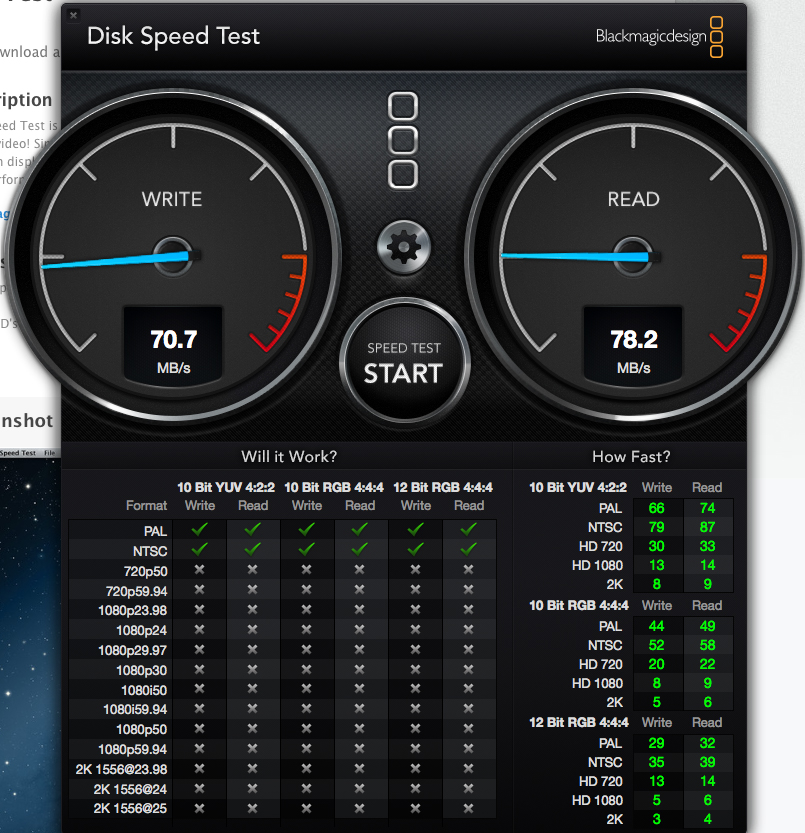
The entire scene played out in front of a nanny cam that was actively recording. While the footage will hopefully be enough to identify the criminal, it doesn’t help to prevent something like this from happening in the first place. Violence escalated quickly and the first obvious step to protect your family against this type of crime is to prevent a criminal from entering your home in the first place. Just know that nothing you can ever do will ever completely prevent a motivated criminal from attempting to enter your house. However, you can take steps to slow them down from entering or having your house so hardened that they’ll make their own decision to avoid it.

Remember this, all security is simply buying time. That’s an important take home and one to never forget. Locks, alarms and deterrents are all just buying time and are nowhere near foolproof. Locks can be picked, alarms can’t send anyone soon enough and deterrents can be avoided by an observant criminal. In this article, we’ll present some tips on what you can do to not only protect yourself and your family, but how to fortify your home to better resist becoming a victim.

Home Invasion vs. Burglary

There’s a notable difference between a burglary and a home invasion, that being you. If you’re home, it’s a home invasion. If you’re not, it’s a burglary, plain and simple. Criminals don’t always know what they’re walking into during the day, but at night it’s a different story. Who knows, in the video above, the criminal could have been as surprised by the homeowner as she was of him. Someone intent on a crime of opportunity will more than likely choose the most opportune time to commit it. You being home does not equal the most opportune time, no matter how stupid the criminal is.

A criminal that breaks into a residence at night is expecting a confrontation of some kind. Hopefully it will be short lived when you shoot them dead, but as we’ve mentioned before in “Dealing with Violent Confrontations” you should always avoid a confrontation if possible. This is the same in a home invasion scenario, not by using the same methods, but by using some forward thinking to deny criminals the opportunity.

Analysis of a Criminal

criminalIt’s important to understand how criminals work during a home invasion and some characteristics of these violent offenders. Primarily they target homes where they’re less likely to face resistance and gain access to important information like pin numbers, jewelry, cash, etc. There’s also the chance that these criminals are just looking for a violent confrontation or a sexual assault opportunity.

Unlike typical burglars, home invasions require homework and these criminals will spend the time to properly target a person or residence. Most good burglars will watch a home to see when the homeowner is gone, but home invaders will go as far as knowing your daily routine. This will include where you work, where you shop and where you hang out. All this information will be collected to determine not only the value of their target, but also the resistance they might face.

These criminals could use deception to approach your residence posing as a delivery man, salesman, or even have a woman accomplice to knock on the door why the agressor waits out of sight. This situation would normally occur during the day and is a technique employed by the criminal as a scout. Always be suspicious of those that you allow into your home, such as the exterminator, carpet cleaner, repair man, etc. If something doesn’t feel right, ask them to leave and request someone else or go with another company. This is also a good time to mention to use a reputable company that’s been recommended to you by someone you trust.

When attempting to enter your residence, home invaders will employ techniques commonly found in CQB (Close Quarters Battle), which are Speed, Surprise and Violence of Action. Speed and surprise are fairly self explanatory, but Violence of Action relates to the overwhelming control these criminal will use to overwhelm their victims and instill fear. This will occur during the first 60 seconds of their initial contact as they’ll be looking to counter any threat they might face.

Working in pairs is to be expected, so remember to always expect that. If you’ve countered one threat, there may be more, so always keep your head on a swivel and remember your situational awareness. You have to be prepared to be restrained with duct tape, rope or zip ties if these criminals do get the jump on you. While they shouldn’t if you’re prepared, you need to know how to defeat these restraints when the opportunity presents itself.

Home invasion criminals have been known to be incredibly lazy while ransacking a home, sitting down to eat, taking a nap, etc. All while you’re restrained and forced to watch in disbelief. We’ll avoid cliches like “watching in terror,” because if you’re reading this on ITS, you’ve hopefully adopted a different mentality and should be rationally thinking about your next move instead of playing the part of the victim.

Ironically, drug dealers are prime targets for home invasions. The abundance of cash, drugs and valuables is highly desired by other dopers and criminals. Not that its a bad thing and we could all care less about them anyway. Whatever is driving the home invader’s motives, this threat is real and one that needs to be taken seriously.

Know Your Neighborhood

neighborhoodThis can’t be stressed enough, only you know when something is awry or out of place, like a strange car parked with multiple passengers inside. Always be cautious of change and shifts in the baseline. If you’re leaving for work in the morning and you see a suspicious car parked around the corner, don’t ignore it. Circle the block and see if its still there when you return. Be a few minutes late for work and blame it on the traffic.

Walking a dog is a fantastic way to know your neighborhood, learning your neighbors patterns, what cars they drive, how many people are typically around a residence, etc. Even jogging is a good excuse to learn the neighborhood. While meeting your neighbors is never a bad thing, letting them know too much about you could be a good thing or a bad thing, depending on how you look at it.

Note what construction vehicles and lawn mowing companies frequent your neighborhood. Don’t be afraid to call the police on a strange person/vehicle that looks out of place. You’d rather look like a paranoid idiot, than regret not preventing something from happening.

As mentioned earlier, better criminals will stakeout neighborhoods, observing patterns of when people come and go and when the best time to hit them is. If something feels wrong in your neighborhood, it is wrong. Trust your gut, because if you can’t you’ve got bigger problems on your hands.

Hard Target vs. Soft Target

targetWhile we’ll get into a list of tips further in the article, it’s a good time to bring up the difference between a hard target and a soft target, as this is what criminals are looking for. Think for a minute about businesses and how much security they typically have nowadays. You don’t often find that same level of security at a household, which makes them softer targets. Police will often patrol businesses and main thoroughfares more than they will neighborhoods.

This also applies to individuals, while looking unsuspecting can often work to your advantage, this may be one instance where it won’t. Appearing non-threatening could make you appear to be a softer target in these situations. If this is what you’re going for, great. Also be aware of how you’re dressed because criminals will look for this. Wearing expensive jewelry, watches or driving a flashy car will attract this kind of criminal scum to you, so be cognizant of this when you’re out and about. Obviously, single females are a prime target, so if that’s you, this article is particularly important.

We’re big advocates of SDRs or Surveillance Detection Routes, the path you take back to your vehicle or to your final destination can reveal a lot about what threats could have latched onto you.

A simple SDR you can run while on foot is to walk right past your intended destination and on a path that you know anyone that was following you would be going out of their way. Using storefront glass and other things to note suspicious characters following you is important. Driving is the same thing, take different paths to and from destinations to ensure you haven’t picked up a tail.

Observation is always key anywhere you are and is the primary tool against recognizing threats before they happen.

Protect and Fortify

So how do you fortify your home to become a hard target and take steps to protect yourself? Education and planning are key, so use these steps below and get started!

Home Exterior

  • Keep your house well lit at night to discourage would-be criminals. Have motion detecting flood lights on low-lit areas around your home.
  • Post stickers and alarm signs on the exterior of your home. Even fake alarm decals and signs can be a deterrent.
  • Don’t leave heavy objects in the backyard that can be used to throw through windows, particularly patio furniture.
  • Invest in security cameras with motion sensors, IR and a solid recording device like a DVR. The cost on these has come down considerably from what they used to be.
  • Make sure your camera recording system is housed in a lockbox so a thief can’t take the recording of their crime.
  • Redundant camera angles can help capture footage of a criminal that has properly cased your house and knows the path they can take to disable a camera before it sees them.
  • Internet cameras can also be a good option if you’re away from your home and still need to monitor them.
  • At the least, have a zone alarm to alert you when someone is coming to the door or up the driveway.
  • Use highly-visible house numbers so that the Police can readily identify your home.
  • Lock your gates using an Abloy Security Padlock and leave some nice surprises on top of the fence if they think about scaling it.
  • Don’t enter your home if it looks like it’s been illegally entered, leave the premises and call the police.
  • Be aware of the trash you leave on the curb. Break down boxes from recently purchased items like TVs and conceal them from prying eyes and the trash man.

Windows

  • Always lock windows, even second floor windows.
  • Use secondary locking devices on windows to prevent them from opening past a certain height. Just one more thing to make it more difficult to gain entry.
  • Ensure windows have vibration or glass-break sensors connected to the alarm system.
  • Consider Solar Screens on your windows which will not only save on your cooling bill, but allow you more privacy and prevent window shopping.
  • Solar Screens also are typically screwed into your window frame, which makes removing them slightly more difficult.
  • Look at anti-break window film as an option. If you have glass doors, make sure they’re double paned and laminated.
  • Fortify basement windows with bars or anti-break window film. Secure windows where A/C units are attached.
  • Put a dowel rod in the track of your sliding glass door to prevent it from being opened if the lock is bypassed.
  • Secure any skylights or roof-access with upgraded hardware or anti-break window film.
  • Be aware of the bushes surrounding exterior windows. Sharp hedges (along with the noise created) will discourage these as entry points.
  • Trim your exterior bushes to prevent hiding places and trim tree limbs that allow second story or roof access.

Doors

  • Use solid-core exterior doors including the door into your garage, which should also have a deadbolt.
  • Get a wide-angle peephole and use it before answering the door, but consider covering it up while not in use. Reverse peephole viewers are readily available.
  • Invest in anti-kick door solutions like a Door Devil to prevent brute force entry. A door chain isn’t going to help one bit, even answering the door.
  • Upgrade your locks to high security locks. Bump-Proof locks, Medeco locks and others like these are worth the investment. Most household locks are simple to bypass.
  • At the very least you should install longer screws into your door jambs and hinges, preferably 3″ screws.
  • Have a spare key hidden in an uncommon place outside your home or better yet, with a neighbor.

Home Interior

  • Get a security alarm with interior motion detectors and set the alarm when you’re at home (obviously not the interior motion detector). Criminals rely on an alarm not being set while someone is home and awake.
  • Insure your alarm is monitored and will continue to work in the event you lose power in a storm or it happens to be neutralized. Look into cellular monitoring.
  • Have a secondary alarm keypad in your master bedroom that can be used to sound a panic alarm or quickly access alarm controls.
  • Have a plan for your family or roommates in your home in the event of a home invasion. Talk it over and know what each person’s responsibilities are. That plan should include ways to escape the home if necessary.
  • Consider a safe room as a rally point where you have the ability to protect yourself and call the police. Stash a spare cell phone here.
  • Keep your cell phone by the bed ready for you or another person to call 911.
  • Keep multiple weapons in places that you’ll likely be taken to in an invasion. Obviously you need to be aware of leaving weapons where children can get to them.
  • Have a loaded gun mounted inside the door to your safe. If you’re forced to open it, you’ll be able to give that criminal more than your valuables.
  • Get a dog. A barking dog will bring unwanted attention to a potential burglar, but don’t rely on your dog to attack a criminal unless trained to.
  • Change alarm codes often and when you have to distribute a spare key, make it to a specific (differently keyed) door in case a key is lost you’ll just have to replace one lock.
  • Record serial numbers of expensive items and have backups of your computer off-site using Mozy, Carbonite or in the cloud somehow.
  • Mark and engrave your property with your driver’s license number (not social) to aid in returning your stolen property or discourage theft in the first place.
  • Discuss the importance of home security with everyone, it only takes one person to forget to lock a door or window.
  • Bolt down safes, filing cabinets and lock up expensive items like bikes and four-wheelers.
  • Shred all personal documents using a cross-cut shredder. This includes credit card offers, envelopes with the name of your bank, etc.

Vehicles/Garage

  • Keep a weapon and tools to defeat restraints concealed in your vehicle. You could be kidnapped and forced to withdraw money from an ATM.
  • Keep spare vehicle keys or any important spares in a lock box or safe, not within reach of anyone that might gain access.
  • Always keep the alarm set on your vehicle, even in the garage. Consider a Club or secondary device to prevent theft, even in your garage.
  • Having your the keys next to you while you sleep, you can press the car alarm panic button in a pinch.
  • Consider disabling the release-cord to your electric garage door opener, particularly if you have garage door windows. If this function is needed you can have something nearby to use.
  • Change your factory set garage door opener code, thieves can drive neighborhoods with common openers looking for a doors that they work on.

Skill-Sets

  • Learn skill-sets like lock picking and defeating illegal restraints. If the criminal does get the jump on you, have the means to escape when the time is right.
  • Buy a gun and seek proper training on how to use it. Become proficient and know it’s limitations.
  • Get a concealed carry permit if allowed in your state. Always carry!
  • Don’t open carry if allowed. Why show all your cards if you have the option of concealed carry?
  • Use PERSEC (personal security) when discussing anything outside of your circle of trust, don’t reveal personal details to anyone who doesn’t need to know. That includes over the Internet and Facebook!
  • Letting people know when you’re away from home over Twitter and Facebook is just plain stupid.
  • Log all property into a trusted system with serial numbers, photos and even video that is stored off-site.

Notes

It’s important to note that most home invasions are listed by the offense, such as burgularies or assaults. This means you won’t really find statistics on actual home invasions. Nevertheless, this doesn’t take away from the fact that the threat is real. Doing everything you can to protect yourself and your family should be priority number one.

Please share this article with your family, friends and loved ones. Warn them of the inherent dangers of home invasions and how to protect against them. Use the resources we’ve created here on ITS Tactical to develop your skill-sets and practice them to stay proficient. We don’t want to hear any stories of how one of our readers became a victim, rather we’d like to see a news report on you gunning down a criminal during a home invasion. Nothing warms our hearts more than hearing those kinds of stories on the news.

We’d like to also highly recommend everyone around you reads Gavin De Becker’s book, The Gift of Fear. It’s by far the most applicable book to exactly what this article is all about. If you have any tips, anything to add to the conversation, or anything we’ve overlooked, please leave a comment below. The more everyone knows the better prepared we’ll all be.

28 Jun 15:03

G&A Perspective: Panic Purchases and the Volatile Ammo Market

by Kyle Wintersteen

Within weeks of President Obama’s 2008 election, my grandfather purchased an extra 100 rounds of .45 Colt and .357 Mag. I thought he was silly, and maybe even a little paranoid.

“I just don’t like the uncertainty of having him in power,” the retired law enforcement officer and Korean War veteran told me. “[Obama] hasn’t shown an interest in gun control yet, but who knows? I want to have the ammo I need on hand, just in case.”

Months later, I wish I’d followed grandpa’s lead. Supplies of popular calibers such as .223 Rem., .45 ACP, 9mm and .22 LR dried up. Twelve-gauge soon followed. In 2013, nearly all calibers—even the most obscure—are in frighteningly short supply.

My grandfather was partially correct. Walking into a big-box retailer and buying all the rounds you want has become a distant memory under the Obama administration. However, the president has not made a direct, legislative impact on the shortage. Instead, a variety of factors are at play, all of which are delaying the ability of ammunition makers to meet consumer demand. Let’s take a look at the volatile ammo market, including what it will take to get us out of this mess, and how long it may take for better days to arrive.

Unprecedented Demand
Industry experts believe the issue boils down to overwhelming supply and demand. The U.S. civilian market has never felt a more insatiable appetite for ammunition.

“There is unprecedented demand for ammunition occurring all across the United States, and there are several contributing factors,” said Larry Keane, senior vice president of the National Shooting Sports Foundation. “One is there are simply more guns in civilian possession in the United States than ever before. There are now more than 300 million firearms in civilian possession and 100 million civilian firearm owners. According to one of our surveys, 20-25 percent of purchases are by first-time buyers of firearms.”

Based on those estimates, there are approximately 20 million more gun owners in America today than during the George W. Bush administration. When people purchase firearms—guess what—they also buy ammunition. Should it be a surprise that the supply chain is strained?

The economy may also factor into the surging demand.

“We also think part of what’s driving the demand is the general economy, which—to be fair to this administration—is poor at best,” Keane said. “In tough economic times, there’s a fear of crime and instability, which leads many people to purchase firearms and in turn ammunition.”

Certainly, the political climate also plays a role. Spikes in firearm and ammunition sales occurred following Obama’s election in 2008, his subsequent reelection in 2012, the political response to recent events and pretty much anytime Joe Biden opens his mouth.

“People buy firearms when they fear restrictions on their Second Amendment rights,” Keane said. “Following the Newtown tragedy, we’ve seen even more heightened concern about gun control at the federal and state levels. Particularly at the state levels, that’s become reality in Colorado, New York, Maryland, Connecticut and elsewhere. There’s definitely a consumer reaction when politicians discuss erecting barriers to the exercise of the Second Amendment.”

Can’t We Just Make More Ammo?
The frustration of empty ammo shelves has caused some gun owners to search for someone to blame. Oftentimes, ammunition manufacturers seem to be the common-sense scapegoat.

Many folks wonder why ammo companies can’t just ramp up production.

“All U.S. manufacturers are making ammo 24 hours per day, seven days per week—I’m not sure they can do much more than that,” Keane said. “We get calls from retailers constantly asking why they aren’t making more, and we have to explain that there’s only 24 hours in a day.”

For those who argue manufacturers should expand their production capacity, let’s think realistically for a second. Imagine you’re the CEO of an ammo company—your operation has a high sales volume and low profit margins. Adding production capacity to your factory through building machinery and hiring additional workers is no small investment. As a businessman, will you ever see a return on investment if the current demand subsides?

Like it or not, ammo makers have a business to run, and expanding factories to meet short-term demand doesn’t make sense to their long-term health. If you think manufacturers are enjoying the run on ammunition, you couldn’t be more wrong. They are in full public relations crisis mode, based largely on accusations they aren’t doing everything possible to increase supply.

According to Neal Emery from Hornady, “We are producing as much as we can, much more than last year, which was a lot more than the year before, etc. No one wants to ship more during this time than we do.”

Most companies are directing common queries to press release statements rather than offering specific comment—probably to keep things consistent, but also because they lack sufficient time to individually answer all the ammo queries pouring in.

One of my friends who works for a major ammunition maker is worried sales will plunge as consumers realize they purchased all they’ll need for a while. In that case, companies may have to lay off employees, not just including those hired to keep plants rolling 24/7

Suffice it to say, the blame does not lie with ammunition manufacturers. They want the chaos to end as much as we do.

How Gun Owners are Reacting
Perhaps the most regrettable aspect of the short supply is how it’s forced many people to shoot less.

“Instead of going to the range and shooting a few hundred rounds of .40 S&W, I’ll shoot about 50 rounds,” said Alex Dawes, president of a Penn State student activist group known as Nittany Lions for Concealed Carry. “I have, however, started shooting skeet and trap a lot more because 12-gauge target loads are much easier to come by.”

Ron Lutz, owner of Ron’s Gun Repair in Lemont, Pa., has adjusted his shooting habits as well.

“I don’t have a good supply of .30-06 for my M1 Garand or .223 for my ARs, so I’m worried about shooting them,” Lutz said. “I reload my .357/.38 and my .45 ACP, and have a lot of bullets, primers and powder, so I’m okay there too.”

Another common question is regarding the rate by which consumers are stockpiling more ammunition than they need. We’ve all heard incidences of consumers buying cases of ammo and attempting to gouge prices. However, a larger driver likely results from consumers who fear if they see ammo and don’t buy it, it may be more expensive next time—or it won’t be there at all.

“That’s a normal economic reaction when supply is tight,” Keane said. “And it becomes sort of this self-fulfilling prophecy. Consumers are buying more ammunition than they need, because they’re afraid they won’t be able to get it later. In doing so they further increase the supply/demand disparity we’re experiencing.”

Some suppliers have sought to slow this process by rationing ammo. At many big-box retailers, for instance, purchases are limited to 75-100 rounds per consumer.

“The strategy [of limiting purchases] does keep ammunition on the shelves longer, which helps clamp down on the idea that I better buy now or it won’t be there later,” Keane said.

However, that solution hasn’t been convenient for high-volume shooters.

“I bought most of my shells at the local Wal-Mart until they began limiting me to three boxes,” said professional gun dog trainer Mike Wallace, who owns Salmy Acres Kennel in Kearneysville, W.V. “I can go through [75-100 rounds] in a single day, so I’ve started ordering a month’s supply of shells online every two weeks to avoid back orders. Cabela’s has been my favorite in terms of price and convenience.”

Is There a Government Conspiracy?
Another driving factor of consumer fear is the theory that the government is trying to assert de facto gun control by snatching up all our ammo. Many conservative bloggers have alleged the Department of Homeland Security’s purchase of 1.6 billion rounds is all the proof we need. Several news outlets falsely suggested the ammo buys would occur in a single year, when in fact it’s over the course of five years. Still, that’s a lot of bullets for a single government agency.

“All ammunition manufacturers say that purchases by law enforcement and the federal government have not been atypical,” Keane said. “Nevertheless that rumor is out there and a lot of people are concerned, which has driven a lot of purchasing.”

Predicting the Future
We’re stuck in a vicious cycle in which supply is limited because consumers snatch up ammo when they see it. Consumers continue to ask how much longer this cycle can keep going on.

“If I could accurately predict that, we’d be having this discussion from my yacht,” Keane chuckled. “I don’t know more than anybody else, but one of the factors is how much gun control continues to be discussed in the media. If anti-gun politicians take to the airwaves, it certainly won’t help demand subside.”

Whether supply has slowly begun to improve seems to depend who you ask. Low-brass shotshells are in fairly decent supply, but good luck finding high-brass. Same for the most popular handgun and rifle cartridges. Some consumers claim they’re in somewhat better supply than months ago, but others argue the shortage has never been worse. Unfortunately, the supply and demand disparity is difficult to measure.

“This is the sort of thing that drops off over time,” Keane said. “It’s not like flipping a switch, but things will get back to normal. Manufacturers are constantly finding ways to improve efficiency. So either they’ll boost capacity—demand will go down—or as often happens we’ll see a little bit of both. Regardless, surges in demand for ammunition have happened before, and we will get back to economic equilibrium.”