Image via http://infothread.org – Click Image to Enlarge to View Sources
Prepaid debit cards are sold as gift cards at many stores and offered by Visa, Mastercard and American Express. These cards are purchasable with cash, which enables them to be used for anonymous, cash-like digital payments.

Once purchased the cards can be used like normal debit or credit cards, but to be used online, they must be registered on a Website. Purchasing goods with these cards doesn’t make much sense, since any physical item will require a real shipping address, but it’s an attractive option for paying for services. One could use an anonymous debit card to purchase VPN and prepaid cell phone services, both of which will contribute to preserving the privacy of your electronic communications.
When purchasing a prepaid card for anonymous use, it’s important to avoid cards which are reloadable. The reloadable cards usually involve actual credit and, as such, require a social security number to be activated. Non-reloadable cards only require a name and address. This information is never verified. It is only used in Address Verification System checks, which is the system that merchants use to verify that a person using a card to make an online purchase, is in fact the card owner. As long as the name and address you enter while registering the card is the same that you provide the merchant, the AVS check will pass.
Visa, Mastercard, and American Express prepaid cards can be purchased at most grocery and drug stores. These stores will usually have a rack somewhere with a wide selection of store-specific gift cards, for places such as Amazon and iTunes, as well as calling cards, prepaid cell-phone cards and reloadable debit cards. The non-reloadable prepaid cards that you’re looking for will be somewhere on the same rack. They’ll be labeled as gift cards and tend to only be available in fixed amounts.
The nation-wide chain of Simon Malls all offer gift cards that can be purchased in any dollar amount from $20 to $500. You can choose between American Express and Visa cards. These gift cards are no different from the prepaid Visa and American Express cards available at your local grocery store, save for the Simon logo.
Simon claims that American Express cards do not need to be registered for online use. I’ve had trouble with American Express cards, both registered and un-registered and tend to avoid them now. I’ve never had problems with Visa or Mastercard cards at any merchant.
I purchase both types of cards. I’ve always paid with cash and I have never been asked for any identification.
The Simon gift cards require a $2.95 activation fee at the time of purchase, which is regardless of the value that you place on the card.
The un-branded cards also require an activation fee at the time of purchase. This varies based on the fixed-amount of the card that you’re purchasing. It tends to be somewhere between $3.95 and $6.95. The fees are the same for Visa, Mastercard and American Express.
Some of the cards will expire after a period of years and some of them will have monthly fees deducted for inactivity after the first year. These terms will vary depending on the card that you choose, but they tend to be irrelevant. You are not purchasing the card as a long-term value store. You are purchasing the card to use it and it will likely be depleted within a couple months, at which point you can go buy another one.
Prepaid debit cards do have their limitations.
The first limitation doesn’t affect us, since we’re discussing using these cards online. The second limitation may impact your intended use, but despite the card’s claimed limitation, I have successfully used them to pay recurring charges. I imagine that this depends on how the merchant does their billing.
The cards can be used to fund a new PayPal account, which allows us to avoid the final limitation, if the foreign merchant accepts PayPal. You can also sign up for subscriptions with a PayPal account funded by an anonymous debit card to address the second limitation.
Before they can used online, the anonymous debit cards must be registered so that they are able to pass AVS checks. Registration of the card can be completed anonymously through Tor. Tor is an implementation of onion routing, which is a technique used to anonymize digital communications by bouncing the packets through multiple nodes in the network. Before leaving your computer each packet is encrypted multiple times, such that each node in the Tor network can remove only one layer — like peeling off the outer layer of an onion. This prevents any of the nodes on the network from knowing both the origin and destination of the packet. Every node on the network, with the exception of the final exit node, is also prevented from reading the contents of the packet. If the packet was encrypted before being handed to Tor (such as with common web communications using the TLS/SSL protocol), the exit node will also be unable to read its contents.
The easiest way to use Tor is by downloading the Tor Browser Bundle. This is a version of Mozilla Firefox that has been tweaked for privacy, and communicates solely though Tor. The Tor Browser is available for Linux, OS X and Windows. It is simply a binary that needs to be extracted and run. It doesn’t require installation or any configuration.
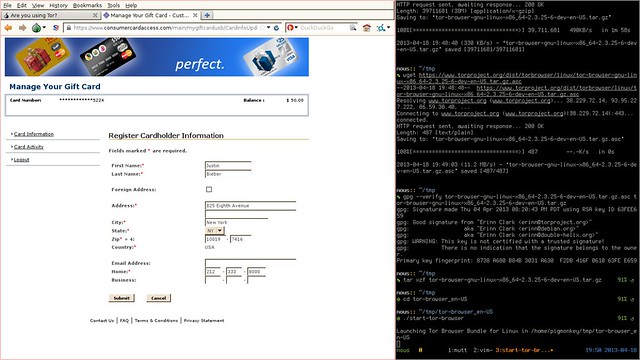
Each prepaid card comes with activation instructions that include the URL of the registration page. After visiting this registration page in the Tor Browser, you’ll be asked to enter a name, address and phone number. Remember that this address will only be used for AVS checks. No other verification will be done. Whatever name and address you use, make a note of it so that you can enter the correct billing information when using the card.
After the card has been registered it’s ready to use. Any online use of the card should also be done through the Tor network to preserve your anonymity. If you decide to use the card with a PayPal account, register a new PayPal account through Tor.
Most online purchases will require an email address. Since you’re already in the Tor Browser, head over to Tor Mail and sign up for a new address to use with the card. If you want a quick disposable email address, try Mailinator.
It seems more often we read news stories where it is apparent that at least in some areas of the country, the inmates are running the asylum, meaning people who are irrational or just plain nuts are the people in power making the rules—or in some cases, the laws.
The most recent, “Are you kidding me?” news story came from West Virginia, where a 14-year-old middle school student was arrested and suspended simply for wearing an NRA T-shirt. I looked into the story, convinced that there had to be something else involved—an assault on a teacher, drugs, something.
Nope. Jared Marcum was arrested simply because he wore an NRA T-shirt to school and refused to take it off. On the shirt was a picture of a hunting camoed AR-15 and the words, “Protect Your Right” along with the NRA logo. The shirt apparently upset a teacher in the cafeteria, who told Marcum to take off the shirt or turn it inside out. Marcum informed the teacher that the shirt didn’t violate the school’s dress code, so he was sent to the principal’s office.
“When the police came, I was still talking and telling them that this was wrong, that they cannot do this, it’s not against any school policy,” Marcum told The Associated Press. “The officer, he told me to sit down and be quiet. I said, ‘No, I’m exercising my right to free speech.’ I said it calmly.” After the incident, local police charged Marcum with disrupting the educational process and obstructing an officer.
Check out the video from WOWK-TV in Charleston, W.V.:
According to the Logan County School District’s dress code, students are forbidden from wearing anything that displays profanity, violence, discriminatory messages or sexually suggestive phrases. Garments that glorify alcohol, tobacco or drugs are also banned. Still, Marcum’s lawyer, Ben White, insists that the NRA shirt did not constitute a violation of the dress code, let alone grounds for an arrest. White requested copies of the surveillance tape from the cafeteria.
Video evidence in the case, White said, indicates the situation in the cafeteria deteriorated when a teacher raised his voice while confronting Jared. Other students jumped up on benches and began chanting Jared’s name.
“I think the disruption came from the teacher,” White said. After his one-day suspension, Marcum returned to school wearing the exact same T-shirt that got him suspended. Marcum was joined by about 100 other students across Logan County, W.V., who wore shirts with similar gun rights slogans in a show of support for free speech.
“I’m still confused, thoroughly confused,” Marcum told a local TV station. “The school didn’t even make a statement to the news agencies, much less myself.”
The case has been turned over to the local juvenile prosecutor.
“My sense is that no charges will be imminent,” White said.
We at Guns & Ammo can’t believe any prosecutor would be stupid enough to press charges against Marcum, but then again, who would have thought Marcum would have been suspended and arrested in the first place?
This is a complete and total failure of leadership. Apparently there is no responsible adult supervision in Marcum’s school; if there was, the teacerh, the principal and the police officer should have been the ones punished for misbehavior.
However, there is one thing we all learned from this story: Jared Marcum’s parents are doing a darn good job.
What do you think? Is the school justified in suspending Marcum, or does the suspension violate his First Amendment rights?
In the wake of the terrorist attack on the Boston Marathon and the identification, arrest, and charging of Dzhokhar Tsarnaev, I've been feeling very self-conscious. That's because lots of people are talking about federal criminal law and criminal procedure, subjects with which I am somewhat familiar. When they do, I ask myself: when I very frequently talk about things I haven't bothered to learn about, do I sound like that? God help me.
Today: nutty and deliberately ignorant conspiracy theories about Tsarnaev's first court appearance.
As I mentioned early in the week, Tsarnaev made his initial appearance from his hospital bed on April 22, 2013, the first court day after his arrest. At that hearing, United States Magistrate Judge Marianne B. Bowler said this to him:
You have a right under the Constitution of the United States to remain silent. Any statement made by you may be used against you in court, and you have the right not to have your own words used against you.
In other words, Magistrate Judge Bowler informed Tsarnaev of his Fifth Amendment rights.
(The transcript suggests she did so incorrectly and confusingly — the last clause just isn't right unless you modify it to say "you have the right not to be compelled to say things against yourself," because the government certainly can use your words against you if those words aren't compelled. That may mean that the court reporter got it wrong, or that Judge Bowler had the sort of slip of the tongue any of us can have speaking extemporaneously.)
Judge Bowler reading Tsarnaev his rights has caused great consternation in some circles. It has been reported that he initially answered questions but stopped talking after read his rights. Outrageous! Critics want to know: why was he allowed to make a court appearance? Why did the judge read him his rights? More critically, what motive did the judge have to do so?
The jittery and uncombed are eager to rush in to answer that question.
First, I give you the one-vowel-short-of-aptly-named Pat Dollard, whose headline shrieks "SHOCK: JUDGE WHO ENDED INTERROGATION OF BOSTON BOMBER WITHOUT DOJ KNOWLEDGE LINKED TO MUSLIM BROTHERHOOD":
UPDATE: Judge Bowler lists herself as “a dedicated international traveler” on her bio in Business Week. Where does she travel to in such a dedicated fashion? Who does she see there, and what does she do, so regularly as to be self-described as “dedicated”. And, perhaps, “dedicated” to anything in particular? Did she take on a radical Muslim boyfriend in her travels?
International travel is, indeed, suspicious. An international travel is likely to encounter foreigners, some of whom are not even white.
Or take Daniel Greenfield of Frontpage Mag, who has this on "Boston Bomber Magistrate’s Middle Eastern Connections":
As FOX News reported and Robert Spencer noted, Dzhokhar Tsarnaev stopped talking once he was prematurely read his Miranda rights. That helps the authorities establish the lone wolf narrative. Whatever else we might have learned from him is probably lost.
. . . .
While Islamic infiltration of our political system is well known, the infiltration of our legal system is less well known, but operates within similar parameters with foreign contacts being made. There is no way of knowing how much Bowler has been influenced by her connections with the legal and political systems of the Muslim world, but it is telling that her international judicial relations appear to begin and end with the Muslim world.
The very fact that there is no way to know how much Bowler was influenced by Muslims show exactly how shadowy and mysterious Muslims are!
Now, here's why these people are full of shit.
Magistrate Judge Bowler was required by federal law to tell Tsarnaev of his right to remain silent. Rule 5 of the Federal Rules of Criminal Procedure, governing initial appearances, says this:
(d) Procedure in a Felony Case.
(1) Advice. If the defendant is charged with a felony, the judge must inform the defendant of the following:
(A) the complaint against the defendant, and any affidavit filed with it;
(B) the defendant's right to retain counsel or to request that counsel be appointed if the defendant cannot obtain counsel;
(C) the circumstances, if any, under which the defendant may secure pretrial release;
(D) any right to a preliminary hearing; and
(E) the defendant's right not to make a statement, and that any statement made may be used against the defendant.
And how did Magistrate Judge Bowler wind up holding an initial appearance? The U.S. Attorney's Office — the federal prosecutors, an arm of the U.S. Department of Justice — filed the criminal complaint on Sunday, April 21, 2013, initiating the criminal case. The docket for the case to date is here. Filing a complaint against a person in custody starts the federal criminal process moving, leading naturally to a first appearance. If the feds hadn't filed the complaint, there's no way Judge Bowler could have held a hearing with Tsarnaev without someone filing a habeas corpus petition. Judges can't initiate such federal criminal proceedings on their own.
The Patient Zero for this plague of derangement is Fox News' Megyn Kelly:.
The FBI filed a federal criminal complaint against the 19-year-old on Sunday, and federal District Court Judge Marianne Bowler [emphasis added] arrived at the hospital where he is being treated to preside over his initial hearing Monday, when she read him his Miranda rights.
[FBI officials told The Associated Press Wednesday that Tsarnaev acknowledged to investigators his role in the attacks before he was advised of his constitutional rights. He reportedly said he was only recently recruited by his brother to be part of the attack.]
But Fox News' sources say there was confusion about Bowler's timing, with some voicing concerns that investigators were not given enough time to question Dzhokhar under the "public safety exception" invoked by the Justice Department.
Someone with a saintly level of patience could probably teach prominent journalist Megyn Kelly the difference between a District Court Judge and a Magistrate Judge if she wanted to know for, say, the purpose of reporting accurately about the most important federal criminal case of the year. Maybe the same person could teach her how to use the Google to see which one Magistrate Judge Bowler is.
But Kelly is merely a carrier of the derangement. It is to her credit that she acknowledges being told that Rule 5 required Magistrate Judge Bowler to inform Tsarnaev of his rights — and that she acknowledges being told that the "Judge Bowler initiated the hearing too early" theory is bullshit.
Two officials with knowledge of the FBI briefing on Capitol Hill said the FBI was against stopping the investigators' questioning and was stunned that the judge, Justice Department prosecutors and public defenders showed up, feeling valuable intelligence may have been sacrificed as a result.
Yes, federal agents are often against application of the rule of law. But:
But Justice Department spokesman Dean Boyd disputed the claims, saying that the suspect’s initial appearance was scheduled following the filing of the criminal complaint in a manner “consistent” with procedure – and that the agents were aware.
“The Rules of Criminal Procedure require the court to advise the defendant of his right to silence and his right to counsel during the initial appearance. The prosecutors and FBI agents in Boston were advised of the scheduled initial appearance in advance of its occurrence,” Boyd said.
A federal law enforcement official also told Fox News that the courts, not the Justice Department, made the decision on when and where to hold the hearing.
“The (FBI) agents and prosecutors were notified beforehand,” the official said, claiming those agents had already left the room when the judge came in.
So: some federal law enforcement official says that "the courts" made the decision when and where to hold the hearing. That is almost certainly literally true. But it's almost certain that first, the U.S. Attorney's office informed the court that they were ready for a hearing. Again, the feds initiate cases, and they initiate first appearances by showing up at court with someone in custody or asking the court to hold a hearing. Is it physically possible that Judge Bowler could, on her own initiative, scheduled a hearing after the feds initiated the case by filing the complaint? Yes. But it is an extraordinary claim, requiring some sort of evidence. Unnamed "federal law enforcement officials" are not known for their command of federal criminal procedure.
In short: the proposition that Judge Bowler was motivated by some sleeper-cell jihadist agenda to rush to inform Tsarnaev of his rights in order to shut him up is very stupid.
I recognize that federal criminal procedure is not common knowledge. But it's not hard to figure out either. I figured it out and I'm more than a little dim. A brief call to any first-year Deputy Federal Public Defender or Assistant United States Attorney, let alone any experienced federal criminal practitioner, would have cleared up these imbecilities.
But who wants to do actual research before accusing a judge of being a terrorist parisan? The wild-eyed people sniffing every falafel Judge Bowler ever ate are either (1) crazy (2) lazy (3) stupid or (4) dishonestly partisan, or some combination of those.
Update: A reaction from Pat Dollard:

Perhaps Pat Dollard is not able to understand the difference between an interrogation by law enforcement and an appearance in court. Or, more likely, he doesn't care.
Edited Again:
And in the category of "really ought to know better," consider Paul Mirengoff at Powerline:
I have never practiced criminal law (except briefly at the international level) and have not studied it since 1974. Thus, like most Americans, much of what I think I know about criminal procedure comes from watching television and movies.
My viewing experience does not include any instances in which a judge read a criminal defendant his or her Miranda warning in the middle of police interrogation. Thus, I was shocked to learn that this happened in the case of the surviving Tsarnaev terrorist.
. . . .
I can’t help but that suspect that it was the Obama administration that decided Tsarnaev should receive the Miranda warning. After all, wasn’t it the prosecutor who brought the judge to Tsarnaev’s hospital room in the first place? And isn’t it almost certain that the local prosecutor, an assistant U.S. attorney, acted on instructions from the higest level of the Justice Department? Line prosecutors don’t make decisions about how to treat terrorists in high profile cases when there is time to consult the DOJ.
The party line is that the magistrate judge made the decision to Mirandize the terrorist because she deemed her appearance in the hospital as constituting an appearance in court by Tsarnaev. This strkes me as ridiculous, unless the prosecutor characterized the event as the equivalent of a court appearance.
Although Mirengoff might be known for engaging his mouth without engaging his brain, he's not a moron, and not lazy: he's a well-qualified attorney. But his post amounts to saying "please congratulate me for refusing to research and for assuming criminal procedure works like I see on TV." Mirengoff is perfectly capable of researching the Federal Rules of Criminal Procedure and confirming that Rule 5 requires the judge to inform a defendant of their rights. Mirengoff attempt to evade the issue by asking why the judge would "deem her appearance in the hospital as constituting an appearance in court," and calling this ridiculous. It is Mirengoff's response that is both ridiculous and willfully ignorant. If the hearing held in the defendant's room wasn't an initial appearance, what the devil was it? It wasn't a probable cause hearing — the judge had already found probable cause by approving the complaint, and no further probable cause determination was necessary until either an indictment or preliminary hearing. It was run, in every respect, exactly like an initial appearance. Federal courts sometimes conduct initial appearances by video or in a hospital room when the circumstances require, as minimal research would have shown. It's very likely that the U.S. Attorney's Office pushed for an initial appearance in the hospital in order to ward off any future argument that the government failed to take Tsarnaev before the magistrate "without unreasonable delay" as required by Rule 5(1)(A).
If Meingoff is embarrassing, the loathsome and amoral torture-fetishist John Yoo is infuriating:
This is an outright violation of the separation of powers. It is not for federal judges, or worse yet their assistants, to rove around looking for criminal cases in which to act as law enforcement agents. The decision whether to read Miranda lies up to the executive branch.
Like Meingoff, John Yoo is neither stupid nor lazy nor unqualified to research legal issues. At the most charitable interpretation, neither wants to make even the most minimal inquiry about law and true facts when their gut reaction suits their partisan narrative. More likely, they are both deliberately dishonest people.
Law, Facts, And Even Minimal Gestures Towards Research All Have Suspicious Muslim Connections © 2007-2013 by the authors of Popehat. This feed is for personal, non-commercial use only. Using this feed on any other site is a copyright violation. No scraping.

Chrome/Firefox/Safari/Opera: The Netflix Queue Sorter userscript can rearrange your Netflix queue by date added, title, star rating, average rating, even length or year released. If your queue is a mess, this simple script will clean it up and make it easier to find the things you've been meaning to watch.
If you're like me, your Netflix queue is probably only organized by when you added the shows and movies in the list. It makes it pretty difficult to find something you've been meaning to watch without a lot of clicking or scrolling. This userscript gives you complete control over your queue—and actually reorganizes it for you, not just changes the way it looks on the web. You can sort by just about any common field, so if you want your TV shows first and your movies second, but you want them both in alphabetical order, this script will do that. Want the movies organized by star rating instead of alphabetical? Sure, the script can handle that too.
The userscript works for DVD and Instant queues, and if you're unfamiliar with how to install and use userscripts and styles, we have a guide to help, and the link below has installation instructions for each major browser.
Netflix Queue Sorter | Userscripts.org


Read more of this story at Slashdot.

Jay McDanielThe real issue with torture is not whether or not it is effective but rather if it is moral and proper for a country dedicated to political and individual freedom and the presumption of innocence should be engaged in such a practice. I believe that the drafters of our constitution would be appalled by this country's cavalier use of torture hidden behind claims of national security!
On April 16, like me, you were probably paying attention to the aftermath of the Boston Marathon bombings, waiting breathlessly for intrepid journalists at CNN, the New York Post, and Reddit to implicate a series of innocent people in a manner suggesting the involvement of a doctor with a flashlight. If your attention wandered from that, you may have become preoccupied by a tremendous explosion in Texas, one not preceded by the traditional local incantation "hey, hold my beer." Then you probably looked back at Boston for a two-day chase involving stolen SUVs and grenades and gunfights and boats. It was a very American week in the media.
I know I was paying attention to all of that. Oh, and the kids were being the kids, and I was busy at work, and I was irritable.
Maybe that's why I didn't notice the release of a detailed report explaining how America has tortured people since 9/11.
Perhaps the most important or notable finding of this panel is that it is indisputable that the United States engaged in the practice of torture.
This finding, offered without reservation, is not based on any impressionistic approach to the issue. No member of the Task Force made this decision because the techniques “seemed like torture to me,” or “I would regard that as torture.” Instead, this conclusion is grounded in a thorough and detailed examination of what constitutes torture in many contexts, notably historical and legal. The Task Force examined court cases in which torture was deemed to have occurred both inside and outside the country and, tellingly, in instances in which the United States has leveled the charge of torture against other governments. The United States may not declare a nation guilty of engaging in torture and then exempt itself from being so labeled for similar if not identical conduct. The extensive research that led to the conclusion that the United States engaged in torture is contained in a detailed legal memorandum attached to this report. It should be noted that the conclusion that torture was used means it occurred in many instances and across a wide range of theaters. This judgment is not restricted to or dependent on the three cases in which detainees of the CIA were subjected to waterboarding, which had been approved at the highest levels.
But, of course, it was necessary, right?
There is no firm or persuasive evidence that the widespread use of harsh interrogation techniques by U.S. forces produced significant information of value. There is substantial evidence that much of the information adduced from the use of such techniques was not useful or reliable. There are, nonetheless, strong assertions by some former senior government officials that the use of those techniques did, in fact, yield valuable intelligence that resulted in operational and strategic successes. But those officials say that the evidence of such success may not be disclosed for reasons of national security.
The report is lengthy and detailed. I'm still reading it. A report condemning the government is no more worthy of automatic belief than a statement supporting the government. My evaluation of the report would be aided by critical reviews, both pro and con, both in the "mainstream media" and amongst bloggers. I'm not holding my breath for it. Consider how little it's been reported during this tumultuous week. I could try to be outraged or smug about that, but the truth is that it is entirely possible that I will be distracted by other, simpler, funnier things.
This is how most of us have decided we are willing to live.
While You Were Freaking © 2007-2013 by the authors of Popehat. This feed is for personal, non-commercial use only. Using this feed on any other site is a copyright violation. No scraping.
First, just in case it's not utterly obvious, I'm glad that the two murderous cowards who attacked civilians in Boston recently are off the streets. One dead and one in custody is a great outcome.
That said, a large percent of the reaction in Boston has been security theater. "Four victims brutally killed" goes by other names in other cities.
In Detroit, for example, they call it "Tuesday".
…and Detroit does not shut down every time there are a few murders.
"But Clark," I hear you say, "this is different. This was a terrorist attack."
Washington DC, during ongoing sniper terrorist attacks in 2002 that killed twice as many people, was not shut down.
Kileen Texas, after the Fort Hood terrorist attack in 2009 that killed three times as many people, was not shut down.
London, after the bombing terrorist attack in 2005 that killed more than ten times as many people, was not shut down.
"But Clark," I hear you asking, "what about the lives saved?"
There is no evidence that any lives were saved by the Boston shutdown.
"Yeah, but you can't know for sure!"
True. I can't. But in London, Washington, LA after the El Al shootings, and so on and so on and so on, there were not lockdowns, and there were no further fatalities. It's not perfect proof, but it's suggestive.
"Then why the hell do you care, Clark?"
First, the unprecendented shutdown of a major American city may have increased safety some small bit, but it was not without a cost: keeping somewhere between 2 and 5 million people from work, shopping, and school destroyed a nearly unimaginable amount of value. If we call it just three million people, and we peg the cost at a mere $15 per person per hour, the destroyed value runs to a significant fraction of a billion dollars.
"Yeah, maybe…but in this day and age where the federal government is borrowing an extra $3.85 billion per day, a couple of hundred million doesn't sound like much. After all, if we're borrowing money that our children and grandchildren will have to pay back to fund Cowboy Poetry Festival and military golf courses, then what's another $200 or $400 million to keep people safe?"
I've got multiple answers:
First, just because you're already two hundred pounds overweight doesn't mean that another bowl of ice cream won't hurt you. It will.
Second, the cost isn't just measured in dollars – it's measured in the degree to which it trains a population to freak out over minor risk and to trust blindly in authorities.
Third, keeping citizens off the street meant that 99% of the eyes and brains that might solve a crime were being wasted. Eric S Raymond famously said that "given enough eyeballs, all bugs are shallow". It was thousands of citizen photographs that helped break this case, and it was a citizen who found the second bomber. Yes, that's right – it wasn't until the stupid lock-down was ended that a citizen found the second murderer:
The boat’s owners, a couple, spent Friday hunkered down under the stay-at-home order. When it was lifted early in the evening, they ventured outside for some fresh air and the man noticed the tarp on his boat blowing in the wind, according to their his son, Robert Duffy.
The cords securing it had been cut and there was blood near the straps.
We had thousands of police going door-to-door, searching houses…and yet not one of them saw the evidence that a citizen did just minutes after the lock-down ended.
"But Clark," you protest, "you may not trust the government to decide what's risky and what's not, but I do. If it saves even one life, then shutting down a major city is the right move. That's obvious!"
But the Boston police didn't shut down an entire city. They shut down an entire city except for the donut shops.
Law enforcement asked Dunkin' Donuts to keep restaurants open in locked-down communities to provide… food to police… including in Watertown, the focus of the search for the bombing suspect.

The government and police were willing to shut down parts of the economy like the universities, software, biotech, and manufacturing…but when asked to do an actual risk to reward calculation where a small part of the costs landed on their own shoulders, they had no problem weighing one versus the other and then telling the donut servers "yeah, come to work – no one's going to get shot."
And they were right.
security theater, martial law, and a tale that trumps every cop-and-donut joke you've ever heard © 2007-2013 by the authors of Popehat. This feed is for personal, non-commercial use only. Using this feed on any other site is a copyright violation. No scraping.
PhotographyIsNotACrime.com points out the obvious: after years of warning us that photography is suspicious, the police were happy to accept all of those amateur photographs and videos at the Boston Marathon.
Adding to the hypocrisy is that these same authorities will most likely start clamping down on citizens with cameras more than ever once the smoke clears and we once again become a nation of paranoids willing to give up our freedoms in exchange for some type of perceived security.After all, that is exactly how it played out in the years after the 9/11 terrorist attacks where it became impossible to photograph buildings, trains or airplanes without drawing the suspicion of authorities as potential terrorists.
I commented in this article on the repeal of the transparency provisions of the STOCK Act:
Passed in 2012 after a 60 Minutes report on insider trading practices in Congress, the STOCK Act banned members of Congress and senior executive and legislative branch officials from trading based on government knowledge. To give the ban teeth, the law directed that many of these officials' financial disclosure forms be posted online and their contents placed into public databases. However, in March, a report ordered by Congress found that airing this information on the Internet could put public servants and national security at risk. The report urged that the database, and the public disclosure for everyone but members of Congress and the highest-ranking executive branch officials -- measures that had never been implemented -- be thrown out.The government sprang into action: last week, both chambers of Congress unanimously agreed to adopt the report's recommendations. Days later, Obama signed the changes into law.
The article went on to talk to four cybersecurity experts, all of whom basically said the same thing:
Bluntest of all was Bruce Schneier, a leading security technologist and cryptographer. "They put them personally at risk by holding them accountable," Schneier said of the impact of disclosure rules on Congress members and DC staffers. "That's why they repealed it. The national security bit is bullshit you're supposed to repeat." (Three of the four experts we consulted opted for the same term of choice.)
There was a security risk, but it was not a national security risk. It was a personal Congressperson risk.
EDITED TO ADD (4/25): Jon Stewart quoted my "the national security bit is bullshit" line.
Yesterday, in a disturbing report published on CNET, new documents obtained by EPIC reveal that Obama administration officials have authorized a new government program involving the interception of communications on Internet service providers, including AT&T—one of the key players in the NSA warrantless wiretapping program.

Under long-standing federal law, the government needs to use legal process to compel service providers to hand over customer communications, yet reportedly, the government is promising these companies they will not to prosecute them for violating US wiretapping laws if they hand over the information voluntarily. And the secret surveillance authorization seems quite broad, touching on huge swaths of private, domestic activity:
The secret legal authorization from the Justice Department originally applied to a cybersecurity pilot project in which the military monitored defense contractors' Internet links. Since then, however, the program has been expanded by President Obama to cover all critical infrastructure sectors including energy, healthcare, and finance starting June 12.
CNET reported also that the National Security Agency (NSA) and Department of Defense were “deeply involved in press for the secret legal authorization” further underscoring widespread worries that the military may be given access to Americans’ personal information through cybersecurity operations. The report comes as Congress is debating CISPA, a dangerous bill that carves a “cybersecurity” loophole in all our privacy laws.
While we are still sifting through the more than thousand pages of documents—obtained by EPIC Privacy through the Freedom of Information Act and posted to their website—the most controversial aspect of this program seems to be that the government has not used legal process to obtain Internet traffic from AT&T and other ISPs involved in the program. Instead, the Justice Department has handed them what the Justice Department calls a “2511 letter”—named after a section of the Wiretap Act—which purports to immunize them from prosecution.
Section 2511 makes it a crime to wiretap—intercept electronic communications—with some exceptions, like a properly issued warrant. It provides no exception for a letter from the Justice Department. CNET reported an industry representative told them "the 2511 letters provided legal immunity to the providers by agreeing not to prosecute for criminal violations of the Wiretap Act. It's not clear how many 2511 letters were issued by the Justice Department."
Beyond what CNET reported, we still need to analyze these new documents to determine how pervasive this surveillance is and its impact on the American public. We are currently reading them over and will have a more detailed analysis soon.
Related Issues: Cyber Security Legislation NSA Spying Related Cases: Jewel v. NSA


 || Join EFF
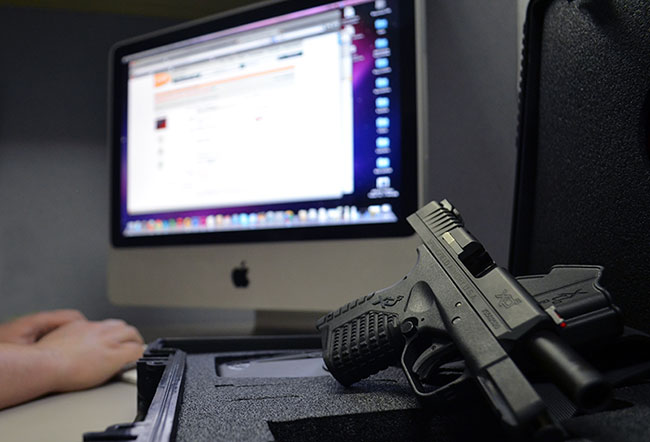
As a gun writer, I like to consider myself a little more well-informed than the average gun owner about most things that go “bang.” Buying and selling guns, ammo and accessories online is no big deal, right? Well, thinking you’re smart and well-informed, and being smart and well-informed are two different things. As of right now, my PayPal account is restricted until I fill out their, “I’m sorry I broke your rules,” document, admitting I violated their Acceptable Use Policy. What did I do?
I had the temerity, the audacity, the cojones to sell an AR-15 magazine on GunBroker, and accept payment through PayPal. When Paypal found out, they restricted my account so that I can now deposit money into it—but not withdraw any—until I fill out and send in their Acceptable Use Policy affidavit.
EBay is well known to be hostile to gun owners, treating firearms, parts and ammunition like the plague, but I thought I was safe working through GunBroker, which specializes in hosting auctions of exactly those kind of products readers of Guns & Ammo would be interested in. Lesson learned. I guess that’s why sellers on GunBroker don’t have PayPal listed as a payment option, but instead take money orders, checks, credit cards, etc.
GunsAmerica has recently instituted a policy that states everything bought on their site has to be paid for with USPS Postal Service Money Orders. As GunsAmerica explains, “If you use USPS money orders and mail them USPS, you generate what they call a ‘nexus’ and if, God forbid, you are scammed online, they will respond to your complaint.”
The USPS has Postal Service Inspectors, and they take fraud seriously.
“Credit cards are the safest way to pay for internet purchases, but only gun dealers are allowed to have a merchant account that can take payments for guns online.” If somebody trying to sell you something online is saying something different, they’re either wrong or somehow trying to scam you.
In doing research for this article, I also found this on GunsAmerica: “Paypal is not an option. Please do not attempt to use it to pay for or to get paid for GunsAmerica sales. Paypal is violently anti-gun and has suspended and frozen thousands of legitimate gun seller accounts over the years.” Too bad I didn’t know that earlier, but hopefully my pain can be your gain.
GunBroker and GunsAmerica are the two of largest Internet auction sites devoted to firearms and accessories, but not the only ones. There are also GunAuction.com, ArmchairGunShow.com and ArmsBid.com, just to name a few. If you’ve never used one of the online auction sites to buy or sell guns, ammo, or accessories, there are a few things I’ve learned over the years that will help you out.
To buy or sell anything through an online auction site, you’ll have to set up an online user account. Sellers on these websites live and die by their reputation, which is referred to by various terms such as their “feedback” or “user level.” GunBroker uses a grading system that should be familiar to anyone who went to school, A+ being the best. How many total votes they’ve received is also listed, so a seller who has a high grade with a huge number of sales is always the best bet. Sellers to look for on GunsAmerica have a user level that says they are “Trusted” or “Gold.”
Online auction sites are so popular and useful, they are used by gun stores and professional sellers as much or more now than they are by private citizens. This isn’t a bad thing. Selling stuff online requires very little investment and reaches a wide audience, so gun stores and FFL holders can often sell guns more cheaply online than stores who only do face-to-face business.
When you have something to sell and have an account set up, most of the auction sites have easy-to-use walkthroughs to show you how to set up your own auction. The fees they charge for putting up a listing can range from a few bucks to a few dozen, and the fees are usually only charged after the item has sold. Most of the time the fees are calculated as a percentage of the selling price—1 to 2 percent on GunsAmerica based on your membership level, and 1.25 to 5 percent on GunBroker based on the price of the item sold.
One helpful hint: Always upload a photo of what you’re selling. If you don’t, not only will most potential buyers pass up your listing, anyone still interested will just email you asking for a photo.
GunBroker and its like aren’t the only useful places to track down good deals online. Whatever type of firearm you fancy, chances are there is a forum devoted to it somewhere—such as ColtAutos.com, where collectors gather.
Perhaps the largest firearms forum is AR15.com. “Arfcom,” as it is known, is a huge site that isn’t just devoted to ARs, and gun companies know this. Manufacturers have a large presence on the site, not just through ads but through forum posts talking about new products, or talking their customers through problems they may be experiencing. Many companies frequently have special deals available only to members of Arfcom. Arfcom also has their Equipment Exchange, where members who want to buy, sell, trade or get involved in group buys send emails back and forth.
When dealing with individual sellers, the potential for being scammed is always higher. There’s no way to completely eliminate fraud, so just use common sense—if a deal seems too good to be true, it probably is. Also, if the seller only provides stock photos, wants you to mail your payment to a P.O. Box or maybe a different state even though they’re selling one of their “personal” items, or does anything else that raises your red flags, you have only yourself to blame if you send your payment and never see anything in return.
When is the best time to buy and/or sell? Well, if you’ve got any sort of semi-auto, magazine-fed rifle you’re looking to part with, now would be the time. The same goes for any ammunition or AR or AK magazines—they are all drawing premium prices. Legally, buyers are responsible for making sure the products they’re purchasing are legal in their city/state, but as a seller, you should learn which states have banned certain items. That is why so many gun companies have stopped sales of ARs and standard capacity magazines to departments and even individual law enforcement officers in ban zones such as New York, because they don’t want to run afoul of new and ever-changing gun laws.
When you post your listing, you want as many people as possible to have the chance to look at it, so don’t have it run over a holiday weekend. Again, use common sense—Hawaiian shirts sell better in June than they do in January. If you live in a place which sees snow on the ground six months of the year and only want to sell your competition rifle to a local, February is not a good time to put it up for sale.
Today’s defensive handguns are rugged, reliable machines, but they won’t stay that way if they’re not properly maintained. While most shooters will be careful to keep their guns dry and free of debris, it’s not uncommon for handguns to be fired without the benefit of regular cleaning and proper lubrication. Shooting handguns dirty or dry (or both) can result in malfunctions and permanent damage.
Modern firearms are powerful tools that experienced shooters understand need to be treated with respect. While a gun is in use, we carefully follow a set of common sense rules to keep everyone safe. But how do we practice firearms safety when the shooting or hunting sessions are over? Most of the guns folks own will spend the majority of their working life at rest, placed in one state of storage or another, until the next shooting event. Since they remain powerful tools between trips to the range, it’s very important to store them properly.
When introducing your child to the shooting sports, it's important to choose a firearm that's best suited to their abilities.
It doesn’t matter whether you’re going hunting or planning a fun day at the range; you want to hit what you’re aiming at, so the first step is to make sure your rifle is properly zeroed.
Don't end up in the slammer because you don't know the rules. James Tarr goes over how to interact with police while carrying a firearm.
Most people looking to purchase their first firearm have a long list of questions. Handgun or long gun? Pistol or revolver? Shotgun or rifle? What about caliber and ammunition type? Finally, how can the gun be stored so it is both ready for home defense, and inaccessible to curious children and criminals?
I observed a spill suspiciously close to a three-year-old's play table. I asked, "How did the floor get wet?"
She replied, "Water."
It's not lying, but it's definitely not telling the whole story. She'll probably grow up to become a lawyer.
Yesterday, we filed a motion to quash a subpoena seeking the identity of the blogger behind Die Troll Die, a website dedicated to “News and Views Involving Copyright Trolls & John/Jane Does.”
For years, Die Troll Die has been covering news about Prenda Law and its predecessor Steele Hansmeier PLLC, amoung many others. Prenda Law is a porn troll. This means that it looks for IP addresses that allegedly downloaded adult films via BitTorrent, seeks to subpoena the ISP for the contact information of the account holder associated with that IP address, and then threatens to name the alleged infringer in a copyright lawsuit, right next to the embarrassing title of a pornographic film. Or just settle, for thousands of dollars.
The tactics of Prenda Law and its main attorneys, Paul Duffy, John Steele, Paul Hansmeier, and Brett Gibbs have faced well-deserved criticism, from the blogs and from the bench. EFF has been working on the issue for some time, filing amicus briefs and offering expert testimony. Nevertheless, Prenda Law and its affiliated attorneys have filed hundreds of cases, against tens of thousands of people, and, according to John Steele, made millions of dollars.
Over the last few months, the tide has begun to turn. A federal judge in Florida dismissed a case for “attempted fraud on the courts,” and another federal judge in Los Angeles called Prenda Law’s tactics a “legal shakedown,” “essentially an extortion scheme,” and opened an inquiry on whether to issue sanctions.
And Prenda Law’s trolling was not the only issue: serious questions began to arise about Prenda Law’s purported clients using invented names and fictitious signatures on key legal documents — in particular, Alan Cooper accused Prenda of stealing his identity, and holding him out as a front man for their shell company plaintiffs.
In February, while facing the sanctions inquiry from the Los Angeles federal court and a deposition in San Francisco, Prenda Law filed a specious lawsuit against a number of its critics and opponents, claiming it was defamed by the Die Troll Die website, as well as another criticism site, Fight Copyright Trolls. The lawsuit, one of three nearly identical suits filed by Prenda Law, Paul Duffy and John Steele respectively, also targeted Alan Cooper — the witness against them in the sanctions hearing — and his attorney Paul Godfread.
Prenda Law then issued subpoenas, seeking to identify its pseudonymous opponents. One subpoena went to Automattic, the operator of Wordpress, which hosts Fight Copyright Troll and Die Troll Die, seeking to identify everyone who even read the blogs. Automattic rightly refused to respond, citing the many legal defects in the subpoena.
Another subpoena went to Wild West Domains, a subsidiary of GoDaddy and the domain name registrar for dietrolldie.com. Wild West Domains provided Die Troll Die with notice of the subpoena, but said it would comply unless Die Troll Die formally objected. Die Troll Die retained EFF to represent it, and yesterday we filed the motion to quash. (EFF also represents Fight Copyright Trolls).
Die Troll Die has a Constitutional right to speak its mind, and give its opinion, however negative, of Prenda Law. Courts protect that right by requiring litigants to show they have a good case before unveiling critics. This, Prenda Law does not have.
As we explain in the brief, Prenda Law’s claims are meritless. It is opinion, not defamation, to call someone an “a$$hat” or call their business model “repulsive,” and it's flat out ridiculous to claim that the Prenda Law (a corporation) has been libeled by allegations of fornication and adultery. Seriously: Prenda Law asserted that calling the close business relationship between various companies and people “incestuous” was a literal accusation of incest, and therefore libel.
Furthermore, Die Troll Die, as the operator of a message board, is not liable for the comments on the website, even if they were defamatory. This is bedrock law, upon which the every website that allows user content depends.
In short, Prenda Law does not have a valid claim against the defendants. It is simply trying to retaliate against its critics.
In the meantime, things have been going very poorly for Prenda Law. In March, they failed to show up at the first sanctions hearing (transcript) in Los Angeles, where Judge Otis Wright heard damning evidence of fraud on the courts. Judge Wright ordered them to appear in person on April 2 (transcript), and the Prenda Law lawyers elected to assert their Fifth Amendment rights against self-incrimination rather than respond to the judge’s inquiry about "attorney misconduct such misconduct which I think brings discredit to the profession."
As Prenda Law began dismissing its trolling cases around the country, Prenda Law’s defamation case was removed to federal court in Illinois, and Cooper and Godfread asserted counterclaims and moved to dismiss the claims as a SLAPP (Strategic Lawsuit Against Public Participation).
And today, Paul Duffy made an appearance in a Prenda case before the federal court in San Francisco. The question was basically how badly should Prenda Law's purported client AF Holdings lose — whether they would lose for now, but have a chance to refile if they got their house in order, or whether they should lose forever, and have to pay the defendant's attorneys' fees. The Court wanted to know whether Prenda's attempts to dismiss the case were in bad faith, to avoid further questions about ownership.
Related Cases: Prenda Law v. Paul Godfread, Alan Cooper, et al. AF Holdings v. Does || Join EFF
For those of us following the continuing saga of the unnecessary and harmful WIPO Broadcasting Treaty, its latest manifestation is starting to have the feel of a tired movie franchise. Every few years, as soon as Hollywood thinks it can squeeze a few more dollars out of a new installment, the same bad idea gets rehashed with the same cast of characters, and still no substance.
But unlike a bad sequel, we can't just ignore each new round of negotiations: the interests pushing for the treaty are counting on a lapse of vigilance from the public in order to push the bad policy through.
So what is the Broadcasting Treaty, anyway? In short, the idea is to create a new bundle of copyright-like veto points for broadcasters. In official descriptions, those new broadcaster powers are referred to as "rights," but that language clouds the fact that the treaty is really about creating new restrictions.
Let's say a broadcaster shows a public domain movie on their network. Currently, nobody can restrict your rights to use that film however you like — whether that's recording it to watch later, making a remix with it, or even broadcasting it over your own network or on your own website. That is, after all, the point of the public domain, and it's a very good thing.
A Broadcasting Treaty, though, would give broadcasters the power to restrict your use of those works — even if they have no copyright interest in the works at all.
The broadcasters and other representatives of the entertainment industry like that scheme because it gives them more opportunities to control the kinds of audiovisual content they broadcast. If they've got any other reason, one that isn't just about serving their own interests at the expense of the public, they've been tight-lipped about it.
KEI, the only consumer interest group that's even been present at the latest round of discussions, has put together an excellent — if frustrating — guide to the kinds of empirical policy questions that are not coming up in the reality-free zone in which the negotiations are taking place:
It has been extremely difficult to get broadcaster treaty supporters to explain why a treaty is needed, in a world where content is already protected under several copyright and related rights treaties. [...] We don't know if the rationale is related to piracy or to create a set of new economic rights for people who broadcast (and do not create) content. And, we don't understand why copyright does not already provide mechanisms to address piracy, when it occurs.
There are alleged gaps in copyright protection for works, but other than vague assertions that sporting events are not protected in some countries (which ones?) and some poorly articulated claims that broadcast owners don't have standing to litigate piracy, the "gaps" argument is hard to follow -- even though people are genuinely open minded, and would consider fixes to problems if they could be explained.
And while the need for a new broadcast treaty may be hard to pin down, the harm it could cause is not. Just this month, a U.S. appeals court has affirmed that an innovative new web television service called Aereo is not infringing copyright in its operations, despite allegations in lawsuits from major American broadcasters. This decision was a victory for the company, and also for consumers who benefit from the product. As we wrote earlier this month:
The decision is a positive step because it repudiates the "permission culture" worldview of the TV networks and their allies. The networks, joined by ASCAP, sports leagues, and a former Register of Copyrights, argued essentially that anyone who profits from copyrighted works must be made to pay, and that if a company like Aereo builds a business that copyright law doesn't touch, the court should try to rewrite the law. Courts can't do that, of course. Copyright law has never regulated all possible uses of creative works. Many uses are free for everyone, without payment or permission, and private, personal transmission of free TV is one of them.
In other words, the broadcasters couldn't convince the courts to shut Aereo under copyright law. From a consumer perspective, that's obviously a good thing — early reviews are extremely positive, and the competition may shake up a category that has long been stagnant. But under the proposed Broadcasting Treaty, they could shut down that innovative service after all.
If this year's Broadcasting Treaty proposal is just a poorly conceived sequel, it promises to be the feel-bad hit of the summer. Efforts like these, pushed forward without evidence in a forum with little accountability, need to be stopped before they make it into the books internationally and laundered back into bad domestic policy.
Related Issues: Intellectual Property Broadcasting Treaty || Join EFF
UPDATE APRIL 22:
1-800-CONTACTS contacted us, through their lawyer, to complain about this post. The company complains that we incorrectly stated that it does not provide a virtual try-on system. Well, it turns out that the company (which owns Glasses.com) intends to launch a virtual try-on iPad app. We weren't aware of this app. And this is not surprising, since it is not yet available and was publicized on April 17, 2013, the same day as our post. In contrast, Ditto's competing product was launched back in April last year.
1-800-CONTACTS also protests that there is nothing "scandalous" about its CEO visiting Ditto's site to check out its product. We agree. There is certainly nothing wrong with keeping tabs on the competition. What we do think is scandalous, however, is what the company did next. After checking out Ditto's product, 1-800-CONTACTS apparently went out and purchased a patent in order to sue its competitor. This is the key fact and one the company's response to us carefully avoids mentioning. Indeed, 1-800-CONTACTS claims that its CEO is the "inventor" of its own app. But the company's lawsuit is based on U.S. Patent 7,016,824, a patent that has nothing whatsoever to do with its CEO, that is, until his company purchased it.
1-800-CONTACTS says it is not a patent troll. Sure, the company is not a classic patent troll—a shell company that does nothing but buy patents and sue—but it's little better. Patent trolls generally want to use the club of litigation to extort licensing fees. But all indications are that 1-800-CONTACTS isn't interested in a license from Ditto. Rather, it wants to destroy the competition.
You can read 1-800-CONTACTS' complaint here and decide for yourself if we are being too hard on the company. One thing to consider, however, is that 1-800-CONTACTS has a long record of using the courts to bully its competitors. It is a serial trademark bully and has pushed for terrible laws in its home state. When companies like 1-800-CONTACTS compete in the courts instead of the marketplace, lawyers win but innovation and consumers lose.
Here at EFF, we've recently been talking a lot about how the flood of bad software patents has led to an explosion in abusive patent troll litigation. But patent trolls are not the only problem with the patent system. Companies are increasingly using software patents to compete in the courts instead of the marketplace. Sometimes, as in the smartphone wars, these fights are between industry giants. In other cases, established players can leverage the massive expense of patent litigation to squelch the competition.
Take, for instance, the story of Ditto. Ditto is a two-year old company that employs 15 people. Its founders started it to address a problem they had found trying to buy eyeglasses on the Internet, specifically that existing ways to virtually try before you buy were awkward. So they spent many long days and late nights developing a pretty cool technology: one where users record a video of their face using their webcam and then allows them to see how eyeglasses look on their face through 180 degree views.
The folks at Ditto focused their energy on building and launching a product that would appeal to consumers. And their hard work was paying off: they received funding to grow the business, money they used to improve the technology, to hire employees, and to market the product.
Then, as we hear all too often, along came the claims of patent infringement. We often talk of trolls as companies who neither make nor sell anything, but in this case Ditto was threatened by 1-800-CONTACTS, a company who sells glasses online but does not provide the kind of technology that Ditto had painstakingly developed.
It appears that 1-800-CONTACTS' CEO went onto Ditto's website the very day it launched, presumably to investigate the upstart competitor's new technology. Having seen Ditto's product, 1-800-CONTACTS then went out and purchased a patent from a defunct company that claims to cover selling eyeglasses over a network using a 3D model of a user's face.
But here's the thing: 1-800-CONTACTS does not appear at all interested in licensing the patent to Ditto. Rather, it seems determined to put Ditto out of business. Period. So it's suing Ditto in federal court in Utah, hundreds of miles from Ditto’s headquarters in California.
Ditto's CEO Kate Endress calls the 1-800-CONTACTS suit "devastating." As opposed to reinvesting money in growing the business, DITTO now has to spend money on litigation. As Kate put it, "It's really disheartening. How can any company innovate in this atmosphere?"
One of the many problems facing Ditto right now is that, according to Kate, it may not even be able to afford to win. Patent litigation is expensive and takes years. (This is the problem that the pending SHIELD Act will help fix, which is one of the reasons we support it.)
We'd like to help Kate and her company Ditto, and are asking you to join us. We have published a call for prior art at Ask Patents. Please read the call and share any prior art you might know about. We also hope you'll further join in the conversation at Ask Patents by upvoting the submissions from others you think are best (and by sharing information you have on even more patent applications).
Files: 1-800_contacts_response_to_eff.pdf Related Issues: Patents || Join EFF
 Yesterday, the US House prepared for the debate on the privacy-invading "cybersecurity" bill called CISPA, the Cyber Intelligence Sharing and Protection Act. The rules committee hearing was the last stop before the bill is voted on by the full House.
In the hearing, Rep. Mike Rogers (R-MI) was questioned about the core problems in the bill, like the broad immunity and new corporate spying powers. In response, he characterized users who oppose CISPA as "14 year olds” tweeting in a basement.
The bill may be voted on as early as Wednesday. This means there’s little time left to speak out. Please tell your Representative to vote no on the bill:
Here are some of the takeaways from the hearing.
Rep. Rogers Dismisses CISPA Opponents as Teenage Basement Tweeters
After a heated exchange about the overly broad legal immunity, Rep. Jared Polis (D-CO) noted the widespread opposition to CISPA by Internet users. In response, Rep. Rogers characterized opponents to CISPA as "14 year olds” tweeting in a basement. See the video here.
Of course, many people oppose CISPA -- several thousand of whom tweeted at Rogers after his remark.
Internet companies like Mozilla, Reddit, NameCheap, Gandi.net, and other have also come out strong against the bill. And over 70 cybersecurity experts and academics sent a joint letter opposing CISPA last year, expressing their firm opposition to the dangers of Roger’s approach to computer security:
We have devoted our careers to building security technologies, and to protecting networks, computers, and critical infrastructure against attacks of many stripes. We take security very seriously, but we fervently believe that strong computer and network security does not require Internet users to sacrifice their privacy and civil liberties.
Earlier this week, 34 civil liberties groups sent a letter opposing CISPA in its current form.
And the newest addition to CISPA opposition? The White House, which issued a veto threat (PDF) yesterday.
Rep. Rogers Makes The Case For Why Representatives Should Vote No
Rep. Rogers is adamant that no sensitive personal information or email content will be collected under the bill and then sent to the federal government. Under questioning from Rep. Polis, Rogers said "Again, zeroes and ones, hundreds of millions of times a second, in patterns. It has nothing to do with content. Nothing."
First of all, of course it's zeros and ones. That's how information is passed in the digital environment--whether it is content or not. If Rogers is going to propose fundamentally changing privacy on the Internet, he ought to know that the contents of email are transferred with zeros and ones in patterns.
Second, if Rogers really meant this, there is an easy solution. Exclude the content of communications from the bill. Voila! Companies would not be able to transfer the content of anyone’s email under the bill, whether in the form of zeros and ones, or by carrier pigeon.
Reducing Confidence in the Internet
Rep. Polis spoke candidly during the hearing about some of the detrimental effects CISPA could have on Internet users’ trust in online services:
This directly hurts the confidence of Internet users. Internet users - if this were to become law - would be much more hesitant to provide their personal information -even if assured under the terms of use that it will be kept personal because the company would be completely indemnified if they 'voluntarily' gave it to the United States government.
Rep. Rogers was not convinced, asserting this would not be a problem. He’s wrong. CISPA gives legal immunity to companies who share your information under the bill, with no exception for privacy policies or user agreements that promise to protect your privacy. Even worse, core privacy laws like the Privacy Act, Cable Communications Policy Act, the Wiretap Act, the Video Privacy Protection Act, and the Electronic Communications Privacy Act will be decimated by CISPA, robbed of their power to protect you when it comes to this so-called cybersecurity sharing.
One amendment that could have helped to address this concern was a proposal by Rep. Justin Amash (R-MI) which would have made clear that a company can still make a legally-enforceable commitment to users via a contract (such as terms of use) that it will not share personally identifiable information with the federal government.
However, this amendment was not allowed to proceed to the floor for a vote.
Privacy Amendments Aren't Allowed to Proceed For A Full House Vote
The hearing ended with the decision on which amendments would be allowed for consideration during the floor vote. In all, 42 amendments were submitted to CISPA - the majority of which dealt with privacy and civil liberties problems with the bill. Only 12 were allowed to go to the floor for a full vote.
Among the amendments that will not move forward are forward-thinking proposals by Reps. Adam Schiff (D-Calif.) and Jan Schakowsky (D-Ill.), both of whom suggested amendments that would address some of the core privacy concerns in CISPA. The first (PDF), championed by Rep. Schakowsky, would require that the first point of sharing information with the federal government must be with a civilian agency, so that U.S. military or defense agencies won’t directly collect or receive cyber information on American citizens.
Another amendment (PDF) promoted by Rep Schiff, requires companies sharing information with the government or other private entities under the bill make “reasonable efforts” to remove personally identifiable information of individuals unrelated to the cyber threat.
At first the chairmen didn’t even allow a vote on whether or not these amendments could be presented to the full house for a vote. A vote on the amendments was held by the committee only after Democrats raised the issue.
Unfortunately, both amendments were ruled out of order - along with many others that would have addressed civil liberties issues. This means that fixing the bill through floor amendments --which was always unlikely--is now clearly impossible. EFF is urging Representatives to oppose the bill in the upcoming vote.
Say No To CISPA
CISPA will likely be up for a vote in the next 24 hours. CISPA is still riddled with problems and must be stopped. Tell your Congressmen now to say no to CISPA.
Related Issues: Privacy Cyber Security Legislation
|| Join EFF

Jay McDanielPoliticians really should make sure they actually know what they are talking about before opening their mouths.
A link to a YouTube video was recently forwarded to me, the content of which was so unbelievable that if I had read a transcript, I would have assumed it was a satire or spoof. Unfortunately, it is clear that it is not the case.
The video shows a Feb. 7 press conference presided over by Emeryville (Calif.) Police Chief Ken James, who refers to current proposed anti-gun laws.
During the press conference, James makes several statements that are completely irrational in regards to “reasonable gun laws helping our officers on the street.”
But the most over the top statement is, “One issue that always boggles my mind is the idea that guns are a defensive weapon. That is a myth. A gun is not a defensive weapon. A gun is an offensive weapon, used to intimidate, and used to show power. Police officers do not carry a gun as a defensive weapon to defend themselves or their other officers, they carry a gun to be able to do their job in a safe and effective manner and face any opposition that we may come upon. If it was a defensive measure, why did we lose 55 officers last year to gun violence?”
The above comment is so nonsensical and divorced from reality, it would be comical if it weren’t so terrifying. Based on the content of James’ statement, it is clear that either he is remarkably stupid, or thinks the public is. I would hope that someone as “Darwin Award” stupid as he comes across couldn’t get elected to high office, but you never know—especially since we’re talking about California.
Most police chiefs are elected to office, which makes them politicians. Many politicians like having control over the people they purportedly “serve,” which is why so many police chiefs are very anti-gun when the majority of street cops are not. Does James actually believe the inanities that are coming out of his mouth?
Of course, James isn’t the only public official spewing nonsense through a public forum. In March, our esteemed vice president, Joe Biden, took to YouTube with this brilliant home defense advice: If you think there are troublemakers near your home, just walk outside with a double-barreled shotgun and fire two blasts in the air.
As if that statement wasn’t ignorant enough in regards to gun safety, Biden went even further with Field & Stream, saying if you want to keep bad guys away from your house, “Just fire the shotgun through the door.”
Earlier this month, Colorado Rep. Diana DeGette also made a fool of herself during a public forum hosted by the Denver Post. While discussing high-capacity magazines, DeGette said, “I will tell you these are ammunition, they’re bullets, so the people who have those now they’re going to shoot them, so if you ban them in the future, the number of these high capacity magazines is going to decrease dramatically over time because the bullets will have been shot and there won’t be any more available.”
Great, except that’s not true at all. Anyone with half a brain will tell you magazines can be reloaded with ammo, a fact apparently lost on DeGette.
When the public and media called DeGette out on her error, her office doubled down on stupid: “The Congresswoman has been working on a high-capacity assault magazine ban for years, and has been deeply involved in the issue; she simply misspoke in referring to ‘magazines’ when she should have referred to ‘clips,’ which cannot be reused because they don’t have a feeding mechanism.”
Also wrong.
Such statements would be comical if they weren’t so terrifying; after all, these are the people charged with not only defending our rights, but in James’ case, our lives.
Read more of this story at Slashdot.

Jay McDanielThe rule of unintended consequences!
Microsofties love their acronyms, but you have to remember to send every potential name through a review panel of twelve-year-old boys to identify the lurking embarrassments.
When it came time in Windows 7 to come up with the names of the various subteams, two of the proposed names were Core OS eXperience and Find and Use eXperience, using the trendy letter X to abbreviate the trendy capitalization of the word eXperience.
The naming system was promptly reconsidered.
One of the subteams of Windows 8 is known as User-Centered Experience. The original name of the subteam was the You-Centered Experience (because it's all about you, the user), and they somewhat inadvisedly decided to adopt the nickname YOU, believing themselves to be sooooo clever.
What this actually did was create Abbot-and-Costello-level confusion.
"There's a work item assigned to YOU to handle this case."
— No, I don't have any such work item.
"No, not you. I mean the YOU team."
Some time after the standard acronyms and abbreviations for all the teams were settled upon, one of the reporting systems used to track the progress of the project was set up to allow reports to be generated not only for specific individuals or lists of individuals, but also for organizational units or feature teams. If you wanted to generate a report for Bob and everybody who reports through him, you could enter o_bob as the target of the report instead of having to type the name of every single person who worked for Bob. And if you wanted to generate a report for everybody who works on the XYZ feature team, you could enter f_xyz.
This meant that generating the reports for the YOU team required you to type f_you. The members of the YOU team were not pleased by this, and they prevailed upon the people who run the reporting system to change their notation. The request was granted, and the syntax for selecting an entire feature team was changed to ft_xyz instead of just f_xyz.
I would have argued that this was a problem of the YOU team's own creation. Next time, don't pick such a confusing name for your team.
Bonus chatter: During Windows XP development, we didn't use these fancy team acronyms. The teams were simply numbered. The kernel and drivers team was team 1. The terminal services team was team 4. The user interface was team 6. I forget most of the other numbers. But as I recall, there was no team 7, perhaps in tribute to Building 7.
Jay McDanielWell then I guess it is OK for the government to read our snail mail letters too since they are stored at the post office. :-(
Read more of this story at Slashdot.

Jay McDanielSurprise, Surprise! The US government is hiding its actions from the citizens again! :-(
Read more of this story at Slashdot.

Jay McDanielI was looking forward to seeing one of these groups at the Joint Service Open House this year. :(
Read more of this story at Slashdot.


