


Read more of this story at Slashdot.

Read more of this story at Slashdot.

Looking to take that FPS (First Person Shooter) experience to the next level? Are you tired of dropping the enemy like every other gamer out there? Do you want to have the baddest @ssed looking game controller in cyberspace? The the Delta Six game controller may be what you need to add to your gaming arsenal. The Delta Six is a FPS game controller built to look and feel like a real weapon. The Delta Six has the ability to know when you lift the controller to aim or move it to melee, it uses motion control as well as other technologies to achieve this level of sophistication. The Delta Six is built on the Arduino platform and is open source so developers can interface with it. The Delta Six is a Kickstarter project by David Kotkin and is seeking funding until June 7, 2013 with an estimated delivery in Dec 2013. This controller is compatible with the PC, XBOX and PS3 and will be upgradeable to the next generation systems via a downloadable patch. Funding options start at $1 and run to $500 with $159 getting you a Delta Six game controller.
Tagged as: Crowdfunded, PC Gaming, PS3, XBox
Jay McDanielBAD IDEA!!!!
Read more of this story at Slashdot.

Read more of this story at Slashdot.

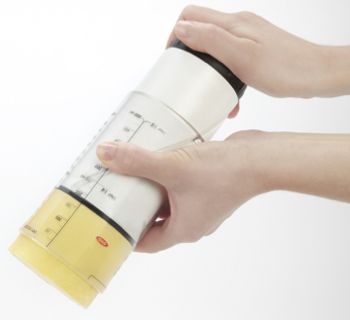
OXO has a serious presence in my kitchen, but the one- and two-cup adjustable measuring cups I added four months ago might be the last items I would sell. They are darned near perfect.
I’ve used other plunger-and-sleeve style adjustable measuring cups, and they were great for measuring odd quantities or volumes without using several different-sized cups (or one size several times), but sticky or oily stuff got in between the plunger and the sleeve, making reuse impossible without stopping to disassemble and clean the cup.
OXO has taken a page from the AeroPress coffee maker and solved this problem by using a similar gasket on the end of the plunger that seals against the sleeve and pushes the measured item out. The plunger rides in helical grooves in the sleeve, so one twists to adjust the measurement or eject the measured item. This makes additive measurements of a second item easy and allows more controlled ejection, too.
The grooves stop short of the extent that would allow you to pull the plunger from the bottom of the sleeve, ensuring that the gasket wipes the sleeve. End result: the only part you usually wash is the gasket itself.
The sleeve is marked in multiple units, with one set for liquid measure and one set for dry; the latter assumes some empty space at the top, great for coarse items, lightweight flours — and shaky hands.
These fulfill OXO’s stated mission of not just reproducing tools, but finding ways of improving the functionality by a noticeable amount.
-- Pierce Presley
[This is a Cool Tools Favorite from 2013]
OXO Good Grips 2-Cup Adjustable Measuring Cup ($12)
Available from Amazon

Sure, everyone involved can come up with a variety of excuses — they aren’t technically misleading customers, it’s all in the fine print, and these are the standard ways the industry operates — but hardware has been advertised in many misleading ways.
We’re not the only ones calling these marketing gimmicks misleading. Some of these tricks have even been the subject of class-action lawsuits for misleading consumers. Today we will look at 8 ways hardware manufacturers attempt to pull the metaphorical wool over the consumer’s eyes.


|
Jay McDanielNow everybody with a hobby and all SCUBA divers are terrorists. This is terrible advice.
Read more of this story at Slashdot.

Read more of this story at Slashdot.


If you thought current media-darling Curiosity is where all the martian action is right now, think again. Its elder sibling, Opportunity, is still rolling up there too. In fact, it's just wheeled its way into a little page of NASA history: the longest distance one of its vehicles has traveled on a body beyond Earth. A recent short (by our standards) trip of 263 feet took its total to 22.22 miles covered on Mars' surface since landing in January 2004. The previous title holder was a Lunar Rover, part of the Apollo 17 mission over 40 years ago, that covered (if you hadn't guessed) 22.21 miles. Opportunity's not beat the world galaxy record though. That honor goes to the Soviet Lunokhod rover, which totted up a total of 23 lunar-based miles back in 1973. In relative terms, Curiosity's barely stretched its legs.
Via: CNET
Source: NASA

Ubuntu tablets may not be particularly new, but thanks to its liberal build, things can get a bit more interesting when another OS is added to the mix. Ekoore's Python S3 tablet goes a little further, nestling Ubuntu, Android and Windows 8 behind its 11.6-inch screen. Specifications can be customized on the order page, but there's an Intel Celeron processor, 8GB of RAM and a 128GB SSD for storage, while the 1,366 x 768 resolution was chosen to suit all three operating systems: Windows 8, Android 4.2 and Ubuntu 13.04. There's connectivity through both WiFi and an optional 3G module -- the Win 8 license itself is also a purchasable extra. The device is priced at $770 for the US, while you'll be able to pick up a dockable keyboard add-on (with built-in battery) for around $179. For those of you who still can't decide your favorite tablet OS, you can hedge your bets and place an order at the source.
Filed under: Tablets
Via: PC World
Source: Ekoore (Italian)
Read more of this story at Slashdot.


A great question, since the mobile experience is inherently different than the desktop experience. Because the mobile platforms are more closed, we can't integrate into the mobile browsers and apps as easily. This means that LastPass can't "see" into those other browsers and apps in order to fill your data there, unless you're using Dolphin Browser or Firefox Mobile on Android, for which we do offer addons. The LastPass app does allow you to login, view your stored data, and tap an entry to launch it within the LastPass app, where LastPass can fill the data and you can login to your sites."I would like a lot more detail on how to make the LastPass Android app work with apps that require logons and passwords. I love how LastPass works on my laptop and desktop machines; using it here has been second nature to me. But I find myself logging onto my phone's LastPass app and cutting and pasting. Surely there's a better way?" - Keith K.



No matter who you are or how well connected, there’s one unifying truth about the ammo shortage of 2013—it’s no respecter of persons.
That much was obvious at the recent NRA Show in Houston, where everyone from law enforcement officials to industry personnel—all the way down to your average man on the street—noted the incredible difficulty of procuring ammunition over the last few months. As Chad, an NRA member from Austin, Texas, said, you know times are rough when .22 ammo is missing from shelves.
“You can’t find .22 ammo anywhere,” Chad said. “I found a 525-round box at Academy [Sports & Outdoors] and thought I hit the lottery. That’s the first time I’ve seen it in probably six months.”
Like Chad, many NRA members have dealt with the ammo shortage by implementing a strategy of persistence—they simply keep checking back with their local sporting good outlet, gun shop or feed store, hoping to catch the latest shipment as it hits the shelves. For the people who claimed to have at least limited success finding ammo, this was undoubtedly the most common tactic.
Others, like Houston natives Ronald and Gale, said they’ve simply cut back on range time.
“It’s kept us off the range as much as we’d like to go,” Ronald said. “I’m afraid it’s going to put some of our good ranges—some mom and pop operations—out of business. Personally, this was coming for a long time. I’ve got enough to fend off a good attack, should I say. But like most good Boy Scouts, be prepared.”
As Ronald pointed out, there’s more than one way to deal with the shortage. You can either scavenge whatever is available when it’s available, you can stay away from the range or you can do both. The anecdotal evidence from NRA members at the show seems to point in this direction—gun owners are not only scraping together whatever ammo they can find, they’re also keeping more of it boxed up at home.
“Ammo is so hard to get, most of the people I know, when you do get it you don’t go to the range,” said Scott of Lufkin, Texas. “People that go to the range on a regular basis just aren’t going because you can’t afford to shoot the ammo and then not be able to replace it.”
Supply and Demand
The obvious question many people are asking is why the shortage happened in the first place. The answers aren’t always so obvious, but it starts with the political climate and the ongoing threat of anti-gun legislation. That threat—especially when it comes from the government—fuels an increase in demand for the buyer, who grabs and stashes as much ammo as he can.
Add an Associated Press report from Feb. 15 stating the Department of Homeland Security wants to buy up 1.6 billion rounds of ammo in the next few years—plus an ongoing discussion about it by the conspiracy theorists in the blogosphere—and you’ve got a veritable run on the market. Groups like the National Shooting Sports Foundation (NSSF) and the NRA, meanwhile, have called a government attempt to stockpile ammunition a farce, attributing shortages to a simple increase in demand driven by anti-gun politics. Either way, demand skyrockets.
Manufacturers like Hornady, which gets questioned all the time about why it doesn’t just amp up production, said it’s just not that simple.
“We’ve been steadily growing our production for a long time, especially the last five years,” Hornady said on its website. “We’ve added presses, lathes, CNC equipment, people and space. Many popular items are produced 24 hours a day. Several hundred Hornady employees work overtime every week to produce as much as safely possible. If there is any question about that—please take a tour of the factory. You’ll be amazed at what you see.”
The Silver Lining
There is a silver lining in all of this, though. First, a good portion of the Assault Weapons Ban of 2013 was unceremoniously shot down on the Senate floor in the middle of April. With Feinstein’s incendiary measures out of the way, there’s at least some hope tensions will die down. With less for gun owners to fear, the expectation is for demand to settle down and production to play catch up. Many industry officials at the NRA show were at least optimistic about such a possibility, though nothing will likely change in the immediate future.
The ammo shortage has also caused a drastic increase in laser training sales, according to Aaron Moore, vice president and director of operations at LaserLyte.
“We’ve sold a whole lot more laser trainers,” Moore said. “We’ve been up about 700 percent in sales over last year.”
Adaptation may just be the key message for gun owners in America. It’s a different world than even a year ago, which means persistent shopping around and utilizing alternative methods of training are plausible options for many. It also means there’s never been a time to stand and defend your rights as an American and as a gun owner like the present. It’s a constant reminder of how quickly our precious freedoms can disappear if we don’t stand vigilant.
The government seizure of Associated Press telephone records in the course of a leak investigation undermined freedom of the press in the United States, congressional critics said yesterday.
“It seems to me the damage done to a free press is substantial,” said Rep. Zoe Lofgren at a hearing of the House Judiciary Committee.
Pursuant to subpoena, the government captured call records for 20 telephone lines of Associated Press reporters and editors over a two month period last year. The records are logs of calls made and received, but do not include their contents. It was a “massive and unprecedented intrusion” into newsgathering activities, wrote the AP’s president Gary Pruitt in a May 13 letter.
The Justice Department denied that the action deviated from established policy.
“We understand your position that these subpoenas should have been more narrowly drawn, but in fact, consistent with Department policy, the subpoenas were limited in both time and scope,” wrote Deputy Attorney General James M. Cole in a May 14 reply.
The move arose from an AP story about a disrupted bomb plot originating in Yemen that led to the revelation of a classified counterterrorism operation and the existence of a valued agent. “This is among the top two or three serious leaks that I’ve ever seen” said Attorney General Eric Holder. He did not elaborate.
Meanwhile, the upshot is that any presumption of confidentiality in the source-reporter relationship has been compromised across the board, especially but not only in national security reporting.
“Reporters who might have previously believed that a confidential source would speak to them would no longer have that level of confidence, because those confidential sources are now going to be chilled in their relationship with the press,” Rep. Lofgren said yesterday.
Last year, congressional leaders harshly criticized the Obama Administration for supposedly failing to aggressively combat leaks of classified information, including in the present case.
“The Administration’s disregard for the Constitution and rule of law not only undermines our democracy, it threatens our national security,” said Rep. Lamar Smith, at a hearing of the House Judiciary Committee last year. “The Justice Department has not taken the initiative to prosecute leaks of national security secrets. Recent leaks about a foiled bomb plot out of Yemen and a cyberattack against Iran are, in the words of Senate Intelligence Chairwoman Dianne Feinstein, quote, ‘very detrimental, very concerning, and hurt our country,’ end quote.”
The irony was not lost on Rep. Jerrold Nadler.
“I think we should put this in context, and remember that less than a year ago this committee’s Republican leadership demanded aggressive investigation of press leaks, accusing the administration itself of orchestrating those leaks,” he noted. “Then, members of this committee wanted the reporters subpoenaed, put in front of grand juries and potentially jailed for contempt. Now, of course, it is convenient to attack the attorney general for being too aggressive or the Justice Department for being too aggressive.”
“But this inconsistency on the part of my Republican colleagues should not distract us from legitimate questions worthy of congressional oversight, including whether the Espionage Act has been inappropriately used looking at leakers, whether there is a need for a greater press shield,… and Congress’ broad grants of surveillance authority and immunity,” Rep. Nadler said.
Rep. Lofgren said that the damage done to freedom of the press by the clandestine seizure of AP phone records “will continue until corrective action is taken.”
The post Subpoena of AP Phone Records Said to Damage Press Freedom appears on Secrecy News from the FAS Project on Government Secrecy.
To steal a line from Rep. Virginia Foxx, the gentlewoman from North Carolina: This is our shocked face.
Far be it for us to complain about Congress making noise about press freedom and improper surveillance, but c'mon—it's about darned time someone other than Sen. Ron Wyden and Rep. Zoe Lofgren stood up for civil liberties. It's just too bad that something like the Department of Justice's subpoenas for Associated Press phone records has to happen first before our elected leaders take notice.
But, better late than never. Shock is reverberating through the halls of Congress, particularly in yesterday's Justice Department oversight hearing in the House Judicary Committee, where Attorney General Eric Holder denied knowledge of (and culpabality in) the AP leak investigation. Some of the outcry is policital, for sure, with Republicans jumping on the opportunity to pair AP subpoena revelations with news of the IRS targeting conservative groups and new information related to the Benghazi attack. We'll stow our cynicism for now and embrace the outrage where we find it, especially if it results in the passage of the newly introduced Telephone Records Protection Act.
So how much outrage is there? We used the Sunlight Foundation's handy tool, Scout, to search Congressional speeches to measure the snowballing fury at the DOJ among members of Congress. Here are some of the highlights.
Mr. Speaker, when I went to the Soviet Union in the 1980s, the Communist leaders told me that they believed in and had a free press and they also had free speech. However, I also learned that Soviet law prohibited these freedoms when they jeopardized state secrets--or national security, as we call it in America. The state-secret provision was so broad the Soviet press and speech were gagged and shackled. They certainly were not free.
Now we learn that our Department of Justice improperly seized without notice phone records of over 100 Associated Press journalists--all in the name of national security concerns.
To me, this is a clear violation of the spirit and letter of the First Amendment. These actions border on the Soviet method of legalizing these freedoms but never allowing them. So it's time to revisit U.S. law and require in all cases judicial review where these types of records are seized.
We cannot allow our government to arbitrarily abolish the First Amendment in the name of ``state secrets.''
And that's just the way it is.
Then the revelation on Monday that the Justice Department of the United States--think about that, the chief law enforcement agency of the country--had issued this blanket search of the phone records of I think the Nation's largest reporting group, the Associated Press. I understand if they were going after a leak that endangered America and security; that is one thing. We can have a debate about that. But they went much further than that. It was a blanket request of all of these phone calls, including the switchboard. Pretty outrageous.
...For example, you think about some of our most precious freedoms--the First Amendment right to free speech. Think about if you are a reporter at the Associated Press. Think about if you are a source--unrelated to national security--to the Associated Press. Think about if you are a whistleblower, someone who is blowing the whistle on government activity because you work in the government and you think what the government is doing is wrong. Think about that for a second.
Now, all of a sudden, what are you afraid of? I am not calling that reporter back because their phone might be tapped, my number might show up on their records, because the Justice Department has just shown they are willing to do that. Think about the chilling effect that sends up and down the government.
If there is wrongdoing somewhere in the government right now, people are probably afraid to blow the whistle because they are afraid they are being surveilled by the Justice Department or that the person they are talking to is being surveilled. That is how outrageous this is.
The administration's apologists are in a panic. They claim the President is not responsible for any of this wrongdoing. The President, who made a career touting government as the solution to most every problem, now solicits our understanding. It seems the leviathan is rather unwieldy and difficult to manage.
This is my shocked face.
[W]e are learning that the Department of Justice seized phone records of Associated Press reporters, including records of their personal phone lines. Now, the ability to wiretap and probe needs to be in place in narrow circumstances, but the wide-ranging nature of what happened raises a number of questions, questions that beg us to ask: How do we protect the freedom of the press?
Mr. Speaker, it is the fashion amongst many of us to blame the press for our troubles, and that's, of course, because the press reports our troubles. At their best, the media keeps us honest, it keeps us in our constitutional lanes, and it reports our failures. It is essential for democracy. There is a reason why freedom of the press is not the Second or Fourth or 10th Amendment. It's the First Amendment.So, Mr. Speaker, I am profoundly concerned over the Department of Justice's overbroad and chilling behavior with respect to the Associated Press. Seeking records for 20 phone lines, giving the AP no notice, refusing at this point to discuss their behavior feels to me like overreach.Mr. Speaker, it's time for the Department of Justice to stand back. You can imagine that there is somebody out there today who has a failure to report who is chilled and says, I will not do that because of the approach that the Department of Justice has taken.Mr. Speaker, I am proud to serve in the very core of democracy, but this Chamber rests on foundations, and a key part of that foundation is a free and competent press.
Well, we once had a political party known as the Know-Nothings. We now have a President who wants us to believe that he knows nothing...He wants us to believe that he knows nothing about the Department of Justice subpoenaing 2 months of the Associated Press' phone records.
What has happened to the days in America when Democratic President Harry Truman proudly placed a placard on his desk that said: "The buck stops here''? Perhaps, sadly, we have returned to the days where the question to the President of the United States ought to be: What did you know and when did you know it?
Just yesterday we learned of another breach of public trust and another potential violation of our First Amendment freedom--the freedom of the press. Press reports indicate the Department of Justice secretly obtained extensive telephone records of reporters and editors for the Associated Press in what the head of the news organization called a ``massive and unprecedented intrusion'' into how news organizations gather the news. According to the Associated Press's legal counsel, the records obtained included those from reporters working out of the House of Representatives press gallery.
While it is unclear at this point how many reporters were targeted and why, the effect of this data gathering is clear: intimidation of the press and suppression of free speech.
This is unacceptable. A free and unfettered press is vital to any democracy. Moreover, the scope of this information gathering is simply beyond the pale--and likely beyond precedent.
Update: Rep. Hank Johnson asked us to include some of the remarks he prepared for the judiciary hearing.
I strongly believe that Congress must protect the free flow of information and ideas under the First Amendment. This is why I voted for the Free Flow of information Act, a federal shield law that would have required judicial oversight over media subpoenas. This vital legislation, which was blocked by Republicans in the Senate and opposed by some of the same Members of the Committee who are shocked by the AP investigation, would likely have avoided much of the alarm caused by this investigation.
Protecting the freedom of the press also requires that we strike a careful balance in preventing national security leaks where there is a very real threat to American lives. As a member of the Armed Services Committee, I am acutely aware of the threats that face our Nation and the need for confidentiality when confronting these threats.
The public outcry in response to the AP investigation also illustrates the public’s alarm with the lack of privacy protections for our everyday communications. Every day, the phone records of countless Americans are subject to criminal investigations without a warrant based on probable cause. Investigators need only a subpoena to obtain the numbers you call and receive, as well as emails and text messages that are more than 180 days old. Warrantless surveillance brings us ever-closer to the surveillance state described by George Orwell where “every sound you made was overheard,—and, except in darkness, every moment scrutinized.”
This issue demonstrates the urgent necessity to modernize laws that have been outpaced by technology and the ease of collecting massive amounts information about Americans. We need to modernize the Electronic Communications Privacy Act of 1986 by requiring a warrant for surveillance involving communications, phone records, and movements. We need to update the Espionage Act of 1917 to limit prosecutions to cases involving real harms to our national security.
An expanded edition of EFFector, EFF's almost-weekly newsletter.
I’m Danny O’Brien, EFF’s new International Director. Five years ago, I worked on the EFF team that identified the threat of ACTA, a secret global intellectual property treaty we discovered was being used to smuggle Internet control provisions into the laws of over thirty countries. Together with an amazing worldwide coalition of activists from Europe to South Korea, we beat back that threat.
I’m writing to you today to explain what's happening with the new ACTA: the Trans-Pacific Partnership (TPP). TPP has been around since the Bush administration, but recently the pace has picked up, with governments saying they want to get the agreement signed and done by the end of this year.
Global activism can stop TPP, but preventing the endless merry-go-round of new IP treaties means tackling the problem at its roots. I'd like to describe what we're doing on both those fronts, and how you can help. But first, I'd like you to meet this gentleman:
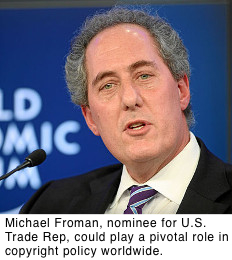
This is Michael Froman, and barring a scandal, he's about to be the new United States Trade Representative (USTR). The U.S. Trade Representative negotiates international trade agreements on behalf of the United States. Congress has one opportunity to ask him questions at his nomination hearing.
They should take full advantage of it. Right now, the only reason the public knows anything about what the USTR is doing on IP is that whistleblowers participating in the treaty process have leaked what they can. (Congressman Darrell Issa re-published the leaks on his own office site, over the USTR's objections).
Those documents show that the American proposals for the Trans-Pacific Partnership would export the worst of modern U.S. copyright law, and thwart other countries' ability to create laws that best meet their domestic needs:
Treaties like this also help to fossilize existing U.S. law and force other countries to sign up for American missteps. Momentum in D.C. for rolling back copyright terms and DRM law is growing, but opponents of those changes have argued that lawmakers can't undo their own mistakes—because, they say, we've already signed onto IP trade agreements that we supposedly can't undo.
We're asking U.S. senators to use the nomination process to grill Froman about the USTR’s IP plans, and we’re petitioning him directly to adopt meaningful transparency and stop using trade agreements to push aggressive IP programs worldwide.
Could Froman really reform U.S. trade agreement strategies? Yes, but only if he and the Administration face coordinated pressure from American politicians and citizens plus resistance from other countries pushing back against American demands.
Which brings us to why EFF's Maira Sutton and Katitza Rodriguez are remotely working right now—from Lima, the capital of Peru.

Starting today, the U.S. Trade Rep and negotiators from 10 other countries are meeting in Lima to take part in the latest round of negotiations for TPP.
We beat them there. Kat is our International Rights Director. She's also Peruvian. She's spent the last month in Lima working with fellow Peruvian technologists, makers and artists, highlighting how TPP will affect them. She has been working with the other groups fighting TPP on the ground, including Hiperderecho, Peru's own digital rights activism group.

The result? An explosion in information and public debate in Peru about TPP. Kat has written Spanish language editorials, met with Peruvian politicians, journalists, students, free software advocates and filmmakers. Lima's hackerspace, Escuelab, hosted a two-day hackathon that produced memes and microsites that explain TPP to fellow Peruvians and the world. There's even the inevitable Peruvian TPP Downfall video. Other hackerspaces took part around the world, producing sites with titles like http://whytheheckshouldicareaboutthetpp.com/.
The slogan and hashtag of Peruvians' digital rights activists is "#yaratpp", a slang term which means (roughly) "Warning! TPP!". Peruvians have joined the fight at Nonegociable.pe, asking their President to set clear non-negotiable lines to ensure that Peruvians' fundamental freedoms are respected in the TPP negotiations.
The TPP negotiators are on deadline in Lima. They've already said TPP's IP chapter is one of the "more challenging issues that remain." It's more challenging still when the host country is demanding to know why this trade agreement would undermine local entrepreneurs and artists. Meanwhile, politicians back in the U.S. are demanding a closer look at their head negotiator's IP stance.
Like battling ACTA, stopping the TPP and its descendants is going to be a long-term fight that will take a worldwide effort. But you can help us today by taking advantage of the Froman nomination to speak truth to power.
Sign our petition demanding that Froman usher in a new age of transparency as the next US Trade Representative:
If you’re in the U.S., please also send a message to your representative to demand an end to these secret backdoor negotiations:
Don’t Let Them Trade Away Our Internet Freedoms
And if you're in Peru, join Hiperderecho and tell the Peruvian president that our rights over the Internet are non-negotiable:
Pidamos juntos límites no negociables
Stay tuned to the Deeplinks blog for more updates on the fight for sensible global copyright policy.
As part of the fallout of the Boston bombings, we're probably going to get some new laws that give the FBI additional investigative powers. As with the Patriot Act after 9/11, the debate over whether these new laws are helpful will be minimal, but the effects on civil liberties could be large. Even though most people are skeptical about sacrificing personal freedoms for security, it's hard for politicians to say no to the FBI right now, and it's politically expedient to demand that something be done.
If our leaders can't say no -- and there's no reason to believe they can -- there are two concepts that need to be part of any new counterterrorism laws, and investigative laws in general: transparency and accountability.
Long ago, we realized that simply trusting people and government agencies to always do the right thing doesn't work, so we need to check up on them. In a democracy, transparency and accountability are how we do that. It's how we ensure that we get both effective and cost-effective government. It's how we prevent those we trust from abusing that trust, and protect ourselves when they do. And it's especially important when security is concerned.
First, we need to ensure that the stuff we're paying money for actually works and has a measureable impact. Law-enforcement organizations regularly invest in technologies that don't make us any safer. The TSA, for example, could devote an entire museum to expensive but ineffective systems: puffer machines, body scanners, FAST behavioral screening, and so on. Local police departments have been wasting lots of post-9/11 money on unnecessary high-tech weaponry and equipment. The occasional high-profile success aside, police surveillance cameras have been shown to be a largely ineffective police tool.
Sometimes honest mistakes led organizations to invest in these technologies. Sometimes there's self-deception and mismanagement—and far too often lobbyists are involved. Given the enormous amount of security money post-9/11, you inevitably end up with an enormous amount of waste. Transparency and accountability are how we keep all of this in check.
Second, we need to ensure that law enforcement does what we expect it to do and nothing more. Police powers are invariably abused. Mission creep is inevitable, and it results in laws designed to combat one particular type of crime being used for an ever-widening array of crimes. Transparency is the only way we have of knowing when this is going on.
For example, that's how we learned that the FBI is abusing National Security Letters. Traditionally, we use the warrant process to protect ourselves from police overreach. It's not enough for the police to want to conduct a search; they also need to convince a neutral third party -- a judge -- that the search is in the public interest and will respect the rights of those searched. That's accountability, and it's the very mechanism that NSLs were exempted from.
When laws are broken, accountability is how we punish those who abused their power. It's how, for example, we correct racial profiling by police departments. And it's a lack of accountability that permits the FBI to get away with massive data collection until exposed by a whistleblower or noticed by a judge.
Third, transparency and accountability keep both law enforcement and politicians from lying to us. The Bush Administration lied about the extent of the NSA's warrantless wiretapping program. The TSA lied about the ability of full-body scanners to save naked images of people. We've been lied to about the lethality of tasers, when and how the FBI eavesdrops on cell-phone calls, and about the existence of surveillance records. Without transparency, we would never know.
A decade ago, the FBI was heavily lobbying Congress for a law to give it new wiretapping powers: a law known as CALEA. One of its key justifications was that existing law didn't allow it to perform speedy wiretaps during kidnapping investigations. It sounded plausible -- and who wouldn't feel sympathy for kidnapping victims? -- but when civil-liberties organizations analyzed the actual data, they found that it was just a story; there were no instances of wiretapping in kidnapping investigations. Without transparency, we would never have known that the FBI was making up stories to scare Congress.
If we're going to give the government any new powers, we need to ensure that there's oversight. Sometimes this oversight is before action occurs. Warrants are a great example. Sometimes they're after action occurs: public reporting, audits by inspector generals, open hearings, notice to those affected, or some other mechanism. Too often, law enforcement tries to exempt itself from this principle by supporting laws that are specifically excused from oversight...or by establishing secret courts that just rubber-stamp government wiretapping requests.
Furthermore, we need to ensure that mechanisms for accountability have teeth and are used.
As we respond to the threat of terrorism, we must remember that there are other threats as well. A society without transparency and accountability is the very definition of a police state. And while a police state might have a low crime rate -- especially if you don't define police corruption and other abuses of power as crime -- and an even lower terrorism rate, it's not a society that most of us would willingly choose to live in.
We already give law enforcement enormous power to intrude into our lives. We do this because we know they need this power to catch criminals, and we're all safer thereby. But because we recognize that a powerful police force is itself a danger to society, we must temper this power with transparency and accountability.
This essay previously appeared on TheAtlantic.com.

After limbering up with taxi tests since December, the X-47B unmanned combat air system has finally taken off from an aircraft carrier, making it the first pilotless plane to have successfully done so, and with a catapult launch to boot. Despite the craft's ability to fly on its own, it was controlled by a human aboard the George H.W. Bush after it was flung from the ship. Once in the air, the Northrop Grumman-built craft was guided back for a landing on a runway planted on terra firm. Now that the bird's proved it can handle launches at sea, other excursions will put the automatic navigation and landing features through their paces. Hit the break for a video of the X-47B taking to the skies.
Filed under: Misc, Transportation
Source: IEEE Spectrum, US Navy (YouTube)
Read more of this story at Slashdot.

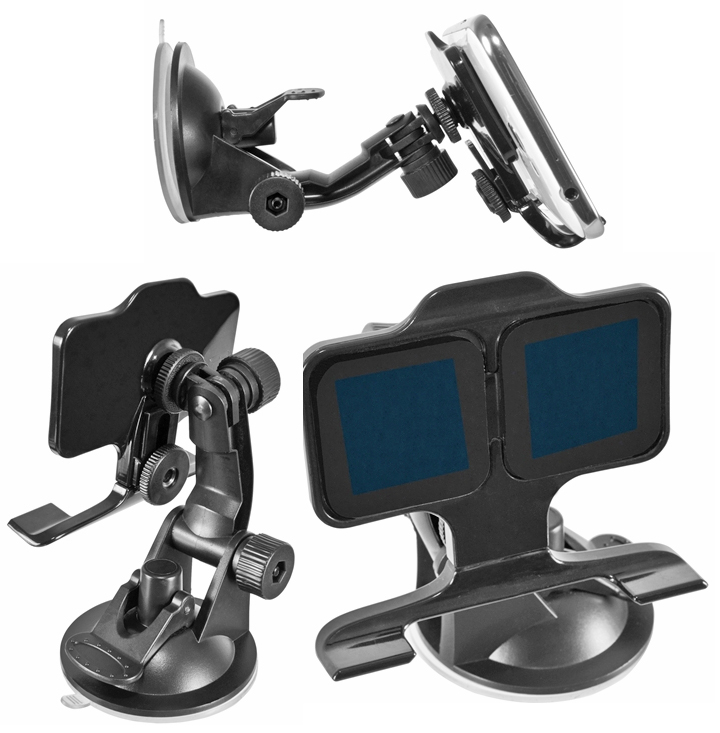
Well, you’ll at least be able to stop replacing your in-car device mounts if you purchase the Innotraveler Universal Car Mount from Seidio. This mount has a baseplate and two re-useable adhesive pads to hold your phone, GPS, MP3 player, or other small device (up to a 5.5″ screen) securely in the mount. You anchor the Innotraveler to your car’s windshield or dash with the locking suction cup base on the adjustable stand. It’s $29.95 at Seidio and is available for shipping now.
Tagged as: In-car mounting system for smartphone, universal phone stand
Read more of this story at Slashdot.


Google's inched ever closer to the dream of Star Trek-style computing with its new Conversational Search, unveiled today at Google I/O. You start a search by saying "Okay, Google...," speak your query, whether it's "when does my flight leave" or trivia like "what's the population of my town." Google responds, both by voice and with text results.
Conversational Search uses the data that Google has about you and your activities to power search results with information that's actually relevant to your interests. You can say "show me my vacation pictures," and Google will bring up photos you've uploaded. At the same time, you can say "Show me things to do around Washington DC," and Google will not just respond to you in-voice, but also present search results littered with popular destinations, arranged on a Google Map and with relevant links below.
The new search features will roll out slowly (and are available to members of Google's Search Field Trial now), but will be available as part of Google Chrome on all platforms soon.
A Multi-Screen and Conversational Search Experience | Inside Search: The Official Google Search Blog
Read more of this story at Slashdot.


As with most news organizations, a lot of the posts we publish start out as emailed tips from you, our dear readers. But some employees put their jobs on the line when they share info, which, as you might imagine, makes them reluctant to hit send. The New Yorker seems to have a solution that'll offer a much higher degree of anonymity, stripping IP addresses and other identifying data whenever you upload a file or submit a tip. You create an alias, and all correspondence takes place within a secure environment, called Strongbox. Best yet, the code for this tool, called DeadDrop, is completely open-source, so you can download the necessary software and implement it on your own site, free of charge. More info on both are available at the source links below.
Filed under: Internet
Jay McDanielI want one!!
Read more of this story at Slashdot.

Last week’s big decision in CLS Bank v. Alice saw a divided Federal Circuit tackle the patentability of software. Five judges voted to strike down patent claims to a “computer system” programmed to implement a financial transaction. But five judges would have upheld the claims. With the case seemingly headed to the Supreme Court, what’s at stake?
The key question in CLS Bank was whether an abstract idea (such as using an escrow agent as part of a financial transaction) can be patented if, instead of claiming the idea itself, the applicant claims a computer system that implements the idea. (Of course, the law precludes patent protection for laws of nature, natural phenomena, and abstract ideas.) In a thoughtful opinion by Judge Lourie, five members of the Federal Circuit held that merely “appending generic computer functionality” to an otherwise abstract concept is not enough to make it non-abstract, or somehow patentable.
The other members of the court reacted to this suggestion with alarm. Warning of a “free fall of the patent system,” Judge Moore wrote:
Let’s be clear: if all of these claims, including the system claims, are not patent-eligible, this case is the death of hundreds of thousands of patents, including all business method, financial system, and software patents as well as many computer implemented and telecommunications patents.
Perhaps more significantly, Judge Moore claimed that this “would decimate the electronics and software industries.” These are dramatic claims. But will the sky fall if we get rid of abstract software patents?
It is important to realize that software patents and the software industry are not the same thing. As Judge Moore’s own scholarship shows, patent issuance is “a poor measure of innovation value.” And there are straightforward economic reasons why patents and software are a bad fit. Far from being an incentive, software patents tend to operate as a barrier to entry and a tax on innovation. As Bill Gates wrote back in 1991: “If people had understood how patents would be granted when most of today’s ideas were invented, and had taken out patents, the industry would be at a complete standstill today.”
Recent events in New Zealand confirm that the software industry does not need patents. With the strong backing of its IT community, the NZ government is clarifying its law to ensure that software is not patentable. It will add the following language to its patent act:
(1) A computer program is not an invention and not a manner of manufacture for the purposes of this Act.(2) Subsection (1) prevents anything from being an invention or a manner of manufacture for the purposes of this Act only to the extent that a claim in a patent or an application relates to a computer program as such.(3) A claim in a patent or an application relates to a computer program as such if the actual contribution made by the alleged invention lies solely in it being a computer program.
The head of NZ’s largest software company welcomed the move, explaining that “software patents are counter-productive, often used obstructively and get in the way of innovation."
Almost 20 years ago, in a case called In Re Alappat, the Federal Circuit held that an algorithm implemented in a general-purpose computer is patentable. That case opened the floodgates to software patents, which, in turn, have led to the rise of the patent troll. Software patents by their nature are vague and often broad, giving trolls a powerful tool to use to threaten lawsuits and demand licensing fees. More often than not, these trolls neither make nor sell anything, but are quite successful at shaking down creators and creating a chilling effect on innovation. There’s great momentum lately to fix the troll problem, but, to be sure, the root of that problem is software patents themselves.
Ultimately, we hope the United States Supreme Court will decide that Section 101 of the Patent Act does not allow for abstract ideas to become patentable simply by implementing these ideas in a general purpose computer or on the Internet. There is no reason to fear that such a ruling would decimate the software industry. To the contrary, it would more likely remove a barrier to innovation.
Read more of this story at Slashdot.


