Google has a long history of introducing, then forgetting about, and finally officially killing off its products. Most recently, that included Google Spaces, a service that most of us never knew existed to begin with. Let’s take a tour of some of our favorite services Google’s killed off over the years.
10. Google Buzz
Google Buzz was introduced in 2010 and quickly discontinued in 2011. Buzz was basically a Facebook clone that also integrated with your email for some reason. You could share photos, videos, and links directly to your contacts or the public at large.
Buzz died a quick death because it was unclear exactly what you were supposed to use it for, but it planted the seed for a number of improvements with its rival, Facebook. Google+ followed suit as Google’s own replacement to Buzz a few years later, but even that’s barely hanging on at this point.
9. Picnik
Picnik was a free online photo editing tool that made it easy to make minor adjustments to photos without the need for desktop software. After uploading photos you could easily adjust brightness, color, and more, then save the edited image back to your hard drive.
Speaking of photo management, Picasa, Google’s desktop photo library tool, was one of our favorite ways to organize your digital photos until Google decided to kill it off in 2016. The good news is that most of Picasa’s features made it into Google Photos.
While Google Photos lacks the desktop management tools that Picasa had, the online version is plenty robust as a replacement. Which is good, because except for Apple Photos, there really aren’t many desktop photo management apps left.
7. Google Answers
Google killed Google Answers way back in 2006. Unlike current competitors like Stack Exchange, Quora, and the always-insightful Yahoo Answers, Google Answers incentivized good answers by offering up cash payments.
When a user asked a question on Google Answers they could also post a bounty between $2-$200. If you liked a well-researched answer, you’d pay out and could add a tip on top of that. Before Google Answers, Google had a similar service, called Google Questions and Answers, where you’d email Google staffer a question and they’d answer it for $3. While Quora is the best replacement, there’s no money involved there, but services like Fiverr and Amazon Mechanical Turk take a similar approach if you’re looking for someone to do your research for you.
6. Google Wave
Google Wave existed between 2010 and 2012 and was one of the company’s most ambitious failures. Wave was too ambitious though, as nobody was quite sure how to use the email-instant messenger-document collaborating-wiki-forum-blogging tool. Once Google laid Wave to rest, Apache took over some of the protocols, but little came of it.
As baffling as Wave was for most users, it laid the groundwork for a number of now-popular services, including Slack and Discord, which are the closest modern equivalents when it comes to Wave’s chat systems. If you miss the document collaboration features in Wave, you have plenty of alternatives in Google Drive, Dropbox, or Office.
The general idea of Helpouts was connecting you, a normal human Google user, with an expert so you can ask questions live. Some of these Helpouts channels cost money, but most were free, which is why it failed in the long run. Still, it was useful in theory and the ability to ask experts questions on everything from home repair to Photoshop was appealing.
There aren’t a ton of alternatives that work the same way as Helpouts, but Clarity.fm is similar if you need help with a startup and our own Ask an Expert series is great provided the topic of the week is useful for you.
4. Google Notebook
Google discontinued Google Notebook in 2012, but it lived a long and full life by Google standards. As the name suggests, Google Notebook was an online notes platform where you could store notes and even add web clippings provided you were using Firefox or Internet Explorer. If that all sounds familiar it’s because it’s basically Evernote.
The good news is that replacements are a dime a dozen. Google Notebook might have been one of the first online notes apps, but nowadays Evernote, OneNote, Simplenote, and Google Keep all fill the void. While all of the modern options have far surpassed Google Notebook, it still holds a special place in our hearts for being one of the first good options around.
3. Google Labs
Writing about weird Google Labs experimental features was Lifehacker’s bread and butter for a very long time. Google Labs made it possible for the general public to test all kinds of weird new Google features and apps in a variety of its services, from Google Calendar to Google Chrome.
iGoogle, which initially launched as Google Personalized Homepage, had a good run from 2005-2013, and the internet mourned its death with surprising despair. iGoogle was a totally personalized startup page that you could customize with whatever you wanted, which, in the age of algorithms, is a long lost feature.
You do still have some options though. For now, myYahoo still exists, igHome looks almost identical to iGoogle, and Netvibes is the most modern option of them all.
1. Google Reader
On July 1, 2013, the internet lost one of its most faithful companions: Google Reader. The RSS Reader that millions counted on since 2005 was gone and in its place was a radio wave shaped hole in all our hearts.
Well, that and a few dozen replacement services. Feedly is still going strong and easily the best alternative to Reader, though plenty of other alternative like Feeder, The Old Reader, and Digg Reader are all worth a look.
Early morning Saturday President Donald Trump made several tweets that accused his predecessor of conducting a “Nixon/Watergate” wiretapping scheme on Trump Tower during the election. Trump is staying the weekend at his private Mar-a-Lago resort in Palm Beach, Florida, and he offered no evidence of his wiretapping claims, which he called “McCarthyism!”
It’s not exactly clear what Trump is referencing—or whether the information was based on intelligence briefings from law enforcement, or just gleaned from media reports. It has been widely detailed that there’s an ongoing investigation that began in 2016 into possible links between Trump’s close associates and top Russian officials, including a report issued by American intelligence agencies in January that concluded the Russian government sought to influence the election on Trump’s behalf.
Obama’s spokesman, Kevin Lewis, issued a short response to Trump’s allegations, saying "A cardinal rule of the Obama administration was that no White House official ever interfered with any independent investigation led by the Department of Justice. As part of that practice, neither President Obama nor any White House official ever ordered surveillance on any U.S. citizen. Any suggestion otherwise is simply false."
It has been widely reported that the FBI sought approval last summer to monitor members of the Trump team suspected of having irregular talks with the Russians. Ali Soufan, chair of the Soufan Group security firm and a former FBI agent, noted that such requests must be sanctioned by federal judges.
“The president cannot order criminal wiretaps or any other kind of wiretaps,” said Soufan. “No president can."
The process for obtaining a federal wiretap, either for domestic crimes or for foreign intelligence purposes, involves the approval and supervision of a federal judge. Those requests are made by investigators themselves, and the president is ultimately briefed on them only if Justice Department officials believe it is necessary.
“They deliberately withhold that because they don't want the president to get involved in an ongoing investigation," said Clint Watts, a fellow at the Foreign Policy Research Institute and a former FBI special agent. "They play by a really strict rulebook at DoJ."
Bruce Green, a law professor at Fordham and a former federal prosecutor said a president ordering a wiretap would be unusual, to say the least.
“It would obviously be improper for the government to seek wiretap authorization for partisan political purposes, rather than legitimate criminal investigative or national security purposes as set out in the application to the court,” said Green. “In prior administrations, if a President directed the Attorney General or another government lawyer to seek wiretap authorization for illegitimate reasons, the lawyer would have been expected to try to dissuade the President and, if the President persisted in giving this order, to refuse and/or resign.”
A judge would also likely refuse such a request. “An ethical government lawyer would be expected to disclose the President's involvement to the court, which could then be expected to deny authorization,” Green said.
If, hypothetically, a judge did approve a warrant for electronic surveillance of Trump officials, that would mean the judge was persuaded there was probable cause to believe they were going to commit a crime or were communicating with agents of a foreign power––and that the gravity of the circumstances justified approving the request, even in the face of the massive potential political fallout.
Terrible! Just found out that Obama had my "wires tapped" in Trump Tower just before the victory. Nothing found. This is McCarthyism!
Reports have also suggested that former National Security Adviser Mike Flynn’s conversations with the Russian Ambassador Sergey Kislyak were picked up during surveillance of Kislyak. The FBI sometimes eavesdrops on foreign leaders while in the U.S., and it is possible that agents overheard Flynn’s conversation while monitoring Kislyak’s phone line. Flynn ultimately resigned, after it was reported that he misled administration officials about the content of his conversations with Kislyak.
Another possible impetus for the president’s tweets could have come from comments made Thursday by conservative radio host Mark Levin. On his show, Levin said Obama had tried to undermine the Trump campaign by eavesdropping, calling the former president’s administration a “police state.” Levin then demanded a Congressional investigation, and his comments were picked up by Breitbart, the website formerly run by Steve Bannon, Trump’s chief strategist*.
According toThe Washington Post, the Breitbart story was being circulated among Trump’s senior staff before the weekend. Trump’s mood before he left to his resort Friday, The New York Times reported, seemed to “be explosive”, and the president reportedly railed about leaks in his staff and among federal intelligence agents.
But Trump’s ire did not end with Obama Saturday morning.
Trump capped off his tweetstorm with a comment on his reality TV show replacement, Arnold Schwarzenegger.
Arnold Schwarzenegger isn't voluntarily leaving the Apprentice, he was fired by his bad (pathetic) ratings, not by me. Sad end to great show
*This article originally stated that Trump White House adviser Stephen Bannon founded Breitbart News; he was formerly its executive chairman. We regret the error.
More than one save-it-for-later service is finding a new owner these days -- Mozilla has acquired Read It Later, the developer behind Pocket. The service will be treated as a product separate from (but of course, complementary to) Firefox, and will fold into Mozilla's open source project. It's also poised to give a boost to Mozilla's Context Graph strategy, which uses related knowledge to help you find what you're really looking for on the web.
The reasons behind the move are both ideological and pragmatic. If you ask Mozilla chief Chris Beard, it's a way of "fighting against the rising tide" of walled gardens online. This helps you share web material regardless of the platform you're on, he says. However, it's also a simple matter of growing Mozilla's mobile footprint. Firefox is one of the bigger browsers in the smartphone world, but it's still small relative to Chrome or Safari. Pocket puts Mozilla's brand in front of more people, and might just give them an incentive to try Firefox when they'd otherwise have given it a pass.
“They consider him a stupid, unstrategic politician.”
Mikhail Fishman is the editor-in-chief of the Moscow Times, an English-language weekly newspaper published in Moscow. The paper is critical of Vladimir Putin; indeed, it was targeted twice in 2015 by Russian hackers and has been attacked repeatedly by pro-Kremlin pundits.
A Russian citizen and an outspoken critic of Putin, Fishman has covered Russian politics for more than 15 years. For the past year, he has monitored the increasingly bizarre relationship between Putin and Trump, with a particular focus on Putin’s strategic aims.
In this interview, originally conducted in February, I ask Fishman how Trump is perceived in Russia, why Putin is actively undermining global democracy, and what Russia hopes to gain from the political disorder in America.
Sean Illing
From your perch in Moscow, how do you see this strange relationship between Putin and Trump?
Mikhail Fishman
It is strange. It looks a bit irrational on Trump's part to be sure. Why does he have this strange passion for Putin and Russia? I have to say, I don't believe in the conspiracy theories about "golden showers" and blackmailing. I don't believe it exists and I don't believe it's a factor. But this, admittedly, makes the whole thing that much stranger.
Sean Illing
You’re obviously referencing the explosive Trump dossier published by Buzzfeed in January. What makes you so skeptical of the claims in that dossier?
Mikhail Fishman
Two things. One, I've been a political journalist for 15 years working and dealing with sources in Russia and elsewhere. And frankly, a lot of this appears shallow to me. I'm sure Russia has plenty of dirt on Trump, but I can't accept without hard evidence much of the what I've heard or read.
Second, this still has the ring of a conspiracy theory, this idea that the Kremlin has blackmailed Trump into submission. I'm generally opposed, on principle, to conspiracy theorizing. So I'm just skeptical until there's concrete evidence.
Sean Illing
Let’s talk about Trump and Putin as individuals. How are they different? How are they similar?
Mikhail Fishman
I would prefer to talk about how they're different, because those differences are so obvious and extreme. They come from very different worlds. Putin is an ex-Soviet intelligence officer with all that that implies. Trump is a colorful American businessman and showman.
In their habits, they're radically different. Trump is a posturing performer, full of idiotic narcissism. He appears to be a disorganized fool, to be honest. Putin, on the other hand, is calculating, organized, and he plans everything. He also hides much of his personal life in a way that Trump does not.
Then there's also the fact that Putin is so much more experienced than Trump. He has more than 15 years of global political experience. He knows how to do things, how to work the system. He makes plenty of mistakes, but he knows how to think and act. Trump is a total neophyte. He has no experience and doesn't understand how global politics operates. He displays his ignorance every single day.
Photo by Adam Berry/Getty Images
Russian President Vladimir Putin attends a meeting to discuss the Ukrainian peace process at the German federal Chancellery on October 19, 2016, in Berlin, Germany.
Sean Illing
What is the perception of Trump in Russia? Is he seen as an ally, a foe, a stooge?
Mikhail Fishman
The vision of Trump is basically shaped by the Kremlin and their propaganda machine — that's what they do. During the election campaign, Trump was depicted not as an underdog but as an honest representative of the American people who was being mistreated by the establishment elites and other evil forces in Washington.
Sean Illing
The Kremlin knew that to be bullshit, right? This was pure propaganda, not sincere reporting, and it was aimed at damaging Hillary Clinton.
Mikhail Fishman
Of course. All of it was aimed at damaging Hillary Clinton. Putin expected Trump to lose, but the prospect of a Clinton victory terrified him, and he did everything possible to undermine her.
Sean Illing
Why was he so afraid of a Clinton victory?
Mikhail Fishman
Because he knew that would mean an extension of Obama's harsh orientation to Russia, perhaps even more aggressive than Obama. Putin has experienced some difficult years since his 2014 invasion of Crimea, but he didn't expect this level of isolation. He saw — and sees — Trump as an opportunity to change the dynamic.
Sean Illing
A lot of commentators here believe the most generous interpretation of Trump’s fawning orientation to Putin and Russia is that he’s hopelessly naïve. Do you buy that?
Mikhail Fishman
That's a good question. Why does he like Putin so much? I think Trump sees Putin as a kind of soulmate. Let's be honest: Trump is not a reflective person. He's quite simple in his thinking, and he's sort of attracted to Putin's brutal forcefulness. If anything, this is what Trump and Putin have in common.
Sean Illing
Has Putin made a puppet of Trump?
Mikhail Fishman
Of course. This is certainly what the Kremlin believes, and they’re acting accordingly. They're quite obviously playing Trump. They consider him a stupid, unstrategic politician. Putin is confident that he can manipulate Trump to his advantage, and he should be.
Sean Illing
In other words, Trump’s a useful idiot to them?
Mikhail Fishman
Exactly. The Kremlin is limited in their knowledge about what's going on in Washington, but they see the chaos and the confusion in Trump's administration. They see the clumsiness, the inexperience. Naturally, they're working to exploit that.
Photo by Kevin Dietsch - Pool/Getty Images
President Donald Trump tours the Smithsonian National Museum of African American History & Culture on February 21, 2017, in Washington, DC.
Sean Illing
What’s the long geopolitical play for Putin? What does he hope to gain from the disorder in America?
Mikhail Fishman
The first thing he wants and needs is the symbolic legitimization of himself and Russia as a major superpower and world player that America has to do deal with as an equal. He wants to escape the isolation of Russia on the world stage, which was what the campaign in Syria was all about. Putin has grand ambitions for himself and for Russia, and nearly every move he makes is animated by this.
Sean Illing
How much of this, from Putin’s perspective, is about discrediting democracy as such?
Mikhail Fishman
He didn't believe Trump would win, so he was preparing to sell Clinton's victory as a fraud. And this is part of his broader message across the board, which is that democracy itself is flawed, broken, unjust. Putin actually believes this. He doesn't believe in democracy, and this is the worldview that he basically shares with Trump: that the establishment is corrupt and that the liberal world order is unjust.
Sean Illing
But Putin’s interest in undermining democracies across the globe is about much more than his personal disdain for this form of government. He wants to point to the chaos in these countries and say to his domestic audience, “You see, democracy is a sham, and it doesn’t work anywhere.” That serves as a justification for his own anti-democratic policies. In the end, it’s about reinforcing his own power.
Mikhail Fishman
That's true. But again, this what Putin really believes. He does not believe a true and just democracy exists anywhere. This is the worldview they've been spinning for years and they've really internalized it.
For Putin, this is very much a zero-sum game. The West is the enemy. America is the enemy. Whatever you can do to damage the enemy, you do it. The more unrest there is in America, the better positioned Russia is to work its will on the world stage. He wants to divide democratic and European nations in order to then play those divisions to his advantage.
Sean Illing
A pervasive concern in this country is that Trump admires Putin’s strongman authoritarianism, and seeks to replicate it in America. Do you think this concern is well-founded?
Mikhail Fishman
I think it is. Again, it comes to back what Trump and Putin have in common. They're both male chauvinists. Trump probably admires the fact that Putin is the kind of guy who feels the need to ride horses shirtless; it appeals to his authoritarian instincts. But this is about much more than imagery.
They are both illiterate people in a way. They're not widely educated. They do not believe in institutions. They see democratic institutions as burdens, impediments to their will. They don't believe that social and political life should be sophisticated; they think it should be simple.
And this sort of thinking naturally concludes in one-man rule. I think Trump will fail, but there’s no doubt that he shares these authoritarian impulses with Putin.
Why this founder asks candidates for work samples, a live demo, and a paid trial period before making an offer.
Why this founder asks candidates for work samples, a live demo, and a paid trial period before making an offer.
It's getting more common to hear of startups composed of team members who've never actually met—in fact, I'm founding one right now. If the future of work is remote, getting there will mean figuring out how to hire people you may never be in the same room with, from countries you've never been to.
Last month, David Gelernter, the pioneering Yale University computer scientist, met with Donald Trump to discuss the possibility of joining the White House staff. An article about the meeting in TheWashington Post was headlined, “David Gelernter, fiercely anti-intellectual computer scientist, is being eyed for Trump’s science adviser.”
It is hard to imagine a more misleading treatment.
By one common definition, anti-intellectualism is “hostility towards and mistrust of intellect, intellectuals, and intellectual pursuits, usually expressed as the derision of education, philosophy, literature, art, and science, as impractical and contemptible.”
Here is the exchange that I had with Gelernter when I reached out to ask if he would be interested in discussing the substance of his views on science, politics and culture.
Conor Friedersdorf: The Founding era had as significant a scientist and inventor as Benjamin Franklin playing major parts in the revolution and experiment in self-government.
What might a science advisor offer elected officials today?
Yuriko Nakao / Reuters
David Gelernter: I think the lesson of Franklin is not that a science advisor can tell you all sorts of things about government and diplomacy and human nature, but that thoughtful people are almost never defined by a pre-existing intellectual shoe-box. The best scientists aren't the dedicated drudges who have no other interests. The best take after Newton, Einstein and tens of thousands of lesser lights in their devotion to science andother things too. As a scientist handing out advice on the study of science, something I do as a college teacher, one of my main messages is that you can't be an educated human being on the basis of science alone; another main message is that, sometimes, you can't even be a scientist or technologist on the basis of science alone.
If I were loosely gathering topics of study into categories, I might call them arts, religion, scholarship, and science. As important as scholarship and science are, arts and religion are more important. Those were my main goals (my wife’s, too) in educating our two boys, who are now both in their 20s. Arts and religion define, in a sense, a single spectrum rather than two topics. And this spectrum is where you find mankind's deepest attempts to figure out what's going on in the universe. A student who doesn't know the slow movement of Schubert's B-flat major op post sonata, or the story of David and Absalom, needs to go back to school and learn better.
The best scientists are often the ones who are plainest about their non-scientific interests. Feynman's intro physics books are the best of all physics intros in part because he talks freely about beauty: Here's a beautiful theorem. Here's a beautiful fact. My own small contributions to software were guided at every step by my search for beautiful design. More important, as I argue in my recent book on the spectrum of consciousness: who knows most about the human mind? Today it's John Coetzee, Philip Roth, Cynthia Ozick. That’s why the book turns to novelists and poets at least as often as to neurobiologists and psychologists. I've had far more sustained, intense reaction to my one novel (1939) than to anything else I've published.
The short stories I've published over the years in Commentary have been read by maybe six people each; but the reaction from readers of those stories, in seriousness, intelligence, and depth, swamps the reaction to any science, tech, or political piece I've published.
Friedersdorf: One of the few newspaper columns that has stuck with me for years is Charles Krauthammer's meditation on Fermi's Paradox and what he calls “the high probability that advanced civilizations destroy themselves.” This is a fear Baby Boomers associate with nuclear weapons. How do those products of the World War II era compare to other advances in technology that stoke existential worries? I am thinking of the people who worry about AI risk, or warn that we're on the cusp of greatly expanding the number of people who can engineer a low-cost bio-weapon, or perhaps something entirely beyond my knowledge. The pessimist in me worries that advances in science and technology are always outpacing our ability or inclination to guard against their destructive potential. Is there something beyond nuclear-weapons policy that presidents should be doing to lessen the chance of humanity destroying itself?
Gelernter: Charles Krauthammer runs to pessimism, and I think he has this wrong—in fact backwards. The striking thing is that Stalin had the bomb and Mao had the bomb and neither ever used it. If both of those mass-murdering thug-tyrants were able to restrain themselves, it's not too surprising that their successors did too. You worry that "advances in science and technology are always outpacing our ability or inclination to guard againstthem,” but it seems to me that this is exactly what hasn't happened.
The U.S. and our allies have escaped nuclear, chemical, and bio attacks not because of the humane ideals of our enemies, but because we devote huge energy and effort to defense, and to our own mass-destruction weapons. Of course terrorists would love to murder huge numbers of westerners, and chemical weapons and perhaps some kinds of bio-weapons are easier to acquire and handle than nuclear weapons; and terrorists don't have hostage states and populations like a Stalin or Mao. But we have to assume that the terrorists have been trying this sort of attack since at least October 2001.
What's amazing isn't that they nearly always fail but that occasionally, on a small but tragic scale, they succeed. If you think about it, they have men willing to die for the cause but so do we—every American infantryman, every front-line soldier of the U.S. and our allies has put his life on the line; and our police, FBI and their allies do it routinely, too. We don't call them suicide fighters, we call them brave, patriotic, big-hearted Americans—or British, French, Israelis—but that doesn't change the facts.
And our soldiers are about 1,000 years further along in technology, much better-trained and equipped, and fighting for their homes and families, and freedom, which are better causes than medieval tyranny, the annihilation of Jews and Christians, and the enslavement of women—not the most inspiring ideas to fight and die for.
I find it amazing that there's so little discussion and analysis of where Mideast terrorism came from. When I was a child, Israel faced mortal danger every day, but Israel-hating terrorists didn't care much about the West in general. What happened? We know exactly what. Jimmy Carter let the Shah fall and let Khomeini replace him. It was one of the stupidest moves in modern history; it's caused unspeakable suffering in Iran and throughout the Middle East. What have we learned?
To lessen the chances of mankind destroying itself, I'd say we ought to do what we did in the Cold War: stand up for the things we believe and try to encourage them everywhere on earth, without fighting wars ourselves. (Anyway, that was our goal.) Our cowardly refusal to arm the Ukraine, the reluctance we showed in helping the Kurds, are exactly what we shouldn't be doing to maintain peace. To have peace, we ought to make sure that basically evil men are scared of basically good ones. That's been U.S. policy since 1945, basically, for all presidents; I say, keep on down this road, helping make the world a little safer and freer every time in every way we can.
Friedersdorf: If our domestic policy were informed by a similar lodestar—to stand up for what is basically good, to oppose what is basically evil, and to have the wisdom to know the difference (and when neither good nor evil are implicated), how should we approach the most controversial intersections of science and policy?
I am thinking of questions like how much today's humans owe to future generations; if or when it is permissible to do research on stem cells from human embryos or to edit the human genome; what restrictions, if any, there ought to be on abortion or euthanasia; whether factory farms, or zoos, are wrong, etc. I don't mean to imply that these matters are all alike, or the most pertinent, but how you might guide policymakers who approach you in the course of trying to figure out what's best.
Gelernter: Frankly, I think that guiding citizens (insofar as I'm able to guide anyone) is far more important than advising policymakers. I've published a series of pieces over the years on this sort of question in the Frankfurter Allgemeine Zeitung (they translate them), which have led in turn to contributions to German anthologies on these topics, occasional lectures in Germany, etc. I've never found a place to publish such things in English, not for a handful of academics but for the educated public.
That being said, I'm not quite sure I understand the question.
Does it ask how I'd make a decision, or what decisions I've actually made? I make my own decisions from inside the modern-orthodox Jewish world; I try to read relevant Talmudic and halakhic and responsa literature. The rabbis, my rabbis, are my moral guides. But it's often the case that they haven't dealt quite with the right question, or I disagree (Jewish theology is a literature of constant disagreement; nor of course do I present my views as any sort of rabbinic position—considered becoming a rabbi long & hard, but didn't). In any case, I then turn on my brain and do my best to figure out the question. I'm too old to foist off the final responsibility on anyone but myself. So that's how I make these decisions. (There are philosophers who influence me, but as authors more than arbiters. Nietzsche and Wittgenstein have always enchanted me, more for the way they embrace art than for their doctrines. Wittgenstein would sit in the nave of Ely, not far from Cambridge, and admire it. Something I love to do, though he had a lot more opportunity.)
As to my answers, I've written & argued in Germany that (for example) computers & social nets ought to be treated like bars or strip joints: not acceptable for children. (At least we ought to consider treating them that way.) I don't like the idea of legal restrictions. But I might urge that we get computers out of schools until our children are able to read & write half decently—at least as decently as they used to during the middle two-thirds of the 20th Century.These are local decisions. But a science advisor's most important role is facing the public, not the president. A science advisor has to convince Americans that they're out of their minds to turn their backs on science. It is foolish, dangerous, and a waste of a beautiful opportunity.
AI presents tremendously serious moral problems which we leave to Kurzweil and friends. But in practical terms, there's no way on earth I could get a piece from a very different viewpoint before a mass audience.
The ideological narrowness of mainstream commercial magazines is one of the deep, deep frustrations of my life. We have a thriving conservative intelligentsia in this country; it includes many (in fact most) of the smartest people I've ever met. (Think about Norman Podhoretz, George Will, Bill Bennett, Donald Kagan—radically different sorts of thinker, all four strikingly brilliant. There are a few dozen more even at this exalted level.) It's a pleasure and a high honor to be part of America's conservative culture. But the Left hears nothing we say: nothing. Nothing. Most have shrugged this off; only a few of us care. Because I teach at Yale and, more important, because I belong to the art world & have since birth, I can't help caring—and sometimes being outraged, sometimes just grief-stricken. What a damned mess we've made of intellectual life in this absurdly wealthy, lucky, blessed nation.
Friedersdorf : What's something you've wanted to get before a mainstream American audience? I'm especially eager to discuss anything that lends insight into your original thinking. Let's talk about whatever it is that you want to talk about.
Gelernter: This was the most fascinating invitation by far I've ever got (“an opportunity to put any viewpoint you'd like...”)—yes, more than the White House Chanukah parties! More than my chance to ride in my second cousin's Corvette Stingray when I was 10! I don't want to bury you—I want something clearly expressed and organized, and concise.
[5 days elapsed, before I heard from Gelernter again.]
Gelernter: I've attached 20 ideas.
I'm sorry to list so many; but the chance you've given me is unique… I've profited enormously, and I appreciate it... Every assertion is merely my own opinion. Lots of people will disagree, but it's boring to read "in my opinion... in my opinion..." I've only tried to sketch out what I'm pondering & working on right now, as briefly as I can.
Even at that, I've gone far too long.
1.
Letting toxic partisanship heal. Everyone knows that we live in politically superheated times; partisanship feels more bitter and more personal than it ever has in my lifetime.
There are many reasons, but here is one: we all know that faith in the Judeo-Christian religions is dramatically weaker than it used to be. But human beings are religious animals, and most will find an alternative if the conventional choices are gone.
The readiest replacement nowadays for lost traditional religion is political ideology. But a citizen with faith in a political position, instead of rational belief, is a potential disaster for democracy. A religious believer can rarely be argued out of his faith in any ordinary conversational give-and-take. His personality is more likely to be wrapped up with his religion than with any mere political program. When a person’s religion is attacked, he’s more likely to take it personally and dislike (or even hate) the attacker than he is in the case of mere political attacks or arguments. Thus, the collapse of traditional religion within important parts of the population is one cause of our increasingly poisoned politics. Yet it doesn’t have to be this way.
Turn back to the generation after the Second World War. The collapse of religion is well underway, but there is another alternate religion at hand: art.
Think of the extraordinary blaze-up of art in America in the postwar years, especially the 1950s and first half of the ‘60s: painting above all; choreography in New York (Balanchine, Robbins, the American Ballet Theater, the Joffrey and other regional companies); serious music, led by Bernstein’s Young Peoples Concerts broadcast nationwide by CBS; intense interest in new American novelists; Frost; the Americanized Auden, Eliot and Delmore Schwartz; the great quartet of European masters as seen from the US: Picasso and Matisse, Giacometti and Chagall; the European film as an art form (Swedish, Italian and French––Hitchcock’s Birds, for that matter, opened in the early ‘60s at MOMA); in the architecture of the Americans Wright and Kahn and Eero Saarinen, and the Europeans Mies and Corbu and Gropius; in the design of the Eames studio, in the museum show as an event, in drama and the Actor’s Studio; art-books, magazines, posters, high-fidelity audio, Lincoln Center, the Dick van Dyke show; a situation comedy with frequent episodes about the theater, galleries, art films--and on and on.
An astonishing era.
Among much else, it helped politics go down easier. (Only a little easier; but every bit helped.) Other things did too, of course; and art, as always, was its own reward. But we miss something if we don’t see how the religion of art took pressure off politics.
Nowadays it’s mostly gone. But it doesn’t have to be. Art itself is the reason to bring art back to center stage. But some of the merely incidental benefits might be enormous.
2.
Beauty is objective.
Take any civilization, ask for its artistic masterpieces; today, they are almost guaranteed to be valuable all over the world. There’s almost nothing less subjective than the sense of beauty.
3.
Michelle McLoughlin / Reuters
Yale is building two new “colleges” or dormitories, modeled on Oxford and Cambridge colleges. The buildings are gothic—but copied not from the originals but from early-20th-century Yale gothic, mainly by James Gamble Rogers (an eminent architect who deserves to be studied alongside Pope and White and Lutyens, and will be someday).
Students love the Rogers colleges, and I like the university noticing the fact. They love quads.
But if Yale had turned on its brain, it could have had quads and something exciting and new, instead of something that tries so hard to be boring and old. Yale has mostly had enormous success over the years when it was willing to take new architecture seriously.
Take a chance, dammit.
Quads are good; quads are necessary. But why not build a college with four separate quads stacked up like a pile of book, each half-overlapping the one beneath? Each quad except the topmost has partly sun, then runs underneath the next-higher quad, into the shade. Students are guaranteed to make up new sports played on all four levels simultaneously. Lit up at a night, the four quads make the most fascinating party-space. Performances (music, plays, movies) are set up on the outside half of the bottom quad, and observed from higher quads and from all over the college.
Or, imagine a fjord sort of building with four fairly steep, severe outer walls. There’s a dramatic slit in each exterior wall, and four pathways lead (windingly) to the heads of four separate routes around the hidden central quad—one for walking, one for running, one for swimming and a fourth for rowing (in the winter, skating). The central quad is almost filled by a large glass cube with a carousel inside. The glass walls keep a fair amount of sound enclosed, so that the carousel can play its carousel music–children and parents from the neighborhood can be admitted (through an underground passage) during several hours most afternoons. Take a chance!
4.
It used to be that nearly all American children were reared as Christians or Jews. In the process they were given comprehensive ethical views, centering on the Ten Commandments and the “golden rule,” and God’s requirements as spelled out by the prophet Micah: “Only to do justice, and love mercy, and walk humbly with your God.”
As a result American were not paragons; but they had a place to start. Today many or most children in the intellectual or left-wing part of the nation are no longer reared as Christians or Jews. What ethical laws are they taught? Many on the left say “none, and it doesn’t matter”—a recipe for one of the riskiest experiments in history.
The left, and my colleagues in the intelligentsia, need to come to terms with this issue. Rear your children to be atheists or agnostics—fine. But turning them loose on the world with no concept of right and wrong is unacceptable. You might well say that Jewish and Christian ethical teaching managed to accomplish remarkably little; but if you believe that, and propose to teach your children even less than the bare bones that proved (you say) so inadequate, then your irresponsibility is obvious. Choose the ethical code you like, but choose something and make sure they know it.
5.
Long ago, I wrote a novel (also a history) about the 1939 NY World’s Fair. My parents had been there; I’d been at the 1964 Fair as a boy. At the time (mid ‘90s) I believed the party line: it would be crazy to have a new world’s fair. I was wrong. A modern nation can’t operate unless the science world and the public are on speaking terms.
The public must pay the bills, and tolerate the long-term planning, that substantial science and technology projects require.
The sharpest, smartest young people must be excited about science. More than ever, every prospective science student has excellent reasons to do something else—go into law or business and be richer, into government and wield power, or into medicine, to be incomparably richer and to be treated with respect and admiration nearly everywhere. Only deep excitement can overcome obstacles like those. No world’s fair can do the job all by itself, but we’re crazy to sacrifice any tool we can bring to bear.
Jeff Haynes / Reuters
At a time when the population is threatening to fall apart into countless spiky crystals that have nothing to do with or say to one another, a world’s fair helps bring populations together and gives everyone something to think about aside from how much they dislike everyone else. Of course a new one would lose a ton of money; but we’ve never needed a change of topic and a stiff dose of intellectual excitement more than today. You can’t measure the value of what we’d gain, but it would be gigantic.
6.
Our cultural revolution, roughly 1945-1970, created modern America—created the nation and the world we live in. It happened because of a strange circumstance: Two large social changes (separate though related) happened at almost the same time and their effects overlapped. As a result two tidal waves, which would each have produced major changes, came together and overturned everything.
The effect, loosely and broadly speaking, was to move the nation decidedly to the left. But no conspiracy created it. In fact, the left itself doesn’t even begin to understand; has never analyzed it. But we must all understand this event, unquestionably the most important in American history since the end of the Second World War. Of course Civil Rights were important. Feminism was important. But those two changes happened the way they did because of the Cultural Revolution.
Two big waves flowing in the same direction:
First, the major American colleges, run heretofore by WASPs, opened their doors, after the Second World War, to all sorts of people—first, Jews. A decade later, blacks and women. Jews were admitted as students, then faculty members, finally bosses—deans and presidents. Naturally, big changes resulted. College faculties were left-leaning anyway, but a significant Jewish contingent made them even more so.
Second, a growing belief that college, like high school, was good for everyone—and the “professionalization” of all sorts of fields where a BA used to be plenty: the rise of business schools, the growing importance of education schools and of journalism schools were three of the most important aspects of this big change. The transformation of journalism from a battered-hat group of rough-speaking, hard-drinking, widely-admired “ordinary guys” who were thought to be mostly conservatives to penetrating, opinionated intellectuals who are mainly liberal is a major story in itself.
The unbigoted-colleges revolution, which pushed colleges to the left and helped detach them from their old WASP bases, together with the professionalization and college-for-everyone revolution, which increased colleges’ reach and influence, were post-war revolutions that coincided, swamping American culture. The result was a 1970s America vastly different from the 1940s version, dominated by academic ideas. Thus "political correctness," e.g., is an issue not only in academic promotions but in naming Navy warships (!). The new version had good and bad aspects, but whether you’re pleased, horrified, or neutral, there’s no way to miss the huge importance of these events. But most historians have missed them.
Most seem intent on ignoring the Cultural Revolution—or tying it to a strange concoction of Vietnam, rock music, drugs, birth-control, the Civil Rights movement and so on. Yet if Vietnam or rock had never existed, if Civil Rights had been fought out in the 1930s or had only grown serious in 1975, a Cultural Revolution would still have transformed this nation during the post-World War II generation.
7.
Where does a writer’s stuff appear?
A small, distinguished quarterly has asked me to write a piece explaining the more-or-less inevitable end of the colleges (which I wrote about in the WSJ a few weeks ago), and what will replace them. I’m grateful to them for asking, and will probably say yes. In a different world, I’d be writing the piece for a commercial magazine, and a general audience would actually read it. I’m a professional writer; I wrote a weekly culture-and-politics column for the New York Post in the ‘90s and the LA Times in the ‘00s. I’d rather write for a wider audience. But no commercial mag will touch me. One pays a price for one’s political beliefs. (Yet the price, in this society, is so trivial compared to what men have paid in living memory, the price they pay today in Islamic states, Marxist utopias and all kinds of tyrannies, that it is truly stupid, truly infantile to complain.)
8.
Artificial Intelligence is going nowhere until we have mastered Artificial Emotion. AI will continue to solve particular, set problems brilliantly, as it has been doing with slowly-increasing prowess since the 1950s, but AI software won’t show a glimmer of originality or creativity, which are essential to the very idea of thought, until it can simulate emotion as accurately as it does other mental phenomena.
We think with emotions as well as ideas.
But psychology and personal bias has led philosophers of mind starting with Descartes, and psychologists, neurobiologists & AI researchers, to demote emotions to second-class status. Our first successful humanoid robot—the first robot that is clearly on the road to a human-like imitation mind—won’t happen until we know how to imitate human emotions, and how to integrate them completely into artificial thought. Of course, such robots will feel nothing; we have no way to make a computer or any machine feel, and we probably never will. But we will learn to build artificial minds that work as if they can feel—and can see and hear and think and imagine too.
What makes emotion crucial?
We’re capable of assembling two basic kinds of mental sequence, but we tend to ignore one of them. The logical sequence is well-known—we work our ways from some problem or starting point to a solution, explanation, plan of action. This is reasoning, broadly speaking. We assemble ideas using the rules of informal logic. But we also assemble sequences of feelings—sensations and emotions. (Usually such sequences assemble themselves: we enter some new environment and sensations arrive, observations occur to us, and often we respond emotionally.) Logical ideas tend to be stepping-stones to our mental destination. Feelings, on the other hand, tend to be “translucent”—we can overlay them and see through a whole stack of them, although each element adds some color or special effect to the ensemble. We tend to bring such feelings to bear not one-by-one, stepping-stone-wise, but all at once.
Assembling a sequence or a stack of feelings tends to yield one particular, highly-specific feeling—incorporating aspects of many different emotions and sensations. We tend to label memories with particular, specific emotions; some memories consist entirely of a stack of feelings. How do we decide quickly (using emotion, not analysis or reasoning) that we like some applicant and want to hire him, dislike someone else, like or dislike a book that we’ve barely started, or are fascinated by a sight or a room or house or painting that we’ve only just glanced at? These abilities suggest to many psychologists and philosophers that emotions are a “parallel mind,” alongside the analytical, reasonable mind. But how does the parallel mind work?
How do emotions yield judgments so quickly? Judgments we’re often at a loss to explain, except post facto, but that are often right?
Say we meet someone, start a book, wander into a forest path, look at a building. In this new “environment,” our sensations, observations and emotions pile up. Suppose we now examine these feelings all at once, as if we were gazing through a stack of translucent images. If we use this highly-specific, specialized, multi-element feeling as a memory cue, we tend to recall episodes associated with roughly the same set of sensations and emotions. When we pull out of memory a recollection associated with the same sort of feelings we’re experiencing now… it’s natural to apply the outcome or conclusion or analysis we arrived at then. And that’s (in briefest outline) how emotions work as a “parallel mind,” how they lead us to fast conclusions we can’t necessarily explain--but they feel right. It all depends not on a step-by-step logical sequence but on a step-by-step emotional one.
A similar mechanism allows the mind to link together far apart, radically-different memories, which share something deep although they seem to share little or nothing, yielding a brand-new analogy, which in turns yields a mental “restructuring” or a new way to look at things, which in turn yields an original invention or viewpoint. That’s how one important type of creativity works—or at least, how it starts.
9.
AI is one of the most important technologies in history, and we’re going about it wrong. To do it right, we need information about the mind. The people who know the mind best aren’t neurobiologists, they’re novelists & poets. Science must learn from the arts.
A scientist who know only science is in no position to do science.
10.
That’s why my recent Tides of Mind has far more quotes from Shakespeare & Wordsworth & Jane Austen, and Coetzee and Roth and Cynthia Ozick, than from any scientist or psychologist.
Tides of Mind is a sort of commentary on Coetzee’s Life & Times of Michael K. I can only understand Michael K. himself as an almost implausibly-perfect example of what I mean by “low-spectrum thinking.” I argue for a “spectrum of consciousness” running from concentrated, rational, emotionally-controlled, vigorous thought (when energy is high) to diffuse thought, saturated with emotion and recollections, that leads into sleep. Upper-spectrum thought is abstract, full of language and even numbers; lower-spectrum thought is concrete, full of sensation and emotion.
One way to describe the spectrum is as a continuum from doing to being: the mind is capable of doing-- acting, planning, noticing and solving problems; deciding on goals and concocting plans. This is the aspect of mind we usually focus on. But the mind is also capable of passively experiencing some particular state. As we move from the focused, logical, reasonable, analytical, planning-and-solving mind towards the diffuse, emotional, reminiscing, sitting-back-and-watching mind, and even farther “down spectrum,” into the dreaming mind, which shuts out external stimuli and responds to a hallucinated, emotion-saturated, hot-house reality… we’re moving from a mind whose main business is acting to one whose main business is being.
Ordinarily, we each drift through the spectrum every day, from a relatively up-spectrum point towards the bottom and sleep. But it’s also clear that different personalities have different biases—different spectrum points that are most natural and comfortable, different home bases to which they repeatedly return. Michael K shows us what a low-spectrum personality is like. “There seemed nothing to do but live. He sat so still that it would not have startled him if birds had flown down and perched on his shoulders.”
This is being, not doing.
“I have never seen anyone as asleep as you,” a friend tells him.
“I am like a woman whose children have left the house, he thought; all that remains is to tidy up and listen to the silence.” This is being, feeling, observing, versus talking and thinking and doing. “As summer slanted to an end, he was learning to love idleness…. As a yielding up of himself to time, to a time flowing slowly like oil from horizon to horizon over the face of the world… ‘I am not clever with words,’ he said, nothing more.”
Words and language are the central abstractions of human life. Abstraction is up-spectrum; but when we think visually, emotionally, narratively, we are thinking concretely—down-spectrum. Michael’s uneasiness in using language is the main reason why nearly everyone regards him as a simpleton. There is much more to be said about this reading of Michael K—what we learn about the book, and the spectrum.
11.
The Ambassadors is Henry James’s finest novel, and ranks alongside Emma as one of the two finest in English. Everyone notices the symmetry of the two-section, twelve-chapter plan.
But critics don’t seem to notice the center of the symmetry.
The Ambassadors is about Paris. Paris is unusual in having an exact psychological and approximate physical center—Notre Dame and the parvis out front, where there’s a milestone embedded in the pavement from which distances throughout France are measured.
Benoit Tessier / Reuters
The church itself stands towards the middle of the island in the middle of the river in the middle of the city. And James has arranged for Notre Dame, the center of Paris, to be the exact center of his book about Paris too.
It is the center of the episode on which the plot hinges.
Strether, the hero, comes to the church on the first page of the first chapter of part II. He enters a mere respectful outsider, an admirer but no intimate of the church, the city or the heroine. Inside he sees (without recognizing) Marie de Vionnet in the distance, from the back. She is lost in meditation or prayer. Moreover “there are no altars for him” in the great Catholic church—either because he is a New England puritan or just a New England skeptic. But he leaves with Mme. de Vionnet on a new basis of close friendship. And now there is an altar for him in Paris. She is the altar.
Although the story ends in a kind if disillusionment, Strether is transformed by his religious experience. The Ambassadors remains the perfect study of the woman-worship that is so important to James; that appears at the center of each of his last two novels also.
And it’s important in earlier James too, perhaps most strikingly in The Awkward Age—an underrated, first-order masterpiece with a wholly-undeserved reputation for difficulty. It includes James’s most dazzling, most breathtakingly beautiful set pieces—the subtle, wordy, moody, moving conversations among a small unchanging group on which he thrives. It is about the worship of a woman that outlives her death to be handed on like a precious sacred vessel, frail yet almost intact, to her granddaughter. This act of handing-on is the novel—as critics can’t seem to see.
It’s impossible not to wonder where this theme has gone. Have men stopped worshipping women?
Hardly.
During feminism’s heyday feminist leaders made clear that they didn’t choose to be worshiped. But it was never up to them. Such emotions are part of a man’s life, not a woman’s.
If we take (say) the novels of Roth and of Coetzee as representing the last several generations of great novels in English, the one instance of woman-worship that comes to mind in all their novels is startling: the magistrate’s love for the unnamed barbarian girl in Waiting for the Barbarians. He loves her not for her perfection but exactly for her imposed imperfection, for the wounds and the suffering visited on her by the secret police.
(The lack of interest in woman-worship as a central theme seems to hold for such relatively young novelists as Sean O’Reilly, Patrick Flanery, Anthony Schneider, Robert Seethaler and Jenny Erpenbeck too.) We seem to have lost something essential, a matter of life and death.
12.
John Brockman believes I invented the term “Cloud”; I’m not sure. But we did build the first cloud, in the course of building a network-programming system called Linda, when I was a grad student at SUNY Stony Brook and an assistant prof at Yale in the 1980s.
My book Mirror Worlds (’91) was “one of the most influential books in computer science” (Tech Review, 7/07) and directly inspired the creation of the Java net-programming language (according to Bill Joy, once head scientist at Sun Microsystems); generally said to have "foreseen” the World Wide Web (Reuters, 3/20/01, and others).
Lifestreams, which we built in the 1990s (it was Eric Freeman’s dissertation project), was the world’s first social network (in the modern, online sense). The first blog on the internet (“Women in Computing”) ran on top of our first Lifestreams system at Yale, in 1996.
Since then I’ve tried to push Lifestreams into the limelight, where it belonged (this Wednesday I met with three undergrads who are beginning yet another in the long series of Lifestreams implementations); but in recent years I’ve worked mainly on AI and philosophy of mind, which yielded the book Tides of Mind (Norton ’16: “A new paradigm for the study of human consciousness,” Nick Romeo, Chicago Tribune); I am working now on “let me build you a robot,” about emotion in robots and AI and the mind generally.
And also a novel, set in the early years of the 1960s. My novel 1939 did better by far than any other of my books. But I’m not sure how I’ll manage to get the new one published.
13.
How you’ll shop. Someone will make a lot of money some day (soon, I think) by using software in a fairly dense, fairly typical suburb to organize an “orbiting supermarket.”
You buy a small fleet of trucks and distribute your wares over the fleet. Then you send them out to cruise. (They could easily be electrics.) When we need something, we hang out a digital flag—need a loaf of bread, or “a loaf of vitamin-enhanced 50-slice Wonder Bread,” or whatever; we choose from dazzling high-resolution menus, so we can buy exotic produce we can’t even name. When a fleet’s truck is in your area, software checks whether you’ve got flags out, and whether your flags correspond to something onboard. The robotized little warehouse behind the driver, together with ordinary sat-nav, make the drop-off quick. If one of your flags is getting old (45 minutes, say, and you still haven’t gotten your milk), software routes an appropriate truck to your front door whether or not it was in your area.
The plan seems to save customers time at the expense of added truck-use and road-use. What happens in fact is much like a series of raster-scans executed by vans over the “screen” of your neighborhood. Vans rarely go out of their way or retrace steps. Flying drones might eventually be cheaper. (But how do we quantify the value of low-skills jobs and a friendly face? Customers will come to know all the drivers…. And when package-delivery services and the post office coordinate services with the orbiting supermarkets, we’ll have an impressively efficient system.)
14.
How you’ll get from the suburbs to downtown and back. To get into Manhattan, I’d start out in my own car and hang out a digital flag with my exact destination. At some point along the highway, software tells me: “pull over & park in #57 in the roadside parking lot.” I do so & stay put in my car--and within 5 minutes, a van picks me up and I’m on my way, straight to a destination drop-off in the city. When traffic is light, the rendezvous happens close to the city; when it’s heavy, it happens much further out—and bigger vans do the carrying. This sort of “mass transportation” would be more & not less convenient than driving; would also be more predictable and flexible. (In the van I’d put on my headphones & disappear into my own world.)
The New York Times is outraged. We should be getting the public onto the trains, at gunpoint if necessary!
But even left-wing Connecticut would rather drive—not for love of driving but because, for most of us, trains are grossly inefficient, an insultingly ludicrous waste of time.
(1) I drive to the station—then park, get a ticket, shoehorn myself into the schedule—waste time waiting, or count on missing my train sometimes; (2) take the train; (3) get into some other transit system to reach my destination, (4) get back in, to return to the station, (5) train, and (6) drive home—usually through the local rush-hour. Unless you happen to live near a station, it’s infuriatingly wasteful of the thing that matters most: your life.
Brendan McDermid / Reuters
Transportation in the eastern corridor is a disgrace. It must change. Why not change it using the networks we’ve got instead of new networks, merely adding software and—admittedly—a huge fleet of vans, buses and drivers? But simulate the thing carefully first—which should have started decades ago; then try it in a small test…. Or will we do nothing until the local economy literally starts to fall apart? That will happen, because we each have only so many hours to throw away….
15.
The next Web. (The stream-based cybersphere.) The Cybersphere isn’t a Web; instead it’s trillions of streams trickling down some immense mountainside. Each stream is a time-organized “feed” (like the AP feed, or a Twitter stream, or a Facebook wall). Each stream has a broad theme—the stream of the European paintings department at the Met, NY, or the official stream of the NY Mets, of Simon & Schuster, Ferrari, the XYZ hospital pathology dept, the pizza place on the corner, the association for Hiberno-Saxon mss, Fox News, C-SPAN, England, Wells, St. Cuthbert in Wells. Most streams belong to persons: My stream is a chronological list of every document I create (text, videos, spreadsheets, photo-albums). Each stream-element is marked with allowed readers. I mark nearly all my elements “private.” Elements I’ll share with the world—my website, in effect—I mark “public.” Or an element might be for “family,” “project Zep,” “Ozick readers of CT,” etc.
This is essentially the whole structure of the new web (the worldbeam)—and of every user’s private operating system; one system for all his computers, phone, car-computers, audio equipment and so on.
All streams have a future as well as a past.
If I have a meeting at 2PM tomorrow, I add a note to the future of my lifestream at 2PM tomorrow. I can search and browse the whole stream, past, present and future. Every stream flows from the future towards the present, from the present into the past, at the speed of time. I build my computing world by mixing into my own stream any other streams that are interesting: maybe streams belonging to my family-members and close colleagues and best friends. Maybe streams for local schools. Maybe streams for stores where I shop; news streams of all sorts; streams for organizations I care about.
Everything I’m interested in comes to me, and flows right past. I might notice something interesting as it passes by, or might look for it by searching and browsing. If built right, this is the only operating system or web browser anyone ever needs.
16.
Something important we haven’t noticed: recursive structure is a fundamental part of sophisticated architecture, especially of gothic and of the parade of styles--mainly renaissance, baroque and neo-classical—that occupied the centuries down to the 20th (or in some cases, down till today). Recursive structure means that a structure is repeated within itself: An octagonal spire, for example, is decorated with small spires, identical to the large one, at the base of the four angled faces of the octagon.
The curve of a large church’s apse is repeated in the curves of the scooped-out chapels running along the face of the apse. Art historians have noticed this important fact, naturally.
But “recursive structure” is a term from computer science; there’s no comparable term in art or architectural history—and as a result of separating science and art, every historian who writes about the phenomenon makes up his own terminology, and the generality of the technique, the big picture, remains hidden. What a shame!—we could understand everything from the delicate structure of a masonry edging in a late medieval English chantry chapel to the whole east end of Salisbury Cathedral, or Michelangelo’s giant orders, as instances of the same deep phenomenon. But we don’t. A wall separates computing from the arts. Another wall, more impregnable, separates conservative intellectuals from the mainstream. I published a piece about this phenomenon (with many examples and good photos) in the Weekly Standard’s books-and-art section. But I’ve yet to find a single art historian, or anyone with an interest in medieval art or architectural history, who ever saw it.
17.
We don’t understand great medieval churches properly.
The extent to which western churches are based on a pilgrimage to Jerusalem is implicit in parts of the literature, but doesn’t seem to have been studied thoroughly, especially in the way that a Christian’s progression from the west-end to the sacred east-end recreates the pilgrimage in miniature—in the sense that the Christian’s steps trace an easterly path which is a literal part of a pilgrimage to Jerusalem. Thus the font at which Christian life begins is usually at or near the west end. (Southern cathedrals such as Florence’s, with the baptistery as a separate building west of the main church, underline the start of the pilgrimage.) A pilgrim heads eastward through the nave and arrives at the crossing; moving into the choir, he is usually approaching the high altar, east of the choir. A saint’s shrine, in England especially, was apt to be east of the high altar (thus the Confessor’s shrine at Westminster Abbey, Becket’s former shrine at Canterbury, and many, many other cases).
The east end of the church is a re-creation of the Celestial Jerusalem—of Paradise, of the goal of the pilgrimage. This is true of the traditional French apse or chevet, concave to enclose the pilgrim—but also of the great eastern window at Lincoln (for example) or the glass wall at the east end of York or Gloucester. The English tradition of siting a lady chapel in the easternmost position—east of the altar, east of the shrine, as in Salisbury or Winchester or Exeter or Wells, and in some parish or former abbey churches (such as Abbey Dore)—underlines the pilgrimage theme. At Wells, for example, the great east window hovers above the altar. This is the main source of light from the east, the light of Paradise towards which a Christian life leads.
But beneath the great east window, light enters from a distance, from the beautiful reticulated windows of the octagonal lady chapel. Just as a choir within the west façades of Wells and Salisbury, singing through hidden sound-holes, welcomes pilgrims and processions into church on feasts such as Easter, the light of the easternmost windows sneaking in beneath the great east window, beyond the altar, calls pilgrims east, to the lady chapel and the celestial Jerusalem and Paradise.
18.
Who is history’s greatest composer? (I encourage my students to ask this sort of wildly unpopular question because it sharpens one’s critical understanding, and forces one to make choices.)
The composer is Franz Schubert; he died at 31, and none of his three competitors had finished masterpieces to compare with his at 31. His three opus posthumous sonatas are among the deepest achievements in art. The slow movements of the last two might be the most beautiful in all of music—in competition only with Mozart’s Requiem and the last movement of Beethoven’s op 111 sonata. And what if Schubert’s competitors had each died at 31? Beethoven had finished his stupendous C minor piano concerto, op. 37, and several perfect piano sonatas; but his great work was yet to come.
Bach had finished Herz und Mund und Tat und Leben, one of his finest cantatas and his single biggest hit (it includes “Jesus Joy of man’s desiring”); but his greatest music all came later.
Mozart is the toughest competitor, because he finished Figaro at 30—Figaro, greatest of his operas, greatest of all operas, the best answer in music (better even than Don Giovanni) to the hardest of all musical problems--how to come to an end. But listen carefully once more to the three sonatas and Schubert wins. (Which doesn’t change the underlying truth, that Beethoven’s Missa Solemnis, his op 110 and 111 sonatas, his string quartet in C# minor and the Gross Fuge are the greatest music of all.)
19.
My own paintings are inspired by the great NY abstract expressionists of my youth (especially de Kooning) and a couple of Francophones (Matisse and Giacometti, who was born in Italian Switzerland but lived in Paris)—and by medieval architecture (especially the decorative patterns invented by masons and carpenters in the late English gothic of the 14th through 16th centuries) and the great Insular Gospel Books, especially Lindisfarne and Kells—probably the two greatest artworks we have. Nearly all of my paintings include texts, usually in Hebrew.
Each one is a setting of a text in the same way, broadly speaking, that Schubert sets a text in a lied. But there are some portraits also. Only orthodox Jews and Israelis can read the texts; orthodox Jews have no great love of painting, and the Israeli art world is fiercely secular. What does an artist do when he’s stuck (by his own choice entirely!) in a hole no one cares about? Should he shrug it off and get on with his work, or does an artist’s work include proselytizing for his own vision? In my case, that includes the deeply visual character of Judaism—and the visual character of much of thought.
20.
The extraordinary graphic power of new computers ought to have set up a blizzard of new thoughts and new work on images and the mind, teaching images, reading images, expressing ourselves in images. That it hasn’t, that it’s set up nothing, is one of the surest ways to see that western culture is almost dead––is surviving on royalty checks from heroes of the past.
But there’s still more than enough time to change everything.
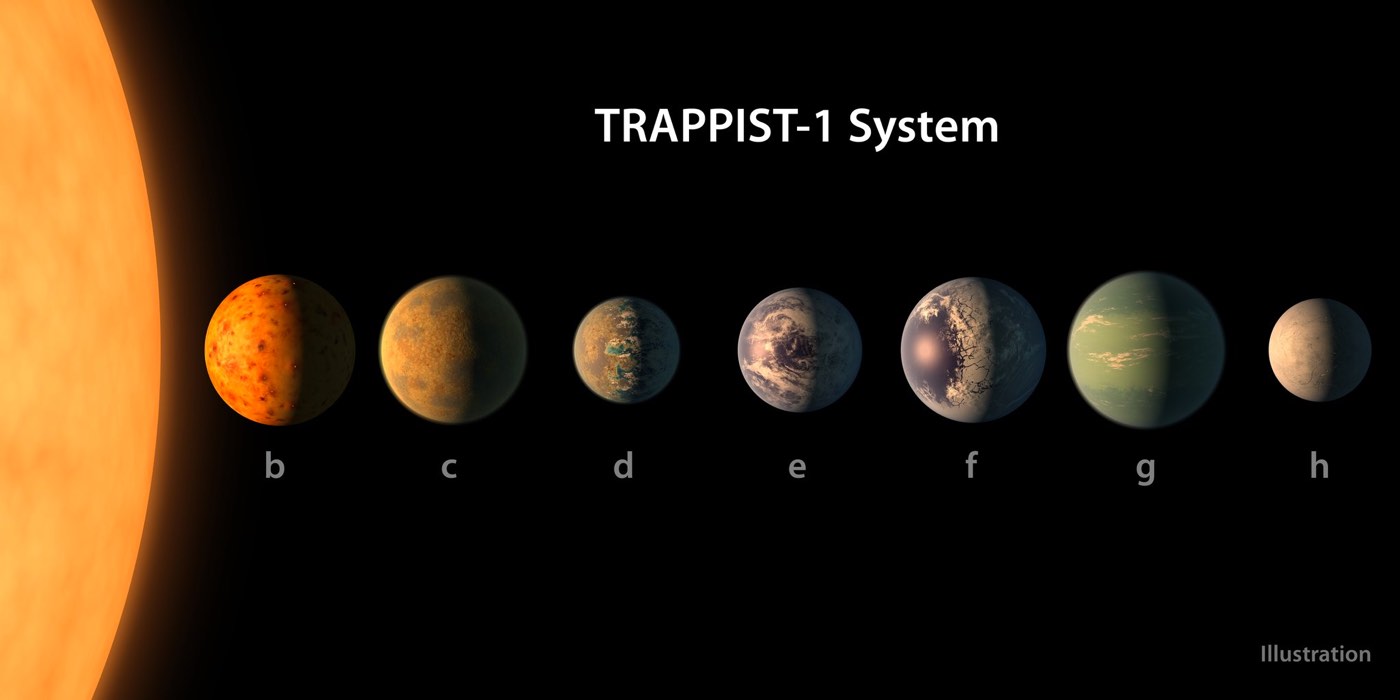
The planets orbit a dwarf star named Trappist-1, about 40 light years, or about 235 trillion miles, from Earth. That is quite close, and by happy accident, the orientation of the orbits of the seven planets allows them to be studied in great detail.
One or more of the exoplanets - planets around stars other than the sun - in this new system could be at the right temperature to be awash in oceans of water, astronomers said, based on the distance of the planets from the dwarf star.
“This is the first time so many planets of this kind are found around the same star,” said Michael Gillon, an astronomer at the University of Liege in Belgium and the leader of an international team that has been observing Trappist-1.
A recruiter with 20 years of experience recently reported on the research into whether remote software teams perform better. One study of 10,000 coding sessions concluded it takes 10-15 minutes for a programmer to resume work after an interruption. Another study actually suggests unsupervised workers are more productive, and the founders of the collaboration tool Basecamp argue the bigger danger is burnout when motivated employees overwork themselves. mikeatTB shares his favorite part of the article:
One interesting take on the issues is raised by ThoughtWorks' Martin Fowler: Individuals are more productive in a co-located environment, but remote teams are often more productive than co-located teams. This is because a remote team has the advantage of hiring without geographic boundaries, and that enables employers to assemble world-class groups.
The article shares some interesting anecdotes from remote workers, but I'd be interested to hear from Slashdot's readers. Leave your own experiences in the comments, and tell us what you think. Are remote software teams more productive?
Or eating candy like I said in our post a month ago.
In a wide-ranging interview, Mike McCue, CEO of news curator app Flipboard, talked about how -- and from where -- people get their news nowadays and how it shapes their worldview. From a report: McCue said getting all your news from either friends or algorithms is "challenging and semi-dangerous" because today's social platforms, like Twitter and Facebook, favor content that people engage with, driving "extremist" content to the top. Hence, he argues, the "fake news" epidemic, which McCue believes had an effect on the 2016 election. "Sometimes I think of news feeds as the 'mystery meat' of your information diet," he said. "It's not like you finish reading your Facebook feed, after half an hour, and feel like, 'That was a great use of time!' It's like if you ate potato chips all day long."
Richard Overton fought in the South Pacific in World War II, is 109 years old, still drives, sometimes drinks whiskey with breakfast, smokes 12 cigars a day (but doesn’t inhale), and still lives in the house he built himself in 1945. In this video from National Geographic, Overton talks about his military service, his faith, his long life, and soup. Overton’s short summary of World War II:
It wasn’t good, but we had to go.
I don’t really care to live to 100, but if I had Overton’s spirit and attitude, perhaps I’d consider it.
It’s not exactly a runaway victory for Colbert, as he only managed to beat Fallon by about 12,000 viewers (and Fallon still beat Colbert in the all-important “under 50-years-old” demographic), but he’s been steadily gaining on NBC’s late-hight hose for a while now, initially coming the closest in the week of January 16 before Trump’s inauguration. That does seem to suggest that Colbert taking his show in a more political direction while Fallon continues playing beer pong with celebrities ...
Andrew Moseman, writing for Popular Mechanics: Here's a fun math puzzle to brighten your day. Say you've got four 4s -- 4, 4, 4, 4 -- and you're allowed to place any normal math symbols around them. How many different numbers can you make? According to the fantastic YouTube channel Numberphile, you can make all of them. Really. You just have to have some fun and get creative. When you first start out, the problem seems pretty simple. So, for example, 4 - 4 + 4 - 4 = 0. To make 1, you can do 4 / 4 + 4 - 4. In fact, you can make all the numbers up to about 20 using only the basic arithmetic operations of addition, subtraction, multiplication, and division. But soon that's not enough. To start reaching bigger numbers, the video explains, you must pull in more sophisticated operations like square roots, exponents, factorials (4!, or 4 x 3 x 2 x 1), and concatenation (basically, turning 4 and 4 into 44).
Rukmini Callimachi tells the story of coming to America as a refugee from Romania.
Many immigrants to America don’t recognize the country they call home right now. One of them is Rukmini Callimachi, a reporter who covers al-Qaeda and ISIS for the New York Times.
After President Trump signed an executive order Friday that, among other things, bans refugee admissions for 120 days and Syrian refugees indefinitely, Callimachi found herself in tears.
She took to Twitter on Saturday to tell her story about coming here as a child from Communist Romania, and finding a home dramatically more welcoming than Switzerland, where she had to hide the truth about her origin.
Callimachi’s story is just one being told in this shocking moment of crisis for immigrants and refuges. Many are using the hashtag #IAmARefugee on Twitter to share them.
Here’s her story, followed by a few other powerful ones we’ve seen.
1. Last night, I found myself in tears at the news. I do not recognize the America that welcomed my family so many years ago. #IAmARefugee
12. All the kids had fancy pencil cases My mom splurged to get me a really nice once with an eraser and ruler inside. It looked like this: pic.twitter.com/0Mq4RmzKrQ
Political consultant Peter Daou describes the chaos of leaving a war zone and finding refuge in the United States. Even though his mother was an American citizen, it didn’t mean the journey was easy.
1. For very personal context on Trump's refugee ban, let me tell you my own story of being bombed out of my home as a child. (1/15)
An NBC affiliate in Philadelphia is reporting that two Christian Syrian families (with visas and green cards) were detained and sent on a return flight to Syria. NBC talked to a relative of one of the families who lives in Allentown, PA.
"This is like a nightmare come true," he said, adding that they had visas and green cards legally obtained months ago.
"They're all Christian citizens and the executive order was supposed to protect Christians fleeing persecution," he said.
On Holocaust Remembrance Day, we share the story of Martin Greenfield, who was freed from Auschwitz & went on to be the president's tailor. pic.twitter.com/azT6hgpTwW
Visit the original post to see all 3 images from this gallery.
NBA Commissioner, Adam Silver, has been preparing hoops fans for the reality of advertisements on jerseys for some time now.
Thus, it should come as little surprise that today we have our first official look at the uniforms for the Boston Celtics, Philadelphia 76ers and Sacramento Kings for the forthcoming 2017-18 seasons which all appear with confirmed corporate sponsorships that include GE, Stubhub and Blue Diamond Almonds.
In the case of the GE and Celtics partnership, it is worth more than $7 million USD a year as the brand attempts to win the hears of Bostonians after moving its headquarters there last year.
For Stubhub and the 76ers, their partnership is said to be worth $5 million USD a year for a 2.5-by-2.5-inch patch.
It’s still unknown if each NBA franchise will feature advertisements, or if it’s left up to individual organizations to decide if they want to seek out additional revenue streams.
The Celtics certainly aren’t struggling for income – valued at $2.1 billion USD – making it the fourth most valuable team in the NBA. However, the 76ers and Kings each rank 28th and 18th respectively – with nearly 30 percent less revenue in some cases.
Although feelings are decidedly mixed, there is good NBA uniform news on the horizon. When Nike takes over as the official sponsor, they are reportedly doing away with the sleeved jerseys.
Celtics co-owner Steve Pagliuca talks about the team's multi-year partnership with GE. pic.twitter.com/oImRRN6OxF
Evan Puschak looks at a single joke Louis C.K. tells about playing Monopoly with his daughters and takes it apart to see how Louis builds and delivers his material. By the end, you’ll likely have a new appreciation of the efficiency and power of Louis’ performance…every word he utters is doing work.
You know, more than anything else I think I’m obsessed with articulation, with the magic of putting things just the right way. There are 207 words in this joke and not a single one is wasted. They’re used either in meaning or in rhythm to contribute to the overall effect, an effect that lets us see the world from a different angle, and more importantly, makes us laugh.
Good phrase, “the magic of putting things just the right way”.
Mickeycaskill quotes a report from Silicon.co.uk: Accenture research has found Blockchain technology has the potential to reduce infrastructure costs by an average of 30 percent for eight of the world's ten biggest banks. That equates to annual cost savings of $8-12 billion. The findings of the "Banking on Blockchain: A Value Analysis for Investment Banks" report are based on an analysis of granular cost data from the eight banks to identify exactly where value could be achieved. A vast amount of cost for today's investment banks comes from complex data reconciliation and confirmation processes with their clients and counterparts, as banks maintain independent databases of transactions and customer information. However, Blockchain would enable banks to move to a shared, distributed database that spans multiple organizations. It has become increasingly obvious in recent months that blockchain will be key to the future of the banking industry, with the majority of banks expected to adopt the technology within the next three years.
For what it’s worth: it’s never too late or, in my case, too early to be whoever you want to be. There’s no time limit, stop whenever you want. You can change or stay the same, there are no rules to this thing. We can make the best or the worst of it. I hope you make the best of it. And I hope you see things that startle you. I hope you feel things you never felt before. I hope you meet people with a different point of view. I hope you live a life you’re proud of. If you find that you’re not, I hope you have the courage to start all over again.
Why so many people remember seeing a Sinbad genie movie that never happened.
Last week, New Statesman published a feature about a community of Reddit users who are fans of a movie from the 1990s starring the comedian Sinbad. The movie is called Shazaam, and Sinbad plays a bumbling genie who adventures with two small kids.
The piece, however, is not about millennials’ unending enthusiasm for ’90s nostalgia. It’s much, much weirder: It turns out that the movie Shazaam never existed, and yet many of the people New Statesmen writer Amelia Tait spoke to could not be convinced otherwise.
Even Sinbad himself denies the movie exists.
Have you noticed no one my age has seen this so called Sinbad Genie movie, only you people who were kids in the 90's. The young mind !
The New Statesmen piece explores a fascinating question: How could so many people share the same false memory of the same fake movie?
First off: It’s not that these people are confusing Shazaam for Kazaam, the very real movie starring Shaquille O’Neal as a genie. They think the two movies were released around the same time (like the asteroid apocalypse movies Armageddon and Deep Impact, which both premiered in 1998). Tait explains:
Imagine if you woke up this morning and Disney’s 1998 animation A Bug’s Life did not exist. After endlessly scouring the internet, you’d come up with nothing, despite your own distinct memories of a bunch of ants going on wild hijinks through the undergrowth. You’d turn to your best friend, your brother, your mum, and say, “Hey, remember A Bug’s Life? It was about ants”, and your friend/brother/mum would turn to you and says: “No, darling. You’re thinking about Antz.”
This is how those who believe in the “Sinbad genie movie” feel when people say they are simply getting confused about Shaq’s Kazaam.
One possibility is the Mandela effect, or the idea that a group of people who share a false memory all originated in a parallel universe in which the memory wasn’t false. (The “effect” is named after Nelson Mandela because it finds its roots among people who swear they remember him dying while in prison. This is a real thing people discuss. The Shazaam trutherism Tait reports on started on the Mandela effect subreddit.)
Mass universe-hopping is unlikely. The truth is much simpler: Human memory is really, really malleable.
Elizabeth Loftus, psychology’s leading researcher on false memory, has shown this time and time again. In her research, just the mere suggestion by an interviewer that cars "collided" instead of "hit" will lead people to recall a car accident as more severe than it was. More famously, she showed that people can be made to recall childhood memories that never happened. All it took was showing study participants fake letters from relatives that claimed they had been lost in a mall as a child.
“The most worrying thing is that you don’t need to be suffering from psychological issues to have false memories created in your head,” neuroscientist Dean Burnett writes in his book Idiot Brain, which outlines all the ways our brains fail us. “It can happen to virtually everyone.”
Tait has another intriguing suggestion: The false memory of the movie Shazaam is fueled by discussion about it on the web. That all the Shazaam truthers are riffing off one another, giving each other subtle suggestions — like in Loftus’s studies — to form a false narrative that exists in all their minds. It’s called the “the social contagion of memory,” as one of Tait’s sources explains.
In a world rife with misinformation, “fake news,” and the ability to avoid conversing with people who disagree with you on the internet, it’s easy to imagine more Shazaam-like memories infecting people’s minds.
An anonymous reader quotes a report from Motherboard: According to research published Thursday in Science, physicists at Princeton University have designed a device that allows a single electron to pass its quantum information to a photon in what could be a big breakthrough for silicon-based quantum computers. The device designed by the Princeton researchers is the result of five years of research and works by trapping an electron and a photon within a device built by HRL laboratories, which is owned by Boeing and General Motors. It is a semi-conductor chip made from layers of silicon and silicon-germanium, materials that are inexpensive and already widely deployed in consumer electronics. Across the top of this wafer of silicon layers were laid a number of nanowires, each smaller than the width of a human hair, which were used to deliver energy to the chip. This energy allowed the researchers to trap an electron in between the silicon layers of the chip in microstructures known as quantum dots. The researchers settled on photons as the medium of exchange between electrons since they are less sensitive to disruption from their environment and could potentially be used to carry quantum information between quantum chips, rather than within the circuits on a single quantum chip. The ability to scale up this device would mean that photons could be used to pass quantum information from electron to electron in order to form the circuits for a quantum computer. "We now have the ability to actually transmit the quantum state to a photon," said Xiao Mi, a graduate student in Princeton's Department of Physics. "This has never been done before in a semiconductor device because the quantum state was lost before it could transfer its information."
Apple only released one substantial update to its entire lineup of Mac computers in 2016, and what a controversial update it was. To many outsider observers, the last year made it feel like the Mac is far from a priority at Apple -- and a report from the reliable Mark Gurman of Bloomberg backs that up. According to Gurman's anonymous sources, the Mac team just isn't a priority with Jony Ive's design team, the company's software team or senior management at large. Additionally, both technical challenges and the departures of key members of the Mac team have also slowed things down.
Perhaps the most notable example Gurman gives comes from the new MacBook Pro. Originally, Apple engineers wanted to use the "tiered" battery system found in the 12-inch MacBook to get more capacity into the new MacBook Pro lineup. But the new battery failed some key tests prior to launch, so Apple had to revert to an older, more standard battery design that resulted in worse battery life as well as disorganization and scrambling as the company pulled in engineers from other teams to get everything squared away. Gurman says this affected development on other parts of the Mac lineup.
It's a pretty big black eye for Apple, as many reports and reviews have noted how the MacBook Pro's battery life is just not up to par with its competition and doesn't represent what most expect when spending so much money. In fact, since the computer launched, Apple pushed out a software update that removed "time remaining" estimates from macOS (the company claims the MacBook Pro's battery functions as expected, but that the OS is just not showing proper battery life estimates).
Speaking of macOS, Gurman reports that there's no longer a dedicated team for developing the Mac's software. There's just one big software team that works across iOS and the Mac. That makes a lot of sense given the close ties between the systems that have developed in recent years -- but it also means that iOS gets the lion's share of resources. That's reasonable given the iPhone's massive importance to Apple's bottom line, but it's still bad news for those of us who like seeing continued Mac innovation.
It's not just on the software side -- Jony Ive and his design team are also visiting with the Mac team much less and not reviewing nearly as many concepts as they used to. This might explain why the spec bump that the 12-inch MacBook received earlier this year was so minor. Originally, Apple had planned to add a second USB-C port and Touch ID, two additions that would have been most welcome. But instead Apple added a rose gold color option and a slightly faster processor.
Of course, Apple maintains that it's business as usual for the Mac. "We have great desktops in our roadmap. Nobody should worry about that," CEO Tim Cook said recently in a company Q&A session that Bloomberg reported on. But the fact that Apple's own employees are questioning the company's dedication to it's former flagship product has to say something about what's going on in Cupertino.
I love this. I hope more players leaving for the draft don't play as soon as it stops benefiting them. Maybe that'll force the NCAA to start sharing the wealth.
Two star players who’ve been injured this season are sitting out of non-New Year’s games.
As bowl season rolls around in college football, draft-eligible juniors have to make a pretty big decision: to stay for their senior season or declare for the NFL Draft.
With that decision comes another, apparently: whether or not to play in your team’s bowl game.
This year, we’ve already seen a couple of players with high draft stocks opt out of the bowl games that their teams are set to play in. On Friday, LSU running back Leonard Fournette announced that he would not play in the Citrus Bowl against Louisville. A couple of days later, Stanford’s Christian McCaffrey announced he would be leaving Stanford before the Cardinal’s game against North Carolina.
Given these two announcements coming pretty close to one another, it would appear that this could become a trend. As expected, there are some mixed reactions with this decision. On the one hand, some believe that these players should finish the season out with their teams before preparing for the NFL Draft. On the other, there is the belief that the decision is smart, due to the risk of injury that could alter the players’ draft stock.
Football is a dangerous sport.
Last year, Notre Dame’s Jaylon Smith was expected to be a top-10 NFL Draft pick — until about halfway through the first quarter of the Fiesta Bowl against Ohio State. Smith suffered a gruesome knee injury, tearing both his ACL and LCL.
The injury greatly affected his draft stock. Instead of having his name called within the first hour of the NFL Draft, he fell to the second day, and was taken at No. 34 overall by the Dallas Cowboys.
Smith ended up signing a four-year deal with the Cowboys, one with a $2.9 million signing bonus that is worth roughly $6.1 million. It’s still a solid amount of money, but had he been taken, say, third, his contract in total would be close to $26 million, per Pro Football Talk. Smith was fortunate enough to get insurance money, which will pay $900,000. All in all, this money is nowhere near what he would’ve made if he would’ve sat out of the Fiesta Bowl game.
Fournette and McCaffrey presumably saw what happened to Smith last year.
Both have dealt with injuries this season.
Fournette’s ankle injury caused him to miss five games, and almost six, had he not been motivated to suit up against Florida after some pregame chippiness. Fournette registered just 12 carries for 40 yards that game and did not travel for the Tigers’ season finale against Texas A&M.
McCaffrey, who finished second in last year’s Heisman Trophy voting, missed Stanford’s game against Notre Dame in the middle of this season after suffering an undisclosed injury vs. Washington State. Head coach David Shaw described him as “banged-up.”
So, if an already injured player at a position like running back, where players rapidly lose value by taking hits, wants to protect himself from injury and not risk losing millions of dollars, can you really blame him?
This is an especially competitive draft class for running backs.
Potential first-rounders like Fournette and McCaffrey face intense competition, including each other, with millions of dollars at stake.
Another sign this is a deep class of backs: Georgia’s Nick Chubb is returning to school for 2017 despite entering 2016 as a potential Heisman Trophy contender.
Another running back with a projected high draft stock is Florida State’s Dalvin Cook. The Noles will take on Michigan in this year’s Orange Bowl, one of the six biggest bowls. Cook is expected to play against the Wolverines despite suffering injuries in his career and projecting as a high pick, were he to declare early. If Cook were to sit out, the chances of Florida State beating Michigan would go down significantly.
Some GMs will think it’s smart for players to manage their health. However, perhaps some might not like the idea of players sitting out will approve if a player like Cook or Pitt’s James Conner has an impressive bowl game.
How much do these bowl games really matter, anyway?
For Stanford and LSU, really not all that much. LSU has already announced it is sticking with Ed Orgeron as its next head coach, so it’s not like this Citrus Bowl game vs. Louisville is a must-win. Orgeron also said he supports Fournette’s decision. Given Fournette didn’t play in LSU’s previous game, there’s a chance Fournette may not have even been able to play.
Stanford’s Sun Bowl game against UNC isn’t all that important either — the Cardinal finished the season with nine wins, so getting to 10 wins would just be the cherry on top. Plus, there isn’t much a single game could do for McCaffrey in terms of raising or lowering his draft stock, unless he were to get injured.
Also:
Got a text from a coach. "If some coaches can skip bowls to get ready for their next job, how can anyone fault Fournette or McCaffrey??"
We’ve already seen the likes of Matt Rhule, Tom Herman, and Willie Taggart depart for new jobs prior to their teams’ bowl games. Why should it be any different for players who want to prepare for their next job a game early?
But what if these were New Year’s Six bowl games or even Playoff games?
These games actually matter. If a player ever sits out a chance at a national championship or a Rose Bowl title in order to protect his draft stock, then we’ll know this trend has really ramped up.
We see assistant coaches staying on with their old jobs to coach their teams in a Playoff game, even after accepting a new job. Herman did so at Ohio State, and Kirby Smart did so with Alabama last year, and Lane Kiffin is doing so this year.
The bottom line is this: There are some games that simply matter more than others, which comes into play for both coaches and players who are moving on with their careers. If a player wants to forgo a single exhibition game to avoid risking his NFL career, where’s the harm in that?


/cdn.vox-cdn.com/uploads/chorus_asset/file/8026767/615648564.jpg) Photo by Adam Berry/Getty Images
Photo by Adam Berry/Getty Images
/cdn.vox-cdn.com/uploads/chorus_asset/file/8026785/643450784.jpg) Photo by Kevin Dietsch - Pool/Getty Images
Photo by Kevin Dietsch - Pool/Getty Images