Some can only win when others lose.
Others seek to win by helping others succeed.
One of these approaches scales far better than the other.


Some can only win when others lose.
Others seek to win by helping others succeed.
One of these approaches scales far better than the other.
Yesterday, three federal judges ruled that Wisconsin’s 2011 redistricting map was a case of partisan gerrymandering — in this instance, the…

Democrats need to be an opposition party, not a minority party.
More Americans voted for Hillary Clinton than for Donald Trump. More Americans voted for Democratic Senate candidates than for Republican Senate candidates.
So why aren’t Democrats acting like it? Why aren’t they trying to force Republicans, the media, and the emergent Trump White House to act like it?
This is not an argument that the election was rigged, or that Trump’s win is somehow illegitimate. The president is chosen by the Electoral College. The Senate is built to favor small states. Gerrymandering is legal. America does not decide national elections by simply tallying up votes.
But the will of the voters still matters, or at least it should. Thus far, Democrats have slipped comfortably into the position of minority party. They aren’t demanding that Trump put forward compromise candidates for key posts. They aren’t laying out a proactive agenda that would serve as their basis for negotiations with Trump and the Republicans. And they aren’t, in their public messaging, emphasizing that most voters opposed Trump’s agenda, and that both Democrats and Republicans need to take that seriously.
Democrats have confused the reality of being out of power with the idea of being in the minority. This lets the Trump administration and the Republican Party confuse the reality of being in power with the idea of having a mandate for their agenda.
As grim as the situation is for Democrats — and it is grim — it’s not going to take long for Republicans to recognize their peril. They’ve lost the popular vote in six of the past seven elections. Their president-elect is less popular than any incoming president in the history of polling. It’s the out-of-power party that tends to gain in midterm elections.
/cdn0.vox-cdn.com/uploads/chorus_asset/file/7516203/Screen_Shot_2016_11_17_at_10.42.56_AM.png) Gallup
Gallup
If Trump were wise, he would govern with some humility. The question he faces is how to turn his minority into a majority. The answer is to reach out to the majority of Americans who didn’t vote for him and don’t approve of him — to show them, in word and deed, that they were wrong about him.
But that’s not going to happen. In his every move since winning the election, Trump has shown he’ll govern as the most extreme version of himself. So far, he has made Breitbart’s Steve Bannon his chief strategist, RNC Chair Reince Priebus his chief of staff, and retired Gen. Michael Flynn his national security adviser, and announced that Sen. Jeff Sessions will be his attorney general.
So far, there’s been no effort, at all, to reach out to the other side, or to play against type. There’s been nothing akin to Barack Obama’s announcement, which came this very week in 2008, that he intended to retain George W. Bush’s defense secretary, Robert Gates.
All of which leaves an opening for Democrats. If Trump doesn’t intend to represent the majority of the country, then they can. They don’t hold much power in Congress, but they hold more than Republicans did in 2009, and Republicans were able to cause plenty of problems for Obama’s agenda.
/cdn0.vox-cdn.com/uploads/chorus_asset/file/7516213/156512381.jpg) Photo by Olivier Douliery-Pool/Getty Images
Photo by Olivier Douliery-Pool/Getty Images
Democrats should insist, in both appointments and legislation, that Trump govern with some consideration for the majority of Americans who voted for someone else. That should be the cost for their cooperation. Democrats should force both the media and Republicans to take seriously the fact that Trump is governing without a majority, or even a plurality, of the American people behind him, and that that carries with it a responsibility to govern modestly.
This is nothing more, and nothing less, than asking Trump to absorb the weight of the office he holds, and the message of the election he won. Trump is now president of the entire United States of America, not just the people who voted for him, and he needs to act that way. It’s the opposition party’s duty to remind him of that.
So far, there’s been little evidence that the media, the Democrats, or the Republicans really appreciate this. The media is still trying to understand how Trump won. Democrats are still trying to understand how Clinton lost. And Republicans are thrilled that they’re now in power. Everyone is so shocked by the election’s unexpected outcome that they’ve overlooked the actual results.
There’s been a lot of talk about “normalizing” Trump, but this is more fundamental: To ignore the election results and act like the strongest possible version of Trump’s agenda was endorsed by most voters re-historicizes Trump. It makes the election into something it wasn’t, and gives Trump license to govern in a way he shouldn’t.
Elections decide who wins power. They don’t decide how it should be wielded. If Trump governs in a way that respects the center of opinion in the country — a center Democrats appear to hold — Democrats should work with him. If he isn’t, then they should keep pointing that out, and force him to govern alone. They owe their voters nothing less.
Correction: An earlier version of this post said that Democrats looked likely to overtake Republicans in total House votes. That was based on bad information — Republicans are up by about 3.6 million, and while votes are still being counted, Democrats look unlikely to close that gap.
Ben WolfThis is a huge problem that is essentially ignored.


Read more of this story at Slashdot.
Ben WolfCrazy
I saw a blog post this weekend that looked at the IPO filings of 79 tech companies and calculated the ownerships of the founders and the VCs at IPO.
The result of that analysis is that the average founder ownership at IPO was 17% and the average VC ownership at IPO was 56%.
I’ve written a bunch on this topic and here are two posts that address this exact issue:
Founder Dilution – How Much Is “Normal”?
In both posts, I lay out how the equity gets shared with employees and investors as the company grows and scales.
Here’s the most important quote from those two posts:
In my experience, it will generally take three to four rounds of equity capital to finance the business and 20-25% of the company to recruit and retain a management team. That will typically leave the founder/founder team with 10-20% of the business when it’s all said and done. The equity split at 20% for the founders will typically be; 20-25% for the management team, 20% for the founders, and 55-60% for the investors (angel all the way to late stage VC).
I wrote that seven and half years ago, but on this topic, not much has changed over the thirty years I’ve been doing VC.
Raising round after round of venture capital is expensive. There are some entrepreneurs who figure out how to get profitable and not raise round after round (or avoid VC altogether), there are some entrepreneurs who are able to raise a very high valuations and avoid a lot of dilution, and there are many entrepreneurs who choose to sell the business before they take a lot of dilution. But for the entrepreneurs who raise four to six rounds of VC before going public, the math is the math. If you end up owning more than 20% at IPO, you are beating the averages.
Ben WolfThis is the best.

Anthony Rizzo caught (and pocketed) the ball that made the final out of the Cubs' World Series victory, but Kris Bryant was the man on the field who first knew what was happening, and he couldn't contain his excitement while he made it happen:
/cdn0.vox-cdn.com/uploads/chorus_asset/file/7399085/smiley.0.gif)
Might've even shed a tear before he made that through.
Ben WolfI want to see the parody of this where all the people who actually buy this thing use it for creepy ass spying purposes.
Apple Watch wearers who take pleasure in the dark arts of stealth photography might want to take note of CMRA. Its new smartwatch strap comes with an 8MP camera and takes photos and videos with the simple press of a button.
For aesthetic and performance reasons, Apple’s previous Apple Watch Series 2 smartwatch came sans camera despite the addition being heavily rumored in the release run-up. As well as the aforementioned 8MP shooter, CMRA also features a more practical 2MP selfie cam which can be used for video calls when paired in tandem with the Glide (which also owns CMRA) watchOS app. Live streaming is another handy feature.
CMRA features 8GB of in-strap storage for photos and video clips, and also comes with its own shutter button. The strap comes with a dock which charges both it and the watch, and even if the latter runs out of juice, you can freely continue taking photos using the strap’s shutter.
CMRA is available in four colors — teal, white, grey, and black — and is available now for a pre-order discount price of $149.
In other Apple news, check out this ill-conceived iPhone 7 commercial.

You thought it was a joke, but they were not joking.
Parks and Recreation is one of the most optimistic shows of our lifetime. It masterfully blended this optimism with humor in order to make its fans feel genuine emotions and attachment for its characters, their lives, and the little town in Indiana they called home.
It shouldn’t be a surprise, then, that in the final season of Parks and Rec set in the future of 2017, the writers decided that the Cubs had won the 2016 World Series.
There is a chance Lucy predicted the future #ParksandRec pic.twitter.com/j74iH3tvfM
— Natalie Morales (@nataliemorales) October 24, 2016
Best of all? They weren’t actually joking about it. Let’s rewind to 2015 and co-creator of Parks and Rec, Michael Schur:
During a press stop in January of last year, Schur told the crowd that a reference the sitcom made to the Cubs winning the 2016 World Series was no joke. Before he could finish his sentence, he was interrupted with laughter. The Cubs were, after all, just a few months removed from an 89-loss season.
It’s 2016, and the Cubs not only made the World Series — an impressive enough prediction from notable baseball fan Schur, who you might also know as Fire Joe Morgan and Twitter’s Ken Tremendous — but they also managed to win the whole thing.
See? The optimism of Parks and Rec really is rooted in reality! The world isn’t so bad when it mirrors Pawnee, you know.
Ben WolfNaysayers... gotta love 'em.

With major 26.2-mile races in Washington, D.C., New York City and Philadelphia coming up this fall, it’s safe to say we are in peak marathon season.
According to Running USA, almost two million people ran a half-marathon in the U.S. last year, and more than a quarter of that ran a full. Although down from the previous year’s high, the market for running shoes is still showing no signs of slowing down. In 2015, Americans spent $3.2 billion on running shoes, according to the National Sporting Goods Association—up 40% since 2010.
For hardcore runners, smaller brands are still at the forefront when it comes to performance. According to a recent Running USA survey, Brooks is the most recently purchased running shoe brand by serious runners (23%), followed by ASICS and Saucony — New Balance came in 5th, just behind Nike.
Meanwhile, adidas (arguably this year’s most improved brand) isn’t even on the radar when it comes to hardcore runners.
Ben WolfI was wondering when this sort of thing would start happening. You think this'll take a bite out of the success of Instagram in the long run?

Ben WolfRocky marathon!

November is approaching fast, and though we definitely know there’s something happening that month we’re supposed to remember, we have no idea what it is. It’s some kind of important civic duty we’re supposed to participate in within the first eight days or so, but that doesn’t help much. Oh well, hopefully the new offerings from Hulu will remind us of what it is or keep us distracted long enough that we don’t feel bad about missing it. Thankfully, the latter option should be pretty easy to accomplish in November, because Hulu is getting a good amount of solidly binge-worthy TV shows and movies.
The new TV shows hitting Hulu include the complete 13th season of Top Chef, the sixth season of Real Housewives Of Beverly Hills, and the complete first seasons of Uncle Grandpa and Miles From Tomorrowland—for both young kids and ...
Ben WolfI love this.
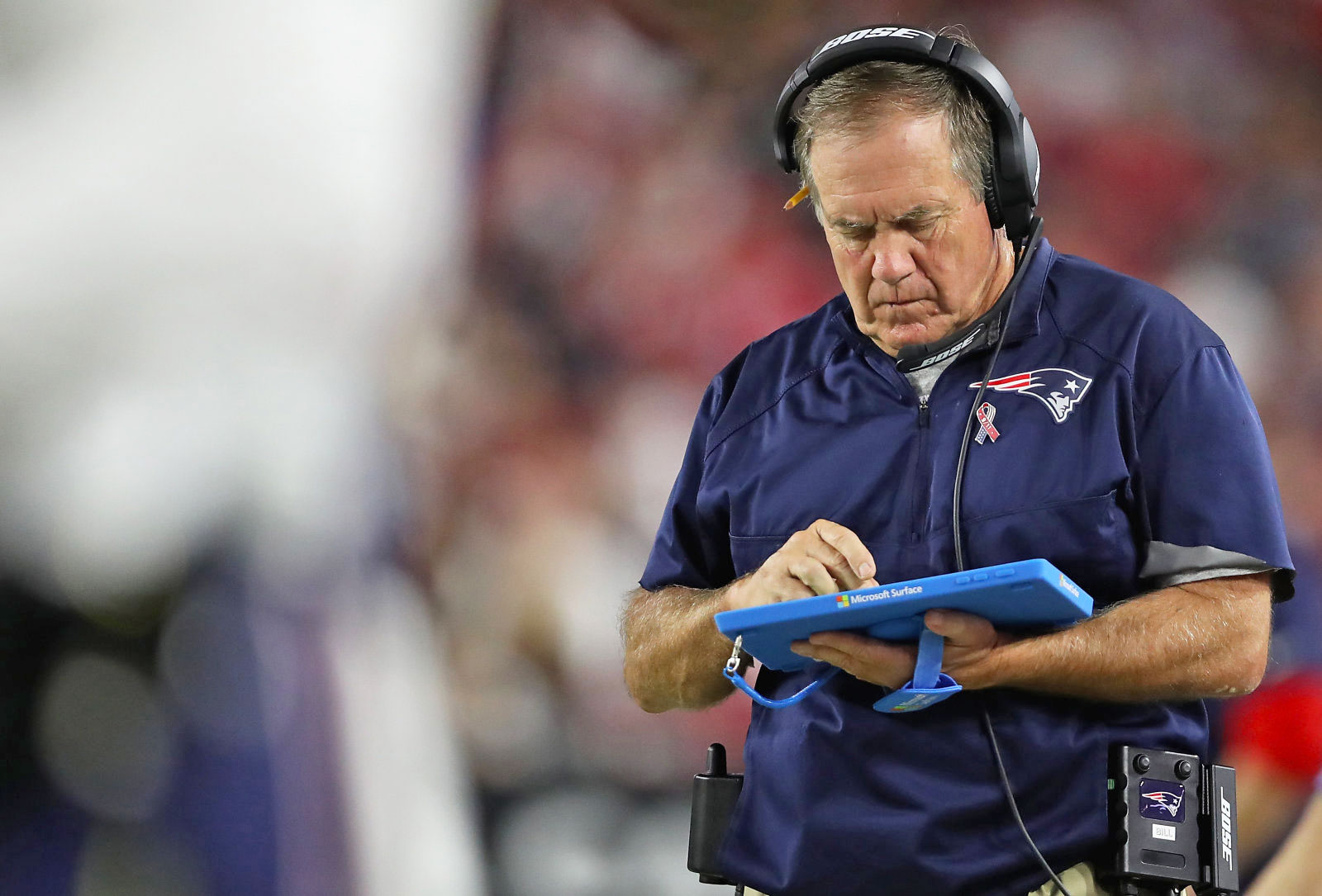
You'd think Patriots coach Bill Belichick is feeling over the moon right now. After all, his golden boy Tom Brady is finally back from a four-game suspension, handed to him by the NFL for his role in a cheating scheme now widely known as "Deflategate." But no, Belichick isn't happy. Instead, the Super Bowl-winning coach is lashing out at tablets. And while he doesn't mention Microsoft's Surface by name, that's the device the tech giant pays $80 million dollars a year for teams to use on the sidelines. It's also the one he just smashed in a game against the Bills earlier this month.
"As you probably noticed, I'm done with the tablets," Belichick said at a press conference today, in response to a question about issues he had with the tech during the Patriots' latest game. "I've given them as much time as I can give them. They're just too undependable for me," he added. "I'm going to stick with pictures as several of our other coaches do as well because there just isn't enough consistency in the performance of the tablets.
Belichick says he "just can't take it anymore," noting that he's going back to relying on printed images to view and analyze plays. "It's a personal decision. "I'll use the paper pictures from here on because I've given it my best shot," he added. "I've tried to work through the process but it just doesn't work for me and that's because there's no consistency to it."

The NFL gave us the following statement: "Microsoft is an integral, strategic partner of the NFL and implementing their technology on our sidelines has increased the efficiency and speed of collaboration between coaches and players to an all-time high. Within our complex environment, many factors can affect the performance of a particular technology either related to or outside of our partner's solutions. We continue to work with all of our partners to ensure the best systems are in place to most effectively assist the clubs in the execution of their game plan."
As for Microsoft, the company told Engadget that it respects Belichick's decision, but naturally doesn't agree with his comments about the Sideline Viewing System not being reliable. Unfortunately, the fact is there's plenty of proof to suggest otherwise.
Here's the full statement from Microsoft: "We respect coach Belichick's decision, but stand behind the reliability of Surface. We continue to receive positive feedback on having Surface devices on the sidelines from coaches, players and team personnel across the league. In the instances where sideline issues are reported in NFL games, we work closely with the NFL to quickly address and resolve."
Here's Belichick's full answer as to why he hates the tablets. Lasted five minutes and 25 seconds. pic.twitter.com/wcSqebtQRu
— Zack Cox (@ZackCoxNESN) October 18, 2016
Source: Patriots
Ben WolfWe're small.

A recent paper claims that the Universe has 10 times more galaxies than we previously thought: an estimated 2 trillion galaxies covering every single patch of sky visible from the Earth. But that doesn’t mean the Universe is more massive or that it contains more stars. Phil Plait explains:
Now, let me be clear. This doesn’t meant the Universe is ten times bigger than we thought, or there are ten times as many stars. I’ll explain — I mean, duh, it’s what I do — but to cut to the chase, what they found is that there are lots of teeny, faint galaxies very far away that have gone undetected. So instead of being in a smaller number of big galaxies, stars are divvied up into a bigger number of smaller ones.
So how many stars are there in the Universe? The Milky Way contains about 400 billion stars. Some massive elliptical galaxies house more than 100 trillion stars. Estimates of the total number are rough, but it’s probably around 10^24 stars…that’s a septillion stars, a trillion trillion. It’s absurd that we’d be the only planet in the Universe with life on it.
Tags: astronomy Phil Plait science spaceBen WolfI've been thinking about something similar since Glenn Beck came out and pulled his Trump support. And called Hillary an "ethical choice." I think part of the reason Trump has been able to soar is that people like Beck have made public servants like Obama and Clinton look like villains.
What if the fear and malaise and anger isn't merely being reported by cable news...
What if it's being caused by cable news?
What if ubiquitous video accompanied by frightening and freaked out talking heads is actually, finally, changing our culture?
Which came first, the news or the news cycle?
We seem to accept the hegemony of bottom-feeding media as some natural outgrowth of the world we live in. In fact, it's more likely an artifact of the post-spectrum cable news complex in which bleeding and leading became business goals.
There's always front page news because there's always a front page.
The world is safer (per capita) than ever before in recorded history. And people are more frightened. The rise of the media matches the rise of our fear.
Cable news isn't shy about stating their goals. The real question is: what's our goal? Every time we hook ourselves up to a device that shocks us into a fear-based posture on a regular basis, we're making a choice about the world and how we experience it.
They want urgency more than importance. What do we want?
[I wrote this months ago, and every time I'm about to post it, I hesitate because recent events make it look like I'm writing it for that reason. Finally, I realized that it's never a quiet moment in the media cycle any more, is it?]
EA Sports’ FIFA is one of the most popular sports video games in the world. But it’s also a challenging game to master, which can make for some blooper-filled afternoons with your mates. In these two videos, real players get out onto the pitch to imitate the mannerisms and slip-ups of their video game counterparts.
Tags: remix soccer sports video video games
Here at Highsnobiety HQ I’m notorious for returning stuff that I buy off of the internet. A clear majority of the orders that I make online will end up being sent back to whoever I bought it from, and, these days, I make a point of only buying from sites that offer free shipping because I know how likely it is that I won’t be satisfied with my order.
I’m incredibly particular, difficult to please, and averse to compromise, but, like most people, my decision to return an order usually comes from a dissatisfaction with the product itself – its fit or feel, or a dissimilarity to the product shots on the site that I ordered it from. But several months ago that began to change.
As I inspected a pair of Air Max 1s that I had been eyeing up for many weeks, I felt an impulse to return them even though there was nothing wrong with the shoes themselves. AM1s are one of about five sneaker models that I wear on rotation, so there wasn’t anything unexpected about my order, and although they didn’t look quite as good as they did online (nothing ever really does, though), they didn’t look bad, per se.
For people that enjoy shopping, or buying nice things, rather, each purchase is supposed to douse the human brain in a quick, satisfying blast of dopamine – which is precisely why so many of us get sucked into materialism – but I simply felt a bit numb. That feeling of excitement that you get when opening up a fresh box of sneakers, or trying on a new outfit, or loading up your Macbook for the first time felt duller, more muted. Comparatively, it was the difference between devouring a succulent steak after not eating all day and compulsively snacking on stale Doritos out of sheer boredom.
 Running Magazine
The reason for this is because I felt sapped by the relentless churn of consumption that’s needed to power capitalism and its pathological obsession with infinite growth. We’re consistently told to buy, to spend our way out of economic recessions, our senses are assaulted by invasive advertising aimed at making us lust over individual brands and products, and more broadly, the act of consuming. The media that we use, from Instagram to WhatsApp, are defacto marketing channels, and every new collection or Nike sneaker that you see on sites such as this one is essentially an advert.
As humans in the 21st century, I believe that our minds have been conditioned to reflexively consider each potential purchase we’re exposed to, to visualize owning that particular product if even for a moment. Just about every industry from technology to fashion is built upon a model of designed obsolescence and disposable fads, and we’re constantly reminded that what we own is outdated and needs replacing. It’s exhausting. And even if, like me, you consciously choose to reject the hype and see consumerism for what it is, I think it’s impossible to completely immunize yourself to those subconscious impulses that push us to spend. Fighting it often feels as draining as giving in.
I initially referred to what I was experiencing as “consumer burnout,” but I soon learned that it fits the diagnosis of a much more widely publicized phenomenon known as “the tyranny of choice.” If you take a quick glance the shelves of a typical supermarket or 7-11 or just about any other store in the Western world these days, you’ll instantaneously be overwhelmed by the number of brands and items on offer, with the average American supermarket housing some 48,750 items on average way back in 2010, a figure that has almost certainly increased.
The orthodox view is that more choice is undeniably better, which to an extent is true – no one yearns for communist-era Romania, where shops only stocked cabbage and pickles (presumably) – but having too much choice, like we do now, is potentially making us miserable.
 Stephane Mahe / Reuters
Ardent capitalists like to equate consumer choice with freedom, but they rarely (or never, rather) mention its pitfalls. More options can also mean more stress, as we agonize over choosing the right one. Think about it: when you want to purchase a new stereo, or a car, or anything that will make a significant blow to your budget, do you simply walk into your nearest store and pick one on a whim, or do you spend minutes or even hours of your life sifting through reviews on the internet, comparing specs and hunting down the lowest price tag that you can find? This is time and effort that could be spent with friends, family, on hobbies or something constructive, but is siphoned away from our lives and converted into profits by brands.
Because cash is essentially equated with survival in the modern world, making the right consumer choice can sometimes become a debilitating pressure that makes you unable to choose at all: according to one study conducted in a California supermarket, when shoppers were presented with 24 options of jam, only 3% of them actually ended up buying one. That figure rises to 30% when the number of jams is reduced down to six. An abundance of choice has the potential to riddle us with anxiety because as our options increase, so do our chances of picking the wrong one.
And what happens when you plump with the wrong choice? Well that obviously depends on how much money you’ve spent. But if it’s a significant outlay, like a crap holiday, you’re left with not only the dissatisfaction of wasted time and money, but also a gnawing feeling of squandered potential.
If it’s a physical purchase, like, say, an uncomfortable sofa, that object serves as an enduring reminder that you messed up. Some people are grounded enough to simply shrug it off and move on, but the more neurotic amongst us will dwell on it, wistfully pondering what could’ve been, visualizing the enjoyment that they could’ve had but didn’t get and thinking up alternative realities where different consumer choices could’ve led to a better outcome. This is markedly different to having limited choice, which can be incredibly frustrating in its own particular way, but at least it allows you to blame circumstance rather than yourself.
 Ralph D. Freso / Reuters / Landov
Also, who says that more choice is inherently better? As I mentioned earlier, brands, advertisers and other capitalist ideologues like to frame extensive consumer choice as a form of freedom, an expression of the fundamentally democratic nature of the free market, but consumer freedom is a false liberty, one that serves to distract from the uncomfortable realization that we’re unable to make the sort of decisions that truly matter.
We can choose to buy the adidas NMD in what seems to be every single color combination detectable by the human eye, but the 36 million people that came together globally to protest against the Iraq War in early 2003 were completely ignored by their leaders. Never has a U.S. election been contested by two candidates as unpopular with their respective bases as they are this year, and many people will simply be voting for one as a way of keeping the opposition out of the White House. Yes, this is still a choice, but it is a hollow, disempowered one.
These are the decisions that matter, and the decisions that matter are increasingly beyond the reach of normal people. Instead, we’re left to mull over complete trivialities like which filling we’d like in our Chipotle burritos or which finish we’d prefer on our iPhone 7, giving us an illusion of freedom. All our abundant consumer choices are choices of no significance at all.
The views and opinions expressed in this piece are those solely of the author, and do not necessarily reflect the position of Highsnobiety as a whole.
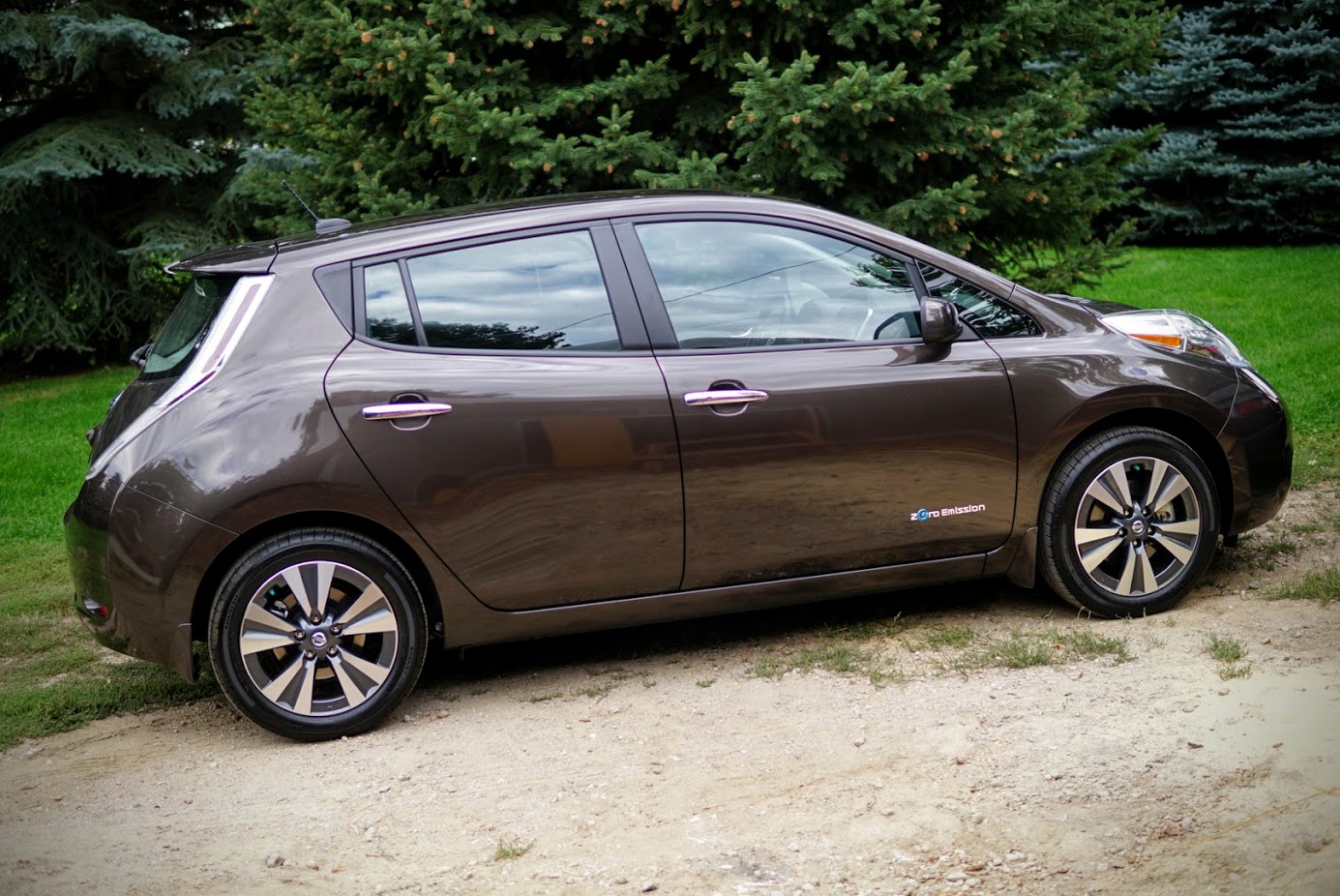
The new ride – a 2016 Leaf SV in this deluxe ’70s brown color.
Before we begin, I should probably admit that the Mustache family absolutely did not need a new car. Or even a new used car. In fact, we didn’t even need the two older used cars that we have been keeping around for the last five years, because our local life has blossomed so nicely in this small city that there is really nothing outside of biking distance, aside from the odd trip to the airport.
If I were still my real retired self (circa 2005-2011), we probably would have sold these vehicles and gone blissfully car-free, combining bikes and bike trailers, with car sharing, carpooling, rentals, and Uber/Lyft rides for our trips out of town, which only average twice per month. The money savings of maybe $2000 per year would only be a minor improvement to our annual spending, but the peace of mind of a clear driveway, no maintenance or registration or maintenance or insurance, and the joy of trying something new, would be worth much more.
But instead, I now lead this dual life: Normal Pete, the retired Dad/carpenter is in control for 90% of my waking hours, but like a werewolf, his alter ego Mr. Money Mustache (circa 2011 to present) takes over occasionally, and he has a different agenda.
MMM is restless, reckless, bossy, prone to experimentation, has a surplus of blog-related income at his disposal, and has to answer to millions of people. Pete’s friends mostly live nearby and already ride bikes, but certain MMM readers are still burning millions of gallons of gasoline driving gas-powered cars on long commutes. Many of them want to know if there is a better way.
So, Mr. Money Mustache just bought himself a brand-new, 2016 Nissan Leaf to run a long-term science experiment and report the data back to you. Pete is a bit nervous about this shiny new toy in the driveway, but he will do his best to have some fun with it.
Why is this a Valid Experiment?
As I mentioned in the recent post about Driving a Tesla to California, I think we’re on the cusp of a very positive change in transportation. Gasoline-powered cars are just about to go the way of the dinosaurs they burn as fuel, and they’ll be replaced by a mixture of electric cars you can drive yourself, and electric cars that drive themselves.
However, this transition is just getting started. Over 99% of new cars sold in the US are still gas-powered, and when I run the numbers as an engineer and car enthusiast, I find this to be preposterous. Logically, this should already be less than 50%, and by the end of this decade, it should be zero. The only thing keeping more people from ditching gasoline is that people don’t realize how fucking amazing electric cars are, and I feel I should do my part to share this information. The most effective way to do this is to own one myself and write about the experience.
So Why Did You Choose a Brand-New Nissan Leaf?
The simplest way to explain might be to draw a complete picture of the US car market as I see it – including both gas and electric vehicles of all categories. This decision-making chart covers the spectrum of personal transportation needs for, as far as I can tell, about 99% of the population.
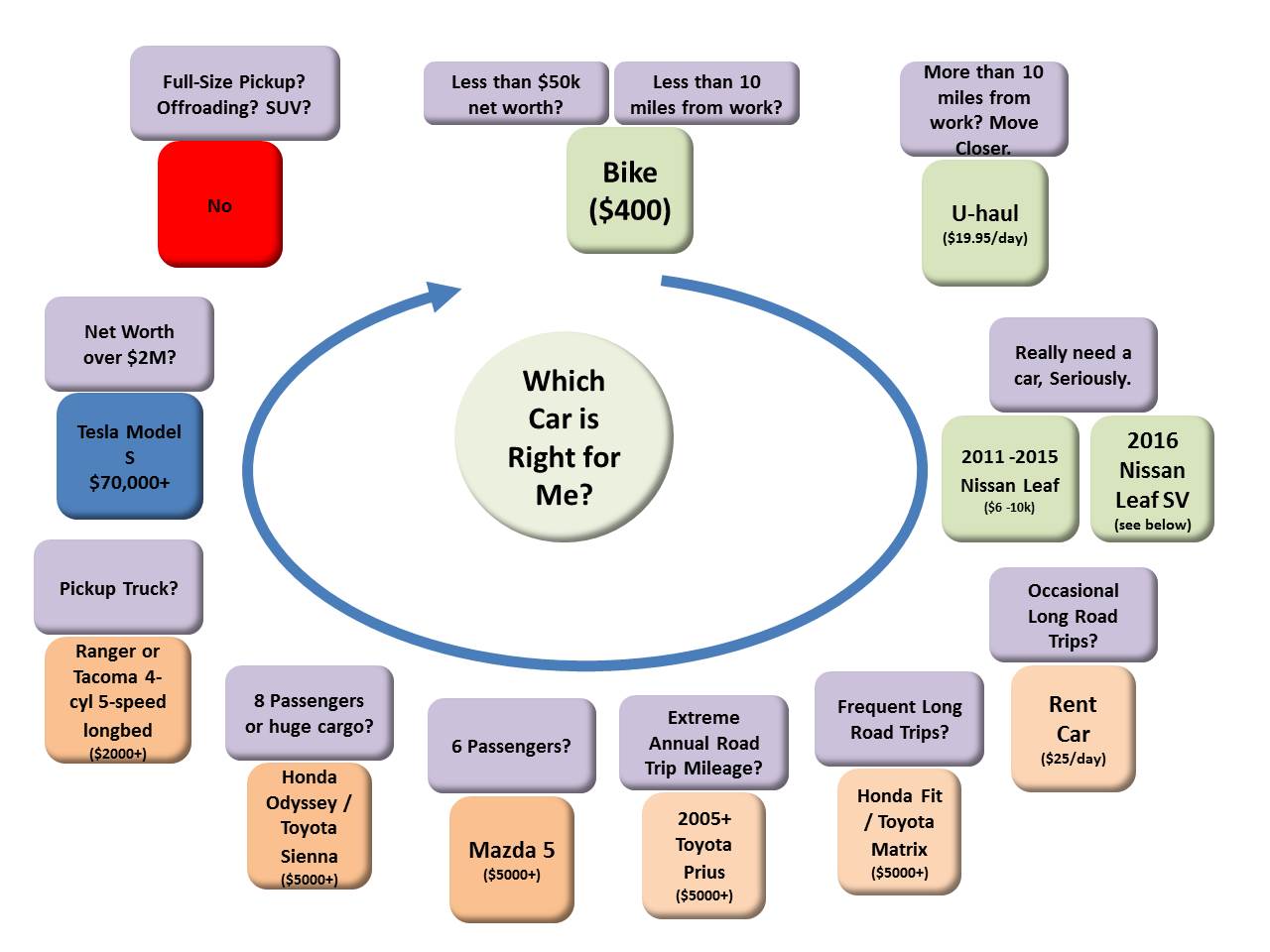
Fig. 1: Car Decision Chart
I was initially looking for a 2013 Leaf, but given my city’s location (90 miles roundtrip to the airport and some other key destinations) the longer range of the 2016 SV model would eliminate all possible range anxiety. Plus, given our unusual money situation these days and my desire to support the EV market in general, I figured the extra dollars would not be missed.
What about Other Electric Cars?
Besides the Leaf, there are EV versions of the Ford Focus, Volkswagen Golf, Audi A3, BMW i3 and a bunch of other cars. By the end of 2016, the new GM Bolt will be out with 240 miles range, at a higher price. GM has also made the excellent Volt plug-in hybrid since 2011, which is now pretty affordable on Craigslist. In another 2 years or so, you can get a Tesla Model 3 for $35k before tax credits. And the cars will keep getting better as battery prices drop.
I just chose the Leaf because I wanted to completely ditch the gasoline engine right now. It offered the best price/performance ratio in today’s market and is the most widely available. As you’ll see below, it could actually be considered a cost-effective choice despite the rapidly changing technology.
How Much Does This Thing Cost?
Now THIS is where things get interesting.
Straight off of my sales sheet, this is what the car will cost me:
Sorta Net Price of Car: $13,391
However, it’s not quite that good, because many of these discounts are taken only after you pay sales tax on the full price of the car ($31,544 in this case). In my region, sales tax is about 8.26%, so I paid $2605 of tax. About $1500 more than you’d pay on a car that was really priced at 14 grand.
So my total out-of-pocket cost with tax will be $16,000, which is equivalent to buying a brand-new car with a list price of $14,775. This is right around the price of the cheapest new cars* you can get in the US these days. The difference, of course, is that you get something that is fast, silent, pollution-free, almost free to refuel, carpool-lane eligible and pretty luxurious instead of an economy car.
My Dirty Financing Secret and the Strange Positive Cashflow
Blowing all credibility as Mr. Money Mustache, I actually financed this car.
In order to get that “hard to explain $6000 discount” from Nissan, you have to buy the car with zero downpayment and a 0% interest rate. You can then choose to pay the car off at any point, or let the free money ride over a 72 month payoff period.
I’ve bought new vehicles twice before in my lifetime, and both times I got a discount for paying cash. In this case, the incentives are reversed. (If you work in the financial sector, please let us know in the comments section below why it makes any sense for Nissan to do this!)
The only downside of all this is that carrying a car loan requires me to carry at least $1000-deductible collision/comprehensive insurance on the car, which costs me $190 per year extra at Geico. My car loan is for the full $28,000, so the insurance premium works out to only 0.6% of this balance per year – much less than I’ll earn by investing that money elsewhere, so therefore I’ll keep the loan unless it becomes a pain for some reason.
The net of all this is a very odd cashflow diagram for buying this car:
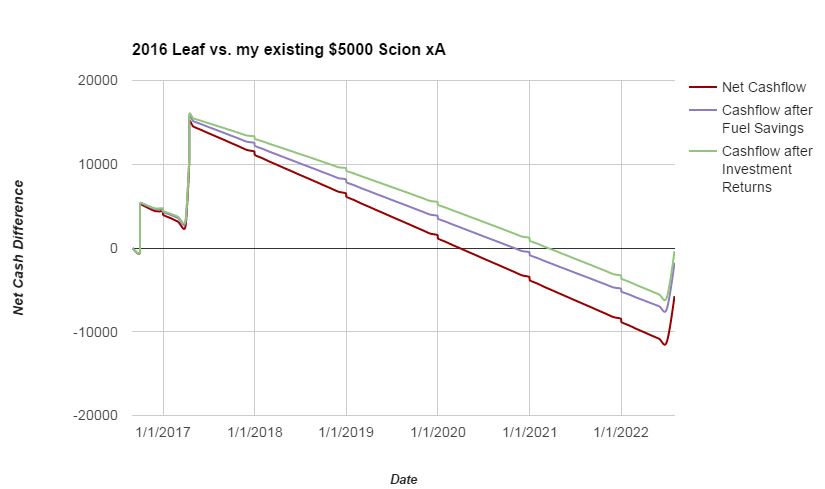
My net cashflow difference over time for buying this car. Original spreadsheet here.
I drove the car home without paying anything at all – I just signed a few papers. Two weeks in, I still haven’t paid a dime, which feels really inappropriate.
Meanwhile, I have already sold my old car on Craigslist and collected $5000 in cash, which is now in the bank. In about a month, Nissan will start withdrawing “car payments” from my bank at $400 per month. But at tax time, I’ll collect that juicy $12,150 in tax credits we saw above. Meanwhile, there are fuel savings every month, and I get to enjoy living in the future (and promoting the joy of gas-free transport to everyone else) the whole time.
The bottom line is that at on balance, I will actually have more money sitting in investments than I would have, if I had kept the old car – at least until mid-2021. On top of that, I’ve placed the new car in service as a business vehicle, which will make it partially tax deductible and skew those graph lines even higher.
At the end of the graph, I put a blip to simulate what would happen if I sold the Leaf for $7500 at that point. Meanwhile, my Scion would have been 16 years old and worth maybe $2000. Who knows what the year 2022 will bring – I could keep the Leaf, or perhaps switch to the latest self-driving electric car with a 400 mile range and replace my domestic air travel with sleeping in my future car while it drives me across the country at night.
Maintenance is much simpler on electric cars, but the battery does fade gradually. The warranty is 8 years, but you might be down to about 50% range after 100,000 miles. The Leaf battery can easily be swapped, at which point you’ll have an almost-new car. If you’re beyond the warranty period, the current price for this upgrade at a Nissan dealership is $5500, although with battery prices down 80% over the last 10 years, I would expect this to be about 50% lower by the time a new battery grows old enough to need replacement. For now, you could consider long-term battery wear to be roughly equivalent to engine maintenance costs on a very reliable small car (3 cents per mile).
Is it Actually A Nice Car?
In general, the Leaf is a spiffy vehicle, both inside and out. Interior materials are reasonably classy, especially if you get the black interior. Seats have a firm, reasonably sporty shape.The 5-door hatchback design makes it easy to load and unload people and cargo. Both front and back seating areas, and the trunk, are quite roomy. I can easily fit five of me into the car (6’0/185 lbs), and two more of me could actually fit into the hatch (without such niceties as seatbelts or comfort, of course). Or you can fold down the 60/40 rear seats and have an area big enough for two bikes or 1-2 adults sleeping (if you set up a level sleeping platform). Overnight camping (even in winter) in an electric car is somewhat practical, because you can run the automatic climate control overnight without running out of battery – even better if you have it plugged in.
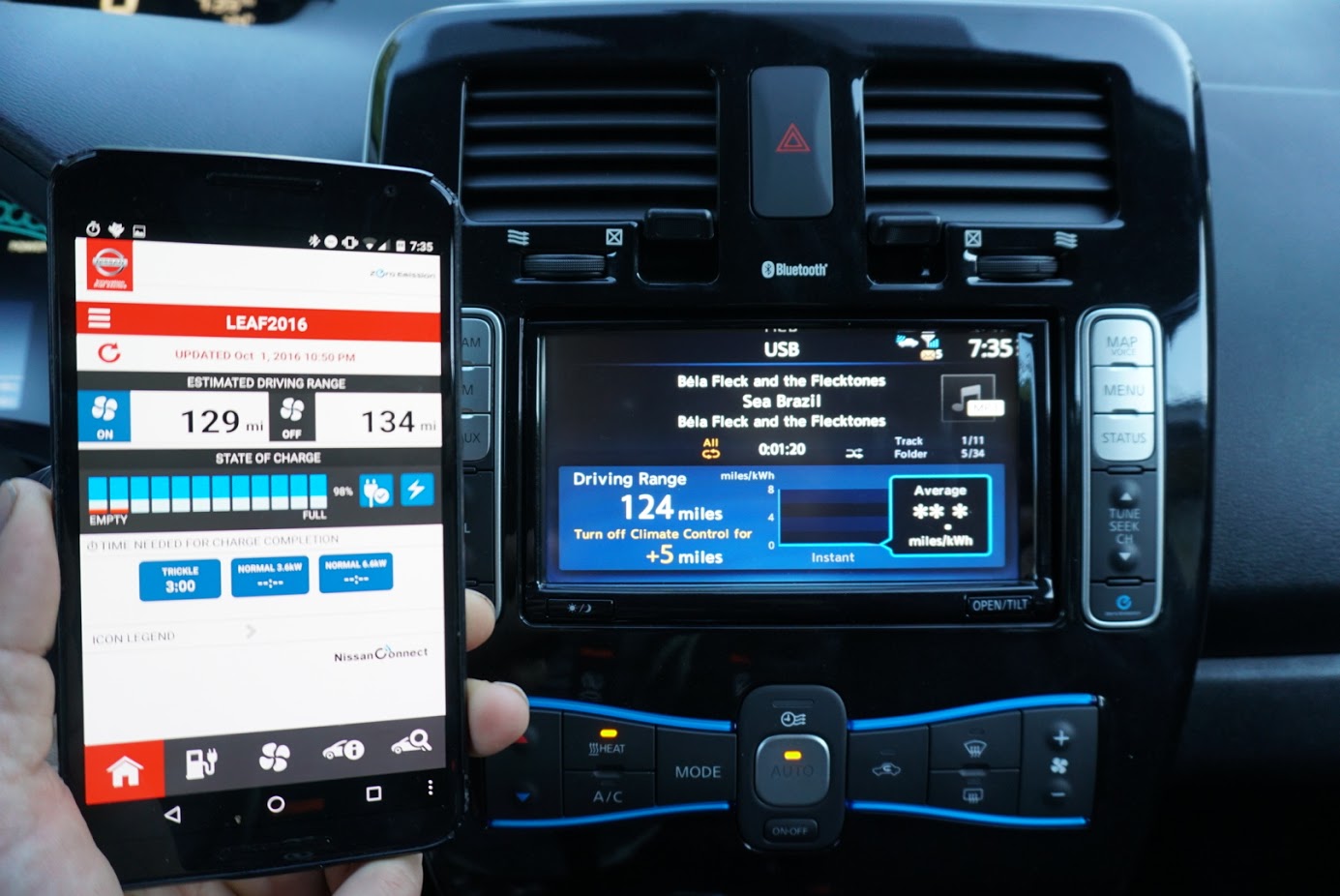
The Leaf’s main computer screen, and the phone app that goes with it**.
The car has some semi-useful electronics as well: a permanent cellular data connection allows you to check on the Leaf from your smartphone if you install the Nissan app. You can pre-heat (or pre-cool) the cabin from the comfort of your bed or office, as well as start/stop charging, check the charge level and review your driving history and efficiency with a nice calendar-based record. There’s also a GPS navigation system.
However, the whole system of menus, displays, and the app are a tech experience straight out of 2007. If you judge the Nissan by current iPhone/Android standards, you can only laugh and shake your head. On the other hand, even the Tesla Model S touchscreen is no match for a modern tablet.
Finally, the Leaf’s audio system sounds quite good thanks to 6 speakers including column-mounted tweeters. I filled up a 32GB USB drive (value $9) with about 500 of my favorite albums in MP3 form, and plugged it into the port on the dashboard. The car navigates the folders nicely and displays the album art. So I’m set for life and never have to resort to commercial FM or satellite radio.
How’s the Performance?
The Leaf is a controversial car: some say it is ugly and drives like an econobox, while I find it looks pretty damned nice, especially with the 17″ wheels and wide performance tires (215/50/17) that now come on the SV and SL models.
The weight distribution is close to 50/50 and nice and low, with the battery pack way down under the floor and the electric motor between the front wheels. Combining those good tires with the reasonably tight suspension, I find you can whip this car around on a curvy mountain road and it handles it very well. Cornering and passing in the city and interstate is similarly enjoyable.
But the best part is the acceleration. Subjectively, I’d describe the typical economy car or SUV as “plenty fast”, and a midrange performance car as “way faster than you need.” The Leaf feels even faster, at “holy shit this thing is fast!” – only a couple of impractical notches below my impression of the Tesla Model S, whose acceleration is “YEEEAAAH-WHAT THE HELL I’M ABOUT TO CRASH INTO THIS CAR THAT WAS JUST DISTANT SPECK ON THE HORIZON TWO SECONDS AGO!!”
The speed is a bit elusive: acceleration around town is fierce, but the official 0-60MPH acceleration numbers for the car are hard to find. So I tested it myself by flooring the car with a camera mounted in the back. You can also get a feel for the smooth, quiet operation of this car as there’s a bit of regular driving thrown in there:

As noted in the video, the actual numbers are only average compared to professional driver results on a moderately sporty car like a Honda Civic. But the instant 100% torque (187 ft-lbs of it) means that casually hitting the gas pedal on this car is equivalent to instantly shifting down to first gear in that Honda, revving the engine to 4000 RPM, then dropping the clutch at full throttle and powershifting through the gears at redline. Most people don’t drive like that in real life, and thus an electric car feels much faster for most drivers.
How Far Can it Go on a Charge? (and how much does the charging cost?)
The EPA rates the car at 107 miles per charge, because they simulate typical American driving patterns (full throttle at all times with constant unnecessary braking, and a parachute and a sack of bricks attached to the back of the car). So far, my lowest performance has been 115 miles (25 miles remaining after a 90 mile roundtrip to a far corner of Denver, mostly on the interstate at 70-80 MPH with A/C). And my best is around 150 miles (city and country driving averaging about 45MPH).
“How Long Does it Take to Charge?” is usually the next question, but the idea of waiting to fuel your car is actually somewhat obsolete. Because you generally just leave it plugged in every night, you awake to a car that is totally full – so most electric car owners never need to make a refueling stop. Much more convenient than gasoline.
However, to actually answer the question – you also can charge the car from empty to full in about 5 hours at the typical public charging station (these are often free to use). Or about 30 minutes at a DC fast charging station. Nissan provides 2 years of free nationwide charging with new Leafs. Public charging is starting to become pretty useful:
There are over 36,000 public charging machines in the US, and the number grows by over ten per day. This should continue to accelerate, because an 8-car gasoline pumping station costs about $1 million to build, while an 8-spot EV charger would be less than half the cost, and requires much less land (plus profit margins on electricity can be much higher than those on gasoline). Existing gas station chains including BP are already adding electric charging stations alongside their gas pumps.
Both coasts have already set up an “electric highway” infrastructure, which is a string of the ultra-fast 30 minute chargers spaced conveniently for electric cars.
If I’m charging at home, the car holds about 30 kWh of electricity, which costs roughly $3.00 at my local electric rates. By comparison, an economy car (35MPG) would burn around $10 of gas at today’s cheap prices to go the same distance, which means the Leaf is getting the equivalent of roughly 115 MPG. This comparison gets even better as the price of gas increases.
Do I Need an Expensive Home Charging Station?
In most cases, no. Just plug the car into a regular outlet whenever you aren’t using it, using the cord that comes with the car. This adds 4-5 miles of charge per hour, or 60 miles per day if you leave your car parked from, say, 7PM to 7AM.
If you need faster home charging (3-4x faster than the standard cord), you grab a 240 volt charger (about $300 on Amazon), and plug it in to any dryer plug. You can add an outlet like this in your garage or driveway for about $60 in parts and wiring, or hire an electrician to do it for a few hundred dollars, depending on the distance from your main breaker panel. Or you can get even fancier – search Amazon for “J1772” for all your options.
It’s even better if you can plug it in at work and let your employer pay for your energy.
Don’t Electric Cars Pollute Just as Much because of Coal Power Generation?
No. Because electric motors are much more efficient, even the worst case (charging an electric car purely on coal-fired electricity) comes out slightly better than burning the typical fracked and imported gasoline mix. Even better, the US electric grid is only about 28% coal these days, and dropping. Natural gas is still our biggest generator for now, but solar and wind account for almost half of new capacity added each year.
At my house, I’ve enjoyed 100% wind power for over 10 years, just by signing up to my local power company’s wind power program. Whether you buy an electric car or not, you should check with your electric company and switch to wind power (or install solar panels) immediately. And save your receipt, because I might use it as an excuse to invite you to lunch someday.
Further Reading:
This car is a pretty new thing for me. As I have some fun and test it out, I’ll put the results on a permanent page on this blog called The Nissan Leaf Experiment.
Although I have no affiliation with Nissan or any car dealership, I had a great experience buying this from Nigel at Boulder Nissan, because he’s a genuine EV nerd rather than a car salesman. If you’re shopping for one of these cars, feel free to compare the price I paid price to those at your own local dealership, or contact Nigel himself. You can tell him MMM sent you (he’ll know what that means).
Have Questions? Ask them in the comments below
I really enjoy talking about energy and transportation stuff, so I will do my best to answer more questions below. Also, I suspect that about half of the world’s 97,000 Leafs are owned by Mustachians since we are the ideal demographic for such inventions. So you’re an owner and know the answer to one of the questions, feel free to answer it on my behalf. And also share any corrections to this article if you see some incorrect details.
* note: most of the cars on that 10-most-affordable-cars list are excellent choices, especially the Honda Fit
** notice how my phone reports a different range than the main screen? That’s the perfect example of the clunky interface. You have to manually hit the “refresh” button on the phone app, which then goes into an unsightly 1990s spinning animation for, quite literally 38 seconds before you get the new data.
I can’t help imagining the request must be triggering a pager on someone’s belt at the Nissan Tennessee factory, who then runs to the nearest landline telephone and frantically makes a call.
Martha: “Hello, Bill? This is Martha at Nissan Tennessee. We need a range check on Mr. Money Mustache’s Leaf in Longmont Colorado!”
Bill: “No problem, I’m right in that neighborhood right now! I’ll pull into his street and check on the car. Stand by. (…)”
Bill: “OK! I got it! He’s at 124 miles remaining.”
Martha: “Thanks Bill! You are like a gazelle these days. How are the kids?”
Bill: “Well, Bill Jr. is a little bit sick, but we’re doing pretty well. Cynthia’s starting soccer next week…”
Martha: “Well, I better get this number entered into the mainframe. Talk to you later!”
Bill: “Sure thing, talk to you later!”
A few seconds later, I get my range update.
Hint to Nissan: you can poll this shit asynchronously in the background, and then the data will be reasonably current whenever I open the app. You cannot have 38 second delays in a product that you actually ship to customers. Who actually saw this and said, “Ship it!”?? Please hire some Mustachians to design all aspects of your interface in the future. We can help if you want to get in touch before the next Leaf comes out. Your look-and-feel grace period is almost over, as Tesla will not be gentle with you.

FBI director James Comey recently recommended that we all cover our webcams with tape for security reasons. Comey believes that doing so is a simple step for people to "take responsibility for their own safety and security."
Apparently Comey doesn't want to be spied on. In questions during a conference at the Center for Strategic and International Studies, Comey revealed that cam-covering is commonplace at the FBI and other government offices. "It's not crazy that the FBI director cares about personal security as well," he added. "If you go into any government office, we all have our little camera things that sit on top of the screen, they all have a little lid that closes down on them. You do that so people who do not have authority don't look at you. I think that's a good thing."
That the FBI's director covers his cams may be a surprise to some, just as it was when people spotted Mark Zuckerberg's webcam tape-over in a photo of his Facebook desk this spring.
But many of us who've been paying attention to cybercrime and punishment have been covering our webcams for years, and telling all our friends and family to do it, too. What's more surprising is that it's taken this long for officials and the press to raise the alarm. I mean, they're just a few years behind, but hey, it's nice to know they care.
In 2010, a Pennsylvania school narrowly escaped criminal charges when it was caught secretly taking photos of students through the webcams on school-issued laptops. Harriton High School student Blake Robbins filed a civil suit, and the FBI launched an investigation when he found out school employees had photographed him 400 times over a two-week period -- sometimes when he was partially undressed or sleeping. School officials said they had a tracking system for finding lost or stolen laptops but admitted that the software program took images every 15 minutes without telling the user. It turns out they'd snapped around 56,000 privacy-violating pictures of students.
Aside from institutional malfeasance, there's been a thriving black market for compromised webcams and the video or photos they can produce -- for many years. A clearly startled 2013 BBC reporter claimed the going price for access to a woman's webcam was priced at $1 per girl, whereas computer webcams belonging to men cost $1 -- for one hundred. And even then, three years ago, it was old news. The programs that capture images, take videos and record audio are not expensive, and they do their jobs surreptitiously by overriding the "record" light so victims don't know they're being spied on.
BBC's story was sparked by a case involving a Miss Teen USA contestant. A year before Cassidy Wolf won the 2013 crown, a guy in her high school used a program to hack into the webcam on her computer and take photos of her. She found out when he got into her social media accounts and tried to extort money from her. It turns out that she was one of 12 girls he had taken photos of and threatened for cash. He was sentenced to 18 months behind bars.
The software is typically put on a computer when the victim clicks a link, often through an email, and the computer becomes infected with a program that hides while letting the computer's camera be controlled remotely. Known as phishing, it's the most common form of online hack attack.

The following year, the FBI ran its largest cyber operation to date, in 2014, arresting scores of webcam hackers in over a dozen countries, who had all been using a program called Blackshades. The program has the ability to give its user access to "photographs and other files on the victim's computer, record all of the keystrokes entered on the victim's keyboard, steal the passwords to the victim's online accounts, and even activate the victim's web camera to spy on the victim -- all of which could be done without the victim's knowledge." The malicious tool was shown to have been purchased by several thousand hackers in over 100 countries, infecting more than half a million computers around the world.
After her harrowing experience, Ms. Wolf now tapes over all of her webcams, and so should we all. Everything has a camera. Your phone, your laptop, your tablet. If you have a modern device that can get online, it probably has a camera. And if it has a camera, someone looking for cash or scummy thrills has probably figured out how to hack it and turn it on without your knowing. Protecting yourself is as easy as taping it up, just like Zuck and Comey. Sticky notes work well because they have a gentle adhesive, and you can also find privacy stickers for purchase online that are made specifically for putting on (and taking off) web and phone cameras.
Perhaps what's such a facepalm isn't the irony of the FBI telling us how not to get spied on, or why cam-covering is such a wacky idea to Comey's friends. It's that the FBI is acknowledging to the public that, really, it's "everyone for themselves" when it comes to technology and personal security.
Which is how some of us have been proceeding all along.
Image: AP Photo/Richard Drew (Blackshades)

Hillary Clinton wants to become the president of the United States of America, and there is nothing she won’t do to make that a reality. This now includes an interview with Zach Galifianakis, braving a few insults about her pantsuits and her campaign on his fake web talk show Between Two Ferns.
Like most Between Two Ferns interviews (see: President Barack Obama and Justin Bieber), its brilliance is in its awkwardness and Galifianakis’s ability to create this quasi-artificial persona and ask absurd questions.
"Not to take away from that historical significance from you perhaps becoming the first female president, but for younger, younger generations you will become their first white president," Galifianakis deadpans. "That’s pretty neat too."
Clinton’s (non)reaction seals the joke.
/cdn0.vox-cdn.com/uploads/chorus_asset/file/7146165/2016-09-22%2009_41_28.gif)
He then asks Clinton about a contingency plan should she lose an election — something that we don’t often hear. Somehow, and for some strange reason, it makes the idea of civil war sort of … hilarious.
"When you see how well it works for Donald Trump, do you ever think to yourself, ‘Oh, maybe I should be more racist?’" Galifianakis continues. "When he’s elected president, and Kid Rock is secretary of state, are you going to move to Canada? Or one of the Arctics?"
"I would stay in the United States. I would try to prevent him from destroying the United States," Clinton replies.
"So you’re going to lead the civil war?"
"No, I wouldn’t take up arms."
"Oh, right, because you were saying before we were rolling that you wanted to take away everyone’s guns."
The sketch also works because Clinton isn’t taking herself too seriously, by which I mean she’s being completely serious in the face of pantsuit insults and Trump steak remarks.
Now, if only there were some way to get Galifianakis to moderate the upcoming debates.
And finally, if Galifianakis's boring policy talk was not to your liking, Clinton did do an interview with Vox's Ezra Klein earlier this year:
Mozilla's latest Firefox adds a couple new and refined features intended to improve the time you spend reading online. While Firefox released an ad-stripping, layout-simplifying Reader Mode way back in 2012, the newest release brings a new "Narrate" feature and additional tweaks for a better reading (or listening) experience.
Mozilla might be a little late to the game compared to Apple's robotic VoiceOver, but Firefox's new text-to-speech feature helpfully narrates articles so you can step away from the screen or swap to another tab and listen at your leisure. Reader mode is also getting some additional customization options that allow users to tweak the text, font size or reader voice, as well as new light and dark themes for daylight or nighttime reading that's easier on the eyes.
If you're on an Android device, Firefox now helpfully stores some previously viewed pages and data so you can interact with pages you've already visited, even if you hop on a plane or your data connection drops out. Finally, the latest update also brings better multiprocess support, which should translate to a much more responsive and much less crash-y web experience. Mozilla says it has improved overall responsiveness by a whopping 400% for users who forego browser add-ons, and the plan is to add support for compatible add-ons by 2017. At that point, Firefox will also flip the switch on Flash, which should do wonders for browser responsiveness.
The ACLU, Amnesty International, and Human Rights Watch are calling for the pardon of Edward Snowden. The ACLU:
The government has charged Snowden under the Espionage Act, a World War One-era law that doesn’t distinguish between selling secrets to foreign governments and giving them to journalists working in the public interest. If Snowden were to be tried under the charges he faces, any argument that his actions benefited the public would be inadmissible in court.
The Pardon Snowden campaign will work through the end of Obama’s administration to make the case that Snowden’s act of whistleblowing benefited the United States and enriched democratic debate worldwide, and we’re asking citizens to write to the president via our website.
Though some government officials claimed that irreversible harm had been done to US national security, little evidence has been aired publicly. Snowden entrusted the release of information to seasoned journalists and made them promise to inform the government and consider any claim of harm to national security in advance of publication. Adm. Michael Rogers, on taking the helm of the NSA a year into the revelations, told the New York Times he couldn’t say “the sky is falling.” Even Attorney General Eric Holder, who still advocated Snowden’s prosecution as he left office, conceded he performed “a public service.”
“Edward Snowden clearly acted in the public interest. He sparked one of the most important debates about government surveillance in decades, and brought about a global movement in defence of privacy in the digital age. Punishing him for this sends out the dangerous message that those who witness human rights violations behind closed doors should not speak out,” said Salil Shetty, Amnesty International’s Secretary General.
“It is ironic that it is Snowden who is being treated like a spy when his act of courage drew attention to the fact that the US and UK governments were illegally spying on millions of people without their consent.
“The mass surveillance exposed by Snowden impacts the human rights of people around the world. Our new campaign gives the public a chance to call for his pardon and thank him for triggering action by concerned individuals around the world to take back their privacy.”
Several prominent individuals have lent their support to the effort as well, including Steve Wozniak, Eve Ensler, Daniel Ellsberg, and Teju Cole. Bernie Sanders is also urging some form of clemency fror Snowden.
Why this push now? Obama is leaving office (typically a good time for pardons) and Oliver Stone’s Snowden is due out in theaters tomorrow. The reviews aren’t bad and Joseph Gordon-Levitt’s impersonation of Snowden is uncanny (see the trailer).
Tags: crime Edward Snowden Wilco just dropped their latest album Shmilco last week. Continuing the promo run for the album, Jeff Tweedy was a guest on Comedy Central's @Midnight With Chris Hardwick, and he participated in the recurring #hashtagwars game. The theme this time around was #onewordoffsongs in which contestants change one word of the title of the … More »
Ben WolfEff the undecided voter.

Here’s the paradox- even the most creative brands are not immune to the perils of becoming a large company.
The main perils being, of course, bureaucracy and exponential increases in complexity.
These perils develop over time, layer upon layer, building up and over each other like silt on a river’s bottom.
This buildup gets in the way of ‘flow.’
It stops creativity before the creativity even gets traction.
How can you fix it? Always keep things moving.
Eradicate the fear of change.
Encourage dissent and debate. Encourage growth.
Don’t let the fossils form around you just yet.
The post never lose the flow appeared first on Gapingvoid.
We like to think of ourselves as living in an age of unprecedented disruption. Just look at all the commonplace features of our world that didn’t exist a century ago—jet travel, television, space flight, the Internet. If you could transport someone from the year 1916 to the present, we ask a little proudly, wouldn’t that person be stupefied by the changes? And, of course, he would be, at least for a few days, until he figured out how everything worked. But one thing would be very familiar to such a time traveller: the pride, and the anxiety, we feel about being so modern. For people in the early twentieth century were as acutely aware of their modernity as we are of ours, and with just as good reason. After all, they might have said, imagine someone transported from 1816 to 1916: what would that person have thought of railroads, telegraphs, machine guns, and steamships?
See the rest of the story at newyorker.com
Related:American Airlines doesn't know what to say.
And they're having a lot of trouble saying it.
They're making a fortune this year due to low oil prices, and one way to manage shareholder expectations for the future is to put some of that profit into brand advertising. And so, they hired a fancy ad agency and started to run full-page, two-sided, glossy inserts in newspapers. The single ad I'm looking at cost at least $100,000. And I might be one of a hundred people who are actually reading it.
The copy-dense ad includes references to babies, red-eyes, noise, middle seats, lessons learned, 'relinquish', making the best of the situation and the ability to sleep anywhere. All told in an odd third-person, referring to the hero as "they" not "you."
With a layout that's so confusing that there's a big arrow that says "start here".
Some things worth remembering:
For thirty years, the airlines have relentlessly trained travelers to spend as little as possible on a seat, offering generic alternatives and contemptuous, confusing pricing policies. To blame the state of travel on the passenger ("Let's move that conversation from us and turn it onto them..." said Fernand Fernandez, VP of global marketing at AA) doesn't feel like the foundation for a great marketing campaign, does it?
The lesson for anyone spending money on ads: it pays to be consistent, generous and thoughtful when you build an ad campaign.
[Posted from LGA. /rant]
[For those that wanted to see the ad, here it is]