Leica's Photokina announcements don't stop with the unique, screenless digital M Edition 60 — the German camera maker has a series of more conventional digital models on the way. First up is the X (Type 113) and X-E (Typ 102, above), premium compact cameras with 16-megapixel APS-C sensors that follow on from the X1 and X2. The X-E doesn't appear to be a huge advance on its predecessor, similarly featuring a 24mm f/2.8 lens, but the X has a 23mm f/1.7 lens, beating out Fujifilm's popular f/2 X100 series. The Leica cameras have no optical or electronic viewfinder built in, however, and only the X is capable of shooting video.
Leica's Panasonic rebrands continue
Leica is also returning to its familiar tactic of rebranding popular Panasonic compact cameras. The new Leica V-Lux (Typ 114) appears to be the same as Panasonic's FZ1000 superzoom, and the D-Lux (Typ 109) is clearly based on the Japanese company's impressive new Lumix LX100. Pricing information is as yet unavailable, but if history is any guide you'll be paying extra for a sleeker design, a red-dot logo, and some bundled photography software.
And if digital still isn't your thing, you might be interested in the new Leica M-A, a fully mechanical film rangefinder camera that shares much in common with the existing Leica MP. It's being issued as part of the same 60th anniversary celebration as the M Edition 60, and will come bundled with Kodak Tri-X 400 monochrome film — another product that made its debut in 1954. It'll be out next month.
Finally, the new Leica T mirrorless camera is getting a pair of new lenses, doubling the somewhat meagre range of optics available for the system. The 11-23mm f/3.5-4.5 wide-angle and 55-135mm f/3.5-4.5 telephoto lenses will give T shooters more options in terms of focal length, but the slow zoom lenses aren't likely to appeal to those who appreciate Leica's traditional fast primes.
Here at MailChimp, we’re always trying to listen hard and change fast. Turns out, this requires a good bit of coffee. Each department has its own take on how to keep the stuff flowing, mostly with the standard Bunn-O-Matic commercial machines. A few folks regularly avail themselves of our espresso setup. The developers fill two airpots—one with regular, the other double strength.
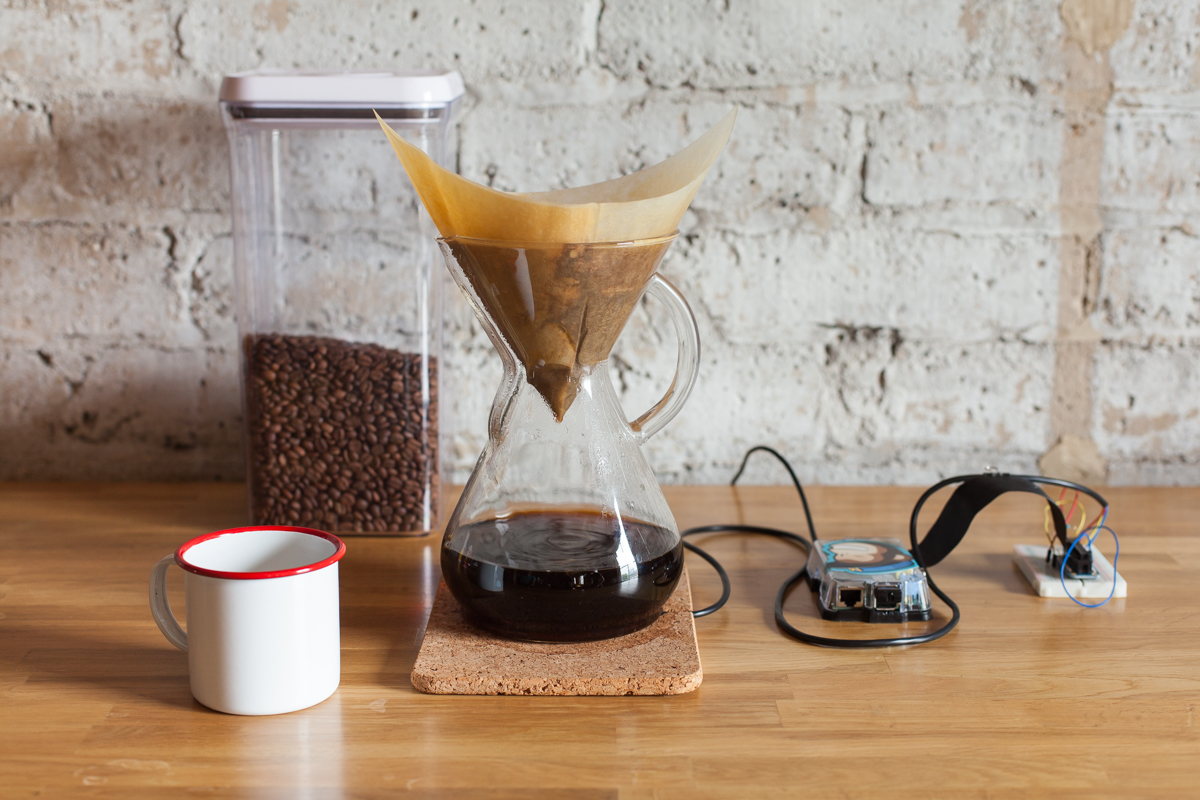
And then there’s the marketing team and our precious Chemex.
We make a pour-over pot once every hour or so, all day long, 5 days a week, 50-something weeks a year. Last December, when we were gathering data for our annual report, we got curious about how many Fresh Pots that might amount to. We tried to count it up, but begrudgingly had to accept the fact we didn’t have a good measure beyond pounds consumed. We even tried to keep track with a bean counter, but that didn’t last long.
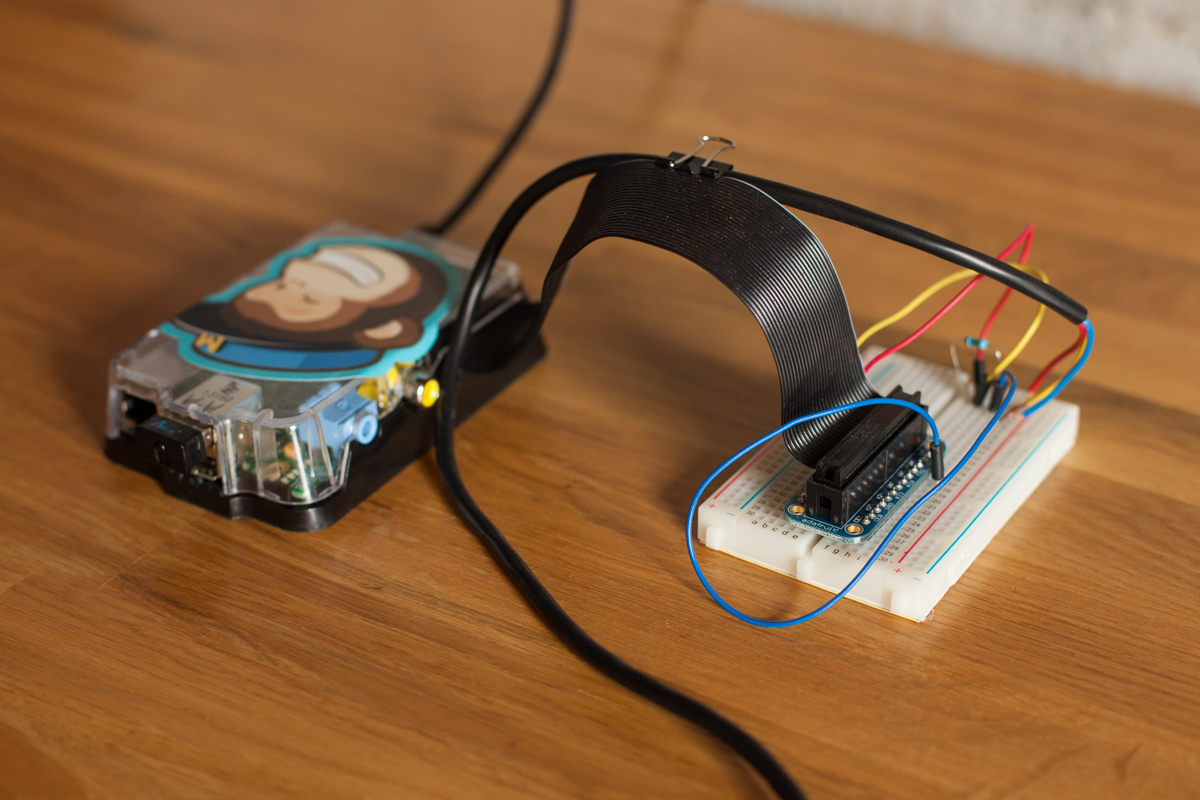
For a while, the exact nature of our coffee consumption seemed like it would remain just another mystery of the universe. But then one day, talking to Mark while waiting on yet another Fresh Pot, I said, “Hey, I bet we could track the temperature with a Raspberry Pi and post to the group chat when there’s a fresh one.”
I wasn’t too serious, but Mark’s response was one often heard around MailChimp when ridiculous projects are proposed: “Sounds great, just let me know what you need to get it done.”
With a Raspberry Pi in hand, the first thing I did was add a script to the boot process that sent an email using Mandrill with its IP so I could find it on our network without trouble.
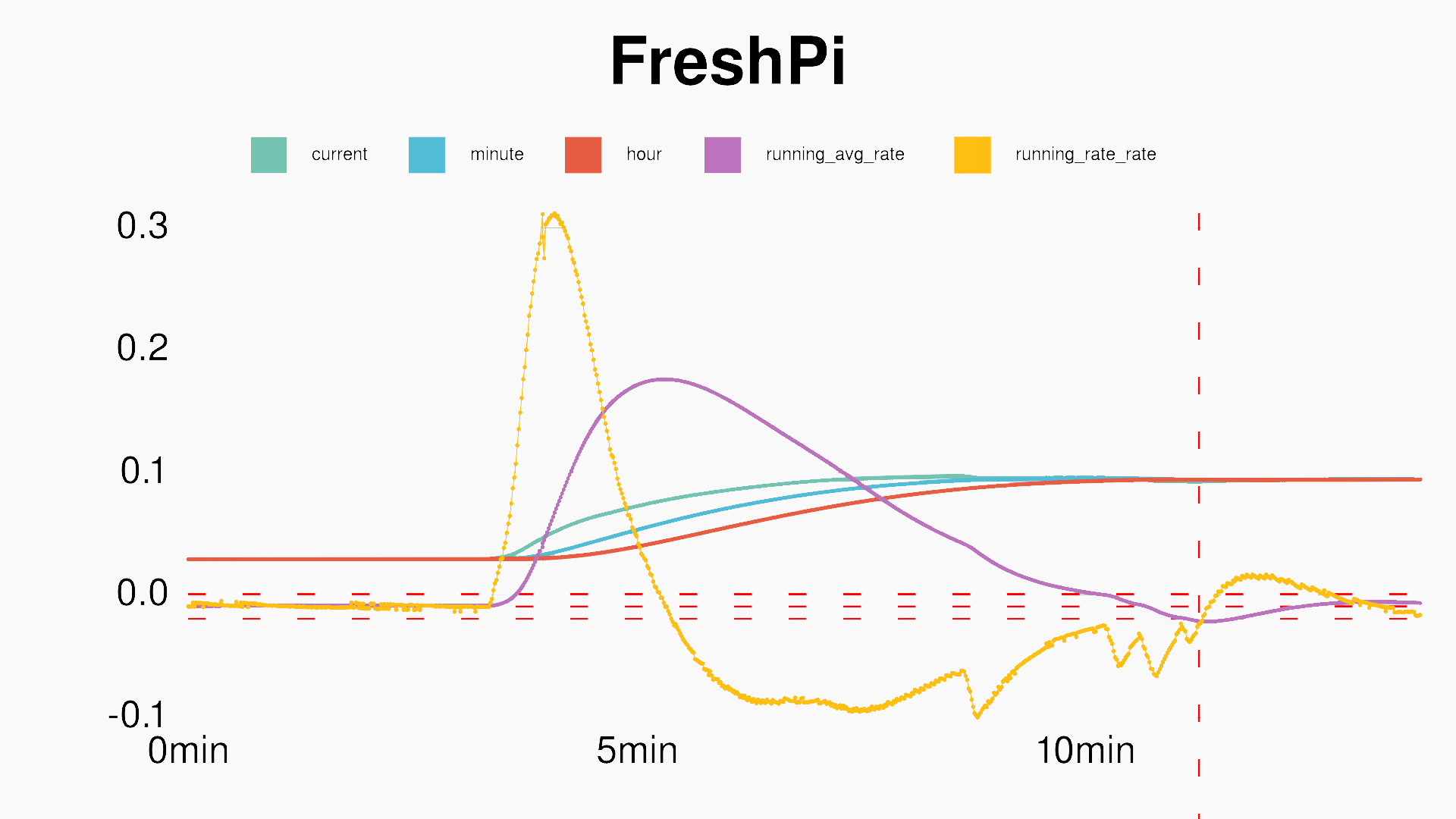
Then, I had to tackle the problem of detecting pot states with only a single datapoint: current temperature. I hoped that comparing the running averages of different time spans would be enough to determine the pot’s status. (The average Chemex temperature over the course of a few minutes, for instance, would tell us something different than the average temperate over the course of an hour.)
Since this was a greenfield project, I wanted to work with an unfamiliar language. I felt like the more functional nature of Clojure would be a great fit for passing along a single piece of state. This turned out to be a great decision, and I’ll explain why in a minute.
Graph it home
I hacked together a quick program that would spit out the current temperature, minute’s running average, hour’s running average, and the running average’s rate of change to a log file so I could analyze them.
Log files in hand, I temporarily turned back to Ruby using the wonderful Gruff charting library to visualize things and make patterns easier to spot.
A few batches of hot water gave me a decent idea what things should look like, so I moved our coffee equipment to my desk to get some live data. This let me check in with the actual running state of the program and compare it with the status of the pot (and led to some coworker laughs and a wonderful smell at my workspace all day).
A brewing or fresh pot is easy to recognize, but figuring out when the pot is empty turned out to be a little tricky. It takes a while for the Chemex to completely cool off, which means it could be empty and still warm, which I’m sure would lead to more than a few disappointing trips to the kitchen. Luckily, the rate a pot cools tells us if it is empty or not—for instance, a half-full pot stays warm longer than an empty one simply because of the coffee still in it. Always nice to have physics on your side.
Watchers for the win
Armed with the collection of datapoints (running averages, rate of change, etc.) for each of the pot’s states, I moved on to figuring out how to notify our department’s group chat room when a pot was brewing, ready, empty, or stale. This is where some of the built-in features of Clojure came in handy.
I already had a program that logged the current state of itself every second. By switching the actual state to an agent, I could apply watchers to it. These watchers get called whenever the agent changes, which is perfect for analyzing changes in state.
Another agent added was the pot itself. The watcher for the temperature would look for the above mentioned boundaries, and update the pot’s state, leaving another watcher to track the pot and notify our chat room. When it came time to pick an alias to deliver the notifications, Dave Grohl was the natural choice.
Here’s a simple example of the pot watcher looking for a brewing pot:
The great thing is the watcher only gets called when the status changes, not on each tick of the temperature. Using agents felt great to me in this case as they provided a clean way to watch state (without callbacks or a ton of boilerplate) and maintain separation of concern between different parts of the program.
Freshness into the future
I’m still working out a few kinks, tuning in the bounds, and keeping a log of pots. It’s been a fun experience and I learned a ton. Something tells me this won’t be the last time we work with Raspberry Pi on a project. What’s next, Fresh Pots in space? Luckily, we’ve got plenty of coffee to propel us.
Ben: Thanks to Steven and MailChimp for permission to use the post – we’re very pleased to see the Pi used as the tool of choice of coffee-hungry developers around the world! Coffee is important to us here at Pi Towers…
Blast from the past – remember this coffee pot? Click to read more
MailChimp is what I use to power Pi Weekly – my weekly Raspberry Pi news & projects email newsletter – check it out at piweekly.net!
DARREN SPROLES DARREN SPROLES DARREN SPROLES DARREN SPROLES
Andrew Luck threw a late interception and Cody Parkey hit a game-winning field goal to give the Eagles a 30-27 victory Monday night.
Entering Monday night, Andrew Luck had yet to lose two games in a row. Fortunately for the Philadelphia Eagles, all streaks must come to an end, and Luck's is now dead.
Nick Foles led the Eagles on a game-winning drive, as Cody Parkey kicked a 36-yard field goal as time expired to give Philadelphia a 30-27 victory against the Indianapolis Colts Monday night.
The win moves the Eagles to 2-0, while the Colts fall to 0-2. Here's what we learned Monday night:
1) Andrew Luck is human. Not only did he finally lose two games in a row, but Luck's own costly interception set up the Eagles' game-tying drive late in the fourth.
He certainly wasn't at his best Monday night (he was 20-of-34 for 172 yards, though he did have three touchdowns), but Luck did put the Colts in a position to win when Indianapolis went up 27-20. Then, as Indianapolis was driving to go up by two scores and put the game away, Luck was intercepted and the Eagles took it to a tired Colts defense.
2) The Eagles aren't so good at first halves. For the second week in a row, Philadelphia had plenty of offensive trouble scoring in the first half. The Eagles got deep into the Colts' territory plenty of times, but they came up with only six points for a 17-6 halftime deficit.
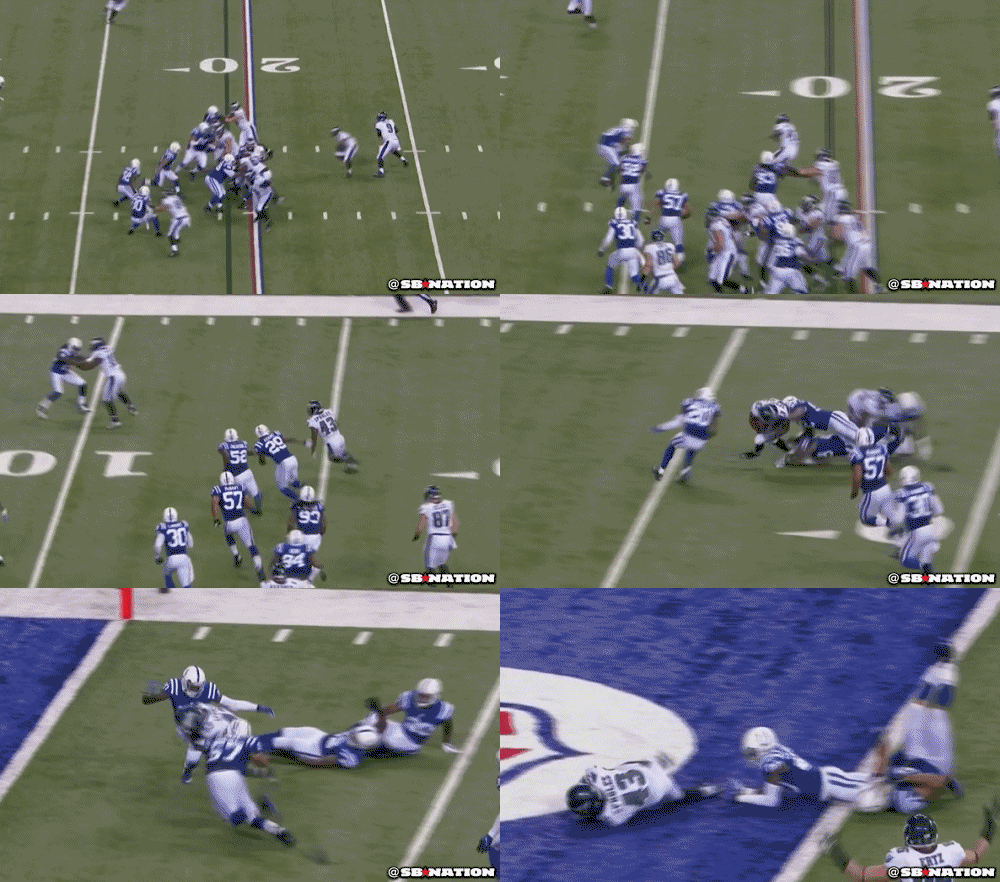
But who cares about the first half when you can play so well in the second? Once again, the Eagles looked like a completely different team in the second half, tying the game at 20 with 2:44 left in the third quarter with a great run by Darren Sproles.
Then Sproles followed it up with a 51-yard reception to help set up the Eagles' game-tying TD with 3:25 remaining.
Despite another comeback, Philadelphia still might want to start showing up for the first half of games from now on. #HotTake
Nevertheless, the Eagles are sitting pretty at 2-0.
3) Do the Colts have a running game now? It's possible, though at this point, when Trent Richardson is having a good day, it's downright baffling. Was the Eagles' run defense that bad, or has Richardson broken through just a little bit? On Monday, it would appear to be the latter, as Richardson was finally a little more decisive in his cuts, powering his way to 79 yards on 21 carries.
Of course, he did have a costly fumble to keep Philadelphia in the game, so, you know...baby steps.
Ahmad Bradshaw added 70 yards on just 13 carries, and the Colts were finally able to rely on their running game a little more. Not that it's much consolation in a tough loss like this.
Injuries
Eagles
Linebacker Mychal Kendricks left late in the third quarter with a right calf injury and did not return to the game.
Colts
Defensive end Arthur Jones left in the second quarter with a right ankle sprain and was unable to return as well.
Nick Cave is known first and foremost as a singer-songwriter—mainly in the transgressive post-punk band The Birthday Party and the brooding, mysterious ensemble Nick Cave And The Bad Seeds—but he’s also worked in prose and film. One thing that ties all his projects together is a grainy, cinematic quality, which is partly the reason why 20,000 Days On Earth works so beautifully. The documentary, directed by Iain Forsyth and Jane Pollard, only barely lapses into the standard, talking-head testimonial that’s become the default setting for rock docs. The rest of the film attempts to match, through shadowy nuance and verité-style perspective, the starkness and intensity of Cave’s work, regardless of what medium it takes on. And at that, it almost entirely succeeds.
Cave got his start in the ’70s in an Australian new-wave band called The Boys Next Door; when that group morphed into ...
An anonymous reader writes: Multiplayer modes used to be an extra part of most games — an optional addition that the developers could build (or not) as they saw fit. These days, it's different: many games are marketed under the illusion of being single-player, when their focus has shifted to an almost mandatory multiplayer mode. (Think always-online DRM, and games as services.) It's not that this is necessarily bad for gameplay — it's that design patterns are shifting, and if you don't like multiplayer, you're going to have a harder time finding games you do like. The article's author uses a couple recent major titles as backdrop for the discussion: "With both Diablo III and Destiny, I'm not sure where and how to attribute my enjoyment. Yes, the mechanics of both are sound, but given the resounding emptiness felt when played solo, perhaps the co-op element is compensating. I'd go so far as to argue games can be less mechanically compelling, so long as the multiplayer element is engaging. The thrill of barking orders at friends can, in a way, cover design flaws. I hem and haw on the quality of each game's mechanics because the co-op aspect literally distracted me from engaging with them to some degree."
He was carrying a sword? This mf in my geography class carried a sword to class everyday and when I expressed my discomfort it was dismissed. But this brotha was shot in the back.
and it was a blunted sword.. couldn’t have cut anybody… but white people walking around with loaded rifles in target…
Exactly! This is evil.
Damn. Niggas can’t even cosplay anymore? I would love to see the cosplay community say something about this but that definitely won’t happen
Also: this paper is edited by a clown. It should’ve been in the first fucking paragraph that this dude was cosplaying. I’m reading this shit wondering why the fuck this negro is walking down the street with a sword and obvious answer is hidden almost at the en of the article.
This dude was cosplaying.
He was dressed up in a costume.
Should all black people just stay home on Halloween this year?
Friendly reminder that the police shot a black cosplayer in the back
Enterovirus D68, the respiratory illness suspected of hospitalizing hundreds of children in the nation, has now spread to the Northeast and is likely to hit the whole country.
Connecticut and New York are the latest states to report cases of the rapidly spreading virus that has targeted young children, especially those with asthma, in 21 states.