SFGate |
After bombs found, police say Frein making errors SFGate BLOOMING GROVE, Pa. (AP) — The discovery of two powerful pipe bombs during a massive manhunt in the Pennsylvania woods indicates the fugitive wanted in an ambush on state troopers is stressed out and making mistakes, authorities said as they ... Pennsylvania police on manhunt find pipe bombs in woodsHonolulu Star-Advertiser Pennsylvania: Pipe Bombs Found in ManhuntNew York Times Two pipe bombs found in Pennsylvania cop-killer manhuntLos Angeles Times all 363 news articles » |
firehose
Shared posts
01 Oct 04:34
After bombs found, police say Frein making errors - SFGate
01 Oct 04:00


Titan's Enigmatic "Magic Island" Continues To Baffle Scientists
by George Dvorsky

Remember that bizarre "magic island" on Titan's northern seas? The one that suddenly emerged and then inexplicably disappeared? Well, it's baaa-aaack — and it's changed.
firehose and -1 others like this
01 Oct 04:00
NYU Eats World
Universities usually make headlines with sports-related meltdowns, but NYU was fending off charges of outlandish payouts and perks to some high-level executives, and of labor and human-rights abuses at its branch campus in the Middle East.
billtron likes this
01 Oct 03:57


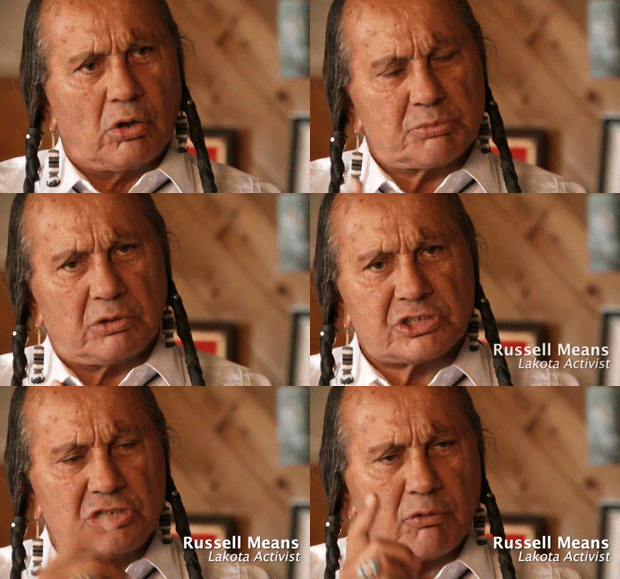
citylung: orphanofearth: "And then to treat my nation like we...
"And then to treat my nation like we don’t know how to fight. We, the Lakota, who are responsible [for being] the first nation to ever militarily defeat the United States of America on the field of battle, and "Lawrence of the Plains” has to teach us how to fight??”
Russel Means on Costner’s Dances With Wolves (1990)
From the fantastic, Native-produced documentary Reel Injun
and it is on Netflix
firehose and -1 others like this


01 Oct 02:50


Here's Bruce Wayne Listening To Death Metal And Sketching, On Gotham
by Charlie Jane Anders
Somebody really, really needs to remix this scene so young Bruce Wayne is listening to Batman's song about darkness from The Lego Movie. Spoilers ahead...
firehose likes this
01 Oct 02:49
DC Wonderfully Responds To Those Terrible Superman/Wonder Woman & Batman Shirts - Well, that's a nice start.
by Victoria McNally

Say what you want about DC Comics and their various and sundry public marketing snafus, but they’re getting much, much better at quickly and graciously addressing fan concerns and apologizing for their involvement. Which, I guess they kind of had to when you think about it. Still, credit where it’s due, guys.
In case you disappeared from the Internet yesterday and don’t know what we’re talking about, yesterday several websites (including us, of course) pointed out that the above two t-shirts don’t exactly lend themselves to a positive and empowering atmosphere for female comic book fans. In light of the controversy, a spokesperson for DC told The Huffington Post the following:
DC Comics is home to many of the greatest male and female Super Heroes in the world. All our fans are incredibly important to us, and we understand that the messages on certain t-shirts are offensive. We agree. Our company is committed to empowering boys and girls, men and women, through our characters and stories. Accordingly, we are taking a look at our licensing and product design process to ensure that all our consumer products reflect our core values and philosophy.
Between this and the apology by Justice League: Axis of Villains board game maker Wonder Forge to writer Peter V. Brett, who recently recounted his poor experience playing the woman-less game with his young daughter, it seems like DC (and the companies they license their characters to, of course) are sloooowly starting to figure out we hate it when they do stuff like this. Which is great! That’s what we want, after all: for DC to help make comics a friendlier and more welcoming environment for everyone by championing diversity and equality, and maybe encouraging young girls to aspire to more than “Batman’s wife” or “Superman’s score.”
Oh, also, a Wonder Woman movie. But it’s all basically the same core concern when you think about it.
Are you following The Mary Sue on Twitter, Facebook, Tumblr, Pinterest, & Google +?
01 Oct 02:49
‘Cherry Tree House’, A Beautiful Spherical Sculpture Crafted From Willow
by EDW Lynch

“Cherry Tree House” is a beautiful spherical sculpture, crafted from willow, that is propped in the branches of a tree. The sculpture — seen here dramatically illuminated at night — was created by artist Tom Hare. Hare is a specialist in willow sculpture, and he has more work on his website.


photos by Daniel Castledine
via Lustik
01 Oct 02:48


Newswire: Tim & Eric directed a lightbulb commercial starring Jeff Goldblum
by Katie Rife
Even the most famous weirdos have to eat, and Tim Heidecker and Eric Wareheim have never tried to hide their work making ads for companies like Old Spice and Absolut Vodka (not that they’d be able to deny any of the bizarre spots were theirs in the first place). Heidecker and Wareheim’s newest corporate client is multinational superconglomerate GE, which threw a little cash at the surrealist comedy duo to sell lightbulbs to the hyper-self-aware pre-post-ironic market. (Can’t light everything with your iPhone, millennials.) Heidecker and Wareheim got Jeff Goldblum—consistently one of the Internet’s top five favorite actors who wasn’t on Star Trek—to star in the ad, which looks twice as expensive as an average Tim & Eric Awesome Show, Great Job! bit, but with 100 percent less vomit.
Lblock likes this
01 Oct 02:43


Newswire: How To Get Away With Murder’s premiere broke DVR viewership records
by Dan Selcke
Collectively declaring their right to enjoy the professional and personal exploits of tough-as-nails lady lawyers whenever they damn well please, more than 6 million Americans banded together to view the premiere of How To Get Away With Murder, whenever they could get around to watching it on their DVRs. The ABC drama starring Viola Davis as a defense attorney who specializes in getting the job done—no matter what—debuted this past Thursday to an audience of 14 million people. It was a strong showing, but within three days, viewership had swelled to 20.3 million. That represents the biggest live-plus-3 ratings jump in history, handily trumping other time-shifting champions like The Blacklist and Gotham, and giving ammunition to anyone interested in arguing that Viola Davis could best James Spader or Batman in a fight.
Impressive as How To Get Away With Murder’s record-busting is, it’s part of ...
01 Oct 02:43
YouTube Star Who Harasses Women Is Now Being Accused Of Rape
by Sam Maggs

Ah, Sam Pepper. First, you were just a guy who harassed women for YouTube views. Then, you were a guy who allegedly harassed women just because. Now, you’re being accused of raping a girl the last time you were in Toronto. Next time, some advice you may want to consider: don’t sexually assault people for any reason. Just a thought.
For those of you who need a quick backgrounder, the story goes something like this. Sam Pepper is an ex-Big Brother contestant and YouTuber who racked up views in videos where he sexually harassed women, by doing things like pinching their butts or lassoing them on the street. Pepper, attempting to save his public image (such as it was) attempted to pass off his most recent stunt as a “social experiment” to raise awareness for domestic violence against men. Since this was patently untrue, Pepper’s network dropped him – especially once brave women started popping up across the internet, willing to share their stories of how Pepper allegedly personally sexually assaulted them (many of them while they were underage).
Now, because things weren’t already horrible enough, a Toronto woman is stepping forward and accusing Pepper of raping her. The entire account, which you can read over at BuzzFeed News, is from a 20-year-old woman, who asked to have her name withheld. She says she met Pepper through Twitter, and they began communicating before his Toronto concert back in April on Facebook.
BuzzFeed has logs of the (alleged, I guess) Facebook chats, and they’re pretty brutally self-explanatory; Pepper essentially pressures her into meeting him at his hotel room before the concert, at which point he forces her to perform oral sex on him. After the concert (behind spoiler tags for those who might be triggered by sexual assault):
In light of this accusation, BuzzFeed says Pepper deleted his Instagram, Facebook, and Tumblr accounts. Pepper’s Twitter account is active, but he hasn’t tweeted since the day before these new allegations surfaced. [Updated: We originally erroneously reported that Pepper had deleted his Twitter, instead of Facebook. Apologies!].
Of course, this woman isn’t the only one to have accused Pepper of assault in the recent weeks. SEX+ YouTuber Laci Green posted a video recounting the tales she’s heard from women recently, some of whom are planning on pressing charges. That’s in addition to this video from YouTuber thisisdottie, this video from an anonymous woman, this blog post by Shirley J, these tweets from Bryony Harris, and this account from Abbey McEnroe, all of whom have similar accusations against Pepper of sexual assault.
I feel like I’ve said everything I have to say about Pepper, so I can only leave you with these persistent messages: don’t watch his videos. Don’t support his work. Don’t watch or support the videos of anyone who posts similar types of sexual harassment masquerading as “pranks.” Report anything you find. Speak out against it when you feel it is safe for you to do so.
And equally as importantly: never victim blame. Listen to and support survivors, and we can all make the world a slightly better place, in spite of guys like Sam Pepper.
(via Jezebel)
Previously in Sam Pepper
- First, he harassed women on YouTube
- Then, he tried to call it a “social experiment”
- Then he was dropped from his network amidst assault allegations
- “MURDER PRANK!!!” is the perfect send-up of it all
Are you following The Mary Sue on Twitter, Facebook, Tumblr, Pinterest, & Google +?
01 Oct 02:43
Things We Saw Today: Who Just Said “Skull-Shaped Pizza Rolls”? - It's so beautiful.
by Rebecca Pahle

OH MY GOD. OH MY GOD. OH MY GOD. OH MY GOD. OH MY GOD. Hungry Happenings has the recipe. OH MY GOD. OH MY GOD. (via That’s Nerdalicious)
- The Sexual (and Racial) Politics of Nerd Culture: A Dialogue*. Stuff like this is why The Toast is one of the greatest sites that is, has been, and ever will be.
- How to Be a Woman On the Internet (via Styleite)
- State Farm Drops Rob Schneider Because He’s an Anti-Vaccine Moron (via Pajiba, warning for autoplay video)

I’m not working from the office today, so I can’t be sure, but I’m reasonably certain that when Crystal recapper and resident TMS Sailor Moonatic Victoria saw these Artemis and Luna leggings, she threw something. (via Storenvy)
- Meet the Women Who Conquered the Comics World at Neatorama.
- Donald Glover and Elizabeth Banks have joined the cast of Magic Mike XXL. Collider has a synopsis.
- Remember the Museum of Science Fiction’s design contest? Its winner is Emily Yen—you can see her design here (scroll down a bit).

ThinkGeek is selling these Star Trek A-line dresses, and boy, do they look comfy. (via Fashionably Geek)
Are you following The Mary Sue on Twitter, Facebook, Tumblr, Pinterest, & Google +?
01 Oct 00:31

FCC considering petition to ban Washington NFL team name from television
by Louis Bien
FCC Chairman Tom Wheeler is considering a petition that would ban Washington's team name from television, striking another potential blow to a moniker widely deemed to be offensive.
The Federal Communications Commissions is reviewing a petition asking that the Washington NFL team name be banned from television stations, according to the National Journal. The petition, filed by a George Washington law professor, claims that the name "Redskins" should be banned for violating federal rules barring indecent content from appearing on broadcast television.
FCC Chairman Tom Wheeler acknowledged the petition at a press conference Tuesday.
"There are a lot of names and descriptions that were used for a time that are inappropriate today," Wheeler said. "I think the name that is attributed to the Washington football club is one of those."
Wheeler has said that he personally finds the team name offensive, but stopped short of saying it is illegal. Harsher opinions have been issued against the team name by former FCC officials. Last year, former FCC chiefs penned a letter deriding Washington and calling for the current FCC administration to act.
CBS fired Jimmy "the Greek" Snyder in 1988 for making racially derogatory remarks. ESPN - a cable channel, not a broadcasting channel - apologized for remarks that sportscaster Brent Musburger made in January about the girlfriend of the University of Alabama's quarterback.
If broadcasters follow their own tradition, they will insist that Snyder no longer put them in the intolerable position of using a derogatory term to describe his team. So, too, should the FCC applaud broadcasters for pursuing the name change.
Action by the FCC would put even more pressure for team owner Dan Snyder to change the name of his football team. Earlier this year, the U.S. Patent Office canceled Washington's registrations on its team names. Snyder has appealed the decision. If he loses, Washington would no longer be able to claim trademark rights on the team name, opening it up to be monetized by others and erasing a significant source of revenue for the organization.
firehose and -1 others like this
01 Oct 00:27
stephenhawqueen: the US is unreal like girls cant wear shorts to school you can literally lose...
 |
Courtney
shared this story
from  Super Opinionated. Super Opinionated.
|
the US is unreal like girls cant wear shorts to school, you can literally lose your job for being gay, and unarmed black children are brutally murdered on the regular but white ppl r still like “what a beautiful country. i can freely carry a gun for no reason and some of our mountains look like presidents. god bless”
01 Oct 00:21


Facebook’s ad platform will know who you are, what you buy, even offline
by Casey Johnston
A few of a marketer's favorite things.
Facebook has officially relaunched the advertising platform Atlas in a new incarnation that will allow marketers to track users in new dimensions, according to a blog post from the company. Atlas will offer the ability to not only synthesize information about where users are seeing ads, but also to see how and whether those ad views play out into a purchase, even if it's offline.
Facebook acquired Atlas from Microsoft in 2013, and now the platform has been "rebuilt from the ground up." Atlas aims to accomplish what it calls "people-based marketing"—that is, the counterpoint to marketing based on a browser cookie or isolated social media profile.
Atlas's services purport to solve the "cross-device" problem, where marketers struggle to relate the browsing activity on a user's phone to what they do on their computer. This has become easier to an extent with Facebook profiles and logins, but Atlas also plans to add "partners" that "cross search, social, creative management and publishers" to track how ads are viewed and how successful they are on multiple "channels and platforms."
Read 2 remaining paragraphs | Comments
30 Sep 22:50
FCC Rejects Blackout Rules
by Soulskill
firehose!
Today the Federal Communications Commission eliminated its sport blackout rules, which prevented cable and satellite television providers from showing sporting events that were blacked out on a local station. It's common practice in the NFL to black out football games locally if the stadium didn't sell enough tickets. The ruling now removes government protections for the NFL's policies (the NFL can continue to black out local broadcasts). The FCC's decision is based on "significant changes" to the industry over the 40 years since the rules were adopted. Television has replaced ticket sales as the primary source of revenue, and the NFL is incredibly popular. They also don't think there's any chance the NFL will move its games to pay-per-view. 


Read more of this story at Slashdot.
30 Sep 22:50

Path Talk lets you text businesses instead of calling, and it actually works
by Ellis Hamburger
"What if you could text message a store instead of calling them?"
This is the stuff of a Silicon Valley fairytale — the promise of an app that’s never actually going to work. But this one does. Path Talk, the first standalone app from Dave Morin’s Path social networking enterprise, now lets you message businesses. I’ve been testing the app for the last few days with great results.
I messaged the Apple Store to find out if they had any 64 GB space gray iPhone 6’s in stock. I messaged Barney’s to see if they had a coat I was looking for. I even messaged Chipotle to find out how long the lunch line was. Path Talk works with any store — there’s no proprietary software for them to install or iPads to set up — since you aren’t actually messaging the store itself. Path’s call center is fields your responses, calls up stores, and types answers back to you in real-time. In most cases, I got a response within 10 minutes. Chipotle, however, never responded, which was an answer in itself.
Path Talk 1.1 for iPhone screenshots
Previous NextPath Talk’s "place messaging" service is built on top of TalkTo, a three-year-old company Path acquired back in June. TalkTo employs a large number of callers, now dubbed "Path agents," who are dedicated to calling stores and restaurants for you. TalkTo founder Stuart Levinson wouldn’t say how many agents exist, but said that wait times are rarely longer than five or ten minutes, and the company staffs up in response to big product launches and events.
Path spent the last few months integrating TalkTo functionality, which now lives in a tab of its own inside Path Talk. Tap "Places," then either choose a nearby place or type in a place to send a message. Path uses Foursquare’s venue engine to find nearby places and phone numbers, but TalkTo also has its own database of places to pull from. Once you send a message to a place, you’ll get an instant response from Path confirming your question, and then, hopefully, a real response a few minutes later. In my tests, responses from some stores came after 15 minutes, but I doubt I'd be able to get through any quicker had I called myself.

It’s unusual for a messaging app to have a Places tab. Most of them, from WhatsApp to Facebook Messenger, focus only on talking with friends. Path vice president Cynthia Samanian says she hopes Path Talk’s unique combination of features will draw in new users and make Path Talk their primary messaging app. "Talk is the hub for all your important messages and communications," says Samanian. Before the TalkTo integration, Talk included novel features like status icons that say when a friend’s in the car, in the neighborhood, or low on battery.
But even with place messaging functionality and status icons, Path Talk as a primary messaging service is a tough sell. In most developed countries around the world, one or two apps with hundreds of millions of users dominate the messaging market, while Path has fewer than five million daily active users total. Neither Path nor Path Talk have broken through to the mainstream in any market, though Path is popular in Indonesia, where the company raised an additional round of funding back in January. Levinson wouldn’t say how many users TalkTo had before it was acquired.
"A lot of people have said to us — 'It’s like Siri, but it works.'"
Fortunately, people today download and use tons of apps, and I wholeheartedly recommend Path Talk as a great way to contact stores when you aren’t able to call them. One especially great feature is the ability to send a message late at night, and then get a response back once the store opens in the morning. "The more you use it, the more it feels natural, and it’s why a lot of people have said to us — 'It’s like Siri, but it works,'" says Levinson. According to Path, the top three queries so far have been for reservations, product pricing and availability, and appointments.
If Path Talk catches on, it could provide Path with an important new source of revenue. Employing an entire call center at a loss ain't easy. "70 percent of users are using this for purchase intent -— to express before they’ve bought something that they’re interested in this appointment, restaurant, or product," says Levinson. "There’s some really neat things we can do with monetization. Our brains are on fire with different things we can do right now." Monetization still seems like a ways off, however. In the meantime, I'm texting McDonalds to find out when the McRib is back.
firehose likes this
30 Sep 22:49
Reddit gets $50 million in funding and will share 10 percent of that with its users
by Ben Popper
firehosereddit is for redditors + bitcoin is for sociopaths = TAL
The front page of the internet has a lot more money in the bank, with Reddit confirming $50 million in new funding. More interesting than the amount raised, however, was that investors promised 10 percent of their new equity in the company will be shared with community members, a highly unusual move. While the exact mechanics of how these shares will be distributed to users is not yet clear, lead investor Sam Altman told The Verge that it will most likely use a block chain method similar to the systems used to create and distribute Bitcoin.
"Community sites should own themselves."
Altman is the president of the startup incubator Y Combinator, but before he was an executive there he was a founder going through the program. "I went through YC the same class as Reddit, and so I was one of the first dozen or so users," he explained. "My thought at the time was these community sites should own themselves. For years I couldn't think of a great way to do that."
With the emergence of a decentralized system for creating currency, and contracts, Altman says it was time to try something new. "The block chain came along and I thought, huh, this might the biggest evolution of corporate structure since the limited-liability corporation. So we don't know exactly how it will work yet, but all the investors are committed to allocating these shares to the community if we can find a way to make it work."
"Money can become worthless very quickly."
Those other investors include big-name venture capital firms like Andreessen Horowitz and Sequoia Capital, along with prominent angel investors like Peter Thiel and Ron Conway, plus a smattering of celebrities like Jared Leto and Snoop Dogg. Reddit CEO Yishan Wong downplayed the funding, writing on Reddit's blog that, "An investment like this doesn’t mean we’re rich or successful ... Money can become worthless very quickly, value is something that is built over time through hard work." The new funding will be used to add staff, pay rising infrastructure costs, and develop new tools for community management and moderation.
30 Sep 22:48
Grooveshark Found Guilty of Massive Copyright Infringement
by Soulskill
An anonymous reader writes: If you're a Grooveshark user, you should probably start backing up your collection. In a decision (PDF) released Monday, the United States District Court in Manhattan has found Grooveshark guilty of massive copyright infringement based on a preponderance of internal emails, statements from former top executives, direct evidence from internal logs, and willfully deleted files and source code. An email from Grooveshark's CTO in 2007 read, "Please share as much music as possible from outside the office, and leave your computers on whenever you can. This initial content is what will help to get our network started—it’s very important that we all help out! ... Download as many MP3’s as possible, and add them to the folders you’re sharing on Grooveshark. Some of us are setting up special 'seed points' to house tens or even hundreds of thousands of files, but we can’t do this alone." He also threatened employees who didn't contribute. 


Read more of this story at Slashdot.
firehose, Scott Weigand and -1 others like this
30 Sep 22:48
Ello is the doomed utopia we can't stop building
by Casey Newton

One day this summer, I spent an afternoon with computing pioneer Jaron Lanier talking about virtual reality. Lanier is a leading critic of the internet’s advertising-based business models, and when Facebook’s acquisition of Oculus Rift came up, he pushed the company to look for alternative sources of revenue. "Every time there is a new platform, there is a chance to create a new economic model," Lanier said.
The desire for an alternative to Facebook goes most of the way in explaining the overnight sensation that is Ello, a three-month-old social network founded on the idea that ad-based internet businesses are corrupt. The service, which has yet to build a mobile app and is available only on the web, exploded in popularity this month after reports that artists and LGBT people were fleeing Facebook in favor of Ello, because unlike Facebook it allows them to use pseudonyms. A torrent of press coverage and commentary followed, and the currently invite-only network now has a waiting list of 1 million people.
Founded on the idea that ad-based social networks are corrupt
With this new platform comes the kind of chance Lanier talked about: an opportunity to create a service that succeeds without demanding ever more data about our personal lives. It’s an idea contained in Ello’s founding manifesto, which promises "a better way." "Collecting and selling your personal data, reading your posts to your friends, and mapping your social connections for profit is both creepy and unethical," the company says on its About page. "Under the guise of offering a ‘free’ service, users pay a high price in intrusive advertising and lack of privacy."
At this early stage, Ello offers a clean, modernist design with a bare-bones feature set. Its users post a motley assemblage of photos, one-liners, and disjointed conversations among early adopters. But really, Ello is a dream of starting over — a blank slate where you can create the network that has so far eluded you. Ad-free and pseudonym-friendly, it’s a place where you can easily toggle between your real friends and everyone else — "Noise," as Ello calls them — and where your sharing and messaging are never interrupted by the sight of an unwanted brand.
For now, there’s a lot about Ello that’s simply weird. When you log in, your screen is split into two main tabs. The left side of your screen shows you large circular avatars of the people you follow, in a highly inconvenient and basically useless reverse-chronological order from the point that you followed them. (All you can do with the avatars is click them to see the person’s feed of updates; it’s as if half your favorite website was taken up by its blogroll.) The right side of the feed is where you’ll find the posts of the people you follow, and it’s full of posts of every length, from simple greetings to extended essays.

There are photos there, as well, and animated GIFs; Ello has said it welcomes porn, so you may see some of that, too. Replies appear in your feed even when the person you follow is responding to someone you don’t; but you don’t get notified when someone responds to you, because there’s no system for notifications. As with any new network, early adopters are fond of using it to discuss the network itself: users are suggesting interesting accounts to follow; sharing tips (hit shift+1 to make your friends’ faces take up the entire screen!); and complaining about missing features (no block feature; no private messaging).
Ello is half-formed
Ello is half-formed, if that. It’s buggy, the search function doesn’t work, and the app has been plagued by down time in recent days — although perhaps not as much as you would expect, given how quickly it has been growing. There are no mobile apps for Ello as of yet; instead there’s a mobile web client that works well enough.
Founders say that users will eventually pay for the service via small fees for extra features — a few dollars for emoji or the ability to control multiple accounts from a single login. That will start to repay the $435,000 the company raised from FreshTracks Capital, a venture capital firm in Vermont. And over time, the founders say, they hope Ello evolves into a full-fledged alternative to existing networks.
Something will probably kill Ello before any of that happens, of course. But what if it doesn’t? Could this time be different?
Ello was conceived by a team led by Paul Budnitz, a 47-year-old artist and maker of designer toys. He previously founded Kidrobot, a shop for unusual children’s toys, and Budnitz Bicycles, a maker of custom city bikes. Budnitz and some friends wanted to discuss projects they were working on, but were unsatisfied with existing tools. Teaming with the design firm Berger & Föhr and the software developers at Mode Set, Budnitz shepherded the first version of Ello into existence. After teasing the site in April, he began extending invitations to the public in July, and the momentum built from there.

On Thursday, amid reports that drag queens were moving from Facebook to Ello so that they could post under their stage names, Ello was receiving 4,000 signup requests an hour. By Friday, that number was up to 40,000 requests per hour, and that number held steady through Monday, according to a spokesman. It has proven especially popular in privacy-conscious Germany, Ello says, though most of its users are from the United States.
40,000 sign-up requests per hour
The network’s rise was accompanied with growing skepticism that Ello could deliver on its promise of a private, ad-free network that remained mostly free to use. The writer and festival organizer Andy Baio was the first to note that Ello had raised venture capital without disclosing it on their site; he argued the company would find it difficult to sustain its operations unless it quickly raised more. (Ello’s paid features have yet to arrive.) Meanwhile, writer Quinn Norton highlighted the huge number of problems social networks face as they grow. "The code won’t scale. The revenue model won’t be quite right. The hosting will be problematic. People will blame you for bigotry, hate, and even aiding human rights abusers and criminals … and that’s just what happens if people love you."
So what happens if Ello succeeds? It’s going to need money in a hurry. It’s going to need to hire quickly to address all the issues Norton raises, and more. The founders seem aware of this; they declined my interview request, saying they were working around the clock to keep Ello from falling apart.
Much of the skepticism about Ello focuses on a single fact: networks founded on the premise of enhanced privacy have never resonated with a mass audience. People say they value privacy and then volunteer their entire life histories to Facebook. Google+ launched ad-free with a "Circles" model designed to encourage more private sharing; it never took off, and after the departure from Google of its creator, it has been all but in maintenance mode. Path, a four-year-old social network for mobile devices, is moribund in the United States. But the closest analog to Ello may be Diaspora, which raised $200,000 on Kickstarter in an effort to create a private, ad-free Facebook alternative. The resulting product floundered, though, and its creators left the project less than two years after starting it.
Interest motivated less by privacy than novelty
But the early interest in Ello seems motivated less by privacy than it is by novelty. Part of the appeal for early adopters — aside from the predictable land rush for desirable user names — is trying to figure out what Ello is, or could be. It’s a chance to rebuild your network of friends from scratch, to find an audience more in tune with your interests, and (for now) to escape the heavy brand presence found on every other form of media. It’s a place to mess around.
What it lacks in features, though, it makes up for in possibility — the sense that Ello could be anything its users want it to be. What’s most interesting about these ad-free social networks isn’t that they keep failing but rather that they keep returning. This time it will be different, we tell ourselves. And the fact that it never is won’t stop us from trying again.
30 Sep 22:45
Ello and Consumer Friendly Business Models
by Ben Thompson
Vox introduced Ello this way:
A brand-new social networking startup — Ello — has gone viral. At one point on Thursday, the site was acquiring 31,000 new users an hour — many of whom flocked to there because of a disagreement with Facebook over its policy requiring real names, which some say is unfair to LGBTQ and transgender users.
Ello might be the new Facebook or the new Twitter or the new social media flop. It’s too early to tell.
Actually, no, it’s not too early. Ello will fail, deservedly so. It has a consumer hostile business model.
Discussion of how a company makes money – its business model – is often completely divorced from discussion about the product at hand, but I think that’s a mistake; business models fundamentally impact product, if not now, then assuredly in the future. To their credit, Ello is quite up-front about the fact that many of their decisions are driven by business models, specifically, their opposition to ads. From their WTF document:
Many other social networks (like Twitter, Facebook, Tumblr, Google+, Instagram, etc. etc.) started out ad-free, then suddenly switched gears. They modified their privacy policies, started selling information about their users to data brokers, and bombarded us with ads. Many users of those networks feel betrayed.
Ello’s entire structure is based around a no-ad and no data-mining policy. Quite frankly, were we to break this commitment, we would lose most of the Ello community. Including ourselves, because we dislike ads more than almost anyone else out there. Which is why we built Ello in the first place.
OK, so how exactly will Ello make money?
Very soon we will begin offering special features to our users. If we create a special feature that you like, you can choose to pay a very small amount of money to add it to your Ello account forever. We believe that everyone is unique and that we all want and need different things from a social network. So, we are going to offer all sorts of ways for users to customize their Ello experience.
I have no idea what these features might be – a mobile app and an API would be good places to start – but the gist is clear: to get the optimal Ello experience you had better pay up, but only once, and you’ll have it forever.
This is a terrible idea.
Here’s how this policy will play out in practice:
- The initial experience of using Ello will be a poor one because you won’t have access to all of the features
- A poor initial experience will lead to high rates of abandonment among the few friends you manage to convince to try the service
- You will complain to Ello and they will have exactly zero incentive to make things better
It’s this final point that is critical for me whenever I evaluate a new product or service: does the product’s business model incentivise the developer to be responsive to my needs as a user?
The way this drives my decision-making in hardware is the easiest to understand:
- Businesses predicated on selling high margin products are highly incentivized to differentiate their products to attract my purchase, and also highly incentivized to ensure quality to guarantee that I stay loyal
- Businesses predicated on achieving the lowest prices are highly incentivized to drive down costs, and are much more likely to sacrifice quality
Thus, I almost always buy high margin products, especially for products I use regularly. The incentives are better for me as a customer, according to the criteria that I consider important.
Things are a little more complex when it comes to software, but the same guiding principle is still in place: I like companies that are incentivized to make and keep me happy:
My favorite business model is a subscription: I pay every month for a piece of software or a service, which means the software or service provider is always under pressure to earn my money
Advertising is actually not far off from a subscription-style service: while in a very narrow view the adage “you’re the product that’s being bought and sold” is certainly true, the reality is that the Google and Facebooks of the world are arguably even more incentivized to make sure the user experience is great. After all, the value they offer has to be sufficient to overcome the negative effects of advertising (and in some case, particularly Google search, there are times when advertising is actually additive to the user experience)
-
Up-front payments can go either way:
- I’m a fan of up-front payments if the developer has plans to release new versions of the software that require me to pay to upgrade. This sort of business is similar to high-margin hardware: not only must this developer offer something very compelling to earn my up-front payment, they must also deliver something of quality to ensure I’m willing to pay for versions two, three, and four
- On the other hand, if the developer will never charge for upgrades, then I think this business model isn’t consumer friendly at all. A developer of such an app is incentivized to garner as many up-front payments as possible with no regard for existing customers
“Unlock”-type schemes are the worse. These can be products where you need to pay for features or assistance to accomplish some given task (free-to-play definitely falls in this category). Developers who use these schemes are incentivized to make the experience of their product frustrating so that I might be willing to pay to avoid the frustration. But, once I pay, there is no incentive to keep me happy
That said, my business model preference is impacted by the type of product that is being offered. For example, while I particularly like subscriptions for productivity-focused products that I use on a regular basis, games are more singular experiences that I take in at a particular moment in time; in that case I like paid downloads that let me experience the game on my own schedule. When it comes to social networks, on the other hand, advertising is clearly the best option: after all, a social network is only as good as the number of friends that are on it, and the best way to get my friends on board is to offer a kick-ass product for free. In other words, the exact opposite of the feature-limited product that Ello is proposing.
Make no mistake: I am very much aware that Facebook is tracking everything I do – and that it’s getting worse. As I wrote on Monday in my Daily Update (members-only), the killer feature of the just-relaunched Atlas is not buying ads outside of Facebook. Rather:
What Facebook is proposing with Atlas is that advertisers can connect the dots between online advertising – on Facebook or off – to actual purchases made by customers no matter where those purchases are made. This means that ads served through Atlas will, in the long run, be much more effective for marketers, even as Facebook improves their targeting which will allow them to command ever higher rates across all of their ad offerings.
Not only is that a marketer’s dream, it’s also profoundly creepy.
Here’s the thing though: the reason Facebook can pull that off is because companies like Datalogix, Epsilon, Acxiom, and Bluekai – all Facebook partners since 2013 – have been tracking what I do and buy for years. Privacy died a long time ago; pretending like Facebook killed it is naive (just ask Richard Stallman). If you truly care about privacy then don’t use the Internet, credit cards, a mobile phone, the list goes on-and-on.
If, on the other hand, you care about making a successful social network that users will find useful over the long run, then actually build something that is as good as you can possibly make it and incentivize yourself to earn and keep as many users as possible.
As for Ello, well, co-founder Paul Budnitz told Mashable:
“The advertisers are the customer and the user is the product that’s being bought and sold,” he told Mashable. “We don’t see ourselves competing with [Facebook], because what we’re doing feels so different.”
I completely agree; it feels like a political statement not a product that I – and more importantly, none of my friends – would want to use, and I’m pretty certain that Mark Zuckerberg doesn’t see them as competition either.
The post Ello and Consumer Friendly Business Models appeared first on stratechery by Ben Thompson.

30 Sep 22:44


sixpenceee: A skull pocket watch from the 17th century. It was...
A skull pocket watch from the 17th century. It was made by Jean Rousseau and contains silver and brass. It is currently at display at the Louvre Museum in Paris. (Source)


30 Sep 22:44
Karl Lagerfeld Stages a Feminist Rally at Chanel | Vanity Fair
by gguillotte
Taking his cue from the 70s women’s movement, the designer sent models down his faux street with placards in hand. “Boys Should Get Pregnant, Too,” “History Is Her Story,” “Ladies First,” “Be Different,” and “Tweed is Better Than Tweet,” the banners read. Whitney Houston’s “I’m Every Woman” blared from the speakers for the finale.
30 Sep 22:44
Portland named second best coffee snob city in America | OregonLive.com
by gguillotte
Seattle came in at No. 1. (We demand a recount!)
The report also determined the best coffee snob zip code with each city. In Portland, that was 97214, which includes the Buckman, Sunnyside and Belmont neighborhoods.
30 Sep 22:44
UPDATE 1-First Ebola case diagnosed in the United States -CDC | Reuters
by gguillotte
firehosewelp
Stocks in small biotechnology companies working on Ebola therapies or vaccines rose on the news of the U.S. Ebola patient in after-hours trading.
30 Sep 21:15
CDC: Ebola confirmed in Dallas patient
by gguillotte
firehosewelp
"This is not Africa," Thompson said. "We have a great infrastructure to deal with an outbreak."