Bakersfield Now |
California declares e-cigarettes a health threat Bakersfield Now California declares e-cigarettes a health threat »Play Video Paul Frohman smokes an electronic cigarette outside an office building in downtown Los Angeles on Wednesday, Jan. 28, 2015. (AP Photo/Richard Vogel). SACRAMENTO, Calif. (AP) — California ... and more » |
firehose
Shared posts
30 Jan 08:22
California declares e-cigarettes a health threat - Bakersfield Now

30 Jan 07:57


shanellbklyn: thatkidfromharlem: Gentrification "Don’t take...
Gentrification
"Don’t take it personal" be as insulting as you want sir you’ve earned it fuck those pretentious ass frat boys and those uppity ass white folks.
30 Jan 07:56


Random Roles: Martin Starr on Amira & Sam, Freaks And Geeks, odd birds, and a whole lot of fun
by Will Harris
Welcome to Random Roles, wherein we talk to actors about the characters who defined their careers. The catch: They don’t know beforehand what roles we’ll ask them to talk about.
The actor: He may have started his film career in a coma—no, seriously, he played a kid in a coma in Hero—but Martin Starr made his mark on the small screen right out of the gate, thanks to his unforgettable work as Bill Haverchuck on Freaks And Geeks, his first full-time series gig. Since then, Starr has made several appearances on the big screen, often in projects by former Freaks folks, including the 2007 Judd Apatow trifecta of Knocked Up, Superbad, and Walk Hard: The Dewey Cox Story. He also turns up on TV regularly: In addition to having been part of the ensemble of Party Down, he’s presently part of the cast of HBO ...
firehose likes this
30 Jan 05:13
The Whiteness Of "Public Radio Voice"
by hodad

Chenjerai Kumanyika Linda Tindal
Last summer, I produced my first public radio piece as part of a week-long intensive radio workshop run by Transom. While writing my script, I was suddenly gripped with a deep fear about my ability to narrate my piece. As I read the script back to myself while editing, I realized that as I was speaking aloud I was also imagining someone else’s voice saying my piece. The voice I was hearing and gradually beginning to imitate was something in between the voice of 99% Invisible host Roman Mars and Serial host Sarah Koenig.
Those two very different voices have many complex and wonderful qualities and I’m a fan of those shows. They also sound like white people. My natural voice — the voice that I use when I am most comfortable — doesn’t sound like that. Thinking about this, I suddenly became self-conscious about the way that I instinctively alter my voice and way of speaking in certain conversational contexts, and I realized that I didn’t want to do that for my first public radio-style piece.
Of course, I’m not alone in facing this challenge. Journalists of various ethnicities, genders and other identity categories intentionally or unintentionally internalize and “code-switch” to be consistent with culturally dominant “white” styles of speech and narration. As I wrote my script for the Transom workshop piece, I was struggling to imagine how my own voice would sound speaking those words. This is partially because I am an African-American male, a professor, and hip-hop artist whose voice has been shaped by black, cultural patterns of speech and oratory. I could easily imagine my more natural voice as an interviewee or as the host of a news-style podcast about “African-American issues,” or even a sports or hip-hop podcast. Despite the sad and inexplicable disappearance of NPR shows like Tell Me More, I can find many examples of African-American hosts — like Tavis Smiley, John Hanson, Roland Martin, Bomani Jones, Freddie Coleman and Reggie Osse (Combat Jack) — of both of those kinds of media. But in my mind’s ear, it was harder to hear my voice, that is to say my type of voice, as the narrator of the specific kind of narrative, non-fiction radio piece that I was making.

Ira Glass of This American Life Neilson Barnard / Getty Images
I love listening to podcasts and public radio. I listen to them in my car, while chopping vegetables, while I’m working out, and when I should be doing other things (writing, grading, or producing my own podcast pieces.) The voices on podcasts and public radio are informed, interesting, gentle friends. They keep me company as they share important, entertaining, and sometimes tragic stories. But the timbre, accent, inflections, rhythm, metaphors, and references of these voices reflect class, region, ethnicity, gender, and other components of identity. Meanwhile — though I don’t have the statistics handy to prove this — my impression is that few of the hosts of popular narrative non-fiction podcasts and public radio programs like This American Life, Invisibilia, RadioLab, Startup, and Strangers are non-white. In short, very few of these hosts speak the way that I speak. This is one reason that some of my black and brown friends refuse to listen to some of my favorite radio shows and podcast episodes despite my most impassioned evangelical efforts.
I spoke to hip-hop artist, poet, author, doctoral student, and podcast skeptic A.D. Carson about this. He and I have produced both scholarly and artistic works together, but we don’t share the love of public radio.
Now I’m not sure I agree that all podcast voices are “warm coffee voices” and A.D. is clearly not moved by, or not aware of, the many different kinds of podcast and vocal styles that do exist if you know where to look. The problem is that you do really have to know where to look and if you don’t, then you might only be exposed to a narrow range of voices. This is why whether we agree or not, we all know what A.D. is talking about.
To give you a sense of how this affects me, here’s what I sound like as a hip-hop artist. Although I don’t speak this way all the time, it reflects an important aspect of my personality. I wrote it after I heard there would be no indictment in the Eric Garner case.
How can I bring that voice into my efforts as a radio producer? On the other hand, here is what happened with the Transom piece. I hear more code-switch than Chenjerai on my first effort.
Let me say I’m proud of this piece. It would be arrogant and lazy to expect my first piece to be amazing. So my issue isn’t about that. Some of what bothers me is just problems with poor writing choices. At times, I wrote with in a voice that isn’t my own (“Fisherman with Capital F”? What does that even mean?). What bothers me most when I listen to this piece is that I’m acutely conscious of the way I’m adjusting my whole experience/method of inhabiting my personality. My voice sounds too high in pitch, all the rounded corners of my vernacular are awkwardly squared off. I’ve flattened the interesting aspects of my voice. On the suggestion of Samantha Broun and Jay Allison of Transom, I tried to re-record part of that piece to better understand and illustrate these subtle differences.
When I hear this rerecorded piece, I’m not sure how much more effective it is, but I feel better listening to it. My voice is calmer, but hopefully not boring. In place of “Fisherman with a Capital F,” I allowed myself to get passionate for a moment about my subject’s fishing credentials. Overall, I feel more centered and I sound like myself, rather than sounding like myself pretending to be a public radio host.

Protestors in Ferguson, Missouri in November Scott Olson / Getty Images
Different hosts with different voices tell different kinds of stories. I make this point because there are many public radio programs that go to significant lengths to include the voices of underrepresented groups. These voices most often appear as people who are interviewed, but this is not the same has having hosts with different perspective and styles of speech.
In August and then again in November 2014, my wife and I traveled to Ferguson, Missouri. When we first got there in August, I remember talking to some young African-American males who lived on the street where Michael Brown was killed. I asked one why he thought that there had been such an uprising in Ferguson. In response, he reminded me that Michael Brown’s body had lain in the street for four hours (he said eight) before being picked up. Of course I had heard this before, but he made me feel it. I sat quietly for over 40 minutes and let him tell his own story his own way. His voice smoldered with conviction as he spoke. The deep resentment and frustration in his steady low tones pushed through any detachment or emotional distance that I might try to maintain. I felt the weight of Michael Brown’s body, and the weight of so many other lives in this young man’s voice. I wasn’t hearing his voice thrown in as a sound bite garnish to another host’s main dish. Instead, he was the narrator, assembling memories, images, emotions, and even speculation into his own multi-modal account. I would like to hear people who speak with voices like this young man’s voice as hosts and narrators on public radio shows and podcasts.
I can offer many examples of other voices that we don’t often get to hear as hosts. I think about my colleague Marilyn, an African-American female lecturer who speaks powerfully in various voices. Marilyn is from Chicago and when she speaks to me the way that she speaks at home, I learn all kinds of things about her, her family, Chicago, and life in general that don’t come across the same way when she speaks “professionally.” There’s no way to transcribe the music of her voice and that’s the point. You can only enter that world by hearing it yourself.
I also think about Uncle Carlos. My uncle-in-law Carlos lived part of his life in Ecuador and part of it in the Bronx. I remember him reminiscing about his recently deceased dog. Many people have a version of this kind of story, but no one can tell it the way my Uncle Carlos told it. “Oh man!” He would say, almost yelling at me! “You don’t understand the times that we,” (he and his dog) “got each other through!” “After he couldn’t walk so good, I would pick that dog up in my arms and carry him anywhere we need to go! You don’t get it man.” His voice — a beautiful mixture of New York and Ecuadorian English accents would cut into you. Then he would pause for long periods letting it sink in. This silence — the kind that is likely to be cut out in the editing process — was as important as his words. They were part of the unique rhythm and pace of his speech. He spoke loudly and passionately, too loudly and passionately for most public radio, but that’s the way our family communicates. I wonder what my Uncle Carlos would share with us if he were the host of a show.
Before I started writing this piece, this problem seemed simpler to me than it does now. That is because I was focusing on what I heard, and what I heard were the voices of white people on most of the popular public radio shows and podcasts. I didn’t want to hear it, but it would jump out at me despite my efforts to ignore it. Often, but not always, when I hear non-white journalists they also seem to be adjusting their vocal style of narration and reporting to what has come to be understood as professional.
However, as I dug deeper into this problem, I realized how tied up this phenomenon is with the broader complexities of speech, region, identity and dominant culture.
Certainly, there are real problems with diversity that many organizations are working to address, but these problems don’t only have to do with race. In fact, as I look across the landscape of popular podcasts, problems of representation regarding gender, ableism, sexual orientation, age, and other parameters of ethnicity might be even worse. I’m focusing on the racial aspects of this problem because this is how I personally experience the imbalance. I’m not saying that voices and styles of speech map on to the ethnicity of the speaker in any simple way. There is no single “authentic” African-American, Latino, Asian, Native American, or white way of speaking. To say otherwise would be to participate in a reductive and inaccurate essentialism of which I want no part.
However, I do think that there is what the Brazilian philosopher Paulo Freire called a “dominant syntax” and flowing from that is a narrow range of public radio and podcast host voices and speech patterns that have become extremely common. Public radio has become a kind of speech community with its own norms and forms of aesthetic capital. Just as it is not very common for me to hear a radio host with a thick South Boston accent, there is a whole range of vocal styles that are common in the African American, Latino, Asian American, and Native American cultures but rarely heard from hosts.
Which all raises the question: What or who is the public in public radio? The demographics of race and ethnicity are changing in the United States. The percentage of non-Hispanic whites in the U.S. population dropped to roughly 63% in 2014. Middle growth series projections estimate that by 2043 the “minority population” will constitute a numerical majority in the total U.S. population. Latinos are already the largest demographic in California. With these changing demographics come new stories, new languages, and new ways of speaking American English. The sound of public radio and podcasts must reflect this diversity if we are serious about social justice and encouraging active, constructive participation.
So what do we do?
There are two important takeaways from all of this.
1. Depending on who you are, and how you speak, you may not find many examples of voices and styles of storytelling that sound like yours.
It is not just about the kind of stories that non-white journalists tell. It’s also about the ways that vocal styles communicate important dimensions of human experience. When the vocal patterns of a narrow range of ethnicities quietly becomes the standard sound of a genre, we’re missing out on essential cultural information. We’re missing out on the joyful, tragic, moments and unique dispositions that are encoded in different traditions of oratory. Fortunately, there are organizations fighting for diversity in many areas of media. I recommend becoming involved with these efforts.
2. If you’re a radio producer or podcast host and your way of speaking is different from what you generally hear in radio and podcasts, produce many, many, podcasts in which you are the narrator.
As boring and cliché as it is, there is no substitute for practice, and there is actually no other way to develop your voice. I’m still working on being a more consistently productive journalist in this regard. There’s just no way around it: The more you get used to your recorded voice, and writing in your voice, the more confidence you will build.
Republished and edited with permission from Transom.org, the DIY workshop and showcase for new public radio.
firehose and -1 others like this


29 Jan 08:08

butterflies sucking fresh blood from a sock
firehosevia KV
butterflies sucking fresh blood from a sock


29 Jan 07:53
What is your all-time favorite chart?
This one still gets me.

firehose and -1 others like this
29 Jan 07:53
Nintendo's Kick-Ass 1966 Board Game
by gguillotte
As you can see in the gallery on Before Mario, the game — released using the old "Nintendo Game" logo — doesn't look terribly complicated (not that it should have been, since it was for kids). You spun a dial, you moved around, you battled some monsters.
firehose likes this
29 Jan 07:53
Kristen Stewart Is the Rare American to Get Nominated for French Film's Highest Honor
by gguillotte
Kristen Stewart is the first American actress ever to receive a nomination for Best Supporting Actress at the César Awards, the French equivalent of the Oscars. France’s Academy of Cinema Arts and Sciences announced this morning that Stewart, 24, has been nominated for her role as a movie star’s personal assistant in Clouds of Sils Maria, a performance Vanity Fair called "the best of her life." The movie opened last summer in France and will play a limited U.S. run in April. The psychological drama received six César nominations in total, including a Best Actress nod for Juliette Binoche, who plays the aforementioned movie star.
firehose likes this
29 Jan 07:52
Training for the 2016 Summer Olympics
firehosevia Rosalind
ThOR hates sports beat
Training for the 2016 Summer Olympics

29 Jan 07:44
pseudery, n.
firehose'Intellectual or social pretension or affectation; pseudo-intellectual speech, writing, debate, etc.'
aka firehose
29 Jan 07:43


Amazon WorkMail – Managed Email and Calendaring in the AWS Cloud
by Jeff Barr
firehosevia Jfiorato
Have you ever had to set up, run, and scale an email server? While it has been a long time since I have done this on my own, I do know that it is a lot of work! Users expect to be able to access their email from the application, device, or browser of their choice. They want to be able to send and receive large files (multi-megabyte video attachments and presentations often find their way in to my inbox). Email administrators and CSO’s are looking for robust security measures.
Paradoxically, email is both mission-critical and pedestrian. Everyone needs it to work, but hardly anyone truly understands what it takes to make this happen!
Introducing WorkMail
Today  I would like to introduce Amazon WorkMail. This managed email and calendaring solution runs in the Cloud. It offers a unique set of security controls and works with your existing desktop and mobile clients (there’s also a browser-based interface). If your organization already has a directory of its own, WorkMail can make use of it via the recently introduced AWS Directory Service. If not, WorkMail will use Directory Service to create a directory for you as part of the setup process.
WorkMail was designed to work with your existing PC and Mac-based Outlook clients including the prepackaged Click-to-Run versions. It also works with mobile clients that speak the Exchange ActiveSync protocol.
Our 30-day free trial will give you the time and the resources to evaluate WorkMail in your own environment. As part of the trial, you can serve up to 25 users, with 50 gigabytes of email storage per employee. In order to help you to move your organization to WorkMail, we also provide you with a mailbox migration tool.
WorkMail makes use of a number of AWS services including Amazon WorkDocs (formerly known as Amazon Zocalo), the Directory Service, AWS Identity and Access Management (IAM), AWS Key Management Service (KMS), and Amazon Simple Email Service (SES).
WorkMail Features
You can set up WorkMail for a new organization in a matter of minutes. As I mentioned earlier, you can use your existing directory or you can have WorkMail set one up for you. You can send and receive email through your existing domain name by adding a TXT record (for verification of ownership) and an MX record (to route the mail to WorkMail to your existing DNS configuration).
As a WorkMail user, you have access to all of the usual email features including calendaring, calendar sharing, tasks, contact lists, distribution lists, resource booking, public folders, and out-of-office (OOF) messages.
The browser-based interface has a full array of features. It works with a wide variety of browsers including Firefox, Chrome, Safari, and newer (IE 9 and higher) versions of Internet Explorer. The interface gives you access to email, calendars, contacts, and tasks. You can access shared calendars and public folders, book resources, and manage your OOF.
WorkMail was designed to work in today’s data-rich, email-intensive environments. Each inbox has room for up to 50 gigabytes of messages and attachments. Messages can range in size all the way up to 30 megabytes.
As part of this launch we are renaming Amazon Zocalo to Amazon WorkDocs! WorkMail can be used in conjunction with WorkDocs for simple, controlled distribution of documents that contain sensitive information.
WorkMail Security Controls
Let’s talk about security for a bit. WorkMail includes a number of security features and controls that will allow it to meet the needs of many types of organizations. Here’s an overview of some of the most important features and controls:
- Location Control – The WorkMail administrator can choose to create mailboxes in any supported AWS region. All mail and other data will be stored within the region and will not be transferred to any other region. During the Preview, WorkMail will be supported in the US East (Northern Virginia) and Europe (Ireland) regions, with more to follow over time.
- S/MIME – Data in transit to and from Outlook clients and certain iPhone and iPad apps is encrypted using S/MIME. Data in transit to other clients is encrypted using SSL.
- Stored Data Encryption – Data at rest (messages, contacts, attachments, and metadata) is encrypted using keys supplied and managed by KMS.
- Message Scanning – Incoming and outgoing email messages and attachments are scanned for malware, viruses, and spam.
- Mobile Device Policies & Actions – The WorkMail administrator can selectively require encryption, password protection, and automatic screen locking for mobile devices. The administrator can also remotely wipe a lost or mislaid mobile device if necessary.
Getting Started with WorkMail
Let’s walk through WorkMail while wearing our email administrator hats! I need to create a WorkMail organization. In most cases, I would use a single organization for an entire company.
I start by opening up the AWS Management Console and choosing WorkMail:
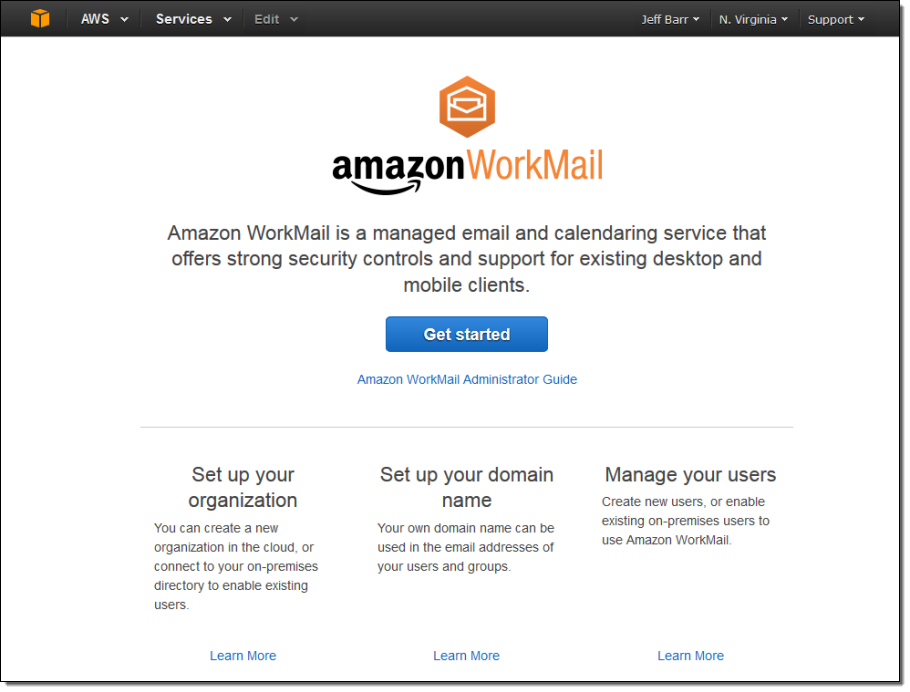
I click the Get started button. At this point I can choose between a Quick setup (WorkMail will create a new directory for me) or a Custom setup (WorkMail will use an existing directory that I configure):
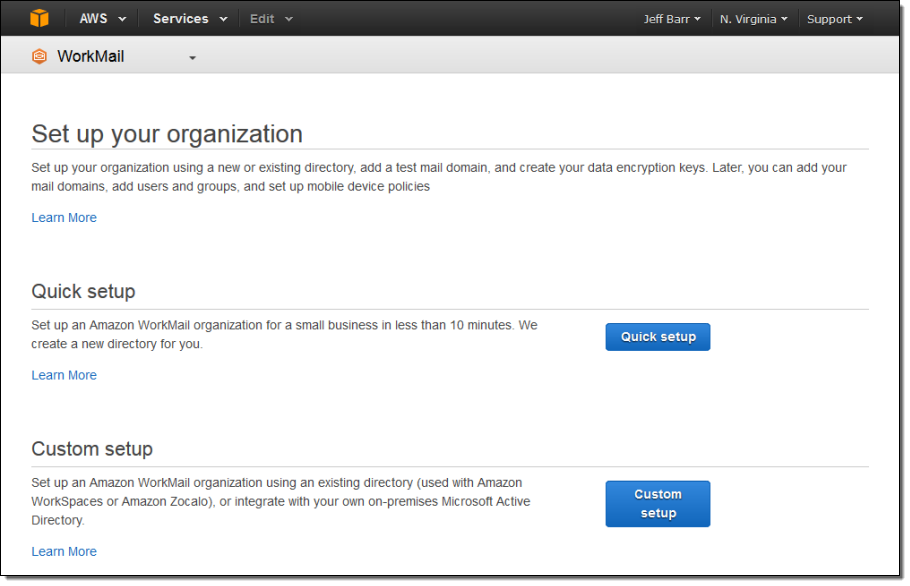
I’ll go for the quick setup today. I need to pick a unique name for my organization:
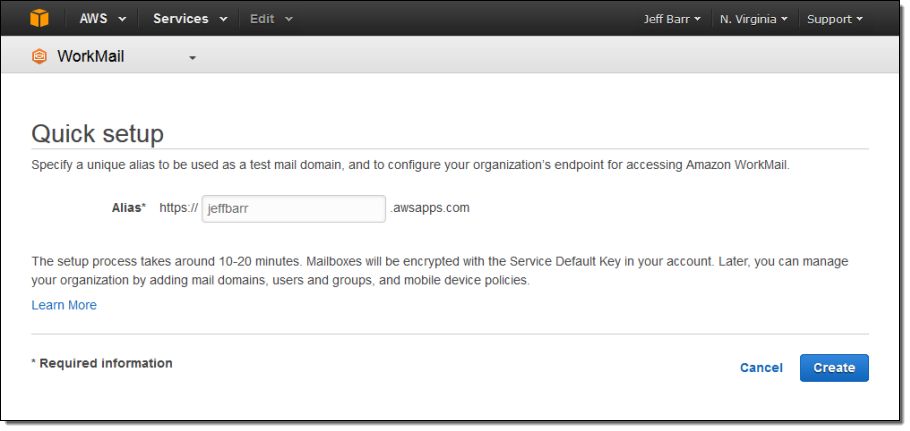
This will automatically create a directory and then create and initialize my organization. It will also initiate the Amazon SES domain verification process (for jeffbarr.awsapps.com in this case) and create a set of DKIM keys so that I can send DKIM-signed mail. The entire process takes 10 to 20 minutes and requires no additional work on my part. The organization’s status will start out as creating and will transition to active before too long:
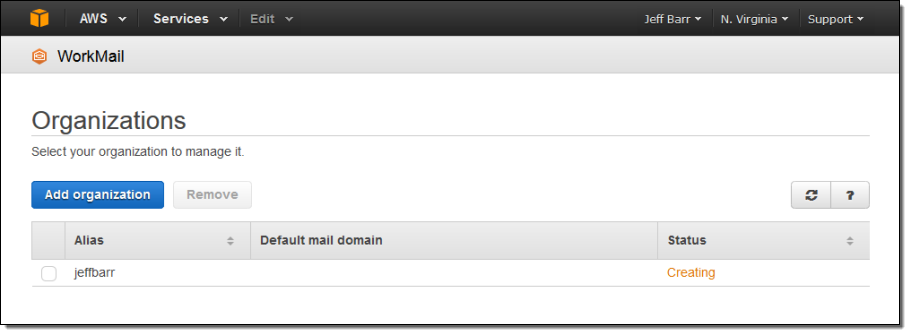
After the creation process completes I can begin to add WorkMail users to my organization (if I had used an existing directory in the previous step I could simply select them from a list at this point). I’ll begin by adding myself:
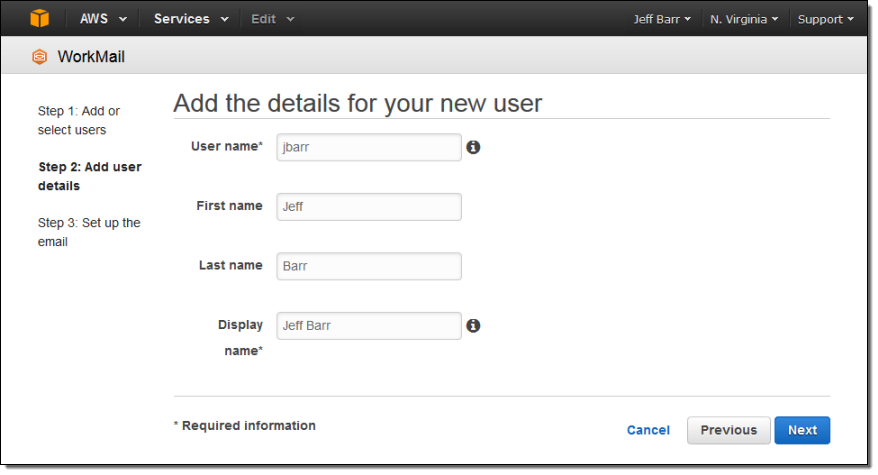
Then I specify the email address and password. If I have associated one or more domain names with the organization, I can use the name as the basis for the email address:
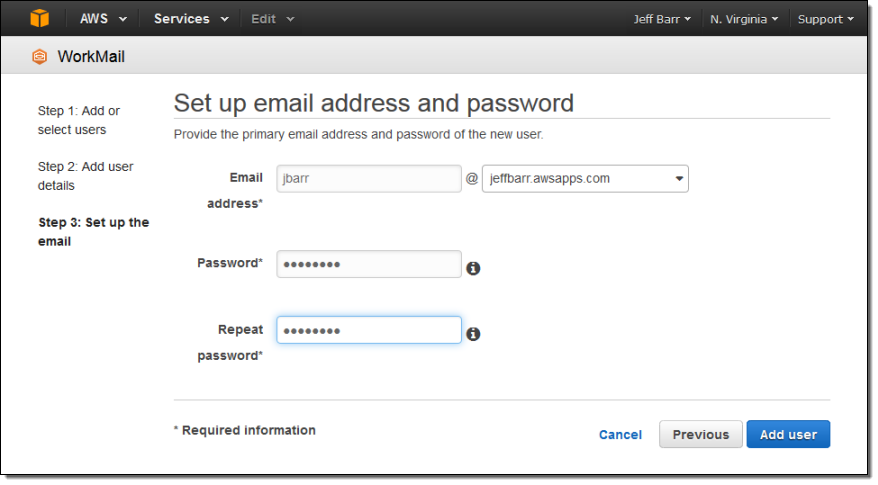
I can browse all of the organization’s users:
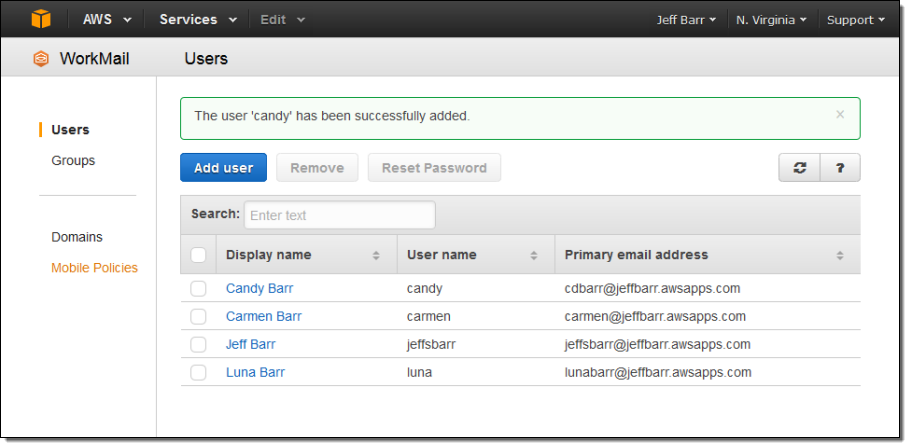
I can also create groups, attach domains, and manage mobile device policies, all from the Console.
The WorkMail Browser-Based Interface
Let’s take a look at the browser-based interface to WorkMail. Here’s my inbox:
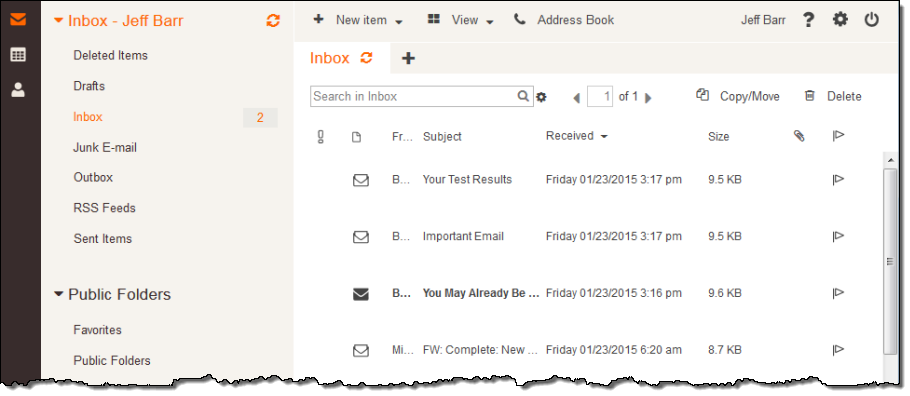
And my calendar:
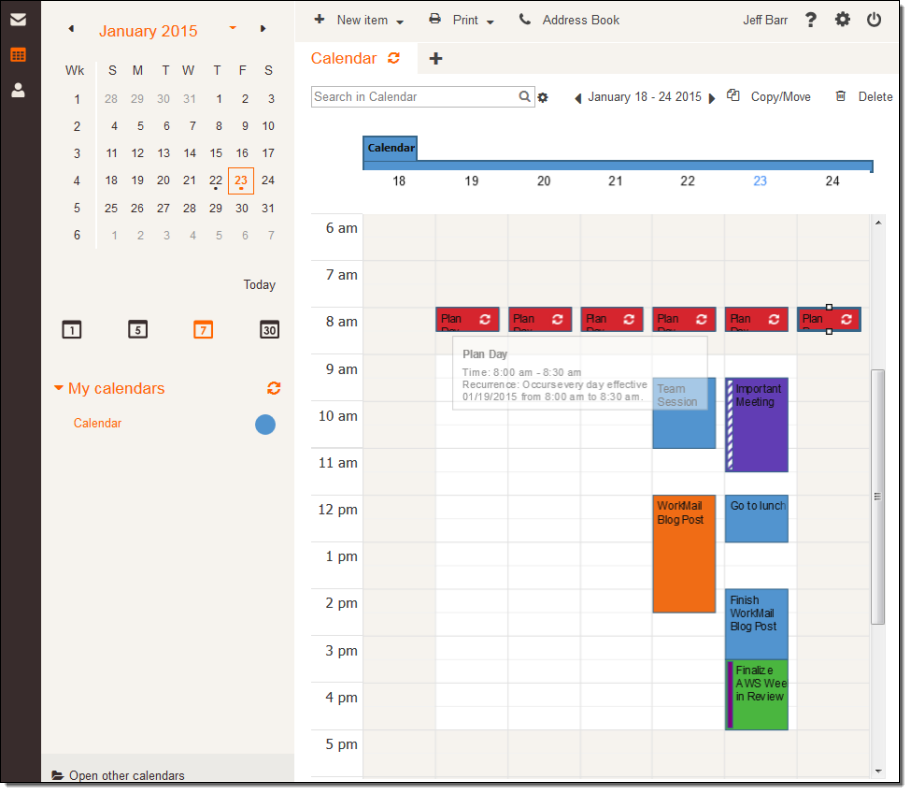
This is just a sampling of the features that are available in the WorkMail.
Pricing and Availability
We are launching a Preview of Amazon WorkMail in the US East (Northern Virginia) and Europe (Ireland) regions today and you can sign up for the Preview if you are interested in joining.
After the 30-day free trial (25 users and 50 gigabytes of storage per user), pricing is on a per-user, pay-as-you-go basis. You will be charged $4 per month for a 50 gigabyte WorkMail mailbox, or $6 per month for a bundle that includes WorkMail and WorkDocs. There is no separate charge for the use of SES to send messages.
— Jeff;

29 Jan 07:43
Follow up: Here’s a 3D printed Tardigrade (Water Bear) by EricHo on @Shapeways @BreathingMemes
by adafruit

Tardigrade (Water Bear) by EricHo on Shapeways.
The Tardigrade (also known as the Water Bear) can survive in extreme environments. For example, they can withstand temperatures from just above absolute zero to well above the boiling point of water, pressures about six times greater than those found in the deepest ocean trenches, ionizing radiation at doses hundreds of times higher than the lethal dose for a human, and the vacuum of outer space. Get your hands on this interesting creature today. Designed in collaboration with Kostika Spaho.
firehose and -1 others like this
29 Jan 07:41
People Who Are Good At Cocktail Parties Are Also Better At The Internet
Some people are better at navigating cocktail parties, family gatherings, and office meetings. And, as it turns out, they are better at the Internet too.
firehose likes this
29 Jan 07:41

saltycornchip: best-of-memes: Someone took a candid photo of a...
Someone took a candid photo of a fight in Ukranian Parliament that is as well-composed as the best renaissance art
this is currently my favorite thing on the entire internet
firehose and -1 others like this
29 Jan 07:26


#653: “Help, I’m dating a Men’s Rights Activist”
by JenniferP
 |
Courtney
shared this story
from  Captain Awkward: Captain Awkward:
|
| Citizen_kane_slow_clap.gif |

“That had better be one charming pig.” – Jules, Pulp Fiction
Dear Captain Awkward,
I have a problem. I am a feminist. Why is that a problem? Because my boyfriend, as generous and thoughtful and funny and sweet as he is, doesn’t get it. At all. We’ve been dating for over a year and I love him, which is what makes this so hard. About three months into our relationship, I noticed that when I’d bring up some women-centric issue (i.e, the Steubenville rape case), his argument was “Well, she shouldn’t have been drinking so much.” Which, of course, is awful and, yes, I may have gone to bed angry that night.
I chalked it up to him just “being a guy” and being influenced by the world’s habit of blaming the victim, etc. But then, as our relationship progressed, these things just kept. popping. up. To the point where he told me that he believes in Men’s Rights and he thinks feminists are crazy and damaging. I’ve told him my feelings on this and how hurtful and scary I think these opinions are. He’s told me that he may be influenced this way because of a (really bad) past relationship, a relationship which I knew all about when we started dating.
If I knew he had these opinions and this hate back when we first started dating, I would have walked away in a heartbeat. But I’ve been sucked in. I love him. But every time this comes up, like if there’s a news story that’s big (Gamergate and the Ugly Shirt Comet Guy were big topics) where he feels “feminists” are getting out of line, I feel sick inside.
I’m embarrassed when we go to parties and my level headed friends (both men and women) don’t share his opinions, I feel my stomach tighten when I’m browsing online and see a story about feminist issues – not because the story makes me upset, but because I’m worried about what HE will think about it. I’ve honestly told him ALL of this and he doesn’t want me to change my opinions for him. He says that my opinions and views don’t change the way he feels about me. But do they change the way I feel about him? I think so.
I know all of this sounds like a laundry list of reasons to break up. But he has so many fantastic qualities and there’s a reason I’ve stuck around this long. Do you have any suggestions for how to… I don’t know… fix this?
First, I guess I should congratulate you on finding possibly the world’s hottest and most charismatic man, the apocryphal Brad Pitt in all MRA arguments about how women are unfair when they have preferences about which men they interact with and how, i.e. “You’d put up with vile and creepy stuff from an alpha like Brad Pitt, just not meeeeeeeeeeeeeeeee.”
Digging into this more, you’re both“allowed” your opinions, but you’re the one whose stomach is in knots when you see a news story that he might have a different opinion on? You’re constantly embarrassed when he’s around your friends? And one bad relationship with a woman turned him against all women (except for you)?*
Here are some concerns, expressed as questions:

Looking more ‘sheveled than usual. Def. has time to follow women into elevators and stand too close to them on public transit.
- “I believe in the Men’s Rights Movement.” So, like, what parts of it exactly? How deep does his MRA sentiment go? Jerkass comments here and there, vague sympathies, or actually participating in trolling? Celebrating mass murderers who are fueled by misogyny? Reading sites that post personal details of feminists the better to doxx them, harass them, and try to get them fired from their jobs? (these are all real things, though I am not linking them except to send you to We Hunted The Mammoth for the depressing almost-daily rundown)
- You said if you’d known he felt like this when you started dating, you’d have walked out in a heartbeat. How did this all start coming up? Do you feel like he downplayed or kept silent about these views in the early stages of dating on purpose?
- Do you find yourself minimizing your own views, not bringing up things that are important to you, because you’re tiptoeing around to avoid the inevitable argument? Or are your days all him ranting about “false rape accusations!” and you being like “those aren’t really a factor, tho” all the time? Sounds sexy.
- When he says “feminists are crazy and damaging,” you realize, he means you, right? He means you.
- Does he similarly hold back from discussing topics that he knows might upset you?
- How does he treat your friends when this stuff comes up when you’re out and about?
- What will he do if someday you “get out of line“? Right now you are the magical exception to all of these other “out of line,” “crazy,” “damaging” women (women like me).
It does in fact sound like a laundry list of reasons to break up (or re-read The Lysistrata), but you do you. Your decisions about your life and your heart are your own. Some people really get off on the whole Opposites Attract/I Have Found The One Good One vibe, or think that systematically destroying each other”s arguments is a form of foreplay, and you two might be those people. The thing you have to know going forward, though, is that you cannot “fix” another adult to make them be more how you want them to be. You can decide to love what’s there, you can disengage, but there’s no fixing them, and as soon as you see the other person as a collection of things that needs fixing, the relationship has a hole in the bucket, Dear Liza.
I guess the most optimistic thing I could say is that many of us go through a period in our lives where we try out extreme views of one sort or another that don’t hold up over time or with more experience and self-awareness. True story: I was a vocal libertarian** for two semesters of college, and I apologize for anyone who was in any kind of discussion-based class with me back then as I tried on the the position of The One Person Who Could Clearly See The Flaws In The System That No One Had Ever Seen Or Pointed Out Before. I do think that some of the young dudes who are very, very concerned about ethics in game journalism right now are going to feel super-sheepish about the whole thing before long, with the caveat that having ridiculous views is one thing, harassing behavior is another, and that no one is required to hang out and be someone’s Humanity Tutor. You do NOT have to be the shining example of womanhood who melts his steely heart and shows him the way. “He might grow out of it” isn’t a ringing endorsement, and if you are both, say, 52 instead of 22, your Nope Rocket awaits you.

Destination: Nopetune
Recommended reading:
- We Hunted The Mammoth(or, DON’T read this if you want to keep looking at his face across your breakfast table)
- Bad Feminist
- Meninist Valentines (hee)
*This is the fishiest logic, to me. After millenia of oppression, violence against women, centuries of being legal property, straight women will still find something to love about and root for in straight men. But one bad relationship is an excuse to hate women and think they deserve fewer rights than men? Oh wait. Except for you. You the shining exception to all other women. Until you mess up in some way, of course.
**Apologies to actual libertarians out there in the crowd. 18-year-old me was definitely one of the obnoxious ones who ruins it for the rest of y’all.
29 Jan 07:18


Feminist Frequency to pivot toward combating “gendered online harassment”
by Sam Machkovech
On Friday, Anita Sarkeesian, host of the Feminist Frequency YouTube series and frequent target of GamerGate-related online harassment, published a year-end financial report as per the requirements of operating FF as a 501(c)(3) nonprofit organization. The report included an open letter to supporters, a boatload of stats, and a detailed list of the nonprofit's plans for the new year—including an expected slew of videos but also an official pivot to focus on "gendered online harassment."
After describing Feminist Frequency's genesis as a video project meant to "bring discussions of feminist theory to a wider audience"—a pitch she used in her successful 2012 Kickstarter campaign—Sarkeesian wrote that her experiences over the past two years, full of "daily vitriol" from online commenters, have forced her to reexamine her organization's purpose. "As a result, we have expanded Feminist Frequency’s mission to include advocacy around ending online hate and abuse, analyzing and advancing awareness of how gendered harassment operates online," she wrote.
The letter said that current efforts include consulting gigs with "tech and game companies" regarding online harassment within their communities, along with helping other active online feminists come up with "long-term solutions to deal with the epidemic of online abuse and create mechanisms for support." The report's list of plans for 2015 doesn't specify exactly how that mission might change or grow, other than hoping to create "a network with a variety of different programs and hosts analyzing media from a systemic/intersectional/anti-oppression lens."
Read 3 remaining paragraphs | Comments
firehose and -1 others like this
29 Jan 07:17

The German government is funding a Battlestar Galactica larp on a retired destroyer
by Adi Robertson
firehosewelcome to Germany
Live-action role-playing, or larping, can be just a nice way to spend a weekend. But especially in parts of Europe, it's also an educational tool — and that doesn't necessarily make it any less cool. On February 4th, a retired German destroyer will become the site of a five-day, 80-person larp based on Ronald D. Moore's Battlestar Galactica. In Projekt Exodus, the ship will be temporarily redubbed the Hesperios, a space freighter that picks up an escape pod and is — through events unknown to us — drawn into the war between human and Cylon.
If this sounds familiar, it's because Projekt Exodus is very similar to The Monitor Celestra, a highly successful 2013 larp set on a Swedish battleship. It's also supported by a significantly older BSG larping group called Twelve Colonies. The team behind Monitor Celestra at one point hoped to host another run in the US, but that seems to have never panned out, so this may be the closest we'll get to a successor in the short term.
Larping: the next step in ahistorical reenactments
Unlike Monitor Celestra, though, Projekt Exodus is explicitly educational. It's designed to "analyze the narrative structure" of Battlestar Galactica, and more specifically, to explore the political issues the show raised — questions about freedom, safety, and humanitarianism. By spending multiple days immersed in a character, playing out a fictional series of decisions, "the players will get to experience problems of our society from a complete new viewpoint," the organizers say. "They will be confronted with [a] new situation and impressions that will leave a lasting mark on their thinking." Besides the actual role-playing, the larp starts with a long workshop that helps players get into character, and it concludes with a day of analysis.
According to the organizers, it's being funded with money from the German Federal Agency for Civic Education. The agency is devoted to fostering political and media literacy; among other things, it's published comics, set up training program for local journalists, and funded international exchange programs. Other national governments have supported role-playing as an edifying activity as well; in Sweden, grants are available for larp and gaming hobbyist groups, and American historical reenactments can edge into larping territory.
Want to sign up for Projekt Exodus? Too bad — it's all sold out (and even if it weren't, you'd have to speak German to participate, locking out most of us here at The Verge.) But if you're near Wilhelmshaven on February 8th, you can visit the "Spaceship Doors Open Day," seeing the ship in full set dressing and with some of its space-faring crew members on board.
29 Jan 07:15
Viz To Reprint Nintendo Power's 'Legend of Zelda' Comic By Shotaro Ishinomori, The Best Possible Zelda Comic
by Chris Sims

Like a lot of kids who grew up in the ’90s, I loved Nintendo’s monthly magazine Nintendo Power with a passion, and one of my favorite things about it was reading the comic version of The Legend of Zelda: A Link to the Past. I loved that series largely because it made the weird adventure of the video game even weirder. It wasn’t until I was an adult that I realized the story was written and drawn by legendary manga creator Shotaro Ishinomori — you know, the guy who created Kamen Rider and the Super Sentai franchise, among other things — and realized just why it was so good.
Sadly, the story has been out of print for several years, but now it’s coming back: Viz Media announced over Twitter today that they will publish a new collection of Ishinomori’s Zelda comic, set for release on May 5.

As for why they’re doing it now, it actually makes a lot of sense. After all, the Zelda-themed Hyrule Historia from Dark Horse was one of last year’s biggest selling comics projects, topping the New York Times best-seller list, and while Viz published Akira Himekawa’s Zelda comics a few years ago, none of them had the mix of Nintendo Power nostalgia and a legendary manga creator that you get from Ishinomori’s comics.
Now if we can only get a new printing of those other Nintendo Power comics, like that Mario story where Princess Peach dresses as Luigi or that Starfox comic where Falco beats the living hell out of Fox in order to keep him from flying, everything’ll turn out all right.
firehose likes this
29 Jan 07:14
Lively Baby Nigerian Dwarf Goat Headbutts a Very Gentle Fluffy White Dog Who Doesn’t Seem to Mind
by Lori Dorn
A tiny baby black Nigerian Dwarf goat named Peppa Lass headbutts, climbs on, and generally acts annoying towards a very tolerant Komondor dog named Duchess, who is nothing but a gentle giant with the hyper hircine youngster. According to their humans at Denman’s Critters, Peppa Lass gets along with everyone.
Peppa Lass our little Nigerian Dwarf goat loves our two dogs, Duchess and Pharaoh. Peppa Lass loves to play, jump on, cuddle and even scratch with the our two gentle Komondors. It is never a dull moment around here!
Just last week Peppa Lass dressed up in pink and went outside in the snow with Pharoah.
firehose likes this
29 Jan 07:08
Women Would Lean In if They Didn't Have to Sacrifice Family, New Study Shows
by gguillotte
According to a new study by researchers Sarah Thébaud and David S. Pedulla, more women would gladly “lean in” to their careers if their workplaces would allow them things like flexible scheduling, parental leave, and subsidized child care.
firehose likes this
29 Jan 07:06
How YouTube Lost Its Soul, And May Lose The Creators That Built It
In 2013, Jason Calacanis wrote a post titled, “I ain’t gonna work on YouTube’s farm no more.”
Many thought he was crazy to reject cash from the largest online video distributor on the planet. But if the claims made about YouTube’s new partner agreement in a blog post by cellist Zoe Keating are true, it may have been a smart move after all.
firehose likes this
29 Jan 05:48
Remember That Time Japan Invented The Most Adorable Robot Snowplow Ever? - More like Yuki-T'awww, AM I RIGHT GUYS
by Victoria McNally

Meet Yuki-Taro. He’s a little robot who was developed by the Hokkaido Regional Development Bureau, and unveiled to the world at the Aichi Expo in 2005. He also poops ice bricks like a little snow WALL-E. He’s my new best friend. We’re going to be very happy together.
Built in cooperation with New Energy and Industrial Technology Development Organization (NEDO) and the Engineering Department at Yamagata University, this little guy is guided by a GPS sensor and twin cameras in his “eyes” to detect potential obstacles in his path—like the snow that falls regularly in Niigata, Japan, where the researchers who invented Yuki-Taro are reportedly from. It then compresses the snow that it takes into its front shovel into 28.5 pound bricks, and can carry up to 220 pounds of snow-bricks on its rear deck.
Unfortunately, even if you could afford the 1 million yen (or $9000) price tag, it’s probably unlikely that you’ll ever be able to give one of these bots a forever home pooping igloo building materials onto your front driveway for you. Although Yuki-Taro won the Good Design award in 2006 and there was hope that a commercially available version of the plow would hit the market in the next five years, it appears that there haven’t been any investors interested in producing the robot on a larger scale.
Poor Taro. He’s like the last snowbender. WE STILL LOVE YOU, SNOWPLOW BUDDY. Let’s go mess with some otter penguins or something!
(via Laughing Squid)
Are you following The Mary Sue on Twitter, Facebook, Tumblr, Pinterest, & Google +?
firehose and -1 others like this
29 Jan 05:46
How Will 'Fifty Shades' Measure Up to the Kink Classic 'Secretary?'
by gguillotte
One of the likely reasons for the novel Fifty Shades of Grey’s success is that it treats sadomasochism as an alluring forbidden fruit, something that feels good but is ultimately very bad. That’s a much less provocative view than the one held by Secretary, in which S&M creates a kind of “new normal” for its damaged but sympathetic protagonists.
29 Jan 05:45


Cop who stole nude pics off arrested women’s phones gets no jail time
by Cyrus Farivar
A now-former California Highway Patrol (CHP) officer who was charged with criminal felony charges after seizing and distributing racy photos copied from arrestees’ phones has pleaded no contest and will serve no jail time.
Sean Harrington’s plea deal, which was finalized on Tuesday, means that he receives a 180-day suspended sentence, three years of felony probation, and according to local media accounts, “must also speak at a community violence solutions class to tell everyone what he did.” Harrington resigned from the CHP last year after the charges were filed.
The case emerged last year from a woman, referred to in court documents as “Jane Doe #1,” who came forward to local authorities in early October 2014 after being briefly arrested on suspicion of driving under the influence (DUI) of alcohol in late August 2014 in San Ramon, California, about 35 miles east of San Francisco.
Read 14 remaining paragraphs | Comments
29 Jan 05:41

pennyfornasa: This is the most detailed image of Pluto captured...
firehosedwarves are cooler anyway
This is the most detailed image of Pluto captured to date.
In less than 6 months, NASA’s New Horizons probe will provide the first close-up photos of Pluto when it visits the dwarf planet. Learn more: http://www.penny4nasa.org/2015/01/15/new-horizons-begins-approach-to-pluto/
firehose likes this