iCab continues to be the best web browser on iOS. It's not as fast as Safari for some tasks but the features are really impressive. Now it adds a clever feature to use a webpage as a Today widget.
The implementation has high and low points. The clever part is that the page is a local cache in iCab so it doesn't need to immediately load the page and it remains useful when there's no reception. In my brief testing, there was no lag with the widget.
The major issue I have with the widget is the lack of scrolling. The Today widget uses bookmarks to display a single frame of the page as an image. That frame does not change and does not have active links or buttons. If I want to see an entire page, for example a long commuter train schedule, I must scroll the page and create multiple Today bookmarks. Tapping the Today widget opens the page in iCab.
In some ways, this is better. The iCab widget allows for navigation between bookmarks and even provides a method for deleting the bookmark without leaving the Today screen.
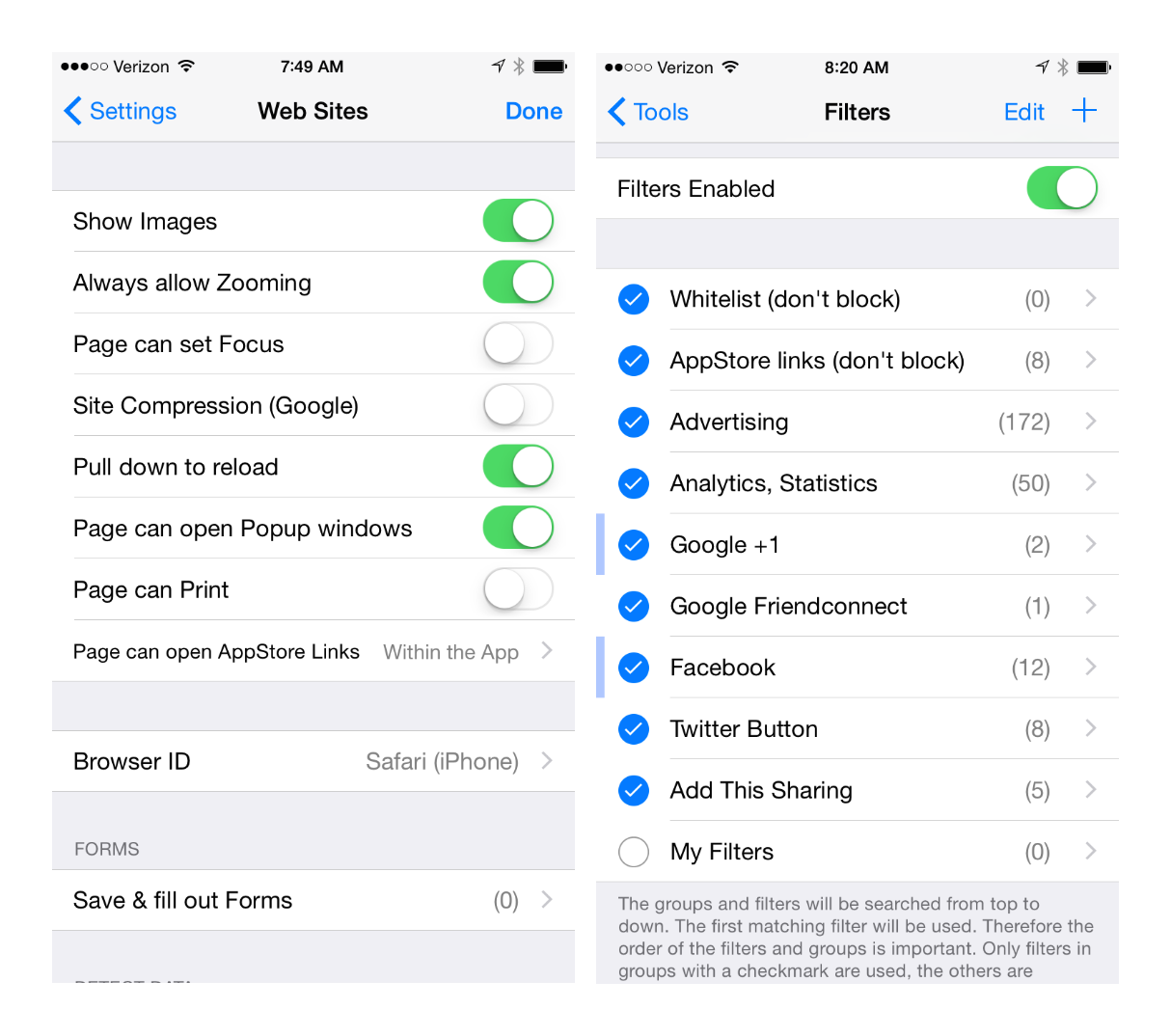
If you ask me, there are many more reasons to love iCab than this widget. These setting screens lay out just a few.
That "Always allow zooming" setting is great. Even pages that force some sort of mobile layout, respond to pinch and zoom in iCab. The filters are also a huge bonus with a mobile device. They block a variety of common punch-to-the-face ad banners. Page load time (and I suspect bandwidth too) are cut way down with iCab. There's a lot to like about this browser. The Today widget is a minor improvement on top of a huge list.
Not all books are equal, said the European Union this week, ruling that ebooks sold in Europe constitute an "electronically supplied service" and so are subject to a higher rate of value-added tax (VAT) than physical books. This means that buying ebooks is likely to become more expensive in some countries, as booksellers raise their prices to pass the cost of increased VAT rates onto customers.
Some countries — like the UK — will not be affected
This change will primarily affect France and Luxembourg — the two countries that prompted the ruling after petitioning the EU's Court of Justice (ECJ) to be allowed to sell ebooks at the VAT rate of paper books. In France, this means the VAT rate will increase from 5.5 percent to 20 percent, while in Luxembourg it will rise from 3.5 percent to 17 percent. Countries that already sell ebooks at the higher tax rate — such as the UK and Germany — will not be affected.
The ruling also won't affect US companies like Amazon, which previously sold ebooks via Luxembourg to take advantage of the country's lower VAT. Legislation that came into force earlier this year closed this loophole, ruling that VAT for digital goods should be levied at the rate of the country the customer is based in.
Both France and Luxembourg said they would campaign for an overhaul of digital VAT in Europe, with French Culture Minister Fleur Pellerin saying: "We will continue to push for what is called technological neutrality, meaning the same taxation for books, irrespective if they are on paper or electronic." According to data from analytics firm Statisa, ebook sales are still growing in Europe. They accounted for 4.5 percent of total book sales in 2013 and are predicted to rise to just over a fifth of total sales by 2017.
You can't spell baseball without two "B's." That's a simple enough spelling challenge that we don't need Scripps to adjudicate it. There were more than two bees at the Royals' game Sunday -- there was a whole swarm of them.
In a crowded session at this year's Game Developers Conference, Brian Moriarty, author of the 1990 adventure game Loom, delivered a post mortem on the game to a packed audience in San Francisco. At the end, he said that he is eager to make a sequel and named the three studios he would be willing to collaborate with on the game.
Throughout the presentation, Moriarty became emotional many times about the time he spent on the Skywalker Ranch working with the Lucasfilm Games SCUMM engine, and with the audio engineers at Skywalker Ranch to create the unique and musical experience that became Loom. He went on to talk about the fan mail he still receives, to this day, from people in the industry or who hope to one day make games that were inspired to create by their experience with Loom.
From his talk today, it's clear he wants to do it again.
"It’s a very humbling experience to have touched so many people, and to have been given the absolute freedom to experiment with George Lucas’ money," Moriarty said, which was met with a chorus of laughter.
"It was a privilege I can never repay, and probably never repeat. However there are now three studios who I would entrust with the sequels: Telltale, Double Fine and Wadjet Eye. Talk to me. I’m on the make."
Moriarty's post mortem on Loom revealed many secrets behind the game, but none of them was more touching than hearing about his own experience of his creation just weeks before he delivered his talk, which, oddly enough, fell on the very day when, more than twenty years ago, the game went gold.
"While preparing for this speech, I played Loom from start to finish for the first time in over a quarter of a century. I had forgotten nearly half of it," Moriarty said. "I remember the general scheme and plot, but many little details, many lines were gone. So I had the extraordinary experience of playing my own game as if it were sort of someone else's. And through the pain of making it I have really not been able to see what I had done. You know, it really doesn't suck. Yeah, it’s shorter than normal and easier than normal, but that's what Telltale does every day now."
An on-duty, uniformed police officer was shopping in a Philadelphia GameStop when two men burst into the store to rob it, authorities said. The police officer was killed in an ensuing shootout inside the store.
Officer Robert Wilson III and the two suspects, believed to be brothers, "engaged in a fierce and violent gunbattle" Capt. Darrell Clark said on Friday. Wilson was shot multiple times and killed when he was shot in the head.
More than 50 rounds were fired in about 30 seconds by the three men Clark said, according to WCAU-TV of Philadelphia. Civilians were inside the store as the gun battle raged, though none were shot.
Wilson shot one of the suspects in the leg before he was killed. The two suspects were later identified by witnesses and arrested. They have been charged with first-degree murder. Police said both confessed and said they chose the GameStop for the robbery believing it to be an easy target.
GameStop franchises are routinely targeted by criminals, and robberies there have even involved hostage situations, with staff and customers sometimes bound or locked in back rooms. It is very rare, however, that one ends in a fatality, much less a fusillade of 50 shots fired.
In a statement posted to its Facebook page, GameStop offered its condolences to Wilson's family and its gratitude for his actions during the shootout.
"The Company is thankful that due to the brave actions of Officer Wilson and the Philadelphia Police Department, all of our employees and customers are safe an unharmed."
Police said Wilson was shopping at the GameStop for a gift for his 8-year-old son because the boy had done very well in school. Wilson has another son, who is 1 year old.
"What parent probably hasn't done that for a child in recognition of good work and he just happens to be there at the time that these two guys come in there for a robbery," Charles Ramsey, commissioner of the Philadelphia police, said on Friday.
Gather round, spacelings: it’s time for another EVE Online story that simultaneously leaves us wishing we played the game and comforted that we don’t.
(If you already play EVE I’m not looking to exclude you… I’m just fairly confident you’ll already be aware of this torrid tale.)
Evenews24.com ran a story earlier this week that a former member of the Vanguard Frontiers (VAF) corporation was the victim of a theft to the tune of around 600 billion ISK. When that sum is priced against the going rate for PLEX – an in-game item that represents 30 days of game time – it works out at about $13,000.
A player under the name Non Erata joined Vanguard Frontiers soon after beginning to play EVE, eager to improve his position and wealth within the game. Unfortunately for VAF, Non Erata had also recently read a Cracked.com article titled Top Seven Dick Moves in Online Gaming, which inspired him to plan his own corporate heist.
To that end he spent six months slowly gaining the trust and friendship of senior figures within VAF, leading and training teams of rookies and later setting up a new area of wormhole operations within the corporation. On the back of the latter he secured a position as a corporate director. This left him in a prime position to execute his plan, using the Non Erata character and five other alts to asset strip the corporation while its leadership was offline.
Evenews24 interviewed the current CEO of Vanguard Frontiers, ladygrey, and an ex-CEO, Tessa Yor. Both seemed understandably disappointed and betrayed by Non Erata’s actions, and called for consequences within the game for players like Non Erata. They stressed that not only had he stolen corporate assets, he had stolen assets from a large number of players, and that while the corporation would soldier on a lot of players had been hit hard. It seems unlikely that consequences for heists of this nature will be introduced to EVE, or significant safeguards against them, as the freedom to both co-operate as groups and betray as individuals is a large part of EVE’s enduring appeal. Still, one never knows.
600 billion ISK or $13,000 isn’t the biggest theft in EVE history. All the way back in 2005 the Guiding Hand Social Club executed an assassination and looted around $16,500 in ISK and original blueprints, and when the Mittani and Goonfleet presided over the destruction of Band of Brothers in 2009 a defector reportedly transferred trillions to the Goons. There was also a Ponzi scheme in which a few players walked away with over a trillion ISK collected from other players. But still, $600bn ISK, $13,000 – that’s an awful lot. Not to mention the feeling of betrayal, which you can’t put a price on.
For the full story, warts and all, hit up Evenews24.com. They’ll use all the right acronyms and everything. I tried to get into EVE a couple of times, but now I prefer to just read stories like this about it.
FAST is currently designed for deployment at airports, where heightened security threats justify warrantless searches under the administrative search exception to the Fourth Amendment. FAST scans, however, exceed the scope of the administrative search exception. Under this exception, the courts would employ a balancing test, weighing the governmental need for the search versus the invasion of personal privacy of the search, to determine whether FAST scans violate the Fourth Amendment. Although the government has an acute interest in protecting the nation's air transportation system against terrorism, FAST is not narrowly tailored to that interest because it cannot detect the presence or absence of weapons but instead detects merely a person's frame of mind. Further, the system is capable of detecting an enormous amount of the scannee's highly sensitive personal medical information, ranging from detection of arrhythmias and cardiovascular disease, to asthma and respiratory failures, physiological abnormalities, psychiatric conditions, or even a woman's stage in her ovulation cycle. This personal information warrants heightened protection under the Fourth Amendment. Rather than target all persons who fly on commercial airplanes, the Department of Homeland Security should limit the use of FAST to where it has credible intelligence that a terrorist act may occur and should place those people scanned on prior notice that they will be scanned using FAST.
Microsoft is at the Games Developer Conference this week, and the company is trying to convince games makers that Windows 10 is the platform for all their titles. Part of that involves SDKs, demonstrations, and sessions to talk to developers directly. One such session was "new opportunities for independent developers" with a fascinating talk from Microsoft’s Chris Charla on Wednesday.
Charla explained the intricacies of game and app development for Windows 10 and the Xbox One, but one particular slide stood out from the rest: the one with the IBM XT depicting Windows 7. While Charla’s slide is clearly a subtle poke at Windows 7, it does speak somewhat to Microsoft’s position on its popular operating system. Windows 10 is where the company is heading, and it’s also what Microsoft really needs everyone to upgrade to and buy into. Windows 7 is already turning into another Windows XP as businesses shun Windows 8 and consumer feedback has been negative around Microsoft’s latest update.
There’s a reason Microsoft named it Windows 10 and not Windows 9. When consumers look at their machines over the next few years and eventually realize they have Windows 7 and can’t run cool universal Windows 10 apps, they’re going to feel a lot more behind than if it was named Windows 9. It’s a small and subtle bump that has the same effect as stores pricing items as 99 cents instead of $1. It’s a mind game, and let’s face it Windows 7 is really old. It will be six years old in July, and that’s a long time in this modern technology era. Microsoft will take any opportunity to remind everyone that Windows 7 is really old as Windows 10 approaches. That free upgrade will suddenly look mighty tempting to everyone running the ancient and old-fashioned Windows 7.
HughPickens.com writes: Quentin Hugon, Benjamin Benoit and Damien Leloup have created a memorial page for projects adandoned by Google over the years including: Google Answers, Lively, Reader, Deskbar, Click-to-Call, Writely, Hello, Send to Phone, Audio Ads, Google Catalogs, Dodgeball, Ride Finder, Shared Stuff, Page Creator, Marratech, Goog-411, Google Labs, Google Buzz, Powermeter, Real Estate, Google Directory, Google Sets, Fast Flip, Image Labeler, Aardvark, Google Gears, Google Bookmarks, Google Notebook, Google Code Search, News Badges, Google Related, Latitude, Flu Vaccine Finder, Google Health, Knol, One Pass, Listen, Slide, Building Maker, Meebo, Talk, SMS, iGoogle, Schemer, Notifier, Orkut, Hotpot, Music Trends, Refine, SearchWiki, US Government Search, Sparrow, Web Accelerator, Google Accelerator, Accessible Search, Google Video, and Helpouts. Missing from the list that we remember are Friend Connect, Google Radio Ads, Jaiku, SideWiki, and Wave.
We knew there were a lot, but who knew there'd be so many. Which abandoned Google project do you wish were still around?
jones_supa writes: Ubuntu is going live with systemd, reports Martin Pitt in the ubuntu-devel-announce mailing list. Next Monday, Vivid (15.04) will be switched to boot with systemd instead of UpStart. The change concerns desktop, server, and all other current flavors. Technically, this will flip around the preferred dependency of init to systemd-sysv | upstart in package management, which will affect new installs, but not upgrades. Upgrades will be switched by adding systemd-sysv to ubuntu-standard's dependencies. If you want, you can manually do the change already, but it's advisable to do an one-time boot first. Right now it is important that if you run into any trouble, file a proper bug report in Launchpad (ubuntu-bug systemd). If after some weeks it is found that there are too many or too big regressions, Ubuntu can still revert back to UpStart.
In the five years Joel Atyas spent disputing a $278 charge with T-Mobile, his credit score was impacted and a collection agency came after him. But after filing a complaint with the Federal Communications Commission and telling Ars his story, T-Mobile has finally made nice with the former North Carolina-based customer. For now.
"The issue seems to be technically resolved in that the outstanding balance has been removed, and I have been assured that T-Mobile will undertake to repair the damage done to my credit rating," Atyas wrote in an e-mail to Ars.
"I would not say that I’m ‘satisfied,'" he said. "Relieved is a better word. Having to spend hours upon hours over five years to untangle a mess of T-Mobile’s making does not lead to positive satisfaction."
Link
The tie, adorned with 1990s-era NFL team logos, worn by former Toronto mayor Rob Ford during the process conference where he admitted to smoking crack sold for $16,100 on eBay, put up for bidding by Ford himself.
oh wait are they onboarding non-customer-facing people? n/m
In Silicon Valley, where there’s a constant battle for talent, companies big and small are welcoming employees with open arms—and maybe also a bottle of booze.
Tech companies take a sense of pride in doing things differently, and the same applies to the first day of work. Fun rituals and perks can reinforce a company’s culture, but they can also help fight churn, a costly problem for any business. We surveyed dozens of tech companies to learn about the more unusual aspects of their orientation programs.
Swag, swag, swag
Everyone loves free stuff. At Chubbies Shorts, an e-commerce startup that sells shorts to bros, newbies are encouraged to raid the warehouse and get decked out in the company uniform. “Shorts on shorts on shorts,” says a company rep. To match the bottom half of their outfits, new hires are also encouraged to pick up other gear not sold on the Chubbies online store, such as sweatshirts, hats, sunglasses and bags.
Teespring, a crowdfunding platform for custom T-shirts, hands new employees a special shirt with “Free Fish Co” adorned on the front. It’s a reminder of the company’s humble beginnings: The founders, who were students at Brown University, created a similar T-shirt in 2011 to commemorate the closing of a local dive bar.
Freebies aren’t just fun: They also connect employees with the very product they’re working on. Fashion startup Polyvore hands new employees a $100 gift card to spend on the site, so they can get acquainted with how its users find and buy items. Similarly, video technology company Clearleap gives new employees a Roku media player. “It’s great to be part of a tech company that is changing how we watch TV, but it’s also fun to enjoy your hard work pay off as a viewer,” according to a spokesperson.
Alcohol is also a winner. The swag bag at Twitter includes a bottle of wine with company branding (as well as a tote bag, T-shirt, laptop sleeve, and notebook). Opower, an energy data company, gives new employees a bottle of champagne to save for a special occasion: when the company is acquired or goes public, or when it helps reduce carbon emissions by 1% in the US. Because the company went public last April, Opower gave everyone another bottle. “It’s a reminder that although we achieved one of those goals, we still have a long way to go to reach the second,” says a representative.
Getting your hands dirty
For companies that run marketplaces, what better way to get employees up to speed than by putting them in the users’ shoes?
At Homejoy, a marketplace for finding housecleaners, all new hires—including software engineers and execs—are expected to roll up their sleeves and scrub toilets. The initiation ritual was inspired by CEO Adora Cheung’s short stint as a housecleaner before she launched the startup with her brother. Employees are required to go on and pass test cleans—the same tests that all cleaners have to go through to get on Homejoy’s platform.
Similarly, Postmates, a marketplace for couriers, makes its full-time employees across all departments go through courier training. “We all go through orientation and are encouraged to make as many deliveries as we can,” according to a company spokesperson.
At Dyson, which makes high-end vacuums, fans, and hand dryers, an engineer leads a class for new hires on taking apart and reassembling vacuum parts. “By taking apart the cleaner head,”, says a representative, “Dyson people are challenged to ask themselves the following questions: What features enhance the performance of the machine? Why have we chosen to fix parts in a particular way? What were the reasons for choosing a particular material? Which technology is used in other products? How do you think the machine was manufactured?” Employees have about 45 minute for the exercise, and the rep says “failure is accepted,” so long as they try.
A trip to headquarters
All new hires at audio hosting company SoundCloud are flown to its headquarters in Berlin. The point of the sojourn is to have them learn more about the city, company culture, and the Factory, a 170,000-square-foot tech hub that’s now home to SoundCloud and other startups. For those relocating to Germany, the company also sets them up with a local guide whose services include airport pickup, translation assistance, and help with paperwork.
Data company Qlik also flies all employees to its headquarters in Lund, Sweden to attend a program called Qlik Academy, which teaches employees about the history and culture of the company and its homeland.
Back to school
Some companies are known for hosting elaborate orientation programs that are like being back in the classroom. Facebook runs a six-week-long bootcamp to acquaint new engineers with all parts of its code base.
Graduating from Airbnb’s engineering bootcamp.(Airbnb)
Airbnb‘s program for engineers runs three weeks, getting them up to speed with culture and code. The bootcamp also helps new hires decide which of the 12 engineering teams they ultimately want to join. At the end, the company also hosts a mini-graduation ceremony complete with mortarboards tossed in the air.
Pinterest‘s program, Basecamp, pairs new engineering hires with more experienced members of the team to work through challenges. Like with Airbnb, the program helps engineers decide which team to join.
Twitter hosts what it calls Flight School, a weeklong orientation that’s more focused on getting employees jazzed up about working for the company than taking care of logistics. (There’s another program specifically for engineers as well.) The program lasts a week, starting every Monday at its San Francisco headquarters. Through a number of talks, CEO Dick Costolo and his lieutenants get employees pumped up about why it’s an exciting time to join the company. The first day usually includes a group lunch and ends with with cookies, cupcakes, and champagne. For the next two to three days, employees are broken out in groups specific to their team. On Friday, the entire class meets together again for one last hurrah. “The new hires, they become a very close-knit group,” says Kristine Crawford, a senior communication associate who runs Flight School. “A lot of people on their one-year anniversary go grab drinks.”
At mobile rewards startup Belly, employees attend a weeklong program called Belly U at its Chicago headquarters to learn about company history and culture. Unsurprisingly, nights on the town typically happen at venues that have opted into Belly’s rewards program, which uses an app to replace loyalty cards. “Everybody who is here, they feel they are part of this culture and Chicago tech scene,” says chief operating officer Julio Bruno. Sales folks—many of whom are new to the workforce—have another week of training specific to their local markets.
At ZestFinance, an underwriting company that helps lenders assess credit risk, all new hires go through Zest U, where fellow employees teach newcomers about the company’s business, technology, and culture. Adding to that, new employees are given a starter project to help them develop the skills needed in their roles. “We assume it will take up to a quarter before you are really adding value, and so we focus a lot of time in your first few months on learning,” according to a spokesperson.
Hit the ground running
Some companies want employees to start contributing on day one. During the first day of Airbnb‘s bootcamp, engineers are encouraged to push code directly to the website. “We want to show people, ‘Hey, right away you’re creating impact, pushing your code to millions of users,'” says engineering manager Jason Bosinoff.
It’s a similar story with analytics company New Relic. “We want them to contribute immediately and make a real impact from the get-go,” says a company representative. Crafts marketplace Etsy has new engineers deploy code to add their photos to the company website. (Non-technical employees are also trained to push code in their second week.)
At ad firm engage:BDR, the process begins even earlier: during the interview stage. The company asks job candidates to develop a plan for their first 90 days at the company. “This action plan is the new employees’ onboarding roadmap,” says HR director Wetzel.
Unsurprisingly, the first thing new employees do atSlack, a fast-growing startup that makes a chat tool for corporations, is get acquainted with the service. They’re encouraged to read the chat history in channels relevant to them. “That gives them a good sense of what’s going on now, where various projects are at, what the priorities are—that kind of thing,” says CEO Stewart Butterfield. “They can quickly pick up on subtle aspects of the culture, the norms for communication, who knows the answers to what kinds of questions and who really makes the decisions—that kind of soft knowledge which can take a very long time to absorb when you start at a new place.”
Breaking the ice
Most offices use team lunches, happy hours, or all-hands meetings to break the ice and introduce their newest staff. (Our survey suggests that the game “tell two truths and a lie” is very popular.) Some companies, however, prefer less rote rituals.
Twitch, a company that broadcasts live video-game play online, has new employees record videos introducing themselves. The videos are shown at the company’s weekly town-hall meetings. At Jobvite, new employees are surprised with a flurry of balloons tied to their desks. They’re also encouraged to bring in treats for “rookie cookies,” an excuse for existing employees to drop by for a snack, introduce themselves, and chit chat.
At Pinterest, every new hire class takes a group photo centered on a theme (eg. The Brady Bunch) that’s included in the company yearbook. Every other Friday, each new class is responsible for decking out the office with a certain theme (one recent one included “hellastorm,” for the Bay Area’s freak weather back in December), starting with a companywide breakfast and ending with a happy hour where the hires are introduced.
To help employees bond, online retailer Zazzle organizes an in-office scavenger hunt where new hires zip around departments to find answers to clues. Shopify, which provides an e-commerce platform for businesses, takes its hunt online. The company scatters virtual Easter eggs on its internal website for employees, and the new employee who finds the most Easter eggs at the end of two weeks wins a prize. Zendeskwelcomes new hires by taking them out of the office to work on neighborhood community service projects.
Video conferencing company Highfive puts new hires up to different challenges, such as having a sales rep sell a product to people on the street. And as if that’s not enough pressure, the last person to go through orientation is also the one who helps welcome the next employee—both events occasionally occur on the same week.
“I truly believe that onboarding is an art,” says Sarah Wetzel, director of human resources at digital ad firm engage:BDR. “Each new employee brings with them a potential to achieve and succeed. To lose the energy of a new hire through poor onboarding is an opportunity lost.”
'the stun gun is a "thoroughly modern invention" not protected by the Second Amendment'
Massachusetts' ban on the private possession of stun guns—an "electrical weapon" under the statute—does not violate the Second Amendment right to bear arms, the state's top court has ruled.
The decision says (PDF) that the US Constitution's framers never envisioned the modern stun-gun device, first patented in 1972. The top court said stun guns are not suitable for military use, and that it did not matter whether state lawmakers have approved the possession of handguns outside the home.
Nevertheless, we note that stun guns deliver a charge of up to 50,000 volts. They are designed to incapacitate a target by causing disabling pain, uncontrolled muscular contractions, and general disruption of the central nervous system.... It is difficult to detect clear signs of use and misuse of stun guns, unlike handguns. Stun guns can deliver repeated or prolonged shocks without leaving marks. ...The Legislature rationally could ban their use in the interest of public health, safety, or welfare. Removing from public access devices that can incapacitate, injure, or kill a person by disrupting the central nervous system with minimal detection is a classic legislative basis supporting rationality. It is immaterial that the Legislature has not banned weapons that are more lethal. Mathematical precision by the Legislature is not constitutionally required.
The court, ruling in the case of a Massachusetts woman caught with stun gun, said the stun gun is a "thoroughly modern invention" not protected by the Second Amendment, although handguns are protected.
Star Citizen turned a spacefighter into a charcoal briquette on YouTube to show you it's serious about the depth — and persistence — of its damage model. Hang out under hostile laserbeams too long and your vessel will look like someone fried hashbrowns on it.
It's not just the blistering or the burning from garden variety beam cannons or mass-driver weapons. Some armaments are powerful enough to shoot off chunks of a spaceship, too, as seen from 1:03 onward. Star Citizen sets up a couple dummy targets to show what this looks like — and how it affects a ship's movement (assuming it isn't under power.)
Star Citizen is still looking at a full commercial launch in 2016, with beta rollouts of components such as its FPS module between now and then. The game has surpassed $70 million in crowdfunding since it began taking donations in 2012, and expects to top $100 million in crowdfunding before it's all over.
'Because the information management office could not change the Department’s policy for handling Sensitive But Unclassified material, he assumed charge of the mission’s information management operations. He ordered a commercial Internet connection installed in his embassy office bathroom so he could work there on a laptop not connected to the Department email system. He drafted and distributed a mission policy authorizing himself and other mission personnel to use commercial email for daily communication of official government business. During the inspection, the Ambassador continued to use commercial email for official government business. Gration’s demands and “flouting of direct instructions to adhere to Department policy “ put the IT staff at the embassy in Kenya in the position of having to choose between making their boss happy and following State Department regulations and government information security requirements. When they failed to respond to Gration’s demands in a timely fashion, he escalated things by “publicly berating members of the staff, attacking them personally, loudly questioning their competence, and threatening career-ending disciplinary actions,” the IG’s office reported. “These actions have sapped the resources and morale of a busy and understaffed information management staff as it supports the largest embassy in sub-Saharan Africa.”
Apparently, Gration’s impatience with IT extended to not using his secure email and the “front channel” secure diplomatic cable system. The Inspector General’s inspection team observed that “the Ambassador does not read classified front channel messages. No one in the mission screens incoming cables for the Ambassador relevant to Kenyan and US interests in the region. The OIG team also observed that the Ambassador very infrequently logs onto his classified account, which would allow him to read cables and classified emails.” In the end, the IG team recommended that somebody check his accounts for him and screen messages for relevance.
In other words, Gration was the end user from hell for an understaffed IT team in a politically sensitive outpost. “He has willfully disregarded Department regulations on the use of commercial email for official government business,” the IG report noted, “including a front channel instruction from the Assistant Secretary for Diplomatic Security against such practice, which he asserted to the OIG team that he had not seen”—because he never used his secure network account.
What could have possibly motivated that sort of behavior from a man who had clearly dealt with secure government IT systems in the past as an Air Force major general? In part, it may have been that regardless of how competent the IT team at the Nairobi embassy was, State Department information systems might make working out of a bathroom look good to anyone accustomed to more corporate IT.'
'Being an Information Management Specialist in the US Foreign Service can be a challenging and thankless job. At the Nairobi embassy, supporting all that was (and continues to be) complicated by “local infrastructure that suffers from almost daily electricity and communication outages,” the Office of the Inspector General reported. “And the American staffing in the information management section has remained the same despite large increases to overall mission staffing in the last 2 years and a constant flow of visitors that averages 200 people on any given day.”
On top of that, there’s the issue of what embassies are given to work with. State’s Global OpenNet, the intranet that provides the backbone for department-wide e-mail and instant messaging, is dependent on aging Microsoft communications infrastructure, including Microsoft Office Communicator for unified voice and video communications. The State Department is in the middle of a roll-out of a new Office desktop environment (Office 2010), and that’s broken unified communications for some users in the process—since Lync clients won’t be supported until later this month.'
'if you are willing to move anywhere in the world, can get a Top Secret clearance, get through the Foreign Service selection process to be considered for employment (which, based on the experiences of some I know now in the Foreign Service, can take years), then you can actually be considered for an opening. However, there are currently none—the last vacancy announcement closed in December—and if you've applied before, you have to wait a year after the last posting closed to apply again.
In the event that there's an Information Management Specialist slot open and you've cleared all the other hurdles, and you can do everything there is to do in IT (from pulling wires and doing desktop support to managing an IT, telephony and mailroom staff of foreign nationals), you can pull down as much as $63,702 a year plus benefits (plus a differential bonus for particularly dangerous places). But probably, you’d make something closer to the $43,000 range. By comparison, the expected salary for a certified Unix sysadmin with a Top Secret clearance in Maryland is around $75,000—no wire-pulling required.'
The current scandal roiling over the use of a private e-mail server by former Secretary of State Hillary Clinton is just the latest in a series of scandals surrounding government e-mails. And it’s not the first public airing of problems with the State Department’s IT operations—and executives’ efforts to bypass or work around them. At least she didn’t set up an office in a restroom just to bypass State Department network restrictions and do everything over Gmail.
However, another Obama administration appointee—the former ambassador to Kenya—did do that, essentially refusing to use any of the Nairobi embassy’s internal IT. He worked out of a bathroom because it was the only place in the embassy where he could use an unsecured network and his personal computer, using Gmail to conduct official business. And he did all this during a time when Chinese hackers were penetrating the personal Gmail inboxes of a number of US diplomats.
Why would such high-profile members of the administration’s foreign policy team so flagrantly bypass federal and agency regulations to use their own personal e-mail to conduct business? Was it that they had something they wanted to keep out of State’s servers and away from Congressional oversight? Was it that State’s IT was so bad that they needed to take matters into their own hands? Or was it because the department’s IT staff wasn’t responsive enough to what they saw as their personal needs, and they decided to show just how take-charge they were by ignoring all those stuffy policies?
I can’t even put into words how upset I am about this. Rogers Wildlife Rehabilitation has been open for almost twenty years, and is the only place in North Texas that takes in literally any type of bird if it’s been injured, orphaned, or otherwise incapacitated. They’re…



/cdn0.vox-cdn.com/uploads/chorus_asset/file/3481764/bees.0.gif)


 Super Opinionated.


