Shared posts

18 Feb 17:55

Downton Abbey, “Season Three, Episode Seven”

by Sonia Saraiya
firehose

I LOVE THIS SHOW, WHAT'S IT CLALLED UHHH
"THE WHITE DUDE IS ALWAYS WRONG"

Here’s a joke for you: A white guy’s entire life changes when a few untimely deaths move him several places up the line of succession. Now he’s a rich white guy, about to inherit a really big house. He gets to do this because he’s a dude, and his duty in life is largely about producing more dudes. But then he has some trouble deciding whom to marry, and then for a while people think his man parts don’t work. After more than 10 years of faffing about he finally knocks a nice lady up. As he drives home, after seeing his son for the first time, here is what he thinks to himself: “La la la, I’m Matthew Crawley! I’m a hamfisted son-in-law, heir, and husband, but I get everything I want pretty much because I make sexytimes with my wife! I ...

Read more
18 Feb 16:50

Laser Intended For Mars Used To Detect "Honey Laundering"

by samzenpus
A laser tool funded by the European Space Agency to measure carbon on Mars is now being used to help detect fake honey. By burning a few milligrams of honey the laser isotope ratio-meter can help determine its composition and origin. From the article: "According to a Food Safety News investigation, more than a third of honey consumed in the U.S. has been smuggled from China and may be tainted with illegal antibiotics and heavy metals. To make matters worse, some honey brokers create counterfeit honey using a small amount of real honey, bulked up with sugar, malt sweeteners, corn or rice syrup, jaggery (a type of unrefined sugar) and other additives—known as honey laundering. This honey is often mislabeled and sold on as legitimate, unadulterated honey in places such as Europe and the U.S.."

Share on Google+

Read more of this story at Slashdot.


18 Feb 06:52

"Eternal nothingness is O.K. if you’re dressed for it."

“Eternal nothingness is O.K. if you’re dressed for it.” - Woody Allen
18 Feb 05:47

Editing women into Wikipedia | Not Exactly Rocket Science

Last Friday, a group of volunteers gathered in the Royal Society in London to edit female scientists into the history books—or at least, into Wikipedia. Their goal was to start fixing the online encyclopaedia’s comparatively thin information about women in science and technology.

I attended the “edit-a-thon”, reporting for Nature. Before I turned up, I wondered about the rationale behind holding a specific event to edit Wikipedia, which can be done at any time and place. I also wondered how much the editors could accomplish in just 3.5 hours. Both concerns were addressed on the day, and in the piece. Take a look. Also, there was an Ada Lovelace/Wikipedia cake.

18 Feb 05:44

Country Singer Mindy McCready Dead at 37

by mj
According to FOX 8 and other sources, it's been confirmed that country music singer Mindy McCready has committed suicide. Reportedly her body was found in Heber Springs, AR. Updated: Mindy McCready died of a single self-inflicted gunshot wound.
18 Feb 05:44

Transnational Data on Gender and Science Aptitude

by Lisa Wade, PhD

In 2009, 470,000 15-year-olds in 65 developed nations took a science test.  Boys in the U.S. outperformed girls by 14 points: 509 to 495.  How does the U.S. compare to other countries?

The figure below — from the New York Times — features Western and Northern Europe and the Americas (in turquoise), Asia and the Pacific Islands (in pink), and the Middle East and Eastern and Southern Europe (in yellow).  The line down the middle separates societies in which boys scored higher than girls (left) and vice versa (right).

Notice that the countries in which boys outscore girls are overwhelmingly Western and Northern Europe and the Americas.

This data tells a similar story to the data on gender and math aptitude.  Boys used to outperform girls in math in the U.S., but no longer.  And if you look transnationally, cultural variation swamps gender differences.  Analyses have shown that boys outperforming girls in math is strongly correlated with the degree of inequality in any given society.

One lesson to take is this: any given society is just one data point and can’t be counted on to tell the whole story.

Via The Global Sociology Blog.

Lisa Wade is a professor of sociology at Occidental College. You can follow her on Twitter and Facebook.

(View original at http://thesocietypages.org/socimages)

18 Feb 05:43

Sylvie Reuter

18 Feb 05:11

OrganonContradiction and ContrarietyOK, listen up.  This is...


Organon
Contradiction and Contrariety

OK, listen up.  This is probably the most important post I’ve ever written.  If you only ever read one thing on my blog or only ever take away one idea from it, please make it the distinction between contradiction and contrariety.

The diagram you see above is my own invention.  I use it to teach this distinction, as I’m now doing.  The sentence you see above it is from the first book of Aristotle’s Organon, the Categories.  Aristotle’s Organon, by the way, has nothing to do with Patti Smith, Kate Bush, or Wilhelm Reich, but it has everything to do with Francis Bacon’s Novum Organum and Descartes’ Meditations.  This is quite possibly the most important text in the history of philosophy, and this sentence may actually be the single most important sentence in that history, though not necessarily the most profound, true, or revelatory.  This sentence is the nexus of every radical innovation in Aristotle’s corpus, and the keystone of his logical system.  It is therefore, in a very meaningful sense, the beginning of Western metaphysics.  Bow down, take a moment of silence.  Let this sentence sink in.  Savor it.

Now, to see why this sentence is so important, and what it has to do with the distinction between contradiction and contrariety, we have to take a step back from Aristotle to his oedipal teacher-daddy, that shallow, self-absorbed queen Plato, beloved of Socrates of Athens and Derrida the Algerian.  Specifically, recall if you will, Derrida’s basic argument about “logocentrism.”  Derrida asserts that a single set of ontological and epistemological conditions that he calls “logocentrism” have obtained continuously since Plato; this is what he calls “the European form of the metaphysical or onto-theological project, the privileged manifestation, with worldwide dominance, of dissimulation, of general censorship of the text in general” (“Freud and the Scene of Writing,” 197).  For Derrida, this same basic condition obtains necessarily as the condition of metaphysics.  In every text Derrida reads, he locates places where a concept or concepts almost violates the condition of logocentrism but finally fall back into its trap.  Of Freud’s concepts, for example, he claims that “all these concepts, without exception, belong to the history of metaphysics, that is, to the system of logocentric repression” (ibid).  

What does this have to do with contradiction and contrariety?  Just this.  All of Plato’s problems, and therefore all of Derrida’s problems, stem from the nature of non-contradictory oppositions.  The nature of knowledge, Derrida says, is necessarily organized by a chain of substantial oppositions between pairs of things, or “binary oppositions”:  good or bad, day or night, with one term always valued more highly and the two existing, as Aristotle says, “without a middle.”  Derrida speaks of this as “non-contradiction, the cornerstone of Western metaphysics.”  Any given thing must be either the one, or the other, and, like the aporias in Plato, Derrida’s aporias always fizzle away when they come to a place where the difference between the two halves of a contradiction can no longer be clearly demarcated, thus collapsing, supposedly, all the oppositions on which this initial indeterminacy is built.  (If that explanation seems dense, imagine how annoying it would be to read this if you didn’t have that explanation). 

In other words, the basic condition of “Western metaphysics” and “Western philosophy” for Derrida, is closely related to what I described in my post about the sex-gender opposition in yesterday’s post.  It boils down to this:  ultimately, nothing is ever absolutely one thingor the other, because there’s only one substance, there’s only one economy, and all relations and distinctions are ideas in the mind, as Hume and Spinoza say repeatedly.  Binary non-contradiction is a useful model for thinking through certain problems, but conceptually and textually, it’s just absolutely invalid. 

As I’ve said, Derrida and Plato have exactly the same problems, because Derrida assumes that the fundamental conditions of metaphysics haven’t changed in 2,500 years.  Not only does Derrida claim that the fundamental conditions of metaphysics haven’t changed in 2,500 years, he also claims to be the radically innovative discoverer of these basic Platonic problems.  Except, yeah, here’s the thing - the conditions of metaphysics change every time you build a new conceptual plane of immanence and every time the historical bloc shifts, and, more importantly, these problems were noticed, oh, 2,450 years ago.  By Aristotle, Plato’s student, who famously broke with his teacher, founded his own school, tutored Alexander the Grrrreat, and then promptly became the most important and influential and most widely-read philosopher in the fucking universe, as is really clearly shown by historical and textual sources.  So you see why Derrida insisted that nothing has changed since Plato.  Because, um, it’s absolutely and completely untrue. 

Aristotle, being a fucking genius, quickly noticed there were some things wrong with Plato’s theories.  Assuming, of course, that he had theories - Plato’s dialogues are notoriously obscure, and, as Derrida and I are fond of pointing out for different reasons, the dialogues almost always end with nothing solved, nothing learned, and many new problems spawned, which is just what you want in a philosophical corpus. 

The reason Plato’s dialogues end like this is because he was never able to get past the problem of non-contradiction and the problematics it spawned in turn.  Never, not in a single dialogue.  Perhaps his most famous attempt to work through the metaphysics of non-contradiction is the dialogueParmenides, in which Plato “dramatizes” a semi-legendary encounter between his teacher Socrates and Parmenides, the great Eleatic philosopher, and Parmenides’ brilliant, bitchy student Zeno of Elea, author of the famous paradoxes.  Now, both Socrates and Parmenides died before Aristotle was born.  So why was there a character named “Aristotle” in the dialogue? 

Scholars, with typical insight, usually say, “Aristotle Aristotle wasn’t alive, so it must be some other, random Aristotle who doesn’t matter.”  These are the same people who think that if they keep reading Plato’s dialogues for 2,000 years, they might eventually learn something, despite their insistence on ignoring the most obvious evidence which is right in front of their nose. 

So here’s what I think:  I think the Aristotle in Plato’s Parmenides is our Aristotle.  Many scholars agree that Parmenides is a late-middle dialogue and marks a kind of ‘midlife crisis’ for Plato.  I agree with that.  And I think the source of this crisis was Plato’s desertion by his lover, student, and nominal successor, Aristotle.  Diogenes Laertius records Plato saying that “Aristotle spurns me as a colt kicks his mother.”  Ouch.  But we should absolutely not assume that this mid-life crisis in Plato had to do with his being human and having feelings and a life and relationships.  No, no.  Surely Plato’s problems are rooted in the ontological impossibility of a condition of thought not pre-marked by the epistemological conditions of arche-writing.  That makesWAY more sense.  

So, again.  Plato, being a boring, aristocratic whiner, drones on and on about this non-contradiction bullshit for pages and pages and pages.  Then Aristotle comes along, scratches his chin, pulls up his sleeves, and says, “It is, therefore, distinctive of substance that what is numerically one and the same is able to receive contraries.  This brings to an end our discussion of substance.”

BOOM.  There’s no other way to put it.  I mean, compare the length and idiocy of Socrates’s circumlocutions, which never go anywhere.  Socrates never brought an end to a fucking discussion in his life.  Aristotle solves all of Plato’s problems in a single sentence, goes to lunch, and then walks back to his school where, as Diogenes Laertius also says, “He would walk up and down with his students, debating questions until it was time to rub each other with oil.”  Woof.  My kind of teacher.  In between, Aristotle wrote somewhere between 350 and 500 books, we’re not quite sure.  AND, all ancient sources agree that he was always well-groomed, well-dressed, and very handsome, unlike Socrates, who was so ugly that the other faggots of Athens continually asked each other how it was possible that the gorgeous Greek stud-muffin Alcibiades was attracted to him (see the beginning of Plato’sProtagoras, or Plutarch’s life of Alcibiades for evidence).  I don’t think I need to continue to demonstrate how much infinitely more awesome Aristotle was than Socrates and Plato.  I mean, seriously.  We’re talking Sartre and Deleuze here, guys. 

Alright.  So now at last, having establish an historical and conceptual plane of immanence to explain the significance of the concepts, and having Kept History Real, I can finally get to the gist. 

Let me give Aristotle’s definitions first.  In my recent post on Aristotle’s term logic and the Square of Oppositions, I pointed out that all of term logic basically boiled down to one idea:  being can be predicated in different ways.  This is an epistemological assertion:  it describes the possibilities of the plane of conceptual immanence.  Dialectics, meanwhile, is the means by which the plane of immanence is organized, and the distinction between contradiction and contrariety within a single substantial predication is a radically new dialectical element, invented by Aristotle, which forms the most essential basis of his entire conceptual plane of immanence.  That’s why it’s important.  Because nothing in philosophy as we know it, including Derrida, would be possible without this distinction that Aristotle fucking invented.  

OK.  Here are Aristotle’s definitions, in my own translation and paraphrase.  Variations on these definitions are found in almost every book of the Organon
Two statements are contradictory if one affirms or denies universally what the other affirms or denies particularly.  Thus, for example, the statements “All men are assholes” and “My boyfriend is not an asshole” are contradictory, because they can’t both be valid (they can’t be predicated of the same substance). 
Two statements are contrary if one affirms or denies particularly what the other affirms or denies particularly of the same thing.  So it is not contradictory or invalid to say “This plate is hot” and “This plate is cold” of the same plate.  The same object or ‘substance’ (‘plate,’ in this case) can serve as the objects of both predication without contradiction. 

Just as importantly, a contrariety, unlike a contradiction, admits of a middle.  For Plato, you can’t be both pious and not-pious.  For Aristotle, you can be a little of both, and that’s how life works.  Which one makes more sense to you? 

So that’s the gist of it.  Let me just add a few more points about the diagram on the index card.  As in every plane of conceptual immanence, and as in my example from yesterday, all the concepts indicated here are ideas in the mind.  A contrariety is not any more “real” or “true,” or any less so, than a contradiction.  They are just two different ways of thinking about the relationship of any two possible objects.  Basically, before Aristotle, you either believed that everything was contradiction, as Parmenides seems to have, or you believed that everything was contrariety, as Heraclitus seems to have.  Plato spent his whole life trying to reconcile these two positions, and then Aristotle solved the whole crisis with one sentence.  Girlfriend isfierce.  

Think of each arrow on the diagram as a single “strand” from a complex network of ideas - your own mind’s total plane of conceptual immanence, what some people call “subjectivity” or “consciousness.”  On one kind of strand, all the concepts overlap and bleed into each other.  One one kind of strand, all the concepts arenominallydistinct.  That is, they aren’t ontologically more or less distinct than the other kind, you justunderstandthem as being distinct.  It’s all in your head, though.

Instead of beginning your plane of conceptual immanence with such aggressive and militaristic binary oppositions as Derrida taught you (rational/irrational, night/day, good/bad, normative/queer), think of your plane of conceptual immanence as a total body - a body without organs, in fact.  Now, you know perfectly well that in a single body, some blood vessels bring in oxygenated blood and some carry away de-oxygenated blood.  That doesn’t make arteries “better” than veins, it just means both functions are required to make your brain work.  It’s not a question of contradiction orcontrariety, because that in itself is a contradiction.  That’s what Plato was never able to understand.  It takes both kinds of dialectic to make a village.  It’s OK if things get a little messy.  That’s just how the plane of conceptual immanence works.  And more importantly, that’s how life works. 

18 Feb 04:08

OMEGA SUITES (1991-1998), THE ARCHITECTURE OF CAPITAL...


Lethal Injection Chamber, Territorial Correctional Facility, Canon City, CO


Electric Chair, Somers Correctional Institution, Somers, Connecticut


Electric Chair, Greensville Correctional Facility, Jarratt, Virgin


Lethal Injection Chamber, Nevada State Prison, Carson City, Nevada

OMEGA SUITES (1991-1998), THE ARCHITECTURE OF CAPITAL PUNISHMENT, BY LUCINDA DEVLIN via Socks Studio

Lucinda Devlin started in 1991 a series of photographs of gas chambers, injection rooms, electric chairs, and death row cells in the rural United States’ penitentiaries, entitled “The Omega Suites“, after the last letter of the Greek alphabet as an allusion to the finality of execution.

The purpose of this photographs is not to bring an ethical view upon the issue of death penalty in the States, but to focus on the environment where the process of capital punishment takes place.

“My personal view of the role of capital punishment in our society is not an issue in these photographs” states Devlin. “Rather, I have attempted to let the environments themselves communicate directly with viewers.”

The architectures of isolation, the sanitized chambers of life privation, are captured with Hasselblad cameras through long exposures, resulting in clinically sterile images.

18 Feb 02:03

awesomepeoplehangingouttogether: Richard Nixon and Robocop


awesomepeoplehangingouttogether:

Richard Nixon and Robocop

18 Feb 02:03

Grumpy Cat Joins the Dark Side

18 Feb 02:02

The Tree with the Apple Tattoo

by Nicola

Chimera 460

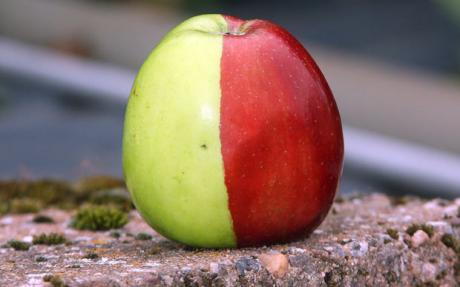
IMAGE: A random mutation caused this Golden Delicious apple to turn half-red, half-green. According to Susan Brown, she can breed apples with a stable variation of this mutation that creates candy-cane red stripes on a pale yellow-skinned apple. Photo ARCHANT via The Daily Telegraph.

In a 2011 talk titled “Taste the Apples of the Future,” Cornell University professor Susan Brown, one of only three commercial apple breeders in the United States, offered an enticing glimpse of yellow-red chimeras, pink-fleshed varieties, and the non-browning NY-674, whose resistance to discoloration was discovered by chance during an equipment failure.

Before moving onto her own, more practical work developing higher yielding, earlier fruiting varieties that are resistant to cold storage “scald,” Brown also mentioned that in Japan, farmers were already growing apples with built-in branding — the Japanese symbol for “good health” tattoed onto their skin by the sun.

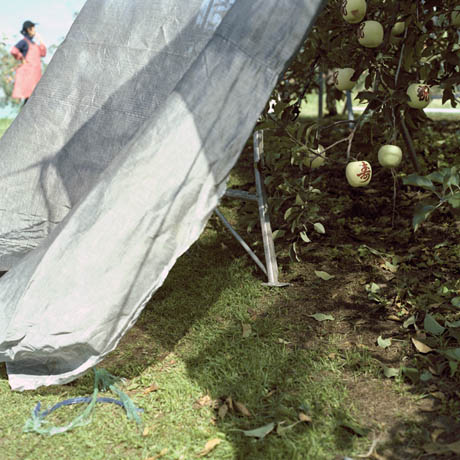
Field Worker & Stenciled Apples, Fall, Aomori Prefecture

IMAGE: Field Worker & Stenciled Apples, Fall, Aomori Prefecture, photograph by artist Jane Alden Stevens.

In 2007, Cincinnati-based artist Jane Alden Stevens spent four months in Japan, documenting the extraordinary attention its orchardists put into growing perfectly beautiful apples. In addition to culling blossoms to reduce over-crowding and ensure regular, large fruit, and then hand-pollinating them using powder-puff wands, Japanese farmers put a double-layer of wax paper bags around their baby apples for most of the growing season.

Hand Pollination #1, Spring, Aomori Prefecture

IMAGE: Hand Pollination #1, Spring, Aomori Prefecture, photograph by artist Jane Alden Stevens.

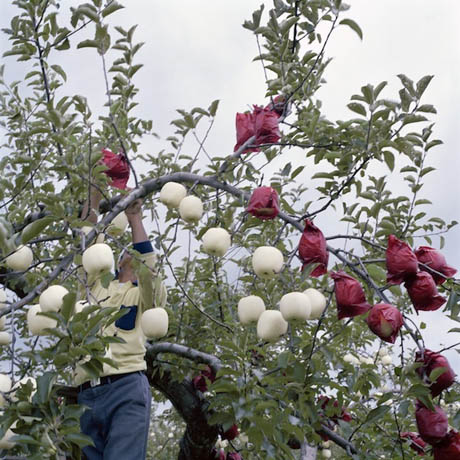
Bags for Apples, Early Summer, Aomori Prefecture

IMAGE: Bags for Apples, Early Summer, Aomori Prefecture, photograph by artist Jane Alden Stevens.

The bags do double duty, shielding the apples from pests and weather damage while also increasing the skin’s photosensitivity. In the autumn, a few weeks before harvest, the bags are removed — first, the outer one, revealing the fruit’s sun-deprived, pearly white skin, and then, up to ten days later, the translucent inner ones, whose different colours are chosen to filter the light spectrum in order to produce the desired hue.

90_stevens15a 460

IMAGE: Removing Inner Bags #1, Fall, Aomori Prefecture, photograph by artist Jane Alden Stevens.

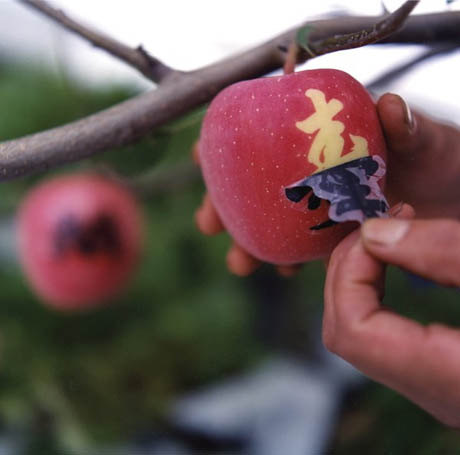
As they are finally exposed to the elements for the final few weeks before harvest, the most perfect of these already perfect apples are then decorated with a sticker that blocks sunlight to stencil an image onto the fruit. This “fruit mark” might be the Japanese kanji for “good health,” as Susan Brown mentioned. Others have brand logos (most notably that of Apple, the company), and some, according to Stevens, are “negatives with pictures. One Japanese pop star put his picture on apples to give his entourage for presents.”

Peeling off stencil 460

IMAGE: Photogram Beneath the Stencil, Fall, Aomori Prefecture, photograph by artist Jane Alden Stevens.

Far from being the apple of the future, however, Stevens tells the University of Cincinnati magazine that apple bagging and stencilling is in decline. When she visited Japan in 2007, apple bagging was applied to about thirty percent of the crop, “but fifty years ago, it affected seventy percent,” Stevens says. “Farmers do it themselves, but their children aren’t following in their footsteps, and there aren’t enough laborers to do the work.”

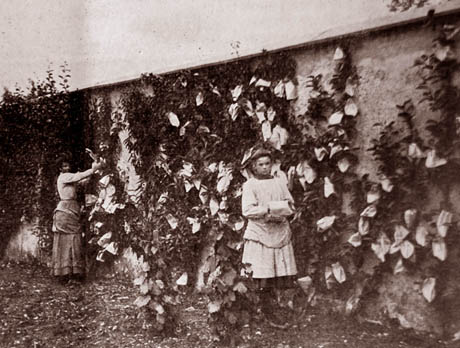
Fruit-marking is not even a recent — or an exclusively Japanese — development. I first came across mention of it in Suzanne Freidberg’s wonderful book, Fresh, which describes the efforts of the nineteenth-century fruit-growers of Montreuil to “brand” their apples for the novelty-seeking Parisian luxury market. Wives and children spent their winters folding and gluing thousands of paper bags, and their springtime covering up each individual apple at a rate of up to 3,000 per hour.

IMAGE: L’ensachage (fruit bagging), from the Le travail quotidien” section of the Société Régionale d’Horticulture de Montreuil online archive.

The introduction of fruit stencils followed quickly behind, initially applied to the fruit with egg white or bave d’escargot (snail slime). According to Freidberg, particularly ambitious growers also developed negatives on their apples, in a kind of “fruit photography”:

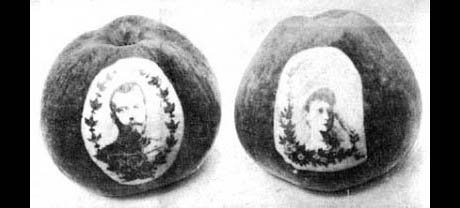
The marked fruit of the Montreuillois first won renown at the 1894 Saint Petersburg exhibition, where they presented the czar of Russia with an apple stenciled with his own portrait. King Leopold of Belgium, Edward VII of England, and Teddy Roosevelt received similar fruits.

Tsar and wife 460

IMAGE: Photographic apple portraits of the Tsar of Russia and his wife, via the website of artist Pauline Fouché.

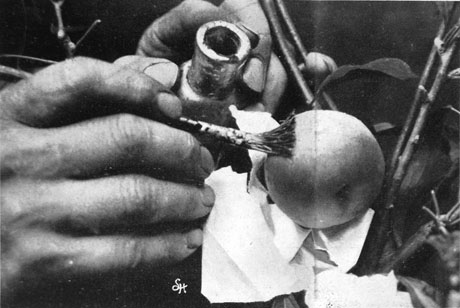
DCF 1.0

IMAGE: Applying gelatin glue to an apple, from the Le travail quotidien” section of the Société Régionale d’Horticulture de Montreuil online archive.

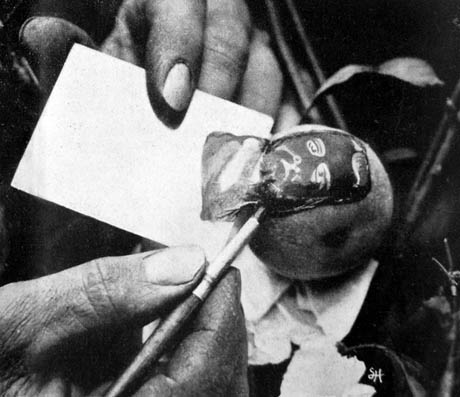
DCF 1.0

IMAGE: Peeling away a stencil on an apple, from the Le travail quotidien” section of the Société Régionale d’Horticulture de Montreuil online archive.

The idea of fruit-marking may well have come from an even earlier source, Freidberg notes, mentioning a reference in an Arabic treatise on agriculture from the twelfth century. Nonetheless, by the 1930s, the practice was all but extinct in France, as Montreuil was absorbed into the Parisian suburbs and an industrialising agricultural sector produced ever cheaper mass-market fruit.

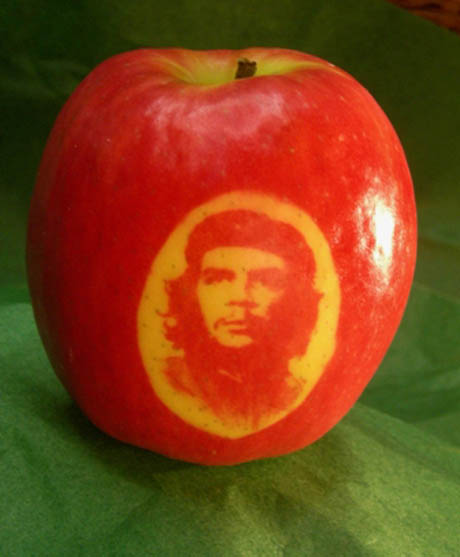
Still, after three years of trying, the Société Régionale d’Horticulture de Montreuil appears to be successfully reviving the lost art for today’s hobbyists and home gardeners. Their album of recent successes includes swirling dragons and tribal imagery worthy of any would-be Ink Master; a twenty-first century apple is more likely to sport a Che tattoo than a king or tsar.

Che 460

IMAGE: A stencil of Che Guevara, from the fruits marqués section of the Société Régionale d’Horticulture de Montreuil website.

Perhaps Cornell’s Susan Brown is onto something with apple stencils, after all. Although the commercial growers she works with are unlikely to pursue fruit bagging and photography, at least in the near future (the labour costs are simply too high), the technique seems ripe for rediscovery by today’s artisanal producers. Banksy could market a line of stencils for London’s fruit trees, Brooklyn growers could develop photographs of local landmarks on their heirloom varieties, and suburban families could entice their children into choosing apples over sweets by imprinting them with cartoon characters. Move over, bacon — tattooed apples are the next trend.

18 Feb 02:01

Photo


18 Feb 01:43

Maker’s Mark learns a painful social media lesson, won’t dilute bourbon

by Zachary M. Seward
firehose

Hey Russian Sledges, re: dilution in the Twitter era

Maker's Mark bottle being sealed with red wax

Maker’s Mark said today that it will not reduce the amount of alcohol in its bourbon after a weeklong backlash on social media chastened the famed distillery.

Screen shot 2013-02-17 at 4.48.40 PM

The reversal speaks to how brands often misjudge their relationship with customers, who can now vote more powerfully with their Twitter accounts than with their wallets. “What we’ve learned is that this is the customer’s brand,” Maker’s Mark COO Rob Samuels, grandson of the bourbon’s creator, said today in an interview. “It was an overwhelming response, we listened all week, and tomorrow morning we’ll immediately return Maker’s Mark to 90 proof.”

The company had emailed loyal customers on Feb. 9 to say it was lowering its proof to 84, or 42% alcohol, in order to address a supply shortage driven by bourbon’s surging popularity in the United States and certain other markets like Australia, Germany, and Japan. The announcement, first reported by Quartz, spread quickly in social media, rising from a small firestorm to an all-out backlash. The company defended itself in interviews, saying the taste wouldn’t change, but it didn’t help.

Screen shot 2013-02-17 at 4.48.48 PM

A useful comparison is Jack Daniel’s, which lowered the proof of its whiskey from 86 to 80 in 2004. There were plenty of complaints, but it was a different time: Facebook had just been created, Twitter didn’t yet exist, and that’s arguably why Jack Daniel’s is still distilled at 80 proof today. In the intervening years, plenty of brands, from Dell to United Airlines, have learned how social media can amplify customer complaints into corporate crises.

Still, look at this chart of the number of tweets about Maker’s Mark starting the day before the company announced it would water down its bourbon, using data from social analytics firm Topsy:

Maker-s-Mark-backlash-on-Twitter_chart

The Twitter backlash actually peaked on Tuesday, Feb. 12. Is it possible the company could have weathered the storm? Discussing today’s developments on Twitter, some people suggested Maker’s Mark had misjudged social media twice: first by under-anticipating the reaction and then by over-reacting to it.

Samuels said today in an interview that he continued to hear from customers all week, if not through social media then in emails and calls to their office. He said he attended a previously scheduled event last week at St. Elmo Steak House in Indianapolis, Indiana, where loyal customers were vocal about the change. “Let’s just say they didn’t hold back,” he said.

His father, Bill Samuels, a lawyer who eschewed the family business for years before taking over the distillery in 1980 and growing it into an international brand, was also pensive about the company’s rough week. He had maintained that reducing the alcohol in Maker’s Mark wouldn’t affect the taste of the bourbon that his father created in 1954 in Loretto, Kentucky, where it is still distilled, and said taste tests with customers had proven it.

“Clearly, if we would have just gotten a bunch of customers together and said, ‘Do you want us messing with your bourbon in any way?’ we would have gotten a resounding no,” Bill said. “So in a sense, we were asking the wrong question.”

Maker’s Mark was independently owned until 1981, when it began falling into the hands of increasingly large conglomerates, ending up in 2011 as part of Fortune Brands, which also owned seemingly random companies like Master Lock and Titleist, the golf equipment retailer. That corporate structure has tested the bourbon’s branding as a family-owned distillery committed to “small batch” production. In 2011, Fortune spun off its spirits brands into a publicly traded company, Beam Inc., which also makes the cheaper bourbon Jim Beam.

Neither Rob nor Bill would comment in detail about Beam’s involvement in the original decision to water down Maker’s Mark or today’s about-face. “They’re in full agreement as we reverse this decision,” Rob said. In recent earnings calls, Beam executives have warned that supply shortages could keep it from speeding up sales growth, especially in promising markets like South Korea, which in 2011 eliminated a 20% tariff on bourbon imports.

Without water as a tool to stretch its supply and with the bourbon having to age a minimum of six years before reaching customers, Maker’s Mark is left with few options. It could increase prices, as many argued it should, though it has already done that over the past several years. The company is also making capital investments to increase its production capacity in Loretto, but that will take at least four years to have an effect on supply.

As for the 84 proof Maker’s Mark, a small amount of it was created and sold to distributors before the company decided to return to 90 proof. “We think a lot of those bottles will become collector’s items,” Rob said.


17 Feb 23:48

Bringing the Zach Morris phone into the 21st century

by Brian Benchoff

DSCF7247

With the gravitas of [Michael Douglas] in Wall Street and the technological amazement of [Zach Morris] on Saved By The Bell, the classic 1980s ‘brick’ cell phone has a lot to offer these days. Not only is it large enough to be used as a blunt weapon, it’s also useful as an anchor and more durable than an old-school Nokia. Most, if not all of these phones have gone silent since analog cellular service went dead a few years ago, but that didn’t stop [Andrew] from bringing his back to life.

The core of this build is a 128×64 OLED screen that replaced the old seven-digit, seven-segment display and a very small GSM module. The ancient PCB was discarded and a new hardware revision was created in Eagle based on an Arduino-powered microcontroller. The buttons from the original phone remained, thanks to a custom designed resistive button footprint on the PCB and a bit of conductive ink.

What’s surprising is this phone actually works. [Andrew] can not only receive texts on his phone, but also send them using his own implementation of a number pad keyboard. It’s an awesome build, and from what we can tell, the first proper DIY cell phone we’ve ever seen. About time someone got around to that, and we couldn’t have hoped for a better form factor.


Filed under: cellphones hacks
17 Feb 23:48

Amazon Sells Out Predator Drone Toy After Mocking Reviews

by samzenpus
parallel_prankster writes "Amazon users are addressing the drone controversy with sarcasm. Maisto International Inc.'s model Predator drones are selling out on Amazon.com Inc.'s website as parody reviews highlight how the toys can help children hone killing skills, mocking a controversial U.S. practice. The toy is a replica of the RQ-1 Predator, an unmanned aircraft that the U.S. Air Force has used in combat over Afghanistan, Pakistan, Serbia, Iraq and Yemen, according to the product description on Amazon. Only one of the $49.99 military-style toy jets is available for purchase on Amazon's site, which is brimming with assessments laced with dark humor. 'You can't spell slaughter without laughter,' one pithy joker wrote."

Share on Google+

Read more of this story at Slashdot.


17 Feb 23:47

KDE's Aaron Seigo Bashes Ubuntu Phone

by samzenpus
sfcrazy writes "KDE's Plasma Active team leader Aaron Seigo has raised some concerns around Ubuntu Phone. He says 'We can start with the obvious clue: Unity currently does not use QML at all; Ubuntu Phone is pure QML. So, no, it is not the same code, it is not the sort of seamless cross-device technology bridge that they are purporting.' He then concludes, 'If you're a Free software developer, user and/or supporter and buying into these claims, I don't know how else to put it other than this: you're being duped. Consider what supporting those who employ such tactics means for Free software.'"

Share on Google+

Read more of this story at Slashdot.


17 Feb 23:47

Get an advance look at this year’s Free Comic Book Day selections

by Brigid Alverson
Molly Danger/Princeless

Molly Danger/Princeless

The snow is piled high where I am, and May seems like a long time away, but the Free Comic Book Day folks are getting into the spirit by posting some free previews (or “prevues,” as they spell it, since these are Previews prevues). The selection includes Gilbert Hernandez’s Marble Season, a Molly Danger comic by Jamal Igle that will be bundled with a Princeless story by Jeremy Whitley, Atomic Robo, 2000AD, Brian Wood’s Star Wars, and more.

As in previous years, the FCBD website is also running a series of creator interviews. These aren’t particularly deep; all the creators get the same set of softball questions (actual question, I kid you not: “Tell us why everyone should read comic books?”) but some of them, like Fred Van Lente, go beyond “Comics are AWESOME!!!!!” and have a bit of fun with it. Recent interviews worth a glance include Cory Godbey, who is working on an adaptation of Jim Henson’s Labyrinth; Emmanuel Guibert and Mark Boutvant on Ariol; and Robert Venditti on X-O Manowar. It’s all nakedly promotional, but it’s promoting comics after all, and there is some good stuff in there, both in the responses and the art samples.

17 Feb 23:46

Publisher Sues University Librarian Over His Personal Blog Posts

by samzenpus
McGruber writes "The Chronicle of Higher Education has the news that Herbert Richardson, founder of Edwin Mellen Press is suing McMaster University and University Librarian Dale Askey for $3 Million over Mr. Askey's posts on a personal blog. In 2010 Mr. Askey wrote a blog post about Edwin Mellen Press on his personal Web site, Bibliobrary. Mr. Askey referred to the publisher as 'dubious' and said its books were often works of 'second-class scholarship.' For a few months afterward, several people chimed in in the blog's comments section, some agreeing with Mr. Askey, others arguing in support of the publisher. In a February 11 statement, the McMaster University Faculty Association (MUFA) stated that The Canadian Association of University Teachers (CAUT) 'and the MUFA Executive agree that this case represents a serious threat to the freedom of academic librarians (pdf) to voice their professional judgement and to academic freedom more generally.'"

Share on Google+

Read more of this story at Slashdot.


17 Feb 23:46

Danica Patrick wins pole for NASCAR's Daytona 500 - MyFox Phoenix


ABC News

Danica Patrick wins pole for NASCAR's Daytona 500
MyFox Phoenix
(AP Photo/Terry Renna). Danica Patrick displays the flag after winning the pole during qualifying for the NASCAR Daytona 500 Sprint Cup Series auto race at Daytona International Speedway, Sunday, Feb. 17, 2013, in Daytona Beach, Fla. (AP Photo/Terry ...
Danica Patrick embraces 'on the radar' pressure of Daytona poleOrlando Sentinel
Danica Patrick makes history at Daytona 500fox5sandiego.com
Danica Patrick makes history by winning pole position at DaytonaGant Daily

all 359 news articles »
17 Feb 23:46

DragonCon issues statement on its connection to Ed Kramer

firehose

tl;dr: Don't sell shares in a fan convention to an alleged child molester

Noting that co-founder Ed Kramer is still “a stockholder despite our desires otherwise,” DragonCon issued a statement to address the “great deal of discussion” surrounding the accused child molester.
17 Feb 23:45

Attention

17 Feb 23:44

RIP

firehose

NYT Styles Magazine logo change


RIP

17 Feb 23:43

Destiny Not Coming To PC, Bungie Deny Reality

by John Walker
firehose

"nobody plays shooters the way they used to play them before Halo ’cause nobody wants to"

By John Walker on February 17th, 2013 at 10:44 pm.

Obviously concept art, what with this not being on PC graphics.

Halo creators Bungie have confirmed that their next game, online shooter Destiny, will not be coming to PC. With 360 and PS3 versions certain, and next-gen consoles hinted at, it would seem to make a certain degree of sense to release the game on the format most suited to online FPS. But no, because according to Bungie, of mouse and keyboard players, “Nobody plays shooters the way they used to… ’cause nobody wants to.”

This was the studio’s co-founder, Jason Jones, according to Destructoid. To give you the full statement, so you don’t think I’m twisting his words, he said:

“We did a bunch of ambitious things on Halo deliberately to reach out to people. We limited players to two weapons, we gave them recharging health, we automatically saved and restored the game – almost heretical things to first-person shooters at the time. We made the game run without a mouse and keyboard. And now nobody plays shooters the way they used to play them before Halo ’cause nobody wants to.”

There are two possibilities. Jason Jones has never heard of Team Fortress 2, Counter-Strike, or any other number of hugely played online FPS games for the PC. Or Bungie just don’t give a toss about reality any more. I’m sure what he meant to say was, “We couldn’t be bothered to make a PC version,” but for some reason it came out as, “Blurble flurble flipple-flopple ploooooooo.”

Perhaps he misspoke, perhaps he’s a braggart who thinks Halo changed the face of FPS while no one else noticed, perhaps he just meant the regenerating health thing…? But I’m pretty sure I’d like to see him going up against some of the best online FPS players in the world, him with his joystick, them with their mice and keyboards that they haven’t been told they don’t want to use any more.

17 Feb 23:31

Doctor Who (Classic), "Shada"

by Christopher Bahn

“Shada” (season 17, episodes 21-26. Filmed in 1979; never aired.)

In 1979, Douglas Adams, then script editor for Doctor Who, wrote a story for the show in which the villain disastrously shatters into half a dozen fragments of himself that scatter throughout time. That was “City Of Death,” one of the best serials Doctor Who ever did. Later that year, he wrote another one. This time, the story itself exploded, shattered into half a dozen fragments of itself, and scattered throughout time. That was “Shada,” the great lost story of season 17, a half-filmed serial from Tom Baker’s second-to-last season as the Fourth Doctor. And for a long time, people wondered if it too wouldn’t have been one of the greats. But that was back when it was still lost.

It’s oddly appropriate that the last scene of “Shada” begins with the Doctor reading from Charles Dickens ...

Read more
17 Feb 22:49

Photo


17 Feb 22:49

And now, an academic paperback for over $1500

by Jonathan

So I went to Amazon to pick up Constance Classen’s The Deepest Sense: A Cultural History of Touch, which I’m looking forward to reading.  This is what I found:


While I’m definitely interested in picking up the book, and while it is clearly eligible for super saver shipping, this is the first over-$1500 academic paperback I’ve ever seen. Either someone made a whopper of a typo, Amazon has some kind of algorithmic error (or U of Illinois press does), or the press has a truly insane pricing plan for purchasers outside the United States.

Luckily, there are other vendors who will sell it for less.

Assuming it’s an error, and one that might be to the author’s detriment, I emailed Amazon to ask why the book was so expensive. If I hear back, I’ll post it here.

Update:

Here’s the email I got back from Amazon.  Suitably cryptic:

Thank you for writing to us at Amazon.ca.

I am sorry, but this item’s price “The Deepest Sense” was listed as wrongly on our web site.

We build our web site information from many sources, and we really appreciate knowing about any errors which find their way into it.

I’ve forwarded your message to the inventory department and I can ensure that this error is corrected as soon as possible. This process will takes 5 to 7 business days, so we request you to wait until that time to get this issue corrected.

I will write back to you within 5 to 7 business days with a resolution.

Thank you for your patience and understanding, and thanks for shopping at Amazon.ca.

Did we answer your question?

If yes, please click here:
http://www.amazon.ca/rsvp-y?c=cycdthew3542761760

If not, please click here:
http://www.amazon.ca/rsvp-n?c=cycdthew3542761760&q=caff

Please note: this e-mail was sent from an address that cannot accept incoming e-mail.

To contact us about an unrelated issue, please visit the Help section of our web site.

Best regards,

Vel S.
Amazon.ca
Your feedback is helping us build Earth’s Most Customer-Centric Company.
http://www.amazon.ca

Postscript:

On Facebook, Dave Noon pointed me to this $23 million book about flies.

17 Feb 22:48

All Criterion movies free this weekend

by Sarah Pavis

In a deal last year, Criterion movies went from one paid online service to another (Netflix to Hulu Plus).

However from now through Monday February 18th, all Criterion movies are free on Hulu for anyone in the US. No sign-up or log-in required.

Some recommendations: Yojimbo, Schizopolis, Hoop Dreams, and Zazie dans le métro.

Update: The free weekend has ended and most Criterion movies are back behind the Hulu Plus paywall but there are still a handful of Criterion movies available to watch for free on regular-Hulu including Hoop Dreams as well as Zatoichi, Quadrophenia, and The Long Voyage Home

Tags: Criterion Collection   Hulu   movies
17 Feb 22:47

Solar Peach Walls

by Nicola

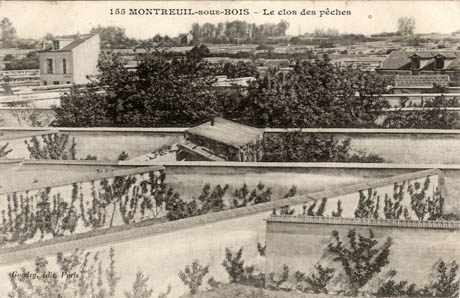
As a coda to my previous post, I should note that before their adoption of apple ensachage and photographic tattoos, the nineteenth-century fruit growers of Montreuil had already adopted innovative peach growing techniques to produce the most coveted stone fruits in the world.

murs6 460

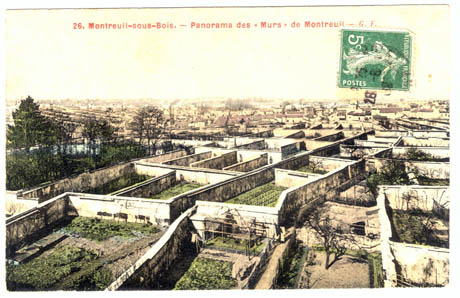
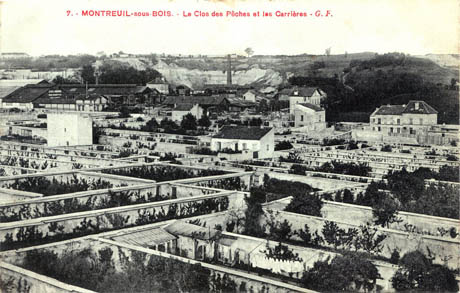
IMAGE: Postcards from the era show Montreuil’s seemingly infinite solar courtyards, Vues de Montreuil à la grande époque des Murs à pêches from the collection of the Société Régionale d’Horticulture de Montreuil.

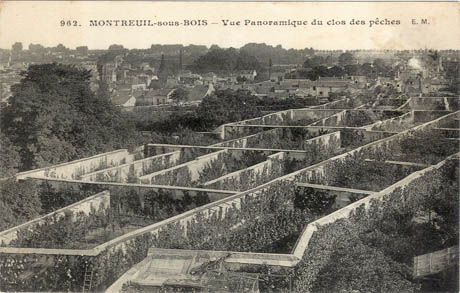
Their secret lay in the construction of a honeycomb of solar walls. As Suzanne Freidberg writes in Fresh, the Montreuillois enclosed rectangular plots “in walls of plaster — a material that absorbs heat much more effectively than brick — and oriented them all north-south, so as to capture the most sunlight.”

murs2 460

IMAGE: Vues de Montreuil à la grande époque des Murs à pêches from the collection of the Société Régionale d’Horticulture de Montreuil.

This gridiron of sun traps were surprisingly effective, according to Freidberg:

Indeed, both day and night the gardens were warmer than their surroundings by several degrees Celsius. In this microclimate Mediterranean fruits thrived. Peaches ripened a month before others on the market, when prices were still sky-high. In addition, the villagers trained their espaliers to stretch out across the east-facing walls like giant fans cradling each peach in a perpetual sheltered sunbath. This design produced not only unusually big and beautiful fruits but also more of them from each tree.

murs3 460

IMAGE: Vues de Montreuil à la grande époque des Murs à pêches from the collection of the Société Régionale d’Horticulture de Montreuil.

cueillette 460

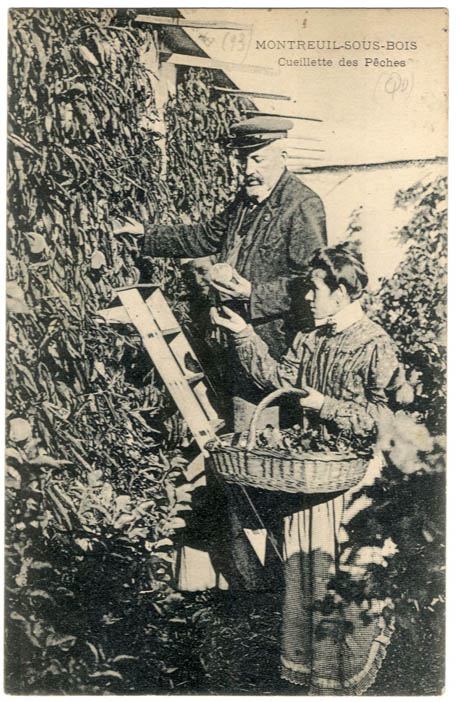
IMAGE: Harvesting Montreuil’s peaches — the best in France, and, some would argue, the world. From the collection of the Société Régionale d’Horticulture de Montreuil.

French horticulturalists, unable to believe that illiterate peasants had come up with this system on their own, suspected they had stolen the idea from the king’s garden at Versailles. Nonetheless, observers marveled at the sight of solar walls applied at the scale of infrastructure, re-designing the landscape and microclimate of an entire village. Freidberg translates the comments of a contemporary visitor, Pierre Jean-Baptiste Legrand d’Aussy:

 It’s a really interesting spectacle to look down from the surrounding hillsides on this immense multitude of gardens, carved up every which way by walls covered with trees and verdant vines. You think you’re looking at a hive of bees…

murs5 460

IMAGE: Vues de Montreuil à la grande époque des Murs à pêches from the collection of the Société Régionale d’Horticulture de Montreuil.

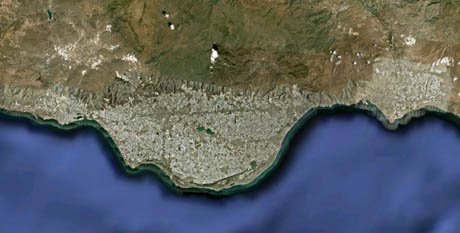
Looking at panoramic postcards of Montreuil from the end of the nineteenth century, with fully three-quarters of the town’s territory transformed into plaster-walled solar courtyards for peaches, it’s tempting to compare the landscape with the sea of greenhouses have similarly reformatted El Ejido, in the Almeira province of Spain, today.

mar_plasticos 460

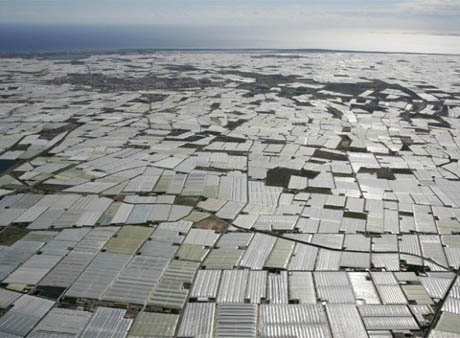
IMAGE: El Ejido’s saladscape, via.

The desert landscape that previously served as the backdrop for Sergio Leone’s “spaghetti westerns,” as architect Keller Easterling notes in her chapter on El Ejido in Enduring Innocence: Global Architecture and Its Political Masquerades, is now a sea of plastic — the largest concentration of greenhouses in the world, hot-housing summer vegetables all winter long.

The nineteenth-century plaster wall of Montreuil is paralleled, in El Ejido, by the adaptation, in the 1970s, of a flat-roofed, “parallel type,” plastic-sheeting and wire structure used locally for growing table grapes. Just as in Montreuil, this single structural unit became the “germ,” in Easterling’s formulation, for a new landscape-scale agricultural infrastructure, reshaping the region’s ecology and its economy.

El-Ejido_Landschaft_unter_Plastik-460

IMAGE: El Ejido from above, via.

El-Ejido_Landschaft_unter_Plastik-2 460

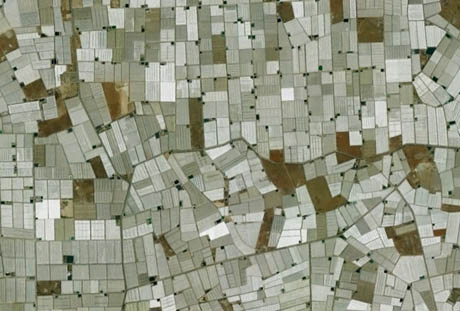
IMAGE: Satellite imagery of the El Ejido peninsula, via.

Of course, the tiled suntraps of El Ejido have not only transformed a single town, but an entire peninsula — the 80,000 contiguous acres of parallel plastic greenhouses are clearly visible from space. In addition, while the fruit growers of Montreuil drew on their wives and children to provide cheap labour, the greenhouses of El Ejido rely on seasonal or illegal workers from North Africa, in a complicated and exploitative relationship that, as Easterling writes, has ignited a “tomato war” — “a translocal valve of labor, race, and migration problems in Europe.”

Unpacking the economic, ecological, and geopolitical forces that conspire to transform a “germ” into a highly engineered landscape, worthy of postcard and satellite photography, as well as our marveling attention — and then, as was the case in Montreuil and as seems inevitable in El Ejido, given its aquifer depletion, to dismantle it half a century later, is a fascinating exercise. The lucrative market in counter-seasonal produce has spurred ever more sophisticated architectures of climate modification — including, of course, my personal obsession, cold storage — marching across the urban hinterlands in formation…

17 Feb 22:47

Meet the world's first cyborg

by Sarah Pavis

Born with achromatopsia, a rare condition that causes complete colour blindness, Neil Harbisson developed the eyeborg, a device that translates colours into sounds for him.

Harbisson has been claimed to be the first recognized cyborg in the world, as his passport photo now includes his device. In 2010, Neil Harbisson and Moon Ribas created the Cyborg Foundation, an international organization to help humans become cyborgs. The foundation has also experimented with other sensory devices, including an "earborg," which translates sound into color, and a "speedborg," which allows people to detect movement through electronic earrings that vibrate.

"One day I started hearing colors in my dreams. Then I understood what being a cyborg meant. It's not the union between the eyeborg and my head, what converts me into a cyborg, but the union between the software and my brain. My body and the technology have united. It's very very human to modify one's body with human creations."