firehose
Shared posts
15 May 22:52
The Old Reader has its own registration system now
firehosea little late as I'm not switching accounts again
but maybe this brings Amy back?
firehose and -1 others like this
15 May 22:46
Larry Page: Technological innovation is slow because people criticize Google
firehoseAAAAAAAAAAAAAAAAAAAAAAAAAAAAAAAAAAAAAAAAAAAAAAAAAAAAAAAAAAAAAAAAAAAAAAAAAAAAAA
Larry Page: Technological innovation is slow because people criticize Google:
“Our industry, and Google, all of you, we’re really only at one percent of what we can do… we’re really moving slow.”
“And some of that is due to negativity. Every story I read about Google is about us versus some other company, or something else, and I really don’t find that interesting. We should be building things that don’t exist.”
“And some of that is due to negativity. Every story I read about Google is about us versus some other company, or something else, and I really don’t find that interesting. We should be building things that don’t exist.”
“Technology lets us free up ourselves to do more different things. I think people in the future will think we’re just as crazy as we think people in the past were.”
…
“That’s why Google got involved with the movie The Internship. Well, they were making a movie and I’m not sure we had a choice, but we got involved. Computer Science has marketing problem.”
“The guy who runs search is the coolest guy in that movie. We’re really excited about that.”
15 May 22:40
You Can Read All The Benghazi Emails Here
The White House released more than 100 pages of e-mails on Wednesday in a bid to quell critics who say President Barack Obama and his aides played politics with national security following the deadly attack on the U.S. diplomatic compound in Benghazi, Libya.
15 May 22:38
Top Results from Google Image Searches for Things that Cats have Typed
by dorothy


![precision-ground-stainless-steel-8mm-post-h-60mm-p8-60-317-p[ekm]338x286[ekm]](http://www.verysmallarray.com/wp-content/uploads/precision-ground-stainless-steel-8mm-post-h-60mm-p8-60-317-pekm338x286ekm.jpg)


firehose likes this
15 May 22:38


Wadi Al-Salaam: The Largest Cemetery in The World via Amusing...
Wadi Al-Salaam: The Largest Cemetery in The World via Amusing Planet
Wadi us-Salaam, which literally means the Valley of Peace, is an Islamic cemetery located in the holy city of Najaf, Iraq. The cemetery covers an area of 1485.5 acres and contains millions of bodies, making it one of the strongest contender for the title of the largest graveyard on earth. Najaf itself is one of Iraq’s biggest cities, with a population of nearly 600,000. But the adjoining city of the dead holds the remains of millions, stretching for up to 10km along the valley. Wadi Al-Salam cemetery is also the only cemetery in the world where the process of burial is still continuing to day since more than 1,400 years.
firehose likes this



15 May 22:34

Google demands Microsoft remove YouTube Windows Phone app, cites lack of ads
by Tom Warren
firehose"Every story I read about Google is about us versus some other company, or something else, and I really don't find that interesting. We should be building things that don't exist. ... I've personally been quite sad at the industry's behavior around all these things. If you take something as simple as IM, we've had an open offer to interoperate forever. Just this week Microsoft took advantage of that by interoperating with us. You can't have people milking off of just one company."
--Larry Page at Google I/O
Microsoft updated its own YouTube application for Windows Phone just over a week ago and Google isn't impressed. The Verge has obtained a copy of a cease and desist letter that Google has sent to Microsoft recently, demanding that Microsoft "immediately withdraw this application from the Windows Phone Store and disable existing downloads of the application by Wednesday, May 22, 2013." Microsoft's YouTube app for Windows Phone appears to have taken Google by surprise.
Windows Phone app violates API use
Google's complaint centers on the lack of ads in Microsoft's YouTube app, something it claims is a direct violation of the terms and conditions of the company's YouTube API. The Verge has learned that Microsoft created the app without Google's consent with features that specifically prevent ads from playing. The lack of ads clearly hits Google's own revenues, but also those of its third-party content creators that are paid through the company's AdSense program. "Unfortunately, by blocking advertising and allowing downloads of videos, your application cuts off a valuable ongoing revenue source for creators, and causes harm to the thriving content ecosystem on YouTube," says Google's letter, addressed to Microsoft's Todd Brix.
Microsoft has previously complained to the EU over Google's apparent refusal to let Windows Phone access YouTube metadata. While it initially seemed like both companies had reconciled their differences, that's clearly not the case. On stage at Google I/O today, CEO Larry Page detailed his take on technology's future, noting that industry negativity is holding back progress. Page told an audience member that "we struggle with people like Microsoft," though he said Google had a "great relationship" with the company.
All the bickering means customers lose out
The relationship is clearly strained with campaigns like Scroogled, and the YouTube complaint is the latest in a set of issues between both companies. In December, Google announced its plans to drop Exchange ActiveSync support, a decision that left Microsoft sweating over its lack of the alternative CalDAV and CardDAV protocol support for Windows Phone. Despite this, it's clear the pair can work together on certain interperability. Just this week, Microsoft announced its plans to support Google Talk within Outlook.com, a change that's beneficial for consumers of both company's services.
For now, it appears that Windows Phone YouTube users will have to utilize unofficial third-party apps or settle for Google's mobile web version. Until Microsoft and Google can collaborate without bickering, it's the customers of both companies that lose out.
The Verge has reached out to Microsoft for comment on Google's cease and desist letter and we'll update you accordingly.
- Related Items youtube app windows phone microsoft google youtube api api cease and desist legal
15 May 22:32
Changing my gender to male on Google+ improved my What's Hot experience
Changing my gender to male on Google+ improved my What's Hot experience:
Earlier today, +Kimberly Chapman told me about a little experiment she’d done. She’d opened a tab on her browser and directed it to plus.google.com/explore, a stream that enables you to see the hottest content on Google+. In another tab, Chapman changed her gender on her Google+ profile from female to male, and then loaded the Explore page into another tab.
The difference was astonishing. “As a girl, I get stupid warm-fuzzy meaningless shit,” Chapman writes on a post (http://goo.gl/ZDBxT). “As a guy, I get nerdy stuff. This is not okay. I get that [What’s Hot] algorithms are based on what people click, like, share, comment on, etc. Fine. But I challenge anyone to give me one good reason why there should be such a drastic difference in less than ten seconds by simply changing my gender, other than institutionalized sexism about what girls and guys apparently like.”
I tried the experiment myself just a moment ago. Below are ten posts that graced my screen, organized into pairs. I have paired them based on their placement on my stream and no other factors. The example image shown below, for instance, shows a post with a quote and one with a bar graph — the quote was the fifth post on my Explore stream when I was female and the bar graph was the fifth post on my Explore stream when I was male.
Note that I have not changed anything other than my profile. And despite my extensive interaction with the social network, when I’m female, gadgets might as well not exist. When I was male, I saw two posts referencing #io13 , but there was no mention of the event when I was female. In fact, the closest thing to tech news I got as a female was an article about how to become an influencer on Pinterest. Needless to say, this article didn’t show up when I was male.
Neither did the nausea-inducing feel-good quotes on pictures.
+Yonatan Zunger, Chief Architect of Google+, responded to the issue, saying: “What’s Hot is based both on properties inherent to the post — how people have reacted to it when they saw it, +1’s, reshares, and so on — and on properties of the viewer, especially profile info. Gender is one of those signals, as are quite a few other things. From what I can tell, gender is having a relatively large effect on the result set, because our models (based on people’s actual responses to seeing these things) seem to show a pretty sharp gender difference in response.”
He agreed the model is too gender sensitive, adding that a team is currently working on content recommendations that better reflect individual user preferences. He assures users that “there was no human editing to say that women like X and men like Y.”
UPDATE: At 13:08 Pacific, Zunger commented on this post saying that further discussion with the What’s Hot team has revealed that the system that populates Explore is using an old-generation algorithm, which is known to have been very gender sensitive.
“The system that populates the actual What’s Hot posts you see in your [Home] stream is the more modernized system, with a lot more subtlety in its model, and it does not have the same level of gender sensitivity,” Zunger added. “It’s still aware of it, but it’s a small feature, not a big one.”
Google+ plans to upgrade Explore to the new algorithm. Thank you, Google+ team for being responsive about this issue. We look forward to seeing how this algorithm continues to evolve to serve us more and more of the content each of us wants.
15 May 22:32


the knight and his steed photo by nicolas reusens
firehosevia Vjuliao
Tertiarymatt, Russian Sledges and one other like this
15 May 22:32
Ubuntu Looks Towards MySQL Alternatives
Arch Linux replaced MySQL with MariaDB, openSUSE gutted MySQL, Fedora replaced MySQL, and now Ubuntu Linux is looking to continue the trend...
15 May 22:31
Starshift
by Janelle
firehosevia Elena Bulygina

firehose likes this
15 May 22:30
Google Play Books enables user ebook uploads, Google Drive support
by Matt Brian
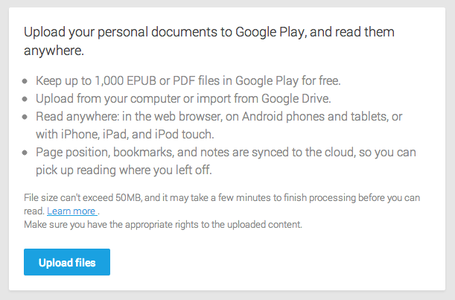
Google has updated its Play Books e-reader apps for iOS and Android to include support for EPUB and PDF files from outside the Play Store. The new feature has been enabled as part of Google's strategy to unite its cloud services, allowing users to either upload their ebooks via its website, or import them from their Google Drive storage. Google says that users will be able to store up to 1,000 files for free, as long as they are under 50MB.
Once uploaded, books will be available via the web, on Android smartphones and tablets, and the iPhone and iPad — page positions, bookmarks, and notes will be synced between each of those devices. With these features, Google's Book apps now have an edge over Amazon's Kindle and Apple's iBooks apps — which currently don't sync sideloaded titles between ebook libraries.

15 May 22:25


“Mommy, why did we make the Cylons?” United States...
by theburnlab
firehosevia GN
“Mommy, why did we make the Cylons?”
United States Navy launches first X-47 robotic drone fighter jet from an aircraft carrier deck
15 May 21:53


Film: Watch This: In The Loop is as merciless as its spiritual ancestor, TV’s The Thick Of It
by Sam Adams
Every day, Watch This offers staff recommendations inspired by a new movie coming out that week. This week: The release of Star Trek Into Darkness has us fondly remembering other movies based on, or spun-off from, TV shows.
In The Loop (2009)
Not exactly a continuation of Veep creator Armando Iannucci’s brilliant British series The Thick Of It, In The Loop is like a reboot set in a slightly alternate universe. Cast member Chris Addison recurs, but instead of perpetually flustered policy aide Oliver Reeder, he’s a distinctly more mercenary political operative; the movie’s Olivia Poulet was cast in The Thick Of It’s third and fourth series as another, entirely different, character. But there are two crucial constants. Like The Thick Of It, In The Loop sends up the small-potatoes bickering of British politics. More importantly, it also carries over the iconic character of Malcolm Tucker ...


15 May 20:37
Columbia seeks to end whites-only scholarship - UPI.com
firehosemidwestern values
Columbia seeks to end whites-only scholarship - UPI.com:
The university is hoping to free up grant money for the Lydia C. Roberts Graduate Fellowship from its stipulations which include, among other things, a restriction to students “of the caucasian race.”
The rules governing the fund cannot be changed without a court order, which is why the fund’s trustees have filed papers with the Manhattan Supreme Court to lift the restrictions, the New York Post reported.
“Circumstances have so changed from the time when the Trust was established” that complying with the restrictions is “impossible,” the filing said. “Columbia University is now prohibited by law and University policy from discriminating on the basis of race.”
Roberts, the fellowship’s namesake, left most of her $509,000 estate to Columbia when she died in 1920. In addition, Roberts fellows are prohibited from studying several fields, including law, and must not only hail from Iowa but must return to the Hawkeye State for two years after graduating.
15 May 20:22

JoJo's Bizarre Adventure: All Star Battle to feature Kars, Rohan
by Samit Sarkar
By Samit Sarkar on May 15, 2013 at 3:30p
The roster of characters in JoJo's Bizarre Adventure: All Star Battle, the upcoming fighting game from CyberConnect2 and Namco Bandai, will include Kars and Rohan, according to this week's issue of Jump magazine (scan here, via All Games Beta).
Kars, named after the new wave band The Cars, is the leader of the Pillar Men in Battle Tendency, the second part of the original manga series that the fighting game is based on. Rohan Kishibe, a manga artist, appears in part 4, Diamond is Unbreakable.
Namco Bandai announced All Star Battle last July and released a trailer in September. The game is set to launch Aug. 29 in Japan on PlayStation 3; Namco Bandai has not announced releases outside Japan.

15 May 20:14
The Portland Press | Crowd Supply
firehosemeanwhile, in Portland
The Portland Press | Crowd Supply:
The Portland Press
$4,809 pledged
of $80,000 goal
30
days left6%
funded41
pledges-
2 Oregon Wool Cup Cozies
Ships December 2013
$49
Free Shipping!
 Back This Project
3 claimed , 497 left
-
The Portland Press
Ships December 2013
$99
Free Shipping!
 Back This Project
26 claimed
-
The Portland Press Package
Ships December 2013
$149
Free Shipping!
 T-shirt Style Iconic Logo ”Bucket” Logo T-shirt Size Unisex Small Unisex Medium Unisex Large Unisex Extra Large Back This Project
11 claimed
-
Reseller Kit
Ships December 2013
$449
Free Shipping!
 Back This Project
1 claimed
Funding ends Jun 14, 2013 at 11:59pm PDT
Remind MeA french press for your Mason jar, manufactured in Oregon using raw materials from the USA, and backed with a lifetime warranty.
Home coffee-making equipment has come a long way, but the typical french press is still assembled from plastic and delicate glass in an overseas factory. We want to improve your coffee making experience with quality and materials that you can relate to. That’s why we’re introducing the Portland Press:

The Portland Press is a french press for a Mason jar, made in the state of Oregon, out of materials sourced in the USA. It’s a simple, clean, practical design made out of fundamental materials: glass, wool, steel, wood. Most importantly, the Mason jar is easy to replace if it breaks, and the rest of the Portland Press is backed with a lifetime warranty.

Our favorite part about this project is telling the story behind the people who are making the parts. The Portland Press was designed by Bucket, but the components are made by a variety of people with different backgrounds. Some of the manufacturers who we’re working with include Portland Stamping & Manufacturing, Spooltown, Creekside Fiber Mill, Puddleduck Farm, B&L Wood Creations, Northwest Spring Manufacturing, Oregon Screw Machine Products, and Tualatin Valley Workshop.

PREMIUMS & PLEDGE LEVELS
Set of 2 Oregon Wool Cup Cozies ($49)
Includes a whole lot of gratitude from Bryan and Rob for showing your support. These felted wool cozies are 100% Oregon made. Thanks to Puddleduck Farm, Creekside Fiber Mill, and Spooltown for making this product a reality. Fits on all 12-oz regular-mouth quilted crystal jelly jars. Jars not included. Limited to the first 500 backers.

The Portland Press ($99)
A french press for a 24-oz. Pint & Half Mason jar that’s made entirely in the state of Oregon, and looks nice on your counter top. Backed with a lifetime warranty. Includes press, one 24-oz. Pint & Half Mason jar and a custom size cozy to keep your coffee hot. We expect the post-crowdfunding retail price of the Portland Press to be $119.

The Portland Press Package ($149)
Receive The Portland Press, two felted wool cup cozies, and a t-shirt. A french press for a 24-oz. Pint & Half Mason jar that’s made entirely in the state of Oregon, and looks nice on your counter top. Backed with a lifetime warranty. Includes press, one 24-oz. Pint & Half Mason jar, a custom size cozy to keep your Portland Press hot, two felted wool cup cozies (12-oz. jars not included), and a unisex Bucket t-shirt (available in two styles, sizes small to extra large).

Choose one of the above t-shirts for The Portland Press Package.
The Portland Press Reseller Kit ($449)
Receive five Portland Presses, each of which is a french press for a 24-oz. Pint & Half Mason jar that’s made entirely in the state of Oregon, and looks nice on your counter top. Backed with a lifetime warranty. Each includes a press, a 24-oz. Pint & Half Mason jar, and a custom size cozy to keep your Portland Press hot. We expect the post-crowdfunding retail price of a single Portland Press to be $119.

RISKS & CHALLENGES
Some of the metal components for the Portland Press have not gone through final design phase. This phase of the design process is cost-prohibitive without external funding due to the tooling that is required to produce the spring and the stamped sheet metal components. We have completed the prototype and proof of concept phases for all of the Portland Press components. We have also completed final design and prototype phases for the wool cozy and the wood lid.
We have detailed quotes and fulfillment lead times from all suppliers for order quantities of 100, 1000 and 10,000. If the designs change during the final design phase, the production costs will also change. However, the proof of concept phase has shown that final design changes will be minor. Only a few minor dimensions may change, while the overall design of the french press mechanism will stay the same, ensuring that changes in production cost will be minimal.
15 May 20:05
I fucking wish
by donniedemeijer
firehosevia Vjuliao

Sofía Henao, firehose and one other like this
15 May 20:01
That Angry Birds movie that’s coming out in three years will be distributed by Sony Pictures, accord
by Evan Narcisse
That Angry Birds movie that’s coming out in three years will be distributed by Sony Pictures, according to Deadline Hollywood. Somewhere, Nathan Drake is yelling into a phone wondering what the hell is going on with HIS movie.



15 May 19:44
Money Bucket: Selling the Portland Loo
firehosemeanwhile, in Portland
Money Bucket: Selling the Portland Loo:
 IMAGE: Composite photo by Anna Jaye Goellner
Anne Peterson is a problem solver.
.jpg)
.jpg)
.jpg)

.jpg)
.jpg)
She may not look like one—her dyed maroon hair and gold-rimmed sunglasses hint at her second life as a “Burner” (one who regularly attends Burning Man)—but in 2006, when the city of Portland wanted citizens to disconnect their downspouts, it put Peterson in charge. In 2011, when it wanted to convince restaurants to install grease traps, Peterson handled that too.
When Peterson looks at the latest problem she’s been handed, she sees a load of crap.
LOO FOR SALE: Anne Peterson runs operations and sales of the Portland Loo for the city. “Maybe we sell them for 10 years,” she says. “Maybe somebody will invent the fabulous holographic toilet and whap us out of business. I don’t know.”
IMAGE: Anna Jaye Goellner
Last December, the Bureau of Environmental Services assigned Peterson to sell the Portland Loo, a 3-ton steel outhouse made in Oregon.
Her job is persuading other city governments to buy our loos at $90,000 a pop.
Why? If Peterson, supervising two marketing consultants working on commission, can sell enough loos to other cities, the proceeds will pay the cleaning bill for the six public toilets Portland has already installed.
The loo has been the most celebrated and debated addition to the Rose City streetscape since then-City Commissioner Randy Leonard returned from a trip to Europe in 2006 with the idea for a stainless-steel, open-air public toilet.
The invention is designed to solve the woes associated with decrepit, dangerous public restrooms.
It’s made of steel, so you can’t break it. It has angled slats at the top and bottom, so police can see inside. It has a single stall usable by both men and women, with enough room inside for a wheelchair, a stroller or a bicycle. It can be installed directly on the sidewalk and plugged into city utility pipes. It even has solar panels.
Leonard was so gung-ho on the idea that he had the city patent the design.
But Leonard didn’t budget for the cost of cleaning the loos. And that expense—which has ballooned to nearly $90,000 a year—has been paid with the water and sewer bills of city ratepayers.
Now Peterson, who also oversees loo upkeep, has been handed custody of a political orphan—a project City Hall officials either scoff at or don’t want to talk about.
Irate water ratepayers have even sued the city for the $617,588 spent to date on maintaining the loo and marketing it.
If the city wants to make the loo self-funding, it would have to sell at least four toilets a year. And that’s not counting Peterson’s $76,814 annual salary and her benefits—add those in, and the city would need to sell eight loos a year.
Since it began marketing in 2010, the city has sold three.
Peterson did not create the loo, nor did she ask for the task of marketing it. And the cost of the Portland Loo’s trial is chump change compared to some of the city’s other experimental projects, like the multimillion-dollar Portland Streetcar.
But her assignment does suggest how far Portland’s government can drift from its core responsibilities. Providing loos downtown may be a beneficial public service. Trying to sell them around the globe to pay for maintenance? Not so much.
The money Peterson will spend marketing the loo could preserve the job of one of the firefighters or cops who are about to be laid off as new Mayor Charlie Hales tries to account for a $21.5 million budget shortfall.
The loo sales project hasn’t been mentioned as a budget cut. Nobody at City Hall knows how to shut the faucet off.
“Is my time worth it?” asks Peterson, as she walks between loos on Southwest Naito Parkway. “Some days, I’m like, ‘I don’t know.’”
video by Sara Sneath
In 2005, a year before she landed at the sewer bureau after years spent managing children’s services programs for Multnomah County, Peterson drove with her 16-year-old daughter in a 1970s motor home to Burning Man, the annual weeklong bonfire extravaganza in the Nevada desert.
Since then, she returns regularly with her partner, artist Martin Montesano, and his signature machine: a 7-foot-tall, 6-ton mechanical spider called “The Walking Beast.” (The creature, a perennial Burning Man attraction now equipped with a massive flamethrower, is housed in a Salem garage.)
Peterson, 54, stands out in the buttoned-down sewer bureau: Her dyed hair is a remnant of the green-and-blue dreadlocks she grew for Burning Man. The day in 2006 when she walked into her Bureau of Environmental Services office—wearing leopard-print calfskin boots—she decided she needed to buy some khakis.
Peterson flourished at the sewer bureau, proving herself a proficient and accomplished project chief. But now—in a legacy of a city that tethered its future to projects outside its borders—she is a loo sales clerk.
Her role—assisted by her boss, facilities manager Scott Turpen—is to field calls from other cities interested in buying a loo, explaining the logistics of purchasing, shipping and installing a toilet. (A Boston official recently expressed worry that the loo, which weighs as much as 6,000 pounds, would crash through the sidewalk and into the subway system.)
Peterson doesn’t do any outreach, and she doesn’t see her mission as entrepreneurial.
“Our goal is not to sell loos,” she says. “That’s a strategy. Our goal is to maintain a public good. And it’s an undefinable public good. Randy Leonard’s office took it on as a hallmark project. And like many hallmark projects, it created issues that weren’t anticipated.”
That main issue is basic: cleaning it.
Portland’s loos are cleaned twice a day by a contractor, managed by the Portland Business Alliance. The cost is $14,566 a year for each toilet.
For six loos, that adds up to $87,396 a year, in addition to a $12,000 mechanical repairs budget. (The city’s seventh loo, which opens May 17 in the Pearl District’s new Fields Park, is an anomaly: It will be cleaned by the Parks & Recreation staff, and is open only during park hours.)
When Leonard announced his idea for the loo in 2008, he cited the fact that the toilets weren’t self-cleaning as a selling point. Seattle had just abandoned its own public-toilet project—the five city-purchased, $1 million automated toilets ended up a squalid mess that attracted drug addicts and prostitutes.
By contrast, the Portland Loo could be cleaned with a hose attached to a faucet on the structure’s wall.
“The guts of this are basic and designed to take a lot of abuse,” Leonard told The Oregonian.
Leonard left office in December. WW attempted to reach him at his new home in West Linn. “I don’t want to talk to you,” Leonard said softly, and closed the door.
DIRTY DEEDS: The city pays a contractor $14,566 annually to clean each loo, like this one at Southwest Naito Parkway and Taylor Street.
IMAGE: Anna Jaye Goellner
Leonard was so proud of his idea that he had the city patent it, at a cost of $15,441. The patent application—approved in July 2010—reads “Inventor: Charles Randall Leonard.” (Private architect Curtis Banger drafted the actual designs.)
The patent application describes the loo as “the brainchild of Commissioner Randy Leonard, who saw a growing global problem and devised a novel, local solution…there is an ever-increasing demand for functional, low-cost, easy-to-maintain, low-power-consuming, safe and accessible public-restroom facilities available to all citizens of a modern society.”
Two years after the Leonard-run Portland Water Bureau began installing loos—at a final cost of $686,000 in general-fund money and $156,000 from the Portland Development Commission—the Water Bureau began marketing the toilet to other cities. The goal, Leonard’s staffers told the press, was to make the city money.
A Portland Loo sells for between $90,000 and $110,000, depending on amenities and whether it includes electric power or solar panels. Madden Fabrication, a welding company in Industrial Northwest Portland, charges $60,000 to build one.
In 2010, Water Bureau officials and Leonard’s staff started sending emails to cities—including Las Vegas, Oakland and San Jose, Calif.—suggesting they buy.
The response was mixed.
“Sounds perfect for so many of our areas,” a staffer in the Berkeley, Calif., mayor’s office wrote the Water Bureau. “Of course, we’d need to find a funding source with things so tight (and scary) here in California.”
The Water Bureau sold its first loo to Victoria, B.C., in 2011; it was promptly voted “Canada’s Best Restroom” after a social-media push by Portland city staffers.
Since February, the city has sold a second and third loo to Ketchikan, Alaska, and Nanaimo, B.C., both for their waterfront tourist districts.
The San Diego City Council is set to finalize its two-loo deal this month, but the contract has hit a familiar snag: Nobody in San Diego has found money for cleaning the toilets.
“In the world of loveliness, there would be cities lining up and we’d be cranking contracts out,” Peterson says.
ALL TOMORROW’S POTTIES: Carol McCreary prepares a PHLUSH exhibit on the Twin Bucket Emergency Toilet, which she warns will be critically important after an earthquake.
IMAGE: Anna Jaye Goellner
Back in Portland, hostility grew from the people who were footing the cleaning bill—water ratepayers.
In 2011, ratepayers that included former City Commissioner Lloyd Anderson sued the city, claiming that revenue from water and sewer bills was paying for projects unrelated to providing water and sewer service. One of their targets is the $617,588 of Water Bureau money that’s been spent on maintaining and marketing the loo.
Not long after, former Mayor Sam Adams transferred the loo project to the Bureau of Environmental Services—removing it from an embattled Water Bureau.
Kent Craford, a former seaplane-company CEO who is a spokesman for the plaintiffs, says the city tried to avoid ratepayer scrutiny. “BES got the turd put in their pocket—pun intended,” he says.
Last year, facing a lack of success in selling the loo, the City Council voted to double down—and contract with marketers to sell the loo to other cities, giving them a 10-percent commission for every loo they sold.
The only vote against the plan? City Commissioner Dan Saltzman, who called it “ill-timed” and pointed to the lawsuit against the Water Bureau as evidence the city shouldn’t be attempting any additional loo efforts.
Saltzman still opposes using city time to market loos anywhere. He says the idea of paying for loo upkeep by selling more loos is foolhardy.
“Sounds like a drug addiction or something,” Saltzman says. “Sounds like a bad addiction.”
One of the two marketers the city contracted is Greg Madden, who runs Madden Fabrication, the steel company that builds the loo.
The other is Carol McCreary—the woman who originally sold the city on public toilets.
“I’m sure there are people in our bureau who would rather do anything but talk to Carol McCreary,” says Peterson, who now manages her. “They just couldn’t handle the overwhelming nature of her head.”
EVERYONE MUST GO: Anne Peterson (left) manages Carol McCreary, who is contracted by the city to sell loos for a 10 percent commission. They are shown in this composite photo at the loo on Northwest Couch Street and 8th Avenue, along the Park Blocks.
IMAGE: Anna Jaye Goellner
In 2010, as Portland prepared to unveil its second loo next to the Salmon Springs Fountain on Southwest Naito Parkway and Taylor Street, McCreary ghostwrote a speech for the Water Bureau to use at its “First Flush” opening ceremony.
“A hundred years ago, Simon Benson saw a universal need: the need for a clean drink of water,” the speech begins. “Right now, we’re standing in front of another elegant piece of street furniture. Like the Benson Bubbler, it promotes commerce and tourism and is likely to be seen as the kind of amenity that all cities should have. And like the Benson Bubbler, for me at least, the Portland Loo just shouts out, ‘Welcome to Portland!’”
The expansion of the loo project marked a triumph for McCreary and her organization, Public Hygiene Lets Us Stay Human, or PHLUSH.
The group was originally formed in 2005 as an ad hoc subcommittee of the Old Town/Chinatown Neighborhood Association. PHLUSH’s original goal was simply to badger city officials into putting public restrooms in Old Town to relieve the city’s homeless.
The group first gained the ear of then-Mayor Tom Potter—who opened City Hall’s restrooms 24 hours a day—and then Leonard.
Two years before Leonard announced his loo plans, PHLUSH published a report calling for public restrooms in Old Town—including the suggestion that the city install free-standing “street furniture.”
“Had Carol [McCreary] not been doing this stuff, there wouldn’t have been a Portland Loo,” says Robert Brubaker, program manager for the American Restroom Association, a Baltimore nonprofit that advocates for public restrooms.
The PHLUSH offices, on the fifth floor of an Old Town office building, look like a sanitation museum crossed with a highway construction site: Plastic buckets and barrels line the walls, including a blue rain barrel with a white seat on top, lettered in curving script: “Donations Accepted Inside.” A cartoon chart of the Portland sewer system is displayed on an easel, and books on the shelves include Rose George’s The Big Necessity: The Unmentionable World of Human Waste and Why It Matters.
“We human beings are just highly sophisticated tubes,” McCreary says, walking along a MAX line in Old Town. “We’re tubes. And we’re absolutely obsessed about food. But we won’t look at daily needs on the other end.”
McCreary, 67, spent three decades in and out of developing countries: Yemen, Morocco and Afghanistan. Her jobs ranged from developing a TV show with messages about HIV in Pakistan to coaching executives at the Tunisian-American Chamber of Commerce how to get investments.
But it wasn’t until she arrived in Portland in 2002 and began taking care of her aging parents that she became obsessed with public toilets—not for developing nations, but in the First World.
“We’ve got an absolute crisis,” she says. “We don’t talk about it, we don’t write about it. We’re doing toilets all wrong, everywhere.”
McCreary has dedicated herself to fighting the notion that toilets should be private property, indoors and separated by gender, or should even tie into the water system. Instead, she seeks 24-hour, unisex public restrooms as a common good, just like sidewalks or street lamps.
A slight woman with a tuft of white hair, McCreary is a dizzying conversationalist, seemingly hard-wired for epiphanies, which she often yelps out.
Despite her evangelical style, McCreary hasn’t sold a toilet since being contracted to market the Portland Loo last October.
“It just hasn’t been on my radar,” she says.
Peterson still believes she can harness McCreary’s energies toward selling the loo.
“People go to the Macy’s parade to see the balloon,” Peterson says. “That balloon would not be in the parade if not for someone holding onto the cord. I would say Carol is probably a Macy’s balloon. I’m the one holding on.”
TRICKLE-DOWN EFFECT: Romtec Inc., a toilet manufacturing company in Roseburg, is selling “the Sidewalk Restroom” for half the price of the Portland Loo. “It’s still a rock-solid steel product,” says Romtec sales associate Travis Olson.
The challenge of selling loos has become more difficult—competition has emerged. And it is pricing toilets lower.
Last November, the Cincinnati City Council announced it was looking at buying a Portland Loo for the city’s farmers market. National media trumpeted the proposed purchase as another indication of Portland’s leading role in public toilets.
But Cincinnati backed away in January, citing the cost and saying it wanted to study the project for another year. City officials also said they had found a cheaper free-standing metal toilet, built by a company called Romtec Inc.
“The Portland Loo comes with all the frills and thrills—the solar panels, the stainless steel,” says Jon Harmon, legislative director for Cincinnati City Councilman Chris Seelbach, who first championed the purchase. “The Romtec model has that as an option.”
Romtec Inc. is a private manufacturer of public-restroom buildings in Roseburg—178 miles south of Portland.
Romtec has been selling restrooms to cities and national parks since 1991. But only last year did it begin marketing an item called “the Sidewalk Restroom.”
That metal public restroom looks like the Portland Loo’s identical twin—the same steel structure, the same slats, the same size. On the company’s website, it is billed as “a new direction for urban restrooms.”
The Sidewalk Restroom starts at $38,500.
Greg Madden, the loo builder, says he’s aware of the Sidewalk Restroom. “My marketing technique is to keep improving the loo so it’s the only product out there,” he says.
Despite the fact that Portland is being underbid by more than half, despite officials’ skepticism and despite the ratepayers’ lawsuit, Hales has not cut the loo sales project—or any loo expense—from his bureau-slashing city budget.
“Should the city be in the business of selling products like the loo in the future? I don’t know,” Hales says. “And frankly, it wasn’t as high a priority in my budget as police reform and keeping water and sewer rates low. Will I take a stronger look at the issue for the next budget? Likely.”
One new arrival at City Hall is dubious of the loo sales strategy.
“We shouldn’t be involved in a commercial enterprise that doesn’t make money,” says Commissioner Steve Novick. His colleagues Amanda Fritz and Nick Fish declined to comment.
The mayor has acknowledged that numerous projects in the water and sewer bureaus shouldn’t be funded by utility bills. Hales’ budget proposes moving 11 programs—even those as small as $62,000 for elm-tree protection—from the water and sewer bureaus into the general fund.
But the loo sales experiment persists. It lives on as a shining steel example of how occasionally Portland area governments fund big projects without thinking about the cost of maintaining them.
Multnomah County built the $60 million Wapato Jail in North Portland in 2004 without having the money to run it. It has never housed an inmate, and is now being rented out for movie shoots.
The Portland Streetcar’s eastside extension cost $148 million to build last year, but the city’s funding dropped so much that the streetcar couldn’t afford operators to drive the cars, and had to decrease arrivals.
And Metro’s natural-lands levy on the May 21 ballot asks voters to approve a new tax to upgrade 12,000 acres the planning agency bought with two other tax levies—but has no money to maintain.
Craford says ratepayer advocates are preparing a ballot measure creating a people’s utility district for as early as the May 2014 election—taking the water and sewer departments out of City Hall control and placing them in a public co-op run by an elected board.
He says loo marketing shows ratepayer money is still “being siphoned off for some ex-commissioner’s vanity project. And they don’t see how that’s a problem? We’re not convinced that there’s ever going to be any meaningful change from City Hall.”
Peterson, who will probably be moved to another project at the end of the year, says the loo’s distress is familiar.
“Fifty years from now, will the loos be as iconic to Portland as the Benson Bubblers?” she asks. “I sure hope so. [But] you can’t just plunk it down and think it’s going to maintain itself.”
Portland Loo Locations
SOURCE: portlandoregon.gov
- SW Naito Parkway and SW Taylor St.
- SW Naito Parkway and SW Ash St.
- NW Glisan St. between 5th and 6th Aves.
- NW Johnson St. and 11th Ave. at Jamison Square
- NW 10th Ave. and Overton St. at Fields Park
- NW Couch St. and 8th Ave.
- SW Columbia St. and Park Ave.
15 May 19:42
"Teachers told us there’s a huge gap between what’s possible with technology and..."
firehosewow
just wow
"Page is saying he wants a separate country to try out new laws and no one is even murmuring about it.”
“
-
Teachers told us there’s a huge gap between what’s possible with technology and what’s practical… and then they told us it’s Google’s job to fix this.
Of course we give you the ability to turn off history.
We’ve always believed that the best way to do real-time communications is face to face.
At Google we think we can give some of your time back.
Some memories are not meant to be downsized. Are people happy? Smiling? Might make the highlights.
The graph becomes more and more powerful each day.
Starting today, we will anticipate your next question.
Sometimes the answer you’re looking for is a song or video your friend sent you, or an upcoming meal or flight… you should simply be able to ask Google.
You can ask Google like you would ask a friend.
All of that context in your life, all those sensors are going to make your life better.
We’re really only at one percent of what we can do… we’re really moving slow. And some of that is due to negativity.
I think we’ve been really excited about the web, being birthed from it.
You can’t focus on negativity and zero-sum games. I don’t know how to deal with all of those things.
How will Google let us protect freedom of speech on the Internet? This is the area where business gets really interesting.
Google X is focused on real atoms and bits.
Every time we’ve done something crazy we’ve learned something. Not every time, but most of the time.
Our main goal is happy users wearing Glass.
I have young kids and that’s enough. If you didn’t have young kids, I don’t know.
Some of our institutions, like the law, aren’t keeping up. Law can’t be right if it’s 50 years old.
Maybe some of us need to go into other areas and improve, help them understand technology.
There are many exciting things you could do that are illegal or not allowed by regulation. And that’s good, we don’t want to change the world. But maybe we can set aside a part of the world.
I like going to Burning Man.
As a technologist maybe we need some safe places where we can try things and not have to deploy to the entire world. I like thinking about things like that. Maybe we have a safe place where people can go live in a world like that and see if it works.
We have to start early, and get young women and girls. I think we can more than double the rate of progress.
There are amazing things we can do, things that have technological levers. DNA sequencing, for example.
Why are so many people invested in keeping medical issues private?
Q: I worry that Google is reinforcing my world view and not exposing me to serendipitous discovery.
Larry Page: That’s funny — a lot of people worry about that. I don’t worry about that at all. It’s up to you. The right solution is not randomness. It’s better to give you exactly what you wanted and use the saved time to look at other things. … People are starving in the world not because we don’t have enough food, but because we’re not organized.
-
actual quotes from Google I/O, aka the Dystopian Novel Pitch Contest, aka Shit Supervillains Say
Live from the Google I/O 2013 keynote - The Verge
The Verge: “What’s weird is the absolute lack of reaction to any of this in the room — Page is saying he wants a separate country to try out new laws and no one is even murmuring about it.”
15 May 19:26




Camera board available for sale!
by eben
The camera boards are now available for order! You can buy one from RS Components or from Premier Farnell/Element14. We’ve been very grateful for your patience as we’ve tweaked and refined things; it’d have been good to get the camera board out to you last month, but we wanted your experience to be as good as possible, and we’ve been working on the software right up until last night. Thank you to Gordon and Rob at Raspberry Pi and to Dom Cobley for their work on the firmware (Rob also worked on the documentation); to JamesH for his work on the software; to the Broadcom Cambridge ISP team, particularly David Plowman and Naush Patuck, for volunteering to help with tuning; to Bruce Gentles at Broadcom for his volunteering to help with some of the initial bring-up; to James Adams at Raspberry Pi for running the hardware project, and everybody at Sony Pencoed for making it happen.
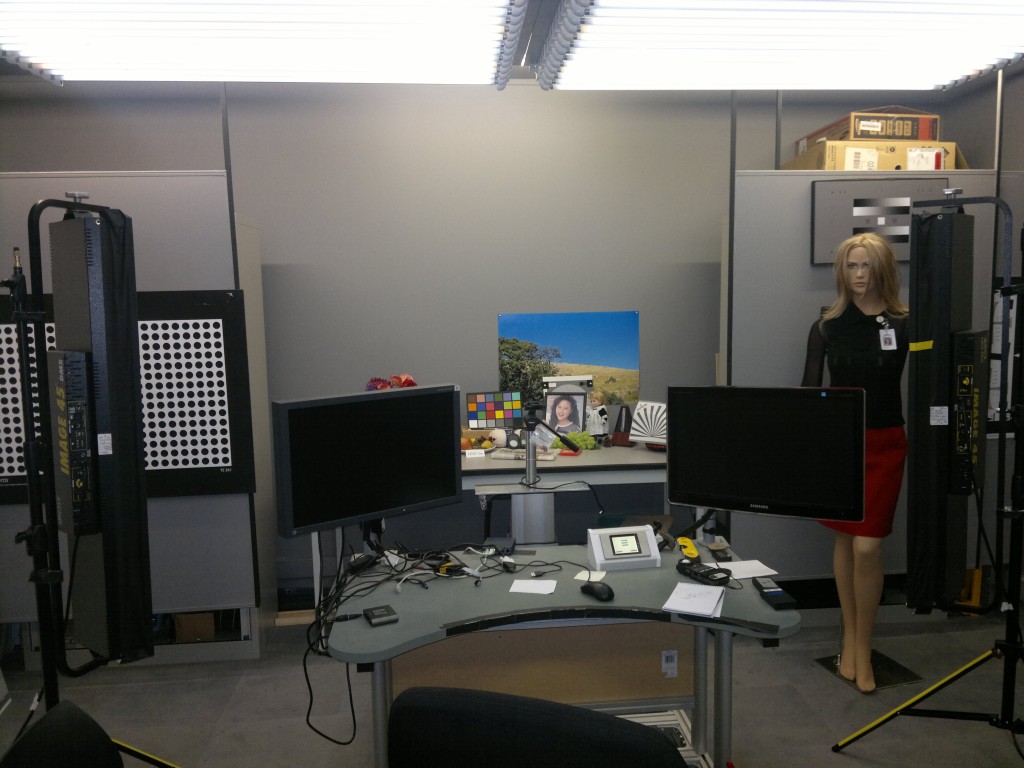
Tehzeeb Gunza at OmniVision coordinated things from their end, and helped us with sensor selection. Thanks also to Gert van Loo and Rob Gwynne for their work on the hardware design. (And thank you to Broadcom for letting us take advantage of your team’s willingness to volunteer for us!) This, for the curious, is the camera lab we’ve been borrowing from Broadcom for testing. The mannequin’s name is Veronica. She’s lousy company. The room gives us a calibrated and fixed target to use during tuning; it’s designed to be filled with examples of the sorts of things people tend to take pictures of. Which makes it a kind of creepy place to hang out. Between this and anechoic chambers, we’re getting the full range of testing chambers that give us the shivers.

Click to enlarge. You might be interested to learn that this was snapped with a Nokia N8, which uses an earlier version of the imaging core that’s in the Raspberry Pi (but a different sensor and optics).
For such a small device, this has been an enormous project, and a year-long effort for everybody involved. We’re pretty proud of it: we hope you like it!
How to set up the camera hardware
Please note that the camera can be damaged by static electricity. Before removing the camera from its grey anti-static bag, please make sure you have discharged yourself by touching an earthed object (e.g. a radiator or water tap).
The flex cable inserts into the connector situated between the Ethernet and HDMI ports, with the silver connectors facing the HDMI port. The flex cable connector should be opened by pulling the tabs on the top of the connector upwards then towards the Ethernet port. The flex cable should be inserted firmly into the connector, with care taken not to bend the flex at too acute an angle. The top part of the connector should then be pushed towards the HDMI connector and down, while the flex cable is held in place. (Please view the video above to watch the cable being inserted.)
The camera may come with a small piece of translucent blue plastic film covering the lens. This is only present to protect the lens while it is being mailed to you, and needs to be removed by gently peeling it off.
How to enable camera support in Raspbian
Boot up the Pi and log in. The default username is pi, and the default password is raspberry. (Note: if you have changed these from the default then you will need to supply your own user/password details).
Run the following commands in a terminal to upgrade the Raspberry Pi firmware to the latest version:
sudo apt-get update
Click to enlarge
sudo apt-get upgrade
Click to enlarge
Access the configuration settings for the Pi by running the following command:
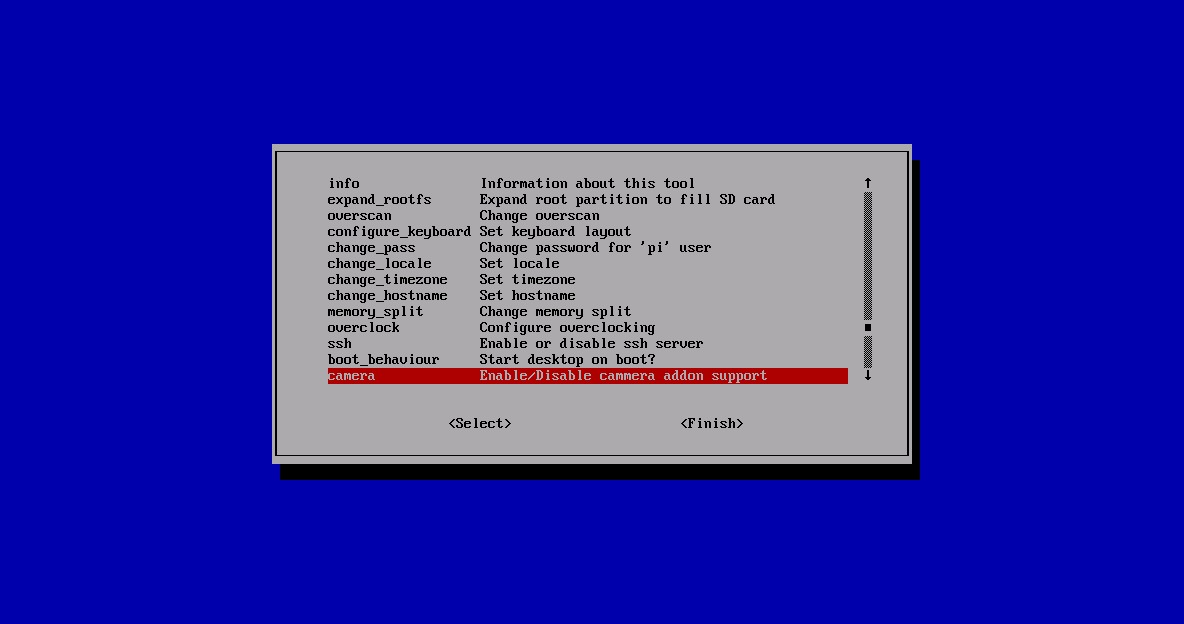
sudo raspi-config
Navigate to “camera” and select “enable”.
Click to enlarge
Click to enlarge
Select “Finish” and reboot.
Click to enlarge
How to use the Raspberry Pi camera software
raspivid is a command line application that allows you to capture video with the camera module, while the application raspistill allows you to capture images.
-o or –output specifies the output filename and -t or –timeout specifies the amount of time that the preview will be displayed in milliseconds. Note that this set to 5s by default and that raspistill will capture the final frame of the preview period.
-d or –demo runs the demo mode that will cycle through the various image effects that are available.
Example commands
Capture an image in jpeg format:
raspistill -o image.jpg
Capture a 5s video in h264 format:
raspivid -o video.h264
Capture a 10s video:
raspivid -o video.h264 -t 10000
Capture a 10s video in demo mode:
raspivid -o video.h264 -t 10000 -d
To see a list of possible options for running raspivid or raspistill, you can run:
raspivid | less
raspistill | less
Use the arrow keys to scroll and type q to exit.
Extended documentation is available.
Note that we recommend that you change SSH password if you are using a camera, in order to prevent unwanted access.
How to stream video from the Raspberry Pi camera over a network
To view the feed on Linux
Install the dependencies by running the following in a terminal:
sudo apt-get install mplayer netcat
Find your IP address by running ifconfig. (Your IP address will be listed in the console output and will probably be of the form 192.168.1.XXX).
Run the following command in a terminal to view the feed using MPlayer:
nc -l -p 5001 | mplayer -fps 31 -cache 1024 -
To view the feed on Windows
Install and run Linux instead.
Find your IP address by running ipconfig. (Your IP address will be listed in the console output and will probably be of the form 192.168.1.XXX).
Note that your browser may complain that these files are malicious, as they are unsigned executables.
Press the Windows key and the ‘r’ key simultaneously to bring up the “Run” dialog. Enter cmd.exe into the dialog and press enter/return to open a DOS prompt.
Enter the following command at the prompt to view the feed using MPlayer:
[Path to nc.exe]\nc.exe -L -p 5001 | [Path to mplayer.exe]\mplayer.exe -fps 31 -cache 1024 -
To view the feed on OS X
Download MPlayer.
Alternatively, you can download mplayer using Brew, which we recommend.
Find your IP address by running ifconfig. (Your IP address will be listed in the console output and will probably be of the form 192.168.1.XXX).
Run the following command in Terminal to view the feed using MPlayer:
nc -l -p 5001 | mplayer -fps 31 -cache 1024 -
To view the feed on a Raspberry Pi:
Find your IP address by running ifconfig. (Your IP address will be listed in the console output and will probably be of the form 192.168.1.XXX).
Run the following commands in a terminal on the receiving Pi:
mkfifo buffer
nc -p 5001 -l > buffer | /opt/vc/src/hello_pi/hello_video/hello_video.bin buffer
To transmit the feed from the Pi with camera module attached
After setting up the “receiving” machine as per the instructions above, run the following commands in a terminal on the “transmitting” Pi:
raspivid -t 999999 -o – | nc [insert the IP address of the client] 5001
You can then use the commands listed in the “How to use the Raspberry Pi camera software” section above to change the capture time or to add a video effect.
How to submit bug reports or see the source code
You can see the source code and submit bug reports for raspivid and raspicam here.
15 May 19:14
Google shoves ads into Maps
firehoseAAAAAAAAAAAAAAAAAAAAA
Google shoves ads into Maps:
Google Offers integrated into Maps, as well. Showing a Starbucks offer that pops right up.
15 May 19:11
Recurring Developments
Recurring Developments:
An interactive visualization of running jokes in Arrested Development
firehose and -1 others like this
15 May 19:10

jonathan burton jonathanburton.net

jonathan burton jonathanburton.net

jonathan burton jonathanburton.net

jonathan burton jonathanburton.net

jonathan burton jonathanburton.net

jonathan burton jonathanburton.net
Card Games
jonathan burton jonathanburton.net
jonathan burton jonathanburton.net
jonathan burton jonathanburton.net
jonathan burton jonathanburton.net
jonathan burton jonathanburton.net
jonathan burton jonathanburton.net
firehose likes this
15 May 19:09
Kubuntu, KDE Has Little Hope For Ubuntu's Mir
Martin Gräßlin, the maintainer of KDE's KWin window manager, has been vocal against Canonical's Mir Display Server from the beginning. He's now written another blog post on the matter in which he makes it rather clear there is little hope of seeing KDE running on the Ubuntu Wayland-competitor...