 New York Daily News |
Michelle Obama decries 'slander' that educated blacks are 'trying to act white'
Washington Post During a commencement address at Bowie State University on Friday, first lady Michelle Obama urged the graduates of the historically black university to "please stand up and reject the slander that says a black child with a book is trying to act white.” ... Michelle Obama's bangs are no more - USA TodayUSA TODAY Michelle Obama to Bowie State Grads: It's Time to Feel Hungry AgainPatch.com First lady: "Reject the slander" that educated blacks are "trying to act white"CBS News Politico -BET -WJLA all 32 news articles » |
firehose
Shared posts
17 May 22:17
Michelle Obama decries 'slander' that educated blacks are 'trying to act white' - Washington Post
firehose and -1 others like this
17 May 22:15
ihatechrispine: you ever get a terrible pain in your chest because of star trek (sigh) All the...
you ever get a terrible pain in your chest because of star trek
(sigh) All the time.
Tertiarymatt, firehose likes this
17 May 22:15

Hundreds of LED-equipped umbrellas will descend on MIT this Sunday night
by Nathan Ingraham
firehosemeanwhile, in Cambridge
Blade Runner
Residents in the Boston area will have the chance to see a pretty unique art installation this weekend. On Sunday evening, hundreds of LED-enabled umbrellas will light up Cambridge thanks to a collaboration between MIT and a Connecticut-based dance group known as Pilobolus. The event is called UP: The Umbrella Project and was first performed up in Camden, Maine last October. Over 300 members of the MIT student body, faculty, and staff will participate; each gets an umbrella lined with red, green, and blue LED lights plus a controller to let them change the lighting as they see fit, and all of the movements will be broadcast onto a large inflatable screen so that the performers can see their movements.
The event organizers describe it as a "large scale experiment for how social dynamics work, for how individuals can make decisions that can benefit that then effect the larger result" — while each person can control their own umbrella, there will be "leaders" to help guide the group. Aside from the visuals, there's a research angle that appealed to MIT's Computer Science and Artificial Intelligence lab (CSAIL), which is hosting the event. "Our work deals with developing algorithms that allow robots to operate independently within a large decentralized network so that the robots can coordinate and work together to accomplish a common task," said Dr. Kyle Gilpin, a postdoctoral associate at CSAIL. Unfortunately, participation is limited to those in the MIT community, but it should be a fun time for spectators as well. To get an idea of what's in store, check out the video below of the October performance.
- Via Streetwise
- Source PilobolusMIT
- Related Items mit csail led lighting pilobolus up the umbrella project umbrellas
Tertiarymatt likes this
17 May 22:15
Apple pulls Bang With Friends hookup app from the App Store
by Nathan Ingraham
firehose"if the company finds Bang With Friends so objectionable, why approve the app in the first place?"
Bang With Friends, the somewhat-controversial hookup app that lets users anonymously pick which of their Facebook friends they'd like to "bang" and then notifies users when there's a match, has had its iPhone app pulled from the App Store. There's no word on why yet — the Bang With Friends site simply says that "we're working with Apple to get BWF back into the App Store shortly." The app may have a clever premise that could be used to revolutionize all kinds of social interaction, but given the risque subject matter, we're not entirely surprised to hear that it's gone. While we all know at this point that Apple can ban apps with near-impunity, but if the company finds Bang With Friends so objectionable, why approve the app in the first place? We're reaching out to Apple and the apps developer and we'll let you know if we find out.
- Via CNET
- Source Bang With Friends
- Related Items apple app ios app bang with friends bwf
17 May 22:07


Wizard Cops: They cast spells first, and ask questions later
by Rob Bricken
firehoseshadowrunnnnn
If the stars of an '80s cop show started playing D&D, I imagine the result would be a lot like "Wizard Cops," this wonderful short from Light Forge Studios. Loose-wand McDunna is a tough cop who doesn't play by the rules. But can he stop an evil Warlock's magic bean-running operation before he's kicked off the force?!
    
|
firehose and -1 others like this
17 May 22:06
Australian Government Backdoor Internet Filter Shuts Down 1,000 Websites
by Soulskill
An anonymous reader writes "The Australian government has secretly censored over 1,000 web sites through a hitherto-unused internet censorship law. In April the Melbourne Free University was blocked without any explanation. Section 313 of the Telecommunications Act allows the government to close web sites without warning to "uphold laws, protect public revenue and safeguard national security". This is open to abuse as Australians only have limited free speech rights which already make it difficult for the press to report corruption." 


Read more of this story at Slashdot.
17 May 22:05
Gunshots Send Actors Running At Cannes Film Festival
A man was arrested at the Cannes film festival on Friday after firing a starting pistol during a live TV broadcast on the palm-lined waterfront, sending actors Christoph Waltz and Daniel Auteuil running for cover.
17 May 21:37


ē Asha to Asha
by Ben Thompson
firehose"Nokia is particularly well-suited to this market; their phones have always been the most durable, with the best battery life, and their distribution channel is still unmatched. If the company returns to prominence the headliner will likely be Asha, thanks to a strategy predicated on identifying a new axis of competition instead of simply trying to be a little bit better."
Symbian forever~
Nokia released two phones last week: one critically important called the Asha 501, and one simply iterative called the Lumia 925. Techmeme, at least, got the relative importance exactly backwards:
Nokia Lumia 925 stories on the left; Asha 501 story on the right
Not to blame Techmeme; few if any of their readers were the target market for the Asha 501, while the Lumia 925 is squarely aimed at the kind of folks reading this blog. But the truth is the Asha 501 is far more interesting.
Asha is Nokia’s evolved feature phone line, and the 501 is the newest model in that line. Based on Smarterphone, the successor to Series 40, the 501 will be sold for less than US$100; more importantly, it will have an SDK for 3rd-party developers, a first for Nokia’s low-end phones.1
At first glance, the 501 seems kind of pointless in a world of $100 Android smartphones. Consider this conclusion from GSM Nation:
The Asha 501 faces stiff and fierce competition from low-cost Android phones. Nokia’s Stephen Elop unveiled this phone in India, a key market for the Finnish phone manufacturer. At a price of nearly $100, the Asha is asking customers to leave Android phones that can be bought at this price point carrying superior tech. India has several local phone companies that offer a modern, dual-core Android experience at prices from just $120. Android brings with it the power of a burgeoning app store and the wonderful realm of rooting. The Asha 501 on the other hand, features a fresh OS and bottom-end hardware specifications.
When you look at the performance and the price, it’s not clear how the Asha can compete:
The price-performance frontier; anything not on the edge is uncompetitive
The red line in this graph is the price-performance frontier; the only competitive position is on this frontier.2 If you are inside of the frontier, that means there are competitors that have the same performance for a cheaper price, or have better performance for the same price.
Asha seems to be an example of the latter. It has worse specifications than a cheap Android phone, and a much worse app selection.3 Thus it has been largely ignored by a tech press that considers little more than features and price.
However, finding a market is about finding a new axis of differentiation. In the case of low-end smartphones, are there things that matter beyond price and performance?
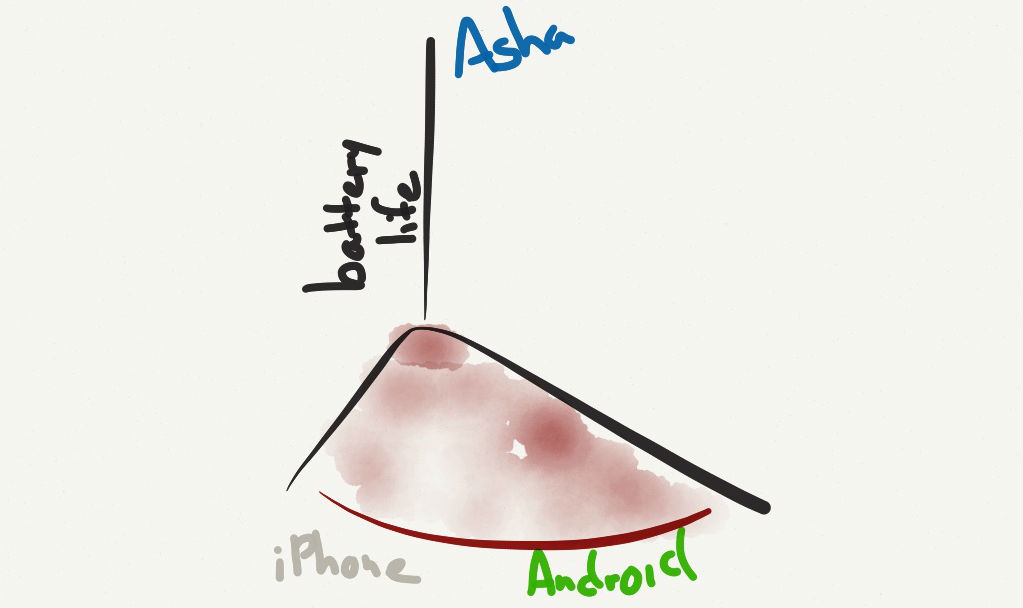
Consider again where Asha will be sold: India, Africa, Latin America – all have markets where mobile phones are the primary form of computing, as well as areas without consistent electricity. In such markets, nothing matters more than battery life. From CNN:
The internet in Africa is entirely different to the internet used in the developed world. In America or Europe, the internet is generally something you surf on a computer or tablet — a device with a 10-inch to 15-inch screen. In Africa, hundreds of millions of people will experience the internet for the first time on a 2-inch cellphone screen. Probably in black and white. And probably only as text…
The reason is simple: With a dearth of infrastructure, the vast majority of people (an estimated 1.5-billion globally, according to the UN) have no electricity. More people in Africa have a mobile phone than access to electricity. That means, for a phone to be functional, it needs decent battery life. These feature phones have anywhere up to a week.
Look again at what makes an ideal phone: a week of battery life, which necessitates a text-based screen and a dependence on SMS.
The Asha 501 blows this away: the battery life is amazing – 48 days on standby – and that color screen is looking much more impressive. And now there is an app platform to deliver drought alerts, health information, banking and more.
Suddenly, a graph of Asha’s competitive position looks much more promising:
Asha competes on a different vector than iPhone and Android
Nokia is particularly well-suited to this market; their phones have always been the most durable, with the best battery life, and their distribution channel is still unmatched. If the company returns to prominence the headliner will likely be Asha, thanks to a strategy predicated on identifying a new axis of competition4 instead of simply trying to be a little bit better.
- This previously stated, incorrectly, that the Asha 501 was based on Series 40. Thanks to Niels Leenheer for the correction
- This article is not about the iPhone versus Android, and besides, I’m talking about low-end Android, not the Galaxy S4 or HTC One
- Incidentally, Lumias have the exact same problem, except they’re much more expensive as well
- I know the strategy isn’t new, but the SDK is
Tertiarymatt, firehose likes this
17 May 21:35
T-Mobile drops anti-net neutrality lawsuit filed by MetroPCS, leaving Verizon on its own
by Adi Robertson
firehoseall carriers suck forever
Cellphone carriers have generally met net neutrality proposals with varying levels of hostility, but Verizon and MetroPCS have been particularly belligerent: in 2011, they sued to overturn the FCC's then-newly adopted Open Internet rules. Since then, the two have consistently argued in court against the rules, which they've said undermine the freedom to run their networks as they see fit. But as T-Mobile finalizes its merger with MetroPCS, it's decided it doesn't want an old lawsuit to come with its new spectrum. In a court statement filed today, T-Mobile has moved to dismiss its appeals claim.
T-Mobile's decision to back out doesn't mean the suit is over. Verizon will continue its litigation, though the court document indicates that it knows about the move and will make no attempt to stop it. And the Open Internet rules themselves haven't stopped companies from pushing the boundaries of what constitutes blocking the competition. AT&T has maintained that it was in the right to block FaceTime over its network, and Comcast started favoring its own Xfinity TV app even after the rules took effect. But for now, Verizon is alone among US carriers in its legal challenge.
- Source Court Filing (Public Knowledge)
- Related Items fcc regulation competition lawsuit t-mobile verizon metropcs net neutrality open internet
firehose likes this
17 May 21:33

Hey, Dandy. Richard Burton would like to talk to you about your...
firehosevia multitasksuicide
Hey, Dandy.
Richard Burton would like to talk to you about your triple monks.
17 May 21:32
The US Military’s Disastrous Plan To Use Napalm-Strapped Bats In WWII | Gizmodo Australia
by OnlyMrGodKnowsWhy
firehose"The good news: the bombs were highly effective. The bad news: again, the bombs were highly effective. The barracks quickly burst into flames — along with the general’s car."
Full disclosure: HUP book
Ultimately known as Project X-Ray, the plan used Mexican free-tailed bats, which were kept calm during travel by jamming them into ice cube trays to be cooled down and forced into hibernation.
When it came time to release the (what would be thousands of) bats, a cardboard trap was supposed to spring open and send the napalm-loaded creatures deep into enemy lines. Ideally, the bats would roost in hard-to-reach places, set them on fire, and avenge the nation in the process. Unfortunately, things didn’t go quite according to plan.
Trial and Horrible Error
During a test run of just six of the flying bombers, the bats unexpectedly took off a little too early and headed not for their target, but straight for the barracks. The good news: the bombs were highly effective. The bad news: again, the bombs were highly effective. The barracks quickly burst into flames — along with the general’s car.

firehose and -1 others like this
17 May 21:32
 Confirmed Lulzsec members Ryan Cleary, Jake Davis, Mustafa al-Bassam and Ryan Ackroyd have been sentenced for their part in the great hack of 2011, which saw Lulzsec targeting notable companies such as Sony, EA and Nintendo.
The four were initially charged nearly a year ago. Davis, as leader, was sentenced with two years jailtime, while Cleary was sentenced to 32 months for producing malicious software, Ackroyd for 30 months for his role as press secretary of the group and Al Bassam, who posted the stolen data online, was given a 20-month suspended sentence.
"The harm they caused was foreseeable, extensive and intended," Andrew Hadik, lawyer for the Crown Prosecution Service told BBC. "Indeed, they boasted of how clever they were with a complete disregard for the impact their actions had on real people's lives. This case should serve as a warning to other cybercriminals that they are not invincible."
Lulzsec carried out many high-profile hacks in 2011, starting with the Sony Pictures hack that eventually led to a lengthy PSN outage. Lulzsec also attacked Nintendo, EVE Online, Minecraft, The Escapist and Battlefield Heroes before calling it quits.
Four Lulzsec hackers convicted in Britain
by David Hinkle
The four were initially charged nearly a year ago. Davis, as leader, was sentenced with two years jailtime, while Cleary was sentenced to 32 months for producing malicious software, Ackroyd for 30 months for his role as press secretary of the group and Al Bassam, who posted the stolen data online, was given a 20-month suspended sentence.
"The harm they caused was foreseeable, extensive and intended," Andrew Hadik, lawyer for the Crown Prosecution Service told BBC. "Indeed, they boasted of how clever they were with a complete disregard for the impact their actions had on real people's lives. This case should serve as a warning to other cybercriminals that they are not invincible."
Lulzsec carried out many high-profile hacks in 2011, starting with the Sony Pictures hack that eventually led to a lengthy PSN outage. Lulzsec also attacked Nintendo, EVE Online, Minecraft, The Escapist and Battlefield Heroes before calling it quits.
 Four Lulzsec hackers convicted in Britain originally appeared on Joystiq on Fri, 17 May 2013 16:45:00 EST. Please see our terms for use of feeds.
17 May 21:29
Silvio Berlusconi’s Parties Featured Women Dressed As Barack Obama
Silvio Berlusconi’s private disco reportedly featured women dressed not just as sexy nuns and nurses but also as President Barack Obama.
17 May 21:29
buzzfeed: George Takei responds to “traditional” marriage...









Tertiarymatt, firehose likes this

17 May 21:27
Liefeld Turns to Kickstarter for "Brigade" Revival
firehosechrist
Borrowing a page from Top Cow’s 2012 resurrection of "Cyber Force," Image Comics co-founder Rob Liefeld has turned to Kickstarter to help relaunch his 1990s Image Comics series "Brigade."


17 May 21:23


The Zombieland TV show is your zombie kill of the week
by Rob Bricken
firehoselol

Amazon has decided not pick up the Zombieland TV series, whose pilot premiered last month. Writer/producer Rhett Reese was especially bitter, tweeting that "die-hard Zombieland [movie] fans" had "hated it out of existence." I guess the fact that the pilot was just a lackluster imitation of the movie was just a coincidence, then.
|
|
17 May 21:22
Virtual Same-Sex Marriage is Thriving in This Online Fantasy Game
by Evan Narcisse
firehose"However, because Elves and Giants oppose each other, an Elf character and a Giant character cannot get married."

You can play as an orc or dark elf in loads of massively multiplayer online games. But you can’t marry someone of the same gender in most of them. That’s not the case in Nexon’s Mabinogi.
The marriage guide for the cartoony role-playing game explicitly states that “a wedding can take place between two players of the opposite or the same genders.” That option came to the Korean-developed game in October 2012 and it’s proven to be a meaningful addition for the game’s players. Look at these stats from Nexon:
- 30% of same sex weddings have taken place between two male avatars
- 70% of same sex weddings have taken place between two female avatars
- 9% of all in-game marriages in total have been between two male avatars
- 22% of all in-game marriages in total have been between two female avatars
Same-sex marriage has become a trending political issue both in the United States and worldwide, with a recently passed law in France being upheld as constitutional. No such law exists in either North or South Korea and portrayals of homosexuality—while on the rise in televised dramas—are still relatively rare. So it’s fairly significant that Nexon ran counter to their home country’s relatively conservative cultural mores and added same-sex marriage to Mabinogi.
There’s one exception to the game's marry-who-you-want freedom, though: “However, because Elves and Giants oppose each other, an Elf character and a Giant character cannot get married.”
Elves and giants, the Capulets and Montagues of our time.
Update: Per Nexon, here are the in-game perks are for getting married in Mabinogi.
Wedding ring
- Cannot be destroyed without a divorce
- Can be engraved with a message prior to the wedding
- Provides 1 Defense and 1 Protection
- Cannot lose durability and thus never needs repair
While near your spouse with a wedding ring equipped you receive the following for 400 seconds
- HP +10
- Stamina +10
- MP +10
The first time a player gets married they receive the achievement “The Old Ball and Chain”
The Married title, which specifies who you’re married to when worn
Getting married allows the couple to start a family with up to six children
- Requires adoption certificates for each child added
- Allows the couple to create a Family Name and gives a family title
- Allows the family to summon each other
17 May 21:15
A Vine Lesson on How To Wake Up Your Dog
by Rusty Blazenhoff
Curtis Lepore shows how he woke up his dog with his phone in a cute Vine titled “How To Wake Up Your Dog.”

17 May 20:49
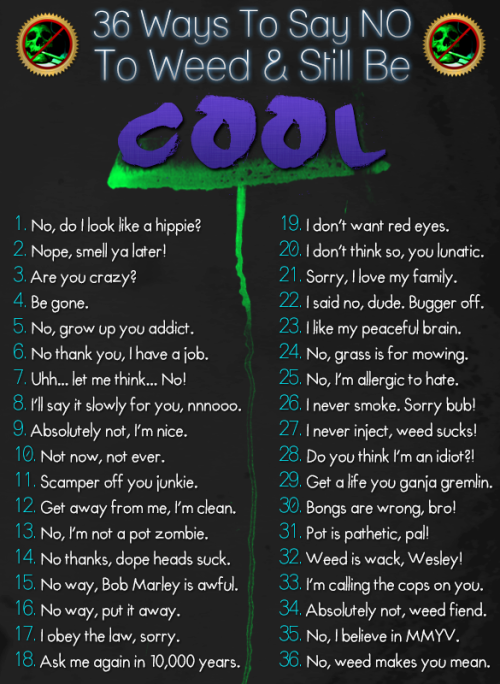
pot zombie.
firehosevia THANKGODYOUREHERE
pot zombie.
firehose, Brian Stouffer likes this
17 May 20:48

Team Fortress 2's latest update, Robotic Boogaloo, is totally community-made
by Michael McWhertor
By Michael McWhertor on May 17, 2013 at 2:49p
The latest update for Team Fortress 2, a major content release dubbed Robotic Boogaloo, is different from the dozens of similar updates from Valve. Like previous updates, it features a comic that ties into Team Fortress 2's increasingly complex and evolving backstory, a new animated short and all-new items for players to collect and craft — 57 virtual items, many of them hats, naturally.
What separates Robotic Boogaloo from earlier additions is that it's 100 percent created by the Team Fortress 2 community. Valve's involvement, at least in terms of content creation, was minimal.
What started as a small, community-driven content push for the free-to-play shooter became something Valve-sanctioned and promoted on the TF2 website. Community members even put the official website hub together, crafting a story that explains why a flood of new robot-themed items and headwear is invading the Mann Co. store.
"The idea is that Grey Mann has gone bankrupt over a year of failed attacks on Mann Co, and attempts to sell his robotic bootlegged creations to the mercs," explained community member Jake "Heartsman" Harold, one of the driving forces behind today's update.
Robotic Boogaloo follows two major robot-themed updates from Valve: Mann vs. Machine and the Mecha Update. Those two releases added a third faction to the game, Gray Mann's team of robots. Today's update recreates a long list of hats and headwear as if they were recreated by Gray's robots.
"A total of 51 people worked together to create Robotic Boogaloo," Harold told Polygon, saying a smaller team had originally intended to create a small mod website where Team Fortress 2 players could download "robo-reskins."
"Then, when Valve decided to pick up the project, more artists joined, directions were set and a lot more work had to be done on the update presentation content," Harold explained. "We involved people like Populus (who animated our short) and BANG! (who rendered most of the website's artwork). We also decided to work with 2D artists from the community to make pieces based on the items that you can find around the website, in an attempt to make this as community involved as we could. We were even given the chance to put the website together ourselves, with Smashman helping on the code.
"The only thing the community didn't create were the crate and the key."
Valve says that despite the major push from the community, it will continue to work on further Team Fortress 2 updates itself.
"This doesn't mark the end of Valve-produced TF2 updates, by the way," Valve wrote on its blog. "As far as we're concerned, there's plenty of room for both to happily co-exist. We're in uncharted territory here, and it's exciting to be exploring it with you."
firehose likes this
17 May 20:46
'Free speech doesn't mean free stuff': Congress begins copyright reform with a plea for civility
by Adi Robertson
firehoseaaaaaaaaaaaaaaaaaaaaaaaaAAAAAAAAAAAAA
For the first time in over a decade, Congress is looking at a major copyright overhaul. But before it happens, the House Judiciary Committee is looking backwards, at both a 3-year-old copyright report and what it sees as an earlier, quieter time, when intellectual property debates were the province of the courtroom rather than the internet. Behind it all is a simple question: why are people so upset about copyright law?
"No sharp elbows."
Yesterday, the Judiciary held "A Case Study for Consensus Building," the first in a series of hearings on copyright. It focused on the Copyright Principles Project (CPP), a legal study group that released a nearly 70-page report on potential reforms in 2010. Five members of the original project were selected to testify: former Copyright Office General Counsel Jon Baumgarten, law professors Laura Gasaway, Pamela Samuelson, and Daniel Gervais, and Microsoft Assistant General Counsel for Copyright Jule Sigall.
Though the Judiciary Committee did not endorse the project’s findings, it held the process up as an example of the kind of discourse it wanted: "civil," pragmatic, and run by people willing to listen. In his testimony, Sigall recalled Samuelson telling him that "the group would have diverse perspectives on copyright but all members would share a common trait: ‘no sharp elbows.’" Baumgarten agreed. "When viewed from the perspective of today’s increasingly polarized, largely distrustful, and deeply antagonistic copyright debates," he said, "the process and report of the CPP was a breath of fresh air." Senators and witnesses alike bemoaned a coarsening in the copyright debate.
"Debates in the '60s and '70s were engaged in by people who respected copyright law."
That coarseness proved a point of tension: did it simply signal a lack of respect for copyright law, or was it the result of the law becoming more important than ever? Baumgarten, who served the Copyright Office in the 1970s, appeared to be in the former camp. "I don’t think the copyright system is broken or dysfunctional," he asserted. The problem, as he saw it, was that people simply no longer wanted to protect it. Despite disagreement in past decades, he said, "by and large, the copyright revision debates in the '60s and '70s were engaged in by people who respected and in many case loved copyright law."
Sigall expressed similar disappointment. "Over the past 20 years," he said, "I’ve watched the public perception of copyright deteriorate, from a positive — if little-known — means of enriching public knowledge to the increasingly negative, and even hostile, manner in which it is sometimes viewed today." But unlike Baumgarten, he believed the issue lay with the law, which "is straining to remain relevant" in a world of widespread, instant distribution. Gervais made a similar point, pushing for a copyright philosophy based on "maximizing authorized uses," not minimizing unauthorized ones.
"Copyright is now part of almost every American’s daily activities."
As reform advocates see it, the problem isn’t just that the law is irrelevant: It’s that it actively interferes with things modern citizens take for granted. "Before the internet and digital devices became what is now probably the most widely used way of accessing copyrighted material," said Gervais, "individual consumers and users had few reasons to think about copyright in their daily lives." But now, "copyright is part of almost every American’s daily activities, from simple email to online database access to entertainment consumed at home." When the possibilities for copying and remixing are nearly endless, copyright becomes extremely visible, whether it’s seen as a saving grace, a necessary protection, or an outright evil. And when it becomes visible, it’s much easier to see how baroque and complicated the law has really become.
Outside of perhaps Baumgartner, all panelists agreed that the present copyright system needed pruning, presenting a number of suggestions that have long been discussed by reformers. Nearly everyone saw a serious problem with orphan works: pieces of art, music, or literature whose copyright has no known owner, making them almost impossible to license or adapt without breaking the law. Several suggested updating the copyright registration system, which is meant to keep a record of who owns the rights to a given work. There were also calls to limit statutory damages — a form of legal compensation that can stick defendants with hundreds of thousands of dollars in fines for copyright infringement.
"I would love to see a law that is encompassed in 20 pages."
Their proposals didn’t always sit well with either the Judiciary Committee or people whose work depends on copyright. Shortly before and during the hearing, musicians and artists began to complain that the hearing would not involve members of the creative community: one blog sarcastically remarked that it presented "a ‘broad perspective’ that didn't include any filmmakers, musicians, artists, etc." Representatives, meanwhile, pressed the panelists to pare down the law even more. "There’s 68 pages of the article you wrote!" complained Representative Mel Watt (D-NC). "I would love to see a copyright law that is encompassed in 20 pages." He sometimes characterized critics as unrepentant pirates: "Free speech doesn't mean free stuff," he warned.
It’s no coincidence that the House chose to open its hearing series with a panel on consensus. The Stop Online Piracy Act was one of the most stunningly contested bills in recent years, drawing mass protest and hyperbolic warnings on both sides. Congress, though, is also hardly immune from dismissing critics of anti-piracy laws or exhibiting general bewilderment at how the internet works. A productive copyright debate will indeed need to start with toning down the rhetoric — both inside and outside the Beltway.
17 May 20:45


Game of Thrones will end with season 7, according to producer
by Rob Bricken
 We've all been wondering how the Game of Thrones TV show will end. Will George R.R. Martin finish the book series in time? Will HBO try to pad it out? Will it be canceled? Now we have an answer — assuming all goes well. the show will last seven seasons, according to producer Frank Doelger.
|
|
17 May 20:43
9th Grade Science Experiment: Garden Cress Won't Germinate Near Routers
by Soulskill
firehosegreat
New submitter SessionExpired writes "Five 9th graders from Denmark have shown that garden cress won't germinate when placed near a router (Google Translation of Danish original). Article text is in Danish, but the pictures illustrate their results. The exact mechanism is still unknown (Danish original), but experts have shown interest in reproducing the experiment." 


Read more of this story at Slashdot.
firehose likes this
17 May 20:42
Don’t Let Mark Bittman Cook Your Brain with Bad Science : Collide-a-Scape
by OnlyMrGodKnowsWhy
firehoseI don't like Bittman or GMOs, but whatever
Grist for the mill
By Keith Kloor | May 17, 2013 1:29 pmMark Bittman, the popular food writer for the New York Times, has written a column that is almost beyond parody for its unintentional irony. The only way to fully appreciate his lack of self-awareness is to stop and marvel at numerous passages. Let’s start at the top:
Things are bad enough in the food world that we don’t need to resort to hyperbole to be worried or even alarmed.
This is some chutzpah. Here’s Bittman from September 15, 2012:
It’s not an exaggeration to say that almost everyone wants to see the labeling of genetically engineered materials contained in their food products.
Almost everyone? Same column:
G.M.O.’s, to date, have neither become a panacea — far from it — nor created Frankenfoods, though by most estimates the evidence is far more damning than it is supportive.
This is completely untrue. If Bittman had wanted to be factual he would have referred NYT readers to credible sources on the state of the science on biotech crops and foods, such as here or here. Instead, he links to a website called the Organic Authority and a post that explains why
GMOs are bad for your body, bad for the community, bad for farmers and bad for the environment.
This is what is known as laundering untruths.
A bit further down in his current column chock full of unintentional ironies, Bittman muses,”to whom should we be listening? Who speaks with authority?” Please. Bittman knows well that his perch at the NYT is influential and that foodies revere and trust him. Still, he pushes the theme and says that on whom we should be listening to,
When it comes to big issues, the answer is “actual experts,” and it’s almost always “not ourselves.”
Amazingly, he goes on to discuss Dan Kahneman’s widely acclaimed 2011 book, “Thinking Fast and Slow,” which is about how our decisions and behavior are influenced by “cognitive biases.” Yet Bittman gives no indication that he is aware of how utterly biased he is on the issue of genetically modified foods, and how this leads him to scaremonger and communicate false information.
This next passage, which betrays his convoluted thinking, is classic:
In matters where you’ve become a true expert, you should trust your intuition. Otherwise, it pays to literally stop and think. When I read a news story like this one, which claims that G.M.O.s are linked to leukemia, I might be scared out of my wits — Americans can’t avoid genetically modified food without a huge effort, and even then there are no guarantees. So are we doomed to years of chemo? Perhaps not: If I sit down and do my homework all I can really say with intelligence is that it’s premature to conclude that ingesting food with genetically engineered ingredients is safe.
I happen to have an expert bullshit detector, so my intuition tells me that Bittman here is either being idiotic or utterly disingenuous. Because if he was intelligent and/or did his homework, he would know that he’s as likely to develop leukemia from GMOs as he is from overhead power lines. Secondly, that’s not a news story he cites, but a blog post written by the “founder” of a “natural medicine database.” If you can find an actual news story written about this latest dubious study on GMOs in a pay-to-play journal, let me know. That Bittman is laundering such a slanted piece of propaganda (that also cites a widely discredited study) under the false banner of news should tell you everything you need to know about his expert sources.
Finally, it’s worth pointing out again that Bittman started off his column by saying, “we don’t need to resort to hyperbole to be worried or even alarmed.”
It’s a shame he doesn’t take his own advice, for near the end, he writes (my emphasis):
As I wrote a few weeks ago, barely a day goes by that someone doesn’t say to me, “There’s nothing I can safely eat.” Many of us are afraid of our food and of the way it’s produced, and to some extent that fear is well founded.
To a great extent, Bittman is irresponsibly spreading that fear (which is not well founded), particularly with respect to genetically modified foods. He also is, as one media biotech watchdog recently put it, “a scourge on science.”

17 May 20:41


New Hampshire Town Sues Parking Meter Vigilantes
by Henry Grabar
firehosevia lg
Keene, New Hampshire, is a magical place where no one ever gets a parking ticket.
Thanks to a group called Robin Hood of Keene, some 4,000 Keene drivers have avoided parking tickets entirely for at least four years. That's because the Merry Men are always a step ahead of the meter maid with a few quarters, leaving only a small note: "Your meter expired; however, we saved you from the king's tariffs, Robin Hood and his Merry Men. Please consider paying it forward."
Parking enforcers of Keene have not found the Merry Men so merry. In a lawsuit filed by the City of Keene against six members of the group, the city alleges that the parking meter vigilantes "regularly, repeatedly and intentionally taunted, interfered with, harassed and intimidated" the city's employees, even touching them. One parking enforcement officer alleged in an affidavit he was called "bitch," "coward," and a "murderer of brown babies," in reference to his military service. Another claims to have suffered heart palpitations as a result of similar harassment.
The city is seeking an injunction to keep the Robin Hood crew at least 50 feet away from its on-duty parking officers; James Cleaveland, a Robin Hooder blogging at libertarian blog Free Keene, says the suit is "ridiculous."
"Most importantly, according to the job description for a city of Keene parking enforcer," Cleaveland writes, "'This position requires a person' to 'relate with the general public' and 'Endure verbal and mental abuse when confronted with the hostile views and opinions of the public and other individuals often encountered in an antagonistic environment.'
See? They had it coming!
Top image: Flickr/Mechanikat.
|
|
17 May 20:25


Can You Heat Your Home With Bricks and Twigs? Paul Wheaton Thinks So.
by Erica
firehosevia Tertiarymatt
meanwhile, in Portland (the Wisners are Portlanders; Erica works at OMSI. Bonus: She's a Hampster)
Let’s say, just for argument’s sake, that you think the world would be a better place if the collective “we” used less coal, oil, natural gas, nuclear energy and other heat-generating resources.
Or, maybe you don’t give a rip about the environment but you sure like saving money.
Perhaps you just need a reliable DIY way to heat your off-grid cabin?
Enter the Rocket Mass Heater, a “hyper-efficient wood-burning stove” (Wikipedia) and the preferred home heating solution for hip enviro-survivalist-DIY-off-grid-natural-building types since 1970.
I’m no expert, but as far as I can tell, a Rocket Stove is a way to build a massive jet-engine-type-burner (think “turkey fryer BTUs from something that looks like a coffee can”) that runs on twigs and kindling. These have the advantage of being DIY-able for nearly free if you have the right random collection of stuff hanging around.
A Rocket Mass Heater is basically one of those jet-engine-type-burners and a special exhaust tube built into a big mass of masonry-type stuff that radiates heat out into your home. (For goodness sake, don’t use my description to build one – you’ll blow something up – go get a proper plan.)
The result of mixing a jet engine that runs on twigs with a lot of masonry bricks?
Well, according to Richsoil.com, Rocket Mass Heaters have some serious advantages over conventional home heating methods:
- Heat your home with 80% to 90% less wood
- Exhaust is nearly pure steam and CO2 (a little smoke at the beginning)
- Radiant heat from one fire can last for days
- Build one in a day and half
- Buildable for less than $20
I only partially grok the fire science behind Rocket Mass Heaters, but this photo helps to make it more clear:
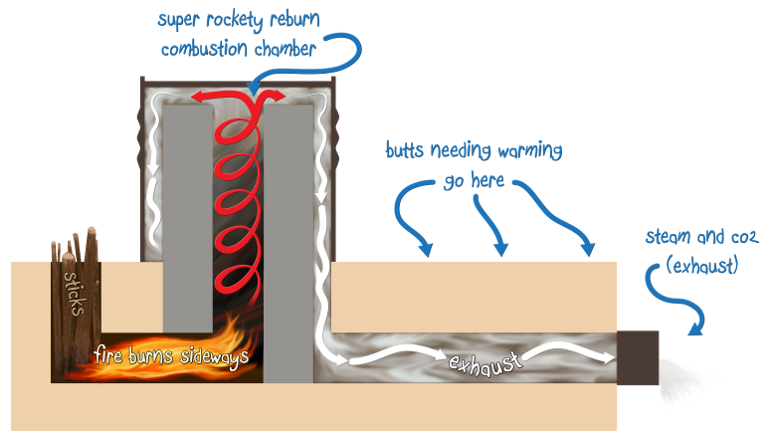 Image:Richsoil.com
What makes a Rocket Mass Heater unique is the extremely well insulated chimney that gets so hot it burns off smoke and particulate and creates a strong air-flow current that results in a super-clean, nearly smoke-free burn using minimal wood.
The “Mass” in a rocket mass heater is important too – the super hot combustion chamber and the exhaust channel radiate their heat out through rocks, fire-bricks, fire-cob and the other high mass stuff that surrounds them and this radiant heat means that a small RMH fire can warm a home for days. This mass means that Rocket Mass Heaters tend to have a particular look – kinda like if a clay pizza oven and a window seat had a baby.
Which can be far more attractive than it sounds, actually. Like this:
 Image: Ernie Wisner, Rocket Mass Heater super-expert
Or this:
 Image: Cob Cottage Publications via Amazon.com
If you are as intrigued as I was when I started learning about Rocket Mass Heaters, you can find a ton more info at the Permies.com Forum dedicated to wood burning stoves. I also like this video for a good overview on how these heaters are put together.
And if you think this crazy brick-and-twig off-grid heating system might be for you, you may want to get in on an active Kickstarter Campaign started by Paul Wheaton of Permies.com. He’s making a 4-Set DVD series on how to build Rocket Mass Heaters (and other related stuff) without blowing up your house or melting your face off. The trailer for the Kickstarter is worth a watch below if this technology interests you.
If you could learn to build one safely, would you go off-grid for your home heat with a Rocket Mass Heater?
firehose, Cooper Griggs and one other like this