Read more of this story at Slashdot.

Read more of this story at Slashdot.
firehosengl if I go to space I am doing what that woman does all fucking day
space: where the fetal position can be functional

The Nation |
New Pakistan PM Nawaz Sharif launches term on vow to stop US drone strikes
CBS News ISLAMABAD Newly-elected Pakistani Prime Minister Nawaz Sharif called Wednesday for an end to U.S. drone strikes in the country's embattled tribal areas, along the Afghan border, choosing to open his term on an issue which unites most Pakistanis, but ... Pakistan's New Prime Minister Calls for End to Drone StrikesNew York Times Nawaz Sharif formally elected prime minister of PakistanWashington Post Nawaz Sharif takes Oath as PM for third timeThe News International Newsday all 285 news articles » |
firehoselol Win8
some star trek shit going on here; 3.1 not bad, 95 bad, 98 not bad, ME bad, XP not bad, Vista bad, 7 not bad, 8 bad
Microsoft's Surface Type and Touch Covers swapped out traditional keyboard F keys for quick access to volume, media, and other controls, but that has left a gap for those used to function keys and Windows keyboard shortcuts. In an update that will be made available on June 11th, Microsoft is adding options to its function keys for Surface keyboards. Surface RT and Pro owners will be able to lock F1-F12 function keys to use them as regular shortcuts for actions like alt+F4 to close apps. At present, you need to hold the function key + alt + F4 to activate the regular Windows keyboard shortcut.
The update will also make some functions a little easier to complete with one hand, including function key + del to increase the display brightness, or function key + spacebar to take a screenshot. It's a fairly minor addition, but coupled with the ongoing monthly updates to Surface it demonstrates that Microsoft is serious about keeping its own tablets up to date with new features and functionality.

“Spell It Out” is a new music video by The Lonely Island where Andy Samberg (Lenny) explains who the ‘F’ he is by rapping with letters. The new single track is available to purchase online from iTunes and Amazon. It will also be on The Wack Album, which is set to release on June 11, 2013.
Luckily, have345 commented on the YouTube video and spelled out the song for us:
Dude that has sex with pigs for money but only as a side thing right now, I’m just short on cash and have irons in the? fire but in this economy it’ll have to do my name is Lenny!

image and video via The Lonely Island
By Charlie Hall
on June 05, 2013 at 12:01p
T
Two horses, tied together by one ankle with a short leather strap, graze on the rich green lawn half a block away. Closer, some chickens scratch along the edge of a lush vegetable garden. A stray cat grooms itself on the rim of a wide concrete well.
These are the suburbs of Lviv, Ukraine. Elsewhere in Western Europe, this area might be mistaken for rural, but here it's where wealthy people live — a thin crust of land between the dense, timeless city and the barren countryside.
Past the chickens and the horses, past the well and the cat, inside the ground floor of this apartment building is a modern recording studio. It is equipped with thick foam baffles, delicate microphones and the best mixing equipment available in Ukraine. Maksym Hryniv has come here with his composer, Igor Bryshlyak, to record vocals for the soundtrack of a new game.
"I cannot stress how important it is," Hryniv says. "Everything will depend on the music, so the music has to be good. It's not the case where you can turn off the music and you will still play the game. If you turn off the music you will have no game. It's a big difference."
So much depends upon Katarina, Bryshlyak's girlfriend, whose largely untrained voice is being recorded for the first time today. Inside the tiny studio both she and Hryniv are shaking, nervous but energized all the same.
This is the next step in the journey for Mokus Games, one of the most successful small studios in Ukraine. Its new game is original, ambitious and the result of a labor of love shared between friends.
And it all began with breakdancing.
Human Angle: The Breakdancing Indie
A street battle in Malaysia
Lviv is often called the Paris of Ukraine, as much for its Austrian-inspired architecture as for its diverse population. It's a sleepy little city with cobblestone streets and a maze of narrow roads filled with three-quarters of a million people, mostly Ukrainians and Poles.
Everything moves slowly here, as it has for more than 750 years since the city's founding. Hryniv is the exception. Against the background of this sluggish city he is a blur. He stands only around 5 feet 6 inches, but in motion his short legs cover a lot of ground in very little time. It's hard to keep up with him. Like a forest fire, he actually appears to move faster when moving uphill.
He grew up here in the city, 15 minutes from the edge of an ancient forest that used to be the domain of the kings that once ruled this land. In Hryniv's youth he used to walk there and pick apples.
"They are somewhere between wild and domesticated," he says.

At 32, Hryniv is athletic and deceptively strong. "I love different types of physical activity. I love skiing. I love snowboarding. I love parkour. I love everything extreme."
When he first noticed breakdancing on MTV he didn't even know what he was seeing. "It was a long time ago. I was 18. We had no YouTube, we had no information about what breakdancing was. ... In the former Soviet Union we had no breakdancing, no kind of modern street dances. I got very interested and I wanted to try."
On a trip to Germany, the brother of one of Hryniv's friends bought a VHS tape full of breakdancing footage, and a teenaged Hryniv and friends studied that tape and practiced for months to spin on their heads, walk on their hands and flip over scraps of cardboard.
"We didn't know how to learn the tricks. We didn't have any foundation, any roots of how to do it. We had to invent the breakdances by ourselves."
Hryniv's upper body strength was an asset, and he became known for his powerful acrobatic moves. "We had a few crews in my city," Hryniv says. "I was one of the best and that's how I started. We had a few battles — a few competitions. Some of them we won, some of them we lost. And this is how it was."
Hryniv continued to practice with his crew throughout his university schooling, and years later graduated with a degree in mathematics and a portfolio of incredible dance moves. But in Ukraine, breakdancing doesn't pay, so he found work programming.
"The main force that pushes Ukraine forward," Hryniv says, "is software development. Because we have a great scientific background. We have some kind of special Soviet Union education, a very good education in math and physics. But ... it's mostly just outsourcing, like you can see in India or China."
"I was the only white breakdancer. The people supported me a lot. They screamed. It was really very beautiful."
Not merely blessed with an amazing physique, Hryniv is also a very strong and very fast programmer. It's something he gets from his mother. "My mom is a software engineer, but in the Soviet Union she was a software engineer without a computer."
He excelled at contract work, and was eventually one of the first of Ukraine's full-time remote workers. So long as he could connect to the internet a few times a day, he found he could live wherever he wanted.
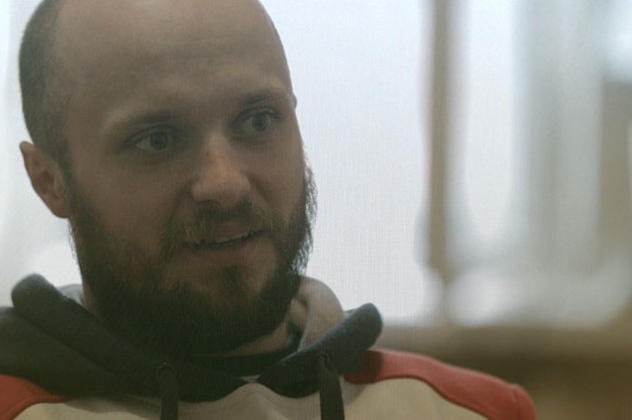
"I just checked on Wikipedia," Hryniv says, "what countries I can go to without [getting a] visa. And for me it was, as a Ukrainian, possible only to go to Ecuador or Malaysia." Easy access to the internet made Malaysia the right choice, and so he packed his bags and left.
While there, he worked in fits and starts at building a root-kit detector for a security software company. He rented an apartment, bought a motorcycle and, despite the language barrier, quickly made friends. It wasn't long before he was plugged into the Malaysian breakdancing culture.
"They invited me to a competition to be part of their crew," Hryniv says. On the horizon were the Malaysian championships, and the powerful Ukrainian gave his nimble team an advantage. They began practicing every day. "I was the only white breakdancer at [the] competition. The people supported me a lot. They screamed. It was really very beautiful. In one of my best battles I tried hard, was really good and took second place in [all of] Malaysia."
Months later he would return to Ukraine a self-taught international breakdancing champion, eyes open to all the possibilities available to him.
Dancing with Flash
When he returned to Lviv he knew that he didn't want an office job. A friend offered him a role as the technical lead on a team that was making a massively multiplayer online game for children called Chobots. Hryniv's team designed the entire back-end infrastructure, and he led them from his home in Lviv.
"It was kind of a new world for me," he says. "Just code, just servers and that's all. But during this project I realized that I can do something more. [Now] I had tasted it."
And just as he did with breakdancing, he threw himself head first into game development. At that time in Ukraine there was no real marketplace for games online. As this article is published, Xbox Live is still not available there. The lack of access makes selling games hard. Hryniv began hunting around online forums for advice.
"You can ask the same question in Cambodia," he says. "We [both] are Third World countries. And you know if we compare Ukraine to other countries of the former Soviet Union ... Belarussia, Kazakhstan, I think it's the same there. Some places it's even worse."
Flash games, because of their low system requirements, were an obvious entry point. Hryniv put aside as much money as he could from his work on Chobots and began a marathon of game development, turning out his first game in just one month and keeping up that pace for most of a year.
The goal was to attract as many players as possible in a free, browser-based open market. By collecting more players, he could charge more to put ads inside his games. If a game was good enough, perhaps a publisher would even want to buy it. His success depended on his games' popularity and little more.
"When I started to create games I had absolutely no skills in game design," Hryniv says. "Actually, it's similar to breakdance. When you start you just have to copy each other. ... You cannot invent something new from the start. It's just impossible. It's just how people learn."
The first game that Hryniv set out to create was a simple top-down shooter. What would make his game unique would be the lifelike physics that controlled the blood and gore. But as he played with the code, it became clear to him that he had accidentally created a physics engine similar to the one in a popular puzzle game, World of Goo.
Instead of adding that feature to his shooter, he gave into temptation and made a clone.
"It was a rip-off of World of Goo," he admits. "I was contacted by [Goo developer] 2D Boy and they asked me to put a banner inside the game: 'Inspired by World of Goo.' And I did. And I hope no one got harmed in any way. ... It could have been very different."
2D Boy could have raised a firestorm of controversy around Hryniv, driven its fanbase and even other developers to pillory him. But the restraint it showed toward him, however undeserved, was a powerful gesture in his eyes. It showed him how to treat other developers, other artists. It was how he would want to be treated. He would never so blatantly steal again, but it wouldn't stop him from iterating on the mechanics of his competitors.
"It was a rip-off of World of Goo. I hope no one got harmed in any way. It could have been very different."
"If you don't put anything personal into your game, yeah, it's bad," he says. "If you take just one game and copy it, yeah. It's not good. But, for example, if you take two different [styles of gameplay] ... and you mix it and everything works together, you will have a completely new product. And it will be 100 percent yours."
It was this technique of borrowing inspiration from multiple genres that would lead Hryniv to his breakout hit, Contre Jour.
"When I [began] it was like any other game that I created," Hryniv says. "But then I started to realize that it was something bigger. ... I decided not to leave it on Flash but to try to make it mobile."
A publisher called Chillingo, a subsidiary of Electronic Arts, believed in the concept and quickly signed him to a contract.
"They told me, 'Make the game! It's amazing and you have to put all you can into the game. You have to make it just perfect.'" Quickly he was connected with an artist, Mihai Tymoshenko, and a composer named David Ari Leon. But he never met them in person.

"I was alone," Hryniv says. "I had a contract [with Tymoshenko] for one month. I had no money left [to pay him for more]."
What Hryniv initially thought would be a three-month adventure in mobile game development turned into a nine-month ordeal. It stretched his finances to the breaking point, leading him to sell his motorcycle in order to put food in his refrigerator and keep the power on. Then, with the game ready for release, Chillingo delayed an additional two months to hit the right marketing window in the summer of 2011.
But in the end it was all worth it. Contre Jour is a physics-based puzzle game where players have only indirect control over the protagonist, an emotive one-eyed sphere. The game utilizes all of the input methods that mobile users had been trained for, including multi-touch. Casual gamers who had already spent dozens of hours with Angry Birds and Cut The Rope were ready for the puzzler's challenging level of difficulty, and a special high-definition version was a hit on Apple's newest tablet.
The reviews were glowing, and the awards started rolling in, including Apple's iPad Game of the Year. Traditional media outlets like Time Magazine even took notice, with Time including Contre Jour in its roundup of the 25 best iPad games of 2012.
Clear Black
It's not very expensive to live in a developing nation. If Hryniv had been living in the West, the profits from Contre Jour would have been a windfall, to be sure. But by the end of 2012 Hryniv had made enough money to retire in Lviv, one of the most expensive tourist destinations in all of Ukraine.
Explaining to friends and family how he had become wealthy was next to impossible, because no one he knew could actually buy his game; Apple's App Store wouldn't come to Ukraine until March of the following year.
But while casual gamers fell in love with Contre Jour, critics saw it as derivative. They said it borrowed its monochrome art style from popular platformer Limbo, that its physics model copied any of a number of popular games. Hryniv still bristles at the comparisons.
But instead of taking his money and moving on, he invested in his small studio, Mokus Games. He has surrounded himself with friends (friends who happen to be skilled artists) and designed his small company to create a new, unique game.
The working title is Clear Black.
"When I started to create Flash games it was totally different," Hryniv says. "When I started out I did one game in one month and released it. ... It was really high pressure, but it's how it is done in the Flash world. Everything was created from the first try.
"But now we create three prototypes, we decide which is better, we create a few styles of graphics and we decide which is better. We create a few music tracks. Each feature ... that we create we do a few iterations. And every iteration [of the game] becomes better and better."
But Hryniv still owes this latest project to his ability to write code quickly. "This new style of graphics, these shaders and these pixels ... it was done in seven minutes.
"If you are really good then you don't need to write a lot of code."
Mokus Games began work on a mashup of a rhythm game and a real-time strategy game. In the game, as units were created or destroyed, they would contribute a tone to the song being played. But the concept proved unwieldy, and after a few iterations Hryniv ordered the concept put on ice. Instead, Mokus Games would create a musical platformer.
Clear Black plays like a runner-type game, with the main character moving at a constant speed from left to right. It's up to the player to make their avatar jump and climb to avoid obstacles, and the soundtrack provides most of the cues.
"When you play it with the music it's much easier," Hryniv says. "Even I, the creator of the game, I fail if I do not listen to the music. Because you 'feel' the music, you can complete much harder levels.
"It's about a character that lives in a pixel world. He's starting to realize that it's possible that not everything could be created only with pixels, but it could be some different type of material."
For Hryniv, it will be a very personal story. "Actually I think my character will, during the game, feel the same emotions that I feel living in this world."
When levels are properly tuned, players should be able to beat them with their eyes closed. But the art style is so striking players would be foolish not to look. Large pixels with heavy borders form a mosaic on the screen. Images roll under the tiles as the action pans parallax against the background. It is like looking at the world reflected in the jeweled eyes of an insect.
Even Hryniv seems amazed by how beautiful it looks in motion. "It's something that you cannot find in any other game. Because there are a lot of games with pixel art, but you will not see this style of pixel art. It's totally new."
The design calls for 40 levels. That means 40 unique songs, and for that reason they've come to this recording studio on the outskirts of Lviv, to record a vocal track.
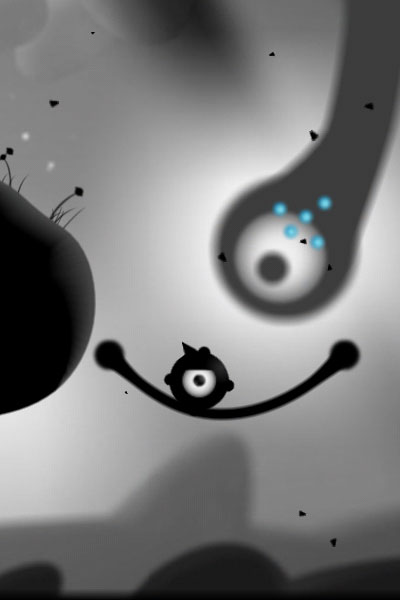
Contre Jour 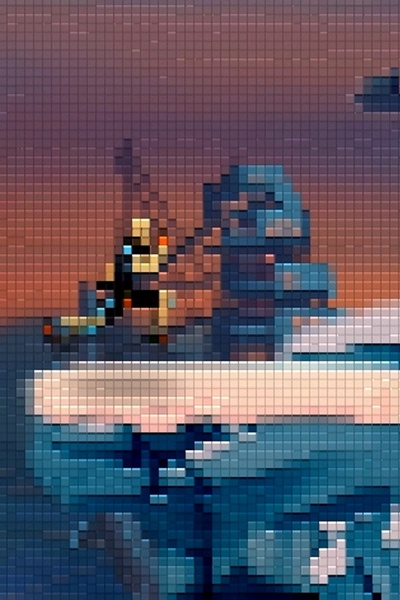
Clear Black
A single soul dwelling in two bodies
Clear Black was originally called Dubstep Run. It was a working title, but it shows the narrow perspective on music Mokus Games had going into the project. Now, with so many levels to fill, the team is considering different musical genres.
"It was actually not my idea to do vocals," Hryniv says. "I really thought it wouldn't work together. When we started I thought it should be club music ... some kind of aggressive music. But later, when we tried the piano, I see that some part of the game can be lyrical."
Up until now Hryniv has been used to working on games alone. It's taken him some time to find the right people to work with him. His composer, Igor Bryshlyak, he met through breakdancing.
"We were dancers, 'B-Boys,'" says Bryshlyak. "He was my teacher sometimes. Then we were just friends playing Xbox and PlayStation together. And then he hired me maybe five or six years ago as a tester."
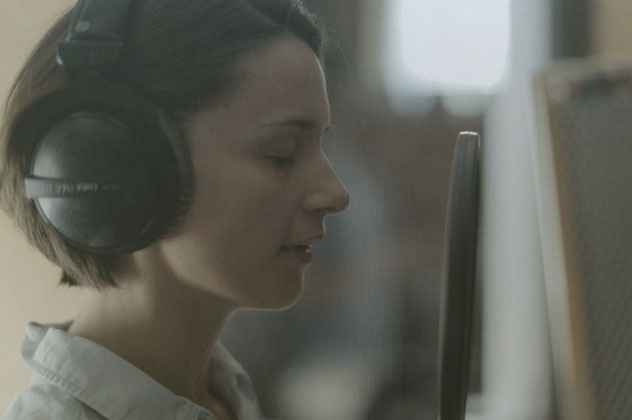
Composer Igor Bryshlyak's girlfriend, Katarina.
Hryniv sees in Bryshlyak a passion for music not unlike the passion he has for game design.
"I write the code," says Hryniv. "My artist [Andrew], he's my great friend. He draws the graphics. Igor, he's my great friend as well. He writes the music. And Katarina, she sings. And we are really good friends and we are making this together. And this is very important for me.
"You know, when you do something with your friends, you enjoy it. The main [reason] why I make games is because I enjoy it. And this way I enjoy it more."
No one knows if Clear Black will be a successful game. Hryniv has traded early retirement for another bite at the apple, and this time he's brought along more mouths to feed. But he's enjoying the process and taking it all in.
In the recording studio, Katarina begins a third take. Her lyrics are balanced on a microphone cable in front of her because her hands are shaking too much to hold the folded scrap of paper steady.
Her voice is growing stronger now, coming into the melody confidently.
This light is fading.
You won't see no more strangers outside the door.
I know you know
Nothing is holding us here.
And then there is no one other.
Through the door to the control room Hryniv is beaming, barely holding back tears. 
Video: Jimmy Shelton, Tom Connors
Editing: Russ Pitts, Matt Leone
Design / Layout: Matthew Sullivan, Warren Schultheis, Charlie Hall
Image credits: Mokus Games, Jimmy Shelton, Tom Connors, Charlie Hall
Music: David Ari Leon
firehoselol
Three days into Computex Taipei, the year's biggest computer show, not a single manufacturer has announced a Windows RT device. Windows RT, the version of Windows 8 designed for more power-efficient ARM processors, made its official debut at last year's show on a convertible tablet by Asus.
Windows RT has suffered a shaky period since its October launch, with disappointed comments from partners, fire sales from manufacturers, and unflattering performance comparisons all contributing to a general sense of negativity. The Computex show floor has been dominated by devices running Windows 8 on Haswell and various other processors from Intel, but ARM-powered units have been conspicuous by their absence.
Qualcomm has pledged support for RT 8.1
However, the upcoming Windows 8.1 update and its RT counterpart could provide a shot in the arm to the fledgling OS. Qualcomm has pledged support for RT 8.1 with its new Snapdragon 800 processor, which president and COO Steve Mollenkopf described in a presentation today as offering "about 75 percent better performance than the S4 Pro."
The Verge has heard that manufacturers may be holding back RT devices for Qualcomm's new chip and the 8.1 update, which is also designed to improve the experience on smaller-screened devices. Earlier in the week, Acer announced the first 8-inch Windows 8 device, the Iconia W3, which has not been designed specifically for the upcoming version of Microsoft's OS. Windows 8.1 will, however, be offered as a free upgrade to Windows 8 users.
firehoseyesss
The updated version of Spelunky that launched on Xbox Live Arcade last July will be released on Windows PC this summer, developer Mossmouth announced today.
It will be available first on Steam and GOG.com, and later on the Humble Store. The studio previously announced that ports of the XBLA version would be released this summer on PlayStation 3 and PlayStation Vita via PlayStation Network. Mossmouth's Derek Yu told Polygon during GDC that the PS3 and PS Vita ports would be handled by a different studio; we've reached out to the company to ask if the same is true for the upcoming PC version.
Spelunky was originally released on PC in September 2009; that version, which Mossmouth now refers to as Spelunky Classic, will remain free.
You can check out our glowing review of the XBLA version of Spelunky here, and read our extensive feature on the game's two-year journey from PC freeware to XBLA hit here.

Continue reading Ticket to Ride choo-choos onto Android
 Ticket to Ride choo-choos onto Android originally appeared on Joystiq on Wed, 05 Jun 2013 11:30:00 EST. Please see our terms for use of feeds.
firehose"vegetarians are also more likely to exercise, be married, smoke less and drink less alcohol"
STUDY CONFIRMS THESIS OF ROCK AND ROLL: LIVING LONGER IS UNCOOL, BORING

“Veg out! Another study finds vegetarians live longer than meat-eaters.” I saw that headline (and others) this week and I read: “Media misunderstand science (again).”
One of the most basic concepts in science is that correlation does not imply causation—even though it is sometimes highly suggestive of it. For example, in post-war Germany, as the stork population fell, so did the human birth rate. But as I was deeply troubled to learn, storks do not cause babies—rather, economic growth led to both destruction of stork habitat, and to declining fertility rates.
So it goes with vegetarianism and longevity. It’s absolutely true that vegetarians live longer (at least among Seventh Day Adventists, the target group of the study). In fact, in this study, vegetarians live six to nine years longer, which is a huge effect. But vegetarians are also more likely to exercise, be married, smoke less and drink less alcohol—all factors that also contribute to a longer life. The actual causal relationship between becoming vegetarian and living longer is unclear, and is certainly smaller than the correlation might seem to suggest.
Now, should you be vegetarian, or at least a meat-reducer? Absolutely. In the hidden confines of factory farms, animals live in conditions of suffering that no decent human being could sanction. Eating a single egg means that one hen was locked in a cage in darkness, barely able to move, for 24 hours. Was it worth it, in exchange for the cost of going free range, or even switching to porridge in the morning? It seems pretty difficult to justify.
But for those concerned with animal suffering, touting the health benefits of vegetarianism (as many veg advocacy organisations do) can not only be misleading, it risks being downright dangerous. By far the most likely culprit for the health costs of eating meat is red meat: rich in saturated fat and carnatine. But, in terms of animal suffering per calorie, red meat pales in comparison with chicken, eggs, and fish (where the animals live in far worse conditions, and where dramatically fewer calories are produced per animal). So if, by promoting the health benefits of meat reduction, consumers cut down on red meat and compensate with chicken, eggs and fish, then the veg advocate might have done more harm than good.
As with all areas of doing good, we need to use effective altruism: to think hard, and find good evidence to work out the consequences of our actions, and try to do the actions that do the most good—whether that’s doing the most good for animals, for humans, or for anything else. Some good-seeming actions can achieve very little, and some can even backfire. Promoting the health benefits of vegetarianism might be one.
Will blogs at effective-altruism.com. We welcome your comments at ideas@qz.com.











“I don’t say homosexuality is an abomination, Sir, the bible does.”
Read more of this story at Slashdot.

firehosechoose your own adventure beat
Jun 5th 2013 By: Matt D. Wilson

DC2, which will feature actions such as word balloons and sound effects popping up when readers swipe their screens, will debut in writer Jeff Parker and artist Jonathan Case's Batman '66 series later this summer. DC2 Multiverse, which enables readers to choose different paths through a comic story, will first appear in a Batman: Arkham Origins video game tie-in comic.
DC Co-Publisher Jim Lee told Variety that the DC2 Multiverse format is meant to mirror what video gaming is about: choices.
"When we're trying to attract different audiences and people who are into our characters and not necessarily into our comics, this is a way to get into it."
Lee didn't specifically compare the DC2 format to Marvel's Infinite Comics, but the concept seems to be basically the same. He did say it would remind readers of the classic Batman TV show, which was famous for its onomatopoeia graphics during fight scenes.
"What's cool is that you really get to challenge the rules of traditional storytelling," Lee told Wired. "You aren't beholden to a strict left to right western culture narrative. You can have elements that leap back and forth."

Cleveland, Ohio-based teen web developer Will Smidlein figured out how to post a full-length video on Vine, a video app that is built to max out videos at six seconds. He decided to bring back a popular meme, rickrolling, by using the 3-minute long video for Rick Astley’s “Never Gonna Give You Up.” He reports that the Vine has been taken down by Vine’s parent company Twitter.
I uploaded “Never Gonna Give You Up”, in it’s entirety, to Vine.Apparently it’s being fixed.
— Will Smidlein (@ws) June 3, 2013
And it got taken down.Oh well, it was fun being internet famous while it lasted. I’ll wait for them to patch then write a post-mortem.
— Will Smidlein (@ws) June 3, 2013
I truly feel awful for the engineers whose day I ruined with my stupid messing around.
— Will Smidlein (@ws) June 3, 2013
UPDATE:
Will tells his story in a post titled “I Think I Broke Something: The Story Of Rickrolling Vine“:
My site seems to be down (because I never assumed I’d gain any popularity this quickly), so here’s a mirror of the post I just wrote:
This afternoon, I was messing around with Vine, the app purchased by Twitter to make video sharing easy.
It’s become massively popular among my friends, so I figured I’d confuse them a bit by posting something longer than 6 seconds.
I tinkered around and soon found out how they were doing video uploads. A bit more tinkering later, and I was able to upload a file directly. I’ll get to the actual hack at a later date, once it’s patched.
So, I had this new power, and I wasn’t quite sure it would work. I threw the only video file I had encoded correctly up, and sure enough, it worked.
I had Rickroll’d Vine.
The tweet got a little bit of attention, but I later deleted it after a request from a friend of a friend at Twitter engineering. This was a courtesy thing more than anything else.
A few hours later, I went AFK for a few minutes, and had received congrats, kudos, and interview requests from personal heros and internet celebrities.
I was mortified.
I had just ruined some poor engineer’s day.
I did my best to stop it, but once something is on the internet, it’s there for good.
I appreciate all the support, but I also ask that you think of the dude who forgot a final check on his codebase before uploading, because I’ve been that guy. It sucks to have the whole internet laughing at your mistake, and I hate that I’ve done that.
Vine is a really well built concept, app, and service. They’ve scaled wonderfully, and I hope that people like me don’t discourage them to continue doing great things.
Thanks Paula!
firehosevia Toaster Strudel
firehosevia Kenny Vennard

Jamie lee Curtis asserting her dominance then enjoying a cool beverage
don’t ever talk that way about yogurt again or I swear to god…
firehoseMOUSE GUARD AUTOSHARRRRRE

I love when Mouse Guard creator David Petersen writes process posts, particularly when they involve the construction of models to help him draw mouse-sized rooms (or entire towns), and sewer tunnels ideal for a Teenage Mutant Ninja Turtle. His latest, for the cover of Mouse Guard: Legends of the Guard Vol. 2 #3, doesn’t feature any little papercraft houses, but it’s interesting nonetheless.
From reference material and initial sketches to inks and the finished illustration, the artist walks us through the creation of the cover, which features a trio of musicians “that could play so well, they’d call back the dead.” However, the execution proved a little complicated.
“The inks were a bit tricky because of the ghost effects,” he writes, “and at several times while inking I worried this cover wouldn’t work the way I was proceeding with it, but I just pushed through figuring I’d make sense of it all in color.” And it did, as you can see from the finished cover above.
Mouse Guard: Legends of the Guard Vol. 2 #3 arrives Aug. 28.

firehosefollowup; shared because Burger Time

While no video game will ever truly plumb the emotional depths of Burger Time (“Despair is an inconsiderate hot dog, blundering through the stacking of life’s burgers”—Rimbaud), European developer Mighty Box Games has made a noble effort with its new browser game loosely based on the music of Joy Division. As you may expect from a Joy Division game, Will Love Tear Us Apart? is somber stuff, its mission guided by “an ambition to frustrate, upset and sting the player into remembering the dark days preceding the death of a relationship.” As you might not expect from a Joy Division game, you can't advance to the next level by finally ditching Peter Hook in a warp zone.
Anyway, "frustrate" is right: The game is really more of an impressionistic, interactive art piece, with all of the action revolving around your confused, feckless direction of a couple as ...
Read more Read more of this story at Slashdot.

firehosePippin beat

A few years ago, I found myself in a flea market in downtown Montreal. Amid dusty furniture and faded French-Canadian comic books, I saw something that piqued my interest: a large black plastic box—a cross between a Nintendo 64 and something you might pull from the wreckage of a jetliner. Placed on top of it was a pair of sleek gray boomerang-style controllers and what appeared to be a modem. The device was simple and utilitarian, yet it had a hint of style. The colorful logo on the front of the device read “Pippin @WORLD.” What the hell was this thing?
A chain-smoking salesman seated nearby told me it was some kind of gaming system from Apple. It was mine if I had a hundred bucks. I contemplated snapping it up, but I figured it was unlikely to work—not to mention the fact that I’d have to ...
Read more Read more of this story at Slashdot.