Ping Pong Tube: WHOOOAAA slow down, future.
firehosevia Tadeu
firehoseL
O
L
prevents nothing, fucks the customer
Adobe's new cloud-integrated image editing app Photoshop CC has been pirated within a day of its release. Photoshop CC represents a big step away from standalone software for Adobe, and is only available through a monthly or annual subscription. As Fstoppers reports, Pirated copies of the software are being shared through BitTorrent, and don't require authentication with Adobe's servers. Photoshop CC was cracked in much the same way as previous versions of Photoshop, and the pirated software takes advantage of the software's offline mode, which only checks in with Adobe's servers once a month.
Any hopes that Photoshop CC would curb piracy were unfounded
Although Creative Cloud represents more than an anti-piracy move — Adobe is focused on providing cloud services like online storage, version backups, online publishing, and social integration through its subscription model — there were hopes that the shift away from standalone software would help stop piracy. Photoshop is considered to be one of the most pirated pieces of software, along with other popular desktop apps like Microsoft's Office suite. With Office 365, Microsoft is also transitioning to a subscription model, but it also offers a full version of all Office as a one-off purchase, as well as many individual apps. Perhaps because of that — or perhaps because Microsoft's security is more advanced — Office 365 hasn't fallen victim to pirates yet.
It's difficult to imagine that Adobe didn't know this was going to happen. From the timeframes involved, it doesn't seem that the company hasn't made a real attempt to improve its piracy protection. There are also a few caveats to bear in mind: users choosing to pirate the software won't be able to access many of Adobe's cloud features, which, aside from a few minor feature tweaks, are the main selling points of Photoshop CC. Ultimately, the company's goal of getting its paying customers locked into subscriptions isn't really affected by the software leak. Pirates will always find a way.

firehoseno
 |
rachel
shared this story
from  Shakesville. Shakesville.
|

If you know who these two puppets creatures are, then you might be kind of excited about this:
From October 1st, 2013 to December 31st, 2013, The Jim Henson Company and Grosset & Dunlap of the Penguin Young Readers Group will be accepting writing submissions to find the author for a new novel set in the world of Jim Henson’s The Dark Crystal. This author search is open to all professional and aspiring professional writers.
Tell me I'm not the only one who loved that movie beyond reason as a kid. (Even if I noticed a few flaws when I got older, okay, OKAY.)
So if the sequel isn't happening-- again! -- officially licensed novels sound pretty good to me. Good luck, writer-fans (especially feminist writer-fans)! I can't wait to see the results.
(Hat-tip to my cuz ACB.)

Mysterious package labeling on Flickr.
They’re dried medlars. But is that a translation of a brand name, or what?
firehosethe Spongebob shelf really would've made that scene pop
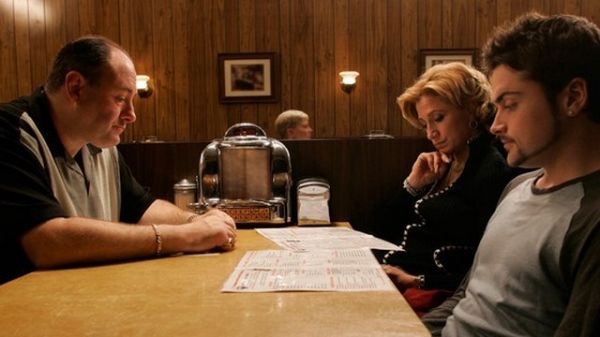
I’m tearing up (and I only ever watched like 2 episodes of The Sopranos)
James Gandolfini, the actor
who played Tony Soprano on The Sopranos, died yesterday. The famous final scene of the series was shot at Holsten's in Bloomfield, NJ. The diner honored Gandolfini by keeping his booth clear and ready.
Link -via The Hairpin
firehoseBobby Jindal will do or say anything to get elected beat
firehoseno new music only covers of GoT theme and Get Lucky
Black Simon & Garfunkel — Questlove and Captain Kirk Douglas of The Roots — perform a cover of Daft Punk’s “Get Lucky” on a recent episode of Late Night with Jimmy Fallon.
Louis C.K., Jim Gaffigan, and Aziz Ansari have all taken comedy specials straight to the web. Now John Hodgman is blazing a similar, but somewhat different path. His latest standup special straight, Ragnarok, is available online, exclusively from Netflix. In the hour-long film — which began streaming today — Hodgman takes the stage at Brooklyn's Bell House barefoot, with a pair of aviators on, and sporting a mustache that would make Magnum P.I. proud.
"How TV, film and comedy should and is going to be enjoyed"
Hodgman's new comedy special is a part of the Netflix's push to produce more original programing — such as the new season of Arrested Development, House of Cards, and Lilyhammer. The streaming service also recently signed an exclusive deal with DreamWorks to get more than 300 hours of original animated content into its offerings. In a blog post, Hodgman said "this is how TV, film, and comedy should and is going to be enjoyed: smart people curating great content in an ad free environment; artists cultivating their own audiences directly; and those audiences finding and enjoying the precise work they want on a schedule of their choosing." He also said the special would hit on the topics of such as mayonnaise, hockey instruction, and tips on raising sperm whales on your home survival compound.
The New York Times is slowly reducing the amount of content that nonsubscribers can see for free. The paper announced today that readers using the mobile website and apps will be able to access just three articles a day before being cut off, starting June 27th. Previously, mobile readers could access 10 to 15 articles a day from the paper's "Top News" section for free. Mobile readers still have a better deal than web readers, who are limited to 10 free articles a month.
The Times also announced a week-long free trial to boost sales of its apps. Digital subscriptions cost between $15 and $35 a month, a steep price compared to digital content services such as Netflix ($8 a month) and Pandora ($36 a year). The Times seems spendy even compared to The Wall Street Journal, which charges its well-heeled audience $22 a month for a digital-only subscription.
The Times' very public paywall experiment is being closely watched by publishers around the country, many of whom are considering similar plans to solve their own money woes. The paper's base of paywall subscribers is growing, although the pace recently slowed; pressuring mobile users to subscribe may reverse that trend.
firehoseChapter a million in why I stopped playing PFS
IQuarent,
I've talked to the GM who ran "Way of the Kirin" about your PC's death and I don't think he unfairly targeted you, nor do I think he has a personal vendetta against you. You decided to stay in the fight after being dropped to less than half hp in the surprise round. You could have backed out and healed yourself, or simply removed yourself from being the most obvious target for the next attack, but decided to remain and present your foes with a target they knew from experience could be hit. I don't believe you were the victim of bad GMing. I think you made a very risky tactical decision (given your current hit points and the proven ability of your foes to dish out at least as much damage as they had done before) and it went against you.
Luckily you had enough prestige to be resurrected so you get to learn from your decision and play this PC again, perhaps a bit more cautiously.
Also, in the future I would ask that you take up these kinds of issues with me in person or via email before taking them to the Paizo messageboards. Airing your criticisms of people you play with here can create bad feelings among your actual community who run games for you. Remember that there's a very good chance that your GMs read these posts as well, and they can tell from your posts which games (and people) you are talking about.

Companies that protect your privacy with software are seeing a big to their businesses following revelations that America’s internet giants have been turned into appendages of its surveillance state.
The companies don’t create products that are specifically designed to thwart NSA spying or government surveillance, but as Sarah Downey, privacy analyst for privacy software company Abine explained, “One thing that’s emerged [from the NSA leak] is that the social networks and data trackers are the source of the data supply chain. The private companies are collecting data and feeding the government with it. So if you want to stay more private, you have to limit the data that these companies gather about you.”
In other words, if you want to stay out of the NSA’s databases, you first have to stay out of the databases of marketers and companies—like Google and Facebook—that rely on advertising to fund their services.
Here are the numbers:
DoNotTrackMe, made by Abine, prevents private companies from tracking your activity across the web, which is the first step in aggregating that data for marketers. In the week after the NSA revelation, installations shot up 54% when compared to the week before. At its peak on Friday June 14, installations of the extension were up 98% compared to the previous Friday. Abine makes money by selling “premium” versions of its privacy products, including DeleteMe and (the forthcoming) MaskMe.
DuckDuckGo is big on not storing its users’ personal information, unlike Google, which uses that information to personalize search results. The site’s traffic has spiked since NSA leaker Snowden asserted that Google is feeding data to the US government. “By not storing any useful information, DuckDuckGo simply isn’t useful to these surveillance programs,” Gabriel Weinberg, founder of DuckDuckGo, recently told Silicon Angle.
FoxyProxy is an extension for the Firefox web browser that re-routes traffic through a “Virtual Private Network,” thus masking the location and identity of anyone using the extension. Bandwidth consumed by FoxyProxy users was up 48% in the week after the NSA leak.
All of these companies remain relatively obscure, despite their collective goal of making online privacy accessible to the masses. Which is either a testament to the complexity of protecting one’s privacy online, or evidence that most people simply don’t care about digital surveillance—or both.

every american i’ve talked to on skype asked about bagged milk so far
what the hell is bagged milk?
what
gUYS
IT’S JUST MILK
IN A BAG
WHY IS THIS SUCH A STRANGE CONCEPT
BECAUSE IF YOU OPEN IT, DOESN’T IT GO EVERYWHERE?
HOW DO YOU EVEN
#but.. can’t you open it like you open bagged water?
WHAT THE FUCK IS BAGGED WATER
WHY ARE YOU BAGGING DRINKS?

Canadian astronaut Chris Hadfield won the hearts of YouTube addicts the world over with his antics in zero gravity. Sadly, Hadfield has moved out of the International Space Station and back to Canada (although not without a farewell song), so who better for the role of zero-gravity superstar than Major Wang Yaping of China?
The 33-year-old astronaut and her two colleagues are on a short voyage on the Shenzhou 10 to the Tiangong 1 space lab, where she delivered a long lecture on Thursday aimed at 60 million Chinese schoolchildren. Like Hadfield, Wang used social media to connect with her younger audience, accepting questions via the Chinese micro-blogging service Weibo. Her approach was more serious than Hadfield’s, although the cross-legged zero-gravity aerobatics were entertaining. (And yes, David Bowie fans, she holds the rank of major according to Xinhua.)
The lecture got a positive if not ecstatic welcome from earthbound viewers. One Weibo user called Wang’s experiments with water “of great importance to mankind’s exploration of outer space.” That might be going a bit far, but for the most part people enjoyed the show. There were the inevitable grumblers, though—when the mission was launched last week, one micro-blogger wrote: “Why don’t they spend this money solving China’s real problems instead of wasting it like this?”—so it looks like Major Wang has a ways to go before she makes the grade.

firehose"I hope Microsoft is pulling a New Coke on us, announcing a shit console nobody wants, only to eventually announce the Xbox Classic and winning back everybody's hearts. Microsoft is making a console for itself. Not for gamers. Not for developers. Just for its own, greedy little Orwellian self. I'm not interested."
After the news hit of Microsoft's flip on their online and used game policies, I emailed Fish to see if he had changed his mind.
"Nah," he wrote, "I don't think it changes much for me. They didn't change anything about their anti-indie policies."
Phil Fish won't say a lot about Fez 2, the sequel to his widely acclaimed debut game. But he's pretty clear about one thing: Where it won't be showing up.
When I asked him this week what platforms he's considering for the sequel, this is what he had to say:
"Not Xbox."
That shouldn't come as a surprise to anyone who knows, or has been following along with Fish, Fez and its journey to the Xbox 360.
Shortly after the game's release in 2012, developer Polytron pushed a patch out to fix some bugs in the game. The patch, in turn, corrupted some save files. It was pulled by Microsoft. Faced with paying a second time for certification to fix the patch or just pushing it back up as is, Fish decided to leave it as is, saying that the recertification was too expensive.
"It's a shitty numbers game to be playing for sure," the developer wrote on his blog at the time, "but as a small independent, paying so much money for patches makes NO SENSE AT ALL." Polytron added that if Fez had been released on Valve's Steam service "the game would have been fixed two weeks after release, at no cost to us." In a follow-up tweet, Polytron wrote "HEY! only a few months left to our XBLA exclusivity!"

The relationship between Microsoft and Polytron never really recovered. And the Xbox One, so recently bathed in criticism about everything from the price to privacy concerns to its approach to used games, hasn't helped.
I asked Fish about his thoughts on the Xbox One earlier this week, hours before Microsoft announced their sudden policy change.
"I hope it's a joke," he told me in the email interview. "I hope Microsoft is pulling a New Coke on us, announcing a shit console nobody wants, only to eventually announce the Xbox Classic and winning back everybody's hearts. Microsoft is making a console for itself. Not for gamers. Not for developers. Just for its own, greedy little Orwellian self. I'm not interested."
After the news hit of Microsoft's flip on their online and used game policies, I emailed Fish to see if he had changed his mind.
"Nah," he wrote, "I don't think it changes much for me. They didn't change anything about their anti-indie policies."
On the other hand, Fish seems quite taken with the PlayStation 4.
"PS4 seems to be doing everything right," he wrote, when asked about the console. "It's too early to tell how everything is going to unfold but their heart definitely seems to be in the right place. Which is a weird thing to say when talking about giant monolithic corporation, but there's a handful of people working at Sony today who are really trying to do some good. And whether or not I would develop for it comes down to how the platform holder treats me. With Microsoft they've made it painfully clear they don't want my ilk on their platform. I can't even self-publish there. Whereas on PS4, I can. It's that simple. Microsoft won't let me develop for their console. But Sony will."
"One is having a big love-in orgy and the other is doing yet another fucking Minecraft port."
At E3 last week, Microsoft spent little time discussing indie titles while Sony brought indie developers and their games into their booth, setting them up along side AAA titles for the PlayStation 3, PlayStation Vita and PlayStation 4.
There is a stark difference between how the two companies approach indies, Fish said.
"One is having a big love-in orgy and the other is doing yet another fucking Minecraft port," he wrote.
The relationship both companies have with indies is becoming an important element of the lead up to launch. Ironically, this increased focus on indie developers and their games comes at a time when the very label may no longer serve a purpose, Fish said.
"I think it's starting to get more detrimental than anything else," he said of the value of identifying a game as an indie. "It served a purpose at some point, but I think we've outgrown the term. Games are games are games. I don't want people to judge my games based on team size or budget. That shouldn't matter to the player."
And this was the year that indies got their own E3 of sorts. Horizon, an indie-centric press conference put on during E3 by Venus Patrol and MOCAtv, was packed with news from indies, including Fez 2's announcement.
So what can Fish tell us now about his next game?
"It exits," he said, "and Rich Vreeland is doing the music. That's pretty much it."
Well, not exactly. When I ask him why he's making a sequel as opposed to an entirely new game, Fish had a bit more to say about Fez 2.
"It is an entirely new game!" he wrote. "FEZ 2 is to FEZ 1 what Zelda 2 was to Zelda 1, but more different.
"The biggest reason is that I just wanted to go back to that world. I want to expand on my little world and its mythology. It's not a case of wanting to recycle ideas we didn't get to put in FEZ I. Since the games are going to be so different, there's not a whole lot that could just carry over."
firehoseKyle Orland piles on
game journos sure do love a good pariah
At the end of 2012, we brought you our favorite charts of the year—the most significant trends, compelling data, and elegant visualizations, as picked by the Quartz staff. We’re a bit obsessed with charts here, and as 2013 nears its half-way point, we already have a growing list of favorites. Here they are:

This remarkable chart—from the Kleiner Perkins Caufield Byers “Internet Trends” presentation in late May—shows the shifting shares of global GDP over an unusually long timeframe. Europe’s dive over the past century is made clear, along with China’s sharp rise, and India’s middling progress. Perhaps surprising: China’s and India’s huge shares in 1820. And the American Century looks a lot less impressive in this context. —Kevin J. Delaney

The International Labor Organization made this chart (pdf) to compare “job quality,” measured by average wages, benefits, and hours worked, with job creation, between 2007 and 2011. Essentially, the place to be is in the top right quadrant (where countries are creating more and better jobs) and not the bottom left (where economies are creating fewer, worse jobs).
In most advanced economies, the new jobs being created are of lower quality, like the German “minijob”, with the exceptions of countries like South Korea, Norway, and Poland. The United States has fewer jobs, but is creating better ones—a finding that reflects growing inequality in the US. The emerging markets, on the other hand, are finding it easier to create more and better jobs because they’re starting from a low base. In other words, it’s easy to improve job quality in a country where most people make less than $10 a day; it’s much harder in a country where the median income is $50,000 per year. —Tim Fernholz

This chart shows how home prices in large US cities have really started gathering steam this year. The closely watched S&P/Case-Shiller 20-city index jumped 10.9% in March, the biggest change in seven years. —Matt Phillips

I love this chart because it illustrates a point that can’t be made often enough: Despite its dominant market share, Android remains a highly fragmented ecosystem. Most people with Android smartphones are using a version of the Android operating system (Gingerbread) that came out in 2010 and, frankly, isn’t that great. This is exactly the point Apple CEO Tim Cook was making when he flashed this slide at Apple’s World Wide Developers Conference earlier this month. —Christopher Mims

There are many things to love about this screenshot, published by the Guardian, from a US National Security Agency data-mining tool:
Like so much of what Snowden has leaked, the screenshot raises more questions than it answers. But there’s something brilliant and ultimately very informative about its rudimentary interface and oversimplified heatmap, teasing the troves of data contained within this thing they call Boundless Informant. At a glance, we see where the American surveillance machine has pointed its ears: Iran, Pakistan, Jordan, Egypt, India—and, with nearly the same intensity, the US itself. —Zachary M. Seward

The US has less than one-twentieth of the global population but accounts for over a fifth of world health-care spending. Africa’s entire foreign debt ($200 billion) is just half what the planet spends each year on prostitution. British data journalist David McCandless’s blog, Information is Beautiful, is a repository of simple and elegant data visualizations. He isn’t the first or only person to try to capture what all the money in the world does—if you want to be truly gobsmacked by numbers, look at this stunning giant chart from XKCD— but his Billion-Dollar-O-Gram, updated for 2013, is certainly one of the easiest ways to get a very quick and sudden sense of perspective on how much the big things in this world cost. —Gideon Lichfield

The discovery of dozens of planets by Kepler, a spacecraft designed specifically for that purpose, is difficult to grasp, let alone visualize. The best most of us can do is recall that sunset from Tatooine. That is why this interactive graphic from the New York Times is my pick for the favorite chart of the first half 2013. Though it doesn’t look like a traditional chart, it fulfills the primary function of one: to communicate a lot of complicated information in an easily understandable visual format. Its sparse design contains a wealth of information: size of stars in relation to our sun, star temperature, relative size of planets, velocity of orbit, and more. And it’s beautiful, too, which is a nice little bonus. —Leo Mirani

American household balance sheets have healed a lot since the financial crisis hit. The ensuing stock market collapse and housing implosion incinerated some $16 trillion in household wealth. In nominal terms, American households managed to claw all that money back by the first quarter of 2013. But that doesn’t mean households are back where they were before the crisis.
Because of population growth there are now more households, which means aggregate US household wealth is shared by more people. And because of inflation, a US dollar buys less in 2013 than it did in 2008. UBS economists, who created this chart, estimate that after adjusting for inflation and household growth, net worth per household is still down 10% from where it was in 2007. —Matt Phillips

When Edward Snowden leaked information about the existence of a large government surveillance program in the US, it brought the concept of metadata into the national spotlight. The NSA is collecting gobs of it, but a key question in the mind of the public is, what exactly can metadata reveal about you?
To provide a taste of metadata’s power, Kieran Healy, a sociologist at Duke University, used metadata from the past to identify Paul Revere as a central figure in a network of American revolutionaries in 1772. The chart itself (cropped in this screenshot) is nothing to put in a frame; but that Healy used relatively straightfoward math to pinpoint Revere three years before his legendary Midnight Ride is an unforgettable example of what metadata can show. —Ritchie King

China is the largest internet market in the world, with an estimated 564 million citizens online in 2012. This chart, another from the Kleiner Perkins “Internet Trends” report, shows how smartphones have quickly become the most popular method for connecting to the internet in China. The trend—and similar ones in other countries—helps explain the growth of phone makers like Apple and Samsung and the hard times for traditional PC makers. The chart also points to the continued growth potential for mobile commerce, communications, and services. —Kevin J. Delaney

We used a chart from the World Bank to illustrate the dropoff in foreign direct investment after Kenya’s violent and deadly elections in 2007. It’s not much to look at, but this chart speaks volumes about attitudes heading into the country’s elections earlier this year. After that staggering 87% drop in FDI, there was no way the Kenyan government or business would allow this election to be anything but peaceful. And so it was. Or so we were told. —S. Mitra Kalita

Especially in this era of anemic demand, talk often turns to global trade. Currency wars, the weakening yen, the fate of periphery euro zone economies, the Trans-Pacific Partnership, China’s GDP—all those thing swivel in some way on the concept. But its near-universal relevance also makes it blandly abstract. That’s why my favorite chart of late is David Yanofsky’s two-part exploration of the international bull semen trade for Quartz. And I say that not just because I want the challenge of avoiding raunchy punning for the next two sentences. The US-Iran trade chart neatly unravels all these little filaments of need—the ones that drive people to trade with each other regardless of who’s government is QE-bombing whose. David’s pink dots are an elegant reminder that ”global trade” isn’t just cars, crude and semi-conductors. It’s also cucumber seeds, toothbrushes, lentils and, yes, bull semen. —Gwynn Guilford

Europeans are quick to stereotype each other, as this survey in May from Pew Research found. Almost everyone agrees that Germans are the most trustworthy, least compassionate and most arrogant nation; in fact, Germans dominate the rankings in general, no doubt a sign of their outsize influence on the continent. Each country pats itself on the back for being the most compassionate, and Greece unsurprisingly gets low marks for trustworthiness. But my favorite finding: Italians consider themselves to be the least trustworthy, and the French reckon that when it comes to arrogance, nobody beats the French. How nice to have a little self-awareness. —Gideon Lichfield

Amid growing confidence in the US economic recovery as well as a sturdy rally in the stock market, gold prices collapsed in April. They’ve tried to get off the mat a couple of times, but no dice. —Matt Phillips

Businessweek showed the relationship between long-term unemployment and job openings. It reveals that the long-term unemployed in the US are still having trouble finding jobs even as the job market has improved to levels last seen in 2004. —David Yanofsky

My favorite chart is Quartz’s breakdown of how China’s traditional “bride price” system works today. In this reverse-dowry kind of scenario, men give cash (sometimes measured in weight), appliances, liquor, tea, and other gifts to their fiancees and future in-laws. It also gets at the concern in China that people have become too materialistic. The original version of the chart had gone viral on Chinese social media as people debated whether the bride price system was hurting young couples who have to save for years before they can marry. —Lily Kuo

I take the subway every morning, so I’m pretty familiar with how many different languages echo around New York City. But I wouldn’t have guessed that Portuguese and Japanese are two of the city’s predominant languages (at least on Twitter), or that more of its dwellers tweet in Korean than French, and Turkish than Arabic. And even if I had, I couldn’t have documented it as simply and beautifully as this. —Roberto A. Ferdman

|
rachel
shared this story
from  ThisIsWhyImBroke.com: ThisIsWhyImBroke.com:
|
| :) |

In the same way, it is entirely possible to go and visit an Upper Cretaceous Series deposit - such as the Hell Creek deposit where the Tyrannosaurus fossils were found - but it is naturally impossible to visit the Late Cretaceous Epoch as that is a period of time.


Read more of this story at Slashdot.

firehose"When people call Microsoft ‘evil', while I don't want to defend them, it's kind of an undeserved compliment," he said. "To be evil, you have to have vision, you have to have communication, execution... None of those are traits are things that I would ascribe to Microsoft Studios."
R
O
F
L
Skulls of the Shogun developer 17-Bit ran into several problems during the game initial publication — many of which the studio blames on launching alongside a handful of new Microsoft devices and services — but does not believe the company is "anti-indie," lead designer Borut Pfeifer told Rock Paper Shotgun.
17-Bit felt publishing through on Xbox Live Arcade and alongside the company's new Surface tablets, Windows 8 and Async multiplayer service would help their game become successful. Pfeifer said the team didn't get the hardware until "very late," and the certification process took longer than expected. Issues with the game on one platform would be fixed only to contradict processes running on another. Pfeifer also said that during development, the team had to take out a loan in order to keep working on the title, as Microsoft was late in paying them.
"To be fair, we knew we were kind of making a deal with the devil," said. "Probably one of our biggest mistakes was thinking in 2008 terms, where it's like ‘if you want to be on console you've got to be a console first', and that's just not true any more.
"We felt like we knew what we were getting into even though it would take a long time to negotiate," he added. "We had something that they wanted, so we thought we'd take advantage of that. It was a case where we were like, 'we know some things are going to be a problem but we think that on some level we'll get something out of them as well,' but I think it was an awful lot worse for us than others. We ran into problems that nobody else had got or talked about it."
Pfeifer said he doesn't think Microsoft is intentionally unfriendly towards indie developers, but calls them an "indifferent machine to it all."
"When people call Microsoft ‘evil', while I don't want to defend them, it's kind of an undeserved compliment," he said. "To be evil, you have to have vision, you have to have communication, execution... None of those are traits are things that I would ascribe to Microsoft Studios."
Microsoft Studios, Microsoft's video game publishing division, "came across as though they were institutionally incompetent" to 17-Bit, he said.
"I think they're not really set up to be a decent publisher," Pfeifer said. "I do feel slightly bad saying that, because there were people there who worked hard on our behalf, but at the same time there are systemic problems with the way that division is setup and run."
Polygon has reached out to Microsoft for comment on Pfeifer's statements and will share more details as we have it.