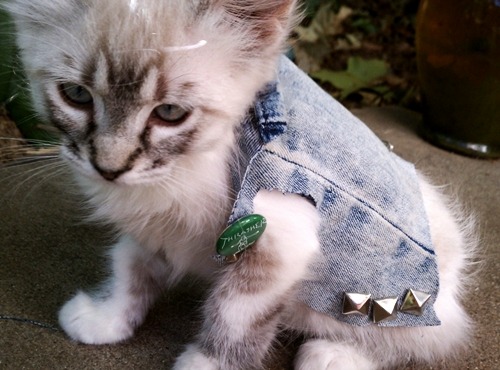


Kittens in punk rock jackets.

 Minecraft belongs in a museum, according to MoMA originally appeared on Joystiq on Fri, 28 Jun 2013 17:00:00 EST. Please see our terms for use of feeds.
firehosemeanwhile, in Portland

With these ridiculous Mercury staffers focused on making each other miserable with the Worst Night Ever series, I quietly snagged the gig of a fucking lifetime: covering the Oregon Humane Society Top Dog Model Finale.
That’s right.
MODELING.
DOGS.
DOG MODELS!
Here is one of them:
Hit the jump for blah blah blah DOG PICTURES!
This modeling show was a benefit for the OHS and was held at the Hotel Moncaco. I paid extra so my friend Jenny and I could get VIP seats and goodie bags. We were in the front row. I felt like one of the Olsen girls.
Apparently just anybody could have submitted pictures of their rescue dogs for consideration. I am sad that I did not know about this earlier because my dog genius would have cleaned up. Actually, he probably would have been the one to pee on the judges’ table and bark nonstop. I was really impressed by how well-behaved the dog models were. The fact that it was 10,000 degrees in the banquet room probably helped mellow everybody out.
Non-dog sidebar: The event was hosted by KPTV weatherman Andy Carson, a petite, manic blonde man who must be - sorry! - Wm. Steven Humphrey’s less funny, equally suggestive brother. He kicked it off with one of the best things I have ever heard: “LET’S GET IT ON WITH THE DOGS!” WHAT?! Okay.
Moving on: there were 10 small dog finalists and 10 big dog finalists. The smallest dog weighed was a chihuahua mix that weighed 6 lbs, and the biggest was a great dane named Henry who weighed 150 lbs. I wanted to put a saddle on him and have the little dogs ride him but I kept that to myself. Each dog got two walks: the first was regular dog walking, the second included tricks and costumes. One sucky thing about our seats, and where they had the judges, is that I ended up with a lot of pictures of dogs' buttholes.
During the intermission, some OHS staffers brought out a couple of dogs who were available for adoption. This is after two hours at a very warm event with a full bar and I cannot believe I did not take them both home. One of the dogs was even named MERCURY. LIKE THIS VERY PUBLICATION. He was so freaking cute. Hey, staff: get this dog! Make him the office dog. LOOK HOW CUTE. Jesus.
We all got to vote on our favorite little dog and our favorite big dog. I voted for Zelda, a pug, because I am a pug person, and Samson, a gentle golden retriever and cancer survivor.
The overall winners were Bobo, a little fluffy white thing with a huge fan club, and Marley, a shy labrador/mutt. But truly, we were all winners, because we got to pet a lot of dogs, and they were all really cute. It was a super fun evening and I am so glad that I was there.
My dog was also glad I went because my goodie bag contained several delicious treats and he liked them a lot. Watch out, fellow dog models, Oscar is going to be all over your asses next year.
DOGS!
firehosegreat
At the Idaho Correctional Institution, inmates' aural link to the outside world is called the Music Warden. For between one and two dollars a song, the black box will load music into a specially designed prison MP3 player, a small luxury that has replaced FM radios, tapes, or CDs from the prison store. Spin looks at just why two companies have decided that selling songs to prisoners could be big business, why cheap MP3 players could be making prisons safer, and what easier access to music means to the inmates themselves. "It gives me a different coping mechanism, just being able to be here with everyone else, but also not be here," says one inmate serving time for robbery. "Because it's my own music, it brings back memories of stuff that I like and gives me a little normalcy."

“It was easier telling my parents I was was gay…” –Nico Santos
Comedians Dave Waite and Grant Lyon have created the It Gets Worse Project as a way “to communicate why being a stand up comedian is simultaneously the best and worst job in the country.” They say it’s “meant as a parody of the popular and inspiring It Gets Better Project” but it “takes the opposite approach and describes the joy of a comedian’s first open mic and descent into the reality of crying alone in a Red Roof Inn after a terrible road gig.” All of the project’s videos can be found at the It Gets Worse YouTube channel.
Comedians submit themselves to constant abuse from audiences and their own inner demons, and yet they keep coming back, continually inspired to write new jokes and try new stages. They are either noble artists or complete idiots.
submitted via Laughing Squid Tips
firehosemeanwhile, in Portland
firehosevia Overbey
"The boisterous and drunken exchange of hospitality between sailors in extreme northern waters."
“The MitchiriNeko March” is an animated video featuring ridiculously adorable multi-color cartoon cats dancing, marching, and playing musical instruments. A MitchiriNeko is a cat-like creature that likes to crowd together, and the adorable Japanese creation also stars in MitchiriNeko Mix, a game for iOS and Android in which players synthesize existing MitchiriNeko to create new types of cat. The app is currently available to download from the iTunes App Store and Google Play, and Koukoupuffs has put together a useful guide for how to play since the game is only available in Japanese.

image via Koukoupuffs
via MetaFilter, Neatorama
firehose"In the absence of major exclusive features or strong social lock-in, if you make a feed reader today, it better support multiple sync services. Conversely, if you’re making a service, it better have an API for third-party clients."
A number of readers have asked me to clarify my tweet yesterday about NetNewsWire being “dead” to me, despite the recent 4.0 Mac beta. I have some complaints about the app itself, but they’re mostly irrelevant personal preferences. My statement was based on two other major concerns.
First, it’s simply too late. In three days, Google Reader will shut down and there will be no NetNewsWire client that syncs. The new Mac app is in an early beta, the new sync service is still in progress, and Black Pixel says they’re “revisiting the designs” for the iPhone and iPad clients, so we’re probably in for a pretty long wait for all three apps. This is a massive undertaking that appears to still be in its early stages. In the meantime, many NetNewsWire users — myself included — will switch to other apps, change our habits, and start building an affinity for something else.
That’s why I said it was “dead” to me: it will stop working for my purposes on Monday, it will be a long time before I can use it again, and when (if) that time comes, it may not be what I want to use.
My second concern is strategic, and it applies beyond just NetNewsWire.
In the wake of Google Reader’s demise, we now have many feed-sync services with public APIs, all of which are accumulating users and customers, including Feedly, Feedbin, FeedHQ, Feed Wrangler, Fever, NewsBlur, The Old Reader, BazQux, and probably one or two more that launched while I was writing this sentence and somehow already got added to Mr. Reader.
If your primary focus is traditional feed-reading (i.e. excluding browsing-centric, social-hybrid apps such as Flipboard), I believe launching a proprietary feed-sync solution in today’s environment is a huge strategic error.
A major strength of this multi-sync-service environment, as long as at least a couple of the services have widespread client support (which has already happened), is that users can pick and choose their favorite apps on different platforms. Google Reader gave us the same benefit: I was happily using NetNewsWire on Mac and Reeder on iOS for years, because I preferred NetNewsWire over Reeder on Mac and vice versa on iOS.
With multiple clients supporting the new sync services, we’ll retain most of the same luxury.
But if your app only syncs to your own service and nobody else’s, you’ve put up a massive barrier: for someone who likes feed-reading on multiple platforms, to switch to you, they’ll need to like your respective clients better than their existing choices on every platform they use.
It’s all or nothing. And the chance that someone will decide that you’re worth the “all” is far lower than the chance that they’d switch to just one of your apps that they like.
From Black Pixel’s vague public statements on sync, it appears likely that NetNewsWire will only sync with its own service.1 If so, they’re setting extremely high barriers: not only will customers face the all-or-nothing decision, but Black Pixel will need to ship three complete apps before any of them are very useful to people with all three devices. It’s extremely ambitious — probably too ambitious. If that’s their plan, I hope they’ll reconsider.
They’re not the only ones at risk of an overly ambitious strategy: many new services trying to replace Google Reader are taking the same gamble.
In the absence of major exclusive features or strong social lock-in, if you make a feed reader today, it better support multiple sync services. Conversely, if you’re making a service, it better have an API for third-party clients.
These strategies don’t apply in every market, of course. But the feed-reader market, with so many geeks and power users, is much more likely to own multiple devices, want native clients on each of them, and require syncing. Feed readers all do pretty much the same things and differentiate primarily on interface choices, so potential lock-in effects are minimal and the market appreciates client choice.
The post-Google-Reader market is already established as a multi-service environment, so the chances of any one company locking in another majority are (thankfully) low. If you try, you’ll be fighting an uphill battle.
Black Pixel declined to comment on their sync plans for this post. ↩
firehosevia saucie
firehosevia Tertiarymatt, via Wilson
Out of all the harrowing storylines in journalist Jeremy Scahill's new film Dirty Wars, the one about Abdulelah Haider Shaye best spotlights the U.S. government's new assault against press freedom.
Shaye is the Yemeni journalist who in 2009 exposed his government's coverup of a U.S. missile strike that, according to McClatchy’s newswire, ended up killing "dozens of civilians, including 14 women and 21 children." McClatchy notes that for the supposed crime of committing journalism, Shaye was sentenced to five years in prison following a trial that "was widely condemned as a sham" by watchdog groups and experts who noted that the prosecution did not "offer any substantive evidence to support [its] charges."
What, you might ask, does this have to do with the American government's attitude toward press freedom? That's where Scahill's movie comes in. As the film shows, when international pressure moved the Yemeni government to finally consider pardoning Shaye, President Obama personally intervened, using a phone call with Yemen's leader to halt the journalist's release.
Had this been an isolated incident, it might be easy to write off. But the president's move to criminalize the reporting of inconvenient facts is sadly emblematic of his administration's larger war against journalism. And, mind you, the word "war" is no overstatement.
As New York Times media correspondent David Carr put it: "If you add up the pulling of news organization phone records (The Associated Press), the tracking of individual reporters (Fox News), and the effort by the current administration to go after sources (seven instances and counting in which a government official has been criminally charged with leaking classified information to the news media), suggesting that there is a war on the press is less hyperbole than simple math."
In this unprecedented global war, President Obama has been backed by the combined power of Justice Department prosecutors, FBI surveillance agents, State Department diplomats and, perhaps most troubling of all, a cadre of high-profile Benedict Arnolds within the media itself.
One of them is Meet the Press host David Gregory, who, after saying journalist Glenn Greenwald "aided and abetted" NSA whistleblower Edward Snowden, demanded to know of the reporter: "Why shouldn’t you be charged with a crime?" On the same Meet the Press program, NBC's Chuck Todd didn't want to know whether the NSA's surveillance is illegal, but instead demanded to know "how much was (Greenwald) involved in the plot" to expose the NSA's potential crimes. They were subsequently followed up by New York Times business reporter Andrew Ross Sorkin, who, after years of writing hagiography that helped Wall Streeters avoid prosecution, called for Greenwald's arrest.
Not surprisingly, the result of all this is a culture of fear. As the CEO of the Associated Press recently said, there has been a "chilling effect on newsgathering" thanks to an assault which seems "tailor-made to comfort authoritarian regimes that want to suppress their own news media."
By definition, the consequences of that "chilling effect" will be difficult to see - stories never reported, facts never unearthed and whistles never blown. In cases like Shaye's, there will also be journalists not released from prison.
No doubt, the resulting news vacuum is exactly what the Obama administration wants. After all, even if the White House's version of events is wildly inaccurate, deliberately misleading or completely untrue, such a vacuum allows the official story to become the only story.
That kind of information monopoly is great for the president, and it is perfectly acceptable to the courtiers and glorified television actors in the Washington press corps who masquerade as real journalists. But it is quite the opposite for a world that desperately needs more independent reporting and assumption-challenging journalism, not less.
firehosevia Tertiarymatt: "Blixa autoshare"
Teho Teardo & Blixa Bargeld - Mi Scusi (video edit) (by Teho Teardo)
The other video from “Still Smiling”.
firehosevia Tertiarymatt: "Blixa autoshare."
Anteprima XL. Blixa Bargeld & Teho Teardo - “Alone With The Moon” (by videodrome-XL)
Blixa’s new project, record coming out soon.
firehosewe have reached this point

Instagram for Chrome is a Chrome extension that allows users to browse their Instagram feed, like and comment, and explore hashtags right in their browser. The extension also supports the newly-added video feature. Instagram for Chrome is currently available for download from the Chrome Web Store.
image via Instagram for Chrome
Thanks Shelby DeNike!
firehoseaaaaaaaaaaaaaaaaaaAAAAAAAAAAAAAAAAAAAA

It’s hard to deny the benefits of financial stability to a child’s upbringing. But new research suggests that the goals of pursuing wealth and raising a child are incongruous. Parents with more money and education derived less meaning from childrearing. It’s possible that people who find less purpose in parenting are drawn to higher paying jobs.
But here’s how some wealthy parents are trying to have it all: By using their children to achieve material satisfaction.
Conspicuous wealth plus parenting makes for adorable if not jarring fodder, a part of the trend Buzzfeed dubs “baby fashion blogs.” Earlier this week, New York Magazine featured Gucci-clad, iPad 2-wielding 5-year-old Alonso Mateo. He has become an Instagram sensation for his Kanye-style swagger and runway-sharp fashion. His mother, Luisa Fernanda Espinosa, acknowledges her unconventional situation:
“I think people usually judge right away,” Espinosa says, defending her choices. “When we go shopping, if he wants loafers just like his daddy and I can afford them, I get them. We’re fine raising our son. He’s always polite, he’s grounded, he’s a sweet boy.”
It’s one thing to dress your kid like his father, another to invite internet-stardom. Of course a generation that has professionalized parenthood would derive satisfaction from Junior’s ubiquity on social media.
Besides, it’s cute when children act like adults. What’s not cute is grownups’ more focused on raising their Klout scores than their own kids.
We welcome your comments at ideas@qz.com.


Satellite television provider DirecTV appears to have the leading bid for video streaming service Hulu, according to sources familiar with the sale process.
Other contenders include Guggenheim Digital Media and a joint bid from the Chernin Group and AT&T, the sources said. Final, binding offers for Hulu had been due today, but the deadline has been extended to Tuesday, in part to give DirecTV more time to assemble its acquisition package.
The competition for Hulu, which wasn’t able to fetch significant offers when it first went up for sale in 2011, demonstrates how various segments of the media industry suddenly see value in owning their own platforms. Hulu has about 4 million subscribers paying about $8 a month for a mix of movies, TV shows, and original content. It also offers some video for free.
Sources say DirecTV has an advantage because, as one of the largest multi-system operators (MSOs) in the United Sates, it’s already a major customer of Hulu’s owners—Disney, Comcast, and News Corp. DirecTV could use Hulu to diversify its offerings or even to create a cable service delivered entirely over the internet. It currently operates over satellite as well as the web.
But the Chernin Group, led by former News Corp. president Peter Chernin, and Guggenheim, headed up by former Yahoo interim CEO Ross Levinsohn, are seen as more entrepreneurial. That could help ease concerns about Hulu losing its innovative spirit and strong engineering team if it were sold to a corporate buyer like DirecTV.
Hulu owners are hoping to fetch a price in the $1 billion range and if they don’t get such offers, they may rethink a sale, sources said. But at least some of the bids are expected to hit that price range, sources said. Yahoo, Amazon, and private equity firm Silver Lake also considered separate bids for Hulu, but their interest has waned, sources say.
There’s also still a possibility that Hulu’s owners avoid an outright sale by bringing in another media company such as Time Warner Cable or Time Warner, through an investment. Some analysts have advised against selling. Part of the reason Hulu is on the block, though, is that its owners have disagreed over what strategy to pursue.
Hulu declined to comment.

Flood
We recently learned that there is an extensive collection of videos –music, extras, or otherwise– by They Might Be Giants are available to view on Vimeo.
Clap Your Hands
Don’t Let’s Start
via Jason Scott

Nokia’s ultra-low-cost handsets might not be as sexy as the latest iPhone or Samsung Galaxy. But they are a much-needed source of cash for the ailing Finnish company, as well as a staple of the telecom networks of the developing world. If you—like a good many of the people on earth—need a phone that’s water- and dust-resistant, can last a month on standby between charges, and only costs $20, Nokia’s new Nokia 105 is the way to go. And even at this price, reveal the industry analysts at IHS, Nokia is making money on the phone.
The total cost of the materials and manufacturing of the Nokia 105, estimates IHS, is $14.20. Throw in other unknown costs, like marketing, software, licensing, royalties and distribution, and Nokia might be making a mere $5 per handset, or less. Here’s the breakdown for the major parts, which doesn’t include assembly:
The Nokia 105 is almost identical in features to Nokia’s iconic 1100 cell phone, which included components that, eight years ago, cost at least three times as much as the ones in the new Nokia 105. In the meantime, Nokia has reduced the number of microchips in the 105 to three, from the six that were in the 1100. By keeping the phone’s features basically the same, the classic progression of technology means the same device at a much lower price—exactly what the developing world, and Nokia, needs.
Nokia remains the second largest mobile handset maker in the world by volume, and phones like the 105, which represent 90% of the company’s sales (the other 10% are true smartphones like the Nokia Lumia) are key to its strategy of getting “the next billion” onto Nokia-branded phones and, hopefully, keeping them there as they upgrade to smartphones. In some respects it’s a desperate gamble: In the first quarter of 2013, Nokia had a net loss of $357 million, following a staggering $1.2 billion loss in the last quarter of 2012. Even if the 105 is a runaway success, the margins on these phones are so low they can’t can stem the tide of red ink.

firehoseBrandon Bird beat

Star Trek‘s Captain Jean-Luc Picard drives a mean pizza-launchin’ machine while hunting down an enemy Borg in this latest drawing by Los Angeles-based artist Brandon Bird.
firehosevia saucie: "Kevin Allman is the editor of Gambit, an alternative weekly in New Orleans. He lived in Portland from 2005 to 2008."
bonus: "Reddit—another Advance Publications holding"
oblig. Portlandia, via the top comment: http://www.hulu.com/watch/448219#i1,p0,d1#i1,p0,d1

Bay Area Bike Share is a new bike share service coming to the San Francisco Bay Area in August 2013. The service will be operated by Alta Bicycle Share, the same company that runs Citi Bike in New York City. The service is launching as a pilot program with 700 bikes distributed amongst 5 communities—San Francisco, Redwood City, Mountain View, Palo Alto, and San Jose—with plans for to expand to other Bay Area cities in the future. Membership sales begin July 15, 2013.
Thanks Emily!

In a beautiful illustration of potential pitfalls in today's click-to-repost digital age, the editor (or vice president of content?) of the Oregonian has been working in the last day to stomp out a bit of misinformation from some heavily trafficked corners of the web: that he laid off his own wife.
Peter Bhatia has reached out to the New York Observer—which first misreported the tidbit and has appended a "clarification" that, really, should be a straight-up correction.
"This post is incorrect," Bhatia wrote yesterday, in the comments section below the piece. "I did not lay off my wife. I am editor of the paper and run the news operations. She is on the editorial page, separate from the news staff. Please remove this post."
Oregonian Managing Editor Therese Bottomly chimed in, too:
"Wow, how many things can someone get wrong in one short item?" she wrote, laying out a list of errors before closing with: "Did any reporting go into this? Remove this from your site. You're embarrassing yourself."
The post has been tweeted out at least 92 times.
The Huffington Post aggregated the Observer story, and has included a proper correction and the following statement from Bhatia, also submitted via the comments thread:
The Observer's post is wrong and I have asked for a retraction. I did not lay off my wife. She is on the staff here but I am the editor and supervise the news staff. She is on the editorial page staff, separate from the news staff. The report is wrong.
The AOL Jobs site also posted the tidbit. As of this morning it had not included a correction.
The confusion has its origins in Willamette Week's cover story this week about a round of harsh layoffs at the O that are accompanying the paper's move to a digital focus. The piece notes "Bhatia handled all but two of last week's newsroom layoffs himself," and then goes on to discuss possible metrics for the decisions.
After about 10 paragraphs, it says:
The layoffs included editorial writer and columnist David Sarasohn; home and garden reporter Bridget Otto, daughter of ex-publisher Stickel; and commentary editor Liz Dahl, Bhatia's wife.
Several of Bhatia's decisions struck many in the newsroom as heartless. Among them: He laid off a husband and wife, veteran editors Randy Cox and Joany Carlin, despite knowing Cox is fighting advanced kidney cancer.
It's true WW never explicitly states Bhatia made the call on firing his wife, but it's not hard to see how the New York Observer piece, written by (according to the website Linkedin) an intern, got there.
It's also, as one commenter notes on the WW site, "a delicious irony - you mean replacing professional reporters and editors with inexperienced, underpaid 'aggregators' of other people's work can result in factual errors? You don't say."
firehosevia Overbey
pitch perfect
After the heavy breathing from yesterday’s post, here’s a lighter touch on Prism.

The grande burritos at Gordito’s, a Mexican restaurant in Seattle, Washington, are so big that they have photographed them next to babies to prove it. Seattle Times reports that parents can bring in their under 1 year old kid to be compared next to their ginormous 4 lb. burrito and they will get a free one.

images via Foodbeast
firehosethey spend most of their time complaining that a third-party controller doesn't work right
Can a $99 console compete with the big boys?
The Ouya is finally upon us. Since its wildly successful Kickstarter campaign, the Android-powered console has had plenty of buzz and cautious optimism around it. But can it possibly stand up against the likes of Microsoft, Sony and Nintendo? Russ Frushtick and Chris Plante attempted to find that out in the first ever console-centric episode of Today I Played, covering everything from set-up, software and the glories of Towerfall.
firehosenope
Boston Restaurant Talk reports Griddler's Burger and Dogs and Union Square Donuts in Somerville are teaming up on a $6 "bronut:"
The dish will include a Griddler's burger patty that has a fried egg on top, with both being inside a sweet and salty maple-bacon glazed donut "bun" from the donut shop.


